

Public service internships are mainstays in contemporary political science curricula, helping students to connect their theoretical and conceptual understanding of the discipline to the applied professional arena. Abundant scholarship on teaching and learning underscores the numerous benefits of internships on students’ substantive knowledge, career development, and democratic citizenship (Collins, Knotts, and Schiff Reference Collins, Knotts and Schiff2012; Foley and Jordan Reference Foley and Jordan2024; Van Vechten, Gentry, and Berg Reference Van Vechten, Gentry and Berg2021).
However, there may be unseen and unanticipated consequences of these practicums. Political science interns often are on the frontlines of observing the firsthand trauma, stress, and mental health challenges that frequently accompany people who are seeking support and services from government. This may include legislative interns who are assisting impoverished constituents in securing food stamps, students who are helping survivors navigate an application for a personal protection order, and legal externs who are reviewing evidence in a murder trial. As such, students may experience secondary traumatic stress (STS), which is defined as the “stress resulting from helping or wanting to help a traumatized or suffering person” (Figley Reference Figley and Figley1995). Like other researchers, we refer interchangeably to STS as “secondary trauma,” “vicarious trauma,” “secondhand trauma,” and “empathy-based stress,” among other terms (Lipsky and Burk Reference Lipsky and Burk2009).
The discipline rightly has explored the traumatic effects from field research and data collection of human rights abuses, violence, and conflict on students’ and faculty members’ well-being (Eck and Cohen Reference Eck and Cohen2020; Gade and Wallace Reference Gade and Geoffrey2023; Hummel and El Kurd Reference Hummel and Kurd2021; Loyle and Simoni Reference Loyle and Simoni2017). However, it has yet to examine students’ indirect exposure to trauma via public service internships. We employed this phenomenological study of STS among students engaging in public service internships to address the current gap in political science teaching and learning scholarship.
The discipline rightly has explored the traumatic effects from field research and data collection of human rights abuses, violence, and conflict on students’ and faculty members’ well-being. However, it has yet to examine students’ indirect exposure to trauma via public service internships.
To assess the frequency and intensity of STS exposure among political science interns, we administered surveys to 146 undergraduate and graduate students enrolled in internship courses from two public universities. We asked them about their knowledge of, exposure to, and potential symptoms of vicarious trauma, as well as how often they practiced self-care. In addition, halfway through the academic semester, we required students to watch a 25-minute video lecture about STS, its effects, and strategies to cope with or mitigate such empathy-based stress. Students then penned a journal reflection documenting their qualitative exposure to secondary trauma during their internship and their proposed action plan to deal with resultant stress and feelings of helplessness.
We found that political science interns experience STS during their practicums. Although priming effects cannot be ruled out entirely, qualitative responses and quantitative analyses of survey data indicated that, controlling for individual characteristics and internship type, the interns’ STS exposure increased by an average of 14.6 percentage points during the semester. Notably, women, older students, and those with a history of primary trauma were more likely to report STS subjection. Nevertheless, the adage “knowledge is power” holds in this context. Students who reported higher levels of STS also were more likely to implement action plans (i.e., 36.9 percentage points) by outlining coping strategies after watching the mid-semester video lecture. Our findings emphasize the need for political science departments and internship coordinators to educate students about the risk of STS and to provide resources to foster resilience and coping mechanisms. Future political science pedagogical research should explore the short- and long-term impacts of STS on students’ core competency development and professional growth.
We found that political science interns experience STS during their practicums. Although priming effects cannot be ruled out entirely, qualitative responses and quantitative analyses of survey data indicated that, controlling for individual characteristics and internship type, the interns’ STS exposure increased by an average of 14.6 percentage points during the semester.
SECONDARY TRAUMA IN HELPING PROFESSIONS
Political scientists recently highlighted the potential trauma that both students and scholars may be exposed to in the classroom (Zartner Reference Zartner2019), through political violence data coding (Gade and Wallace Reference Gade and Geoffrey2023), and during fieldwork research involving survivors of human rights violations (Eck and Cohen Reference Eck and Cohen2020; Hummel and El Kurd Reference Hummel and Kurd2021; Loyle and Simoni Reference Loyle and Simoni2017). Nevertheless, our discipline’s research is limited in documenting the existence and effects of trauma on students during these experiential-learning endeavors, including public service internships.
STS arises from one-time or repeated exposure to assisting or desiring to assist individuals who have directly experienced trauma and have shared their traumatic experiences with the person serving them (Figley Reference Figley and Figley1995; Lipsky and Burk Reference Lipsky and Burk2009). STS involves distress and emotional disruption from observing, learning about, or listening to narratives of survivors of primary trauma (Figley Reference Figley and Figley1995; Lipsky and Burk Reference Lipsky and Burk2009). STS can trigger both psychological and physiological responses, including elevated blood pressure, hypertension, cardiovascular disease, and an increased risk of stroke, among other effects (Lipsky and Burk Reference Lipsky and Burk2009). STS also may produce emotional dysregulation, self-doubt, impaired decision making, porous boundaries, relationship difficulties, physical ailments, disconnection from surroundings, and a diminished sense of meaning and hope (Pearlman and McKay Reference Pearlman and McKay2008). Failure to recognize and manage secondary trauma can lead to lower job satisfaction, emotional and physical strain, burnout, compassion fatigue, and moral distress, which ultimately jeopardize career longevity (Figley Reference Figley and Figley1995; Lipsky and Burk Reference Lipsky and Burk2009).
Researchers have documented the prevalence and consequences of STS among human service professionals, including therapists and mental healthcare providers (Hesse Reference Hesse2002), nurses and physicians (Boitet et al. Reference Boitet, Meese, Hays, Gorman, Sweeney and Rogers2023), immigration attorneys and judges (Harris and Mellinger Reference Harris and Mellinger2021; Lustig et al. Reference Lustig, Delucchi, Tennakoon, Marks and Slavin2008), and higher-education student-affairs professionals (Lynch Reference Lynch2023). Additionally, scholars have identified secondary trauma among students through their educational and training experiences, such as social work students in practicums (Cunningham Reference Cunningham2004; Harr and Moore Reference Harr and Moore2011; Rinfrette et al. Reference Rinfrette, Rine, Pugh, Zaleski, Araque and Hedges2021); law students during externships (Bakhshi, Wesley, and Reddy Reference Bakhshi, Wesley and Reddy2021); criminal justice interns (Hilinski-Rosick, Branch, and Walker Reference Hilinski-Rosick, Branch and Walker2022); and psychology students in both classroom and clinical settings (Simiola et al. Reference Simiola, Smothers, Thompson and Cook2018; Zurbriggen Reference Zurbriggen2011). Political science increasingly encourages departments to integrate internship opportunities into their curriculum to enhance students’ substantive knowledge and civic values (Foley and Jordan Reference Foley and Jordan2024; Van Vechten, Gentry, and Berg Reference Van Vechten, Gentry and Berg2021). However, there is limited understanding of how these interns encounter and manage secondary trauma.
Secondary Trauma In Public Service Internships
Interns often become voyeuristic onlookers to people’s trauma. Whether these interactions are one-time or frequent, this spillover trauma can affect student well-being. Helping hurt people also may harm interns.Footnote 1 This exposure to secondary trauma may motivate interns to further engagement or debilitate them in unexpected ways. Students experiencing STS may have difficulty sleeping, endure disturbing dreams, or become less active. Others might disengage socially, struggle to concentrate, or become more fearful and forgetful. Some may feel easily annoyed, discouraged, or disillusioned, whereas others might develop grandiose thoughts about their work or try to numb their feelings through excessive media consumption, smoking, or drinking (Lipsky and Burk Reference Lipsky and Burk2009). These varied reactions reflect the impact of the trauma that student interns have experienced (Bakhshi, Wesley, and Reddy Reference Bakhshi, Wesley and Reddy2021; Harr and Moore Reference Harr and Moore2011; Hilinski-Rosick, Branch, and Walker Reference Hilinski-Rosick, Branch and Walker2022; Simiola et al. Reference Simiola, Smothers, Thompson and Cook2018). Prolonged exposure to stress can impair a person’s ability to regulate emotions and lead to significant mental health issues (Lipsky and Burk Reference Lipsky and Burk2009).
Whereas all interns can experience STS, vulnerability to it is likely heterogeneous. Drawing on previous research, we hypothesized that interns with a history of primary trauma may be more susceptible to secondary trauma (Cunningham Reference Cunningham2004; Guarino and Chagnon Reference Guarino and Chagnon2018; Pearlman and McKay Reference Pearlman and McKay2008). Vicarious trauma experienced during the internship may compound the effects of personal trauma, further impacting their ability to process it. This may include individuals from marginalized groups with intergenerational trauma and historical discrimination (Williams, Thompson, and Hora Reference Williams, Thompson and Hora2020). Tosone, Nuttman-Shwartz, and Stephens (Reference Tosone, Nuttman-Shwartz and Stephens2012) noted that “collective catastrophic events” can affect both victims and helpers, particularly when they belong to the same community, creating “shared trauma.” However, evidence suggests that experiencing and acknowledging primary trauma may foster coping mechanisms that enhance resilience to STS (Méndez-Fernández et al. Reference Méndez-Fernández, Aguiar-Fernández, Lombardero-Posada, Murcia-Álvarez and González-Fernández2022). This raises the possibility that individuals from historically marginalized groups may have developed greater resilience to STS in some cases (Siller and Aydin Reference Siller and Aydin2022).
Research reveals that women report higher levels of burnout and stress associated with STS (Bakhshi, Wesley, and Reddy Reference Bakhshi, Wesley and Reddy2021; Guarino and Chagnon Reference Guarino and Chagnon2018). Accordingly, we expected female students to exhibit higher rates of STS incidence. Prior experience (or lack thereof) also may influence interns’ vulnerability to STS, either mitigating or exacerbating its effects. Research suggests that novices often lack adequate coping strategies and the power to address beneficiaries’ needs, making early professionals more susceptible to STS (Cunningham Reference Cunningham2004; Guarino and Chagnon Reference Guarino and Chagnon2018; Lynch Reference Lynch2023). Conversely, other studies highlight that greater workload and prolonged exposure may increase vulnerability (Levin et al. Reference Levin, Albert, Besser, Smith, Zelenski, Rosenkranz and Neria2011). We did not make any a priori assumptions but instead assessed interns’ prior experience using multiple variables: age, completion of a previous internship, average weekly hours (logged) at the internship, and first-generation college-student status. Younger students, first-time interns, those working fewer hours, and first-generation college students may be more vulnerable due to limited experience. Alternatively, older students, those with multiple internships, individuals working longer hours, and students with college-educated parents may report higher STS levels, reflecting the cumulative effects of vicarious trauma over time.
Finally, the type of internship also may matter. Due to the distressing nature of the cases and high workload exposure, students in legal and legislative placements—in which they deal with first-person accounts most often—may be particularly susceptible to STS (Levin et al. Reference Levin, Albert, Besser, Smith, Zelenski, Rosenkranz and Neria2011; Zurbriggen Reference Zurbriggen2011). Beyond these variables, we also controlled for students’ residency status (i.e., in-state, out-of-state, or international) and whether their internship was paid.
INCIDENCE AND IMPACT OF SECONDARY TRAUMA ON INTERNS
To determine the incidence and impact of secondary trauma on public service interns, we administered pre- and post-surveys to 146 political science undergraduate and master of public policy students at two public universities in the Midwest: Michigan State University and Western Michigan University.Footnote 2 This sample leveraged variation in internship type, student academic status, degree program, demographics, and higher-education institution. Our approach improved on past studies (Harr and Moore Reference Harr and Moore2011) by leveraging critical variation, moving beyond single-institution, posttest-only surveys of interns in similar field placements. We adapted survey questions from Bride et al. (Reference Bride, Robinson, Yegidis and Figley2004), who developed the STS scale, and Guarino and Chagnon’s (Reference Guarino and Chagnon2018) guide for helping schools mitigate trauma in students.
Among survey respondents, most were juniors or seniors, with an average age of 21 and a mean GPA of 3.67 (Jordan, Jordan, and Foley Reference Jordan, Jordan and Foley2025). Additionally, almost 40% identified as racial/ethnic minorities, more than 60% as female, and more than 25% as first-generation college students; more than half received financial aid. Furthermore, 44% of students obtained paid internships, working a median of 18 hours per week.Footnote 3
Our pre-questionnaire assessed students’ prior knowledge of secondary trauma, their anticipated trauma during internships, self-care practices, incidence of primary trauma, and demographic characteristics. Mid-semester, students watched a 25-minute video lecture on secondary traumaFootnote 4 and its potential effects, symptoms, and coping strategies, and then wrote a journal entry on their experiences and mitigation plans. The post-survey reassessed their STS knowledge, STS exposure, self-care practices, and implementation of provided strategies.
In the pre-survey, respondents indicated limited awareness of having heard the term “secondary trauma,” averaging 0.41 on a “No” (0), “Maybe” (0.5), or “Yes” (1) scale. By the end of their internship, following the video lecture, familiarity significantly increased to 0.82 on a more refined five-point scale from “Not at all familiar” (0) to “Extremely familiar” (1). Regarding STS exposure, 23.3% reported experiencing it during a prior internship or at the beginning of their current praxis. By the end of the semester, this percentage had increased to 38.4%, a statistically significant (p = 0.003, α = 0.05) and substantively important increase.
We documented students’ experiences with STS symptoms by asking 17 questions, encompassing issues including emotional numbness, anxiety, sleep disturbances, hypervigilance, avoidance, irritability, and memory lapses.Footnote 5 By the end of the semester, interns reported increases in 10 of these 17 symptoms; three attained statistical significance at conventional levels: intrusive thoughts about their work outside of intended moments; distress triggered by reminders of their work; and reexperiencing trauma encountered by their clients, constituents, or customers. These results are presented in online appendix figure A1.
In their mid-semester journal entries, students shared qualitative insights about their internship experiences and exposure to vicarious trauma. Online appendix table A2 presents excerpts from these responses, highlighting the variety of internships that political science students undertake and illustrating the emotional, psychological, and physical impacts that they encounter when assisting individuals in distress. Students recounted fielding calls from parents whose children were detained overseas, assisting constituents facing food and housing insecurity, representing accused rapists, listening to victim-impact statements in court, engaging with grieving voters during campaign canvassing, addressing urgent requests for unemployment benefits, and processing cases involving the sexual exploitation of minors. Many students described feeling stressed, powerless, numb, or depressed because of these encounters, with several indicating that these experiences prompted them to reconsider their career aspirations.
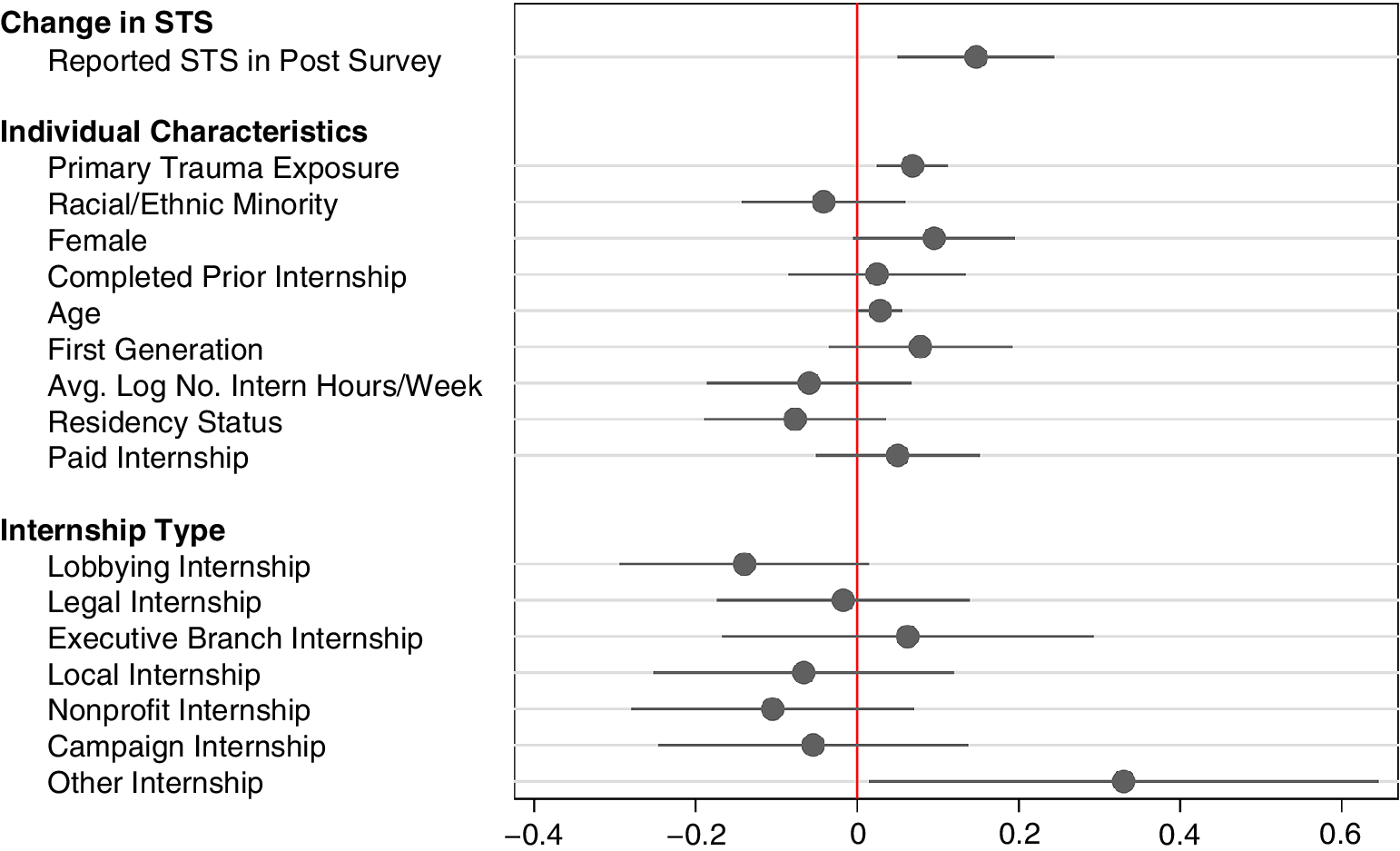
In addition to these narratives, we empirically measured interns’ STS exposure using a random-effects model for panel data. This approach enabled us to account for key time-invariant demographic and contextual variables.Footnote 6 The dependent variable measured students’ self-reported experience of secondary trauma on a scale of “No Exposure” (0), “Maybe Exposure” (0.5), or “Yes Exposure” (1).Footnote 7 Drawing on previous research about STS predictors, we included several independent variables in the model: respondents’ self-reported level of primary trauma exposure (scale from 1 “None” to 5 “Extensive”), racial/ethnic minority status, gender, prior internship experience, age, first-generation college-student status, average logged number of hours worked per week, residency status (i.e., in-state, out-of-state, or international), whether the internship was paid, and type of internship placement. Figure 1 illustrates the coefficient plot for the key covariates. Detailed model results are presented in online appendix table A3.
Political Science Interns’ STS Exposure
Random-effects linear regression model for panel data. The dependent variable is exposure to secondary trauma on 0 (“No”), 0.5 (“Maybe”), or 1 (“Yes”) scale. Robust standard errors clustered on individual IDs. Point estimates are displayed with 95% two-tail confidence intervals. Estimates for which confidence intervals do not cross the red zero line are statistically significant at the α=0.05 level. The omitted category for internship type is legislative internships.

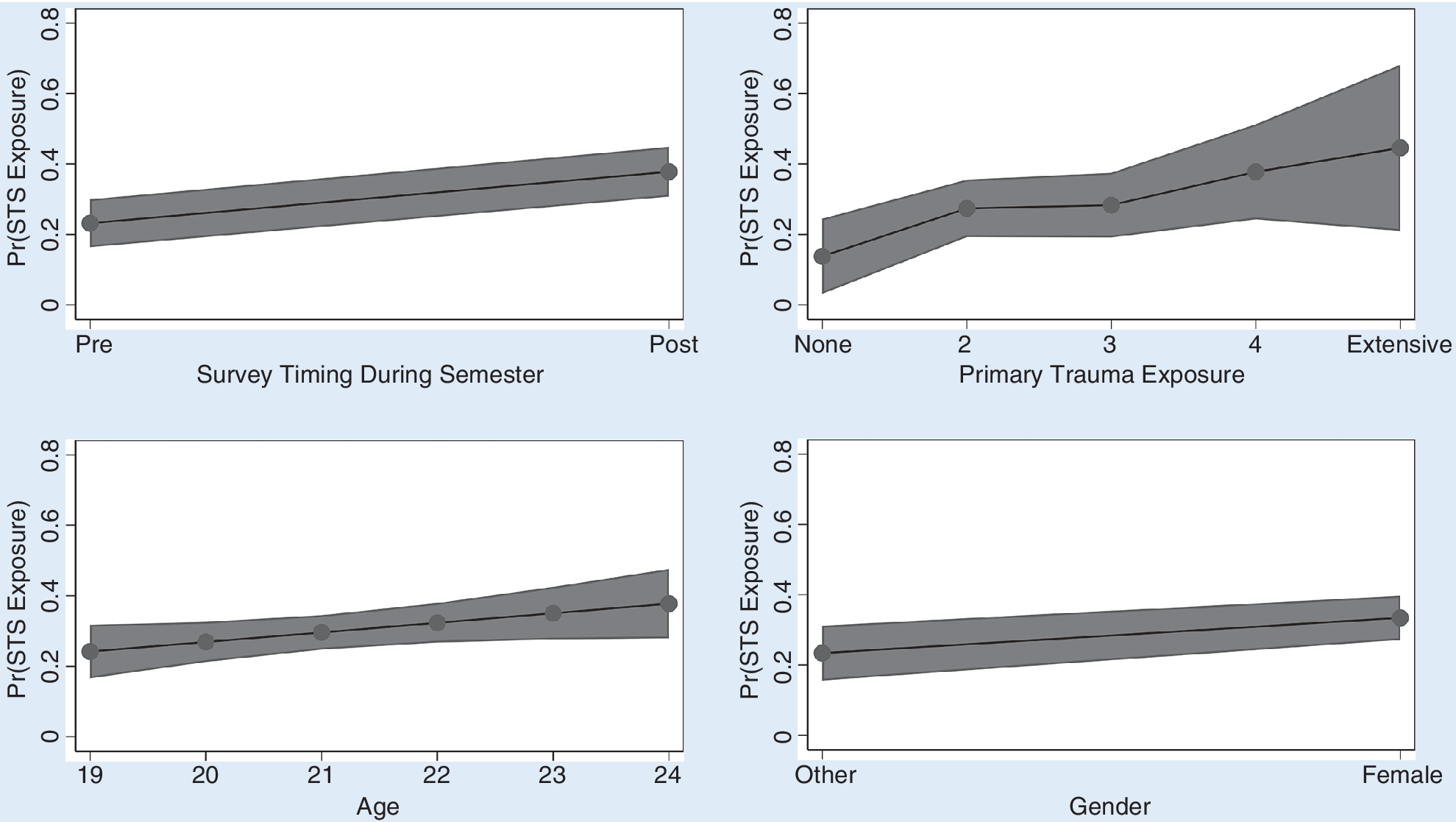
Students reported a substantial increase in vicarious trauma by the end of the semester. Accounting for variables at their observed values, the average marginal increase in STS exposure was 14.6 percentage points. Students with a history of primary trauma were more likely to report secondary trauma: the marginal effect showed a 30.8-percentage-point increase in STS incidence when comparing students with no primary trauma to those with extensive trauma. Older and female students also reported higher STS rates. Specifically, holding other factors constant, increasing a student’s age from 19 (fifth percentile) to 24 (95th percentile) resulted in a 13.6 percentage point increase in STS exposure. One possible explanation is that older students entered their internship with higher levels of STS exposure due to their previous praxis experiences, which potentially highlighted the cumulative impact of STS over time. Women students reported STS exposure that was 10 percentage points higher than non-female students, although this narrowly missed statistical significance (α = 0.05). Figure 2 presents the predictive margins of these four key variables.
Predictive Margins of Key Variables on Secondary Trauma Exposure
The dependent variable represents respondents’ self-reported exposure to secondary trauma on a 0 (“No Exposure”), 0.5 (“Maybe”), or 1 (“STS Exposure”) scale. 95% two-tail confidence intervals.

Variables such as racial/ethnic minority status, prior internship experience, weekly internship hours logged, first-generation college-student status, enrollment type, and whether the internship was paid did not indicate statistically distinguishable associations with STS exposure. It is curious that internship type had a minimal effect on STS hazard. Students in lobbying internships were slightly less likely to report secondhand trauma compared to those in legislative internships (i.e., the omitted reference category and the modal category), whereas students in “other” placements were more likely to report STS.Footnote 8 This suggests that regardless of internship type, political science students regularly engage with traumatized individuals and experience empathy-based trauma as a result. Collectively, these findings are generally consistent with previous studies (Bakhshi, Wesley, and Reddy Reference Bakhshi, Wesley and Reddy2021; Levin et al. Reference Levin, Albert, Besser, Smith, Zelenski, Rosenkranz and Neria2011; Lynch Reference Lynch2023; Pearlman and McKay Reference Pearlman and McKay2008).
An important caveat is that we cannot rule out entirely the priming effects from the pretest or intervention (Kim and Willson Reference Kim and Willson2010). Ideally, a randomized design with control and treatment groups would address this concern. However, ethical and fairness considerations prevented us from withholding information about STS and coping strategies from some students or delaying its delivery until the end of the semester because all interns may have encountered this trauma. Nevertheless, three design elements mitigated the priming risks. First, meta-analyses suggest minimal priming in interventions assessing attitudinal rather than cognitive changes (Kim and Willson Reference Kim and Willson2010). Second, priming effects diminish when pretests, interventions, and posttests are spaced more than a month apart (Kim and Willson Reference Kim and Willson2010). Third, interventions clarify concepts, reducing reliance on subjective interpretation (Hopkins and King Reference Hopkins and King2010). Our design aligned with these criteria by capturing the interns’ self-assessed STS exposure, implementing a six-week gap between assessments and intervention, and ensuring clear definitions of STS. Nevertheless, a robustness check adjusting for pretest effects yielded similar results (see the online appendix “Evaluating Pre-Test Priming Effect”).
INTERNALIZATION OF SECONDARY TRAUMA
Students can enhance their professional resilience and capacity to make a meaningful difference in others’ lives by prioritizing their well-being and implementing strategies to manage secondary trauma. Failure to address STS can lead to disengagement, destructive numbing behavior, social isolation, anger, burnout, and other negative outcomes, which ultimately compromises the trust and reliance placed on them by those they serve (Lipsky and Burk Reference Lipsky and Burk2009).
To assess whether students’ internship experiences affected their self-care routines or habits, we also asked a battery of 25 questions regarding their physical, psychological, emotional, and workplace self-care on the pre- and post-surveys. These included questions about their physical health (e.g., eating regularly, exercising, and getting enough sleep), mental health (e.g., seeking therapy, practicing mindfulness, and engaging in creative activities), and social connections (e.g., building peer-support networks, spending time outdoors, and maintaining relationships). These habits collectively aim to promote resilience, reduce stress, and enhance well-being among students who are experiencing STS.
Except for a decline in the physical self-care category in the post-survey, students’ self-care habits showed minimal change during the semester; however, none of these shifts were statistically significant. This decline may stem from increased STS exposure or typical end-of-semester stress. The only psychological self-care metric with a significant increase was students’ efforts to actively reduce stress: from 2.78 to 3.03 on a five-point scale from “Never” to “Very Often.” Interns also reported improvements in two workplace self-care indicators: “Identifying with projects or tasks that are exciting, growth-promoting, and rewarding” (3.81 to 4.03), and “How often do you take time to chat with coworkers?” (3.82 to 4.02); however, the second indicator narrowly missed statistical significance (α = 0.05). Online appendix figures A2–A5 present the full results. Limited changes in student self-care may suggest that STS had a minimal short-term impact or that students effectively employed the coping strategies introduced in the video lecture and outlined in their action plans.
Coping Strategies for Secondary Trauma
To help students mitigate and cope with STS, the Awareness–Balance–Connection (ABC) framework provides a holistic approach (Saakvitne and Pearlman Reference Saakvitne and Pearlman1996). Awareness encourages recognition of stress triggers and behavioral changes, such as avoidance or numbing behaviors (e.g., excessive social media use and smoking). Balance emphasizes setting boundaries between work and personal life, prioritizing self-care, and maintaining personal well-being. Connection highlights fostering supportive relationships with supervisors, faculty members, peers, and family members for emotional support and combating isolation. The ABC framework does not prevent these emotions but instead helps students to manage them by increasing self-awareness, establishing healthy boundaries, and nurturing supportive connections to ensure long-term success in their government, legal, and public policy careers. These strategies are not “one-size-fits-all”; students should reflect on their stress triggers and plan accordingly.
Most students followed the video lecture’s guidance to create an action plan. Those who experienced higher levels of STS developed plans at higher rates, with a one-unit increase in STS incidence correlating with a 36.9 percentage-point increase in action-plan creation. Racial and ethnic minorities were 15.2 percentage points more likely, and students in nontraditional internships also were more likely, to create an action plan. Online appendix table A5 presents the full results.
Journal responses indicated that students were adopting an action plan involving physical activity (e.g., exercise, walking, and yoga) to alleviate stress. Many sought professional and social support, engaging with therapists, supervisors, family, and friends for emotional guidance and connection. Mindfulness practices such as journaling, meditation, and breathing exercises also were commonly used to center themselves, and hobbies and creative outlets provided productive distractions. Students also highlighted the importance of setting boundaries between work and personal life to maintain a healthy work–life balance through self-care and leisure.
CONSIDERATIONS AND CONCLUSION
This study underscores the incidence of STS among political science interns, revealing significant risks to their psychological, physical, and emotional well-being. Quantitative and qualitative evidence reveals a striking pattern: public service interns across diverse placements reported notable STS exposure, even in part-time roles during a 15-week semester. Although priming and intervention effects are possible, our design minimizes these risks. All interns are vulnerable; however, students with a history of primary trauma, older students, and women are particularly susceptible to higher levels of STS exposure.
Faculty members who are overseeing experiential-learning programs must recognize STS and proactively integrate strategies and curricular components to mitigate its effects. By thoroughly understanding the psychological, physical, and emotional toll of these stressors, faculty members can foster a more supportive experiential-learning environment that equips students to navigate the complexities of early professional experiences. A key goal of higher education is to prepare students for an enduring, impactful career in public service. Providing tools to navigate STS can mitigate burnout and reduce attrition in the field.
With the goal of fostering a “sustainable practice of trauma stewardship” (Lipsky and Burk Reference Lipsky and Burk2009, 16) in students, we encourage internship coordinators to normalize discussions of STS and to equip them with coping strategies. Providing a clear understanding of STS, including its definition, symptoms, and management strategies, can empower students to recognize and address these challenges (Cunningham Reference Cunningham2004; Hummel and El Kurd Reference Hummel and Kurd2021; Zartner Reference Zartner2019). Faculty members and supervisors must offer consistent support, validate students’ emotional experiences, help set realistic professional expectations, and introduce flexibility in tackling responsibilities to prevent overload (Williams, Thompson, and Hora Reference Williams, Thompson and Hora2020).
To help students manage STS and thrive, faculty members can promote self-care and resilience by introducing them to the ABC framework: Awareness of stress triggers, Balance through boundaries and restorative practices, and Connection with supportive relationships (Saakvitne and Pearlman Reference Saakvitne and Pearlman1996; Williams, Thompson, and Hora Reference Williams, Thompson and Hora2020). These practices contribute to a supportive and sustainable approach to experiential learning, benefiting both students and the broader discipline. Faculty members also should partner with campus mental health providers to provide resources and counseling for STS to attend to students’ well-being needs.
To help students manage STS and thrive, faculty members can promote self-care and resilience by introducing them to the ABC framework: Awareness of stress triggers, Balance through boundaries and restorative practices, and Connection with supportive relationships.
In conclusion, addressing STS in experiential learning requires educating students, providing faculty support, and ensuring access to mental health resources. By developing a curriculum that supports students through difficult experiences, faculty members can help them navigate internship demands while fostering the skills, resilience, and emotional readiness essential for both academic and professional success. Moreover, future pedagogical research should investigate the nuanced impacts of STS on political science students, examining both the immediate effects during short-term internships and the long-term implications for their career trajectory. Well-being is not a luxury; it is a necessity.
SUPPLEMENTARY MATERIAL
To view supplementary material for this article, please visit http://doi.org/10.1017/S104909652510142X.
ACKNOWLEDGMENTS
We thank participants at the Michigan Political Science Association’s Annual Conference, October 17–18, 2024, for their insightful questions and valuable feedback. Any errors remain our own.
DATA AVAILABILITY STATEMENT
Research documentation and data that support the findings of this study are openly available at the PS: Political Science & Politics Harvard Dataverse at https://doi.org/10.7910/DVN/GWC8I8.
CONFLICTS OF INTEREST
The authors declare that there are no ethical issues or conflicts of interest in this research.


 Open access

