


DISCUSSION POINTS
-
• What is an acceptable disposal route for intermediate level liquid waste? Some nations simply cement their alkaline ILW from the production of the radiopharmaceutical Mo-99 as a means for long-term storage while a major focus for ANSTO Synroc has been to construct a first of a kind industrial scale plant for immobilizing its ILW from Mo-99 for disposal. For conservatism at ANSTO we adopt HLW waste acceptance criteria for the ILW waste form.
-
• The world has been producing spent nuclear fuel for >50 years and we continue to ask ourselves if there is a better and safer route for the disposal of spent nuclear fuel. A tailored Synroc waste form for spent fuel would offer significant advantages over the straight spent fuel disposal option being considered and would readily meet HLW standards of aqueous durability and waste loading.
-
• HEU and Pu disposal is complicated by the necessity to provide a resistance to HEU or Pu extraction. Synroc-type waste forms stand superior in terms of a chemical resistance to proliferation, however without an internationally recognized method for assessment of nonproliferation for a waste form how can one ever assure sufficient immunity to proliferation concerns?
Introduction
It is accepted internationally that the immobilization of high and intermediate-level nuclear waste requires the production of a durable matrix containing the waste which is then to be disposed in a geological repository. Reference Ringwood, Kesson, Reeve, Levins, Ramm, Lutze and Ewing1 Several technical reviews of Synroc have been given over the years, Reference Ringwood, Kesson, Reeve, Levins, Ramm, Lutze and Ewing1–Reference Gregg and Vance6 with the most recent one being in early 2017. Reference Gregg and Vance6 Though describing early technical work on Synroc, the present paper focusses more on current applications of the Synroc technology platform which now embraces hot isostatic pressing (HIP) of ceramic, glass–ceramic, and glass nuclear waste forms.
While the nuclear power industry has had its ups and downs over the years it is now generally agreed that nuclear power can be an important contributor to the world’s energy mix, particularly in relation to climate change. Having said this it is incumbent on all industries to be able to sustainably deal with associated operational waste. Nuclear waste disposition thus became an important issue with the development of nuclear power from the 1940s onwards. Early work considered immobilization in clay but the US AEC saw glass as a vehicle to contain the wide range of fission products and actinides in nuclear fuel reprocessing waste and in the 1960s demonstrated such incorporation at pilot plant scale with actual reprocessing waste. This type of waste, along with spent nuclear power plant fuel, is designated as high-level waste (HLW). However in the 1970s workers at Pennsylvania State University (PSU) argued that glass was thermodynamically unstable with respect to crystallization and that the use of synthetic minerals would be advantageous because the actual minerals could demonstrate stability over millions of years in hot, wet conditions characteristic of a deep geological repository for the waste. Reference McCarthy7,Reference McCarthy, White and Pfoertsch8 First laboratory-scale attempts at PSU produced “supercalcine” in which the fission products and actinides were incorporated in the structures of a sintered composite ceramic consisting of silicate and phosphate minerals, notably nepheline (NaAlSiO4), apatite (Ca5(PO4)3(OH,F,0.5SO4)), monazite (REPO4, RE = rare earth element), feldspar (BaAl2Si2O8), and others. Reference McCarthy7–Reference Vance9 While this phase assemblage yielded satisfactory leach results, the waste loading of around 70 wt% would have yielded prohibitive amounts of radiogenic heat and it was not amenable to dilution with combinations of alumina, silica, and phosphate. Reference Ringwood, Kesson, Ware, Hibberson and Major10 But it was an excellent and significant start.
Synroc work from the late 1970s to the present decade
In 1978, Ringwood produced at laboratory scale, hot-pressed composite ceramics targeted toward nuclear fuel reprocessing waste. The variety of waste ions present (e.g., actinides, rare earths, and other fission products) in this HLW meant that a multiphase approach was required to treat the waste. These ceramic formulations were composed of the synthetic titanate minerals perovskite, zirconolite, hollandite, and rutile (see Table 1), and these were far superior in terms of aqueous durability (Table 2) to the supercalcine or borosilicate glass. Reference Ringwood, Kesson, Ware, Hibberson and Major10,Reference Ringwood, Kesson, Ware and Northrup11 Moreover these were virtually 100% dense with a very fine grain size which would inhibit microcracking from long-term radiation damage of the perovskite and zirconolite phases which would incorporate the actinides. The resultant lattice expansion in these phases arising mainly from α-recoil ions over thousands of years would induce microstrains relative to the hollandite and rutile phases which would incorporate only very small amounts of actinides and the smaller the grain size, the less tendency for microcracking.
Composition and mineralogy of Synroc-C (20 wt% PW-4b reprocessing waste loading). Reference Ringwood, Kesson, Reeve, Levins, Ramm, Lutze and Ewing1

a RE, An = rare earths and actinides respectively.
Seven-day MCC-1 leach results at 90 °C in deionised water for different elements in Synroc-C. Reference Ringwood, Kesson, Reeve, Levins, Ramm, Lutze and Ewing1

a RE, An = rare earths and actinides respectively.
b g/m2/day.
In 1981, a question arose as to the future disposition of HLW at the Savannah River Site. This HLW consisted of Al-rich and Fe-rich streams and the predominant success criterion was the best demonstrated advanced processing technology. Approximately 70 candidate waste forms were submitted for consideration and a Synroc variant 12,Reference Hoenig, Otto and Campbell13 was deemed the number two choice behind borosilicate glass, citing lack of technical maturity and lower tolerance to waste composition variations. The Synroc variants consisted of nepheline, (with and without minor hollandite), spinel, perovskite, and zirconolite. The addition of hollandite improved the leachability of the Cs which was originally targeted toward nepheline but would probably have formed Cs aluminosilicates instead on ionic size grounds.
The development and demonstration of the synroc process continued through the 1980s with the establishment of a conceptual plant at ANSTO (then the Australian Atomic Energy Commission) to develop the processing technology. This plant produced 100–150 kg batches of inactive Synroc (∼10 kg/h). Waste form consolidation by hot uniaxial pressing was originally adopted at the backend of the plant and the resulting ∼50 kg monoliths provided leaching and microstructural properties as good as those of gram-sized laboratory samples.
Since the US decision in 1981 to progress with glass for their HLW, the focus for Synroc development at ANSTO changed toward waste forms for different types of actinide (notably plutonium), high- and intermediate level wastes, with particular emphasis on wastes which are problematic for glass matrices or existing vitrification process technologies. In the 1990s a Synroc variant was developed at ANSTO in conjunction with the Lawrence Livermore and Savannah River Laboratories for immobilization of surplus impure Pu in the US and Russia. The impurities consisted of different amounts of elements from various chemical groups so while the key phase for the nearly pure PuO2 was the pyrochlore-structured (Ca, Gd) (U, Pu, Hf) Ti2O7 phase, Reference Vance, Jostsons, Moricca, Stewart, Day, Begg, Hambley, Hart, Ebbinghaus, Marra and Chandler14–Reference Cochran, Dunlop, Edmunds, MacLean and Gould16 other minor titanate phases were present in the waste form to deal with the impurities in the Pu streams. The waste loading of Pu was limited to 10 wt% for proliferation reasons and a further 20 wt% of U was also added. Uranium incorporation was partly a requirement because U accompanied the Pu in the waste and partly because the daughter product of 239Pu, which is 235U, was also a long-term criticality risk should it separate from the neutron absorbers and concentrate in a particular locality within a repository. As such, additional 238U was incorporated as an isotopic diluent of 235U and hence to reduce criticality concerns. Also, there was concern that if leaching took place, a Pu-rich zone might form in the far-field environment, so the neutron absorbers Gd and Hf were added as the leach rates of Gd and Hf were fairly similar to those of the Pu. In fact durability studies using a wide range of leaching conditions demonstrated that there was no major separation of the Pu and the neutron absorbers, with the majority of these elements either remaining in the matrix or leaching at low (<10−4 g/m2/d) Reference Ringwood, Kesson, Reeve, Levins, Ramm, Lutze and Ewing1 and comparable rates from the waste form. A further benefit of the addition of the neutron absorbers is that these would suppress neutron emission from (α, n) reactions and thus would minimize the dose to waste form production workers. While HIP was successfully demonstrated with this ceramic waste form composition, the reference process was simply sintering to form pucks, noting that the surplus Pu would not contain significant proportions of volatile fission products. These pucks were to be placed inside a Defense Waste Processing Facility (DWPF) glass canister and surrounded with HLW glass as a gamma shield to inhibit diversion. Reference Cochran, Dunlop, Edmunds, MacLean and Gould16
The Synroc ceramic was chosen ahead of a lanthanide borosilicate (LaBS) glass for many reasons such as the long-term durability of the ceramic phases (10–1000 times more chemically durable than glass over a range of test conditions) Reference Macfarlane17 and its criticality safety both during processing and within the repository, however there were two significant factors favoring the ceramic; (i) its factor of ∼7 lower neutron dose to workers [LaBS glass contained boron which underwent (α, n) reactions] and (ii) its greater resistance to proliferation (LaBS glass offers less resistance to extraction of the incorporated Pu).
Although the ceramic was at the time selected over borosilicate glass, Reference Cochran, Dunlop, Edmunds, MacLean and Gould16 this major project never progressed as the political climate changed in the early 2000s and it was argued that the development of a MOX plant in the US was a better solution for the relatively pure portion of the plutonium inventory. However, progress on this endeavor has been slow and the MOX plant may be suspended. The disposition of Pu also has political and socio–economic requirements with major issues including generating public acceptance of the route chosen as well as political and public policy issues associated with the long times considered for containment and disposal (>106 years). The UK are facing similar technical, political, and socio–economic challenges as they also currently have a commitment to manage over 100 tonnes of surplus PuO2 this century (see below). 18
In the early 2000s and over a period of ∼10 years the Synroc process and terminology started to change from titanate ceramics to the design and preparation of broader classes and types of waste forms including the titanate ceramics of Ringwood Reference Ringwood, Kesson, Reeve, Levins, Ramm, Lutze and Ewing1 plus glass–ceramic and even glass waste forms where there was a distinct advantage in using HIPing rather than vitrification. Thus Synroc evolved toward a technology platform using HIPing rather than a specific multiphase titanate ceramic class of waste form. Of course the properties (such as durability) depend on the class of waste form rather than the production method and as such HIPed glasses have properties characteristic of vitrified materials rather than titanate ceramics. The HIPed glass–ceramics combine advantageous properties of both glasses and ceramics. The HIP process, invented by the Battelle company in the US in the 1950s, has been used since the 1960s in preparing nuclear fuel for submarines, and has been validated at INEL as a credible (and advantageous) method of consolidating radioactive ceramic waste forms. Moreover the method is widely used in industry for preparing inactive ceramics as well as metal-ceramic alloys.
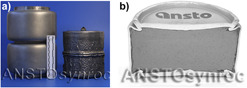
In HIP of ceramics or glass–ceramics the reactive calcined waste form (waste + additives) is the starting material. Calcination removes the chances of any significant gas evolution during the subsequent hot consolidation step which occurs with the material packed in the HIP can. The calcine is first packed inside a metal can. This is then evacuated, and in some cases heated to 200–600 °C for several hours, to remove gases absorbed during brief exposures to humid air, sealed, and then consolidated to full density by compressing it with several tens of MPa of argon gas during the heating cycle. The final consolidation is carried out at typically temperatures of 1000–1300 °C, the heat is applied from outside the can and typically pressures of up to 100 MPa are applied. Figure 1 shows the steps involved in HIPing. Figure 2(a) shows the stainless steel HIP cans before and after consolidation, and Fig. 2(b) shows a diametrally cut section of a HIPed can.
Process flow diagram showing the steps involved during the HIP process.

The HIP cans (a) before (left) and after (right) HIPing and (b) the cross-section of a HIP can showing the consolidated waste form.

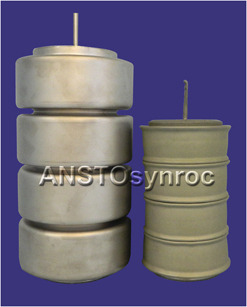
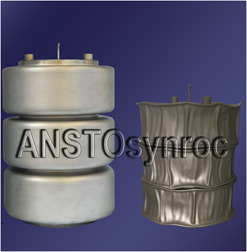
The process inherently is a batch approach but cans containing more than ∼100 kg are feasible. The final shape of the cans post HIPing varies depending on multiple parameters such as canister design type (e.g., straight walled or dumbbell), wasteform type, packing density within the canisters and the onset of pressure as a function of temperature. Understanding the interdependencies between these variables is desired when tailoring the collapse/final shape around constraints such as packing optimization, transportation, and final storage post HIPing. The dumbbell shape of the can offers a great deal of flexibility in terms of tailored aspect ratio variations but it is advantageous to maximize the density of the calcined powder in the can to avoid undue rippling and large deviations from the desired cylindrical geometry of the HIPed can. Collapse to a predictable and uniform right cylinder is important to minimize storage volume in the final repository. Optimization of all the key parameters will result in the desired cylindrical shape post HIPing as is shown in Fig. 3.
Four convolution dumbbell styled canister pre (left) and post (right) HIPing. The HIPed can is 0.16 m in diameter.

A significant advantage of HIP processing is the relatively small footprint of the HIP equipment, arising in the first instance because of the absence of off-gas in the hot-consolidation step. Moreover the main services/process components of the HIP equipment can be located outside a shielded hot cell. In addition the radioactive waste to be processed is located inside a sealed can with no direct contact with the HIP process equipment, so the HIP does not experience significant radioactive contamination. A further advantage of HIP processing is its flexibility in that it can produce ceramic, glass–ceramic, and glass waste forms and thus treat a wide variety of waste streams. Further, the HIP process can be used for encapsulation of solid waste in metal for some wastes. Such examples that have been demonstrated inactively are Sn encapsulation of 129I sorbed on zeolites Reference Vance, Perera, Moricca, Aly and Begg19 or incorporated in solid AgI sodalite or CuI. Reference Vance, Gregg, Grant, Stopic and Maddrell20 There also exists unpublished ANSTO work on metal encapsulation of spent fuel pellets and zircalloy liners.
For radioactive ceramic waste forms a prime advantage is the ability to achieve theoretical density with minimum temperature and therefore minimum grain size, thereby adding to the overall strength and reducing the potential of microcracking via radiation damage when the waste form contains a substantial amount of α-emitting waste actinides. It has also been shown for several types of ceramic waste forms that HIP can/ceramic interactions are not deleterious. Reference Li, Zhang, McGlinn, Moricca, Begg and Vance21,Reference Zhang, Li and Moricca22
In the mid-2000s, considerable effort went into collaboration with the UK’s National Nuclear Laboratory (NNL) to develop a waste form and glove box line to process PuO2-bearing wastes via ceramic processing and ultimately HIPing. Originally, the target wastes were highly impure Pu and other actinide waste streams such as plutonium scrap or processing residues, which are intractable because they contain a considerable quantity of impurities, particularly glass formers. The target glass–ceramic waste form provided the advantage of combining the necessary processing and chemical flexibility of glass with the superior chemical durability and resistance to proliferation of ceramics, which are most suited for immobilizing actinides. The key crystalline host phase for plutonium and other actinides in the glass–ceramic formulation was zirconolite. Reference Ringwood, Kesson, Reeve, Levins, Ramm, Lutze and Ewing1 Plutonium immobilization and disposal is an approach that continues to be investigated in the UK for the management of those Pu wastes that are unsuitable for re-use for example as MOX fuel. 18 More recently however, the UK government are also considering immobilization for its >100 tonnes of civil separated Pu in the event that the preferred re-use option for this material cannot be implemented. 18 A long term solution for the UK’s Pu stocks is very much a priority for the UK government and work continues in this area. Currently we are extending our investigations into the usefulness of zirconolite rich glass–ceramics for immobilizing surplus Pu. Although ANSTO has previously shown that ∼20 wt% of Pu-bearing zirconolite in a glass–ceramic is feasible, larger Pu loadings in glass–ceramics containing ∼70 wt% of zirconolite containing up to 0.5 formula units of Pu are also being explored.
In the late 2000s, studies commenced at ANSTO which were directed to immobilizing the ∼4400 m3 of waste calcines stored in silos at Idaho National Laboratory (INEL). These wastes only contain ∼1 wt% of fission products, however they are problematic for borosilicate glass as they consist mainly of alumina, zirconia, and CaF2. The alumina raises the melting point of the glass waste form considerably and zirconia is highly refractory and has limited solubility. For these wastes the limiting waste loading for Joule melters was therefore ∼20–30 wt%. Further, the CaF2 gives hazardous F-rich emissions at high temperatures in open melting systems, not to mention the volatile fission products. Crystallization in high alumina and zirconia melts can also restrict Joule melter operation. By contrast, Synroc-type glass–ceramics produced by HIPing can yield waste loadings as high as, and in some cases in excess of, 80 wt% Reference Vance and Konings5 and are largely insensitive to the electrical properties and viscosity of the melt. Test samples were based on average compositions of the alumina- and zirconia-based calcines, with a major challenge being the need for the waste forms to meet the toxicity characteristic leaching procedure (TCLP) dissolution limits for the US Resource Conservation and Recovery Act (RCRA) elements such as Hg, Cd, Pb, and Cr. While this demonstration work was successful, the calcines in the silos at INL are highly inhomogeneous and more work is necessary to deal with the waste complexities in individual silos, though insurmountable difficulties do not appear to be present. The US DOE’s record of decision to pursue HIP technology as the preferred treatment option came in 2009. 23 However the current US priorities have focused on treating the higher risk, liquid, waste streams at Hanford, Savannah River, and Idaho sites.
Present decade
ILW immobilization
Since 2010, a major focus at ANSTO has been to construct a plant for immobilizing intermediate level waste arising from the production of the radiopharmaceutical 99Mo isotope from low-enriched UAl alloy targets via the OPAL research reactor. ANSTO is currently in the detailed engineering stage to build a Synroc plant to immobilize these wastes with a pilot plant due for completion in mid-2017 and with a full plant to follow in readiness for treating ILLW.
The typical ILLW composition from 99Mo production at ANSTO via an “alkaline processing route” is 5–6 M NaOH, 1–1.5 M NaAlO2, and fission products. This is classed as intermediate-level liquid waste (ILLW), with an activity of ∼1010–1011 Bq/L after ∼3 years decay time from processing. As such, cementitious waste forms which are generally associated with the LLW are not appropriate. From a long-term waste form storage and disposition viewpoint, 137Cs and 90Sr dominate the activity of this waste. The waste form designed for this waste is to be HIPed in a shielded hot cell to produce a product with leaching properties well below the limit set for the Product Consistency Test (PCT 24 ) for HLW borosilicate glass at 40 and 90 °C. A HIP can (30 L) of the (inactive) waste form has been achieved (see Fig. 4) which easily meets this PCT leaching criteria.
The greater than full-scale 30 L HIP can be used to demonstrate waste form scalability.

In the hot-cell plant design the liquid waste will be mixed with precursor additives before being calcined to produce a nondusty powder. The calcine will be transferred to metal cans which will be HIPed and stored on site before final disposal. The design basis for the waste treatment plant is to treat ∼4750 L/year of ILW following a 2 years decay in storage tanks. The waste is targeted to be processed in HIP cans that have been optimised around storage and HIP hot-zone aspect ratios. It is estimated that ∼200 cans/year will be required to handle the design capacity of the plant.
HIPing within a hot cell environment requires the overall design to consider various abnormal operations such as over pressure protection failure that would lead to the sudden release of process gas outside the pressure vessel. To allow for routine maintenance operations to be undertaken within the hot cell, other abnormal events such as HIP can failure that could result in potential damage and contamination within the HIP need to be designed against and avoided. The construction of the Synroc plant for alkaline 99Mo wastes is due to commence in 2018. All indications are that a plant to run the ANSTO synroc approach to 99Mo treatment will indeed be commercially viable.
By contrast, COVRA in the Netherlands currently cement their alkaline ILW for long-term storage (not final disposal). They add the waste (40 L) to cement in 200 L drums and then encapsulate these in 1000 L cement drums, which also act as radiation shielding. This creates a very large volume of waste which would have knock on financial effects with regard to waste storage facility footprints, transport costs, and life-cycle CO2 emissions. The low aqueous durability of cement, the potential radiolytic hydrogen gas build-up during storage and disposal and the large waste volume produced are all serious deficiencies for repository immobilization of a cement based waste form. The durable ANSTO waste form has a much higher waste loading and will result in significant repository volume and associated cost savings.
ANSTO originally produced 99Mo by irradiation of low-enriched uranium (LEU) UO2 targets in the HIFAR reactor up until 2006 and prior to 1990, these were subsequently dissolved in nitric acid (the “acidic processing route”), producing an ILLW that consisted mainly of uranyl nitrate solution plus fission products in 0.5–1 M nitric acid. Typically the primary waste was 120–200 gU/L and the secondary waste (wash) ∼20 gU/L. Other ANSTO ILWs from 99Mo production include the LEU Na–U–O residue that also contains fission products, notably Sr, ion exchange columns resin and/or alumina based. While the ILLW wastes can be considered separately, a single technology platform to treat all the individual wastes from 99Mo production would have significant advantages. As such, disposition for the U-rich wastes at ANSTO is targeted toward a HIPed pyrochlore-structured CaUTi2O7-rich waste form, Reference Carter, Li, Zhang, Vance and Mitchell25 which will also contain other minor phases such as Synroc-C’s perovskite, rutile plus brannerite, UTi2O6. Reference Vance, Watson, Carter, Day, Lumpkin, Hart, Zhang, McGlinn, Stewart, Cassidy, Chandler and Feng26 The titanate Synroc-type waste form design is similar to Synroc-F Reference Kesson and Ringwood27 targeted to deal with spent power plant nuclear fuel and is also related to the principal phase mentioned previously and chosen for plutonium immobilization in the 1990s. Other 99Mo producers who are using the acidic route currently store this ILW.
Low-level liquid wastes also arise from ANSTO’s current 99Mo production. These are rich in alkalis and sulfates so they may not be likely candidates for cementitious waste forms, and various glass–ceramic options using alkaline earth sulfates and borosilicate glass are also being considered for final disposal as well as geopolymers.
Finally it should be mentioned that many other 99Mo producers currently use highly enriched U (HEU) and this would place further requirements on the waste form, such as the need for the incorporation of neutron absorbers (e.g., Hf, Gd, Sm) into the waste form as well as a proliferation resistance. Re-use is considered an option for the HEU wastes, however this option gives rise to further processing wastes and researchers at ANSTO and the Nuclear Energy Commission of South Africa (NECSA) are collaboratively investigating a range of ceramics, glass–ceramics and glasses for their immobilization. Both the once-through HEU targets as well as wastes potentially produced by recycling used targets are being investigated in this research sponsored by the US NNSA (National Nuclear Security Administration). 28 The proliferation aspect of HEU waste forms will be discussed further in “Proliferation of Pu and HEU”.
Spent power plant nuclear fuel
Spent-nuclear-fuel has long been considered as a special HLW. Depending on the burnup and particularly the linear power density there will be an “instant release” fraction of up to several percent of the Cs, Tc, I, and chalcogenide fission products that will inhabit the cladding and the grain boundaries and so be very prone to water leaching. Reference Ringwood, Kesson, Reeve, Levins, Ramm, Lutze and Ewing1 While other HLW waste forms are required to be highly leach-resistant to water and no credit is given to the container, the reverse is the case for spent fuel assemblies which are currently envisaged by the nuclear power community to be immobilized by simply emplacing them in a thick metal container which will last for 105 years in a deep repository. The argument is that given reducing conditions in the repository, the UO2 will be essentially unleachable and the bulk of the instant release fraction of Cs, Tc and I can be managed by the engineered and natural barriers associated with the repository design. This assumes no intrusion mechanism and thus a fully sealed can. However there are still several unknowns in the likely scenario and we believe that an engineered waste form would have considerable additional safety levels. Also this would avoid the need to use the massive thick metal containers.
Thus we are refining the Synroc-F ceramic formulation Reference Kesson and Ringwood27 which was proposed for immobilization of spent fuel back in the late 1970s. This ceramic is mainly the pyrochlore-structured CaUTi2O7 plus minor Synroc-C phases and would have a waste loading of ∼40 wt%, compared with a probable value of around 10 wt% if borosilicate glass was used for this purpose. Adding glass to promote thermal conductivity and to help immobilize FPs is also under study and we are currently researching this waste form further to a 10 kg scale.
Of course the other option for spent nuclear fuel is to reprocess this waste to recover the uranium and plutonium for re-use and leaving just the fission products to be immobilized in a glass waste form. This is predominantly performed in France and projected to occur in Japan. The reprocessing option is highly political due to cost and proliferation concerns.
Proliferation of Pu and HEU
Another contentious issue is the resistance to proliferation of Pu- and HEU-bearing waste forms. The disposition strategy should not only protect the public and the environment but must also ensure that the fissile element (239Pu and 235U) is not readily recoverable. For Pu, mixing with neutron poisons such as Gd and Hf provides resistance to post-leaching criticality issues but not in principle to proliferation. In general there are two approaches which make it difficult to retrieve the fissile material for reuse are (i) a radiation barrier coupled with physical security (e.g., a deep geological disposal facility) and (ii) incorporation into a proliferation resistant waste form. The latter is often defined as a waste form from which it is more difficult to extract the fissile element. In this case, the vulnerabilities of waste forms to proliferation of Pu or HEU basically depend in the first instance on being able to extract the Pu or HEU from the waste form. In practice this first step would involve dissolution of the waste form after grinding it to a powder. In terms of the different classes of waste forms, cement would be easily dissolved and glass is relatively soluble in strong nitric acid while Synroc materials are much more difficult to dissolve than glass. Of course even when the waste form is dissolved it is not necessarily easy to extract the Pu or HEU, so the authors would argue that Synroc ceramics provide strong resistance against proliferation.
A third approach specific for HEU is down-blending to form LEU. However, it should be noted that dilution of the HEU residue to LEU will result in a large increase in waste volume (∼5-fold increase to down blend 93% enriched uranium) and would lead to considerable increases in transport and storage costs. Our initial work at ANSTO has demonstrated that pyrochlore-rich ceramic or glass–ceramic waste forms show only ∼1% release of their uranium content even after treatment of crushed wasteform in the 75–150 µm particle size range with 4 M nitric acid at 90 °C for one week. However, an internationally recognized method for assessment of nonproliferation for the final waste form would be beneficial.
Performance assessments of nuclear waste forms
Repository disposal considers many uncertainties when it comes to the likely performance of the repository itself with respect to earth movements, with the key parameter being the transfer of radionuclides to the biosphere. While it might be argued that these uncertainties constitute several orders of magnitude, and thus overwhelming uncertainties in the waste form performance, it is accepted that engineered waste forms for HLW should have properties broadly akin to those of long-lived natural glasses and minerals. Straight dilution is agreed to simply add to the disposal costs and if waste form performance standards are set too high then interim storage rather than permanent disposal will become the de facto option.
Again, it is fairly clear that for an industry, the costs of handling the waste should not exceed 5–10% of the cost benefits of the industry itself and this will be an important indicator for the HLW waste forms derived from the nuclear industry.
Conclusions
Currently, the principal Synroc engineering effort at ANSTO is directed toward the immobilization of alkaline ILW from 99Mo processing, mainly at ANSTO but also at other 99Mo production sites. Acidic ILW from early 99Mo processing is also under study as well as associated LLWs. Developing a credible larger-scale engineered waste form for spent power plant fuel is also a strong focus, together with pursuing the proposal that sufficiently leach resistant waste forms strongly negate proliferation risks for Pu and HEU. Currently, no spent nuclear power plant fuel has been placed in a geological repository and as time passes possibly more severe waste acceptance criteria may be developed which in turn could favor an engineered Synroc-type waste form.
Research is continuing on Cs, Tc, and I immobilization, pyroprocessing waste Ra, and particularly Pu waste forms. With the prospect of generation IV reactors, such as the molten salt reactor, the Synroc process is also relevant for graphite, and salt wastes. Reference Vance, Davis, Olufson, Chironi, Karatchetvseva and Farnan29 Also, considerable interest has developed in the benefits of Synroc for the immobilization of calcined HLW currently stored at INEL, a good example where Synroc technology offers considerable processing and waste form property advantages over vitrification.
Our major engineering focus is to design and construct our Synroc process technology, including HIPing of large scale cans. Ultimately, this will lead us to condition nuclear wastes inside a hot cell environment, by building and operating the first of a kind Industrial scale Synroc Waste Treatment Facility. This will treat ANSTO’s 99Mo ILW streams and will be world leading with regard to 99Mo waste management. Once the Synroc process, including HIPing of radioactive waste, is successfully demonstrated in a hot cell environment and within an industrial scale plant, this would open up several opportunities to treat a variety of challenging high- and intermediate-level nuclear wastes around the world. Because of the versatility of Synroc HIP technology, a single HIP plant could deal with a variety of wastes, including low tonnage orphan wastes for which throughput would not be a serious problem.
Acknowledgments
The authors would like to thank Gerry Triani and Bruce Begg for their comments on this manuscript and all the many ANSTO, NNL, INEL, LLNL, and SRS staff who have worked on the various projects. We thank NECSA and NNSA for support in relation to disposition of 99Mo waste.