


Although the mechanism of obesity development is not fully understood, it is confirmed that obesity is mainly due to an energy imbalance caused by excessive energy intake and physical inactivity over a considerable period( Reference Hyde 1 , Reference Lobstein and Millstone 2 ). There are multiple aetiologies for this imbalance and hence the rising prevalence of obesity cannot be addressed by a single aetiology. Genetic factors influence the susceptibility of a given child to an obesity-conducive environment. However, environmental factors, lifestyle preferences and cultural environment seem to play important roles in the rising prevalence of obesity( Reference Hill and Peters 3 , Reference Eckel and Krauss 4 ). Therefore a multidisciplinary analysis understanding the determinants of obesity is needed to prevent further expansion of the epidemic and to tackle its consequences.
Studies have shown an overall socio-economic gradient in obesity in modern industrialized societies( Reference Sassi, Devaux and Cecchini 5 , Reference Robertson, Lobstein and Knai 6 ). Rates tend to decrease progressively with increasing socio-economic status, whether the latter is measured by income, education or occupation-based social class. In most Western societies, globalization of markets, economic development and marketing influence individual behaviour and also influence populations to differing extents depending on regional, national and local factors( Reference James, Rigby and Leach 7 ). Thus the socio-economic inequalities in obesity are the result of a combination of multiple risk factors having a complex interrelationship between micro- and macro-environmental determinants( Reference Freedman, Khan and Serdula 8 ). There are several studies that point to income inequalities as a determinant of obesity in developed countries, because of lower dietary quality and leisure-time physical activities( Reference Pickett, Kelly and Brunner 9 , Reference Drewnowski and Specter 10 ). A few studies have found that energy-dense foods are accessible to the consumer at a very low cost, and high-energy, low-cost foods are the more attractive option for low-income consumers( Reference Drewnowski and Specter 10 , Reference Drewnowski and Darmon 11 ). Although a negative relationship between BMI and household income is a common result( Reference Chou, Grossman and Saffer 12 ), there are many confounding factors, especially race and gender, as this inverse relationship holds for women but not necessarily for men( Reference Chang and Lauderdale 13 ). Part of the gender differences in socio-economic and ethnic inequalities might be explained also by differences in lifestyles, but hypotheses about possible explanations remain largely unexplored and therefore links between obesity and social status or inequality should be interpreted with caution( Reference Sassi, Devaux and Cecchini 5 , Reference James, Rigby and Leach 7 ). Furthermore, perceived social status and self-esteem may influence health behaviour, and obesity prevention may be less successful among lower-income groups than among those with higher incomes, increasing the health inequality( Reference Lobstein and Millstone 2 ). Modern living happens under environmental conditions that facilitate unhealthy behaviours and choices. There is in fact evidence that in developed economies those countries with the longest average working hours have greater obesity levels, supporting the view that restricted leisure time increases the use of ready-prepared foods and fast-food outlets and reduces the time available for physical exercise( Reference Lobstein and Millstone 2 , Reference Trogdon, Finkelstein and Hylands 14 ). A lot of economic research has examined the increased growth of obesity rates by analysing several factors that may contribute to the imbalance of energy consumption and expenditure( Reference Loureiro and Nayga 15 – Reference Cai, Alviola and Nayga 17 ). For example, increased availability of restaurants and the food-away-from-home industry, decreasing physical activity associated with work, urbanization and the increasing labour force participation rate of women have altered people's lifestyle and food choices( Reference Morland and Evenson 18 ).
Attitudes towards fast foods and food-related factors, such as liking or disliking cooking and shopping, can contribute indirectly to weight gain and therefore are associated with the prevalence of obesity( Reference Dave, An and Jeffery 19 ). Thus a better understanding of the food-related attitudes of the segment of obese consumers could contribute to give a potential explanatory concept for obesity. The Food-Related Lifestyle scale (FRL) is a concept which has been used to measure people's attitudes to food-related factors( Reference Brunsø and Grunert 20 , Reference Hoek, Luning and Stafleu 21 ). FRL is a measurement instrument that collects consumer information on attitudes and behaviours concerning ways of shopping, purchasing motives, consumption situation, cooking methods and quality aspects. To the authors’ knowledge, only one study has focused on the underlying association between FRL and obesity( Reference Pérez-Cueto, Verbeke and de Barcellos 22 ). That research studied the association of FRL with obesity in five European countries (Belgium, Denmark, Germany, Greece and Poland) and identified specific FRL dimensions as potential predictors of obesity. It suggested that a stronger tendency to prefer snacks v. meals was a general phenomenon among the sample of obese consumers. Furthermore, the latter attached less importance to quality aspects relating to novelty, freshness, organic products and health, as compared with non-obese consumers, suggesting a lack of involvement with a holistic view of healthiness and foods.
Obesity rates are low in Italy (9 %) relative to most countries in the Organisation for Economic Co-operation and Development( 23 , Reference Gallus, Colombo and Scarpino 24 ), but the trend has been increasing in recent years. Focusing on this country, the objective of the present study was to compare obese v. non-obese consumers in terms of their general food-related lifestyles and to explore possible food-related factors affecting obesity in Italy.
Methods
Participants and data collection
The sample was representative of the Italian population in term of age groups and geographic areas. Telephone recruitment was conducted by a private research company using a computer-assisted telephone interviewing software. One thousand respondents were recruited with equal quotas for men v. women. People were included in the study if they were over 18 years of age and were solely or jointly responsible for the family's food shopping. The initial contact made by telephone was followed by a face-to-face contact to distribute the questionnaire. Subsequently, respondents were contacted by telephone to arrange an appointment to get back the completed questionnaire. The data were collected between October and November 2010 by means of a self-administered questionnaire.
The questionnaire included sociodemographic and anthropometric (self-reported height and weight) characteristics and the FRL question items. The FRL was used to measure the food-related lifestyles of Italian consumers. That instrument was used here as a tool to measure how people link food to the attainment of life values and to compare these between the groups of obese consumers v. non-obese consumers. The FRL instrument consists of sixty-nine item statements with seven-point interval scales ranging from ‘totally disagree’ to ‘totally agree’. It measures twenty-three lifestyle dimensions covering the identification, preparation and actual intake of food products. The twenty-three dimensions describe the five domains of Ways of Shopping, Quality Aspects, Cooking Methods, Consumption Situations and Purchasing Motives.
Data analysis
Sociodemographic variables were compared between the obese and non-obese consumer groups by using Pearson's χ 2 test. Comparison of FRL score means between the obese and non-obese consumer groups was performed with the one-way ANOVA test.
Cronbach's α test was carried out to assess the internal reliability of the FRL dimensions and confirmatory factor analysis (CFA) was performed to assess the validity of measurement models (data not shown, but can be obtained from the first author). Values of Cronbach's α were found to be fairly satisfactory (ranging from 0·54 to 0·82) for most of the twenty-three FRL dimensions, whereas they were low for a few FRL dimensions indicating a low internal consistency. The CFA goodness-of-fit indicesFootnote * were quite good for all domains according to the cut-off criteria. Most of the standardized factor loadings (i.e. regression coefficients) were significantly and substantially different from zero (with values ranging from 0·30 to 0·80) and the factors’ zero-order correlations were below 0·85, indicating acceptable convergent and discriminant validity, respectively( Reference Kline 25 ). However, some indicatorsFootnote * did not achieve a satisfactorily convergent validity due to non-significant values and/or being low in magnitude (i.e. under 0·20). Before removing these items from the analysis, we included them into each factorial design. Only those indicators which produced a significant improvement of the goodness-of-fit indices were kept for further analysis (data not shown, but can be obtained from the first author) and consequently conceptualized like new sub-dimensions of the original FRL domains. The preserved items were: (i) ‘It is more important to choose food products for their nutritional value rather than for their taste’, which belongs to the Quality Aspects domain and was re-labelled as ‘Importance of nutritional value’; (ii) ‘What we are going to have for supper is very often a last-minute decision’, which belongs to the Cooking Methods domain and was re-labelled as ‘Last-minute decision’; and (iii) ‘I look for advertising in the newspaper for store specials and plan to take advantage of them when I go shopping’, which belongs to the Ways of Shopping domain and was re-labelled as ‘Looking for advertising’. Among these three indicators, only the ‘Importance of nutritional value’ was found to be significant in the logistic model and will be addressed in the text.
CFA were performed separately on each of five lifestyle domains (Ways of Shopping, Quality Aspects, Cooking Methods, Consumption Situations and Purchasing Motives) to achieve the convergent and discriminant validity among the underlying dimensions and then to validate the measurement models( Reference Kline 25 ). Multilevel logistic regression analyses were conducted. A dummy variable was created for obesity (1 = obese, 0 = non-obese) and it was used as a categorical dependent variable in the logistic regression. The independent variables included in the logistic regression model were the FRL dimensions (scored as means), gender, age group, education, geographical area, health perception, number of children living in the household, single (yes, no), and frequency of eating ‘fast food’ and of eating ‘take away’. A backward procedure based on the WaldFootnote † test was applied to retain in the model only the variables that had a significant effect on the dependent variable. Statistical analyses were performed using the statistical software packages SPSS Statistics 18.0 for Windows™ and LISREL for Windows version 8·80.
Results
Table 1 shows the sociodemographic characteristics of the total sample. The majority of the respondents had higher education and were not living alone. The prevalence of obesity was 11·1 % (56·1 % of those obese were men and 43·9 % were women), whereas 34·4 % of respondents could be classified as overweight (58·6 % were men and 41·4 % women). Half of the participants (51·0 %) had a BMI within the normal range (54·8 % were women), whereas 3·2 % were underweight (among whom 84·4 % were women). Respondents of the obese group had the highest percentage of older people (P < 0·001) and they perceived their health more negatively compared with the non-obese group (P < 0·001; Table 2).
Sociodemographic characteristics of the sample: Italian men and women (n 1000) over 18 years of age, surveyed in October–November 2010

†Underweight, BMI < 18·5 kg/m2; normal weight, BMI = 18·5–24·9 kg/m2; overweight, BMI = 25·0–29·9 kg/m2; obesity, BMI ≥ 30·0 kg/m2.
Distribution of BMI by gender, age group, education and perception of own health status: sample of Italian men and women (n 1000) over 18 years of age, surveyed in October–November 2010
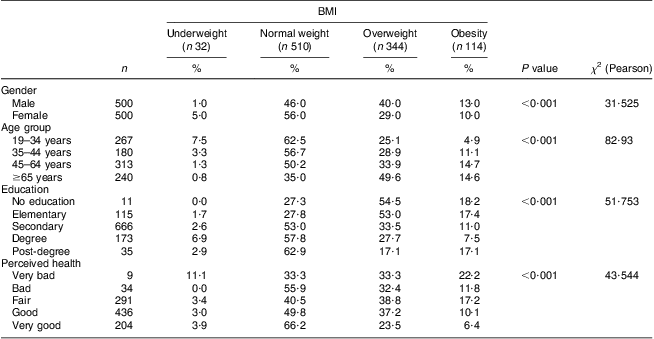
†Underweight, BMI < 18·5 kg/m2; normal weight, BMI = 18·5–24·9 kg/m2; overweight, BMI = 25·0–29·9 kg/m2; obesity, BMI ≥ 30·0 kg/m2.
Table 3 shows the mean scores on FRL dimensions of obese v. non-obese respondents in the sample. The obese group scored higher on freshness (P < 0·05) within the Quality Aspects domain, on ‘Self-fulfilment in food’ (P < 0·05) among the Purchasing Motives and on ‘Enjoyment from shopping’ (P < 0·001) among the Ways of Shopping. Even though the differences between the two groups for other scores were not statistically significant, obese respondents attached higher levels of importance to ‘Price criteria’, which could reveal a higher level of awareness regarding the price when buying foods, and to ‘Interest in cooking’ which could indicate a higher involvement with food, at least regarding the food-related activities such as cooking. The obese respondents scored higher on dimensions in the Consumption Situation domain, particularly on ‘Snacks v. meals’, meaning that the obese respondents gave more preference to snacks over meals compared with the non-obese respondents. Finally, non-obese respondents scored higher on the ‘Importance of nutritional value’ dimension within the Quality Aspects domain of the FRL than obese respondents, showing their general involvement with the nutritional content of foods.
Mean scores for Food-Related Lifestyle (FRL) dimensions and sub-dimensions according to obesity status: sample of Italian men and women (n 1000) over 18 years of age, surveyed in October–November 2010

Mean scores were significantly different from those of non-obese respondents (one-way ANOVA): *P < 0·05, ***P < 0·001.
†Sub-dimensions.
Table 4 shows the odds of being obese for those variables that were found to be statistically significant (P < 0·05). The risk of being obese was higher among consumers who prefer to snack (OR = 1·17) than among those who eat only at mealtimes. Moreover, enjoyment from shopping increased the OR for obesity to 1·24, meaning that these consumers are 24 % more likely to be obese. At the same time, negative associations were found between obesity and the importance of product information (OR = 0·80), the importance of nutritional value (OR = 0·78) and convenience (OR = 0·78), indicating that giving importance to these dimensions may decrease the risk of being obese. Females had 42 % (OR = 0·58) less probability to be obese than males. Absence of children in the household decreased the odds of becoming obese by 47 % (OR = 0·53); that is, an increasing number of children increases the likelihood of being obese. Finally, the probability of being obese in those who perceived themselves to have good or bad health (both OR = 0·19) was about 80 % lower than in those who perceived their health to be very bad. That probability was almost 90 % (OR = 0·11) lower when respondents perceived their health to be very good.
Odds of being obese according to associated Food-Related Lifestyle (FRL) dimensions/sub-dimensions and sociodemographic characteristics: sample of Italian men and women (n 1000) over 18 years of age, surveyed in October–November 2010
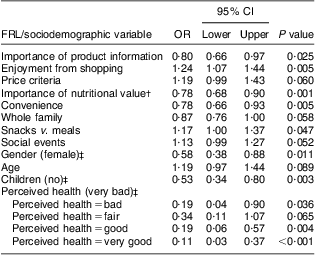
†Sub-dimensions.
‡The k values of the categorical variables are expressed in the model with k − 1 dummy variables. When calculating the odds ratio, the value corresponding to cancellation of the dummy variable is regarded as the ‘reference value’. For example, ‘very bad’ is the ‘reference value’ for the categorical variable ‘perceived health’.
Discussion
The present study found levels of overweight and obesity that were in line with previous studies carried out in Italy( Reference Gallus, Colombo and Scarpino 24 , Reference Banterle and Cavaliere 33 ) and confirmed that the prevalence of obesity among adults in Italy is relatively low compared with other countries( Reference Banterle and Cavaliere 33 , Reference Rennie and Jebb 34 ). However, as in those other studies, our information on weight and height was self-reported. Self-reported height and weight are considered feasible and useful measures in large-scale studies( Reference Goodman and Strauss 35 ), although overestimation of self-reported height and underestimation of self-reported weight have been documented in individuals of both genders( Reference Danubio, Miranda and Vinciguerra 36 ). This information is particularly crucial for researchers who evaluate the effects of BMI based on self-reported height and weight. However, the present study does not make any attempt to infer specific health risks that might be overestimated or underestimated by self-reporting of height and weight. BMI was used here in order to classify respondents for the purposes of better understanding their food-related lifestyle as a potential explanatory concept for obesity.
Our analyses revealed that sociodemographic, economic and cultural variables affect the increasing rate of obesity in Italy. In agreement with previous economic studies found in the literature( Reference Banterle and Cavaliere 33 ), the present results highlighted that disadvantaged social categories, such as elderly people and those with a low level of education, are more susceptible to the problem of obesity. The increase of age tended to be accompanied by an increase in overweight and obesity. Among the young these data confirmed a favourable pattern, since obesity prevalence in Italians aged 19–34 years was about 5 %, which is lower than that of other countries( Reference Rennie and Jebb 34 ). Moreover, the results confirmed that males had a prevalence of obesity slightly higher than that of females( Reference Gallus, Colombo and Scarpino 24 , Reference Banterle and Cavaliere 33 ).
The present study suggests that obesity may be associated with some FRL dimensions. Obese respondents appeared to find more enjoyment from shopping, interest in cooking and self-fulfilment in foods as compared with non-obese ones, confirming previous results( Reference Pérez-Cueto, Verbeke and de Barcellos 22 ). This finding shows that obese consumers enjoy these aspects of foods, even though they do not seem to be involved with quality aspects of food as non-obese consumers are. Furthermore, obese respondents appeared to be less interested in the nutritional content of foods, suggesting their weak involvement in nutritional aspects when they eat. In fact, the obese respondents of our sample gave preference to snacks over meals, confirming results from another study( Reference Pérez-Cueto, Verbeke and de Barcellos 22 ). The present study also suggests that giving importance to product information might decrease the risk of being obese. Therefore, the obese consumers of our sample would not choose what to eat on the basis of nutritional value and general information on the product. From a public health perspective, the fact that attitudes towards nutritional value and product information differ between obese and non-obese consumers raises concerns about the effectiveness of strategies targeting obese consumers to shift their consumption patterns. Moreover, the food choices of obese respondents related to snacking might be a cause for concern as they may facilitate increased energy intake, although the relationship between snacking and body weight was not found to be consistent across studies( Reference Bertéus Forslund, Torgerson and Sjostrom 37 , Reference Phillips, Bandini and Naumova 38 ). However, some strategies specifically directed to the promotion of healthy snacking habits might achieve success in reducing energy intake of those who frequently eat snacks. Further, the findings suggest it is more probable that obese respondents perceive a very bad personal health, meaning that they might be conscious of the health risks associated with obesity( Reference Finkelstein, Brown and Evans 39 ). Therefore, this would suggest that interventions focusing only on the health risks of obesity might provide minimal new information and induce few changes in eating behaviours.
We are aware of some limits and weaknesses of our study concerning the type of observational design and the self-administered questionnaire as the method of data collection, respectively. The limits of an observational study here may be related to: (i) the precision( Reference Carlson and Morrison 40 ) of our sample, in that it is representative of the Italian population but not of obese Italian adults. Then, further research on representative samples of obese adults would be necessary to investigate their food-related lifestyles; (ii) the lack of a control group for understanding the cause of the obesity disease( Reference Grimes and Schulz 41 ). As regards the weaknesses of a self-administered questionnaire, the main criticism usually relies on the correct and homogeneous interpretation of the same meaning of the observed scores on the constructs from all respondents( Reference Spector 42 ). However, the rigorous method of analysis through structural equation modelling in the form of CFA showed an acceptable convergent validity of the factor loadings, assuring that each factor has been commonly understood by the participants and adjusting for the remaining variance that they do not have in common (i.e. measurement error).
Conclusion
The outcome of the present study would suggest that in targeted interventions for public health purposes in order to address obesity, attention should be placed also on the role that food plays in obese consumers’ lives. Then, further research should focus better on the relationship of food habits, obesity and lifestyles at country level and carry out cross-cultural comparisons in order to deepen different cultural contexts.
Acknowledgements
Sources of funding: The present study, conducted within the project PALINGENIO, was funded by the Italian Ministry of Agricultural, Food and Forestry Policies. The study was initiated and analysed by the investigators. Conflict of interest declaration: The authors declare that they have no competing interest. Authorship responsibilities: A.S. conceived and designed the study. E.C. and M.V. worked with the statistical models. E.C. ran the final analyses. All authors contributed to the interpretation of the data. A.S. drafted the initial and final manuscripts; M.V. and E.C. made critical revisions. All authors approved the final version of the manuscript.



