



Early childhood is a pivotal time in the development of food preferences and as such an opportunity to foster the development of healthy eating practices. Fruit and vegetable intakes play an important role in the prevention of chronic diseases( 1 ) and obesity( Reference Mytton, Nnoaham and Eyles 2 ), and to halt the escalating prevalence of both, fruit and vegetable consumption should be encouraged from an early age. There are, however, limited data on fruit and vegetable intakes in very young children.
The beneficial role of both quantity and variety of fruit and vegetable intake has been acknowledged in disease prevention in adults( Reference Cooper, Sharp and Lentjes 3 ). There are also unresolved questions as to the health outcomes associated with fruit juice intake( Reference Xi, Li and Liu 4 – Reference Pan, Malik and Hao 6 ) and concerns about sugar intake including that from fruits( Reference Te Morenga, Mallard and Mann 7 , Reference Te Morenga, Howatson and Jones 8 ). Therefore, it is important to characterise fruit and vegetable intake by identifying the dietary sources and estimating the contribution to nutrient intakes.
At present, there are no established quantitative guidelines for fruit and vegetable intakes for very young children in Ireland or in many other countries. However, there are number of evidence-based resources available, including ‘The Infant and Toddler Forum’( 9 ). It is generally acknowledged that because of the volume that a young child can consume, 400 g/d or 5 (80 g) portions/d, the guideline for those aged ≥5 years in Ireland( Reference Flynn, O’Brien and Faulkner 10 , Reference Flynn, O’Brien and Ross 11 ) and the World Health Organization population goal( 1 ), is not appropriate. Evaluating the proportion of the diet that is comprised of fruits and vegetables in very young children could inform whether public health intervention such as the development of an age-specific guideline is necessary. The aim of this study was to estimate fruit and vegetable intakes and identify the sources and contribution to the total diet in Irish pre-school children aged 1–4 years using data from the National Pre-School Nutrition Survey (NPNS).
Methods
Survey design and population
The NPNS, a nationally representative dietary survey, was carried out by the Irish Universities Nutrition Alliance between October 2010 and September 2011 to establish a database of habitual food and drink consumption in a representative sample of Irish children aged 1–4 years.
In total, 500 (boys 251, girls 249) pre-school children, aged 12–59 months inclusive, were recruited from a database of children compiled by ‘eumom’ (an Irish parenting resource; www.eumom.ie) or from randomly selected childcare facilities in selected locations. Although this facilitated a representative sample of the population of the Republic of Ireland with regard to age, sex and residential location, the sample contained a higher proportion of children of professional workers and a lower proportion of children of skilled manual workers than the general population( 12 ).
Children and their families were visited in their own home by a research nutritionist; 4-d weighed food records were used to collect food intake data. Training in completion of the food record was given to the primary caregivers, and a brief set of instructions on a laminated sheet was provided to accompany the child and food record when in the care of others. The food records benefited from a large amount of researcher–participant interaction, allowing for detailed training of the participants and clarification of recorded data where necessary. All participants completed the records over a continuous 4-d period, including at least 1 weekend day. Food intake data were converted to nutrient intakes using UK and Irish food composition data( Reference Black, Ireland and Moller 13 , 14 ).
This study was conducted according to the guidelines laid down in the Declaration of Helsinki, and ethics approval was obtained from the Clinical Research Ethics Committee of the Cork Teaching Hospitals, University College Cork. Written informed consent was obtained from parents/guardians. A detailed description of the survey methodology is available at www.iuna.net.
Fruit and vegetable intake
In all, 1652 different food codes were consumed on the NPNS, of these 740 had a fruit and/or vegetable component. These included discrete fruits and vegetables and fruits and vegetables contained in composite foods and dishes. The percentage of fruits and/or vegetables in each of these food codes was estimated using standard recipes from the UK food composition database( 14 ), as well as from participants’ food diaries and manufacturers’ product information. Calculations were included to remove inedible or unconsumed portions – for example, cores and uneaten peel. The effects of concentration, for example, in the case of tomato purée, were also accounted for.
Vegetables included the edible parts of plants commonly consumed as vegetables; foods used as vegetables, such as green pulses and sprouts and fresh sweet corn; botanical fruits used as vegetables, such as tomatoes, peppers or cucumbers; and mushrooms and seaweed. Cereals, potatoes and other tubers, as well as dry pulses, were not considered as vegetables. Fruits included the edible part of all fruits that were fresh, canned, frozen and dried, unless they were classified as vegetables. Fruits with high energy content, such as avocados and olives, were included as fruit. In calculating the fruit and/or vegetable proportion of composite foods and dishes, all dishes/foods with a fruit and/or vegetable component regardless of nutritional profile of the dish/food were included.
Statistical analysis
Intakes (g/d) and sources (g/d) were described for the total population and for consumers only using means, medians, standard deviations and percentage of consumers. Intakes from major sources were stratified by age, and the association with age was assessed using ANOVA. Associations were considered significant at P<0·05.
Intakes and sources were further disaggregated by age and are presented for the total population and for consumers only (online Supplementary Table S1 and S2).
The contribution of fruit and vegetable intake to the weight of the total diet (total weight of all food and beverages in the diet) was estimated separately as the contribution of all sources (g), discrete vegetables (g), discrete fruits (g), vegetables in composite foods and dishes (g) and fruits in composite foods and dishes (g) to the total weight of the diet (g). These were expressed as percentages and reported for the total population and by age.
We estimated the proportion of children with contributions of fruits and vegetables to the weight of the total diet at four levels: <10, ≥10 and <20, ≥20 and <30 and >30 %. As the weight of fruit juice contributes disproportionately to the weight of total fruits and vegetables, the proportion of children in each category of percentage contribution was calculated both including fruits and vegetables from all sources and limiting the contribution of 100 % fruit juice to total fruit and vegetable intake to 1 portion/d (50–120 ml)( Reference Lyons, Walton and Flynn 15 ). As food and beverage intake data were weighed and subsequently reported in grams, a 1:1 conversion of millilitres to grams was assumed.
Using age-appropriate portion sizes for individual fresh fruits and vegetables, dried fruits and fruit juices (derived from medians of intakes, mostly weighed) (range 14–124 g)( Reference Lyons, Walton and Flynn 15 ), we estimated the means and standard deviations of daily intake of portions of fruits and vegetables from all sources of fruits and vegetables, and separately limiting the contribution of 100 % juice to 1 portion. We reported these for the total population and by age.
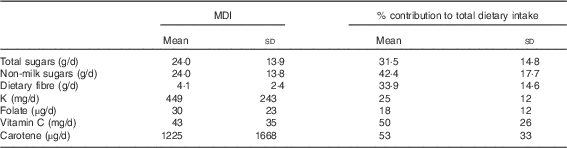
The contribution fruit and vegetable intakes made to the intake of key nutrients was estimated as mean daily intake and percentage contribution of total dietary intake for total sugar, non-milk sugars (NMS), dietary fibre, K, folate, vitamin C and carotene.
Results
The daily intakes of fruits and vegetables in the total population and in consumers only, from all sources and disaggregated by source, are displayed in Table 1. All pre-school children consumed fruits and vegetables during the four survey days. Mean daily intake of fruits and vegetables from all sources was 247 (sd 124) g/d. There were more consumers of fruits (98 %) than of vegetables (90 %). The largest proportion (70 %) of total fruit and vegetable intake (247 g/d) came from discrete fruit intake (171 g/d).
Daily intake (g/d) of fruits and vegetables in Irish pre-school children aged 1–4 years (n 500) (Mean values, medians, percentages and standard deviations)

There were no differences in intakes by sex (P=0·303). Intakes of total fruit were positively associated with age (P<0·001), but there was no significant association between vegetable intake and age (P=0·184) (Table 2). Higher intakes of total fruit in older children were largely explained by higher intakes of 100 % fruit juice, smoothies and purées (Table 2). This was driven by a 3-fold higher intake of 100 % fruit juice in those aged 4 years (77 (sd 99) g/d) v. those aged 1 year (23 (sd 50) g/d) (online Supplementary Table S1).
Daily intakes and sources of fruits and vegetables in Irish pre-school children aged 1–4 years by age (n 500) (MDI and percentage contribution)

* As calculated using ANOVA.
The sources of total fruit intake were discrete fruit excluding 100 % fruit juice, smoothies and pureés (48–56 % contribution to total fruit, range of contribution across age) of which bananas (14–19 %) and apples (7–13 %) contributed the most; 100 % fruit juice, smoothies and pureés (32–45 %); and fruits in composite foods and dishes (7–13 %) of which beverages contributed the most (48–63 %). Total vegetable intake comprised of discrete vegetables (48–62 % contribution to total vegetables, range of contribution across age) of which peas, beans and lentils (11–16 %) and carrots (9–15 %) contributed the most and vegetables in composite foods and dishes (38–52 %) of which meat-based dishes (15–30 %) contributed the most (Table 2 and further disaggregation in the online Supplementary Table S1).
Trends observed for intakes and sources by age in the total population were similar when examined in consumers only (online Supplementary Table S2).
Fruits and vegetables contributed to 20 % (fruit: 15 %, vegetables: 5 %) of the weight of the total diet (Fig. 1). This did not vary significantly with age. The ratio of the contribution of discrete fruits and vegetables:fruits and vegetables in composite foods and dishes varied with age, with older children consuming more discrete fruits and vegetables (Fig. 1).
Percentage contribution of fruit and vegetable intake to the weight of the total diet in the total population (n 500).

Of the 500 children, sixty-one had fruit and vegetable intakes that contributed <10 % of the weight of the total diet, 224 had intakes that contributed ≥10 and <20 %, 148 had intakes that contributed ≥20 and <30 % and sixty-seven had intakes that contributed ≥30 %. Limiting the contribution of 100 % fruit juice to total fruit and vegetable intake to 1 portion/d most affected the number of children categorised as having contributions ≥30 %. After applying the limitation, sixty-four children had fruit and vegetable intakes that contributed <10 % of the weight of the total diet, 243 had intakes that contributed ≥10 and <20 %, 151 had intakes that contributed ≥20 and <30 % and forty-two had intakes that contributed ≥30 %.
The mean daily intake in the total population was 4·7 (sd 2·2) portions of fruits and vegetables and 4·5 (sd 2·0) portions when the contribution of juice was limited to 1 portion/d. Mean daily intake of portions differed by age (P≤0·001 when including all juice and when limiting juice). Children aged 1 year consumed the most portions per day (mean 5·5 (sd 2·6) when including all juice and 5·3 (sd 2·3) when limiting juice) and children aged 4 years consumed the least (mean 4·3 (sd 1·8) when including all juice and 4·1 (sd 1·7) when limiting juice).
Fruit and vegetable intakes contributed to 32 % (24 g/d) of total sugar, 42 % (24 g/d) of NMS, 34 % (4·1 g/d) of dietary fibre, 25 % (449 mg/d) of K, 18 % (30 µg/d) of folate, 50 % (43 mg/d) of vitamin C and 53 % (1225 µg/d) of carotene daily intakes (Table 3).
Discussion
Summary of findings
In this nationally representative survey of pre-school children aged 1–4 years, fruits and vegetables were important foods, contributing 20 % of the weight of the total diet and were consumed by all children during the 4 d surveyed. Discrete fruit intake was the largest contributor to total fruit and vegetable intakes. Total fruit intake was higher in older children, largely driven by higher intakes of 100 % fruit juice. Vegetable intakes contributed to only 5 % of the total weight of the diet, and 10 % of children consumed no vegetables during the four survey days. Composite foods and dishes were important sources of vegetables particularly in younger children in whom they contributed to 52 % of total vegetable intake. Mean portion intake was 4·7 portions/d. In all, 12 % of children had what could be considered a very low (<10 %) contribution of fruit and vegetable intake to the weight of the total diet. Fruits and vegetables are an important source of nutrients, particularly vitamin C (50 % of mean daily intake), carotene (53 %) and dietary fibre (34 %). They also contributed to 42 % of NMS daily intakes.
Results in context
To compare our findings directly with those from other studies is difficult as we have included fruits and vegetables in composite dishes, excluded inedible portions and included calculations for concentration and cooking losses. These are methodologies not routinely included in studies as they require a detailed level of data collection that is often not available. Some general comparisons can be made with surveys from the UK and USA.
In the UK National Diet and Nutrition Survey, mean intakes in 1·5–3-year-olds were 106 g/d for fruit, 114 g/d for fruit juice, 22 g/d for salad and raw vegetables and 48 g/d for cooked vegetables including those from composite dishes, totalling a crude mean of 290 g/d( 16 ). This is similar to the mean intakes of total fruits and vegetables in the present study of 247 g/d. The Feeding Infants and Toddlers Study (FITS) reported that a substantial proportion of US children do not consume any fruits or vegetables in a given day( Reference Siega-Riz, Deming and Reidy 17 ). In contrast, all children in the present study consumed fruit and/or vegetables. This difference may be explained by methodological difference as FITS is based on one 24-h recall and only included discrete fruit and vegetable intakes.
Contribution of composite foods and dishes
The importance of composite foods and dishes in the estimation of fruit and vegetable intakes has been highlighted previously, although in adults( Reference O’Brien, Kiely and Galvin 18 , Reference Fitt, Mak and Stephen 19 ). Our study has shown that inclusion of the contribution of composite foods and dishes is particularly important for estimating vegetable intakes in this age group, as 38–52 % (range across age) of their vegetable intake was from this source. The contribution of composite foods and dishes should be included in estimating intakes for other analyses. If it is not feasible to disaggregate composite food codes, the percentages reported in this study could be applied. Without accounting for this important source, intakes may be underestimated by as much as 52 % in this age group. Thus, composite foods and dishes should also be considered if generating guidelines for consumption.
Fruit and vegetable dietary patterns and guidelines
It is difficult to interpret what contribution to diet fruit and vegetable intake should make in very young children. At present, Irish food-based dietary guidelines pertaining to fruit and vegetable intake are for those aged 5 years and above( Reference Flynn, O’Brien and Faulkner 10 , Reference Flynn, O’Brien and Ross 11 ). Other countries similarly have a gap between breast-/bottle-feeding and weaning advice for infants and the availability of food-based dietary guidelines. For example, the eatwell plate in the UK is also aimed at those over the age of 5 years( 20 ). Some countries have established guidelines, including Australia, who recommend two to three servings of vegetables and legumes and 0·5 servings of fruits for boys and girls aged 1–2 years and 2·5 and one servings, respectively, for 2–3-year-olds( 21 ).
To inform whether the development of age-specific fruit and vegetable guidelines or public health interventions for fruit and vegetable intake in pre-school children is necessary, we carried out a number of observational analyses. Areas we noted for improvement included the contribution of fruit juice to total fruit intake, the proportionally lower vegetable intakes than fruit intakes, the very low intakes of fruits and vegetables (<10 % weight) and 0 g/d intakes of vegetables in a sub-group of the population.
Pre-school age is an important time for establishing good dietary behaviours to carry forward into later life( Reference Kudlova and Schneidrova 22 ). Previous evaluation of discrete fruits and vegetables in Irish school-age children has shown that pre-school children have a higher intake and less reliance on fruit juice than older children and teenagers( Reference Walton, McNulty and Nugent 23 ). Our more detailed observations compounded this finding and also provided further insight as to the evolution of dietary patterns in this age group. The greater dependence on fruit juice as a source of fruits with increasing age noted for older children was already evident in pre-school children. In pre-school children, the total fruit and vegetable intake excluding fruit juice increased with age as did the percentage of the total diet comprised of fruits and vegetables. This suggests that the decline in intake of fruits and vegetables coincides with starting school, marking this as a point for targeted intervention. The mean intake of the pre-school population was 4·7 portions/d. This is encouraging as currently the Irish child and teenager( Reference Walton, McNulty and Nugent 23 ) as well as the adult( 24 ) populations need to double their intakes to meet the 5-a-day fruit and vegetable intake recommendations( 1 ).
Fruit juice
There is mixed evidence for the nutritional benefits of consuming fruit juice. In this nationally representative survey of very young children, 100 % fruit juice was a large contributor to vitamin C intakes, second only to discrete fruit intakes (data not shown). Fruit juice has also been highlighted as the largest contributor to vitamin C intake in older UK children diets( 16 ). However, fruit juice is also a source of free sugar, and limiting the consumption of free sugars is recommended for optimum health( 25 , 26 ). The benefits of replacing fruit juice with whole fruit in terms of increasing fibre intake and decreasing energy intake have also been shown using data from children in the USA( Reference Monsivais and Rehm 27 ).
The association of fruit juice intake with health outcomes is also as of yet inconclusive. For example, higher intake of 100 % fruit juice has been associated with higher risk of incident type 2 diabetes( Reference Muraki, Imamura and Manson 5 ) but a null association has also been reported( Reference O’Connor, Imamura and Lentjes 28 ). The associations of fruit juice intake and the risk of the metabolic syndrome, obesity( Reference Pereira and Fulgoni 29 ) and blood pressure( Reference Oude Griep, Stamler and Chan 30 ) have also been investigated, but there is currently insufficient evidence from which to draw conclusions.
In all, 100 % fruit juice was a large contributor to total fruit intakes in this age group and its contribution increased substantially with age. However, even in the oldest children, the mean intake was 77 g/d. Intakes at this level are unlikely to negatively impact on health outcomes, although the rapid increase in consumption of 100 % fruit juice with age may be of concern. Until a definitive conclusion is made as to the role of fruit juice in the diet, communication of the nutritional benefits of whole fruit instead of fruit juice consumption in this age group would be pragmatic.
Reporting bias
The data are self-reported, and are thus susceptible to reporting bias. Under-reporting food and energy intakes is of particular concern in this context as there are noted implications of under-reporting for the development of food-based dietary guidelines( Reference Becker and Welten 31 ). However, as the focus in these analyses is fruit and vegetable intakes, perceived as ‘healthy’ foods, the social biases associated with food reporting are more likely to bias towards over-reporting not under-reporting. The high level of researcher–participant interaction may have eliminated much misreporting due to forgetting foods, poor or incorrect descriptions of foods and through encouraging compliance. The use of weighed records likely reduced inaccurate estimation of portion sizes. However, researcher–participant interaction and weighing increases participant burden, which can introduce its own biases.
Strengths and limitations
The main strengths of this study are the national representativeness of the sample, the detailed prospective dietary intake data and the comprehensiveness of the estimation of fruit and vegetable intakes. A limitation of this study is that we used the weight of all food and beverages for the weight of the total diet. This may have led to children with high intakes of liquid-like foods and beverages having lower estimated percentage contribution of fruits and vegetables to the total diet. However, as there was no difference in the weight of the total diet across the four groups of level of contribution of fruits and vegetables, this was considered a justified approach.
Conclusions
Fruits and vegetables are important components of the diet of Irish pre-school children. They were eaten by all children, mean intakes were >4 portions/d, they contributed 20 % of the weight of the total pre-school diet and were important sources of dietary fibre, carotene and vitamin C. Some aspects of fruit and vegetable intakes in pre-school children could be improved and would benefit from targeted public health interventions. These include low vegetable intakes overall, increasing dependence on fruit juice with age and very low intakes of both fruits and vegetables in a sub-group of the population.
Contribution of fruit and vegetable intake to daily intake of key nutrients in Irish pre-school children aged 1–4 years by age (n 500) (Mean values and standard deviations)
Acknowledgements
The authors thank the study participants and their families for contributing their time to the survey. The authors also thank the field research staff for collecting the data.
The project was funded by the Irish Government, Department of Agriculture, Food and the Marine under the ‘Food for Health Research Initiative’ 2007–2012.
L. O’C. conceived the research questions, generated the fruit and vegetable intake data, analysed the data and wrote the manuscript. J. W. contributed to the contents and writing of the manuscript and is the study coordinator. A. F. gave critical input to the manuscript and is a principal investigator of the National Pre-School Nutrition Survey. All the authors approved the final version of the manuscript.
The authors have no conflicts of interest or any additional funding to declare.
Supplementary material
For supplementary material/s referred to in this article, please visit http://dx.doi.org/10.1017/S0007114516001422



