





1. Introduction
For linguistic communication to be successful, it usually does not suffice that the comprehender determines what the linguistic input explicitly states (for a recent overview, see Culpeper & Gillings, Reference Culpeper and Gillings2019; Terkourafi & Haugh, Reference Terkourafi and Haugh2019). Rather, one important task of the comprehender is to determine what additional inferences can be drawn based on the particular linguistic structure that the speaker decided to use. This is particularly evident in the use of negation in conversation (e.g., Lyu et al., Reference Lyu, Tu and Lin2020; Urbanik & Svennevig, Reference Urbanik and Svennevig2019). The contexts in which negative sentences can felicitously occur are rather limited (Halliday & James, Reference Halliday, James, Sinclair, Hoey and Fox1993; Tian & Breheny, Reference Tian, Breheny, Katsos and Cummins2019) and thus, negative sentences are associated with specific pragmatic inferences (for an overview, see Moeschler, Reference Moeschler1992).
Negation is often assumed to be cognitively rather difficult and time-consuming to process (Deutsch et al., Reference Deutsch, Gawronski and Strack2006; Dudschig et al., Reference Dudschig, Mackenzie, Leuthold and Kaup2018, Reference Dudschig, Mackenzie, Maienborn, Kaup and Leuthold2019; Fischler et al., Reference Fischler, Bloom, Childers, Roucos and Perry1983). Additionally, negation is often associated with cognitive resource-demanding processes such as suppression or inhibition (Autry & Levine, Reference Autry and Levine2014; de Vega et al., Reference de Vega, Morera, León, Beltrán, Casado and Martín-Loeches2016; Giora et al., Reference Giora, Fein, Aschkenazi and Alkabets-Zlozover2007). Given that these processing efforts are often associated with negation use, one can ask why people nevertheless regularly use negation in discourse. Considering the Gricean Principle of Quantity (Grice, Reference Grice, Cole and Morgan1975), speakers should use negation to express something more than the equivalent affirmative sentences could convey in the same context. Negation as a marker for certain interpretations could help the listener to access the point a speaker wants to make. Previous psycholinguistic research has indeed shown that negation – when used in supportive contexts – is relatively easy to comprehend, but induces rather large comprehension difficulties when used without such a legitimizing context (Dale & Duran, Reference Dale and Duran2011; Glenberg et al., Reference Glenberg, Robertson, Jansen and Johnson-Glenberg1999; Lüdtke & Kaup, Reference Lüdtke and Kaup2006; Nieuwland, Reference Nieuwland2016; Nieuwland & Kuperberg, Reference Nieuwland and Kuperberg2008; Schindele et al., Reference Schindele, Lüdtke and Kaup2008; Tian & Breheny, Reference Tian, Breheny, Larrivée and Lee2016; for an overview, see Kaup & Dudschig, Reference Kaup, Dudschig, Deprez and Espinal2020). Such situations in which negative sentences are pragmatically felicitous include situations in which the speaker corrects a false statement or belief, or communicates exceptions from a rule (Clark & Clark, Reference Clark and Clark1977; Colston, Reference Colston1999; Weil et al., Reference Weil, Schul and Mayo2020).
When referring to exceptions by means of negation, the negation would thus be considered pragmatically felicitous. In contrast, when referring to the rule by means of negation, the negation would be considered infelicitous. Wason (Reference Wason1965) demonstrated this by presenting participants with rows of eight numbered circles. One of the circles was in a different color than the remaining seven circles. Participants first described the whole display (e.g., ‘Circle No. 4 is blue and the rest are red’) and then completed an affirmative or a negative sentence fragment about one of the circles (e.g., ‘Circle No. 4 is/is not …’). Responses to negative fragments were faster when they referred to a single circle that differed from the others, compared to when they referred to a circle that shared the color with six other circles. This result is in line with the idea that negation is easier to process when used to refer to an exception and this, in turn, shows that comprehenders take into account pragmatic aspects of negation during processing. The results of Cornish (Reference Cornish1971) are in line with Wason’s findings and hence support his exceptionality hypothesis. In the context of a circle with varying proportions of a particular color, a negative sentence was easier to evaluate the more space the denied color used up. For example, evaluating a sentence like ‘The circle is not all red’ as true was easier when a proportion of 1/12 was not red, compared to when only 1/12 of the circle was red and the rest blue. This pattern was also found in a production task. Participants completed a negative sentence fragment with the dominant color most often in the condition where it took up 7/8 of the circle. The frequency of this response decreased with decreasing proportions of this color.
Adding to Wason’s exceptionality hypothesis, the relevant factor might be confusability. Confusability results from the similarity between the odd entity and the similar entities. The more similar the entities, the more confusable they are (e.g., one plate among bowls compared to one plate among flowers). De Villiers and Tager Flusberg (Reference de Villiers and Tager Flusberg1974) argued that the felicity of negation use increases with confusability. The authors showed that confusability played an increasing role for children with increasing age. Thus, negation is more pragmatically felicitous not only when it describes the exception, but moreover when the exception could be easily confused with the rule. Valle Arroyo (Reference Valle Arroyo1982) confirmed that negatives are easier to process in an appropriate context. When participants see an exception and a number of similar entities and are made to focus on the whole set, then the negation in a subsequent sentence is easier to process when it refers to the discrepant item. However, Valle Arroyo did not find reliable differences between high and low contrast sets (i.e., sets with low and high confusability, respectively).
Lately, Nordmeyer and Frank (Reference Nordmeyer and Frank2014) studied in more detail the influence of context and contextual strength for the processing of a negation. The authors argue that negation is more informative when the target violates the strong expectation that a context sets up. They presented participants with pictures like a boy holding nothing either following a context of three boys all holding apples or outside of a specific context. Participants verified a target sentence like ‘The boy has no apples’. Without context, negative sentences of this type were difficult to process, but when presented in a context that sets up a strong expectation (i.e., boys are holding apples), the negation referred to an exception and was thus more easily processed. Interestingly, with an increasing proportion of the target item in the context (i.e., zero to four of four boys holding apples), response times to the negated sentences tended to decrease. This was also true for affirmative sentences but particularly for negative sentences. Nordmeyer and Frank (Reference Nordmeyer and Frank2014) explain their findings with the different levels of informativeness of negation – without sufficient context, negative sentences are not very informative and therefore lead to increased processing times. According to this assumption, the pragmatic use of negation in referring to exceptions (Wason, Reference Wason1965) is closely linked to informativeness. The more exceptional a target, the more informative a sentence referring to it by means of negating the attribute of the majority in context (i.e., having apples).
The above-mentioned study by Wason (Reference Wason1965) not only employed the exceptionality condition we already discussed, but also a ratio condition. In this condition, participants encoded the set of the circles differently, namely by characterizing two sets (e.g., ‘Seven circles are red and one is blue’) instead of one set (e.g., ‘Circle No. 4 is blue and the rest are red’). Further, participants in this condition completed sentences in the form of ‘Exactly one circle is/is not …’ instead of ‘Circle No. 4 is/is not …’. In contrast to the results reported above, there was no facilitation for negative sentences referring to the smaller set in the ratio condition. Interestingly, it is not entirely clear why it seems pragmatically felicitous to deny that one dissimilar object has the property of the similar objects (exceptionality hypothesis), but not to deny that one smaller set lacks the property of a larger set (ratio hypothesis). Wason argued that the better the contrast class is perceived, the easier it is to negate with respect to this contrast class. The exceptionality group provides a strong contrast, whereas the ratio group does not. Valle Arroyo (Reference Valle Arroyo1982) found that this contrast is only perceived when the set is encoded as a whole, which is the case in the exceptionality condition but not in the ratio condition. The participants in Nordmeyer and Frank’s (Reference Nordmeyer and Frank2014) study, however, did not have to actively encode the context, but only looked at the context display. It should be noticed, however, that the target to which the sentence referred was not presented simultaneously along with the context – like in Valle Arroyo (Reference Valle Arroyo1982) and Wason (Reference Wason1965), where all objects were shown at once, subsequently followed by the sentence. Instead, the target object and the sentence were presented together and sequentially after the context picture. This might have put special focus on the context of this study. Thus, all of the reported studies had specific context conditions. It was mandatory to actively encode the context before processing the sentences (Valle Arroyo, Reference Valle Arroyo1982; Wason, Reference Wason1965), or the context was made particularly salient by presenting it sequentially to the target entity (Nordmeyer & Frank, Reference Nordmeyer and Frank2014).
Taken together, although the notion that negation processing is facilitated in contexts in which it refers to an exception is omnipresent in the literature, the available evidence is not particularly strong as of yet. In the present study, we aimed to investigate further the boundary conditions for finding a context-based facilitation effect for the processing of negation. We consider it likely that a visual context that is presented in parallel with the target entity produces facilitation effects even if comprehenders are not forced to encode the context as long as the context is interesting enough. We based our experiment on Wason’s exceptionality hypothesis. However, instead of using circles of different colors as Wason did, we presented our participants with displays of four children holding various objects. We consider it likely that these contexts will be encoded spontaneously by the participants simply because they are more engaging (like the displays used by Huang & Snedeker, Reference Huang and Snedeker2009). Employing a visual search paradigm, we aimed to determine whether the processing of negative referential instructions would be facilitated in contexts in which the sentence refers to exceptional objects. We assessed this question with two different context displays and a visual search task. Our paradigm has the advantage of providing an alternative context, which presumably is infelicitous (control condition) and to which the felicitous context can be compared to (instead of comparing it to a no-context condition). Also, the exact same sentences can be used in the felicitous and infelicitous context conditions. See the two left columns of Table 1 for an example of the displays used as context. The first type of display was unbiased and contained a balanced amount of objects (two of each kind, left column in Table 1). Therefore, unbiased displays do not give an appropriate context for a negated statement about any object. The second type of display was biased and included several same (majority) objects and one different (exceptional) object, which constituted an exception (second left column in Table 1). Hence, these displays should provide a felicitous context to use negation when talking about the exceptional object. Identifying this object should be relatively fast when it is referred to using a negative sentence in a context in which it is an exception (biased display) compared to a context in which it is not (unbiased display). Thus, we expected faster identification times for exceptional objects in biased compared to unbiased displays with negated prompts (e.g., ‘Tap on the girl who has no wool.’). Further, we expected an advantage for negated sentences in the biased display when these referred to the exceptional object compared to the majority object (e.g., ‘Tap on the girl who has no wool.’ compared to ‘Tap on the girl who has no cloud.’). Additionally, we also expected the identification accuracy to reflect the felicitous use of negation. For negative prompts, there should be fewer errors identifying the exceptional object in the biased display compared to the unbiased display. In the biased display, identifying the exceptional object should lead to fewer errors than identifying the majority object. To summarize, we expected a main effect of polarity, with longer and more error-prone responses with negative compared to affirmative sentences because negative sentences are usually more complex to process than affirmative sentences (see above). We also expected two interactions: An interaction of polarity and display as well as an interaction of polarity and object. The differences between displays (bias vs. unbiased) and those between objects (exceptional vs. majority) should be more pronounced for negative compared to affirmative sentences.
Combination of displays and sentences for exceptional and majority objects in Experiment 1

Note. Sentences translated from German [original sentences in square brackets]. All images were retrieved from the pixabay website under the pixabay license.
a There were no sentences referring to the ‘majority’ object in the unbiased displays.
2. Experiment 1
2.1. Methods
2.1.1. Participants
After signing informed consent, a total of 61 (51 female) subjects took part. They were between 18 and 77 years old (M = 24.18, SD = 11.88) and all were native speakers of German. Fifty-four subjects were right-handed and seven were left-handed.
2.1.2. Materials
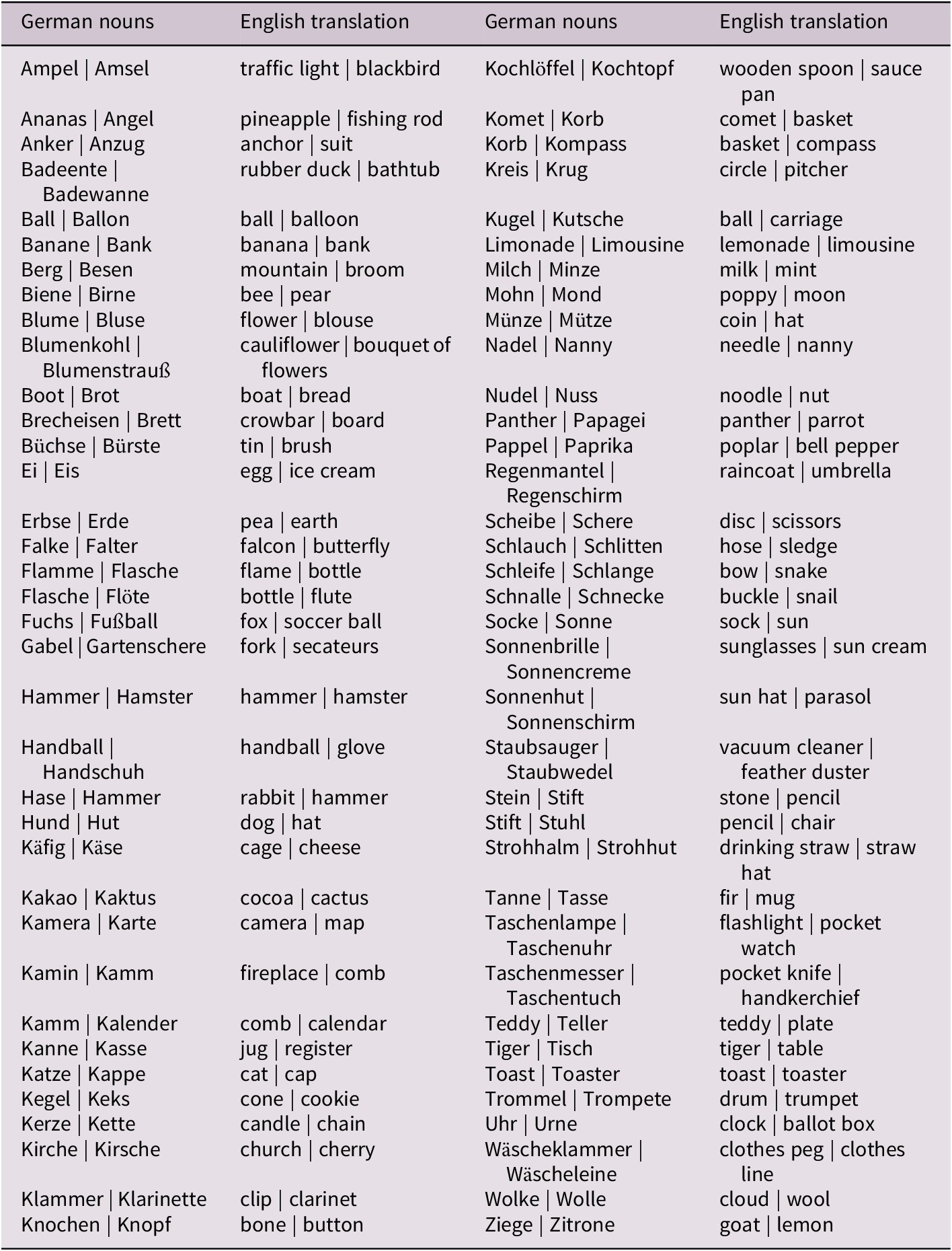
The materials consisted of pictures of 72 object pairs (e.g., a cloud and a ball of wool) and two pictures of a boy and a girl each. The objects of each pair had the same grammatical gender and initial sound in German (e.g., ‘Wolke’ [‘cloud’] and ‘Wolle’ [‘ball of wool’]; see Appendix for the complete list). Boys, girls, and objects were arranged in 2 × 2 displays, one child and one object per quadrant. Each display consisted of two boys, two girls and four objects. The pictures for the boys and girls were the same within each display. Each child was assigned one object of each object pair. There were two types of displays. In the unbiased display, the objects were equally distributed among the children (e.g., a boy with a ball of wool, a girl with a ball of wool, a boy with a cloud and a girl with a cloud). In biased displays, the frequency of objects was imbalanced and there was a majority of one object (e.g., both boys and one girl have a ball of wool and only one girl has a cloud). In this case, the cloud is an exceptional object. Between subjects, each object sometimes appeared as an exceptional object and sometimes as a majority object. The quadrant in which the exceptional object appeared, the position of the children, as well as whether the exceptional object was assigned to a boy or a girl was counterbalanced. The pictures were presented in the middle of a gray background.
Affirmative and negative sentences in German referred unambiguously to a specific quadrant. The sentences’ target was either a child with the exceptional object or the same-sex child with the majority object (e.g., the girl with the cloud or the girl with the ball of wool, respectively). The same sentences referred to the objects in the unbiased display. We chose to distinguish the children by gender instead of using four boys or four girls (e.g., distinguished by t-shirt color) to be able to refer to the child with the majority object in the biased display without an additional identifier (e.g., ‘Tap on the girl who has a ball of wool and a red t-shirt.’). Table 1 shows the combination of displays and sentences. The sentences were presented in Arial font. Sentences and fixation cross appeared in white font color on gray background. The experiment was programmed in PsychoPy2 (Peirce et al., Reference Peirce, Gray, Simpson, MacAskill, Höchenberger, Sogo, Kastman and Lindeløv2019).
2.1.3. Procedure
Participants were randomly assigned to one of the experimental lists. A trial started with a fixation cross in the middle of the screen for 2 seconds. Participants then saw the display on a computer screen for 2.5 seconds before the sentence appeared below the display. They were asked to respond as quickly as possible by pressing a key on the number pad according to the location of the target object in the display. Key 1 spatially corresponded to the lower left quadrant, Key 3 to the lower right quadrant, Key 7 to the upper left quadrant, and Key 9 to the upper right quadrant. Feedback about correctness and the time it took to answer followed. Participants initiated the next trial by pressing Key 5 on the number pad. They were instructed to use only their right index finger to press the keys on the number pad. After six practice trials, participants completed 72 experimental trials. The practice trials and the experimental trials were presented in a random order.
2.1.4. Design
The combination of display bias (biased and unbiased), sentence polarity (affirmative and negated), and target object (exceptional and majority object) resulted in six different item versions for one-half of the object pairs and six-item versions referring to the other object of the pair. Please note that the design was not fully balanced because it is in the nature of the unbiased displays that there is no majority or exceptional object. The items were distributed over 12 experimental lists, so that subjects saw only one item for each object pair and only one version of each item. Each experimental list included 12 items of each item type. Table 1 gives an overview of the item conditions. We measured response times and correctness of the response.
2.1.5. Data processing and analyses
Due to a coding error, picture and prompt did not fit some items in some versions. We recoded the conditions to also include these trials. Before analyzing the data, we excluded one participant with less than 80% correct answers.
In order to analyze the time it took the remaining 60 participants to identify the target, we excluded all trials with an incorrect answer. Second, we excluded all trials with response times shorter than 600 ms and longer than 7,000 ms where participants could not possibly have performed the task correctly. This amounted to 15 trials (0.37%).
We conducted two separate analyses with log-transformed response timesFootnote 1 as well as accuracy as dependent variables. First, we wanted to see whether the responses to affirmative and negated prompts concerning the exceptional object differ between the biased and unbiased display. Therefore, we tested a linear mixed-effect model with the fixed effects polarity (affirmative/negated) and display (biased/unbiased) and the dependent variable log-transformed response times. The model contained the maximum random effect structure with which the model still converged.
 $$ {\displaystyle \begin{array}{l}\mathrm{logRT}\sim \mathrm{polarity}\hskip-0.12em \times \hskip-0.12em \mathrm{display}\hskip-0.12em +\left(1+\mathrm{polarity}\hskip-0.12em +\mathrm{display}\;| \;\mathrm{participant}\right)\hskip0.18em +\hskip-0.12em \\ {}\left(1\hskip-0.12em +\hskip-0.12em \mathrm{polarity}\;| \;\mathrm{item}\right)\end{array}} $$
We further fitted a mixed logistic regression model for the dependent variable accuracy with the fixed effects polarity and display, and the random effect structure with which the model still converged.
 $$ \mathrm{accuracy}\sim \mathrm{polarity}\times \mathrm{display}+\left(1+\mathrm{polarity}\;| \;\mathrm{participant}\right)+\left(1\;| \;\mathrm{item}\right) $$
In what follows, we will refer to these analyses as the Display Analyses, because the relevant factor next to polarity was the type of display.
Second, we compared the responses to affirmative and negated sentences about the exceptional object and the majority object in the biased display. We tested a linear mixed-effect model with the fixed effects polarity (affirmative/negated) and target object (exception/majority). Again, the dependent variable was log-transformed response time. The model contained the maximum random effect structure with which the model still converged.
 $$ {\displaystyle \begin{array}{l}\mathrm{logRT}\sim \mathrm{polarity}\times \mathrm{target}\ \mathrm{object}+\left(1+\mathrm{polarity}+\mathrm{target}\ \mathrm{object}\;| \mathrm{participant}\right) + \\ {}\left(1+\mathrm{polarity}\;| \mathrm{item}\right)\end{array}} $$
Again, we further fitted a mixed logistic regression model for the dependent variable accuracy. The model contained the fixed effects polarity and target object, and the random effect structure with which the model still converged.
 $$ \mathrm{accuracy}\sim \mathrm{polarity}\times \mathrm{target}\ \mathrm{object}+\left(1+\mathrm{polarity}\;| \;\mathrm{participant}\right)+\left(1\;| \;\mathrm{item}\right) $$
We will refer to these analyses as the Object Analyses, because the relevant factor next to polarity was the type of object.
The R package lme4 (version 1.1-27.1; Bates et al., Reference Bates, Maechler, Bolker and Walker2015) was used to implement mixed models. We tested the significance of fixed effects by performing likelihood ratio tests, controlled by the R package afex (version 1.0-1; Singmann et al., Reference Singmann, Bolker, Westfall, Aust and Ben-Shachar2021) in the R Version 4.1.1 (R Core Team, 2021).
2.2. Results
We conducted the Display Analysis on the responses to the exceptional object to test our hypothesis that it is easier to identify an exceptional object that is referred to in a negated statement in a biased display compared to an unbiased display. The results showed a significant effect of polarity (χ2(1) = 57.79, p < .001), reflecting longer reaction times for negative sentences, and a significant effect of display (χ2(1) = 68.14, p < .001), reflecting longer reaction times for unbiased displays. There was no evidence for an interaction (χ2(1) = .070, p = .403). The left plot in Fig. 1 shows the mean log response times as a function of sentence polarity and context condition. The values for the Display comparison are marked with solid lines in the figure.
Logarithmic response times in ms (left plot) and percentage of correct answers (right plot) for identification of exceptional objects and majority objects in biased displays, as well as objects in unbiased displays after affirmative and negated prompts in Experiment 1. Error bars indicate the standard error of the mean.

We conducted the Object Analysis to test the influence of polarity and target object (exceptional/majority object) on the log response times in the biased display. The results showed a significant effect of polarity (χ2(1) = 43.54, p < .001), reflecting longer reaction times for negative statements. The effect of target object was also significant (χ2(1) = 38.38, p < .001), showing an advantage of the exceptional object over the majority object. Crucially, the interaction between polarity and target object was also significant (χ2(1) = 14.57, p < .001). The lines marked with a filled circle in the left plot of Fig. 1 show the mean log response times in the Object comparison. See Table 2 for the exact means and standard deviations for log response times in the different conditions.
Means and standard deviations in milliseconds for logarithmic response times to affirmative and negative statements referring to objects in different displays in Experiment 1 and Experiment 2

We analyzed the accuracy, that is, how often participants pressed the correct key on the number pad. Error frequencies varied from 0 to 15 errors per participant (M = 4.39, SD = 2.96). We conducted the Display Analysis to see whether the polarity of the sentence and the respective display influenced the accuracy of the responses to the exceptional object. There was a significant effect of polarity (χ2(1) = 5.34, p = .021). The accuracy for the responses to the exceptional object was lower with a negative prompt compared to an affirmative prompt. However, there was no evidence for a difference between the displays (χ2(1) = 0.09, p = .767), nor for an interaction (χ2(1) < 0.01, p = .951).
With the Object Analysis, we compared the identification accuracy for the exceptional object in the biased display with the identification accuracy for the majority object in the same display. We did not find a significant difference between affirmative or negative prompts (χ2(1) = 1.89, p = .170). When the prompt referred to the majority object, participants were less accurate than when it referred to the exceptional object (χ2(1) = 15.98, p < .001). There was no evidence for an interaction (χ2(1) = 0.14, p = .705). See the plot on the right side in Fig. 1 for the percentage of correctly answered trials in each condition.
2.3. Discussion
With two forms of displays and affirmative vs. negative reference sentences, we examined the hypothesis that pragmatically supporting contexts reduce the processing costs for negated statements. We expected faster response times and lower accuracy for negative statements referring to exceptional objects compared to majority objects in biased displays and compared to the same object in unbiased displays.
Regarding the response times, responses to exceptional objects were faster in biased displays compared to unbiased displays independent of polarity. If participants had been sensitive to pragmatic aspects of negation, we would have expected to see facilitation for the processing of negative statements in the biased display. However, the response times in the biased display were faster, but no facilitation for negated sentences occurred. Comparing the responses within the biased display showed that responses to exceptional objects were faster than responses to majority objects, in particular for affirmative sentences. Contrary to our expectation, we did not find faster response times for exceptional objects compared to majority objects, specifically with negated statements, but especially for affirmative statements. Both comparisons thus show no indication that participants were sensitive to the pragmatic aspects of negation.
Regarding the accuracy data, we found no interaction of display and polarity for responses to the exceptional object – contrary to our hypotheses. Referring to an exceptional object in a biased display with a negative statement did not reduce errors compared to unbiased displays. When comparing the accuracy for responses in the biased display, responses to the majority object were significantly more often incorrect, regardless of the polarity of the prompt. Again, we did not find a systematic facilitation for negated prompts referring to the exceptional object. Rather, it was generally more difficult to identify majority objects in the biased display.
Why do we not see a negation-specific facilitation, especially in the response times? When looking at the displays, one might assume that the structure of the biased displays is suboptimal. In principle, the biased displays bear a quality participants might have used in their search for the referent in the visual world. When creating the biased displays, we gave three of the four children the same object. As a result, there were two children of the same gender with the same object. These children were thus indistinguishable (the boys with the balls of wool in the example in Table 1). Therefore, contrary to the unbiased display, participants could, in principle, neglect half of the potential referents in their search for the referent even before the sentence appears, simply because the typical sentences used in the experiment would not unambiguously refer to one of these referents. Participants could thus adopt the strategy to focus immediately only on the two distinguishable children (the two girls in the example shown in Table 1), thus only paying attention to half of the display. Although this strategy would, in principle, prevent the predicted facilitation effects from occurring, it is nevertheless highly unlikely that participants indeed adopted this strategy. After all, we did find response time and accuracy differences between the conditions referring to the exceptional vs. majority objects in biased displays, which suggests that participants had not diminished the set of referents beforehand. We, therefore, feel safe in assuming that this aspect of the materials cannot be made responsible for the unexpected results.
Another issue that has to be discussed is that the biased displays were constructed in such a way that the child with the exceptional object might have popped out visually and thus attracted participants’ attention even before the sentences were presented. As a result, participants might have started their search at this quadrant of the display. For affirmative sentences, this would explain the resulting response time pattern quite well. Responses to sentences referring to the child with the exceptional object in biased displays were faster than responses to the same child in the unbiased display, presumably because participants’ attention was already on the target quadrant prior to sentence processing in the former but not in the latter case. For the same reason, responses might have been faster for referents with exceptional compared to majority objects in biased displays. The fact that the predicted processing advantage for referents with an exceptional object in biased displays occurred for affirmative sentences might thus be explained by means of a visual pop-out effect. This leaves open the question of how to explain the response time patterns for the negated sentences. We will come back to this issue later.
For now, we would only like to point out the fact that response times after negative sentences were fastest for the exceptional object in biased displays may reflect that comprehenders like to select as the target the child that they had focused on prior to sentence processing (i.e., the girl with the cloud in the biased display). The relatively fast response times to the child with the majority object after negative sentences in biased displays may, in turn, be due to the fact that participants’ attention is on the negated states of affairs prior to processing the negative sentence (i.e., on the girl with the cloud prior to processing the sentence ‘Tap on the girl who has no cloud.’), which corresponds to an intermediate processing step during negation processing according to some negation processing accounts (e.g., Giora et al., Reference Giora, Fein, Aschkenazi and Alkabets-Zlozover2007; Kaup, Yaxley, et al., Reference Kaup, Yaxley, Madden, Zwaan and Lüdtke2007). Before coming back to this issue below, we decided to rule out the visual pop-out explanation in Experiment 2, for which we altered the displays. We used pictures of six different children in total, as well as different object exemplars per object class (see Fig. 2 for an example). This maintained the distribution of objects to two boys and two girls and enhanced the visual variability within the displays. With this measure, we aimed to reduce the visual pop-out of the child with the exceptional object in the biased display and further made every quadrant unambiguously distinguishable.
Altered unbiased (left) and biased (right) displays for the majority object ‘wool’ and the exceptional object ‘cloud’. All images retrieved from the pixabay website under the pixabay license.

3. Experiment 2
3.1. Methods
3.1.1. Participants
Sixty-two new participants signed informed consent or had the consent of their parents, respectively. The 48 women and 14 men were between 17 and 45 years old (M = 22.85, SD = 4.95). Sixty were native speakers of German or learned the language before their 5th birthday. Two participants typed in an ambiguous answer (possibly typos). Their data were excluded. Fifty-six participants were right-handed. The University’s Faculty of Science Ethics Committee for Psychological Research granted ethical approval for the experiment.
3.1.2. Materials
We adjusted the materials from Experiment 1 to reduce the visual saliency of the exceptional object. First, we replaced the uniform boys and girls with pictures of three different boys and three different girls in counterbalanced positions. Now, the children within a display were distinguishable. Second, we did not assign the same object exemplars to the children, but chose one of three objects for each child (see Fig. 2 for an example). Now, the two children who had the same object in the majority display could, in principle, be distinguished by specifying the object in more detail (e.g., ‘Tap on the boy who has a ball of wool that is red.’). We included 12 fillers of this form to make the participants aware of this possible reference.
3.1.3. Procedure and design
The procedure and design were the same as in Experiment 1. In addition, every participant read 12 additional filler sentences presented randomly together with the experimental sentences. These fillers referred to one of the children of the same gender and the majority object, to also address these quadrants. Note that it was not possible to include fillers like this in Experiment 1, as these quadrants could not be unambiguously referred to (same children with the same objects). Every participant saw the same filler sentences. These were excluded from the analyses.
3.1.4. Data processing and analyses
No participant identified the target correctly in less than 80% of the trials. Due to an error in one of the displays (two quadrants were the same), we had to exclude one item. In total, 71 items entered the analyses.
For analyses of response times, we excluded all trials with an incorrect answer. We excluded outliers analogous to Experiment 1 and only kept trials with response times between 600 ms and 7,000 ms. In total, two trials dropped out. We conducted analyses of response times and accuracy according to the procedures in Experiment 1.
The models for the Display Analyses looked as follows:
 $$ \hskip-11.5em \mathrm{logRT}\sim \mathrm{polarity}\times \mathrm{display}+\left(1+\mathrm{polarity}\;| \;\mathrm{participant}\right)+\left(1\;| \;\mathrm{item}\right) $$
 $$ \hskip-16.5em \mathrm{accuracy}\sim \mathrm{polarity}\times \mathrm{display}+\left(1\;| \;\mathrm{participant}\right)+\left(1\;| \;\mathrm{item}\right) $$
These were the models for the Object Analyses:
 $$ {\displaystyle \begin{array}{l}\hskip-15em \mathrm{logRT}\sim \mathrm{polarity}\hskip-0.12em \times \hskip-0.12em \mathrm{target}\ \mathrm{object}\hskip-0.12em +\hskip-0.12em \left(1\hskip-0.12em +\mathrm{polarity}\;| \;\mathrm{participant}\right) + \hskip-0.12em \\ {}\hskip-15em \left(1\hskip-0.12em +\mathrm{target}\ \mathrm{object}\;| \;\mathrm{item}\right)\end{array}} $$
 $$ \hskip-6.4em \mathrm{accuracy}\sim \mathrm{polarity}\times \mathrm{target}\ \mathrm{object}+\left(1+\mathrm{polarity}\;| \;\mathrm{participant}\right)+\left(1\;| \;\mathrm{item}\right) $$
As in Experiment 1, we tested the significance of fixed effects by performing likelihood ratio tests, controlled by the R package afex (Singmann et al., Reference Singmann, Bolker, Westfall, Aust and Ben-Shachar2021).
3.2. Results
We conducted the Display Analysis to test our hypothesis that it is easier to identify an exceptional object that is referred to in a negated statement in a biased than in an unbiased display. As in Experiment 1, there was a significant effect of polarity (χ2(1) = 54.96, p < .001) and a significant effect of display (χ2(1) = 141.72, p < .001). We also found a significant interaction between polarity and display type (χ2(1) = 7.95, p = .005). The left plot in Fig. 3 shows the log response times as a function of sentence polarity and object in the corresponding display. The solid lines correspond to the Display comparison.
Logarithmic response times in ms (left plot) and percentage of correct answers (right plot) for identification of exceptional objects and majority objects in biased displays, as well as objects in unbiased displays after affirmative and negated prompts in Experiment 2. Error bars indicate the standard error of the mean.

We further conducted the Object Analysis on log response times to test whether there is a processing advantage for negative statements about the exceptional object over negative statements about the majority object in biased displays. The results show a significant main effect of polarity (χ2(1) = 38.76, p < .001) and of object (χ2(1) = 66.39, p < .001). Critically, as in Experiment 1 there was an interaction (χ2(1) = 32.46, p < .001), reflecting an advantage of the exceptional object especially when it is referred to with an affirmative statement. The lines with the filled circle in the left panel of Fig. 3 correspond to the Object comparison. See Table 2 for the exact means and standard deviation of log response times in every condition.
We also analyzed accuracy. Participants pressed the wrong key on the number pad between 1 and 11 times (M = 3.45, SD = 2.75). The Display Analysis compared the accuracy of the exceptional object in the biased and unbiased display for affirmative and negated prompts. The significant effect of polarity reflected that the accuracy was lower with negated prompts than with affirmative prompts (χ2(1) = 4.13, p = .042). There was also a significant effect of display type reflecting a lower accuracy in the unbiased display (χ2(1) = 5.09, p = .024). However, there was no evidence for an interaction between polarity and display (χ2(1) = 0.04, p = .833).
We further conducted the Object Analysis to compare the accuracy of the exceptional and the majority object in the biased display as a function of polarity. There was no significant advantage of affirmative over negated prompts (χ2(1) = 3.08, p = .079). The accuracy did not differ significantly between the objects (χ2(1) = 3.51, p = .061). There was no evidence for an interaction between polarity and object (χ2(1) = 0.04, p = .851). See the right plot in Fig. 3 for the percentage of correct key responses for each condition.
3.3. Discussion
With the new displays in Experiment 2, we aimed to reduce the visual saliency of the child with the exceptional object in biased displays. We expected facilitation for responses to negative statements in felicitous contexts. Therefore, there should have been an advantage of negated references to the exceptional object in the biased displays compared to the same object in the unbiased displays as well as compared to the majority object in the biased displays. Although every quadrant in the biased display is now clearly distinguishable, it is still possible to group the children according to gender and therefore reduce the contrast set from three children with the majority object to one child with the same gender (and the majority object). With this grouping strategy, the contrast sets would not differ between the biased and the unbiased display. If participants had used this type of strategy, there should not have been any difference between the biased and the unbiased display as they are basically identical. However, we clearly found differences between the displays and thus can rule out this strategy.
In Experiment 1, we interpreted the advantage of affirmative statements about exceptional objects in biased displays as a visual pop-out effect. However, we found the same results with the altered displays. Again, there was no evidence for negation-specific facilitation, neither in accuracy nor in response times. Rather, we found an advantage for affirmative sentences referring to the exceptional object in biased displays. By using different pictures of children and different object exemplars in the displays, we aimed to increase the visual variability within the displays and expected the visual pop out of the child with the exceptional object in the biased display to be at least strongly decreased. Therefore, we assumed that response time patterns might reflect negation-specific effects of pragmatically felicitous contexts with the new displays. However, the results basically replicated those of Experiment 1 and thus suggest that participants may still be starting their search processes at the child with the exceptional object in biased displays (starting point account, see above). After all, the different object exemplars of a particular object category were more similar to each other than the exemplars of different object categories. Thus, even though the child with the exceptional object does probably not pop out visually with the new displays, it still sticks out semantically by being an exception and may thus still provide a likely starting point for referent search. This is particularly plausible as the object pairs used in the present experiments shared genus and the initial sound, but often not much more. Clouds and balls of wool might both be considered fluffy, but what qualities do traffic lights and blackbirds (‘Ampel-Amsel’) share? It is possible that the two object categories could have been so dissimilar that this dissimilarity caused a ‘semantic pop-out’ effect. Here, the exceptional object might be so different from the others that it stood out not (only) because of its visual features, but because it was very different from the majority. Pragmatic aspects of negation may be more likely to affect response times for situations in which the potential referents are more similar to each other (like apples and pears compared to clouds and balls of wool). What the results of the present experiments show is that properties of a visual context do indeed influence the processing of affirmative and negative statements. Readers seem to pay attention to the exceptions in a visual context, and this strongly influences their responses to both negative and affirmative sentences.
4. General discussion
According to a widely held assumption, negative sentences come with certain pragmatic constraints in the sense that the contexts in which negation is typically used are rather limited. Typically, negation is used to describe exceptions from a rule or from an expectation (de Villiers & Tager Flusberg, Reference de Villiers and Tager Flusberg1974; Nordmeyer & Frank, Reference Nordmeyer and Frank2014; Valle Arroyo, Reference Valle Arroyo1982; Wason, Reference Wason1965). We assumed that participants are sensitive to this characteristic of negation when identifying a target in a visual search task. We employed two kinds of displays that allowed pragmatically felicitous and infelicitous negative references to the same object, as well as references to different objects within the same context. Experiment 1 employed a simple design, while displays in Experiment 2 were visually more diverse. However, we did not find a facilitation of processing specifically for negated statements about the exceptional object. Rather we found a facilitation in these situations for negative and for affirmative sentences. It seems possible that the displays and the experimental procedure might have encouraged a visual search strategy in the current setup. The results suggest that participants chose to start their search at the most distinctive location of the display, which is the exceptional object in the biased display, and to process all statements in reference to this starting point. With Experiment 2, we ruled out that this is solely due to a visual pop-out of the exceptional object in the biased display. The results were replicated with displays that did not include a visual pop out.
Why were participants not sensitive to the pragmatic aspects of negation in the present experiment? One explanation might be related to the way our displays were constructed. In our displays, all children had one particular object, and the negative sentences thus referred to a particular child by negating the object of another child (‘Tap on the girl who has no cloud.’). Maybe we do not see facilitation in negative sentences referring to exceptions simply because, in these cases, it is still much easier to refer to the respective child using an affirmative sentence (‘Tap on the girl who has a ball of wool.’). Indeed, in other experiments providing evidence that comprehenders take into account the pragmatics of negation during comprehension, the exceptional referent was characterized by not having a particular object that the other referents had without having an alternative object (i.e., a boy carrying nothing in the context of boys carrying apples; see above; compare Nordmeyer & Frank, Reference Nordmeyer and Frank2014). In this case, it is possible that negation is particularly suitable for describing the target referent. In line with this assumption, Nordmeyer and Frank (Reference Nordmeyer and Frank2015) showed in a rating study that referring to a target by saying ‘has no X’ is rated better in a context in which the target has nothing and the remaining people in the context all have object X, than in a context in which the target has an alternative object. Possibly, negative sentences referring to a target carrying an alternative object (as in our experiment) are only facilitated if this object is something that is not easy to identify or unknown to the comprehenders. For instance, for a reader who does not know artichokes, the sentence ‘Select the girl who has no tomato.’ would be easier than ‘Select the girl who has an artichoke.’. Future research is necessary to verify this assumption (for a similar result in production, see Capuano et al., Reference Capuano, Dudschig and Kaupin press).
Another reason for not seeing evidence for a sensitivity to pragmatic aspects of negation in our experiment may be that our displays and the experimental procedure did not provide a strong enough context for the negative sentences. We know from the results by Valle Arroyo (Reference Valle Arroyo1982) that participants need to focus on the set as a whole for negation-specific facilitation to occur. We presupposed that presenting the context in parallel with the target entity would get participants to focus on the whole set as long as the displays are interesting enough (see above). Maybe this presupposition was wrong, and our participants did not encode the displays as a set of four children carrying different objects. If so, it might be no surprise that we did not observe the predicted effects, just as Wason (Reference Wason1965) did not in his ratio group (see above). However, it should be noted that our results are similar to the results of Wason’s exceptionality group in that the affirmative sentences also show a facilitation when referring to the exception. A similar effect is not seen in Wason’s ratio group (and not in the study by Valle Arroyo, Reference Valle Arroyo1982, nor in the study by Nordmeyer & Frank, Reference Nordmeyer and Frank2014). Thus, our results do not seem to resemble Wason’s ratio group, and we therefore do not believe that they reflect weak context manipulations. Rather, we think that the contexts in the present experiments were encoded as a whole, but were used by participants in a strategic way for solving the target identification task. When doing so, they seem to start their search at the exceptional object even though this does not provide an advantage overall. Is this the only conclusion that can be drawn from the present results? We do not think so, as we will argue in the next paragraph in which we will present a processing model for explaining the observed pattern of results.
One remarkable aspect of the results of the present study is that the two experiments produced a nearly identical pattern of response time results that was not predicted. How can this pattern be explained? When looking at the results of the two experiments there are four effects that need to be explained. First, there is the main effect of polarity, with affirmative sentences leading to faster response times than negative sentences. Second, for references to the exceptional object, there is a main effect of display, with biased displays leading to faster response times than unbiased displays. Third, there is a main effect of target object, with references to the exceptional object leading to faster response times than those to the majority object. Finally, there is an object-by-polarity interaction, reflecting relatively fast responses to negative sentences referring to the majority object (e.g., the girl with the wool). We think that this pattern of results can be explained by the following set of assumptions: (1) Prior to sentence processing, participants’ attention is on the exceptional object when the display is a biased display, whereas attention is on a random quadrant when the display is an unbiased display. When processing the sentence, the participant first takes into account the content words, namely the gender information and the name of the object. These draw the attention of the participant to the respective child that matches these content words (i.e., ‘Tap on the girl who has the/no wool.’ both draw the attention toward the girl with the wool). Thus, in some conditions, there are lexically induced switches away from the starting position. These switches are assumed to be mildly time-consuming. (2) In the next step, the comprehender then takes into account the polarity of the sentence. If the sentence is affirmative, no further processing is required. If the sentence is negative, then the comprehender switches to the other referent of the same gender (i.e., the girl with the cloud when reading ‘…the girl who has no wool.’). This negation-induced switching is particularly effortful. (3) As a general pragmatic rule, comprehenders prefer to select as the final referent the exceptional object, both after reading affirmative and negative sentences.
In combination, these assumptions nicely match the observed results: The polarity effect reflects that each negative sentence first draws attention toward a child that is not the target, and these negation-induced switches cost extra processing time (Assumption 2 above). The display, as well as the object effect, reflect a slowdown in cases in which the target is a nonexceptional object due to the general pragmatic principle according to which exceptional referents are preferred (Assumption 3 above). Finally, the interaction of polarity and object in the biased display comes about because of differences in the starting position, thereby inducing lexically driven switch costs (Assumption 1). In biased displays, responses to affirmative sentences referring to the majority object are relatively slow because the attention is first on the exceptional object, and references to the majority object thus lead to lexically induced switch costs. The same is not true for negative sentences. Here lexically induced switch costs occur for the exceptional object, not for the majority object (see Table 3 for details of the proposed processing model).Footnote 2
Costs of processing steps while reading affirmative and negative sentences referring to different objects in biased and unbiased displays

What then can be concluded from these considerations? First and foremost, with respect to the topic of our study, we can conclude that processing sentences referring to a particular target entity is facilitated when the referent is something special, no matter whether the sentence is negative or affirmative, and even when the final referent can only be determined after focusing attention on different referents in intermediate steps. This seems to be a general pragmatic effect, and nothing that would be specific to negation. This conclusion is thus contrary to what we hypothesized in the introduction. However, we can also draw more general conclusions with respect to the processing of negative sentences. Maybe not surprisingly, we can conclude that negative sentences draw the attention of the comprehender to the ‘wrong’ situation, in our example to the girl with the cloud when reading ‘girl who has no cloud’. The reason for this is that the content words in a negative sentence are typically the exact opposite of what the sentence refers to or describes (see Dudschig & Kaup, Reference Dudschig and Kaup2018 for evidence that this disrupts processing). Interestingly, however, this does not seem to be the only reason why negative sentences are hard to process. The other reason is that the comprehender in the next step needs to focus attention away from this ‘wrong’ situation and instead focus on the ‘correct’ situation. According to our explanation, this process is particularly hard and thus the main reason why negation is hard to process (see ‘---’ in the column ‘switch because of negation’ in Table 3). Of course, we are well aware of the fact that these considerations are clearly post hoc and any conclusions drawn can be tentative at best. However, it should also be noted that our conclusions actually fit well with so-called two-step accounts of negation processing which assume that negation is processed in two steps, whereby the first step is a simulation of the negated states of affairs and the second step is a simulation of the factual states of affairs (e.g., Kaup, Zwaan & Lüdtke, Reference Kaup, Zwaan, Lüdtke, Schmalhofer and Perfetti2007). The new conclusion would be that the second step in this sequence is particularly effortful. This was not originally assumed but suggests itself on the basis of the data collected in the present study. In particular, this step is presumably particularly effortful because it involves switching attention away from a previously attended situation that moreover matches the lexical material in the sentence.
5. Conclusion
Comprehenders predict upcoming referents when identifying targets in a visual world paradigm, but they do not seem to do so on the basis of pragmatic aspects that are specific to negation. Rather, it seems that comprehension is facilitated when the sentence refers to an entity that is special, no matter whether the sentence is affirmative or negative. When processing a negative sentence, processing is slowed down for two reasons; first, because the lexical material in the sentence draws attention to the wrong referent, and second, because the comprehender needs to unglue his or her attention from this referent and instead focus on the intended referent during processing. The results presented in this manuscript are the first that hint toward a distinction between the two aspects of negation processing. Future studies are needed to verify the post hoc explanations of the observed results and determine in what way the observed effects are task-specific.
Acknowledgments
We would like to thank Neele Alberts, Constanze Hoffmann, Lisa Kolb-Gessmann, Karina Schaude, and all our student assistants for their help with the preparation of the materials and data acquisition.
Funding statement
This work was supported by the German Research Foundation (DFG) as part of the Priority Program XPrag.de (SPP1727).
Conflict of interest
The authors declare that the research was conducted in the absence of any commercial or financial relationships that could be construed as a potential conflict of interest.
Data availability and data deposition
The data as well as the analyses are available under https://osf.io/e7cw2/.
A. Appendix
Word pairs in German with English translation.


 Open access

