

Learners of a second language (L2) have to overcome many challenges, among many others, to accurately perceive and produce words that contain difficult L2 sounds. For example, German learners of English struggle to differentiate the vowels in word pairs such as pen versus pan (Llompart & Reinisch, Reference Llompart and Reinisch2017). Consequently, they are often perceived to speak with a foreign accent. Foreign-accented speech usually deviates from how native speakers of the target language would typically speak, and is therefore often more difficult to understand than native productions, for native and nonnative listeners (Imai, Flege, & Walley, 2003; van Wijngaarden, Reference van Wijngaarden2001). However, to L2 learners, foreign-accented speech can sometimes be as intelligible as native, nonaccented speech (Bent & Bradlow, Reference Bent and Bradlow2003), specifically when listener and speaker share the first language (L1) background. This benefit has been proposed to arise from shared knowledge about the phonetics and phonology of the learners’ L1. Additionally, it could result from long-term exposure and hence adaptation to accented productions. This is likely, considering that many L2 learners learn their second language in a classroom situation in which they have ample experience with nonnative speech from their classmates and often also from the teacher. If learners were exposed to and adapted to accented speech from the onset of learning, for them accented speech may not only be as intelligible but also as acceptable as native speech of the target language because the accented forms may have become a good fit to the representation of these words. Consequently, learners may be less aware of the accent of their L1 than native listeners of the target language. In the present study, we asked whether German learners of English perceive English words spoken with a German accent as more acceptable instances of these words the lower their own proficiency and experience with English. Results will be compared to native speakers of English.
Native listeners are usually quite good at detecting a foreign accent in another talker’s speech, even when presented with short utterances or single words (Flege, Reference Flege1984). This is because nonnative productions differ along many dimensions from native speech, for example, the word stress may not be on the correct syllable, the temporal relation between sounds may differ from a native manner, or sounds are substituted with others or differ in subsegmental detail (e.g., Bent, Bradlow, & Smith, Reference Bent, Bradlow and Smith2008; Bissiri & Pfitzinger, Reference Bissiri and Pfitzinger2009; Smith, Hayes-Harb, Bruss, & Harker, Reference Smith, Hayes-Harb, Bruss and Harker2009; Wester, Gilbers, & Lowie, Reference Wester, Gilbers and Lowie2007). Foreign accent is usually characterized by a combination of all these aspects. It has been shown that developmental and sociopsychological factors are important determiners of the strength of a learner’s accent, for instance, age of learning, length of residence in the L2 environment, the amount of first and second language use, or motivation, to name but a few factors (for recent overviews see, e.g., Gluszek, Newheiser, & Dovidio, Reference Gluszek, Newheiser and Dovidio2011; Ingvalson, Holt, & McClelland, Reference Ingvalson, Holt and McClelland2012; Moyer, Reference Moyer2007; Piske, MacKay, & Flege, Reference Piske, MacKay and Flege2001).
However, from a linguistic point of view, whether a given L2 sound will be easy or difficult to learn also depends on the phonetic and phonological properties of the learner’s first language sound inventory compared to the L2 that should be learned (Best & Tyler, Reference Best, Tyler, Bohn and Munro2007; Kuhl et al., Reference Kuhl, Conboy, Coffey-Corina, Padden, Rivera-Gaxiola and Nelson2008). Models of second language acquisition (e.g., PAM-L2: Best & Tyler, Reference Best, Tyler, Bohn and Munro2007; SLM: Flege, Reference Flege, Schiller and Meyer2003; NLM-e: Kuhl et al., Reference Kuhl, Conboy, Coffey-Corina, Padden, Rivera-Gaxiola and Nelson2008) propose that the ease with which a separate representation for a new L2 sound can be established, depends on how distinct the new sound is to the closest L1 categories. A new L2 sound contrast is especially difficult to learn (in both perception and production) when the two L2 categories are perceptually mapped onto a single native category. Then learners also tend to produce the L2 contrast less distinctively and less consistently than native speakers (e.g., Levy & Law II, 2010; Smith et al., 2009; Wade, Jongman, & Sereno, Reference Wade, Jongman and Sereno2007). That is, even if a learner can distinguish between the sounds of a new L2 contrast, the cues they use in perception and production may differ from native speakers of the target language (Escudero, Benders, & Lipski, Reference Escudero, Benders and Lipski2009; Iverson et al., Reference Iverson, Kuhl, Akahane-Yamada, Diesch, Tohkura, Kettermann and Siebert2003; Levy & Law II, 2010; Schertz, Cho, Lotto, & Warner, 2015). Because in addition, L2 speech is often characterized by large inter- and intraspeaker variability (Wade et al., Reference Wade, Jongman and Sereno2007), native listeners tend to show more difficulties in understanding and slower processing of foreign-accented speech than nonaccented speech (Ferguson, Jongman, Sereno, & Keum, Reference Ferguson, Jongman, Sereno and Keum2010; Munro & Derwing, Reference Munro and Derwing1999; van Wijngaarden, Reference van Wijngaarden2001).
Despite initial difficulties in understanding accented speech, it has been shown that listeners are able to quickly adapt to noncanonical productions such as found in foreign-accented speech (e.g., Bradlow & Bent, Reference Bradlow and Bent2008; Clarke & Garrett, Reference Clarke and Garrett2004; Reinisch & Weber, Reference Reinisch and Weber2012; Sidaras, Alexander, & Nygaard, Reference Sidaras, Alexander and Nygaard2009; Witteman, Weber, & McQueen, Reference Witteman, Weber and McQueen2013). That is, already after brief exposure to accented speech listeners become better and faster at recognizing words or sentences spoken with a previously unfamiliar accent. Importantly, adaptation does not only occur in an experimental setting, but also through “natural” experience with accented speech outside the laboratory (Witteman et al., Reference Witteman, Weber and McQueen2013). In a priming study, Witteman et al. (Reference Witteman, Weber and McQueen2013) showed that Dutch listeners who had everyday experience with German-accented Dutch were better able to process German-accented words than listeners with limited experience that they accumulated over the course of the experiment (see also Sebastián-Gallés, Echeverría, & Bosch, Reference Sebastián-Gallés, Echeverría and Bosch2005). Moreover, Dutch listeners who were familiar with an Italian accent showed facilitation in understanding Italian-accented Dutch as well as Italian-accented English words. That is, adaptation occurred in, or transferred to a second language (Weber, Di Betta, & McQueen, Reference Weber, Di Betta and McQueen2014; see also Reinisch, Weber, & Mitterer, Reference Reinisch, Weber and Mitterer2013).
Critically, when listening to accents in a second language, listeners are often better able to recognize words if the accent in the stimuli matches the accent of their own L1 (Bent & Bradlow, Reference Bent and Bradlow2003; Weber, Broersma, & Aoyagi, Reference Weber, Broersma and Aoyagi2011; Xie & Fowler, Reference Xie and Fowler2013). For example, Bent and Bradlow (Reference Bent and Bradlow2003) showed that for Korean learners of English, Korean-accented English was as intelligible as native, nonaccented English, even if the Korean accent was defined as strong. That is, the learners had a benefit insofar as that they did not have more difficulties in understanding English spoken in their own accent compared to native, nonaccented English. This was in contrast to native English listeners who clearly understood accented speech less well than native speech. Moreover, in a similar type of study, Spanish speakers of English were better able to answer questions after listening to a lecture that had been read by Spanish speakers of English compared to when read by native English speakers (Major, Fitzmaurice, Bunta, & Balasubramanian, Reference Major, Fitzmaurice, Bunta and Balasubramanian2002). However, in the same experiment, the other tested language groups, Japanese and Chinese learners of English, did not show such an advantage for their own L1 accent. They were similarly good or better when listening to native speakers of English (Major et al., Reference Major, Fitzmaurice, Bunta and Balasubramanian2002; see also Munro, Derwing, & Morton, Reference Munro, Derwing and Morton2006). Hayes-Harb, Smith, Bent, and Bradlow (Reference Hayes-Harb, Smith, Bent and Bradlow2008) suggest that the interlanguage intelligibility benefit holds specifically for poor learners and when listening to poorly pronounced words. Harding (Reference Harding2012) adds that the benefit may be task dependent. However, although the interlanguage intelligibility benefit may not be an all-or-nothing phenomenon, tendencies for an advantage for understanding one’s own familiar L1 accent have repeatedly been found. This issue will be taken up in the discussion of the present results.
Importantly, when looking for a possible explanation of such a benefit, when observed, it has been suggested that it comes from knowledge about the phonetics of the learners’ first language. Because L1 phonetic and phonological patterns often affect the pronunciation of L2 speech sounds, listeners whose L1 corresponds to the accent in the speech sample may have an advantage over other listeners. If in addition, learners have ample experience with the accent of their L1 it could be assumed that for them overall familiarity with the accent may also add to their ease of understanding.
Adaptation to accented speech and subsequent benefits in the speed and accuracy of recognizing accented words have been demonstrated for native and nonnative listeners (e.g., Reinisch & Weber, Reference Reinisch and Weber2012; Sebastián-Gallés et al., Reference Sebastián-Gallés, Echeverría and Bosch2005; Sidaras et al., Reference Sidaras, Alexander and Nygaard2009; Witteman et al., Reference Witteman, Weber and McQueen2013). The more the listeners had adapted, the more accurately they recognized words and the more quickly this happened. What remains unanswered is whether foreign-accented productions also sound better to the listener when asked explicitly. This is especially likely if an L2 is learned in an L1 environment where learners have ample exposure to accented speech. If as a result of adaptation, accented productions were not only well intelligible but also acceptable forms of the target words, this could suggest that accent has become part of the learners’ representations of the L2 (see, e.g., Cutler, Reference Cutler2015, for a discussion of L2 lexical representations). That is, accented forms may have become a reasonably good match to listeners’ reference representations because listeners are familiar with common forms of mispronunciations as possible pronunciation variants of the target words. For example, German learners of English who often produce English words like birthday as “bir[s]day,” with an “s” instead of “th” and frequently hear this form produced by fellow learners, may accept bir[s]day as a possible or even reasonably good form of birthday (Hanulíková & Weber, Reference Hanulíková and Weber2012).
Critically, if learners judge accented words as acceptable instances of the target form, this may have consequences for their own improvement in the L2 because the need for a change may not be obvious. Note that there is some prior evidence that listeners who are familiar with an accent are less harsh in judging this accent (Schmid & Hopp, Reference Schmid and Hopp2014; Thompson, Reference Thompson1991; Winke, Gass, & Myford, Reference Winke, Gass and Myford2013). It has been proposed that listeners’ judgments of a foreign accent become harsher, once they become sensitive to phonetic divergences from nonaccented forms. Only with longer experience, the perceived strength of the accent reduces again, suggesting adaptation (Flege & Fletcher, Reference Flege and Fletcher1992).
In the present study, we asked how German learners of English at different levels of proficiency and with different amounts of exposure would rate the quality of German-accented productions. We presented native English listeners and German learners of English with German-accented words that varied in the magnitude of deviation from typical English productions. We asked German learners as well as native English listeners how well they thought these words were produced. In contrast to other studies that investigated the perceived strength of the accent (e.g., Munro et al., Reference Munro, Derwing and Morton2006), we specifically asked listeners to rate the goodness of a produced word. In this way, we aimed to tap into the learner’s explicit knowledge of target form: When judging how well a word is pronounced, the listener has to compare the word to some inner representation of it. If a word was rated as well pronounced, this would suggest that there was a perceived “match” with a stored representation of this word in the learner’s mental lexicon. To minimize possible influences of suprasegmental aspects of the accent we focused on single, monosyllabic words containing sounds from difficult sound contrasts. As mentioned previously, the pronunciation of certain nonnative sounds is one relevant factor that contributes to a perceived foreign accent and at least native listeners have been shown to detect foreign accent reliably even in short utterances (Flege, Reference Flege1984).
Specifically, we investigate two types of English sound contrasts that have been shown to be difficult for German learners. The vowel contrast /ε/ – /æ/ (see, e.g., Bohn & Flege, Reference Bohn and Flege1992; Llompart & Reinisch, 2017) and the word-final voicing contrast in obstruents (Smith et al., Reference Smith, Hayes-Harb, Bruss and Harker2009). As for the vowel contrast, German, unlike English, has only one lax mid-front vowel,Footnote 1 which is acoustically and articulatorily close to English /ε/. Therefore, this vowel is usually easy for Germans to perceive and produce. The other somewhat more open English mid-front vowel category /æ/ does not exist in German. German learners often have difficulties perceptually discerning it from /ε/ and consequently often also produce it as /ε/-like. This pronunciation may be mistaken as the other vowel by native English listeners, that is, an intended production of pan may be perceived as pen. /æ/ is hence a difficult sound for Germans. A similar case can be made for the word-final obstruents. In German, there is a phonemic contrast between /b,d,g,z,v/ and /p,t,k,s,f/ in word-initial and -medial position, but unlike in English it is neutralized word-finally.Footnote 2 German learners of English often transfer this neutralization in favor of the voiceless sounds to English (Smith et al., Reference Smith, Hayes-Harb, Bruss and Harker2009). Thus, words ending in a voiced stop or fricative, like pig, are more “difficult” for Germans, whereas words like pick are rather “easy.”
The main aim of the present study was to test how German learners of English perceive German-accented words depending on their own English proficiency. Because we expected that the more proficient learners are in their L2, the closer their behavior would be to that of native listeners, we also included a native-listener reference group. The perception of accent was tested by asking how well learners would perceive differences in production quality of accented words, and specifically between words with easy and difficult sounds because the latter are more likely to be produced with an accent.
Our first expectation was that learners with higher proficiency in English will be more likely to perceive a difference in goodness of pronunciation between words with easy and difficult sounds compared to lower-proficient learners. In other words, learners with lower proficiency and less practice in English should be less sensitive to an accent in fellow learners’ productions. As concerns the quality of the tokens, we expected that the better the tokens were produced, the better they would be rated overall. Moreover, the perceived difference in goodness between easy and difficult sounds would be larger in overall poorly produced tokens. This is because in poor productions the difficult sound may be perceived as clearly worse than the easy sound. Again, we asked to what degree listener proficiency would modulate this effect. By specifically testing the relations between the factors sound type (easy vs. difficult sounds), production quality of the tokens (“material”: good, intermediate, and poor productions), and listener proficiency (learners of different levels of proficiency and a native listener reference group), the present study set out to test learners’ perceptual sensitivity to accent in L2 productions. Focusing on accent that matches the listeners’ L1, we would like to speculate that perceiving accented productions as good instances of L2 words may affect initial L2 development because the need for improvement may not be obvious.
METHOD
PARTICIPANTS
Twenty monolingual native speakers of English and 30 German learners of English participated for pay. They reported no history of speech, language, or hearing problems. The native English speakers were undergraduate college students at the University of California, Berkeley (henceforth “American listeners”) aged between 18 and 23. None of them spoke German or had contact with German learners of English. The German learners of English were students at the University of Munich, Germany. Their mean age was 25.2 years (sd = 3.1) ranging from 20 to 33. All speakers had learned English at school in Germany starting at an average age of 10.0 years (sd = 1.9, with the youngest starting at 5 and the oldest at 13 years) where they followed classes for an average of 8.7 years (sd = 1.6, ranging from 6 to 12 years). Participants were selected such that they would be representative of typical German learners of English who had not spent more than 6 months in an English-speaking country. Four of the 30 participants reported to have spent some time in a country that is dominantly English speaking but for less than half a year. At the time of the experiment, all German participants lived in Germany and used English only according to personal habits ranging from hardly any use at all to moderate contact through the Internet (note that films and series on German TV are dubbed into German). This information was assessed in a questionnaire asking about habits of usage of English and self-rated proficiency.
To test whether the German learners’ proficiency in English as a second language influences how they perceive German-accented English, a score was calculated based on five dimensions from the questionnaire. Note that our use of the term proficiency does not refer to the number of years of learning English but rather to a combination of usage-based factors: Specifically, the first two dimensions refer to self-reported frequency of speaking and listening in English. Additionally, the learners’ self-estimated speaking skills and self-estimated proficiency in listening comprehension in English were considered. As a fifth dimension, the learner’s self-estimated accent when speaking English was included. Each question could be answered on a seven-point scale, with 1 indicating frequent use, good skills, or weak accent, and 7 indicating infrequent use, poor skills, or strong accent, respectively. The mean of the five responses was calculated so that each participant received one value that represented his or her “proficiency.”
MATERIALS
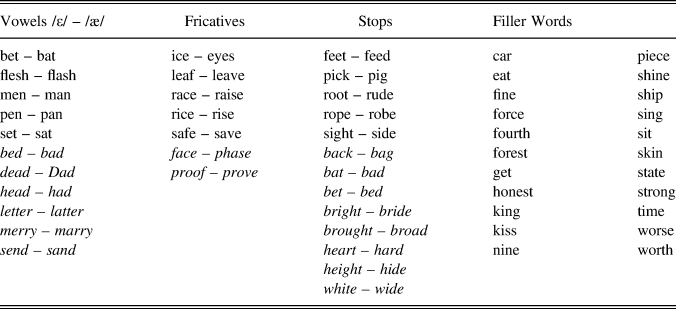
Thirty-one English minimal word pairs were selected that differed in sound contrasts that have been shown to cause problems for German learners in production and perception (Llompart & Reinisch, 2017; Smith et al., Reference Smith, Hayes-Harb, Bruss and Harker2009). Eleven minimal pairs were chosen to differ in the vowel contrast /ε/–/æ/, seven pairs in the word-final voicing contrast in fricatives, and 13 pairs in the word-final voicing contrast in stops. Within each pair, one word contained sounds that had been shown to be “easy” for German learners. These were the /ε/ in words such as pen, and the word-final voiceless stops or fricatives in words such as pick or rice. The other word of the minimal pair contained a sound that had been shown to be “difficult” for German learners. These were the vowel /æ/ like in pan and word-final voiced stops or fricatives, such as in the words pig or rise. As described in the introduction, the labels “easy” and “difficult” were based on whether the critical sounds occur in the German sound inventory (German does not have the vowel /æ/) and in the given word position (German word-final phonologically voiced obstruents are canonically produced as devoiced). Words containing either an easy or a difficult sound will be henceforth termed easy or difficult word, respectively. An additional 22 words were selected to serve as fillers for the recording session. Words are listed in Appendix A.
For the recordings, all words were randomly assigned to 1 of 10 semantically neutral carrier sentences such as The next word is .... Target words were always in the sentence final position. The order of words was randomized with the restriction that the words of a minimal pair could not follow one another. Each word was repeated twice for a total of 160 sentences.Footnote 3
Twenty-four femaleFootnote 4 German learners of English were recorded of which later a subset was selected to represent a range of different proficiency levels. Speakers were recruited according to the same criteria as reported in the preceding Participants section, but none participated later in the main accent-rating experiment. Speakers were instructed in English and asked to read out the entire sentence at a comfortable pace. The sentences including the target word were presented one by one on a screen. The recordings were made in a soundproof recording room using a diaphragm microphone (Neumann Microphone, type TLM 103) and Speechrecorder software (Draxler & Jänsch, Reference Draxler, Jänsch, Lino, Xavier, Ferreira, Costa and Silva2004), which stored each sentence as a separate wav file on a computer.
A subset of speakers was selected to form a representative sample of different proficiency levels, four speakers per group A, B, or C (A = best, B = intermediate, C = worst). The assignment was done separately for each sound contrast and based on how well a given speaker had produced a given critical sound contrast. To assess this production “quality” and to select speakers, acoustic analyses were conducted on the productions of all speakers.
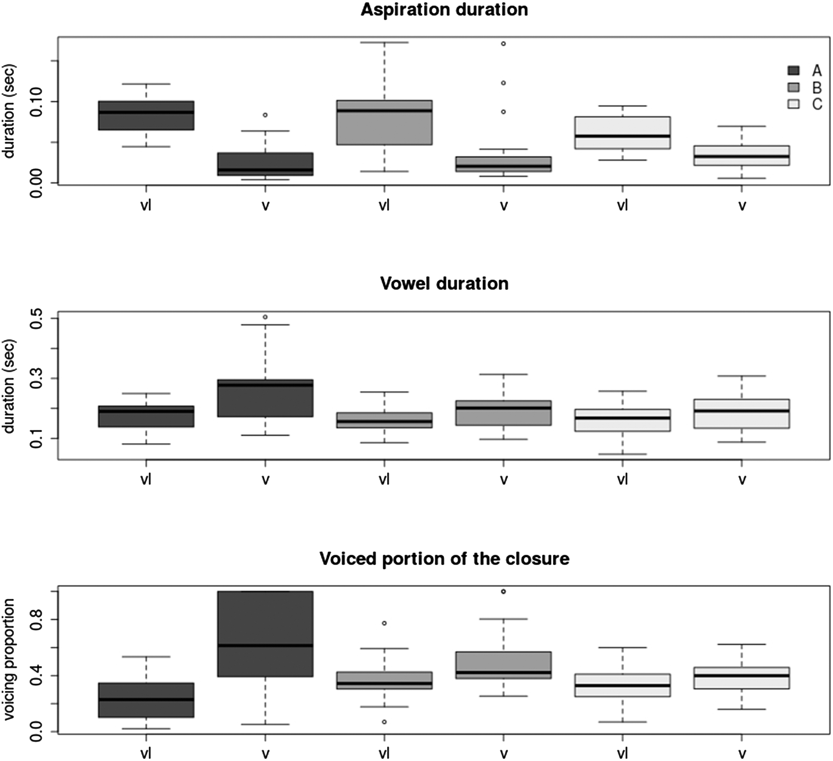
Several acoustic measures were taken for all 24 speakers for each sound contrast using Praat (Version 5.4.08; Boersma & Weenink, Reference Boersma and Weenink2015). For the vowels, these were the first two formants and duration; for the word-final fricatives, these were the duration of the preceding vowel and the duration of the fricative (combined as vowel duration divided by fricative duration), and the voiced portion of the fricative; and for the word-final stops, the duration of the aspiration, the duration of the preceding vowel, and the voiced portion of the closure. These acoustic measures were selected because they have been shown to be the most important cues to the respective contrast for native speakers and listeners of English (see, e.g., Deterding, Reference Deterding1997; Hillenbrand, Getty, Clark, & Wheeler, Reference Hillenbrand, Getty, Clark and Wheeler1995, for the vowels; e.g., Broersma, Reference Broersma2010; Wright, Reference Wright, Hayes, Kirchner and Steriade2004, for the fricatives; e.g., Barry, Reference Barry1979; Smith et al., Reference Smith, Hayes-Harb, Bruss and Harker2009, for the stops). A good contrast was defined as a large difference between the means of the acoustic measures for the two categories across words. Cues to each contrast were weighted in the order named in the preceding text. First, tokens of the eight speakers who had produced the clearest contrasts of the learners were assigned to group A. Then, the eight speakers with the smallest produced contrasts were assigned to group C. The remaining eight speakers were assigned to group B. Because this assignment was done separately for each sound contrast and to reduce the overall number of speakers for the perception experiment, a subset of four speakers per contrast per proficiency group was selected. Overall, productions from 13 different speakers were included (i.e., one speaker could be used for more than one sound contrast).
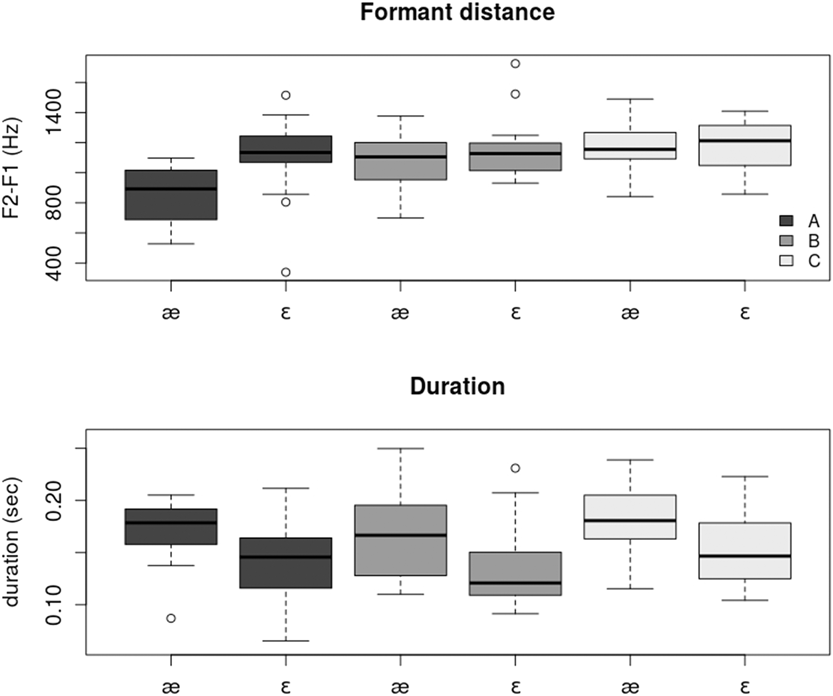
Note that in the remainder of the article we will refer to the variable of speaker proficiency with the label “material” to not confuse it with proficiency of the listeners in the perception task. Material has the levels A, B, and C, where A tokens had been produced most clearly (i.e., larger mean differences and more cues to differentiate the words of the minimal pair), and C tokens showed only a small mean difference and more overlap between the words of the minimal pairs. Tokens from set B were intermediate. The main acoustic measures for each type of contrast and the three material sets can be seen in Figures B.1 through B.3 in Appendix B.
DESIGN
For the goodness rating task, the words of the minimal pairs spoken by the selected speakers were spliced out of the carrier sentences to be presented in isolation. To further reduce the number of trials presented in the experiment, one of the recorded repetitions per word and only five word pairs per contrast type were selected (see Appendix A). The selection proceeded as follows: First, words with other difficult sounds than the critical contrast were excluded (e.g., words with the contrast /ε/-/æ/ that happened to end in a voiced obstruent). Second, words were excluded for which more than two of the speakers indicated that they did not know the meaning (as assessed in a questionnaire after the recordings). The final set of stimuli consisted of 2 words × 5 pairs × 3 sound contrasts × 4 speakers per contrast × 3 speaker groups (material sets A, B, and C) for a total of 360 trials and was the same for all listeners.
PROCEDURE
The English listener group participated at the University of California, Berkeley, in the United States. The German listener groups participated at the University of Munich in Germany. All participants received written instructions in English. For the Germans, this was to set them into an English language mode without influencing their perception by talking to them with a specific accent. The written instructions, the material, and the procedure were the same for both listener groups.
Participants were seated in a soundproof booth in front of a laptop computer. On each trial, they saw one word of the minimal pair in orthographic form in the middle of the computer screen and below a five-point scale with the labels “very good” and “very poor” at the end points. After 300 ms the target word was presented over headphones at a comfortable listening level. The participants’ task was to indicate how well the word was pronounced by pressing one of the number keys from 1 to 5 on a standard computer keyboard. Five hundred ms after the response was recorded, the next trial started automatically. All words in the perception task formed minimal pairs with another word according to one of the three critical sound contrasts. However, at any given trial throughout the experiment only one word was presented at a time auditorily and orthographically. The written word always matched the intended form of the spoken word (i.e., it matched the word that speakers had read during the recordings). For half of the participants in each group the response key 1 was labeled “very good” and 5 “very poor,” whereas for the other half the labels were reversed. The numbers of the scale were always ordered from left (1) to right (5). The words were presented in randomized order, and every 60 trials participants were allowed to take a self-paced break. The experiment was implemented in PsychoPy2 (Version 1.83.01; Peirce, Reference Peirce2007) and took approximately 15 minutes to complete.
ANALYSIS
All statistical analyses were conducted in R (Version 3.3.2, R Core Team, 2017) using the lme4 package (Bates, Mächler, Bolker, & Walker, Reference Bates, Mächler, Bolker and Walker2015) with linear-mixed effects regression models. Mixed models have been shown to be preferable over traditional analyses of variance (ANOVA) in designs such as ours that have repeated measures over participants and items. They are less susceptible to Type I errors in such cases (Quené & van den Bergh, Reference Quené and van den Bergh2008). Random effects take into account that participants and items may differ idiosyncratically and, by estimating participant and item idiosyncrasies, they also allow an estimate how likely it is that the same result would be obtained if the experiment was repeated with different participants and items. Random effects subsume random intercepts and random slopes. Random intercepts estimate to what extent a given participant or item provided ratings above or below average, while random slopes capture differences in the sensitivity to fixed-factor effects (e.g., to what extent pronunciation ratings for an item are strongly or weakly influenced by the acoustic realization of the contrast; see, e.g., Baayen, Davidson, & Bates, Reference Baayen, Davidson and Bates2008; Barr, Levy, Scheepers, & Tily, Reference Barr, Levy, Scheepers and Tily2013; Field, Miles, & Field, Reference Field, Miles and Field2012, for more detailed discussions of mixed-effects models).
For the present analyses, two such linear mixed-effects models were run, one for analyzing the responses of the American listeners and one for the German learners. The dependent variable was the rating for a given word from a given speaker, recoded so that “1” always indicates that listeners rated the pronunciation of the presented word as “very poor” and “5” as “very good” with 2, 3, and 4 as intermediate steps. This rating was used as the dependent variable in both models.
For the model of the native listeners we analyzed two variables of interest and their interaction: sound type, which referred to the “easy” (coded as 0.5) versus “difficult” (coded as -0.5) sound within a given sound contrast, and material. The latter referred to how well the contrast had been produced according to the acoustic measures discussed in the preceding text (see also Appendix B). Material had three levels A, B, and, C (A = largest contrast/best production, B = intermediate, C = smallest contrast/worst production) that were coded as numeric with A = 0.5, B = 0, and C = -0.5. For the analysis of the German learners’ responses, listener proficiency was added as a third variable of interest along with all interactions with the other factors. Proficiency was calculated for each participant as the mean of five self-ratings from the questionnaire (on a scale from 1 to 7; see preceding Participant section). For the statistical analysis and Figure 1, these values were centered on the group mean and recoded so that they conform to a “higher-is-better” model of evaluations. With this coding, the grand mean is mapped onto the intercept, and effects and interactions can be interpreted similar to traditional ANOVA.
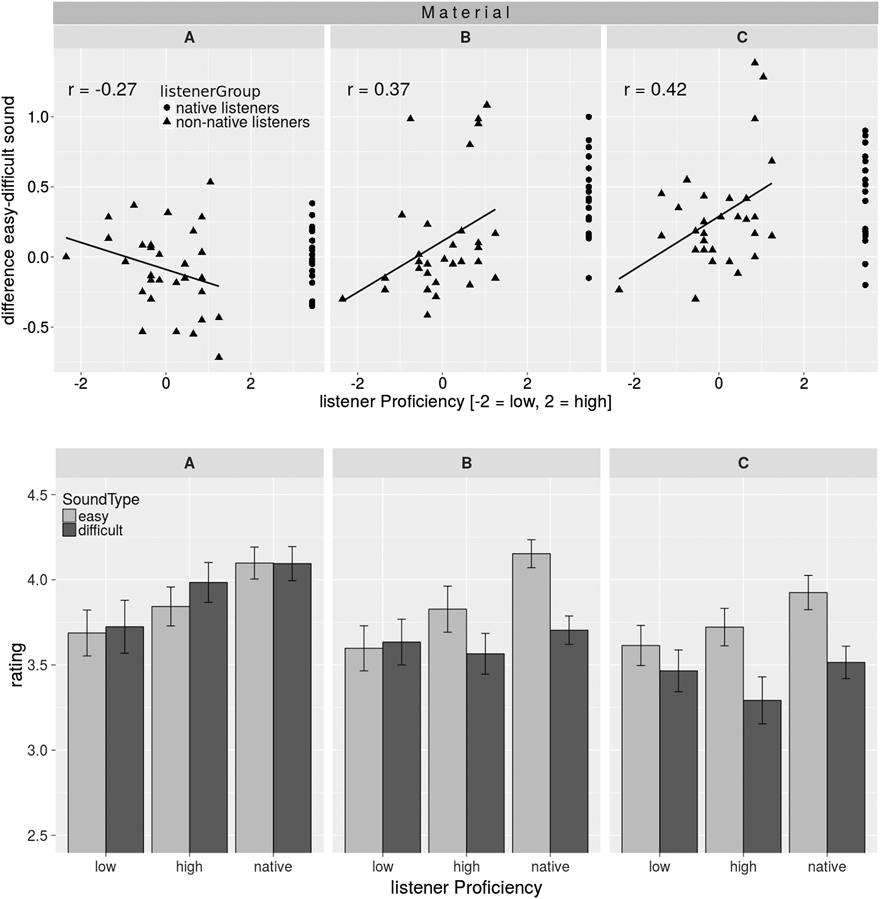
Means of listeners’ ratings from 1 (very poor) to 5 (very good) presented in a scatter plot (upper panels) and in a bar plot (lower panels). In the upper plot, the difference between ratings for easy and difficult sounds is shown for the three material sets (A, B, C), for the range of listener proficiencies (-2 = low, +2 = high), and the native listeners at the very right. In the lower plot, the mean of listeners’ ratings is shown for the three material sets and for the two sound types (easy, difficult) separately. Here, listeners are grouped into low-proficiency German (left), high-proficiency German (mid), and American (“native,” right). The German listeners are assigned to one of two proficiency groups by a mean split. Note that only the range from 2.5 to 4.5 of the responses is shown to better illustrate differences. Error bars represent 1 standard error and were adjusted for within-participant factors (see Morey, Reference Morey2008).
The random-effects structures for both models included random intercepts for participant and word (i.e., item) with random slopes for all fixed factors and their interactions that were manipulated within participants and items, respectively (Barr et al., Reference Barr, Levy, Scheepers and Tily2013; i.e., within participant: sound type and material, within item: material and proficiency in the case of the learner model).
To illustrate the statistically significant effects and interactions for the native listeners and the learners, as well as a descriptive comparison between the two listener groups, two types of plots are presented in Figure 1. The three panels from left to right show listeners’ ratings for the three material sets A, B, and C. While the scatter plots in the upper panels focus on effects and interactions involving listener proficiency, the bar plots in the lower panels zoom in on the effect of sound type.
The y-axis in the upper panels (scatter plots) indicates the difference between the ratings for the easy and the difficult words. That is, the higher the value the better the easy words were rated compared to the difficult ones. A value of zero means that both were rated as equally good. Hence, an effect of sound type would be reflected in values that differ from zero. The x-axis in the upper panels indicates the proficiency of the learners with native listeners added at the very right. As for the analyses, the learners’ proficiency values are centered with higher values indicating higher proficiency. Additionally, regression-coefficients were calculated for the German learners for each material set to estimate the strength of the interactions between listener proficiency and sound type. Note, however, that these were calculated using linear regression for each of the material subsets and without adding random effects (i.e., using the lm() function in the package “stats” in R; R Core Team, 2017). The coefficients are given in Figure 1.
The y-axis in the lower panels (bar plots) shows the mean ratings for the easy and difficult words with the factor sound type indicated in light versus dark colored bars. Here the effect of sound type across material sets can be appreciated more directly than in the upper panels. However, for this illustration listener proficiency has been collapsed into poor learners, good learners, and native listeners. The German learners were grouped by a mean split (i.e., what would amount to value zero in the top panels).
RESULTS
NATIVE LISTENERS
A first overall model was fitted for the American listeners with the factors sound type and material, and interactions between them. This model served as a “baseline,” to test our basic assumption that easy words are rated as better than difficult words and that this may depend on the overall quality of the production.
Results show a significant effect of sound type suggesting that American listeners rated easy words better than difficult words (b = 0.29, SE = 0.12, df = 35.25, t = 2.45, p < .05; b Intercept = 3.92, SE = 0.10, df = 33.80, t = 39.60, p < .001). Furthermore, there was an effect of material (b = 0.38, SE = 0.08, df = 30.54, t = 5.00, p < .001) and a significant interaction between sound type and material (b = -0.41, SE = 0.16, df = 33.05, t = -2.61, p < .05). Because the variable material was coded as numeric with 0.5 for set A, the positive regression weight indicates that the better the tokens, the better ratings were given by the American listeners. The interaction indicates that the effect of sound type (better ratings for the easy than the difficult words) was larger the worse the material set (in material sets B and C). This interaction is clearly visible in Figure 1. In the upper panels, the difference between easy and difficult sounds in material set A is centered around zero (no difference between easy and difficult sounds) but clearly positive for sets B and C (i.e., the easy sounds were rated better). The separate ratings for easy and difficult words and their interaction with material are also illustrated by the bars in the lower panels. The results of this first model hence confirm that the assignment to material sets according to acoustically measured cues is reflected in the native listeners’ ratings. As expected, native listeners perceived the accent stronger in the difficult than easy words. This effect becomes larger from the well to the poorly produced tokens, where the cues are less differentiated (from set A to set C).
GERMAN LEARNERS
The statistical model for the learners included the fixed factors sound type, material, listener proficiency and all interactions. Statistics are reported in Table 1. There was no significant effect of sound type, but a significant effect of material indicating that the better the tokens, the better ratings the German listeners gave. However, material was involved in several interactions. First, as for the native listeners there was an interaction between sound type and material. Looking at Figure 1 it can be seen in the upper panels that the difference between easy and difficult sounds is approximately centered around zero for material set A (i.e., no difference) but moves toward positive values, that is, a larger difference, as the material gets worse (i.e., toward C).
Results of the mixed-effects model fitted with sound type, material, listener proficiency, and their interactions for the German learners
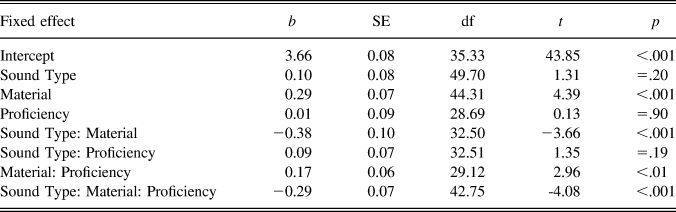
Importantly, the effect of material as well as the interaction between material and sound type was further modulated by listener proficiency, as indicated in the two-way interaction between material and proficiency and the three-way interaction between all three factors. The two-way interaction suggests that overall worse ratings were given from material sets A to C the higher the listeners’ proficiency. The three-way interaction suggests that the difference in ratings between easy and difficult sounds across material sets also depended on listeners’ proficiency. This is illustrated in the scatter plots (upper panels of Figure 1) showing little change in the difference between easy and difficult sound as proficiency increases in material set A (with a nonsignificant correlation in the opposite-than-expected direction). However, the difference in ratings for easy versus difficult sounds increases the higher proficient the learners as we move to material sets B and C. This observation is confirmed by the regression-coefficients for interactions shown in the scatter plots, with a stronger correlation in material C compared to B. The bar plots in the lower panels of Figure 1 give a more direct impression of the effect of sound type across learners and material sets. As can be clearly seen from both types of plots as well as the direction of statistically significant effects, the higher proficient the German learners the more they pattern with the native speakers.
DISCUSSION
The aim of the present study was to test how German learners of English judge the accent in English words spoken by other German learners, and whether they perceive accented productions as more acceptable instances of the intended English words than native English listeners do. This question was motivated by the observation that L2 learners often understand foreign-accented speech just as well as nonaccented speech, and in some cases, they also have an advantage over native listeners in understanding accented speech (e.g., Bent & Bradlow, Reference Bent and Bradlow2003; Hayes-Harb et al., Reference Hayes-Harb, Smith, Bent and Bradlow2008; Imai et al., Reference Imai, Flege and Walley2003). This benefit has been argued to result from shared phonetic and phonological knowledge about the speaker’s first language. If, in addition, learners are frequently exposed to the L2 spoken with their L1 accent, accented productions may be picked up as possible variants to the intended words (Flege & Fletcher, Reference Flege and Fletcher1992). If this was the case, words spoken with a foreign accent typical of the learners’ own L1 should not only be as intelligible, but also as acceptable as nonaccented productions. L2 learners may hence be less “sensitive” to differences in L2 productions than native speakers: specifically to differences between easy versus difficult sounds and, more generally, to differences in the quality of the productions. These hypotheses were tested with a group of German learners of English along a range of proficiencies who were asked to rate English words containing easy versus difficult sounds spoken by other German learners of varying proficiency. The same type of ratings was obtained from a group of native English listeners from the United States.
There were two main findings. First, the more proficient German learners of English are, the more sensitive they are to different degrees of accent in L2 productions of speakers of the same L1. This was the case for differences in easy versus difficult sounds, as well as the overall quality of the tokens. Second, the higher the proficiency of the learners, the more similar their behavior is to the native listeners. Reversely, the less proficient learners are, the less sensitive they appeared to the strength of the accent in productions of learners with the same L1.
Note that our factor “proficiency” was determined based on five dimensions from a questionnaire (see Method section) that focused on self-rated oral proficiency as well as self-reported frequency of use. The differences between learners could hence not be accounted for by factors such as length of learning or amount of instruction because all learners received instruction at school but not ever since then. Rather our proficiency variable was defined based on L2 use and included experience and practice of the L2 at the time of the experiment. Specifically, the more proficient learners also reported being regularly exposed to native English through television and the Internet. The experience of learners with less frequent exposure was more likely to be limited to the lessons they had at school where their exposure was primarily to German-accented English.
In addition to testing listener proficiency, the present study set out to systematically test effects of the L2 material that listeners had to judge. Note that most previous studies either focused on the learners’ accents as rated by native listeners (Flege, Munro, & MacKay, Reference Flege, Munro and MacKay1995; Guion, Flege, & Loftin, Reference Guion, Flege and Loftin2000; but see Munro et al., Reference Munro, Derwing and Morton2006) or they focused on how well learners understand native English forms (Broersma, Reference Broersma2012; Weber & Cutler, Reference Weber and Cutler2004; but see Bent & Bradlow, Reference Bent and Bradlow2003; Hayes-Harb et al., Reference Hayes-Harb, Smith, Bent and Bradlow2008; Weber et al., Reference Weber, Broersma and Aoyagi2011). The material we used were words in isolation, specifically minimal pairs that differed in one critical sound contrast. In this way, the assignment of tokens to material sets could be based on acoustic measures. Importantly, results showed that differences according to these measures are reflected in the native listeners’ ratings. Moreover, also learners showed sensitivity to the difference between easy and difficult sounds and to different degrees of accent (i.e., material), but this depended on their proficiency in the L2 (i.e., the three-way interaction). While higher-proficiency participants with more self-reported experience with native English patterned similar to the natives, participants with lower proficiency appeared to perceive little difference between the quality of productions.
We hypothesized that this could have at least two possible sources: The lower-proficiency listeners may not perceive the accent in the speakers’ productions because the accent is based on an L1 phonology that corresponds to their own—as has been suggested for the interlanguage intelligibility benefit (Bent & Bradlow, Reference Bent and Bradlow2003). Alternatively or additionally, due to frequent exposure to the L1 accented forms, listeners became used to accented pronunciation and therefore accept the accented forms as a reasonably good match to their reference representations.
Being asked what a speaker says, learners have repeatedly been shown to have less difficulties at understanding accented L2 speech compared to native listeners of the target language (e.g., Bent & Bradlow, Reference Bent and Bradlow2003). However, in the present study learners had to explicitly rate how well a word was pronounced, which was known to the listeners as provided in its orthographic form. Whereas familiarity with a certain noncanonical pronunciation may be advantageous in a transcription or listening comprehension task, it may appear as a disadvantage when being asked to judge the strength of the accent. This may be because a “good” match could possibly be found even if the pronunciation differed from how a native speaker would produce the word: Learners have frequently heard accented variants. The finding that lower-proficiency learners appear to show no sensitivity to accent differences in other learners’ productions, but higher-proficiency learners do, hence goes with the assumption that the less proficient learners are, the less nativelike their representations of L2 words are. This finding is also in line with studies indicating that the interlanguage intelligibility benefit holds only for low-proficiency learners (e.g., Hayes-Harb et al., Reference Hayes-Harb, Smith, Bent and Bradlow2008; Pinet, Iverson, & Huckvale, Reference Pinet, Iverson and Huckvale2011; van Wijngaarden, Steeneken, & Houtgast, Reference van Wijngaarden, Steeneken and Houtgast2002; Xie & Fowler, Reference Xie and Fowler2013). For instance, Hayes-Harb et al. (Reference Hayes-Harb, Smith, Bent and Bradlow2008) found a shared-L1 benefit for Mandarin learners of English only for low-proficiency listeners and if the material was produced by low-proficiency speakers. An acoustic analysis of the tokens that caused the largest benefit for low-proficiency listeners over native listeners revealed that the benefit has presumably been caused by a differential use of cues to the specific contrast (the word-final voicing contrast in stop consonants, which does not exist in Mandarin Chinese). Whereas native listeners were misled by the way the L2 speakers had produced the contrast, low-proficiency listeners of the same L1 interpreted the cues in the same nonnative way as the speakers, resulting in better recognition. The finding that this was true only for the low-proficiency listeners may indicate that the learners’ representations are—at this stage of L2 acquisition—mainly shaped by their L1 accent. The more experience learners get with native cues to difficult L2 contrasts the closer their cue weighting may become to native speakers (though they may never fully match; Schertz et al., Reference Schertz, Cho, Lotto and Warner2015, Reference Schertz, Cho, Lotto and Warner2016). Also in the present study, the high-proficiency learners were sensitive to differences in acoustic characteristics of the accent, similarly to native listeners. The low-proficiency learners, by contrast, may have had advantage in word recognition due to a typically nonnative use of cues, and hence appeared “accent-deaf” when explicitly judging second language speech with accent that matches their L1.
More specifically, the lower-proficiency learners have likely established a representation of the target words that is somewhat “fuzzy” especially regarding difficult sound contrasts (e.g., Darcy, Daidone, & Kojima, Reference Darcy, Daidone and Kojima2014; Weber & Cutler, Reference Weber and Cutler2004; see, e.g., Cutler, Reference Cutler2015, for an overview). This fuzziness could be the result of difficulties in perceiving new L2 contrasts (Best & Tyler, Reference Best, Tyler, Bohn and Munro2007; Flege, Reference Flege and Strange1995). Additionally, due to poor L1 accented input, representations are likely to be shaped in an even more nonnative way. Therefore, the mapping from the accented or native L2 signal is usually a good match.
Because the present study used an explicit goodness rating task with single words, the results could suggest that the inexperienced learners are less aware of an accent that corresponds to their first language than listeners with more practice in their L2. This interpretation is in line with previous studies using other types of material, for example, Munro et al. (Reference Munro, Derwing and Morton2006) who showed that Japanese learners rated narratives in English produced by Japanese learners as less accented than English native listeners did. Reduced awareness may be one consequence of being mainly exposed to accented pronunciation variants. However, the awareness of accent may be one important factor in L2 pronunciation.
As concerns development in a second language, our results suggest that with more language experience and native input, representations of L2 words become more nativelike. That is, even though learners may still be used to the accent of their L1 they are able to establish more targetlike representations to which the accented input can be compared. Note that this development is expected and necessary because in many classrooms nonnative teachers have to grade students’ productions. However, despite our finding that learners’ behavior becomes more nativelike with increasing L2 proficiency, the present results are not sufficient to tell how this transition from less to more experienced would proceed. Note also that L2 models assume that learners are able to change over time but leave the exact mechanisms for future research. A quantification of how much input is necessary for developing new or more targetlike representations, however, is not trivial. A number of studies showed that additional information about differences between difficult L2 categories may help learners to start developing separate representations of these L2 sounds. This additional information can either be explicit instruction (such as corrective feedback, e.g., Saito & Lyster, Reference Saito and Lyster2012; Thomson, Reference Thomson2012; for an overview see Derwing & Munro, Reference Derwing and Munro2015, chapters 5 and 7) or when learning new words at a more advanced stage even implicit, for example, orthographic information or visible articulation (e.g., Escudero, Hayes-Harb, & Mitterer, Reference Escudero, Hayes-Harb and Mitterer2008; Llompart & Reinisch, 2017). Future work will have to show how a combination of native-accented input, (meta)knowledge about L2 categories, and awareness of a foreign accent influence how learners’ abilities develop in a second language.
CONCLUSION
The present study showed that the more proficient and experienced L2 learners are in their second language the more sensitive they become to accent in L2 words produced by other learners of the same L1. They thereby appear to rely on similar acoustic cues as native listeners by specifically differentiating the production quality of easy versus difficult sounds, that do not occur in their L1, and by differentiating different degrees of accent. Unlike that, listeners whose experience with spoken English is more limited to speech produced by speakers of the same L1 are more likely to accept accented productions as good instances of L2 words. We suggest that with more native input, representations can become less “accented” and more targetlike. However, future research will have to show how learners can break out of the circle of perceiving the L2 through their L1 filter and compare new input to accented representations. The ability to explicitly judge how well a word was pronounced may be one important aspect to start a change.
APPENDIX
APPENDIX A
Words and word pairs that were recorded in the production session. In the minimal pairs, the word after the dash is the one containing the critical difficult sound. All words used in the experiment are monosyllabic. The words in italics were recorded and acoustically analyzed but excluded from the materials for the perception experiment. The filler words were recorded to distract the speakers from the purpose of the study, but they were not further analyzed.
APPENDIX B
The following figures show a selection of acoustic measures that had been used to determine the produced difference between the words of the minimal pairs. Tokens were assigned to material sets A, B, or C for each type of contrast according to different acoustic measures (see text for details). The variability in the boxes is due to interspeaker differences (four speakers per group) and to the different words (five words per category and contrast).
Upper Panel: Formant values measured as the difference between F2 and F1 in Hz during a stable segment in the vowel for words with either /æ/ or /ε/ for the German learners grouped into three groups of four (dark gray = group A, mid-gray = group B, light gray = group C); Lower Panel: Duration values of the entire vowel for words with either /æ/ or /ε/ and the different groups.
Upper Panel: Vowel/consonant ratios measured as the duration of the vowel divided by the duration of the consonant in words ending in voiced (v) or voiceless (vl) fricatives for the German learners grouped into three groups of four (dark gray = group A, mid-gray = group B, light gray = group C); Lower Panel: Voiced portion of the fricative measured as the duration of the voiced part of the fricative divided by the total duration.

Top Panel: Aspiration duration for words ending in either voiced (v) or voiceless (vl) stops for the German learners grouped into three groups of four (dark gray = group A, mid-gray = group B, light gray = group C); Mid-Panel: Duration of the preceding vowel. Bottom Panel: Voiced portion of the closure measured as the duration of the voicing during closure divided by the total closure duration. As all other words, words containing a word-final stop were embedded in the end of carrier sentences. All word-final stops were produced as released stops.