


Introduction
The Upper Palaeolithic period of the Judean Desert region is known from several cave sites and rockshelters. Excavations conducted in the early part of the twentieth century by Rene Neuville (Reference Neuville1951) revealed Upper Palaeolithic occupations at the sites of A-Taban (stratum B), Erq el-Ahmar (strata F–B) and el-Khiam (strata F–E) (Figure 1). Neuville's (Reference Neuville1934) studies of the stratigraphic compositions and lithic assemblages of these sites defined a linear sequence composed of six chrono-cultural stages for the Judean Desert Upper Palaeolithic.
Location of the Nahal Rahaf rockshelter and Upper Palaeolithic sites in the region. Credit: Michal Birknefeld, Israel Antiquities Authority.

Discovery of new Upper Palaeolithic sites in the Negev and Sinai regions in the 1970s–1980s led to a redefinition of the geographic distribution and cultural terminology of the Levantine Upper Palaeolithic (Gilead Reference Gilead, Cauvin and Sanlaville1981; Marks Reference Marks, Cauvin and Sanlaville1981). Accordingly, the Upper Palaeolithic of the Levant contained several traditions (i.e. the Emirian, Ahmarian, Aurignacian), some of which were contemporaneous such as the Ahmarian and the Aurignacian (see Gilead Reference Gilead1991).
The new terminology incorporated and reassigned Upper Palaeolithic sites in the Judean Desert to the new cultural affiliations (Gilead Reference Gilead1991: tab. I). Nonetheless, some of the assigned assemblages from the Judean Desert appear to be mixed as they contain techno-typological elements characteristic of several Upper Palaeolithic entities. For example, the assemblages from Erq el-Ahmar D–B (Gilead Reference Gilead1991: tab. I), which were conceived as Aurignacian, contain straight blades that are characteristic of the Ahmarian (Neuville Reference Neuville1951: figs 44–45 & 48). This is not surprising as Neuville's excavation was not recorded in detail; sediments were not sieved, plans were general and not all recovered artefacts were archived. In addition, the lack of an absolute chronology and the paucity of information regarding the nature of the palaeoenvironment makes it difficult to compare the Judean Desert sites to neighbouring regions and to integrate them accurately within the Upper Palaeolithic chrono-cultural sequence.
Investigations of the Upper Palaeolithic period in the arid regions of the Negev, Sinai and south Jordan indicated the presence of Emirian and Ahmarian sites (e.g. Bar-Yosef & Philips Reference Bar-Yosef and Phillips1977; Marks Reference Marks1983; Coinman & Henry Reference Coinman, Henry and Henry1995; Fox Reference Fox, Goring-Morris and Belfer-Cohen2003; Kadowaki & Henry Reference Kadowaki, Henry, Nakamura, Adachi and Abe2019). Some scholars also suggest the presence of Aurignacian sites in this region based on lithic characteristics, despite the fact that they were lacking the bone and antler industries, shell beads, and diagnostic artefacts that characterise the Aurignacian in the Mediterranean woodland region (Gilead Reference Gilead, Cauvin and Sanlaville1981; Marks Reference Marks, Cauvin and Sanlaville1981). Comprehensive lithic study by Williams (Reference Williams, Goring-Morris and Belfer-Cohen2003) confirmed the presence of Aurignacian characteristics in the desert assemblages (i.e. carinated endscrapers and burins, curved-twisted blades and bladelets). Still, differences in technology and chronology separate the Negev assemblages into distinct facies initially defined as ‘the carinated industry’ and later termed the ‘Arqov-Divshon’ Culture (Belfer-Cohen & Goring-Morris Reference Belfer-Cohen, Goring-Morris, Enzel and Bar-Yosef2017).
The Arqov-Divshon is understood to be a regional variant, restricted mainly to the Negev Desert, but it also extends beyond the Rift Valley into southern Jordan. Its absolute chronology is not clear, and it is currently assumed to post-date the Ahmarian in the Negev (Belfer-Cohen & Goring-Morris Reference Belfer-Cohen, Goring-Morris, Enzel and Bar-Yosef2017). As yet, this industry has not been identified in the Judean Desert, despite its geographic proximity to the Negev.
Nahal Rahaf 2 rockshelter
Nahal Rahaf 2 is located in the southern Judean desert, approximately 50km south of el-Khiam terrace (Figures 1–2). The site was discovered in 2017 during a geomorphological study in the Nahal Rahaf basin. A geological trench dug into fluvial sediments revealed archaeological layers that included Upper Palaeolithic flint tools, animal bones and charcoal remains in an excellent state of preservation. Following its discovery, the site was test-excavated to define its stratigraphy and cultural affiliation/s, as well as to obtain Late Pleistocene faunal remains.
The rockshelter of Nahal Rahaf 2, showing a view to the north. Credit: Omry Barzilai, Israel Antiquities Authority.

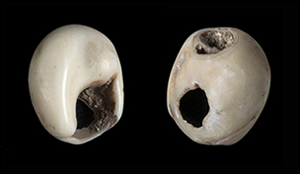
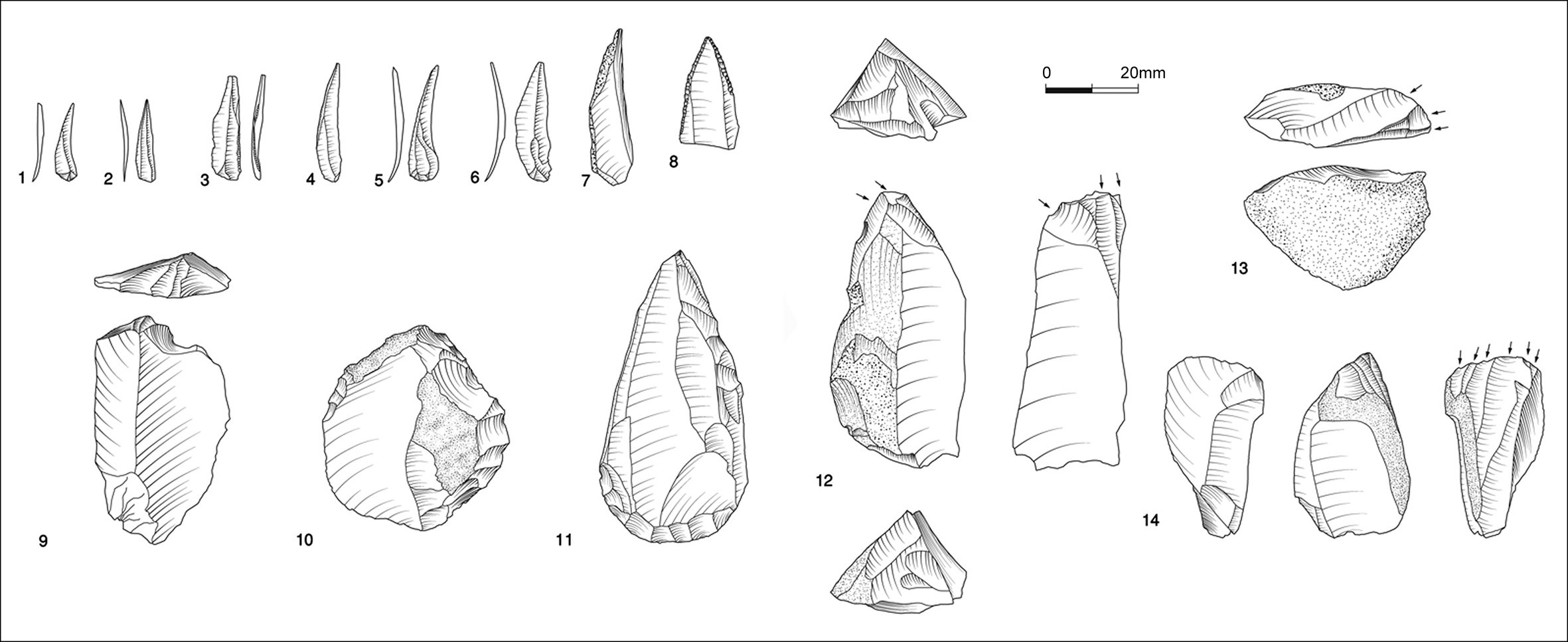
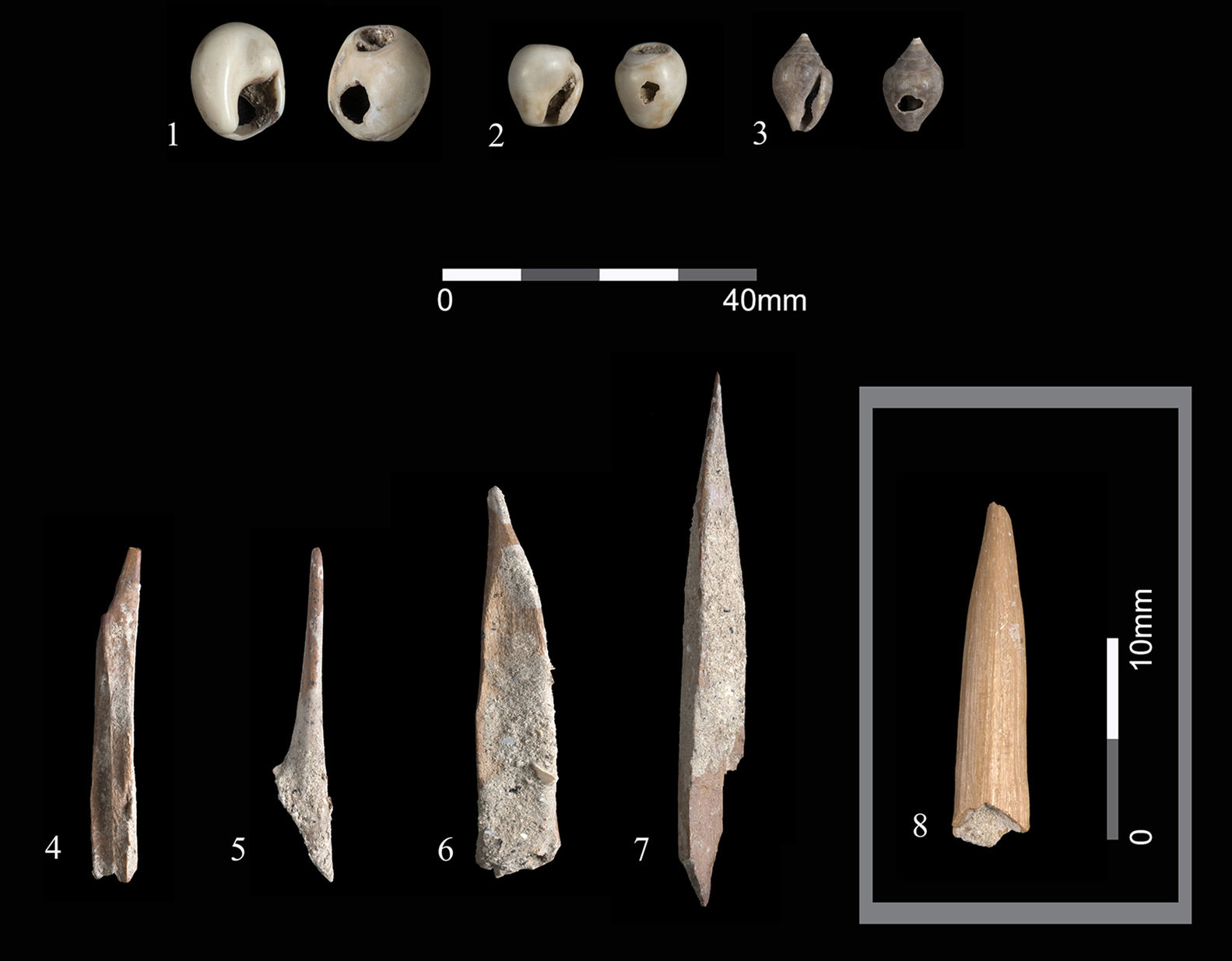
Eight sedimentological layers were exposed in a deep sounding dug in the centre of the rockshelter (Figure 3): layers 1–2) modern dung layers; layer 3) a pit; layer 4) rock falls covered by fluvial flood sediments; layers 5–8) rich archaeological layers containing Upper Palaeolithic lithic artefacts, faunal remains, charcoals and shells. The lithic assemblages from layers 5–8 are characterised by the production of twisted bladelets from laterally carinated items (Figure 4). Endscrapers, burins and retouched bladelets (including Dufour) are common among the tools. Bone tools, including awls, a point (possibly made of antler) and perforated shells, were found alongside the lithic artefacts (Figure 5). The faunal assemblages include caprines and gazelles, which are still extant in the region, but also equid, deer and antelope taxa, which are not. The caprines typically inhabit rocky, cliff-like habitats, while the deer, although rare, point to the relative proximity of a Mediterranean phytogeographic zone, which is today at least 25km distant. The other taxa are typical of grassland habitats that probably existed in the desert highlands on at least a seasonal basis when the site was occupied, and were utilised by its inhabitants for hunting.
A) Schematic plan of the rockshelter; B) the stratigraphic profile. Credit: Emil Aladjem and Maayan Shemer.

Lithic artefacts from layers 5–7: 1–6) curved and twisted bladelets; 7) el-Wad point; 9–10) endscrapers; 11) multiple tools; 12–14) carinated items. Credit: Sergey Alon, Ben-Gurion University.
1–3) Perforated shells: 1) Nassarius gibbosulus; 2–3) Columbella rustica; 4–8) osseous items: 4–7) awls; 8) point. Credit: Clara Amit, Israel Antiquities Authority.
Discussion
Upper Palaeolithic sites are mostly known in the northern part of the Judean Desert (Neuville Reference Neuville1951). To date, Upper Palaeolithic occurrences in the Judean Desert were affiliated with the Ahmarian (i.e. Erq el-Ahmar F–E) and Levantine Aurignacian (Erq el-Ahmar D & B; el-Khiam F) traditions.
Our preliminary work shows that the Nahal Rahaf 2 material culture shares characteristics with the Arqov-Divshon lithic industry of the central Negev (i.e. Ein Aqev, Arqov, Har Horesha), mainly evidenced by the presence of laterally carinated items and twisted bladelets.
The osseous and shell assemblages from Nahal Rahaf 2, however, associate the site with the Mediterranean woodland region during the Levantine Aurignacian (i.e. Manot and Kebara Caves) (Tejero et al. Reference Tejero, Yeshurun, Barzilai, Goder-Goldberger, Hershkovitz, Lavi, Schneller-Pels and Marder2016; Bar-Yosef Mayer Reference Bar-Yosef Mayer2019). Future excavations are expected to define in greater detail the Upper Palaeolithic of the Judean Desert and its relationship to the Central Negev and the Mediterranean regions during the last glacial period.
Acknowledgements
The excavation at Nahal Rahaf (permit G-30/2019) was directed by O. Barzilai and N. Marom. The fieldwork is supported by ERC-Stg 802752.



