





Non-technical Summary
Punctuated equilibrium is an essential concept in paleontology and evolutionary biology. Based on critiques of the idea, however, misconceptions about what “punk eek” does and does not connote are likely to be common. To better understand how scientists perceive punctuated equilibrium, we distributed an exploratory survey in which we asked undergraduate and graduate students and professionals working in these two fields how they use the concept in their research and teaching, and we then assessed how well they comprehend its core ideas. Survey takers agreed that punctuated equilibrium is important to both paleontology and evolutionary biology and should be taught, although most instructors spend no more than a week on the topic. The survey results also revealed potentially common misconceptions and some surprising inconsistencies in how practitioners think about punctuated equilibrium. We therefore developed a set of core “punk eek” ideas around which instructors can build lessons, and provide recommended resources and strategies to improve teaching about punctuated equilibrium. Working together, we can build a better shared understanding of this important concept in paleontology and evolutionary biology.
Introduction
Punctuated equilibrium is an essential concept in paleontology and evolutionary biology but remains controversial 50 years after it was first proposed (Eldredge Reference Eldredge1971; Eldredge and Gould Reference Eldredge, Gould and Schopf1972; Gould and Eldredge Reference Gould and Eldredge1977; Gould Reference Gould2002). In their 1972 paper, Eldredge and Gould devoted considerable space to a discussion of the difficulty that new explanations can have in gaining a foothold in the landscape of entrenched models. This difficulty is especially compounded when the observations used to create the new model are dismissed as trivial under the prevailing paradigm. With hindsight, this discussion now seems prescient. While many paleontologists and evolutionary biologists view punctuated equilibrium as foundational to modern paleobiology, forming the basis for quantitatively treating species as evolutionary entities, others still downplay its importance or dismiss it outright.
According to punctuated equilibrium sensu Eldredge and Gould, species persist through geologic time as relatively stable entities. During most of the stratigraphic range of a species, any change that occurs is small, random, and non-directional. When new species arise, they do so through regular Darwinian mechanisms of natural selection and allopatric (e.g., peripatric) speciation. Although such speciation events take time and may even be imperceptible on biological timescales, the process is very brief relative to the stratigraphic range of the species (typically taking no more than 1% to 10% of the species’ total range). Therefore, on geologic and evolutionary timescales, speciation events may be said to occur almost instantly. The result of punctuated equilibrium is a fossil record in which species originate at discrete moments, exist through long spans of time, potentially generate one or more new species by cladogenesis, and persist morphologically unchanged until their extinction.
The model of punctuated equilibrium gives properties to species that they did not have under previous evolutionary paradigms—stable persistence through time, discrete moments of “birth” and “death,” and a pattern of “reproduction” that can yield multiple distinct new “offspring.” Importantly, these are precisely the characteristics of organisms that make them potential loci of natural selection. It is therefore punctuated equilibrium that provides the theoretical basis for models of species selection and for quantitative paleobiology’s treatment of species as discrete evolutionary entities (Turner Reference Turner2010). In the 50+ years since Eldredge and Gould’s initial publications, these foundational paleobiological assumptions have been validated empirically through multiple case studies describing the punctuated equilibrium pattern in the fossil record of various taxa (Saito-Kato et al. Reference Saito-Kato, Tanimura, Mori and Julius2015; Gelfo Reference Gelfo2016; Spanbauer et al. Reference Spanbauer, Fritz and Baker2018; Gemmell et al. Reference Gemmell, Trewick, Hills and Morgan-Richards2020).
Despite these empirical vindications, punctuated equilibrium is not without its detractors (e.g., Pennell et al. Reference Pennell, Harmon and Uyeda2014; Gingerich Reference Gingerich2019; Hancock et al. Reference Hancock, Lehmberg and Bradburd2021). However, many of the common critiques of punctuated equilibrium are based on misinterpretations of the model. For example, Eldredge and Gould’s distinction between macroevolutionary and microevolutionary timescales has led to one of punctuated equilibrium’s most enduring critiques—that it is a model of evolution that requires change to happen at an accelerated rate and contrary to Darwinian precepts. These critiques paint punctuated equilibrium as being akin to the saltational models of evolution proposed by some geneticists and biologists at the height of the Modern Synthesis (e.g., de Vries Reference de Vries1905; Goldschmidt Reference Goldschmidt1940), and therefore as neither correct, nor even particularly original (e.g., see Hancock et al. Reference Hancock, Lehmberg and Bradburd2021). Although recent research has demonstrated some intriguing potential mechanisms for accelerated change during speciation events (Casanova and Konkel Reference Casanova and Konkel2020; Bakhtin et al. Reference Bakhtin, Katsnelson, Wolf and Koonin2021; Heasley et al. Reference Heasley, Sampaio and Argueso2021), the actual mechanics of punctuated equilibrium do not require macromutations, hopeful monsters, or any other leaps and bounds in either the genotypes or the phenotypes of individuals in a population. Rather, punctuated equilibrium is the extrapolation of standard Darwinian and Modern Synthesis models to this view of life and its history surveyed by paleontologists (Gould Reference Gould2002).
Punctuated equilibrium has long been misunderstood and neglected in the paleontology and evolutionary biology communities (Gould [Reference Gould2002: pp. 972–1024] provides a good review of critiques to that date; see also Lieberman and Eldredge [Reference Lieberman and Eldredge2014, Reference Lieberman and Eldredge2024] and Duran-Nebreda et al. [Reference Duran-Nebreda, Vidiella, Spiridonov, Eldredge, O’Brien, Bentley and Valverde2024] for more recent reviews, and O’Brien et al. [Reference O’Brien, Valverde, Duran-Nebreda, Vidiella and Bentley2024: fig. 2], which documents a decline in use of “punctuated equilibrium/equilibria” in the Google Books database over the last 20 years). This neglect is likely to be reflected in the classroom. Relatively little research has investigated how punctuated equilibrium is understood—or misunderstood—by practitioners or how it is taught (but see Alters and McComas Reference Alters and McComas1994). As former doctoral students of Stephen J. Gould and as educators, we were particularly motivated to assess our colleagues’ understanding of punctuated equilibrium and to encourage an accurate depiction of punctuated equilibrium in classrooms. As a note, our shared history as Gould students is also the reason that we use Gould’s preferred term of “punctuated equilibrium,” instead of Eldredge’s preferred “punctuated equilibria.”
In this study, we pursued four research questions: (1) How important do paleontologists and evolutionary biologists think punctuated equilibrium is to their field? (2) To what extent do paleontologists and evolutionary biologists use punctuated equilibrium in their own teaching? (3) How accurate are paleontologists’ and evolutionary biologists’ understanding of core ideas within the concept of punctuated equilibrium? (4) What aspects of punctuated equilibrium are more or less accepted by paleontologists and evolutionary biologists?
Methods
To address our research questions, we conducted a preliminary survey study to better understand how students and professionals within the fields of paleontology and evolutionary biology define and understand the concept of punctuated equilibrium and, if applicable, how they use it in their research and teaching.
Survey Instrument Development
Our survey instrument was created to collect data about respondents’ perceptions of punctuated equilibrium, the ways in which they engage with the concept, and the prevalence of commonly cited misconceptions about punctuated equilibrium. The survey instrument’s design was informed by the research literature on evolution education, including work by Nadelson and Southerland (Reference Nadelson and Southerland2012), Sbeglia and Nehm (Reference Sbeglia and Nehm2018), Barnes et al. (Reference Barnes, Dunlop, Holt, Zheng and Brownell2019), and Hartelt et al. (Reference Hartelt, Martens and Minkley2022), as well as our own experiences with teaching punctuated equilibrium. The survey items were created specifically by us for the present study.
We included eight questions about punctuated equilibrium. To assess respondents’ perception of the importance of punctuated equilibrium, respondents were asked to numerically rate the importance of punctuated equilibrium to their scientific field of study and the extent to which their own research involved punctuated equilibrium. We also asked respondents to indicate how important they felt it was for textbooks in their field to include coverage of punctuated equilibrium. To determine how punctuated equilibrium is being taught, we asked respondents in what percentage of courses they discuss punctuated equilibrium and the level at which those courses are taught, and how much time they devote to the topic. Time spent teaching about punctuated equilibrium was used as an indicator of the importance instructors placed on punctuated equilibrium within the body of knowledge being taught to future practitioners. We acknowledge that important concepts can be taught and learned over short time intervals; here our focus was on capturing how instructors prioritize punctuated equilibrium relative to other topics included in their course designs.
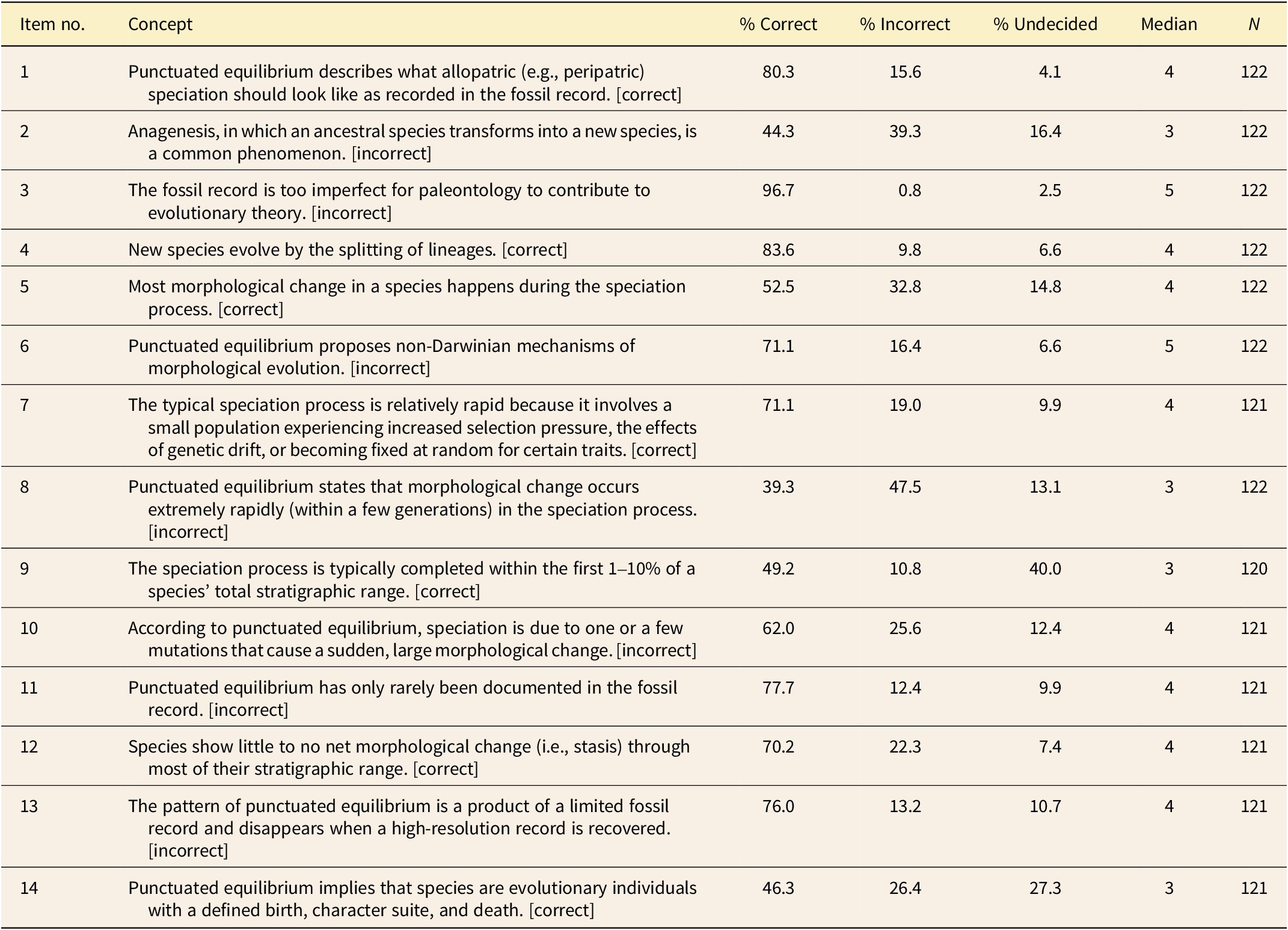
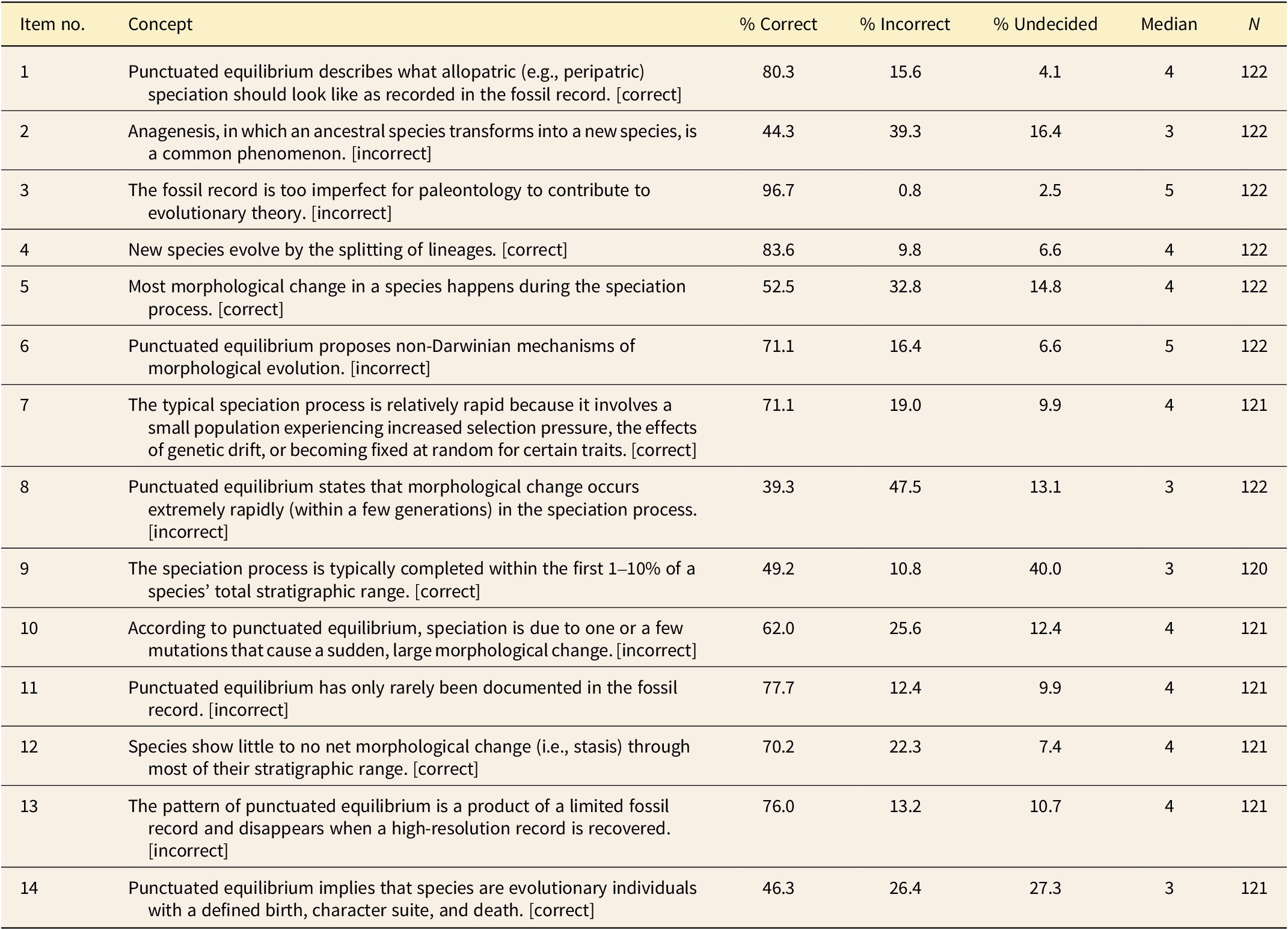
To explore respondents’ understanding of core ideas within punctuated equilibrium, we developed 14 statements, 7 correct ideas related to punctuated equilibrium and 7 incorrect ideas we suspected would present opportunities to identify common misunderstandings (Table 1). We based our “correct” ideas about punctuated equilibrium on the concepts that Gould chose to include in his own college-level teaching during the 1990s, which we personally observed as his graduate teaching assistants, reinforced by the concepts Gould emphasized in his published works (Eldredge and Gould Reference Eldredge, Gould and Schopf1972; Gould and Eldredge Reference Gould and Eldredge1977; Gould Reference Gould1991, Reference Gould2002). Survey Question 2 asked respondents to indicate their degree of agreement or disagreement with each of the 14 statements on a 5-point Likert scale. We also asked respondents to rate their self-assessed understanding of the concept of punctuated equilibrium on a 4-point scale, ranging from no understanding to a high level of understanding.
Items used to assess the accuracy of conceptions about punctuated equilibrium. Of these 14 statements, 7 are correct and 7 are incorrect, as noted. The percentage of respondents who were correct (that is, agreed with a correct statement or disagreed with an incorrect statement), incorrect, or selected “Undecided” are provided, along with the median value (on 5-point Likert scale) and sample size for each item.
The survey instrument included 12 questions designed to collect relevant information about the respondents’ educational background, fields of study, and teaching experience. We asked about their primary scientific discipline and study organisms, the fields in which they earned their undergraduate and graduate degrees, and the time since earning their highest degree. Respondents were also asked to indicate their current position or employment sector and what proportion of their current position involves teaching. We asked whether they teach graduate students or advise student researchers, and whether they have ever taken or taught university-level courses in paleontology and/or evolutionary biology.
A draft of the survey instrument was shared with four colleagues with expertise in punctuated equilibrium and in teaching paleontology. The wording of some survey items was modified in response to their feedback. The finalized 20-question survey instrument was then configured within the Qualtrics online survey platform, and a weblink to the survey was generated. The full survey text with informed consent document is available as Supplementary File 1.
Data Collection
The project’s survey and sampling protocol were reviewed by Bowling Green State University’s Institutional Review Board, which determined the project to fall under exempt category 2 with regard to human subjects research (project number 1920620-1). Anyone who was at least 18 years old and who works or studies within paleontology or the biosciences was eligible to participate in the study. Survey responses were anonymous. The introductory text of the survey stated that the purpose of the project was:
to examine how paleontologists and biologists think about the concept of punctuated equilibrium, first introduced in 1972 by Niles Eldredge and Stephen J. Gould. This project seeks to better understand how people define the concept of punctuated equilibrium and to what extent they use it in their research and teaching.
The survey went live online on June 21, 2022. The survey link and call for participants was distributed via social media (specifically, Facebook and Twitter) using the authors’ personal accounts and also posted in the Paleontology Education private Facebook group. The Paleontological Society and Society for the Study of Evolution shared the posting on their own social media accounts. The survey announcement was also emailed to the authors’ personal networks, with a request for recipients to share the survey link widely. The survey remained live for 21 days. This limited dissemination and duration for survey deployment was deemed appropriate for the pilot study presented as part of the Geological Society of America Topical Session on “Punctuated Equilibrium: 50 Years Later” held in October 2022, the results of which are presented with expanded analysis in this paper. Given its exploratory nature, we acknowledge these data limit the statistical certainty of any patterns displayed, as well as the inferences that may be drawn from them.
Data Analyses
We downloaded survey responses from Qualtrics on July 11, 2022. The “incorrect” items in Question 2 were then reverse coded, so that a response of 5 in our reported results always means the respondent had the correct idea about the item (i.e., strongly agreeing with a correct idea or strongly disagreeing with an incorrect idea).
As Likert scale data are ordinal, responses to individual survey items were assessed by constructing frequency distributions and calculating median values. For Question 2, we also computed the percentage of correct, incorrect, and undecided responses for each of the 14 separate statements about punctuated equilibrium. Internal reliability of the 14 items in Question 2 was assessed by computing Cronbach’s alpha (Taber Reference Taber2018). Differences among groups of respondents for individual survey items were assessed via Kruskal-Wallis tests for equality of medians, followed by pairwise Mann-Whitney U-tests with Bonferroni correction.
We derived a composite score for Question 2 by summing the responses across the 14 items. This composite score has a range of possible values from 14 to 70, with a higher score indicating a better overall understanding of punctuated equilibrium concepts. As the composite score was derived from multiple Likert scale items, the mean is the appropriate measure of central tendency. Mean values of this composite score were therefore computed and compared across groups via analysis of variance (ANOVA).
All statistical analyses were conducted in PAST v. 4.11 (Hammer et al. Reference Hammer, Harper and Ryan2001) with the exception of computation of Cronbach’s alpha, which was done using the ltm package v. 1.2-0 (Rizopoulos Reference Rizopoulos2006) in R v. 4.4.0 (R Core Team 2024).
Results
Sample Size and Demographics
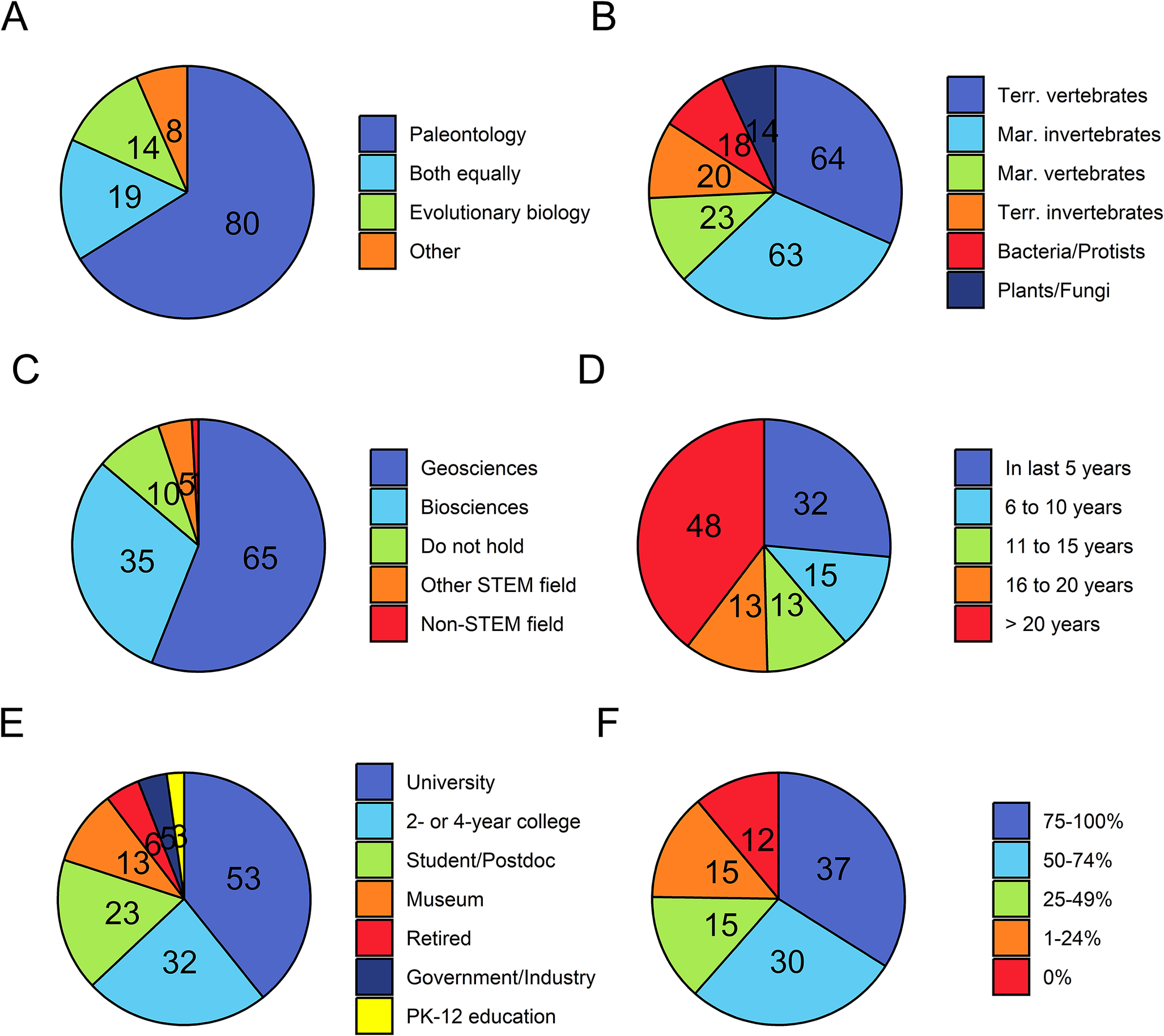
A total of 122 responses were received within the 3-week data collection window. We acknowledge that this is a small proportion of all paleontologists and evolutionary biologists working in the United States today (perhaps ~5–8%, based on professional society membership numbers), but as we show later, the respondents are drawn from many different research specialties and career stages. This broad sample should allow us to draw preliminary inferences from the data and can highlight areas that might benefit from a more systematic approach in the future. Most respondents provided answers to all or nearly all the survey items. One respondent stopped the survey partway through Question 2 (the 14-item concept assessment). Their responses were kept in the analyses of those survey items. Figure 1 summarizes demographic information about the survey respondents. Note that values shown in Figure 1 are numbers of respondents. For some items, respondents could select more than one option, so the total number indicated in the figure exceeds the number of respondents. Hence, percentages are reported here only when appropriate.
Respondent demographics. A, Primary discipline. B, Primary study organisms; Terr., terrestrial and/or freshwater; Mar., marine. C, Field of doctoral degree. D, Time since receiving highest degree. E, Current position/employment. F, Percent of current position that involves teaching.
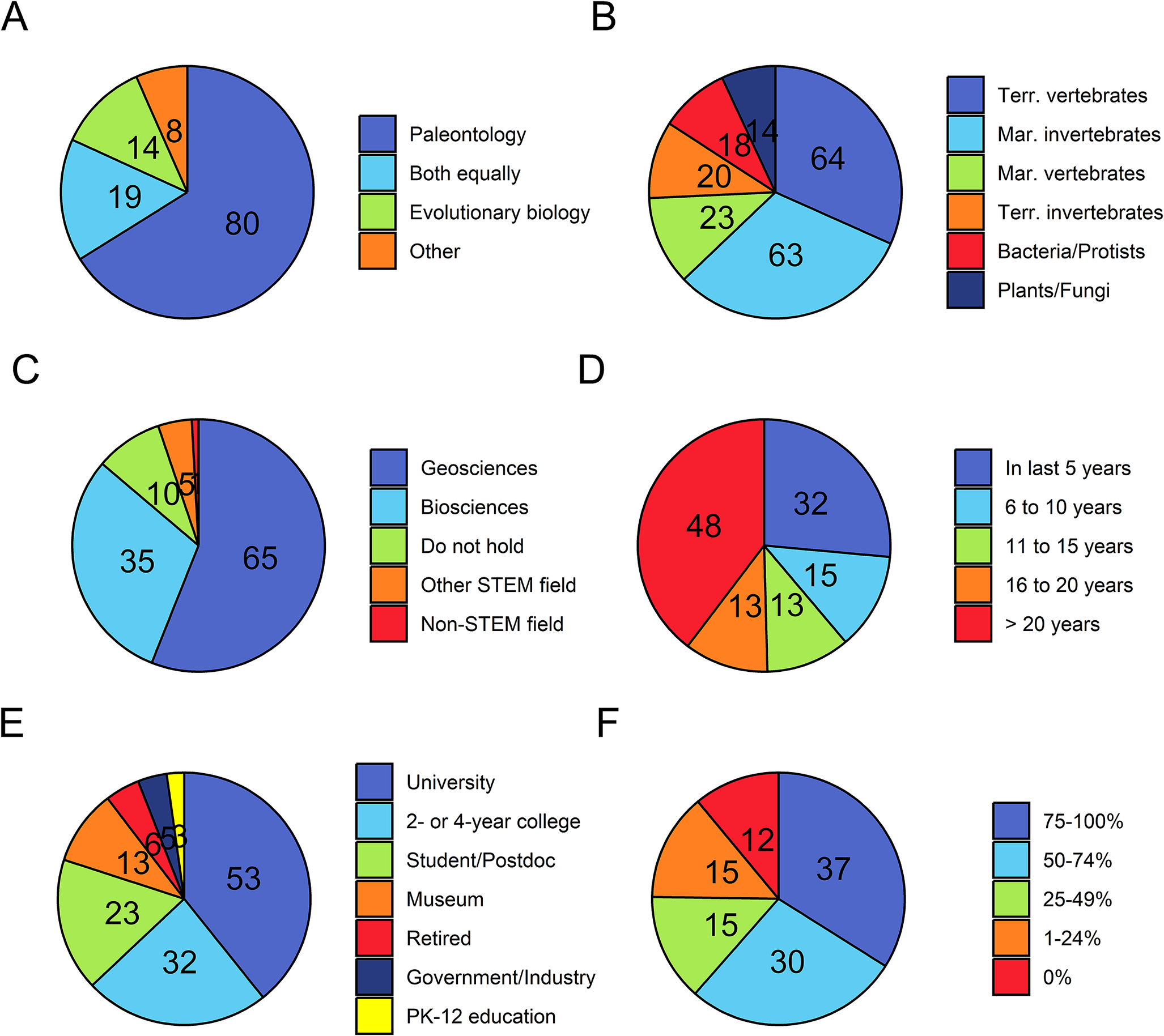
In terms of primary discipline, paleontologists predominate, comprising 66% of the respondents, while 12% are evolutionary biologists, and 16% indicated they work equally with both fossil and modern organisms (Fig. 1A). Eight respondents indicated another field of study, primarily molecular biology, with single responses for ecology, evolutionary neuroscience, and biomedical engineering. Roughly equal numbers of respondents indicated their primary study organisms were either marine invertebrates or terrestrial and freshwater vertebrates. All other major organismal groups are represented in the dataset, albeit at lower percentages (Fig. 1B).
More than 90% of respondents have earned a doctoral degree, mostly in the geosciences or biosciences, with 13 current graduate students and no undergraduate students responding (Fig. 1C). Respondents were drawn from across the spectrum of career stages, with an overemphasis on those later in their careers. Early-career scientists within 5 years of earning their highest degree comprise about 26% of the sample, mid-career respondents between 6 and 15 years past their highest degree comprise 23% of the sample, while late-career researchers 16 years or more past their highest degree comprise about 50% of the sample (Fig. 1D).
More than 70% of respondents hold positions at 2-year or 4-year colleges or at universities, while about 19% are students or postdoctoral scholars (Fig. 1E). Smaller numbers of respondents are employed by museums or other nonprofit organizations, for-profit companies, government agencies, or PK–12 educational institutions. About 5% of respondents indicated they are retired. The majority (about 62%) of respondents are employed in positions that involve at least 50% teaching (Fig. 1F). A total of 11% of respondents indicated that they do not teach in their current position.
About 63% of respondents indicated that they supervise undergraduate student researchers. A total of 37% of respondents indicated that they teach graduate-level courses, with 36% supervising master’s student research and 30% supervising doctoral student research. The majority of respondents have taken at least one university-level paleontology course (85%) and at least one university-level evolutionary biology course (84%). About 68% of respondents have taught a university-level paleontology course, while 43% have taught a university-level evolutionary biology course.
Finally, we asked respondents to indicate the extent to which their own research involves punctuated equilibrium. About 4% of respondents stated that they do not conduct research. Of those who do conduct research, 35% said punctuated equilibrium has no involvement in their research, 38% said it had a little involvement, 18% said it had moderate involvement, and 9% said it had extensive involvement in their research.
Punctuated Equilibrium Is Important
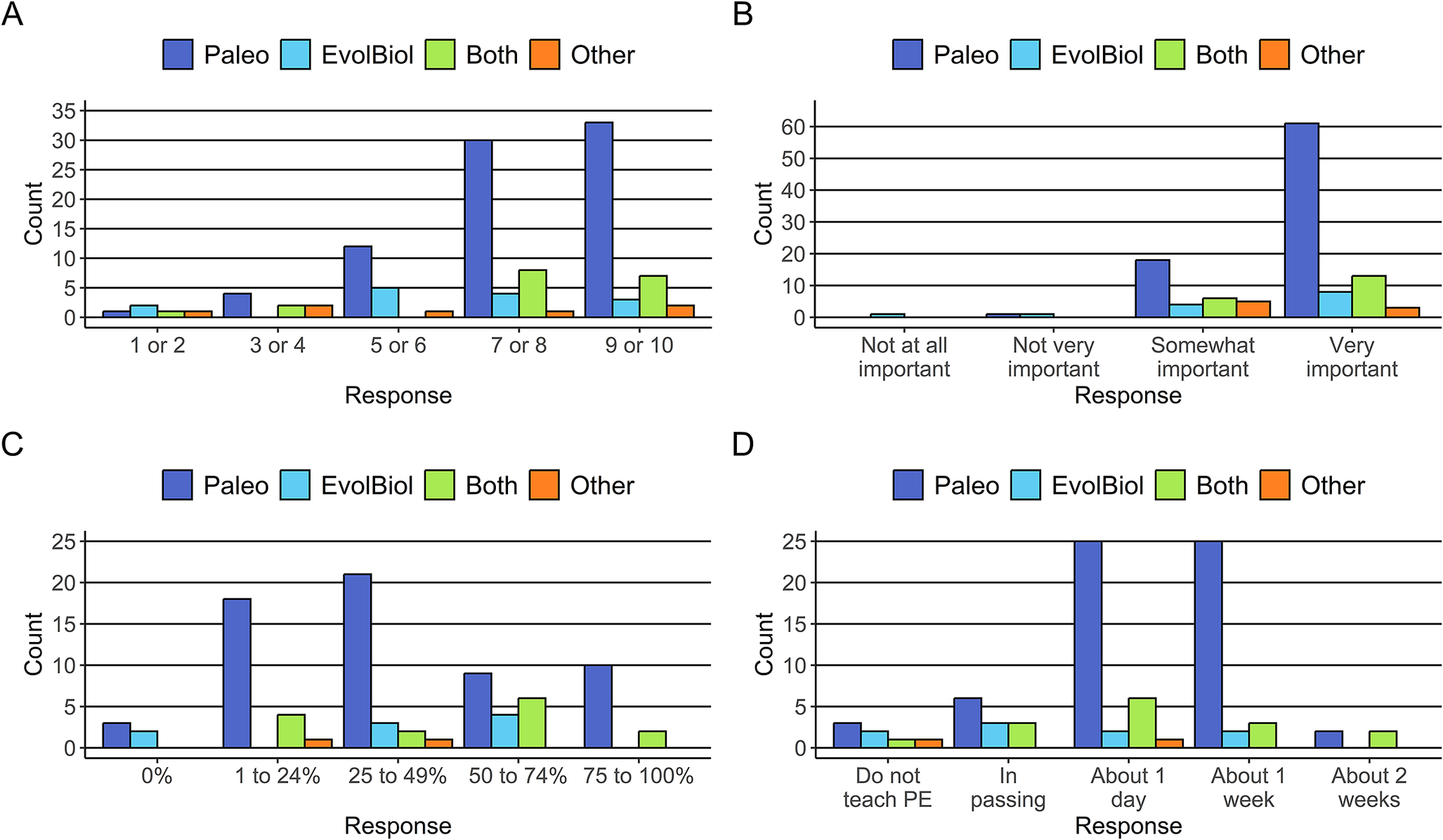
Respondents were asked to rate the importance of the concept of punctuated equilibrium to their own field on a sliding scale from 0 (not at all important) to 10 (extremely important). Overall, the majority of respondents indicated that they feel punctuated equilibrium is indeed important to these research fields, with 38% of respondents selecting 9 or 10 and another 36% selecting 7 or 8. A total of 4% of respondents rated punctuated equilibrium’s importance as 1 or 2. Separating respondents by primary discipline, there were no statistically significant differences in median responses, although a larger percentage of evolutionary biologists gave middle-of-the-range ratings of 5 or 6 (Fig. 2A). The five ratings of 1 or 2 for importance were distributed among all four discipline groups.
Participant responses related to the perceived importance of punctuated equilibrium and the frequency with which it is taught. Responses are shown separately for groups based on self-identified primary scientific discipline: Paleo, paleontology (studying fossil organisms); EvolBiol, evolutionary biology (studying modern organisms); Both, both paleontology and evolutionary biology equally; Other, other self-identified field. A, How do you rate the importance of the concept of punctuated equilibrium to your field (sliding scale from 0 = Not at all important to 10 = Extremely important)? B, How important is it for textbooks in your field to include coverage of punctuated equilibrium? C, In what percentage of the courses you teach do you discuss punctuated equilibrium? D, Thinking just about the course in which you most discuss punctuated equilibrium, how much time do you devote to this concept?
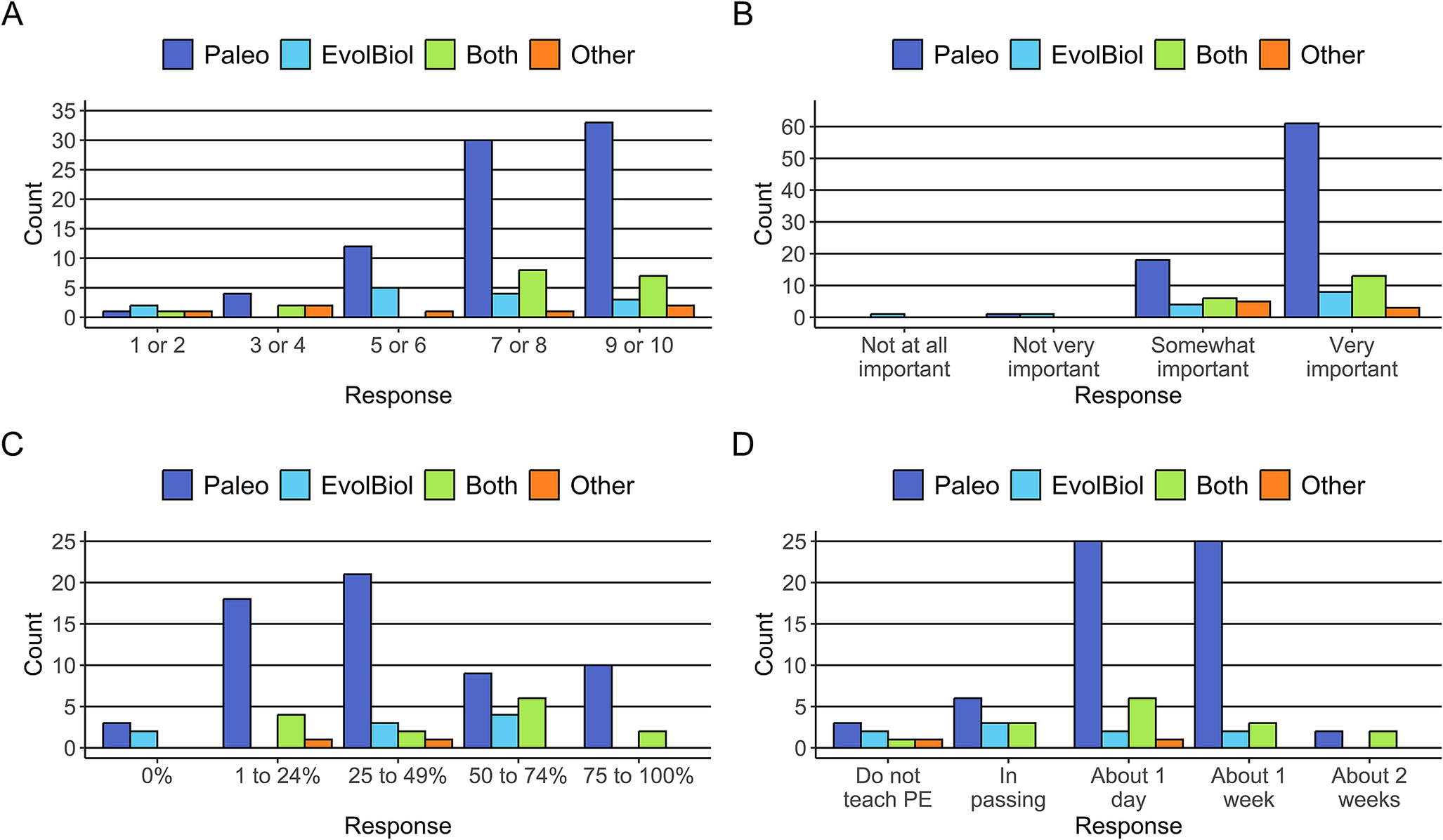
Respondents were also asked how important they think it is for textbooks in their field to include coverage of punctuated equilibrium. A notably high 70% of respondents said it was very important, essential content, with another 27% saying it was somewhat important and good to include. Three respondents selected not very important or not at all important. Once again, there were no statistically significant differences in median response across primary disciplines (Fig. 2B). From these survey responses, we conclude that there is a consensus that punctuated equilibrium is important to both paleontology and evolutionary biology and that it should be discussed as an important concept in paleontology and evolutionary biology textbooks, at least within our small pilot sample of respondents.
Teaching Punctuated Equilibrium
Respondents who teach were asked to indicate the percentage of courses in which they include the topic of punctuated equilibrium, using a sliding scale from 0% to 100%. Responses were then binned by quartiles. Most respondents who teach (94.2%) include instruction on punctuated equilibrium in at least one class. However, about 62% of those who teach about punctuated equilibrium do so in less than half of their courses. There were no significant differences in median responses across primary disciplines (Fig. 2C).
To capture information on where in the curriculum punctuated equilibrium is being taught, we asked respondents to indicate all the levels at which they include punctuated equilibrium in their teaching, for example, introductory-level courses for undergraduate nonmajors or majors, upper-level courses for undergraduate majors, graduate-level courses. As many respondents indicated that they teach punctuated equilibrium at multiple levels, we focused our attention on the lowest level, when punctuated equilibrium is first introduced. One-third of those respondents who teach indicated that they include instruction on punctuated equilibrium in introductory undergraduate courses for nonmajors, while 36% first introduce the concept in upper-level undergraduate courses. We note, however, that we cannot tell from our data whether respondents have the opportunity to teach lower-level courses or not, so we cannot differentiate between those who could teach punctuated equilibrium at a lower level but choose not to and those who do not teach lower-level courses at all. In any case, most respondents who teach about punctuated equilibrium are including it in undergraduate courses. There were no significant differences in median responses across primary disciplines.
We also asked respondents who teach about punctuated equilibrium to select the course in which they discuss the topic the most and indicate how much time they devote to the concept in that course. A majority of 57.5% of those responding to this question indicated that they mention punctuated equilibrium in passing or spend one day on the topic, while 37.5% spend 1 week and 5% spend 2 weeks. Again, there were no differences across primary disciplines (Fig. 2D).
Understanding Punctuated Equilibrium
We analyzed responses to the 14 survey items designed to assess understanding of core ideas within the punctuated equilibrium concept (Table 1). Our goal was to identify the specific ideas that respondents were most likely to misunderstand and to determine whether certain groups of respondents were more likely to hold misconceptions about punctuated equilibrium. It is important to highlight that this preliminary survey has not been validated. While our intention is that responses to these items reflect respondents’ understanding or beliefs about punctuated equilibrium, we acknowledge that, without validation, we cannot rule out the possibility that respondents misinterpreted the wording of the survey items, such that their responses reflect something other than what we intended. The interpretations we present below should therefore be understood as preliminary inferences only. Internal reliability of the 14 survey items was assessed by computing Cronbach’s alpha. For the 14 items, alpha = 0.703 (95% confidence interval: 0.605–0.768); values greater than 0.7 are generally viewed as acceptable, at least in the sense of internal consistency of the survey items (Taber Reference Taber2018).
The majority of respondents self-rated their current understanding of the concept of punctuated equilibrium as high (59%) or average (35%), with only 6% reporting a limited understanding and no one indicating no understanding. Of the small number of respondents self-reporting a limited understanding of punctuated equilibrium, 29% were current students, while 57% held a doctoral degree, mostly teaching at the college or university level.
Individual Items
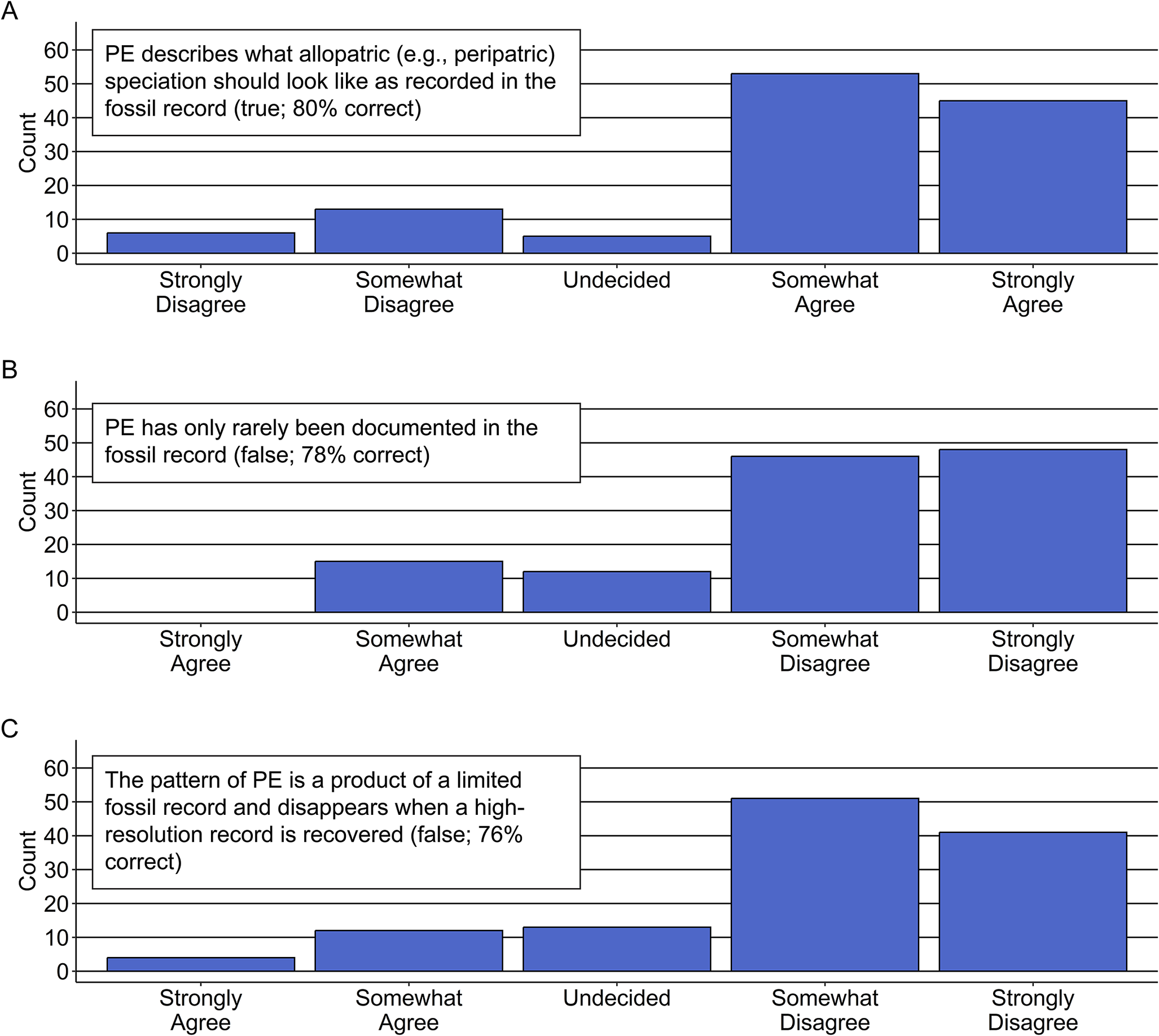
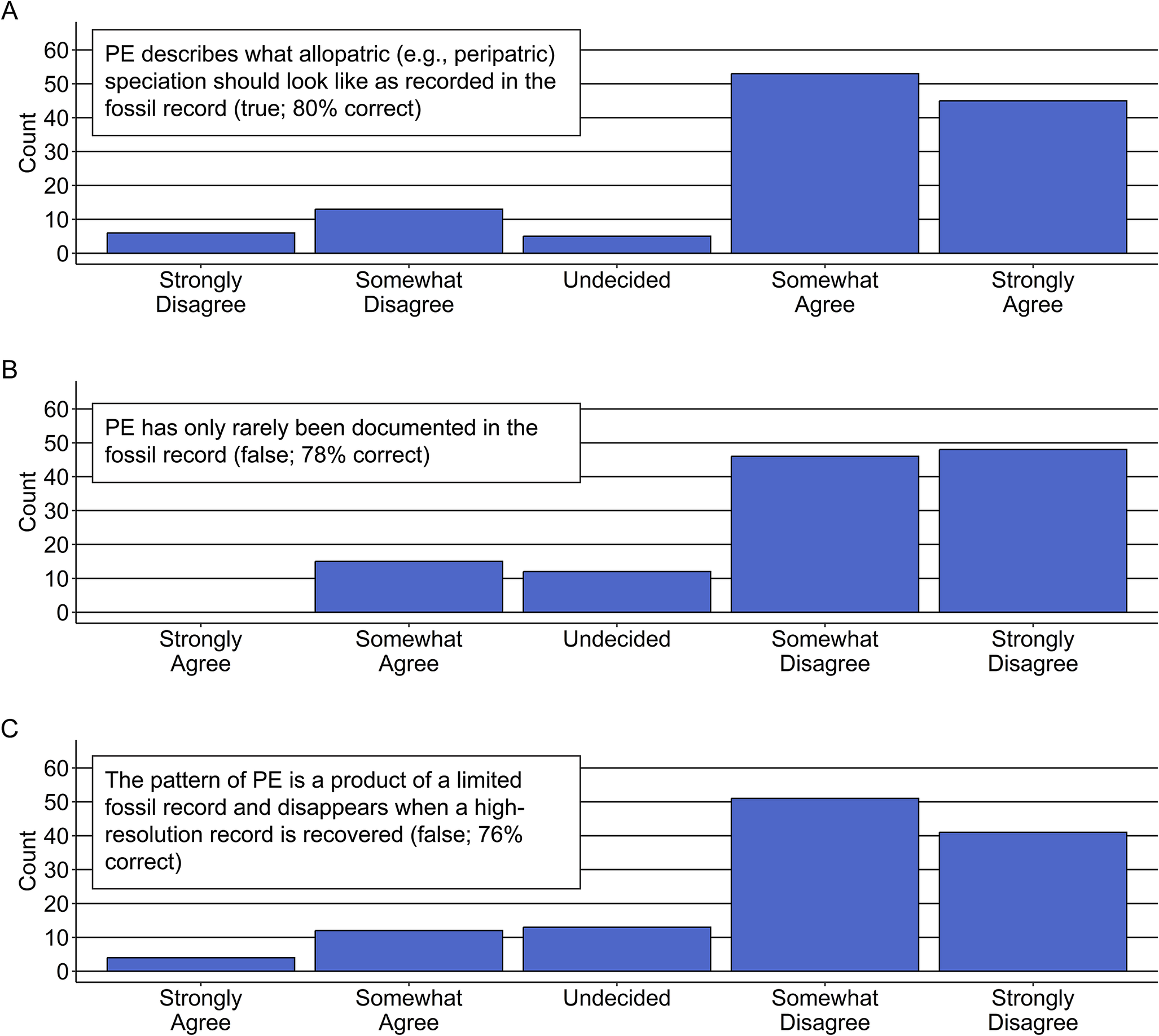
For many of the 14 individual items, the majority of respondents selected the correct answer, that is, somewhat agreed or strongly agreed with a correct statement or somewhat disagreed or strongly disagreed with an incorrect statement. For example, 80% of respondents correctly agreed with Item 1, that punctuated equilibrium describes what allopatric (e.g., peripatric) speciation should look like as recorded in the fossil record (Fig. 3A). Items 11 and 13 are intended to get at misconceptions about the evidentiary basis for punctuated equilibrium. About 78% of respondents correctly disagreed with the assertion that punctuated equilibrium has only rarely been documented in the fossil record (Item 11; Fig. 3B), while 76% of respondents correctly disagreed with the idea that the pattern of punctuated equilibrium is a product of a limited fossil record and disappears when a high-resolution record is recovered (Item 13; Fig. 3C). An even stronger signal supporting the quality of the fossil record emerged for Item 3, the fossil record is too imperfect for paleontology to contribute to evolutionary theory, as 97% of respondents rejected this idea (Table 1).
Items showing a strong understanding of the underlying concepts. Note that in all single-item histograms shown in this and subsequent figures, the x-axis is labeled such that correct responses (that is, agreeing with correct statements and disagreeing with incorrect ones) plot on the right and incorrect responses plot on the left, so that histograms can be directly compared. A, The link between peripatric speciation and punctuated equilibrium (Item 1) seems clear to most respondents. The majority of respondents (B) agree that empirical evidence of punctuated equilibrium exists in the fossil record (Item 11), and (C) believe that high-resolution fossil records do not rule out the punctuated equilibrium pattern (Item 13). PE, punctuated equilibrium.
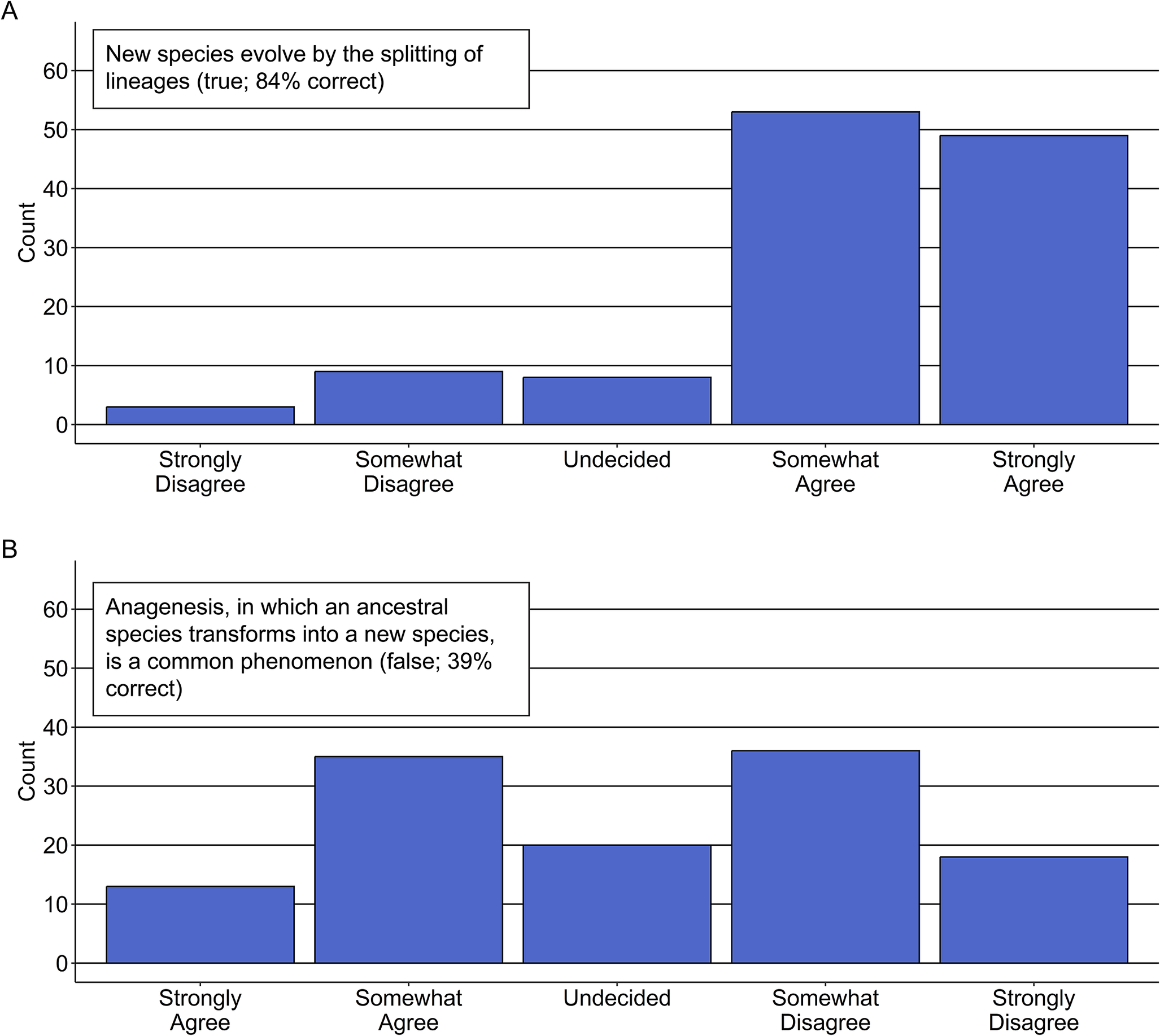
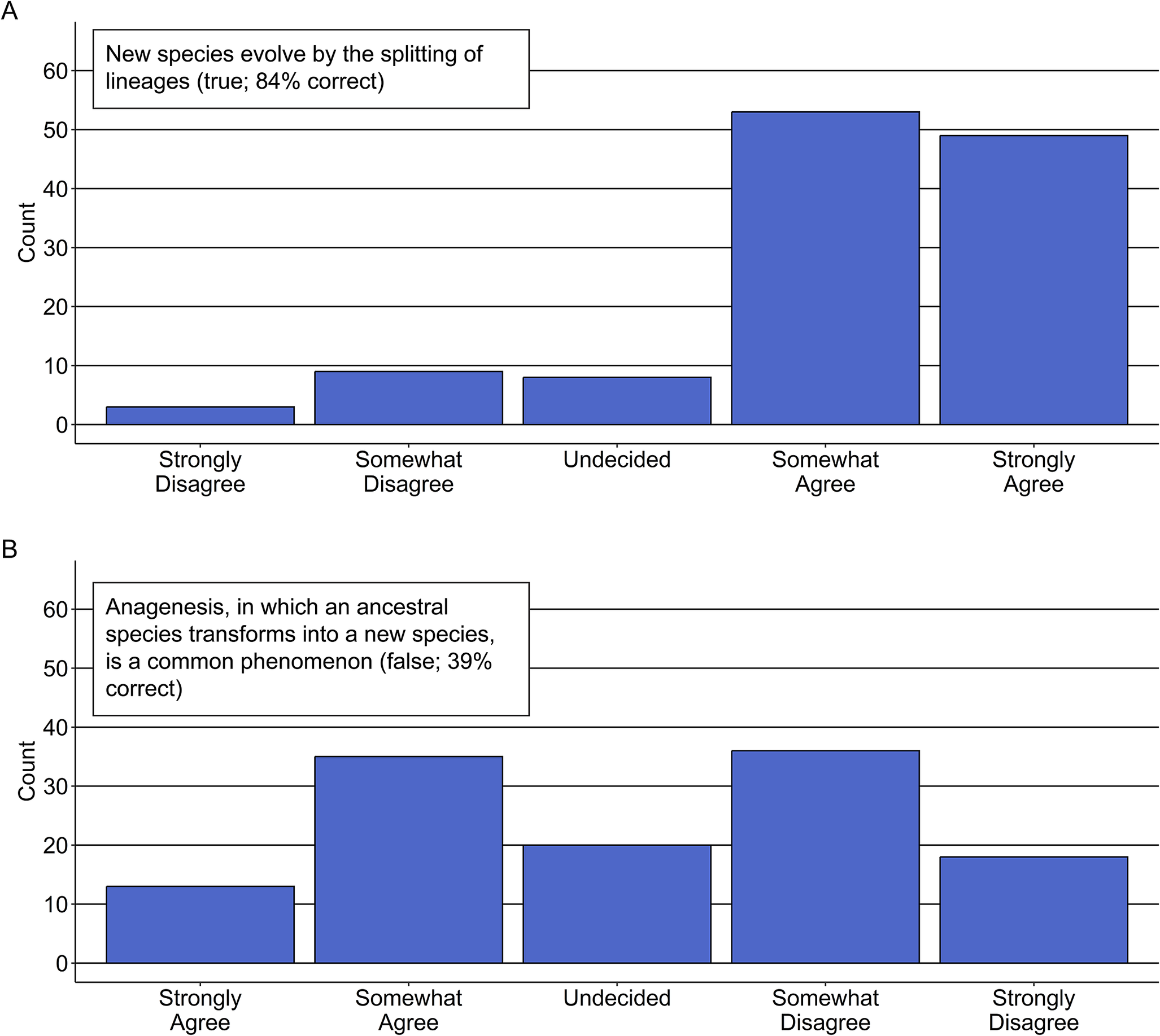
Our survey results revealed a surprising potential inconsistency in how respondents think about the speciation process. For Item 4, 84% of respondents correctly agreed that new species evolve by the splitting of lineages (Fig. 4A). However, 39% of respondents incorrectly agreed with the statement that anagenesis, in which an ancestral species gradually transforms into a new species without branching, is a common phenomenon (Item 2; Fig. 4B). These two statements contradict each other, and we therefore expected the rates of correct responses to be similar for these two items, but it appears that a subset of respondents may not have recognized that incongruity.
Items revealing inconsistent beliefs about the speciation process. A, 84% of respondents agreed that speciation involves the splitting of lineages (Item 4). Yet simultaneously, as shown in (B), 39% of respondents believe that anagenesis, in which a species arises without any branching event, is a common phenomenon (Item 2).
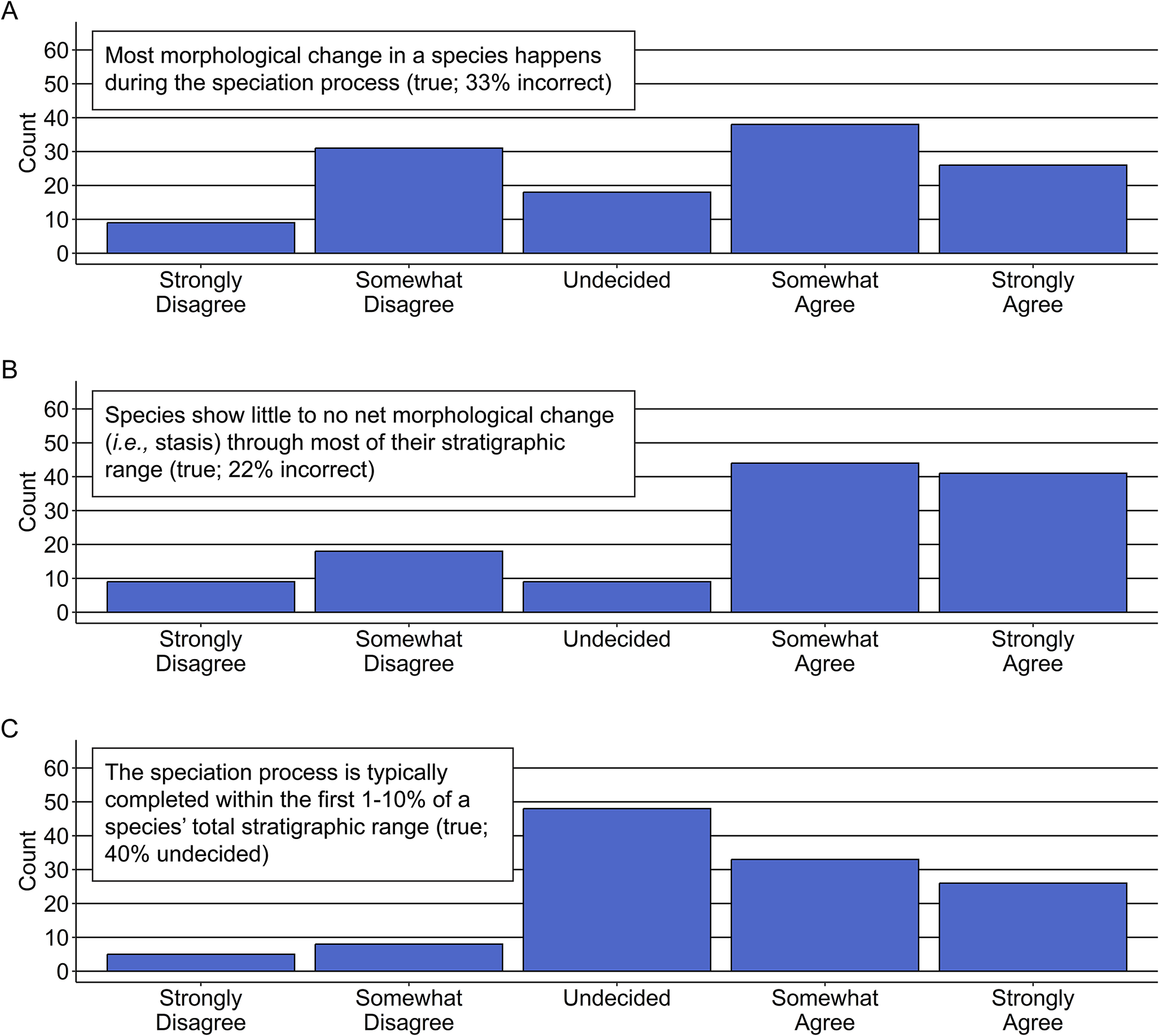
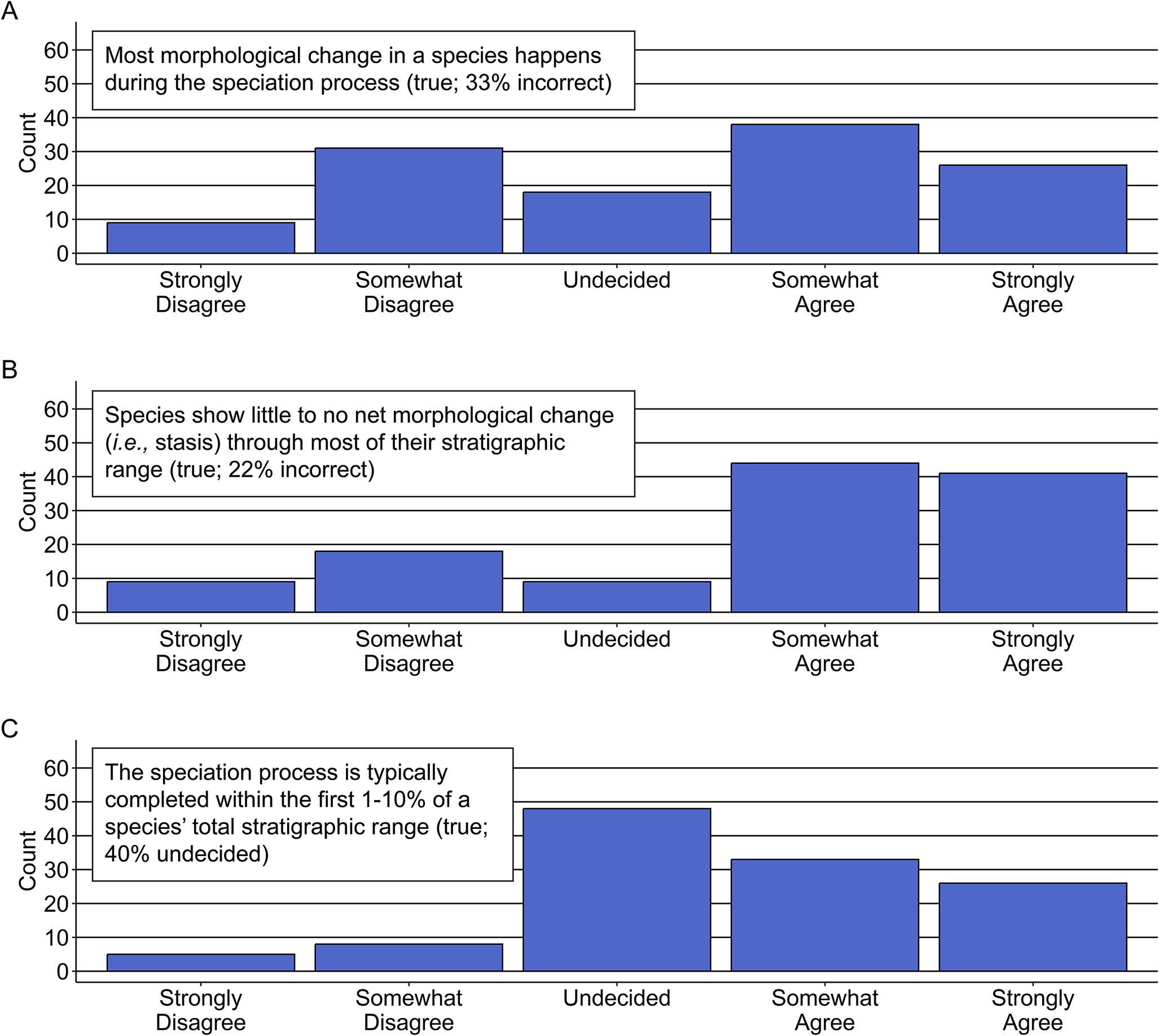
We also found that a relatively large minority of respondents disagreed with several ideas central to the concept of punctuated equilibrium. For example, punctuated equilibrium holds that most morphological change in a species happens during the speciation process (Item 5). About 33% of respondents disagreed with this idea (Fig. 5A). Another essential concept in punctuated equilibrium is stasis: species show little to no net morphological change (i.e., stasis) through most of their stratigraphic range (Item 12). About 22% of respondents disagree with this observation of stasis (Fig. 5B), although we note that we did not ask about the frequency of stasis (i.e., what proportion of lineages show stasis), but just whether respondents agreed with the statement. The “punctuated” part of the concept of punctuated equilibrium is rooted in the observation that the speciation process is typically completed within the first 1–10% of a species’ total stratigraphic range (Item 9). Responses to Item 9 stood out from those for the other 13 items in that a large percentage of respondents (40%) chose “undecided” (Fig. 5C). No other item had such a high proportion of respondents express uncertainty about whether the concept was correct or not.
Items reflecting common incorrect beliefs and confusion about core punctuated equilibrium concepts. A, 33% of respondents disagree that morphological change is concentrated during speciation (Item 5). B, A substantial minority of respondents disagree with the idea of morphological stasis (Item 12). C, Unique among the 14 items analyzed, a large percentage of respondents selected “Undecided” for the duration of the speciation process (Item 9).
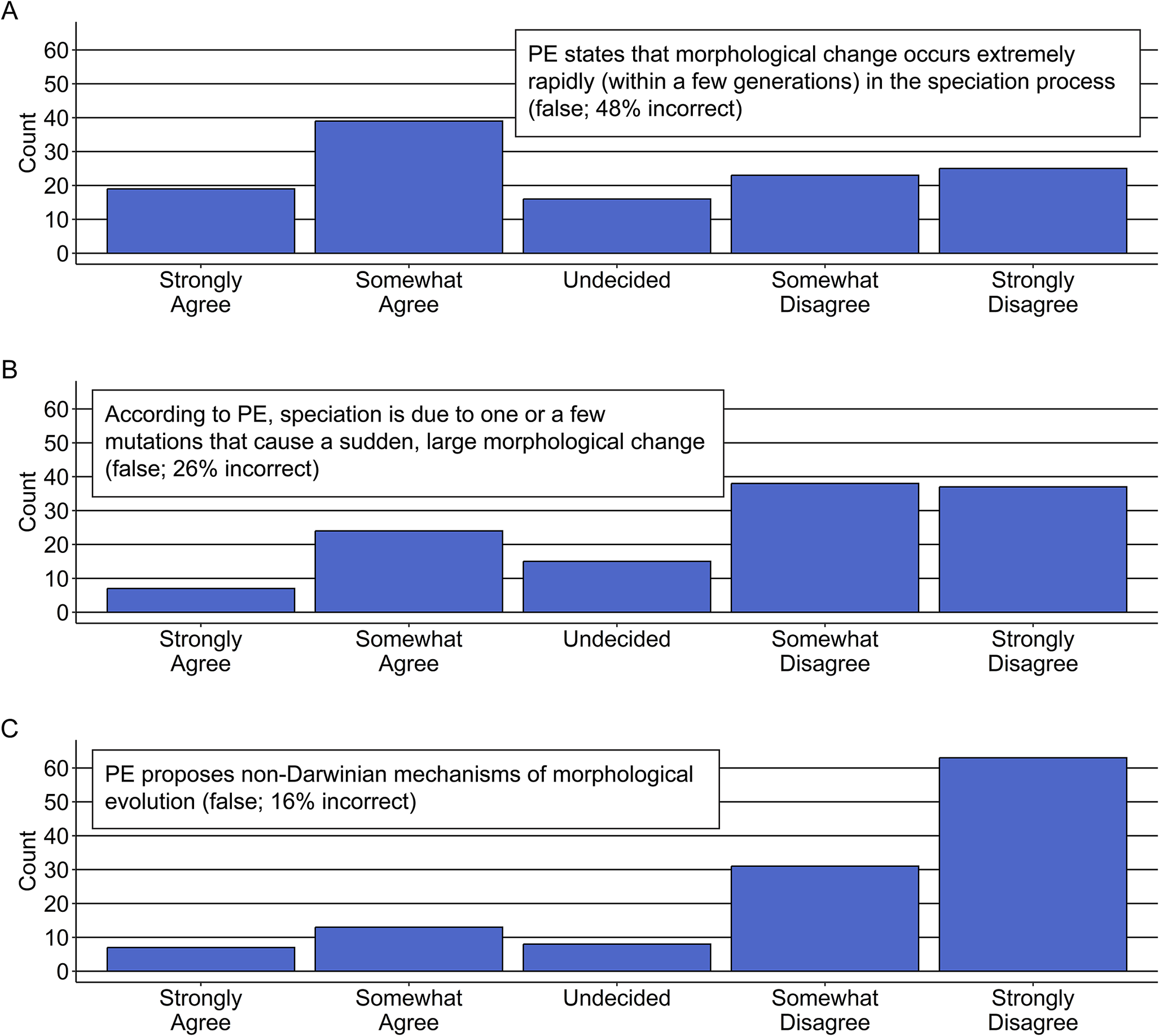
We identified possible critical misconceptions about the rate and cause of morphological change in the punctuated equilibrium model. Perhaps unsurprisingly, by far the most commonly selected misconception was that punctuated equilibrium states that morphological change occurs extremely rapidly (within a few generations) in the speciation process (Item 8). Almost half of all respondents agreed with this statement, even though it is incorrect (Fig. 6A). In reality, punctuated equilibrium merely claims that morphological change is concentrated during the ordinary process of peripatric speciation, which can take tens of thousands of years to complete. Recall that 80% of respondents agreed with the claim that punctuated equilibrium describes peripatric speciation as it is recorded in the fossil record (Item 1; Fig. 3A). This disconnect between correct responses to Item 1 and incorrect responses to Item 8 represents another puzzling inconsistency in respondents’ thinking.
Items revealing critical misconceptions about the rate and cause of morphological change. A, 48% of respondents incorrectly think that punctuated equilibrium claims that morphological change occurs within just a few generations (Item 8), with another 13% undecided. B, 26% of respondents think punctuated equilibrium claims speciation is due to one or a few mutations (Item 10). C, 16% of respondents think punctuated equilibrium proposes non-Darwinian mechanisms for morphological evolution (Item 6).
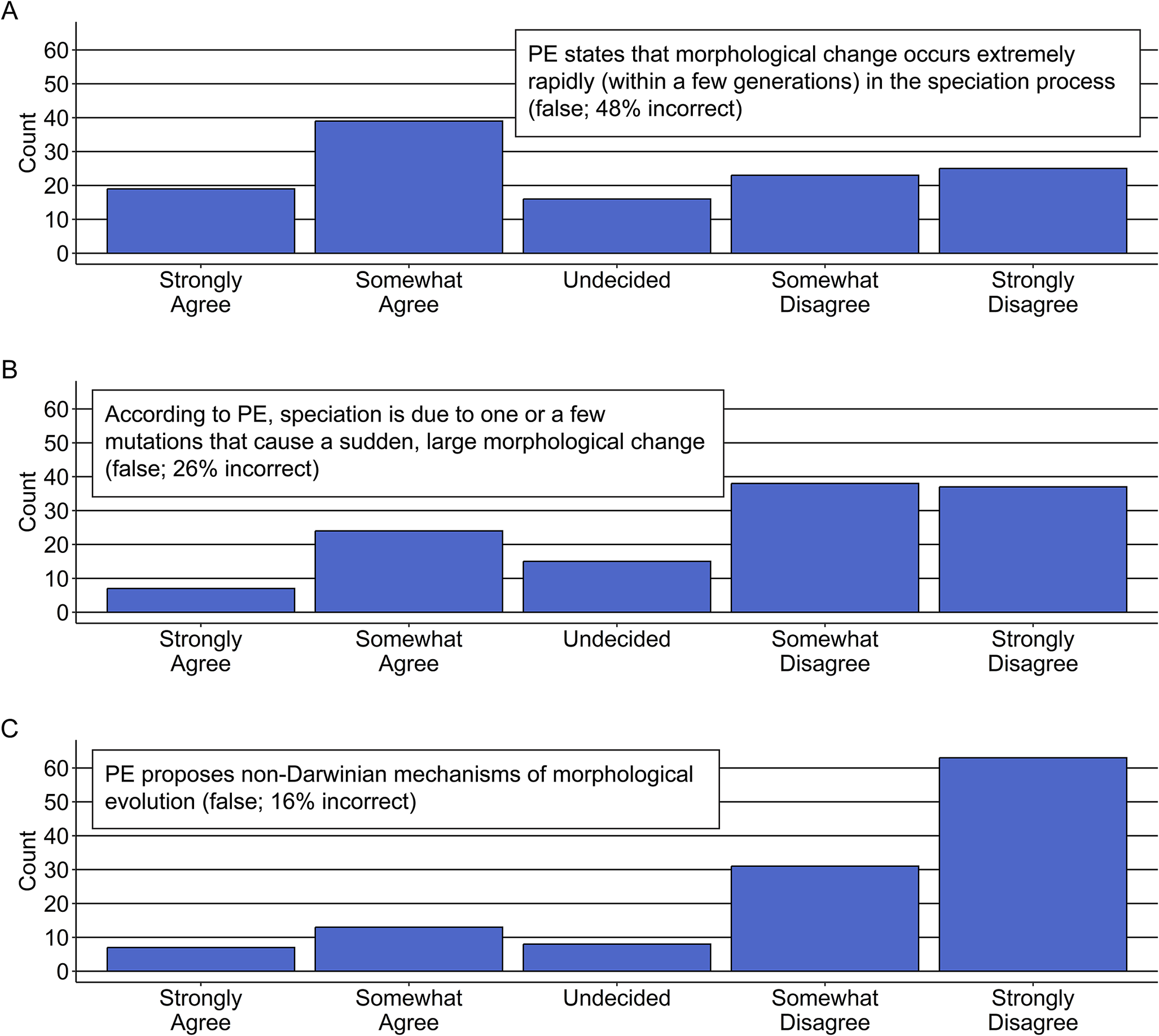
Items 6 and 10 were designed to uncover why respondents might hold the misconception that punctuated equilibrium means biologically rapid morphological change over just a few generations. However, respondents did much better on these items than would be predicted by their response to Item 8. First, only 26% of respondents incorrectly agreed with the claim that punctuated equilibrium says that speciation is due to one or a few mutations that cause a sudden, large morphological change (Item 10; Fig. 6B). Second, even fewer (16%) respondents incorrectly agreed with the idea that punctuated equilibrium proposes non-Darwinian mechanisms of morphological evolution (Item 6; Fig. 6C). Item 7 correctly describes some reasons why speciation might be relatively rapid (e.g., small population size, increased selection pressure). While a majority (71%) of respondents agreed with this item, 19% disagreed, and 10% were undecided (Table 1). We remain puzzled about why so many respondents appear to think punctuated equilibrium dictates that morphological change is extremely rapid on biological timescales or how they might think such rapid change could be achieved.
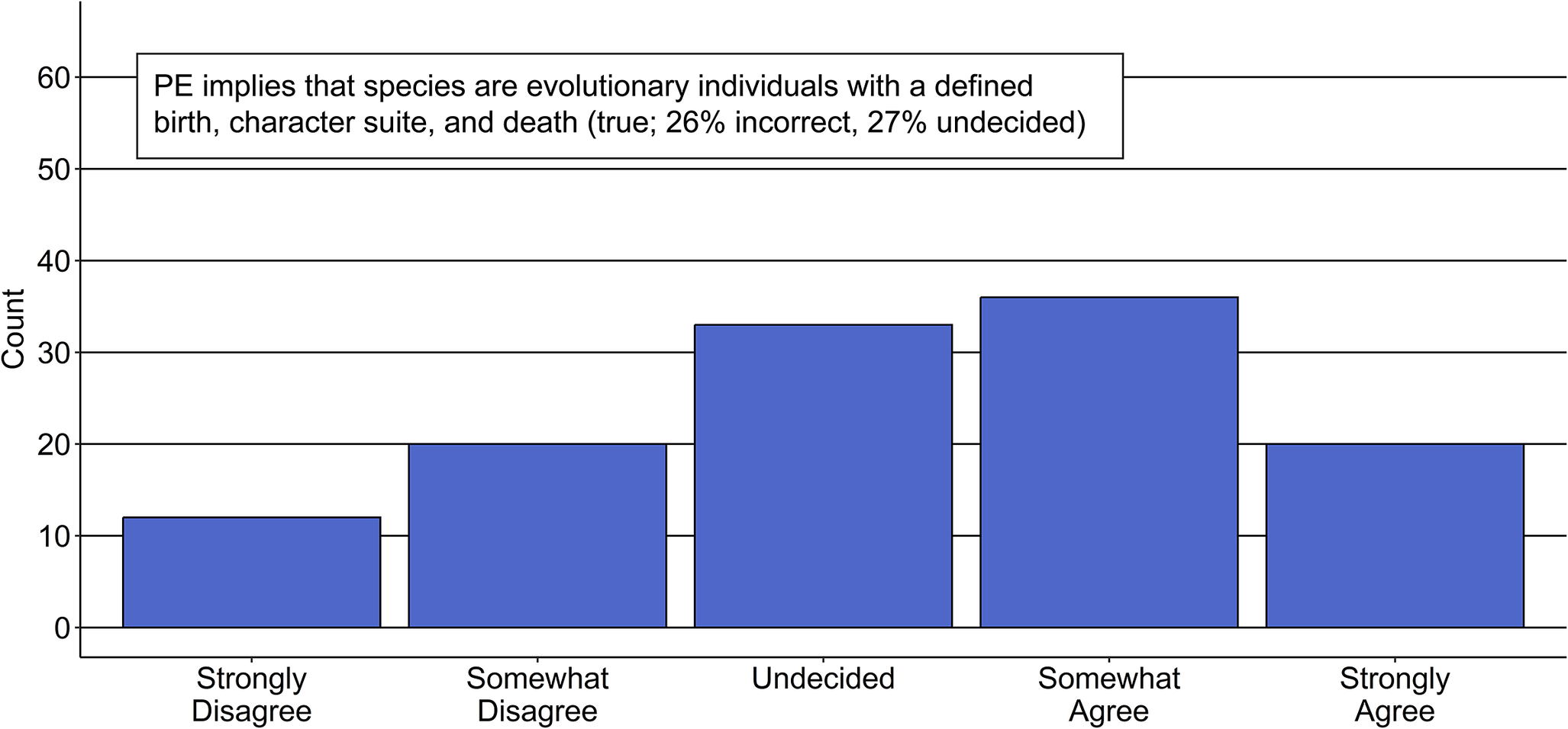
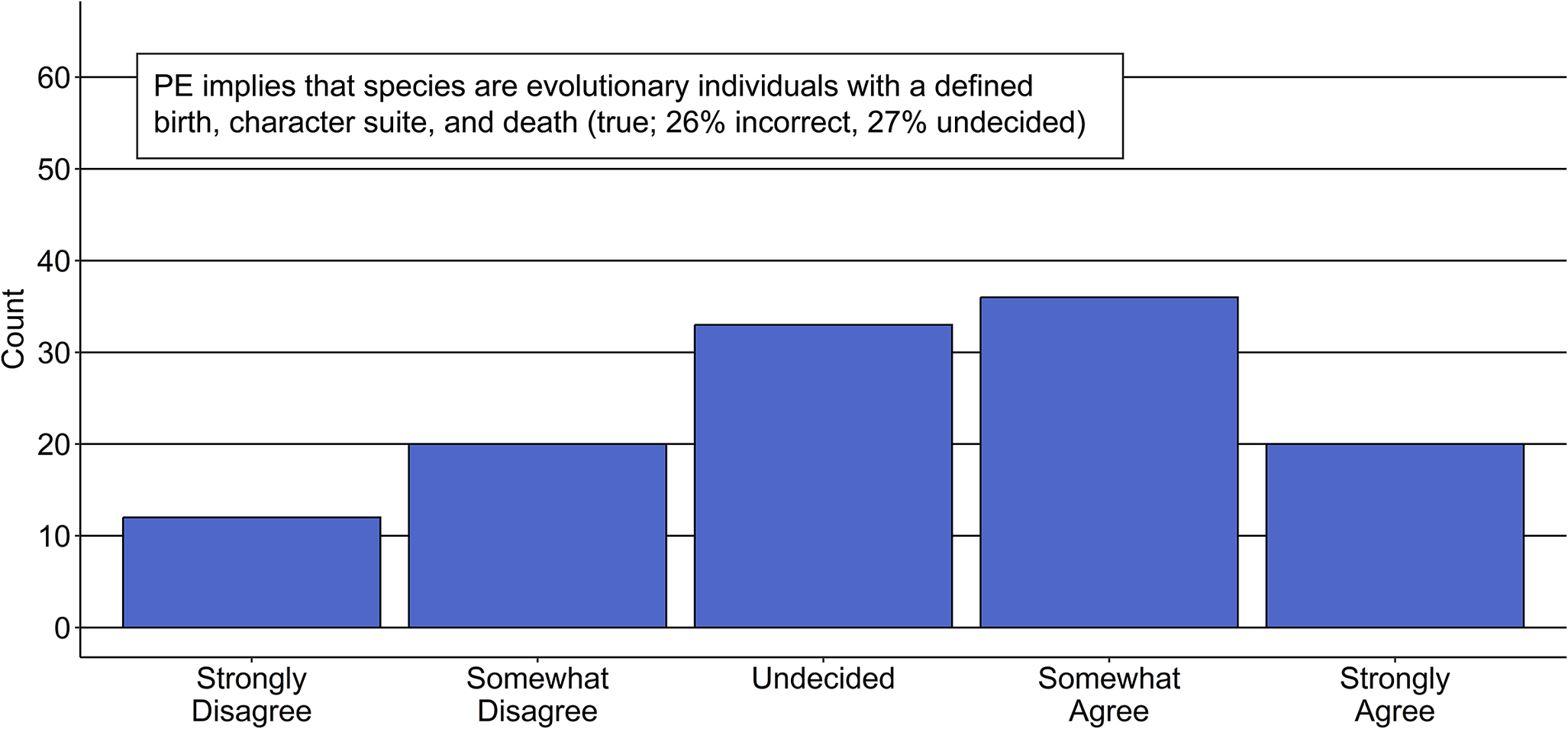
Finally, Item 14 describes the central contribution of punctuated equilibrium to evolutionary theory: species are evolutionary individuals with a defined birth, character suite, and death. We view this inference to be the “punchline” to punctuated equilibrium, why the concept of punctuated equilibrium is so important in the history of thought about evolution in deep time. However, 46% of respondents agreed that punctuated equilibrium implies that species are discrete evolutionary entities, with 26% disagreeing and 27% remaining uncertain (Fig. 7).
Central contribution of punctuated equilibrium to evolutionary theory is not recognized. The “punchline” to punctuated equilibrium is that it elevates species to the status of evolutionary individuals (Item 14), yet fewer than half of respondents recognized this important inference.
Composite Scores
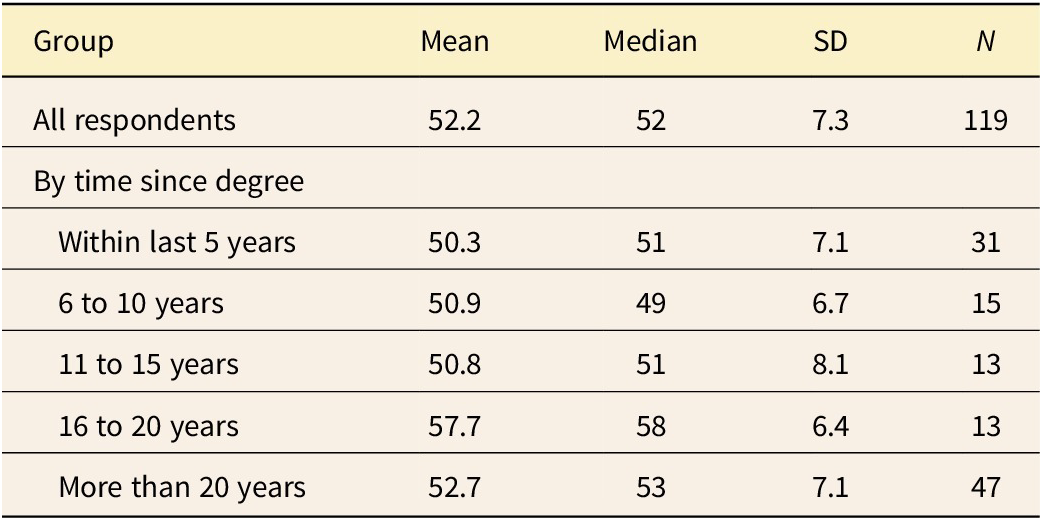
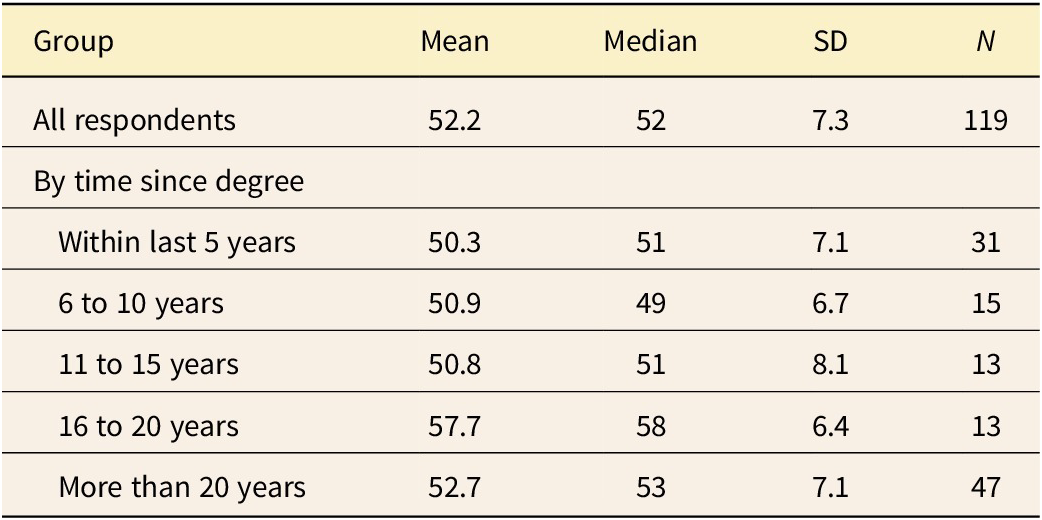
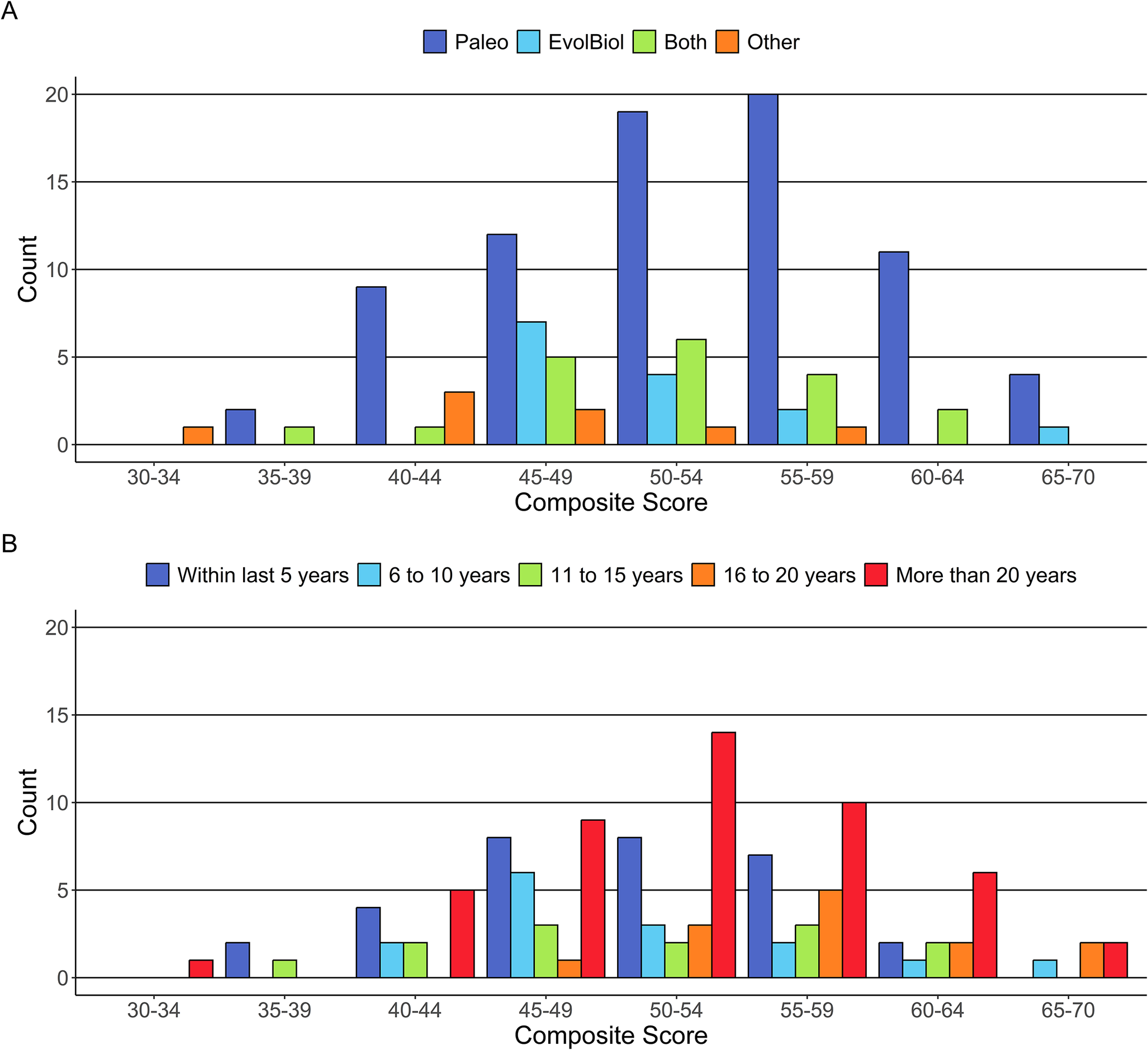
Composite scores were computed by summing responses to the 14 conceptual items, with higher scores interpreted to reflect a better understanding of these core concepts within punctuated equilibrium. Pooling all responses, the composite scores were normally distributed with a mean and median of 52 (out of a possible 70) and standard deviation of 7.3 (Table 2). Fifteen percent of respondents scored 60 or higher. There were no significant differences in composite scores across primary disciplines (Fig. 8A). In particular, we did not find that paleontologists showed a significantly better understanding of punctuated equilibrium than evolutionary biologists. Nor did we find a significant difference in scores for current students versus professional scientists.
Composite scores for all respondents and grouped by time since degree. Composite scores were computed by summing the responses for each of the 14 items (see Table 1), with a minimum possible score of 14 (poor understanding) and maximum possible score of 70 (excellent understanding). Three participants who did not respond to all 14 items were excluded. Analysis of variance (ANOVA) with Tukey’s pairwise comparison shows one significant difference between those who earned their degree within the last 5 years vs. those who earned their degree between 16 and 20 years ago (p = 0.028).
Composite score by (A) discipline and (B) time since highest degree. Analysis of variance (ANOVA) with Tukey’s pairwise comparison shows one significant difference in scores, between those who earned their degree within the last 5 years vs. those who earned their degree between 16 and 20 years ago (p = 0.028). See Table 2 for summary statistics. Abbreviations for disciplines as in Fig. 2.
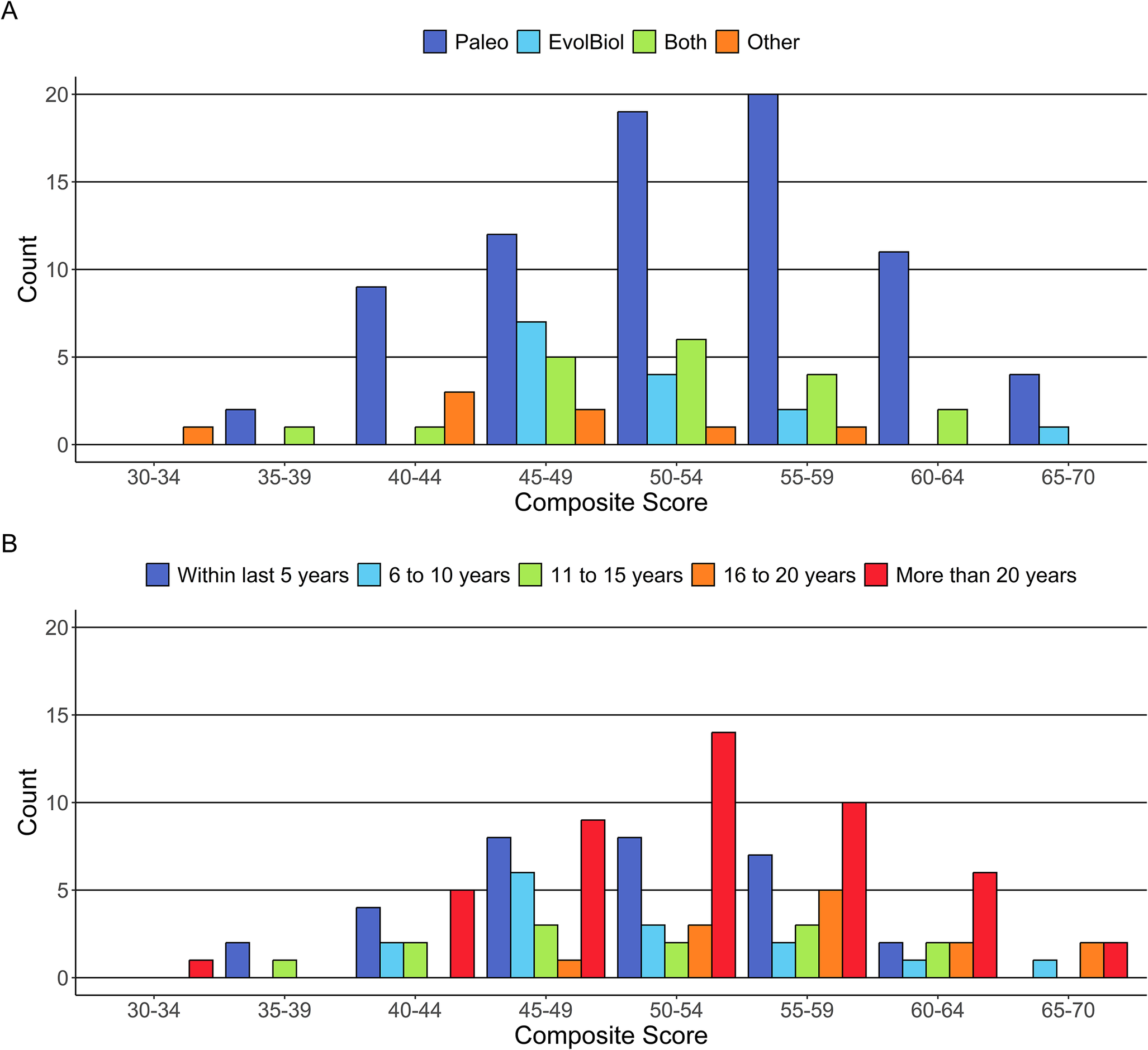
To evaluate whether awareness of punctuated equilibrium has shifted over time, we compared composite scores across groups defined by time since earning the highest degree (Table 2, Fig. 8B). The only significant difference in composite score (identified via ANOVA with post hoc Tukey’s pairwise comparison) was between those who earned their highest degree within the last 5 years (the youngest cohort, with mean composite score of 50.3) and those who earned their degree between 16 and 20 years ago (second-oldest cohort, with mean composite score of 57.7). As the survey was deployed in 2022, this latter cohort would have been students in the late 1990s and early 2000s, while the youngest cohort would have been students between around 2017–2022.
Overall, the distributions of composite scores for various groups overlap and show a broad range. We interpret these results to demonstrate that misconceptions about punctuated equilibrium may be common within our respondent sample—everyone appears to have difficulty with some of the concepts we have identified as central to punctuated equilibrium. At least within the scientific community of our sample, it therefore appears that we do not have a common shared understanding of what we mean when we refer to punctuated equilibrium.
Discussion
Perceptions of Punctuated Equilibrium
After several decades of heated debate about its scientific significance, the dust settled on punctuated equilibrium and it became both a part of textbook canon and the basis for quantitative research that takes the prevalence of stasis and punctuated speciation as its starting points. While this perspective is reflected in the results of this survey (the majority of respondents strongly agreeing that it is important to their fields), the results also show a marked lack of consensus about the basic parameters of this foundational concept—what “punctuated equilibrium” actually means. Our survey response data suggest that both empirical (the belief that anagenesis is a common phenomenon) and conceptual (that punctuated equilibrium states that morphological change occurs within just a few generations during the speciation process) misconceptions may be common.
Some of these misunderstandings likely derive from how punctuated equilibrium is treated in textbooks. We have surveyed many of the introductory- and upper-level undergraduate textbooks in paleontology published in the last 45 years. While a comprehensive review of how punctuated equilibrium is covered in these textbooks is beyond the scope of this paper, we note a few important themes. Both textbooks commonly used in general education courses for nonmajors (e.g., Dott and Prothero Reference Dott and Prothero1994; Stanley Reference Stanley1999; Wicander and Monroe Reference Wicander and Monroe2004; Babcock Reference Babcock2009; Levin Reference Levin2010; Martin Reference Martin2013) and textbooks targeting more advanced geology and biology students (e.g., Raup and Stanley Reference Raup and Stanley1978; Clarkson Reference Clarkson1986; Boardman et al. Reference Boardman, Cheetham and Rowell1987; Carroll Reference Carroll1988; Levin Reference Levin1999; Milsom and Rigby Reference Milsom and Rigby2004; Foote and Miller Reference Foote and Miller2007; Prothero Reference Prothero2013; Benton and Harper Reference Benton and Harper2020) include a discussion of punctuated equilibrium. These discussions virtually always set punctuated equilibrium in contrast to phyletic gradualism, framing the concepts as in conflict and a source of controversy within the scientific community. In many (but not all) cases, the discussion of punctuated equilibrium in the text itself is relatively accurate and nuanced. However, we have found that chapter summaries and end-of-book glossaries often reduced punctuated equilibrium to the simple and misleading claim that “most evolutionary change occurs rapidly.” Other books explain the concept of punctuated equilibrium but then argue that phyletic gradualism is better supported (e.g., Wicander and Monroe Reference Wicander and Monroe2004) or include embellishments not present in the original formulation of punctuated equilibrium (e.g., Martin’s [Reference Martin2013: p. 124] claim that peripheral isolates “expand and radiate” only after the parent species becomes extinct). We suspect that some misconceptions we infer from our survey results, especially about the rate of change and relative importance of anagenesis, may often have their roots in what students gleaned from textbooks at the undergraduate level.
On the other hand, in some cases, it seems as though the understanding of punctuated equilibrium expressed by our survey respondents aligns with its general use in other, nonscientific fields. In social theory, punctuated equilibrium refers to both stasis and rapid change on human timescales (Gersick Reference Gersick1991). Similarly, the lens through which punctuated equilibrium is seen in linguistics (Dixon Reference Dixon1997), legal studies (Givel Reference Givel2006), and marketing (Hamlin et al. Reference Hamlin, Bishop and Mather2015) all reinforce this widespread common usage of punctuated equilibrium as “something that changes in spurts,” without the context of geologic time and allopatry. When considering human cultural artifacts, historical change is often perceived as following Lamarckian rules, which may favor a saltational model of change (Gould Reference Gould2002). The misconceptions inferred from the survey responses, perhaps reinforced by these broader cultural uses, may help explain the confusion in the research literature and textbooks about what punctuated equilibrium does and does not claim.
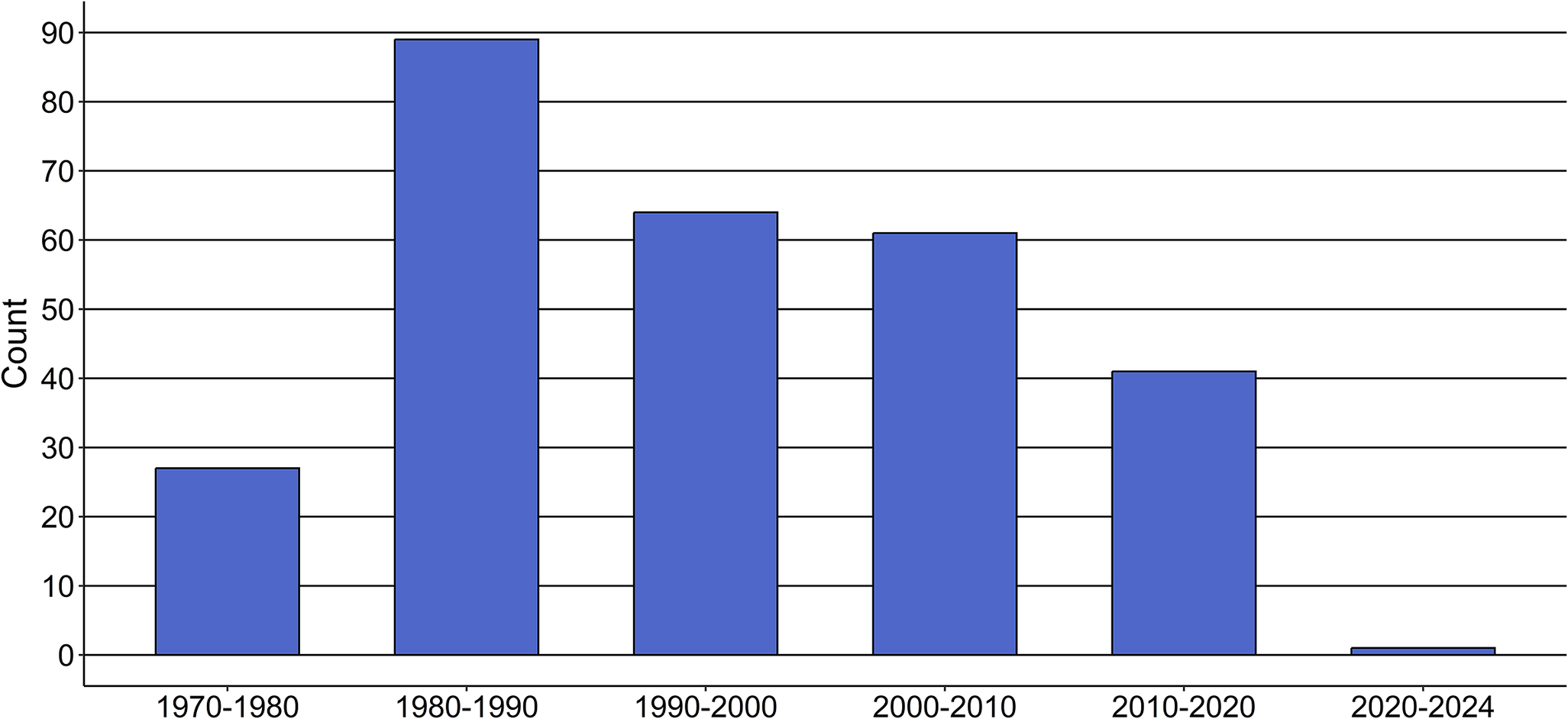
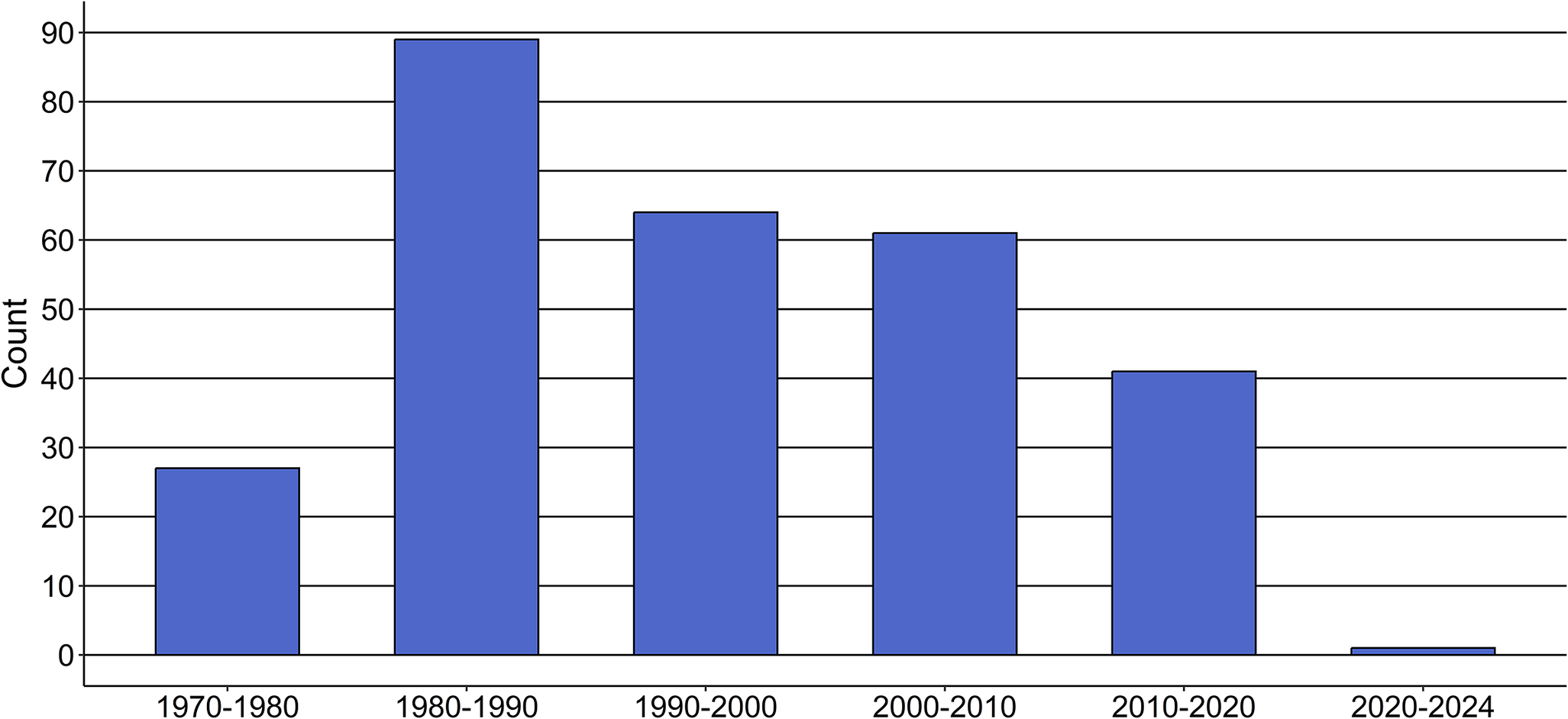
The inferred prevalence of these misconceptions about punctuated equilibrium likely mirrors its movement from hotly debated scientific theory in the 1970s, 1980s, and 1990s to a more fully accepted, and perhaps assumed, aspect of evolutionary theory. Documentation of punctuated equilibrium and the implications of its occurrence are no longer common topics of research and debate. This general impression is easily confirmed using JSTOR’s advanced search engine to track the decline in mentions of “punctuated equilibrium” or “punctuated equilibria” through time in its 11 included paleontology journals (Fig. 9). O’Brien et al. (Reference O’Brien, Valverde, Duran-Nebreda, Vidiella and Bentley2024) documented a similar decline in the use of these terms within the Google Books database.
Number of mentions of “punctuated equilibrium” or “punctuated equilibria” through time in the 11 paleontology journals included in JSTOR.
This drop in discussions of punctuated equilibrium within the scientific literature may reflect a larger trend. More recent paleontological research has focused less on the documentation and interpretation of fossil patterns using rocks and more on the quantitative analysis of the fossil occurrence data already recorded in large databases like the Paleobiology Database. Ironically, widespread anagenesis and pseudoextinction would make such quantitative research methodologies much more difficult than the prevalence of stasis and punctuation. Indeed, these hallmarks of punctuated equilibrium are clearly evident when one recognizes species’ durations on the scale of millions of years and the “rapid” branching of lineages gleaned from patterns of diversification through time. It is the reality of species as evolutionary entities that enables much of the quantitative work upon which twenty-first-century paleontology is centered.
What Don’t We Know: Suggestions for Improving Our Survey Study
We started this pilot survey study to address four research questions: (1) How important do paleontologists and evolutionary biologists think punctuated equilibrium is to their field? (2) To what extent do they use punctuated equilibrium in their own teaching? (3) How accurate are their understandings of core ideas within the concept of punctuated equilibrium? (4) What aspects of punctuated equilibrium are more or less accepted by paleontologists and evolutionary biologists? While the preliminary data presented earlier do provide important insights into our questions, as already described, we wish to acknowledge its limitations and offer suggestions for expanding our study.
First, our sample size is small and nonrandom. A broader deployment of the survey, perhaps in partnership with professional societies beyond the Paleontological Society and Society for the Study of Evolution, is needed to better capture the full range of ideas and understandings among the paleontology and evolutionary biology communities.
Second, we developed the survey items, and in particular the 14 items used to assess respondents’ understanding of punctuated equilibrium, based on our experiences as instructors and researchers. We did not, however, pursue formal validity testing, which is necessary to determine whether respondents interpret the items in the way we intended. Going forward, it would be helpful to conduct cognitive interviews with a representative sample of those in the field to record how they think about and interpret the survey items. These findings can then be used to refine and revise the survey items.
Third, to keep the survey short, we used single items to explore potential misconceptions. A more rigorous assessment of responses to multiple items, perhaps repeated with a later follow-up survey, is needed to demonstrate that these potential misconceptions are in fact deeply rooted and durable conceptions over time.
Fourth, we did not ask respondents to indicate how they learned about punctuated equilibrium. It would be helpful to know whether they learned the concept from textbooks, classroom instruction, seminar-style discussion of primary documents such as Eldredge and Gould’s original 1972 chapter, or personal reading outside formal classes. We might predict that students who engaged with the original documents might hold fewer misconceptions than those who learned only from textbooks. That correlation may be further complicated by the length of time since the respondent encountered these materials.
Fifth, we analyzed our pilot data in a simplistic way, evaluating respondents’ understanding of punctuated equilibrium through a directly summed composite score and assuming that there is a single conceptual understanding out there to assess (“unidimensionality,” to use the jargon of educational research). In our approach, we treated all of the 14 survey items on core punctuated equilibrium ideas as equal in their difficulty and in their relation to a single overall understanding of punctuated equilibrium, assumptions that may not be warranted. Indeed, it may be more informative with respect to understanding misconceptions if some of our survey items do not, in fact, show a relationship with this overall understanding. A more involved statistical modeling process informed by item response theory (IRT) is commonly used for survey studies within educational and cognitive research fields (Magno Reference Magno2009; Knell et al. Reference Knell, Wilhoite, Fugate and González-Espada2015; Maric et al. Reference Maric, Fore, Nyarko and Varma-Nelson2023; Reise and Moore Reference Reise, Moore, Cooper, Coutanche, McMullen, Panter, Rindskopf and Sher2023). However, we felt it was premature to conduct IRT analyses on our dataset given the exploratory nature of our pilot study and its small sample size (a large sample size may be necessary for IRT-based modeling; Jiang et al. Reference Jiang, Wang and Weiss2016).
Our recommendations for expanding this survey study therefore include developing a validated survey instrument via cognitive interviews, adding additional items to explore the stability of potential misconceptions and the different ways respondents learned about punctuated equilibrium, deploying the survey to a broader array of paleontologists and evolutionary biologists (including students, professionals, and textbook writers), collecting a much larger set of responses, and conducting a full IRT-based statistical modeling analysis of the resulting dataset.
Guidance for Teaching and Learning about Punctuated Equilibrium
The lack of a shared understanding of punctuated equilibrium that we infer from these pilot data obviously complicates its effective teaching. To shape a more unified vision of punctuated equilibrium, we present here a set of four critical concepts related to punctuated equilibrium on which instructors can focus their teaching:
-
1. Most morphological change in a species happens during the speciation process.
-
2. [The corollary to 1] Species show little to no net morphological change (i.e., stasis) through most of their stratigraphic and temporal range.
-
3. The speciation process is typically completed within the first 1–10% of a species’ total stratigraphic and temporal range.
-
4. Punctuated equilibrium implies that species are evolutionary units lasting for geologically significant periods of time with a defined start, stable suite of characteristics, and an end.
Addressing Misconceptions
Abundant educational research has revealed the sustained power of initial misconceptions and the need to address these with intentionality (Schneps and Sadler Reference Schneps and Sadler1989; Treagust and Duit Reference Treagust and Duit2008; Dahl Reference Dahl2018; Yacobucci Reference Yacobucci2018; Hartelt et al. Reference Hartelt, Martens and Minkley2022; Ruiz-Martín and Bybee Reference Ruiz-Martín and Bybee2022; Nielson et al. Reference Nielson, Pitt, Fux, de Nesnera, Betz, Leffers, Tanner and Coley2025). Even if teachers have an accurate and shared understanding of punctuated equilibrium, students can be left harboring their personal, incorrect explanations, much as they do with natural selection itself (Abraham et al. Reference Abraham, Meir, Perry, Herron, Maruca and Stal2009). There is thus a demonstrated need to provide students and teachers with several and varied opportunities to wrestle with these prior conceptions.
Based on our survey data and review of textbook content, the two misconceptions that we believe are most critical to address are the notions that (1) punctuated equilibrium states that morphological change occurs extremely rapidly (within a few generations) in the speciation process (suggested by responses to Item 8), and (2) anagenesis, in which an ancestral species gradually transforms into a new species without branching, is a common phenomenon (suggested by responses to Item 2). These misconceptions are related to, but are additional to, the four critical concepts listed earlier. Even if these four critical concepts are addressed, the misconceptions about rates of change and prevalence of anagenesis can remain firmly entrenched, as suggested by the inconsistent and contrary survey results described earlier.
Teaching and Pedagogy
A student’s understanding of punctuated equilibrium may well begin in high school. Punctuated equilibrium appears as part of the “Essential Knowledge” within the Advanced Placement (AP) Biology curriculum in the statement below:
EVO-3.E.1 Punctuated equilibrium is when evolution occurs rapidly after a long period of stasis. Gradualism is when evolution occurs slowly over hundreds of thousands or millions of years. (College Board 2020: p. 141)
One can easily see how this description might feed into the misconceptions identified earlier. Students with this brief exposure, coupled with their impressions gathered through cultural vernacular, need instruction that asks them to examine, challenge, and integrate new understanding into their worldviews.
A quick search of the most popular resources available online as lesson plans and videos reveals that the two misconceptions are very often being propagated by teachers and presenters through their own misunderstanding of the concepts. There is a real need to provide teachers with clear, vetted, engaging resources. What follows are some ideas for how to address these two most common misconceptions and reinforce the four critical concepts in punctuated equilibrium.
Introducing the Concept
We recommend several freely available educational resources as effective introductions to the idea of punctuated equilibrium.
-
1. The diagrams and text used in the punctuated equilibrium section of the University of California Museum of Paleontology’s Evolution website (UC Museum of Paleontology n.d.) provide a clear and accurate introduction to punctuated equilibrium that could be used as part of introductory direct instruction.
-
2. Similarly, the Digital Atlas of Ancient Life, created by Paleontological Research Institute (PRI) staff and collaborators, provides a clear and accurate section about punctuated equilibrium, accompanied by interactive 3D models of some of the original taxa used by Eldredge and Gould (Lieberman and Hendricks Reference Lieberman and Hendricksn.d.). This resource provides both historical perspective and nuance that would allow a student to gain a deeper understanding through engaging with the text and images.
-
3. A unique opportunity exists due to a series of videos housed on PRI’s website and also available on YouTube, created by students in Professor Bruce S. Lieberman’s Biology 599 class at the University of Kansas in the spring semester of 2022.Footnote 1 These videos introduce the basic concepts and claims of punctuated equilibrium using student voices and could easily form the basis of engaging, interactive discussions to help students better understand details and avoid misconceptions.
Digging Deeper/Analysis
The following resources provide more in-depth explorations of punctuated equilibrium and debates surrounding the idea.
-
4. Using controversy to teach deeper understanding is a long-standing pedagogical method. The National Center for Science Education provides at least two resources on its website that could be used for classroom interrogation of the claims and misconceptions often associated with punctuated equilibrium. These are an examination of its presentation in the “intelligent design” textbook Exploring Evolution (2007) and a critique of creationist misuse of punctuated equilibrium from the 1980s.Footnote 2 Both of these resources offer rich opportunities for students to wrestle with both their own misunderstandings and the place that punctuated equilibrium occupies within evolutionary theory.
-
5. Venn diagrams have morphed through time from their original introduction in mathematics to effective classroom teaching tools for examining misconceptions (Gray and Fouad Reference Gray and Fouad2019). Using a Venn diagram to compare and contrast aspects of phyletic gradualism/anagenesis with punctuated equilibrium allows students to more thoroughly investigate the similarities of these concepts while being called upon to detail their differences in scope and claims.
-
6. Concept maps have been the subject of extensive educational research for over 40 years (Novak and Cañas Reference Novak and Cañas2007; Kinchin Reference Kinchin, Mintzes and Walter2020). They have been shown to help students achieve deep understanding as they reform their cognitive structure to include new ideas (Hay et al. Reference Hay, Kinchin and Lygo-Baker2008). A concept map using a focus question such as “How does punctuated equilibrium explain the appearance of new species in the fossil record?” would require that students not only understand the four critical ideas listed earlier, but also that they not fall into the two commonly held misconceptions.
-
7. For students at university and perhaps high school levels, reading and discussion of the original punctuated equilibrium papers (Eldredge Reference Eldredge1971; Eldredge and Gould Reference Eldredge, Gould and Schopf1972; Gould and Eldredge Reference Gould and Eldredge1977) would provide students with opportunities to construct their understanding of the concept directly from the words of those who originated the idea. This pedagogical approach also provides insight into how new ideas in science are proposed and debated, and supports a broader conversation about the historical importance of punctuated equilibrium to the development of modern paleobiology (Sepkoski Reference Sepkoski2012, Reference Sepkoski2019).
Using Data
A more inquiry-driven approach to teaching and learning about punctuated equilibrium would involve the use of real-world data.
-
8. One pedagogical strategy would entail creating hypothetical data or using actual data from paleobiologic resources to create teaching case studies. It seems as though a data-rich teaching activity based in reality has yet to be developed, but existing uses of real data seem like good candidates for modification, such as Reference Casey and LiebermanCasey and Lieberman (n.d.). Alternatively, students could be asked to analyze published data and to reflect on the claims of the authors and evidence used. One potential case study that might provide a chance for fruitful exploration and class analysis would be Malmgren et al.’s (Reference Malmgren, Berggren and Lohmann1983) conclusion of “punctuated gradualism” in foraminifera.
Finally, we also recommend that those seeking to better understand punctuated equilibrium read Gould (Reference Gould1991), Eldredge (Reference Eldredge2008), or the online source by Lieberman and Eldredge (Reference Lieberman and Eldredge2008), which are accessible overviews written by punctuated equilibrium’s original authors.
Conclusions
As explained by Sepkoski (Reference Sepkoski2012) and as expressed in the introduction to the book itself, the volume in which punctuated equilibrium was most purposefully presented to paleontologists, Models in Paleobiology (Schopf Reference Schopf1972), was a text aimed at both working paleontologists and particularly their students. The hope was that exposure to the use of innovative models using fossil data would reinvigorate the field and lead to new ideas and applications. In Sepkoski’s view, punctuated equilibrium and its allowance for a more “literal” reading of a fossil record showing stasis and rapid speciation was one of the major pillars on which the field of paleobiology was built. No longer did paleontologists have to confront “Darwin’s dilemma” (sensu Sepkoski Reference Sepkoski2012), relegated to searching in vain for phyletic gradualism where it did not seem to exist. Indeed, several prominent paleontologists reacted to this 1972 paper with the equivalent of “tell us something we don’t know” (Sepkoski Reference Sepkoski2012: p. 176). Others implied that Eldredge and Gould had constructed phyletic gradualism as a straw man foil to punctuated equilibrium. All of this seems the more ironic when coupled with our survey; 39% of respondents agreed with the statement that anagenesis is, indeed, a common phenomenon, and the straw man has found new life.
While we would argue that there has been no revolutionary influx of documented cases of gradualism in the fossil record over these five decades, one might excuse the respondents who appear to believe that gradualism is a prevalent pattern in the fossil record. What seems more troubling is what this belief means for the field’s ability to use its most valuable asset, the perspective of deep time. As a discipline, are we really back to square one when confronting Darwin’s dilemma? Do we not realize the logical step backward that must accompany this conclusion? Similarly, if so many respondents now feel that the speciation modeled by punctuated equilibrium requires the action of some special, rapid mechanism, could punctuated equilibrium ever be seen as a prevalent pattern in the fossil record? From our admittedly limited pilot dataset, it would appear that not only is there clear confusion and disagreement about what punctuated equilibrium means and implies, but this confusion seems to suggest that a lack of historical and technical understanding of punctuated equilibrium underlies much of our field’s current research.
While most would agree that “nothing in biology makes sense except in the light of evolution” (Dobzhansky Reference Dobzhansky1973), we similarly argue that much of today’s work in paleobiology becomes locked away without the two keys provided by punctuated equilibrium: (1) the ability to treat fossil organisms as evolutionary entities and (2) the perspective that the fossil record is not so filled with gaps that actual evolution is rarely observed and thus beyond paleontology’s purview. As Sepkoski noted, punctuated equilibrium “acted as a model of the kind of paleontology that could break the grip of Darwin’s dilemma and could offer a route to bringing paleontology into the mainstream of evolutionary biology” (Sepkoski Reference Sepkoski2012: p. 184). Perhaps we are not free of this grip after all.
Emphasizing the foundational role of punctuated equilibrium in our current research programs, even while punctuated equilibrium itself is not the subject of research, should be a part of our teaching. Aside from the resources mentioned earlier and those that are developed to teach the basic tenets of punctuated equilibrium, a more difficult task is at hand; reestablishing and clearly acknowledging the necessity of punctuated equilibrium and the view of life it provides us as integral to paleobiology’s ability to use the fossil record as a source of evolutionary insights.
Acknowledgments
The authors thank L. Ivany, P. Kelley, B. Lieberman, and D. Prothero for their feedback on the initial survey draft, and three anonymous reviewers for their constructive comments on the paper. We gratefully acknowledge the assistance of the Paleontological Society and Society for the Study of Evolution in distributing the call for survey participants via their social media accounts and thank all those who shared the survey link within their personal networks. We also express our gratitude to all those who took the time to complete the survey, without which this research project could not have been completed.
Competing Interests
The authors declare no competing interests.
Data Availability Statement
The survey instrument with informed consent document is available as Supplementary File 1 from the Zenodo Digital Repository: https://zenodo.org/records/15611578. Please note that we cannot share the original raw survey data, per Institutional Review Board requirements for data security involving human subjects.

 Open access

