


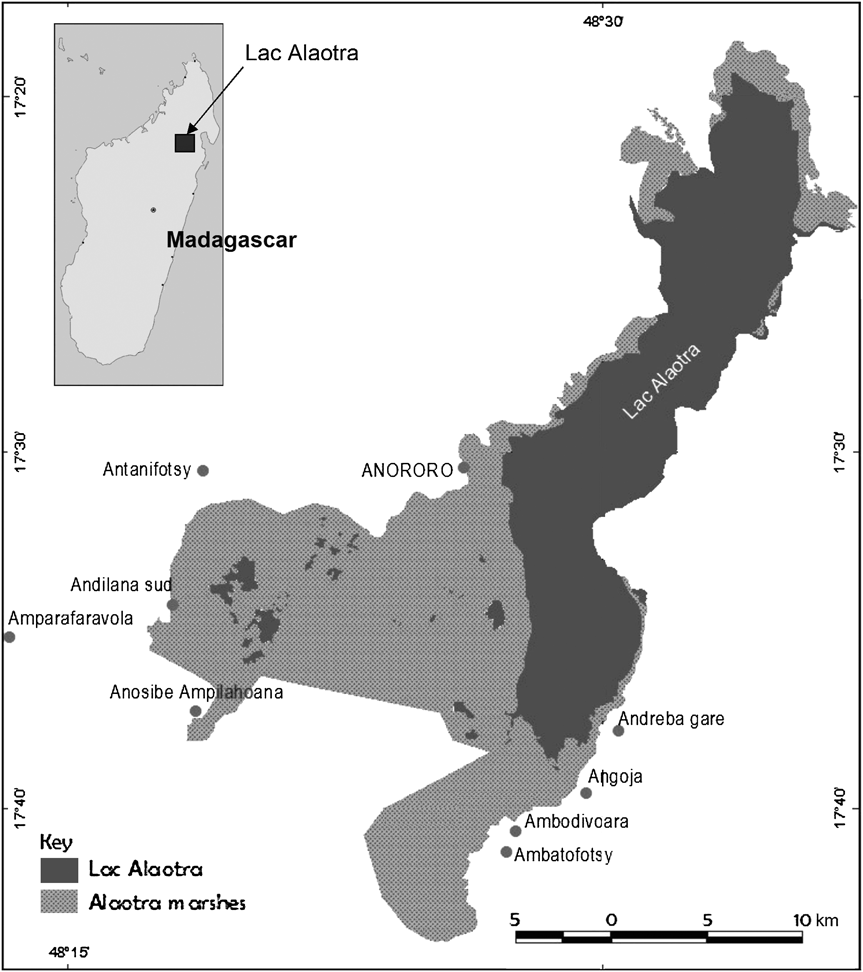
Lac Alaotra is the largest lake in Madagascar, covering an area of 20,000 ha in the central highlands (Andrianandrasana et al., Reference Andrianandrasana, Randriamahefasoa, Durbin, Lewis and Ratsimbazafy2005; Fig. 1). The 23,000 ha wetland bordering the lake supports the Critically Endangered Alaotran gentle lemur Hapalemur alaotrensis (Groves, Reference Groves, Wilson and Reader2005; IUCN, 2008). Eight endemic species of wildfowl have been observed at the lake as well as six species of endemic fish (Andrianandrasana et al., Reference Andrianandrasana, Randriamahefasoa, Durbin, Lewis and Ratsimbazafy2005). Lac Alaotra is also home to over 550,000 people who live along its shores (PRD, 2003) and for whom rice cultivation and fishing are important occupations (Blanc-Pamard, Reference Blanc-Pamard1987; Ranarijaona, Reference Ranarijaona2007), although growing vegetables, livestock rearing and textile manufacture are also practised (Jarosz, Reference Jarosz1994).
Lac Alaotra and the surrounding marshes, and the location of study site, Anororo. The inset indicates the position of the main figure in northern Madagascar.
Much of the original wetland has been converted to rice fields (Andrianandrasana et al., Reference Andrianandrasana, Randriamahefasoa, Durbin, Lewis and Ratsimbazafy2005) but an education and awareness campaign was initiated in lakeside communities in 1996 in an attempt to prevent the complete loss of the wetland habitat (Durbin, Reference Durbin, Rakotosamimanana, Rasamimanana, Ganzhorn and Goodman1999). In 2003 Lac Alaotra was designated a Ramsar site to provide a framework for protecting the remaining wetland (Ramsar Convention on Wetlands, 2007). More recently the government of Madagascar classified the lake as a protected area.
Despite these efforts wetland burning continues to be a significant threat to biodiversity in Lac Alaotra and the surrounding marshes (Ranarijaona, Reference Ranarijaona2007). In 2004 the area of wetland was reduced to c. 47% (10,816 ha) through burning during the dry season (Durrell, Reference Durrell2006). The desire for more agricultural land for rice cultivation has been cited as one of the main reasons for burning (Ralainasolo et al., Reference Ralainasolo, Waeber, Ratsimbazafy, Durbin and Lewis2006). Other motives include burning to provide space to set fishing nets within the mats of invasive vegetation that cover much of the lake (Andrianandrasana et al., Reference Andrianandrasana, Randriamahefasoa, Durbin, Lewis and Ratsimbazafy2005), and political protests (Razanadrakoto, Reference Razanadrakoto2005). Mutschler et al. (Reference Mutschler, Randrianarisoa and Feistner2001) and Ranarijaona (Reference Ranarijaona2007) suggested burning to hunt H. alaotrensis as one reason for the setting of fires. Ranarijaona (Reference Ranarijaona2007) also indicated that fire was used to hunt the introduced fish Ophiocephalus striatus (now classified as Channa maculata; Courtenay et al., Reference Courtenay, Williams, Britz, Yamamoto and Loiselle2004).
As there had been no detailed investigation of the relative importance of each of these potential drivers of wetland burning, the study reported here was carried out to clarify the most important motivations for this practice. The research was conducted over 8 weeks during May–July 2007. It was based in the town of Anororo, on the west coast of Lac Alaotra. Anororo has a population of c. 8,000 people (PCD, 2004). Based on the traditional territorial divisions of Alaotra the site of Anororo also has 9,850 ha (42.8%) of the remaining 23,000 ha of wetland within its boundaries (Andrianandrasana et al., Reference Andrianandrasana, Randriamahefasoa, Durbin, Lewis and Ratsimbazafy2005).
Data were collected using two methods: semi-structured interviews and questionnaires. Purposive sampling (Bernard, Reference Bernard2006) was used to identify individuals for the semi-structured interviews. Different age groups, professions and (where appropriate) sexes within the town were selected opportunistically to capture a range of viewpoints regarding wetland burning. People who had immigrated to Anororo were also included. Nobody was formally interviewed during the first 10 days to enable the lead researcher, JAC, to establish the range of professions practised and to become accepted by townspeople. The importance of rice cultivation and fishing in the town is reflected in the choice of individuals interviewed (Appendix 1). A total of 27 interviews were conducted, in Malagasy, by JAC and a local graduate (LHR).
A questionnaire (Appendix 2) was then designed to test whether the views expressed during interviews reflected those of the town in general. To identify rice cultivators for the questionnaire 1-hour sampling periods were randomly selected each day. During this period all rice cultivators entering the town from the single track leading from the rice fields were interviewed. For fishers we randomly selected 1-hour sampling periods and locations, as fishers could land their catches at six locations around the town. Questionnaires were written in French, translated into Malagasy and then back-translated to French to check for any misunderstandings. In total 122 questionnaires were conducted, i.e. c. 5% of the adult male population of Anororo (PCD, 2004).
Interviewees were asked whether or not they had seen any changes in the environment around the town in their lifetimes. When they mentioned reduction of the wetland caused by burning, they were then asked ‘Why do you think the wetland is burnt?’ Twenty-two informants (81%) interviewed stated that the wetland vegetation had declined as a consequence of burning to gather the Asian snakehead Channa maculata (Fig. 2). Twenty-one (78%) placed this activity above all other reasons for wetland burning or only provided this as an explanation. Informants explained that the fish gather in the wetland vegetation as the water recedes during the dry season (Appendix 3). To reach the fish, people set fire to the plants making it possible to pick up the fish, lying underneath, by hand. Two informants also mentioned that to reach places where C. maculata are buried it is necessary to create paths, requiring further burning of the vegetation.
Reasons given by villagers during interviews (n = 27) and questionnaires (n = 122), combined, to explain marsh burning in Lac Aloatra.
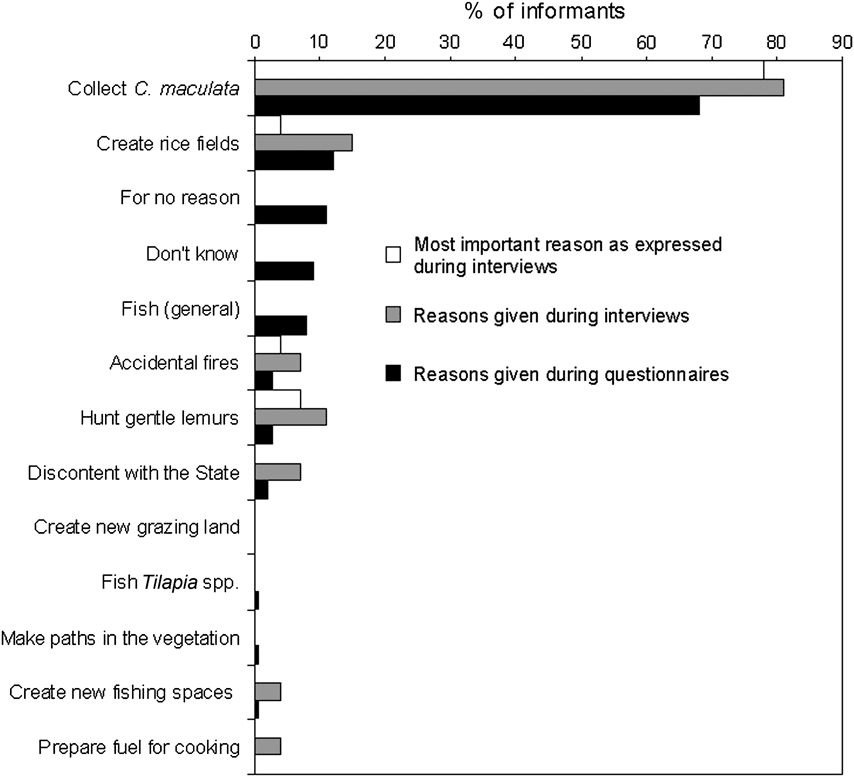
The questionnaire respondents were asked ‘According to you, why do people keep on burning the marshes?’ Eighty-three (68%) stated that hunting for C. maculata was the reason for burning (Fig. 2). A further 10 (8%) respondents provided the more general answer that the marsh was burnt to catch fish.
The Asian snakehead was introduced to Madagascar in the 1970s (Courtenay et al., Reference Courtenay, Williams, Britz, Yamamoto and Loiselle2004) and is now found in most lakes on the island (Sparks & Stiassny, Reference Sparks, Stiassny, Goodman and Benstead2003). Since its arrival in Lac Alaotra the snakehead has probably caused the local extinction of the fish genus Paratilapia (Courtenay et al., 2004) and has been implicated in the disappearance of Delacour's little grebe Tachybaptus rufolavatus (Mutschler, Reference Mutschler, Goodman and Benstead2003). Being facultative air breathers Channa spp. are capable of surviving in the absence of water for significant periods of time (Courtenay et al., 2004). Fishers of Channa striata in Thailand have been documented to use spades to slice the mud to locate the fish that bury into it during times of drought (Smith, Reference Smith1945). However, we could not locate other examples of the use of fire as a tool for catching either Channa spp. or any other fish species.
Our study points to a clear and consistent local interpretation of the practice of wetland burning that differed from the most commonly cited reasons (Mutschler et al., Reference Mutschler, Randrianarisoa and Feistner2001; Mutschler, Reference Mutschler, Goodman and Benstead2003; Ralainasolo et al., Reference Ralainasolo, Waeber, Ratsimbazafy, Durbin and Lewis2006). Burning to create new agricultural land does not appear now to be an important driver of wetland burning. Neither was there significant reference made to burning to create fishing spaces, hunt H. alaotrensis or as a means of expressing discontent with the State. The data presented here support the claim that wetland burning facilitates hunting for the introduced fish C. maculata (Ranarijaona, Reference Ranarijaona2007), and is possibly the main reason for ongoing burning, at least in the wetland around Anororo. This new perspective on the drivers of wetland burning around Lac Alaotra should inform future management decisions concerning how best to conserve this globally important site and the endemic species it supports.
Acknowledgements
We thank the Government of Madagascar and the people of Anororo for providing permission to conduct the study and the Royal Anthropological Institute (Ruggles-Gates Fund for Biological Anthropology), The Leverhulme Trust, the Parkes Foundation, the British Institute in Eastern Africa, University College London and the States of Jersey for financial support. Katherine Homewood commented on early drafts of this article.
Appendices
The appendices for this article are available online at http://journals.cambridge.org
Biographical sketches
Jamie Copsey has been working in the field of biodiversity conservation training and education for over 15 years. His current research interests concern human motivations for natural resource use and how we can use this information to inform conservation practice. Julia Jones has been working on the use and management of wildlife resources by local people in Madagascar for the last 8 years. Herizo Andrianandrasana is a water and forest engineer, working as ecological monitoring coordinator in the Durrell Wildlife Conservation Trust-Madagascar Programme. He has been involved in annual participatory ecological monitoring at Lac Alaotra since 2000. Lala Hasina Rajaonarison is a graduate student in the Department of Geography at the University of Antananarivo. Julia Fa has undertaken research in a number of conservation biology topics in Europe, Africa and South America, specializing in biodiversity assessment and threatened species management.



