

INTRODUCTION
The growing field of historical political economy has generated bold arguments about how the past explains core questions in the social sciences, from wealth disparities and inequality to the propensity for conflict and variation in state capacity. This article hones in on one such debate: recent research finds that sub-Saharan African countries with a history of precolonial political centralization see better economic development (Bockstette, Chanda, and Putterman Reference Bockstette, Chanda and Putterman2002; Englebert Reference Englebert2002), while others associate these same regions with an increase in civil conflict (Paine Reference Paine2019; Wishman and Butcher Reference Wishman and Butcher2022).Footnote 1 Indeed, the literature is nearly evenly split between claims that there is a long-run benefit to centralization (51%) and those that find a decidedly negative (25%) or mixed (24%) impact.Footnote 2 This generates an apparent paradox: how can the legacy of the precolonial past be at once beneficial and harmful?
To date, scholars have explained centralization’s legacies as the result of distinct norms, identities, or resources that facilitate cooperation or contestation with the political center. The implicit assumption is that these mechanisms are highly uniform across precolonial states.Footnote 3 This article challenges this view. I argue that theoretical progress requires us to conceptualize the distinct ways that political power was exercised in precolonial Africa. In so doing, I part ways with the existing focus on political centralization as a binary outcome—a territory was either centralized or it was not—to robustly conceptualize the nature of statehood in precolonial Africa. Focusing on the challenges all executives face when working with subordinate elites, I theorize a continuum in the degree to which monarchs can concentrate political power around themselves to articulate different types of precolonial statehood. A monarch’s political power is most concentrated when elite status is narrowly confined to a specific group or lineage, allowing the monarch to rule his territory directly through close associates. At the continuum’s other end, political power is least concentrated where a monarch administers his territory indirectly via subordinate elites whose authority derives from indigenous traditions outside the monarch’s control.
Mapping this typology onto contemporary outcomes allows me to demonstrate that there is no uniform development bonus or propensity for conflict. Where political authority was highly concentrated—in what I call a despotic type—we see higher rates of civil conflict prevalence today relative to stateless areas, by which I mean regions that were either acephalous or ruled by petty chiefdoms in the precolonial period. In contrast, we see less civil conflict where monarchs were obliged to negotiate with the indigenous local elite via indirect rule. Development outcomes tell an altogether different story: what development bonus accrues to areas that were home to precolonial states is dampened—if not inexistent—in despotic polities, suggesting that the relative concentration of political power is harmful to economic development. In contrast, states where power was least concentrated fare better in the present.
I suggest that this variation can be explained by enduring norms around the exercise of political power. Where states delegated more autonomy to diverse local elites, they inculcated norms validating political negotiation, tolerance of diversity, and collaborative bargaining that persist to the present. As a result, these areas have better mechanisms in place to manage conflict and bolster development today. Conversely, where monarchs concentrated power around themselves, political authority became more coercive, fostering norms of deference to authority, out-group hostility, and higher tolerance of coercive bargaining tactics. These areas, which lack comparable conflict-reducing mechanisms, are accordingly more likely to have antagonistic relations with outsiders. I substantiate the plausibility of these mechanisms with historical data and by testing the theory’s observable implications with data from the Afrobarometer.
I advance this argument by addressing two interlocking challenges currently facing the literature on precolonial centralization. The first is conceptual. In the face of substantial divergence in how we define political centralization, I build on existing theories of centralized political order to articulate a unifying concept of precolonial statehood that is flexible enough to account for African historiography. Specifically, I argue that a state is defined by social segmentation, or the presence of a durable elite class, the ability to extract economic surplus, and a territorial administration that regulates local social and economic life, enabling cooperation across space. This definition forefronts the means by which monarchs manage relationships with subordinate elites to administer their territory, which, in turn, allows me to theorize the typology of precolonial statehood introduced above.
The second challenge relates to measurement. I document substantial migration between the conceptualization and measurement of precolonial statehood in the existing literature. I offer a solution to this problem: drawing on the concept of statehood articulated above, I introduce an original dataset of African states in the nineteenth century, a period of great political dynamism that was marked by both the collapse of old states and the rise of new ones. My Atlas of 19th c. African States estimates the spatial extent of 248 polities that meet my definition of statehood and codes numerous attributes for each.
This article proceeds as follows. I first introduce my conceptualization of a state and the typology I derive from it before discussing the challenges associated with measuring Africa’s precolonial political geography and introducing my dataset. I then test whether different types of precolonial states do in fact generate distinct legacies and present preliminary evidence for the mechanisms before concluding.
WHAT IS A PRECOLONIAL CENTRALIZATION?
Arguments that contemporary patterns in the world—from autocracy (Hariri Reference Hariri2012) to state capacity (Bolt and Gardner Reference Bolt and Gardner2015)—can be explained by a history of political centralization share a common starting point: some areas of the world were centralized in the past, while others were not. Reading across this body of work, however, reveals an inconsistent conceptualization of what exactly we mean by political centralization. As I document in Figure A2.1 in the Supplementary Material, the majority of work invokes the language of institutions, describing centralization as an attribute of states or kingdoms. Others reference something more akin to ethnic norms or the existence of chiefly hierarchies. What is a centralized polity, and where should we locate the threshold for political centralization?
A Proposed Definition
I encapsulate the literature’s shared interest in precolonial centralization with a broad definition of statehood. I argue that a polity is sufficiently centralized to be considered a state when it meets three criteria:
-
1. Social segmentation: A polity must concentrate political authority in an elite class that sits atop a durable social hierarchy, thereby limiting political, economic, and social mobility along prescribed channels. Social differentiation is core to many classic definitions of states (e.g., Claessen Reference Claessen1984; Fortes and Evans-Pritchard Reference Fortes and Evans-Pritchard1940; Johnson and Earle Reference Johnson and Earle1987). For North, Wallis, and Weingast (Reference North, Wallis and Weingast2009, 5–9), for example, the natural state is distinguished from more decentralized political structures by the presence of an elite that sits at the top of a hierarchy of patron–client relationships. Social segmentation varies in how narrow or diverse the elite class is. When it is narrower, monarchs are either able to designate elite status at will by appointing allies (for example, slave administrators as described by Sharman and Zarakol Reference Sharman and Zarakol2024) or are themselves members of the dominant elite group. The Emirs in Sokoto came from the ruling class of Fulani nobles, for example. Where it is diverse, monarchs must negotiate with a diffuse set of elites, including those whose political authority rests on indigenous traditions that predate incorporation. Social segmentation provides a means to distinguish between petty chiefdoms and greater levels of centralization because the existence of a single leader alone is insufficient to meet this condition. Thus, a polity ruled by an established royal lineage that controls multiple offices would count, while cases where the “elite” is limited to an individual ruler, as in a small chieftaincy, would not.
-
2. Economic extraction: Elites must be able to compel the periphery to transfer rents. This can be a system of regularized tribute, such as yearly tribute from peasants as well as taxes on trade or obligatory labor. The extraction of revenue is a defining goal of the state for authors in the tradition of new institutional economics like Levi (Reference Levi1988), but it also features heavily in work by historians (Hawthorne Reference Hawthorne, John and Reid2013). Economic surplus is a crucial source of rents for elites (North, Wallis, and Weingast Reference North, Wallis and Weingast2009) and enables the maintenance and expansion of a political structure precisely because elites can redeploy rents to legitimate the sociopolitical hierarchy, be it through patronage or through the projection of an ideological apparatus (e.g., Claessen and Oosten Reference Claessen and Oosten1996).
-
3. Third, a territorial administration facilitates political integration by linking the ruling elite to their subjects. Such an administration must represent the monarch locally and have the authority to regulate social and economic life. This attribute is highly variable in its empirical manifestation but ranges structurally from direct appointments to indirect systems that delegate power to chiefs, religious authorities, or other indigenous local elites. What is critical is that the state provides an institutional structure for its subjects, allowing us to distinguish between communities that were fully integrated into the political apparatus from those that may occasionally be raided for tribute but otherwise have little felt state presence. A clear test of this condition is whether a monarch can organize cooperation with the periphery, the classic manifestation of which would be the ability to raise troops to mount a common defense.
The concept articulated above offers a relatively minimalist definition of the state. In this way, I build on recent attention to how centralized political order has varied across time and space (see Boix Reference Boix2015; Wang Reference Wang2022; Zarakol Reference Zarakol2022). Although the role of coercion has been fundamental to many theories of the state, most famously summarized in Weber’s (Reference Weber1978, 54) monopoly on the legitimate use of force, similar to North, Wallis, and Weingast (Reference North, Wallis and Weingast2009) or Abramson (Reference Abramson2017), I do not emphasize this as a key threshold for statehood.Footnote 4 Rather, I build on more capacious definitions of statehood found elsewhere in the social sciences that are more compatible with the combative subunits and rivalrous political authorities that have defined centralized political order across world history.Footnote 5 This further ensures that my definition remains flexible enough to capture the varying forms and degrees of political centralization found in precolonial Africa, where political authority included heterarchical dimensions of ritual power (Monroe Reference Monroe2013) and often “exist[ed] amid a degree of public disorder quite incompatible with modern Western views of ‘normal’ state functions” (Kopytoff Reference Kopytoff1987, 20).
Toward a Typology of Precolonial States
As I have argued, a core challenge facing a monarch is the need to retain the allegiance of subordinate elites (North, Wallis, and Weingast Reference North, Wallis and Weingast2009, 30). Across history, leaders have often managed this challenge by developing highly personalized relationships that bestow patronage and various privileges to subordinates in exchange for their continued loyalty (Charrad Reference Charrad2011; see Mann [Reference Mann1986] on medieval Europe). How monarchs structure these relationships, however, is highly variable, and such patronage networks are simultaneously capable of facilitating resistance as subordinate elites seek to signal dissent or assert autonomy.
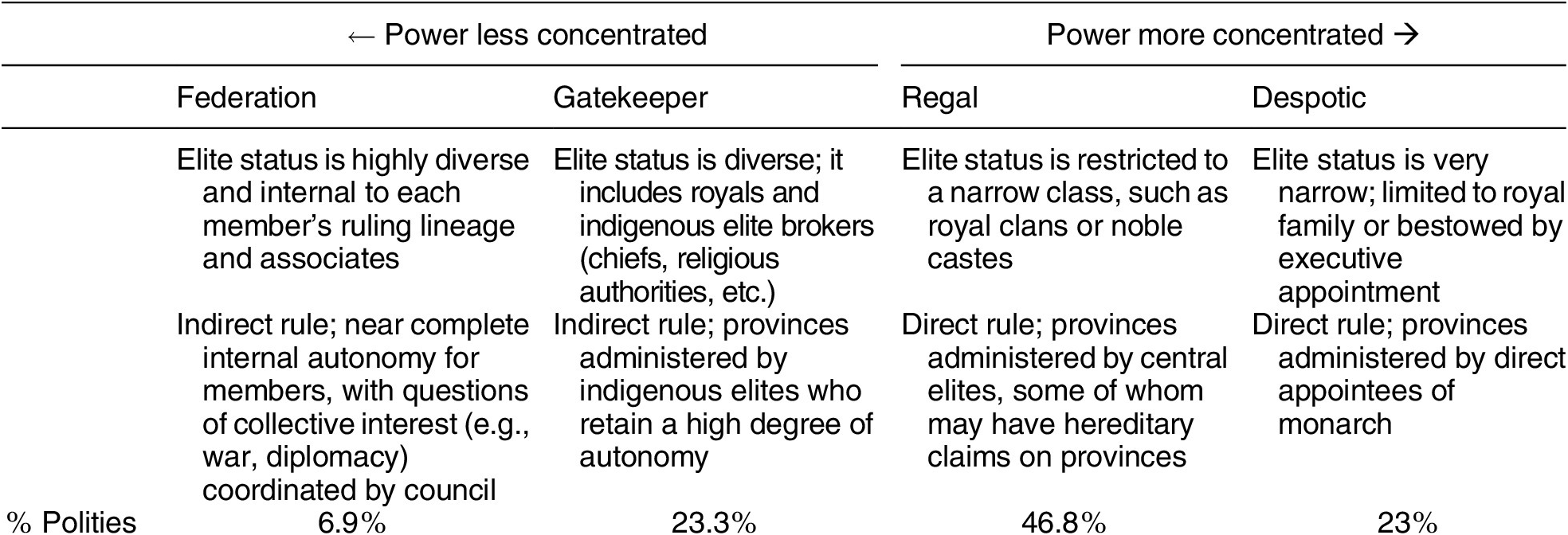
Taking a monarch’s need to retain the allegiance of subordinate elites as a starting point, I develop a typology of precolonial states that categorizes the diverse ways that the African precolonial leaders responded to this challenge. Building on work by African historians, notably Vansina (Reference Vansina1962), and theories of brokerage networks (Gould and Fernandez Reference Gould and Fernandez1989), I focus on the relationship between two components of my definition—social segmentation and territorial administration—to develop a continuum of state types. The typology emphasizes a monarch’s ability to concentrate political power around himself. At one extreme, a monarch could appoint subordinate elites at his discretion, bestowing elite status on loyal allies at will, effectively concentrating the bulk of political authority within himself. This rendered it easier to administer territory directly via appointed or highly loyal elite allies, facilitating more coercive, top-down decision-making and minimizing local autonomy.
More frequently, however, monarchs’ political authority was more diffuse, obliging them to work with diverse brokers, such as indigenous rulers of incorporated provinces or religious authorities, shifting them toward indirect models of territorial administration.Footnote 6 In these cases, local elites provide much of the day-to-day administration of a monarch’s territorial holdings. We can refer to the latter as a more “collaborative” system of political bargaining to the extent that the exercise of political power is predicated on negotiations between a monarch and his subordinates, many of whose elite status derives from sources beyond the monarch’s control.
I dub the most concentrated pole a despotic type. Here, subordinate elites are directly under the control of a monarch and serve at his whim. As a result, the monarch wields substantial authority downward across the territory, and subordinate elites follow the center’s policy directives within a well-defined political space. Despotic states produce the most uniform administration in the typology, therefore, but they are also the most likely to generate antagonism toward dissent and diversity.
Where a monarch’s authority is less absolute, but they face a uniform elite class which they themselves are a member of, we have what Vansina refers to as a regal model. In most cases, the elite class is a royal lineage, but it can also be a clan, religious group, or social caste. In lieu of appointing whom they please as subordinates, monarchs in regal polities rely on their peer elites to administer the territorial periphery. In some cases, provinces become the fiefdom of various sub-clans or sub-lineages, necessitating more bargaining by a monarch wishing for compliance. Nonetheless, under this model—the most common in my dataset—the interests of the monarch and his fellow elite are closely aligned and, as such, his interests are represented quite directly by the individuals he appoints.
In a gatekeeper model, a state’s territory is administered indirectly, with the monarch relying on indigenous clans or lineages who held power prior to incorporation. In so doing, the monarch bestows privilege and patronage to local elites who, in turn, provide tribute and cooperate with the monarch when required, but who otherwise retain a high degree of local autonomy. Although monarchs under a gatekeeper model may try to exert their authority and appoint parallel authorities from the center, they are unable to administer their territory without the collaboration of indigenous elites. As observed by Gerring et al. (Reference Gerring, Daniel, Johan and Julián2011), indirect systems of rule such as this can prove to be highly durable over time as mutually lucrative relationships become entrenched within a polity even if such systems necessitate significant negotiation between parties.
Finally, federations see a monarch rule over external affairs with a council, the constituent members of which otherwise retain internal policy autonomy. Here, political power is the least concentrated. Federation members are mutually dependent for security but understand their primary political loyalty to be within their respective sub-units. Federations, like gatekeeper polities, display more tenuous territorial integration. In both, monarchs invest in maintaining alliances with subordinate elites through various measures, ranging from mutually beneficial exchanges to the threat of coercion. Thus, Vansina (Reference Vansina1962, 333) describes federations as relying on some combination of pressure from external threats, a monarch’s military superiority, or the willing consent of members.
The typology should not be misread as suggesting that federations, where political power is the least concentrated around the monarch, are somehow closest to being stateless. To the contrary, the stability of political order waxed and waned across all four types and within each lay the seeds of a polity’s potential demise. States relying on indirect rule are prone to fissure as the basis for elite authority is less tightly bound to the center. In contrast, regal polities are prone to inter-lineage rivalries as various factions seek to depose each other or, alternatively, to strike out and found their own state. Finally, although despotic states are often quite stable, competition among royal family members can provoke deep succession disputes, and they are not immune to external shocks. The collapse of Ngoyo, for example, was precipitated by the increasingly lucrative Atlantic trade that reoriented economic power away from the monarch and created alternative bases of power that he could no longer control directly (Martin Reference Martin1970).
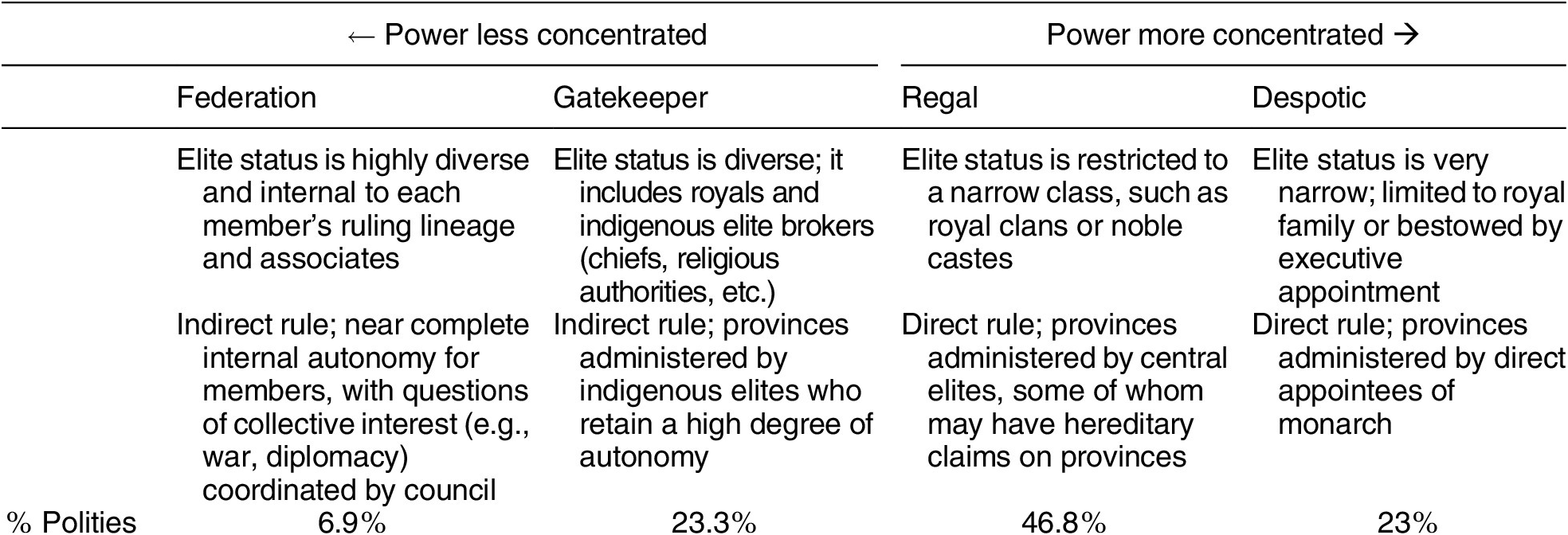
Table 1 visualizes the typology, detailing how social segmentation and territorial administration vary across the four types laid out above.
A Typology of Precolonial States
THE CHALLENGE OF MEASURING THE HISTORICAL STATEHOOD
The previous section laid out an abstract concept of precolonial statehood, but this leaves unanswered the question of how to measure it in history. Far and away, the most common measure of precolonial centralization employed in the literature comes from the anthropologist George Murdock. Approximately half of the literature uses Murdock’s (Reference Murdock1967) measure of ethnic groups’ “Jurisdictional Hierarchy,” which measures a group’s political complexity from 0 (stateless) to 4 (a large state).Footnote 7 Any score of 2 or higher is coded as having been “centralized” in the precolonial era.
Several critiques have been leveled at Murdock’s data, many centering on the factual accuracy of his measures (recently see Paine, Qiu, and Ricart-Huguet Reference Paine, Qiu and Ricart-Huguet2025). My own critique focuses on the uneasy match between Murdock’s data and the conceptualization of centralization articulated in the literature. Murdock set out to measure the “culture-bearing unit,” or ethnic groups. Yet most research on precolonial legacies implicitly or explicitly theorizes centralization as being about states or kingdoms. Bolt and Gardner (Reference Bolt and Gardner2015), for example, are interested in the effects of precolonial statehood, yet use Murdock’s data, substituting a cultural measure for a concept about political institutions. Given the widespread recognition that Africa’s precolonial states rarely corresponded with ethnic boundaries (Colson Reference Colson, Lewis and Duignan1969, 31), this is a questionable leap.
In response, a handful of scholars have attempted to develop alternative measures. Wishman and Butcher (Reference Wishman and Butcher2022) code the location of precolonial capitals, for example, allowing them to generate an estimate of the number of states within contemporary state borders, but limiting the data’s subnational utility. Depetris-Chauvin (Reference Depetris-Chauvin2015), Paine (Reference Paine2019; see also Paine, Qiu, and Ricart-Huguet Reference Paine, Qiu and Ricart-Huguet2025), Bauer, Platas, and Weinstein (Reference Bauer, Platas and Weinstein2022), and Wishman (Reference Wishman2023) use historical atlases to estimate the territory of precolonial states. These are welcome alternatives, but because this work stops short of robustly discussing what qualifies as a precolonial state, it moves awkwardly between concept and measurement, in most cases letting historical atlases dictate the universe of cases. Generally, it is unclear what the basis of the estimates of a state’s territorial extent is in these data because the data-generating process for historical atlases is unknown.
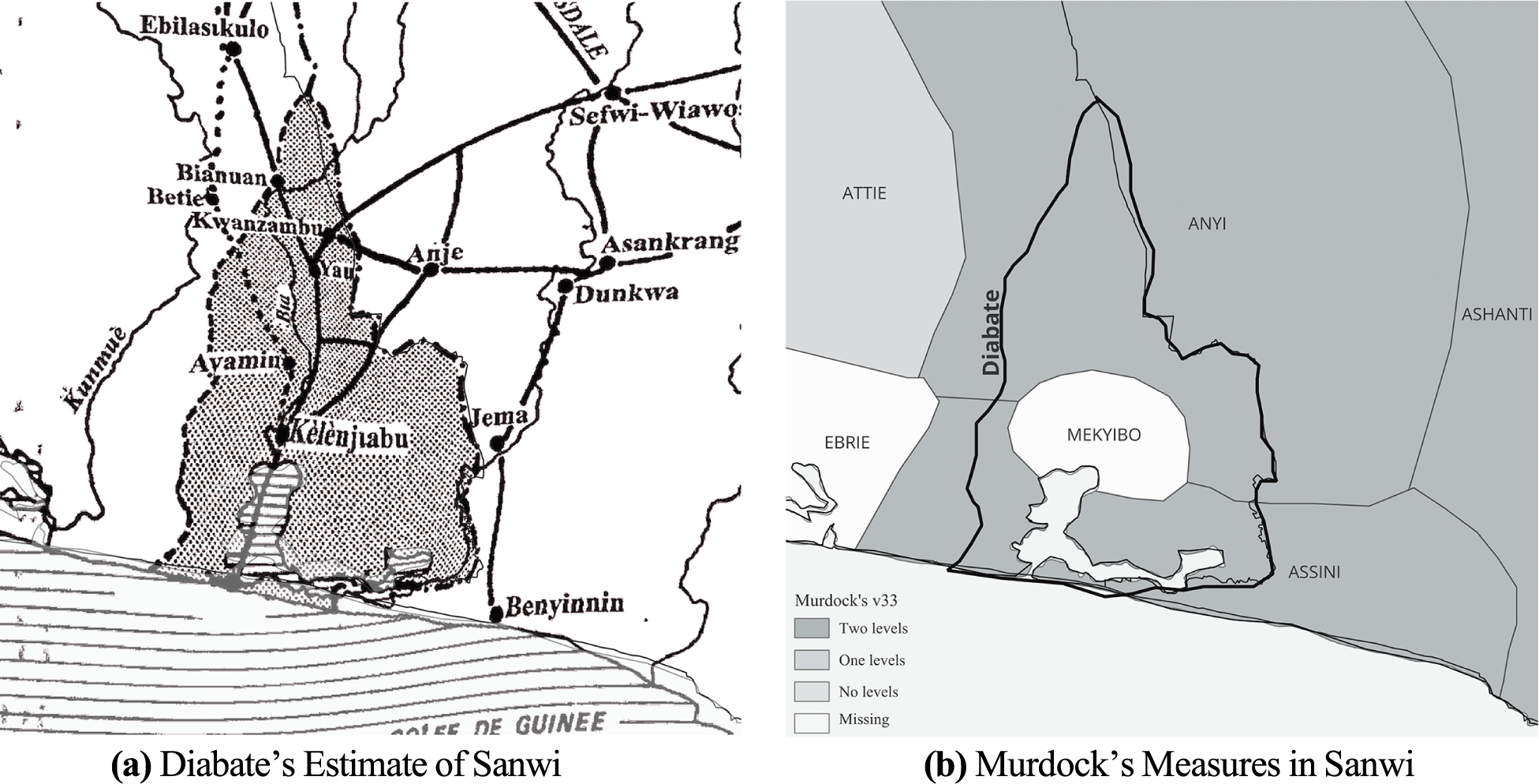
A core consequence of these issues is the increased risk of measurement error. To illustrate this, I make use of the example of Sanwi, a small, precolonial kingdom that fell along the border of present-day Côte d’Ivoire and Ghana. Sanwi was formed around 1700 when local elites began monopolizing the European coastal trade in enslaved peoples, gold, and later rubber, by gaining control over Aby Lagoon (Horovitz Reference Horovitz1977, 5–8, 237). Though the monarchy was ensured by members of the Anyi ethnic group, ethnic minorities did exist, and Akan and Yoruba traders were well-established in the kingdom. The king was represented by village chiefs at the grassroots, and trade was taxed by government officials (Horovitz Reference Horovitz1977). Sanwi thus meets all three components of my definition of a state: political power was ensured by an elite class (social segmentation), who taxed trade and residents (surplus extraction), and whose authority was felt across the territory.
Sanwi is absent, however, in Murdock’s data. The most common translation of Murdock’s codes to a spatial variable comes from Nunn (Reference Nunn2008), who georeferenced Murdock’s (Reference Murdock1959) attempt to spatially estimate the distribution of ethnic groups on the continent at the time of the Berlin Conference. Using Nunn’s map, Murdock’s coding of the area of Sanwi is displayed in Figure 1. By Murdock’s definition, there was no state in the area. Murdock’s data would thus incorrectly predict no legacy for Sanwi, despite a body of historical work that argues Sanwi was a complex political unit with a well-recognized territory. This is all the more striking because Sanwi’s monarchy exists to the present, providing one clear and plausible pathway by which the kingdom’s relevance might still be felt today.
The Example of Sanwi
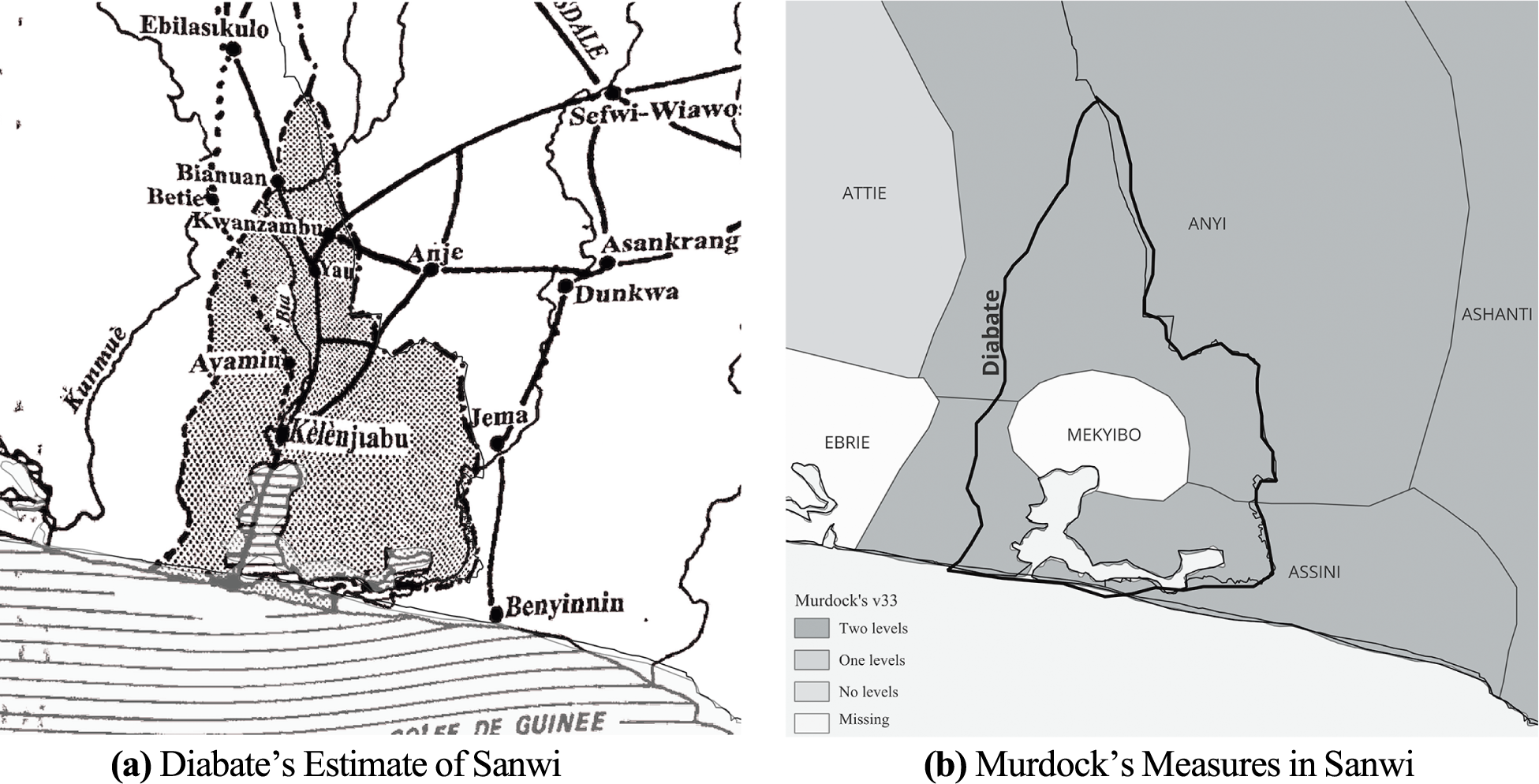
Data using historical atlases do not necessarily fare better. Sanwi is absent in Bauer, Platas, and Weinstein (Reference Bauer, Platas and Weinstein2022), though they estimate part of Sanwi’s territory as falling under Ashanti. Sanwi is missing in Depetris-Chauvin’s (Reference Depetris-Chauvin2015) list of states, but present in Paine (Reference Paine2019). By matching states to EPR ethnic groups, however, the latter effectively erases the state because the broader ethnic group of “other Akan” is not sufficiently centralized.
To the extent that we would consider Sanwi a state, therefore, it is absent in existing datasets. Sanwi crystallizes the concerns I have laid out: by neglecting to first conceptualize and then measure precolonial statehood, we risk drawing inaccurate conclusions because of systematic measurement error (Saylor Reference Saylor2013). Within the literature on precolonial Africa, these risks may be particularly high among states that are less well-studied or that deviate more significantly from forms of statehood seen in European statehood.
AN ATLAS OF 19TH C. AFRICAN STATES
If this article’s first task was to lay out a clearer concept of precolonial statehood, its second is to introduce an alternative measure that avoids the pitfalls described above. In this section, I outline how I translate my conceptualization of statehood into a usable measure of sub-Saharan Africa’s nineteenth-century states. The Atlas of 19th c. African States that I introduce offers an estimate of the location of states in the nineteenth century. All coding was done by undergraduate research assistants and the author. The codebook can be found at https://martha-wilfahrt.github.io/atlas/. The replication data are available at the APSR Dataverse (Wilfahrt Reference Wilfahrt2025).
Constructing the Atlas involved three discrete empirical steps that transparently document movement from concept to measurement.
Establishing a Universe of Cases
Applying the three criteria for statehood laid out above to the historical record generates a universe of 248 cases for sub-Saharan Africa in the nineteenth century.Footnote 8 This list was derived through an iterative process. I began by consulting country-specific historical dictionaries, regional histories, and historical atlases to construct an initial list of candidate polities, but cases were added and removed as I consulted state-specific and regional historiography. Detailed coding on each state and its justification for inclusion in the dataset is documented in the codebook. On average, just under eight historical sources were consulted per polity. The full list of states can be found in Section 3.1 of the Supplementary Material.
My choice to adopt a minimalist definition focused on core attributes of statehood poses a thorny question about borderline cases. How, for example, should I code the case of Nanumba in northern Ghana? The Nanumba possessed a shared identity and symbolic loyalty to the chieftaincy and chiefs, most prominently the Bimbilla Naa, and had a court of notables who benefited from customary communal obligation on their farms. Yet Nanumba falls short of my definition: although there was some social segmentation, there was no demonstrated capacity for cooperation across Nanumba’s territory. Indeed, facing the arrival of German forces, Skalník documents how the three most powerful Nanumba chiefs failed to coordinate as a territorial unit against German forces. Nanumba—a “loosely-knit system of authority based on the sanctity of tradition rather than the willpower of individuals” (Skalník Reference Skalník1987, 318)—would then fall just below my threshold for statehood.
As discussed above, however, my concept remains open enough to capture a range of polities that, like Nanumba, fall far from standard images of a despotic kingdom or Weberian state. Here, the example of Nso, in Cameroon’s grasslands, is useful. Nso was ruled by a Fon who was assisted by a court, largely staffed by hereditary titles. Society in Nso was distinguished between commoners and notables, creating a durable social hierarchy that vested political, social, and economic authority in the Fon and other royals. The Fon extracted tribute, and villages were required to provide labor, thus meeting the criteria of extracting economic surplus. But Nso’s territorial organization was loosely centralized, with subsidiary chiefdoms administered by indigenous hereditary dynasties that retained substantial autonomy in managing local affairs. Nonetheless, they were obliged to follow the Fon on matters of war and capital punishment, ensuring the Fon’s territorial presence and fostering cooperation across the polity. Accordingly, Nso is often described as a confederacy, and I code it as such: because the Fon maintained clear authority over sub-chiefdoms, despite their relative autonomy, and could coordinate behavior across his territory, it meets my definition of a state.
Locating States in the Historical Record
A core contention of this article is that a lucrative avenue for theoretical progress can be found in thinking about different forms of precolonial statehood. If states differ in systematic ways, as historians would lead us to believe, the choice to collapse different types into a single measure raises concerns about unit homogeneity (Lieberman Reference Lieberman2010). To facilitate this, each state in my dataset is coded on numerous relevant dimensions, including a general description of its political system, methods of succession, forms of local representation, and state ideologies. A full list of attributes can be found in Section 3 of the Supplementary Material. This opens a path for a flexible dataset that allows users to add or subtract attributes that they deem core to different forms of political centralization.
These attributes are coded via a careful reading of secondary and primary sources. The vast majority were written in the late colonial or post-colonial era. This creates specific challenges, most notably disentangling the effects of the colonial encounter on indigenous political structures. I make two efforts to rectify this. First, I am attentive to the historiography of each state, considering how historical and anthropological knowledge of different states has evolved and been revised over time. I attempt to carefully adjudicate between contradictory understandings of the nature of political power, though at times this effort is hampered by a scarcity of sources. Secondly, I transparently cite my sources for each attribute of each state (as recommended by Lieberman Reference Lieberman2010) and, by stipulating coding rules ahead of time, the dataset is careful to document attributes of each state as consistently as possible.
Locating States in Space
The third task is equally thorny: how can we locate these states in space? While several precolonial and colonial maps offer approximate political borders in the nineteenth century, these maps offer unreliable estimates across sources, are heavily biased toward states located along the coast that were subject to more frequent European contact, and, critically, often reflect European efforts to map precolonial Africa into European conceptualizations of political space. This latter point builds on a dominant understanding that polities in precolonial Africa should not be thought of as projecting power evenly across space. As Kopytoff (Reference Kopytoff1987) and Herbst (Reference Herbst2000) have argued, African polities lacked incentives to firm up their territorial boundaries. Rather, precolonial political authorities competed over supporters, resulting in soft and changing borders (Colson Reference Colson, Lewis and Duignan1969, 30). Polities had spatial extents and were felt as territorial units, but their borders were neither fixed nor critical for leaders to defend.
This leads me to opt to follow the insights of Herbst (Reference Herbst2000) and others, to think of power in precolonial Africa as emanating outward from core centers of power. Following Wilfahrt (Reference Wilfahrt2021), I construct a list of capitals and other important sites of precolonial power for each case. This may include major market villages, the seats of provincial titleholders, important religious centers, and other sites of historical note, such as large walled cities in the Sahel belt that served as important social and commercial centers. Adopting this approach allows me to be sensitive to what were often spatially diffuse concentrations of power. For example, the King of Nkomi (present-day Gabon) resided in Anyambie, but state councilors met at Obatanga to elect a new king, and the royal court held sessions in Epeng’epolo (Ambouroue-Avaro Reference Ambouroue-Avaro1981, 183–7). All three villages would accordingly be coded as “core” settlements.
I georeference the resulting list of each state’s centers of power using one of three methods. First, most villages are matched to their contemporary coordinates using the GeoNet Names Server.Footnote 9 In cases where the village is known to have moved or disappeared, I rely on secondary sources to locate the original point of settlement. The capital of the Yoruba state of Oyo, for example, is now a ruin in a national park. I georeference Oyo to its ruins accordingly. Elsewhere, villages have disappeared and have no known coordinates. In this situation, common in former settler colonies that displaced indigenous populations, I rely when possible on maps in secondary sources. Triangulating between natural features, notably streams, and known settlements, I approximate the location of these centers. All approximated locations are noted in the data. Finally, some sites simply cannot be located, though I retain them in the master dataset for transparency.
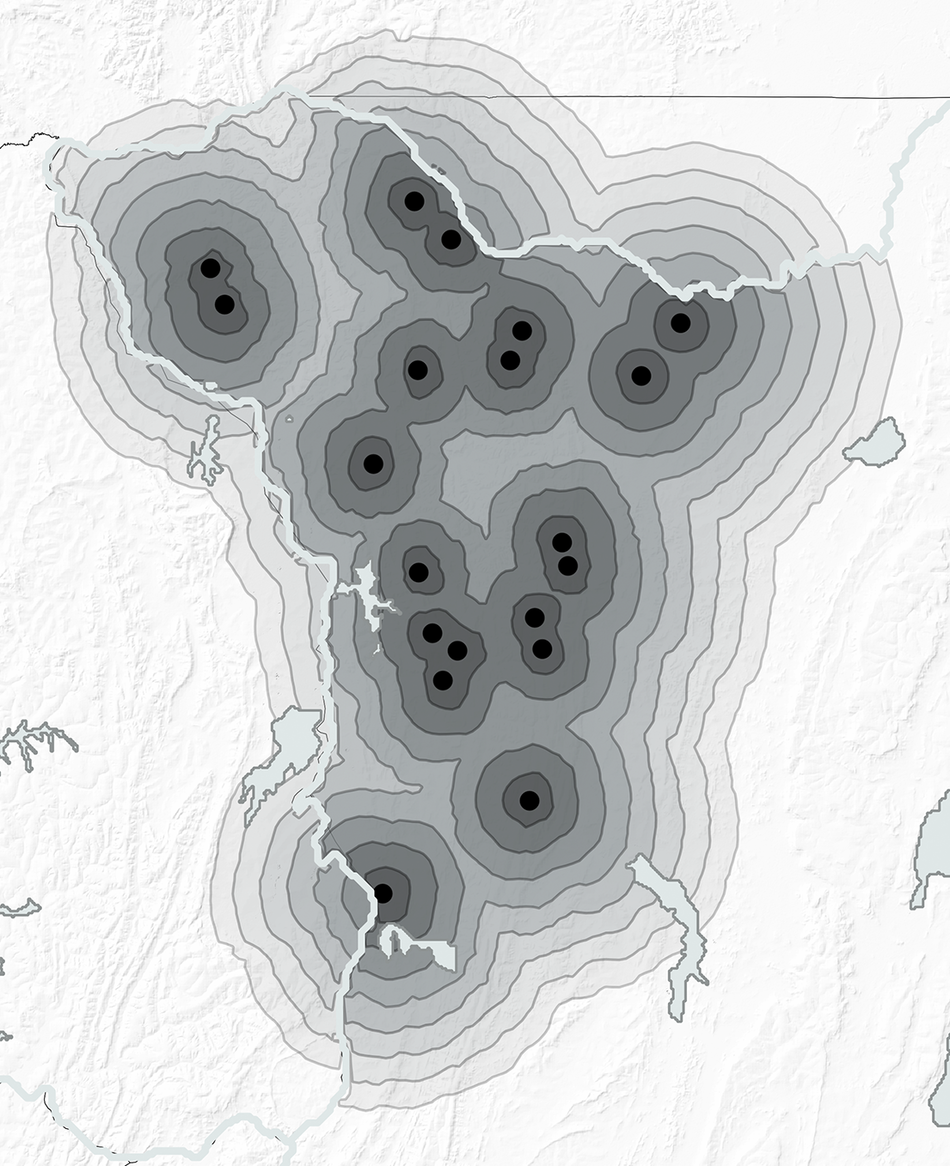
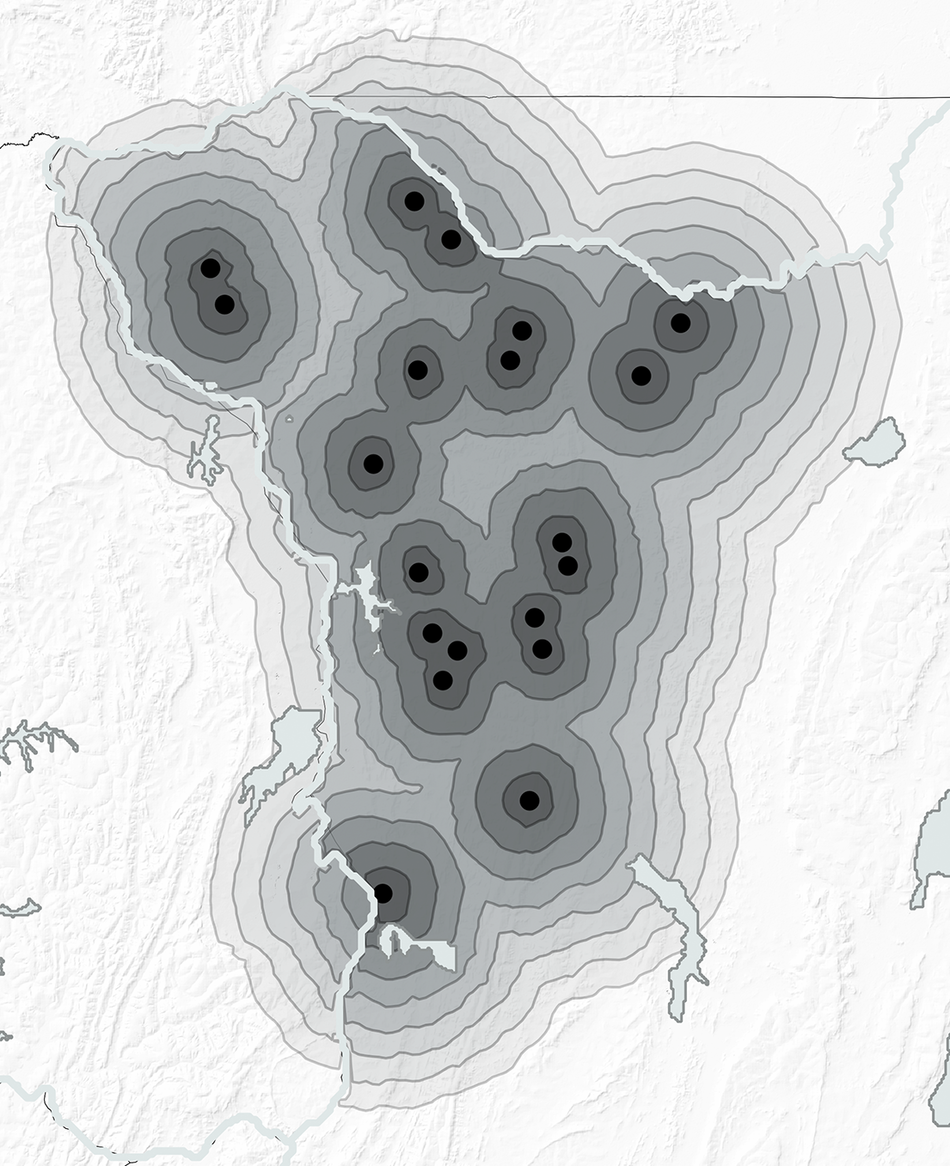
I use these geolocated nodes of political, social, and commercial power to construct a measure of a state’s presence. I assume that power could reasonably extend as far as a day’s journey from each node and employ cost distance tools to estimate plausible travel time outward from each political “core.” Using the movecost package in R, I generate estimates of the distance a person would be able to travel if they walked 8 hours outward in all directions from a given political center, taking into account the difficulty of traversing terrain and imposing a penalty for crossing rivers.Footnote 10 This produces a territorial estimate seen in Figure 2, which illustrates this process for the centralized polity of Karagwe, located in northwestern Tanzania in relatively hilly terrain. Graduated bands mark 1 hour walking increments. I discuss the rational for an 8-hour walk in Section 3.3 of the Supplementary Material. I also calculate this bound upward to 10 and downward to 6 hours as more and less conservative measures.
Illustration of Cost Distance Estimation for Karagwe with 1 Hour Walk Intervals
The Dataset
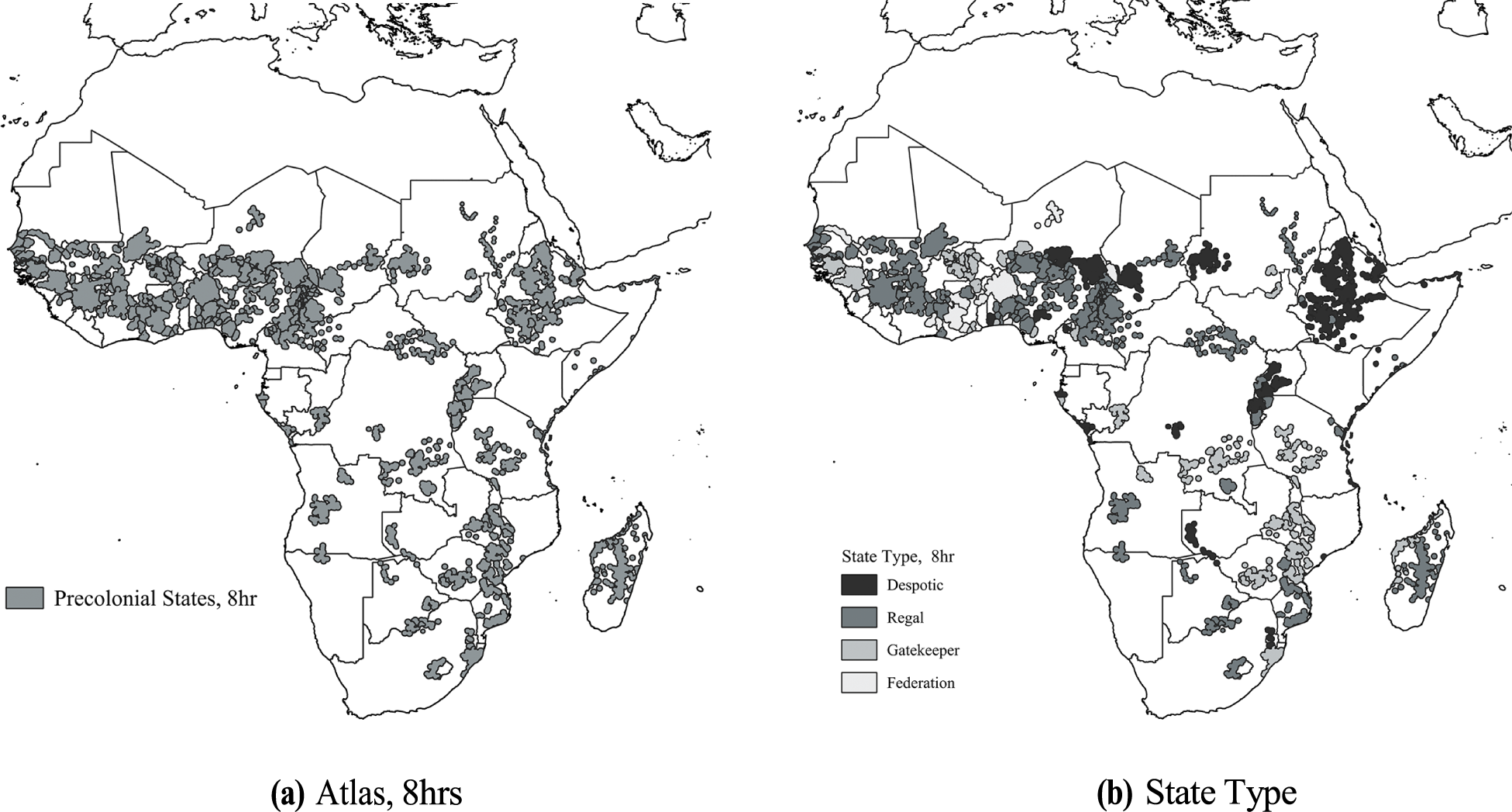
By estimating the empirical extent of Africa’s precolonial states in the nineteenth century, this dataset offers a more precise measure of precolonial statehood as political institutions that were felt in space. Figure 3 maps the location of the states in my dataset as well as the distribution of state types. In Section 3.4 of the Supplementary Material, I highlight the uniqueness of the data by comparing it to alternative measures.
Atlas of 19th c. African States with State Type
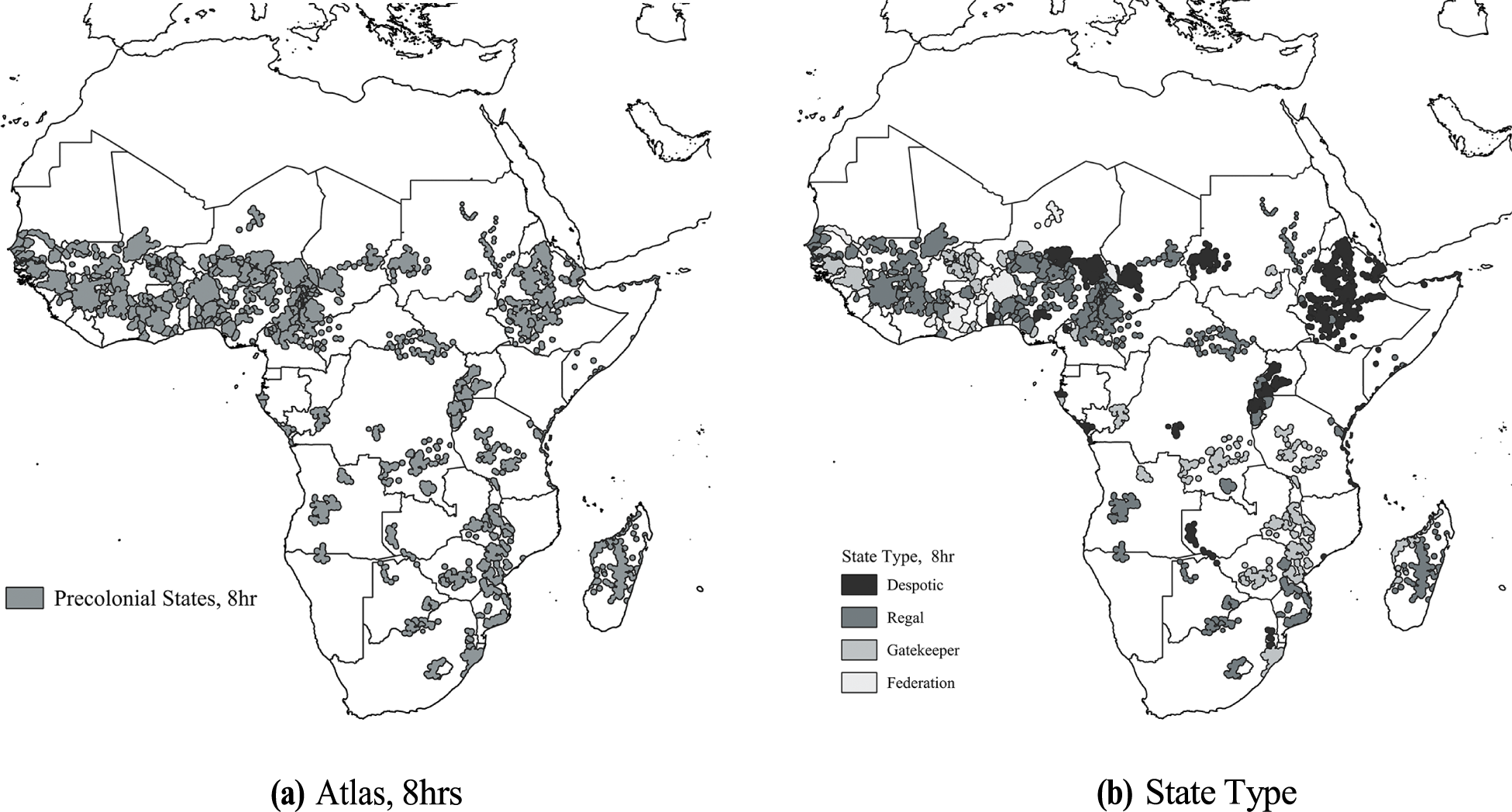
My atlas is not without critique. As noted earlier, and not dissimilar from Murdock’s own data, the ability to code precolonial states remains sensitive to the available historical record. The data further do not resolve the question of how (and indeed whether) to measure areas that occasionally paid tribute or that were only marginally attached to a state. At present, these areas do not enter my dataset absent a clear political delegation from the center. This renders cases of states formed via conquest, such as Samory’s empire-in-formation in West Africa that was actively conquering new territory on the eve of colonization, difficult to code precisely. Finally, the coding method may work better for some states than others. The spatial extent of power from core villages in the Sokoto Emirates may be better measured by one distance measure than say that of the Swahili Coast’s city states or of the pastoral Tswana. This, in part, can be mitigated by employing variable measures, or walking times, of exposure to political centralization.
MAKING PROGRESS ON THE PRECOLONIAL PARADOX
I began this article with the idea of a “precolonial paradox”: precolonial centralization is associated with both higher levels of economic development (Gennaioli and Rainer Reference Gennaioli and Rainer2007; Michalopoulos and Papaioannou Reference Michalopoulos and Papaioannou2013) and an increased propensity for civil conflict (e.g., Paine Reference Paine2019; Wishman and Butcher Reference Wishman and Butcher2022).Footnote 11 How can precolonial centralization improve economic development while also encouraging conflict, which is generally seen as a net negative for development (e.g., Collier Reference Collier1999)? In the remainder of this article, I employ my dataset to resolve this tension.
Data and Estimation Strategy
I estimate the long-run effect of precolonial statehood as measured with my dataset by dividing sub-Saharan Africa into 10 square kilometer grid cells. Grid cells allow me to avoid using post-treatment administrative divisions as the unit of analysis, as these may, in many cases, be endogenous to exposure to centralization itself (e.g., Paine, Qiu, and Ricart-Huguet Reference Paine, Qiu and Ricart-Huguet2025). I interact the grid cells with my Atlas, counting a cell as centralized if 25% of the grid or more falls in the estimated territory of a state.Footnote 12 I present results from the base dataset, which does not collapse political agglomerations like the Sokoto and Adamawa Emirates, the Mossi, and the Yoruba into single units. Although these agglomerations, most notably the Sokoto and Adamawa, were tied together in a shared allegiance to an Emir, their political sub-units retained substantial autonomy and largely acted as independent units. In the case of Adamawa, emirates were frequently at war with each other, suggesting there was little to no coordinating capacity from the Lamido in Yola. Still, this is ultimately a discretionary call. As I show in Section 6.7 of the Supplementary Material, results are largely consistent if we instead treat each of these state systems as a single unit.
I regress two sets of dependent variables on my measure of statehood: experiences with civil conflict and development outcomes. I use two datasets to capture the former. First, I use the UCDP-GED data, which map conflict locations, to estimate the number of conflicts, the number of years exposed to conflict, and conflict intensity (measured by the number of battles) between state forces and organized groups that are motivated by questions of governance or territorial control (from Sundberg and Melander Reference Sundberg and Melander2013, as used in Hinkkainen Elliott and Kreutz Reference Hinkkainen Elliott and Kreutz2019). I complement this with data from ACLED, restricting the sample to battles or episodes of remote violence where the state is one of the involved parties. As with the UCDP-GED data, I measure a count of conflict intensity (number of battles and remote violence with the state as a party) as well as the number of years of conflict experienced in any grid cell. Given a significant skew in the data, I log all conflict variables.Footnote 13
I follow Michalopoulos and Papaioannou (Reference Michalopoulos and Papaioannou2013) and measure economic development with satellite nightlight data from the Defense Meteorological Satellite Program’s Operational Linescan System. The data estimate annual average light emissions for approximately one-square kilometer units and, although not perfect, offer one of the few cross-regional estimates of economic development (see Henderson, Storeygard, and Weil Reference Henderson, Storeygard and Weil2012). I use data from 2013, the last year for which it is available. I truncate the conflict data introduced above to only measure incidences of civil conflict prior to 2013 and earlier for comparability; UCDP GED thus covers 1989–2013 while ACLED covers 1997–2013. Like Michalopoulos and Papaioannou (Reference Michalopoulos and Papaioannou2013), I estimate the effect of centralization on both the raw nightlight score (0–63) as well as its log (+0.01).
I complement the nightlight data with two spatial estimates of poverty. I firstly use Meta’s Relative Wealth Index (RWI), which estimates relative wealth by 2.4 square kilometer grid cells across numerous low-income countries (see Chi et al. Reference Chi, Han, Sourav and Joshua2022). I secondly use Lee and Braithwaite’s (Reference Lee and Braithwaite2022) high resolution poverty maps (Estimated Wealth Data, or EWD), which predict poverty at a granular (1.6 square kilometer) level for all sub-Saharan African countries. Both the RWI and EWD generate their estimates using machine learning and make use of the Demographic and Health Surveys as a ground truth to train their models. The models differ in the sources they use to generate their spatial estimates; the EWD use feature and image-based satellite images, while RWI relies on satellite images, mobile phone network data and connectivity data from Facebook. Both poverty estimates were calculated with data from the mid- to late-2010s. These variables have a high degree of missingness across grid cells. This is particularly true for the RWI data, which notably do not code data for Somalia, Sudan, and South Sudan.
I estimate the long-run effect of exposure to statehood in the precolonial era on these outcome variables with the following equation:
 $$ {Y}_i={\beta}_{0i}+{\beta}_1{Statehood}_i+{\beta}_2{X}_i+{f}_{\left( lat, long\right)}+{\varepsilon}_i $$
where Yi is the outcome of interest for grid cell i. ω 1Statehoodi is the key coefficient of interest, capturing whether a grid cell i is centralized or not. In a second set of models, ω 1Statehoodi represents a factor variable of state type. flat,long is the latitude, longitude of each grid cell i’s centroid plus their interaction and second-order polynomials to control for spatial trends in the data as suggested by Kelly (Reference Kelly2020). εi is the error term. To account for spatial differences in covariance structure, I cluster standard errors by larger grid cells—0.5 degrees or approximately 55 kilometers at the equator—so as to avoid using post-treatment administrative boundaries.
β 2Xi captures a battery of pretreatment geographic and environmental conditions that might explain both the propensity for a grid cell to be home to a precolonial state and contemporary experiences with conflict and development. The physical environment may promote wealth accumulation through its relative attractiveness for economic production, for example. I control for the fraction of a grid cell that is estimated to be suitable for agricultural crops (Ramankutty Reference Ramankutty, Jonathan, John and Kevin2002), its elevation, and a dummy variable that takes a value of 1 if any natural resources that were in circulation in the precolonial period (as described by Chirikure Reference Chirikure and Thomas2018, notably precious gems, gold, silver, and iron) fall within its territory (Gilmore Reference Gilmore, Nils, Päivi and Jan2005; Neustaedter Reference Neustaedter, Ryan, Abraham and Donya2024). I also control for a grid cell’s logged population density in 0 AD (Klein Goldewijk Reference Klein Goldewijk, Arthur, Gerard and Martine2011), a date that I deem sufficiently pretreatment to avoid the risk of capturing the population of medieval empires like the Songhai or Ghana, whose collapse led directly to the foundation of many states in my dataset. I also account for trade exposure, which has been argued by Bates (Reference Bates1987) and Fenske (Reference Fenske2014) to drive state formation via its generation of economic surplus, by controlling for the logged distance to the nearest coastline (and hence exposure to coastal trade) as well as a Herfindahl index of a grid cell’s ecological diversity as measured by White (Reference White1983), Fenske’s (Reference Fenske2014) preferred measure. Because the physical environment can also impede centralization and long-run development, while also potentially fostering the ability to wage a rebellion or decreasing economic activity, I control for whether or not a cell is dominated by mountainous terrain (Sayre Reference Sayre2022) and its average terrain ruggedness (Nunn and Puga Reference Nunn and Puga2012). Finally, I control for the percent of the cell that is covered by water.Footnote 14
Restricting my analysis to include only pretreatment controls addresses concerns about post-treatment bias, but it also increases the risk of omitted variable bias. I run additional models with an expanded β 2Xi that include post-treatment controls. Two are environmental measures that I can only measure in the contemporary period: a cell’s average level of malaria suitability (Malaria Atlas Project 2024) and its average annual precipitation (Funk Reference Funk, Pete, Martin, Diego, James, James and Bo2014). I capture exposure to the post-colonial state with the logged distance to the national capital and, finally, I use Müller-Crepon’s (Reference Müller-Crepon2023) data on state reach to measure a grid cell’s minimum distance to the national or regional capital at independence or 1966 (the first year data are available for), whichever comes later.Footnote 15 This measure is intended to capture relative exposure to the colonial state—whose imprint weighed heavily in the immediate post-independence period. Because the colonial state may have treated precolonial states differently and because this may have generated long-run path dependencies in wealth or conflict propensity, exposure to the early colonial state may be correlated with both the independent and dependent variables. Descriptive statistics of all covariates by state type can be found in Section 4 of the Supplementary Material.
The implicit counterfactual in my model is that grid cells that were inhabited by a state would see different conflict and development outcomes today if they had never been centralized. This raises the question of whether all grid cells in the dataset capture equally valid counterfactual conditions. Put otherwise, were some grid cells never going to be able to support precolonial states? To address this, I examine the ecological range that precolonial states inhabited. For example, no states emerged north of 19.7 degrees latitude, the Saharan dominated the northern tips of Mali, Niger, and Chad. I drop all grid cells that fall outside of the observed range for states, approximately 8,500 grid cells (just under 10% of the total sample). In the Supplementary Material, I demonstrate that my results are consistent when I use the full sample and when I use an alternative measure of the counterfactual condition by dropping all grid cells that were unpopulated in 0 AD, as an alternative indication of their unsuitability for human livelihood.
I adopt several approaches to address growing concerns about spatial dependence in work on historical legacies. As noted, I include the latitude and longitude of each grid cell’s centroid, their interaction as well as their second-order polynomial functions in all models, following Kelly (Reference Kelly2020). In the Supplementary Material, I present results that cluster standard errors at a larger grid cell as well as models that use Conley standard errors and those that omit high values on the dependent variable to account for spatial outliers (Kelly Reference Kelly2022). These alternative strategies generally support the same takeaway as those presented in the main models and are reported in Section 6.4 of the Supplementary Material.
Because states clearly did not emerge randomly across space, β 1Statehoodi cannot capture the causal effect of statehood on the outcome variables under study.Footnote 16 Given that reverse causality is unlikely in this case, the biggest remaining threat to inference is the risk of omitted variables that correlate with both precolonial statehood and contemporary levels of wealth and conflict exposure. Although I control for the most obvious and prominent characteristics that could provide alternative explanations, I cannot rule out this risk. As such, my models are only able to present descriptive correlations, suggesting patterns for future investigation.
Estimating the Legacies of Precolonial Statehood
Replication of the Precolonial Paradox
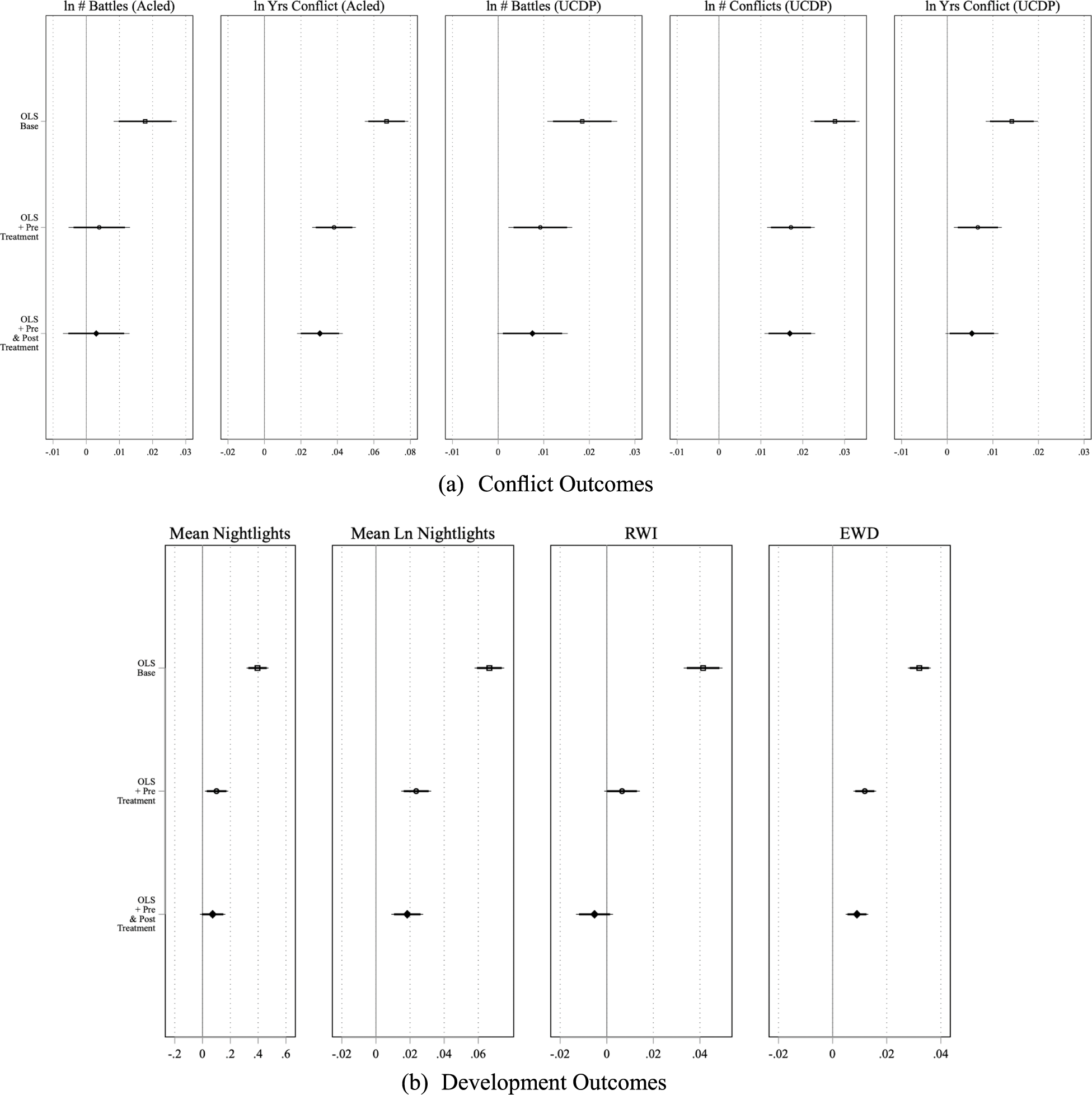
I first estimate precolonial statehood’s long-run effects on contemporary conflict and development outcomes. These results are visualized in Figure 4 with full model results reported in the Supplementary Material. Across the two figures, the results of the OLS regressions echo the dominant findings in the literature: grid cells that fall within the estimated territory of a precolonial state see higher levels of contemporary conflict in four out of the five outcome variables (panel a). At the same time, they see superior development outcomes (panel b), though note that average nightlight data and the RWI private wealth measure lose significance upon the inclusion of post-treatment controls.
Effect of Statehood (8 Hour Walk) on Conflict and Development Outcomes with 90% and 95% Confidence Interval
Note: Dependent variables listed in panel titles. Standard errors clustered by 0.5-degree (approximately 55 kilometers at the equator) grid cells. Reference category is stateless areas. All models include latitude, longitude, their interaction, and their squared polynomials. Full model results can be found in Section 5 of the Supplementary Material.
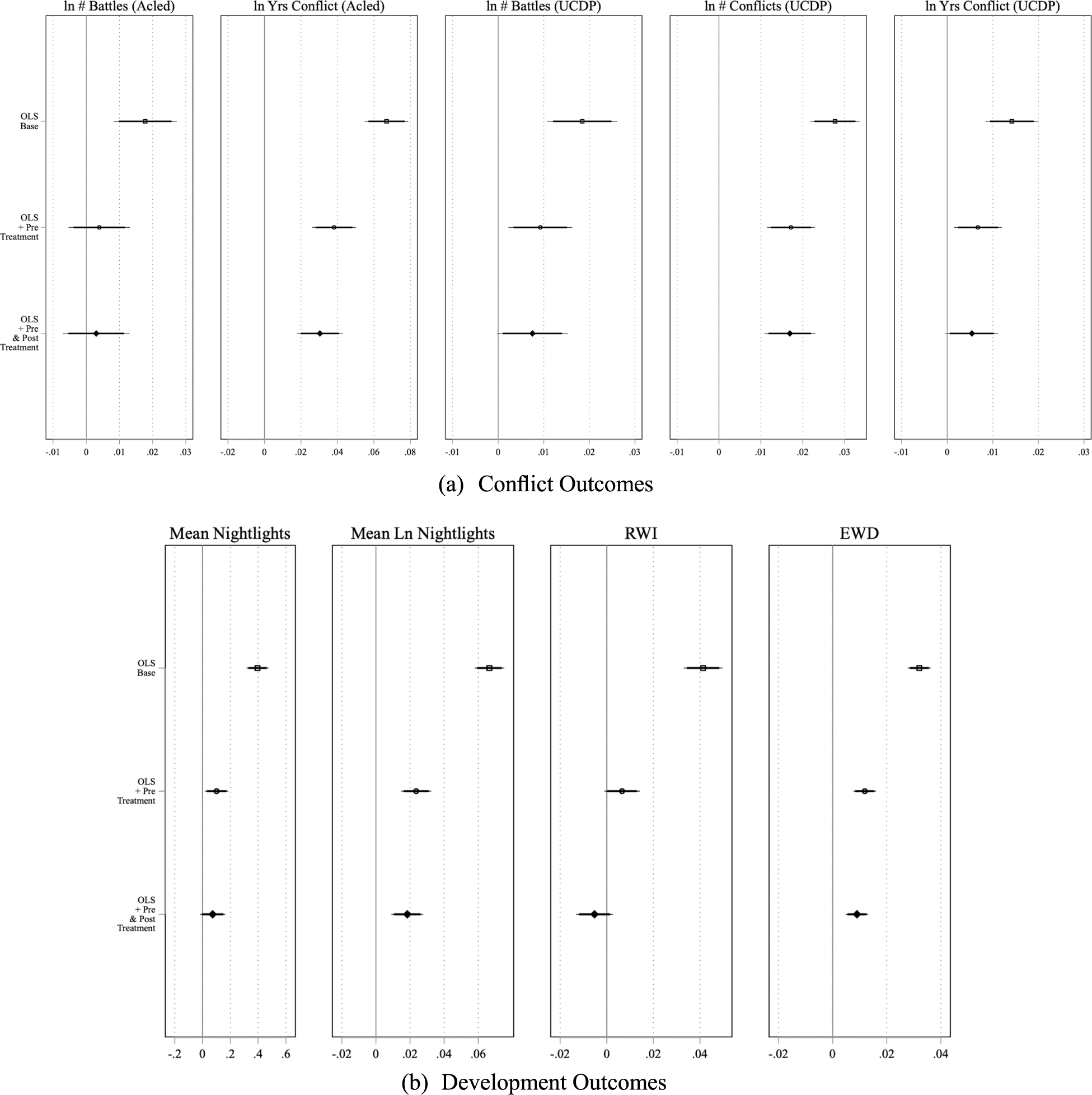
These findings are relative to historically stateless areas which inhabited, on average, less lucrative territory (see Section 3.5 of the Supplementary Material). This sheds light on one reason precolonial states might see more growth over the long run. Yet these areas appear to simultaneously experience more contemporary civil conflict, raising the question of how these areas maintained their development advantage in the face of conflict, which is generally thought of as inimical to growth.
Do Distinct Forms of Statehood Generate Distinct Legacies?
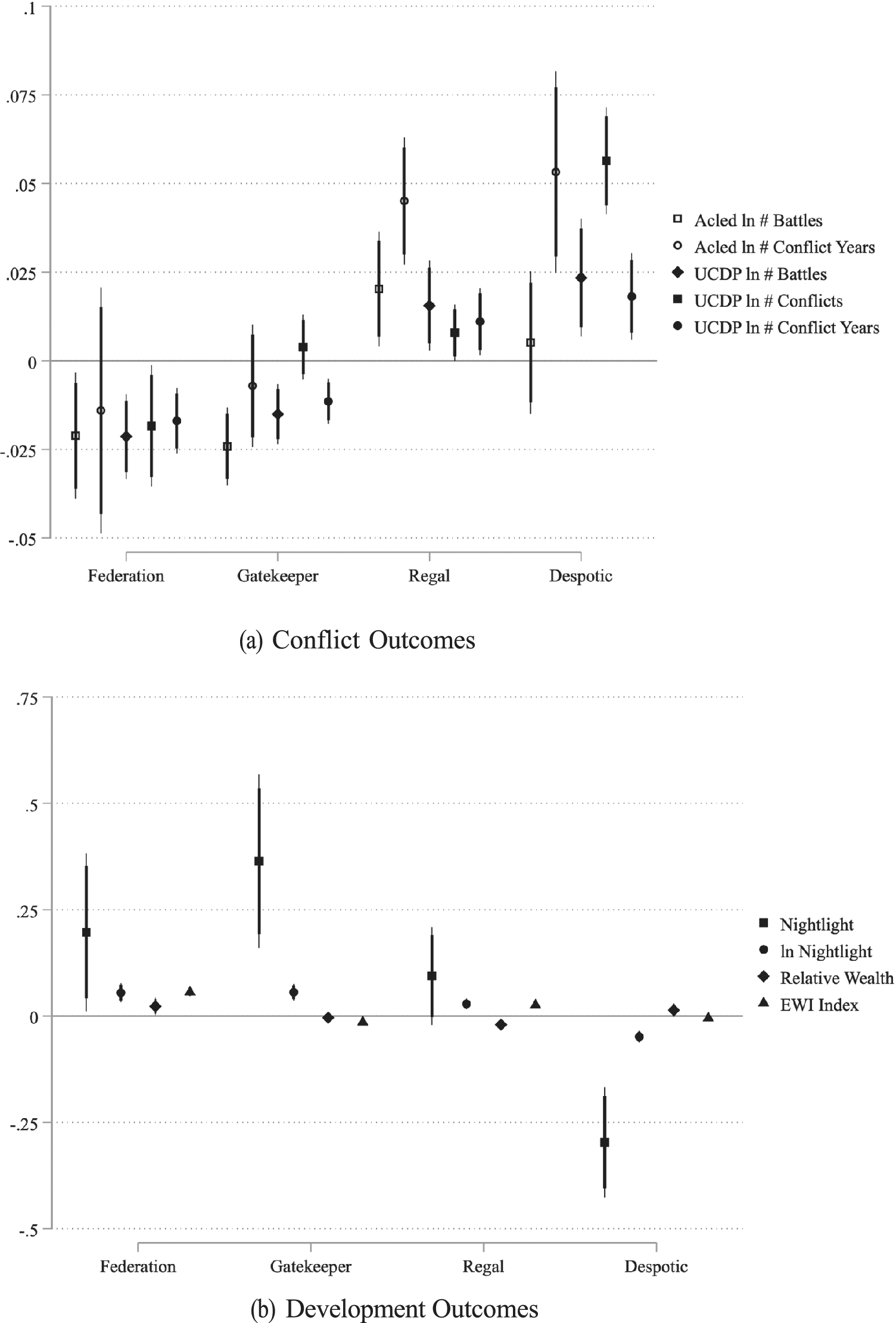
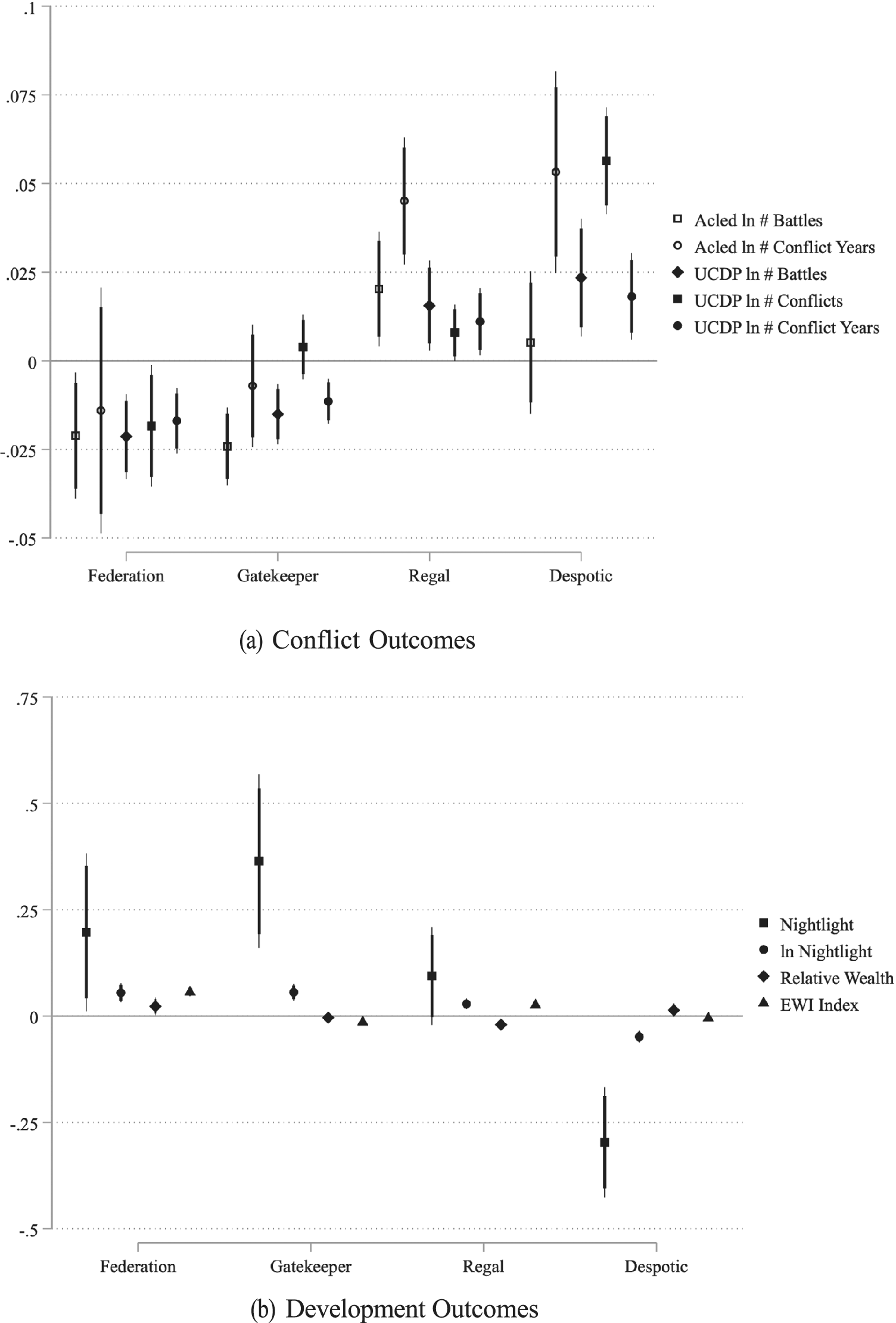
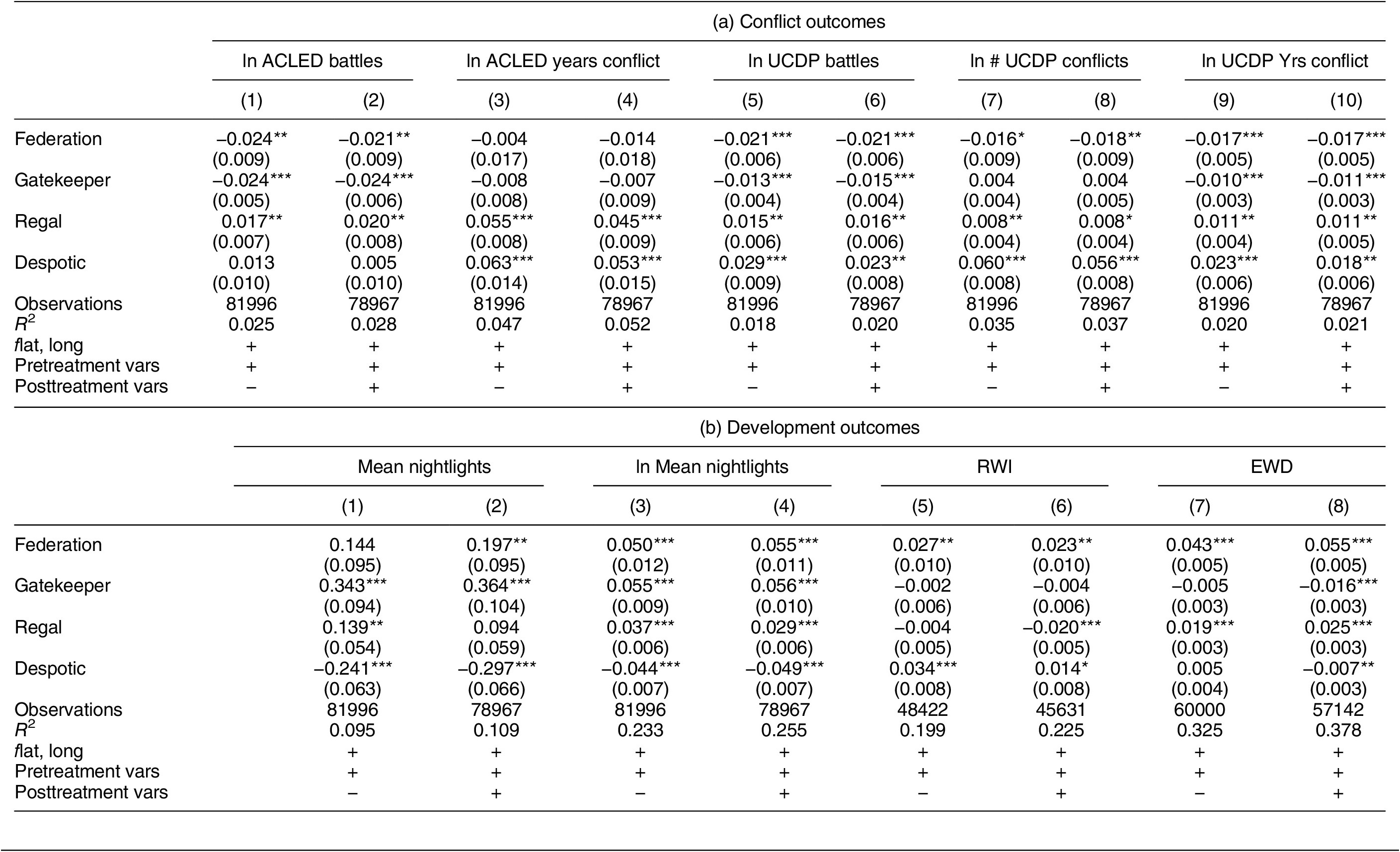
I suggest that this tension reflects a conflation of distinct forms of precolonial statehood and, by extension, distinct historical legacies. I break apart statehood—measured as a binary outcome in Figure 4—and replace it with my typology. Figure 5 plots the coefficients for each type of precolonial state from models that include pre- and post-treatment controls as introduced above. I retain stateless grid cells as the baseline, though results are similar if we take federations as the reference category (see Tables A6.1 and A6.2 in the Supplementary Material). Plotted coefficients are reported in Table 2; full model results, including for unconditioned models, are in the Supplementary Material. Although these models control for many potential drivers of statehood, as with the previous analysis, they are not immune to the threat that some unmeasured factor explains both the type of polity that emerged in a given area and its later propensity for conflict and development.Footnote 17 One particular concern is that exposure to historic conflict might drive both contemporary conflict propensity and the emergence of regal or despotic precolonial polities, where power was more tightly concentrated around the monarch. As I demonstrate in Table A6.4 in the Supplementary Material, although historical conflict correlates with more concentrated political power, including it as a control does not affect the pattern visualized in Figure 5.
Effects of Types of Precolonial Statehood on Conflict and Development with 90 and 95% Confidence Intervals
Note: Results of OLS models with pre- and post-treatment controls, as introduced in the text, and latitude, longitude, their interaction and their squared polynomials. Reference category is stateless areas. Standard errors clustered by 0.5-degree (approximately 55 kilometers at the equator) grid cells. Full model results can be found in Section 5 of the Supplementary Material.
State Type Model Results
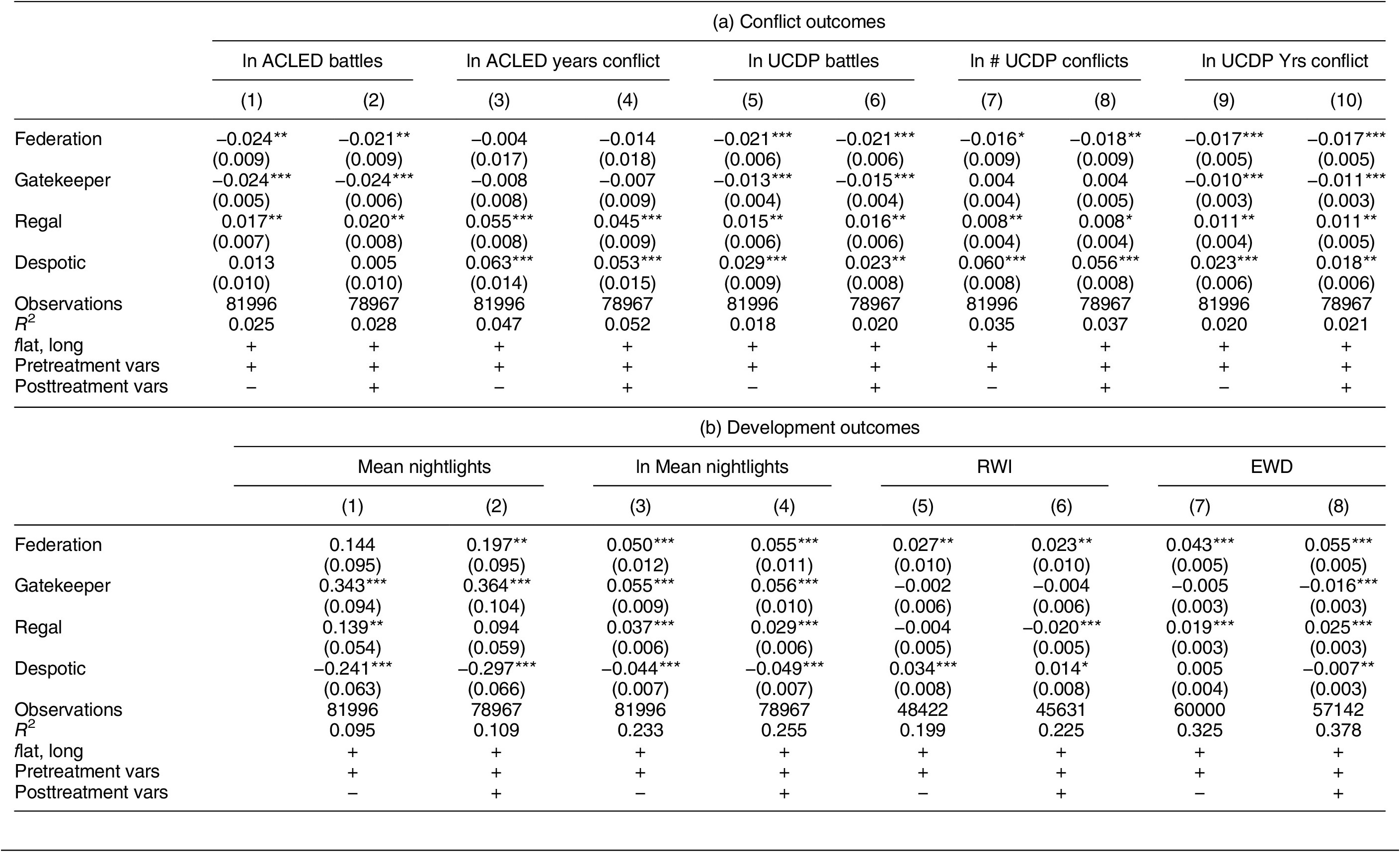
* p < 0.10, ** p < 0.05, *** p < 0.001. Standard errors clustered by 0.5 degrees (~55 kilometers at the equator) grid cells. Reference category is stateless areas.
Table 2 belies the existence of a paradox to suggest instead that different forms of political centralization map onto distinct long-run legacies. Both the ACLED and UCDP-GED data indicate that the propensity for civil conflict varies by state type. States that saw a greater concentration of power under a monarch, particularly regal and despotic types, are significantly more likely to see conflict relative to the baseline, historically stateless areas, for all outcome variables except the logged number of battles as measured by ACLED. In contrast, states that were ruled more indirectly (federation and gatekeeper types) generally appear less likely than historically stateless areas to experience conflict.
Results for economic development outcomes suggest an inverse pattern. Relative to historically stateless areas, the biggest development gains accrue to federations and, to a lesser extent, gatekeeper and regal types. Both calculations of nightlight density suggest that economic development is significantly higher in federation and gatekeeper types, while in contrast despotic states are significantly less developed than stateless areas. The pattern is more nuanced in the private wealth data. Federations are significantly wealthier across all measures, but the other end of the continuum tells a less precise story. Despotic states see a significant, positive coefficient for the RWI, for example, but a significant negative result with the EWD when all controls are included. As noted, the RWI findings should be interpreted with some caution, as the data’s truncated sample removes nearly a quarter of observations for despotic states. What is clear across the models, however, is that in contrast to the conflict finding, whatever development bonus accrues to precolonial states does so most consistently where political power was relatively less concentrated.
As shown in Supplementary Material, the results presented in Figures 4 and 5 are generally robust to the use of the maximum and minimum uncertainty estimates from alternative maps, limiting the sample to states present on the eve of colonization, shrinking and expanding the estimate of a state’s spatial reach by employing 6 and 10 hour walk times and controlling for “contested territory” between states (see Sections 6.5–6.9 of the Supplementary Material). Across numerous model specifications, therefore, a consistent pattern emerges whereby precolonial states that delegated more authority to local elites tend to fare better in the present than those that concentrated political power in the center.
Evidence for the Mechanisms
The results of Table 2 validate my claim that distinct forms of precolonial statehood generate distinct historical legacies. This raises the question of why statehood seems to be most beneficial where political power was relatively less concentrated around the monarch.
As I have described, the concentration of political power around the monarch facilitated more coercive, top-down decision-making, reducing local autonomy and prioritizing homogeneity. In contrast, the indirect territorial administrations of gatekeeper and federation states were built on diverse sources of political authority. This compelled the center to negotiate with local elites, who retained more autonomy. Put otherwise, if despotic states emphasized unilateral political action, gatekeeper and federation types were built on more collaborative governance strategies.
Evidence from the Precolonial Era
I illustrate these dynamics with two particularly well-documented cases: the Buganda Kingdom (present-day Uganda) and the Ashanti (present-day Ghana). Buganda was led by a Kabaka, who appointed chiefs to each of the kingdom’s counties. The kabaka claimed all non-clan land and exerted strong control over his subordinates, dismissing chiefs who failed to provide sufficient obligatory laborers or meet other requirements. Territorial chiefs had to request the kabaka’s permission to leave court to travel to their districts, for example, and they were obliged to maintain high-quality roads to the capital and to build their homes in line with the kabaka’s stipulated standards. Fiscal matters were also highly standardized; the kabaka set a date for annual tax collection, appointing six tax-collectors per district to conduct a census and collect the required dues (Roscoe Reference Roscoe1911, chapter 8; Reid Reference Reid2002).
Buganda is a classic example of a despotic state. In contrast, the confederacy of Ashanti was defined by its highly autonomous districts, with the Asantahene’s collaborating with a territorial assembly of nearly 200 men. Like Buganda, Ashanti possessed a well-developed bureaucracy and tax collection system, but the Asantahene held far less autonomous power. What matters were administered in the center, notably diplomacy and the ability to declare war, were debated at length with councilors. The limits on the Asantahene’s ability to implement his own will are summarized well in the Akan proverb “one man does not rule a nation” (quoted in Wilks Reference Wilks1998, 158). Although the Asantahene was slowly gaining power at the expense of the provinces during the course of the nineteenth century, as late as 1874, the council was able to force out the sitting Asantahene for “never listening to counsel” (Wilks Reference Wilks1998, 160). Core areas of policy, such as the allocation of land, were retained by local chiefs (Austin Reference Austin2005), and even on military questions, the Ashanti preferred diplomacy. As observed by one British official, the Asantehene Ose Tutu Kwame (c.1800–1824) opted “never to appeal to the sword while a path lay open for negotiation” (cited in Adjaye Reference Adjaye1981, 2).
These examples are broadly representative of their types. The Soninke trading state of Gajaaga’s confederate public assembly, which seated representatives from the four ruling clans, led one early French explorer to conclude that the “country has no master, because everyone is a master” (cited in Traoré Reference Traoré2023, 77). Of course, federations did not escape political intrigue. Fouta Toro, along the Senegal river, saw substantial contention among provincial electors over who would head the federation, and those who were chosen were regularly deposed—sometimes as often as every few years—greatly limiting the concentration of political power (Robinson Reference Robinson1975). In contrast, despotic states possessed monarchs who could coerce subordinates and generate substantial policy homogeneity across space. The fon of Bafut funneled most domestic issues to his court where he consolidated political decision-making, for example (Ngwa Reference Ngwa2017). In Dahomey, the fon demanded regular censuses of residents and livestock to raise troops and finance the state. His desire for compliance with his directives further led him to appoint a royal wife to accompany royal messengers and officials in their travels throughout the territory (Yoder Reference Yoder1974, 419).
The dynamics track onto several variables coded in my dataset. I examine two of the descriptive statistics presented in Table 3. First, I look at a monarch’s ability to concentrate power around himself by looking at whether he ruled with councilors. Less than half of despotic states fostered such consultation around the monarch, in sharp contrast to federations, where all but one did so. In general, gatekeeper and regal states also commonly feature councilors; these were often members of the ruling elite in regal states, while in gatekeeper polities, such as the Lunda polities in the Congolese–Zambian borderlands, councilors often included representatives from provinces ruled by indigenous chiefs (Nziem Reference Nziem1999, 602–6).
Characteristics of Precolonial Governance by State Type

Note: Gaps in the historical record mean that judicial policy is not coded for 12 polities.
Secondly, I look at a key dimension of local policy autonomy: the nature of judicial authority. States varied in the degree to which legal processes were centralized. I code judicial systems as falling in three categories: cases where the monarch either administered justice himself or directly appointed officials to do so, cases where almost all judicial decisions were made locally by village chiefs or lineage heads, and cases where justice was co-produced.Footnote 18 The latter case includes states where legal proceedings could be appealed upward or where there was a clear separation of domains, e.g., family law was adjudicated locally while any political questions or those involving the supernatural were addressed by the monarch or his agents. Here again we see a clear pattern: where power was less concentrated in the monarch, more local autonomy was exercised in the judicial sector. Only among despotic states we see direct judicial administration as the most common outcome.
Mapping the Mechanisms in the Present
I suggest that these distinct approaches to exercising power in the precolonial period continue to matter today because they generated enduring political norms around the appropriate exercise of political power. I focus on three norms in particular. First, as political power became more concentrated, continued top-down decision-making encouraged deference to authority. This secondly fostered out-group hostility and, third, facilitated a greater tolerance for coercive or violent bargaining methods. From here, we can begin to see why these areas might see more civil conflict—akin to Paine’s (Reference Paine2019) idea of a security dilemma—and dampened development gains through conflict’s erosion of local wealth, weaker bargaining with the center, or both. Conversely, where the exercise of precolonial political authority was less concentrated, we should see less deference to authority in favor of collaborative decision-making, resulting in a preference for peaceful negotiation and greater tolerance of diversity. This would explain why these areas are both better able to minimize conflict experience and foster development.
Evidence that these norms persist can be found by returning to the illustrative cases of Ashanti and Buganda. Okrah (Reference Okrah2003) documents a continued preference for discussion and consensus building among Ashanti’s descendants, for example, with conflict resolution prioritizing efficiency and the improvement—or at a minimum not aggravating—the relationship between involved parties. Conversely, (Karlström Reference Karlström1996, 491) describes enduring norms of hierarchy in Buganda, one that “emphasizes the allegiance of subordinates to superiors …” In her analysis of Uganda’s 2011 elections, Brisset-Foucault (Reference Brisset-Foucault2013, 518, 524) observes that “candidates were presented as being Kabaka’s servants” with political rallies calling for “moral regeneration and unity and for a rediscovery of a history of military dignity.” Indeed, Bugandan elites have long pushed for autonomy in Ugandan politics, with growing tensions between the Buganda and Museveni’s regime producing episodic violence.
I offer more systematic evidence for these mechanisms using georeferenced Afrobarometer (2003–2023) data from rounds 2–9. This yields insight into the opinions and experiences of over 280,000 African citizens in 33 countries between 2002 and 2022. I match Afrobarometer respondents to the locations of the precolonial states in my Atlas to examine whether attitudinal and behavioral patterns align with the expectations laid out above. This matching effort requires the assumption that most respondents in the territory of a former state are descendants of that state. Because this assumption is more probable in rural localities, which have generally seen less in-migration, I replicate the results that follow for rural respondents only in the Supplementary Material (Table A9.5).
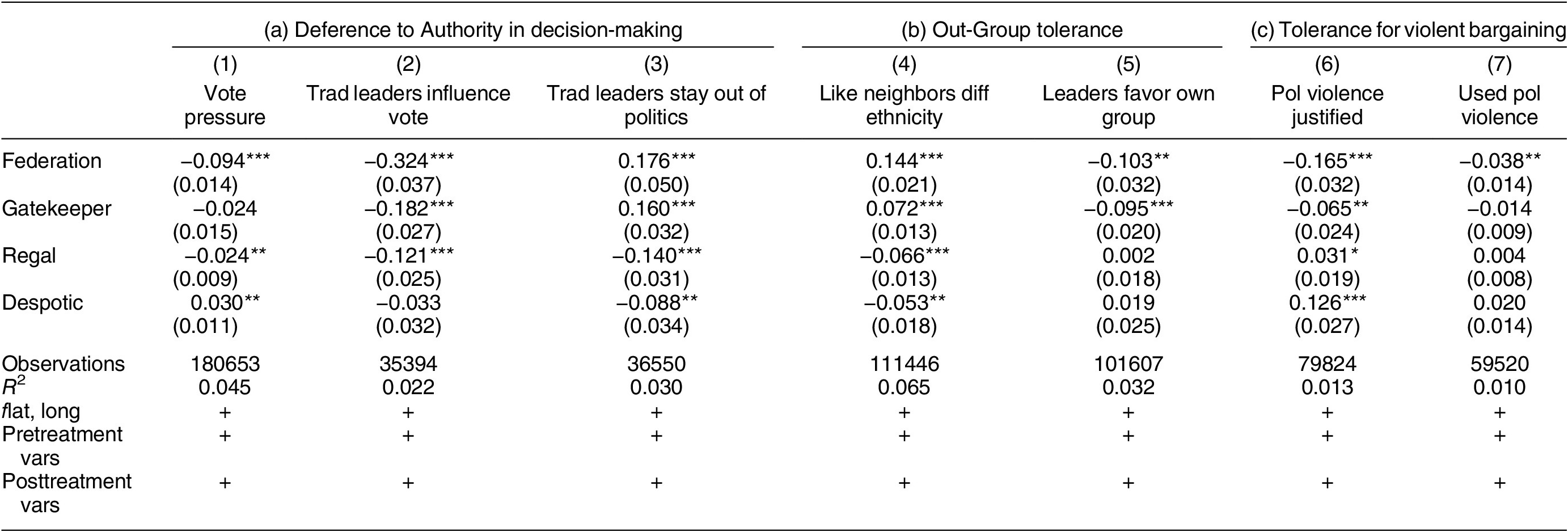
Table 4 presents results from a series of basic OLS regressions that include two batteries of controls. The first includes the same pretreatment variables employed above in addition to three demographic variables from the Afrobarometer that are not expected to have a causal link to precolonial statehood: a respondent’s age, age2, and their gender. A second set includes the post-treatment variables introduced above, as well as whether a respondent lives in an urban center, their education level, and an additive index of their wealth, assessed by how often a respondent has gone without food, water, medical care, cooking fuel, or a cash income in the past year. Section 9 of the Supplementary Material includes Afrobarometer question wording, full model results, and replications excluding post-treatment controls.
Mechanisms: Evidence from the Afrobarometer
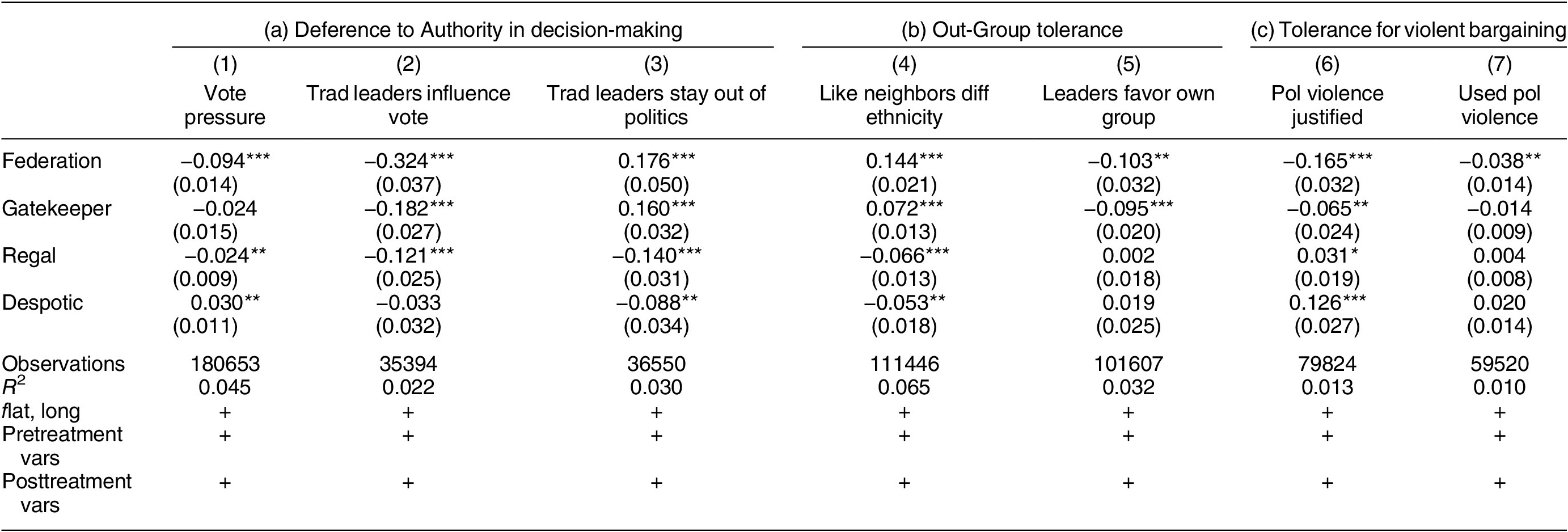
Note: * p < 0.10, ** p < 0.05, *** p < 0.001. Models include round fixed effects. Standard errors clustered by enumeration area. Reference category is stateless areas.
I examine three groups of outcome variables that capture dimensions of the mechanisms outlined above. The first norm relates to deference to authority in decision-making; where precolonial authority was more concentrated around the monarch, top-down political action by the monarch inculcated norms of deferring to elites. One plausible manifestation of this today would be a greater tendency for citizens to both feel and tolerate pressure from elites at the ballot box. Indeed, this is what we see in panel a. Respondents residing in the territory of despotic states are significantly more likely to report experiencing pressure when choosing who to vote for (model 1). Model 2 further demonstrates that respondents in all state types but despotic ones are less likely to report that their traditional authorities influence votes in their communities relative to stateless areas. These experiences further map onto revealed preferences: where political power was more concentrated, respondents view the idea of traditional leaders giving voting advice more favorably (model 3). In direct contrast, respondents in federation and gatekeeper polities are significantly more likely to reject this idea. We can imagine many avenues by which such dynamics might impact development levels or conflict propensity. This might decrease political competition, for example, enabling elite capture.Footnote 19
I examine the second norm—out-group tolerance—in panel b. Despotic and regal states were more likely to emphasize homogeneity within the polity, with despotic states in particular promoting collective identities. One potential observable outcome of this in the present would be an increase in antagonism toward outsiders. In contrast, federation and gatekeeper states were built on diverse subunits that required collaboration across ethnic, linguistic, and religious differences. Respondents in the territory of directly ruled states (regal and despotic types) are in fact significantly less open to the idea of having neighbors of a different ethnic group (model 4), while the inverse holds for residents of former federation and gatekeeper states. This is not limited to ethnicity; I find similar results for openness to neighbors from another religion and political party (Section 9.1 of the Supplementary Material). In model 5, I look at responses to the question of whether one agrees with the idea that elected officials are obligated to help their own communities first, as opposed to helping everyone equally. As argued, where political power was less concentrated, norms of finding mutually acceptable outcomes through discussion and collaborative bargaining prevailed. Although an indirect proxy, the finding indicates that respondents in the territory of federation and gatekeeper states are more hospitable to the idea of collaborating with out-groups, be it their neighbors or their fellow citizens in the post-colonial state.
I look at the third norm, tolerance toward violent bargaining strategies, in panel c. Yet again, we see an inverted pattern: respondents in the territory of despotic and regal states report significantly more tolerance for the idea that political violence is sometimes necessary, while those in federation and gatekeeper regions indicate the opposite. When respondents were asked if they themselves had ever “used force or violence for a political cause,” respondents in the former territory of federations were significantly less likely to report having done so relative to stateless areas. Although all the Afrobarometer results should be interpreted with caution due to the possibility of endogeneity, note that this is particularly true for the results of panel c as these attitudes could very possibly be the result of violence exposure rather than its cause.
Outcome variables that inform the precolonial paradox—experiencing civil conflict and economic development—are often theorized as resulting from negotiating with the central state, for example, by extracting more concessions (Michalopoulos and Papaioannou Reference Michalopoulos and Papaioannou2013) or because their internal institutions render them more credible (Wig Reference Wig2016). In Section 9.3 of the Supplementary Material, I provide tentative evidence that different types of precolonial states produce politicians who engage differently with the center following independence. Using preliminary data on postcolonial cabinet members, I find that federations are more likely to be represented in postcolonial cabinets and that, when they hold the executive, they form both larger and more regionally representative cabinets. In contrast, executives who were born in regions home to despotic states are significantly more likely to come to power in a coup.
Cumulatively, the above evidence supports the intuition behind the theory’s mechanisms: the way in which political power was exercised in the precolonial period left persistent norms in how communities approach political negotiations in the present. This suggests one viable pathway through which the nature of precolonial statehood can increase the propensity for conflict at one end of the continuum while fostering development on the other.
CONCLUSION
This article has diagnosed a seeming paradox in the literature on precolonial legacies—how can precolonial centralization be both developmentally beneficial and detrimental in the long run? My central argument is that by failing to robustly conceptualize and, in turn, measure precolonial statehood, we have overlooked important differences in the nature of precolonial political organization. It is only when we recognize the diversity that characterized Africa’s precolonial statehood that we can begin to resolve the seeming contradictions that I document.
My analyses are limited to correlational findings, leaving open the question of whether a causal relationship truly exists between types of precolonial states and the long-run outcomes under study. In this way, the article sets forward a research agenda to develop not only more rigorous analyses, but to examine more deeply the potential mechanisms that link centralized political order in the precolonial period to variation in socioeconomic well-being in the present.
The findings raise critical questions for debates about the nature of political centralization and its legacies. Two seem particularly pressing. First is the question of how Africa fits into the broader literature on comparative state building, which has largely been content to accept Herbst’s (Reference Herbst2000) argument that the region’s precolonial polities were highly homogeneous as a function of geographic constraints. As I have shown, however, striking differences emerge between states despite these shared and very real structural obstacles. If Africa’s indigenous precolonial states do not tell a single story, then the region presents a largely untapped wealth of empirical insight for our understanding of political order and state building.
Second, the focus on precolonial centralization raises the question of the concept’s negative pole: what does it mean to have been stateless or “non-centralized” and should we treat this as a constant? Work on precolonial centralization has entirely bracketed the institutional legacies of historically stateless communities, despite abundant evidence that they likewise varied in interesting and significant ways. Economic development or conflict propensity may be as influenced by certain types of statelessness as they are by the historical presence of centralized political organization.
SUPPLEMENTARY MATERIAL
To view supplementary material for this article, please visit http://doi.org/10.1017/S0003055425101044.
DATA AVAILABILITY STATEMENT
Research documentation and data that support the findings of this study are openly available at the American Political Science Review Dataverse: https://doi.org/10.7910/DVN/Z3MVU7.
ACKNOWLEDGEMENTS
This article benefited from the detailed comments of Leonardo Arriola, Jaimie Bleck, Robert Braun, Lauren Honig, Igor Kolesnikov, Dominika Koter, Natalie Letsa, Maria Murias, Noah Nathan, Jack Paine, Ben Smith, and Scott Straus as well as participants at UC-Berkeley’s Africa Research Workshop, MIT’s Comparative Politics Series, and Michigan State University’s Eye on Africa Lecture. Three anonymous reviewers provided particularly detailed feedback and greatly improved the article, as did the comments of the editor, Carles Boix. Jacob Nyrup, Carl Henrik Knutsen, Peter Egge Langsæther, and Ina Kristiansen generously shared data from their PtP project. I likewise thank the Afrobarometer for providing georeferenced data. Henry Bailey, Bryant Larson, and Henry Mohn provided excellent research assistance.
CONFLICT OF INTEREST
The author declares no ethical issues or conflicts of interest in this research.
ETHICAL STANDARDS
The author affirms this research did not involve human participants.



 Open access


Comments
No Comments have been published for this article.