


Introduction
False-green kyllinga is a problematic C4 perennial sedge (Cyperaceae) species in turfgrass systems (Bryson et al. Reference Bryson, Carter, McCarty and Yelverton1997). It has been reported in 15 states from Connecticut to North and South Carolina and west to Arkansas (Bryson et al. Reference Bryson, Carter, McCarty and Yelverton1997; USDA 2018). Green kyllinga (Kyllinga brevifolia Rottb.) is another perennial sedge species common to turfgrass, but it has not been reported in the northern United States, as it is thought to be less cold tolerant than false-green kyllinga (Bryson et al. Reference Bryson, Carter, McCarty and Yelverton1997). Green kyllinga is found along the coast of North and South Carolina and farther south into Florida, west to Texas, and in high-value turfgrass in Arizona (Bryson et al. Reference Bryson, Carter, McCarty and Yelverton1997; Molin and Kopec Reference Molin and Kopec1997). Green and false-green kyllinga are difficult to differentiate in the absence of seed morphology and fruit production timing information. False-green kyllinga fruit development is photoperiod-dependent, beginning in late August and continuing until the first frost. False-green kyllinga produces seeds with a smooth keel. Green kyllinga fruits throughout the growing season, and its seeds have a toothed keel (Bryson et al. Reference Bryson, Carter, McCarty and Yelverton1997).
Both Kyllinga species are rhizomatous and form a dense mat that can resemble desirable turfgrass. False-green kyllinga is commonly found at 1.3-cm mowing heights and can tolerate mowing heights as low as 3.0 mm on golf course putting greens (Bryson et al. Reference Bryson, Carter, McCarty and Yelverton1997; M. Elmore, unpublished observation). Green kyllinga is more competitive in turfgrass at low (2.5 cm) mowing heights than higher (5.0 cm) heights (Lowe et al. Reference Lowe, Whitwell, McCarty and Bridges2000). Both species produce flowering culms below golf course fairway mowing heights of 1.3 cm (Bryson et al. Reference Bryson, Carter, McCarty and Yelverton1997). It is thought that kyllinga mats increase in size primarily via rhizome growth and not seed germination. However, seed movement in water and on turfgrass maintenance equipment may be responsible for kyllinga spread over longer distances, as Lowe et al. (Reference Lowe, Whitwell, McCarty and Bridges2000) demonstrated that green kyllinga can establish from seed even in vigorous stands of common bermudagrass [Cynodon dactylon (L.) Pers.]. False-green kyllinga seed germination has not been studied.
Green and false-green kyllinga have become more problematic in recent years, possibly because turfgrass managers are relying less on broad-spectrum POST herbicides such as monosodium methanearsonate (MSMA) and using more PRE herbicides that do not control false-green kyllinga (Belcher and Walker Reference Belcher and Walker2002; Yelverton Reference Yelverton1996). Frequent irrigation may also contribute to increased invasion by Kyllinga spp.; green and false-green kyllinga are more commonly observed in wet areas, and their presence can correlate with areas of high soil volumetric water content on golf courses (Bryson et al. Reference Bryson, Carter, McCarty and Yelverton1997; McElroy et al. Reference McElroy, Yelverton, Burton and Brownie2005a).
Previous research investigating kyllinga control has focused primarily on herbicides. Most experiments have investigated herbicidal efficacy of either green or false-green kyllinga. McElroy et al. (Reference McElroy, Yelverton, Gannon and Wilcut2004, Reference McElroy, Yelverton and Warren2005b) examined herbicide efficacy against both Kyllinga spp. and found that green and false-green kyllinga exhibited slightly variable responses to different herbicides, but these responses were not consistent between field and greenhouse experiments. PRE herbicides such as dithiopyr, oxadiazon, and metolachlor can effectively control green kyllinga seedlings in a greenhouse (Molin and Kopec Reference Molin and Kopec1997). However, kyllinga seedling emergence in the field has not been well studied, and PRE herbicides are not typically recommended for perennial weed control. Therefore, previous research has focused primarily on POST control with various acetolactate synthase (ALS)–inhibiting herbicides and the protoporphyrinogen oxidase (PPO) inhibitor sulfentrazone. Green and false-green kyllinga control with POST herbicides is difficult, and sequential applications usually provide better control than single applications (Gannon et al. Reference Gannon, Yelverton and Tredway2012; McElroy et al. Reference McElroy, Yelverton and Warren2005b). Field experiments by McElroy et al. (Reference McElroy, Yelverton and Warren2005b) evaluated bentazon, halosulfuron-methyl (hereafter halosulfuron), imazaquin, MSMA, sulfentrazone, and trifloxysulfuron for green and false-green kyllinga control. They found that at 1 yr after treatment, one application of an imazaquin + MSMA tank mixture as well as two applications trifloxysulfuron-sodium and halosulfuron were among the most effective treatments; sequential applications of bentazon or MSMA, and single applications of sulfentrazone were generally less effective against both Kyllinga spp. Among herbicides registered for use in cool-season turfgrass, McElroy et al. (Reference McElroy, Yelverton and Warren2005b) found that two applications of halosulfuron and single applications of sulfentrazone controlled kyllinga more effectively than single or sequential applications of bentazon. However, McElroy et al. (Reference McElroy, Yelverton and Warren2005b) evaluated sulfentrazone rates (560 and 420 g ha−1) greater than the maximum allowable single application rate (280 g ha−1) in cool-season turfgrass. Preliminary research by Mansue and Murphy (Reference Mansue and Murphy2015) in cool-season turfgrass reported that halosulfuron (52 g ha−1) controlled false-green kyllinga more effectively than sulfentrazone (140 g ha−1) or mesotrione (175 g ha−1). Similarly, Gannon et al. (Reference Gannon, Yelverton and Tredway2012) found that single or sequential applications of sulfentrazone at 140 to 420 g ha−1 provided unacceptable false-green kyllinga control.
Imazosulfuron is an ALS-inhibiting sulfonylurea herbicide commercialized in 1993 to control sedge and broadleaf weed species in rice (Oryza spp.) (Ishida et al. Reference Ishida, Ohta, Itoh, Nakahama, Miki and Yoshikawa1993; Shimizu et al. Reference Shimizu, Sakamoto, Kamizono, Ohta and Tashiro1996). It was commercialized for U.S. use in most cool- and warm-season turfgrass species at single application rates of 420 to 740 g ha−1 (Anonymous 2011). Imazosulfuron-based programs controlled yellow nutsedge (Cyperus esculentus L.) equally to or greater than industry standard programs in rice and potato (Solanum tuberosum L.) production (Felix and Boydston Reference Felix and Boydston2010; Riar and Norsworthy Reference Riar and Norsworthy2011). In turfgrass, Henry et al. (Reference Henry, Sladek, Hephner and Cooper2012) reported two applications of imazosulfuron (560 g ha−1) on a 2- to 4-wk interval controlled purple nutsedge (Cyperus rotundus L.) similar to industry standard trifloxysulfuron-sodium in common bermudagrass. Unlike trifloxysulfuron, imazosulfuron is registered for use in cool-season turfgrass (Anonymous 2011, 2012).
Reports of herbicide efficacy against false-green kyllinga in cool-season turfgrass are limited. Askew et al. (Reference Askew, Brewer, Rana and Gover2016) found that single applications of imazosulfuron at 420 g ha−1 tank-mixed with fenoxaprop + fluroxypyr + dicamba or MCPA + fluroxypyr + dicamba controlled false-green kyllinga >75% at 13 wk after treatment similarly and suggested investigating imazosulfuron in more detail for false-green kyllinga control (Askew et al. Reference Askew, Brewer, Rana and Gover2016).
The objective of this research was to evaluate single and sequential applications of sulfentrazone, halosulfuron, and imazosulfuron for false-green kyllinga control in cool-season turfgrass. Our hypothesis was that sequential applications would provide more control than single applications.
Materials and methods
Preliminary experiment
An experiment to evaluate imazosulfuron, halosulfuron, mesotrione, and sulfentrazone for false-green kyllinga control was initiated in 2015. The experiment was conducted on a maintained but unused athletic field in Egg Harbor Township, NJ (39°37.32N, 74°20.6W). The field was a mixed stand of cool-season turfgrass mowed once weekly cut at a height of 8 cm and grown on a Hammonton loamy sand (coarse-loamy, siliceous, semiactive, mesic Aquic Hapludult). No fertilizers or plant protectants were applied at any time during the experiment. The site was not irrigated, but natural rainfall was plentiful 2 wk before and after each herbicide application. The field was naturally infested with false-green kyllinga; cover averaged 45% when the experiment was initiated in June 2015 and was 90% in the nontreated plots when the experiment concluded in October 2015, indicating that conditions were conducive for false-green kyllinga growth. Plots measured 0.9 by 3.3 m.
Eight treatments were arranged in a single-factor randomized complete block design with four blocks. They consisted of single and sequential (two) applications of sulfentrazone at 140 g ha−1 (Dismiss; FMC Corp., Philadelphia, PA), halosulfuron-methyl at 70 g ha−1 (Sedgehammer; Gowan Co., Yuma, AZ), and mesotrione at 175 g ha−1 (Tenacity; Syngenta Crop Protection, LLC, Greensboro, NC). Single applications of sulfentrazone (280 g ha−1) and imazosulfuron at 740 g ha−1 (Celero; Valent USA Corp., Walnut Creek, CA) were also included. All treatments except those containing sulfentrazone were applied with a nonionic surfactant at 0.25% (v/v) according to the product label instructions. Treatments were applied on June 11, 2015, and sequential applications were made on July 9, 2015. Treatments were applied with water carrier at 820 L ha−1 through a single AIXR8006EVS nozzle (Teejet; Spraying Systems Co., Glendale Heights, IL) using a hand-held CO2-pressurized (300 kPa) sprayer.
Herbicide regimen comparison
Four experiments with identical treatments were conducted in separate locations in 2017. Experiments were conducted in Newburgh, IN, Bloomington, IN, and at two sites in Cape May Courthouse, NJ. Herbicide treatments consisted of sulfentrazone at 140 g ha−1, halosulfuron at 70 g ha−1, and imazosulfuron at 420 and 740 g ha−1. These four herbicides were applied singly or sequentially for a total of eight treatments. A single nontreated control was included in each block for comparison. Treatments were arranged in a randomized complete block design with three or four blocks depending on the size of the infestation. A nonionic surfactant (0.25% v/v) was included with halosulfuron and imazosulfuron treatments according to the product label instructions.
Indiana locations
One experiment was conducted in Newburgh, IN, on a creeping bentgrass fairway nursery at Victoria National Golf Club (VNGC; 37°59.8N, 87°20.23W) mowed at 0.8 cm thrice weekly with a reel mower and irrigated to prevent wilt. Fungicides, fertilizer, and insecticides were applied at the discretion of the superintendent to prevent pest maladies and maintain a playable surface. The creeping bentgrass was grown on a disturbed soil capped with 5 cm sandy loam root zone and a soil pH of 7.2 and 1.0% organic matter. False-green kyllinga cover as visually estimated on a plot-by-plot basis averaged 9% and ranged from 4% to 16% on a plot-by-plot basis immediately before treatments were applied. Plots measured 3.0 m by 1.5 m, and treatments were randomized across three blocks. Another experiment was conducted in Bloomington, IN, on a creeping bentgrass tee box at Bloomington Country Club (BCC; 39°7.72N, 86°32.73W) mowed at 1.3 cm twice weekly with a reel mower and irrigated to prevent wilt. Fungicides, fertilizer, and insecticides were applied at the discretion of the superintendent to prevent pest maladies and maintain a playable surface. The soil was a Crider silt loam (fine-silty, mixed, active, mesic Typic Paleudalfs) with a pH of 7.5. False-green kyllinga cover averaged 83% and ranged from 75% to 95% cover on a plot-by-plot basis immediately before treatments were applied. Plots measured 0.5 m by 0.5 m, and treatments were randomized across three blocks. Treatments were applied on May 28 and 29, 2017, at BCC and VNGC, respectively. The sequential applications were made 4 wk later. Treatments were applied with water carrier at 825 L ha−1 through a hand-held single nozzle (8002E, Teejet; Spraying Systems Co., Glendale Heights, IL) at BCC or a three-nozzle boom (XR8002VS, Teejet; Spraying Systems Co., Glendale Heights, IL) at VNGC using CO2-pressurized (207 kPa) sprayer.
New Jersey locations
Two experiments were conducted in Cape May Courthouse, NJ, at Stone Harbor Golf Club (39°06.53N, 74°48.47W). One experiment was conducted on a planting of PennTrio, a variety blend of creeping bentgrass, on a golf practice fairway mowed thrice weekly at 0.9 cm with a reel mower. The plots were irrigated to prevent wilt. Fungicides, fertilizer, and insecticides were applied at the discretion of the superintendent to prevent pest maladies and maintain a playable surface. The original soil was classified as a Berryland sand (sandy, siliceous, mesic Typic Alaquods) but was disturbed during the construction process. The soil was classified as a sand with a pH of 6.4 and 2.9% organic matter by the Rutgers Soil Testing Laboratory (New Brunswick, NJ). False-green kyllinga cover averaged 15% and ranged from 5% to 30% on a plot-by-plot basis immediately before treatments were applied. The second experiment was conducted approximately 350 m from the first experiment on a mixed stand of cool-season turfgrass maintained as a golf course rough on the practice range. It was mowed weekly at 8 cm and was irrigated to prevent wilt at the discretion of the superintendent. The original soil was classified as a Berryland sand (sandy, siliceous, mesic Typic Alaquods) but was disturbed during the construction process. The site was poorly drained and has been maintained as a golf course rough since the course was constructed in 1988. At the time of the experiment the site consisted of an ∼10 cm thatch layer atop the native soil. The Rutgers Soil Testing Laboratory determined that the thatch/mat/sand layer was 9.5% organic matter and a pH of 7.4. The soil below this thatch layer was a sand with 0.9% organic matter and a pH of 7.7. False-green kyllinga cover averaged 43% and ranged from 20% to 60% on a plot-by-plot basis immediately before treatments were applied. Plots measured 0.9 m by 3.0 m, and a 0.3-m nontreated border separated each plot at both sites with treatments randomized across four blocks at each site. Treatments were applied on June 11, 2017, and sequential applications were made on July 9, 2017. Treatments were applied with water carrier at 410 L ha−1 through a single 8002EVS nozzle using a hand-held CO2-pressurized (300 kPa) sprayer.
Treatment evaluation––all locations
In the preliminary experiment false-green kyllinga cover was evaluated visually on a scale of 0 to 100% at 0, 9, and 18 WAIT. At all locations in the herbicide regimen comparison experiment, false-green kyllinga cover was evaluated visually on a 0 to 100% scale at 0, 4, 8, and 12 WAIT. Turfgrass injury was also evaluated at 2 and 4 wk after each application on a 0 (i.e., no injury) to 100 (i.e., complete necrosis) scale. A grid intersect count was conducted at each location 12 WAIT at the conclusion of the herbicide regimen comparison experiments. At each location, a grid with 81 to 180 intersection points was placed onto the center of each plot. The intersect grids were smaller than the treated area in case some encroachment had occurred via rhizome growth from nontreated plot borders. The presence or absence of false-green kyllinga under each intersect was recorded. The number of kyllinga plants detected was divided by the total number of intersections to provide percent false-green kyllinga cover. For all experiments, control determined from visible false-green kyllinga coverage and grid count data was relativized to the nontreated control and calculated as follows:
 $$\left[ {\% {\rm{ control }} = {\rm{ }}\{ } \right[{\rm{1 }}-{\rm{ }}\left( {{\rm{treated plot}}/{\rm{ nontreated plot}}} \right)] \times {\rm{1}}00\} ]$$
Control was calculated within-block prior to analysis.
Statistical analysis
The nontreated control was removed from the ANOVA for all data. Model assumptions were tested through residual analysis (Shapiro-Wilk statistic) in SAS (Statistical Analysis Software, Inc., Cary, NC). Data from BCC were subjected to an arcsine square root transformation to improve distribution of residuals and used for post ANOVA mean separation; nontransformed values are presented for clarity. No other data were transformed. Data from all experiments were analyzed as a single-factor randomized complete block design (P = 0.05). ANOVA was performed using the mixed-model procedure in SAS, and Fisher’s protected LSD (P = 0.05) was used to compare means (Saxton Reference Saxton2010). Treatment effects were fixed, whereas block and location effects were considered random in the mixed-model analysis (McIntosh Reference McIntosh1983). For herbicide regimen comparison data, an F-test was used to determine if data could be combined across locations (McIntosh Reference McIntosh1983). Treatment interactions with location were significant (P = 0.05), so data from each state were pooled and tested for interactions similarly. Treatment-by-location interactions were significant within-state for Indiana data but not New Jersey data. Therefore, New Jersey data were pooled and Indiana locations (BCC and VNGC) are presented separately.
Results and discussion
Preliminary experiment
The treatment effect was significant (P <0.001) at 9 and 18 WAIT. Imazosulfuron (740 g ha−1) applied singly and halosulfuron (70 g ha−1) applied sequentially controlled false-green kyllinga more effectively (≥93%) than all other treatments at 9 and 18 WAIT (Table 1). Single applications of halosulfuron (70 g ha−1) and sulfentrazone at 280 g ha−1 controlled false-green kyllinga similarly (35% to 47%), whereas mesotrione provided <10% control. This experiment demonstrated that further investigation of sulfentrazone, halosulfuron, and imazosulfuron, but not mesotrione, was warranted.
False-green kyllinga control after single and sequential herbicide applications in 2015. Herbicides were applied on June 11, 2015, and the sequential application was made on July 9, 2015. A nontreated control was included for comparison.
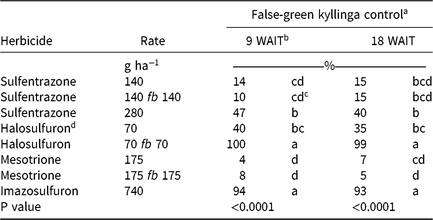
a Control was calculated using visual estimate of false-green kyllinga coverage in each plot on a 0 (no cover) to 100% (complete cover) scale as follows: percent control = {[1 – (treated plot/nontreated plot)] × 100}. Control was calculated within-block prior to analysis.
b Abbreviations: fb, followed by; WAIT, wk after initial treatment.
c Means followed by the same letter within measurement type do not differ according to Fisher’s protected LSD at P ≤ 0.05.
d All treatments not containing sulfentrazone were applied with nonionic surfactant at 0.25% (v/v).
Herbicide regimen comparison
Location-by-treatment interactions were present for Indiana location data; therefore, Indiana data are presented separately for each location. There were no location-by-treatment interactions with main effects in New Jersey; therefore, data were pooled across the two New Jersey locations.
Turfgrass injury
Neither imazosulfuron nor halosulfuron injured turfgrass at any location. Sulfentrazone injured turfgrass <20% and was transient (visible for <2 wk; data not shown).
Control at 4 and 8 WAIT
At 4 WAIT in New Jersey and at VNGC in Indiana, all halosulfuron and imazosulfuron treatments controlled false-green kyllinga more effectively than sulfentrazone treatments (data not shown). At BCC, imazosulfuron, but not halosulfuron controlled false-green kyllinga more effectively than sulfentrazone at 4 WAIT (data not shown). By 8 WAIT both sulfentrazone treatments controlled false-green kyllinga less effectively than all imazosulfuron treatments in New Jersey and at VNGC (Table 2). All imazosulfuron treatments controlled false-green kyllinga similarly (>85%) at 8 WAIT at all locations; these treatments also controlled false-green kyllinga more effectively than a single application of halosulfuron in New Jersey and at VNGC, except for a single application of imazosulfuron at 420 g ha−1 in New Jersey. Sequential applications of halosulfuron and all imazosulfuron treatments controlled false-green kyllinga similarly at all locations 8 WAIT.
False-green kyllinga control after single and sequential herbicide applications in 2017 at 8 and 12 wk after initial treatment (WAIT). Data from two New Jersey (NJ) sites are presented as a combined analysis. Data from two sites in Indiana are presented separately because of location-by-treatment interactions.

a Control from visual false-green kyllinga coverage and control from grid intersect counts were calculated as follows: % control = {[1 – (treated plot/nontreated plot)] × 100}. Control was calculated within-block prior to analysis.
b Abbreviations: BCC, Bloomington Country Club; fb, followed by; VNGC, Victoria National Golf Club.
c Applications of imazosulfuron and halosulfuron included a nonionic surfactant at 0.25% (v/v).
d Initial applications were made on June 11, 2017 in NJ, May 28 2017 at BCC, and May 29, 2017 at VNGC. Second applications were made to half the treatments 4 wk later.
e Means followed by the same letter do not differ according to Fisher’s protected LSD at P ≤ 0.05. Letters can only be used to compare means within the same column.
Control at 12 WAIT
Across all locations, imazosulfuron generally controlled false-green kyllinga more effectively than other treatments. Sequential applications of imazosulfuron at 420 or 740 g ha−1 controlled false-green kyllinga 100% at all locations. Control from single applications of imazosulfuron varied across locations (78% to 99%). Except for a single application of imazosulfuron at 420 g ha−1 at BCC (80% control), all imazosulfuron treatments controlled false-green kyllinga similarly. Henry et al. (Reference Henry, Sladek, Hephner and Cooper2012) also reported excellent efficacy from sequential imazosulfuron applications (560 g ha−1) compared to a single application for purple nutsedge control in bermudagrass. Halosulfuron and sulfentrazone efficacy varied across locations. Single or sequential applications of halosulfuron controlled false-green kyllinga more effectively than sequential applications of sulfentrazone in New Jersey, but at VNGC all halosulfuron and sulfentrazone treatments controlled false-green kyllinga similarly (<40%). At BCC, halosulfuron treatments controlled false-green kyllinga more effectively than a single but not sequential application of sulfentrazone. At both locations in Indiana, all halosulfuron and sulfentrazone treatments controlled false-green kyllinga less effectively than imazosulfuron. In New Jersey, sequential but not single-application halosulfuron controlled false-green kyllinga similarly to all imazosulfuron treatments.
In this research we observed that halosulfuron was less effective than reported by McElroy et al. (Reference McElroy, Yelverton and Warren2005b), who observed 74% and 90% population reductions at 18 WAIT from single and sequential applications, respectively, of halosulfuron at 70 g ha−1. Poor false-green kyllinga control from sulfentrazone observed in this research was also reported in previous cool-season turfgrass research (Askew et al. Reference Askew, Brewer, Rana and Gover2016). Gannon et al. (Reference Gannon, Yelverton and Tredway2012) also observed poor (<55%) false-green kyllinga control at 12 WAIT from single and sequential applications of sulfentrazone at 140 to 420 g ha−1 in warm-season turf. Sulfentrazone efficacy against kyllinga may depend on higher rates, as McElroy et al. (Reference McElroy, Yelverton and Warren2005b) observed 65% and 79% false-green killinga reduction from single applications of sulfentrazone at 420 and 560 g ha−1.
Grid count control at 12 WAIT
Grid count data support visible control observations presented above. False-green kyllinga control and treatment differences according to grid counts were almost identical to visual ratings at all locations. One exception was at BCC, where grid counts determined that two applications of halosulfuron controlled false-green kyllinga 74% and were similar to imazosulfuron treatments. Visual ratings for the same treatment determined it controlled false-green kyllinga 65%, and was less effective than imazosulfuron treatments.
This research demonstrates that imazosulfuron is an effective option for POST false-green kyllinga control. When applied singly, imazosulfuron may be more effective at 740 than 420 g ha−1 at certain locations. However, sequential applications of imazosulfuron controlled false-green kyllinga 100% regardless of rate (740 or 420 g ha−1).
Single applications of halosulfuron provided moderate (<60% control) at all locations. Halosulfuron efficacy was variable across locations, as sequential applications were effective in New Jersey but not at one location in Indiana. We speculate that variable herbicide tolerance among kyllinga biotypes is the main factor responsible for these location differences.
Single and sequential applications of sulfentrazone provided poor false-green kyllinga control (<40%) at 140 g ha−1. Although McElroy et al. (Reference McElroy, Yelverton and Warren2005b) observed good control from single applications of sulfentrazone at 420 and 560 g ha−1, these rates are higher than the 280 g ha−1 single-application maximum labeled for cool-season turfgrass and the 140 g ha−1 maximum for creeping bentgrass. Sulfentrazone may be an important option for resistance management, as halosulfuron and imazosulfuron are both ALS inhibitors. Resistance to ALS inhibitors has not been reported in false-green kyllinga, but an ALS-resistant annual sedge (Cyperus compressus L.) population of turfgrass was found to be resistant after >10 yr of halosulfuron use for sedge control (McCullough et al. Reference McCullough, Yu, McElroy and Chen2016). ALS resistance has been documented in a perennial sedge species as well. A yellow and purple nutsedge hybrid with a high level of resistance to halosulfuron was found in an Arkansas rice production field (Techranchian et al. Reference Techranchian, Norsworthy, Bagavathiannan and Riar2015a, Reference Techranchian, Norsworthy, Nandula, McElroy, Chen and Scott2015b).
This research confirms previous reports of imazosulfuron efficacy and supports the use of imazosulfuron and halosulfuron as part of an integrated management program for false-green kyllinga control. One weakness of this research and previous research for the practitioner is that treatments were applied in June shortly after kyllinga emergence. Given that false-green kyllinga can form a dense mat and dominate the turfgrass sward, many turfgrass managers are hesitant to apply POST herbicides in June, because summer is not an ideal time for cool-season turfgrass interseeding into voids created by dead kyllinga. Future research should evaluate the efficacy of late-summer or early-fall herbicide applications compared to late spring alone and in combination with interseeding. Previous research investigating the control of warm-season perennials bermudagrass and dallisgrass (Paspalum dilatatum Poir.) demonstrated that late-summer herbicide applications are the most effective seasonal application timing (Brosnan et al. Reference Brosnan, Breeden, Elmore and Zidek2011; Elmore et al. Reference Elmore, Brosnan, Mueller, Horvath, Kopsell and Breeden2013).
Author ORCIDs
Matthew T. Elmore https://orcid.org/0000-0002-3049-3892, Aaron J. Patton https://orcid.org/0000-0003-3870-7709
Acknowledgments
This work was supported by the Rutgers Center for Turfgrass Science and Hatch project 1004762 from the USDA National Institute of Food and Agriculture. The authors would also like to thank Evan Hopkins, Jennifer Sawyer, Alex Coward, and Katie Diehl for their assistance in conducting these experiments, as well as golf course superintendents Kevin Tansey, Levi Robertson, and Kyle Callahan. No conflicts of interest have been declared.


 Open access

