

7.1 Introduction
The Deep Transition framework and research stream can be understood as an attempt to move beyond the dominant orientation within sustainability transitions of investigating single systems over a maximum of a few decades. Instead, it centres upon an analysis of the co-evolution of multiple system over many decades or even centuries, exploring how such processes shape the entire economy and/or broader society. The need for such a framework results from three core observations regarding prior sustainability transitions scholarship, here given as rationales.
First, there is a need and ambition to develop a theoretical framework which connects multiple, if not all, systems and complexes of systems which make up an entire economy and/or society. A core strength of the sustainability transitions field is its granular and deep understanding of systems implicated in major global ecological challenges such as the climate crisis. It is argued that the basics of life are not only provided by income but relate in a fundamental way to access to socio-technical systems for the provision of energy, healthcare, food, mobility, water, housing, water, security, communication and education. At the same time, the current configuration of these systems is put forward as the root cause of the various environmental and social challenges we face. The bulk of such work, however, has typically focused on specific single systems like energy, food and mobility, to the detriment of a multi-systemic perspective. Even so, a previously small but steady stream of research on multiple-system interactions has focused on functional and structural couplings that link systems of interest (Konrad et al., Reference Konrad, Truffer and Voß2008); sites of interaction, such as cities or ports; actors or governance structures that link systems and facilitate couplings (Hiteva & Watson, Reference Hiteva and Watson2019, Ohlendorf et al., Reference Ohlendorf, Löhr and Markard2023); parallel but linked developments in various systems or sectors (Rosenbloom, Reference Rosenbloom2020); the role of niches in linking systems (Kanger et al., Reference Kanger, Schot, Sovacool, van der Vleuten, Ghosh, Keller, Kivimaa, Pahker and Steinmueller2021); and patterns in the dynamics of system interaction, such as competition, symbiosis, integration and spillover (Raven & Verbong, Reference Raven and Verbong2009). This work has mainly focused on linking single systems to other systems, rather than providing an analysis of system complexes as a unit of analysis, although recent attempts to look at whole-system reconfiguration are moving in that direction (see, for example, Geels & Turnheim, Reference Geels and Turnheim2022).
Second, there is a need to explore systemic explanations for and entanglements between not only environmental but also social challenges. A core feature of sustainability transitions as a field has been its focus on wicked environmental problems, such as the climate crisis, resource depletion and biodiversity loss and on the specific systems responsible for these problems, such as energy, mobility and food. The argument is that the root causes of these problems are inherent in the current configuration of these systems. This focus on environmental issues was unfortunately initially accompanied by an almost total neglect of enduring social issues such as poverty and inequality during the first waves of sustainability transitions work (see, for example, the recent research agenda, Köhler et al., Reference Köhler, Geels, Kern, Markard, Onsongo, Wieczorek, Alkemade, Avelino, Bergek, Boons, Fünfschilling, Hess, Holtz, Hyysalo, Jenkins, Kivimaa, Martiskainen, McMeekin, Mühlemeier, Nykvist, Pel, Raven, Rohracher, Sandén, Schot, Sovacool, Turnheim, Welch and Weels2019). Instead, the social dimension of the sustainable development concept was typically captured through an interest in or acknowledgement of topics such as inclusive participation, power and governance. In various ways, the field is picking up on this failing, most notably by introducing and developing concepts such as ‘Just Transitions’ (Jenkins et al., Reference Jenkins, Sovacool and McCauley2018; Jenkins et al., Reference Jenkins, Sovacool, Błachowicz and Lauer2020; Swilling & Annecke, Reference Swilling and Annecke2012). This development is driven primarily by the recognition of a need to address the context of developing countries, with Swilling in particular pointing out that the focus on environmental issues at the expense of social challenges is a typical western bias (Swilling, Reference Swilling2020). Deep Transition research aspires to address this bias by focusing on the double challenge of addressing social and environmental issues together in one frame and investigating trade-offs and synergies between them across systems.
Third, there is a need to go beyond research that only covers a few years or decades and to explore much larger timeframes. As a field, sustainability transitions misses a longer historical timeframe that connects systems reconfigurations to slower-moving changes in the wider context of the modern world. In sustainability transition studies, this context is often referred to as the landscape, a concept that remains undertheorised. The landscape is seen as an external context of slow-changing developments, trends and shocks which serve as an externalised backdrop for much of the studied transition dynamics. This is valid for research that focuses on a shorter time period, spanning only a few years or even decades, yet examination of longer time frames invites us to consider more deeply the interactions between the landscape and systems (re)configurations on both conceptual and empirical levels. One implication is that it becomes important to endogenise (parts of) the landscape and ask new questions about its formation and long-term impact on transition dynamics.
Taking the three rationales together means that Deep Transition research promises to provide a fresh and new perspective on what Polanyi has called the Great Transformation (Reference Polanyi2001; original 1944), and historians and macro-sociologists have referred to variously as the Industrial Revolution, or modernisation (for overview, Schot & Kanger, Reference Schot and Kanger2018). Deep Transition work offers an alternative view on these big historical processes by claiming that they have been shaped by socio-technical system change and should be studied through this lens. In effect, Deep Transitions seeks to explain the rise, maturation and crisis of modern societies through the lens of long-term multi-system co-evolution, captured through the notion of the First Deep Transition.
Central to the First Deep Transition is the notion of industrial modernity, conceptualised within Deep Transitions as a constellation of ideational, institutional and practice-related traits embedded within the landscape have come to characterise all industrial societies to a degree, even despite historical and enduring distinctions in their economic, political and cultural character. This concept rests on two pillars. First, the idea that a core and defining feature of modern industrial societies is that they organise systems around science, technology and innovation (STI) activities, using them to address their societal challenges and fulfil their ambitions and visions. Following Schumpeter, Deep Transition research claims that over the past 250 years, and for the first time in history, STI activities became the engine of capitalism, leading to and fueled by capital accumulation (Schot, Reference Schot2016). This central role for STI activities is combined with the idea that STI activities are inherently neutral and are not connected to their social and environmental consequences, thus encouraging human actors to develop new technological solutions without embedding them upfront in society and the natural environment. The second pillar of this notion of industrial modernity is a disregard for the environment, evident both in its externalisation from societal dynamics and in its reduction to being a source of inputs for economic activity and sink for the waste of that activity. In modern societies, a divide is created between humans and the natural environment, with the latter being brought under control by STI activities because resources are framed as a basis of modernity and welfare (Veraart et al., Reference Veraart, Aberg and Vikström2020). Both social and environmental consequences are treated as externalities, including in spatial terms. They are often exported to (former) colonies and are not seen as the responsibility of the actors who are developing socio-technical solutions (Latour, Reference Latour1991; Schot, Reference Schot, Misa, Brey and Rip2003). A key proposition of Deep Transitions is that the modern age is the first time in history that STI activities have acquired this central role as mobilisers for change, and as distributors of social and ecological consequences. This is the reason why the Industrial Revolution is equated with the First Deep Transition, in place of other major transitions in history, such as the Agricultural Revolution, as this maturation of STI’s function within this process is an important step towards the development of fully realised socio-technical systems. This argument is further related to the suggestion that the world has entered a new geological epoch, set in motion by human activities, the Anthropocene (Crutzen & Stoermer, Reference Crutzen and Stoermer2000).
Following the general perspective in sustainability transitions that the root causes of our present environmental and social challenges are found in the configuration of socio-technical systems, the Deep Transitions perspective suggests that the re-configuration of these systems must account for a multi-systemic and long-term lens. The successive waves of socio-technical systems development throughout 250 years of the First Deep Transition have introduced inertia in the form of inter-system linkages and couplings, shared rules and meta-rules, and intractable landscape-level trends that will be difficult to overcome (these concepts are further explored in Section 7.2).
The implication of a Deep Transition analysis is the identification of a need not just for single or multiple system changes or reconfigurations, but for a Second Deep Transition towards a new global economy and society. Such a transition should ensure the world is re-embedded within its planetary boundaries while generating a social foundation that gives people access to the basics in life, allowing human flourishing and enlarging human capabilities (Sen, Reference Sen2005; Rockström et al., Reference Rockström, Steffen, Noone, Persson, Chapin, Lambin, Lenton, Scheffer, Folke, Schellnhuber, Nykvist, de Wit, Hughes, can der Leeuw, Rodhe, Sörlin, Snyder, Costanza, Svedin, Falkenmark, Karlberg, Corell, Fabry, Hansen, Walker, Liverman, Richardson, Crtuzen and Foley2009; Raworth, Reference Raworth2017). It is crucially important that this Second Deep Transition is a Just Transition, and thus does not reinforce post-colonial extractive relationships in which social and ecological consequences are carried by the Global South as well as the poorer part of the population in the Global North (Swilling, Reference Swilling2020).
7.2 Historical and Thematic Development
The Deep Transitions framework not only elaborates on sustainability transitions work, it also seeks to integrate the work of economists, historians and sociologists studying long-term change. In doing so, it aims to connect dynamics of single system transitions to broader theories of historical development. In particular, it draws on the work of Carlota Perez (Perez, Reference Perez1983; Reference Perez2003) by suggesting that the First Deep Transition consisted of five Great Surges of Development, each taking 40–60 years to develop. These surges can each be understood as socio-technical system transitions (taking a similar 40–60-year timespan), and their internal dynamics can be studied using sustainability transitions research insights. Accordingly, in each surge a specific set of systems driven by a shared set of rules (or techno-economic paradigms as they are called by Perez) was built through a wide range of niches, leading not only to the substitution or reconfiguration of single systems, but also to new couplings across the systems, driving the development of the economy and society.
Schot and Kanger leveraged this transitions-based analysis of Perez’s five Great Surges of Development to produce a general framework of Deep Transition, defining such processes as a series of connected and sustained fundamental transformation of a wide range of socio-technical systems in a set of similar directions (Schot & Kanger, Reference Schot and Kanger2018). Examples of such directions for the First Deep Transition include:
increased labour productivity through mechanisation, the quantification and hyper-management of time, mass production and more recently digitalisation, all with huge implications for the quality of work and employment;
relentless reliance on and exploitation of fossil fuels (and other resources), for example for production of plastics, artificial fertiliser, detergents, pharmaceuticals and dyestuff, leading to large integrated chemical complexes;
a historically extreme drive for individual mass consumption and abundance of products and services;
attempted homogenisation of cultures and peoples within a single economic system on a global level;
building of a linear economy, partly in service of growing economic activity, resulting in a massive amount of waste to be dumped;
move towards resource-intensive development and an energy-intensive economy and society;
pushing of global value chains, often embedded in (post-)colonial relationships;
externalising of both ecological and social costs, leading to inequality and poverty.
The importance of shared directions – directionalities in the framework – for systems development is central within this definition, and so the framework introduces several novel concepts and dynamics, alongside leveraging existing ones, to further explore and explain the apparent emergent coordination between systems. In particular, the introduction of the notion of meta-rules and meta-regimes as a coordinating mechanism across multiple systems is one of the central conceptual contributions of the Deep Transition framework. Meta-rules and meta-regimes (as sets of meta-rules), embody the preferred ways of operating and optimising multiple systems. For example, for the meta- regime of mass production such meta-rules include: ‘make parts interchangeable’; ‘standardise products’; ‘separate planning from production’; ‘decouple production from consumption; execute production globally and in real time’ (for a full list of 45 rules, see Kanger et al., Reference Kanger, Bone, Rotolo, Steinmueller and Schot2022a, appendix B). As such, they set and guide shared directionalities for systems reconfiguration.
The notion of rules is an important building block of the MLP, and more broadly in the sustainability transitions field systems change is often conceptualised as institutional (i.e. rule) change (see Fuenfschilling & Truffer, Reference Fuenfschilling and Truffer2014). Yet, in a lot of theoretical and empirical work sustainability transitions are not systematically studied by zooming in on rule change. Instead, the focus is often on system components, such as policies, technologies, business models, user preferences or on power relationships between actors. The Deep Transitions framework instead builds on a rule-focused MLP approach, aligned with an institutionalist interpretation of sustainability transitions. In addition, Deep Transitions research deploys the concepts of niche, regime and landscape (Rip and Kemp, Reference Rip, Kemp, Rayner and Malone1998; Geels, Reference Geels2002). These concepts are rooted in MLP; however, they are also used more widely in the field, outside an MLP context. For the study of multiple systems and regimes, the Deep Transition framework also builds on the idea of functional and structural couplings between systems (Konrad et al., Reference Konrad, Truffer and Voß2008; see also Bergek et al., Reference Bergek, Hekkert, Jacobsson, Markard, Sandén and Truffer2015). These couplings are positioned as carriers of and spaces for building meta-rules. In addition, international organisations and transnational networks are positioned both as organisers of these couplings and as meta-rule learning process organisers.
In combining the two foundations of Perez’s Great Surges and the MLP, the Deep Transition framework can move beyond limitations of by explaining, from a systems perspective, how multiple socio-technical systems have become aligned throughout the First Deep Transition. This integration is achieved by Kanger and Schot (Reference Schot and Kanger2018; Reference Kanger and Schot2019) through a series of 12 core propositions for empirical exploration (Table 7.1). Each of these propositions aims to tie particular periods or phases of Perez’s Great Surge life cycle to corresponding MLP dynamics, either providing a rules- regime- niche- and landscape-based explanation of each phase, or identifying potential mechanisms of systems dynamics at play.
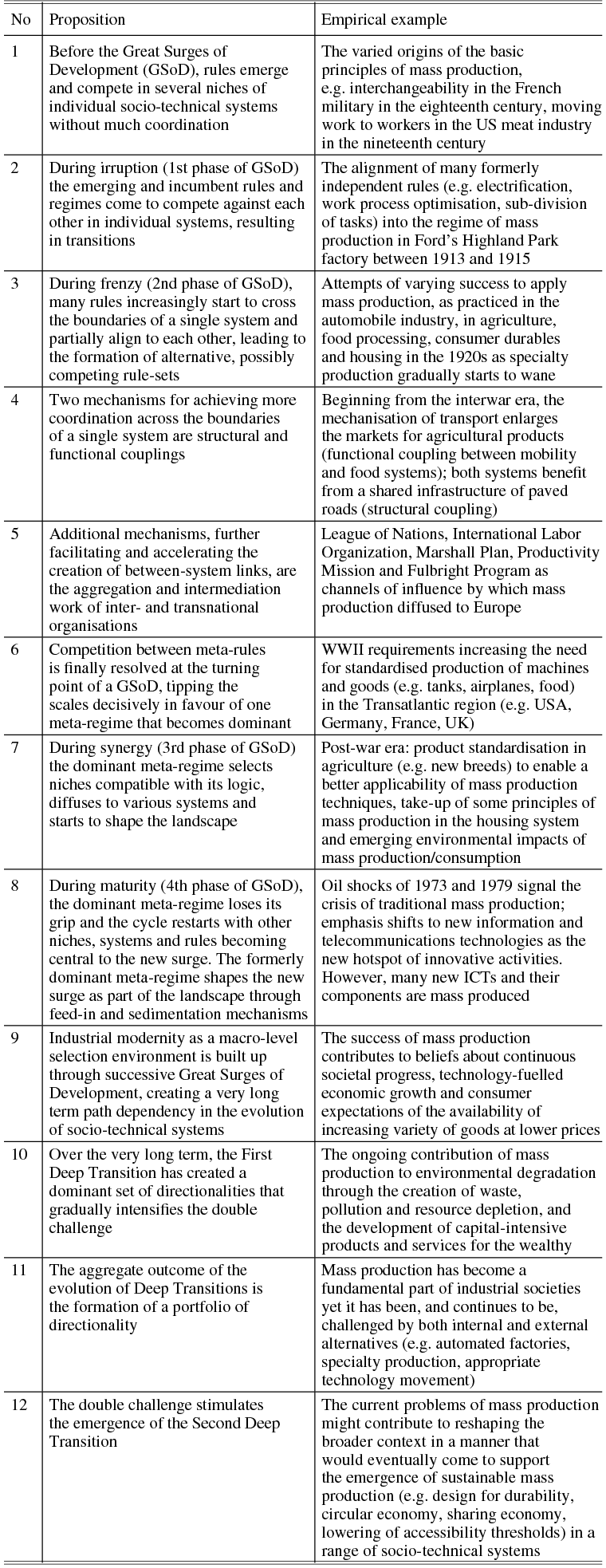
Propositions 1, 2, 3, 6, 7 and 8 relate the pre-surge, irruption (1st phase), frenzy (2nd phase), turning point, synergy (3rd phase) and maturity (4th phase) phases of Perez’s Great Surges of Development to emergence, competition, diffusion, alignment, consolidation and weakening of niches, (meta-)rules and (meta-)regimes, respectively. Propositions 4 and 5 identify structural and functional couplings and the aggregation and intermediation work of inter- and trans-national organisations, respectively, as mechanisms for greater cross-system coordination. Finally, propositions 9, 10, 11 and 12 address the build-up over time of a dominant path dependency, arguing that over successive surges, a set of meta-rules and meta-regimes gradually accumulate within the landscape to provide a macro-level selection environment that supports a common portfolio of directionality. Initial Deep Transitions research has begun to test each of these propositions (see section on Empirical Application), with additional propositions being suggested addressing spatial dynamics (Kanger, Reference Kanger2022).
The Deep Transition framework further highlights that the historical First Deep Transition is in fact a history of the technological ‘winners’, while a separate history of alternative socio-technical practices in niches is needed. Furthermore, many of these alternatives still exist today, even if they remain hidden, and carry the potential to be developed into cornerstones of future systems. The Second Deep Transition is partly about building upon these alternatives, recognising the opportunities afforded by changing landscape conditions to pursue deeper, more fundamental change. Thus, Deep Transitions argues that there is an alternative to building a next Great Surge of Development which simply builds upon and consolidates what has come before, but which instead involves challenging the long-term continuity built up through all six previous surges. This is seen as being vitally important as the First Deep Transition has created a set of wicked environmental and social problems, expressed in the trespassing of the planetary boundaries and erosion of the social foundation of life.
These problems cannot be solved by optimising the meta-rules of the First Deep Transition, because they are ingrained within and a result of its meta-rules. Hence, the argument is that the future of our societies is to be found in enabling a shift to a new development paradigm, enabling a Second Deep Transition.
7.3 Empirical Application
The long-term and large-scale nature of the Deep Transitions framework has necessitated the development of new mixed-method approaches that combine qualitative and quantitative research, with research often focused on testing propositions in ‘most likely’ cases. These are cases one would most likely expect to match the Deep Transitions framework, and which can therefore be used to test it for rejection (should even the most likely case fail to conform to the framework, the framework is likely inaccurate).
7.3.1 Evolutionary Patterns of Great Surges (Studies on Mass Production)
Sillak and Kanger (Reference Sillak and Kanger2020) aimed to assess whether the evolution of mass production followed the patterns hypothesised by the Deep Transitions framework. (They re-formulated propositions 1–8 into 6 (adding ‘gestation’ and ‘turning point’ to Perez’s original 4 Great Surge phase-specific patterns of rules and meta-rule development) for validation, testing these through a qualitative historical case study of mass production in the transatlantic region from 1765 to 1972. This qualitative work was later built upon with complementary quantitative text mining analysis to enable the quantification of the emergence and alignment of rules and meta-rules (Kanger et al., Reference Kanger, Bone, Rotolo, Steinmueller and Schot2022a). The methods were integrated in a sequential exploratory mixed-methods research design, in which the findings of the qualitative historical case study were used to specify inputs for the quantitative text mining analysis of two historical corpuses.
These studies generally confirmed the propositions of the Deep Transitions framework, however with some notable novel additions. First, there was a lack of empirical evidence of the role of transnational actors as organisers of the coupling process (proposition 5) in the frenzy phase, but it was noted this may have been caused by lack of readily available suitable historical source material. Second, in addition to structural and functional couplings (proposition 4), a third type of coupling – rhetorical – was identified connecting different systems. Third, the emergence of alternative versions of the dominant meta-regime even during synergy and maturity phases challenged propositions 7 and 8, which propose consolidation of the dominant meta-regime during synergy followed by the emergence of entirely new rules and meta-rules during maturity (as opposed to variations on the existing meta-regime). This finding led to a new proposition regarding the evolutionary dynamics of mature post-surge meta-regimes: that crisis in the mature meta-regime does not only stimulate the emergence of a new surge, but also an internal transformation of the existing meta-regime. This transformed incumbent meta-regime may then also become part of the next surge, surviving on as a key building block of its successor. This notion challenges the simple idea of replacement. Fourth, the landscape was found to have a larger influence on meta-regime development than was captured in the propositions, including through spatial dynamics.
7.3.2 Industrial Modernity
The Deep Transitions framework proposes the notion of industrial modernity as a macro-level selection environment built up and embedded as a layer within the socio-technical landscape through successive great surges of development (proposition 9). Propositions 10 and 11 note that this can be expressed in the form of a dominant directionality, which has led to or otherwise exacerbated the ‘double challenge’ of environmental (un)sustainability and social (in)justice. Finally, proposition 12 suggests that the presence of this double challenge stimulates the emergence of a Second Deep Transition, necessitating a change in directionality and thus ruptures in industrial modernity. This final proposition is translated into the claim that, since the 1960s, ruptures in industrial modernity have begun to emerge – first signs of a potential Second Deep Transition.
A second line of empirical work, then, focused on testing the validity of these propositions. Kanger et al. (Reference Kanger, Tinits, Pahker, Orru, Tiwari, Sillak, Šeļa and Vaik2022b) and later Kanger et al. (Reference Kanger, Tinits, Pahker, Orru, Velmet, Sillak, Šeļa, Mertelsmann, Tammiksaar, Vaik, Penna, Tiwari and Lauk2023) sought to operationalise these propositions by conceptualising industrial modernity in terms of ideal-typical ideational, institutional and practice-related traits across environmental and technological domains, then examining evidence of its presence and ruptures within it across several countries with notably distinct economic, political cultural characteristics. In both studies the authors mobilised their multi-dimensional and multi-domain approach to provide empirical evidence of long-term continuities and emerging ruptures in industrial modernity, assessing the extent to which ideal-typical traits of industrial modernity manifest themselves in various countries between 1900 and 2020, and to which it is possible to observe ruptures in these traits. A mixed-methods research design was again employed, with text mining of newspapers and magazines deployed alongside analysis of existing databases to simultaneously measure the ideational, institutional and practice-related dimensions.
The findings qualified and expanded the claims of the initial Deep Transitions framework in three ways. First, in relation the environmental domain, the 1960s were indeed a decade of rupture in the ideational dimension, but not in terms of institutions or practices. Second, again for the environmental domain, there is a possible empirical pattern where changes in ideas are followed by institutional shifts, followed, in turn, by very modest and only nascent changes in practices. This pattern was absent from the propositions. Third, whereas new ideas of human–nature relationships have emerged, the dominance of the idea of technology as a neutral fixer of problems has not been broken. Critically, the study found that the ideational, institutional and practice-related similarities cross-cut societies as different as the Soviet Union, USA and India, which supports the validity of industrial modernity as a universally applicable notion. This in turn has been carried forwards by Pahker et al., Reference Pahker, Kanger and Tinits2024b, who developed and applied an index for measuring the ‘thickness’ of industrial modernity in 63 countries, suggesting that such an index could be used as a proxy for assessing the readiness or potential for a Second Deep Transition in each case.
7.3.3 System Entanglers (Studies on International Organisations)
Kern et al. (Reference Kern, Sharp and Hachmann2020) sought to test proposition 5 on the aggregation and intermediation work of transnational and international actors. The paper focuses on the role of the European Union (EU) in developing and diffusing the circular economy meta-regime. The study adopted a combination of primary literature review and interview analysis, expanded through iterative snowballing of both interview subjects and further document analysis until saturation was reached in terms of identifying new mechanisms through which the EU attempted to diffuse circular economy meta-rules. The study challenged the findings of Sillak and Kanger (Reference Sillak and Kanger2020) and Kanger et al. (Reference Kanger, Bone, Rotolo, Steinmueller and Schot2022a), finding ample evidence of the role of the EU as an international actor in diffusing meta-rules through a variety of mechanisms. The discrepancy between this and earlier findings may be the result of differences in data availability (discussed previously). System entanglers have been further examined by Groß et al. (Reference Groß, Streeck, Magalhães, Krausmann, Haberl and Wiedenhofer2022) and Löhr and Chlebna (Reference Löhr and Chlebna2023), who investigated the European Recovery Program (ERP) in relation to France’s post-WWII energy system and a comparative case study analysis of hydrogen-based sector couplings within mobility, heating and industry in Germany, respectively. The former study found evidence that alignment through transformation of various socio-technical systems was accelerated by the ERP, guided by the pursuit of the objective of ‘hidden integration’. Löhr and Chlebna similarly found evidence confirming the role of system entanglers, identifying cross-sectoral competencies and learning and the creation of inter-system linkages as key to their impact.
7.3.4 Turning Points (Studies on Wars)
Among the findings of the studies on mass production was an increased importance of the landscape in shaping transitions. Proposition 6 of the Deep Transition framework describes the central role of landscape shocks as defining features of turning points in Great Surges, forcing a choice between a portfolio of directionalities and meta-regimes. World wars are given as an archetypical example of such shocks, acting to ‘tilt’ the landscape both by changing meta-rules across many systems, and by causing literal physical destruction of infrastructures that would otherwise provide a material inertia to change. In a series of case studies, Johnstone and McLeish examined wars as exogenous landscape shocks, exploring in what ways socio-technical developments during wartime influenced lasting change with respect to socio-technical systems. These study explored, inter alia, the role of the First World War (WWI) and Second World War (WWII) in the turning point of the 4th surge within the First Deep Transition (this is the 1908–1971 period) (Johnstone & McLeish, Reference Johnstone and McLeish2020), their relationship to transitions in energy, food and mobility more broadly (Johnstone & McLeish, Reference Johnstone and McLeish2022), and chemical warfare and transitions in the chemicals systems (McLeish et al., Reference McLeish, Johnstone and Schot2022).
The studies found support for proposition 6, finding strong evidence that world wars, as landscape shocks, indeed played an important role in resolving competition between meta-regimes, leading in this case to the consolidation of the oil based meta-regime and destabilisation of the incumbent coal regime, the geographical transnational integration of various countries into this meta-regime, and the shaping of post-war developments maintaining abundant supply. The authors extended the proposition by identifying four mechanisms created by the context of total war which were responsible for forcing a choice between meta-regimes across several systems. The four mechanisms were: (1) immense demand- pressures placed on the economy and related immense logistical challenges that reoriented patterns of production and consumption; (2) the war demanding a single focus on victory shaping the directionality; (3) the immediate build up of new national and international institutions for coordination purposes leading to new policy capacities and (4) the readiness of actors for cooperation and shared sacrifice (Johnstone & McLeish, Reference Johnstone and McLeish2022).
The mechanisms did not just facilitate rational choice of threats and opportunities provided by the window of opportunity (WoO) of a war, the usual way of analyzing landscape shocks in the sustainability transitions literature. Instead, the authors proposed to analyze the working of a shock with the concept of imprinting, previously used in organisational studies to study how behavior in industries, organisations and networks continue to reflect the conditions of a particular sensitive period. An important aspect of the imprinting concept is that this process occurs not only for actors, but also directly within the landscape, which may experience direct and lasting change in its constituent meta-rules during the shock (McLeish et al., Reference McLeish, Johnstone and Schot2022). Johnstone and Schot (Reference Johnstone and Schot2023) focused on tracing imprinting in the cases of a total war such as WWII, but also the economic shock of the 1973 oil crisis, framing imprinting in contrast with WoO. They found imprinting can explain the lasting impact of WWII of the directionality of change, while the same is not true for the 1973 oil crisis, precisely because this shock opened up a WoO that led to niche development (in particular of renewables), but not a change of meta- regime. Thus, the imprinting mechanism was not activated.
7.3.5 Additional Academic Literature Engaging with Deep Transitions
The above stream of literature aimed at testing, refining and developing the Deep Transitions framework itself is embedded within a much larger body of literature that builds upon similar ideas and provides constructive criticism while referring to or deploying Deep Transitions concepts. This includes literature not only in sustainability transitions, but across other fields too. Each of the below referenced studies either cites the two fundamental Deep Transitions framework papers (Schot & Kanger, Reference Schot and Kanger2018; Kanger & Schot, Reference Kanger and Schot2019), or otherwise engages with core ideas and concepts.
The proposition that our present environmental and social challenges are driven by dysfunctional systems configurations linked to industrial modernity (Korsnes et al., Reference Korsnes, Loewen, Dale, Steen and Skjølsvold2023; Navickiene et al., Reference Navickienė, Meidutė-Kavaliauskienė, C & inčikaitė, Morkūnas and Valackienė2023a; Reference Navickienė, Valackienė, C & inčikaitė and Meidutė -Kavaliauskienė2023b); that multiple systemic change and a Second Deep Transition are needed to address these challenges (Keller et al., Reference Keller, Noorkoiv and Vihalemm2022a; Reference Papanikolaou, Centi, Perathoner and Lanzafame2022b; Soberón et al., Reference Soberón, Sánchez-Chaparro, Smith, Moreno-Serna, Oquendo-Di Cosola and Mataix2022; Eum & Maliphol, Reference Eum and Maliphol2023; Song et al., Reference Song, Rogge and Ely2023; Tapiloa et al., Reference Tapiola, Varho and Soini2023); that this change can be conceptualised through the application of meta-rules change at the landscape level (Simoens et al., Reference Simoens, Fuenfschilling and Leipold2022; Ba & Galik, Reference Ba and Galik2023). Further to this, the importance and utility of the landscape and its dynamics (Bodrozic & Adler, Reference Bodrozic and Adler2022), couplings between systems (Rosenbloom, Reference Rosenbloom2020; Markard, Reference Markand2020; Groß et al., 2020; Nevzorova, Reference Nevzorova2022; Tscherisich & Kok, Reference Tscherisich and Kok2022) and meta-rules (Keller et al., Reference Keller, Noorkoiv and Vihalemm2022a; Reference Papanikolaou, Centi, Perathoner and Lanzafame2022b; Cairns et al., Reference Cairns, Hannon, Braunholtz-Speight, McLachlan, Mander, Hardy, Sharmina and Manderson2023; Ohlendorf et al., Reference Ohlendorf, Löhr and Markard2023; Andersen & Geels, Reference Andersen and Geels2023) to creating transformative change have been recognised. Deep Transitions has also begun to be embedded within specific contexts and conversations, such as in historical analyses the role of system entanglers in organizing coupling processes (van der Vleuten, Reference van der Vleuten2019), in reference to the need for systemic change within the chemicals sector (Papanikolaou et al., Reference Papanikolaou, Centi, Perathoner and Lanzafame2022a; Reference Papanikolaou, Centi, Perathoner and Lanzafame2022b; Centi & Perathoner, Reference Centi and Perathoner2022), and in relation to emerging concepts of ‘earth-space sustainability’ (Yap & Truffer, Reference Yap and Truffer2022; Yap & Kim, Reference Yap and Kim2023). Of note is the discussion of the importance of ports for Deep Transitions as critical infrastructure coupling multiple systems (Bjerkan & Ryghaung, Reference Bjerkan and Ryghaug2021; Bjerkan & Seter, Reference Bjerkan and Seter2021). Furthermore, Deep Transitions has also been recognised within key texts and handbooks on Sustainability Transitions (Geels, Reference Geels2024) Sustainability Science (Clark & Harley, Reference Clark and Harley2019) and Sustainability in general (Cohen, Reference Cohen2020). Finally, Deep Transitions and key concepts have been recognised within the Intergovernmental Panel on Climate Change (IPCC)’s Working Group 3 (Mitigation) 6th Assessment Report.
The framework has also received critical attention. Kemp et al. (Reference Kemp, Pel, Scholl and Boons2022) engage extensively with Deep Transitions, arguing that the framework should engage more with socio- economic developments such as marketisation, changes in the character of labor contracts, changing human beliefs, aspirations, needs and wants. Kemp et al. argue that such developments are evidence of the conflict- and tension-ridden nature of transitions that should be more stressed within the framework. Stirling et al. also point to greater complexity than is captured within the framework, citing Deep Transitions as an example of ‘presumptively self-evident visions for transformations’ (Reference Stirling, Cairns, Johnstone and Onyango2023, p.3) which do not capture sufficiently the diversity of actual transitions. Of specific importance is the work of Swilling (Reference Swilling, Acar and Yeldan2019). He extends the notion of Deep Transition by integrating work on socio-metabolic transitions, which focuses not only on the flow of materials and energy through socio-ecological systems, but also on long-term growth cycles, pairing them with the Great Surges of Development. The unit of analysis of socio-metabolic transitions is the exchange between human (or one may say socio-technical systems) and ecological systems (Fischer-Kowalski & Haberl, Reference Fischer-Kowalski and Haberl2007: Fisher-Kowalski & Swilling, Reference Fischer-Kowalski and Swilling2011). This perspective allows one to conceptualise in a detailed way the impact of socio-technical systems change on resource flows. It advances a necessary discussion on de-coupling of well-being and economic growth from rising rates of resource use. Swilling argues that this work documents the resource limits of the industrial modernity and establishes empirically the need for a Second Deep Transition. He also argues that the way these resource limits currently are addressed contain a distinct danger that a decarbonised ecologically sustainable future is realised while leaving existing inequalities intact. Therefore, Swilling argues it is crucially important to focus on the governance and implicated power struggles of Deep Transitions.
7.3.6 Application of Deep Transitions to the Financial Sector
Following Perez’s observation that Great Surges are built around investment, the Deep Transitions framework has in recent years been applied to the context of public and private investment in systems change. Although the Deep Transition framework stresses the multi-actor nature of transitions, from a Deep Transitions framework the finance industry plays a pivotal, yet too often neglected role (Naidoo, Reference Naidoo2020; Loorbach et al., Reference Loorbach, Schoenmaker and Schramade2020; Penna et al., Reference Penna, Schot and Steinmueller2023). Sustainability transitions research favors transdisciplinary work that tries to change highly contested issues from within by directly working with actors in power, while maintaining a critical and independent position (for various roles of transition researcher see Wittmayer and Schäpke, Reference Wittmayer and Schäpke2014). Aligned with this tradition, the Deep Transition framework has been taken to the finance industry to explore whether and how investors would make sense of it. Schot and colleagues created a Global Investors Panel in 2019, and through a series of interactions the panel developed a new transformative investment philosophy (Schot et al., Reference Schot, Benedetti del Rio, Steinmueller and Keesman2022; Penna et al., Reference Penna, Schot and Steinmueller2023). The core contribution of this philosophy is to argue that investors should put the question upfront whether specific cluster of investments lead to transformative change. To answer this question the research team developed a series of tools and practices focused on defining intervention points (Kanger et al., Reference Kanger, Sovacool and Noorkoiv2020) and transformative outcomes (Ghosh et al., Reference Ghosh, Kivimaa, Ramirez, Schot and Torrens2020) and integrating various future methodologies. The work of the Panel has led to the establishment of a Deep Transition Lab together with a set of investors who are beginning to experiment with these methods (Deep Transitions Lab, 2024).
7.4 Emerging Research and Future Needs
The empirical research discussed above should be understood as first steps towards testing, validating and refining the Deep Transition framework. We identify various areas for future research, covering a suite of distinct yet complementary themes.
First, the 12 propositions of the Deep Transition framework would benefit from additional historical testing, not just in commonly explored systems (energy, food and mobility), but in system complexes which include under-explored systems (such as textiles, housing, healthcare, communications and defence). A related opportunity for future work and departure point for this research may include efforts to define lists of all systems or systems complexes and their accompanying rules and meta-rules as well as industrial modernity traits which make up entire economies and societies, and which have been built up through successive Great Surges of Development. Special attention must be paid in any such work to account for inter-and intra-state and regional variations in these systems, rules and meta-rules and industrial modernity traits, and to study spatial dynamics responsible for these variations (see Kanger (Reference Kanger2022) for propositions on these dynamics). This research must consciously and explicitly reject artificially narrow lenses focused only on the Global North. An important implicated research question is whether it is possible to identify which localities have been responsible for the start up and acceleration of Great Surges of Development of the First as well as Second Deep Transition.
Second, there is a need to explore the conceptual relationship between Deep Transitions and the impact they have had and will have on planetary boundaries, social foundations or human needs and a just transition. This relationship can be conceptualised as a struggle for dominance of specific meta-rules and the distribution of social and ecological consequences among social groups within and between the Global South and Global North. It is important to pay attention to the significant and at times decisive roles of violence, conflict, security concerns and war (see Davies and Schultz (Reference Davies and Schultz2023) for an exploration of role of conflict in future Deep Transition scenarios). We expect that this work will allow the Deep Transition work to build bridges with numerous adjacent fields that have long used the concepts such as socio-ecological systems to organise their analysis and pay attention to the role of conflict (for example, various work in Environmental Political Theory, Political Ecology, Ecological Economics, etc.). Such research is particularly relevant within the context of the Anthropocene, in which rapidly changing environmental systems may fundamentally and irreversibly change the possible viable options for future socio-technical system configurations, and lead to shocks and enact violent conflicts between various areas of the world shaped by post-colonial dynamics, deepening inequalities across class, race and gender dimensions.
Third, the Deep Transition framework would benefit from further research on the governance of Deep Transitions. The complementary roles of various actors need further articulation, in particular in relation to the organisation of various couplings across systems. For example, the historical and future organisation of global value chains by system entanglers, and the implicated sustainability trade-offs (distribution of social and ecological impacts). Additionally, the creation of narratives that can organise the way multiple actors consider the future can be viewed as an important coupling mechanism. This can be seen as a form of anticipatory governance that has shaped the First Deep Transition and will shape the Second Deep Transition too.
Fourth, research should also focus on the application of the Deep Transition framework, including, in particular, engaging in transdisciplinary research alongside societal partners (for example investors, entrepreneurs, policymakers, civil society actors). Such work may, for example, focus on testing through experimentation with a range of actors various intervention points and transformative outcomes (frameworks of leverage points and processes). This would lead to a better assessment of the potential of the Deep Transition framework for enabling actors to catalyze, accelerate and consolidate processes of systems change. Such work may also contribute to developing new methodologies for engaging societal partners in transdisciplinary Deep Transitions research.
7.5 Conclusion
Deep Transition is a new idea. It moves sustainability transitions work out of its comfort zone, asking bigger questions about multi-system change, the interplay of social and ecological issues and long-term change of entire societies. Debate exists on whether this is indeed a desirable direction for the field, however, if accepted, a major advantage will be to enable sustainability transitions to overcome its failure to engage with broader debates on, inter alia, de-growth, development, planetary boundaries, the social contract and the future of capitalism (for exceptions see Feola, Reference Feola2020; Vandeventer et al., Reference Vandeventer, Cattaneo and Zografos2019; Khmara & Kronenberg, Reference Khmara and Kronenberg2020; Pahker et al., Reference Pahker, Kaller, Karo, Vihalemm, Solvak, Orru, Tammiksaar, Ukrainski and Noorkõiv2024a; Escobar, Reference Escobar2015).

 Open access