


1. Introduction
Prototypical historical sciences reconstruct the past based on traces: remnants of long-past events preserved in the present. Paleontologists study fossils, geologists investigate sedimentary layers, and archaeologists excavate. Philosophers of the historical sciences have rightly pointed out that traces of past events come in a multitude of shapes and sizes, some more and some less easy to detect. However, in addition, not all traces relate to the target of a historical investigation in the same way. To capture this dimension, I point out the difference between what I propose to call direct and circumstantial traces, deriving from how different types of evidence are categorized in criminal investigations. Direct traces are in line with existing characterizations of traces. They are causal descendants of past events and, under the right conditions, can serve as evidence for these. Circumstantial traces, by contrast, are part of the same causal network as a research target in the past and serve as evidence for its reconstruction via an intermediary inferential step.
I develop my characterization of direct and circumstantial traces in reference to debates over the provenance of putative traces of early life. Characterizing early forms of life is crucial for understanding early stages of evolution and could yield insights into the origins of life. However, traces of early life are scarce, minute, and often ambiguous with respect to their biological origin. I focus on investigations of putative stromatolites, sedimentary structures formed by the activity of ancient microbes. I contrast what is taken to be a very strong case for the presence of early life—the stromatolites of the Strelley Pool Chert in Western Australia—with a heavily debated case, the stromatolite-like structures at the Isua Greenstone Belt in Greenland. In both cases, circumstantial traces were essential for characterizing the respective rock structures.
2. Traces in the philosophy of the historical sciences
While philosophers of the historical sciences agree on the importance of trace-based reasoning, accounts of what exactly a trace is differ. There are three main proposals:
Present-day phenomenon A is a trace of past event B, iff …
Causal understanding: A is causally downstream from B.
Informational understanding: A encodes information about B.
Evidentiary understanding: A is directly causally downstream from B, and A serves as evidence for B according to relevant background knowledge.
Cleland (Reference Cleland2002, Reference Cleland2011) understands traces causally. A trace is a downstream effect of a long-past cause. Take a long-past volcanic eruption as an example. The eruption has various effects, releasing toxic gases and ash into the atmosphere and spewing lava into its surroundings. Each of these effects causes further effects in turn. Lava flows eventually cool down and form basalt, the rock commonly found in volcanic regions. Historical scientists, then, study what is left at the end of an often very long causal chain. On Cleland’s view, “trace” is an ontological concept. Being a trace means being causally connected to a long-past event. This means a trace is a trace irrespective of whether it has been discovered. However, epistemically speaking, there are plenty of remnants of the past historical scientists do not recognize as traces because they are too degraded. But on Cleland’s view, even remains that are impossible to use in historical reconstruction qualify as traces.
An alternative way to understand traces is to make central their informational nature. On this view, the defining feature of a trace is that it carries a certain amount of information about a long-past event. For example, finding masses of basalt in a region carries information about previous volcanic activity. This view is found, for example, in Turner (Reference Turner2007, 63), who states that “all our evidence about the past comes in the form of informational traces of signals.” Importantly, traces preserve information about the past imperfectly because “historical processes destroy information about the past” (Turner Reference Turner2007, 137). Masses of basalt rock may contain information about volcanic eruptions, but subsequent geological processes can alter or even destroy this information.
Currie (Reference Currie2018) proposes a notion of traces that emphasizes their evidential relevance. Calling something a “trace” is indicative of historical scientists’ epistemic situation, their ability to use a given remnant to advance their investigation. Not all remnants meet this condition. First, traces need to be downstream from past events to serve as evidence for them. Genuine traces are connected to past events through a descendant–ancestor relationship (Currie Reference Currie2018, 70). Second, scientists need to have sufficient background knowledge of how trace and past event are linked. The link is specified by relevant midrange theories (Currie Reference Currie2018, 72). If there is no relevant midrange theory specifying which kind of rock forms from cooled-down lava and what kind of geological processes can act on these rocks afterward, we are not going to be able to recognize basalt rocks as traces of past volcanic eruptions. It is only relative to midrange theories that a present-day remnant can act as evidence for something in the past. Currie’s understanding of trace is epistemic. Without background knowledge linking remnants to the past, these remnants aren’t traces (Currie Reference Currie2018, 73–74).
The causal, informational, and evidentiary understandings of traces are not mutually exclusive. For example, traces can be understood as effects of their past causes and as carrying information about those past causes at the same time. The evidentiary understanding of traces also presupposes causally downstream traces that encode information about their respective causal ancestors. In addition, philosophers of the historical sciences agree that there is more to historical investigations than uncovering traces. Specifically, it has been highlighted that traces do not speak for themselves but need to be evaluated in context (Currie Reference Currie2018; Wylie Reference Wylie, Dawid, Twining and Vasilaki2013). However, less attention has been paid to how exactly this context is established. This paper contributes to filling this gap by highlighting the evidential contribution of different types of traces and their interaction in historical science investigations.
3. Traces of life
One of the strongest cases of evidence for early life is the stromatolites found in the Strelley Pool Chert in the Pilbara region of Western Australia. Stromatolites are rock formations composed of distinct laminated layers of rock created by the activity of organisms. The layers tend to be thin and easily distinguishable from one another, giving the rock a banded appearance. They come in various sizes and shapes, ranging from rounded domes and mounds to columns. Stromatolites form through the layered growth of microbial communities, predominantly cyanobacteria, in shallow aquatic environments. The cyanobacteria communities form mats on the seafloor or in shallow waters. As the communities grow and photosynthesize, they trap sediments and minerals, creating thin layers. Over time, these layers build up on top of each other, creating the distinct rock structures (Awramik and Grey Reference Awramik and Grey2005; Gaines, Eglinton, and Rullkotter Reference Gaines, Eglinton and Rullkotter2009).
The Strelley Pool Chert stromatolites are estimated to be 3.45 billion years old. They first became the subject of intense scientific research and debate in the 1980s. At the time, upon first analyzing them, the geologist Lowe (Reference Lowe1980) took the Strelley Pool Chert stromatolites to be traces of early microbial activity. However, later on, he reversed his opinion on the matter after considering several alternative, abiotic processes that could have resulted in just the sedimentary structures found in the region, specifically hydrothermal activity (Lowe Reference Lowe1994). At the time, this interpretation was consistent with knowledge about environmental conditions in the region at the time the Strelley Pool Chert was formed.
However, subsequently, more stromatolites were discovered and analyzed in the region, revealing much more diverse morphologies than did the structures Lowe studied (Hofmann Reference Hofmann, Riding and Awranik2000). To shed further light on whether the respective rock structures resulted from life or hydrothermal activity, van Kranendonk et al. (Reference van Kranendonk, Webb and Kamber2003) analyzed the trace element geochemistry of the rock structures in the Strelley Pool Chert. In particular, they tested the distribution of rare Earth elements, because distribution patterns of these elements give insights into the relevant environmental settings. Modern shallow seawater contains a particular distribution of rare Earth elements, and a similar distribution pattern was found in the sediments tested around the stromatolites. By contrast, the distribution pattern differed significantly from those of sediments known to be the result of hydrothermal activity (van Kranendonk, Webb, and Kamber Reference van Kranendonk, Webb and Kamber2003, 104).
Further evidence in favor of a biological origin comes from investigations by Allwood and colleagues (Reference Allwood, Walter, Kamber, Marshall and Burch2006, Reference Allwood, Walter, Burch and Kamber2007, Reference Allwood, Grotzinger, Knoll, Burch, Anderson, Coleman and Kanik2009). They conducted a large-scale study of different stromatolites in the Pilbara region, sampling rocks along a line of ten kilometers. Allwood et al. (Reference Allwood, Walter, Kamber, Marshall and Burch2006, 714) highlight the importance of looking at the putative stromatolites in the context of their past environment, or what the authors call their “palaeoenvironmental setting.” Allwood et al.’s analysis shows that stromatolites were most abundant and diverse in size and shape in locations that used to have a reef structure, forming isolated platforms on the shoreline. This marine environment was also evidenced by, among other things, the contemporary geochemical signature of the area. The shallow, tidal marine setting that Allwood et al. (Reference Allwood, Walter, Kamber, Marshall and Burch2006, 718) associates with the presence of stromatolites is also strikingly similar to the geological setting in which living stromatolite-forming microbes are found today. Allwood et al. (Reference Allwood, Walter, Burch and Kamber2007, 204) summarize their general approach as follows:
Stromatolite morphology, if studied in spatial and temporal context in the palaeoenvironment, is a valid and powerful criterion…. That is, if palaeoenvironmental aspects such as spatial relations, conditions and processes are woven into the analysis, then a range of stromatolite features including morphology take on greater validity and importance as criteria to use in the assessment of stromatolite genesis.
In a 2016 paper, Nutman et al. report that they had discovered stromatolites in yet another location, namely, the Isua Greenstone Belt in Greenland. If correct, these stromatolites would be 220 million years older than the previously reported earliest finding of traces of life. Nutman et al. report that they found rock structures showing signs of lamination characteristic of stromatolites close to a dolomitic sediment, which is an indicator of an ancient marine environment, making it plausible that the Isua Greenstone Belt stromatolites could have grown at the water–sediment interface. In addition, Nutman et al. found several trace elements in the putative stromatolites that also indicated a seawater environment.
However, Nutman et al.’s (Reference Nutman, Bennett, Friend, van Kranendonk and Chivas2016) interpretation has faced significant criticism. For example, Allwood et al. (Reference Allwood, Rosing, Flannery, Hurowitz and Heirwegh2018) and Zawaski et al. (Reference Zawaski, Kelly, Orlandini, Nichols, Allwood and Mojzsis2020) argue that rather than being traces of life, the Isua Greenstone Belt rock structures should more plausibly be interpreted as geological structures. They agree with Nutman et al. that the structures are from what used to be a marine environment but point out that “there is no evidence for shallow water depth, and there is no unambiguous evidence that carbonate was part of the primary sedimentary assemblage” (Allwood et al. Reference Allwood, Rosing, Flannery, Hurowitz and Heirwegh2018, 241). The presence of carbonates was another reason that made the initial stromatolite interpretation plausible. Carbonates can be formed by organisms (e.g., seashells) but also by abiotic processes. Critics of Nutman et al.’s interpretation point out that, taking into account the geological context of the Greenland location, there are carbonate bands in rock structures all around the area, making it more plausible that the carbonate formed there by nonbiological means (Zawaski et al. Reference Zawaski, Kelly, Orlandini, Nichols, Allwood and Mojzsis2020).
4. Direct and circumstantial traces
This section introduces a view of traces in the historical sciences that adds an additional dimension to the existing characterizations. This dimension is captured by the distinction between what I propose to call direct and circumstantial traces. The terminology derives from how different types of evidence are categorized in criminal investigations and legal proceedings.
4.1. Types of legal evidence
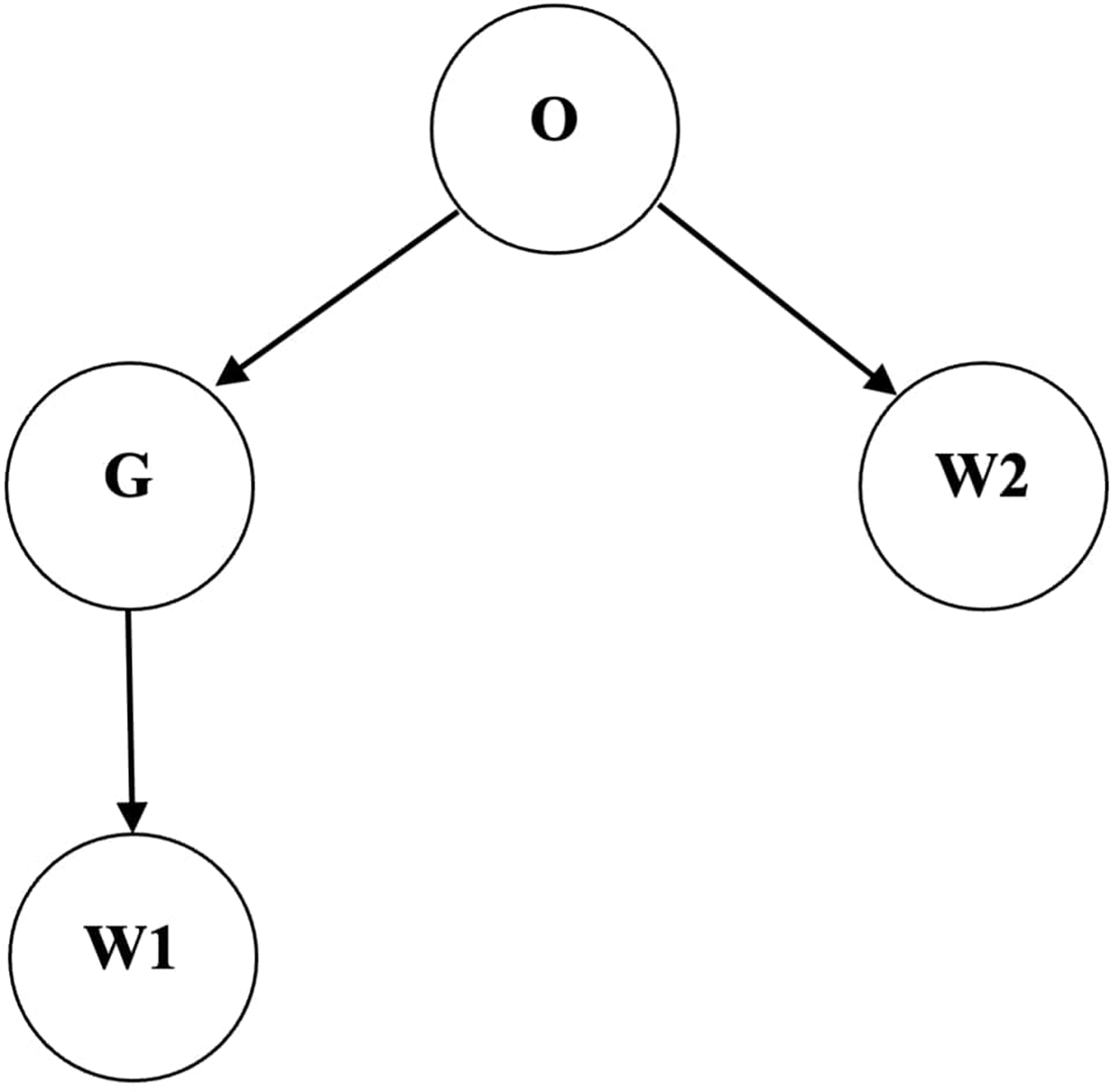
In legal contexts, direct evidence directly speaks to what is at stake in a criminal case. When evaluating whether a defendant is guilty of committing a crime, examples of direct evidence are the defendant’s confession or eyewitness testimony of someone directly observing the crime. By contrast, circumstantial evidence speaks to what is at stake via an intermediate inferential step. Lagnado (Reference Lagnado, Dawid, Twining and Vasilaki2011) and Fenton et al. (Reference Fenton, Neil and Lagnado2013) illustrate the evidentiary contributions of direct and circumstantial evidence through Bayesian networks capturing the structure of legal arguments. Consider the network in figure 1 as an example.
Network for the criminal investigation. G: defendant is guilty. O: defendant was at the scene. W1: testimony first witness. W2: testimony second witness.

The investigation evaluates whether the defendant is guilty of robbing a shop (G). Testimonies of two witnesses (W1, W2) have been obtained. W1 testifies that they saw the defendant threatening violence and obtaining money from the cash register. W2 testifies that they saw the defendant at the shop prior to the crime occurring but then left the place themselves. In the network, each node represents a variable that can take on different values.Footnote 1 The directed edges (arrows) between the nodes represent dependencies between variables. For example, the directed edge between G and W1 represents that W1 probabilistically depends on G. The testimony W1 is more likely to obtain if G is the case. According to Fenton et al. (Reference Fenton, Neil and Lagnado2013, 90), in such a network, “direct evidence involves a single causal link from the issue to be proved to the evidence. If true, this evidence proves the hypothesis in question.”
By contrast, Fenton et al. (Reference Fenton, Neil and Lagnado2013, 91) point out that “circumstantial evidence … is linked to the issue to be proved via a causal path involving at least two steps, for instance, as evidence for motive or opportunity.” According to the network in figure 1, W2 provides circumstantial evidence for G. That is because W2 testifies to the fact that the defendant had the opportunity to rob the shop. After all, they were at the scene. This is represented by variable O. In turn, O obtaining is directly probabilistically relevant to G: The defendant being at the shop makes it more likely (though not certain) that they committed the robbery.
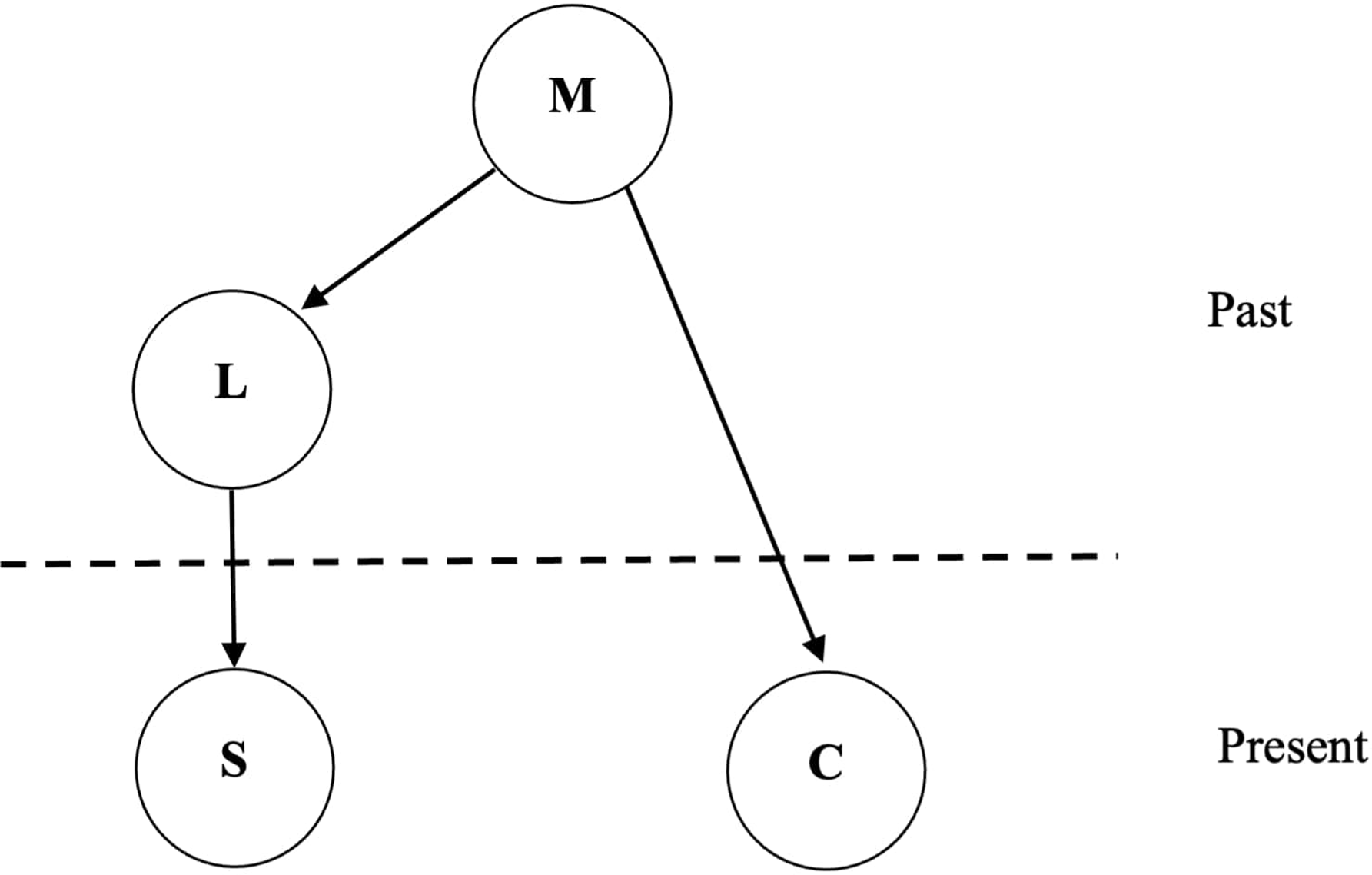
Network for the stromatolite case studies. L: ancient microorganism activity. S: contemporary stromatolite-like structures. M: ancient marine environment. C: contemporary chemical signature.

Neither G nor O is knowable as such; they are hypotheses that must be evaluated in light of the available evidence (Fenton et al. Reference Fenton, Neil and Lagnado2013, 18). While G is the ultimate hypothesis under investigation, O takes on the status of an auxiliary hypothesis that needs to be established for the circumstantial evidence to become relevant to G. This illustrates the additional inferential step needed in cases when legal evidence is circumstantial rather than direct.
4.2. Types of traces
What I propose to call direct traces are the remnants of the past that the causal, informational, and evidentiary understandings of traces are concerned with. Because these views characterize only one type of trace, they do not come with “directness” built in explicitly. In fact, it even seems as if many of the epistemic situations of historical science resist using the term direct in relation to traces. Trace-based reasoning, or so the argument might go, seems anything but direct. However, direct in the present context should not be understood in a physical sense, that is, as two things (events, objects) being close together in space and time. Traces may be spatially close to long-past events, but they are certainly not temporally close.
Rather, in analogy to the legal distinction, direct traces are direct in two senses. The resulting view of direct traces is close to the characterization on the evidentiary view (Currie Reference Currie2018). First, there is a direct causal chain from the historical event in question to the trace. This is less restrictive than Fenton et al.’s (Reference Fenton, Neil and Lagnado2013, 90) condition that there be “a single causal link” to account for the longer length and ramifications of the causal chain when dealing with events in the deep past. The second sense of “directness” concerns the inference from trace to (a feature of) the historical research target. Direct traces directly probabilistically depend on a hypothesis about the historical research target being the case. This is what makes the inference from one to the other a “direct” one. Note, however, that this does not mean that this inference is easy or infallible. As it is most prominently specified in the evidentiary view of traces, such inference requires specific and sometimes hard-to-establish pieces of background theory to be in place.
Let’s look at instances of direct traces in the study of (putative) stromatolites. In both the cases from Australia and Greenland, researchers are concerned with whether the activity of ancient cyanobacteria—our “suspects” so to say—formed discernible sedimentary layers in a certain location. The most important direct traces in these cases were the morphological indicators in the rock record: the peculiar shapes and forms that motivated giving a closer look to the rock formation’s origins. If these are traces of life, they are direct traces. There is a direct causal chain from the past event, the activity of ancient microbes, to a present-day phenomenon, the occurrence of layered and peculiarly shaped columns of rock. Moreover, with the right background knowledge in place, the existence of stromatolite-like structures directly depends on the past activity of microbes. Relevant knowledge in the stromatolite cases concerns, for example, knowledge about contemporary stromatolite-forming microbes.
To explain what I understand by circumstantial traces, let me give a simplified network reconstruction of the factors involved in the stromatolite cases (figure 2).
In this network, the connection between variables S and L corresponds to finding a direct trace of ancient microorganism activity. Variable C represents a piece of evidence that constitutes a circumstantial trace relative to L. Relative to M, however, C is a direct trace. C probabilistically depends on M; M is probabilistically relevant to L: It is more likely that ancient microorganisms were active in a location if (features of) the environmental setting allowed them to thrive, such as in the shallow marine environment evidenced by the particular contemporary geochemistry. Note that in this network, S and C represent empirical evidence, while L and M represent hypotheses about the past. In the case studies, the ultimate hypothesis to be evaluated, the focus of the investigation, concerns L. Then, M is needed to make possible the extra inferential step needed to connect C, the circumstantial trace, to L, the research target in the deep past.
The point just made concerns the epistemic contribution of circumstantial traces. Considering the previous discussion, this might give rise to a couple of additional questions about the nature of circumstantial traces. First, what kind of evidence qualifies as a circumstantial trace? Second, what justifies calling circumstantial traces traces in the first place? Answering these questions requires adding some explicitly causal considerations to the foregoing epistemic considerations. Circumstantial traces are traces of (collections of) events that preceded a particular historical target event and causally contributed to it. In the framework that I am proposing, the connection between past events and circumstantial traces is not a direct causal chain. However, the two are not unrelated; they are part of the same (subset of a) causal network by sharing an earlier common cause. In the network in figure 2, contemporary stromatolite-like structures (S) and contemporary chemical signatures (C) share a common cause in the past. In summary, then, a circumstantial trace must fulfill two conditions:
Present-day phenomenon A is a circumstantial trace of past event B iff …
-
i. A and B share a common cause in the past (causal condition) and
-
ii. A allows an inference to B via an intermediate inferential step (epistemic condition).
Both conditions are needed. The causal condition on its own would let in too much. Every contemporary remnant of a past event shares an earlier common cause with some other remnant somewhere in the deep past. That does not mean, however, that one can actually use these remnants in a historical reconstruction. The solution is the additional epistemic condition. But the epistemic condition on its own would not allow us to distinguish between traces and other types of evidence. The connection in the network for the criminal case also corresponds to causal relations, and with the circumstantial evidence implicating something like motive or opportunity, my causal condition is met. However, requiring that “circumstantial evidence … is linked to the issue to be proved via a causal path involving at least two steps” (Fenton et al. Reference Fenton, Neil and Lagnado2013, 91) allows for different causal links than the one I specified, for example, evidence of postoffense conduct of a defendant.
Circumstantial traces can function both in a positive way, giving further support for a hypothesis about the past, and in a negative way, putting into question such a hypothesis. The former applies to the investigation of the Strelley Pool Chert stromatolites. These sedimentary structures are now widely held by researchers to be the result of early life activity. While investigating the corresponding rock structures, researchers mapped out the geological setting in which the structures were found. They closely analyzed various features of what Allwood et al. (Reference Allwood, Walter, Kamber, Marshall and Burch2006) refer to as the paleoenvironment, among them the contemporary chemical signatures found at the site which I explicitly built into the preceding network (C). These were one of the focal points of the investigation by van Kranendonk et al. (Reference van Kranendonk, Webb and Kamber2003) and also played a role in gaining insights into the past geochemical setting in Allwood and colleagues’ (Reference Allwood, Walter, Kamber, Marshall and Burch2006, Reference Allwood, Walter, Burch and Kamber2007) research. These contemporary signatures are direct traces of an ancient marine environmental setting. In the way they are used in the reconstruction of early forms of life, they are circumstantial traces of ancient microorganism activity. In this case, a hypothesis about the environmental setting (M) serves as an auxiliary hypothesis that allows for connecting ancient microorganism activity to its circumstantial traces.
Note that connecting contemporary chemical signatures (C) to an ancient marine environment (M) is not a trivial task. It depends on pieces of relevant background knowledge that are, for instance, also highlighted by Currie (Reference Currie2018) in the evidentiary understanding of traces. However, connecting features of the ancient environmental setting (M) to the hypothesis about ancient microorganisms (L) is not trivial either. In their investigation of the Pilbara rock structures, Allwood et al. Reference Allwood, Walter, Kamber, Marshall and Burch(2006) considered the environmental setting that contemporary living stromatolites thrive in a nearby locality to foster this link. Hence there is considerable work involved in establishing both whether M could be the case and whether there is a relationship between M and L. In the Pilbara stromatolite case, both these connections were positively established. Because of this, the contributions of S and C point in the same direction: They both indicate the activity of ancient microbes on the Earth in the past. Let’s say that if the contributions of direct and circumstantial traces come together in this way, they are in alignment. If direct and circumstantial traces align, they are both positively relevant for the historical research target in question, even though only one of them is directly causally downstream from the research target. Alignment in this sense is not a passive feature of the evidence but must be actively established and argued for in the course of an investigation in the way just highlighted.
In the Isua Greenstone Belt investigation, it is much less clear whether the direct and circumstantial traces are in alignment in the way just described. The team of researchers supporting the stromatolite interpretation cite, among other things, geological evidence in the surrounding area that is indicative of an ancient marine environment (Nutman et al. Reference Nutman, Bennett, Friend, van Kranendonk and Chivas2016). Let’s unpack this in light of the distinction between direct and circumstantial traces. The further evidence invoked by both Nutman et al. and their critics can be categorized as circumstantial traces. However, in this case, considering the circumstantial traces did not, at least not unequivocally, support the hypothesis put forward by Nutman et al. This is because, to the extent that circumstantial traces in the Greenland case do support particular features of an environmental setting, those are ultimately not positively relevant to establishing a hypothesis about the presence of ancient microbes in the locality. To invoke the comparison to the legal case again, imagine an investigation in which establishing that the defendant had opportunity fails. This could be, for instance, because a witness is giving the defendant an alibi for the time of the crime indicating that the defendant could not actually have been present at the crime scene. In a related way, stromatolite-forming microorganisms are less likely to have been active in the past if they did not have the opportunity either, that is, if a suitable environmental setting was not in place for them to evolve and thrive, as Allwood et al. (Reference Allwood, Rosing, Flannery, Hurowitz and Heirwegh2018) and Zawaski et al. (Reference Zawaski, Kelly, Orlandini, Nichols, Allwood and Mojzsis2020) argue. Note, however, that the stromatolite case is much less clear than providing the alibi in the crime case might be. Again, determining whether direct and circumstantial traces align is not a trivial task, and it will not be self-evident from the given traces.
5. Conclusion
This paper has introduced a distinction between two different types of traces that feature in historical science investigations and that I called direct and circumstantial traces. Circumstantial traces do not limit traces to direct causal descendants of past events—an assumption held by all existing characterizations of traces. This extends our understanding of what philosophers of the historical sciences have called “trace-based reasoning.” Especially in cases when direct traces are hard to come by or ambiguous—such as in the study about investigations of early forms of life—circumstantial traces play a key role. In fact, most historical reconstructions are probably pieced together by drawing on both direct and circumstantial traces, but philosophers of the historical sciences have paid inadequate attention to the contribution of circumstantial traces.
Acknowledgments
I am grateful to Martin Kusch for his thoughtful feedback on multiple earlier drafts of this paper. I also thank kind audiences in Vienna, York, Exeter, and New Orleans for their constructive comments.

 Open access

