




Introduction
Distinguishing language change from stable variation has always been a goal in variationist sociolinguistics. While language change necessitates language variation, the reverse is not necessarily true—variation can remain relatively stable over time. However, there is still a lack of consensus as to what constitutes “stable” variation, especially in variables that may undergo or show extremely slow changes (as in the morphosyntactic domain) and for languages with little diachronic data (Gardiner & Nagy, Reference Gardiner and Nagy2017:78). Furthermore, and despite advancements in the field with respect to the notorious “transition” problem (i.e., what the intermediate stages between two forms at given points in time are), it still remains unclear how to measure and predict language change versus stable variation.
Most studies of linguistic change follow the apparent-time construct by comparing the speech of different age groups with older generations, presumably, representing earlier forms of language, which relies on the relative stability of the society and speech community (Labov, Reference Labov1994:83). But how can we evaluate the relative stability or changes in progress in situations of rapid social change, especially those undergoing transformation due to language revitalization? Using Scottish Gaelic as a showcase, Nance (Reference Nance2022) examined how younger and older generations, who have had varied experiences in language acquisition, schooling, and peer group socialization with the language, could be meaningfully comparable in terms of shared linguistic and social practices.
Our study assesses the extent to which a morphosyntactic feature, the Basque ergative -k marker, is undergoing change or represents stable variation in a situation of rapid social change characterized by language revitalization. We provide an apparent-time analysis by comparing two generations of Basque speakers that represent a significant societal transformation in their experiences acquiring and using the language. We focus on the Basque variety spoken in Gernika (Gernika Basque), where despite “natural transmission” not having been completely interrupted, the educational system has complexified the notion of a speech community in the traditional sense. After its co-officiality with Spanish in 1979 and the Law of Normalization in 1982, Batua (Standard Basque) became the vehicle of instruction in many bilingual and immersion schools, which caused a divide between two generations in terms of their mode of acquisition: although both groups acquired Gernika Basque at home, older speakers grew up with no formal education in Basque, while younger speakers are exposed to bilingual education early on through the Basque immersion bilingual program.
This study addresses recent calls for more diverse sources of data in variationist work (e.g., Stanford, Reference Stanford2016). An important contribution of this study is the understanding of Basque ergative variation as orderly heterogeneity—a variable linguistic feature that, despite having received extensive attention in syntactic theory (Preminger, Reference Preminger2012; Rezac, Albizu, & Etxepare, Reference Rezac, Albizu and Etxepare2014), language acquisition (Austin, Reference Austin2007, Reference Austin2013; Ezeizabarrena, Reference Ezeizabarrena2013; Rodríguez-Ordóñez, Reference Rodríguez-Ordóñez, Grillo, Jopson and LaMendola2015), and language processing (Díaz, Erdocia, de Menezes, Mueller, Sebastián-Gallés, & Laka, Reference Díaz, Erdocia, de Menezes, Mueller, Sebastián-Gallés and Laka2016; Zawiszewski & Laka, Reference Zawiszewski and Laka2020; Zawiszewski, Gutiérrez, Fernández, & Laka, Reference Zawiszewski, Gutiérrez, Fernández and Laka2011), remains understudied from a quantitative sociolinguistic perspective. In this study, we draw from various traditions (formal linguistics, typology, and variationist approaches to subject production) to account for the structured variation of the -k ergative marker in Basque, which we show is constrained by the following linguistic factors: verb type, animacy, person and number of the subject, and phonological context. Overall, our data provide no evidence of loss of the ergative case system in Basque in apparent time. Instead, we find that fewer linguistic factors account for the variation among younger speakers, which we interpret as a form of linguistic fixation in terms of Croft (Reference Croft2000:117–165).
These findings provide competing evidence for the view that minoritized languages, especially those in situations of long-standing contact with a dominant language, are prone to loss of case morphology (Montrul, Reference Montrul2016:58; Trudgill, Reference Trudgill2011:15). The loss of ergative case marking or restructuring of argument-alignment is well-documented, particularly in contexts where the ergative language is the weaker one, such as Dyirbal (Schmidt, Reference Schmidt1985), Chukchi (Kantarovich, Reference Kantarovich2020:120–122), or Hindi (Montrul, Bhatia, Bhatt, & Puri, Reference Montrul, Bhatia, Bhatt and Puri2019). Although Basque is still considered a minoritized language, strong language revitalization efforts have brought a significant change in language acquisition mode. The context of Basque, thus, provides an opportunity to examine the role that change in mode of acquisition may play in the structured variation of ergative systems in minoritized language contact situations. In this study, beyond generation as a proxy of social change (by means of mode of acquisition), we consider language use as a continuous variable to operationalize the relative language dominance of the speakers, alongside gender, a staple factor in assessing linguistic change. Only younger speakers show effects of these social factors, with women showing higher rates of ergative marking alongside speakers with higher rates of use of Basque. We further argue that the differences we find between the two age groups are not a sign of linguistic change per se; rather, they reflect the social changes brought about by language policies that emerged after the law of normalization. Specifically, it is young speakers’ formal education that is stabilizing the existing structured variation and forging new social constraints on Basque ergative marking. Thus, these findings support the view that minoritized languages show “the same sort of orderly heterogeneity frequently observed in large languages” (Nagy, Reference Nagy2017:57) and further contribute to our understanding of the role of social and cultural factors influencing linguistic structure (Coupland, Reference Coupland and Coupland2016; Labov, Reference Labov2001).
The Basque context
Basque is considered a language isolate spoken in the north of Spain and Southwestern France. For most of its history, the relationship between Basque and Romance languages has been that of diglossia until relatively recently; while Latin and later Spanish and French were used for administrative purposes, Basque was usually relegated to the rural peasant and home domain. Franco’s dictatorship in Spain (1939–1975) significantly contributed to the decline of Basque, where the language was forbidden from any public domain. In 1979, Basque became official with Spanish in the Basque Autonomous Community (BAC), and the 1982 Law of Normalization was established as a way to ensure access to the language in all spheres of life. As such, a standard variety of Basque known as Batua (literally “Unified Basque”), which was codified in 1968 under the auspices of Euskaltzaindia (The Royal Basque Academy), was implemented in the education system, which provided a number of bilingual education models depending on the amount of Basque that is included in the program (Zalbide & Cenoz, Reference Zalbide and Cenoz2008).
This societal change marked a generational divide among speakers who acquired Basque through “natural transmission”: a younger generation being educated primarily in Basque contrasted with older speakers who were primarily educated in Spanish but may have obtained Basque literacy later in adulthood. The shift in sociolinguistic profiles raises the question of whether we should be talking about language change or societal change (Coupland, Reference Coupland and Coupland2016; Rodríguez-Ordóñez, Kasstan, & O’Rourke, Reference Rodríguez-Ordóñez, Kasstan and O’Rourke2022). Gondra (Reference Gondra2022) suggested that the social setting of Basque challenges the apparent time model, because although both generations of Basque speakers acquired a regional variety through family transmission, their social experience with the language during their formative years was very different. Hence, there may not be a continuum of shared linguistic norms across generations.
The now growing literature on Basque variation has shown that societal changes have influenced the way traditional varieties are spoken today. For instance, numerous studies have reported strong evidence of change in progress towards standard features, especially at the phonological level (Haddican, Reference Haddican2007). Other work has demonstrated that morphosyntactic features are also showing strong patterns of dialectal leveling (Unamuno, Reference Unamuno2010; Unamuno & Aurrekoetxea, Reference Unamuno and Aurrekoetxea2013). All authors attribute these changes to two important key factors: the changing functional distribution of Basque and Spanish in these territories (Amorrortu, Reference Amorrortu, Gaminde, Goikoetxea and Sarriugarte2003) as well as the obligatory literacy of Standard Basque among the youth (Gondra, Reference Gondra2018; Ormaetxea, Reference Ormaetxea2011).
This study aims to determine whether the ergative -k marker is going through intergenerational change in Basque. To this end, we explore spontaneous data from speakers in Gernika, a traditionally Basque-speaking semi-urban town belonging to the Western variety in BAC’s central part of the Bizkaian province. Historically, this area has constituted the primary focus of the linguistic innovations of many Bizkaian subdialects (Zuazo, Reference Zuazo2014). By the time the metropolitan area of Bilbao became the center of the province in the 16th century, the Bizkaian dialect was already structured based on the innovations that came from the central geographical axis of Durango-Zornotza-Gernika-Bermeo (Figure 1).
Central geographical axis of Durango-Zornotza-Gernika-Bermeo in the Bizkaian dialect of Basque (Zuazo, Reference Zuazo2014:57).

Using the apparent-time model, studies have already shown that Gernika Basque is experiencing linguistic changes, including phonological (Ensunza, Reference Ensunza2016), prosodic (Rodríguez-Ordóñez, Reference Rodríguez-Ordóñez2019), and morphosyntactic (Rodríguez-Ordóñez, Reference Rodríguez-Ordóñez2017, Reference Rodríguez-Ordóñez2021).
Operationalizing Basque ergativity
In this study, we compare the production of the ergative subject case marker -k as either being produced (-k) or omitted (-ø) among younger and older speakers of a traditional Basque-speaking town, belonging to the Western variety of Basque. The ergative -k marker constitutes an optimal sociolinguistic variable, given formal debates surrounding its variation. For instance, under the distributed morphology framework, Arregi and Nevins (Reference Arregi and Nevins2012:37) stated that “the ergative subject -k can surface as absolutive -ø […] in substandard spoken Basque varieties,” suggesting that despite verb assignment, the production of -k in the nominal inflection is highly variable. While Arregi and Nevins (Reference Arregi and Nevins2012) called this variable pattern the Ergative Impoverishment Rule, it is unclear what linguistic and social factors govern this variation and whether it is indeed a sign of linguistic change. In the absence of systematic variationist work on Basque ergativity, or ergativity in general, we draw from formal and acquisition literature as well as typological work to operationalize the variation in natural speech production. We consider the most studied aspects of ergativity variation: verb type, interfaces with phonological context, as well as morphological syncretism and prosody. Drawing from the literature on ergative variation and discourse (Du Bois, Reference Du Bois, Coon, Massam and Travis2017; McGregor, Reference McGregor2010), we include three additional factors in the analysis: animacy, person and number, and the type of noun phrase (NP).
Verb type
Basque is categorized as a morphologically ergative/absolutive language (Dixon, Reference Dixon1994; Ortiz de Urbina, Reference Ortiz de Urbina1989), and like most ergative languages, it shows a subject split pattern, primarily governed by the valency of the verb. Subjects of transitive (1) and unergative verbs (2) are generally marked with the morphological ergative case marker -k, whereas unaccusative subjects (3) tend to be marked with the default absolutive marker (-ø).Footnote 1, Footnote 2 Basque also shows a triple-agreement pattern in that all arguments of the clause tend to be co-referenced in the auxiliary verb through pronominal clitics or agreement markers (Arregi & Nevins, Reference Arregi and Nevins2012:44). For instance, in (1–2),Footnote 3 the ergative subject nik ‘I’ is co-referenced with -t for the transitive and unergative verbs, whereas absolutive subject ni ‘I’ is co-referenced with -n for the unaccusative verb.

The variation in Basque ergativity has been extensively examined in syntactic theory (Preminger, Reference Preminger2012; Rezac et al., Reference Rezac, Albizu and Etxepare2014), historical linguistics (Aldai, Reference Aldai2009), child language acquisition (Austin, Reference Austin2007, Reference Austin2013; Ezeizabarrena & Larrañaga, Reference Ezeizabarrena and Larrañaga1996), and psycholinguistics (Díaz et al., Reference Díaz, Erdocia, de Menezes, Mueller, Sebastián-Gallés and Laka2016; Zawiszewski et al., Reference Zawiszewski, Gutiérrez, Fernández and Laka2011). In particular, the syntactic status of unergative verbs (Bobaljik, Reference Bobaljik1993; Hale & Keyser, Reference Hale and Keyser1993) shows a clear dialectal divide (see Berro & Etxepare, Reference Berro, Etxepare, Coon, Massam and Travis2017; Pineda & Berro, Reference Pineda and Berro2020 for recent discussions). For the purposes of this study, we focus on the Western variety, which would favor the assignment of ergative case marking in unergative verbs, especially among those verbs expressing volitional acts (e.g., dantzatu/dantza egin ‘to dance,’ jolastu ‘to play’), verbs of emission (e.g., dirdiratu ‘to glitter,’ argitu ‘to shine,’ irakitu ‘to boil’), meal-related verbs (e.g., bazkaldu ‘to lunch,’ afaldu ‘to have dinner’), and bodily processes (e.g., zurrungan egin ‘to do snore’) (Berro & Etxepare, Reference Berro, Etxepare, Coon, Massam and Travis2017:19). However, in this variety, there is a restricted number of unaccusative verbs that may also variably take ergative case-marking, such as urten ‘to leave’ (4a-b).

Phonological constraints and syncretism
Basque stops may undergo lenition or deletion under the Stop Deletion Rule, whereby a word-final stop is deleted before any consonant (Hualde, Reference Hualde1991). In some other cases, a final stop may undergo simplification. This naturally applies to ergative -k production, as it is a stop produced in word final position, as in (5). Acquisition work has shown that children are attuned to this rule from early on (Austin, Reference Austin2013), which matches adult production both in adult-child dyads (Ezeizabarrena & Larrañaga, Reference Ezeizabarrena and Larrañaga1996) and spontaneous speech in L2 (Rodríguez-Ordóñez, Reference Rodríguez-Ordóñez, Grillo, Jopson and LaMendola2015, Reference Rodríguez-Ordóñez2022). Subsequent acoustic work has shown that final -k tends to be realized fully voiced prevocalically (Hualde, Beristain, Icardo Isasa, & Zhang, Reference Hualde, Beristain, Icardo Isasa, Zhang, Calhoun, Escudero, Tabain and Warren2019) but reduced as an approximant or deleted in preconsonantal contexts (Hualde, Beristain, Icardo Isasa, & Zhang, Reference Hualde, Beristain, Icardo Isasa and Zhang2021).

The variety under analysis, which falls under the Northern Bizkaian of Western Basque (Hualde, Reference Hualde1991), shows a number of syncretisms between ergative and absolutive case markings, especially in the determiner and demonstrative paradigms (Table 1). This pitch-accent variety makes a distinction between lexically unaccented (e.g., lagune ‘friend,’ etxie ‘house’) and accented words (amúma ‘grandmother’). Lexically unaccented words are assigned an accent on their last syllable (`) but they are assigned a lexical accent (´) when a number of affixes are added, including absolutive plural and ergative plural. This means that absolutive plural (etxíek ‘houses’) and ergative singular cases (etxiék ‘houses’) are distinguished prosodically in this variety. This is not the case with absolutive plural and ergative plural, as they maintain their syncretism at the morphological and prosodic level: they are both pronounced as etxíek ‘the houses.’ This ambiguity is resolved in the verbal morphology, which shows either absolutive plural (6a) or ergative plural (6b).

Ergative/absolutive syncretism

Second person plural pronoun zuek ‘you all’ is also syncretic for absolutive or ergative case (Table 2), but disambiguation may occur in the auxiliary morphology (7a-b).

Ergative/absolutive markings in personal pronouns

Nevertheless, there is a subset of cases in which the abs/erg ambiguity may not be resolved neither phonologically nor morphologically, given that Basque allows pro drop with all arguments of the clause (Ortiz de Urbina, Reference Ortiz de Urbina1989). Example (8) below shows that the only way to disambiguate the syncretism between the abs and erg plural lagúnek “friends” is discursively in context.

Discourse-based factors
We also draw on discourse-based frameworks of variation in ergative languages. For instance, McGregor (Reference McGregor2009:498) showed that the animacy hierarchy accounts for a number of cross-linguistic differences across ergative languages, with languages like Dyrbal or Yaminawa showing ergative marking with those in the right side of the hierarchy (see Figure 2) and more nominative or zero marking with those towards the other side of the continuum, such as first and second person pronouns.
Animacy hierarchy in ergative case marking (McGregor, Reference McGregor2010:1617).

The role that animacy places in Basque ergative production has not been thoroughly examined but there is evidence from event-related potentials that certain third-person animate subjects were processed similarly regardless of case (ergative or zero) among some Basque-Spanish bilinguals (Zawiszewski et al., Reference Zawiszewski, Gutiérrez, Fernández and Laka2011). This finding was understood to be an effect of Spanish influence in that Basque-Spanish bilinguals may process subjecthood through animacy, which would predict higher production of ergativity in non-animate subjects consistent with the animacy hierarchy. The role of subject animacy is intrinsically linked to the role that subjects play in discourse more broadly, given that cross-linguistically, inanimate subjects are far less common (Dahl & Fraurud, Reference Dahl, Fraurud, Fretheim and Gunder1996). According to Du Bois’s (Reference Du Bois1987, Reference Du Bois, Coon, Massam and Travis2017) Preferred Argument Structure framework, arguments expressing new information tend to take non-ergative roles, but the way languages express new information may vary cross-linguistically. For instance, in Sakapultek, a Mayan language spoken in Guatemala, absolutive argument position is mainly restricted to lexical NPs and new mentions, whereas the ergative one is mostly for reduced forms (pronoun, agreement/zero) which have previously been introduced in the discourse (Du Bois, Reference Du Bois, Coon, Massam and Travis2017). In null subject languages like Spanish, it is well established that lexical NPs tend to introduce new information (Torres-Cacoullos & Travis, Reference Torres-Cacoullos and Travis2018), whereas pronouns tend to add pragmatic weight (Davidson, Reference Davidson1996; Dumont, Reference Dumont2016:66). As a null-subject language, Basque also shows a similar effect in expressing overt subject expression (Rodríguez-Ordóñez & Sainzmaza-Lecanda, Reference Rodríguez-Ordóñez and Sainzmaza-Lecanda2018), but it remains to be seen whether these factors are borne out in the production of ergative -k marking in Basque.
Sociolinguistic perception on change
The perceived loss of Basque ergative marking has been a matter of scrutiny in the Basque-speaking population. Figure 3 shows a Facebook post from a teacher expressing their sentiment regarding the low use of ergative marking in the entry exam for university. This is firstly done in the picture by providing the relative frequency of ergative use by stacking exams into two categories: 37 (26.62%) #ergatibozaleak ‘ergative fans’ and 102 (73.35%) #ergatibozidak ‘lack of ergative.’ The meaning of #ergatibozidoa could be further jocularly extended to the morpheme zidak ‘lack of’ from a pragmatic parable of suizida ‘suicide,’ suggesting a change in progress towards the disappearance of the ergative case morpheme. The explanation from the author of the post follows: “#Selektibitatea-n 139 azterketa zuzendu ditut. 102tan (%73,3) hutsen bat dago #ergatiboa-rekin. Beste 37ak Iratiko Boli Dorrean babestuko nituzke betiko.” ‘I have graded 139 exams for the university entry exam. 102 of them (73.3%) show at least one mistake with ergative. The other 37, I would forever protect them in Irati’s Tower of Babel.’ The teacher’s posts make it clear that the variable use of ergative case marking is in fact the norm in these texts, and that the anomaly of using the ergative case morpheme 100% is a miracle that should be placed in this mystical place where language originated (Babel’s Tower). Such metaphor is further reinforced through a comic strip by comic artist Zaldieroa ‘Crazy horse’ that periodically gets published in Berria, the only daily newspaper written in Basque today. Context of the story is presented in the first image, which reads “in the Babel Tower of Irati.” Irati is considered the largest forest in the current territory of the Basque Country and a sacred and mystical place where Basque mythology originated. Within the tower, the priest hands in a black card to Yoda and tells him “Take, Yoda, a black card” and Yoda excitedly responds, “what a privilege!.” The punchline of the comic stems from Yoda’s disappointment when he is ordered “take this card to everybody who forgets the ergative” by the priest. This comic strip may metaphorically reveal the teacher’s desire to act in “saving” Basque ergative marking yet lament and embrace an ideological assumption that language variation is coterminous with language change, as the hashtags #agurergatiboa ‘bye ergative,’ #hizkuntzaldaketa ‘language change’ suggested.
Facebook post (anonymous) regarding Basque ergativity.

Hence, the variation in the production of ergative case marking is often associated with a perceived loss of the feature, but the extent to which this variation is indeed indicative of a change in progress remains to be empirically determined. The present study is guided by the following questions:
(1) Is there evidence of change in the ergative system of Basque?
(2) What linguistic and social factors contribute to the variation in the production of Basque ergative case marking across groups?
(3) What explains the differences in the conditioning of Basque ergative marking?
Methodology
Participants
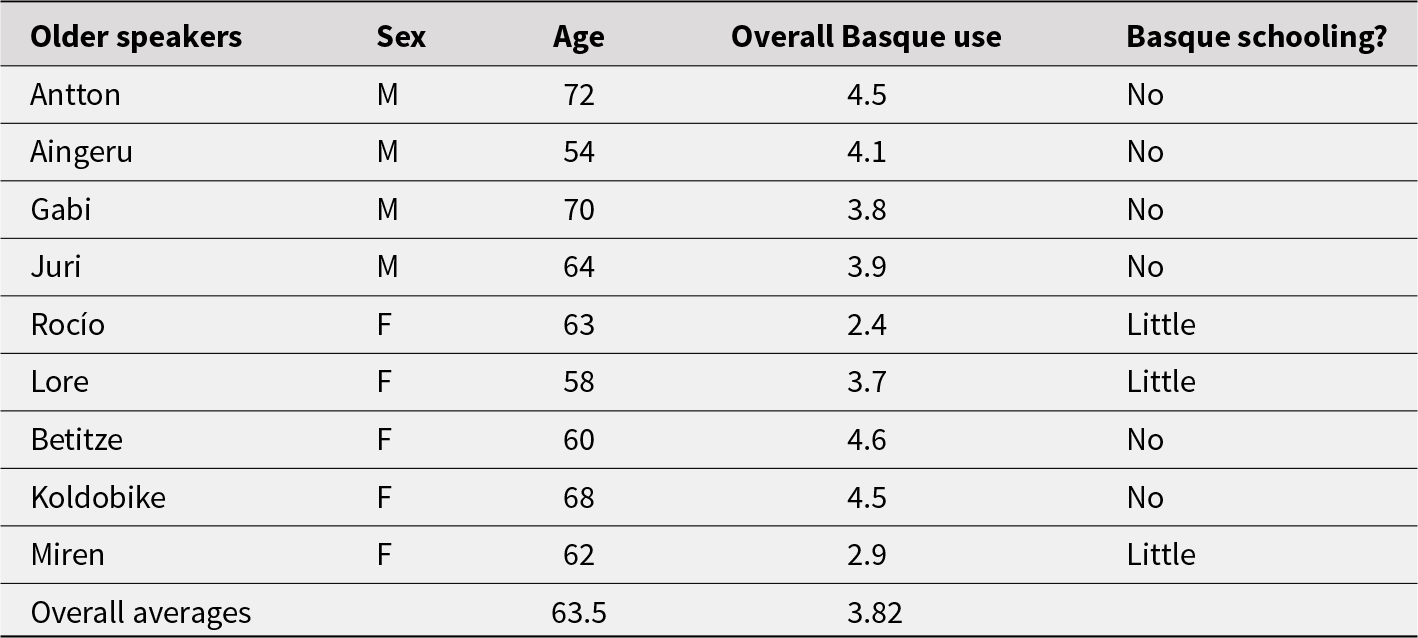
All participants (n = 23) were born and raised in Gernika, a semi urban town in the Bizkaian province of BAC in Spain with 16,972 inhabitants (National Institute of Statistics, 2018). For our purposes, speakers were divided into two age groups, which correspond to the generational change described earlier: Speakers from the older generation (ages 54–70; M = 63.5) received schooling only in Spanish when they were growing up (but four of them reported to have studied Standard Basque for at least 2 years [see Tables A1–A2 in Appendix]). In contrast, all the young speakers (ages 19–45; M = 28.2) received formal instruction both in Standard Basque and Spanish through the immersion program. Census data support this generational divide in Gernika: in 1982, it was estimated that only 30% of the children received formal education in Basque, whereas it is estimated that 100% of children are instructed entirely in Basque today (Gernikako Udala, 2017). The overall knowledge of Basque in town has also increased in the last decade (65% in 1986 versus 87.5% in 2012) (EUSTAT, 2013).
In this study, the overall use of Basque was used as a continuous variable. Participants responded to a sociolinguistic background questionnaire where they were asked to rate their use of their languages (Basque and Spanish) in different social contexts (e.g., family, friends, school, work, partner, children, etc.) on a scale from 1 to 5 (1 = uses Spanish only, 5 = uses Basque only). For each participant, an overall score representing the use of Basque was calculated and was compared to the group mean, which shows comparable means of overall Basque use (younger M = 3.84; older M = 3.82).
Data and coding
The spontaneous speech data for this study come from the Basque Romance corpus (Rodríguez-Ordóñez, Reference Rodríguez-Ordóñez2016) where speakers were recorded in the local variety discussing the economic crisis at the time, changes in their lives, and future plans for the summer. The compiled data were transcribed through ELAN (Sloetjes & Wittenburg, Reference Sloetjes and Wittenburg2008), where all overt subjects were coded for the presence or absence of the -k ergative case marker. The ergative case marker’s presence (-k) or absence (-ø) in nominal morphology was coded auditorily, but given the high incidence of lenition and low salience in certain contexts (Hualde et al., Reference Hualde, Beristain, Icardo Isasa, Zhang, Calhoun, Escudero, Tabain and Warren2019), a visual spectrogram analysis was conducted in Praat. Obvious instances of k-realization were coded impressionistically, as in Figure 4a, which shows a clear stop and release of [k]. Potentially weakened (but nonetheless phonetically realized) tokens were identified based on acoustic cues by locating F2 movement of the previous vowel and tracking of F0, cues that would demarcate raising of the velum and voicing of -k, respectively. Lenited cases, as in Figure 4b, counted towards production, whereas lack of accusation cues (Figure 4c) counted towards omission.
(a) Ergative as [k]; caro, nik entzuten dot ‘right, I hear it’ (Maria_female_21). (b) Ergative as lenition [ϒ]; umiek zortzi urte dekoz ‘the child is 8’ (Eneritz_female_42). (c) Ergative as zero; da zu ze eingozu ‘and what are you going to do’ (Joaquin_male_61).

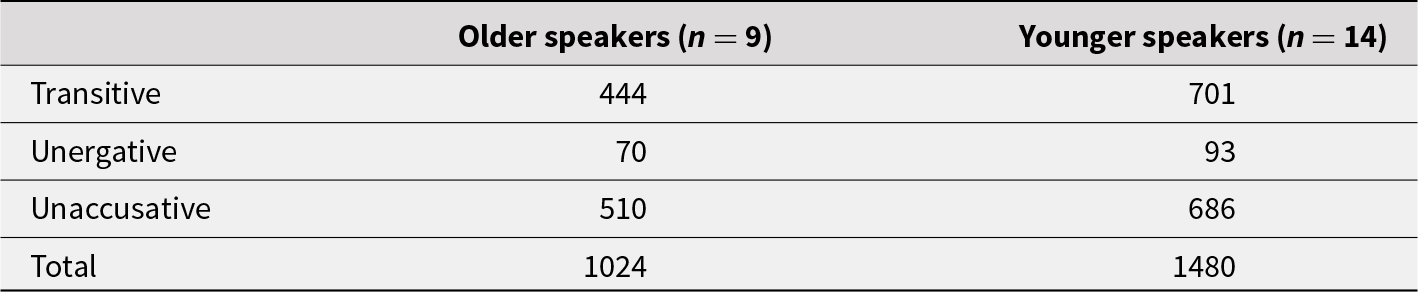
Due to the high incidence of null subjects in adult speech of Basque (∼85% of subjects) (Rodríguez-Ordóñez & Sainzmaza-Lecanda, Reference Rodríguez-Ordóñez and Sainzmaza-Lecanda2018), an average of 60 overt subject tokens per participant were considered, which yielded a total of 2504 tokens for analysis (Table 3).
Distribution of subject tokens for analysis
Coding procedures included considering a number of syncretic forms. As shown in examples (6a-b), absolutive plural (etxíek ‘the houses’) and ergative singular (etxìk ‘the house’) NPs are morphologically syncretic but phonologically discernible through intonation. In this case, we checked the pitch contour in Praat. Although absolutive and ergative plural cases are syncretic morphologically (etxíek ‘houses’), we checked the auxiliary morphology to determine whether the NP was produced marking ergative or absolutive. We excluded tokens with third-person plural syncretisms that were impossible to be disambiguated in pro-drop contexts (e.g., bai itxitzen dabe txakurrek could be interpreted as ‘[they] do allow dogs’ or ‘dogs leave [it]’).
Table 4 shows the social predictors considered in this study; age and sex have been shown to be connected to aspects of linguistic variation in the production of Basque ergative case (Rodríguez-Ordóñez, Reference Rodríguez-Ordóñez2022). Language use was measured as a continuous predictor (from 1 to 5). Table 5 shows the linguistic predictors and the cross-tabulation of factors. Following the Stop Deletion Rule, the following sound was also included as a predictor because stop deletion is more likely preconsonantally (Hualde, Reference Hualde1991) but lenited pre-vocalically (Hualde et al., Reference Hualde, Beristain, Icardo Isasa, Zhang, Calhoun, Escudero, Tabain and Warren2019). Animacy, person, and number were coded into six levels, where, according to the animacy hierarchy, we would expect more ergative production in non-animate subjects (McGregor, Reference McGregor2009). Finally, to determine the role of new information, we considered the subject type, with lexical NPs and proper names being less likely to show ergative marking (Du Bois, Reference Du Bois, Coon, Massam and Travis2017).
Summary of social predictors

Cross-tabulation

Statistical analysis
A mixed-effects logistic regression considering case marking as the dependent variable and all social (age, gender, and language use) and linguistic factors (verb type, grammatical person, NP type, and phonological context) as fixed factors was performed using the lme4 package (Bates, Maechler, Bolker, & Walker, Reference Bates, Maechler, Bolker and Walker2015) in R (version 4.1.2, R Core Team, 2021). Speaker and verb lexemes were set as random effects. Interactions between these independent variables were also considered in the analysis. In identifying the best fitted model, all nested models were compared using the ANOVA function and the most reliable model was chosen based on lowest AIC values. Post hoc analyses were conducted using the lsmeans() function and the models showed no collinearity effects between factors. The same statistical analysis was performed for each age group to determine whether the grammatical system of Basque ergative case marking is affected by the same linguistic factors (cf. Walker, Reference Walker, Podesva and Sharma2014:451).
Results
Results indicate that older speakers omit the ergative -k marker more often than younger speakers (Figure 5); the best fitted model shows that older speakers are less likely to produce ergative subjects with transitive verbs (77%) in comparison to younger speakers (86.9%), a difference that was statistically significant (β = −1.25, z = −3.23, p = .02).
Production of Basque ergative case morpheme according to type of verb (each dot representing individual means).

Older speakers
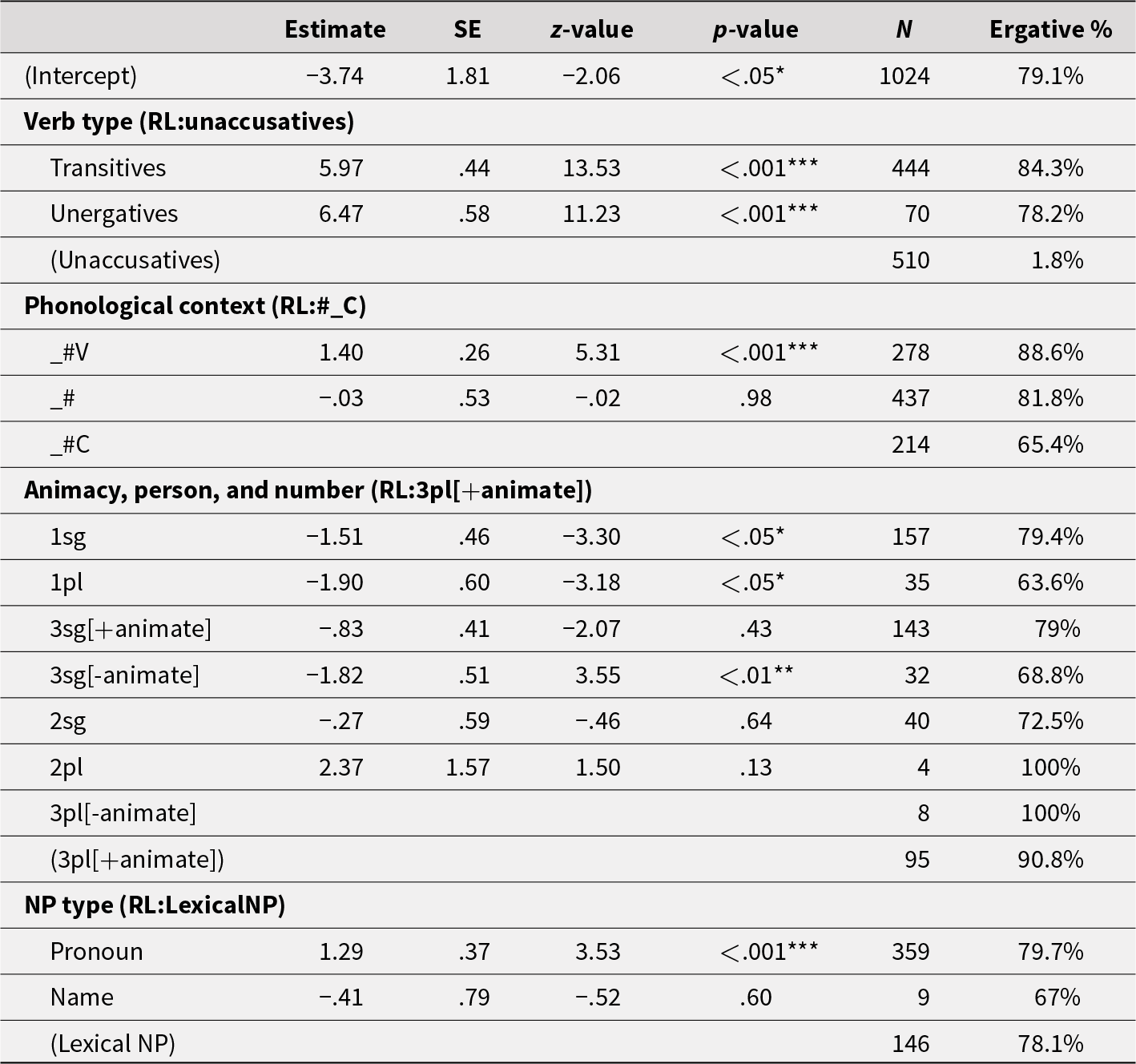
Table 6 shows the best-fitted model for old speakers’ production of Basque ergative case, with positive beta estimates indicating that a factor favors the use of the ergative -k marker in relation to the reference level, indicated in parenthesis. Ergative -k marking is strongly affected by verb type, whereby both transitive and unergative subjects favor ergative marking. Also important is phonological context, with prevocalic contexts favoring Basque -k (88.6%) and preconsonantal positions disfavoring it (65.4%). This finding suggests that old Basque speakers are also attuned to the stop deletion rule in Basque (Hualde, Reference Hualde1991; Hualde et al., Reference Hualde, Beristain, Icardo Isasa, Zhang, Calhoun, Escudero, Tabain and Warren2019) and are also consistent with previous findings that the ergative -k marker is omitted in preconsonantal position in adult spontaneous production (Rodríguez-Ordóñez, Reference Rodríguez-Ordóñez, Grillo, Jopson and LaMendola2015, Reference Rodríguez-Ordóñez2022). Regarding person, animacy, and NP type, results indicate that first- and third-person subjects disfavor the -k marker, especially if the latter are inanimate subjects. Social factors were found not to have an effect among older speakers.
Final regression model of older Gernika speakers (n = 1024) (* = p < 0.05; ** = p < 0.01; *** = p < 0.001)
Younger speakers
Table 7 shows the best-fitted model for younger speakers’ production of Basque ergative case. Similar to the older speakers, verb type is the main factor in the production of Basque ergative case, with transitive and unergative subjects favoring it, whereas unaccusative subjects disfavor it. Regarding phonological context, prevocalic contexts favor the production of Basque ergative morpheme (91.7%), in comparison to preconsonantal (78.9%) and sentence final positions (87%). This latter comparison was not statistically significant (β = −.58, z = −1.52, p = .28), suggesting that young Basque speakers are also attuned to the stop deletion rule in Basque (Hualde, Reference Hualde1991; Hualde et al., Reference Hualde, Beristain, Icardo Isasa, Zhang, Calhoun, Escudero, Tabain and Warren2019, Reference Hualde, Beristain, Icardo Isasa and Zhang2021). Similar to the older group, first- and third-person singular subjects disfavored ergative marking among the youth. Unlike the older group, however, there was no animacy effect. Although there was no interaction between animacy, person, and NP type, results also indicate that pronouns, in general, favor the use of ergative -k. Regarding social factors, the most important predictor was language use, with those speakers who reported speaking more Basque more likely to use the ergative marker more. This effect was accompanied by a gender effect, whereby women also produced higher rates of the Basque ergative morpheme.
Final regression model of younger Gernika speakers (n = 1480) (* = p < 0.05; ** = p < 0.01; *** = p < 0.001)

Discussion
In assessing a potential change in progress of the Basque ergative -k marker under conditions of social change through revitalization, our data find no support for linguistic change, at least not in the form of case loss, as popularly believed. Instead, there is an overall increase in the use of the ergative marker, especially with transitive subjects (younger speakers = 91.7%; older speakers = 84.3%). Despite linguistic stability, results indicate that the linguistic and social factors governing the structured variation of older and younger speakers in Gernika are not the same. Specifically, while older speakers’ use of the ergative case marker shows no effects of social factors, language use and gender become significant predictors among younger speakers. We explain these results as a reflection of societal rather than linguistic change.
Linguistic stability despite differences in constraints
Our findings are consistent with Croft’s (Reference Croft2000:117–165) final stage of language change, namely fixation, which refers to the community-wide adoption of a feature. In cases of stable variables, we tend to witness relatively unchanged patterns of structured variation in that the internal conditionings of variation remain relatively the same. While we see an overall stability in the highest ranked factors (e.g., verb type, phonological context), we argue that despite the variation in the ergative -k marker not being identical across the two age groups, this is the result of societal changes and does not reflect linguistic change per se.
Three important similarities are shared across the two age groups. First, transitive and unergative subjects favor ergative case marking whereas unaccusative subjects strongly disfavor them. Secondly, both groups showed a phonological effect whereby ergative -k is more likely to be produced in prevocalic contexts. This finding is consistent with the Stop Deletion Rule in Basque (Hualde, Reference Hualde1991) and reported in production studies (Austin, Reference Austin2013; Ezeizabarrena & Larrañaga, Reference Ezeizabarrena and Larrañaga1996; Rodríguez-Ordóñez, Reference Rodríguez-Ordóñez, Grillo, Jopson and LaMendola2015, Reference Rodríguez-Ordóñez2022). Third, whereas personal pronouns showed a general trend in favoring ergative case marking, first- and third-person subjects also showed a disfavoring effect. In order to understand these effects, it is important to go back to the literature on subject pronoun expression (SPE) and subjecthood in ergative languages.
An important difference in our data pertains to the animacy effect found in older speakers but absent among younger ones. Specifically, older speakers disfavor ergative marking with 3sg [-animate] subjects. Discourse based accounts have shown that variation in the use of ergative morphemes is driven by the role that subjects have in discourse (Dixon, Reference Dixon1994; McGregor, Reference McGregor2010:1611). The role of animacy in ergative grammars has been largely examined through Silverstein’s (Reference Silverstein, Dixon and Robert1976) animacy hierarchy, which suggests that there are hierarchical implications as to which kind of subjects are more likely to be marked with ergative depending on the cutoff. Building on this idea, Du Bois’s (Reference Du Bois1987, Reference Du Bois, Coon, Massam and Travis2017) Preferred Argument Structure framework claims that arguments expressing new information are more likely to take non-ergative roles. This is consistent with a variationist typology (Torres-Cacoullos & Travis, Reference Torres-Cacoullos and Travis2019), which makes cross-linguistic comparisons of shared probabilistic constraints on the realization of subjects in discourse. Cross-linguistically, lexical NPs and certain third-person personal pronouns (bakoitza ‘each’) are more likely to be obligatory because they may introduce the subject or contain more lexical weight and have a unique referent. Similar findings have been found for Spanish (Otheguy, Zentella, & Livert, Reference Otheguy, Zentella and Livert2007) and Basque (Rodríguez-Ordóñez & Sainzmaza-Lecanda, Reference Rodríguez-Ordóñez and Sainzmaza-Lecanda2018). Our data partially support this finding because first-person and third-person subjects, which are the ones that show higher rates of overt production, are less likely to be produced with the ergative case marker by both groups. This begs the question of whether the obligatoriness of subjecthood, that is, when the subject is in a non-variable context, influences ergative marking. In other words, do subjects that are obligatory in discourse show higher rates of ergative case morpheme? To this end, we re-coded first- and third-person animate singular subjects depending on whether they are obligatory or appear in a variable context. Additionally, pronouns such as bera ‘s/he’ can have a wider scope of referents in the discourse, and they are more likely to be variable. In our data, older speakers produced less ergative -k with third-person singular subjects in obligatory contexts (75%) than in non-obligatory ones (88.2%), but this difference was not found among younger speakers. This suggests that the role that subjects take in discourse may play a bigger role in the production of ergative -k than previously thought, at least for some speakers.
Social constraints
Language use showed a statistically significant effect among the younger group, but not the older one, suggesting that younger speakers who report to use more Basque showed statistically higher rates of the ergative case marker, but the same was not true for older speakers. The effects of language use in bilingual populations are not a novel finding but this factor tends to be operationalized either in terms of home language, peer language, or social networks—not in correlation with another factor. More important is the fact that variationist work on minoritized language contexts has shown that these effects are often collinear with one another. For instance, Mayr, Morris, Mennen, and Williams (Reference Mayr, Morris, Mennen and Williams2017) showed that home language has no bearing on the realization of Welsh and English vowels, but Morris (Reference Morris2022) demonstrated that home language, when highly correlated with the peer group, influenced rhotics and fundamental frequency range, though not /l/ darkening (see Morris, Reference Morris2017). Nance (Reference Nance2020) showed that home language differences in Scottish Gaelic and English-speaking pupils dissipated by the end of elementary school, which contributed to the stabilization of a Gaelic Medium Education variety. Similarly, Rodríguez-Ordóñez (Reference Rodríguez-Ordóñez2019) showed that Gernika Basque young speakers who spoke Spanish both at home and with peers were deviating the most from the local pitch accent system. More recently, studies on Spanish in the U.S. have provided a more nuanced understanding of factors related to age by considering traditionally categorical factors as continuous (e.g., percent of life spent in the US) in evaluations of change. For instance, some Spanish speakers in Boston show that higher life percentage in the US is correlated with changes in their use of variables such as /s/ aspiration, SPE (yo como versus Ø como ‘I eat’) or placement (yo como versus como yo ‘I eat’) (Fleming, Reference Fleming2021). However, these are not representative of communitywide changes (Erker, Reference Erker2017). Our data support this overall trend in that a continuous variable such as language use plays a role in a subset of the community (i.e., younger speakers), but this is not indicative of linguistic change at the wider community scale.
Similarly, gender effects were only among the younger speaker group, with younger women showing higher use of the ergative case marker. For stable variables, women tend to show higher rates of prestige variants than men (Labov, Reference Labov2001), but evidence of women leading change (change from below) has also been reported in Basque (Ensunza, Reference Ensunza2016; García-Palomino, Reference García-Palomino2021). In other minoritized contexts, we see that younger speakers do not replicate gender norms (Nance, Reference Nance2015; Sharma, Reference Sharma2011), and that gender effects tend to interact with other social variables more broadly (Morris, Reference Morris2017, Reference Morris2022). In our data, we argue that the gender differences in the younger group are not necessarily indexing gendered practices of Basqueness (Echeverria, Reference Echeverria2003) but instead are the result of social changes in the BAC. The inclusion of Standard Basque in the education system after 1982 has resulted in a more varied sociolinguistic context, and consequently also, in terms of how variation is viewed. For instance, Rodríguez-Ordóñez (Reference Rodríguez-Ordóñez2013) used a matched guise to show that older speakers and younger speakers of Gernika Basque respond differently towards contact-induced features that have long been part of the vernacular norm. Evidence of this awareness is seen in some forms of dialectal leveling across different varieties (Haddican, Reference Haddican2007; Unamuno & Aurrekoetxea, Reference Unamuno and Aurrekoetxea2013) in favor of the standard variant in some cases. Thus, the institutionalization of Basque has possibly resulted in a higher awareness of prescriptive norms, which consequently tend to show more marked gender-based differentiation (Cheshire, Reference Cheshire, Chambers, Trudgill and Schilling-Estes2002:427). This is consistent with Eckert’s (Reference Eckert1989) observation that already in high school, most girls and boys are aware that they need to follow very different routes to achieve power and status, and such differences may play out linguistically. While all of our speakers are now out of high school, the two groups differ in a fundamental aspect, namely, their access to formal education in Basque. In short, given the intersectionality between gender and prescriptivism in variationism, it is reasonable to suggest that formal education effects are being linguistically played out for younger speakers’ marking of ergative case.
The production of Basque ergative -k marker shows stable variation, despite the internal constraints between the different age groups not being identical. So, what has changed? We argue that formal education in Basque is helping stabilize existing variation in Basque ergative marking, and the effects of gender and language use may reflect attitudinal change and not ergative marking loss. Changes in mode of acquisition have shown to have effects in the variation of traditional Basque-speaking communities and the town under study. For instance, Ensunza (Reference Ensunza2016) showed that peer groups in bilingual schools predicted young Gernika speakers’ participation in sound changes. Rodríguez-Ordóñez (Reference Rodríguez-Ordóñez2019) showed that Standard Basque instruction plus peer group predicted changes in the pitch accent system. The role of formal education across generations has rarely been examined in Basque studies directly. Against this backdrop is Gondra (Reference Gondra2022), who argued that younger speakers recovered the stabilization of a syntactic variable (e.g., word order for a narrow focus interpretation with unergative and unaccusative verbs) through the Basque immersion program, a structure that was presumably lost among the previous generation. Thus, the changing sociolinguistic circumstances, such as formal education, appear to impact the course of linguistic variation and change, showing that differences across generations of speakers at a given point in time do not always mirror actual diachronic change (Mougeon, Nadasdi, & Rehner, Reference Mougeon, Nadasdi and Rehner2005).
Conclusions
Our study opens several venues for further inquiry into the analysis of Basque ergativity, morphosyntactic change, and language revitalization more broadly. As a reviewer suggested, future work could also examine the consequences of variable ergative -k marking on word order, especially given that recent findings show that inverse correlations (trade-offs) are indeed mediated by social factors (Levshina, Reference Levshina2021). Furthermore, speakers’ metapragmatic commentaries should not remain uncharted, as they may reflect social awareness, at least at the individual level. Exploring the indexical associations of the ergative -k marker, and whether these meanings are different across age groups, would address recent calls for modeling linguistic changes alongside changes in social meaning (Hall-Lew, Moore, & Podesva, Reference Hall-Lew, Moore, Podesva, Hall-Lew, Moore and Podesva2021:18), but also further our understanding of how the two are mutually constitutive in situations of social transformation such as in communities undergoing language revitalization. Finally, the role of changes in mode of language acquisition also warrants further research in other varied Basque-speaking communities (i.e., some French-speaking territories of the Basque Country where language shift is more advanced have experienced an increase in Basque immersion programs). A comparative analysis will allow us to determine the role of mode of language acquisition in linguistic stabilization.
In sum, we examined the variation of the ergative -k marker in two age groups that represent the social changes brought by Basque language revitalization, and contrary to popular belief, we show evidence of linguistic stabilization. We argued that the differences in the social constraints that favor Basque ergative marking are the result of social changes, and not linguistic ones. Importantly, we concluded that formal education in Basque is possibly stabilizing this variation, and therefore, differences across generations of speakers at a given point in time do not always mirror actual diachronic change. We believe that it is precisely the changing social aspects of societies undergoing language revitalization that is key to distinguishing social from linguistic change, as well as between language change and linguistic stabilization.
Appendix
Older speakers
Younger speakers


 Open access

