





Introduction
Code-switching, or the use of two languages within a single coherent utterance, is a hallmark of bilingual language use. It also sheds light on the workings of the bilingual language system, providing an indication of how bilinguals manage the integration and separation of their two languages.
A central finding from both corpus-based (e.g., Deuchar, Reference Deuchar2005; Eppler, Reference Eppler1999; Lantto, Reference Lantto2012; Lipski, Reference Lipski and Paradis1978; Pfaff, Reference Pfaff1979; Poplack, Reference Poplack1980; Poplack & Meechan, Reference Poplack, Meechan, Milroy and Muysken1995) and experimental research (e.g., Kootstra, van Hell & Dijkstra, Reference Kootstra, van Hell and Dijkstra2010) is that code-switches tend to occur at sentence positions that are structurally equivalent across the bilingual's two languages (Poplack's Reference Poplack1980 “equivalence constraint”). Both structural and processing-based explanations for this finding have been offered. From the structural perspective, switching at structurally equivalent positions ensures that the code-switched utterance has a word order that is permissible in both of the languages involved. For example, since English transitive sentences employ subject–verb–object (SVO) word order rather than subject–object–verb (SOV) word order, the insertion of an English verb in an otherwise SOV utterance (e.g., Afrikaans, Die seun wys naar ‘n prentjie waarop die man die blom KISSES, ‘The boy points to a picture in which the man the flower kisses’) yields a result that deviates from English surface structure (Myers-Scotton, Reference Myers-Scotton2002; Sankoff & Poplack, Reference Sankoff and Poplack1981). A processing-based explanation for the same observation rests on the assumption that code-switching should be most likely at points in the discourse where cross-language activation is high. At the syntactic level of processing, this would be at points of structural overlap (Kootstra et al., Reference Kootstra, van Hell and Dijkstra2010).
The word order constraint on code-switching is a language-internal factor that shapes bilingual language production. Research has also identified language-external factors that influence this process. One is (immediately) prior linguistic context: specifically, code-switching in production is susceptible to structural priming, such that individuals tend to reuse the sentence structure of a code-switched utterance they have just heard and/or code-switch at the same sentence position used in the preceding sentence (e.g., Fricke & Kootstra, Reference Fricke and Kootstra2016; Kootstra et al., Reference Kootstra, van Hell and Dijkstra2010, Reference Kootstra, van Hell and Dijkstra2012). For example, Kootstra et al. (Reference Kootstra, van Hell and Dijkstra2010) showed that, all other things being equal, a speaker who hears an SVO code-switched picture description (where SVO is cued by use of the subjunction want ‘because’, e.g., Een grappig plaatje want het meisje CHASES THE HORSE ‘A funny picture, because the girl chases the horse’) and must subsequently produce their own description of a picture depicting a simple transitive event is more likely to use SVO word order than SOV word order compared to when they hear an SOV description of the same image (where SOV is cued by the subjunction waarop ‘in which’, e.g., Een grappig plaatje waarop het meisje THE HORSE CHASES ‘A funny picture in which the girl chases the horse’). Similarly, if the speaker hears a code-switched utterance in which the switch occurs mid-description (as in the examples above), they are more likely to also produce a mid-description switch compared to when they hear an utterance in which the switch occurs before the picture description (pre-description switch, e.g., Een grappig plaatje want THE GIRL CHASES THE HORSE ‘A funny picture, because the girl chases the horse’).
The preference for using a shared word order when code-switching interacts with the efficacy of code-switching priming. Again in Kootstra et al. (Reference Kootstra, van Hell and Dijkstra2010), speakers were less likely to align their code-switched utterance (i.e., the target) with the utterance they had just heard (i.e., the prime) when the prime employed a word order not shared across Dutch and English (i.e., SOV or VSO). However, open questions remain regarding the nature of this interaction between word order and priming. One such question is whether lexical repetition across the prime and target – a factor known to boost priming effects in both monolingual and bilingual production (Mahowald, James, Futrell & Gibson, Reference Mahowald, James, Futrell and Gibson2016) – can facilitate the priming of code-switched utterances across non-shared word orders, such that participants would produce more code-switched non-shared-word-order utterances following a code-switched non-shared-word-order prime when there is lexical overlap between prime and target compared to when there is no lexical overlap. The current study addresses this question. To do so, we implement a structural priming paradigm that draws on the methods of two prior code-switching priming studies (Kootstra et al., Reference Kootstra, van Hell and Dijkstra2010, Reference Kootstra, van Hell and Dijkstra2012). Our participants are a group of Afrikaans–English bilinguals (n = 46). While patterns of code-switching between Afrikaans and English have been described in the literature (e.g., Van Dulm, Reference Van Dulm2007; Van Gass, Reference Van Gass2008), Afrikaans–English code-switching has not yet been investigated from a psycholinguistic perspective. Further, use of this language pair positions our study as an interesting counterpart to Kootstra et al.'s (Reference Kootstra, van Hell and Dijkstra2010, Reference Kootstra, van Hell and Dijkstra2012) examinations of Dutch–English code-switching: although Dutch and Afrikaans are structurally very similar, code-switching may be more prevalent in the societally multilingual South African setting than in the Netherlands, which might affect participants’ code-switching processing (see e.g., Beatty-Martínez & Dussias, Reference Beatty-Martínez and Dussias2017).
Word order constraints in code-switching
The role of word order equivalence in code-switching production was first identified in corpus studies (e.g., Deuchar, Reference Deuchar2005; Eppler, Reference Eppler1999; Lipski, Reference Lipski and Paradis1978; Pfaff, Reference Pfaff1979; Poplack, Reference Poplack1980; Poplack & Meechan, Reference Poplack, Meechan, Milroy and Muysken1995). One of the most influential of these is Poplack (Reference Poplack1980), who examined mixed-language discourse among 20 Spanish–English bilinguals in New York. Here, less than 1% of the switches recorded occurred at points where the word order of the two languages differed. Poplack (Reference Poplack1980) explained this pattern based on what she termed the “equivalence constraint”, which states that code-switching “tends to occur at points in discourse where juxtaposition of L[anguage]1 and L[anguage]2 elements does not violate a surface syntactic rule of either language” (Poplack, Reference Poplack1980, p. 581).
The equivalence constraint also follows from another syntactic account of code-switching – namely, Myers-Scotton's (Reference Myers-Scotton2002) matrix language framework. According to this account, elements that convey morphosyntactic information in a mixed-language utterance should all be drawn from a single language, the so-called “matrix language”. Further, the word order of the entire utterance should align grammatically with that of the matrix language. As such, use of a word order that is shared between a bilingual's two languages should allow for free switching between the languages, since the resulting utterance's word order will necessarily be permissible in both languages. When word order is not shared, however, switching is expected to be constrained. With reference to the example given in the previous section, the utterance Die seun wys na ‘n prentjie waarop die man die blom KISSES ‘The boy points to a picture in which the man the flower kisses’ has an English finite verb – a carrier of morphosyntactic information – embedded in an Afrikaans SOV word order. An utterance of this type should be rare in comparison to, for example, The boy points to a picture in which the man SOEN the flower ‘The boy points to a picture in which the man kisses the flower’, where the SVO word order is permissible in both English and Afrikaans.
An alternative perspective on the tendency for code-switches to occur in shared-word-order utterances centres on cross-language activation. It is well established that the bilingual brain seldom switches off either of its two languages completely: even in an entirely monolingual context, when the brain is processing input in one language, elements of the other language are also activated (Berghoff, McLoughlin & Bylund, Reference Berghoff, McLoughlin and Bylund2021; Duyck, van Assche, Drieghe & Hartsuiker, Reference Duyck, van Assche, Drieghe and Hartsuiker2007; Kroll, Bobb & Wodniecka, Reference Kroll, Bobb and Wodniecka2006; Spivey & Marian, Reference Spivey and Marian1999; Thierry & Wu, Reference Thierry and Wu2007; van Hell & Dijkstra, Reference van Hell and Dijkstra2002). Assuming that heightened activation facilitates accessibility, switching from one language to the other should be easiest when cross-language activation is highest.
Cross-language activation, in turn, is assumed to peak when word order is shared across the two languages. This can be explained with reference to processing models (e.g., Hartsuiker, Pickering & Veltkamp, Reference Hartsuiker, Pickering and Veltkamp2004; Green & Wei, Reference Green and Wei2013) in which abstract syntactic representations are tagged for language membership, with constructions that are shared across the bilingual's two languages sharing a single representation. Assuming that the different levels of the processing system – phonetic, lexical, syntactic, and so forth – interact (e.g., Pickering & Garrod, Reference Pickering and Garrod2004; Kootstra, van Hell & Dijkstra, Reference Kootstra, van Hell, Dijkstra, Isurin, Winford and de Bot2009), increased activation at the syntactic level should resonate to the other levels of the processing system, increasing the accessibility of items from both languages and allowing them to be more easily integrated into the emerging utterance (Kootstra et al., Reference Kootstra, van Hell and Dijkstra2010). As such, code-switches should be more likely when an utterance uses a word order that is shared across the bilingual's two languages. Relatedly, switch costs should be reduced in shared-word-order compared to non-shared-word-order utterances; a proposal that is supported by, for example, Declerck and Philipp (Reference Declerck and Philipp2015).
A further structural constraint on code-switching that has been proposed relates to switch positions: specifically, it has been argued that switches between a verb and its object should be more difficult than switches between subject and verb (see e.g., Belazi, Rubin & Toribio, 1994; Di Sciullo, Muysken & Singh, Reference Di Sciullo, Muysken and Singh1986, who ground their argument in the notion of government; Joshi, Reference Joshi, Dowty, Kattunen and Zwicky1985 and Poplack, Reference Poplack1980 offer alternative accounts). While this argument has not been borne out in studies of noun phrase production (e.g., Parafita Couto & Stadthagen-Gonzalez, Reference Parafita Couto and Stadthagen-Gonzalez2019; Parafita Couto & Gullberg, Reference Parafita Couto and Gullberg2019; Torres Cacoullos, Dion, LaCasse & Poplack, Reference Torres Cacoullos, Dion, LaCasse and Poplack2021), there is evidence that verb-phrase (VP)-internal switches may be somewhat more difficult to process than VP-external switches (Suurmeijer, Parafita Couto & Gullberg, Reference Suurmeijer, Parafita Couto and Gullberg2020). However, this asymmetry has yet to be examined using a priming methodology, whereby it is possible to systematically manipulate the activation of particular structures, both monolingual and bilingual.
The effect of short-term experience on code-switched production – structural priming
Structural priming refers to the “tendency to repeat or better process a current sentence because of its structural similarity to a previously experienced (prime) sentence” (Pickering & Ferreira, Reference Pickering and Ferreira2008, p. 427). By shaping an individual's language production and aligning it to that of their interlocutor, structural priming serves to facilitate mutually intelligible communication, while simultaneously reducing processing effort by prompting the reuse of previously employed linguistic structures (Garrod & Pickering, Reference Garrod and Pickering2004). Priming is also understood as acting on the comprehender's expectations about upcoming input: after comprehending a particular structure, the comprehender's expectation of this structure increases (e.g., Bock & Griffin, Reference Bock and Griffin2000; Chang, Dell, Bock & Griffin, Reference Chang, Dell, Bock and Griffin2000). Under the view that “prediction is production” (Dell & Chang, Reference Dell and Chang2014), this change in predictions then increases the likelihood of the comprehender reusing the prime structure themselves. Assuming that infrequent or dispreferred structures yield the greatest changes to predictions and thus to production, this view accounts for the observation that such structures yield stronger priming effects than commonly encountered ones (Jaeger & Snider, Reference Jaeger and Snider2013).
There is a wealth of evidence of structural priming effects in both monolingual and bilingual production. With respect to monolinguals, Bock (Reference Bock1986) and many subsequent studies have shown, for example, that individuals are more likely to produce a passive sentence after hearing a prime sentence in the passive versus the active voice. The same effect holds in bilingual language processing, when the prime is presented in one language and the response is given in another language. An important caveat here, however, is that priming seems to be less effective when word order is not shared across the two languages (e.g., Bernolet, Hartsuiker & Pickering, Reference Bernolet, Hartsuiker and Pickering2007; Hartsuiker et al., Reference Hartsuiker, Pickering and Veltkamp2004; Jacob, Katsika, Family & Allen, Reference Jacob, Katsika, Family and Allen2017; Loebell & Bock, Reference Loebell and Bock2003; Muylle, Bernolet & Hartsuiker, Reference Muylle, Bernolet and Hartsuiker2021). Cross-language priming effects constitute important evidence that similar syntactic representations in a bilingual's two languages are simultaneously activated and can influence each other, and, conversely, that cross-language activation is reduced during the processing of language-specific syntactic representations. This idea aligns with observations of limited cross-linguistic interference when bilinguals produce utterances using a non-shared word order (e.g., Ahn, Ferreira & Gollan, Reference Ahn, Ferreira and Gollan2021).
Studies on within- and across-language structural priming have demonstrated that priming effects occur in the absence of any other overlap (e.g., thematic, lexical, phonological, prosodic) between the prime and target sentences (see e.g., Kootstra & Muysken, Reference Kootstra and Muysken2017; Pickering & Ferreira, Reference Pickering and Ferreira2008; Van Gompel & Arai, Reference Van Gompel and Arai2018 for reviews). It has also been shown, however, that the strength of structural priming is modulated by the reuse of lexical items across prime and target. Specifically, repetition of lexical items across prime and target leads to stronger priming effects (Mahowald et al., Reference Mahowald, James, Futrell and Gibson2016). This so-called “lexical boost” effect holds for the repetition of verbs (Pickering & Branigan, Reference Pickering and Branigan1998) and nouns (Cleland & Pickering, Reference Cleland and Pickering2003) and is also operative in cross-language priming (Schoonbaert, Hartsuiker & Pickering, Reference Schoonbaert, Hartsuiker and Pickering2007).
Structural priming also applies to code-switched utterances, which integrate material from the bilingual's two languages. All other things being equal, bilinguals are more likely to code-switch following exposure to a code-switched prime sentence versus a monolingual prime sentence (Fricke & Kootstra, Reference Fricke and Kootstra2016; Kootstra, Dijkstra & van Hell, Reference Kootstra, Dijkstra and van Hell2020). Further, when they subsequently produce their own code-switched utterance, they are, for example, more likely to switch between subject and verb following exposure to a code-switched prime sentence that switched between subject and verb versus between verb and object (Kootstra et al., Reference Kootstra, van Hell and Dijkstra2010, Reference Kootstra, van Hell and Dijkstra2012). In addition, the lexical boost effect has been shown to apply to both the priming of code-switching overall (Fricke & Kootstra, Reference Fricke and Kootstra2016) and the priming of the sentence position of a code-switch (Kootstra et al., Reference Kootstra, van Hell and Dijkstra2012).
Previous studies of code-switching priming have indicated that while the word order of a code-switched utterance can be primed – such that the bilingual employs a word order that is not shared between their two languages – switch-position priming is less effective within a non-shared word order. For example, Kootstra et al.'s (Reference Kootstra, van Hell and Dijkstra2010) participants, when interacting with a confederate who switched in both shared- and non-shared-word-order utterances, aligned their production more closely to that of the confederate when the confederate's code-switched utterance employed the shared word order. This indicates that language-internal constraints on code-switching (i.e., shared word order) interact with the language-external factor of immediately prior linguistic context (i.e., priming).
In Kootstra et al. (Reference Kootstra, van Hell and Dijkstra2010), which focused on the role of word order similarity in code-switching priming, lexical overlap between prime and target was kept constant, while, in Kootstra et al. (Reference Kootstra, van Hell and Dijkstra2012), the effect of lexical overlap was investigated for the priming of shared-word-order utterances only. Thus, it remains unclear whether the lexical boost effect can be manipulated to override the word order constraint such that lexical overlap between prime and target could strengthen the priming of both non-shared word order and switch position in code-switched utterances. The present study aims to address this question.
The present study
We report on a two-part experiment that draws methodologically on Kootstra et al. (Reference Kootstra, van Hell and Dijkstra2010, Reference Kootstra, van Hell and Dijkstra2012). As in Kootstra et al. (Reference Kootstra, van Hell and Dijkstra2010), Afrikaans–English bilinguals first completed a baseline picture description task in which they were asked to read aloud a lead-in fragment cueing either shared (SVO) or non-shared (SOV) word order through the use of two different subjunctions (want and waarop, respectively) and to complete the picture description, including a code-switch. Importantly, in both the baseline and priming tasks, the lead-in fragment cued use of either SVO or SOV, but participants were free to use whichever word order they preferred in their continuation, as well as to switch at any position in this continuation. The dependent variables of interest were therefore internally generated by the participants, contributing to the ecological validity of the study.
The baseline task provided an indication of the participants’ preferences regarding word order and switch position when producing code-switched utterances in the absence of priming. The inclusion of such a condition is standard procedure in priming studies (e.g., Kaan & Chun, Reference Kaan and Chun2018; Köhne, Pickering & Branigan, 2014; Kootstra et al., Reference Kootstra, van Hell and Dijkstra2010; Kootstra & Şahin, 2018; Messenger, 2021), since the comparison between responses in the baseline and priming conditions makes it possible to establish in which conditions priming has occurred.
Following the baseline task, the same participants completed the priming component of the experiment, in which they heard a code-switched utterance (the prime) and subsequently produced a code-switched picture description (the target), again after reading a lead-in fragment. Primed word order (SVO or SOV) and switch position (either between first and second position – S|VO and S|OV – or between second and third position – SV|O and SO|V) were manipulated, as was lexical repetition across the prime and target. The dependent variables in this task were response word order and response switch position.
In the baseline task, we expected to see a preference for the shared SVO word order, since the literature indicates that use of the shared word order facilitates code-switching. In the priming task, we expected use of the non-shared word order to increase as a function of priming and to be boosted by lexical repetition across the prime and target.
As for switch position choices, we expected use of the primed switch position to be higher in the SVO word order and in the lexical repetition condition; the former because it should be easier to switch in SVO utterances, and the latter because lexical repetition has previously been shown to facilitate switch position priming (Kootstra et al., Reference Kootstra, van Hell and Dijkstra2012). However, at the same time, we expected to observe an interaction between primed word order and lexical repetition, such that the lexical boost in switch position priming would be stronger in non-shared-word-order utterances.
Method
Participants
Participants (n = 46) were recruited from a university in the Western Cape province of South Africa. Ethical clearance for the study was obtained from the university's Research Ethics Committee: Humanities (project number 7838).
All participants were native speakers of Afrikaans (mean age = 20 years, standard deviation (SD) = 1.6 years). They had been exposed to English from an early age, which included exposure during their schooling, where English was compulsory as a subject (and in some cases used as medium of instruction as well). Their LexTale scores (mean = 84.6%, SD = 9.6%, range = 59.7–100%; Lemhöfer & Broersma, Reference Lemhöfer and Broersma2012) indicated that they were highly proficient in English. Information on participants’ code-switching behaviour was collected using the Language History Questionnaire 2.0 (Li, Zhang, Tsai & Puls, Reference Li, Zhang, Tsai and Puls2014). On average, participants reported that they code-switched relatively frequently in daily life, but there was a considerable amount of variation in this measure (calculated as average frequency of switching with friends, family, classmates, and colleagues; mean = 3.5/7, SD = 3.7). Supplementary Table S1 (Supplementary Materials) presents the full participant characteristics.
Materials
Baseline task
Prior to the priming experiment, all participants completed a picture description task that would familiarize them with the procedure while also serving as a baseline indicator of their code-switching preferences. Fifty pictures (20 experimental, 30 fillers) were constructed as baseline items. These pictures – like those used in the priming experiment – were based on the pictures employed in Kootstra et al. (Reference Kootstra, van Hell and Dijkstra2010), which in turn were constructed from images previously employed in sentence production (Hartsuiker et al., Reference Hartsuiker, Pickering and Veltkamp2004) and picture naming research (Szekely et al., Reference Szekely, Jacobsen, D'Amico, Devescovi, Andonova, Herron and Bates2004).
The 20 experimental baseline pictures to be described were constructed from a pool of seven actors, four actions, and 11 patients. These all depicted simple transitive events (e.g., ‘the grandmother strokes the duck’). As in Kootstra et al. (Reference Kootstra, van Hell and Dijkstra2010), the actor was depicted on the left-hand side of all pictures used in both the baseline and the main experiment, so that participants could easily distinguish between actor and patient (see the second display screen in Figure 1 for an illustration of a baseline trial and Appendix S1 for a list of the experimental items in the baseline task).
Illustration of an experimental trial in the priming task. While the first display screen was shown, participants heard the prime sentence. The next display screen presented the target picture to be described, with a background color cueing the language to be used (Afrikaans, English or code-switched). The participant read the lead-in fragment presented at the top of the screen, then completed their picture description.

For each experimental baseline picture, participants first read a lead-in fragment cueing either SVO (Hierdie is ‘n snaakse prentjie want… ‘This is a strange picture because…’) or SOV word order (Hierdie is ‘n snaakse prentjie waarop… ‘This is a strange picture in which…’) and then completed their description. Background colour was used to cue a particular language (combination) for the description, as in Kootstra et al. (Reference Kootstra, van Hell and Dijkstra2010) and other studies on language switching (e.g., Costa & Santesteban, Reference Costa and Santesteban2004; Meuter & Allport, Reference Meuter and Allport1999). The 20 experimental baseline pictures were presented on a green background, which cued participants to switch between Afrikaans and English during their description. Participants were instructed to switch only once per utterance. The remaining 30 filler baseline pictures were paired with lead-in fragments cueing either SVO or SOV word order, which were either wholly Afrikaans, wholly English, or switched once from one language to the other. Filler baseline pictures were paired with a green, red, or a blue background (ten of each), with red cueing an Afrikaans continuation and blue an English continuation, and green as before a single switch between English and Afrikaans. Filler baseline items were randomly interspersed with experimental baseline items to form two differently ordered lists.
Priming task
On completion of the baseline task, participants moved on to the priming task. Each experimental stimulus consisted of an auditory code-switched sentence (prime) and a (target) picture that participants needed to describe by means of a code-switched sentence. We manipulated (i) the word order of the prime sentence (SVO or SOV), (ii) the position of the code-switch in the prime sentence (between first and second position or between second and third position; i.e., S|VO, S|OV vs. SV|O, SO|V), and (iii) the presence/absence of lexical repetition (where the verb and patient were repeated in the lexical repetition condition) across the prime and the target. See Table 1 for an overview of the eight experimental conditions and Figure 1 for an illustration of an experimental trial.
Overview of experimental conditions

The auditory stimuli were recorded by a female early simultaneous English–Afrikaans bilingual in a sound-treated room using an external microphone. We used Audacity (version 2.2.2, Audacity Team, 2019) for recording at a sampling rate of 44,100 Hz with subsequent noise removal and amplitude normalization.
As in Kootstra et al. (Reference Kootstra, van Hell and Dijkstra2010), the pictures for the priming task were generated from a pool of lexical items: specifically, ten different actors, ten different actions, and 40 different patients, all of which were non-cognates between English and Afrikaans (see Appendix S2 for a list of the experimental stimuli in the priming task). Actors, actions, and patients were not repeated across the baseline and the experimental task. We constructed 80 pictures for the critical trials (i.e., ten trials per condition). Each of the ten different actions appeared once per condition, while each actor appeared in a minimum of five different conditions, and each object occurred in two different conditions.
Filler items consisted of an additional 120 pictures and 120 auditory sentences, which were interspersed individually between the experimental items. These items were constructed using 16 additional actors, eight additional actions, and 16 additional patients not used in the critical trials or in the baseline task. Of the 120 picture description filler trials, 60 were monolingual: participants read a monolingual lead-in fragment (30 of each, where the wholly Afrikaans trials were evenly divided between SVO-cueing lead-in fragments and SOV-cueing lead-in fragments) and completed their picture description in this same language. The other 60 trials were code-switched trials, in which participants read a code-switched lead-in fragment that differed from the lead-in fragments used in the critical trials. All of these lead-in fragments started in Afrikaans but switched to English at one of four positions. Participants were then cued to produce a code-switch during their picture description as well.
Of the audio filler trials, 60 were monolingual (30 English and 30 Afrikaans) and 60 were code-switched. All code-switched audio filler trials started in Afrikaans and switched to English.
Filler items were interspersed randomly between critical prime-target pairs, and two differently ordered lists were produced.
Apparatus and procedure
Participants were tested individually in a quiet room. The baseline and priming experiments were run on EPrime 3 (Psychology Software Tools, Inc., 2016). Stimuli were displayed on a monitor with 1920 x 1080 resolution. Participants’ spoken picture descriptions were recorded using an external microphone, and they responded to questions (see below) using keys on an external keyboard. During the priming task, participants wore noise-cancelling headphones to ensure that they could hear the sentences clearly.
Participants were told that they were going to complete two tasks, and that the first (the baseline task) involved describing some pictures using Afrikaans, English, or both languages. Before beginning the baseline task, participants completed a naming task in which they were familiarized with both the Afrikaans and English labels for the actors, actions, and patients that would appear in the task. This familiarization task ensured that potential problems with lexical access would not affect participants’ code-switching behaviour (see e.g., Costa & Santesteban, Reference Costa and Santesteban2004; Hermans, Bongaerts, Bot & Schreuder, Reference Hermans, Bongaerts, Bot and Schreuder1998; Kootstra et al., Reference Kootstra, van Hell and Dijkstra2010).
After the familiarization task, participants received instructions for the baseline task. They were told to first read the sentence fragment displayed at the top of the screen and then to describe the picture. If the background was red, they were to produce a description in Afrikaans only; if blue, in English only; and if green, using both Afrikaans and English. In the ‘green’ condition, they were told they could use either language first, but that they had to switch languages only once. It was made clear that they should not switch directly after the lead-in fragment (i.e., pre-description), but that they could switch anywhere in their picture description (i.e., mid-description).
Once the instructions had been given, participants completed a block of 12 practice items. Subsequently, they completed the baseline task (one of two lists). The task was self-paced, and participants pressed a key to continue after they had completed each of their picture descriptions.
Participants then moved on to the priming task. Another familiarization procedure was undertaken, in which participants were shown the Afrikaans and English names for all the actors, actions, and patients used in the priming experiment. Instructions for the task were then provided. We followed Bock (Reference Bock1986) in utilizing a memory cover task to distract participants from the priming manipulation. Participants were told that they needed to pay careful attention to the pictures and sentences they were going to see/hear in the task, because the aim of the task was to remember which pictures they had seen before and which sentences they had heard before. To make this memory cover task realistic, 40 of the 120 filler sentences and 47 of the 120 filler pictures in the task were repeat items. Participants were instructed to listen carefully when they heard a sentence and respond to the question asking whether they had heard the sentence before by pressing a key. For the picture trials, they were told to describe the picture as prompted by the background colour (red, blue, or green), following the same procedure used in the baseline task. They then had to respond to the question asking whether they had seen the picture before by pressing a key (‘z’ for ‘yes’ and ‘m’ for ‘no’).
The priming task began with a practice round of 12 items. Participants subsequently completed one of the two experimental lists. The experiment included three self-timed breaks.
Once they had completed the experiment, participants filled in the Language History Questionnaire 2.0 (Li et al., Reference Li, Zhang, Tsai and Puls2014) and completed the LexTale test (Lemhöfer & Broersma, Reference Lemhöfer and Broersma2012) on the computer. The entire testing session took approximately two hours.
Analysis
The primary interests in the analyses were participants’ use of the cued/primed word order and their switch position choices. We examined use of the cued/primed word order (i) in the absence of lexical repetition (baseline task compared to priming task) and (ii) in the presence of lexical repetition (priming without lexical repetition compared to priming with lexical repetition). Subsequently, we explored switch position choices in the (i) baseline task and (ii) the priming task.
We ran generalized linear mixed effects models using the lme4 package (version 1.1.27; Bates, Mächler, Bolker & Walker, Reference Bates, Mächler, Bolker and Walker2015) in the R environment for statistical computing (version 4.1.2; R Core Team, 2021). For each model, we used the maximal random effects structure that would converge (Barr, Levy, Scheepers & Tily, Reference Barr, Levy, Scheepers and Tily2013). In all cases, this included random intercepts for participants and items; where possible, by-participants and by-items random slopes were included for the fixed effects and their interactions. Model specifications are provided in the relevant text. P-values were obtained via the lmerTest package (version 3.1.3; Kuznetsova, Brockhoff & Christensen, Reference Kuznetsova, Brockhoff and Christensen2017) and calculated using Satterthwaite's approximations. Finally, interactions were explored using the emmeans package (version 1.7.3; Lenth, Reference Lenth2019).
Results
Use of cued/primed word order
Table 2 provides a breakdown of the use of cued/primed word order per condition in the baseline and priming tasks. For the baseline task, the table shows that although participants had a general preference for SVO, this preference declined when SOV was cued: SVO was used 87% of the time following an SVO-cueing lead-in fragment and 79% of the time following an SOV-cuing lead-in fragment. A similar but stronger pattern is observed in the priming task in the absence of lexical repetition, where use of SVO was 98% following an SVO prime and 67% following an SOV prime.
Use of cued/primed word order in baseline task and priming task (proportions; absolute numbers in parentheses)
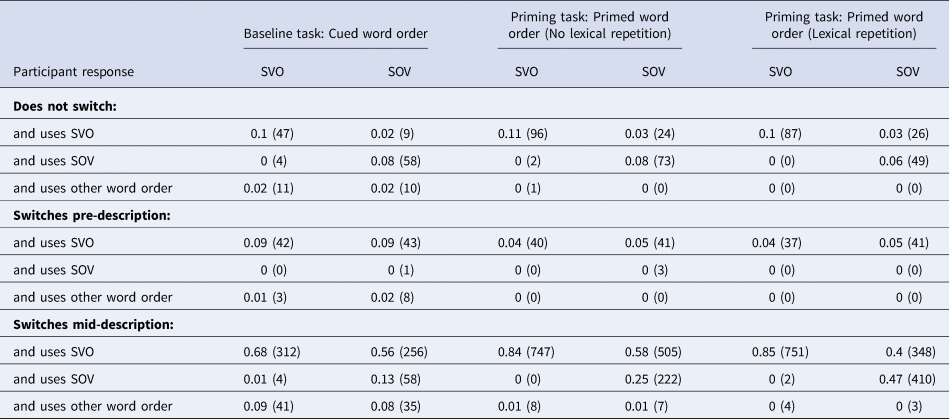
Note: “Pre-description” refers to switches made between the lead-in fragment and the participant's own description (e.g., Hierdie is ‘n snaakse prentjie want THE GRANNY STROKES THE DUCK ‘This is a strange picture because the granny strokes the duck’); “mid-description” refers to switches made within the participant's own description (e.g., Hierdie is ‘n snaakse prentjie want die ouma STROKES THE DUCK ‘This is a strange picture because the granny strokes the duck’).
Baseline task and priming task, no lexical repetition
To establish whether a priming effect on word order choice occurred over and above the cueing effect of the lead-in fragment, we compared use of the cued/primed word order across the baseline and priming tasks (in the absence of lexical repetition) via a generalized linear mixed effects model. Here, we included only responses in which a code-switch was produced (pre- or mid-description; 2,376/2,711 responses; 87.6%).
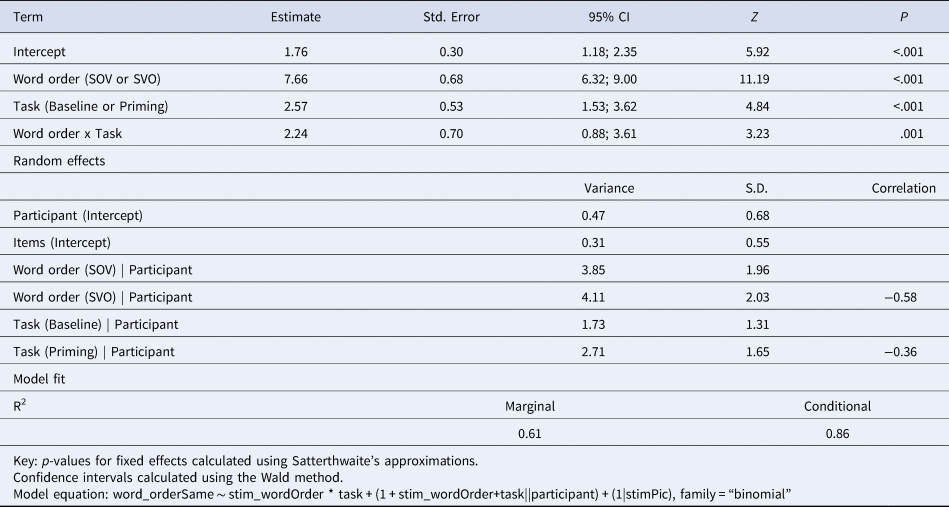
In the model, the dependent variable was whether the response word order was different from or the same as the cued/primed word order. Fixed effects were stimulus word order (SOV or SVO, coded as -0.5 and 0.5) and task (baseline or priming, coded as -0.5 and 0.5). We included random intercepts for participants and items and by-participants random slopes for cued/primed word order and task. Model results are in Table 3. The model output showed that while participants were overall more likely to use the cued/primed word order (as indicated by the significant positive value of the intercept), this likelihood was higher when cued/primed word order was SVO compared to SOV and also higher in the priming task compared to the baseline task. Further examination of the interaction between cued/primed word order and task indicated that the effect of word order, while significant in both tasks, was stronger in the priming compared to the baseline task (reflecting an effect of the specific word order of the prime sentence over and above the cueing effect of the lead-in fragment). This interaction effect is illustrated in Figure 2; Supplementary Table S2 (Supplementary Materials) presents the estimated marginal means for the model.
Interaction between cued/primed word order and task in the absence of lexical repetition. Y-axis depicts likelihood of using cued/primed word order.

Model output, response word order as a function of cued/primed word order and task
Priming task, lexical repetition versus no lexical repetition
We turn now to examine the effect of lexical repetition on use of the primed word order (non-use vs use) in the priming task. Included in this analysis were all the priming task responses in which a code-switch was made (pre- or mid-description); this is 3,169 responses out of a total of 3,680 (86.1%).
Table 2 shows that lexical repetition had no effect on word order choice when SVO word order was primed because there was hardly any variation in the SVO condition: SVO was practically always chosen (i.e., a ceiling effect occurred). We therefore ran a separate model on the response word order in the SOV prime condition (n trials = 1,580), with lexical repetition (absent or present, coded as -0.5 and 0.5) as an independent variable, random intercepts for participants and items, and by-participants random slopes for lexical repetition. The model results (Supplementary Table S3, Supplementary Materials) indicate that when SOV word order was primed, participants were significantly more likely to use SOV word order in their response when lexical repetition was present compared to when it was absent.
In summary, the analysis of the word order data shows that participants’ word order choices when code-switching were influenced by the word order of the prime sentence, particularly when the prime sentence used SVO word order. This priming effect was boosted by lexical repetition across prime and target only in the non-shared-word-order condition.
Switch position choices
We examine switch positions only for mid-description switches made in either SVO or SOV word order. In the baseline task, this was 630/803 responses (78.5%); in the priming task, it was 2,985/3,169 responses (94.2%). Table 4 provides an overview of the response switch positions in the baseline and priming tasks. Supplementary Tables S4 and S5 (Supplementary Materials) provide a complete overview of response switch positions in the baseline and priming tasks, respectively.
Response switch positions in the baseline and priming tasks. Baseline task switch positions reflect participants’ free switch position choices in each word order (SVO and SOV); priming task switch positions reflect use of each primed switch position.

Baseline task
In the baseline task, the four most common switch positions were S|VO, SV|O, SO|V and S|OV. A generalized linear mixed effects model, with ‘switch between first and second position’ (no or yes) as the dependent variable, cued word order (SOV or SVO, coded as -0.5 and 0.5) as a fixed effect, random intercepts for participants and items, and by-participants random slopes for cued word order shows an overall preference for switches made between the first and second position (intercept: β = 1.74, SE = 0.24, z = 7.24, p < .001) but no effect of cued word order on the tendency to switch between the first and second position. The overall preference for a switch between first and second position in the absence of an effect of cued word order likely arises because in both cued word order conditions, participants tended to produce SVO utterances. Model results are in Supplementary Table S6 (Supplementary Materials).
Priming task
In the priming task, the primed switch positions were the most commonly used switch positions in participants’ responses; further, these switch positions appeared in the same order of frequency as in the baseline task (i.e., S|VO, SV|O, SO|V, and S|OV).
We ran a generalized linear mixed effects model to examine the effects of primed word order, primed switch position, and lexical repetition on use of the primed switch position, with response switch position (different from or same as primed switch position) as the dependent variable, primed word order (SOV or SVO, coded as -0.5 and 0.5), primed switch position (between the second and third position or between the first and second position; coded as -0.5 and 0.5) and lexical repetition (absent or present, coded as -0.5 and 0.5) as fixed effects, random intercepts for participants and items, and by-participants random slopes for primed word order, primed switch position, and lexical repetition. The model results (Table 5; estimated marginal means are in Supplementary Table S7, Supplementary Materials) show main effects of primed word order, primed switch position, and lexical repetition. Participants were more likely to use the primed switch position when the primed word order was SVO compared to SOV, when the primed switch position was between the first and second position (i.e., S|VO or S|OV) compared to between the second and third position (i.e., SV|O or SO|V), and when lexical repetition was present versus absent. Further exploration of the interaction between primed word order and primed switch position (see left panel, Figure 3) indicated that the switch position effect was significant in the SVO word order condition – where use of the primed switch position was greater when the primed switch position was S|VO compared to SV|O – but not in the SOV word order condition. In contrast, while the presence of lexical repetition was strongly associated with greater use of the primed switch position in the SOV word order condition, this effect was much weaker in the SVO word order condition (see right panel, Figure 3).
Effects on use of the primed switch position in the priming task. Left: Interaction between primed word order and primed switch position. Right: Interaction between primed word order and lexical repetition.

Model output, use of primed switch position (yes/no) as a function of primed word order and lexical repetition

In summary, the analysis of the switch position choice data shows greater switch position priming in the shared word order (i.e., SVO) compared to the non-shared word order; in the shared word order, use of the primed switch position is greater for S|VO switches compared to SV|O switches. Further, as in the word order choice analyses, we observed a lexical boost effect on switch position priming primarily in the non-shared word order (i.e., SOV).
Discussion
The present study explored the interaction between word order sharedness and lexical repetition in the priming of code-switched production among Afrikaans–English bilinguals. To investigate this relationship, we drew on the methods of Kootstra et al. (Reference Kootstra, van Hell and Dijkstra2010, Reference Kootstra, van Hell and Dijkstra2012), who examined a similar language combination (Dutch–English) but in a setting in which code-switching is likely to be less common. Despite this contextual difference, our findings regarding the effects of structural overlap and priming largely overlap with those of Kootstra et al. (Reference Kootstra, van Hell and Dijkstra2010). Specifically, the results corroborate Kootstra et al.'s (Reference Kootstra, van Hell and Dijkstra2010) finding that code-switching can be primed in non-shared-word-order utterances, both in terms of whether to switch and where to switch. At the same time, the findings extend our knowledge of the relationship between cross-linguistic similarity and priming by providing new evidence that lexical repetition strengthens code-switching priming in non-shared-word-order utterances in particular.
Our combined analysis of the code-switched responses from the baseline task and those from the priming task in the absence of lexical repetition showed two effects on use of the cued/primed word order: it was higher in the SVO than the SOV condition, and in the priming task than the baseline task. The first of these findings aligns with both theoretical accounts of code-switching and empirical observations, in that it shows that code-switching is facilitated in utterances using a word order that is common to both the bilingual's languages (e.g., Deuchar, Reference Deuchar2005; Eppler, Reference Eppler1999; Kootstra et al., Reference Kootstra, van Hell and Dijkstra2010; Lantto, Reference Lantto2012; Lipski, Reference Lipski and Paradis1978; Pfaff, Reference Pfaff1979; Poplack, Reference Poplack1980; Poplack & Meechan, Reference Poplack, Meechan, Milroy and Muysken1995). This facilitation effect can be explained in at least two ways. First, use of a shared word order in code-switching prevents a word order conflict following the insertion of material from another language with a different surface structure; and second, the heightened cross-language activation that results from use of a shared word order increases the accessibility of items from both languages, thus making language switches more likely. The latter explanation would align with findings from other paradigms showing reduced cross-language activation in non-shared- compared to shared-word-order processing (e.g., Ahn et al., Reference Ahn, Ferreira and Gollan2021; Declerck & Philipp, Reference Declerck and Philipp2015). A further interesting aspect of the activation-based explanation is that it makes it possible to account for effects of overlap across languages at other levels of processing, such as cognate triggering of code-switching (e.g., Broersma, Carter, Donnelly & Konopka, Reference Broersma, Carter, Donnelly and Konopka2020; Kootstra et al., Reference Kootstra, Dijkstra and van Hell2020). Thus, it could be argued that effects of both structural and lexical overlap across languages in code-switching are in fact reflections of the same cross-language activation mechanism but then at different levels of processing.
Interestingly, the task effect observed indicates that priming, compared to cueing, prompts greater use of a particular word order in code-switched production; further, this priming effect was stronger in the SVO word order condition compared to the SOV word order condition. This finding replicates the results of Kootstra et al. (Reference Kootstra, van Hell and Dijkstra2010), in that it shows that participants’ word order choices when code-switching are influenced by immediately prior linguistic context.
Our next analysis of the effect of lexical repetition on response word order showed no further effect of lexical repetition on response word order when the primed word order was SVO, since the priming effect alone was sufficient to prompt ceiling-level use of the shared word order. In contrast, when SOV word order was primed, the use of this word order was greater when lexical repetition was present compared to when it was absent. We thus have evidence that the lexical boost effect applies to response word order in code-switched production as well, adding to Kootstra et al.'s (Reference Kootstra, van Hell and Dijkstra2012) observation of a lexical boost effect on switch position priming.
This finding of ours is compatible with an account of the lexical boost as reflecting a short-term increase in the activation of a particular lexical and structural pairing, which increases the likelihood of this pairing being reused (e.g., Bock & Griffin, Reference Bock and Griffin2000). From this perspective, there is a dual process at play in structural priming, where priming of abstract syntactic structure results from error-based learning and the lexical boost effect is caused by a separate, more transient mechanism. In our study, the heightened activation caused by lexical repetition may have served to facilitate priming of the dispreferred SOV structure by increasing its salience in memory. Thus, error-based learning and lexical repetition may have worked together here to increase production of (dispreferred) code-switched SOV utterances.
We also observed a clear effect of word order similarity in our analysis of response switch position choices. Specifically, use of the primed switch position was greater in the SVO than the SOV condition, which again aligns with the idea that shared word order facilitates code-switching. Further, primed word order interacted with lexical repetition to influence switch position priming, such that the lexical boost effect was considerably stronger when SOV was primed than when SVO was primed. This result provides additional evidence that lexical repetition boosts priming effects for dispreferred or infrequent structures in particular (Jaeger & Snider, Reference Jaeger and Snider2013).
Finally, the analysis of the switch position data also revealed an effect of primed switch position in the SVO word order condition: here, priming was greater for S|VO switches compared to SV|O switches. While some previous research (e.g., Suurmeijer et al., Reference Suurmeijer, Parafita Couto and Gullberg2020) suggests that VP-external and VP-internal switches are processed differently, our findings imply that such a difference does not arise under all conditions. Specifically, in dispreferred or less frequently used switch configurations – for example, in non-shared-word-order utterances – the structural position of the switch may have only a minor effect on the processing thereof. This proposal can be accommodated within an experience-based perspective on language processing, in which the processing system is said to become attuned to features of the input in its environment (e.g., Beatty-Martínez & Dussias, Reference Beatty-Martínez and Dussias2018; Dell & Chang, Reference Dell and Chang2014). Assuming that switches in non-shared-word-order utterances are approximately equally rare, we would not expect to observe processing differences across them.
Taken together, our results provide evidence of the interplay between cross-linguistic similarity and priming in code-switched production. That is, not only was code-switching itself facilitated by structural overlap, but effects of primed code-switching were also stronger in the shared word order compared to the non-shared word order. This was the case for both the response word order and the response switch position. Interestingly, this result is consistent with findings regarding cross-linguistic structural priming, in which most studies show that priming effects are strongest in cases of shared word order across languages (e.g., Bernolet et al., Reference Bernolet, Hartsuiker and Pickering2007; Jacob et al., Reference Jacob, Katsika, Family and Allen2017; Kidd, Tennant & Nitschke, Reference Kidd, Tennant and Nitschke2015). An important implication of these results is that phenomena of cross-linguistic interaction in bilingual speech (in our case, the role of shared word order in code-switching) and priming in bilingual language use may well be based on the same underlying mechanisms. Similar arguments have been made in the context of cross-linguistic influence by Serratrice (Reference Serratrice2013, Reference Serratrice2017), who proposed that cross-linguistic influence caused by structural overlap across languages can be seen as the outcome of syntactic priming across languages.
Future research could investigate other factors that may also partake in the interplay between structural overlap and priming in code-switched production. In terms of task effects, it is possible that self-priming may occur across the course of an experiment, such that participants’ frequent production of, for example, a particular switch position in the task might increase the likelihood of them reusing this switch position as the task goes on (see e.g., Fricke & Kootstra, Reference Fricke and Kootstra2016). At the individual level, participants’ responses to priming may be affected by language proficiency (Kootstra et al., Reference Kootstra, van Hell and Dijkstra2012), language dominance (Myslín & Levy, Reference Myslín and Levy2015), language status (Blokzijl, Deuchar & Parafita Couto, Reference Blokzijl, Deuchar and Parafita Couto2017), and code-switching experience (Adamou & Shen, Reference Adamou and Shen2019; Balam, Parafita Couto & Stadthagen-González, Reference Balam, Parafita Couto and Stadthagen-González2020; Beatty-Martínez & Dussias, Reference Beatty-Martínez and Dussias2017; Guzzardo Tamargo, Valdés Kroff & Dussias, Reference Guzzardo Tamargo, Valdés Kroff and Dussias2016; Kheder & Kaan, Reference Kheder and Kaan2016). To further explore the potential effect of code-switching experience, future research might continue in the vein of this study and expand the types of bilingual populations that are studied while also collecting comprehensive data on participants’ language use, code-switching behaviour (e.g., Hofweber, Marinis & Treffers-Daller, Reference Hofweber, Marinis and Treffers-Daller2020), and objective proficiency in both/all of their languages. The results of such investigations would shed further light on the mechanisms governing bilingual language use.
Conclusion
This paper sought to expand our knowledge of the factors affecting code-switched production, focusing specifically on word order similarity and priming (lexical repetition). The results demonstrate that code-switching behaviour is affected by a dynamic interplay between these factors. While code-switching is facilitated in utterances with shared word order, priming and specifically lexical repetition across prime and target boosts the production of code-switching in non-shared-word-order utterances.
Competing interests
The authors declare none.
Data availability
The data that support the findings of this study are openly available on Figshare at https://doi.org/10.6084/m9.figshare.17178524.
Supplementary materials
For supplementary material accompanying this paper, visit https://doi.org/10.1017/S1366728923000044
Appendix S1: Baseline task, critical stimuli
Appendix S2: Priming task, critical stimuli
Table S1: Participant characteristics
Table S2: Estimated marginal means, effects of cued/primed word order and task on response word order (baseline task and priming task in the absence of lexical repetition)
Table S3: Model output, response word order as a function of primed word order and lexical repetition in the SOV-prime condition
Table S4: Switch position choices, baseline task, mid-description switches
Table S5: Switch position choices, priming task, mid-description switches
Table S6: Model output, baseline task switch position (after subject/not after subject) as a function of cued word order
Table S7: Estimated marginal means, effects of primed word order, primed switch position and lexical repetition on response switch position
Acknowledgments
We gratefully acknowledge the Swedish Foundation for International Cooperation in Research and Higher Education, the South Africa–Sweden Bilateral Scientific Research Cooperation Programme, grant nr SA2016-6848 to M. Gullberg, as well as Stellenbosch University Subcommittee A project funding awarded to R. Berghoff. We also thank Talya Beyers for research assistance and the three anonymous reviewers for their feedback on the manuscript.


 Open access

