





Peer victimization entails being the receiver of intentionally aggressive or hurtful behavior, which can be physical (e.g., hitting) as well as relational (e.g., social exclusion), by one or more peers (Hawker & Boulton, Reference Hawker and Boulton2000). A third of adolescents report being victimized by their peers, according to an international meta-analysis (Modecki et al., Reference Modecki, Minchin, Harbaugh, Guerra and Runions2014). The rates show variation between studies, due to measurement and variation in the school context. However, some are persistently or frequently victimized. For example, in a large Dutch study around 20% of children (aged 7–12 years in schools with the KiVa antibullying program) were initially victimized, of whom a fifth (3.6% of all children) remained victimized even after participation in an antibullying program (Kaufman et al., Reference Kaufman, Kretschmer, Huitsing and Veenstra2018). In a recent Australian survey 42% of children (12–13 years) reported being victimized in the last month, of whom almost half (18% of all children) weekly (Australian Institute of Health and Welfare, 2020). Victimized children and adolescents are at risk for impaired mental health such as anxiety and depressive symptoms (Arseneault, Reference Arseneault2018; Christina et al., Reference Christina, Magson, Kakar and Rapee2021), which can last even into adulthood (Copeland et al., Reference Copeland, Wolke, Angold and Costello2013). Hence, identifying factors that may contribute to the initiation and maintenance of peer victimization experiences is important. A possible maintaining factor is rejection sensitivity. Rejection sensitivity is a social-affective-cognitive model of the self, others, and relationships, in other words, a tendency to interpret social situations in a certain way. People who are highly rejection sensitive anxiously or angrily expect to be rejected by others (Downey, Freitas, et al., Reference Downey, Freitas, Michaelis and Khouri1998; Pietrzak et al., Reference Pietrzak, Downey, Ayduk and Baldwin2005).
A focus on rejection sensitivity and its association with victimization by peers aligns with Social Information Processing (SIP) Theory. SIP theory provides an in-depth description of the development of social-affective-cognitive models of the self, others, and relationships, which follow from social experiences and channel these past experiences into future social interactions (Crick & Dodge, Reference Crick and Dodge1994). SIP theory identifies three phases in this process. First, an individual must attend to or notice the social signals or cues in the social interaction (encoding). Second, these cues must be interpreted together, whereby meaning must be ascribed to this combination of cues (interpretation). Last, after encoding and interpretation, individuals form a behavioral response by selecting a goal, constructing possible responses, deciding on a response, and executing the chosen response. Through these repeated cycles of experiences within social interactions, individuals develop a social-affective-cognitive model, which includes memories, schemas, and social knowledge (referred to as a “database”; Crick & Dodge, Reference Crick and Dodge1994). This social-affective-cognitive model guides interpretation and reactions to future interpersonal interactions, but it is also modifiable through new social experiences. Over time and with repeated experiences, models are thought to become more ingrained and resistant to change. Furthermore, social-affective-cognitive models may be localized to interactions with certain social groups (e.g., peers, or teachers) based on previous experiences or they may generalize across different individuals, groups, or settings (e.g., entire school context). SIP theory explicitly draws attention to how past experiences can influence how people encode, interpret, and respond to social interactions in the future. Hence, the way in which children and adolescents interpret and behave in social situations may contribute to the initiation and maintenance of future victimization experiences.
SIP theory suggests that individuals who are rejection sensitive have developed a social-affective-cognitive model that is primed for the possibility of rejection. When one expects rejection or interprets a social interaction as rejecting, anger, or anxiety are common responses (Downey, Freitas, et al., Reference Downey, Freitas, Michaelis and Khouri1998; Zimmer-Gembeck et al., Reference Zimmer-Gembeck, Nesdale, Webb, Khatibi and Downey2016, Reference Zimmer-Gembeck, Gardner, Hawes, Masters, Waters and Farrell2021). Children or adolescents with a rejection sensitive schema, when compared to those without such a schema, are more likely to expect others will reject them and this expectation is accompanied by anxiety or anger. In SIP theory, such a combination of expectation and emotion is considered to be more likely among individuals who report a more extensive history of negative interpersonal experiences, such as being victimized by peers. Supporting this view, individuals who have a history of victimization report greater vigilance to social rejection cues, and thus, they are more rejection sensitive (Kellij et al., Reference Kellij, Lodder, van den Bedem, Güroğlu and Veenstra2022).
Taken together, SIP and past research suggest that children and adolescents exposed to more victimization experiences than their peers will be higher in rejection sensitivity. Thus, a between-person association between peer victimization and rejection sensitivity would be expected. Furthermore, within-person longitudinal associations between victimization and rejection sensitivity (i.e., within-person associations) would be expected. According to SIP theory, the social-affective-cognitive model is continuously updated with new experiences, which has an influence on interpretations and behaviors in future situations (Crick & Dodge, Reference Crick and Dodge1994). When individuals face an intensification of victimization, an increase in (hyper)awareness of possible rejection may occur and rejection sensitivity is expected to increase. Furthermore, increasingly aggressive or anxious responses to situations perceived as rejection are more likely when individuals’ rejection sensitivity intensifies. These responses can, in turn, increase the risk of subsequent victimization experiences. Overall, such bidirectional links are indicators of a negative cycle of peer victimization and rejection sensitivity.
Theoretical work on rejection sensitivity aligns with the idea that excessive expectations of being rejected by others will covary with victimization experiences and also draws attention to the mediational role of negative social responses (Feldman & Downey, Reference Feldman and Downey1994; Zimmer-Gembeck et al., Reference Zimmer-Gembeck, Nesdale, Webb, Khatibi and Downey2016). For example, in past research, adolescents who scored higher on a measure of anxious rejection sensitivity anticipated responding with more withdrawal or social isolation to negative social interactions, whereas those higher in angry rejection sensitivity anticipated responding with more negative behaviors toward others, such as seeking retribution or aggression (Cain et al., Reference Cain, De Panfilis, Meehan and Clarkin2017; London et al., Reference London, Downey, Bonica and Paltin2007; Zimmer-Gembeck & Nesdale, Reference Zimmer-Gembeck and Nesdale2013). Notably, both withdrawal and aggression can pose risks for future victimization. In particular, withdrawal provides fewer opportunities to engage with others, which could provide opportunities to repair interpersonal problems and practice social skills (e.g., negotiation or assertion). Furthermore, withdrawn children may be future targets of victimization because of their more passive response style (Rubin et al., Reference Rubin, Coplan and Bowker2009). In contrast, reactive aggression is a behavior that is readily observable and is likely to evoke negative feelings and reactions from others, also leading to an increased risk of victimization in the future (Lamarche et al., Reference Lamarche, Brendgen, Boivin, Vitaro, Pérusse and Dionne2006; Reijntjes et al., Reference Reijntjes, Kamphuis, Prinzie, Boelen, van der Schoot and Telch2011; Schwartz et al., Reference Schwartz, Dodge, Coie, Hubbard, Cillessen, Lemerise and Bateman1998). Hence, the relation between victimization and rejection sensitivity might be bidirectional and involve within-person associations. Moreover, the identification of both angry (e.g., aggressive) and anxious (e.g., withdrawal) responses to the anticipation of rejection suggests that distinguishing the angry and anxious forms of rejection sensitivity from each other would help to localize which responses to peer victimization (aggression or withdrawal) will put adolescents at most risk for future or escalating victimization. No prior research has distinguished angry from anxious responses to anticipated rejection in the association with victimization.
There is substantial evidence that peer victimization and general rejection sensitivity are associated, but few studies have investigated longitudinal associations. Cross-sectional research has shown that individuals exposed to more victimization experiences tend to be more rejection sensitive (Calleja & Rapee, Reference Calleja and Rapee2020; Mellin, Reference Mellin2012; Rowe et al., Reference Rowe, Zimmer Gembeck, Rudolph and Nesdale2015; Zimmer-Gembeck et al., Reference Zimmer-Gembeck, Nesdale, McGregor, Mastro, Goodwin and Downey2013; Zimmer-Gembeck, Reference Zimmer-Gembeck2015) and associated with more beliefs about being abandoned or let down by others (Alba et al., Reference Alba, Calvete, Wante, Van Beveren and Braet2018). Longitudinal research reporting correlations showed that youth who are victimized by their peers were, later on, also more rejection sensitive (Rowe et al., Reference Rowe, Zimmer Gembeck, Rudolph and Nesdale2015; Zimmer-Gembeck, Reference Zimmer-Gembeck2015). In one of these studies, however, peer victimization did not predict rejection sensitivity half a year later when using a structural equational modeling (SEM) approach (Rowe et al., Reference Rowe, Zimmer Gembeck, Rudolph and Nesdale2015). To our knowledge, only one previous study examined bidirectional associations between peer victimization and rejection sensitivity over time (Calvete et al., Reference Calvete, Fernández-González, González-Cabrera and Gámez-Guadix2018). Results indicated that middle adolescents (ages 12–17) who were more often bullied had increased expectations of rejection (e.g., mistrust others, and being emotionally deprived, abandoned, and unwanted by others) about 6 months later. In turn, these increased expectations predicted increased levels of victimization 6 months later (Calvete et al., Reference Calvete, Fernández-González, González-Cabrera and Gámez-Guadix2018). Another study on a similar construct, being disliked by peers, found no evidence for bidirectional associations with rejection sensitivity. In this four-wave longitudinal study of middle adolescents (M age = 15 years), only concurrent associations between feeling disliked by peers and fear of negative evaluation were found (Beeson et al., Reference Beeson, Brittain and Vaillancourt2020). It may be, however, that feeling disliked is not the same as being victimized and the results might differ if victimization was measured. Nevertheless, when taken together, there is strong evidence that adolescents who experience more peer victimization are higher in rejection sensitivity, but studies on longitudinal bidirectional effects are mostly lacking and the only study on victimization does indicate that there may be bidirectional effects between peer victimization and rejection sensitivity (Calvete et al., Reference Calvete, Fernández-González, González-Cabrera and Gámez-Guadix2018).
Notably, research also suggests that it is fundamental to differentiate between- from within-person associations when examining bidirectional associations over time (Berry & Willoughby, Reference Berry and Willoughby2017). Between-person associations involve differences and associations across (or between) people: a person, who has more victimization experiences compared with others, is more likely to also have higher levels of rejection sensitivity. Within-person associations involve associations of changes within an individual. A common construct regarding within-person associations is fluctuation (i.e., deviation from each individual’s own expected score) within individuals over time: a fluctuation in victimization between repeated times of measurement is related to the individuals’ fluctuation in rejection sensitivity (Hamaker et al., Reference Hamaker, Kuiper and Grasman2015). These within-person fluctuations can lead to a negative cycle of victimization; fluctuations in victimization lead to an increase in rejection sensitivity, which in turn leads to an increase in victimization, and so on. Applying this novel approach to this area, we investigated negative cycles to identify important temporal patterns of influence, moving beyond cross-sectional or between-person associations. Our more general purpose was to identify possible ways to improve interventions with an individualized approach.
The present study
Drawing on core ideas of SIP theory, we investigated between-and within-person bidirectional associations between peer victimization and rejection sensitivity using two separate longitudinal samples of young adolescents (one sample of Dutch adolescents with four waves of data and one sample of Australian adolescents with three waves of data). Importantly, having these two samples enabled us to examine a broader age range as well as changing social situations (the Dutch data collection started half a year after starting the first grade of secondary school and the Australian data collection started in the last grades (5–7) of elementary school). Social hierarchies are often reestablished and reorganized in secondary school (de Vries et al., Reference de Vries, Kaufman, Veenstra, Laninga-Wijnen and Huitsing2021), leading to changed social situations, which might lead to changes in the associations between rejection sensitivity and victimization.
To test associations between rejection sensitivity and victimization over time, we used random intercept cross-lagged panel models (ri-CLPMs), which allow the differentiation of between- and within-person associations (Hamaker et al., Reference Hamaker, Kuiper and Grasman2015). For the between-person associations (i.e., the extent to which victimization and rejection sensitivity were associated on a between-person level), we expected that peer victimization and rejection sensitivity would be positively related (H1). For the within-person cross-lagged associations, we expected that individual fluctuations in victimization would be positively related to subsequent fluctuations in rejection sensitivity (i.e., when individuals report higher than their typical levels of victimization, they also report higher than their typical levels of rejection sensitivity at the subsequent time point) (H2). We also expected the converse within-person associations, whereby individual fluctuations in rejection sensitivity would be positively related to subsequent fluctuations of victimization (H3). We explored whether anxious or angry rejection sensitivity related differently to victimization. In addition, we explored whether rejection sensitivity toward peers or teachers related differently to victimization. Possibly, adolescents’ social-affective-cognitive models of rejection sensitivity may apply only to specific social situations (e.g., only to interactions with peers and not teachers). We did not have hypotheses for these exploratory analyses, as no evidence exists with regard to the rejection sensitivity subtype (anxious/angry) or specificity of social situation (peer/teacher). Finally, in light of sex differences in sensitivity to negative experiences in peer relationships (e.g., Rose & Rudolph, Reference Rose and Rudolph2006), exploratory analyses were conducted to examine the extent to which associations were similar across sex and whether age was of influence in the model. The study hypotheses and the analytic approach were preregistered (see https://osf.io/mxf7g?view_only=95e0a232d9ce45a483cd577f8d2f75e3).
Method
Participants
Sample 1 (S1)
Data for S1 were drawn from a larger four-wave longitudinal study aimed at examining the associations of peer experiences with adolescents’ health outcomes in early- to mid-adolescence (de Bruine et al., Reference de Bruine, Denissen and Giletta2022). The respondents were recruited from two Dutch secondary schools. All first-year students were invited to participate in the study (N = 459). Approximately 57% of the parents returned consent forms, and the majority of those who did (87% of returned forms, which is 50% of all invited) gave consent for their child to participate in all waves of the study. There was no information on students who did not receive informed consent. Of the students with parental consent, 13 did not take part in T1, leaving 215 students at T1 (47.1% of the targeted population). Most respondents, 192 (82.4%), took part in all four waves. Students who responded in all four waves did not differ from students with fewer responses with respect to sex, ethnicity, parental education, age, or baseline levels of victimization, rejection sensitivity, anxiety, or depression (p’s > .05).
Overall, 233 students (47% girls) of a single cohort took part in S1. Of these, 215 respondents took part in T1 and were enrolled in the first year of secondary school (age 11–14, M = 12.7 years, SD = 0.49). The other respondents (n = 18) joined the study during the subsequent waves of data collection. Most of the respondents were Dutch (88.0%) or non-Dutch European/Caucasian (2.1%), while a minority (9.9%) had another ethnic background, such as Turkish, Moroccan, Indonesian or Iranian. At baseline, most were living together with both their parents (81.4%) and others were living with either one parent (7.5%) or were alternating between the father and the mother (10.2%).
Sample 2 (S2)
Data for S2 were drawn from a larger three-wave longitudinal study aimed at examining the predictors and outcomes of rejection sensitivity in early adolescence. In three primary schools, researchers distributed information sheets, parent consent forms, and a demographic questionnaire to all students to take home. Their parents were asked to complete and return the forms to the school. Parental consent was received for 76% of the invited students, 21% did not return the consent forms, and 3% declined to participate. There was no information on students who did not receive informed consent. All 711 respondents who had parental consent agreed to take part in the study, of whom 85.2% participated in all waves. Students who responded in all three waves did not differ from students with fewer responses in terms of demographics (sex, nationality, parental education, and age), baseline levels of examined constructs (victimization and rejection sensitivity), or mental health at baseline (anxiety and depressive symptoms) (p’s > .05).
A single cohort of 711 students (50% girls) participated in the study at T1. Of the respondents, 649 participated in the first wave (91.3%) and the others (n = 62) joined the study at T2. Respondents were attending grades 5, 6, or 7 in three Australian primary schools (ages 9–13, M = 10.9 years, SD = 1.0). Of 701 parents who reported their sociocultural background, most reported white (91.5%), with the remaining respondents being Asian (3.9%), Australian First Peoples, Torres Strait or Pacific Islander (3.4%), or other (1.2%). Most parents were married or cohabiting with a partner (83.7%), whereas 2.3% were single (never married), 13.6% were divorced or separated, and 0.4% were widowed.
Procedure
Sample 1
Respondents were invited during school time to complete online questionnaires, taking approximately 60 min. Questionnaires were completed in designated rooms with no more than six students at a time. T1 of the data collection took place from December 2016 to January 2017. The remaining assessments took place approximately 6, 12, and 18 months after T1. Respondents received a 10-euro gift card for their participation. The medical ethical committee Brabant (METC Brabant) gave ethical approval for this study (NL56418.028.16).
Sample 2
Respondents were invited to complete the questionnaires in students’ regular classrooms under the supervision of researchers. T1 took place in the first and second term of the school year in 2011, T2 and T3 took place at approximately 6-month intervals thereafter. The respondents who changed schools after T1 (4%) completed questionnaires at their new school (if three or more students participated at that school), at home, or by telephone. The questionnaires were completed in approximately 45 min and respondents received a small school-related gift at each wave of participation. The Human Subjects Review Committee from Griffith University gave ethical approval for this study.
Measures
Peer victimization
In S1, peer victimization was measured with the self-reported Revised Peer Experiences Questionnaire (RPEQ: Prinstein et al., Reference Prinstein, Boergers and Vernberg2001). This measure contains thirteen questions on physical, relational, and reputational victimization (e.g., “A kid told lies about me so other kids wouldn't like me”). Respondents rated each question on how often this had happened to them (1 = never, 2 = once or twice, 3 = a few times, 4 = about once a week, 5 = a few times a week), either since the beginning of the school year (T1) or in the past 6 months (other waves). We used the mean across all items, with higher scores indicating more frequent victimization (Cronbach’s α .84–.90 across waves).
In S2, peer victimization was measured using seven items of the Children’s Social Behavior Scale (CSBS: Crick & Grotpeter, Reference Crick and Grotpeter1995). The items covered self-reported overt victimization, relational victimization, and exclusion (e.g., “Kids threaten or do push, show or hit me”). Respondents indicated how often they experienced each form of victimization since the last wave of measurement (1 = not at all, 2 = a little bit, 3 = a fair bit, 4 = often, 5 = a lot). At each wave, the answers to the seven questions were averaged to obtain total peer victimization scores (Cronbach’s α .85–.88 across waves).
Rejection sensitivity
In S1, six peer scenarios of the Children’s Rejection Sensitivity Questionnaire (CRSQ: Downey, Lebolt, et al., Reference Downey, Lebolt, Rincón and Freitas1998) were used to measure rejection sensitivity. In each vignette, the adolescents were asked to imagine that the scenario was happening to them. An example scenario is: “Imagine you want to buy a present for someone who is really important to you, but you don't have enough money. So, you ask a kid in your class if you could please borrow some money. The kid says, ‘Okay, wait for me outside the front door after school. I’ll bring the money.’ As you stand outside waiting, you wonder if the kid will really come.” Respondents answered three questions for each scenario. The first question (Q1) involved how nervous the student would feel in each situation, with answer options ranging from 1 (not nervous) to 6 (very, very nervous). The second question (Q2) involved how mad the respondent would feel in each situation, with answer options ranging from 1 (not mad) to 6 (very, very mad). The last question (Q3) asked to what extent respondents expected to be accepted or helped, with answer options on a gliding scale from 1 a certain expectation of acceptance (YES!!!), through 2 to 5 with no explicit labels attached, to 6 a certain expectation of rejection (NO!!!).
For each scenario, we used the standard method for scoring this measure (Downey, Lebolt, et al., Reference Downey, Lebolt, Rincón and Freitas1998), which involved multiplying the response to the anxious question (Q1) by the response to the expectancy question (Q3) and averaging these six multiplicative scores to get the anxious rejection sensitivity score. Higher scores indicated higher levels of anxious rejection sensitivity. Similarly, to get the angry rejection sensitivity score, we multiplied the response to the mad question (Q2) by the response to the expectancy question (Q3) and averaged the six multiplicative scores. Higher scores indicated higher levels of angry RS. General rejection sensitivity was calculated as the average of the anxious rejection sensitivity and the angry rejection sensitivity scores. Higher scores indicated higher levels of general rejection sensitivity (Cronbach’s α .86–.88 across waves).
In S2, rejection sensitivity was measured with six scenarios (three related to peers as described for S1 and three related to teachers) of the CRSQ (Downey, Lebolt, et al., Reference Downey, Lebolt, Rincón and Freitas1998). An example teacher vignette is: “Imagine that a famous person is coming to visit your school. Your teacher is going to pick five kids to meet this person. You wonder if she will choose YOU.” Response options of all questions in S2 ranged from 1 (not nervous at all/not mad at all/NO!) to 5 (extremely nervous/extremely mad/YES!). The third question, regarding acceptance or help, included a more neutral answer option (3 maybe) due to the unequal answer scale. Scores were formed using the procedure described for S1, and scores were also formed separately for the peer scenarios, teacher scenarios and all scenarios together (i.e., peer RS, teacher RS, and general RS, respectively). Cronbach’s α of the measures were acceptable for peer RS items (.68–.71) and teacher RS items (.66–.69) across all waves. Cronbach’s α was good for all items across all waves (.80–.82).
Statistical Analyses
Alpha level
We performed one main analysis and several sensitivity or robustness analyses in both data sets (see Supplement 1). The dependent variables in the different models were correlated, as they were calculated from a subset of the questionnaire (anxious/angry or peer/teacher scenarios) or transformed (adjusted outliers or log-transformation). Although there was one main analysis, we did several sensitivity and robustness analyses, therefore we chose to be conservative and reduce the possibility of a Type 1 error by using the Bonferroni multiple testing correction adjusted for correlated dependent variables (Bonferroni D/AP procedure: Sankoh et al., Reference Sankoh, Huque and Dubey1997). In S1 we ran a total of 16 analyses and in S2 19 analyses, the average correlation between the adjusted dependent variables with the original dependent variables was .95 in S1 and .94 in S2, leading to a critical p-value of .042 in both S1 and S2 (https://www.quantitativeskills.com/sisa/calculations/bonfer.htm; Quantitative Skills, 2019).
Goodness-of-fit-indices
To evaluate model fit, we used the comparative fit index (CFI), root mean square error of approximation (RMSEA), and standardized root mean square residual (SRMR). Models that have CFI > .90 and RMSEA/SRMR < .08 were considered to have an acceptable fit, while CFI > .95 and RMSEA/SRMR < .05 were considered to have a good fit (see also Masselink et al., Reference Masselink, Van Roekel, Hankin, Keijsers, Lodder, Vanhalst, Verhagen, Young and Oldehinkel2018).
Univariate and bivariate descriptive information
To provide an initial estimation of the variance at the between- and within-person level, intraclass correlations (ICC) were calculated in both samples for peer victimization and rejection sensitivity. We also calculated bivariate correlations between the rejection sensitivity and peer victimization scores.
Random intercept cross-lagged panel models
The ri-CLPM (Hamaker et al., Reference Hamaker, Kuiper and Grasman2015) extends the more common CLPM. In a basic CLPM, the bidirectional associations over time between variables are examined while taking group means into account. In this model, individuals are expected to vary over time around the group mean, instead of their own individual means. Thus, CLPMs do not account for individual stable differences, and between-person and within-person associations are intertwined in this model (Berry & Willoughby, Reference Berry and Willoughby2017).
In the ri-CLPM, stable individual differences are accounted for by separating between- and within-person variance (see Figure 1 of Hamaker et al., Reference Hamaker, Kuiper and Grasman2015). The observed raw scores are partitioned into a grand mean, a between-person partition and a within-person partition. The grand mean is the average over the whole sample for that particular timepoint. The between-person partition (random intercepts) is the average individual deviation of these grand means over all timepoints, and hence, is time-invariant and represents a stable between-person difference (in ri-CLPM models they are estimated as latent variables based on the repeated measures). Typical individual levels are the sum of the grand mean (of that timepoint) and the random intercept of the individual. The within-person partition (individual deviations) is the observed raw score minus the sample grand mean of that timepoint and the between-person partition of that individual (raw score Xt − grand mean Xt − random intercept) (Mulder & Hamaker, Reference Mulder and Hamaker2021). The random intercepts of both variables (in our case victimization and rejection sensitivity) can be used to estimate the between-person association for these variables. The individual deviation scores can be used to estimate the size of the within-person auto-regressive associations of that variable, the size of within-person cross-lagged associations, and the size of the within-person concurrent residual association.
Estimated in this manner, the within-person auto-regressive associations resemble a within-person carry-over effect of that variable. For victimization, a positive within-person auto-regressive association means reporting both higher than typical victimization at one wave and the next wave. Hence, a positive within-person auto-regressive association does not (necessarily) mean that this individual increased in victimization over time. If a significant within-person cross-lagged association is found, this indicates that the individual deviation in victimization in one wave is associated with the individual deviation in rejection sensitivity in the next wave, while controlling for individual deviation in rejection sensitivity in the previous wave (and vice versa from rejection sensitivity to victimization). Last, within-person concurrent residual associations are the extent to which individual deviation in victimization is associated with individual deviation in rejection sensitivity in the same wave, which is not explained by either the auto-regressive or cross-lagged paths.
Main analyses: General rejection sensitivity
To test H1, H2, and H3, we fit ri-CLPMs (Hamaker et al., Reference Hamaker, Kuiper and Grasman2015) to each sample separately in MPlus 8.4 (Muthén & Muthén, n.d.) to estimate within- and between-person associations between general rejection sensitivity scores and peer victimization scores. To check the robustness of our results, we repeated these analyses twice. Once after adjusting 45 (2.61% of all scores) outliers in S1 and 153 (3.81% of all scores) in S2 to the highest non-outlier value (between Q1 − 1.5 IQR and Q3 + 1.5 IQR) and once with log-transformed variables. We also estimated CLPMs in both S1 and S2 to compare CLPM and ri-CLPM results. For the estimated (ri-)CLPMs we examined whether associations significantly differed across time (e.g., whether paths from T1 to T2 were similar to paths from T2 to T3, and so forth) by comparing a model where both within-person auto-regressive and within-person cross-lagged paths were constrained to be equal with a model with these paths freely estimated. We reported the most parsimonious model, which was the constrained model unless otherwise stated.
Missing data were handled in MPlus using the full-information maximum likelihood (FIML) method with robust standard errors (MLR). Little’s (Reference Little1988) Missing Completely at Random (MCAR) tests were non-significant in both S1 (χ 2 (42) = 44.76, p = .357) and S2 (χ 2 (36) = 24.72, p = .922).
Sensitivity analyses
Five sets of sensitivity analyses were conducted. First, in S1 and S2 subtypes of rejection sensitivity (anxious and angry rejection sensitivity) were analyzed separately. Second, in S2 peer- and teacher-related rejection sensitivity were examined separately. Third, we replicated the ri-CLPM in S1 for the three-peer scenario outcomes used in S2 and the three-peer scenarios not used in S2, to examine if the three-peer scenarios used in S2 were representative of all scenarios. We also examined Cronbach’s α and correlations between the different composite rejection sensitivity scores in both samples, and we did an exploratory factor analysis (EFA) in S2 to see whether the constructs could be distinguished. Fourth, we examined in S2 whether sex influenced the model associations by running a constrained multiple-group ri-CLPM with a Wald test to examine whether the models differed between boys and girls. We constrained the within-person auto-regressive and within-person cross-lagged paths to be equal. Last, we ran two constrained ri-CLPMs in S2 with baseline age as a time-invariant predictor. This was done to examine whether age was (a) related to the random intercepts and (b) related to the observed peer victimization and rejection sensitivity scores. We constrained the within-person auto-regressive and within-person cross-lagged paths to be equal. The data and MPlus scripts of the main and additional analyses have been made available at https://osf.io/tj4e7/.
Deviations from the preregistration
In the first preregistration, we described only analyses with S1. However, power became a concern and we sought to repeat the analyses with a larger sample. Therefore, we updated the preregistration to describe repeating the analyses with a second dataset (S2). There were four deviations not included in the updated preregistration (see Table 1). First, we used CLPMs as a robustness check and ri-CLPMs with log-transformed variables as a sensitivity check in both samples. Second, in S2 we used EFA to examine whether teacher and peer rejection sensitivity could be distinguished from one another and estimated ri-CLPMs for teacher rejection sensitivity in S2. Third, we estimated ri-CLPMs in S1 for rejection sensitivity scores formed based on the three peer scenarios that were used in S2, as well for the three peer scenarios that were not used in S2. Last, in S2 we ran a multiple-group ri-CLPM with sex and two ri-CLPMs with baseline age as a time-invariant predictor of either the random intercepts or the observed victimization and rejection sensitivity scores. These latter analyses were run only in S2 given the larger sample size.
Deviations from the preregistration

Note. ri-CLPM = random intercept Cross-Lagged Panel Model, CLPM = Cross-Lagged Panel Model.
Results
Univariate and bivariate descriptive information
Sample 1
Table 2 shows correlations among the study variables in S1. Intraclass correlations (ICC) were calculated to estimate the between- and within-person variance: 47.9% of the variance of victimization and 61.7% of the variance of general rejection sensitivity (using all scenarios) were due to between-person differences.
Correlation matrix of victimization and general rejection sensitivity (all scenarios) in samples 1 and 2
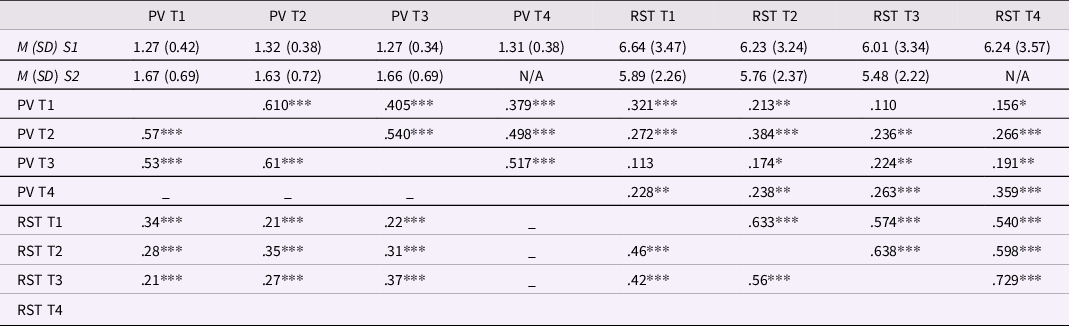
Note. *p < .05, **p < .01, ***p < .001. Sample 1 data is above the diagonal, Sample 2 data is below the diagonal. PV = Peer victimization. RST = General rejection sensitivity. S1 = Sample 1. S2 = Sample 2. Victimization scores are on the same scale (1–5), for sample 1 rejection sensitivity scores are on a 1–36 scale and for sample 2 on a 1–25 scale (due to the 6 and 5 answer categories respectively).
Sample 2
Table 2 shows the correlation coefficients of the variables in S2. ICC were calculated: 56.5% of the variance of victimization and 51.5% of the variance of general rejection sensitivity were due to between-person differences. Rejection sensitivity scores based on the three-peer or the three-teacher scenarios correlated moderately with one another (r’s between .52 and .72, see Supplement 2).
Comparability of samples
The samples clearly differ in age, as they were collected during secondary (sample 1) and elementary school (sample 2). In sample 1, students reported lower levels of victimization than in sample 2, which is in line with research showing that victimization prevalence is higher at younger ages (Australian Institute of Health and Welfare, 2020; Sapouna, Reference Sapouna2008). Rejection sensitivity levels were comparable between the two samples. In each sample, the average victimization and rejection sensitivity levels were relatively stable over time. Furthermore, in both samples, the intracorrelations for victimization and rejection sensitivity were higher than the intercorrelations between the two constructs. Therefore, the samples seem roughly comparable, besides the obvious differences in type of school (secondary/elementary), country (Netherlands/Australia), and age (M age = 12.7/10.9).
Victimization and general rejection sensitivity
Sample 1
The constrained ri-CLPM had an acceptable fit to the data (RMSEA = .012, CFI = .999, SRMR = .067, χ 2(17) = 17.56, p = .417). Table 3 shows the fit for the unconstrained model and the log-likelihood model fit test. The between-person association was positive (β = .39, p < .001); thus, adolescents who had more peer victimization experiences compared to their peers were also higher in rejection sensitivity, supporting H1 (see Figure 1; see Table 4 for the unstandardized estimates). Also, the within-person concurrent associations were significant in most waves (T1: β = .33, p = .011; T2: β = .30, p < .001; T3: β = .16, p = .068; T4: β = .26, p = .005), indicating when adolescents scored higher than their typical victimization level (referring to the sum of the grand mean and the random intercepts), they also tended to score higher than their typical rejection sensitivity level at that moment in time. In contrast to H2 and H3, the within-person cross-lagged associations between victimization and rejection sensitivity were nonsignificant and small in size (see Table 4). Finally, the within-person auto-regressive associations of rejection sensitivity were positive and significant (T1–T2: β = .27, p = .007; T2–T3: β = .24, p = .006; T3–T4: β = .23, p = .038), but the within-person auto-regressive associations of victimization were not, although betas were all larger than .10 (T1–T2: β = .28, p = .055; T2–T3: β = .22, p = .095; T3–T4: β = .19, p = .087).
Sample 1: within and between-person relations of victimization and rejection sensitivity note. Constrained ri-CLPM with standardized coefficients and 95% confidence interval shown in between square brackets. All (six) peer scenarios and both anxious and angry items were included in the calculations of rejection sensitivity. *p < .042, **p < .01, ***p < .001.

Comparison of constrained and unconstrained models in samples 1 and 2

Note. Significant log-likelihood tests indicate preference of the unconstrained model (p < .05) and are indicated by boldfaced entries. RS = Rejection sensitivity, S1 = Sample 1, S2 = Sample 2.
Unstandardized path coefficients of the constrained models on peer victimization and general rejection sensitivity in samples 1 and 2

Note. Boldfaced entries are significant at the corrected p < .042 value. PV = Peer victimization, RST = General rejection sensitivity, ri-CLPM = random intercept Cross-Lagged Panel Model, BP = Between-person, WP = within-person.
Sample 2
The constrained ri-CLPM had a good fit to the data (RMSEA < .001, CFI > .999, SRMR = .018, χ 2(5) = 3.97, p = .554) (see Table 3). Figure 2 displays the standardized estimates of the constrained model, and Table 4 shows the unstandardized estimates. Supporting H1, the between-person association was positive (β = .51, p < .001). Also, the within-person concurrent associations of rejection sensitivity and victimization were positive (T1: β = .27, p < .001; T2: β = .22, p < .001; T3: β = .26, p < .001 respectively). However, providing no support for H2 and H3, the within-person cross-lagged associations between victimization and rejection sensitivity were nonsignificant and small in size (see Table 4). Finally, the within-person auto-regressive associations of rejection sensitivity were positive (T1–T2: β = .36, p < .001; T2–T3: β = .43, p < .001), as were the within-person auto-regressive associations of victimization (T1–T2: β = .18, p = .022; T2–T3: β = .21, p = .042).
Sample 2: within and between-person relations of victimization and rejection sensitivity note. Constrained ri-CLPM with standardized coefficients and the 95% confidence interval shown in between square brackets. All six scenarios, peer and teacher items, and anxious and angry items were included in the calculations of rejection sensitivity. *p < .042, ***p < .001.

Victimization and subtypes of rejection sensitivity
We examined the associations between peer victimization and several types of rejection sensitivity. Exploratory factor analysis indicated that all peer and teacher scenarios loaded on a single factor and teacher-related rejection sensitivity was not empirically distinguishable from peer-related rejection sensitivity (see Supplement 3). With respect to different anticipated feelings when being rejected, results for anxious and angry rejection sensitivity scores in both samples did not differ substantially from the main analyses (see Supplement 4).
Sensitivity and additional checks
We repeated the main analysis in S2 for multiple groups (boys and girls separately). There were no significant sex differences in between- and within-person associations of victimization and rejection sensitivity (see Supplement 5). We repeated the main analysis with baseline age as a time-invariant predictor for the observed scores as well as the random intercepts of victimization and rejection sensitivity and found no significant effect for baseline age (see Supplement 6).
As another sensitivity check, we examined whether the use of a selection of peer scenarios in S2 might have affected the results. The results in S1 did not differ substantially when only the S2 peer-related scenarios were analyzed (see Supplement 3). Furthermore, we also performed the main analyses with adjusted outliers (see Supplement 7) and with log-transformed variables (see Supplement 8). Results did not substantially differ in S1 for both adjusted outliers and log-transformed variables and in S2 for the adjusted outlier analyses. The log-transformed analyses in S2 revealed significant associations for all within-person cross-lagged associations, differing from our main analyses (β’s ranged between .12 and .16).
Finally, we estimated regular CLPMs in both samples. In S1, the CLPM results were similar to the ri-CLPM results. In S2, auto-regressive, concurrent, and cross-lagged associations were all significant (see Supplement 9). However, the ri-CLPMs had a better fit than the CLPMs, as tested with log-likelihood tests (S1: χ 2 (3) = 21.26, p < .001; S2: χ 2 (3) = 36.80, p < .001), highlighting the need to distinguish between- from within-person associations.
Discussion
According to SIP theory (Crick & Dodge, Reference Crick and Dodge1994), negative interpersonal experiences, such as being physically victimized or being ostracized, are foundations for the development of social-affective-cognitive models that guide and alter behavioral responses to others into the future. For victims of peers’ aggressive behavior, their social-affective-cognitive model may involve a greater sensitivity to signs of rejection from others, referred to as rejection sensitivity. Our aim was to clarify the bidirectional associations between peer victimization and rejection sensitivity by employing a statistical approach (ri-CLPM) that allowed us to detect within-person cross-lagged associations while accounting for between-person associations. Thus, we directly addressed whether there are negative cycles of peer victimization and rejection sensitivity over time. We tested for negative cycles in two separate longitudinal samples of young adolescents, to improve confidence in the results given the smaller sample size and associated power concerns in S1 relative to S2. Furthermore, S2 was also used to investigate context-dependency of the associations because of the use of a measure of rejection sensitivity that included questions about peers and teachers. Last, we explored whether anxious and angry responses in anticipation of rejection were differently related to victimization experiences. We expected that fluctuations in adolescents’ self-reported peer victimization experiences would precede subsequent fluctuations in rejection sensitivity, which could put youth at risk for future victimization. In total, such associations would reveal a negative victimization-rejection sensitivity cycle.
In both samples, we found that peer victimization experiences and rejection sensitivity were related at the between-person level (H1) and at the within-person level concurrently, with no clear differences between anxious and angry rejection sensitivity. This implies that the term rejection sensitivity does not need to be specified as anxious or angry but can remain general. Thus, adolescents with higher levels of victimization experiences also reported more rejection sensitivity than their peers. In line with previous research on rejection sensitivity (Downey, Lebolt, et al., Reference Downey, Lebolt, Rincón and Freitas1998; Sandstrom et al., Reference Sandstrom, Cillessen and Eisenhower2003), supplementary analyses showed that the associations did not significantly differ between boys and girls and adolescents’ baseline age had no significant influence. However, the main analyses did not support our second and third hypotheses of a negative cycle of victimization and rejection sensitivity unfolding over time. Yet, there was one exception in the supplementary analyses when log-transformation (because of skewness and outliers) was applied to measures before estimating a ri-CLPM for the larger Australian sample of adolescents (S2).
A novel contribution of our study was testing the within-person level (i.e., state change over time) cross-lagged associations between peer victimization and rejection sensitivity using ri-CLPM. Although cross-sectional associations between peer victimization and rejection sensitivity have been reported in past studies of earlier waves of S2 (Rowe et al., Reference Rowe, Zimmer Gembeck, Rudolph and Nesdale2015; Zimmer-Gembeck, Reference Zimmer-Gembeck2015), these findings provide evidence that associations may be largely due to between-person differences, as indicated by the medium-sized between-person association in our samples. Likely, self-reported peer victimization and rejection sensitivity share some underlying factors, such as shared genetic or environmental influences (Veldkamp et al., Reference Veldkamp, Boomsma, de Zeeuw, van Beijsterveldt, Bartels, Dolan and van Bergen2019). Heritable personality traits like neuroticism (Bratko et al., Reference Bratko, Butković and Hlupić2017) may increase the risk to be victimized and to be more rejection sensitive. Hence, genetic, environmental, and the interaction between them might constitute the large between-person difference that we found. Another possibility is that self-reports of peer victimization and rejection sensitivity are jointly derived from a more general social-emotional-cognitive model that has solidified earlier in life, resulting in strong and immediate associations between them in adolescence. These strong associations within time points may have restricted any possibility of revealing associations across time (Zimmer-Gembeck et al., Reference Zimmer-Gembeck, Nesdale, McGregor, Mastro, Goodwin and Downey2013).
When we did not disentangle between- from within-person variance in the main analyses (using CLPMs rather than ri-CLPMs), we found some significant cross-lagged associations between victimization and rejection sensitivity. As such, our findings highlight the importance of differentiating within- and between-person associations, as cross-lagged associations in CLPMs do not necessarily imply within-person associations. The use of a CLPM may therefore have led to the erroneous conclusion that victimization and rejection sensitivity do fortify each other over time, whereas using ri-CLPM revealed that these bidirectional associations were not significant.
The presence of significant between-person and within-person concurrent associations and the absence of significant within-person cross-lagged associations in most analyses suggest that associations between rejection sensitivity and victimization may primarily already be established by early adolescence, leading to moderate to strong cross-sectional associations but with little influence on each other over time. Stability in rejection sensitivity and victimization might be also important to consider. The ri-CLPM requires sufficient change in both constructs to be able to detect cross-lagged associations. Adolescents’ rejection sensitivity has been found to be relatively stable over periods of a year (London et al., Reference London, Downey, Bonica and Paltin2007) or even 3 years (Marston et al., Reference Marston, Hare and Allen2010). Yet, it is possible rejection sensitivity can undergo some significant change during periods of transition or following major life-changing events. Given that we collected longitudinal data over one to one-and-a-half years and did not squarely capture data across a transition period for all participants (S1 started half a year after students began Dutch high school, most S2 adolescents were in primary school throughout the study), peer victimization and rejection sensitivity might have been quite stable reducing the ability to detect an escalating cycle of rejection sensitivity and victimization.
Two additional study design features could have had an influence on the study findings. First, using 6-month data collection intervals may not have been appropriate for capturing changes in peer victimization or rejection sensitivity. For instance, a victimization experience may trigger sensitivity to rejection in the hours or days following that event, similar to how the need to belong is incited after being rejected (Gerber & Wheeler, Reference Gerber and Wheeler2009). However, these shorter-term fluctuations may not necessarily accumulate into more stable states (which the rejection sensitivity measure assessed in this study), perhaps because other experiences, such as positive interactions with others, may also be occurring that minimize any negative cycles over time.
Second, we used self-reports to measure victimization. Adolescents reporting more rejection sensitivity may also perceive they are more victimized. In that sense, we might have indirectly captured aspects of rejection sensitivity with our measure of peer victimization. Such effects are predominantly caught in both the between-person association and within-person concurrent associations, which were considerable in our study. Using peer-reports as additional information in future studies may help in reducing this possible overlap in self-reported victimization and rejection sensitivity. Victims, who are identified only through self-report, might be more rejection sensitive than victims who are identified through both self- and peer-report (Zimmer-Gembeck et al., Reference Zimmer-Gembeck, Nesdale, McGregor, Mastro, Goodwin and Downey2013). If supported in future research, intervening on rejection sensitivity for self-identified victims might be useful to improve not only their anticipation of rejection, but also their expectation of victimization.
Implications for SIP theory
SIP theory highlights social interactions as foundational to the development of a social-emotional-cognitive model, which is expected to be open to change through new experiences (Crick & Dodge, Reference Crick and Dodge1994). Our findings show that there is a connection between victimization and interpretative schemas of rejection, but do not show predictive bidirectional within-person associations between rejection schemas and victimization. This could imply that SIP theory does not hold in the relation between rejection sensitivity and victimization. Alternatively, other positive experiences may limit the effect of peer victimization experiences. For example, some adolescents who experience victimization might also experience positive social interactions, such as having a good friend. Having good relationships with parents or high levels of peer support has been associated with lower levels of rejection sensitivity in adolescents (McDonald et al., Reference McDonald, Bowker, Rubin, Laursen and Duchene2010), even in longer-term longitudinal studies (Araiza et al., Reference Araiza, Freitas and Klein2020). Hence, positive relationships might compensate for any negative effect of peer victimization on rejection sensitivity. Furthermore, the chronicity of victimization may play an important role: when high levels of victimization experiences endure over time, interpretation schemas might become more ingrained. Conversely, it could be that instead of chronic high intense victimization by a specific group (bullies), low intensity rejection by most peers (like daily rejection experiences, e.g., no one laughs at your jokes or others take long to respond to you) might be more influential for developing these broad interpretative schemas of rejection. Future research may therefore examine the type of and the balance between positive and negative social experiences in addition to the duration and intensity of social experiences in relation to interpretative schemas.
Another implication of the findings for SIP relates to whether interpretative schemas are narrow or broad in their applicability. Considering applicability raises the issue of context-dependency of schemas. In supplementary analyses, we found that teacher- and peer-related rejection sensitivity could not be empirically distinguished from one another, and both related similarly to victimization. Although these results need replication, this is a first indication that expectations of acceptance and rejection may transfer across social contexts, with negative experiences in one context related to rejection expectations in another social context. We encourage future research that considers the breadth of the impact of interpretative schemas on social behaviors.
Limitations
In addition to the limitation raised earlier, another limitation of our study involves sample size and power, especially in S1. In S1, cross-lagged within-person associations could be non-significant due to low power. However, we compensated in two ways. First, we took both statistical significance and effect size into account. Second, we repeated the analyses in S2, which was a larger data set (N = 711). Overall, the results in S1 and S2 were similar.
A final limitation to mention is the vignette-based measurement of rejection sensitivity. In both samples, the same scenarios were used at each time point, which could have encouraged adolescents to respond similarly across time. Therefore, our respondents might have had some artificially inflated stability of rejection sensitivity. In other words, we might have measured less change in rejection sensitivity than if respondents would have had different rejection sensitivity scenarios at each time point.
Conclusion
This is the first study that disentangles within- and between-person associations in the interplay between adolescents’ reports of their peer victimization and rejection sensitivity. Although replication is certainly needed, preferably in larger (and younger) samples with more repeated assessments or longer lags between assessments, our results did not support the notion of a negative developmental cycle of escalating rejection sensitivity and self-reported victimization across a short time period among young adolescents. However, peer victimization and rejection sensitivity do co-vary both at the between-person level and concurrently at the within-person level. It remains possible, however, that negative cycles might only occur for specific adolescents, depending on moderator variables like social anxiety or are already established before adolescence. As such, it is important to acknowledge that addressing rejection sensitivity could still reduce children’s perception that they are victimized but may have less influence on schoolwide bullying rates as observed by others. Therefore, placing some focus on reducing rejection sensitivity in peer bullying or victimization intervention programs might be of value for specific individuals, such as self-identified victims. However, our results do not support within-person negative cycles of peer victimization and rejection sensitivity over time. Instead, victims of peer aggression are in general more rejection sensitive than their less victimized peers, and adolescents higher in rejection sensitivity feel more victimized than their peers.
Supplementary material
The supplementary material for this article can be found at https://doi.org/10.1017/S0954579423000123
Funding statement
This work was supported by The Netherlands Organization for Scientific Research (NWA Startimpuls 400.17.602, Gerine Lodder 016.Veni.195.186, Matteo Giletta: 451-15-004). The research was also supported by a grant from the Australian Research Council (DP130101868) to Melanie Zimmer-Gembeck.
Conflicts of interest
None.


 Open access

