


Proper nutrition is one of the basic strategies for a healthy life and poor nutritional habits can be a risk factor for many chronic diseases. An adequate diet is crucial during infancy and early childhood when children grow rapidly and their eating habits can influence their future health, especially in relation to obesity, CVD or diabetes( Reference Uauy, Kain and Mericq 1 , Reference Law 2 ). The accurate assessment of dietary intakes is critical to understand the relationship between diet and disease occurrence as well as to ensure optimal nutrition.
Assessing the diet is an ongoing challenge, particularly for large populations of children and adolescents( Reference McPherson, Hoelscher and Alexander 3 – Reference Ortiz-Andrellucchi, Henríquez-Sánchez and Sánchez-Villegas 5 ). Assessing the diet of children is considered even more challenging than assessing the diet of adults because of the very high day-to-day variability in nutrient intakes( Reference Willett 6 ). In addition, younger children are not able to adequately recall food items and portion sizes( Reference Baranowski and Domel 7 , Reference Tooze, Subar and Thompson 8 ), so the information has to sometimes be obtained from surrogate respondents. Although different methods to assess dietary intake can be used in the population (such as weighed food records and repeated 24 h recalls), time limitations and economic aspects make them unsuitable for most large-scale studies. The FFQ has a lower respondent burden, is less time consuming and relatively inexpensive. In addition, it can assess usual nutrient intakes. For these reasons, it is the most suitable for epidemiological studies( Reference Willett 6 ).
Although many FFQ have been described in the literature, dietary tools developed for other populations are not adequate, since it is well known that methods validated in a particular population are not necessarily accurate for other groups. The FFQ should include a list of food items and dishes most frequently consumed in the population under study. Unfortunately, no such type of validated questionnaire exists for the Polish population so far. Moreover, validation studies of FFQ among pre-school children are scarce in the literature( Reference Ortiz-Andrellucchi, Henríquez-Sánchez and Sánchez-Villegas 5 , Reference Roman-Viñas, Ortiz-Andrellucchi and Mendez 9 ). Therefore, we have developed an FFQ for an epidemiological study on the relationship between habitual diet and children's health. To assess nutrient intakes more precisely, we have asked about the frequency and portion size usually eaten by the child in addition to the list of commonly consumed foods and beverages.
The relative validity of FFQ is usually assessed by comparing the data with that of a reference method, e.g. repeated 24 h dietary recalls (24hDR), food records or biochemical measurements, such as vitamin concentration in blood samples or nitrogen in urine( Reference Schoeller 10 – Reference Kroke, Klipstein-Grobusch and Voss 12 ). Because of the specificity of the study population (children), we decided to use repeated 24hDR as a reference tool to assess the usefulness of the questionnaire.
The objective of the current paper is to present the relative validity of nutrient intakes estimated by our newly developed semi-quantitative FFQ (SFFQ) administered to 3-year-old children in Krakow, Poland.
Materials and methods
Participants and design
The study participants and their caregivers were enrolled in an earlier established birth cohort from the prospective cohort study ‘Vulnerability of the Fetus/Infant to PAH, PM2·5 and ETS’, covering the period from pregnancy until school age. The design of the study and the population selection have been described in detail previously( Reference Jedrychowski, Whyatt and Camann 13 ). In brief, non-smoking women aged 18–35 years with a singleton pregnancy, no chronic diseases and living in Krakow, Poland were recruited. For the purposes of the current study only mothers with 3-year-old children were selected, for whom both the SFFQ and three full 24hDR were collected within an interval no more than 1 month (n 179). Children with very high (>10 000 kJ) or very low (<3000 kJ) energy intake were excluded (n 3). In addition, thirty-three children were excluded because of mother's absence during most of the children's meals. The final sample consisted of 143 participants. The study was conducted according to the guidelines laid down in the Declaration of Helsinki and all procedures involving human subjects were approved by the Jagiellonian University Bioethics Committee. Written informed consent was obtained from all mothers.
FFQ
Mothers were invited to complete the questionnaire during the follow-up visit when the child reached 3 years of age. The SFFQ was designed to describe a commonly consumed diet at 3 years of age. The selection of food items in the questionnaire was based on data from general knowledge on dietary habits in pre-school children and data from previous surveys among children in this age group. The final SFFQ contained questions on the usual consumption of ninety-five food groups and items, as well as supplementary questions about dietary habits. Food groups were created on the basis of similar nutrient contents in products and mode of preparing, e.g. bread (including wheat, rye or mixed bread), yoghurt and other milk beverages, boiled fish, fried fish, smoked or canned fish, juices with high carrot content, etc. Additional information about the portion size usually eaten by children at this age, as well as the most convenient way of describing a portion size, was collected from the sample of mothers who had children of pre-school age. Finally, we decided to use the portion size expressed in household units, e.g. glass, spoon, piece of, slice of or share of the main portion size. The SFFQ was designed as a tool to be filled in by the mother or other caregiver to collect information about dietary intake of the child over the previous 4-week period. The respondent was also requested to recall the frequency of intake of each food group in the different categories and fill in the number of occasions that the food was eaten per day, week or 4-week period. A copy of the SFFQ can be made available from the authors upon request. We did not collect data about supplement use in the SFFQ.
Repeated 24 h dietary recalls (reference method)
The 24hDR covered three consecutive days, including both weekend days and weekdays. To avoid seasonal changes in usually consumed diet, the interval between the time the SFFQ and the 24hDR were administered had to be no more than 1 month. During home visits, trained interviewers gathered information about foods and beverages consumed by the child during the previous day. The caregiver was asked to write down all the foods consumed by the child each day, including information about foods eaten at the kindergarten or outside the home. Portion size eaten by the child was assessed using the ‘Album of photographs of food products and dishes’( Reference Szponar, Wolnicka and Rychlik 14 ). Data about vitamin and supplement use was not collected. One nutritionist performed the coding of all food items eaten.
Nutrient intakes
The daily intakes of energy and nutrients from the 24hDR were assessed by a computer program created at Jagiellonian University Medical College using the food composition database developed by the National Food and Nutrition Institute( Reference Kunachowicz, Nadolna and Przygoda 15 ). The average of all three 24hDR was used as a representation of individual intake. To calculate the daily intakes of energy and nutrients from the SFFQ, the same food composition tables as for the 24hDR were used. For each questionnaire item (food group), energy and nutrient contents were established using the weighted values from the food composition tables, with the weight based on the consumption frequency of food from the previously collected 24hDR. An estimation of the average daily nutrient consumption was performed by multiplying the consumption frequency of each food group by the specified portion size and the nutrient content from the tables.
Statistical analysis
Statistical analyses were performed using the statistical software package by StataIC 11. As the nutrient intake data had a positively skewed distribution, non-parametric statistical methods were applied. The sample medians, 25th and 75th percentiles were computed for intakes of nutrients from both dietary methods. The differences between methods were tested with the Wilcoxon's rank test.
The Spearman rank-correlation coefficient was used to compare the nutrient intakes assessed by the SFFQ and the repeated 24hDR. Corrected (de-attenuated) correlation coefficients were calculated to correct for residual measurement error in the repeated 24hDR(
Reference Willett
6
,
Reference Liu, Stamler and Dyer
16
) using the formula:
 $$--><$>{{R}_{{\rm{de{\vskip 0.7pt\hbox -}att}}}}\, = \,R\sqrt {1\, + \,\lambda /n} $$$
, where λ is the ratio of the within- to between-person variance from the 24hDR and n is a number of replicates per person(
Reference Willett
6
).
$$--><$>{{R}_{{\rm{de{\vskip 0.7pt\hbox -}att}}}}\, = \,R\sqrt {1\, + \,\lambda /n} $$$
, where λ is the ratio of the within- to between-person variance from the 24hDR and n is a number of replicates per person(
Reference Willett
6
).
The Bland–Altman method was used to evaluate the level of agreement between the SFFQ and the average of the three 24hDR. This method plots the difference between the two measurements against the mean of those measurements. The plot indicates the direction of bias and whether it is constant across the levels of intake. The limits of agreement determine whether the agreement between the two methods is acceptable( Reference Bland and Altman 17 ). The categories of agreement are: ‘good agreement’ (i.e. difference between the two methods is less than or equal to 1 sd of the average nutrient intake from the standard method); ‘fairly good agreement’ (i.e. difference between the two methods is approximately equal to 2 sd); and ‘poor agreement’ (i.e. difference between the two methods is approximately equal to 3 sd) ( Reference Bland and Altman 18 , Reference Hong, Dibley and Sibbritt 19 ).
In order to assess the agreement in quartile distribution of nutrient intakes between the two methods, the weighted kappa coefficient (κ w) was used with the following weights: 1 for perfect agreement; 0·67 for disagreement in one quartile; 0·33 for disagreement of two quartiles; and 0 for disagreement of three quartiles. This procedure allows greater emphasis on large differences in ratings than on small differences. Strength of agreement between the two methods was considered as: poor when κ w ≤ 0; slight when κ w = 0·01–0·20; fair when κ w = 0·21–0·40; moderate when κ w = 0·41–0·60; substantial when κ w = 0·61–0·80; and almost prefect when κ w ≥ 0·81( Reference Sim and Wright 20 ).
Results
The children in the current study were 3 years old, with approximately equal proportions of both sexes (52·4 % male and 47·6 % female; Table 1). According to the WHO criteria, most of the children had adequate body mass and only 11·9 % of the study population was classified as overweight or obese (≥85th percentile of the BMI distribution for 3-year-old children). About half of the children had siblings and more than a third of them (34·3 %) attended kindergarten.
Basic characteristic of the study participants: 3-year-old children (n 143) and their caregivers, Krakow, Poland
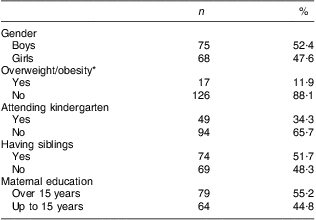
*Defined as ≥85th percentile of BMI distribution according to the WHO Child Growth Standards.
Table 2 presents the average intakes of energy and nutrients measured by the SFFQ and the 24hDR. The SFFQ gave higher estimates of absolute intakes of energy and all nutrients compared with the average of the three 24hDR. The highest differences between intake medians assessed by both methods were observed for vitamin A (63·7 %) and vitamin C (56·8 %). The lowest differences were found for fat (14·0 %), carbohydrate (16·5 %), thiamin (16·7 %) and niacin (17·1 %). We were also interested in whether there were any differences in overestimation of intake because of child's gender. There were no differences between girls and boys in overestimation of intakes of energy and other nutrients by the SFFQ (data not shown). The Spearman rank-correlation coefficient was examined for the intakes from both methods. All of the coefficients were statistically significant (P < 0·001) and ranged from 0·209 for vitamin E to 0·593 for Ca intake. After correction for residual measurement errors all of the correlation coefficients increased, ranging from 0·270 for vitamin E to 0·667 for Ca and riboflavin, with a median of 0·456 (Table 2). The analysis of correlation coefficients showed similar or slightly higher correlations for girls in respect to energy and almost all examined nutrients. The only differences found were for niacin (R de-att = 0·186 for boys and R de-att = 0·523 for girls) and for Ca (with a higher correlation observed for boys (R de-att = 0·632) than for girls (R de-att = 0·580)).
Intakes of energy and nutrients estimated from the semi-quantitative FFQ (SFFQ) and the average of three 24 h dietary recalls (24hDR), differences in intakes between the two methods and correlations of intakes between the two methods (de-attenuated Spearman rank-correlation coefficients, R de-att); caregiver-reported intakes of 3-year-old children, Krakow, Poland
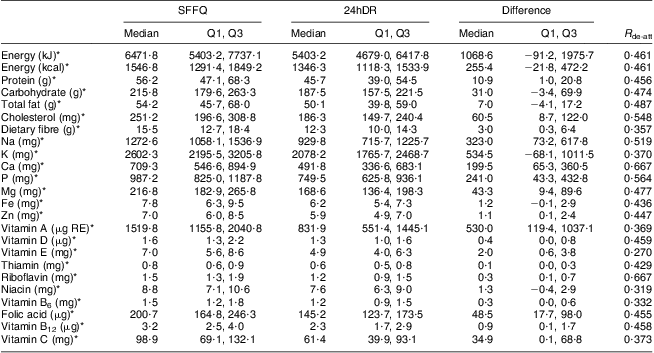
Q1, first quartile; Q3, third quartile; RE, retinol equivalents.
*P value for difference between the instruments (Wilcoxon's test) <0·001.
The Bland–Altman plots for energy and most nutrients showed no systematic error for increasing intakes and the observed differences were both negative and positive (Fig. 1). For the various vitamin intakes, the Bland–Altman plots showed greater differences between the two methods at the highest intakes, with a tendency to report higher intakes from the SFFQ. The level of agreement for energy and most nutrients was classified as good (difference between the two methods ≤1 sd). Fairly good agreement between the two methods was found for Na, Ca, P, Mg, vitamin E, thiamin and folic acid.
Bland–Altman plot of the difference between (a) energy, (b) carbohydrate, (c) vitamin C and (d) calcium intakes estimated with the semi-quantitative FFQ (SFFQ) and the average of the three 24 h dietary recalls (24hDR), plotted against the mean intake of the two methods (——, mean difference; – – –, limits of agreement); caregiver-reported intakes of 3-year-old children, Krakow, Poland
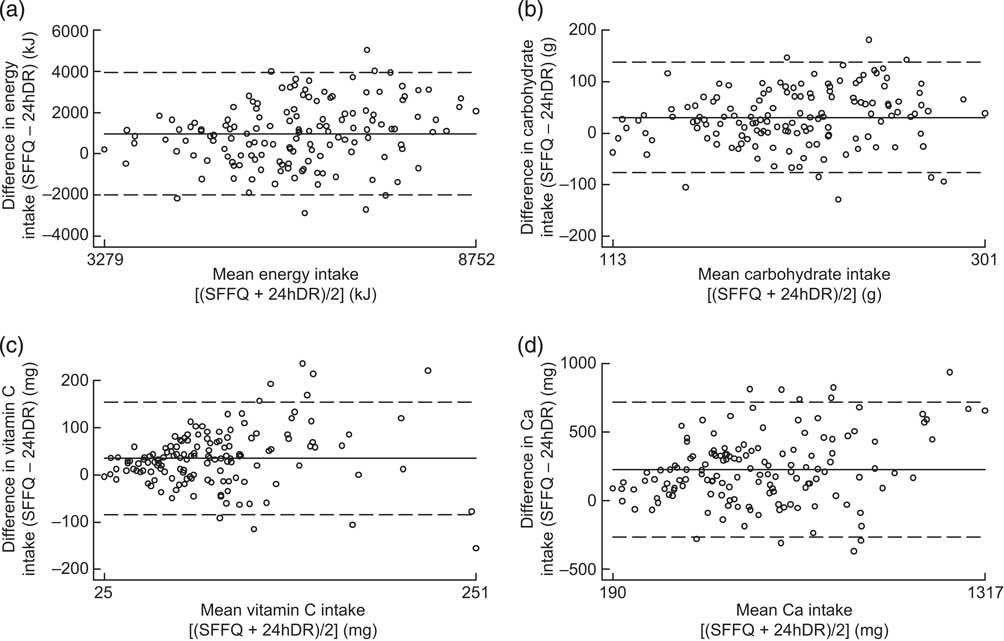
Table 3 shows the ability of the SFFQ to classify the individuals into the same quartile of intake as estimated by the three 24hDR and the misclassification into opposite quartiles. The proportion of children appearing in the same quartile varied from 28·0 % for vitamin B12 to 46·2 % for Ca, and the proportion of children classified into the same or adjacent quartile varied from 69·3 % for thiamin and vitamin E to 84·0 % for riboflavin. On average less than 5·5 % of children were grossly misclassified into the opposite quartile, ranging from 1·4 % for riboflavin to 8·4 % for vitamins E, B6, niacin and dietary fibre. All of the calculated κ w were statistically significant, although they generally showed slight to fair agreement between both methods. Moderate agreement was found for Ca intake.
Classification into quartiles of nutrient intakes calculated from the semi-quantitative FFQ and the average of three repeated 24 h dietary recalls (percentages and weighted kappa (κ w) values); caregiver-reported intakes of 3-year-old children, Krakow, Poland
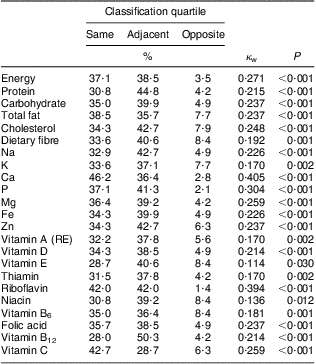
RE, retinol equivalents.
Discussion
To the best of our knowledge, the current SFFQ is the first specifically developed and validated for Polish children. The present SFFQ has been developed to evaluate the habitual diet of 3-year-old children. Irrespective of the method used to estimate food intake in populations, all dietary methods should be validated using a reference dietary method or biomarkers. But there is no ideal standard for dietary assessment; dietary intake cannot be measured with absolute precision in free-living populations. The relative validity of FFQ dedicated to children is usually assessed by comparing their data with weighed food records or 24hDR; validation studies that have used biomarkers as a ‘gold standard’ to evaluate nutrient intakes in pre-school children are scarce and usually refer to a single nutrients( Reference Parrish, Marshall and Krebs 21 , Reference Orton, Szabo and Clare-Salzler 22 ). Other studies estimated only energy intake using the doubly labelled water method( Reference Dutman, Stafleu and Kruizinga 23 , Reference Kaskoun, Johnson and Goran 24 ). As our study population consisted of young children, we decided to use a non-invasive approach by comparing the relative validity of the SFFQ assessment of children's usual energy and nutrient intakes with three repeated 24hDR.
The estimated energy and nutrient intakes were in general higher in the present SFFQ than in the reference method but such overestimation of energy is very often reported in validation studies( Reference Serdula, Alexander and Scanlon 25 – Reference Fumagalli, Pontes Monteiro and Sartorelli 27 ). Also other validation studies of FFQ used among pre-school children have shown that questionnaires usually overestimate nutrient intakes; underestimation is far less frequent and found for single nutrients( Reference Kobayashi, Kamimura and Imai 28 ). A possible explanation is that caregivers may have responded to the same food items more than once, when the child ate the various foods in mixed dishes which include foods from two or more food groups. Another problem is the difficulty to estimate usual serving sizes in FFQ; parents were asked to estimate the average portion size of food which may vary highly due to appetite, etc. When the child ate meals outside the home, for example at kindergarten, this estimation could be even more difficult.
The correlation coefficients calculated for each nutrient intake in the present study were slightly lower than generally reported in other validation studies, but this problem applies to most of the studies carried out among children( Reference Vereecken, Covents and Maes 29 – Reference Andersen, Lande and Trygg 31 ). In our study, the average Spearman rank-correlation coefficient for absolute nutrient intake was 0·364 before and 0·452 after de-attenuation. A weak but still statistically significant correlation was found only for vitamin E. A high correlation (R > 0·5) for Ca, P, Na, cholesterol and riboflavin was identified. The results, in general, are in line with those from other studies; when compared with the correlations from other comparative validity studies of FFQ dedicated to pre-school children, the present SFFQ showed similar or, in some cases, better results( Reference Parrish, Marshall and Krebs 21 , Reference Andersen, Lande and Trygg 31 , Reference Watson, Collins and Sibbritt 32 ).
FFQ are generally used for ranking individuals according to food or nutrient intake rather than for estimating absolute levels of intake. In our study, the children were divided into quartiles by nutrient intake distribution assessed by the FFQ and the 24hDR. On average, 75 % of the children were classified by both methods into the same or adjacent quartile according to their nutrient intakes; the proportion misclassified into extreme quartiles was on average 5·5 %. It appears that by using the SFFQ, it is possible to rank children according to their nutrient intake for most of the investigated nutrients.
The limits of agreement of the Bland–Altman plots indicate wide discrepancies between the two methods used for the nutrient intake estimations. However, for energy and fifteen of the twenty-two nutrients analysed, the level of agreement was classified as good and for seven of them as fairly good. The discrepancies in assessed nutrient intakes can be attributed to the fact that the reference method was based on three consecutive 24hDR, which may not be enough to assess the usual intake for many nutrients as a result of large inter-individual variability( Reference Willett 6 , Reference Huybrechts, De Backer and De Bacquer 33 ). Also, most other validation studies among pre-school children used a 3 d or 4 d period of diet assessment( Reference Parrish, Marshall and Krebs 21 , Reference Kobayashi, Kamimura and Imai 28 , Reference Blum, Wei and Rockett 30 ). Longer observation periods can result in a better estimate of validity( Reference Andersen, Lande and Trygg 31 ). On the other hand, very often performing dietary assessment can alter dietary behaviour; caregivers who are being observed may modify children's diet to a more socially acceptable pattern or to make it easier to record. Therefore statistical adjustment was performed to predict within-person to between-person variability for better estimation of habitual nutrient intakes.
The present questionnaire did not include questions about supplement use. Nutrient content in the usual diet was calculated only on the basis of foods and beverages consumed by children during the past 4 weeks. However, the 24hDR did not include this information either and thus information obtained from both methods is comparable. Further, the sample was a non-random selection from 3-year-old children. The families participating were not recruited specifically for this assessment but were participants in a longitudinal cohort study.
The SFFQ validated in the current study can be a valid instrument to assess the energy and nutrient intakes of small children at the population level. It can be used to make distinctions between children who have high and low intakes of examined nutrients. Because this method is relatively quick and cheap, it can be used in large population studies. Parental report on their child's eating habits is the only way to assess the diet of pre-school children, because small children are not able to recall their diet properly. Due to their age and level of cognitive development, small children may still be unfamiliar with many foods and the names of different types of foods eaten, as well have limited possibility to recognize and recall details from the past. In addition, children's short attention span can be also a challenge to the data collection process as well as the proper assessment of portion size( Reference Willett 6 – Reference Tooze, Subar and Thompson 8 ).
Conclusion
The SFFQ developed for this cohort was found to be a suitable tool for the assessment of dietary intakes of nutrients by small children, especially for ranking children according their nutrient intakes. The presented SFFQ might be a useful tool in epidemiological investigations with a focus on diet as a risk factor for diverse health outcomes.
Acknowledgements
Sources of funding: Baseline data were collected in the study ‘Vulnerability of the Fetus/Infant to PAH, PM2.5 and ETS’, which received funding from the National Institute of Environmental Health Sciences (NIEHS) of the US National Institutes of Health (grant no. 5 R01 ES10165 NIEHS; 02/01/00–01/31/04) and from the NIEHS, the Lundin Foundation and the Gladys T. and Roland Harriman Foundation (grant no. R01 ES010165-0451); Principal Investigator, Professor F.P. Perera; Co-Investigator, Professor W. Jedrychowski. The current part of the study was supported by Jagiellonian University Medical College (grant no. K/ZDS/002416). NIEHS, the Lundin Foundation, the Gladys T. and Roland Harriman Foundation and Jagiellonian University Medical College had no role in the design, analysis or writing of this article. Conflicts of interest: Authors declare no conflicts of interest regarding the submission of the paper. Authors’ contributions: E.S.-T., conception and design of the study, collecting data; A.P., statistical analysis and interpretation of data. Both authors contributed to the drafting, revision and approval the manuscript. Acknowledgements: The authors would like to thank all co-workers from the Chair of Epidemiology and Preventive Medicine, Jagiellonian University Medical College for their help with collecting the dietary data, especially Ryszard Jacek MSc, Marzena Florek MSc, Agnieszka Musiał MSc and Agata Sowa MSc.



