




The “Bread Riots” that broke out in Tunisia on 28 December 1983 lasted barely ten days. Yet, they cost the lives of over one hundred people, according to official figures given by human rights organizations. The riots spread rapidly across the country after initially erupting in the south, in the market of the city of Douz. At the time, the newspapers spoke of riots (ihtijâjât) and militant publications spoke of revolt (intifâda). The narratives told could be inserted into broader chronologies: the history of struggle against neoliberalism;Footnote 1 the end of the reign of independence leader Habib Bourguiba; and the opportunity to consolidate the power of General Zine el-Abidine Ben Ali, who eventually dismissed Bourguiba three years later.Footnote 2 But this revolt's inclusion in the long history of social struggles in Tunisia is rarer.Footnote 3 It is usually seen through the lens of the arrival of Islamist political organizations,Footnote 4 and as indicating their replacement of left-wing forces and organized trade unionism.Footnote 5 This article seeks to put this episode into a new perspective, giving it back its many meanings while trying to understand it as a major turning point for Tunisia.
The “spontaneity” and the dissemination of the revolt tempt us to describe what happened as ephemeral “food riots”.Footnote 6 If we pay attention to the slogans and demands, to the physicality of the demonstrations, we gain a deeper understanding of the political cycle in which this revolt is embedded. Attacks targeting the well-off middle-class neighbourhoods, often seen as collateral damage, suggest a strong element of social conflict, which remains to be interpreted in the context of the withdrawal of redistribution policies and massive urbanization. The aim here is to show how this revolt fits into the repertoire of social struggles in post-independence Tunisia, and, at the same time, show how it contrasts with wider events.
Triggered by price hikes, the revolt was caused by the destabilization of the Tunisian national economy in the wake of global deregulation. More than hunger or poverty, what the demonstrators pointed to was the violation of a tacit social contract. These riots constituted a moment of protest in a context of economic crisis and in the face of a state that was deemed incapable of assuming food-producing responsibilities (hence the Bread Riots). They even affected the middle classes, although the inequalities and tensions within Tunisian society subsequently minimized this dimension as peripheral to the event – both in local memory and in historiography. Arguably, this is one reason why the riots are not an important part of the memory of revolutionary Tunisia, even though they constitute one of the moments when protest action was revived.Footnote 7
Investigating the social context in which the riots broke out has led us to look at evidence from different sources. This article is based primarily on the examination of archives related to urban development plans of the late 1970s and early 1980s. This was in order to discover how it was possible for such a social conflagration to occur in neighbourhoods that were in the process of so-called de-gourbification (or slum clearance),Footnote 8 and had benefited greatly from national and international development aid. In Tunisia, a particularly active group of urban planners had created a collective that was committed to social responses to urban growth, the Groupe Huit. One of the members, Morched Chabbi, deposited his papers at the Tunisian National Archives, where I was able to consult them. In addition to raw material relating to urban planning, including preliminary studies on the sociology and daily life of the neighbourhoods’ inhabitants, the collection includes a number of reports on Tunisia from international institutions such as the International Monetary Fund (IMF) and the International Bank for Reconstruction and Development (IBRD). A few scattered documents were also made available to me at the Urban Rehabilitation and Renewal Agency, created in 1981. In addition, I consulted the national and international press, in Arabic, French, and English, and diplomatic correspondence and reports prepared for the French government. Finally, the testimonies filed with the recent Truth and Dignity Commission (IVD, from the French Instance Vérité et Dignité), and its final report in 2014, made it possible to understand more clearly the viewpoint of the victims of repression and their relatives.Footnote 9
From this documentation, it has been possible to interrogate the nature of what is called the welfare state in a young post-colonial state, along with its collapse. By observing the course of brutally crushed riots that took place over little more than a week, we are able to understand the stakes when the IMF's recommendations are applied in a country such as Tunisia. Urban planning is a rich source of documentation for popular residential areas and their inhabitants, and the observation of these urban districts makes it possible to see what the actual implementation of IMF- and World Bank-backed policies looks like at the local level.
Finally, this article looks closely at how demonstrators from these neighbourhoods developed their own criticisms and responses to the price hikes that took place as a result of structural adjustment policies. The demonstrators are taken as an example of what Partha Chatterjee calls “political society”, as opposed to the more middle-class, state-tied concept of “civil society”:Footnote 10 an apparently unorganized and apolitical group of people who, when provoked, appear to do politics in their own way.
THE RIOT IN CONTEXT
In December 1983, Tunisia had been independent for almost thirty years – just one generation. The events of 1983–1984 had no precedent. When the riots broke out in Douz, politicians tried to apply conventional explanations – political manipulation, especially from Libya, or Islamist conspiracy. It was indeed a revolt that set the whole of Tunisia ablaze. Let us reconstruct how it unfolded according to participant voices that have been retrieved from press documents and the proceedings of the IVD.Footnote 11
Tunisians started to mobilize in anticipation of the government's doubling of the price of bread, which was effective from 1 January 1984. The first casualty of the revolt was a young man aged seventeen, Belgassem Belayeb, who was murdered on 29 December 1983 in the southern town of Douz. Eighty more protestors were wounded on this and subsequent days. On 1 January, a peaceful demonstration was held in the city of Gafsa, apparently initiated by Umar Thabet Qadir, head of the Human Rights League branch there.Footnote 12 The demonstration was blocked by the arrival of heavy police forces. The next day, another death occurred in the Douz region: a twenty-one-year-old farmer who was assassinated by police officers. That same day, the movement reached the city of Sfax, where shops and buses were set on fire. The police opened fire. Twelve people were killed, and more than twenty others were wounded. On 3 January, riots broke out all over the country and particularly in Greater Tunis, where students and young people from popular neighbourhoods rose up. Fadhel Sassi, a political activist and a student, was murdered by the police in the city centre. There were dozens of deaths and hundreds of arrests. The riots continued in the days that followed, when a curfew was introduced, until President Bourguiba announced the suspension of increased security measures on 6 January. Trials were held in May, relating to theft, looting, assaults on private and public property, damage to property (Figure 1), and participation in hostile and unauthorized demonstrations. Hundreds of people in prison were tortured and abused while awaiting trial, and were then sentenced to long prison terms. The sequence of events was therefore short, but very violent.
The ravages in Tunis after the riots (published in the newspaper La Presse de Tunisie, 6 January 1984.

For many of the insurgents, going out on the street that day was a “normal” reaction. Moncef Laajimi, from the Kram, who was not used to protest and state violence, told the IVD that he was astonished at the reaction of the forces of law and order. “We went out into the street, at least 3,000 people. We were unemployed.” They launched a surprisingly gentle slogan: “Bourguiba, you are generous, leave us the bread at 80 millimes.” “The next day, they started shooting at us with real bullets, with a plane above, a helicopter firing.” For Moncef Laajimi, it was all about going out for bread, for the price of bread.Footnote 13 This is also seen in the words of the women who were marching in El-Marsa, some 20 kilometres away from the capital. These textile workers shouted the same slogan: “Bourguiba, you are generous, leave the bread at 80 millimes.”Footnote 14
Ahmed Ben Massoud, from Douz, remembered market day, when the events began. It was a Thursday like any other, a weekly shopping day. Elderly people were talking about the impending price hikes, and they decided to take their concerns to the mayor. But he refused to receive the delegation and sent for the police. Ahmed, a twenty-seven-year-old teacher, was informed of what was happening when he came back home from school. In his account, he insists that his outburst of anger was motivated by the way his elders were treated with disdain for simply and peacefully wanting to express their concerns. That was when the young people got together, sang Humât al hima (“Defenders of the Fatherland”, the national anthem), and gathered to demonstrate: “we didn't really have a culture of protest”, Ahmed added. He was the one who spoke in public to explain what had happened. Tension mounted as the police started to hit people and push them away with sticks. Shots were heard. The next morning, people gathered again. “It was the first time we had experienced such police violence. In opposition, only stones were thrown.” Ahmed was arrested and tortured, and remained in prison for seventeen days. Some of his relatives were injured.Footnote 15
Many other depositions to the IVD confirm this account. They portray a population affected and outraged by measures that impacted family income and purchasing power. The strong presence of women in these movements suggests that it was also a revolt that included housewives and families.Footnote 16 They expressed their indignation peacefully and directly, especially in the early days, calling the government to account at a time when pressure on prices had already worsened.
Other demonstrators told a different story. Jamel Sassi, the younger brother of Fadhel Sassi, who was murdered by the police in downtown Tunis on 3 January 1984, testified to the IVD:Footnote 17
I would like to go back a bit in time to the reign of Bourguiba. Before those days in 1984, there was 26 January 1978, which we lived through. I was eighteen years old, no, sixteen, and we went out, like everyone else, into the streets on Thursday 26 January, for the general strike. My father was then a union representative, one of those who went on strike. This episode destroyed him. I saw him become, he who was always in a suit and tie, a neglected person, with a beard in a mess, dressed in a qashabiyya [a traditional jacket made of wool]. The authorities had given them a one-year work stoppage for their affiliation to the union.
For Jamel, January 1984 was a continuation of earlier struggles, and revenge for the humiliation and degradation suffered by his father. As for the demonstration, it took on a traditional style, taking place downtown. He continues:
On the day of the demonstration, I was on one route and my brother was on another. We met up at Habib Thameur Avenue, approximately towards the “Passage”. We processed. I wasn't a leader, I was young, well, compared with my brother, I was born in 1962, he was born in 1959. We walked towards Rome Street. The police were trying to prevent us from reaching Habib Bourguiba Avenue. They used tear gas and the stick […] We retreated and went towards Athens Street. I met Fadhel again in Paris Avenue. Again, there was gas. The last thing I remember about my brother was that gesture. He carried a purple tissue, he wiped my tears with it, after that I have not seen him again, since that day. Then there was the shooting, people were a little scattered. Some of them ran away, it was a mess. I came back by myself, like many others, I came home. Fadhel didn't come home.
In his testimony, the Bread Revolt, as it is called in Tunisia (in Arabic and French), is portrayed as part of a chronology of struggles; it is not detached from the rest. Jamel and Fadhel are, of course, special cases, being political activists – specifically, left-wing students and high school pupils. However, this account clearly shows that events took place as a continuation of a confrontation with power, as a routine act in which one goes out to demonstrate and then goes home. In Jamel's speech, bread is not at the centre. He states this explicitly:
Bread was not the problem. It was the drop of water that broke the vase. There was a lot of oppression, of misery. Fadhel didn't come home. We were worried, of course. There is this girl, a student from ENIT [the National Engineering School of Tunis], who saw him die on her knees, next to her in this covered Peugeot 404 in which they took him to the Habib Thameur hospital. He told her, don't be afraid, I leave the student movement in your hands.
This testimony, and the special place of this martyr, brings 1984 into the continuum of Tunisian social struggles, in terms of its pattern of events, the involvement of the “student movement”, and in the fundamental aspiration for freedom and social justice (against “oppression” and “misery”).
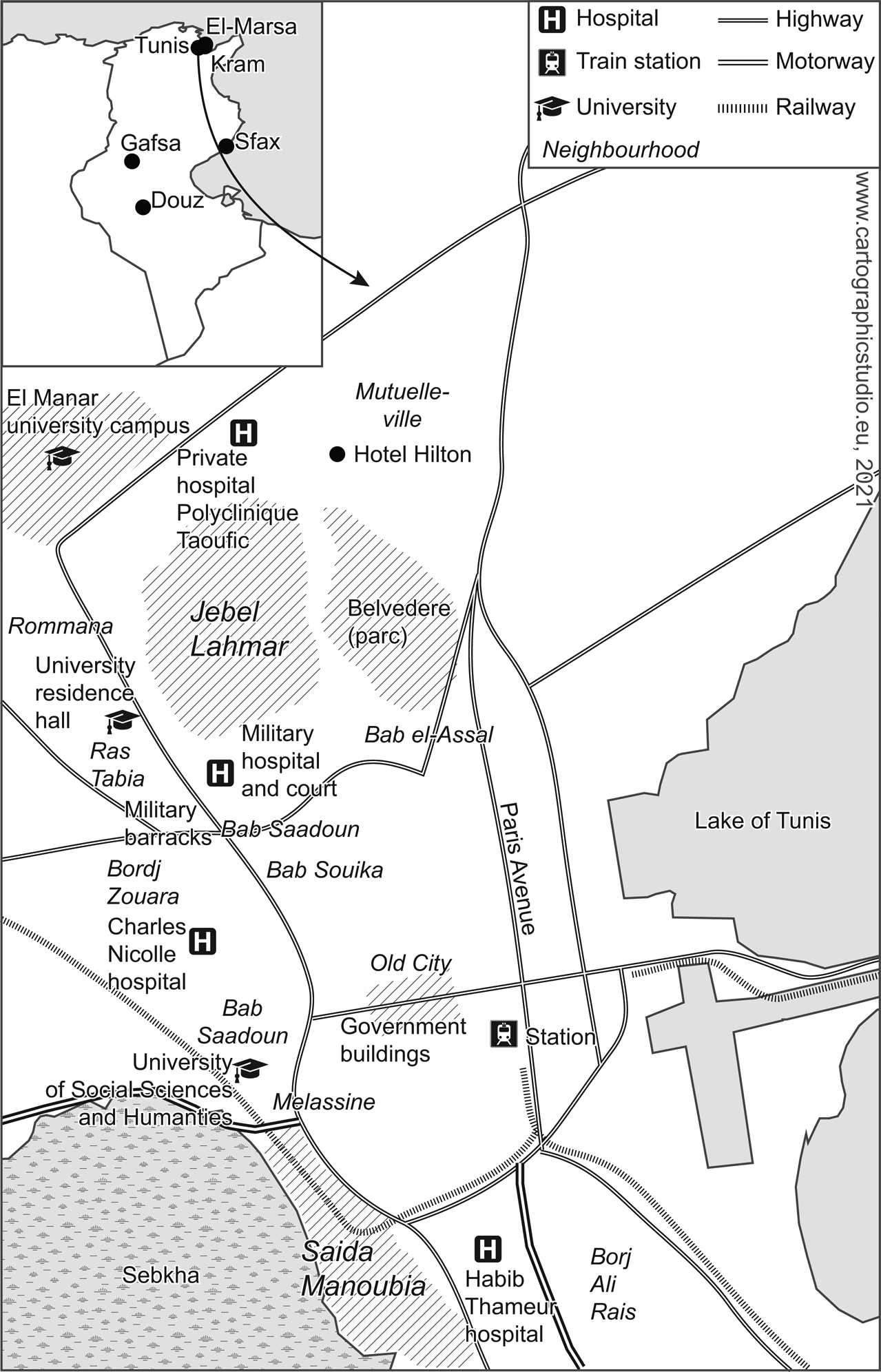
In the rioting, one can read even more narratives, conveyed by the types of action as well as by the slogans that were used. In the crowd, one heard “Power, murderer, is this your policy of openness?” and “We are hungry, and the bread is 170 millimes.”Footnote 18 On 3 January, the revolt started in the popular districts of Tunis, and then reached the city centre. The crowd attacked many symbols of the state, including buses, police cars, and lorries. The two working-class neighbourhoods we are focusing on here are adjacent to privileged or middle-class residential areas (see Figure 2). First, young men from these neighbourhoods marched downtown, where they targeted a number of stores and public property. The account of Anis, from Jebel Lahmar, tells the story:
This time we really made a killing: on Tuesday 2nd, when we left the city, there were a thousand of us in Bordj Zouara, Bab Lakouès, Bab Sidi Abdelsalem. Lots of kids joined us; they ran like rabbits and came to warn us when there were policemen.
At Bab Souika, things started to get rough. The BOPs [Brigades de l'ordre public, Public Order Brigades] charged. And we went wild. Bata [the shoe store] had already burned down. We were tearing down all the signposts and using them to smash the windows. Everything that belonged to the state had to be destroyed. Once hit, the state would necessarily react. We stopped motorbikes, we took petrol in yoghurt pots and wham! we threw it away. The bank in the Kallatine district, the CNEL [Caisse nationale d'épargne logement] […] in passing, we'd break it up, we'd burn it down. We didn't care about money. It's true that some people stole, it's a pity by the way. That allowed Mzali to call us bandits. I saw some of them at Bata's who shouted: “Do you have left foot size 41?” and another one who came back to a TV shop to look for an aerial. On Chedli-Kallala Avenue, at the Party cell, we went upstairs and threw the furniture and TV set out of the window. We went back up to Bab el-Assal. Three cars burned at the Esso kiosk.Footnote 19
The thoughtful nature of these attacks seems obvious, even if we take into account that the interviewee might have taken into consideration the discourse that was expected of him by the journalist: he visibly distinguished himself from robbers, or those who broke things up for fun, but he did not hide the special joy that these moments gave him. We have to rely on the French translation of his words, but the chosen expression “on a fait un malheur” (we really made a killing) captures this feeling well. The rioters created the sense of having choreographed their actions. They wanted to provoke reactions from the authorities, and they targeted the state directly. It may be noted that the bank they attacked was the one that guaranteed and received housing loans as part of urban restructuring plans. It can be assumed that they were familiar with this. Similarly, they pointed to the Party building as representative of the state.
Map of the two neighbourhoods of Djebel Lahmar and Saïda Manoubia, from the reconstruction plans of 1983 (ANT, Fonds Morched Chabbi. Fo. 235 / RHA 716).
Elsewhere, pitched battles against the police took place, in which women often played a central role. “In Mellassine, they distributed sticks, provided stones and sprayed water on demonstrators asphyxiated by tear gas. In Borj Ali Rais,Footnote 20 they attacked buses with stones and shovels.”Footnote 21 Similar clashes could be observed throughout the area, with targeted attacks.Footnote 22 Everywhere public transport was attacked, together with branches of the National Bank of Tunisia, the International Arab Bank of Tunisia, and also youth and cultural centres.
On their way back home, it was the middle-class districts and the external signs of wealth that were targeted; for example, a supermarket was looted in El-Menzah. Demonstrators approached the wealthier neighbourhoods and “[terrorized] the inhabitants barricaded in their houses”, burning cars. Anis continues:
Night was falling and the army started shooting; we all scattered. At the Cité, Footnote 23 we regrouped. But we were not satisfied. So we decided to do something dazzling: burn something big, for example. We went back down in the street. It was a risk. We burned every beautiful car that we came across. Sixteen of them. Pretty good, right? Afterwards, we went to a construction site near the campus, where we dusted off all the equipment. Our goal? To stop the country, until we were heard.Footnote 24
It was therefore on the very edge of their own territory that they attacked, targeting symbols of social wealth, starting with cars, then other goods. Young people turned to their wealthy neighbours, flipping over vehicles, setting up barricades to block traffic.
Events in the Djebel Lahmar neighbourhood are instructive in this respect. Its location made it a place where struggles could converge, as well as it being a front line for street fighting. Djebel Lahmar was on the edge of the Tunis El Manar University. Opposite one of the entrances into the neighbourhood, towards Ras Tabia, was a hostel for female students; the military barracks was only a few hundred meters away. An account transcribed by Jeune Afrique on 18 January allows us to grasp part of what was at stake in a street fight. Jamel, a young man from Jebel Lahmar, relates:Footnote 25
It was the girls from the hostel [near where Jamel lives] who caused the spark. They joined us. We know some of them. I myself was engaged to a second-year student in the department of French. When we left the Cité everyone was with us, including our neighbour, the police officer. You can't imagine how the ululationsFootnote 26 of women electrified us.
He describes a certain atmosphere in which the unanimity of the revolt – perceived and made visible by the cries of the young women and the police officer's lack of opposition – served to legitimize the struggle. He insisted on the links between the men in the neighbourhood and the female students, clearly going against the evidence of a sharp distinction between these two groups.
Next, there were the tactics employed:
You had to get attention right away. What better way to do that than to block the traffic by lighting a fire. We stopped the first bus, emptied it, and then we lit the fire. Of course, at the university hostel, they hurried to lock the doors and windows and to call the BOPs, who came down on us pretty quickly. But, in the meantime, some students had joined us. And we were the ones who caught the BOPs.Footnote 27 The students were at the top of the hill and we were at the bottom. When they came at the students, we chased them with stones, and when they came back towards us, it was the students’ turn to harass them. We wrapped our heads in towels or wet scarves to protect ourselves from tear gas and smoke. We didn't stop until 3:00 in the morning. The girls who had been locked inside the Hostel shouted songs and slogans, and we responded to them. Really, it was a party. The BOPs watched us and beat us up when we bothered them too much. At 11 o'clock we started shouting: “Bread for the hungry, with our blood, with our life, we will avenge you, people.” Well, all the well-known slogans, I mean …Footnote 28
Here, we can see the way in which the struggle of the working-class neighbourhoods was articulated with that of the students, and also the routine of the confrontations with the police, which took on a particularly strong, and even celebratory, dimension. An element of joy arose from the feeling of having fought a battle, and having won it by managing to surround the police and keep their respect.
The rest of the testimony introduced another dimension. For this young man from the shanty towns, the question of the price of bread did not seem to be central either. When questioned by the journalist, Jamel answered by deploying social analysis, fundamentally challenging the idea of hunger riots and giving events a broader dimension of a struggle for social justice. This was expressed in a mixture of articulated political discourse and the convening of “local thugs”, with participants assuming responsibility for their own destiny and not hesitating to resort to violence:
Do I believe in such slogans? It's not important. I'm not really in poverty. Me, my father runs a café, my sister and my two brothers working, we get nearly 700 dinars a month. In the company where I work, the trade union, I don't believe in them. The delegate gets bonuses or benefits. I prefer to fight on my own. In 1977, when I was seventeen years old, I started in this job at 1.5 dinars and then at 2 dinars a week, and it lasted three years. Today I am at 145 dinars a month. From the beginning, I knew how to assert myself. Because I don't fast during Ramadan, the head of department wanted to make me work more than the others. He got my fist in his face. He wanted to fire me, so I spoke a few words to him. “Your daughter Malika, I know her, she's at Carnot High School. If you touch me, I'll give her a treat.” Since then, I've had peace of mind. When I need an advance or a vacation, I talk to my boss. I really have no problem but, frankly, I don't like it when the powerful abuse their power.Footnote 29
Challenging what he sees as a corrupt system in which the most powerful give themselves too many privileges, Jamel builds his own place in the system through violence, threats, or riot. He does not seek to change everything, just to regulate his life. In a way, the revolt as a whole can be read in this way. It is also what the end of Anis's testimony seems to say:
It was obvious that we were going to pay the bill. That the kids in our cités were the ones who were going to die. But you have to sacrifice a little to get more. […] Did Bourguiba back down? No, it's not Bourguiba, it's Mzali. Bourguiba, he rules the country with the majority. And the majority is who? It's the people. We wanted to reach him. We wanted to blow up everything so he'd hear us. He could have crushed us. He preferred to stand in solidarity with us.Footnote 30
Anis claimed the people's victory. The revolt was the price to pay in order to restore justice. It is striking that he uses the metaphor of paying a bill. In the discussion about a “fair price” versus a “true price”, the very existence of the people was at stake. This is what Tunisian government failed to understand in 1983.
NATIONWIDE: FROM PLANNING TO LIBERAL RESTRUCTURING
Independent Tunisia adopted a socialist-oriented economic system in the early 1960s. In 1961, faced with an outflow of capital and a drop in investment, President Bourguiba instructed Ahmed Ben Salah (b. 1926) to impose a national planning policy.Footnote 31 Ben Salah had the goal of “creating an objective mystique” around the plan, which was conceived as a comprehensive collective tool that encompassed not only economic objectives, but also “spiritual and moral activities”.Footnote 32 Such a global undertaking involved transforming the economy, restructuring the social fabric – notably through the establishment of cooperatives – and extending the social transformations known as “modernization”, which concerned not only modes of production, but also lifestyles, and even women's bodies (through family planning and birth control). As Ben Salah expressed it in 1965:
[W]e wanted to break the straitjacket in which we lived. This straitjacket was certainly something we needed to defend ourselves against the spiritual intrusion of colonialism. Yes, we did care about this defence and we were then much more conservative than we are today! […] For we are now against those same traditions that we used to cultivate to protect ourselves against political, moral, and even metaphysical intrusions.Footnote 33
A complete political and ideological apparatus was then put in place, which aroused opposition and contestation, but called for values of social justice, backed by strong belief in progress, and even, at least rhetorically, in democracy and freedom.
The aim was then to “fight against the emergence of new feudal systems”.Footnote 34 A global vision of development was at work, aimed at reforming the foundations of the economy and drastically changing society. Ben Saleh expressed great pride in his policy as early as May 1966: “Tunisian society today has largely got rid of nomadism and tribal divisions to become a homogeneous, modern society, rich in all its nuances and diversity, but where these nuances are not breeding grounds for political or sociological division.”Footnote 35 The model that had been put in place was based on a set of supporting structures built on the school-based meritocracy and on the small-scale property that was supervised by collective units throughout the country. It was firmly oriented towards production and construction, setting up industry that was strongly supported by the state when it was not directly state owned, and was sometimes backed by foreign investment.
The break with Ben Salah and his socialist experiment marked the beginning of the liberal turn of the regime. He was dismissed from his ministerial duties in September 1969, excluded from the Destourian Socialist Party, and stripped of his mandate as a deputy. Accused of having breached the president's trust and of having taken advantage of his poor state of health, he was brought before the High Court of Justice and sentenced on 25 May 1970 to ten years of hard labour.
The system that was put in place in the second half of the 1970s called into question some of Ben Salah's initiatives and relied increasingly on private investment and a policy of major works that especially benefited the middle classes and a new business sector. Later, from the second half of the 1970s, it rested on the financial support of the World Bank and the IMF, which set up structural adjustment facilities. Breaking with socialist tradition, Bourguiba appointed Hédi Nouira (1911–1993), a strong proponent of economic liberalism, who was as enthusiastic about it as his predecessor had been about the planned economy.Footnote 36 Hédi Nouira proposed what he named the “contract of progress” in 1972. The aim was to boost investment through a variety of mechanisms and institutions and to create wealth, all while securing the middle classes’ access to property and public services. This was to be done in particular by freeing up private investment, erasing domestic debt, and implementing a policy of public infrastructure works. He opened up the economy to the outside world by granting tax benefits to companies whose production was exported.Footnote 37 The new Tunisian doctrine was a combination of this entry into capitalism and the persistence of a strong state-led politics. The social welfare policy was then drastically transformed and focused more on the promotion and consolidation of the middle class: the two pillars were access to property and the support of younger people, in order to guarantee social peace and the arrival of foreign capital.Footnote 38
Yet, this liberalism was based on clusters of competitiveness, all of which were located on the coastal fringe, contributing to the dramatic accentuation of territorial and social inequalities. As agricultural development was further neglected,Footnote 39 vast regions (notably in the north-west) were emptied of their inhabitants in favour of the large cities on the coast, such as Tunis, Sfax, and Sousse. The domination of the north-eastern coastal area over the inland regions was reinforced by the regional affiliations of most leaders and ministers, most of whom came from this area. Moreover, a new business class became wealthier, relying on this liberal policy, coupled with widespread corruption and nepotism in the deleterious climate of a seemingly endless reign. The era of liberal normalization took place in a context where President Bourguiba, who had been frail for several years, was prey to multiple plots and intrigues. Disgrace, such as that of Ben Salah, fell easily on those who dared to exceed their function or rank.
The authoritarian state had been in place since the early 1960s, and the High Court of State Security was set up to deal with political trials. Having purged the Arab nationalist movements, then the communist left, at the end of the 1970s, the Ministry of the Interior became particularly interested in the Islamist movement.Footnote 40 Islamist trials began in 1981, while the regime announced unprecedented democratization under the rule of the new Prime Minister, Mohamed Mzali (1925–2010). This resulted in the legalization of a certain number of banned parties, including the Tunisian Communist Party and the Movement of Socialist Democrats, and the subsequent recognition of a “legal opposition”. The Islamist parties, for their part, built their popularity on criticism of the voluntarist and modernizing policy of the Destourian party and its leader, and especially of its cultural secularist side, endorsed both by the Ben Salah era and by Nouira's reforms. Ultimately, Mzali's policies were based on a paternalistic discourse that urged everyone to work hard and to break away from traditions, which were seen as obstacles to development.
The frustration generated by the authoritarianism of the new government and its reforms is perceptible in the student and youth mobilizations that took place during the 1970s.Footnote 41 Many students hailed from the working and lower classes and had benefited from the educational boom of the previous decade. Now, they moved from the status of a privileged postcolonial vanguard of the new nation to that of a dangerous class, whose material benefits were conditional on obedience to an increasingly authoritarian order.Footnote 42 In addition, the country's wage earners and civil servant elites, especially the youngest, felt neglected by an ever more closed and mafia-like regime. This was expressed, among other things, by the massive general strike of January 1978, which was brutally suppressed and included the arrest of trade union leaders.Footnote 43 Although these mobilizations were the target of bloody repression, they remained within the framework of a classic repertoire of social protest. With the “opening” – a word used by the regime for a very light political liberalization in 1981 – the channel of negotiation between these different bodies, and in particular with the Tunisian General Labour Union (UGTT, from the French Union Générale Tunisienne du Travail), seemed to have been relaunched.
In this climate of gradual disintegration of the national unity, which had been inherited from the anti-colonial struggle, pacifying social reforms were attempted in the late 1970s, the effects of which began to be seen when riots broke out in 1983. They were aimed in particular at regulating informal housing on the outskirts of large Sahelian towns and in impoverished city centres, and at improving developing urban areas, roads, electricity and water supply, and sewerage systems. This triggered the policy of “de-gourbification”, the watchword for eradicating “urban wounds” that had become a serious problem for health and public order. The neighbourhoods or cities targeted by these development policies represented major challenges when it came to restoring confidence in human and economic development, as government leaders were aware. Loans were granted by the IMF and IBRD from 1977, as well as by Western countries, to undertake this work and carry out reforms. Relations between Tunisia and the international institutions were excellent. At the same time, consumer prices rose sharply and the situation of the most precarious was worsening. Credits allocated to the Compensation Fund were increasingly large, rising from 8.5 million dinars in 1973 to 259 million dinars in the early 1980s. This increase was largely due to the rise in prices on the world market, but also a result of Prime Minister Mzali's adjustment measures, imposed by the IMF and the World Bank.
AT NEIGHBOURHOOD LEVEL: WHAT PRICES MEANT
“Bread was so cheap that it was wasted” was a phrase that was heard repeatedly in 1983, on the eve of the revolt. A television programme had shown in the weeks before the price rise that bread was being fed to animals. It is said that, on seeing this story, President Bourguiba decided to put an abrupt end to bread subsidies. It appears that the decision to put an end to compensation mechanisms on the prices of basic foodstuffs was taken in the autumn of 1983, and was then discussed with labour and management representatives. It was presented as a way of consolidating finances and as a means of redistribution. At the time, members of the Tunisian government as well as international institutions viewed these subsidies as responsible for the worsening of inequalities because they applied to all equally and not equitably. In addition, the government believed that by freeing itself from this expenditure, it would be able to create a fund for the most deprived. It even promised the trade unions that salaries would be raised. But while the government was still discussing gradual implementation, the president decided that the doubling of the price of bread should be announced immediately, at the end of 1983.Footnote 44
But what exactly are we talking about? Were people starving to death in Tunisia in the early 1980s? The country seemed to be “making progress in the fight against underdevelopment”, with special attention being paid to social programmes, as indicated in a 1980 IBRD restricted report entitled “Tunisia. Social Aspects of Development”.Footnote 45 Yet, the report pointed out that “by focusing social services mainly on those who can pay for them through taxes, the benefits to the poor remain small, though by no means insignificant”.Footnote 46 This was precisely one of the major problems in the implementation of social policy in the liberal Nouira and then the neoliberal Mzali frameworks. The same report stated that absolute poverty affected “no less than one Tunisian in ten”.Footnote 47 The social problems, which were already massive and highly visible in the big cities with regard to housing and sanitation, inevitably became more acute with the liberalization policies.
The key to resolving this problem of aid distribution therefore seemed, for both international experts and the Tunisian government, to lie in an economic orthodoxy whose aim became specifically to combat poverty, but not necessarily inequality, by acting on employment and on prices. The consensus was that the compensation funds mainly benefit the rich. On the issue of prices, it was stated that “[t]he available information indicates that, in relative and absolute terms, the price support programme applied by the Compensation Fund benefits middle and upper income groups over the poor population and the urban population over the rural population”.Footnote 48 In order to achieve adjustments, “transfers and subsidies must eventually be replaced by self-help and productive activities”.Footnote 49 The report therefore recommended that a number of redistributive tools should be abandoned because they were obstacles to achieving the objectives: “housing subsidies, pricing policies, indiscriminate student subsidies, investment incentives that favour high-intensity technologies” were all considered to be obstructive.Footnote 50 New priorities were suggested, including a special effort on housing, but also other programmes that were subsequently set up, aimed at small farmers or small businesses (in particular through the Fonds de Promotion et de Décentralisation Industrielles, a fund for industrial promotion and decentralization that was set up in 1974).Footnote 51
It was on this basis that the negotiations that preceded the price increase were conducted. The trade unions were content to negotiate compensation for low wages, seemingly ignoring the huge proportion of poor people without wages.
The material and moral expectations of the population and their perception of the political situation as they may be read in the revolt focus on the issue of “true prices”. But the government and the World Bank probably did not share the same understanding. For the government, it was a matter of assessing what the compensation funds cost the state and therefore the citizens, then reducing that cost. For the working classes, it was a matter of assessing the fair value of bread and what one gives in return for the right to bread; in other words, the value of one's work and the terms of the unequal exchange between vulnerable workers and a welfare state. In fact, bread did not cost the same for everyone. It became relatively common – at least in the aftermath of the revolt – to note this structural inequality, which cruelly highlighted the main flaws of the liberal policy, which was geared towards the profits of the richest and the consolidation of the middle class in a country where workers’ poverty was still endemic, as was unemployment.
An initial comment must be made about the increase in food prices. It was more significant for large loaves, the basis of the diet of the humblest, than it was for the baguettes of the urban middle classes. It was also very high for the semolina that was used to garnish ordinary dishes, especially in rural areas. To understand the impact of this sharp rise, one must look at the proportion of the budget of the poorest households that was devoted to food expenditure. Statistical studies on household expenditure and a comprehensive survey that was published in 1978 provide a measure of the inequality.Footnote 52 Overall, far from being a country where bread was wasted, at the beginning of the 1980s Tunisia was a country where malnutrition was still predominant, with strong vitamin deficiencies.
Housing was an important part of the state's social policy, but the programmes so far had been mainly property access programmes for the middle classes, carried out by the Société Nationale Immobilière de Tunisie (SNIT),Footnote 53 through lease-purchase programmes.Footnote 54 From 1977 onwards, the state embarked on a policy of integrating informal settlements. After having renounced the violent destruction of shanty towns, which had been a source of tension, it was then necessary, within the framework of the “contract of progress”, to ensure social peace in these long-neglected districts. These operations were carried out within the framework of an urban project agreement that was concluded between the Tunisian Government and the World Bank, ratified on 24 October 1979. Preliminary studies of the development of informal settlements provide crucial information in this regard. We have focused mainly on those concerning part of Greater Tunis, and two areas in particular: the Saïda Manoubia neighbourhood, named after the Sufi saint whose mausoleum is located nearby, on the slopes that descend from the Kasbah towards the Great Sebkha, and the Jebel Lahmar (“The Red Mountain”, now Ezzaïatin) neighbourhood, located between the Belvedere, the Bardo barracks, the El Manar university campus, and new residential areas (see Figure 2).Footnote 55
All these informal settlements were subject to massive development plans in the years 1979–1980, supported by the World Bank at enormous cost.Footnote 56 The brutal implementation of these plans was at the heart of the Bread Revolt. The preliminary rehabilitation studies realized by the urban planners are valuable sources for understanding the lifestyles and tensions at work in these areas. The targeted neighbourhoods were made up of unplanned housing, self-constructions that ranged from rough “solid” housing on agricultural land that had been bought from intermediaries, to shanty towns or precarious constructions that were installed on more or less insalubrious spaces on the edge of Sebkha (see Figure 2),Footnote 57 or on agricultural land. It is indeed in these peripheral urban areas that the effects of the end of subsidy were most felt, as well as in certain rural areas in the north and south of the country. Between 1973 and 1984, out of 3,550 ha of urbanized land, 2,560 ha was occupied by housing, almost half of which was illegal housing.Footnote 58
A number of observations can be made regarding the development plans for these neighbourhoods, and in particular the preparatory documentation that supported them.
The question of settlement density does not seem to have been a determining factor, unless one compares the density of these neighbourhoods with the middle-class neighbourhoods they adjoin.Footnote 59 Jebel Lahmar is located on the edge of one of the most affluent districts of Tunis, Mutuelleville, where ambassadors’ residences and villas with gardens are located. The hill of Mutuelleville is dominated by the modernist silhouette of a Hilton hotel, which borders the Jebel Lahmar district. This district has seen much large-scale construction, such as the Taoufik Private Clinic (the first private clinic in Tunisia, inaugurated in 1979) and the building site (in the 1980s) for the headquarters of the Arab League.Footnote 60 On the other side of Jebel Lahmar, on the road to Bab Saadoun, a housing estate called Rommana provides a perfect example of the policy of access to property designed by the SNIT for the middle classes. Made up of small individual villas, it was being offered in the form of rent-salesFootnote 61 to employees of the national education ministry.
The popular district's footprint in the early 1980s contrasted sharply with the massive villas in leafy neighbourhoods. Nevertheless, the density within neighbourhoods varied greatly; for example, the Jebel Lahmar neighbourhood ranged from 200 to 1,200 inhabitants per km2. This can be explained by the fact that there were some areas here in which housing was not yet abundant, and that more organized and less dense residential areas could be found at the edge of these districts, particularly to the north and along the Belvedere garden.
Another indicator relates to the distribution of household expenditure. It shows the considerable proportion taken up by food expenses, as well as the low level of expenditure on housing and other consumption items. The first step in cleaning up required that the population of these neighbourhoods be connected to the sewerage system and to municipal drinking water. Electricity, gas, roads, and street lighting also had to be installed, and public transportation had to be created or existing lines extended. Connections to all networks had so far been made on an ad hoc basis, with the help of a client-based system in which the “omda”,Footnote 62 and the bigger land vendors,Footnote 63 played an important role.
Far from being completely insalubrious areas, these urban neighbourhoods did not wait for massive state intervention before organizing themselves and allowing more or less legal connection of their dwellings to the public road networks. The same is true for the commercial businesses that set up there, since both districts had many shops and markets. The lack of other facilities was much more obvious, because it was hard to organize them outside the central state. As a result, all these districts were poorly equipped in terms of schools and nurseries, healthcare centres, sports facilities, and other public services.
The consequences of this relative overcrowding and the difficulty of access, as well as the lack of healthcare facilities, can be seen in the figures on diseases, especially among children.Footnote 64 This situation was much more critical in the case of Saïda Manoubia, which can be explained by the fact that the district was built on the edge of semi-marshland, often infested with mosquitoes. In addition, while most of the inhabitants were working people, many were manual labourers, often hired on a daily basis, and there was a very high unemployment rate, especially among young people.Footnote 65
These different elements were at the core of the policy of rehabilitation of already old informal settlements: most of them had begun to be built as early as the 1950s. One can observe the journeys of entire families who moved from impoverished rural areas to these outlying areas,Footnote 66 attracted by the potential of the capital, or in search of better opportunities for their children.Footnote 67 The management of these populations, and in particular the nomads, did not go smoothly or without the implementation of repressive methods, especially in the last days of the French Protectorate.Footnote 68
This rural exodus continued unabated during the decades following independence, in addition to more distant emigration to Europe, the Gulf, or neighbouring Libya. But it sometimes also involved the settlement of Tunisians, who moved from cramped apartments in the city centre to have a piece of land of their own and build a home, which they expected to be a villa,Footnote 69 apparently the aspiration of Tunisian families in the 1980s. Most of the inhabitants interviewed in the early 1980s intended to stay in these neighbourhoods and were slowly building a more sustainable living environment. They wanted to take advantage of the city's services and infrastructure, and they entered the job market (be it formal or informal). These expectations can be read in the replies to the surveyors’ questionnaires. The inhabitants of Saïda Manoubia were at the time primarily worried about connecting to the drinking water system and accessing facilities, rather than land tenure regularization.
Although the housing issue did not seem to produce any specific social movements, it can be assumed from reading the urban planning reports that the neighbourhoods were nevertheless organized to defend their interests. Claude Liauzu observed in 1986 that riots were part of the repertoire of communication that these spaces had established with the authorities. While he deplored the fact that “these practices did not lead to directly political forms, and the local level did not become the basis of an associative life comparable to that born in other regions”,Footnote 70 it is possible to read the events of 1984 as one of the modalities of this political structuring of marginalized spaces. These spaces were socially marginal, made up of the working poor, the vast majority of whom were self-employed; but they participated in the urban and local economy. Over the previous few decades, they had also been developing their own modes of organization and relationships with the authorities in order to provide for the basic needs of the population and to protect the “illegal” activities (relating to the informal economy) that were taking place there. The revolt of January 1984 was perhaps one of the forms that these social movements took, and it is noteworthy that they also occurred in areas that were not abandoned, but were the object of state intervention. What Liauzu failed to see at the time, and becomes clear from the witness accounts already quoted, is that what he called “collective bargaining through riot” was not necessarily based on the absence of law. Rather, it was generated by the accentuation of injustice within the framework of an implicit but established contract with the state.
The implementation of restructuring plans increased financial burdens on families. We do not have any direct data, but it seems clear that connecting to electricity, water, or sewerage increased housing costs. It was specified in the agreements with international organizations that these operations should be entirely financed by the inhabitants (this being a condition of cost recovery). Similarly, the absence or lack of public facilities and services in areas where youth unemployment was endemic determined the perception by young people of their social “value” and whether or not they belonged to the national community.
The government's move towards the “truth of prices”, which had been under way since the summer of 1983, was based in a culture of social negotiation that it was thought had been restored after the social crisis of 1978. It was also based on the feeling that the state had done a great deal for the most modest. The government calculated that it would be able to save money by putting an end to subsidy funds, and that part of the saving (20 million dinars) could be spent directly on the most disadvantaged. This also explains why the UGTT, having negotiated a wage increase, was unable to foresee what was going to explode in December 1983. In this calculation, the place of the weakest, if not completely neglected, was greatly underestimated in terms of the relationship that had been established between them and a state that exercised its authority in different ways in these areas and over these populations – alternating aid plans and strong forms of coercion (especially on the youth, who were accused of banditry or being pro-Islamist). Confronted with this, the forms of resistance developed specific strategies. While children lent a hand to state repression on occasion, in return for payment, in early 1984 they took to the streets to protect the few possessions their families had, or simply to set fires.
In the interplay of relations between society and the Bourguibian government, these fluctuations took place almost systemically, sometimes leading to situations of great violence and revealing the complex relationships that had been established. In this landscape, revolts can be interpreted as political statements made by the people and directed at a dominant elite, as can be clearly recognized through the symbols used.
THE VIOLENCE OF REPRESSION AND THE CONSTRUCTION OF ISLAMISM
The end of the social welfare experiment led by Ahmed Ben Salah was accompanied by two complementary movements: the alignment of Tunisia with the model of a liberal Western economy and the strengthening of an authoritarian and repressive state. The student movements of 1967–1972 were witnesses and victims of this harsher regime. The struggles that marked these years showed the new place of educated youth in the political life of independent Tunisia.Footnote 71 Other forms of protest continued, particularly in the southern part of the country, including border incidents and tensions in working-class towns. These threatened the sovereignty of the country, and also perpetuated internal struggles: at stake was the Bourguibian state and the supposed national consensus.
The “coup of Gafsa” in January 1980 combined all these elements. Nationalists of the Youssefist branch organized a putsch from Libya and stormed the military barracks in the southern industrial city of Gafsa. The demonstrators promoted this botched action on 26 January 1980 as a chance to recall the massacre perpetrated by the Tunisian army two years earlier during “Black Thursday”, bloodshed perpetrated against the workers and students who had mobilized within the framework of the general strike. The Gafsa Coup was described by the authorities as an externally led attempt to destabilize the regime. This episode continued the struggles for power that had shaken the National Movement.Footnote 72 It was also quickly described as a manipulation by Islamists, the regime's new bête noire. These scenarios were echoed in most of the ministries and embassies, which began to see the Islamists’ hand behind every social movement. This rhetoric can be found both in French consular papers and in IMF reports that underlined the risk.
The insurrectional period of 1983–1984 could have ended with the announcement of price restoration, when everyone would have gone home. This is partly what happened after a moment of popular jubilation when people came out of their homes to greet the return to normality. But in reality, although the protests stopped, the repression continued. The scale of the repression makes it possible to recall what was at stake: the true value of bread. In the testimonies heard at the IVD, what is most striking is the violence and the length of the repression that pursued the victims long afterwards – after their release, after the physical torture ended. Many of them never managed to find a job again, and their families were subjected to humiliation and rituals of submission. Jamel Sassi recounts that, every week, his father had to go and sign a paper certifying that his son had not been murdered by the forces of law and order. Repression still persisted in homes and workplaces. The ban on access to a civil service position, or indeed to any kind of job, was sometimes aimed at entire families. The figures vary. According to the League for Human Rights, the riots left 123 people dead and 1,500 injured. The IVD gave significantly lower figures: eighty-nine dead and 938 wounded (including 348 police). The repression did not stop after the riots, nor after the presidential pardon; that did not affect everyone, and was only carried out by Ben Ali after his 1987 coup d'état (amnesty law of 18 August 1988).
The established dialogue between the demonstrators and the authorities resulted in a provisional victory for the demonstrators. Subsequently, a lengthy repressive response was put in place, which went beyond simply bringing the actors of the revolt to their knees. This violence was legitimized through the diagnosis of an Islamist conspiracy and its rhetoric. Mohamed Mzali expresses it bluntly from the outset. The people who were on the street in January 1984 were “the underworld”. His social contempt is unvarnished in his interview with Jeune Afrique, conducted after the events. He describes the participants as “those excluded from society, the unemployed, those who have escaped justice”. Responding to Le Monde on 7 January, he admits that the police were overwhelmed – and claims that the country was not a police state; but states that the slogans heard in the streets were “disturbing”;Footnote 73 “we were certainly expecting some commotion but not real commando operations”. Later, he laments: “Alas! There were also several children pushed into the front ranks of the rioters, using the technique of martyrdom.” Here, Mzali calls up an imaginary that is fuelled by images of children pushed to the front lines in the Islamic Republic of Iran's fight against Iraq.
He stands firm on the background of the “riots”: “Of course, we had to start with the bread; I did it. You have to have the courage to tell the truth to the people. We had it. But there was this political manipulation […].”Footnote 74 In short, he acknowledges a few mistakes in the maintenance of order, and indeed sacked the Minister of the Interior, but he salutes the position of a government that he considers democratic and balanced in the face of the savagery deployed by organized gangs rather than the people. The commission of enquiry he sent out issued its report on 15 March and confirmed this diagnosis.
But the continuation of repression against the actors of January 1984, the worsening of difficulties for the most vulnerable, the decay of a power that was more than ever focused on the “Supreme Combatant”, who was now no more than a puppet agitated by many “courtiers”, determined the management of social problems in the country for a long time. In order to maintain the reign and credibility of the postcolonial power, the fiction of a united nation was kept alive, as witnessed by the scenes of jubilation on 6 January. However, many fractures openly appeared during those few days:
The division of Tunisia into two worlds that ignore each other and now confront each other, the conjunction of two miseries – it would be better to say two “frustrations” – that of the underprivileged countryside and that of the suburbs where the unemployed and idle young people are piled up, has brutally brought about an unknown Tunisia. It is a hard, violent country, which finds its slogans in the class struggle as much as in Khomeinism, which rejects the Tunisia of Bourguiba, humanist and tolerant but also forgetful of social justice, and which believed that the solution to its problems lay in the increase of the gross national product. “Enrich yourself” was the regime's unspoken watchword. “God is great” resounded against him.Footnote 75
The two antithetical slogans seemed to simplify the upcoming confrontation. It can be read differently. January 1984 certainly highlighted the flaws in the Open Door Policy initiated in 1981. The few tolerated parties – and among them the Communist Party – were not represented in the streets, and thus formed a bloc that could be described as bourgeois in the face of the Islamists and the far-left parties, who, while taking care not to claim authorship of the revolt, expressed their support for it. On the political stage, liberalization and democratization appeared for what they were: the mask of a political landscape where real opposition is muzzled and/or repressed.
In the face of this, the consensus of the “advanced” classes (the political and economic elite, but also a large part of the middle class that bought into the state) was constructed as a façade of democracy. On the social level, the revolt attacked the symbols of the state and the goods of the wealthy class as much as those of the middle class: January 1984 was, in the words of Paul Balta, “the great fear of the wealthy”.Footnote 76 But the wealthy were not only the class that had become considerably richer over the past decade: all property owners were designated as the privileged. The authorities wanted to seize power by maintaining pressure and reinforcing repression against the “bad poor”. The middle class, which was initially indignant and subsequently afraid, had to continue to support the government. Social fear transformed into political fear, while social anger was disguised as an attack on the values and identity of modern Tunisia, the country that had built and carried this middle class. The impasses in the educational model and in spatial and generational inequalities were not put at the centre of the debate. Employees, including the most modest, have found themselves increasingly attached to the world of the wealthy, and to the security projected by the state.
The few days of the Bread Revolt were much more than an ephemeral food riot. They were one of those episodes in which we see the disappearance of an implicit social order, alongside promises of progress, hope, and a certain capacity to imagine a society as being open and fluid, or at least allowing forms of meritocracy, whether offered by schools, factories, or small informal trades. The value of bread is less measured by hunger than by the gap, transformed into a divide within a few days, between those who can “be part of it” and those who remain on the sidelines, who build other registers of belonging, other systems of recognition, whether through recourse to violence, religion, or emigration.
I would like to return to Partha Chatterjee's notion of “political society”.Footnote 77 We can ask ourselves, as he does with regard to a certain number of social movements in India, whether what is at stake here is not precisely those who are too often considered to be on the margins, and constitute most of the populated modern world. To say this is not simply to say that those who took to the streets of Tunisia at the end of 1983 were a “silent majority.” Rather, as Chatterjee suggests, they constitute a political force that belongs to a non-continuous and heterogeneous modernity, a political force whose social mainsprings are shifting and cannot be explained solely by the rationality of the state and its economy. Their dialogue with those who govern is undertaken through different modalities: one of these is revolt, but the most frequent is negotiation and the game of clientelism, which, in short, allows the greatest number to live their lives in the “system”, even if they are most often operating outside the law. As he writes, “political society [is] a site of negotiation and contestation”.Footnote 78
When this fragile and always violent link – expressed so well by Jamel's testimony – breaks down, what Chatterjee calls “popular political art” brings into play techniques, new or tried and tested, to recover lost ground.
In the face of this, the state will play its part. It will break with its usual policy of integrating dissident elements to make people believe in change. Another strategy has to be pursued, first in the streets and then more silently in the jails, the neighbourhoods, and the whole territory. The most ferocious repression seen in Tunisia has been connected to designating particular categories as pariahs and dangerous (here, the young rioters or the Islamists) in combination with (re-) building spaces for negotiation and surveillance at the neighbourhood level and showcasing the state's capacity for integration and rehabilitation, especially for the representatives of the middle classes.
There is little doubt that the revolution of 2011 can be read as another such crisis. Its very trigger puts the question of breach of contract back at the centre. Mohamed Bouazizi illegally set up his cart to sell his goods, as usual, on 17 December 2010, but was prevented from ensuring his subsistence in the interstices between the tolerated and the illegal. It was in this gap, and in the humiliation it produced, that the revolution broke out. As with bread, it was not simply a confrontation, or a discussion about a corrupt system (although this was also a central issue), but a political statement, from the working classes, on the meaning of social justice. The dignity that was demanded included possible access to the spaces between the legal and the (politically and economically) represented, in the very place where many of the world's people live. The revolt of 1983–1984 was not a revolution, but it played out a scenario that could have led to very deep changes in society and politics. Instead, the Tunisian authorities of the time, while playing the game of liberalism for a few years, were reinforcing their complex populist and authoritarian strategies to prevent another expression of the politics of the oppressed.


 Open access

