




Introduction
Black henbane (Hyoscyamus niger) is an extremely poisonous plant species that can also be used as a medicinal or psychoactive drug. It is a ruderal species, preferring dry, nutrient-rich natural and anthropogenic habitats on disturbed soils (Weeda et al. Reference Weeda, Westra, Westra and Westra1988: 187). Macrofossils of black henbane are found in numerous archaeological features in north-western Europe from the Neolithic onwards (e.g. Otte & Mattonet Reference Otte, Mattonet and Brandes2001; Herbig Reference Herbig, Stobbe and Tegtmeier2012; RADAR, 2018 data). Due to the occurrence of black henbane as a weed in and around settlements, it is notoriously difficult to interpret the significance of these finds, although some archaeological evidence does suggest that its psychoactive properties were understood and exploited by people (e.g. Knörzer Reference Knörzer1965; Penz et al. Reference Pentz, Baastrup, Karg and Mannering2009; Herbig Reference Herbig, Stobbe and Tegtmeier2012).
The recent (2017) discovery of a sheep/goat bone that had been hollowed out, sealed on one side by a plug of a black material and filled with hundreds of black henbane seeds provides an opportunity to gain new insight into the historical use of this species. Bioarchaeological analysis of the bone, which was found at the Roman rural site of Houten-Castellum in the Netherlands, allows us to assess the different interpretations of black henbane within this region and the wider Empire. In this article, we explore Roman-period finds of black henbane from the Netherlands and descriptions of this species in Classical texts, its occurrence and possible uses. We consider the bone container from Houten-Castellum, its context and the results of its analysis within the broader argument for the intentional use of black henbane in the past.
Black henbane: weed, drug or medicinal plant?
Black henbane is indigenous to Europe and Asia and belongs to the Solanaceae family—the nightshades. Nowadays the species is scarce in the Netherlands, but it may be encountered in ruderal habitats—locations where the soil is disturbed and nutrients are added by the action of humans, animals, water or erosion (Weeda & Schaminée Reference Weeda, Schaminée, Schaminée, Weeda and Westhoff1998: 247–54). The natural habitats of this plant species are, for example, river areas and coastal zones where it is mainly found on dry, calcareous and very nutrient-rich sand and clay soils (Weeda et al. Reference Weeda, Westra, Westra and Westra1988: 187). Black henbane also thrives in settlement areas, especially on dunghills and in nutrient-rich locations in vegetable gardens.
The seeds of black henbane are regularly found in archaeological contexts in north-western Europe. The oldest finds are associated with the Bandkeramik culture (c. 5500–4500 BC) (Knörzer Reference Knörzer and Beyer1998; Herbig Reference Herbig, Stobbe and Tegtmeier2012; Tegel et al. Reference Tegel, Elburg, Hakelberg, Stäuble and Büntgen2012). It is possible that these first farmers brought this plant species with them, either intentionally or unintentionally. Black henbane is a ‘weed of cultivation’, it grows in the favourable conditions of cultivated land and its seeds may be harvested and sown unintentionally, effectively migrating with farming communities. This makes it particularly difficult to prove intentional use of the plant when it is found at archaeological sites; seeds may have accidentally been harvested and stored or entered archaeological features when plants grew in settlements. Herbig (Reference Herbig, Stobbe and Tegtmeier2012) suggests that black henbane was already used by people in the Bandkeramik culture for its psychoactive properties. Evidence for this may be seen in the large numbers of black henbane seeds found in wells in Sachsen, Germany (at the archaeological sites of Schkeuditz-Altscherbitz, Brodau, Dresden-Cotta, Eythra and Leipzig-Plaußig), and the co-occurrence of other utilitarian plant species, for example vegetables, artisanal and medicinal plants (Herbig Reference Herbig, Stobbe and Tegtmeier2012: 153), in these wells.
In the Netherlands, black henbane has been found sporadically from the Neolithic onwards and is found at many Roman sites (see online supplementary material (OSM) Tables S1 & S2 for further details and references). Most of these sites are located in the Dutch river area and the Meuse valley, areas in which the environment reflects the optimal growing conditions for the species nowadays. Often, one to several dozen seeds are found as part of an assemblage of species that would otherwise be expected in a settlement location. Occasionally, individual or a small number of charred black henbane seeds are found in samples containing cereals and arable weeds. In these cases, it is possible that black henbane grew on the edge of arable fields and thus made its way into charred threshing waste.
To try to distinguish between intentional use of black henbane as a medicinal or psychoactive drug and its natural occurrence as a ruderal, three approaches are taken. First, we look at the archaeological contexts in which henbane is found. Finds from inside containers, in hospital contexts or graves, especially if the number of seeds is large, are considered indicative of intentional use by humans. Second, we consider other artefacts within these contexts; recovery of black henbane together with ‘exceptional finds’, for example in features with abandonment offerings, may also suggest intentional human use. Third, following Herbig (Reference Herbig, Stobbe and Tegtmeier2012), we catalogue the presence of cultivated plant species or useful wild plant species within the same contexts as black henbane. Frequent co-occurrence of species may indicate intentional use by humans.
With the exception of an inflorescence—the complete flower head, including stems, stalks and seed pods—found at Houten-Castellum (see below), all finds of black henbane from the Roman Netherlands are waterlogged or charred seeds. The difficulty of the third approach is that many wild plant species with medicinal, symbolic or artisanal uses could have been common in areas surrounding settlements. Therefore, we compare the finds of black henbane with other useful plant species that are relatively uncommon in archaeobotanical assemblages in the Netherlands: deadly nightshade (Atropa bella-donna, medicinal/psychoactive), black horehound (Ballota nigra, medicinal), common St John's wort (Hypericum perforatum, medicinal), motherwort (Leonurus cardiaca, medicinal), white horehound (Marrubium vulgare, medicinal), catmint (Nepeta cataria, medicinal), dyer's rocket (Reseda luteola, artisanal), wild mignonette (Reseda lutea, medicinal) and vervain (Verbena officinalis, medicinal, symbolic). While black horehound, common St John's wort, dyer's rocket and vervain grew or were grown in the Netherlands prior to the Roman period, there is no evidence for white horehound and catmint. Deadly nightshade, motherwort and wild mignonette seem to be Roman introductions that subsequently survived independently (see OSM2 & OSM3). We also looked at herbs that were introduced to the Netherlands in the Roman period: dill (Anethum graveolens), coriander (Coriandrum sativum) and rue (Ruta graveolens). Both dill and coriander are interpreted as medicinal plants in the Roman hospital at Neuss (Knörzer Reference Knörzer1965) but were also used in the Roman kitchen. Rue is also mentioned as a kitchen herb and medicinal plant in classical texts (Apicius for example 3.9[87], 8.8[386], 9.1[402]; Vehling Reference Vehling1977; Dioscorides, De Materia Medica 5.42; Osbaldeston & Wood Reference Osbaldeston and Wood2000; Pliny the Elder, Naturalis Historia 24.90; Jones & Andrews Reference Jones and Andrews1956). After their introduction, these species were probably cultivated in vegetable gardens. Another cultivated species which is known as a food plant and medicine is the opium poppy (Papaver somniferum) (Bakels & Kuijper Reference Bakels, Kuijper, Brinkkemper, Deeben, van Doesburg, Hallewas, Theunissen and Verlinde2006: 12).
Meaning of black henbane as a medicinal plant
The Greco-Roman physician Dioscorides names three types of henbane: white, yellow and black, of which the latter two cause delirium and sleep (De Materia Medica 4.69; Osbaldeston & Wood Reference Osbaldeston and Wood2000). The black type probably represents black henbane and the white and yellow could relate to white henbane (Hyoscyamus albus). According to Dioscorides, white henbane is best for cures and the black should be avoided due to its stronger effects. Henbane seeds can be made into a juice for curing all kinds of pain, mucus and disorders of the womb, while the leaves can be applied to the body to soothe pain or be used in a decoction to cure fever. But when boiled like vegetables, the leaves can cause heavy disturbance of the senses (De Materia Medica 4.69).
The Roman writer Pliny the Elder names four kinds of henbane in his Naturalis Historia (25.17; Jones & Andrews Reference Jones and Andrews1956). Among these, one is identified as having black seeds and purple flowers in contrast to the more common white kind. Pliny warns that all kinds cause insanity and giddiness but a white variety which grows by the sea is most used ‘by medical men’. Juice extracted from the stem and leaves of the plant can be used to remedy chest complaints such as coughs—though the fume of burning henbane may also help joint ailments, gout and tendonitis (Naturalis Historia 22.58, 26.15, 26.64–66; Jones Reference Jones1951; Jones & Andrews Reference Jones and Andrews1956). Chewing henbane root with vinegar is suggested as a remedy for toothache, while the root in an ointment alleviates pains of the womb (Naturalis Historia 25, 105, 26.90). A honey-wine with asses’ milk and the seeds of anise and henbane helps against flatulence and shortness of breath (Naturalis Historia 20.73) and juice obtained from the seeds may be used as an emollient (Naturalis Historia 23.49) or poured in the ears to cure earache (Naturalis Historia 25.103), but Pliny warns this deranges the brain. In fact, he finds the drug dangerous in any form. He notes that drinking wine with four or more leaves was believed to bring down fever, but paradoxically there were also remedies for those who had taken this drink. Thus, Pliny concludes that henbane was both a poison and a remedy (Naturalis Historia 25.17).
In Plutarch's works, henbane is mentioned as a drug or poison incidentally. In Parallel Lives it is noted as one of the poisonous plants cultivated and studied by the Greek king Attalus III (Lives, Vol. IX. 20.2; Perrin Reference Perrin1920). An extract from Moralia describes the effects of henbane:
that disturbance which it raised in those that drink it is not so properly called drunkenness as alienation of mind or madness, such as hyoscyamus and a thousand other things that set men beside themselves usually produce (Questiones convivales III.II.2; Goodwin Reference Goodwin1878 vol. 3: 267).
In medieval texts, magical or ritual properties are ascribed to black henbane alongside its medicinal function. In their compendium of ritual plants in Europe, De Cleene and Lejeune describe (post-)medieval sources in which the plant is used to evoke rain, summon demons and attract game. It is also noted as an ingredient in witches’ potions because of its psychoactive and hallucinogenic properties (De Cleene & Lejeune Reference De Cleene and Lejeune2000: 214–15).
It can be concluded therefore that henbane was used as a medicine, and that the dangerous side effects of its use were known, in the Roman and Greek worlds. Although we cannot be certain which varieties were recognised, Pliny cautions that all kinds produce similar effects. As black henbane is the only species that grows in north-west Europe, we surmise that this was the primary species used in this region.
Context and materials
The archaeological site of Houten-Castellum reveals the remains of a rural settlement in the central Netherlands (Figure 1), which was inhabited from the Early Iron Age (sixth century BC) to the Roman period with a hiatus in the first century BC (van Renswoude & Habermehl Reference van Renswoude, Habermehl, Sinke, van Renswoude and Habermehl2017). The site consists of a residual channel containing settlement refuse and intentional deposits. The Iron Age structures consist of pits, wooden fences and bridges and a ritual enclosure. From the Early Roman period, remains of one or two byrehouses per phase are present on the western bank of the channel but the site seems to have been abandoned by the end of the second century AD (van Renswoude Reference Habermehl, van Renswoude and Habermehl2017: 102–38). The settlement was situated in a dynamic, wet landscape, in which the layout of the channel and gulley systems changed from time to time.
Map showing the location of the Castellum site in the municipality of Houten in the Netherlands (after van Renswoude & Habermehl Reference van Renswoude, van Renswoude and Habermehl2017: fig. 1.1).

The site is unique both because of the long period of occupation and the large quantity of finds—including approximately 207 000 pottery sherds, 1400 metal objects and 86 000 animal bone fragments (Groot & van Haasteren Reference Groot, van Haasteren, van Renswoude and Habermehl2017). Most of the finds come from layers within the residual channel, which can often be dated accurately. Due to the waterlogged conditions, the preservation of organic material is excellent. Houten-Castellum is likely to have been a self-sufficient agrarian community, probably producing a surplus of food in the Roman period. From the earliest phase of the Roman period, the inhabitants were able to tap into military and civilian trade networks, which brought pottery, brooches and stone from regions including the Rhineland, the northern and western Netherlands, England, the Eifel and the Belgian Ardennes (Boreel Reference Boreel, van Renswoude and Habermehl2017; van Renswoude Reference Habermehl, van Renswoude and Habermehl2017).
Seeds of black henbane were present in botanical samples from two pits and one waterhole from the Middle Iron Age in Houten-Castellum and in a pit and a pot found in the residual channel from the Roman period (Kooistra Reference Kooistra, van Renswoude and Habermehl2017: 753). Despite its presence, these samples give no clear indications for human use or manipulation of the plant. Two other finds of black henbane do, however, suggest intentional use.
Within an enclosure ditch, which bordered the yard of two subsequent or simultaneous Roman byrehouses, a basket or fish trap was placed upside down together with four complete handmade cooking pots and an inflorescence of black henbane (see Figures 2, 3 & 4; Habermehl Reference Habermehl, van Renswoude and Habermehl2017: 407; van Renswoude et al. Reference van Renswoude and Habermehl2017: 953–6; Kooistra Reference Kooistra, van Renswoude and Habermehl2017: 755–9). This find, which was dated to AD 90–110 through ceramic typology, is interpreted as an abandonment offering.
Excavation photograph of a deposit within the enclosure ditch containing a basket, pots and black henbane (lower arrow) (reproduced from van Renswoude et al. Reference van Renswoude and Habermehl2017: fig. 20.12).

Details of the black henbane inflorescence from the enclosure ditch deposit, pictured as it was in the field (top) and post-excavation in the lab (bottom). White circles mark the concentrations of seeds from the fruits and arrows indicate the remains of the stem (images reproduced from van Renswoude et al. Reference van Renswoude and Habermehl2017: fig. 20.12; Kooistra Reference Kooistra, van Renswoude and Habermehl2017: fig. 16.5).

Locations of the finds of black henbane within the Roman site of Houten-Castellum, AD 40–120. A) higher bank; B) lower bank; C) older gulley; D) pits phase 7; E) pits phase 8; F) ditches phase 7; G) ditches phase 8 (after van Renswoude Reference Habermehl, van Renswoude and Habermehl2017: fig. 6.21).

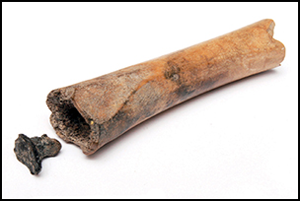
During the analysis of faunal remains from the site, the diaphysis of a sheep or goat femur was found with a plug of black material inserted into one end. When this plug was removed, the shaft was found to contain a large number of seeds that were identified as black henbane. It was not clear straightaway whether the plug was an intentional way to close the cylinder and/or whether the cylinder had been worked. We therefore had the plug analysed by gas chromatography-mass spectrometry (GC-MS), infrared spectrometry and electron microscopy.
Results of analyses and interpretation of black henbane finds
The bone object containing black henbane seeds
The bone cylinder is the left femoral diaphysis of a sheep or goat. Under magnification, it is clear that the bone fragment (72 × 16mm) was worked at both ends. Polishing observed on the middle section may have occurred during handling of the bone (Groot & van Haasteren Reference Groot, van Haasteren, van Renswoude and Habermehl2017: 712–13). The distal end of the femur was closed by a plug of a black material that was inconsistent with soil (see below). Traces of working on the bone cylinder and the fact that it was intentionally closed at one end indicate deliberate use of the bone as an object. The metaphysis of the femur, where the bone widens to form the knee joint, would have provided a natural closure to the shaft, but the internal bone structure is very porous here. Instead, this area was hollowed out and the plug was inserted into the bone. There is no evidence that the bone cylinder was closed at the other end but it is possible that a perishable material such as leather or textile was used. The hollow chamber inside the bone is approximately 59mm long with a diameter of 9mm, allowing a rough estimation for volume of 3.75cm3.
When the bone was cleaned during zooarchaeological analysis, the plug fell out and it was discovered that the bone contained a large number of waterlogged plant seeds (Figure 5). Approximately two-thirds of the seeds were lost in the process, but the remaining sample allowed a botanical identification as black henbane. During the archaeobotanical analysis, 382 seeds were counted with a volume of approximately 0.35cm3. No other plant remains were found in the bone. The cylinder probably originally contained a little over 1000 seeds. If completely filled, it may have contained as many as 4000 seeds.
A) The bone cylinder and plug (reproduced from Groot & van Haasteren Reference Groot, van Haasteren, van Renswoude and Habermehl2017: fig. 14.14B); B) black henbane seeds (photograph by BIAX Consult).

Excavation records indicate that the bone object was found in a water pit dated to AD 70–100 based on the typology of ceramics and a wire brooch included in the deposit (Figure 4; van Renswoude et al. Reference van Renswoude, van Renswoude and Habermehl2017: 1089–92). The pit also contained the partial skeleton of a cow (Groot & van Haasteren Reference Groot, van Haasteren, van Renswoude and Habermehl2017: 692). Higher up in the fill of the pit, three fragments of quern stone were found, two of which came from associated upper and lower halves (Boreel Reference Boreel, van Renswoude and Habermehl2017: 658). These have been found together with a dog's skull. Because these objects are placed higher up in the fill of the water pit, when it was out of use, they have been interpreted as an abandonment offering (van Renswoude Reference Habermehl, van Renswoude and Habermehl2017: 136). Finally, a horse appears to have been buried in the top fill of the pit during the second century—based on stratigraphy and ceramics. The skeleton was incomplete and butchery marks were present on some of the bones (Groot & van Haasteren Reference Groot, van Haasteren, van Renswoude and Habermehl2017: 692). While the two partial skeletons with butchery marks may represent food remains, their occurrence in combination with several unusual finds suggests that they, too, were offerings.
The material used for the plug was identified as tar by Dr Kubiak-Martens (BIAX Consult). To determine the species of tree, the plug was analysed by Professor Langer at the Adam Mickiewicz University in Poznan, Poland (see OSM1 for the full report). Results of GC-MS showed that both ends of the plug were almost identical. A sample from the flat outer part of the plug contained the highest proportion of organic material and was further analysed by infrared spectrometry and scanning electron microscopy with energy-dispersive x-ray spectroscopy (SEM & EDS). The presence of the diagnostic biochemical marker betulin indicates that the plug consists of birch-bark tar (Figure 6). Also identified were alkaloids including hyoscyamine—characteristic of black henbane—and fatty acids from oily plant seeds, which could also derive from black henbane.
Results of gas chromatography-mass spectrometry (GC-MS) analysis of a sample of the plug (upper graph). The lower graph shows the signal of betulin, a biochemical marker diagnostic for birch-bark tar. Please note that the x-axis is different for each graph (images reproduced from Langer 2018 (OSM1)).

Birch-bark tar has been used since the Middle Palaeolithic in the hafting of tools and the repair and waterproofing of ceramics, and a recent paper corroborates its use in the Roman period (Regert et al. Reference Regert2019). Analysis of a decorative black substance on bone hinges from France and Switzerland with direct inlet-mass spectrometry and GC-MS revealed that birch-bark tar was present in 49 of 52 samples. Other Roman-period instances of use are known from Britain, Denmark and Norway (Regert et al. Reference Regert2019). Birch tar was also found on the rim of Gallo-Roman pottery from the sites of Kluizendok, Aalter and Blicquy in western Belgium, where it was probably used to seal these pots (Oudemans Reference Oudemans2009). Our find attests the use of birch-bark tar in a Roman domestic context in north-western Europe.
There are two possible interpretations of the bone cylinder: a pipe or a container. The first interpretation was suggested by Professor Langer in his report on the analysis of the birch-bark tar plug (see OSM1). He interprets the lower organic content of the portion of the plug that was inside the bone compared to the external part of the plug, as evidence that the part inside the bone was heated to a higher temperature than the part outside. This could have occurred in one of three ways: 1) the bone cylinder was heated from the inside; 2) heat was applied to the outside of the bone along the diaphysis, but not too close to the distal end and the outside of the plug; or 3) heat was applied to the smaller part of the plug before the larger flat piece was attached (i.e. before the plug was inserted into the bone).
The darker discolouration of the bone around the metaphysis could suggest the heating of the outside of the bone cylinder (Figure 5), but this may also be caused by natural soil processes and does not necessarily reflect burning. In fact, many bones from waterlogged conditions at this archaeological site show similar black marks and streaks. The seeds are waterlogged and do not show evidence of charring so are unlikely to be the remains of pipe use, unless the pipe had been filled ready for its next use before deposition. Even if that were the case, there are a lot of seeds considering how potent the plant is supposed to be. The deviating design of the bone object compared to other known pipes and the fact that it has only one opening also argue against its use as a pipe. It is possible that the object was not a pipe for smoking but was used to heat the seeds gently to release vapour that could then be inhaled, as described by Pliny (Naturalis Historia 26.15; Jones & Andrews Reference Jones and Andrews1956). Pipes of any kind are, however, extremely rare in Europe before the arrival of tobacco; we found only one example, from Bronze Age Germany (Rind Reference Rind1994).
The alternative interpretation is that the bone cylinder was used as a container for the black henbane seeds. It was permanently closed on one side by the birch-bark tar plug and on the other side it may originally have been closed by some perishable material that has either been removed or has not been preserved. The large number of waterlogged seeds would fit with the interpretation of this find as a container and its contents.
Co-occurrence of black henbane with other medicinal plants
A few other archaeological finds strongly suggest a medicinal or hallucinatory use of black henbane. Until the Roman period, we have little archaeological evidence for the cultivation or medicinal or hallucinatory use of this plant (see OSM2 Table S1a). In the hospital of the first-century AD Roman fortress in Neuss (Novaesium), 128 charred seeds of black henbane were found in association with a number of other medicinal plants: fenugreek (Trigonella foenum-graecum), vervain, common centaury (Centaurium erythraea), common St John's wort, dill and coriander (Knörzer Reference Knörzer1963, Reference Knörzer1965). This strongly suggests that black henbane was known and used as a medicinal plant in the Roman Rhineland.
Black henbane seeds—probably in a leather purse—were found together with a metal ‘wand’ and a box with small animal bones in the grave of a female individual buried at the ring fortress of Fyrkat in Jutland, Denmark, c. AD 980. The woman was believed to be a vølva, a seeress, who used black henbane for hallucinatory purposes (Pentz et al. Reference Pentz, Baastrup, Karg and Mannering2009). Finds of black henbane from medieval hospitals are also known from Scotland (Soutra Hill, Edinburgh; Moffat Reference Moffat1992) and Finland (Turku; Lempiäinen Reference Lempiäinen1992).
Examination of archaeobotanical data shows that black henbane, the nine possible medicinal/useful wild plant species and the four cultivated kitchen herbs/medicinal species, are found at 83 Roman-period sites in the Netherlands (see OSM3). Black henbane is found at 65 of the 83 sites. The other species are found in combination with black henbane more often than they are found without it. Black henbane occurs with at least one of the other species at 42 sites. At 23 sites black henbane occurred without any of these other species.
The pattern revealed by these data suggests that black henbane and other wild species with possible medicinal uses did not always grow naturally in and around human settlements. Deliberate cultivation is strengthened when species are found outside their natural habitat, such as at the Roman site of Hoogeloon-Kerkakkers. Here, four plant species that prefer calcareous soils—black henbane, vervain, motherwort and black horehound—grew in the acidic to neutral sandy sediments. The latter species is not mentioned in Roman texts but later historical sources do mention its medicinal qualities (Kooistra et al. Reference Kooistra, Troostheide, van Beurden and Kubiak-Martens2013: 22–25).
The wild plant species with a possible medicinal or other use, including black henbane, whose presence was investigated for this article, usually grow in divergent habitats. It is possible that they ended up in anthropogenic features naturally, as many other wild plant species do. Nevertheless, we cannot exclude the possibility that there is a connection between the species, related to the possible medicinal use of black henbane and the 13 other species. In this case, these species may have been cultivated in vegetable gardens for their possible application, though for now this remains a hypothesis that requires further testing.
Discussion
Interpretation of archaeological finds of black henbane is not straightforward because the plant can grow naturally in and around settlements. The discovery of a bone container filled with a large quantity of black henbane seeds from a Roman site in the Netherlands is a convincing case for the intentional exploitation of this plant. While the bone object could be a pipe used for smoking black henbane, the overall design of the cylinder and the large quantity and uncharred state of the seeds speak against such an interpretation.
Based on this and examination of the archaeobotanical record for the Roman Netherlands, we suggest that finds of black henbane can be interpreted as evidence for human (medicinal or hallucinogenic) use if they fit one of the following categories:
1. A substantial volume of remains in a closed container, in a burial or other special context (e.g. Houten, Fyrkat);
2. Recovered from a hospital context (e.g. Neuss, Edinburgh, Turku); or
3. Deposited together with other potential medicinal or useful plant species.
Black henbane at Houten-Castellum fits the first category in two ways. First, the seeds were found in a container. Second, the context of the find is considered special because of the combination of items within the water-pit deposit and its interpretation as an abandonment offering. This fits with other special finds from wells in the Roman Netherlands, which are suggested to relate to lifecycle rituals (van Haasteren & Groot Reference van Haasteren and Groot2013). A second deposit at Houten-Castellum, containing a black henbane inflorescence, is also interpreted as an abandonment offering. While we cannot exclude the possibility that the plant grew in the vicinity of the enclosure ditch and entered the deposit through natural processes, it seems too much of a coincidence to find black henbane in two contemporaneous abandonment deposits.
Identification of concentrations of black henbane seeds in the grave of a Viking-Age seeress (Penz et al. Reference Pentz, Baastrup, Karg and Mannering2009), the Roman hospital at Neuss (Knörzer Reference Knörzer1963; Reference Knörzer1965) and medieval hospitals in Scotland (Edinburgh; Moffat Reference Moffat1992) and Finland (Turku; Lempiäinen Reference Lempiäinen1992) also strongly indicate the intentional use of this plant by humans.
As such contexts are rare, we investigated the occurrence of black henbane in combination with other possible medicinal plants. Within the Roman Netherlands, black henbane is found in combination with one to eight other species with a possible medicinal use at 42 archaeological sites. More research is needed to test whether this combination is accidental or intentional.
Weak indicators of human use include signs of charring and large concentrations of seeds. Herbig (Reference Herbig, Stobbe and Tegtmeier2012: 154) argues that charred seeds probably came into contact with domestic fires, which strongly suggests human action but charring could also occur during the processing of cereal grains. In that case, the plants may have grown on the edges of arable fields and the seeds were unintentionally harvested and processed. Black henbane produces large volumes of seeds and, if plants grew naturally in or around settlements, it is possible that a whole plant or inflorescence may occasionally have ended up in an archaeological feature. Therefore, although the bone container demonstrates that black henbane held significance for the inhabitants of Houten-Castellum, we cannot exclude the possibility that the inflorescence from the second abandonment deposit at Houten-Castellum ended up there by accident.
Although the focus in this article has been on black henbane, another aspect of the bone container is also worth considering. The birch-bark tar plug closing one end of the container is the first evidence for the use of this material in the Netherlands in the Roman period. This find, as well as results from pottery from Roman Belgium (Oudemans Reference Oudemans2009), shows that black material and black crusts on pottery rims are worthy of further investigation.
Conclusion
Instances where the intentional human use of black henbane can be proven beyond a reasonable doubt are rare. Only a handful of archaeological examples can be cited: one find in a grave and three finds from hospitals. The discovery at Houten-Castellum, in the Roman Netherlands, of a bone cylinder closed at one end with a birch-bark tar plug and filled with black henbane seeds therefore provides an important new case for the deliberate collection and use of seeds from this plant. Classical texts describe the use of henbane as a medicinal plant and it seems that its uses were also known on the northern edge of the Roman Empire. The two possible interpretations of the bone cylinder are that of a pipe or of a container. We argued against an interpretation as a pipe because the bone was not heated and the black henbane seeds were uncharred. Only one part of the tar plug was heated and this may have occurred prior to its insertion into the bone cylinder.
Inclusion of the bone container in an abandonment deposit and the temporal association with an inflorescence of black henbane recovered from a second abandonment deposit further strengthens our conclusion that black henbane was an important plant in Houten-Castellum. This importance was probably also reflected across the wider Roman Netherlands given the frequent association of black henbane with other plants with known medicinal properties in this area, though more research is needed to understand whether these associations are accidental or intentional. Since one plant can produce hundreds of seeds, concentrations of black henbane seeds can occur naturally and a large number of seeds by itself cannot be used as an argument for human use.
Black henbane presents problems for archaeobotanical interpretation as it could occur naturally at most of the archaeological sites where it has been found. For this reason, it is usually grouped with wild plants. Our analyses show that the plant was used by people but unequivocal cases of intentional use are very rare. Nevertheless, we suggest that black henbane should not be disregarded as a wild plant so quickly in the future; the contexts of finds and associations with other plant species and artefacts should first be carefully considered.
Acknowledgements
We would like to thank Arnoud Maurer for his identification of the black henbane seeds and Otto Brinkkemper for allowing the use of unpublished data. We also thank two anonymous reviewers and the editor for their helpful suggestions to improve our manuscript.
Supplementary material
To view supplementary material for this article, please visit https://doi.org/10.15184/aqy.2024.5.


 Open access

