

The Mesoamerican cosmos was predicated on the animacy of beings, both human and otherwise, accessed through bodily experience. The notion that landscapes are living, that animals and spirits share much in common with humans, and that nonhumans are significant social actors is central to these understandings. Boundaries between humans and things were blurry, as each could engage in animate behaviors, produce emotional responses (or affectivity), and confer or extract vitality. Ancient Mesoamericans extended the concept of personhood beyond the boundaries of the Cartesian Self to include animals, deities, ancestors, crafted goods, forces of nature, landscapes, and the sky. To discuss personhood in an animating society is to explore agency as an interconnected web that does not distinguish between “human” and “nonhuman” actors. Personhood emerges from the relationships in which all sorts of agents are enmeshed (Harrison-Buck and Hendon Reference Harrison-Buck and Hendon2018; Johnson Reference Johnson2020:132–155; C. Watts Reference Watts2013).
In this article, we explore Mesoamerican beliefs regarding transformation, long considered an element of “shamanism” in the precolonial Americas (Freidel et al. Reference Freidel, Schele and Parker1993; Reilly Reference Reilly1989; Walter and Fridman Reference Walter and Fridman2004). We explore these notions for an earlier period than have most archaeological studies, that of the Formative or Preclassic (2000 BC–AD 250). We do this for two reasons. First, there are already useful syntheses of ritual transformation in later times. Classic (AD 250–900) and Postclassic period (AD 900–1521) native texts (e.g., Helmke and Nielsen Reference Helmke and Nielsen2009), colonial documents (e.g., Sousa Reference Sousa2017), and modern ethnographies (Bartolomé and Barabas Reference Bartolomé and Barabas1996; Greenberg Reference Greenberg1981; Millán Reference Millán2019; Monaghan Reference Monaghan1995) record accounts of transformation in considerable detail. Second, these later studies, while fascinating, do not specifically address the origins of these widely shared beliefs. Scholars working on early examples of transformative imagery, sculpture, and other accoutrements have tended to focus on the Olmec, and particularly the were-jaguar, as an eye-catching example (Gutierrez and Pye Reference Gutierrez, Pye, Julia Guernsey and Arroyo2010; Murdy Reference Murdy1981; Pyne and Flannery Reference Pyne and Flannery1976; Saunders Reference Saunders1994; Seredin Reference Seredin2021). Researchers in the Maya area have shown that Formative rulers engaged in transformative rituals, often involving jaguar motifs, to project their role as mediators between human society and the divine (Friedel and Schele Reference Freidel and Schele1988; Freidel et al. Reference Freidel, Schele and Parker1993; Love Reference Love2002; Saturno et al. Reference Saturno, Stuart and Beltrán2006). We aim to place the archaeology of Formative period Oaxaca in dialogue with these well-documented traditions to shed new light on the emergence and spread of transformation beliefs across Mesoamerica. Central to this work is the recognition that relational ontologies are not novel academic products but have instead been part of Indigenous worldviews all along (Atalay Reference Atalay2016; Colwell-Chanthaphonh et al. Reference Colwell-Chanthaphonh, Ferguson, Lippert, McGuire, Nicholas, Watkins and Zimmerman2010; Todd Reference Todd2016; V. Watts Reference Watts2013). As Johnson (Reference Johnson2020:136) summarized, “The criticism from many Indigenous and non-Western groups [is] that they never accepted [Cartesian] dualisms in the first place.” In our article, then, we aim to explore these fascinating ideas rather than recolonizing them as products of Western academia.
Theoretical Background
Coming to know the world through bodily transformation pervades Indigenous American societies, where certain beings can cohere or metamorphose, forming hybrids with combined ontologies or even substituting one ontology for another. A hallmark of ancient Oaxacan material representations and religion is the ability of powerful ritual practitioners, sometimes called “shamans,” to transform. Transformation was both physical and conceptual, implicating diverse beliefs and practices. In this article, we define “ontology” as a philosophical, and specifically metaphysical, approach to understanding existence, being, and the world. We focus on two key processes: deity “impersonation” and nagualism.
Deity “impersonation” is a defining characteristic of prehispanic religion in Oaxaca and Mesoamerica more broadly (Houston Reference Houston, Inomata and Coben2006; Sellen Reference Sellen2002; see also Bassett Reference Bassett2014). Linguistically, the concept of impersonation is highlighted by the Nahuatl word ixiplatl, which Rémi Siméon (Reference Siméon1977:218) translated as “representative” or “delegate.” In Zapotec, the word piàhui, or “mask,” appears as a root in several words that connote impersonation, including terms for “costume” (quelapiàhui) and “representative” (huenipiàhui) (Córdova Reference Córdova1987 [1578]:141, 354). While these translations are useful points of departure, we argue that terms such as “impersonator,” “representative,” and “delegate” may arbitrarily separate the entities who “merge,” reifying Cartesian dichotomies and obscuring the possibility that impersonators did more than mimic their gods. Access to cosmic knowledge distinguished the nobility from the populace in Formative Oaxaca, and the ability of elites to harness a multiplicity of agents was part of what made them ontologically different. Practitioners embodying deities were treated with lavish care before their sacrifice “because after death they were to join the gods, become gods” (Parsons Reference Parsons1933:616).
We follow Bassett (Reference Bassett2014) in differentiating “embodiment” from “impersonation” by highlighting the pretense implied by the latter, whereas the former involves inhabiting—and being inhabited by—the essence of referenced beings. Embodiment is a particular mode of transformation that foregrounds the lived experience of becoming another being. The Indigenous author(s) of the book of Yuta Tnoho—a preconquest narrative (also known as the Codex Vindobonensis) detailing the origins, genealogy, and history of the rulers of Apoala—highlighted the ability of their celestial protagonists to harness the ontology of divinity (Hamann Reference Hamann2002; Monaghan Reference Monaghan1990). The deity Lord 9 Wind is shown establishing sacred objects and practices that came to define the nobility and the wider community (Joyce Reference Joyce2010:59). He is depicted as a powerful priest, sacrificer, warrior, sacrificial victim, and author of codices. Nagualism refers to a transcendence of categories such as “human” and “fauna,” however. The nagual is credited with the ability to shape-shift, access hidden knowledge, and communicate with other planes of existence. Beliefs regarding nagualism vary across cultural contexts. In some Indigenous ontologies, particularly among Nahua speakers of central Mexico, an equivalency exists between the human and animal worlds, which are governed by similar social relationships (Lupo Reference Lupo1995). In other cases, particularly among Ikkotz-speaking groups (commonly known as the Huave) of the Pacific Isthmus, hierarchical terms of filiation characterize these relationships (Millán Reference Millán2005).
Both deity embodiment and nagualism imply a metaphysical “gathering” of entities into a being with unique abilities. But rather than the hybridized entities beginning from diametrical opposition, they were never mutually exclusive from a Mesoamerican perspective. Our analysis of Oaxacan hybrid beings is informed by a renewed scholarly interest in non-Western ontologies that challenges the opposition of humans and nonhumans by demonstrating the permeable boundaries between them (Alberti Reference Alberti2016; Brown and Emery Reference Brown and Emery2008; Descola Reference Descola2013; Kohn Reference Kohn2013; Nadasdy Reference Nadasdy2021; Viveiros de Castro Reference Viveiros de Castro2004). Recently, scholars have called for a move beyond a human-centered ontology and toward considering the agency and subjectivity of nonhumans (Mills and Ferguson Reference Mills and Ferguson2008; Zedeño Reference Zedeño2008). For example, Keen (Reference Keen2006:525) argued that humans in such Indigenous worldviews are consubstantial with other “persons” such as animals, plants, landscapes, objects, materials, substances, and forces of nature. Nonhumans have their own ways of thinking, engaging with the world, and participating in semiotic processes (or symbolizing). In a provocative work, Viveiros de Castro (Reference Viveiros de Castro2004) employed ethnographic research in Brazil to challenge the Western notion of a fixed, universal human perspective. Instead, Viveiros de Castro suggested that Indigenous Amazonians perceive the world through multiple perspectives, and individuals can shift their identities to embody the perspective of other beings. Some people become jaguars, for example, by undergoing ritual transformations or experiences where they gain the qualities and perspectives of jaguars. This is not a symbolic act but a real, ontological transformation where the adherent sees the world, hunts, and behaves as a jaguar.
Like Amazonians, ancient Mesoamericans conceived of reality as a unified whole where entities share a fundamental, animating essence. This relational ontology, wherein no being or phenomenon is self-contained, persists today. From this metaphysical perspective, individuals are defined by their relationships with others. Reality is in flux, continually in the process of becoming (Deleuze and Guattari Reference Deleuze and Guattari1987). For example, Gillespie (Reference Gillespie2021:105) suggested that the Maya disarticulating the physical remains of their ancestors emphasized the partibility of personhood, as well as the potential to “endow” descendants with these corporeal components. Noncorporeal elements, such as names or life force, link individuals to existences beyond the boundaries and timelines of bodies. This extension of personhood across time and space is magnified or transformed through association with animate objects and materials such as masks, greenstone, and minerals. To quote Cordell and Habicht-Mauche (Reference Cordell and Habicht-Mauche2012:1), the power of object agency for archaeological theory lies not in “a discussion of ‘why things matter’” but rather “‘why some things matter’ a lot in particular places and times.” Central to the relational perspective is the recognition that people, animals, objects, architecture, and landscapes are best understood by what connects them (Harris and Cipolla Reference Harris and Cipolla2017:7). Following Harrison-Buck and Freidel (Reference Harrison-Buck and Freidel2021:28–22), we reassess transformation by considering it a “means of acquiring knowledge and knowing the world.” An ontological approach emphasizing relationships between material, immaterial, human, and nonhuman beings allows us to address some oversights of Western scholarship on the animacy of the ancient Mesoamerican world (Astor-Aguilera Reference Astor-Aguilera2010; Harrison-Buck and Freidel Reference Harrison-Buck and Freidel2021). In the next section, we trace ethnohistoric and ethnographic research on ritual transformation, exploring how scholars have defined terms such as “shaman,” “animism,” “deity impersonation,” and “nagual.”
History, Ethnography, and Transformation
Research and debate on transformational art in prehispanic Mesoamerica grew around the turn of the twentieth century (Brinton Reference Brinton1894; Charencey Reference Charencey1871). Hyacinthe de Charencey (Reference Charencey1871) argued for Asian origins of social practices in the Americas, including nagualism. Despite the problematic search for Amerindian origins elsewhere, this work shows that early colonial sources recorded beliefs in ontological transformation in southeastern Mesoamerica before the Spanish arrived. By the mid-1960s, anthropologists and art historians increasingly rejected diffusionism to explain social change. This shift coincided with Peter Furst’s work (e.g., Reference Furst1966) interpreting tomb sculptures from Colima, Jalisco, and Nayarit—previously seen as warriors—as shamans, based on their poses, horned headdresses, and ritual items. Furst’s approach drew on criteria from Mircea Eliade (Reference Eliade1959; see also Eliade Reference Eliade1964), whose study of Siberian groups described shamanism and the trances or “ecstasy,” allowing shamans to interact with spiritual forces. Eliade, believing shamanism once existed in all societies, highlighted animal familiars and a segmented cosmos accessed through an axis mundi—ideas Mesoamericanists expanded on. Yet Kehoe (Reference Kehoe2000) and Klein et al. (Reference Klein, Guzmán, Mandell and Stanfield‐Mazzi2002) argued that “shaman” and “shamanism” are culturally specific to Siberia and may not fit Mesoamerica.
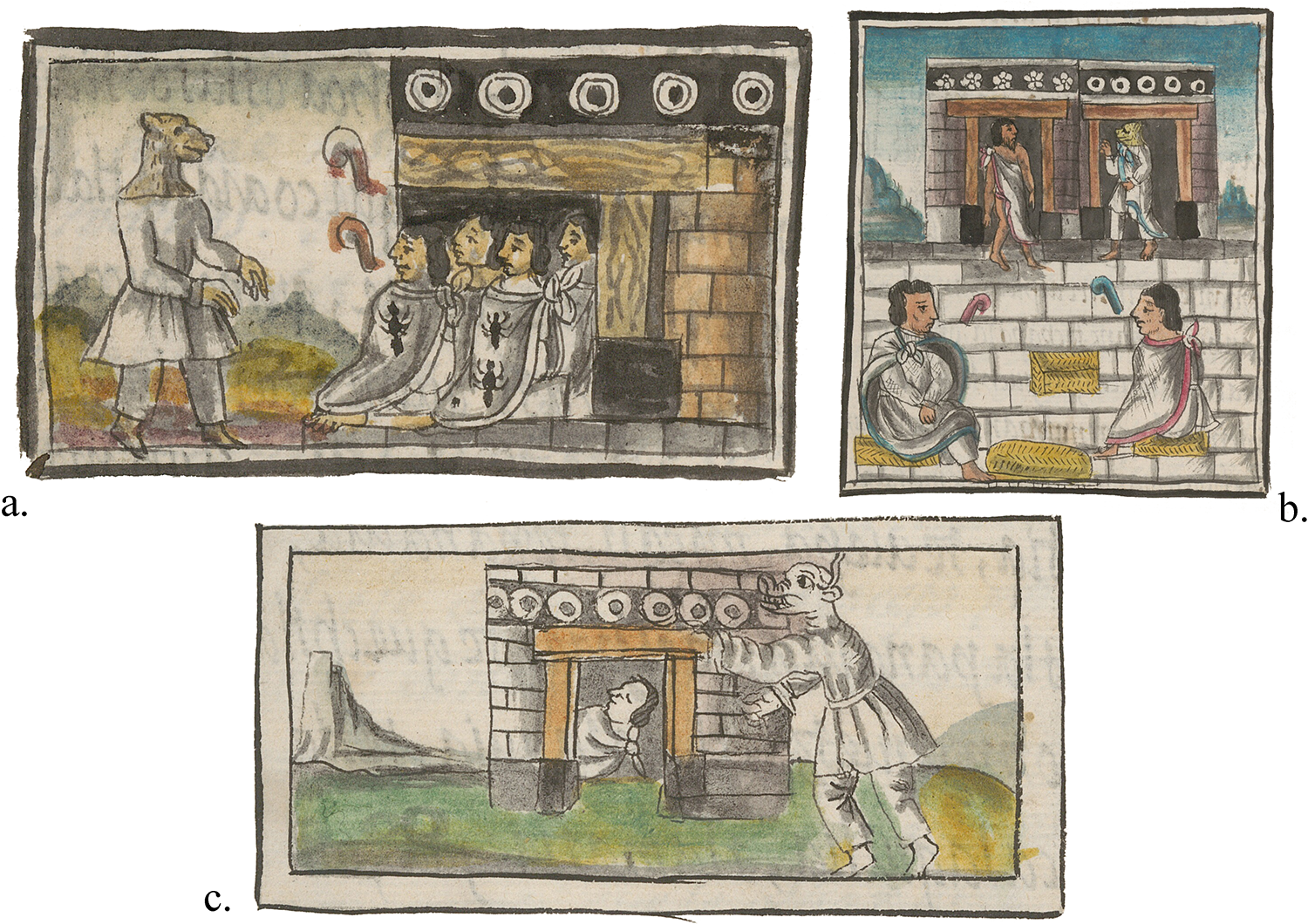
Perhaps the earliest Western mention of nagualism comes from Sahagún (García Garagarza Reference García Garagarza2023:Folio 20v), who described the Aztec naualli, members of the naualteteuctin sorcerer order who frightened people by drinking children’s blood yet could act benevolently (Figure 1a–c). Around 1900, naguales persisted in folklore and material culture, as in Starr’s (Reference Starr1899) catalog. Items representing naguales, which Starr called “toys,” were linked with frightening children into good behavior and with theft and unrest through “the power of magic from the devil” (Reference Starr1899:28–29). Similar beliefs persisted in parts of Mexico and Central America into the twentieth century (Dávalos Hurtado Reference Dávalos Hurtado1949; Lincoln Reference Lincoln1939; Parsons Reference Parsons1932; Villa Rojas Reference Villa Rojas1947).
Images of nagualism in the Florentine Codex (Richter and Houtrouw Reference Richter and Houtrouw2023): (a) “Coyotl inahual”; (b) “Iyacateuctli and Coyotl inahual”; (c) “The possessed one.” (Color online)

Brinton (Reference Brinton1894) drew on Herrera y Tordesillas (Reference Herrera and Tordesillas1601), who described Maya transformations in Honduras in 1530. Naguales were animal spirit guardians tied to humans through sacrifice, bloodletting, and dream visitations. Brinton (Reference Brinton1894:14–19, 27–29, 37–40) noted that colonial accounts—often stigmatized as “idolatry” or “devil worship”—describe blood sacrifice, divination, animal transformations, flight, curing the sick, weather control, prayer to ancestral remains, inherited powers, caves, uprisings, sexual symbolism, and mind-altering substances like peyotl (Lophophora williamsii) and ololiuhqui (Turbina corymbosa). He argued these beliefs survived Spanish suppression: the Bishop of Chiapas and Soconusco, Francisco Nuñez de la Vega, decreed around 1700 that each town should have a prison for “nagualists” (Brinton Reference Brinton1894:25–26). Nuñez de la Vega (Reference Nuñez de la Vega1988 [1702]) believed these transformations were real and collaborated with the Devil; he wrote that someone killed via their nagual would bear the wound (Brinton Reference Brinton1894:29).
Descriptions of nagualism relate closely to the tonal (from Nahuatl tonalli), which Lucille Kaplan (Reference Kaplan1956) and Brinton (Reference Brinton1894:19) discussed, emphasizing the link between human and animal essences. Brinton (Reference Brinton1894:20) suggested conjuring sought to recall the tonal, since its presence brought health and prosperity. Thus, a nagual’s power partly lay in controlling the tonal. On Oaxacan practices, Brinton (Reference Brinton1894:22) cited Friar Juan de Córdova (Reference Córdova1987 [1578]), whose Zapotec studies noted that children’s birthdays tied them to a “personal spirit.” Brinton (Reference Brinton1894:23–24) argued the Mixtec calendar worked similarly, showing overlap between nagualism and tonalism.
In the 1930s, Johnson (Reference Johnson1939) studied highland Oaxacan Mazatec “witchcraft,” describing ritual tool kits, curing rites, and hallucinogens such as pisiete (lime and Nicotiana rustica) and mushrooms; these practices later entered global awareness through Wasson’s (Reference Wasson1957) publication of rituals performed by María Sabina, reportedly against her wishes. He confirmed sacrifices in caves, divination with maize kernels, female ritual specialists, and ties between animals (like deer) and human fate. He found similar beliefs among neighboring Cuicatecs, Mixes, and Zapotecs. Johnson (Reference Johnson1939:143) observed that “the Mazatec share with all the surrounding peoples the general belief in the nagual in some form or another.” He also noted the practitioner’s role in controlling the tonal, writing that “the principle of magical coercion of the gods . . . is perhaps one of the most fundamental Middle American traits” (Johnson Reference Johnson1939:147). He explained this diffusion partly through the Aztec pochteca merchants’ travels (Johnson Reference Johnson1939:149). By the mid-twentieth century, Vogt’s (Reference Vogt1965, Reference Vogt1970) work in Zinacantán offered a more nuanced view of these traditions. He described chʼulel, an inner life-force subject to loss, and chanul, an animal spirit companion tied to a person’s fate, as local expressions of broader ideas about tonalism and nagualism. Vogt showed how these concepts were integral to healing and community cosmology, rather than the “witchcraft” framed in colonial accounts. To see how these long-standing beliefs took material form, we turn now to the archaeological evidence from Formative period Oaxaca.
Transformation in Formative Oaxaca
Archaeological evidence from the Archaic period (8000–2000 BC) in Oaxaca shows that ritual practices and symbolic activities were deeply tied to beliefs in transformation and liminality. Burials in rockshelters often included red ocher, blankets, baskets, and sacrificed dogs, while secondary burials and clustered cemeteries mark transitions to the afterlife. Sites such as Gheo-Shih and Guhdz Bedkol, with their parallel stone alignments, are interpreted as communal spaces for dancing and performance, underscoring the importance of transformative ceremonial spaces (Borejsza Reference Borejsza2021). The use of caves like Cueva del Diablo for rituals today, with offerings of cacao, tamales, and candles, exemplifies how liminal spaces have long served as conduits between earthly and divine realms (Barabas et al. Reference Barabas, Winter, del Carmen Castillo and Moreno2005). Such practices reveal how Archaic life centered on transformation through mortuary rites, sacred landscapes, and “shamanistic” activities.
Building on these traditions, the Formative period in Oaxaca demonstrates how transformational beliefs became increasingly embedded in material culture and iconography. Oaxaca boasts a robust archaeological literature on the religious practices of its Formative period inhabitants (Barber and Olvera Sánchez Reference Barber and Sánchez2012; Blomster Reference Blomster1998; Brzezinski, Barber, and Joyce. Reference Brzezinski, Barber, Joyce, DeLance and Feinman2022; Hepp et al. Reference Hepp, Barber, Brzezinski, Joyce and Wedemeyer2020; Joyce and Barber Reference Joyce and Barber2015). Here we highlight key examples from over two millennia of Oaxaca’s Formative period, including figurines, ceramic iconography, mortuary offerings, and caches. Interactions among groups in different regions waxed and waned throughout the Formative period, resulting in patterns that overlap or diverge.
The corpus of ceramic figurines from the Oaxaca highlands is central for understanding Early Formative period (2000–1000 BC) relational ontologies (Blomster Reference Blomster2004:77–96; Marcus Reference Marcus1998, Reference Marcus2019; Winter Reference Winter2005). For example, the most common animals represented in Tierras Largas phase (1500–1150 BC) figurines were dogs and birds, which in later times were sacrificed for mortuary ceremonies, emphasizing their unusual powers (Joyce Reference Joyce2003:259). Ancient Zapotecs viewed dogs not only as companions or food, but as guides through the Underworld (Urcid Reference Urcid2005:41–42). Birds, able to traverse realms, were messengers between living and dead (Marcus Reference Marcus1998:22). Representing these animals in miniature, including sometimes as musical instruments enabling musicians to transform into animals, underscores the porous boundaries between humans and animals and between forms of existence (Benjamin and Tarnowski Reference Benjamin and Tarnowski1979; Hepp and Joyce Reference Hepp, Joyce and Joyce2013; Hepp et al. Reference Hepp, Barber and Joyce2014; Taussig Reference Taussig1993).
In the lower Río Verde region of coastal Oaxaca, the earliest preserved iconographic artifacts are ceramic figurines and musical instruments (Hepp Reference Hepp2015, Reference Hepp2019; Hepp and Joyce Reference Hepp, Joyce and Joyce2013). Securely dated Early Formative examples come from La Consentida, where they appear in contexts that blur the “public” versus “private” dichotomy (cf. Flannery and Winter Reference Flannery, Winter and Flannery2019:37; Marcus Reference Marcus1998). The solid-bodied figurines are almost exclusively anthropomorphic—except for a probable spider monkey head—while many musical instruments, especially ocarinas, are avian (Hepp et al. Reference Hepp, Barber and Joyce2014). The figurines mostly depict females or wear feminine attire but are diverse in manufacture and accoutrements (Hepp Reference Hepp, DeLance and Feinman2022b). A ceremonial cache near human burials at La Consentida suggests ritual specialist activity (Hepp Reference Hepp2019:153–155, Reference Hepp, Santasilia, Hepp and Diehl2022a).
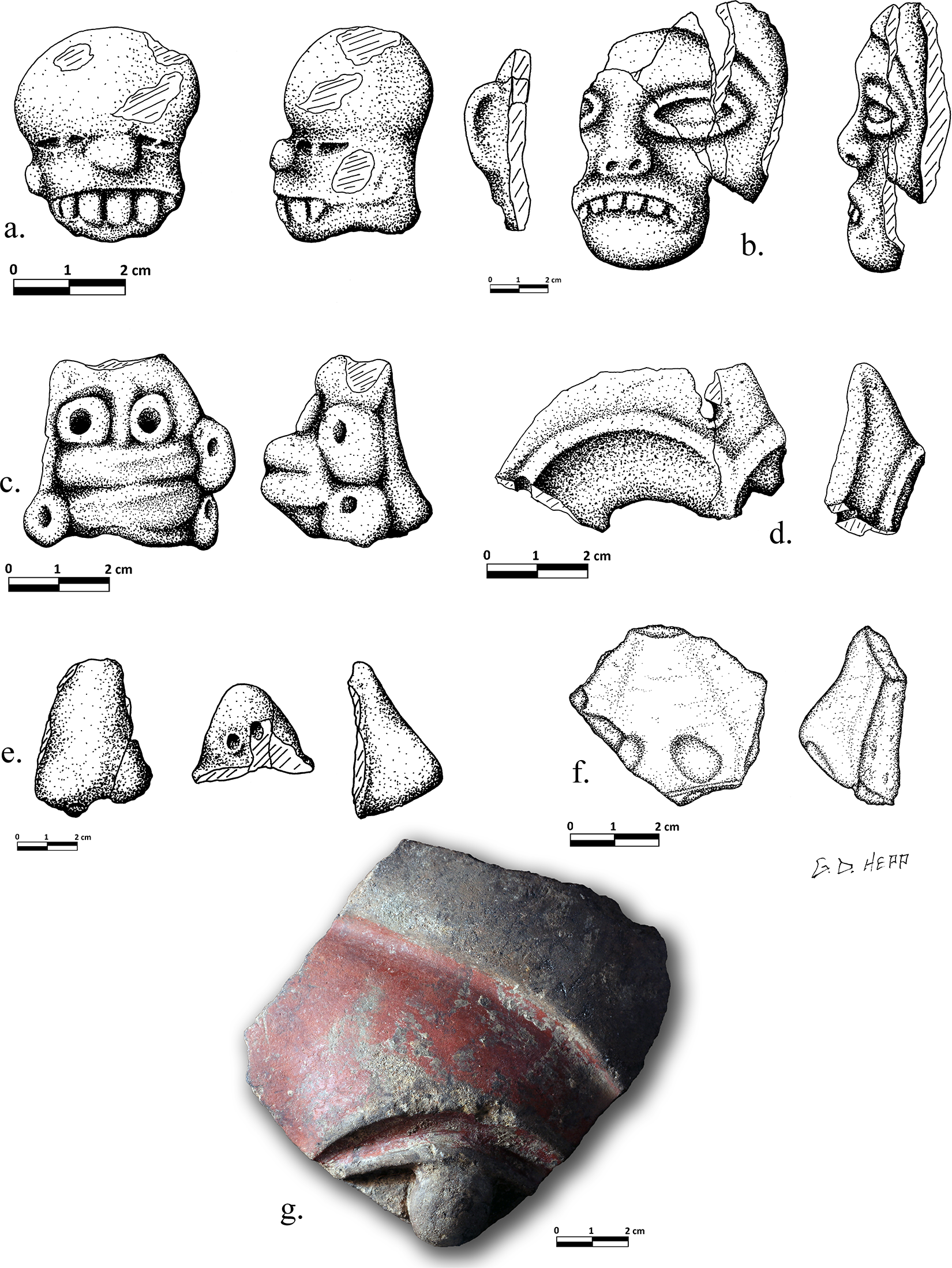
Two artifacts from La Consentida—a figurine head and a possible effigy vessel fragment—play with life and death duality, perhaps referencing decay or a skeletal deity (Figure 2). Another figurine head combines a zoomorphic face with human jewelry (ear spools). The face, with toad-like or simian features, may depict a masked human. Masks in ancient Mesoamerica were never merely decorative; donning them allowed wearers to transform into deified or spiritual beings. Such acts are more than impersonations; they are examples of embodiment, in which the ritual practitioner inhabited the ontology of the being represented. Similarly, playing zoomorphic instruments allowed musicians to “become” animals. Fragments of ceramic masks, likely used alongside perishable counterparts, have been recovered at La Consentida. These earliest mask fragments are anthropomorphic (Hepp et al. Reference Hepp, Barber, Brzezinski, Joyce and Wedemeyer2020), a trend that would shift in later centuries.
Early Formative period ceramic iconography from La Consentida, Oaxaca (illustrations by Guy Hepp). (Color online)

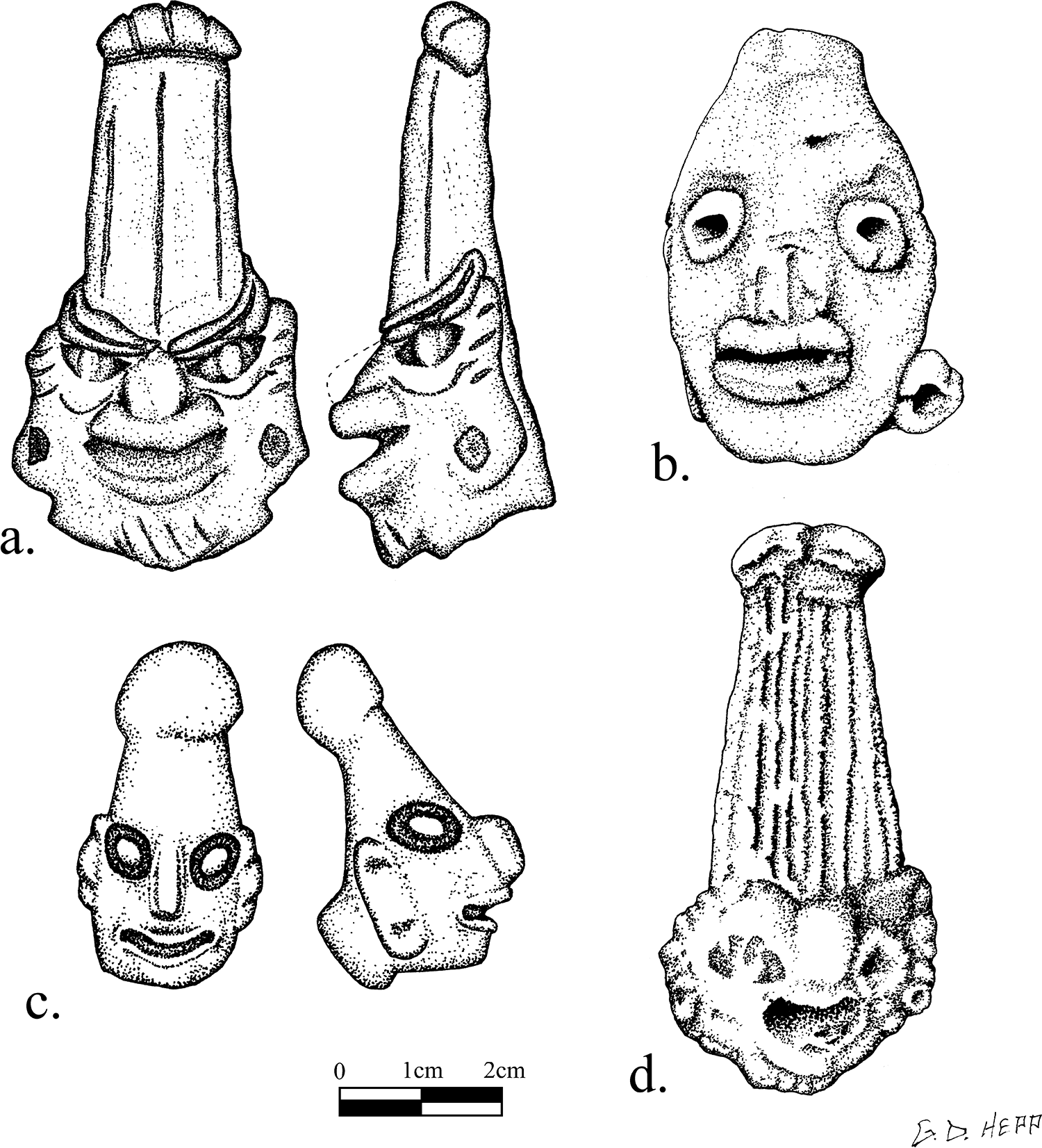
During the later Formative (400 BC–AD 250), figurines became more diverse than the typical anthropomorphic and zoomorphic forms of earlier times (Figure 3a–d). Bernal (Reference Bernal1946:Lám. 79) and Whalen (Reference Whalen1981:Plate 52, no. 64) reported fantastical forms from the Valley of Oaxaca combining human faces with elongated heads. One example, perhaps imported from the highlands, was found in a Terminal Formative domestic deposit at Río Viejo (Hepp and Joyce Reference Hepp, Joyce and Joyce2013:Figure 9.4). These figurines may reference maize fertility, cranial modification, or human reproductive anatomy. A relational perspective suggests these interpretations need not be mutually exclusive.
Figurines with elongated heads from the lower Río Verde Valley and the Valley of Oaxaca: (a) Miniyua phase figurine from domestic context at Río Viejo; (b) Minizundo phase figurine from the patio at Cerro de la Cruz; (c) Late Formative figurine from Feature 51, Household Unit 1c-1, Tomaltepec (redrawn from Marcus [Reference Marcus1998:305] and Whalen [Reference Whalen1981:Plate 52, no. 64]); (d) Terminal Formative figurine from the Valley of Oaxaca (redrawn from Bernal Reference Bernal1946:Lám. 79).

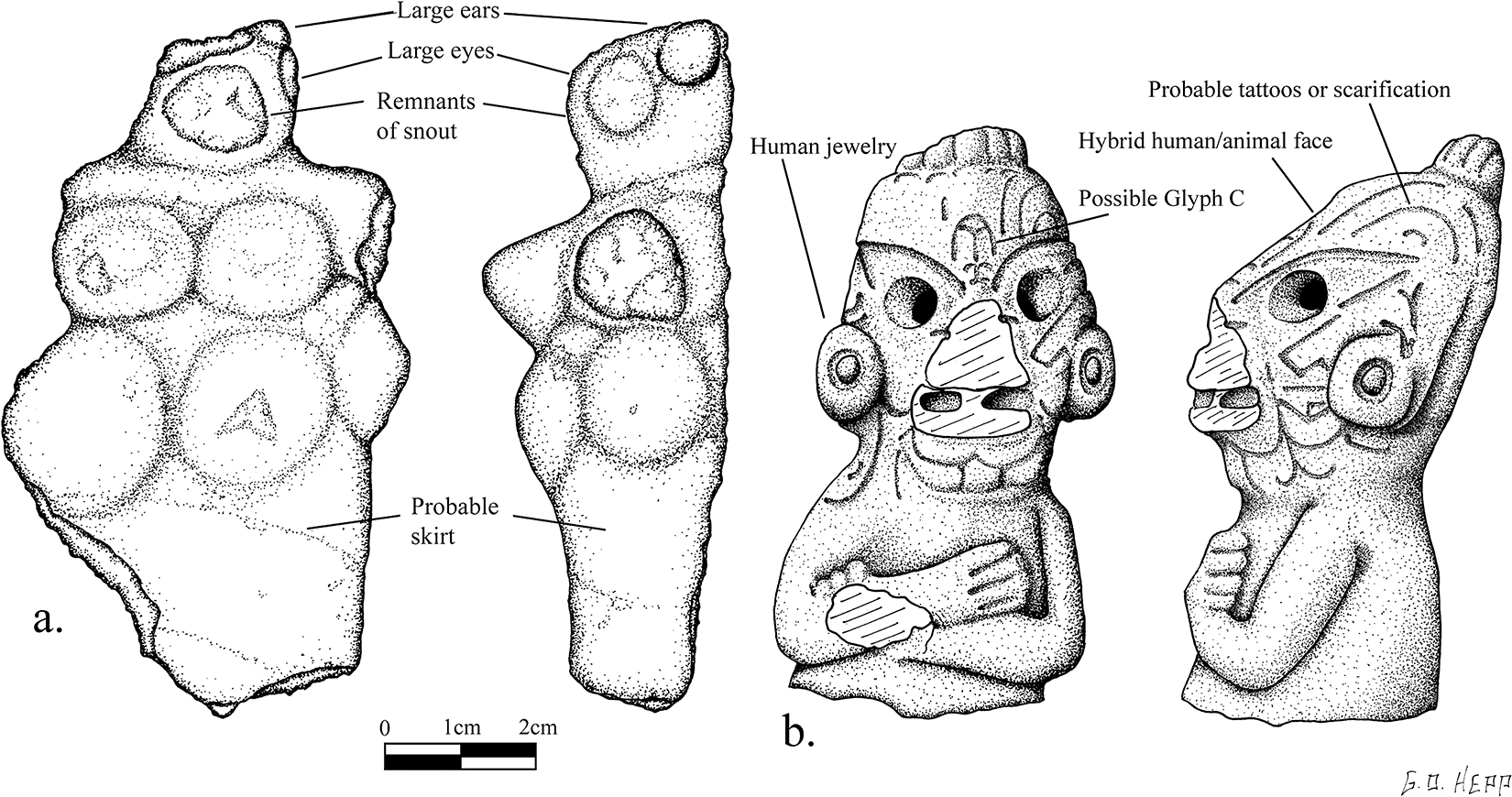
Lower Río Verde figurines diversified over time, more frequently depicting animals, masculine figures, and transitional human/zoomorphic hybrids (Hepp and Joyce Reference Hepp, Joyce and Joyce2013; Hepp and Rieger Reference Hepp, Rieger, Orr and Looper2014). One Late Formative Río Viejo figurine combines human and nonhuman traits and bears an exaggerated female body, a faint skirt, and a zoomorphic head with large eyes, ears, and a snout (Figure 4a). In the 1960s, Donald Brockington identified figurines combining human and nonhuman elements, some showing probable facial scarification or tattooing, suggesting more than humans wearing masks (Brockington Reference Brockington2001:Figures 7, 11, 17; Hepp and Rieger Reference Hepp, Rieger, Orr and Looper2014). Such markings, along with a possible “Glyph C” on one forehead, may signal ritual specialists and transformative paraphernalia (Figure 4b).
(a) Transformational figurine from high-status domestic midden at Late Formative period Minizundo phase Río Viejo; (b) probable Terminal Formative figurine fragment from the site of Lagartero (redrawn from Brockington Reference Brockington2001:Figure 7). Note earspools and probable facial tattooing or scarification, combined with probable zoomorphic facial characteristics.

The development of hieroglyphic writing and religious iconography during the later Formative produced objects referencing transformation. Zapotec potters depicted humans, animals, and spiritual beings on ceramic effigy vessels, braziers, and sculptures, mixing elements to emphasize relationality (Sellen Reference Sellen, Jennings and Sellen2018; Urcid Reference Urcid, Jennings and Sellen2018). Marcus and Flannery (Reference Marcus and Flannery1996:158) suggested effigy vessels were part of standardized “place settings” for commensal events. Early interpretations saw Zapotec effigies as representations of a complex pantheon (Boos Reference Boos1966; Caso and Bernal Reference Caso and Bernal1952). Attached vessels were identified as burial urns (Chavero Reference Chavero1940:1:404–405), yet no human remains have been found inside. Marcus questioned the existence of Zapotec deities altogether, arguing the effigies represented royal ancestors wearing guises of divinities (Marcus Reference Marcus1983; Marcus and Flannery Reference Marcus and Flannery1996). While literally accurate for some contexts, this view overlooks deeper animistic ontologies.
Despite changing production methods, urn iconography remained largely consistent for centuries (Sellen Reference Sellen, Jennings and Sellen2018). Early urns with Cociyo imagery featured simple figures with masks and conical hats. In the Tani phase (AD 200–350), artists added lampshade-shaped headdresses with glyphs; in the Pitao phase (AD 350–500), they added collars, capes with raindrop glyphs, and fangs. In later phases (Peche [AD 500–600] and Xoo [AD 600–800]), Cociyo urns were more standardized, lacking the collars and teeth of earlier versions. Sellen’s (Reference Sellen, Jennings and Sellen2018; also see Urcid Reference Urcid2001) research demonstrates that Caso and Bernal’s deity model should be adjusted, not discarded. Many urns exhibit inscriptions tied to the 260-day ritual calendar that ordered religious life. As Sellen (Reference Sellen, Jennings and Sellen2018:82–83) noted, the multiple deity masks and interchangeable costumes support the view that these were ancestors impersonating calendrical deities, favoring Caso and Bernal’s pantheistic interpretation over an animistic reading that denies deities altogether.
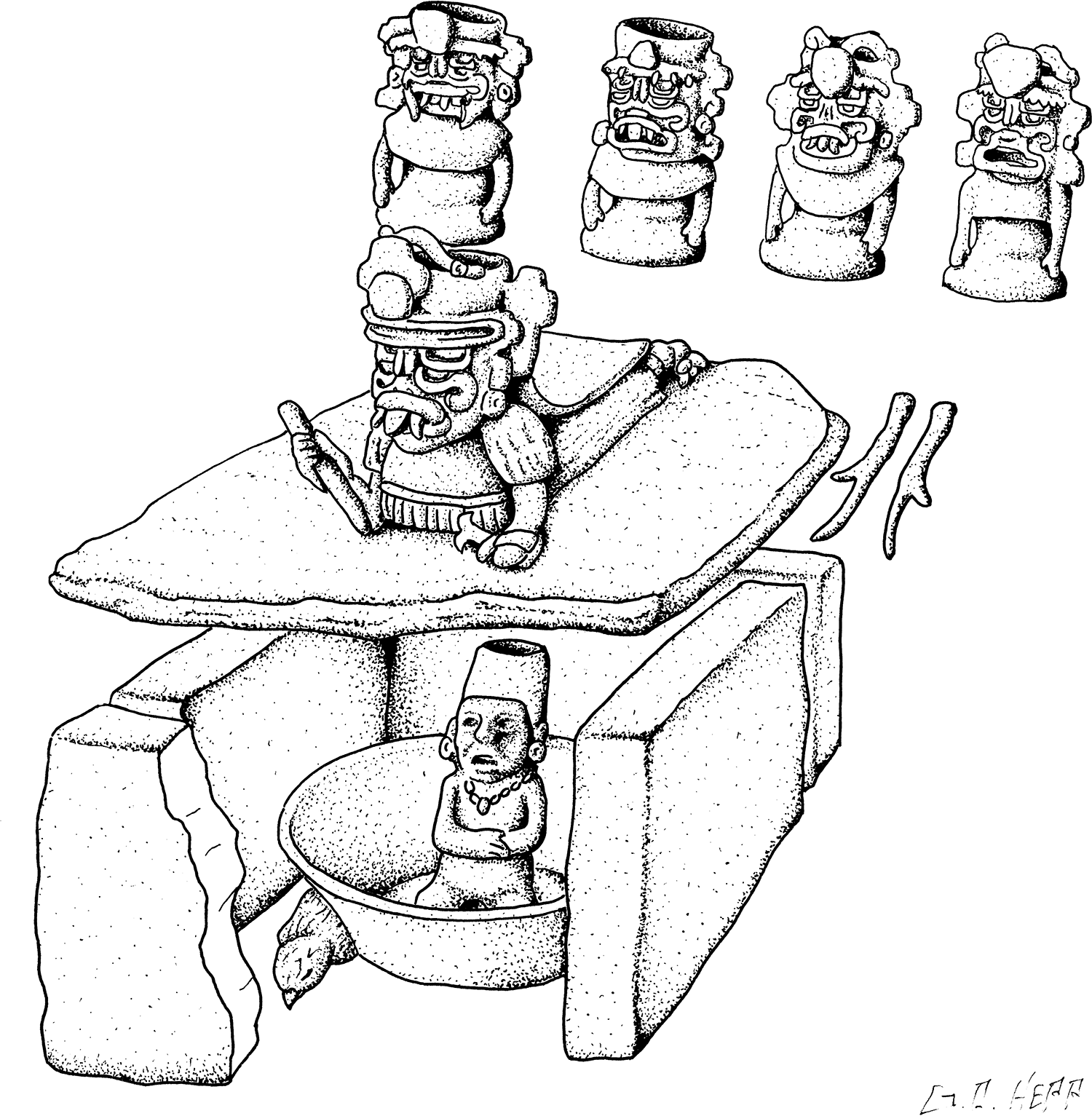
We agree with Sellen’s epigraphic and iconographic approach but modify it to highlight transformative, animistic ontologies. An offering beneath the floor of Structure 35 at San José Mogote is instructive (Figure 5). Centered on a miniature adobe tomb enclosing a figurine under a slab roof, a noble kneels in a bowl with arms crossed. Marcus and Flannery (Reference Marcus and Flannery1996:186) identified it as a funerary “companion,” given such objects’ frequency in noble tombs. Zapotecs often placed such vessels in groups, perhaps representing cult devotees or an entourage for a noble’s journey through the afterlife (Whitecotton Reference Whitecotton1977:54). Beyond the tomb, four Cociyo-masked women also kneel. Another individual, dubbed the “Flying Figure,” is prone on the tomb’s roof and wears a flowing cape and a different Cociyo mask. This figure also holds an implement resembling a dibble stick—a metaphor for germinating maize. Marcus and Flannery saw the scene as the metamorphosis of a noble into a “Cloud Person” in contact with lightning.
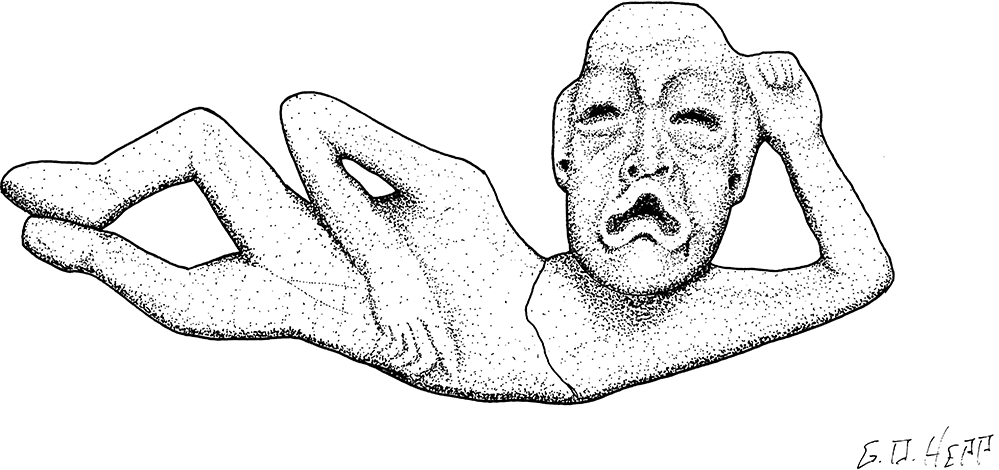
Serpentine reclining figure pendant (redrawn from Taube Reference Taube2004:Plate 35).

We argue that Zapotec imagery and offerings reveal an animistic ontology in which ritual specialists did not merely impersonate gods but actively became other-than-human forces—merging with rain, maize, or lightning and blurring ontological boundaries. These were moments of embodiment, where transformation was lived in and through the body, producing new forms of social and cosmic connection. Urcid (Reference Urcid2009) reinterpreted the cache from Structure 35 through an origin story collected by Wilfredo Cruz (Reference Cruz1935) in the early twentieth century. This story describes Cociyo seated atop a mountain with four giant clay pots guarded by lizard-shaped lightning bolts. Urcid argued the cache recreated the “rain giver” role, where an ancestor embodying Cociyo breaks open a cosmic granary to spread maize to the cardinal directions (Urcid Reference Urcid2009:30). Our relational approach builds on this, emphasizing how ancestor veneration involved ritual practitioners, hallucinogens, and sacred objects (Hermann Lejarazu Reference Lejarazu and Manuel2008). This offering speaks to a Zapotec concern with sustaining a balanced world amid climatic threats, with rulers’ intercessions reinforcing social inequality by petitioning for agricultural fertility.
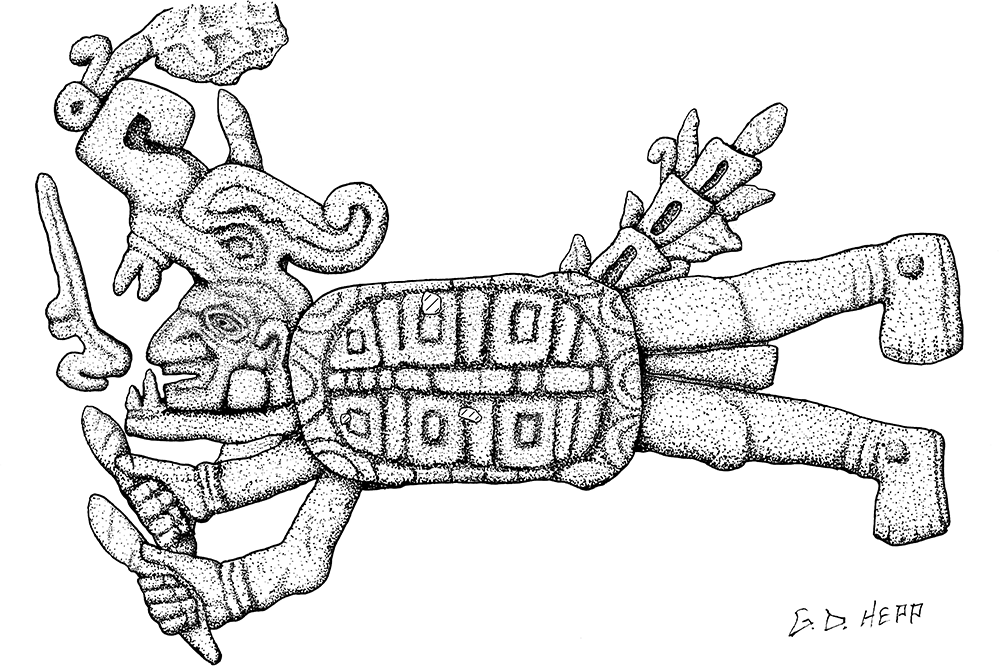
The role of ritual practitioners in embodying the divine is further illustrated by the xicani. Urcid (Reference Urcid2001:203–204) derived this term from Córdova’s (Reference Córdova1987 [1578]) colonial descriptions of Zapotec “necromancy.” The xicani and Mixtec yahui imagery, seen in highland Oaxaca since at least 300 BC (Urcid Reference Urcid2001:297), show prone figures flying as balls of fire and passing through solid objects (Hermann Lejarazu Reference Lejarazu and Manuel2009:75). Depictions of “flying” practitioners appear across Mesoamerica by the Middle Formative, reflecting altered states and communion with the divine (Easby et al. Reference Easby, Scott and Hoving1970; Taube Reference Taube2004:164–167). Olmec ritual specialists appear as pendants, suspended around the neck in reclined poses (Figure 6). Flying figures also appear in later elite Zapotec tombs, such as the low-relief plaster sculpture of a flying priest sacrificer in Tomb 1 at Zaachila (Figure 7). Tomb 2’s tripod vessel shows a xicani transforming into a butterfly. Bernal (Reference Bernal, Heydon and Horcasitas1969:155) noted the resemblance of Olmec reclining figures to Monte Albán’s “Danzante” sculptures. Traditionally seen as sacrificial victims (Marcus Reference Marcus1983; Marcus and Flannery Reference Marcus and Flannery1996), some “Danzantes” may also depict self-sacrifice, invoking ancestors for oracular warfare (Urcid and Joyce Reference Urcid and Joyce2014). Their inscriptions record rulers’ enthronements, suggesting connections between living rulers and ancestral powers.
Tableau in the central cache under Structure 35 at San José Mogote (redrawn after Urcid Reference Urcid, Jennings and Sellen2018:Figure 15).

Plaster xicani flying priest sacrificer sculpture from Tomb 1 at Zaachila (illustration by Guy Hepp).

Whether the xicani was a deity or a divine power bestowed by one is debated (Lind Reference Lind2015:22). Lind argued the xicani was not a deity or alter ego but a power given by Pitao Peeze that allowed transformation and flight (Hermann Lejarazu Reference Lejarazu and Manuel2009; Urcid Reference Urcid2001). A local xicani variant in the lower Verde appears at Yugüe, where Burial 14-Individual 16, a subadult male, was buried with an iron ore mirror and a carved deer bone flute showing a figure with fleshed limbs and a skeletal torso (Barber and Olvera Sánchez Reference Barber and Sánchez2012:16). This figure’s buccal mask likely signifies the rain deity complex represented by Cociyo, Dzahui, or the Chatino Tyoo. Another Yugüe artifact, a serving bowl, depicts a ritual specialist donning a saurian mask, echoing the xicani/yahui complex (Brzezinski, Barber, et al. Reference Brzezinski, Barber, Joyce, DeLance and Feinman2022; Hermann Lejarazu Reference Lejarazu and Manuel2009).
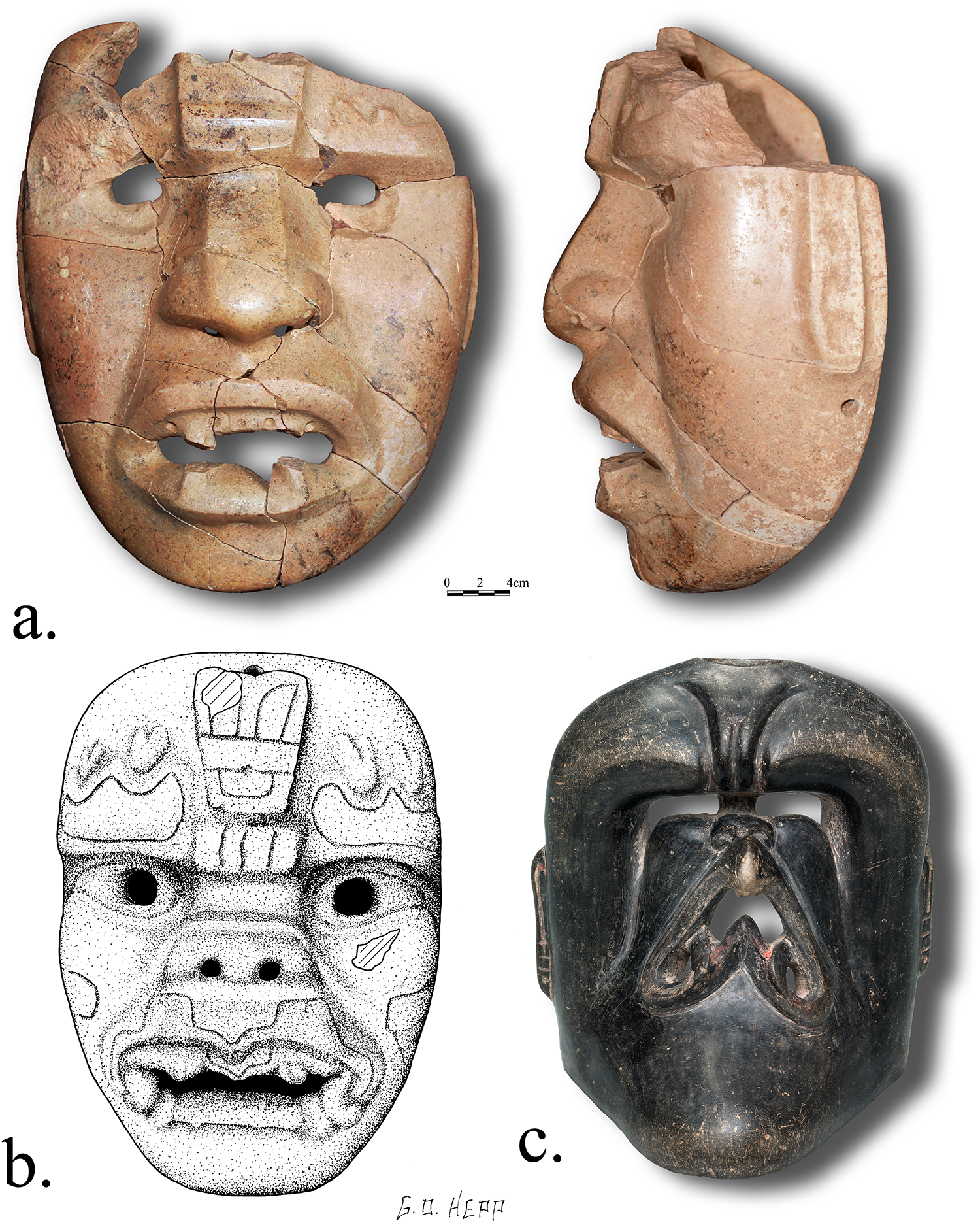
Chatinos also referenced transformation in offerings for public buildings. At Cerro de la Virgen, a cache beneath a ceremonial temple shows how objects together constituted new ontological capacities (Brzezinski, Monson, et al. Reference Brzezinski, Monson, Joyce, Barber, Santasilia, Hepp and Diehl2022). Buried at the summit of a terraced center, Structure 1’s cache contained a rain deity mask, a second mask fragment, miniature thrones, and a figurine (Figure 8a), encircled by nine small vessels (Brzezinski et al. Reference Brzezinski, Joyce and Barber2017). The thrones highlight rulers’ authority but also iconically represent the divine stage for offerings (Kaplan Reference Kaplan1995). The flexed figurine likely depicts a wrapped ancestor. The pottery may point to its personhood as an entity requiring sustenance (Joyce Reference Joyce, Kosiba, Janusek and Cummins2020; Overholtzer Reference Overholtzer, Hendon, Overholtzer and Joyce2021). The mask’s human silhouette, flamed eyebrows, ear plaques, and fangs evoke Cociyo (Figure 8b–c; Covarrubias Reference Covarrubias1946; Gaxiola González Reference Gaxiola González1984:51–52; Urcid Reference Urcid and García2002).
(a) Reconstructed stone objects recovered from base of Structure 1 at Cerro de la Virgen, Oaxaca; (b) Serpentine stone Cocijyo mask from Oaxaca (currently held by the Peabody Museum, PM# 37-4-20/4891; illustration by Guy Hepp); (c) Formative ceramic vessel with rain deity mask from Las Bocas, Puebla (currently held by the Cleveland Museum of Art, PM# 2002.67). (Color online)

Collectively, this bundled offering likely petitioned a rain deity for agricultural fertility, mediated by a revered ancestor and consecrated through the ritual breaking of objects (Brzezinski et al. Reference Brzezinski, Joyce and Barber2017:524–525). Its ergonomic features show it was wearable, used in performances involving dance, song, or psychoactive substances (Hepp et al. Reference Hepp, Barber, Brzezinski, Joyce and Wedemeyer2020). Masking practices were pervasive but only one way that Chatinos expressed transformation. Archaeological and ethnographic evidence shows that performances combined musical instruments, costumes, and other sensory elements to animate the divine (Hepp Reference Hepp, Santasilia, Hepp and Diehl2022a; Hepp et al. Reference Hepp, Barber and Joyce2014). These Oaxacan cases show that beliefs in transformation were part of a wider Mesoamerican tradition. To see how local practices fit within this larger world, we now turn to parallels from the Olmec heartland, Pacific slope, and Preclassic Maya.
A Broader View of Transformation in Formative Mesoamerica
The capacity of ritual specialists and rulers to merge with animal or divine essences formed a cornerstone of religious and political life in ancient Mesoamerica. From the enigmatic “were-jaguar” motifs of the Olmec heartland to the monumental stelae and stucco façades of Preclassic Maya cities like Takalik Abaj and El Mirador, transformation was monumentalized in ceramic, stone, and plaster as a potent sign of sacrality. In Oaxaca, Zapotecs, Mixtecs, and Chatinos developed parallel iconographies of bodily metamorphosis and divine embodiment, yet these traditions took on regionally distinct expressions that reflect both deep continuities and striking divergences in Mesoamerican ontologies of power. By comparing these Oaxacan traditions to those of other Formative period societies, we can better understand how ancient artists and rulers crafted visual languages of transformation to shape ritual performance, political legitimacy, and cosmic mediation across diverse landscapes.
Although their pantheon includes a wide array of animals and hybrid creatures, the most powerful human–animal fusion among Early and Middle Formative Olmec societies was undoubtedly the jaguar. Scholars have long recognized that the jaguar-nagual ruler was believed to channel the powers of avian-serpent and rain deities to exercise control over key elements of nature (Furst Reference Furst1968; Reilly Reference Reilly1989; Taube Reference Taube1995). The jaguar nagual manifests in a variety of material forms, but its most enduring depiction combines unmistakable jaguar physiognomy with human features. This hybrid imagery blurs the boundaries between human, animal, and deity, embodying a relational ontology like that seen in Oaxaca’s rain deity masks and xicani transformation scenes but articulated through a more explicitly feline metaphor.
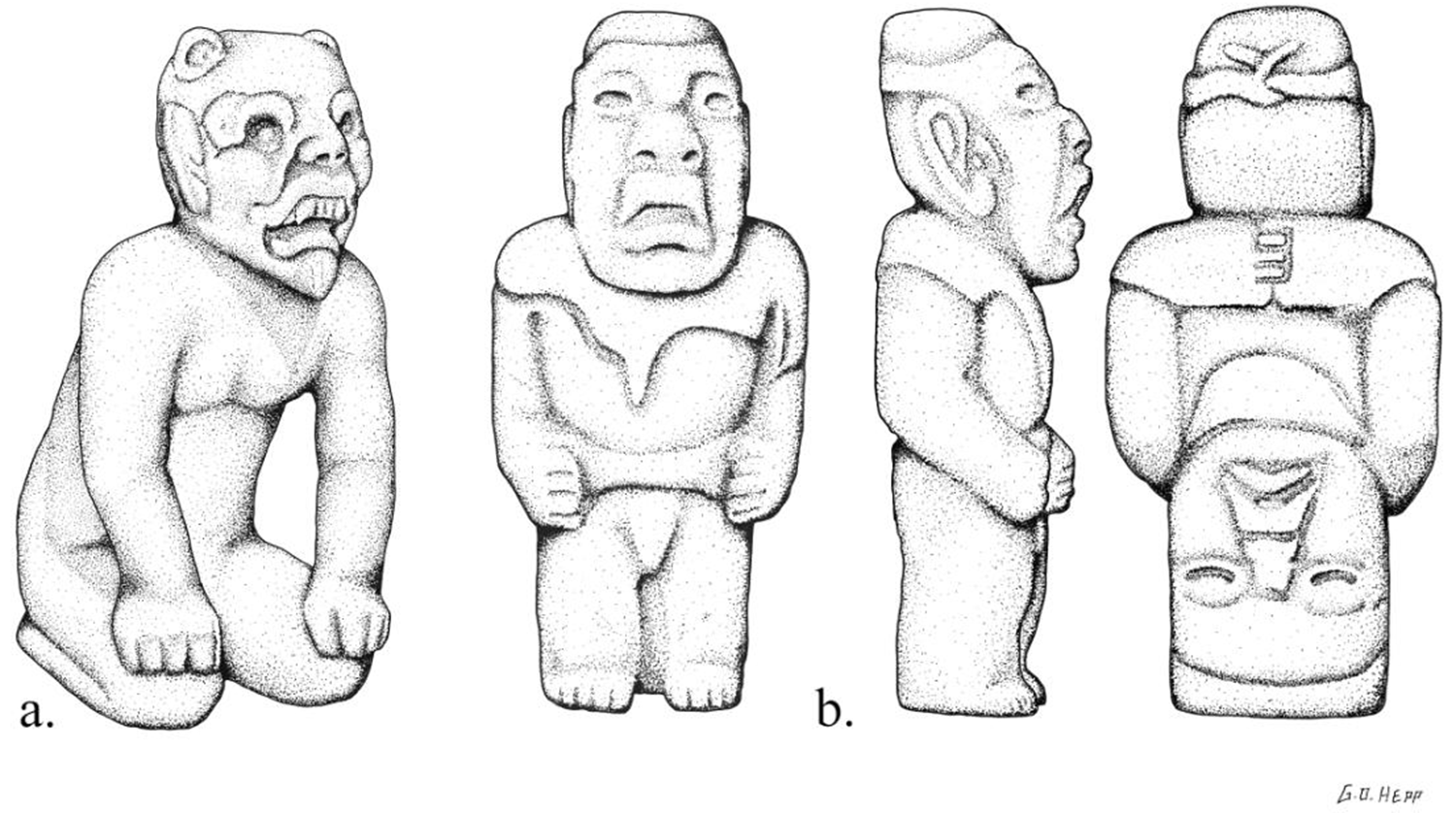
One small corpus that illustrates this well is the series of Olmec sculpted figures at Dumbarton Oaks, which contains several examples of beings depicted in transformation. Some figures possess human bodies with feline facial traits or vice versa, while others stand upright in postures that reveal they are not animals per se but humans inhabiting their jaguar nagual forms (Gutierrez and Pye Reference Gutierrez, Pye, Julia Guernsey and Arroyo2010:28). Cyphers’s (Reference Cyphers2023) recent survey of Gulf Coast sculpture underlines the pervasiveness of this human–feline hybridity: Monument ER-5 from Estero Rabón shows a deformed head that fuses human and feline features, its elongated, toothy mouth suggesting a buccal mask and its L-shaped eyes referencing a divine gaze. Ritual mutilation—evident in decapitation marks and frontal breakage—may signal the transformation of the body itself into a liminal vessel. Similarly, San Lorenzo’s Monument SL-90 presents a seated figure mid-transformation: it combines feline paws with human hands and nails, the mouth open to reveal fangs—an image of a human moving between states of being (Figure 9a; Cyphers Reference Cyphers2023:88–90). As Gutierrez and Pye (Reference Gutierrez, Pye, Julia Guernsey and Arroyo2010:29) argued, these renderings are not strictly literal. The seamless blending of human and animal forms speaks to an ontological continuum rather than rigid taxonomies. Their case study of the San Pedro Aytec figurine—excavated near the Guerrero–Oaxaca border—exemplifies this principle (Figure 9b). The piece depicts a human figure clad in a jaguar skin mask and garment, complete with tabular cranial modification and a second, hidden feline-like face carved onto its back. When turned over, this “dual-face” design reveals a transformative duality: a masked noble poised to become his jaguar nagual in a performance that likely involved music, dance, and psychoactive substances.
(a) Monument SL-90 from San Lorenzo, a hybrid human–feline form emphasizing metamorphosis as a key theme in Olmec sculpture (redrawn after Cyphers Reference Cyphers2023:88–90); (b) San Pedro Aytec figurine from the Guerrero–Oaxaca border, designed with dual human and jaguar visages to evoke transformative identity (redrawn after Gutierrez and Pye Reference Gutierrez, Pye, Julia Guernsey and Arroyo2010:29).

These Olmec representations of transformation resonate with examples from Mesoamerica’s Pacific slope, where local communities creatively adapted feline imagery to their own cosmological and political contexts. Monument 1 at Ojo de Agua depicts a standing figure with classic Olmec features—flame-like eyebrows, almond-shaped eyes, a swept-back cranium—whose pectoral displays a smaller figure, merging the human ruler with a divine essence within a single composition (Guernsey Reference Guernsey2012). By the Middle Formative, these blended motifs had become more elaborate at Takalik Abaj. Monument 14 shows a squatting figure clutching both a feline and a hooved animal, a composition that fuses human physicality with potent animal powers while referencing Gulf Coast iconography through its helmet. Monument 15 at the same site stages a striking reversal of the nagual transformation narrative: a human figure emerges from a jaguar’s open mouth on the front, while the back preserves the jaguar’s legs and tail, literally depicting the moment of rebirth from animal to human (Schieber de Lavarreda and Orrego Corzo Reference Schieber de Lavarreda, Corzo, Guernsey, Clark and Arroyo2010). These inversions illustrate how transformation was not a unidirectional crossing but a fluid oscillation between forms, echoing Oaxaca’s xicani ritual specialists who fly between realms.
Farther south, the Preclassic Maya also monumentalized transformational imagery, but often at an architectural scale. At sites like El Mirador and Kaminaljuyu, massive stucco masks flanking pyramid staircases transformed entire buildings into animate beings. These colossal façades, often depicting otherworldly creatures with gaping maws, flame-like brows, and zoomorphic eyes, embodied the fusion of ruler, mountain, and deity. They were not mere ornaments but acted as performative backdrops where rulers and priests enacted rituals that visually and acoustically animated these living facades (Houston et al. Reference Houston, Stuart and Taube2006; cf. Hansen Reference Hansen and Grube2001). In doing so, Maya builders extended the logic of portable masks and figurines to the monumental scale, embedding transformation into the very stones that shaped urban life.
As in Oaxaca, caves, springs, and other liminal places also played key roles in Maya transformation practices. Naj Tunich and the Candelaria cave system, for instance, were sites where elite ritual specialists deposited masks, jade, ceramics, and musical instruments as offerings to rain and fertility deities (Brady and Prufer Reference Brady and Prufer2005; Woodfill Reference Woodfill2014). These subterranean rituals echo Oaxaca’s Archaic traditions, such as the enduring use of Cueva del Diablo for contemporary shamanic offerings. Musical instruments, ubiquitous in Oaxaca’s Early Formative contexts like La Consentida, also appear widely across the Maya and Gulf Coast worlds. Shell trumpets and flutes amplified the transformative power of sound, allowing performers to voice the speech of spirits or become thunder and rain personified (Hepp and Joyce Reference Hepp, Joyce and Joyce2013). In both regions, the combination of masking, music, and sacred landscape created multisensory rites where transformation was not symbolic but embodied through performance.
When we compare these broader examples to Oaxaca’s highland and coastal record, both common threads and striking local inflections become clear. In the Zapotec heartland, effigy vessels, figurines, and bundled caches like those from San José Mogote or Cerro de la Virgen show how rulers and ritual practitioners merged with rain, maize, lightning, and ancestral forces (Sellen Reference Sellen, Jennings and Sellen2018; Urcid Reference Urcid2001). The Structure 35 cache, with its miniature adobe tomb, kneeling figurine, Cociyo-masked effigies, and the so-called Flying Figure, staged a scene of metamorphosis: a noble transformed into a Cloud Person who opens a cosmic granary to ensure agricultural fertility. Such imagery was not static. As urn iconography evolved over centuries, artists conserved core motifs—masks, fangs, headdresses—while innovating glyphic inscriptions and costumes that signaled shifting meanings and ancestral genealogies (Marcus and Flannery Reference Marcus and Flannery1996; Urcid Reference Urcid2009).
The xicani and Mixtec yahui further exemplify relations of transformation. Whether depicted flying through the air as balls of fire or morphing into butterflies, these beings show that bodily metamorphosis was fundamental to authority. The Yugüe burial with its mirror and carved deer bone flute expands this theme: the skeletal torso and buccal mask inscribed on the flute allude to the rain deity complex while demonstrating how music and imagery worked together to animate transformation. The Chatino cache at Cerro de la Virgen—where a rain mask, ancestor figurine, miniature thrones, and pottery were interred under a ceremonial temple—shows how bundled offerings could fuse personhood, rulership, and agricultural fertility into a performative whole (Brzezinski, Barber, et al. Reference Brzezinski, Barber, Joyce, DeLance and Feinman2022; also see Guernsey Reference Guernsey2020).
Taken together, these cases reveal that transformation in Formative Mesoamerica was not an abstract symbol but a relational practice embedded in bodies, materials, landscapes, and performance. Portable figurines, masks, instruments, bundled caches, and monumental façades all worked together to enact a worldview in which humans could become other-than-human forces—jaguars, rain, maize, lightning—mediating cosmic flows to ensure social order and agricultural abundance. Olmec elites emphasized the jaguar as a supreme metaphor for rulership and cosmic authority, monumentalizing human–feline hybrids in stone and portable sculpture. On the Pacific slope, feline motifs blended with local animal spirits and environmental symbolism, dramatized through dynamic stelae that narrated beings shifting between forms. Maya builders expanded this grammar to the scale of entire temples, turning urban centers into living mountains guarded by open-mouthed spirit beings.
Meanwhile, Zapotecs, Mixtecs, and Chatinos integrated these broader ideas with local rain deity complexes, ancestor veneration, and agricultural metaphors. Unlike the narrower feline focus of Olmec rulers, Oaxacan ritual specialists embodied a wider spectrum of transformative beings—Cloud People, flying priests, maize sprouts—materialized through offerings that choreographed people, pottery, masks, and musical instruments into bundled acts of worldmaking.
The Oaxacan evidence sits firmly within a wider Formative Mesoamerican constellation of transformational ontologies. From Gulf Coast figurines to Maya stucco masks, the same core principles repeat: bodies can change, humans can become other-than-human, and this capacity is both the source and the sign of legitimate religious and political power. By tracing these connections, we see that Oaxaca’s transformational figurines, rain deity masks, xicani flying figures, and bundled caches were never provincial oddities but rather were vital nodes in a complex of transformation that shaped how ancient Mesoamericans understood the porous boundary between the human world and the animate cosmos.
Conclusions
Researchers have long noted that “transformational” figures in ancient Oaxacan figural art depict humans wearing masks. We have argued that this interpretation, while perhaps literally true in some cases, is also an incomplete, Westernized explanation that downplays nonhumans and thus “misses the point” of transformation from Indigenous Mesoamerican perspectives. To wear a mask, at least sometimes, was to transform oneself in a nagualistic sense. These acts were also depicted in ceramic and stone. A pattern we identify in the Formative period iconography of Oaxaca is a diversification over time, in which a tradition of primarily anthropomorphic depictions fluoresced into a broader array of characters. In discussing this trend, we reject human/animal or human/deity dichotomies that categorize these characters as merely masked humans. Ontological boundaries between humans and other beings were often obscured, bleeding into one another and highlighting the animacy of the world.
Our examination of early research regarding transformation, nagualism, and the Oaxacan “shaman,” particularly ethnohistoric work from the nineteenth century, is meant to do more than trace scholarship through time. The ideas of scholars from past generations reverberate into the present and still have much to offer today’s researchers of ancient Oaxaca. We recognize that a complication of “dust archaeology” is that many such works are mired in colonialism and Eurocentric models of culture, religion, and society. We are mindful of the renewed colonization of appropriating Indigenous worldviews for the sake of scholarship (see Todd Reference Todd2016). To ignore the ethnohistoric, ethnographic, and archaeological evidence of Indigenous ontologies, however, would be to deny our ancient and contemporary interlocutors their unique ways of knowing and perceiving. Nor do we assume that the Indigenous ontologies of Oaxaca’s prehispanic inhabitants have remained static through time or across space. Rather, the evidence underscores the variability and historical dynamism of nagualism, which manifested in diverse and shifting forms rather than as a static or homogeneous tradition across Mesoamerica. For this reason, archaeological context and detailed iconographic interpretations are necessary for exploring how relational ontologies operated in ancient Mesoamerica and why, to return to the sentiment shared by Cordell and Habicht-Mauche (Reference Cordell and Habicht-Mauche2012:1), some material indicators of nagualistic transformation matter a lot in certain contexts.
The forced introduction of Christianity following European incursion has had a profoundly disruptive effect on Mesoamerican belief systems. This colonial project, and native responses to it, have resulted in syncretic forms of belief and practice. At their most destructive, these trends have caused the eradication of the relational ontologies we discuss in this article. Yet, as ongoing calendrical celebrations in Oaxaca that incorporate masking demonstrate, the conquest will never be complete. Highlighting the animacy that infused the ancient Oaxacan world with life is vital to anthropological scholarship because of how pervasive these beliefs were and continue to be. We have argued that Formative period Oaxacan materials—from figurines and effigies to caches and urns—illustrate a relational ontology in which humans, animals, ancestors, and deities continually merged and remade one another. By highlighting embodiment as more than impersonation, we underscore that these were not symbolic acts alone but bodily and experiential transformations that defined how ancient Oaxacans knew their world. Transformation was both a representational strategy and an embodied ontology through which people engaged with and sustained their cosmos. The idea that humans and other beings have similar abilities to confer vitality and can cohere to form hybrid beings with new capacities to affect the world pervaded all aspects of Mesoamerican life, from the utilitarian to the discursive.
Acknowledgments
We thank Marijke Stoll and Guillermo Ramón Celis, along with the editors of Latin American Antiquity. We are also indebted to Nicholas Hopkins, Javier Urcid, Ricardo Higelin Ponce de León, and our five astute peer reviewers. Our work would not have been possible without support from the Fulbright Program, the National Science Foundation, the Templeton Foundation, the Instituto Nacional de Antropología e Historia, the University of Colorado, Boulder, and California State University, San Bernardino.
Funding Statement
This research was supported by the University of Colorado Boulder Graduate School, the Department of Anthropology at the University of Colorado Boulder, and the National Science Foundation Doctoral Dissertation Research Improvement Grant “The Río Verde Hinterland Project” (co-PI with Arthur A. Joyce, BCS-1551842). Additional support was provided by the John Templeton Foundation, the Tinker Foundation, and the Fulbright Program.
Data Availability Statement
All data generated or analyzed during this study are included in this published article. Additional datasets are available from the corresponding author.
Competing Interests
The authors declare that they have no known competing financial interests or personal relationships that influenced the work reported in this article.

 Open access

