





1. Introduction
Social media is not a neutral channel for information distribution. How visible information posted online is, and how many users in a social network it can reach, depends on many factors. These include the network structure (Jackson et al., Reference Jackson, Rogers and Zenou2017), the emotional volatility of the content (Brady et al., Reference Brady, Wills, Jost, Tucker and Bavel2017), past exposure to similar information (Nguyen, Reference Nguyen2020), and the design and recommendation algorithms of the particular social media platform (Napoli, Reference Napoli2015). The design of the social media platform might also determine how vulnerable the platform is to exploitation: Is it possible to act tactically to increase the visibility of a post?
This paper contributes to the study of social networks and the measurable impact social media platforms have on their users. Social networks have been studied using numerous methods in numerous disciplines. Formal logic methods for representing and reasoning about social networks have been used to analyze opinion diffusion and social influence (Baccini and Christoff, Reference Baccini, Christoff and Verbrugge2023; Christoff and Hansen, Reference Christoff and Hansen2015; Christoff et al., Reference Christoff, Hansen and Proietti2016; Dennis et al., Reference Dennis, Fu and Slavkovik2022; Lorini and Sartor, Reference Lorini and Sartor2016), social bots (Reference Pedersen, Slavkovik, Smets, Ghosh and IcardPedersen et al., 2021a , 2023), group polarization (Pedersen et al., Reference Pedersen, Smets, Ågotnes, Dastani, Dong and van der Torre2020, Reference Pedersen, Smets and Ågotnes2021b), gatekeepers (Belardinelli, Reference Belardinelli2019), echo chambers (Pedersen et al., Reference Pedersen, Smets, Ågotnes, Blackburn, Lorini and Guo2019), and informational cascades (Baltag et al., Reference Baltag, Christoff, Rendsvig and Smets2019), among other phenomena. Our work is positioned within this literature.
We are here concerned with the problem of applying formal methods to study the visibility of agents and information in a social network. In addition to having structural properties, a number of agents and how they are connected, a social network also has other properties connected to the visibility of an agent, such as: which interests and opinions the agents have, what they are communicating, and how the network changes through time. Furthermore, given a particular social network with rules inspired by real-life behavior, we aim to analyze the safety of a network: whether it is vulnerable to exploitation by a potential malicious agent. It is our position that logic-based methods are needed to complement empirical methods to reach a full understanding of these properties of social networks.
The notion of visibility is rooted in the idea of being seen. One of our main motivations is to present an analysis of visibility that captures a complex view of what it means to be visible in a social network, one that extends merely counting the followers of an agent. To do this, we introduce a modal logic for representing agents and their opinions and interactions in a social network.
Our social network consists of a set of agents and two sets of relations between them: one represents followers and the other represents posts that pass through the network. We turn to Fig. 1 for an intuitive explanation of the network.
Model M with the followership relation depicted by dashed arrows.

The network M consists of three agents a, b, and c. Dashed arrows represent a followership relation: c follows b and b follows a. The situation concerns a post on a particular topic, called p. Agent a is in favor of, pro, p, denoted $p^{+}$
, whereas c is contra p, denoted
$p^{+}$
, whereas c is contra p, denoted $p^{-}$
. Agent b has no opinion about p. Furthermore, agent a has posted on p, represented by a reflexive loop denoted
$p^{-}$
. Agent b has no opinion about p. Furthermore, agent a has posted on p, represented by a reflexive loop denoted $p_{a}$
, and agents b and c have seen the post, denoted by
$p_{a}$
, and agents b and c have seen the post, denoted by $p_{a}$
-arrows from a.
$p_{a}$
-arrows from a.
The intuition behind our models is to observe a situation of posting and sharing a post after it has happened. Posting, sharing, following, and unfollowing adhere to some simple rules of the system:
(1) When an agent posts, all her followers see the post.
(2) If an agent sees a post on a topic she likes, she will reshare the post and follow the original poster.
(3) If an agent sees a post on a topic she dislikes, she does not reshare it and unfollows the agent from whom she has seen the post.
(4) If an agent sees a post on a topic she is indifferent to, she does not do anything.
Knowing the rules of the system, we can return to M in Fig. 1 and observe that c likely has unfollowed a after a posted on p.
These rules are an oversimplification of a real-life network, but we believe they capture some key notions of a social network that we can use to analyze situations that may occur in an actual network setting. Although it might be unrealistic that an agent would, for instance, always unfollow when seeing a post she disagrees with, these simplified rules of the system capture some basic notions that can be found in existing networks: namely, hostility toward agents whom we disagree with and friendliness toward agents whom we agree with. It is also a point to be made that even with such simple rules, we can model interesting situations in which similar mechanisms actually happen.
We first present a logic that specifies a static network, as seen in Fig. 1. The purpose of this logic is not to define what visibility is but to allow us to discuss different qualitative and quantitative measures of visibility and formalise some of them in the logic. Next, we extend the framework into a dynamic setting where we stepwise observe what happens when information is posted in the network. We show that according to the rules of the system, the interests of the agents’ followers matter a lot to what information is shared and seen. We also show that a malicious agent could take advantage of the network construction to post an unpopular opinion that will reach many agents. Then, we extend the logic further to include operators to analyze tactical actions from an agent’s perspective. This lets us formally reason about whether an agent can act in a certain way to increase the visibility of their posts. We believe these observations can be useful in understanding how agents in a network contribute to spreading controversial information such as misinformation.
We are also interested in the mathematical properties of the three logics we present in this paper: static visibility logic (SVL), visibility logic (VL), and arbitrary visibility logic (AVL). We give formulas corresponding to the rules of the system and show that SVL is complete with respect to the models with these rules. The model checking problem for SVL is in P. With the first dynamic extension, we show that the language of VL is strictly more expressive than SVL. We also prove that the model checking problem for VL is PSPACE-complete. When extending VL to AVL, we show that adding quantification over actions to the dynamic language results in a new strictly more expressive language. The model checking problem for AVL is, however, also PSPACE-complete.
The contribution of the paper is the following:
• We introduce three novel logics to analyze posting and sharing information in a social network and prove mathematical results about these formal systems.
• We propose quantitative and qualitative measures of visibility and reachability and formalize some of the properties as logical formulas.
• We use our formal system to reason about mechanisms that might occur in real-life online social networks, specifically we formalize how a potentially malicious agent could take advantage of the network construction to post a controversial opinion that will reach many agents.
• Motivated by analyzing safety and exploitation in our system, we introduce quantification over actions to formally study tactical actions from an agent’s perspective.
The paper is structured as follows. In Section 2, we give an overview of work in social network analysis on reachability and visibility. In Section 3, we present SVL. We specify mathematical properties of the logic, give some logical formulas corresponding to measures of visibility, and prove soundness and completeness of SVL. In Section 4, we extend SVL with a dynamic operator and name it VL. We give a motivating example where we show that one can exploit the network structure to expose more agents to a controversial opinion. We also prove an expressivity result and give the complexity for the model checking problem. Then, in Section 5, we extend VL with an action operator and name it AVL. We show another expressivity result as well as the complexity of the model checking problem for AVL. In Section 6, we give an account of other dynamic hybrid logics for social networks and position our logics within this literature. In Section 7, we summarize our paper and outline directions for future work.
2. Visibility and Reachability
Visibility in social networks is yet to be explicitly explored from a formal logical perspective. The concept has, however, been researched in the social network analysis literature. We present a selected collection of this work to learn how this related field has attempted to measure visibility. There seems to be no consensus in the literature on what it means to be visible in a social network, which motivates the usefulness of further study on this topic. This is confirmed in the literature review by Treem et al. (Reference Treem, Leonardi and van den Hooff2020), which focuses on communication visibility in computer-mediated communication.
Closely related to visibility in social networks is the notion of reachability. What exactly reachability is, or how closely related it is to visibility, is not agreed upon, which is illustrated by the different measures seen in this section. Visibility and reachability are presented as properties of both networks, agents and posts, when relevant we specify which in the following.
In a book known to be part of the canonical literature in social network analysis, Easley and Kleinberg (Reference Easley and Kleinberg2010) describe the reachability properties of a network in terms of identifying which agents are reachable from which others through connected paths of edges.
Samanta et al. (Reference Samanta, Pal, Mukherjee, Abraham, Cherukuri, Madureira and Muda2016) distinguish reachability and visibility in an online social network, where the first measure is dependent on the second. The network is represented as an undirected graph where nodes represent agents and the relation between them represents one of three non-overlapping relations: trusted friends, acquaintances, or distrusted agents. Agents can post information with four different visibility settings: trusted friends, trusted friends and acquaintances, all friends, and public. The visibility of an agent is therefore measured with respect to what relation the viewers of the post have to the agent that posts. The reachability factor of a post is defined in terms of a function: $d(v_{1}, v_{2}) = \frac{|e(v_{1}, v_{2})|}{\sqrt{|v_{1}|}\times \sqrt{|v_{2}|}}.$
In this function,
$d(v_{1}, v_{2}) = \frac{|e(v_{1}, v_{2})|}{\sqrt{|v_{1}|}\times \sqrt{|v_{2}|}}.$
In this function, $v_{1}$
is the set of agents in the network that have seen the post and
$v_{1}$
is the set of agents in the network that have seen the post and $v_{2}$
is the set of agents that have not seen the post.
$v_{2}$
is the set of agents that have not seen the post. $e(v_{1},v_{2})$
is the set of relations between agents across
$e(v_{1},v_{2})$
is the set of relations between agents across $v_{1}$
and
$v_{1}$
and $v_{2}$
specified with respect to the relations in the network graph. The reachability factor is dependent on the visibility settings of the agent who posts; the set
$v_{2}$
specified with respect to the relations in the network graph. The reachability factor is dependent on the visibility settings of the agent who posts; the set $v_{1}$
increases and
$v_{1}$
increases and $v_{2}$
decreases when the visibility settings include a higher number of agents.
$v_{2}$
decreases when the visibility settings include a higher number of agents.
Tang et al. (Reference Tang, Musolesi, Mascolo and Latora2010) present a temporal characterization of reachability. In this work, the reachability is measured between two given nodes in a time interval in the network. The network is presented as a series of undirected graphs that represent how a network changes through time. The nodes in the network can be regarded as agents and the relation between them as information channels. Node j is reachable in the time interval $[t_{\min}, t_{\max}]$
from node i if a message can be delivered through the information channel in that time interval.
$[t_{\min}, t_{\max}]$
from node i if a message can be delivered through the information channel in that time interval.
Rathore and Tripathy (Reference Rathore and Tripathy2021) define two types of visibility of an agent in an online social network: topological and behavioral visibility. Although it is mentioned that this could be a generic social network, the examples refer to the microblogging network Twitter, at the time of writing now called X, which is represented as a directed graph of agents who can post and follow each other. In the model presented by Rathore and Tripathy (Reference Rathore and Tripathy2021), a tweet embodies at least one topic from a set of interests S. Each agent in the network also has some specified interests from S. Topological visibility of an agent is calculated based on the number of followers of the agent and the clustering coefficient of the network. The clustering coefficient is usually defined in the literature in terms of directed graphs and is meant to give a view of the network structure. The higher the number, the more highly connected the network is. It is not specified which definition of clustering coefficient is used by Rathore and Tripathy (Reference Rathore and Tripathy2021). The behavioral visibility of an agent is defined as the average of the visibility of all the tweets that are shared by the user in a time interval $\Delta t$
. The visibility of a tweet represents the number of users influenced by the tweet and is proportional to the number of followers whose interests match the topics of the tweet.
$\Delta t$
. The visibility of a tweet represents the number of users influenced by the tweet and is proportional to the number of followers whose interests match the topics of the tweet.
Liu and Terzi (Reference Liu and Terzi2010) propose a framework to compute the privacy score of users in online social networks. In this framework, the more visible the information is in the network, the higher the privacy risk. As part of computing privacy scores, an estimation of the visibility of information is also made. The visibility V(i,j) denotes the visibility of an item of information i for a user j and is calculated as the probability that j has made the information associated with i publicly available.
3. Reasoning About Visibility in a Static Setting
We are ready to present some of the main concepts underlying our intuitions about visibility in a formal setting. We begin by introducing the language and semantics of SVL, which serve as a basis for the logics presented in later sections.
3.1 Language and semantics of SVL
Let $\mathsf{Nom} = \{i,j,k,...\}$
be a countable set of nominals, and
$\mathsf{Nom} = \{i,j,k,...\}$
be a countable set of nominals, and $\mathsf{Top} = \{p,q,r,...\}$
be a countable set of topics, such that
$\mathsf{Top} = \{p,q,r,...\}$
be a countable set of topics, such that $\mathsf{Nom} \cap \mathsf{Top} = \emptyset$
.
$\mathsf{Nom} \cap \mathsf{Top} = \emptyset$
.
Definition 1. We define the well-formed formulas of the language of the static fragment of visibility logic $\mathbb{SVL}$
to be generated by the following grammar:
$\mathbb{SVL}$
to be generated by the following grammar:
 \[\varphi ::= p^+ \mid p^- \mid i \mid \neg \varphi \mid (\varphi \wedge \varphi) \mid \Diamond_{i:p} \varphi \mid \Diamond^{-1}_{i:p} \varphi \mid \blacklozenge \varphi \mid \blacklozenge^{-1} \varphi \mid @_i \varphi\]
where $p \in \mathsf{Top}$
and
$p \in \mathsf{Top}$
and $i \in \mathsf{Nom}$
. We define propositional connectives like
$i \in \mathsf{Nom}$
. We define propositional connectives like $\vee, \to$
and the formulas
$\vee, \to$
and the formulas $\top, \perp$
as usual and the duals as standard
$\top, \perp$
as usual and the duals as standard $\Box := \neg \Diamond \neg$
,
$\Box := \neg \Diamond \neg$
, $\Box^{-1} := \neg \Diamond^{-1} \neg$
,
$\Box^{-1} := \neg \Diamond^{-1} \neg$
, $\blacksquare := \neg \blacklozenge \neg$
, and
$\blacksquare := \neg \blacklozenge \neg$
, and $\blacksquare^{-1} := \neg \blacklozenge^{-1} \neg$
.
$\blacksquare^{-1} := \neg \blacklozenge^{-1} \neg$
.
Given a formula $\varphi \in \mathbb{SVL}$
, we can recursively define the modal depth of the formula
$\varphi \in \mathbb{SVL}$
, we can recursively define the modal depth of the formula $md(\varphi)$
in the following way:
$md(\varphi)$
in the following way: $md(p^+) = md(p^-) = md(i) = 0$
,
$md(p^+) = md(p^-) = md(i) = 0$
, $md(\lnot \varphi) = md(@_i \varphi) = md(\varphi)$
,
$md(\lnot \varphi) = md(@_i \varphi) = md(\varphi)$
, $md(\varphi \land \psi) = \textrm{max}\{md(\varphi), md(\psi)\}$
, and
$md(\varphi \land \psi) = \textrm{max}\{md(\varphi), md(\psi)\}$
, and $md(\Diamond_{i:p} \varphi) = md(\Diamond^{-1}_{i:p} \varphi) = md(\blacklozenge \varphi) = md(\blacklozenge^{-1} \varphi) = md(\varphi) + 1$
. The size of
$md(\Diamond_{i:p} \varphi) = md(\Diamond^{-1}_{i:p} \varphi) = md(\blacklozenge \varphi) = md(\blacklozenge^{-1} \varphi) = md(\varphi) + 1$
. The size of $\varphi$
, denoted
$\varphi$
, denoted $|\varphi|$
, is defined as follows:
$|\varphi|$
, is defined as follows: $|p^+| = |p^-| = |i| = 1$
,
$|p^+| = |p^-| = |i| = 1$
, $|\lnot \varphi| = |\Diamond_{i:p} \varphi| = |\Diamond^{-1}_{i:p} \varphi| = |\blacklozenge \varphi| = |\blacklozenge^{-1} \varphi| = |@_i \varphi| = |\varphi| + 1$
, and
$|\lnot \varphi| = |\Diamond_{i:p} \varphi| = |\Diamond^{-1}_{i:p} \varphi| = |\blacklozenge \varphi| = |\blacklozenge^{-1} \varphi| = |@_i \varphi| = |\varphi| + 1$
, and $|\varphi \land \psi| = |\varphi| + |\psi| + 1$
.
$|\varphi \land \psi| = |\varphi| + |\psi| + 1$
.
In our language, similar to other approaches to logic-based analysis of social networks (see, e.g., Christoff et al. Reference Christoff, Hansen and Proietti2016), we distinguish three possible dispositions of an agent to a topic $p \in \mathsf{Top}$
. The agent may be pro p, which we express with
$p \in \mathsf{Top}$
. The agent may be pro p, which we express with $p^+$
, contra p, expressed by
$p^+$
, contra p, expressed by $p^-$
, or indifferent to p, if the agent is neither pro nor contra p. The agent cannot be both pro and contra p.
$p^-$
, or indifferent to p, if the agent is neither pro nor contra p. The agent cannot be both pro and contra p.
Constructs $\blacklozenge \varphi$
and
$\blacklozenge \varphi$
and $\blacklozenge^{-1} \varphi$
express that “the current agent follows an agent satisfying
$\blacklozenge^{-1} \varphi$
express that “the current agent follows an agent satisfying $\varphi$
” and “the current agent is followed by an agent that satisfies
$\varphi$
” and “the current agent is followed by an agent that satisfies $\varphi$
,” respectively. Formulas
$\varphi$
,” respectively. Formulas $\Diamond_{i:p} \varphi$
and
$\Diamond_{i:p} \varphi$
and $\Diamond_{i:p}^{-1} \varphi$
mean that “there is an agent satisfying
$\Diamond_{i:p}^{-1} \varphi$
mean that “there is an agent satisfying $\varphi$
who sees the (re)post by the current agent on topic p (originally posted by an agent named i)” and “there is an agent satisfying
$\varphi$
who sees the (re)post by the current agent on topic p (originally posted by an agent named i)” and “there is an agent satisfying $\varphi$
whose (re)post on topic p (originally posted by an agent named i) is seen by the current one.”
$\varphi$
whose (re)post on topic p (originally posted by an agent named i) is seen by the current one.”
Formulas of SVL are defined on relational visibility models.
Definition 2. A visibility model (or a model) M is a tuple $(A,F,+,-,V,R)$
, where
$(A,F,+,-,V,R)$
, where
• A is a nonempty set of agents,
• $F: A \rightarrow 2^{A}$
is an irreflexive followership relation,
$F: A \rightarrow 2^{A}$
is an irreflexive followership relation,•
$+: A \rightarrow 2^{\mathsf{Top}}$
assigns to each agent a set of topics she is pro,•
$-: A \rightarrow 2^{\mathsf{Top}}$
assigns to each agent a set of topics she is contra such that for all agents
$a \in A$
, it holds that
$+(a) \cap -(a) = \emptyset$
,•
$V: \mathsf{Nom} \rightarrow 2^{A}$
is a valuation such that for all
$i \in \mathsf{Nom}$
:
$|V(i)| = 1$
,•
$R:\mathsf{Top} \times A \rightarrow 2^{A \times A}$
is a visibility relation for each topic and each agent satisfying the following conditions, where
$p \in \mathsf{Top}$
and
$a, b, c \in A$
: (1) If
$(a,b) \in R(p,c)$
, then
$(a,a) \in R(p,c)$
.(2) If
$(a,a) \in R(p,c)$
, then
$(a,b) \in R(p,c)$
for all b such that
$b \in F(a)$
.(3) If
$(a,b) \in R(p,c)$
,
$p \in +(b)$
, and
$b \neq c$
, then
$(b,b) \in R(p,c)$
and
$b \in F(c)$
.(4) If
$(a,b) \in R(p,c)$
,
$p \in -(b)$
, and
$a \neq b$
, then
$(b,b) \not \in R(p,c)$
and
$b \not \in F(a)$
.(5) If
$(a,b) \in R(p,c)$
,
$p \not \in +(b)$
,
$p \not \in -(b)$
, and
$a \neq b$
, then
$(b,b) \not \in R(p,c)$
.


A pointed visibility model $M_{a}$
is a model M with a distinguished point
$M_{a}$
is a model M with a distinguished point $a \in A$
where evaluation takes place. If necessary, we refer to the elements of the tuple as
$a \in A$
where evaluation takes place. If necessary, we refer to the elements of the tuple as $A_M$
,
$A_M$
, $F_M$
,
$F_M$
, $+_M$
,
$+_M$
, $-_M$
,
$-_M$
, $V_M$
, and
$V_M$
, and $R_M$
. A visibility model such that for all
$R_M$
. A visibility model such that for all $a \in A$
there is some
$a \in A$
there is some $i \in \mathsf{Nom}$
such that
$i \in \mathsf{Nom}$
such that $V(i) = \{a\}$
is called named. All models we will be dealing with in the paper are named. Let
$V(i) = \{a\}$
is called named. All models we will be dealing with in the paper are named. Let $Nom(a):=\{i \in \mathsf{Nom} \mid a \in V(i)\}$
be a set of all nomimals assigned to an agent, and
$Nom(a):=\{i \in \mathsf{Nom} \mid a \in V(i)\}$
be a set of all nomimals assigned to an agent, and $Top(a):= \{p \in \mathsf{Top} \mid R(p,a)\}$
be a set of all topics that an agent posted. A visibility model M is finite if all of A,
$Top(a):= \{p \in \mathsf{Top} \mid R(p,a)\}$
be a set of all topics that an agent posted. A visibility model M is finite if all of A, $\bigcup \{+(a)\mid a \in A\}$
,
$\bigcup \{+(a)\mid a \in A\}$
, $\bigcup \{-(a)\mid a \in A\}$
,
$\bigcup \{-(a)\mid a \in A\}$
, $\bigcup \{Nom(a) \mid a \in A\}$
, and
$\bigcup \{Nom(a) \mid a \in A\}$
, and $\bigcup \{Top(a) \mid a \in A\}$
are finite.
$\bigcup \{Top(a) \mid a \in A\}$
are finite.
Let $M = (A,F,+,-,V,R)$
be a finite visibility model. The size of M equals to
$M = (A,F,+,-,V,R)$
be a finite visibility model. The size of M equals to

In Definition 2 above, the first condition on R states that if agent b sees a post, which was originally posted by agent c on topic p, from agent a, then a herself can see the post. The second condition ensures that if an agent posts a post, all her followers can see the post. Condition number three specifies that if an agent sees a post on a topic she likes, she will reshare the post and follow the original poster. The fourth condition says that if an agent sees a post on a topic she dislikes, she does not reshare it and unfollows the agent from whom she has seen the post. Finally, the last condition stipulates that if an agent sees a post on a topic she is indifferent to, she does not reshare the post.
Note that our definition of R does not preclude situations where agents may have seen a post on a topic they dislike from an agent they do not follow. How such situations may come about will be the focus of the next section.
Definition 3. Let $M = (A,F,+,-,V,R)$
be a model,
$M = (A,F,+,-,V,R)$
be a model, $a,b,c \in A$
,
$a,b,c \in A$
, $p \in \mathsf{Top}$
,
$p \in \mathsf{Top}$
, $i \in \mathsf{Nom}$
, and
$i \in \mathsf{Nom}$
, and $\varphi, \psi \in \mathbb{SVL}$
. The semantics of SVL is recursively defined as follows:
$\varphi, \psi \in \mathbb{SVL}$
. The semantics of SVL is recursively defined as follows:
 \[\begin{array}{lll}M_a \models p^+ &\text{iff} &p \in +(a) \\M_a \models p^- &\text{iff} &p \in -(a) \\M_a \models i &\text{iff} &a \in V(i) \\M_a \models \lnot \varphi &\text{iff} &M_a \not \models \varphi\\M_a \models \varphi \land \psi &\text{iff} &M_a \models \varphi \text{ and } M_a \models \psi\\M_a \models \Diamond_{i:p} \varphi &\text{iff} &\exists b,c \in A: (a,b) \in R (p,c) \text{ and } V(i) = \{c\} \text{ and } M_b \models \varphi \\M_a \models \Diamond^{-1}_{i:p} \varphi &\text{iff} &\exists b,c \in A: (b,a) \in R (p,c) \text{ and } V(i) = \{c\} \text{ and } M_b \models \varphi \\M_a \models \blacklozenge \varphi &\text{iff} &\exists b \in A: a \in F(b) \text{ and } M_b \models \varphi\\M_a \models \blacklozenge^{-1} \varphi &\text{iff} &\exists b \in A: b \in F(a) \text{ and } M_b \models \varphi\\M_a \models @_i \varphi &\text{iff} &M_b \models \varphi \text{ and } \{b\} = V(i)\end{array}\]
Observe that if $M_a \not \models p^+$
then we have that either
$M_a \not \models p^+$
then we have that either $p \in -(a)$
or not. This corresponds to the intuition that agent a is not pro p if she actively dislikes the topic (she is contra p), or if she is indifferent to it. Similarly, for
$p \in -(a)$
or not. This corresponds to the intuition that agent a is not pro p if she actively dislikes the topic (she is contra p), or if she is indifferent to it. Similarly, for $M_a \not \models p^-$
.
$M_a \not \models p^-$
.
The valuation function V is such that for all $i \in \mathsf{Nom}: |V(i)| = 1$
. In other words, a name can only be true for one agent. However, note that one agent can have several names, that is, it can be the case that two nominals i and j are forced at the same agent a. Furthermore, we allow for two agents to post on the same topic, that is, regardless of whether two nominals i and j refer to the same agent, both
$i \in \mathsf{Nom}: |V(i)| = 1$
. In other words, a name can only be true for one agent. However, note that one agent can have several names, that is, it can be the case that two nominals i and j are forced at the same agent a. Furthermore, we allow for two agents to post on the same topic, that is, regardless of whether two nominals i and j refer to the same agent, both $\Diamond_{i:p} \top$
and
$\Diamond_{i:p} \top$
and $\Diamond_{j:p} \top$
can be forced simultaneously.
$\Diamond_{j:p} \top$
can be forced simultaneously.
Recall the example from Fig. 1. In the figure, we have that $M_a \models p^+$
,
$M_a \models p^+$
, $M_c \models p^-$
, and
$M_c \models p^-$
, and $M_b \models \lnot p^+ \land \lnot p^-$
, meaning that agent a is pro topic p, agent b is indifferent toward the topic, and c is contra p. Moreover, we have, for example, that
$M_b \models \lnot p^+ \land \lnot p^-$
, meaning that agent a is pro topic p, agent b is indifferent toward the topic, and c is contra p. Moreover, we have, for example, that $M_c \models \Diamond^{-1}_{i:p} \top \land \blacksquare \lnot p^+$
, meaning that agent c has seen a post by the agent with name i on topic p, and that all agents that c follows are not pro p.
$M_c \models \Diamond^{-1}_{i:p} \top \land \blacksquare \lnot p^+$
, meaning that agent c has seen a post by the agent with name i on topic p, and that all agents that c follows are not pro p.
We can formalize some of the notions of visibility and reachability as formulas in SVL. Let $M = (A, F, +, -, V, R)$
be a model. Some quantitative amounts related to visibility that we can count in finite models are as follows:
$M = (A, F, +, -, V, R)$
be a model. Some quantitative amounts related to visibility that we can count in finite models are as follows:
• How many followers the agent called i has:
$|\{a \in A \mid M_{a} \models \blacklozenge i\}|$
• How many agents have seen the agent called i’s post on p:
$|\{a \in A \mid M_{a} \models \Diamond_{i:p}^{-1} \top\}|$
• How many agents that are pro p have seen the agent called i’s post on p:
$|\{a \in A \mid M_{a} \models p^{+} \wedge \Diamond_{i:p}^{-1} \top\}|$


We also present some formulas corresponding to qualitative properties of agents in the network. The following formulas are forced at an agent iff the property holds of that agent:
• The current agent i is the original poster of a post on p:
$i \wedge \Diamond_{i:p}\top$
• The current agent has seen i’s post on p:
$\Diamond^{-1}_{i:p} \top$
• All the followers of the current agent i have shared i’s post on p:
$i \wedge \blacksquare^{-1}\Diamond_{i:p} \top$
• The current agent i shared a post to a follower j, but j also saw the post from another source:
$i \wedge \blacklozenge^{-1}(j \wedge \Diamond^{^-1}_{i:p} i \wedge \Diamond^{^-1}_{i:p} (\neg i \wedge \neg j))$
• The current agent i has gained a follower who is pro p, after i posted on p:


 $i \wedge \Diamond_{i:p} \top \wedge \blacklozenge^{-1}(p^{+} \wedge \Diamond^{-1}_{i:p}i)$
• The current agent i has reached the agent j with i’s post on p in no more than three steps:
$i \wedge \Diamond_{i:p} \Diamond_{i:p} \Diamond_{i:p} j$

Definition 4. A formula $\varphi$
is called valid if for all models
$\varphi$
is called valid if for all models $M_a$
, we have that
$M_a$
, we have that $M_a \models \varphi$
. Formulas
$M_a \models \varphi$
. Formulas $\varphi$
and
$\varphi$
and $\psi$
are equivalent, if for all models
$\psi$
are equivalent, if for all models $M_a$
, it holds that
$M_a$
, it holds that $M_a \models \varphi$
if and only if
$M_a \models \varphi$
if and only if $M_a \models \psi$
.
$M_a \models \psi$
.
Definition 5. Let $\mathcal{L}_1$
and
$\mathcal{L}_1$
and $\mathcal{L}_2$
be two languages. We say that
$\mathcal{L}_2$
be two languages. We say that $\mathcal{L}_2$
is more expressive than
$\mathcal{L}_2$
is more expressive than $\mathcal{L}_1$
if for each
$\mathcal{L}_1$
if for each $\varphi \in \mathcal{L}_1$
there is an equivalent
$\varphi \in \mathcal{L}_1$
there is an equivalent $\psi \in \mathcal{L}_2$
, and there is a
$\psi \in \mathcal{L}_2$
, and there is a $\chi \in \mathcal{L}_2$
for which there is no equivalent
$\chi \in \mathcal{L}_2$
for which there is no equivalent $\tau \in \mathcal{L}_1$
.
$\tau \in \mathcal{L}_1$
.
The following notion of bisimulation is based on hybrid bisimulation (Areces and ten Cate, Reference Areces, ten Cate, Blackburn, van Benthem and Wolter2007) and on bisimulation for logics with “backward-looking” modalities (see, e.g., Kurtonina and de Rijke Reference Kurtonina and de Rijke1997).
Definition 6. Let $M = (A_M,F_M,+_M,-_M,V_M,R_M)$
and
$M = (A_M,F_M,+_M,-_M,V_M,R_M)$
and $N = (A_N,F_N,$ $+_N,$ $-_N,$ $V_N,R_N)$
be visibility models, and
$V_N,R_N)$
be visibility models, and $Q \subseteq \mathsf{Nom}$
. We say that M and N are Q-bisimilar (denoted
$Q \subseteq \mathsf{Nom}$
. We say that M and N are Q-bisimilar (denoted $M \leftrightarrows_Q N$
) if there is a nonempty relation
$M \leftrightarrows_Q N$
) if there is a nonempty relation $B \subseteq A_M \times A_N$
, called Q-bisimulation such that the following conditions are satisfied:
$B \subseteq A_M \times A_N$
, called Q-bisimulation such that the following conditions are satisfied:
Atoms $^+$
If B(a,b), then for all
$^+$
If B(a,b), then for all $p \in \mathsf{Top}$
:
$p \in \mathsf{Top}$
: $p \in +_M(a)$
iff
$p \in +_M(a)$
iff $p \in +_N(b)$
,
$p \in +_N(b)$
,
Atoms $^-$
If B(a,b), then for all
$^-$
If B(a,b), then for all $p \in \mathsf{Top}$
:
$p \in \mathsf{Top}$
: $p \in -_M(a)$
iff
$p \in -_M(a)$
iff $p \in -_N(b)$
,
$p \in -_N(b)$
,
Nominals 1 If B(a,b), then for all $i \in Q$
:
$i \in Q$
: $a \in V_M(i)$
iff
$a \in V_M(i)$
iff $b \in V_N(i)$
,
$b \in V_N(i)$
,
Nominals 2 For all $i \in Q$
, if
$i \in Q$
, if $V_M(i) = \{a\}$
and
$V_M(i) = \{a\}$
and $V_N(i) = \{b\}$
, then B(a,b),
$V_N(i) = \{b\}$
, then B(a,b),
Forth $\Diamond$
If B(a,b) and
$\Diamond$
If B(a,b) and $(a,a^\prime) \in R_M(p,c)$
, then there is a
$(a,a^\prime) \in R_M(p,c)$
, then there is a $b^\prime \in A_N$
such that
$b^\prime \in A_N$
such that $(b,b^\prime) \in R_N (p,c)$
and
$(b,b^\prime) \in R_N (p,c)$
and $B(a^\prime,b^\prime)$
,
$B(a^\prime,b^\prime)$
,
Back $\Diamond$
If B(a,b) and
$\Diamond$
If B(a,b) and $(b,b^\prime) \in R_N(p,c)$
, then there is an
$(b,b^\prime) \in R_N(p,c)$
, then there is an $a^\prime \in A_M$
such that
$a^\prime \in A_M$
such that $(a,a^\prime) \in R_M (p,c)$
and
$(a,a^\prime) \in R_M (p,c)$
and $B(a^\prime,b^\prime)$
,
$B(a^\prime,b^\prime)$
,
Forth $\Diamond^{-1}$
If B(a,b) and
$\Diamond^{-1}$
If B(a,b) and $(a^\prime,a) \in R_M(p,c)$
, then there is a
$(a^\prime,a) \in R_M(p,c)$
, then there is a $b^\prime \in A_N$
such that
$b^\prime \in A_N$
such that $(b,b^\prime) \in R_N (p,c)$
and
$(b,b^\prime) \in R_N (p,c)$
and $B(a^\prime,b^\prime)$
,
$B(a^\prime,b^\prime)$
,
Back $\Diamond^{-1}$
If B(a,b) and
$\Diamond^{-1}$
If B(a,b) and $(b^\prime,b) \in R_N(p,c)$
, then there is an
$(b^\prime,b) \in R_N(p,c)$
, then there is an $a^\prime \in A_M$
such that
$a^\prime \in A_M$
such that $(a^\prime,a) \in R_M (p,c)$
and
$(a^\prime,a) \in R_M (p,c)$
and $B(a^\prime,b^\prime)$
,
$B(a^\prime,b^\prime)$
,
Forth $\blacklozenge$
If B(a,b) and
$\blacklozenge$
If B(a,b) and $a \in F_M(a^\prime)$
, then there is a
$a \in F_M(a^\prime)$
, then there is a $b^\prime \in A_N$
such that
$b^\prime \in A_N$
such that $b \in F_N (b^\prime)$
and
$b \in F_N (b^\prime)$
and $B(a^\prime,b^\prime)$
,
$B(a^\prime,b^\prime)$
,
Back $\blacklozenge$
If B(a,b) and
$\blacklozenge$
If B(a,b) and $b^\prime \in F_N(b)$
, then there is an
$b^\prime \in F_N(b)$
, then there is an $a^\prime \in A_M$
such that
$a^\prime \in A_M$
such that $a^\prime \in F_M (a)$
and
$a^\prime \in F_M (a)$
and $B(a^\prime,b^\prime)$
,
$B(a^\prime,b^\prime)$
,
Forth $\blacklozenge^{-1}$
If B(a,b) and
$\blacklozenge^{-1}$
If B(a,b) and $a^\prime \in F_M(a)$
, then there is a
$a^\prime \in F_M(a)$
, then there is a $b^\prime \in A_N$
such that
$b^\prime \in A_N$
such that $b^\prime \in F_N (b)$
and
$b^\prime \in F_N (b)$
and $B(a^\prime,b^\prime)$
,
$B(a^\prime,b^\prime)$
,
Back $\blacklozenge^{-1}$
If B(a,b) and
$\blacklozenge^{-1}$
If B(a,b) and $b^\prime \in F_N(b)$
, then there is an
$b^\prime \in F_N(b)$
, then there is an $a^\prime \in A_M$
such that
$a^\prime \in A_M$
such that $a^\prime \in F_M (a)$
and
$a^\prime \in F_M (a)$
and $B(a^\prime,b^\prime)$
.
$B(a^\prime,b^\prime)$
.
We say that $M_a$
and
$M_a$
and $N_b$
are Q-bisimilar and denote this by
$N_b$
are Q-bisimilar and denote this by ${M_a \leftrightarrows_Q N_b}$
, if there is a bisimulation linking agents a and b. If
${M_a \leftrightarrows_Q N_b}$
, if there is a bisimulation linking agents a and b. If $Q = \mathsf{Nom}$
, we say that
$Q = \mathsf{Nom}$
, we say that $M_a$
and
$M_a$
and $N_b$
are bisimilar and write
$N_b$
are bisimilar and write ${M_a \leftrightarrows N_b}$
.
${M_a \leftrightarrows N_b}$
.
The following theorem is a standard result in hybrid modal logic (Areces and ten Cate, Reference Areces, ten Cate, Blackburn, van Benthem and Wolter2007).
Theorem 7. Let $M_a$
and
$M_a$
and $N_b$
be two models. If
$N_b$
be two models. If $M_a \leftrightarrows_Q N_b$
, then for all
$M_a \leftrightarrows_Q N_b$
, then for all $\varphi \in \mathbb{SVL}$
such that
$\varphi \in \mathbb{SVL}$
such that $\varphi$
includes only nominals from Q,
$\varphi$
includes only nominals from Q, $M_a \models \varphi$
if and only if
$M_a \models \varphi$
if and only if $N_b \models \varphi$
.
$N_b \models \varphi$
.
Definition 8. Let $M = (A_M,F_M,+_M,-_M,V_M,R_M)$
and
$M = (A_M,F_M,+_M,-_M,V_M,R_M)$
and $N = (A_N,F_N,$ $+_N,$ $-_N,$ $V_N,R_N)$
be visibility models. We say that M and N are n-bisimilar (denoted
$V_N,R_N)$
be visibility models. We say that M and N are n-bisimilar (denoted $M \leftrightarrows_Q^n N$
) if there is a sequence of relations
$M \leftrightarrows_Q^n N$
) if there is a sequence of relations $B_n \subseteq \ldots B_0$
, called n-bisimulation that satisfies the following. First, a nonempty relation
$B_n \subseteq \ldots B_0$
, called n-bisimulation that satisfies the following. First, a nonempty relation $B_0 \subseteq A_M \times A_N$
is a 0-bisimulation if for all (a,b) such that B(a,b), clauses
$B_0 \subseteq A_M \times A_N$
is a 0-bisimulation if for all (a,b) such that B(a,b), clauses $\mathbf{Atoms}^+$
,
$\mathbf{Atoms}^+$
, $\mathbf{Atoms}^-$
,
$\mathbf{Atoms}^-$
, $\mathbf{Nominals\ 1}$
, and
$\mathbf{Nominals\ 1}$
, and $\mathbf{Nominals\ 2}$
hold. Then, for
$\mathbf{Nominals\ 2}$
hold. Then, for $n>0$
, relation
$n>0$
, relation $B_n$
is an n-bisimulation, if there is an
$B_n$
is an n-bisimulation, if there is an $(n-1)$
-bisimulation
$(n-1)$
-bisimulation $B_{n-1} \subseteq B_n$
such that
$B_{n-1} \subseteq B_n$
such that
Forth $\Diamond$
If
$\Diamond$
If $B_n(a,b)$
and
$B_n(a,b)$
and $(a,a^\prime) \in R_M(p,c)$
, then there is a
$(a,a^\prime) \in R_M(p,c)$
, then there is a $b^\prime \in A_N$
such that
$b^\prime \in A_N$
such that $(b,b^\prime) \in R_N (p,c)$
and
$(b,b^\prime) \in R_N (p,c)$
and $B_{n-1}(a^\prime,b^\prime)$
,
$B_{n-1}(a^\prime,b^\prime)$
,
Back $\Diamond$
, Forth
$\Diamond$
, Forth $\Diamond^{-1}$
, Forth
$\Diamond^{-1}$
, Forth $\blacklozenge$
, Back
$\blacklozenge$
, Back $\blacklozenge$
, Back
$\blacklozenge$
, Back $\Diamond^{-1}$
, Forth
$\Diamond^{-1}$
, Forth $\blacklozenge^{-1}$
, Back
$\blacklozenge^{-1}$
, Back $\blacklozenge^{-1}$
Similar to the cases in Definition 6 with subscripts n and
$\blacklozenge^{-1}$
Similar to the cases in Definition 6 with subscripts n and $n-1$
for B as for the case
$n-1$
for B as for the case $\mathbf{Forth}$ $\Diamond$
.
$\Diamond$
.
We say that $M_a$
and
$M_a$
and $N_b$
are n-bisimilar and denote this by
$N_b$
are n-bisimilar and denote this by $M_a \leftrightarrows^n N_b$
if there is an n-bisimulation linking agents a and b. If, additionally, n-bisimulation between
$M_a \leftrightarrows^n N_b$
if there is an n-bisimulation linking agents a and b. If, additionally, n-bisimulation between $M_a$
and
$M_a$
and $N_b$
is restricted to nominals from
$N_b$
is restricted to nominals from $Q \subseteq \mathsf{Nom}$
, we say that
$Q \subseteq \mathsf{Nom}$
, we say that $M_a$
and
$M_a$
and $N_b$
are Q-n-bisimilar and write
$N_b$
are Q-n-bisimilar and write $M_a \leftrightarrows^n_Q N_b$
.
$M_a \leftrightarrows^n_Q N_b$
.
One of the classic results in standard modal logic is a restricted version of Theorem 7 stating that n-bisimulation implies satisfaction of the same modal formulas up to modal depth n (Goranko and Otto, Reference Goranko, Otto, Blackburn, van Benthem and Wolter2007). This, however, is not the case for hybrid modal logic, since operator $@_i$
allows reaching an agent named i no matter “how far” the agent is from the current agent. On the other hand, the result holds for hybrid modal logic if we only concentrate on formulas that do not include nominals that are used in models at hand. Granted this is an even more restrictive case, the fact will be useful later in the paper.
$@_i$
allows reaching an agent named i no matter “how far” the agent is from the current agent. On the other hand, the result holds for hybrid modal logic if we only concentrate on formulas that do not include nominals that are used in models at hand. Granted this is an even more restrictive case, the fact will be useful later in the paper.
Theorem 9. Let $M_a$
and
$M_a$
and $N_b$
be two models, and let
$N_b$
be two models, and let $Q \subseteq \mathsf{Nom} \setminus \{i \in \mathsf{Nom} \mid V_M(i) \neq \emptyset \text{ or } V_N(i) \neq \emptyset\}$
. If
$Q \subseteq \mathsf{Nom} \setminus \{i \in \mathsf{Nom} \mid V_M(i) \neq \emptyset \text{ or } V_N(i) \neq \emptyset\}$
. If $M_a \leftrightarrows_Q^n N_b$
, then for all
$M_a \leftrightarrows_Q^n N_b$
, then for all $\varphi \in \mathbb{SVL}$
such that
$\varphi \in \mathbb{SVL}$
such that $md(\varphi) \leqslant n$
, and
$md(\varphi) \leqslant n$
, and $\varphi$
includes only nominals from Q,
$\varphi$
includes only nominals from Q, $M_a \models \varphi$
if and only if
$M_a \models \varphi$
if and only if $N_b \models \varphi$
.
$N_b \models \varphi$
.
The proof of the theorem is standard noting that all nominals appearing in $\varphi$
have the empty denotation.
$\varphi$
have the empty denotation.
3.2 A Sound and complete axiomatization of SVL
In this section, we present a sound and complete axiomatization of SVL. The main direction of our proofs follows the strategy of establishing completeness of hybrid logic that can be found in works by Blackburn and ten Cate (Reference Blackburn and ten Cate2006) and Blackburn et al. (Reference Blackburn, de Rijke and Venema2001). We omit proofs of lemmas if they can be adopted from the cited literature with minimal changes.
Definition 10 The proof system of SVL, $\mathbf{SVL}$
, comprises axioms and rules of inference from Tables 1 and 2.
$\mathbf{SVL}$
, comprises axioms and rules of inference from Tables 1 and 2.
Hybrid and bidirectional axioms

In rule SUB, σ is a substitution that uniformly replaces nominals by nominals, and topics with formulas.
Followership and visibility axioms

The axiomatization of SVL combines the axiomatizations of hybrid logic (Blackburn et al., Reference Blackburn, de Rijke and Venema2001, Section 7.3), hybrid tense logic (Blackburn and ten Cate, Reference Blackburn and ten Cate2006), and additional novel axioms and rules of inference for followership and visibility.
Remark 11. Note that we do not claim that $\mathbf{SVL}$
is the minimal set of axioms and rules of inferences that is sound and complete for the class of visibility models. For the purposes at hand, it is enough that
$\mathbf{SVL}$
is the minimal set of axioms and rules of inferences that is sound and complete for the class of visibility models. For the purposes at hand, it is enough that $\mathbf{SVL}$
is finitary and complete.
$\mathbf{SVL}$
is finitary and complete.
Let us consider Table 1 first. Axioms K are standard modal distributivity axioms. Axiom schema Self-Dual states that hybrid operator $@_i$
is its own dual. Ref states that an agent named i actually satisfies nominal i. According to Agree, accessing an agent in two
$@_i$
is its own dual. Ref states that an agent named i actually satisfies nominal i. According to Agree, accessing an agent in two $@$
-steps is the same as accessing the same agent in a single
$@$
-steps is the same as accessing the same agent in a single $@$
-step. Axiom Intro allows us to put an arbitrary true formula under the scope of
$@$
-step. Axiom Intro allows us to put an arbitrary true formula under the scope of $@$
. Interactions between
$@$
. Interactions between $@$
and all diamonds in our language are captured by the set of Back axiom schemata. Axioms T are standard axioms of tense logic ensuring that our models are bidirectional. The interaction between
$@$
and all diamonds in our language are captured by the set of Back axiom schemata. Axioms T are standard axioms of tense logic ensuring that our models are bidirectional. The interaction between $@$
and the fact that our followership and visibility relations are bidirectional is captured by axioms HT. Finally, we have standard rules of inference like modus ponens MP, necessitations Nec, and substitution Sub. Rule Name states that if we can prove that
$@$
and the fact that our followership and visibility relations are bidirectional is captured by axioms HT. Finally, we have standard rules of inference like modus ponens MP, necessitations Nec, and substitution Sub. Rule Name states that if we can prove that $\varphi$
holds at an arbitrary agent i, then we can prove
$\varphi$
holds at an arbitrary agent i, then we can prove $\varphi$
.
$\varphi$
.
Now let us turn to the axiom schemata in Table 2. Irref captures the irreflexivity of the followership relation, and Cons states that an agent’s views on a topic are consistent. Axiom Foll states that if the current agent sees a post from some other agent on a topic she likes, she starts following the original poster and reposts the post. Alternatively, Unfoll specifies that if the current agent sees a post on the topic she does not like, she unfollows the agent she the post from. Finally, according to Indiff, if the current agent is indifferent to the topic of the post she sees, then she does nothing.
That $\mathbf{SVL}$
is sound can be shown by a direct application of the definition of semantics.
$\mathbf{SVL}$
is sound can be shown by a direct application of the definition of semantics.
Theorem 12. $\mathbf{SVL}$
is sound.
$\mathbf{SVL}$
is sound.
As an example of an $\mathbf{SVL}$
derivation, consider a set of theorems, where
$\mathbf{SVL}$
derivation, consider a set of theorems, where $\heartsuit \in \{\Diamond_{i : p}, \Diamond_{i:p}^{-1}, \blacklozenge, \blacklozenge^{-1}\}$
:
$\heartsuit \in \{\Diamond_{i : p}, \Diamond_{i:p}^{-1}, \blacklozenge, \blacklozenge^{-1}\}$
:

We show how to derive Bridge $_{\blacklozenge}$
:
$_{\blacklozenge}$
:


Now we turn to the proof of the completeness of $\mathbf{SVL}$
. In our proof sketch, we follow Blackburn et al. (Reference Blackburn, de Rijke and Venema2001, Section 7.3) and Blackburn and ten Cate (Reference Blackburn and ten Cate2006) and omit proofs of lemmas that can be taken “as is” from the cited literature with straightforward changes.
$\mathbf{SVL}$
. In our proof sketch, we follow Blackburn et al. (Reference Blackburn, de Rijke and Venema2001, Section 7.3) and Blackburn and ten Cate (Reference Blackburn and ten Cate2006) and omit proofs of lemmas that can be taken “as is” from the cited literature with straightforward changes.
As usual in the completeness proofs that employ the canonical model construction, we commence with the notion of a maximal consistent set (MCS).
Definition 13. Let $\Gamma$
be a set of formulas. We call
$\Gamma$
be a set of formulas. We call $\Gamma$
consistent if
$\Gamma$
consistent if $\Gamma \not \vdash \bot$
, and
$\Gamma \not \vdash \bot$
, and $\Gamma$
is maximal if for any
$\Gamma$
is maximal if for any $\varphi$
, either
$\varphi$
, either $\varphi \in\Gamma$
or
$\varphi \in\Gamma$
or $\lnot \varphi \in \Gamma$
. If
$\lnot \varphi \in \Gamma$
. If $\Gamma$
is both maximal and consistent, then we call
$\Gamma$
is both maximal and consistent, then we call $\Gamma$
a maximal consistent set (MCS). We say that MCS
$\Gamma$
a maximal consistent set (MCS). We say that MCS $\Gamma$
is named if and only if it contains a nominal. For
$\Gamma$
is named if and only if it contains a nominal. For $i \in \mathsf{Nom}$
and MCS
$i \in \mathsf{Nom}$
and MCS $\Gamma$
, set
$\Gamma$
, set $\{\varphi \mid @_i \varphi \in \Gamma\}$
is called a named set yielded by
$\{\varphi \mid @_i \varphi \in \Gamma\}$
is called a named set yielded by $\Gamma$
.
$\Gamma$
.
It is straightforward to show that MCSs contain all the instances of the axioms of $\mathbf{SVL}$
and are closed under MP. From the hybrid perspective, each MCS itself contains a collection of named MCSs with the properties defined in the following lemma.
$\mathbf{SVL}$
and are closed under MP. From the hybrid perspective, each MCS itself contains a collection of named MCSs with the properties defined in the following lemma.
Lemma 14. Blackburn et al. Reference Blackburn, de Rijke and Venema2001, Lemma 7.24. Let $\Gamma$
be a MCS, and for all
$\Gamma$
be a MCS, and for all $i \in \mathsf{Nom}$
, let
$i \in \mathsf{Nom}$
, let $\Delta_i = \{\varphi \mid @_i \varphi \in \Gamma\}$
. Then the following holds:
$\Delta_i = \{\varphi \mid @_i \varphi \in \Gamma\}$
. Then the following holds:
(1) For all
$i \in \mathsf{Nom}$
,
$\Delta_i$
is an MCS and
$i \in \Delta_i$
.(2) For all
$i,j \in \mathsf{Nom}$
, if
$i \in \Delta_j$
, then
$\Delta_j = \Delta_i$
.(3) For all
$i,j \in \mathsf{Nom}$
,
$@_i \varphi \in \Delta_j$
if and only if
$@_i \varphi \in \Gamma$
.(4) For all
$i \in \mathsf{Nom}$
, if
$i \in \Gamma$
, then
$\Gamma = \Delta_i$
.


Before we continue, we need a set of additional rules of inference that are called  , where $\heartsuit \in \{\Diamond_{i : p}, \Diamond_{i:p}^{-1}, \blacklozenge, \blacklozenge^{-1}\}$
.
$\heartsuit \in \{\Diamond_{i : p}, \Diamond_{i:p}^{-1}, \blacklozenge, \blacklozenge^{-1}\}$
.

These rules are derivable from $\mathbf{SVL}$
in the presence of axioms HT (Blackburn and ten Cate, Reference Blackburn and ten Cate2006). Rules
$\mathbf{SVL}$
in the presence of axioms HT (Blackburn and ten Cate, Reference Blackburn and ten Cate2006). Rules  may not look entirely straightforward. However, for the purposes at hand, we need these rules just for the next definition, and more on the intuition behind Paste rules can be found in Blackburn et al. (Reference Blackburn, de Rijke and Venema2001, Section 7.3).
Definition 15. An MCS $\Gamma$
is called pasted if and only if
$\Gamma$
is called pasted if and only if $@_i \heartsuit \varphi \in \Gamma$
implies that for some
$@_i \heartsuit \varphi \in \Gamma$
implies that for some $j \in \mathsf{Nom}$
,
$j \in \mathsf{Nom}$
, $@_i \heartsuit j \land @_j \varphi \in \Gamma$
, where
$@_i \heartsuit j \land @_j \varphi \in \Gamma$
, where $\heartsuit \in \{\Diamond_{i : p}, \Diamond_{i:p}^{-1}, \blacklozenge, \blacklozenge^{-1}\}$
.
$\heartsuit \in \{\Diamond_{i : p}, \Diamond_{i:p}^{-1}, \blacklozenge, \blacklozenge^{-1}\}$
.
The next lemma is a hybrid version of Lindenbaum Lemma, and its proof relies on rules  .
.
Lemma 16. (Blackburn et al. Reference Blackburn, de Rijke and Venema2001, Lemma 7.25). Let $\mathsf{Nom}^\ast$
be a new countable set of nominals such that
$\mathsf{Nom}^\ast$
be a new countable set of nominals such that $\mathsf{Nom} \cap \mathsf{Nom}^\ast = \emptyset$
. Moreover, let
$\mathsf{Nom} \cap \mathsf{Nom}^\ast = \emptyset$
. Moreover, let $\mathbb{SVL}^\ast$
be the language obtained from
$\mathbb{SVL}^\ast$
be the language obtained from $\mathbb{SVL}$
by adding
$\mathbb{SVL}$
by adding $\mathsf{Nom}^\ast$
. Then every consistent set of formulas of
$\mathsf{Nom}^\ast$
. Then every consistent set of formulas of $\mathbb{SVL}$
can be extended to a named and pasted MCS of formulas of
$\mathbb{SVL}$
can be extended to a named and pasted MCS of formulas of $\mathbb{SVL}^\ast$
.
$\mathbb{SVL}^\ast$
.
Now we have all the ingredients for the construction of the canonical model.
Definition 17. Let $\Gamma$
be a named and pasted MCS. The named and pasted model yielded by
$\Gamma$
be a named and pasted MCS. The named and pasted model yielded by $\Gamma$
,
$\Gamma$
, $\mathfrak{M}^\Gamma$
, is a tuple
$\mathfrak{M}^\Gamma$
, is a tuple $(\mathfrak{A}^\Gamma,\mathfrak{F}^\Gamma,\mathfrak{+}^\Gamma,\mathfrak{-}^\Gamma,\mathfrak{V}^\Gamma,\mathfrak{R}^\Gamma)$
, where
$(\mathfrak{A}^\Gamma,\mathfrak{F}^\Gamma,\mathfrak{+}^\Gamma,\mathfrak{-}^\Gamma,\mathfrak{V}^\Gamma,\mathfrak{R}^\Gamma)$
, where
•
$\mathfrak{A}^\Gamma = \{\{\varphi \mid @_i \varphi \in \Gamma\} \mid i \in \mathsf{Nom} \}$
is the set of all named sets yielded by
$\Gamma$
with typical elements denoted
$\mathfrak{a}$
,
$\mathfrak{b}$
, and
$\mathfrak{c}$
,•
$\mathfrak{a} \in \mathfrak{F}^\Gamma (\mathfrak{b})$
if and only if
$\forall \varphi: \blacksquare \varphi \in \mathfrak{a}$
implies
$\varphi \in \mathfrak{b}$
,•
$+^\Gamma (\mathfrak{a}) = \{p \in \mathsf{Top} \mid p^+ \in \mathfrak{a}\}$
,•
$-^\Gamma (\mathfrak{a}) = \{p \in \mathsf{Top} \mid p^- \in \mathfrak{a}\}$
,•
$\mathfrak{V}^\Gamma (i) = \{\mathfrak{a} \in \mathfrak{A}^\Gamma \mid i \in \mathfrak{a}\}$
,•
$(\mathfrak{a},\mathfrak{b}) \in \mathfrak{R}^\Gamma (p, \mathfrak{c})$
if and only if
$\forall \varphi: \square_{i:p} \varphi \in \mathfrak{a}$
implies
$\varphi \in \mathfrak{b}$
, where
$\mathfrak{V}^\Gamma (i) = \{\mathfrak{c}\}$
.


There are several properties that we need to check in order to ensure that $\mathfrak{M}^\Gamma$
is indeed a visibility model. First, observe that by items (1) and (2) of Lemma 14, each nominal names a unique agent in
$\mathfrak{M}^\Gamma$
is indeed a visibility model. First, observe that by items (1) and (2) of Lemma 14, each nominal names a unique agent in $\mathfrak{A}^\Gamma$
. Next, no agent is pro and contra the same topic. This follows from the fact that each agent
$\mathfrak{A}^\Gamma$
. Next, no agent is pro and contra the same topic. This follows from the fact that each agent $\mathfrak{a} \in \mathfrak{A}^\Gamma$
satisfies all the instances of axiom Cons.
$\mathfrak{a} \in \mathfrak{A}^\Gamma$
satisfies all the instances of axiom Cons.
The followership and visibility relations of visibility models are bidirectional, which is manifested by the presence of converse modalities in $\mathbb{SVL}$
. In the next two lemmas, we argue that the corresponding relations of the canonical model
$\mathbb{SVL}$
. In the next two lemmas, we argue that the corresponding relations of the canonical model $\mathfrak{M}^\Gamma$
are also bidirectional.
$\mathfrak{M}^\Gamma$
are also bidirectional.
Lemma 18 The following definitions of $\mathfrak{a} \in \mathfrak{F}^\Gamma (\mathfrak{b})$
are equivalent for all
$\mathfrak{a} \in \mathfrak{F}^\Gamma (\mathfrak{b})$
are equivalent for all $\varphi$
:
$\varphi$
:
-
(1)
$\blacksquare \varphi \in \mathfrak{a}$
implies
$\varphi \in \mathfrak{b}$
-
(2)
$\blacksquare^{-1} \varphi \in \mathfrak{b}$
implies
$\varphi \in \mathfrak{a}$
-
(3)
$\varphi \in \mathfrak{b}$
implies
$\blacklozenge \varphi \in \mathfrak{a}$
-
(4)
$\varphi \in \mathfrak{a}$
implies
$\blacklozenge^{-1} \varphi \in \mathfrak{b}$


Proof. From (1) to (2). Assume that (1) holds. We show (2) by contraposition, that is, we demonstrate that $\varphi \not \in \mathfrak{a}$
implies
$\varphi \not \in \mathfrak{a}$
implies $\blacksquare^{-1} \varphi \not \in \mathfrak{b}$
. Let
$\blacksquare^{-1} \varphi \not \in \mathfrak{b}$
. Let $\varphi \not \in \mathfrak{a}$
. Since
$\varphi \not \in \mathfrak{a}$
. Since $\mathfrak{a}$
is an MCS,
$\mathfrak{a}$
is an MCS, $\varphi \not \in \mathfrak{a}$
if and only if
$\varphi \not \in \mathfrak{a}$
if and only if $\lnot \varphi \in \mathfrak{a}$
. By
$\lnot \varphi \in \mathfrak{a}$
. By  and
and  , we also have that $\blacksquare \blacklozenge^{-1} \lnot \varphi \in \mathfrak{a}$
. By (1), the latter implies that
$\blacksquare \blacklozenge^{-1} \lnot \varphi \in \mathfrak{a}$
. By (1), the latter implies that $\blacklozenge^{-1} \lnot \varphi \in \mathfrak{b}$
, which is equivalent to
$\blacklozenge^{-1} \lnot \varphi \in \mathfrak{b}$
, which is equivalent to $\lnot \blacksquare^{-1} \varphi \in \mathfrak{b}$
. Since
$\lnot \blacksquare^{-1} \varphi \in \mathfrak{b}$
. Since $\mathfrak{b}$
is an MCS, it holds that
$\mathfrak{b}$
is an MCS, it holds that $\blacksquare^{-1} \varphi \not \in \mathfrak{b}$
. From (2) to (1). Similar to above using
$\blacksquare^{-1} \varphi \not \in \mathfrak{b}$
. From (2) to (1). Similar to above using  .
.
From (3) to (4). Assume that (3) holds. We show that $\blacklozenge^{-1} \varphi \not \in \mathfrak{b}$
implies
$\blacklozenge^{-1} \varphi \not \in \mathfrak{b}$
implies $\varphi \not \in \mathfrak{a}$
. To this end, let
$\varphi \not \in \mathfrak{a}$
. To this end, let $\blacklozenge^{-1} \varphi \not \in \mathfrak{b}$
, which is equivalent to
$\blacklozenge^{-1} \varphi \not \in \mathfrak{b}$
, which is equivalent to $\blacksquare^{-1} \lnot \varphi \in \mathfrak{b}$
. By (3), the latter implies that
$\blacksquare^{-1} \lnot \varphi \in \mathfrak{b}$
. By (3), the latter implies that $\blacklozenge \blacksquare^{-1} \lnot \varphi \in \mathfrak{a}$
. From
$\blacklozenge \blacksquare^{-1} \lnot \varphi \in \mathfrak{a}$
. From $\blacklozenge \blacksquare^{-1} \lnot \varphi \in \mathfrak{a}$
and contraposition of
$\blacklozenge \blacksquare^{-1} \lnot \varphi \in \mathfrak{a}$
and contraposition of  we get $\lnot \varphi \in \mathfrak{a}$
by MP. Since
$\lnot \varphi \in \mathfrak{a}$
by MP. Since $\mathfrak{a}$
is an MCS,
$\mathfrak{a}$
is an MCS, $\lnot \varphi \in \mathfrak{a}$
is equivalent to the fact that
$\lnot \varphi \in \mathfrak{a}$
is equivalent to the fact that $\varphi \not \in \mathfrak{a}$
. From (4) to (3). Similar to above using
$\varphi \not \in \mathfrak{a}$
. From (4) to (3). Similar to above using  .
.
(1) is equivalent to (3). By taking a contraposition of (1).
Lemma 19. The following definitions of $(\mathfrak{a},\mathfrak{b}) \in \mathfrak{R}^\Gamma (p,\mathfrak{c})$
with
$(\mathfrak{a},\mathfrak{b}) \in \mathfrak{R}^\Gamma (p,\mathfrak{c})$
with $\mathfrak{V}^\Gamma (i) = \{\mathfrak{c}\}$
are equivalent for all
$\mathfrak{V}^\Gamma (i) = \{\mathfrak{c}\}$
are equivalent for all $\varphi$
:
$\varphi$
:
(1)
$\square_{i:p} \varphi \in \mathfrak{a}$
implies
$\varphi \in \mathfrak{b}$
(2)
$\square_{i:p}^{-1} \varphi \in \mathfrak{b}$
implies
$\varphi \in \mathfrak{a}$
(3)
$\varphi \in \mathfrak{b}$
implies
$\Diamond_{i:p} \varphi \in \mathfrak{a}$
(4)
$\varphi \in \mathfrak{a}$
implies
$\Diamond_{i:p}^{-1} \varphi \in \mathfrak{b}$


Proof. The proof is similar to the proof of Lemma 18 using  and
and  .
.
Finally, we show that the followership and visibility relations of $\mathfrak{M}^\Gamma$
satisfy the properties from Definition 2, that is, that
$\mathfrak{M}^\Gamma$
satisfy the properties from Definition 2, that is, that $\mathfrak{M}^\Gamma$
is indeed a visibility model. But before we delve into the proof per se, we also mention that the following schema is a theorem of
$\mathfrak{M}^\Gamma$
is indeed a visibility model. But before we delve into the proof per se, we also mention that the following schema is a theorem of $\mathbf{SVL}$
:
$\mathbf{SVL}$
:

Elim can be derived from the contraposition of Intro using Self-Dual.
Lemma 20. Model $\mathfrak{M}^\Gamma$
has an irreflexive followership relation, and its visibility relation satisfies (1)–(5) from Definition 2.
$\mathfrak{M}^\Gamma$
has an irreflexive followership relation, and its visibility relation satisfies (1)–(5) from Definition 2.
Proof. Irreflexivity. Assume toward a contradiction that there is $\mathfrak{a} \in \mathfrak{A}^\Gamma$
such that
$\mathfrak{a} \in \mathfrak{A}^\Gamma$
such that $\mathfrak{a} \in \mathfrak{F}^\Gamma (\mathfrak{a})$
. Since
$\mathfrak{a} \in \mathfrak{F}^\Gamma (\mathfrak{a})$
. Since $\mathfrak{a}$
is a named MCS, there is an
$\mathfrak{a}$
is a named MCS, there is an $i \in \mathsf{Nom}$
such that
$i \in \mathsf{Nom}$
such that $\mathfrak{V}^\Gamma (i) = \{\mathfrak{a}\}$
. Moreover,
$\mathfrak{V}^\Gamma (i) = \{\mathfrak{a}\}$
. Moreover, $\mathfrak{a}$
contains all the instances of Irref, and in particular
$\mathfrak{a}$
contains all the instances of Irref, and in particular $@_i \lnot \blacklozenge i \in \mathfrak{a}$
, which is equivalent to
$@_i \lnot \blacklozenge i \in \mathfrak{a}$
, which is equivalent to $@_i \blacksquare \lnot i \in \mathfrak{a}$
. From
$@_i \blacksquare \lnot i \in \mathfrak{a}$
. From $i \in \mathfrak{a}$
and
$i \in \mathfrak{a}$
and $@_i \blacksquare \lnot i \in \mathfrak{a}$
, we can conclude
$@_i \blacksquare \lnot i \in \mathfrak{a}$
, we can conclude $\blacksquare \lnot i \in \mathfrak{a}$
by Elim and MP. By the definition of
$\blacksquare \lnot i \in \mathfrak{a}$
by Elim and MP. By the definition of $\mathfrak{F}^\Gamma$
,
$\mathfrak{F}^\Gamma$
, $\mathfrak{a} \in \mathfrak{F}^\Gamma (\mathfrak{a})$
if and only if
$\mathfrak{a} \in \mathfrak{F}^\Gamma (\mathfrak{a})$
if and only if $\forall \varphi: \blacksquare \varphi \in \mathfrak{a}$
implies
$\forall \varphi: \blacksquare \varphi \in \mathfrak{a}$
implies $\varphi \in \mathfrak{a}$
. Thus,
$\varphi \in \mathfrak{a}$
. Thus, $\blacksquare \lnot i \in \mathfrak{a}$
implies
$\blacksquare \lnot i \in \mathfrak{a}$
implies $\lnot i \in \mathfrak{a}$
, which contradicts
$\lnot i \in \mathfrak{a}$
, which contradicts $i \in \mathfrak{a}$
and
$i \in \mathfrak{a}$
and $\mathfrak{a}$
being consistent.
$\mathfrak{a}$
being consistent.
-
(1). We need to show that if
$(\mathfrak{a},\mathfrak{b}) \in \mathfrak{R}^\Gamma (p,\mathfrak{c})$
, then
$(\mathfrak{a},\mathfrak{a}) \in \mathfrak{R}^\Gamma (p,\mathfrak{c})$
, where
$\mathfrak{a},\mathfrak{b},\mathfrak{c} \in \mathfrak{A}^\Gamma$
. Thus, assume that
$(\mathfrak{a},\mathfrak{b}) \in \mathfrak{R}^\Gamma (p,\mathfrak{c})$
, and let
$\mathfrak{V}^\Gamma (i) = \{\mathfrak{a}\}$
and
$\mathfrak{V}^\Gamma (j) = \{\mathfrak{c}\}$
. Since a is an MCS, it contains all instances of Ag-See, and in particular
$@_i(\Diamond_{j:p} \top \to \Diamond_{j:p}i) \in \mathfrak{a}$
. By Elim and MP, we further have that
$\Diamond_{j:p} \top \to \Diamond_{j:p}i \in \mathfrak{a}$
. From the fact that
$\top \in \mathfrak{b}$
and
$(\mathfrak{a},\mathfrak{b}) \in \mathfrak{R}^\Gamma (p,\mathfrak{c})$
, we have
$\Diamond_{j:p} \top \in \mathfrak{a}$
. The latter implies that
$\Diamond_{j:p}i \in \mathfrak{a}$
by MP. From
$i \in \mathfrak{a}$
and
$\Diamond_{j:p} i \in \mathfrak{a}$
, we conclude, by Lemma 19, that
$(\mathfrak{a},\mathfrak{a}) \in \mathfrak{R}^\Gamma (p,\mathfrak{c})$
. -
(2). We show that if
$(\mathfrak{a},\mathfrak{a}) \in \mathfrak{R}^\Gamma (p,\mathfrak{c})$
, then
$(\mathfrak{a},\mathfrak{b}) \in \mathfrak{R}^\Gamma (p,\mathfrak{c})$
for all
$\mathfrak{b} \in \mathfrak{F}^\Gamma (\mathfrak{a})$
. Let
$\mathfrak{V}^\Gamma (i) = \{\mathfrak{a}\}$
,
$\mathfrak{V}^\Gamma (j) = \{\mathfrak{c}\}$
, and
$\mathfrak{b} \in \mathfrak{A}^\Gamma$
be an arbitrary agent such that
$\mathfrak{b} \in \mathfrak{F}^\Gamma (\mathfrak{a})$
. Moreover, let us assume
$(\mathfrak{a},\mathfrak{a}) \in \mathfrak{R}^\Gamma (p,\mathfrak{c})$
. Since
$\mathfrak{a}$
is an MCS, it contains the following instance of Fol-See:
$@_i(\Diamond_{j:p} i \rightarrow \blacksquare^{-1}\Diamond^{-1}_{j:p} i)$
. We can use to get
$\Diamond_{j:p} i \rightarrow \blacksquare^{-1}\Diamond^{-1}_{j:p} i \in \mathfrak{a}$
. By the third item of Lemma 19,
$(\mathfrak{a},\mathfrak{a}) \in \mathfrak{R}^\Gamma (p,\mathfrak{c})$
is equivalent to the fact that if
$i \in \mathfrak{a}$
, then
$\Diamond_{j:p} i \in \mathfrak{a}$
. We obtain the latter from
$i \in \mathfrak{a}$
and MP. Furthermore, from
$\Diamond_{j:p} i \rightarrow \blacksquare^{-1}\Diamond^{-1}_{j:p} i \in \mathfrak{a}$
and
$\Diamond_{j:p} i \in \mathfrak{a}$
, we derive
$\blacksquare^{-1}\Diamond^{-1}_{j:p} i \in \mathfrak{a}$
. From
$\mathfrak{b} \in \mathfrak{F}^\Gamma (\mathfrak{a})$
and
$\blacksquare^{-1}\Diamond^{-1}_{j:p} i \in \mathfrak{a}$
, we have, by item (2) of Lemma 18,
$\Diamond^{-1}_{j:p} i \in \mathfrak{b}$
. Finally, the fact that
$i \in \mathfrak{a}$
and
$\Diamond^{-1}_{j:p} i \in \mathfrak{b}$
is equivalent to
$(\mathfrak{a},\mathfrak{b}) \in \mathfrak{R}^\Gamma (p,\mathfrak{c})$
by item (4) of Lemma 19. -
(3). We need to show that if
$(\mathfrak{a},\mathfrak{b}) \in \mathfrak{R}^\Gamma (p,\mathfrak{c})$
,
$p \in +^\Gamma (\mathfrak{b})$
, and
$\mathfrak{b} \neq \mathfrak{c}$
, then
$(\mathfrak{b},\mathfrak{b})\in \mathfrak{R}^\Gamma (p,\mathfrak{c})$
and
$\mathfrak{b} \in \mathfrak{F}^\Gamma (\mathfrak{c})$
. Assume that it holds that
$(\mathfrak{a},\mathfrak{b}) \in \mathfrak{R}^\Gamma (p,\mathfrak{c})$
,
$p \in +^\Gamma (\mathfrak{b})$
, and
$\mathfrak{b} \neq \mathfrak{c}$
, and let
$\mathfrak{V}^\Gamma (i) = \{\mathfrak{b}\}$
and
$\mathfrak{V}^\Gamma (j) = \{\mathfrak{c}\}$
. As
$\mathfrak{b} \in \mathfrak{A}^\Gamma$
and thus is an MCS, it contains the following instance of Foll:
$@_{i}((p^{+} \wedge \Diamond^{-1}_{j:p} \top \wedge \neg j) \to (\Diamond_{j:p}i \wedge \blacklozenge j))$
. From
$i \in b$
by Elim and MP, we obtain
$(p^{+} \wedge \Diamond^{-1}_{j:p} \top \wedge \neg j) \to (\Diamond_{j:p}i \wedge \blacklozenge j) \in \mathfrak{b}$
. The truth of the antecedent follows from the assumptions that
$(\mathfrak{a},\mathfrak{b}) \in \mathfrak{R}^\Gamma (p,\mathfrak{c})$
,
$p \in +^\Gamma (\mathfrak{b})$
,
$\mathfrak{b} \neq \mathfrak{c}$
, and
$\mathfrak{V}^\Gamma (j) = \{\mathfrak{c}\}$
. Hence,
$\Diamond_{j:p}i \wedge \blacklozenge j \in \mathfrak{b}$
, or, equivalently,
$\Diamond_{j:p}i \in \mathfrak{b}$
and
$\blacklozenge j \in \mathfrak{b}$
. From
$\Diamond_{j:p}i \in \mathfrak{b}$
and
$i \in \mathfrak{b}$
by item (4) of Lemma 19, we have that
$(\mathfrak{b},\mathfrak{b})\in \mathfrak{R}^\Gamma (p,\mathfrak{c})$
. Similarly, from
$\blacklozenge j \in \mathfrak{b}$
and
$j \in \mathfrak{c}$
by item (3) of Lemma 18, we obtain
$\mathfrak{b} \in \mathfrak{F}^\Gamma (\mathfrak{c})$
. -
(4). Assume that for some
$\mathfrak{a},\mathfrak{b},\mathfrak{c} \in \mathfrak{A}^\Gamma$
, we have that
$(\mathfrak{a},\mathfrak{b}) \in \mathfrak{R}^\Gamma (p,\mathfrak{c})$
,
$p \in -^\Gamma (\mathfrak{b})$
,
$\mathfrak{a} \neq \mathfrak{b}$
, and
$\mathfrak{V}^\Gamma (i) = \{\mathfrak{b}\}$
,
$\mathfrak{V}^\Gamma (j) = \{\mathfrak{c}\}$
, and
$\mathfrak{V}^\Gamma (k) = \{\mathfrak{a}\}$
. We need to show that all of these imply
$(\mathfrak{b},\mathfrak{b}) \not \in \mathfrak{R}^\Gamma (p,\mathfrak{c})$
and
$\mathfrak{b} \not \in \mathfrak{F}^\Gamma (\mathfrak{a})$
. Assume toward a contradiction that
$(\mathfrak{b},\mathfrak{b}) \in \mathfrak{R}^\Gamma (p,\mathfrak{c})$
or
$\mathfrak{b} \in \mathfrak{F}^\Gamma (\mathfrak{a})$
. First, let
$(\mathfrak{b},\mathfrak{b}) \in \mathfrak{R}^\Gamma (p,\mathfrak{c})$
. Since
$\mathfrak{b}$
is an MCS, it contains the following instance of Unfoll:
$@_i( (p^- \land \Diamond^{-1}_{j:p} (\lnot i \land k)) \rightarrow (\lnot \Diamond_{j:p} \top \land \lnot \blacklozenge k))$
. From
$i \in \mathfrak{b}$
and Elim, we have
$ (p^- \land \Diamond^{-1}_{j:p} (\lnot i \land k)) \rightarrow (\lnot \Diamond_{j:p} \top \land \lnot \blacklozenge k) \in \mathfrak{b}$
. Our assumptions imply the truth of the antecedent. Hence,
$\lnot \Diamond_{j:p} \top \land \lnot \blacklozenge k \in \mathfrak{b}$
. At the same time,
$(\mathfrak{b},\mathfrak{b}) \in \mathfrak{R}^\Gamma (p,\mathfrak{c})$
is equivalent to
$\top \in \mathfrak{b}$
implies
$\Diamond_{j:p} \top \in \mathfrak{b}$
, by item (3) of Lemma 19. Since
$\mathfrak{b}$
is an MCS, we have that
$\top \in \mathfrak{b}$
, and hence
$\Diamond_{j:p} \top \in \mathfrak{b}$
, which contradicts
$\lnot \Diamond_{j:p} \top \in \mathfrak{b}$
. Now, let
$\mathfrak{b} \in \mathfrak{F}^\Gamma (\mathfrak{a})$
. From
$k \in \mathfrak{a}$
by item (3) of Lemma 18, we conclude that
$\blacklozenge k \in \mathfrak{b}$
, which contradicts
$\lnot \blacklozenge k \in \mathfrak{b}$
. -
(5). Assume that for some
$\mathfrak{a},\mathfrak{b},\mathfrak{c} \in \mathfrak{A}^\Gamma$
, we have that
$(\mathfrak{a},\mathfrak{b}) \in \mathfrak{R}^\Gamma (p,\mathfrak{c})$
,
$p \in +^\Gamma (\mathfrak{b})$
,
$p \in -^\Gamma (\mathfrak{b})$
,
$\mathfrak{a} \neq \mathfrak{b}$
, and
$\mathfrak{V}^\Gamma (i) = \{\mathfrak{b}\}$
,
$\mathfrak{V}^\Gamma (j) = \{\mathfrak{c}\}$
, and
$\mathfrak{V}^\Gamma (k) = \{\mathfrak{a}\}$
. We demonstrate that
$(\mathfrak{b},\mathfrak{b}) \not \in \mathfrak{R}^\Gamma (p,\mathfrak{c})$
. Assume toward a contradiction that
$(\mathfrak{b},\mathfrak{b}) \in \mathfrak{R}^\Gamma (p,\mathfrak{c})$
. Since
$\mathfrak{b}$
is an MCS,
$\top \in \mathfrak{b}$
, and by item (3) of Lemma 19, we thus have
$\Diamond_{j:p} \top \in \mathfrak{b}$
. At the same time, b contains all the instances of Indiff, and in particular,
$@_i ((\lnot p^- \land \lnot p^+ \land \Diamond^{-1}_{j:p} \lnot i) \rightarrow \lnot \Diamond_{j:p} \top) \in \mathfrak{b}$
. By
$i \in \mathfrak{b}$
and Elim, we have
$(\lnot p^- \land \lnot p^+ \land \Diamond^{-1}_{j:p} \lnot i) \rightarrow \lnot \Diamond_{j:p} \top \in \mathfrak{b}$
. The antecedent follows from our assumption. Hence,
$\lnot \Diamond_{j:p} \top \in \mathfrak{b}$
, which contradicts the aforeshown
$\Diamond_{j:p} \top \in \mathfrak{b}$
.


 to get


Lemma 20 thus establishes that our canonical model $\mathfrak{M}^\Gamma$
is indeed a visibility model.
$\mathfrak{M}^\Gamma$
is indeed a visibility model.
Lemma 21. Let $\Gamma$
be a named and pasted MCS, and let
$\Gamma$
be a named and pasted MCS, and let $\mathfrak{M}^\Gamma$ $=(\mathfrak{A}^\Gamma,\mathfrak{F}^\Gamma,\mathfrak{+}^\Gamma,\mathfrak{-}^\Gamma,\mathfrak{V}^\Gamma,\mathfrak{R}^\Gamma)$
be the named and pasted model yielded by
$=(\mathfrak{A}^\Gamma,\mathfrak{F}^\Gamma,\mathfrak{+}^\Gamma,\mathfrak{-}^\Gamma,\mathfrak{V}^\Gamma,\mathfrak{R}^\Gamma)$
be the named and pasted model yielded by $\Gamma$
. Then the following holds.
$\Gamma$
. Then the following holds.
(1) Let
$\Diamond_{j:p} \varphi \in \mathfrak{a}$
and
$\mathfrak{a} \in \mathfrak{A}^\Gamma$
. Then there is a
$\mathfrak{b} \in \mathfrak{A}^\Gamma$
, such that
$(\mathfrak{a}, \mathfrak{b}) \in \mathfrak{R} (p, \mathfrak{c})$
,
$\mathfrak{V}^\Gamma (j) = \{\mathfrak{c}\}$
, and
$\varphi \in \mathfrak{b}$
.(2) Let
$\Diamond_{j:p}^{-1} \varphi \in \mathfrak{b}$
and
$\mathfrak{b} \in \mathfrak{A}^\Gamma$
. Then there is an
$\mathfrak{a} \in \mathfrak{A}^\Gamma$
, such that
$(\mathfrak{a}, \mathfrak{b}) \in \mathfrak{R} (p, \mathfrak{c})$
,
$\mathfrak{V}^\Gamma (j) = \{\mathfrak{c}\}$
, and
$\varphi \in \mathfrak{a}$
.(3) Let
$\blacklozenge \varphi \in \mathfrak{a}$
and
$\mathfrak{a} \in \mathfrak{A}^\Gamma$
. Then there is a
$\mathfrak{b} \in \mathfrak{A}^\Gamma$
, such that
$\mathfrak{a} \in \mathfrak{F} (\mathfrak{b})$
and
$\varphi \in \mathfrak{b}$
.(4) Let
$\blacklozenge^{-1} \varphi \in \mathfrak{b}$
and
$\mathfrak{b} \in \mathfrak{A}^\Gamma$
. Then there is an
$\mathfrak{a} \in \mathfrak{A}^\Gamma$
, such that
$\mathfrak{a} \in \mathfrak{F} (\mathfrak{b})$
and
$\varphi \in \mathfrak{a}$
.


Proof. We prove only item (3) and all other items can be shown analogously. Assume that $\blacklozenge \varphi \in \mathfrak{a}$
and
$\blacklozenge \varphi \in \mathfrak{a}$
and $\mathfrak{V}^\Gamma (i) = \{\mathfrak{a}\}$
. By Intro we thus have that
$\mathfrak{V}^\Gamma (i) = \{\mathfrak{a}\}$
. By Intro we thus have that $@_i \blacklozenge\varphi \in \mathfrak{a}$
. Since
$@_i \blacklozenge\varphi \in \mathfrak{a}$
. Since $\Gamma$
is pasted,
$\Gamma$
is pasted, $@_i \blacklozenge\varphi \in \mathfrak{a}$
implies that there is a
$@_i \blacklozenge\varphi \in \mathfrak{a}$
implies that there is a $j \in \mathsf{Nom}$
such that
$j \in \mathsf{Nom}$
such that $@_i \blacklozenge j \land @_j \varphi \in \Gamma$
. Let
$@_i \blacklozenge j \land @_j \varphi \in \Gamma$
. Let $\mathfrak{b}$
be the MCS with
$\mathfrak{b}$
be the MCS with $j \in \mathfrak{b}$
. By Elim, we thus have that
$j \in \mathfrak{b}$
. By Elim, we thus have that $\blacklozenge j \in \mathfrak{a}$
and
$\blacklozenge j \in \mathfrak{a}$
and $\varphi \in \mathfrak{b}$
. From
$\varphi \in \mathfrak{b}$
. From $j \in \mathfrak{b}$
and
$j \in \mathfrak{b}$
and $\blacklozenge j \in \mathfrak{a}$
, we conclude, by item (3) of Lemma 18, that
$\blacklozenge j \in \mathfrak{a}$
, we conclude, by item (3) of Lemma 18, that $\mathfrak{a} \in \mathfrak{F} (\mathfrak{b})$
.
$\mathfrak{a} \in \mathfrak{F} (\mathfrak{b})$
.
With the next lemma, usually called in the literature The Truth Lemma, we establish the equivalence between membership of a formula in some $\mathfrak{a} \in \mathfrak{A}^\Gamma$
and truth of the formula at agent
$\mathfrak{a} \in \mathfrak{A}^\Gamma$
and truth of the formula at agent $\mathfrak{a}$
of the canonical model.
$\mathfrak{a}$
of the canonical model.
Lemma 22. Let $\mathfrak{M}^\Gamma$ $=(\mathfrak{A}^\Gamma,\mathfrak{F}^\Gamma,\mathfrak{+}^\Gamma,\mathfrak{-}^\Gamma,\mathfrak{V}^\Gamma,\mathfrak{R}^\Gamma)$
be the named and pasted model yielded by a named and posted MCS
$=(\mathfrak{A}^\Gamma,\mathfrak{F}^\Gamma,\mathfrak{+}^\Gamma,\mathfrak{-}^\Gamma,\mathfrak{V}^\Gamma,\mathfrak{R}^\Gamma)$
be the named and pasted model yielded by a named and posted MCS $\Gamma$
, and let
$\Gamma$
, and let $\mathfrak{a} \in \mathfrak{A}^\Gamma$
. Then for all
$\mathfrak{a} \in \mathfrak{A}^\Gamma$
. Then for all $\varphi$
,
$\varphi$
, $\varphi \in \mathfrak{a}$
if and only if
$\varphi \in \mathfrak{a}$
if and only if $\mathfrak{M}^\Gamma_{\mathfrak{a}} \models \varphi$
.
$\mathfrak{M}^\Gamma_{\mathfrak{a}} \models \varphi$
.
Proof. The proof is by induction of $\varphi$
. Cases of topics and nominals follow directly from Definition 17, and Boolean cases are straightforward. Among the modal cases, we show just
$\varphi$
. Cases of topics and nominals follow directly from Definition 17, and Boolean cases are straightforward. Among the modal cases, we show just $\blacklozenge \varphi$
and other modal cases can be proved similarly by using the appropriate items of Lemmas 18, 19, and 21.
$\blacklozenge \varphi$
and other modal cases can be proved similarly by using the appropriate items of Lemmas 18, 19, and 21.
Case $\varphi = \blacklozenge \psi$
. From left to right. Let
$\varphi = \blacklozenge \psi$
. From left to right. Let $\blacklozenge \psi \in \mathfrak{a}$
. By item (3) of Lemma 21, this implies that there is a
$\blacklozenge \psi \in \mathfrak{a}$
. By item (3) of Lemma 21, this implies that there is a $\mathfrak{b} \in \mathfrak{A}^\Gamma$
such that
$\mathfrak{b} \in \mathfrak{A}^\Gamma$
such that $\mathfrak{a} \in \mathfrak{F} (\mathfrak{b})$
and
$\mathfrak{a} \in \mathfrak{F} (\mathfrak{b})$
and $\psi \in \mathfrak{b}$
. By the Induction Hypothesis, the latter is equivalent to the fact that there is a
$\psi \in \mathfrak{b}$
. By the Induction Hypothesis, the latter is equivalent to the fact that there is a $\mathfrak{b} \in \mathfrak{A}^\Gamma$
such that
$\mathfrak{b} \in \mathfrak{A}^\Gamma$
such that $\mathfrak{a} \in \mathfrak{F} (\mathfrak{b})$
and
$\mathfrak{a} \in \mathfrak{F} (\mathfrak{b})$
and $\mathfrak{M}^\Gamma_{\mathfrak{b}} \models \psi$
, which, in turn, is equivalent to
$\mathfrak{M}^\Gamma_{\mathfrak{b}} \models \psi$
, which, in turn, is equivalent to $\mathfrak{M}^\Gamma_{\mathfrak{a}} \models \blacklozenge \psi$
by the definition of semantics.
$\mathfrak{M}^\Gamma_{\mathfrak{a}} \models \blacklozenge \psi$
by the definition of semantics.
From right to left. Assume that $\mathfrak{M}^\Gamma_{\mathfrak{a}} \models \blacklozenge \psi$
. By the definition of semantics, this is equivalent to the fact that there is a
$\mathfrak{M}^\Gamma_{\mathfrak{a}} \models \blacklozenge \psi$
. By the definition of semantics, this is equivalent to the fact that there is a $\mathfrak{b} \in \mathfrak{A}^\Gamma$
such that
$\mathfrak{b} \in \mathfrak{A}^\Gamma$
such that $\mathfrak{a} \in \mathfrak{F} (\mathfrak{b})$
and
$\mathfrak{a} \in \mathfrak{F} (\mathfrak{b})$
and $\mathfrak{M}^\Gamma_{\mathfrak{b}} \models \psi$
. By the Induction Hypothesis, the latter is equivalent to
$\mathfrak{M}^\Gamma_{\mathfrak{b}} \models \psi$
. By the Induction Hypothesis, the latter is equivalent to $\mathfrak{a} \in \mathfrak{F} (\mathfrak{b})$
and
$\mathfrak{a} \in \mathfrak{F} (\mathfrak{b})$
and $\psi \in \mathfrak{b}$
, which implies
$\psi \in \mathfrak{b}$
, which implies $\blacklozenge \psi \in \mathfrak{a}$
by item (3) of Lemma 18.
$\blacklozenge \psi \in \mathfrak{a}$
by item (3) of Lemma 18.
Case $\varphi = @_i \psi$
. Assume that
$\varphi = @_i \psi$
. Assume that $\mathfrak{M}^\Gamma_{\mathfrak{a}} \models @_i \psi$
. By the definition of semantics, this is equivalent to
$\mathfrak{M}^\Gamma_{\mathfrak{a}} \models @_i \psi$
. By the definition of semantics, this is equivalent to $\mathfrak{M}^\Gamma_{\mathfrak{b}} \models \psi$
for a
$\mathfrak{M}^\Gamma_{\mathfrak{b}} \models \psi$
for a $\mathfrak{b} \in \mathfrak{A}^\Gamma$
such that
$\mathfrak{b} \in \mathfrak{A}^\Gamma$
such that $\mathfrak{V}^\Gamma (i) = \{\mathfrak{b}\}$
. By the Induction Hypothesis,
$\mathfrak{V}^\Gamma (i) = \{\mathfrak{b}\}$
. By the Induction Hypothesis, $\mathfrak{M}^\Gamma_{\mathfrak{b}} \models \psi$
if and only if
$\mathfrak{M}^\Gamma_{\mathfrak{b}} \models \psi$
if and only if $\psi \in \mathfrak{b}$
, which implies
$\psi \in \mathfrak{b}$
, which implies $@_i \psi \in \mathfrak{b}$
by Intro and MP. By item (3) of Lemma 14, we have that
$@_i \psi \in \mathfrak{b}$
by Intro and MP. By item (3) of Lemma 14, we have that $@_i \psi \in \mathfrak{a}$
. The other direction is similar by using Elim instead of Intro.
$@_i \psi \in \mathfrak{a}$
. The other direction is similar by using Elim instead of Intro.
We finally have all the ingredients in order to demonstrate that the axiom system $\mathbf{SVL}$
is complete for the class of visibility models.
$\mathbf{SVL}$
is complete for the class of visibility models.
Theorem 23. Every consistent set of formulas is satisfiable on a visibility model.
Proof. Let $\Sigma$
be a consistent set of formulas. By Lemma 16,
$\Sigma$
be a consistent set of formulas. By Lemma 16, $\Sigma$
can be extended to a named and pasted MCS
$\Sigma$
can be extended to a named and pasted MCS $\Gamma$
in
$\Gamma$
in $\mathbb{SVL}^\ast$
. Let
$\mathbb{SVL}^\ast$
. Let $\mathfrak{M}^\Gamma$ $=(\mathfrak{A}^\Gamma,\mathfrak{F}^\Gamma,\mathfrak{+}^\Gamma,\mathfrak{-}^\Gamma,\mathfrak{V}^\Gamma,\mathfrak{R}^\Gamma)$
be the named and pasted model yielded by
$=(\mathfrak{A}^\Gamma,\mathfrak{F}^\Gamma,\mathfrak{+}^\Gamma,\mathfrak{-}^\Gamma,\mathfrak{V}^\Gamma,\mathfrak{R}^\Gamma)$
be the named and pasted model yielded by $\Gamma$
. Since
$\Gamma$
. Since $\Gamma$
is named, by item (4) of Lemma 14 and the definition of
$\Gamma$
is named, by item (4) of Lemma 14 and the definition of $\mathfrak{M}^\Gamma$
,
$\mathfrak{M}^\Gamma$
, $\Gamma \in \mathfrak{A}^\Gamma$
. By Lemma 22 and the fact that
$\Gamma \in \mathfrak{A}^\Gamma$
. By Lemma 22 and the fact that $\Sigma \subseteq \Gamma$
, the latter is equivalent to
$\Sigma \subseteq \Gamma$
, the latter is equivalent to $\mathfrak{M}^\Gamma_{\Gamma} \models \varphi$
for all
$\mathfrak{M}^\Gamma_{\Gamma} \models \varphi$
for all $\varphi \in \Sigma$
.
$\varphi \in \Sigma$
.
4. Visibility Logic
To reason about the effects of agents posting on various topics, we introduce a dynamic extension of SVL that we call visibility logic (VL). Compared to SVL, VL is enriched with dynamic operators $[\pi]\varphi$
, where
$[\pi]\varphi$
, where $\pi$
is an action of the current agent making a post. While defining VL, we follow dynamic epistemic logics (DELs) (van Ditmarsch et al., Reference van Ditmarsch, van der Hoek and Kooi2008), and in particular action model logic (Baltag and Moss, Reference Baltag and Moss2004; van Ditmarsch et al., Reference van Ditmarsch, van der Hoek and Kooi2008). We begin with a motivating example.
$\pi$
is an action of the current agent making a post. While defining VL, we follow dynamic epistemic logics (DELs) (van Ditmarsch et al., Reference van Ditmarsch, van der Hoek and Kooi2008), and in particular action model logic (Baltag and Moss, Reference Baltag and Moss2004; van Ditmarsch et al., Reference van Ditmarsch, van der Hoek and Kooi2008). We begin with a motivating example.
4.1 Example: Taking the advantage to be seen by many
In some networks, the best tactic for exposing more agents to a controversial opinion is to first post on a popular topic. Consider the follower-network M in Fig. 2. For simplicity, we do not include nominals in the figure. This network consists of six agents named in alphabetical order from a to f. Agent a has two followers: b and c. Agent b has three followers: d, e, and f. We assume that agents d, e, and f might have some followers that we do not have information about, noted in the figure with dots. Furthermore, agent a is positive in favor of vaccination (abbreviated v in the figure) which is a controversial topic among the agents: all agents have an opinion about vaccines and three of the agents a, c, and f are pro vaccination, whereas b, d, and e are contra vaccination. The topic of dogs (abbreviated d), on the other hand, is widely liked. All agents like dogs, except a who is indifferent: $d \not \in +(a)$
and
$d \not \in +(a)$
and $d \not \in -(a)$
.
$d \not \in -(a)$
.
A follower-network M where vaccination is a controversial topic.
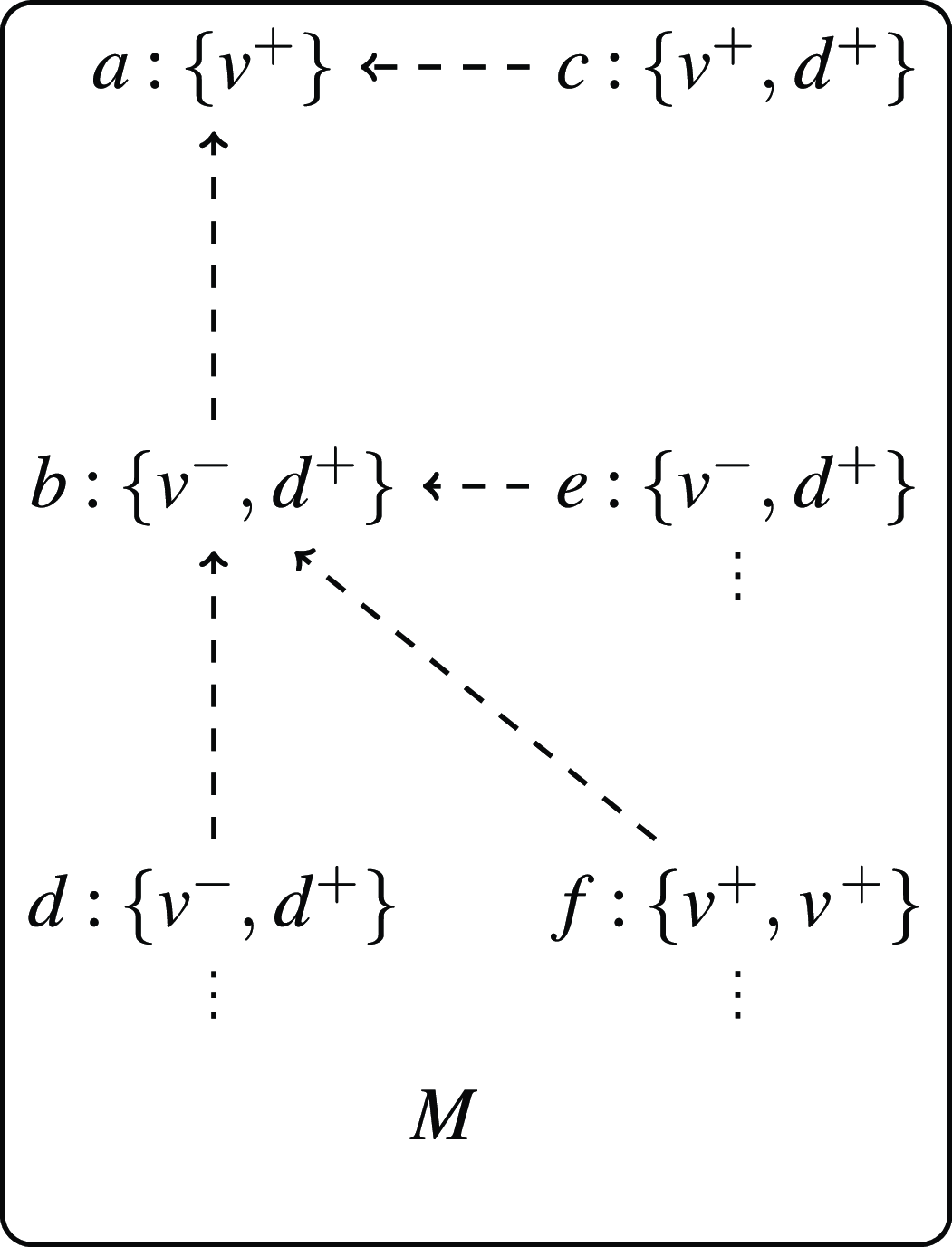
Imagine that agent a wants to post on vaccines and wants as many as possible of the other agents in the network to see the post. We show that the best tactic for agent a is to first post on dogs, even though a is indifferent about dogs, and then later post on vaccines. Consider first the scenario in Fig. 3 where agent a posts v from the outset. An update happens in two steps. First, we add visibility arrows corresponding to posting and resharing. In the second step, we update the followership relation based on whether the agents who have seen a post are pro or contra the post. The resulting update is $M^{a:v}$
in Fig. 3, where agents b and c have seen a’s vaccine post, and only c remains as a’s follower.
$M^{a:v}$
in Fig. 3, where agents b and c have seen a’s vaccine post, and only c remains as a’s follower.
Update $M^{a:v}$
after agent a posts in favor of vaccines.
$M^{a:v}$
after agent a posts in favor of vaccines.

Then, consider instead the situation where agent a posts on dogs in the update $M^{a:d}$
in Fig. 4 before posting on vaccines in the update
$M^{a:d}$
in Fig. 4 before posting on vaccines in the update $M^{a:d,a:v}$
in Fig. 5. Note that to make the situation easier to read, we omit the followership arrows in the visibility update and the visibility arrows in the followership update in both figures. After
$M^{a:d,a:v}$
in Fig. 5. Note that to make the situation easier to read, we omit the followership arrows in the visibility update and the visibility arrows in the followership update in both figures. After $M^{a:d}$
, all agents have seen agent a’s post on dogs. Since they like dogs, all agents also follow a after the update.
$M^{a:d}$
, all agents have seen agent a’s post on dogs. Since they like dogs, all agents also follow a after the update.
Update $M^{a:d}$
after agent a posts on dogs.
$M^{a:d}$
after agent a posts on dogs.

Update $M^{a:d,a:v}$
after agent a posts on vaccination after first posting on dogs.
$M^{a:d,a:v}$
after agent a posts on vaccination after first posting on dogs.

In $M^{a:d,a:v}$
, we see the results after agent a first posted on dogs and then vaccines. All the agents have now seen a’s vaccine post. Most of them did not like it and unfollowed a, but only after they were exposed to the post. Interestingly, we also notice that agent f, who was not originally a follower of a in the initial network outset, now follows a and has shared the vaccine post to their followers.
$M^{a:d,a:v}$
, we see the results after agent a first posted on dogs and then vaccines. All the agents have now seen a’s vaccine post. Most of them did not like it and unfollowed a, but only after they were exposed to the post. Interestingly, we also notice that agent f, who was not originally a follower of a in the initial network outset, now follows a and has shared the vaccine post to their followers.
There are two tactical reasons for agent a to post on dogs before their more controversial post on vaccines. Firstly, a larger portion of the agents now saw a’s post on vaccines since they followed agent a after the dog post. Second, a has been able to reach out and expand their network: agent f who is also pro vaccines has shared the vaccination post to their, for us unknown, followers.
The reason behind a phenomenon such as this is directly connected to an underlying notion of trust between agents in the network. In our setting, agents follow other agents when the former is exposed to content that they like by the latter. In the example, we imagine agents likely followed a because they wanted to see more dog-friendly content. Agent a misuses the trust of their followers by pretending to be interested in dogs before posting on vaccination.
What becomes clear in this example is that in our simplified setting of posting and sharing in a social network, the interests of an agent’s followers matter a lot to what information is shared and seen. Second, the system is vulnerable to exploitation by a potentially malicious agent: there are opportunities to tactically post on popular topics to later expose more agents to a controversial opinion. To reason about dynamic situations such as these, we introduce VL.
4.2 Language, semantics, and logical properties of VL
The language of VL is an extension of the language of SVL.
Definition 24. Syntax. The language of visibility logic $\mathbb{VL}$
is defined recursively by the following BNF:
$\mathbb{VL}$
is defined recursively by the following BNF:
 \begin{align*}\begin{array}{lllll}\varphi &::= &p^+ \mid p^- \mid i \mid \neg \varphi \mid (\varphi \wedge \varphi) \mid \Diamond_{i:p} \varphi \mid \Diamond^{-1}_{i:p} \varphi \mid \blacklozenge \varphi \mid \blacklozenge^{-1} \varphi \mid @_i \varphi \mid [\pi]\varphi\\\pi &::= &p \mid (\pi \cup \pi)\end{array}\end{align*}
where $[\pi]\varphi$
is read “after the current agent executes action
$[\pi]\varphi$
is read “after the current agent executes action $\pi$
,
$\pi$
, $\varphi$
holds.”
$\varphi$
holds.”
Union of actions $(\pi \cup \tau)$
was inherited by DELs from propositional dynamic logic (PDL) (Fischer and Ladner, Reference Fischer and Ladner1979), and in the context of visibility formulas,
$(\pi \cup \tau)$
was inherited by DELs from propositional dynamic logic (PDL) (Fischer and Ladner, Reference Fischer and Ladner1979), and in the context of visibility formulas, $[p \cup q] \varphi$
mean “whichever topic the current agent posts on, p or q,
$[p \cup q] \varphi$
mean “whichever topic the current agent posts on, p or q, $\varphi$
will be true (in both cases).”
$\varphi$
will be true (in both cases).”
Given a formula $\varphi \in \mathbb{VL}$
, we define modal depth and the size of the formula similarly to the corresponding definitions for
$\varphi \in \mathbb{VL}$
, we define modal depth and the size of the formula similarly to the corresponding definitions for $\mathbb{SVL}$
with the following additional cases:
$\mathbb{SVL}$
with the following additional cases: $md([\pi]\varphi) = md(\varphi)$
, and
$md([\pi]\varphi) = md(\varphi)$
, and $|[\pi]\varphi| = |\pi| + |\varphi| + 1$
, where
$|[\pi]\varphi| = |\pi| + |\varphi| + 1$
, where $|\pi \cup \tau| = |\pi| + |\tau| + 1$
.
$|\pi \cup \tau| = |\pi| + |\tau| + 1$
.
Definition 25. (Semantics). Let $M = (A,F,+,-,V,R)$
be a visibility model,
$M = (A,F,+,-,V,R)$
be a visibility model, $a \in A$
, and
$a \in A$
, and $p,q \in \mathsf{Top}$
. The semantics of VL is the same as in Definition 3 with the following additions:
$p,q \in \mathsf{Top}$
. The semantics of VL is the same as in Definition 3 with the following additions:
 \begin{align*}\begin{array}{lll}M_a \models [p]\varphi &\text{iff} &M_a^{a:p} \models \varphi\\M_a \models [\pi \cup \tau] \varphi &\text{iff} &M_a \models [\pi]\varphi \text{ and } M_a \models [\tau]\varphi\\M_a \models \langle \pi \cup \tau \rangle \varphi &\text{iff} &M_a \models \langle \pi \rangle \varphi \text{ or } M_a \models \langle \tau \rangle \varphi\end{array}\end{align*}
where $M_a^{a:p}$
is defined in the following two steps. First, let
$M_a^{a:p}$
is defined in the following two steps. First, let $M^\ast = (A$
, F,
$M^\ast = (A$
, F, $+$
,
$+$
, $-$
, V,
$-$
, V, $R^\ast)$
, where
$R^\ast)$
, where $R^\ast (p,a)$
is the least fixed point of function
$R^\ast (p,a)$
is the least fixed point of function $f: 2^{A \times A} \rightarrow 2^{A \times A}$
defined as:
$f: 2^{A \times A} \rightarrow 2^{A \times A}$
defined as:
 $$\begin{aligned}f(X) = &X \cup \{(a,a)\} \cup \{(b,c) \mid (b,b) \in X \text{ and } c \in F(b)\} \\&{}\cup\{(c,c) \mid p \in +(c) \text{ and } \exists b: (b,c) \in X\}.\end{aligned}$$
Informally, intermediate model $M^\ast$
differs from M only in R in such a way that
$M^\ast$
differs from M only in R in such a way that $R^\ast$
now contains the fact that a has posted on p, that her post has reached all her followers, and that all followers who are pro p reshare the post further to their followers. Second, we construct
$R^\ast$
now contains the fact that a has posted on p, that her post has reached all her followers, and that all followers who are pro p reshare the post further to their followers. Second, we construct $M^{a:p}$
out of
$M^{a:p}$
out of $M^\ast$
by updating F:
$M^\ast$
by updating F:
(1)
$F^{a:p}(a) = F(a) \cup \{b\}$
, if
$a\neq b$
,
$p \in +(b)$
, and
$\exists c: (c,b) \in R^\ast(p,a)$
,(2)
$F^{a:p}(b) = F(b) \setminus \{c\}$
, if
$p \in -(b)$
and
$(c,b) \in R^\ast(p,a)$
.


Intuitively, agent b will follow the original poster a if she has seen the post, maybe not even from a, and if she is pro the topic. Agent c will stop following anyone from whom she has seen a post on a topic she dislikes.
Returning to the example in the beginning of this section, we can use the new operators to reason about the situation with formulas that hold in the models given in the example. For simplicity, we name the agents with nominals corresponding to their labels in the model. That is, $M_{a} \vDash a$
,
$M_{a} \vDash a$
, $M_{b} \vDash b$
and so on, where
$M_{b} \vDash b$
and so on, where $a, b \in \mathsf{Nom}$
. To avoid confusion with the agent named d, we denote the topics “vaccines” and “dogs” with vacc and dogs instead of v and d as used in the example. The following formulas, with their respective intuitive readings, hold in the initial model M in Fig. 2:
$a, b \in \mathsf{Nom}$
. To avoid confusion with the agent named d, we denote the topics “vaccines” and “dogs” with vacc and dogs instead of v and d as used in the example. The following formulas, with their respective intuitive readings, hold in the initial model M in Fig. 2:
•
$M_{a} \vDash [vacc] \blacksquare^{-1}c$

“After posting on vaccines, a will have only one follower, c.”
•
$M_{a} \vDash [vacc]( \Diamond_{a:vacc} b \wedge \Diamond_{a:vacc} c \wedge \Box_{a:vacc}(a \vee b \vee c))$

“After posting on vaccines, only b and c, except for a, will have seen a’s post.”
•
$M_{a} \vDash [dogs] (\blacklozenge^{-1} b \wedge \blacklozenge^{-1} c \wedge \blacklozenge^{-1} d \wedge \blacklozenge^{-1} e \wedge \blacklozenge^{-1} f)$

“After posting on dogs, all agents from b to f will follow a.”
•
$M_{a} \vDash [dogs][vacc] (\Diamond_{a:vacc} b \wedge \Diamond_{a:vacc} c \wedge \Diamond_{a:vacc} d \wedge \Diamond_{a:vacc} e \wedge \Diamond_{a:vacc} f)$

“After a first posts on dogs, and then on vaccines, all agents from a to f will have seen a’s post on vaccines.”
To give a further taste of VL, let us provide some properties that are valid or not valid on visibility models. All the validities can be shown by an application of the definition of the semantics.
Proposition 26. Let $p,q \in \mathsf{Top}$
and
$p,q \in \mathsf{Top}$
and $\varphi \in \mathbb{VL}$
.
$\varphi \in \mathbb{VL}$
.
(1)
$\lnot [p] \varphi \leftrightarrow [p] \lnot \varphi$
is valid.(2)
$[\pi \cup \tau]\varphi \leftrightarrow [\pi]\varphi \land [\tau]\varphi$
is valid.(3)
$\Diamond^{-1}_{i:p} \varphi \leftrightarrow [q]\Diamond^{-1}_{i:p} \varphi$
is valid.(4)
$[p]\varphi \rightarrow [p][p]\varphi$
is not valid.(5)
$[p][p]\varphi \rightarrow [p]\varphi$
is not valid.


The first formula states that the operator of posting on a topic is its own dual. The second property shows how to eliminate nondeterministic choice. The third item claims that once an agent has seen a post of an agent with the name i on topic p, no further post can revoke this. The fact that formulas four and five are not valid indicates that consecutive posting on the same topic yields different results. A counterexample showing this would include the current agent with the name i posting on p and gaining new followers. Additional posts on the same topic by the same agent will add new p-arrows to those new followers, thus resulting in a different updated model that is not guaranteed to satisfy $\varphi$
.
$\varphi$
.
4.3 Expressivity and model checking
Now, we state that VL is more expressive than its static fragment SVL. This result is quite interesting, since many of DELs, for example, public announcement logic (Plaza, Reference Plaza2007), arrow update logic (Kooi and Renne, Reference Kooi and Renne2011), and action model logic (van Ditmarsch et al., Reference van Ditmarsch, van der Hoek and Kooi2008, Chapter 6), are equally expressive as the static logic they are built upon. Those expressivity results are usually obtained with the use of so-called reduction axioms that allow one to equivalently rewrite formulas of dynamic extensions to formulas of the static fragment. Thus, the fact that VL is more expressive than SVL also entails that no reduction axioms for VL are possible.
Theorem 27. $\mathbb{SVL} < \mathbb{VL}$
.
$\mathbb{SVL} < \mathbb{VL}$
.
Proof. Consider a $\mathbb{VL}$
formula
$\mathbb{VL}$
formula $[p]\blacklozenge^{-1} \blacksquare^{-1} \bot$
, and assume toward a contradiction that there is an equivalent formula
$[p]\blacklozenge^{-1} \blacksquare^{-1} \bot$
, and assume toward a contradiction that there is an equivalent formula $\psi$
of
$\psi$
of $\mathbb{SVL}$
with
$\mathbb{SVL}$
with $md(\psi) = n$
. Since
$md(\psi) = n$
. Since $\psi$
has a finite size, there is a set of nominals
$\psi$
has a finite size, there is a set of nominals $Q = \{j_1, \ldots, j_{n+1}\}$
that are not present in
$Q = \{j_1, \ldots, j_{n+1}\}$
that are not present in $\psi$
.
$\psi$
.
Consider models M and N in Fig. 6. The models are chains of length $n+2$
that start with agent a and with each next agent following the previous one. The only difference between the models is that the last agent in the chain in model M is pro topic p, and the last agent in the chain in model N is neither pro nor contra topic p.
$n+2$
that start with agent a and with each next agent following the previous one. The only difference between the models is that the last agent in the chain in model M is pro topic p, and the last agent in the chain in model N is neither pro nor contra topic p.
Models M and N.

Now we will argue that $[p]\blacklozenge^{-1} \blacksquare^{-1} \bot$
distinguishes
$[p]\blacklozenge^{-1} \blacksquare^{-1} \bot$
distinguishes $M_a$
and
$M_a$
and $N_a$
. In particular,
$N_a$
. In particular, $M_a \models [p]\blacklozenge^{-1} \blacksquare^{-1} \bot$
and
$M_a \models [p]\blacklozenge^{-1} \blacksquare^{-1} \bot$
and $N_a \not \models [p]\blacklozenge^{-1} \blacksquare^{-1} \bot$
. Indeed, agent a posting on topic p results in the updated visibility model
$N_a \not \models [p]\blacklozenge^{-1} \blacksquare^{-1} \bot$
. Indeed, agent a posting on topic p results in the updated visibility model $M_a^{a:p}$
presented in Fig. 7. In the updated model, it holds that
$M_a^{a:p}$
presented in Fig. 7. In the updated model, it holds that $M_{b_{n+1}}^{a:p} \models \blacklozenge i$
, that is, that agent
$M_{b_{n+1}}^{a:p} \models \blacklozenge i$
, that is, that agent $b_{n+1}$
follows agent a. Moreover, agent
$b_{n+1}$
follows agent a. Moreover, agent $b_{n+1}$
does not have any followers so
$b_{n+1}$
does not have any followers so $M_{b_{n+1}}^{a:p} \models \blacksquare^{-1} \bot$
is vacuously true. Hence,
$M_{b_{n+1}}^{a:p} \models \blacksquare^{-1} \bot$
is vacuously true. Hence, $M_a \models [p]\blacklozenge^{-1} \blacksquare^{-1} \bot$
. To see that
$M_a \models [p]\blacklozenge^{-1} \blacksquare^{-1} \bot$
. To see that $N_a \not \models [p]\blacklozenge^{-1} \blacksquare^{-1} \bot$
, it is enough to notice that agent
$N_a \not \models [p]\blacklozenge^{-1} \blacksquare^{-1} \bot$
, it is enough to notice that agent $b_{n+1}$
is not pro topic p, and thus they do not follow agent a in the updated model. Updated model
$b_{n+1}$
is not pro topic p, and thus they do not follow agent a in the updated model. Updated model $N_a^{a:p}$
is depicted in Fig. 7 on the right.
$N_a^{a:p}$
is depicted in Fig. 7 on the right.
Models $M^{a:p}$
and
$M^{a:p}$
and $N^{a:p}$
. Reflexive
$N^{a:p}$
. Reflexive $p_a$
-arrows and followership arrows from
$p_a$
-arrows and followership arrows from $b_k$
to a for
$b_k$
to a for $k \in \{1, ..., n\}$
are omitted for readability.
$k \in \{1, ..., n\}$
are omitted for readability.

In order to show that $M_a \models \psi$
if and only if
$M_a \models \psi$
if and only if $N_a \models \psi$
, observe that
$N_a \models \psi$
, observe that $M_a$
and
$M_a$
and $N_a$
are n-bisimilar (but not
$N_a$
are n-bisimilar (but not $(n+1)$
-bisimilar), which implies that the pointed models are
$(n+1)$
-bisimilar), which implies that the pointed models are $(\mathsf{Nom} \setminus Q)$
-n-bisimilar. From the fact that
$(\mathsf{Nom} \setminus Q)$
-n-bisimilar. From the fact that $md(\psi) = n$
and Theorem 9, it follows that
$md(\psi) = n$
and Theorem 9, it follows that $M_a \models \psi$
if and only if
$M_a \models \psi$
if and only if $N_a \models \psi$
. Hence, we have a contradiction with an earlier assumption that
$N_a \models \psi$
. Hence, we have a contradiction with an earlier assumption that $\psi$
is equivalent to
$\psi$
is equivalent to $[p]\blacklozenge^{-1} \blacksquare^{-1} \bot$
.
$[p]\blacklozenge^{-1} \blacksquare^{-1} \bot$
.
Before we turn to the model checking problem for VL, we mention that the complexity of the model checking problem of SVL is in P. This result follows trivially from the fact that model checking hybrid tense logic with universal modality is in P (Franceschet and de Rijke, Reference Franceschet and de Rijke2006).
Theorem 28. Model checking SVL is in P.
Not only is VL more expressive than SVL, but its model checking problem is also more computationally demanding. We show this by providing a model checking algorithm for VL that runs in polynomial space. For hardness, we use the classic reduction from quantified Boolean formulas.
Theorem 29. The model checking problem for VL is PSPACE-complete.
Proof. To show that the model checking problem for VL is in PSPACE, we present Algorithm 1.
An algorithm for model checking VL

The algorithm follows the semantics, and its correctness can be shown via induction on $\varphi$
. Now we argue that the algorithm requires at most polynomial space. The interesting case here is
$\varphi$
. Now we argue that the algorithm requires at most polynomial space. The interesting case here is $\varphi = [p] \psi$
. Without giving an explicit algorithm for constructing
$\varphi = [p] \psi$
. Without giving an explicit algorithm for constructing $M^{a:p}$
, we note that the size of
$M^{a:p}$
, we note that the size of $M^{a:p}$
is bounded by
$M^{a:p}$
is bounded by $\mathcal{O}(|M|^2)$
(the worst-case scenario of R(p,a) and F being universal). Since there are at most
$\mathcal{O}(|M|^2)$
(the worst-case scenario of R(p,a) and F being universal). Since there are at most $|\varphi|$
symbols in
$|\varphi|$
symbols in $\varphi$
, the total space required by the algorithm is bounded by
$\varphi$
, the total space required by the algorithm is bounded by $\mathcal{O}(|\varphi| \cdot |M|^2)$
.
$\mathcal{O}(|\varphi| \cdot |M|^2)$
.
To show hardness of the model checking problem, we use the classic reduction from the satisfiability of quantified Boolean formulas: given a QBF $\Psi := Q_1 p_1 \ldots Q_n p_n \psi(p_1, \ldots, p_n)$
, where
$\Psi := Q_1 p_1 \ldots Q_n p_n \psi(p_1, \ldots, p_n)$
, where $Q_i \in \{\forall, \exists\}$
, determine whether
$Q_i \in \{\forall, \exists\}$
, determine whether $\Psi$
is true. To reduce the satisfiability of QBF
$\Psi$
is true. To reduce the satisfiability of QBF $\Psi$
to the model checking of VL, we construct a model
$\Psi$
to the model checking of VL, we construct a model $M_a$
and a formula
$M_a$
and a formula $\Psi^\prime$
of
$\Psi^\prime$
of $\mathbb{VL}$
such that
$\mathbb{VL}$
such that $\Psi$
is true if and only if
$\Psi$
is true if and only if $M_a \models \Psi^\prime$
.
$M_a \models \Psi^\prime$
.
More specifically, given a QBF $Q_1 p_1 \ldots Q_n p_n \psi(p_1, \ldots, p_n)$
, we construct a visibility model
$Q_1 p_1 \ldots Q_n p_n \psi(p_1, \ldots, p_n)$
, we construct a visibility model $M = (A,F,+,-,V,R)$
, where
$M = (A,F,+,-,V,R)$
, where $A = \{a_0, \ldots, a_n\}$
,
$A = \{a_0, \ldots, a_n\}$
, $F(a_i) = \{a_0\}$
for all
$F(a_i) = \{a_0\}$
for all $i \neq 0$
,
$i \neq 0$
, $+(a_i) = p_i$
for all
$+(a_i) = p_i$
for all $i \neq 0$
,
$i \neq 0$
, $-(a_i) = \emptyset$
for all i,
$-(a_i) = \emptyset$
for all i, $V(i_j) = \{a_j\}$
, and
$V(i_j) = \{a_j\}$
, and $R(p,a) = \emptyset$
for all
$R(p,a) = \emptyset$
for all $p \in \mathsf{Top}$
and
$p \in \mathsf{Top}$
and $a \in A$
. Additionally, we assume that there is a topic q that no agent is either pro or contra. Intuitively, M is a model consisting of
$a \in A$
. Additionally, we assume that there is a topic q that no agent is either pro or contra. Intuitively, M is a model consisting of $n+1$
agents, where everyone follows agent
$n+1$
agents, where everyone follows agent $a_0$
, who follows no one. Each agent, apart from
$a_0$
, who follows no one. Each agent, apart from $a_0$
, is pro exactly one topic, and no one is contra anything. Finally, the translation of the QBF is done recursively as follows:
$a_0$
, is pro exactly one topic, and no one is contra anything. Finally, the translation of the QBF is done recursively as follows:
 \begin{align*}\psi_0^\prime &:= \psi( \Diamond_{i_0:p_1} (i_1 \land \Diamond_{i_0:p_1} \top), \ldots, \Diamond_{i_0:p_n} (i_n \land \Diamond_{i_0:p_n} \top))\\ \psi_k^\prime &:=\begin{cases} [p_k \cup q] \psi_{k-1}^\prime &\text{if } Q_k = \forall\\ \lnot [p_k \cup q] \lnot \psi_{k-1}^\prime &\text{if } Q_k = \exists\\\end{cases}\\\psi^\prime &:= \psi^\prime_{n}.\end{align*}
We need to show that
 \begin{align*}Q_1 x_1 \ldots Q_n x_n \psi(p_1, \ldots, p_n)\, \text{is satisfiable iff}\, M_a \models \psi^\prime.\end{align*}
Agent $a_0$
posting on topic
$a_0$
posting on topic $p_i$
means that the truth value of
$p_i$
means that the truth value of $p_i$
has been set to 1. If agent
$p_i$
has been set to 1. If agent $a_0$
posts on topic q, this means that the truth value of the corresponding
$a_0$
posts on topic q, this means that the truth value of the corresponding $p_i$
has been set to 0. Since there are no two agents that are pro the same topic, the choice of truth values is unambiguous.
$p_i$
has been set to 0. Since there are no two agents that are pro the same topic, the choice of truth values is unambiguous.
We use nondeterministic choice to model quantifiers. The universal quantifier $\forall p_k$
is emulated with
$\forall p_k$
is emulated with $[p_k \cup q] \psi^\prime_{k-1}$
meaning that no matter what agent
$[p_k \cup q] \psi^\prime_{k-1}$
meaning that no matter what agent $a_0$
chooses to post on,
$a_0$
chooses to post on, $p_k$
or q, formula
$p_k$
or q, formula $\psi^\prime_{k-1}$
will be true. Similarly, the existential quantifier
$\psi^\prime_{k-1}$
will be true. Similarly, the existential quantifier $\exists p_k$
is emulated with
$\exists p_k$
is emulated with $\lnot [ p_k \cup q ] \lnot \psi^\prime_{k-1}$
meaning that agent
$\lnot [ p_k \cup q ] \lnot \psi^\prime_{k-1}$
meaning that agent $a_0$
can post on a topic, either
$a_0$
can post on a topic, either $p_k$
or q, to make
$p_k$
or q, to make $\psi^\prime_{k-1}$
true. Finally, propositional variable
$\psi^\prime_{k-1}$
true. Finally, propositional variable $p_j$
is translated into the formula
$p_j$
is translated into the formula $\Diamond_{i_0:p_j} (i_j \land \Diamond_{i_0:p_j} \top)$
that is true if and only if there has been a post on
$\Diamond_{i_0:p_j} (i_j \land \Diamond_{i_0:p_j} \top)$
that is true if and only if there has been a post on $p_j$
, and the corresponding agent
$p_j$
, and the corresponding agent $a_j$
, who is pro
$a_j$
, who is pro $p_j$
, has reposted it. For all other agents
$p_j$
, has reposted it. For all other agents $a_k$
, the formula will not hold. Posting on q instead of
$a_k$
, the formula will not hold. Posting on q instead of $p_j$
results in the fact that
$p_j$
results in the fact that $\Diamond_{i_0:p_j} (i_j \land \Diamond_{i_0:p_j} \top)$
is not satisfied anywhere in the model, thus corresponding to setting
$\Diamond_{i_0:p_j} (i_j \land \Diamond_{i_0:p_j} \top)$
is not satisfied anywhere in the model, thus corresponding to setting $p_j$
to 0.
$p_j$
to 0.
As an example, consider a QBF $\forall p_1 \exists p_2 (p_1 \rightarrow p_2)$
. The formula is first translated into a formula of
$\forall p_1 \exists p_2 (p_1 \rightarrow p_2)$
. The formula is first translated into a formula of $\mathbb{VL}$
:
$\mathbb{VL}$
: $[p_1 \cup q] \lnot [p_2 \cup q] \lnot (\Diamond_{i_a:p_1} (i_b \land \Diamond_{i_a:p_1} \top) \rightarrow \Diamond_{i_a:p_2} (i_c \land \Diamond_{i_a:p_2} \top))$
. The corresponding model M is depicted in Fig. 8.
$[p_1 \cup q] \lnot [p_2 \cup q] \lnot (\Diamond_{i_a:p_1} (i_b \land \Diamond_{i_a:p_1} \top) \rightarrow \Diamond_{i_a:p_2} (i_c \land \Diamond_{i_a:p_2} \top))$
. The corresponding model M is depicted in Fig. 8.
Models M, $M^{a:p_1}$
,
$M^{a:p_1}$
, $M^{a:q}$
, and
$M^{a:q}$
, and $M^{a:p_1, a:p_2}$
.
$M^{a:p_1, a:p_2}$
.

Now, $M_a \models [p_1 \cup q] \lnot [ p_2 \cup q ] \lnot (\Diamond_{i_a:p_1} (i_b \land \Diamond_{i_a:p_1} \top) \rightarrow \Diamond_{i_a:p_2} (i_c \land \Diamond_{i_a:p_2} \top))$
if and only if
$M_a \models [p_1 \cup q] \lnot [ p_2 \cup q ] \lnot (\Diamond_{i_a:p_1} (i_b \land \Diamond_{i_a:p_1} \top) \rightarrow \Diamond_{i_a:p_2} (i_c \land \Diamond_{i_a:p_2} \top))$
if and only if
 $$M_a^{a:p_1} \models \lnot [ p_2 \cup q ] \lnot (\Diamond_{i_a:p_1} (i_b \land \Diamond_{i_a:p_1} \top) \rightarrow \Diamond_{i_a:p_2} (i_c \land \Diamond_{i_a:p_2} \top))$$
and
 $$M_a^{a:q} \models \lnot [ p_2 \cup q ]\lnot (\Diamond_{i_a:p_1} (i_b \land \Diamond_{i_a:p_1} \top) \rightarrow \Diamond_{i_a:p_2} (i_c \land \Diamond_{i_a:p_2} \top)).$$
Both updated models $M_a^{i_a:p_1}$
and
$M_a^{i_a:p_1}$
and $M_a^{i_a:q}$
are depicted in Fig. 8. Notice that since agent b is pro topic
$M_a^{i_a:q}$
are depicted in Fig. 8. Notice that since agent b is pro topic $p_1$
, they repost it thus creating a reflexive loop labeled with
$p_1$
, they repost it thus creating a reflexive loop labeled with $p_1$
. Agent c, who is not pro topic
$p_1$
. Agent c, who is not pro topic $p_1$
, does not have such a loop. In the case of q, none of the agents have a reflexive loop.
$p_1$
, does not have such a loop. In the case of q, none of the agents have a reflexive loop.
In model $M_a^{a:p_1}$
, propositional variable
$M_a^{a:p_1}$
, propositional variable $p_1$
has been set to 1. Thus, we can choose to update the model further with a’s post on
$p_1$
has been set to 1. Thus, we can choose to update the model further with a’s post on $p_2$
to satisfy the initial formula. Indeed, consider model
$p_2$
to satisfy the initial formula. Indeed, consider model $M^{a:p_1, a:p_2}$
. In the model, we have that
$M^{a:p_1, a:p_2}$
. In the model, we have that $M^{a:p_1, a:p_2}_a \models \Diamond_{i_a:p_1} (i_b \land \Diamond_{i_a:p_1} \top) \rightarrow \Diamond_{i_a:p_2} (i_c \land \Diamond_{i_a:p_2} \top)$
since there is an
$M^{a:p_1, a:p_2}_a \models \Diamond_{i_a:p_1} (i_b \land \Diamond_{i_a:p_1} \top) \rightarrow \Diamond_{i_a:p_2} (i_c \land \Diamond_{i_a:p_2} \top)$
since there is an $a:p_1$
-arrow to state satisfying
$a:p_1$
-arrow to state satisfying $i_b$
from which there another
$i_b$
from which there another $a:p_1$
-arrow. Similarly for
$a:p_1$
-arrow. Similarly for $a:p_2$
-arrows. This corresponds to satisfying
$a:p_2$
-arrows. This corresponds to satisfying $p_1 \rightarrow p_2$
by setting both variables to 1.
$p_1 \rightarrow p_2$
by setting both variables to 1.
In model $M_a^{a:q}$
, propositional variable
$M_a^{a:q}$
, propositional variable $p_1$
has been set to 0. Thus, we can choose any further update of the model. Let agent a post on q once again. Since we do not discriminate between different posts on the same topic, model
$p_1$
has been set to 0. Thus, we can choose any further update of the model. Let agent a post on q once again. Since we do not discriminate between different posts on the same topic, model $M_a^{a:q, a:q}$
looks exactly like
$M_a^{a:q, a:q}$
looks exactly like $M_a^{a:q}$
. Moreover, it is clear that
$M_a^{a:q}$
. Moreover, it is clear that $M_a^{a:q, a:q} \models \Diamond_{i_a:p_1} (i_b \land \Diamond_{i_a:p_1} \top) \rightarrow \Diamond_{i_a:p_2} (i_c \land \Diamond_{i_a:p_2} \top)$
since
$M_a^{a:q, a:q} \models \Diamond_{i_a:p_1} (i_b \land \Diamond_{i_a:p_1} \top) \rightarrow \Diamond_{i_a:p_2} (i_c \land \Diamond_{i_a:p_2} \top)$
since $M_a^{a:q, a:q} \not \models \Diamond_{i_a:p_1} (i_b \land \Diamond_{i_a:p_1} \top)$
. This corresponds to satisfying
$M_a^{a:q, a:q} \not \models \Diamond_{i_a:p_1} (i_b \land \Diamond_{i_a:p_1} \top)$
. This corresponds to satisfying $p_1 \rightarrow p_2$
by setting both variables to 0.
$p_1 \rightarrow p_2$
by setting both variables to 0.
Remark 30. Our PSPACE-hardness proof relied on the union operator $\pi \cup \tau$
. At the same time, by item (2) of Proposition 26, all formulas with action modalities with unions can be equivalently translated into formulas, where action modalities have only single topics in them. It is not immediately obvious whether our PSPACE-hardness argument can be rewritten without unions. We conjecture that it is indeed possible, taking into account that DEL with unions (Aucher and Schwarzentruber, Reference Aucher, Schwarzentruber and Schipper2013) and DEL without unions are both PSPACE-hard (de Haan and van de Pol, Reference de Haan and van de Pol2021). We note, however, that the PSPACE-hardness argument for DEL without unions is much more complex than the one for DEL with unions.
$\pi \cup \tau$
. At the same time, by item (2) of Proposition 26, all formulas with action modalities with unions can be equivalently translated into formulas, where action modalities have only single topics in them. It is not immediately obvious whether our PSPACE-hardness argument can be rewritten without unions. We conjecture that it is indeed possible, taking into account that DEL with unions (Aucher and Schwarzentruber, Reference Aucher, Schwarzentruber and Schipper2013) and DEL without unions are both PSPACE-hard (de Haan and van de Pol, Reference de Haan and van de Pol2021). We note, however, that the PSPACE-hardness argument for DEL without unions is much more complex than the one for DEL with unions.
5. Arbitrary Visibility Logic
The example in Subsection 4.1 demonstrated that what topic an agent posts on matters. Depending on an agent’s goals, posting on some topics rather than others can be more productive. For instance, if the goal of the posting agent in the example is to gain as many followers as possible, then posting on dogs is a better strategy than posting on vaccines.
As agents’ goals can be reached by posting on one topic, and not reached by posting on another, we can ask a natural general question: given a visibility model M, a goal $\varphi$
and a current agent a, is there a topic such that after posting on it, agent a makes
$\varphi$
and a current agent a, is there a topic such that after posting on it, agent a makes $\varphi$
true in model M? Observe the existential quantification in the question. A dual question with the universal quantification may be asked about some safety property
$\varphi$
true in model M? Observe the existential quantification in the question. A dual question with the universal quantification may be asked about some safety property $\varphi$
of a visibility model M: is true that whatever the current agent posts on,
$\varphi$
of a visibility model M: is true that whatever the current agent posts on, $\varphi$
will still hold in the updated visibility model?
$\varphi$
will still hold in the updated visibility model?
To capture such reasoning, we extend the language of visibility logic with constructs $[\ast]\varphi$
that means “whatever action the current agent executes,
$[\ast]\varphi$
that means “whatever action the current agent executes, $\varphi$
will be true.” Shifting our perspective from the effects of a particular agent action to the (non-)existence of an action achieving a certain goal is inspired by quantification in DEL (van Ditmarsch, Reference van Ditmarsch2023) and in particular by arbitrary public announcement logic (Balbiani et al., Reference Balbiani, Baltag, van Ditmarsch, Herzig, Hoshi and de Lima2008). It is following the latter that we call VL extended with quantifiers AVL.
$\varphi$
will be true.” Shifting our perspective from the effects of a particular agent action to the (non-)existence of an action achieving a certain goal is inspired by quantification in DEL (van Ditmarsch, Reference van Ditmarsch2023) and in particular by arbitrary public announcement logic (Balbiani et al., Reference Balbiani, Baltag, van Ditmarsch, Herzig, Hoshi and de Lima2008). It is following the latter that we call VL extended with quantifiers AVL.
Definition 31. The language of arbitrary visibility logic $\mathbb{AVL}$
is defined recursively by the following grammar:
$\mathbb{AVL}$
is defined recursively by the following grammar:
 \begin{align*}\begin{array}{lllll}\varphi &::= &p^+ \mid p^- \mid i \mid \neg \varphi \mid (\varphi \wedge \varphi) \mid \Diamond_{i:p} \varphi \mid \Diamond^{-1}_{i:p} \varphi \mid \blacklozenge \varphi \mid \blacklozenge^{-1} \varphi \mid @_i \varphi \mid [\pi]\varphi \mid [\ast] \varphi\\\pi &::= &p \mid (\pi \cup \pi)\end{array}\end{align*}
where $[\ast]\varphi$
is read “whatever action the current agent executes,
$[\ast]\varphi$
is read “whatever action the current agent executes, $\varphi$
holds.” Its dual, which is defined as
$\varphi$
holds.” Its dual, which is defined as $\langle \ast \rangle \varphi := \lnot [\ast] \lnot \varphi$
, is read as “there is an action which the current agent can execute such that
$\langle \ast \rangle \varphi := \lnot [\ast] \lnot \varphi$
, is read as “there is an action which the current agent can execute such that $\varphi$
will hold.”
$\varphi$
will hold.”
Given a formula $\varphi \in \mathbb{AVL}$
, we define modal depth and the size of the formula similarly to the corresponding definitions for
$\varphi \in \mathbb{AVL}$
, we define modal depth and the size of the formula similarly to the corresponding definitions for $\mathbb{VL}$
with the following additional cases:
$\mathbb{VL}$
with the following additional cases: $md([\ast]\varphi) = md(\varphi)$
, and
$md([\ast]\varphi) = md(\varphi)$
, and $|[\ast]\varphi| = |\varphi| + 1$
.
$|[\ast]\varphi| = |\varphi| + 1$
.
Definition 32. Let $M = (A,F,+,-,V,R)$
be a visibility model,
$M = (A,F,+,-,V,R)$
be a visibility model, $a \in A$
, and
$a \in A$
, and $p,q \in \mathsf{Top}$
. The semantics of AVL extends the semantics of VL (Definition 25) with the following dual clauses:
$p,q \in \mathsf{Top}$
. The semantics of AVL extends the semantics of VL (Definition 25) with the following dual clauses:
 \begin{align*}\begin{array}{lll}M_a \models [\ast]\varphi &\text{iff} &\forall \pi: M_a \models [\pi] \varphi\\M_a \models \langle \ast \rangle\varphi &\text{iff} &\exists \pi: M_a \models \langle \pi \rangle \varphi\end{array}\end{align*}
Note that we quantify not over single topics but over actions that can be more complex.
Returning to the example in Subsection 4.1, we can say that there is a topic on which agent a can post such that agents from b to f will follow her: $M_{a} \vDash \langle \ast \rangle (\blacklozenge^{-1} b \wedge \blacklozenge^{-1} c \wedge \blacklozenge^{-1} d \wedge \blacklozenge^{-1} e \wedge \blacklozenge^{-1} f)$
, where
$M_{a} \vDash \langle \ast \rangle (\blacklozenge^{-1} b \wedge \blacklozenge^{-1} c \wedge \blacklozenge^{-1} d \wedge \blacklozenge^{-1} e \wedge \blacklozenge^{-1} f)$
, where $b, ..., f$
in the formula are nominal corresponding to agents
$b, ..., f$
in the formula are nominal corresponding to agents $b, ..., f$
in the model. And indeed such a topic is dogs. At the same time, agent a, no matter what she posts on, will never lose her follower c, or, formally,
$b, ..., f$
in the model. And indeed such a topic is dogs. At the same time, agent a, no matter what she posts on, will never lose her follower c, or, formally, $M_a \models [\ast] \blacklozenge^{-1} c$
, where c in the formula is a nominal corresponding to agent c in the model.
$M_a \models [\ast] \blacklozenge^{-1} c$
, where c in the formula is a nominal corresponding to agent c in the model.
Below are some of the valid and not valid formulas of AVL.
Proposition 33. Let $\varphi \in \mathbb{AVL}$
.
$\varphi \in \mathbb{AVL}$
.
(1)
$[\ast] \varphi \to [\pi]\varphi$
is valid(2)
$[\ast] (\varphi \land \psi) \to [\ast]\varphi \land [\ast]\psi$
is valid(3)
$[\ast] [\ast] \varphi \to [\ast] \varphi$
is not valid(4)
$[\ast] \varphi \to [\ast][\ast] \varphi$
is not valid


The first formula states that if after executing any action $\varphi$
is true, then
$\varphi$
is true, then $\varphi$
will be true after executing some particular action. The second property is an expected distributivity of a modal box over conjunction. That quantifiers cannot be, in general, collapsed is expressed in formulas three and four.
$\varphi$
will be true after executing some particular action. The second property is an expected distributivity of a modal box over conjunction. That quantifiers cannot be, in general, collapsed is expressed in formulas three and four.
Next, we show that in general formulas with quantifiers cannot be reduced to equivalent formulas without quantification. This in particular means that AVL is strictly more expressive than VL.
Theorem 34. $\mathbb{VL} < \mathbb{AVL}$
Proof. Consider $\langle \ast \rangle \blacklozenge^{-1} \blacksquare^{-1} \bot \in \mathbb{AVL}$
, and assume toward a contradiction that there is an equivalent
$\langle \ast \rangle \blacklozenge^{-1} \blacksquare^{-1} \bot \in \mathbb{AVL}$
, and assume toward a contradiction that there is an equivalent $\psi \in \mathbb{VL}$
with
$\psi \in \mathbb{VL}$
with $md(\psi) = n$
, and such that nominals
$md(\psi) = n$
, and such that nominals $Q = \{j_1, \ldots, j_{n+1}\}$
do not appear in
$Q = \{j_1, \ldots, j_{n+1}\}$
do not appear in $\psi$
, and also none of p,
$\psi$
, and also none of p, $p^+$
, and
$p^+$
, and $p^-$
appears anywhere in
$p^-$
appears anywhere in $\psi$
. Now consider models
$\psi$
. Now consider models $M_a$
and
$M_a$
and $N_a$
from Fig. 6, for which we argue that
$N_a$
from Fig. 6, for which we argue that $M_a \models \langle \ast \rangle \blacklozenge^{-1} \blacksquare^{-1} \bot$
and
$M_a \models \langle \ast \rangle \blacklozenge^{-1} \blacksquare^{-1} \bot$
and $N_a \not \models \langle \ast \rangle \blacklozenge^{-1} \blacksquare^{-1} \bot$
. For the former, we have that
$N_a \not \models \langle \ast \rangle \blacklozenge^{-1} \blacksquare^{-1} \bot$
. For the former, we have that $\exists \pi: M_a \models \langle \pi \rangle \blacklozenge^{-1} \blacksquare^{-1} \bot$
by the semantics, and, letting
$\exists \pi: M_a \models \langle \pi \rangle \blacklozenge^{-1} \blacksquare^{-1} \bot$
by the semantics, and, letting $\pi := p$
, the rest follows as in the proof of Theorem 27. For the latter, we consider
$\pi := p$
, the rest follows as in the proof of Theorem 27. For the latter, we consider $N_a \models [ \ast ] \blacksquare^{-1} \blacklozenge^{-1} \top$
, which is equivalent to the fact that
$N_a \models [ \ast ] \blacksquare^{-1} \blacklozenge^{-1} \top$
, which is equivalent to the fact that $\forall \pi: N_a \models [ \pi ] \blacksquare^{-1} \blacklozenge^{-1} \top$
. Now, it is clear from the construction of
$\forall \pi: N_a \models [ \pi ] \blacksquare^{-1} \blacklozenge^{-1} \top$
. Now, it is clear from the construction of $N_a$
that for all
$N_a$
that for all $\pi$
that do not contain p, the only agent that will follow a would be agent
$\pi$
that do not contain p, the only agent that will follow a would be agent $b_1$
that satisfies
$b_1$
that satisfies $\blacklozenge^{-1} \top$
. If
$\blacklozenge^{-1} \top$
. If $\pi$
contains p, then all agents
$\pi$
contains p, then all agents $b_1$
,
$b_1$
, $\ldots$
,
$\ldots$
, $b_n$
will follow agent a, and it is easy to check that for all of them
$b_n$
will follow agent a, and it is easy to check that for all of them $\blacklozenge^{-1} \top$
is satisfied.
$\blacklozenge^{-1} \top$
is satisfied.
To see that $M_a \models \psi$
if and only if
$M_a \models \psi$
if and only if $N_a \models \psi$
, recall that not only are the models
$N_a \models \psi$
, recall that not only are the models $(\mathsf{Nom} \setminus Q)$
-n-bisimilar, but
$(\mathsf{Nom} \setminus Q)$
-n-bisimilar, but $\psi$
does not contain p as well. Thus, the only way for
$\psi$
does not contain p as well. Thus, the only way for $\psi$
to distinguish the models is to witness states
$\psi$
to distinguish the models is to witness states $b_{n+1}$
by a stack of
$b_{n+1}$
by a stack of $\blacklozenge^{-1}$
, which is impossible due to
$\blacklozenge^{-1}$
, which is impossible due to $md(\psi) = n$
and the models being
$md(\psi) = n$
and the models being $(\mathsf{Nom} \setminus Q)$
-n-bisimilar.
$(\mathsf{Nom} \setminus Q)$
-n-bisimilar.
In Section 4, we have shown that additional expressivity of VL, compared to SVL, comes at a price: the complexity of the model checking problem for VL jumps to PSPACE, compared to P for the case of SVL. Taking into account that AVL is strictly more expressive than VL, a natural question is whether we have to pay with yet another jump in complexity. Interestingly, the answer to the question is “no,” and in the rest of the section we argue that the complexity of the model checking problem for AVL is in PSPACE.
First of all, model checking AVL is not entirely straightforward. We cannot directly implement the semantics of the logic in an algorithm since quantifiers $[\ast]$
and
$[\ast]$
and $\langle \ast \rangle$
quantify over a countably infinite number of topics and their unions. However, we will show that it is enough just to consider the topic used in a finite model and appearing in a given formula.
$\langle \ast \rangle$
quantify over a countably infinite number of topics and their unions. However, we will show that it is enough just to consider the topic used in a finite model and appearing in a given formula.
Recall that $Nom(a):=\{i \in \mathsf{Nom} \mid a \in V(i)\}$
is the set of all nominals assigned to agent a, and
$Nom(a):=\{i \in \mathsf{Nom} \mid a \in V(i)\}$
is the set of all nominals assigned to agent a, and $Top(a):= \{p \in \mathsf{Top} \mid R(p,a)\}$
is the set of all topics that agent a has posted.
$Top(a):= \{p \in \mathsf{Top} \mid R(p,a)\}$
is the set of all topics that agent a has posted.
Definition 35. Let M be a finite visibility model, and $\varphi$
be a formula. Then the set of topics appearing in M, denoted
$\varphi$
be a formula. Then the set of topics appearing in M, denoted $\mathit{Var} (M)$
, is
$\mathit{Var} (M)$
, is $\bigcup_{a \in A} Top (a)$
. Similarly, with
$\bigcup_{a \in A} Top (a)$
. Similarly, with $\mathit{Var} (\varphi)$
we denote the set of topics appearing in formula
$\mathit{Var} (\varphi)$
we denote the set of topics appearing in formula $\varphi$
. Finally, we will write
$\varphi$
. Finally, we will write $\mathit{Var} (M,\varphi)$
for
$\mathit{Var} (M,\varphi)$
for $\mathit{Var} (M) \cup \mathit{Var} (\varphi)$
.
$\mathit{Var} (M) \cup \mathit{Var} (\varphi)$
.
Definition 36. Let $\pi$
be an action. We call
$\pi$
be an action. We call $\pi$
unique if no topic appears in
$\pi$
unique if no topic appears in $\pi$
twice.
$\pi$
twice.
Lemma 37. For each action $\pi$
, there is an equivalent unique action
$\pi$
, there is an equivalent unique action $\tau$
.
$\tau$
.
Proof. Let $M_a$
be a visibility model and let
$M_a$
be a visibility model and let $p \in \mathsf{Top}$
. Assume that
$p \in \mathsf{Top}$
. Assume that $M_a \models [\pi \cup p \cup p]\varphi$
. By item (2) of Proposition 26, this is equivalent to
$M_a \models [\pi \cup p \cup p]\varphi$
. By item (2) of Proposition 26, this is equivalent to $M_a \models [\pi]\varphi \land [p]\varphi \land [p]\varphi$
, which in turn is equivalent to
$M_a \models [\pi]\varphi \land [p]\varphi \land [p]\varphi$
, which in turn is equivalent to $M_a \models [\pi]\varphi \land [p]\varphi$
. Using again item (2) of Proposition 26, we get
$M_a \models [\pi]\varphi \land [p]\varphi$
. Using again item (2) of Proposition 26, we get $M_a \models [\pi \cup p]\varphi$
.
$M_a \models [\pi \cup p]\varphi$
.
Definition 38. Let $\mathit{Var} (M,\varphi)$
be given. Then
$\mathit{Var} (M,\varphi)$
be given. Then $\Pi(M,\varphi)$
is the set of all unique actions that can be built from
$\Pi(M,\varphi)$
is the set of all unique actions that can be built from $p \in \mathit{Var} (M,\varphi)$
. Also,
$p \in \mathit{Var} (M,\varphi)$
. Also, $\Pi^\ast(M,\varphi)$
is the set of all unique actions built from
$\Pi^\ast(M,\varphi)$
is the set of all unique actions built from $p \in \mathit{Var} (M,\varphi) \cup \{p^\ast\}$
.
$p \in \mathit{Var} (M,\varphi) \cup \{p^\ast\}$
.
Note that the size of $\Pi(M,\varphi)$
is exponential in the size of
$\Pi(M,\varphi)$
is exponential in the size of $\mathit{Var} (M,\varphi)$
. We will have to address this issue later in the analysis of complexity.
$\mathit{Var} (M,\varphi)$
. We will have to address this issue later in the analysis of complexity.
Using the set of unique actions, we can redefine the semantics of our quantifiers so that the quantification ranges over a finite set of actions.
Lemma 39. Let $M_a$
be a finite model, and let
$M_a$
be a finite model, and let $p^\ast$
be a topic such that
$p^\ast$
be a topic such that $p^\ast \not \in \mathit{Var} (M,\varphi)$
.
$p^\ast \not \in \mathit{Var} (M,\varphi)$
.
 \begin{align*}\begin{array}{lll} M_a \models [\ast]\varphi &\text{iff} &\forall \pi \in \Pi^\ast(M,\varphi): M_a \models [\pi] \varphi\\M_a \models \langle \ast \rangle\varphi &\text{iff} &\exists \pi \in \Pi^\ast(M,\varphi): M_a \models \langle \pi \rangle \varphi\end{array}\end{align*}
Proof. We show only the second item, and the first item can be proved analogously. Assume that $ M_a \models \langle \ast \rangle\varphi$
. By the definition of semantics this is equivalent to
$ M_a \models \langle \ast \rangle\varphi$
. By the definition of semantics this is equivalent to $\exists \pi: M_a \models \langle \pi \rangle \varphi$
. Let
$\exists \pi: M_a \models \langle \pi \rangle \varphi$
. Let $\pi$
be an arbitrary action, and, by Lemma 37 we can safely assume that
$\pi$
be an arbitrary action, and, by Lemma 37 we can safely assume that $\pi$
is unique. There are two cases to consider. First, for all
$\pi$
is unique. There are two cases to consider. First, for all $p \in \pi$
we have that
$p \in \pi$
we have that $p \in \mathit{Var}(M,\varphi)$
, that is,
$p \in \mathit{Var}(M,\varphi)$
, that is, $\pi$
consists only of topics that are explicitly present in the model or formula
$\pi$
consists only of topics that are explicitly present in the model or formula $\varphi$
. In this case, the result trivially follows. Now, let us assume that there are some
$\varphi$
. In this case, the result trivially follows. Now, let us assume that there are some $p_1, \ldots, p_n \in \pi$
such that
$p_1, \ldots, p_n \in \pi$
such that $p_1, \ldots, p_n \not \in \mathit{Var}(M,\varphi)$
. Since those topics do not appear in the model, they cannot influence the visibility or posting relations of agents. Hence, posting on each of these topics is equivalent to posting on
$p_1, \ldots, p_n \not \in \mathit{Var}(M,\varphi)$
. Since those topics do not appear in the model, they cannot influence the visibility or posting relations of agents. Hence, posting on each of these topics is equivalent to posting on $p^\ast$
, which also appears neither in the model nor in the formula
$p^\ast$
, which also appears neither in the model nor in the formula $\varphi$
. Formally, let
$\varphi$
. Formally, let $\pi = \tau \cup p_1 \cup \ldots \cup p_n$
, and thus
$\pi = \tau \cup p_1 \cup \ldots \cup p_n$
, and thus $M_a \models \langle \tau \cup p_1 \cup \ldots \cup p_n\rangle \varphi$
. Using item (2) of Proposition, 26 repetitively, we have that
$M_a \models \langle \tau \cup p_1 \cup \ldots \cup p_n\rangle \varphi$
. Using item (2) of Proposition, 26 repetitively, we have that $M_a \models \langle \tau \rangle \varphi \lor \langle p_1 \rangle \varphi \land \ldots \lor \langle p_n\rangle \varphi$
. Since none of
$M_a \models \langle \tau \rangle \varphi \lor \langle p_1 \rangle \varphi \land \ldots \lor \langle p_n\rangle \varphi$
. Since none of $p_1, \ldots, p_n$
appear in
$p_1, \ldots, p_n$
appear in $\mathit{Var}(M,\varphi)$
,
$\mathit{Var}(M,\varphi)$
, $M_a^{a:{p_i}} \models \varphi$
is different from
$M_a^{a:{p_i}} \models \varphi$
is different from $M_a$
in that there is a reflexive
$M_a$
in that there is a reflexive $p_i$
-arrow at agent a, and
$p_i$
-arrow at agent a, and $p_i$
-arrows to all of the a’s followers. Posting on
$p_i$
-arrows to all of the a’s followers. Posting on $p^\ast$
has exactly the same effect. Since,
$p^\ast$
has exactly the same effect. Since, $p_i$
is not in
$p_i$
is not in $\varphi$
, then
$\varphi$
, then $M_a^{a:{p_i}} \models \varphi$
if and only if
$M_a^{a:{p_i}} \models \varphi$
if and only if $M_a^{a:{p^\ast}} \models \varphi$
. Thus, we can substitute each
$M_a^{a:{p^\ast}} \models \varphi$
. Thus, we can substitute each $p_i$
with
$p_i$
with $p^\ast$
to get
$p^\ast$
to get $M_a \models \langle \tau \rangle \varphi \lor \langle p^\ast\rangle\varphi$
, which is equivalent to
$M_a \models \langle \tau \rangle \varphi \lor \langle p^\ast\rangle\varphi$
, which is equivalent to $M_a \models \langle \tau \cup p^\ast \rangle \varphi$
, where
$M_a \models \langle \tau \cup p^\ast \rangle \varphi$
, where $\tau \cup p^\ast \in \Pi^\ast(M,\varphi)$
.
$\tau \cup p^\ast \in \Pi^\ast(M,\varphi)$
.
Before we provide the algorithm for model checking AVL, we need to take care of $\Pi^\ast(M,\varphi)$
. We mentioned above that the size of
$\Pi^\ast(M,\varphi)$
. We mentioned above that the size of $\Pi^\ast(M,\varphi)$
is exponential in the size of
$\Pi^\ast(M,\varphi)$
is exponential in the size of $\mathit{Var}(M,\varphi)$
, and thus we cannot keep the whole set in memory if we want to claim that the algorithm is in PSPACE. To deal with this, we introduce an auxiliary function
$\mathit{Var}(M,\varphi)$
, and thus we cannot keep the whole set in memory if we want to claim that the algorithm is in PSPACE. To deal with this, we introduce an auxiliary function $\mathit{next}(M,a,\pi)$
that, given a model M, an agent a, and an action
$\mathit{next}(M,a,\pi)$
that, given a model M, an agent a, and an action $\pi \in \Pi^\ast(M,\varphi)$
, returns the next action
$\pi \in \Pi^\ast(M,\varphi)$
, returns the next action $\pi^\prime$
in
$\pi^\prime$
in $\Pi^\ast(M,\varphi)$
.
$\Pi^\ast(M,\varphi)$
.
Without loss of generality, we can assume that $\Pi^\ast(M,\varphi)$
is ordered based on the order of topics in
$\Pi^\ast(M,\varphi)$
is ordered based on the order of topics in $\mathsf{Top}$
. Hence, the ordering we have in mind looks as follows for
$\mathsf{Top}$
. Hence, the ordering we have in mind looks as follows for $\{p_1, \ldots, p_n\} = \mathit{Var}(M,\varphi) \cup \{p^\ast\}$
:
$\{p_1, \ldots, p_n\} = \mathit{Var}(M,\varphi) \cup \{p^\ast\}$
: $p_1$
,
$p_1$
, $p_1 \cup p_2$
,
$p_1 \cup p_2$
, $\ldots$
,
$\ldots$
, $p_1 \cup p_n$
,
$p_1 \cup p_n$
, $p_1 \cup p_2 \cup p_3$
,
$p_1 \cup p_2 \cup p_3$
, $\ldots$
,
$\ldots$
, $p_1 \cup p_2 \cup p_n$
, …,
$p_1 \cup p_2 \cup p_n$
, …, $p_2$
,
$p_2$
, $p_2 \cup p_3$
, …,
$p_2 \cup p_3$
, …, $p_n$
.
$p_n$
.
Now assume that we are given an arbitrary $\pi$
in the ordering. To compute
$\pi$
in the ordering. To compute $\mathit{next}(M,a,\pi)$
, we first check whether the last element in union
$\mathit{next}(M,a,\pi)$
, we first check whether the last element in union $\pi$
of length l can be incremented, that is, whether it is
$\pi$
of length l can be incremented, that is, whether it is $p_k$
with
$p_k$
with $k<n$
or not. If yes, then increment this topic. If not, then check whether the topic at position
$k<n$
or not. If yes, then increment this topic. If not, then check whether the topic at position ${l-1}$
can be incremented. If it can be incremented, then we increment it and change the topic at position l to the one which follows the topic at position
${l-1}$
can be incremented. If it can be incremented, then we increment it and change the topic at position l to the one which follows the topic at position $l-1$
in the ordering of
$l-1$
in the ordering of $\mathsf{Top}$
. If it cannot be incremented, then we recursively proceed until we either produce a new union of length l, or produce a new union of length
$\mathsf{Top}$
. If it cannot be incremented, then we recursively proceed until we either produce a new union of length l, or produce a new union of length $l+1$
, or, else, start with a singleton topic that is next in the ordering of
$l+1$
, or, else, start with a singleton topic that is next in the ordering of $\mathsf{Top}$
. If there is no such a topic, that is, we have reached
$\mathsf{Top}$
. If there is no such a topic, that is, we have reached $p_n$
, then return end. The described procedure can be computed in the time (and hence space) polynomial in the sizes of M and
$p_n$
, then return end. The described procedure can be computed in the time (and hence space) polynomial in the sizes of M and $\varphi$
.
$\varphi$
.
Theorem 40. Model checking AVL is PSPACE-complete.
Proof. The hardness follows trivially from the PSPACE-completeness of the model checking problem for VL. To argue that AVL model checking is in PSPACE, we present Algorithm 2, where all the cases apart from $[\ast]\psi$
are exactly as in Algorithm 1.
$[\ast]\psi$
are exactly as in Algorithm 1.
An algorithm for model checking AVL
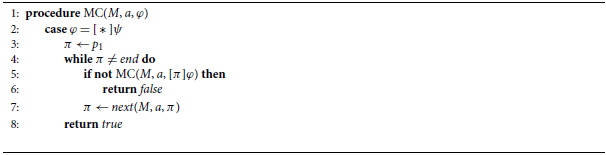
The correctness of the algorithm follows from the semantics of AVL and Lemma 39. Regarding the complexity, recall that given M and $\varphi$
there is a set of all unique actions
$\varphi$
there is a set of all unique actions $\Pi^\ast(M,\varphi)$
that are built from
$\Pi^\ast(M,\varphi)$
that are built from $p \in \mathit{Var} (M,\varphi) \cup \{p^\ast\}$
. The size of
$p \in \mathit{Var} (M,\varphi) \cup \{p^\ast\}$
. The size of $\Pi^\ast(M,\varphi)$
is exponential in the sizes of M and
$\Pi^\ast(M,\varphi)$
is exponential in the sizes of M and $\varphi$
, and thus we do not keep it in memory. Instead, we use function
$\varphi$
, and thus we do not keep it in memory. Instead, we use function $\mathit{next}(M,a,\pi)$
, starting from
$\mathit{next}(M,a,\pi)$
, starting from $\pi = p_1$
(line 3), to obtain the next action in
$\pi = p_1$
(line 3), to obtain the next action in $\Pi^\ast(M,\varphi)$
. Computing
$\Pi^\ast(M,\varphi)$
. Computing $\mathit{next}(M,a,\pi)$
can be done in polynomial time (and hence space). Similarly to the case of Algorithm 1, the space required to store the current updated model is bounded by
$\mathit{next}(M,a,\pi)$
can be done in polynomial time (and hence space). Similarly to the case of Algorithm 1, the space required to store the current updated model is bounded by $\mathcal{O}(|M|^2)$
. While checking all possible updates takes exponential time, we can reuse space for storing updated models. Hence, the total space required by the algorithm is bounded by
$\mathcal{O}(|M|^2)$
. While checking all possible updates takes exponential time, we can reuse space for storing updated models. Hence, the total space required by the algorithm is bounded by $\mathcal{O}(|\varphi|\cdot |M|^2)$
.
$\mathcal{O}(|\varphi|\cdot |M|^2)$
.
6. Dynamic Hybrid Logics for Social Networks
Logics for reasoning about social networks is still a relatively new field. Yet, the community has brought forward many interesting analyses of social phenomena in the past decade. The logical frameworks used widely vary. Our framework is a modal logic with dynamic operators and nominals in the hybrid tradition. In this section, we give an assessment of other social network logics that use versions of dynamic hybrid logics as an underlying framework and compare them to the logics presented in this paper. By social network logic, we mean logics where a relational graph between agents is explicitly modeled.
Many social network logics utilize the modal logic Kripke frame to model a network of agents with a binary relation representing friendship, followership, and/or communication channels. In SVL, VL, and AVL, the underlying Kripke frame has two relations on the set of agents, the followership relation F and the visibility relation R. As we will see in this section, taking a relation on a Kripke frame to represent followership is not novel in this paper. However, modeling a relation of sharing and resharing a post as a binary relation on the set of agents is a new way to model communication using a social network logic. This approach gives us an organized and precise view of complex network situations which we hope can be further implemented in the field. The dynamic operator $[\pi]\phi$
changes both the followership and visibility relation in the updated model, but the valuation function is not updated. That is, in our system agents cannot change their current preferences. The operator
$[\pi]\phi$
changes both the followership and visibility relation in the updated model, but the valuation function is not updated. That is, in our system agents cannot change their current preferences. The operator $[*]\phi$
included in the language of AVL is particularly interesting from a conceptual view. It lets us reason about whether an agent has a possibility to act such that
$[*]\phi$
included in the language of AVL is particularly interesting from a conceptual view. It lets us reason about whether an agent has a possibility to act such that $\phi$
holds after the action. Such reasoning about the tactical choices of agents in social networks is a powerful tool that we believe can be useful to analyze the safety of networks, also in future work in the field. We go on to discuss other known dynamic hybrid logics for social networks.
$\phi$
holds after the action. Such reasoning about the tactical choices of agents in social networks is a powerful tool that we believe can be useful to analyze the safety of networks, also in future work in the field. We go on to discuss other known dynamic hybrid logics for social networks.
Zhen and Seligman (Reference Zhen, Seligman, van Ditmarsch, Fernández-Duque, Goranko, Jamroga and Ojeda-Aciego2011) present a logic to model peer pressure within a community of social relationships. The logical model $M = \langle W, A, \sim, \leq, V \rangle$
includes a set of possible states of the world W and a set of agents A. The relation
$M = \langle W, A, \sim, \leq, V \rangle$
includes a set of possible states of the world W and a set of agents A. The relation $\sim$
is a symmetric and irreflexive friendship relation on A, where
$\sim$
is a symmetric and irreflexive friendship relation on A, where $a \sim_{w} b$
is read as “agent a is friends with agent b in state w.”
$a \sim_{w} b$
is read as “agent a is friends with agent b in state w.” $\leq$
is a preference relation on W, and
$\leq$
is a preference relation on W, and $u \leq_{a} v$
is read as “for agent a, state v is at least as good as state u.” The language includes two types of nominals: one for possible states and one for agents. Formulas are evaluated at pairs (w, a) of possible states and agents in the model. The dynamic components of the logic are the unary operators
$u \leq_{a} v$
is read as “for agent a, state v is at least as good as state u.” The language includes two types of nominals: one for possible states and one for agents. Formulas are evaluated at pairs (w, a) of possible states and agents in the model. The dynamic components of the logic are the unary operators $[\phi \leq \psi]$
and
$[\phi \leq \psi]$
and $[\phi < \psi]$
which update the preferences of an agent in a possible state. Define
$[\phi < \psi]$
which update the preferences of an agent in a possible state. Define $[\phi] := \{w \in W \mid M, w, a \vDash \phi\}$
. A statement
$[\phi] := \{w \in W \mid M, w, a \vDash \phi\}$
. A statement $M, w, a \vDash [\phi \leq \psi] \theta$
holds, roughly, whenever
$M, w, a \vDash [\phi \leq \psi] \theta$
holds, roughly, whenever $\theta$
holds in the updated model in which agent a’s preferences now includes links from all
$\theta$
holds in the updated model in which agent a’s preferences now includes links from all $[\phi]$
-states to all
$[\phi]$
-states to all $[\psi]$
-states. Similarly in the case of
$[\psi]$
-states. Similarly in the case of $M, w, a \vDash [\phi < \psi] \theta$
, but here also preference links from all
$M, w, a \vDash [\phi < \psi] \theta$
, but here also preference links from all $[\psi]$
-states to all
$[\psi]$
-states to all $[\phi]$
-states are deleted.
$[\phi]$
-states are deleted.
Christoff (Reference Christoff and Lorini2013), Christoff and Hansen (Reference Christoff, Hansen, Grossi, Roy and Huang2013, Reference Christoff and Hansen2015), Hansen (Reference Hansen2015), and Christoff et al. (Reference Christoff, Hansen and Proietti2016) introduce a series of influential social network logic papers using different dynamic hybrid logic frameworks to study diffusion, social influence, and opinion dynamics. We give a short account of the frameworks by Christoff and Hansen (Reference Christoff and Hansen2015) and Christoff et al. (Reference Christoff, Hansen and Proietti2016). The models in the work by Christoff and Hansen (Reference Christoff and Hansen2015), named network models, are tuples $\mathcal{M} = (A, \asymp, g, v)$
where A is a set of agents and
$\mathcal{M} = (A, \asymp, g, v)$
where A is a set of agents and $\asymp$
is a binary relation on A representing the social network. g and v are valuation functions with respect to nominals and the features of agents, respectively. Dynamic transformations are modeled in the dynamic modality
$\asymp$
is a binary relation on A representing the social network. g and v are valuation functions with respect to nominals and the features of agents, respectively. Dynamic transformations are modeled in the dynamic modality $[\mathcal{D}]$
. The formula
$[\mathcal{D}]$
. The formula $[\mathcal{D}] \phi$
holds at an agent in a network model if and only if
$[\mathcal{D}] \phi$
holds at an agent in a network model if and only if $\phi$
is forced at the agent in the updated model
$\phi$
is forced at the agent in the updated model $\mathcal{M}^{\mathcal{D}}$
in which only the valuation v is changed. v’ in the model
$\mathcal{M}^{\mathcal{D}}$
in which only the valuation v is changed. v’ in the model $\mathcal{M}^{\mathcal{D}}$
updates the original valuation given a set of preconditions and post-conditions in
$\mathcal{M}^{\mathcal{D}}$
updates the original valuation given a set of preconditions and post-conditions in $\mathcal{D}$
. Simply stated, the post-conditions determine what should hold true in the updated model when the preconditions hold in the original model.
$\mathcal{D}$
. Simply stated, the post-conditions determine what should hold true in the updated model when the preconditions hold in the original model.
The framework by Christoff et al. (Reference Christoff, Hansen and Proietti2016) builds upon and extends the one by Christoff and Hansen (Reference Christoff and Hansen2015). The Logic of Knowledge, Diffusion and Learning (KDL) adds an epistemic dimension to the models and includes a knowledge operator K to the language. The language also includes a dynamic operator $[\mathcal{L}]$
in addition to
$[\mathcal{L}]$
in addition to $[\mathcal{D}]$
. The operator
$[\mathcal{D}]$
. The operator $[\mathcal{L}]$
updates what the agents know about their friends. For a finite set of formulas
$[\mathcal{L}]$
updates what the agents know about their friends. For a finite set of formulas $\mathcal{L}$
, an agent a and an epistemic state w,
$\mathcal{L}$
, an agent a and an epistemic state w, $\mathcal{M}, w, a \vDash [\mathcal{L}] \phi$
is true if and only if
$\mathcal{M}, w, a \vDash [\mathcal{L}] \phi$
is true if and only if $\phi$
holds in the updated model
$\phi$
holds in the updated model $\mathcal{M}^{\mathcal{L}}$
. The intuition is that after the update, the current agent knows the features of their friends if the features are formulas in
$\mathcal{M}^{\mathcal{L}}$
. The intuition is that after the update, the current agent knows the features of their friends if the features are formulas in $\mathcal{L}$
. A running example is given where agents have both an external and an internal hidden opinion. Either type of opinion is pro, contra, or neutral. The paper defines some rules such as “if all the friends of an agent express a pro (contra) opinion, the agent will fall in line and express a pro (contra) opinion in the next round” and studies how the network evolves.
$\mathcal{L}$
. A running example is given where agents have both an external and an internal hidden opinion. Either type of opinion is pro, contra, or neutral. The paper defines some rules such as “if all the friends of an agent express a pro (contra) opinion, the agent will fall in line and express a pro (contra) opinion in the next round” and studies how the network evolves.
The logic known as “Facebook logic” was initially introduced by Seligman et al. (Reference Seligman, Liu, Girard, Banerjee and Seth2011) and further expanded on by Seligman et al. (Reference Seligman, Liu, Girard and Schipper2013) and Liu et al. (Reference Liu, Seligman and Girard2014). These papers have been highly influential in the field of social network logics and have been cited as inspiration for papers by authors such as the previously mentioned Zhen and Seligman (Reference Zhen, Seligman, van Ditmarsch, Fernández-Duque, Goranko, Jamroga and Ojeda-Aciego2011), Christoff and Hansen (Reference Christoff and Hansen2015), and Christoff et al. (Reference Christoff, Hansen and Proietti2016). Seligman et al. (Reference Seligman, Liu, Girard and Schipper2013) present a dynamic version of the logic, called dynamic epistemic friendship logic (DEFL). The models of DEFL are tuples $M = \langle W, A, k, f, V\rangle$
where W is a set of epistemic states and A is a set of agents. k is a family of equivalence relations on W, and f is a family of symmetric and irreflexive relations on A. The language includes operators for the two types of relations: nominals and the hybrid binder operator
$M = \langle W, A, k, f, V\rangle$
where W is a set of epistemic states and A is a set of agents. k is a family of equivalence relations on W, and f is a family of symmetric and irreflexive relations on A. The language includes operators for the two types of relations: nominals and the hybrid binder operator $\downarrow$
. With the language, one can state sentences such as “Bella knows that she is not a spy but doesn’t know if a friend of hers is a spy,” denoted
$\downarrow$
. With the language, one can state sentences such as “Bella knows that she is not a spy but doesn’t know if a friend of hers is a spy,” denoted $@_{b} (K \neg s \wedge \neg K \langle F \rangle s)$
. The dynamic operators in DEFL are based on the theory of General Dynamic Dynamic Logic (Girard et al., Reference Girard, Seligman, Liu, Bolander, Braüner, Ghilardi and Moss2012) and use details from PDL. The models can be updated after announcements from agents, which can also be private or public questions from one agent to another. Due to the complex nature of the operators, we will not go into more technical detail. Fernández González (Reference Fernández González2022) give some further alternatives for dynamic extensions of the framework by Seligman et al. (Reference Seligman, Liu, Girard, Banerjee and Seth2011). One extension lets agents send and receive asynchronous announcements. Asynchronous announcements are not assumed to be immediately received as they are sent, rather, the message is sent to a queue and can be received at a later stage. Two operators are added to the language:
$@_{b} (K \neg s \wedge \neg K \langle F \rangle s)$
. The dynamic operators in DEFL are based on the theory of General Dynamic Dynamic Logic (Girard et al., Reference Girard, Seligman, Liu, Bolander, Braüner, Ghilardi and Moss2012) and use details from PDL. The models can be updated after announcements from agents, which can also be private or public questions from one agent to another. Due to the complex nature of the operators, we will not go into more technical detail. Fernández González (Reference Fernández González2022) give some further alternatives for dynamic extensions of the framework by Seligman et al. (Reference Seligman, Liu, Girard, Banerjee and Seth2011). One extension lets agents send and receive asynchronous announcements. Asynchronous announcements are not assumed to be immediately received as they are sent, rather, the message is sent to a queue and can be received at a later stage. Two operators are added to the language: $[n! \phi]$
is read as “agent n sends a message
$[n! \phi]$
is read as “agent n sends a message $\phi$
to the queue” and
$\phi$
to the queue” and $[n:r]$
is read as “agent n receives all queued messages sent by her friends.”
$[n:r]$
is read as “agent n receives all queued messages sent by her friends.”
Xiong and Guo (Reference Xiong, Guo, Blackburn, Lorini and Guo2019) introduce Dynamic Hybrid Logic for Followership which language is the basic hybrid language added a dynamic operator $[a \uparrow \theta]$
. The models are standard hybrid models, with a set of agents and a binary relation representing followership.
$[a \uparrow \theta]$
. The models are standard hybrid models, with a set of agents and a binary relation representing followership. $[a \uparrow \theta] \phi$
is read as “after a chooses to only follow agents satisfying
$[a \uparrow \theta] \phi$
is read as “after a chooses to only follow agents satisfying $\theta$
,
$\theta$
, $\phi$
holds.” Other dynamic social network logics using hybrid elements are included in works by authors (Occhipinti Liberman and Rendsvig, Reference Occhipinti Liberman, Rendsvig, Blackburn, Lorini and Guo2019, Reference Occhipinti Liberman and Rendsvig2022; Pedersen et al., Reference Pedersen, Smets, Ågotnes, Blackburn, Lorini and Guo2019, Reference Pedersen, Smets and Ågotnes2021b; Sano and Tojo, Reference Sano, Tojo and Lodaya2013). Details of these frameworks are left out for now.
$\phi$
holds.” Other dynamic social network logics using hybrid elements are included in works by authors (Occhipinti Liberman and Rendsvig, Reference Occhipinti Liberman, Rendsvig, Blackburn, Lorini and Guo2019, Reference Occhipinti Liberman and Rendsvig2022; Pedersen et al., Reference Pedersen, Smets, Ågotnes, Blackburn, Lorini and Guo2019, Reference Pedersen, Smets and Ågotnes2021b; Sano and Tojo, Reference Sano, Tojo and Lodaya2013). Details of these frameworks are left out for now.
7. Conclusion and Future Work
This work was devoted to the analysis of the concepts of visibility and exploitation in social networks using modal logic. After discussing related work from the perspective of social network analysis, we introduced a logic we named SVL and its dynamic extensions, VL, and AVL. We did not give a definite answer as to how one should measure visibility but proposed several quantitative and qualitative measures relevant to our social network models. To motivate VL, we presented an example where we showed how, given some simple rules of the system, a potential malicious agent can take advantage of the network to expose more agents to a controversial opinion. In AVL, we introduced operators to reason about whether an agent can act such that a certain outcome holds.
On the mathematical side, we showed soundness and completeness of SVL with respect to social networks that follow our given rules. We also proved that the language of VL is strictly more expressive than the language of SVL, and that the language of AVL is strictly more expressive than the language of VL. The first increase in expressivity, from SVL to VL, also resulted in a significant increase in the complexity of model checking, from P to PSPACE. Interestingly, the second expressivity increase, from VL to AVL, has not resulted in a jump in the complexity of model checking, that is, the complexity of the model checking problem for AVL is still PSPACE-complete.
As we mention in the paper, an implication of the result $\mathbb{SVL} < \mathbb{VL}$
is that a proof of the completeness of VL using reduction axioms is not possible. Thus one of the open problems is to find a sound and complete axiomatization of VL. As we also prove that
$\mathbb{SVL} < \mathbb{VL}$
is that a proof of the completeness of VL using reduction axioms is not possible. Thus one of the open problems is to find a sound and complete axiomatization of VL. As we also prove that $\mathbb{VL} < \mathbb{AVL}$
, completeness of AVL can neither be proved using reduction axioms into SVL nor VL. A sound and complete axiomatization of AVL is therefore also an open problem.
$\mathbb{VL} < \mathbb{AVL}$
, completeness of AVL can neither be proved using reduction axioms into SVL nor VL. A sound and complete axiomatization of AVL is therefore also an open problem.
Another direction for future work is to formalize triggering in social network communication. The idea is that seeing a post on a controversial topic might trigger an agent to post a reaction. To do this, we could expand our framework such that agents can not only post on a topic but also pro or contra a topic. This entails letting $\pi::= p \mid p^{+} \mid p^{-} \mid \pi \cup \pi$
in the dynamic formula
$\pi::= p \mid p^{+} \mid p^{-} \mid \pi \cup \pi$
in the dynamic formula $[\pi] \phi$
. Then, we could specify particular controversial topics and add a rule stating that if an agent sees a post that is pro the controversial topic and they are themselves contra, and then the agent will post contra the topic, or vice versa.
$[\pi] \phi$
. Then, we could specify particular controversial topics and add a rule stating that if an agent sees a post that is pro the controversial topic and they are themselves contra, and then the agent will post contra the topic, or vice versa.
Related to the former point, the social network presented in this paper comes with a set of rules that is an oversimplification of a real-life network. In future work, we would like to add more detailed, and more realistic, rules, which would give us a more complicated system to study other interesting social phenomena with. Furthermore, in our work, we focus on the effects of agents posting on different topics rather than posting different posts on the same topic. One avenue for further research is to extend the framework to also allow agents to post more than one post on the same topic.
Acknowledgements.
Thank you Marija Slavkovik for collaboration on the previous version of this paper and for helpful suggestions on this extended work. Thank you also to the reviewers for their insightful comments and constructive criticism. This includes the reviewers of the conference proceedings paper which this paper is an extension of.
Competing interests.
The authors declare none.


 Open access

