

Introduction
Why do certain countries provide more opportunities for women to serve as cabinet members compared to others? The field of gender politics has extensively examined the various conditions that influence women's inclusion in cabinet positions and political representation (Claveria, Reference Claveria2014; Escobar-Lemmon and Taylor-Robinson, Reference Escobar-Lemmon and Taylor-Robinson2005; Goddard, Reference Goddard2019; Krook and O'Brien, Reference Krook and O'Brien2012; Siaroff, Reference Siaroff2000). Despite the growing scholarly attention to women's political representation, few researchers have considered the impact of political leaders on women's access to the executive branch. Although some studies have explored the impact of leaders’ gender identities on the appointment of female ministers (Krook and O'Brien, Reference Krook and O'Brien2012; O'Brien et al., Reference O'Brien, Mendez, Peterson and Shin2015), there remains a gap in understanding how political leaders affect female representation in ministerial cabinets. This is a surprising omission given that top political leaders, especially in presidential systems, often possess great autonomy over cabinet members’ nomination decisions (Linz, Reference Linz1990)
We argue that the socioeconomic background of political leaders influences the promotion of women's political representation in cabinets. Specifically, we contend that political leaders who experienced economic hardship in their youth are more likely to appoint female cabinet members than those without such a background.
Anecdotal evidence sheds light on how political leaders’ experiences of economic adversity can affect women's political representation. During Kim Dae-jung's presidency, 8 per cent of ministerial positions in the South Korean government were allocated to women,Footnote 1 marking a notable improvement from the 1 per cent during his predecessor Kim Young-sam's tenure. The Kim Dae-jung government also took noteworthy measures to alleviate gender disparities in Korean society, including the establishment of the Ministry of Gender Equality and Family and the introduction of legislation mandating political parties list women as at least 30 per cent of candidates in the party-list proportional representatives. Similarly, the former Chancellor of Germany, Gerhard Schröder, appointed female ministers to 29 per cent of cabinet positions during his tenure, which is notable as in the year preceding his party's parliamentary election victory, only 9 per cent of the ministerial positions were allocated to women under the Kohl administration.
Why did South Korea and Germany experience a significant increase in women's political representation during Kim's and Schröder's tenures? Leaders’ partisanship alone cannot explain why they significantly increased the proportion of female ministers compared with their predecessors, as Schröder was a leftist politician and Kim was a centrist politician. Furthermore, neither country's political institutions, that is, electoral systems and gender quotas, underwent significant changes before or during their tenure. However, interestingly, these two leaders do share a common characteristic: they grew up in economic disadvantage. Kim was the son of an economically underprivileged farmer on an isolated island, while Schröder's family endured economic hardship after his father died on the battlefield during the Second World War when he was an infant.
Previous studies have examined how politicians’ family and class backgrounds shape their legislative behaviour and policy outcomes (Carnes and Lupu, Reference Carnes and Lupu2015; Han and Han, Reference Han and Han2021). Although these studies have suggested a link between politicians’ class backgrounds and their policymaking decisions, there is limited understanding of how political leaders’ personal backgrounds affect their decisions regarding promoting women's political representation within the executive branch. Thus, this study aims to investigate how the backgrounds of political leaders affect gender equality in cabinet positions.
Using time-series cross-country data encompassing 155 countries—both democratic and authoritarian—from 1966 to 2015, our research reveals a significant correlation between childhood economic adversity and political leaders’ appointment of women in ministerial positions. While leaders in democratic and autocratic countries may harbour distinct motivations for appointing female ministers, we contend that their shared experience of economic hardship leads to a significant increase in such appointments across different regime types.Footnote 2
Specifically, our findings indicate that leaders who experienced economic hardship during their youth are more likely to appoint female ministers. Compared to leaders from middle- and upper-class backgrounds, those from economically disadvantaged families lead to a 0.83 percentage point higher appointment of female ministers in their cabinets during their tenure. This finding holds substantial significance, considering that the average proportion of female ministers in our sample was 7.4 per cent.
This study contributes significantly to the literature in two ways. First, it expands the growing body of research on gender studies by examining the influence of the economic backgrounds of political leaders’ families. While previous studies on women's political representation, particularly the appointment of female ministers, have primarily focused on other factors, such as societal and institutional dynamics, little attention has been given to the role of political leaders. Although a few studies have investigated the effect of political leaders’ gender identity (Krook and O'Brien, Reference Krook and O'Brien2012; O'Brien et al., Reference O'Brien, Mendez, Peterson and Shin2015) on the appointment of female ministers, limited attention has been paid to the role of other socioeconomic backgrounds. By incorporating a comprehensive sample that covers both democratic and autocratic countries, this study reveals political leaders’ economic background considerably influences their appointment of female ministers. Second, this study speaks to the literature on the relationship between leaders’ backgrounds and policy outcomes (Chattopadhyay and Duflo, Reference Chattopadhyay and Duflo2004; Dreher et al., Reference Dreher, Lamla, Lein and Somogyi2009; Fuhrmann, Reference Fuhrmann2020; Han and Han, Reference Han and Han2021). Consistent with previous studies, our findings reaffirm that political leaders play a significant role in improving women's representation in cabinet positions. More importantly, this study explores the impact of political leaders’ personal backgrounds on political gender equality, shedding light on an unexplored dimension of political leadership and its implications for gender equality in political decision-making.
Women's Appointment in Cabinets
Historically, women's political participation has been limited. In 1966, the world had only 31 female ministers. Subsequently, there was a gradual improvement, with the average proportion of female ministers reaching 16.6 per cent by 2015 (Nyrup and Bramwell, Reference Nyrup and Bramwell2020). Despite this progress, women continue to hold a relatively small proportion of cabinet positions.
The literature on gender politics has examined the significance of appointing female ministers to cabinet positions. This field of study explores the implications and outcomes of such appointments by analyzing their impact on democratic legitimacy, representation, policy and social equality. The increasing appointment of women to cabinet roles contributes significantly to more inclusive and representative governance. This enhancement of women's descriptive representation in politics not only benefits gender equity but also bolsters citizens’ trust in and perceptions of democratic institutions. The presence of women in political roles is increasingly seen as a symbol of democratic legitimacy, a perspective supported by numerous studies (Barnes and Jones, Reference Barnes, Jones and Schwindt-Bayer2018; Clayton et al., Reference Clayton, O'Brien and Piscopo2019; Schwindt-Bayer, Reference Schwindt-Bayer2010; Stauffer, Reference Stauffer2021; Verge et al., Reference Verge, Wiesehomeier and Espírito-Santo2020). Since cabinets and governments play pivotal roles in policy formation and execution (Atchison and Down, Reference Atchison and Down2009), integrating more women into these bodies signals broader openness in policymaking. This inclusiveness potentially extends beyond policies specifically beneficial to women, as highlighted by previous research (Chattopadhyay and Duflo, Reference Chattopadhyay and Duflo2004; Kittilson, Reference Kittilson2008; Schwindt-Bayer, Reference Schwindt-Bayer2006; Swiss et al., Reference Swiss, Fallon and Burgos2012), impacting broader representation and policy effectiveness.
Progress in female representation in cabinets also leads governments to adopt policies that foster gender equality. Women holding cabinet positions are pivotal in creating a more favourable labour environment for their gender. They achieve this by advocating for policies such as maternity and parental leave along with job protection measures during pregnancy and family leave (Atchison, Reference Atchison2015; Atchison and Down, Reference Atchison and Down2009). These initiatives are crucial for enhancing women's participation in the workforce and play a vital role in diminishing gender disparities in the labour market.
Beyond gender equality, the presence of women in politics contributes significantly to broader social equality, as exemplified by the allocation of greater budgetary resources to social and educational services (Barnes et al., Reference Barnes, Beall and Holman2021). Furthermore, a higher proportion of women in cabinets is associated with increased generosity in foreign aid (Lu and Breuning, Reference Lu and Breuning2014). Since foreign aid is instrumental in promoting global equality and combating poverty (Kim et al., Reference Kim, Han and Han2022), the involvement of women in the policymaking process positively impacts both the domestic and international arenas. This highlights the extensive influence of female representation in politics, extending its benefits beyond gender issues to encompass the wider aspects of social equality and global development.
Earlier research on female ministerial appointments revolved around formal factors, such as political institutions and party ideologies. Studies have shown that the nature of governments and electoral systems influence how political parties allocate cabinet positions. For example, coalition governments with a limited number of positions for each governing party tend to appoint fewer female ministers (Claveria, Reference Claveria2014; Krook and O'Brien, Reference Krook and O'Brien2012). Moreover, there is a notable tendency among leftist parties to appoint more female ministers, possibly due to their egalitarian ideologies and connections to feminist movements (Claveria, Reference Claveria2014; Escobar-Lemmon and Taylor-Robinson, Reference Escobar-Lemmon and Taylor-Robinson2005; Goddard, Reference Goddard2019; O'Brien, Reference O'Brien2018; Siaroff, Reference Siaroff2000). In contrast, right-wing parties, who often hold conservative views of women's roles, show a lower propensity for female ministerial appointments. This contrast underlines the diverse approaches of political parties to addressing gender representation within cabinets.
Recent studies on women's cabinet appointments have shifted the focus from institutional and ideological factors to chief executives’ motivations. They suggest that adverse conditions, such as corruption and financial crises, might encourage a departure from traditional practices, thus paving the way for more diverse leadership, including the increased representation of women in politics (Armstrong et al., Reference Armstrong, Barnes, O'Brien and Taylor-Robinson2022, Reference Armstrong, Barnes, Chiba and O'Brien2024). In multi-ethnic societies, particularly in regions such as sub-Saharan Africa, the politicization of ethnicity is a key factor in how leaders allocate cabinet roles, impacting the appointment of female ministers (Arriola and Johnson, Reference Arriola and Johnson2014). Leaders in such contexts might prioritize satisfying politicized ethnic groups, sometimes at the cost of female representation in the cabinet.
The above insights underscore the crucial role political leaders play in appointing female cabinet members. Understanding how political leaders can enhance the presence of women in cabinets is essential for comprehending the dynamics and decision-making processes that foster gender diversity in political leadership. Studies of party politics reveal how local party leaders, acting as gatekeepers, influence the selection of female candidates, often through direct and indirect discrimination (Bjarnegård and Kenny, Reference Bjarnegård and Kenny2016; Cheng and Tavits, Reference Cheng and Tavits2011; Lovenduski and Norris, Reference Lovenduski and Norris1993). For example, female party elites tend to recruit more female candidates, likely because they prefer candidates with traits traditionally associated with women, possess gender-balanced social networks and thus have greater access to a pool of qualified female candidates (Cheng and Tavits, Reference Cheng and Tavits2011). Accordingly, we posit that this gatekeeping role extends to executive leaders who have significant control over the selection of cabinet members, thus affecting the representation of women in political roles.
This study significantly contributes to the field of women's political representation by focusing on the roles of political leaders. Recent research has highlighted how leaders’ characteristics and socioeconomic backgrounds can impact economic, social and foreign policy outcomes (Chattopadhyay and Duflo, Reference Chattopadhyay and Duflo2004; Dreher et al., Reference Dreher, Lamla, Lein and Somogyi2009; Fuhrmann, Reference Fuhrmann2020; Han and Han, Reference Han and Han2021; Kim et al., Reference Kim, Han and Han2022). Although a few studies have investigated the role of chief executives in appointing female ministers with a particular focus on leaders’ gender identity (Krook and O'Brien, Reference Krook and O'Brien2012; O'Brien et al., Reference O'Brien, Mendez, Peterson and Shin2015), there is a notable gap in understanding how these leaders influence the appointment of female ministers in cabinets. This oversight is particularly surprising considering that chief executives often have considerable autonomy in nominating cabinet members. Such autonomy places chief executives in a unique position as gatekeepers for female ministers, thus granting them significant sway over a key facet of political representation.
This study explores how political leaders’ personal backgrounds, especially their experiences of economic hardship in their youth, affect the proportion of female ministers in cabinets. This approach is novel as it represents the first large-scale, cross-national examination of the relationship between leaders’ personal histories and the appointment of women to ministerial positions. By exploring this link, we aim to shed light on how chief executives’ personal experiences can influence their decisions and actions, subsequently shaping the cabinet's gender composition and impacting broader political representation.
Economic Hardship and Women's Cabinet Appointment
We contend that political leaders who experienced economic hardship in their youth improve women's political representation by appointing more female ministers to cabinet posts than those who do not have such experiences. Leaders’ experiences of economic hardship shape leaders’ political attitudes toward gender equality as such experiences are intertwined with broader economic and class issues.
Previous studies have identified a link between personal experiences of economic hardship and support for redistributive policies (Giuliano and Spilimbergo, Reference Giuliano and Spilimbergo2014; Hacker et al., Reference Hacker, Rehm and Schlesinger2013; Margalit, Reference Margalit2013; Naumann et al., Reference Naumann, Buss and Bähr2016). Building on these studies, others have explored how leaders’ personal experiences influence their attitudes toward social policies (Borwein, Reference Borwein2022; Carnes and Lupu, Reference Carnes and Lupu2015; Han and Han, Reference Han and Han2021). Specifically, politicians with blue-collar backgrounds tend to advocate for increased social spending. This advocacy is rooted in their personal encounters with economic vulnerability and lack of resources, driving them to support the expansion of welfare policies aimed at reducing economic inequality (Borwein, Reference Borwein2022; Carnes and Lupu, Reference Carnes and Lupu2015). Moreover, their first-hand experiences of economic challenges play a significant role in shaping their political perspectives on social welfare. We extend these studies by discussing the role of leaders’ previous life experiences in women's empowerment in cabinets.
Specifically, we argue that early life experiences of economic hardship help political leaders better understand the importance of political equality, particularly in the area of political rights of women, who are a traditionally under-represented group. According to socialization theory (Hyman, Reference Hyman1959), early life experiences substantially shape individuals’ political attitudes. Previous studies have linked the economic interests of low-income groups to their support for redistribution (O'Grady, Reference O'Grady2019). In addition, leaders’ political socialization, based on their economically disadvantaged family background, helps them develop pro-redistributive attitudes (Han and Han, Reference Han and Han2021). However, while previous studies have focused on how economic adversity affects political attitudes toward economic egalitarianism, our study examines how leaders’ experiences of economic hardship affect their preferences for political egalitarianism.
Experiencing economic hardship helps political leaders understand how structural factors, such as class stratification, affect economic and political inequality. Experiencing economic hardship significantly affects individuals’ preferences for government intervention in the national economy to reduce economic inequality (Giuliano and Spilimbergo, Reference Giuliano and Spilimbergo2014; Margalit, Reference Margalit2013; Naumann et al., Reference Naumann, Buss and Bähr2016). However, its impact may extend beyond nurturing economic egalitarianism, which is closely related to improvements in political equality. For instance, leftist governments, known for their pro-redistributive policy platforms, tend to allocate more ministerial positions to women than their right-wing counterparts (Claveria, Reference Claveria2014; Escobar-Lemmon and Taylor-Robinson, Reference Escobar-Lemmon and Taylor-Robinson2005; Goddard, Reference Goddard2019; O'Brien, Reference O'Brien2018; Siaroff, Reference Siaroff2000).
Moreover, economic adversity evokes the feeling of being politically under-represented. In unequal societies, low-income individuals often seek greater political participation by initiating anti-regime movements (Acemoglu and Robinson, Reference Acemoglu and Robinson2006; Boix, Reference Boix2003). Economically challenged individuals may attribute their economic struggles to the political under-representation of their classes. The situational attribution of economic disadvantage can lead individuals to support greater egalitarianism (see Piff et al., Reference Piff, Wiwad, Robinson, Aknin, Mercier and Shariff2020). Likewise, experiencing economic hardship enhances political leaders’ understanding of women's under-representation in society. These leaders may attribute gender inequality in politics not to a lack of competent female political candidates but rather to the political structures that cause gender disparity in politics.
Leaders from economically disadvantaged backgrounds may view gender inequality as intertwined with broader economic and class disparities. Gender inequality arises not only from the specific roles and burdens in the sexual division of labour but also from the broader context of the collective subordination of women as a group (Annesley et al., Reference Annesley, Engeli and Gains2015; Htun and Weldon, Reference Htun and Laurel Weldon2010). This dual aspect of gender inequality encompasses both the tangible, day-to-day challenges women face and the more systemic, overarching societal norms that perpetuate their disadvantaged status. Leaders born in economically disadvantaged families may attribute their own experiences of economic hardship to both economic inequality and the political under-representation of marginalized groups. This holistic understanding of inequality highlights the intersection between gender and class.
Leaders who have experienced economic hardship are motivated to advocate policies that promote women's economic independence and political rights. This approach to policymaking and resource allocation reflects their belief in the interconnectedness of gender equality, economic equity and class justice. By appointing more female ministers, they aim to break down structural barriers to women's political participation and address gender disparity not only as a societal issue but also as a fundamental aspect of economic and political empowerment.
In this context, leaders’ personal experiences of economic hardship produce a deeper understanding of gender inequality in terms of both political and economic dimensions. Such experiences can lead to the creation of a more inclusive political landscape in which there is a fairer distribution of power and resources among male and female citizens, thus promoting equal citizenship in society. Therefore, we propose the following hypothesis:
H1: Political leaders who have experienced economic hardship during their youth are more inclined to appoint more female ministers to cabinet posts.
Data and Model Specifications
DataFootnote 3
Our study explores how leaders’ economic backgrounds impact women's representation in the executive government in both democratic and authoritarian countries. Leaders from democratic and autocratic regimes may have distinct motivations for appointing more women to their cabinets. Democratic leaders, motivated by their desire for re-election, seek to appeal to a wider electorate. In contrast, authoritarian leaders use their greater autonomy over appointments to strategically appoint more female ministers. As noted by Nyrup et al. (Reference Nyrup, Yamagishi and Bramwell2023), such appointments can reduce the risk of coups, which are often initiated by male political elites. By diversifying their cabinet, dictators can dilute the concentration of power among these traditional elites. Additionally, appointing more women can strategically enhance a dictator's image internationally, projecting a progressive and inclusive facade. This can help attract foreign aid, improve diplomatic relations and soften criticisms regarding human rights abuses. To test our arguments, we expanded the dataset originally created by Han and Han (Reference Han and Han2021), which was limited to democracies from 1980 to 2011, to encompass 155 countries covering both democratic and authoritarian countries from 1966 to 2015. Han and Han (Reference Han and Han2021) utilized Archigos data (Goemans et al., Reference Goemans, Gleditsch and Chiozza2009) to identify the chief executive leader of each country at the end of the year and then coded the economic status of these leaders’ families using a variety of sources, including government websites, academic publications and newspapers, until 2010. Building on their methodology, we extended the coding of leaders’ economic backgrounds in democracies and autocracies from 1966 to 2015. Following the approach of Nyrup and Bramwell (Reference Nyrup and Bramwell2020), who compiled a comprehensive global dataset of cabinet members using July as the standard reference point for each year, we adopted July as the timeframe for identifying chief executive leaders and coding their economic backgrounds in our extended dataset.Footnote 4
Dependent variable: proportion of female ministers
Our main argument is that political leaders who experienced economic hardship in their youth are more likely to allocate more cabinet posts to female ministers. To test this, we use a global dataset of cabinet members from Nyrup and Bramwell (Reference Nyrup and Bramwell2020) which includes the number of female ministers and the total ministerial positions in 155 countries from 1966 to 2015. Given that each country has a different number of ministers in cabinet posts, we utilize the proportion of female ministers in the total cabinet positions for the analysis.Footnote 5Figure 1 illustrates the changes in the proportion of female ministers in the sample between 1966 and 2015, which generally shows an increasing trend of female ministers over time. In 1966, women held only 1.2 per cent of the cabinet positions. However, the proportion of female ministers steadily increased, reaching approximately 16.4 per cent by 2015.Footnote 6
Proportion of Female Ministers over Time.
Note: This figure shows the proportion of female ministers in the executive branches of countries worldwide between 1966 and 2015.

Independent variable: political leaders’ experience of economic hardship
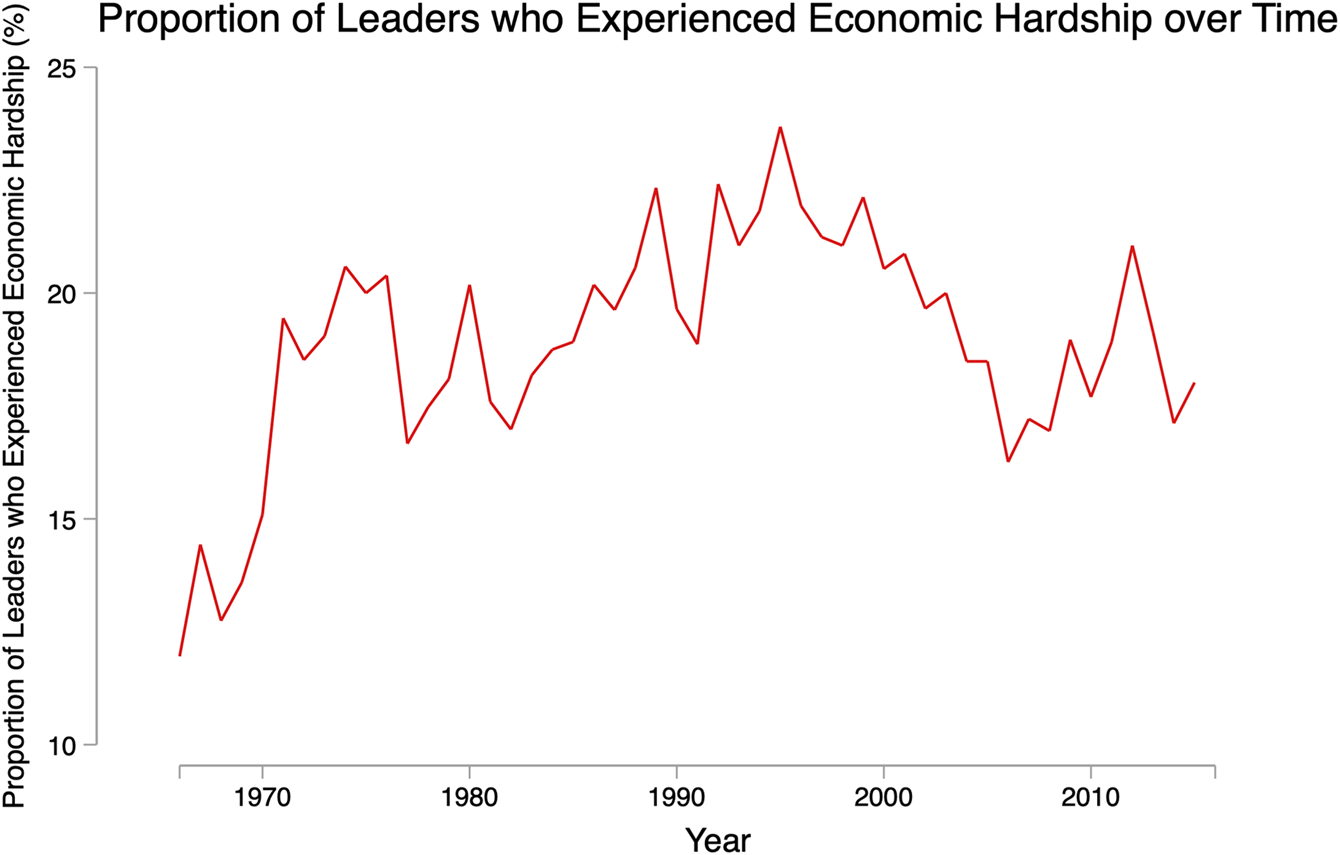
To operationalize the Economic Hardship variable, we follow the approach of Han and Han (Reference Han and Han2021). To capture political leaders’ experiences of economic hardship in their youth, Han and Han (Reference Han and Han2021) first identified the head of government for a specific year by determining who was in office at the end of the year. This process is based on studies conducted by Besley and Reynal-Querol (Reference Besley and Reynal-Querol2011) and the Archigos dataset (Goemans et al., Reference Goemans, Gleditsch and Chiozza2009). This step was accomplished by ascertaining the chief executive leader in July and aligning our approach with the methodology employed by Nyrup and Bramwell (Reference Nyrup and Bramwell2020) to ensure data consistency. Once the top executives were identified, we coded their material backgrounds by examining the reported wealth of their families during childhood. This information was collected from secondary sources, including academic articles, books, government websites, historical archives and newspapers. If no specific information was available on the reported wealth of political leaders’ families, economic hardship was assessed by examining the occupations of the breadwinners in their families. In this case, we classified blue-collar occupations as coding for Economic Hardship.Footnote 7 We used middle-income and affluent families of political leaders as the reference category. Figure 2 shows how political leaders’ economically disadvantaged family backgrounds changed from 1966 to 2015, indicating that the proportion of leaders from low-income families fluctuated between 12 per cent and 23.7 per cent. In 2015, approximately 18 per cent of leaders were born into low-income families, indicating that a considerable number of leaders experienced economic adversity during their childhood.
Proportion of Political Leaders who Experienced Economic Hardship over Time.
Note: This figure shows the proportion of chief executive leaders who experienced economic hardship in their youth between 1966 and 2015.
Controls
We incorporate several variables that can affect the appointment of female ministers. Gross domestic product (GDP) per capita (GDPpc) from the World Bank is added to the empirical models as economic development can shape progressive attitudes toward gender roles, and potentially lead to the appointment of more cabinet positions to women. We also include the GDP growth rate (GDP Growth) from the World Bank because political leaders may appoint more female ministers to signal a departure from the status quo, particularly when they have performed poorly in economic policies (see Armstrong et al., Reference Armstrong, Barnes, O'Brien and Taylor-Robinson2022). We also add Resource Dependence as labour markets in resource-dependent countries tend to have less demand for female workers, which restricts women's political influence. We use the natural logarithm of total oil and gas export values in 2014 dollars from Ross and Mahdavi (Reference Ross and Mahdavi2015). Additionally, we incorporated Democracy because democracies promote a greater representation of women than autocracies, primarily through free and fair electoral competition, employing the dichotomous measure of democracy from Boix et al. (Reference Boix, Miller and Rosato2013). Additionally, we control for various demographic factors of political leaders, such as age, gender and college education. We expect that older, male and less-educated leaders will hold more traditional views toward women's roles, and therefore be less inclined to appoint female ministers to cabinet posts.
Model specifications
To test our hypothesis, we used time-series cross-sectional (TSCS) data. The TSCS data may have contemporaneous correlations and unit heteroskedasticity issues that violate the basic assumptions of ordinary least squares (OLS) estimation. To address this concern, we estimate empirical models using OLS regressions with panel-corrected standard errors. We also add country- and year-fixed effects to control for unobserved country- and year-specific characteristics that may affect the proportion of female ministers. By incorporating two-way fixed effects, we aim to eliminate variations between countries and across years that could be correlated with both the independent and dependent variables. In particular, given that the proportion of female ministers has risen over time, adding year-fixed effect can help mitigate the potential correlation caused by time-trend effect, thereby accounting for these longitudinal trends in the proportion of female ministers. Considering Nickell's (Reference Nickell1981) bias, we do not include the lagged dependent variable (LDV). Including two-way fixed effects and the LDV in the same model can create endogeneity issues between the LDV, fixed effects and the independent and control variables (Angrist and Pischke, Reference Angrist and Pischke2009). The unit of analysis in our data is country-year. All independent and control variables are lagged by one year to address potential endogeneity issues.
Empirical Results
Table 1 presents the coefficient estimates of the effect of economically disadvantaged family backgrounds on the proportion of female ministers in the executive branch. We first estimated Model 1 without controls. Model 2 includes controls for economic and political factors, Model 3 includes controls for leaders’ demographic characteristics, and Model 4 incorporates all the controls separately included in Models 2 and 3.
Effect of Economic Hardship on the Proportion of Female Ministers

Note: The OLS regression models predict the proportion of female cabinet members (%); panel-corrected standard errors are presented in parentheses. Country- and year-fixed effects are included. * p < 0.01, ** p < 0.05, *** p < 0.01
The coefficients of Economic Hardship in Table 1 are significant and positive, indicating that experiencing economic hardship encourages political leaders to appoint more female ministers. Specifically, Model 4 shows that political leaders with experience of economic hardship in their youth allocate 0.83 percentage points more cabinet positions to female ministers than those without such experience. This finding is significant, given that the average annual change in the proportion of female ministers is 0.34 in the sample. Moreover, a 0.83 percentage point increase in leaders who experienced economic adversity is equivalent to 22.9 per cent of the standard deviation in changes in the proportion of female ministers.
None of the coefficient estimates of GDPpc and GDP Growth are significant. Contrary to our expectations, Resource Dependence significantly increases the proportion of female ministers. However, this result may be driven by Northern European countries, which have abundant resources owing to the oil and gas fields in the North Sea and high proportions of female ministers. Once these countries are excluded, the impact of Resource Dependence disappears.Footnote 8 As expected, Democracy significantly improves women's political representation in cabinet posts in Model 2.
Among the controls for leaders’ demographic characteristics, Age produces the expected result: older leaders tended to appoint fewer female ministers. This trend may stem from older leaders adhering to traditional gender norms, which results in fewer female appointments in their cabinets. The coefficient estimate for Female is significant and positive, suggesting that female leaders are more likely to allocate ministerial positions to women. This finding contrasts with O'Brien et al., (Reference O'Brien, Mendez, Peterson and Shin2015), who showed that female prime ministers often appoint fewer female ministers, possibly due to the pressure to conform to the masculine norms prevalent in traditional leadership. However, O'Brien et al.'s research focuses on advanced parliamentary and semi-presidential democracies, where factors such as a coalition government and strict party discipline might reduce gender's influence on appointments. In contrast, our study encompasses a number of less-developed countries, presidential democracies and autocracies, where leaders typically have greater autonomy in cabinet appointments, thus potentially leading to results that differ from those of O'Brien et al. (Reference O'Brien, Mendez, Peterson and Shin2015). Contrary to our expectations, leaders’ college education (College) results in a lower proportion of female members in cabinet posts. Educated individuals often hold meritocratic views (Kunovich and Slomczynski, Reference Kunovich and Slomczynski2007), leading them to prioritize competence and qualifications in the selection of cabinet ministers, potentially overlooking gender. However, this approach may unintentionally perpetuate gender imbalances by not addressing the underlying biases and systemic barriers that limit women's access to high-level political positions.Footnote 9
We estimate four additional models to address potential confounders. First, we add the variable of political leaders’ rich family backgrounds to examine whether our empirical findings are influenced by the choice of reference category (Model 1 of Table A4). Second, we include controls for leaders’ previous occupations, which may affect their attitudes toward women's political representation (Model 2 of Table A4). Considering that many political leaders from economically challenged families may have the same occupational backgrounds; that is, blue-collar workers, it is important to accurately capture the conditions that influence these leaders’ preferences for appointing female ministers. Third, we included the leftist government ideological orientation (Left) from the Varieties of Democracy Project (V-Dem) (Coppedge et al., Reference Coppedge, Gerring, Knutsen, Lindberg, Teorell, Altman, Bernhard, Steven Fish, Glynn, Hicken, Lührmann, Marquardt, McMann, Paxton, Pemstein, Seim, Sigman, Skaaning, Staton, Cornell, Gastaldi, Gjerløw, Mechkova, von Römer, Sundström, Tzelgov, Uberti, Wang, Wig and Ziblatt2020) in Model 3 of Table A4.Footnote 10 Government partisanship has also been shown to affect the proportion of female ministers (Duverger Reference Duverger1955; Caul, Reference Caul1999; Siaroff, Reference Siaroff2000). Leaders from low-income families tend to affiliate with leftist parties because of their pro-redistributive attitudes, which are influenced by socialization processes. Thus, our empirical findings may be endogenous to the impact of leader partisanship. Finally, in Model 4 of Table A4, we add the logarithm of the mean district magnitude from the Database of Political Institutions 2020 (Cruz et al., Reference Cruz, Keefer and Scartascini2021) to control for the impact of electoral systems on women's political representation. We also incorporate the proportion of women in the labour force (Female Labour Participation) from the World Bank into Model 4 of Table A4 as greater female labour force participation may increase the pool of female experts and politicians, thereby improving women's political representation. As shown in Table A4, our main findings remain robust even after addressing potential confounders.
Moderators
Political factors
The relationship between leaders’ experiences of economic hardship and women's political representation in cabinet posts may be moderated by political factors. First, the influence of leaders’ backgrounds on the appointment of female ministers is contingent on the type of political regime. In democracies, leaders are incentivized to appoint more female ministers owing to the competitive nature of elections and the need to appeal to a broader electorate, while in autocracies, where the selection process is often dominated by the ruling elite (Boix, Reference Boix2003; Acemoglu and Robinson, Reference Acemoglu and Robinson2006), this incentive is reduced. However, it is also possible that autocratic leaders play a more significant role in women's cabinet appointments if they experienced economic hardship in their youth. In autocracies, political leaders have greater autonomy in cabinet appointments and often make decisions without legislative approval. Therefore, autocratic leaders may exhibit a stronger connection between personal economic hardship and the appointment of female ministers as their personal preferences play a more direct and influential role in such decisions.
Second, the political authority wielded by leaders in presidential systems, in contrast to parliamentary systems, has a greater influence on popularly elected presidents from economically disadvantaged family backgrounds when appointing female ministers (Linz, Reference Linz1990). Furthermore, coalition governments, which are frequently formed under parliamentary regimes, can diminish the impact of leaders’ personal experiences of economic hardship on female ministerial appointments. The formation of coalition governments involving multiple parties heightens intraparty competition for the limited ministerial positions available to women in each party (Claveria, Reference Claveria2014; Krook and O'Brien, Reference Krook and O'Brien2012). Consequently, there is a decreased probability of male ministers being appointed to parliamentary regimes, even if leaders come from economically disadvantaged families.
Third, the relationship between a leader's experience of economic hardship and the appointment of female ministers is further moderated by the government's ideological orientation (Caul, Reference Caul1999; Duverger, Reference Duverger1955; Siaroff, Reference Siaroff2000). Owing to their progressive stance on gender equality, leaders in governments with a leftist orientation may be more inclined to allocate cabinet positions to women. On the other hand, in right-leaning governments, where traditional gender roles are often emphasized, conservative leaders who have experienced economic hardship may be more motivated to appoint female ministers than other rightist leaders without such experiences. This motivation could stem from their personal understanding of political under-representation, which makes them more likely to increase their female representation in the cabinet.
Finally, the legislative seat share of the governing parties also plays a role in conditioning the relationship between Economic Hardship and the proportion of female ministers. When ruling parties lack a majority of legislative seats, they may appoint more female ministers to cultivate broader support from citizens. To analyze these dynamics, we used data on political regimes from Boix et al. (Reference Boix, Miller and Rosato2013) and the leftist government ideological orientation from V-Dem (Coppedge et al., Reference Coppedge, Gerring, Knutsen, Lindberg, Teorell, Altman, Bernhard, Steven Fish, Glynn, Hicken, Lührmann, Marquardt, McMann, Paxton, Pemstein, Seim, Sigman, Skaaning, Staton, Cornell, Gastaldi, Gjerløw, Mechkova, von Römer, Sundström, Tzelgov, Uberti, Wang, Wig and Ziblatt2020). We also obtained data on presidential systems and seat share of governing parties from the 2020 Database of Political Institutions (Cruz et al., Reference Cruz, Keefer and Scartascini2021).
Table A5 presents the empirical results after considering the moderating effects of the previously mentioned political factors. In Model 1, Democracy does not moderate the relationship between Economic Hardship and the proportion of female ministers, which suggests that leaders’ experiences of economic hardship positively influence the appointment of female ministers regardless of whether the country is democratic or autocratic. As discussed earlier, autocratic leaders often possess more discretion in ministerial appointments than their democratic counterparts. In such scenarios, leaders from economically disadvantaged backgrounds might favour the appointment of more female ministers as a co-optation strategy to bolster regime support. Furthermore, increasing the proportion of female appointments can potentially lower the risk of a coup, which is typically instigated by predominantly male groups (Nyrup et al., Reference Nyrup, Yamagishi and Bramwell2023). This pattern could lead to the Democracy variable playing an insignificant role in the relationship between Economic Hardship and the appointment of female ministers.
Model 2 reveals that presidential systems do not have a significant moderating effect on the relationship between Economic Hardship and the proportion of female ministers, indicating that the political system does not markedly alter the link between Economic Hardship and women's representation in the cabinet. This suggests that irrespective of the political system, leaders may maintain a certain degree of ability to appoint female ministers, especially if they have personal experience with economic hardship.
Leftist government partisanship (Left) in Model 3 and the legislative seat share of government parties (Gov't Seat Share) in Model 4 significantly influence the impact of leaders’ personal experiences of economic hardship on the gender composition of the executive branch. Figure 3 illustrates the marginal effect of Economic Hardship on the proportion of female ministers considering variations in leftist government partisanship (top panel) and the seat share of governing parties (bottom panel).
Marginal Effect of Economic Hardship on the Proportion of Female Cabinet Members Based on Government Leftist Partisanship (Top Panel) and Changes in Government Party's Seat Share in the Legislature (Bottom Panel).
Note: These plots were generated using the coefficient estimates from Models 2 (top panel) and 3 (bottom panel) in Table A7. The top figure shows the marginal effect of economic hardship on the proportion of female cabinet members (%) due to changes in leftist government partisanship. The bottom figure shows the marginal effect of economic hardship on the proportion of female cabinet members (%) due to changes in the governing party seat share. The shaded areas indicate 95 per cent confidence intervals. The frequency of each value in the variable displayed on the x-axis is shown by light grey bars, whereas the dark grey bars indicate the frequency of leaders hailing from economically disadvantaged families for each value of the variable.

Interestingly, the top panel of Figure 3 reveals that the ideological position of the governing parties moderates the influence of economic hardship on the proportion of female ministers. Specifically, Economic Hardship significantly increases women's representation in cabinet posts only when the leftist partisanship index is less than 0.4. In other words, the influence of Economic Hardship disappears when the level of leftist government partisanship is 0.4 or higher.Footnote 11 This finding indicates that experiencing economic hardship significantly increases the proportion of female ministers when leaders are affiliated with right-wing or centre-right parties. Because leftist partisanship is closely related to egalitarianism, its impact may nullify the influence of leaders’ experiences of economic hardship.
The bottom panel of Figure 3 shows that the impact of Economic Hardship decreases as the seat share of the governing parties increases. Specifically, leaders’ experiences of economic hardship in their youth significantly increases the proportion of female ministers only when the seat share of the governing parties is 60 per cent or lower. This implies that minority governments should prompt leaders from economically disadvantaged families to appoint more female ministers. These leaders may believe that signalling a strong commitment to egalitarianism is an effective strategy for cultivating support from most citizens and maintaining their hold on power.
Upward mobility
Some may argue that personal experience of economic hardship does not nurture egalitarian values if political leaders experience upward mobility, as it may lead individuals to strongly support personal autonomy and reduce government intervention in free markets (Benabou and Ok, Reference Benabou and Ok2001; Houle and Miller, Reference Houle and Miller2019; Piketty, Reference Piketty1995). Under these conditions, political leaders from low-income families may not support improving gender equality, believing that the low representation of female ministers is due to a lack of competent women.
To address this issue, we rerun the empirical models after including the interaction between Economic Hardship and each of the leaders’ occupational backgrounds; that is, businesspeople, lawyers and military officers, which can be related to the experience of upward mobility for leaders originating from economically disadvantaged families.Footnote 12 The data on leaders’ occupational backgrounds are obtained from Han and Han (Reference Han and Han2021), and we extend these data in terms of both coverage and time horizon.
Table A6 presents the empirical results after addressing political leaders’ potential upward mobility. Across all models, the coefficient estimates of Economic Hardship remain significant and positive, supporting our theoretical prediction. While the interaction term with Military (Model 3) does not significantly affect the proportion of female ministers, the interaction terms with the business (Businessperson) and legal (Lawyer) occupational experience of leaders significantly moderate the relationship between Economic Hardship and women's political representation in cabinet posts.
The top panel of Figure A1 depicts the marginal effect of economic hardship on the leaders’ business occupational backgrounds. When leaders originate from other occupational backgrounds, their personal experiences of economic adversity motivate them to promote women's political representation. However, if leaders have an occupational business background, the effect of economic hardship disappears. Such leaders seem to prioritize efficiency over egalitarian values, even if they come from economically disadvantaged families. Furthermore, there are few successful female businesspeople in this sector.Footnote 13 Consequently, leaders with business experience may exhibit a higher degree of insensitivity toward promoting women's political representation. This indicates that the upward mobility of leaders with business experience reduces the impact of economic hardship on the appointment of female ministers.
In Figure A2, the top panel displays the marginal effect of economic hardship on leaders who have experience of working in legal occupations. Even if leaders do not have legal occupational backgrounds, experiencing economic hardship is linked to a significant increase in the proportion of female ministers. However, if leaders work in the legal profession, the effect of Economic Hardship becomes stronger than for leaders without such experience. Combined with the experience of economic hardship in youth, leaders who are legal professionals may strongly believe in the values of social justice and fairness. Consequently, we find no strong evidence that the upward mobility of leaders with legal occupational backgrounds reduces the impact of Economic Hardship on the allocation of cabinet positions to female ministers.
Robustness checks
Countries with leaders from economically disadvantaged families can exhibit attributes that differ from those without such leaders. However, unobservable differences among the countries may contaminate our empirical findings. To address this concern, we employ coarsened exact matching (CEM) to estimate the gap in the proportion of female ministers between leaders with and without experiences of economic hardship. CEM matches a leader originating from an economically disadvantaged family with a leader from a middle- or high-income family that possesses identical or most similar covariates (Iacus et al., Reference Iacus, King and Porro2012). Table A7 presents the coefficient estimates of the effects of leaders from economically disadvantaged families on the proportion of female ministers after balancing the empirical distribution of the covariates using CEM. The empirical results presented in Table A7 support our theoretical prediction, indicating that the unobservable attributes of the countries do not drive our empirical findings.
In Table A8, we rerun our main models (Model 4 of Table 1) after including LDV and excluding country- and year-fixed effects following Angrist and Pischke (Reference Angrist and Pischke2009). This empirical setting can effectively capture the influence of the previous levels of female cabinet ministers. Model 1 in Table A8 reveals that Economic Hardship does not significantly affect the proportion of female ministers when we include the dependent variable lagged by one year. However, it is noteworthy that the proportion of female ministers typically does not fluctuate within a year. Instead, leaders generally maintained the composition of ministers in their cabinet positions for a relatively long period. Infrequent annual changes in the proportion of female ministers may reduce the impact of Economic Hardship. Therefore, it may be plausible to use dependent variables lagged by more than one year to capture the impact of leaders’ personal experiences of economic hardship on changes in gender composition in the executive branches. As anticipated, the coefficient estimates of Economic Hardship are positive and significant when the dependent variables are lagged by more than one year (Models 2 and 3 in Table A8).
We also estimate Models 1–4 in Table A9 at the leader-tenure level by calculating the average of all variables during each leader's tenure. As mentioned earlier, the gender composition of cabinet members may not change frequently because leaders tend to maintain the majority of cabinet members for a long time. As presented in Models 1 and 2 in Table A9, the coefficient estimates of Economic Hardship remain significant and positive when the leader-level analyses are conducted while maintaining our original empirical setting.
Conclusion
This study found that political leaders’ experiences of economic hardship in their youth led them to adopt more progressive views on gender roles and significantly increase the proportion of female ministers in the executive branch. Economic adversity during youth enhances political leaders’ understanding of how structural factors hinder traditionally under-represented groups’ political participation. We suggest that leaders who have experienced economic hardship are likely to see gender disparity as being closely related to economic and class inequality because the experience of economic hardship leads political leaders to have a greater understanding of marginalized groups, such as women. Consequently, leaders from economically disadvantaged families are more likely to appoint female ministers than those from middle- and upper-class families.
Importantly, our findings highlight that the impact of economic hardship on female minister appointments is closely linked to various political contexts. We examined whether the effect of economic hardship undergoes changes in four distinct political contexts: regime type, presidential vs. parliamentary systems, government partisanship and the dominance of governing parties. While we did not observe the moderating effects of regime type and presidential system, noteworthy moderating effects were identified in the case of government partisanship and dominance of governing parties. Notably, we found that the effect of economic hardship on the female appointments of ministerial positions are observed across democracies and authoritarian regimes. We interpret this as an indication that political leaders, whether in democratic or authoritarian regimes, share strong incentives to appoint more female ministers, building on their personal experience. Democratic leaders are inclined to appoint female ministers because such appointments may enhance their appeal to a broader electorate. In contrast, authoritarian leaders make these appointments owing to the greater political leeway they have in making such decisions. Another interesting finding is that economic hardship has a stronger effect under non-leftist governments than under left-wing governments, which suggests that left-wing partisanship has the potential to counterbalance the influence of leaders’ backgrounds on ministerial appointments.
Our study enhances the emerging field of gender politics by bridging the gap between the gender politics literature and research on political leaders. Aligned with prior investigations of the connection between leaders’ backgrounds and policy outcomes (Chattopadhyay and Duflo, Reference Chattopadhyay and Duflo2004; Fuhrmann, Reference Fuhrmann2020; Han and Han, Reference Han and Han2021; Dreher et al., Reference Dreher, Lamla, Lein and Somogyi2009), our findings underscore the influential role of leaders’ experiences of economic hardship in improving women's political representation. Specifically, this study contributes to the understanding of women's representation by highlighting the crucial role of political leaders in appointing female ministers. While existing studies have explored the influence of leader characteristics on policy outcomes, our work addresses a notable gap by elucidating how chief executives, leveraging their substantial autonomy in cabinet nominations, shape the representation of women in political cabinets. This contribution is pivotal, emphasizing the significant role that leaders play as gatekeepers in moulding a crucial aspect of political representation. Finally, building on the groundwork of previous research (Han and Han, Reference Han and Han2021), our study significantly contributes to the research on political leaders by expanding the coverage of their economic backgrounds to encompass both democratic and authoritarian countries across 155 countries from 1966 to 2015. We believe that this extensive dataset holds valuable potential for future investigations into the role of political leaders in diverse contexts.
We suggest several avenues for future research. First, it is essential for subsequent studies to examine how political leaders influence various dimensions of political representation beyond ministerial appointments. For instance, exploring how leaders’ personal and political backgrounds shape their inclination toward implementing gender quotas could offer a comprehensive understanding of their impact on broader gender-related policies. Second, future studies should investigate how political institutions moderate politicians’ impact on gender equality. While political leaders may express a preference for improving women's political representation, the presence of veto players or constraints imposed by party organizations may restrict their ability to initiate and implement impactful policy reforms. Third, we encourage future studies to explore the influence of additional factors related to political leaders’ backgrounds on ministerial appointments. For example, leaders’ educational backgrounds may significantly affect the selection of ministers with higher or lower levels of education. Similarly, leaders’ ethnic and religious backgrounds can shape their decisions regarding ministerial appointments. Investigating these aspects can provide valuable insights into the nuanced dynamics of political leadership and their impact on cabinet appointment.
Finally, it is essential to acknowledge the limitations of this study. While we identified significant associations between political leaders’ experiences of economic hardship and the appointment of female ministers, we must recognize the inherent constraints of an observational study. The correlational nature of our analysis does not establish causation, and unobserved factors may influence the observed relationship. Therefore, for a clearer understanding of causality, readers should exercise caution when attributing it to the associations identified in the present study. Accordingly, we emphasize the need for careful consideration of potential confounding variables and advocate enhanced research designs in future studies to address this limitation.
Supplementary Material
The supplementary material for this article can be found at https://doi.org/10.1017/S0008423924000313.
Acknowledgements
This work has been supported by Hankuk University of Foreign Studies Research Fund.
Competing interests
The authors declare none.


 Open access

