


Introduction
The dugong Dugong dugon is categorized as Vulnerable on the IUCN Red List because of population declines, habitat loss and degradation, and human exploitation (IUCN, 2007). In Cambodia and southern Vietnam no recent research has been conducted on the dugong (Marsh et al., Reference Marsh, Penrose, Eros and Hughes2002). In Cambodia, the dugong was believed to be extinct near the Thailand border, although rumoured to be present along the south-east coast near Vietnam (Fig. 1). In Vietnam, near the border with Cambodia, there are unconfirmed sightings of groups of dugongs near Phu Quoc Island (Perrin et al., Reference Perrin, Dolar and Alava1995). In the Gulf of Thailand there are small numbers of dugongs in eastern Thailand close to the border with Cambodia (Hines et al., Reference Hines, Adulyanukosol and Charuchinda2003, Reference Hines, Adulyanukosol, Charuchinda, Somany and Sam Ath2004).
(a) Location of the study area in Cambodia and Vietnam. (b) The three areas studied along the Cambodian coast, and Phu Quoc Island, Vietnam, in 2002 and 2004. (c) Aerial tracks surveyed along the Cambodian coast in January 2004.

There is a recently enacted law in Cambodia that designates aquatic mammals as a fishery resource. This legislation, signed by the King of Cambodia on 21 May 2006, was proposed by the Ministry of Agriculture, Forestry and Fisheries (MAFF) to establish a Fisheries Administration with provisions to manage, protect, and conserve aquatic mammals and their habitat (MAFF, 2006). The law also prohibits catching, selling, buying and transporting fisheries resources that are designated endangered by MAFF.
In Vietnam, legislation protecting the dugong and its habitat from exploitation and destruction has been in place since 1989. There are several laws that address the dugong as a fisheries resource, including Group 1B under Decree 18 (1992, updated in 2002 with Decree 48). Under this law species are protected against hunting, trade, confiscation, captive breeding, and import and export unless permission is granted by the Prime Minister. The dugong is categorized as Endangered in the Red Data Book of Vietnam, last updated in 1994 (Cox et al., Reference Cox, Khuong and Hines2003). A new Fisheries Department law mentioning aquatic mammal protection was ratified by the Vietnamese National Assembly in November 2003 and came into effect in July 2004 (K. Symington, pers. comm.).
The aims of this research were to assess the distribution and population of the dugong and its habitat along the Cambodian coast and Phu Quoc Island in Vietnam, and provide recommendations for management and conservation.
Methods
In 2000 and 2001 Hines (Reference Hines2002) and Hines et al. (Reference Hines, Adulyanukosol and Duffus2005a, Reference Hines, Adulyanukosol, Duffus and Deardenb) created and implemented repeatable and practical field protocols to provide baseline information and monitor populations of dugongs along the Andaman coast of Thailand. We applied these methods here, using aerial surveys to find and assess the numbers of dugong along the Cambodian coast, and intertidal and boat-based surveys of seagrass areas. We conducted interviews in fishing communities close to potential dugong habitat in Cambodia and Phu Quoc Island, Vietnam, to enquire about people's history of association with the dugong, locations of dugong populations, and people's opinions on dugong and seagrass conservation.
Aerial surveys
Aerial surveys in Cambodia in January 2004 were flown using a Cessna 206 aircraft flying at an average height and speed of 152 m and 92.6 km h−1, respectively. The surveys were flown using strip (i.e. fixed-width) transects (Hines, Reference Hines2002; Hines et al., Reference Hines, Adulyanukosol and Duffus2005a), which is the most commonly recommended survey method for the dugong (Marsh, Reference Marsh, O'Shea, Ackerman and Percival1995; Pollock et al., Reference Pollock, Marsh, Lawler and Allredge2006) and has been shown to be an efficient way to cover the most area with the least time and expense (Hines et al., Reference Hines, Adulyanukosol and Duffus2005a). We designed a zigzag pattern to equalize the effort on all parts of the transect line, and transects were flown at predefined intervals of 400-500 m apart, based on an estimate of 200 m visibility from each side of the aircraft, perpendicular to shore (Hines et al., Reference Hines, Adulyanukosol and Duffus2005a). Tide tables were not available but tidal amplitude is negligible along this coast and did not influence the timing of surveys. We generally flew surveys in the morning to avoid afternoon winds and glare. All survey areas were either near villages or in unpopulated areas. We planned our survey and transect areas based on our previous interviews in Cambodia in 2002, boat surveys as reported in Beasley et al. (Reference Beasley, Davidson, Somany and Sam Ath2002), and consultations with researchers at the Department of Fisheries in Phnom Penh and Koh Kong.
On 16-17 January 2004 we flew over the western coast of Cambodia, south of the Thai border, with flights originating out of Koh Kong (Fig. 1). On 16 January we flew south to the island of Koh Rung. On 17 January we flew south-east to the eastern shore of Kampong Som Bay, and the southern coast of Thma Sa. On 19-20 January we flew out of Phnom Penh and surveyed the eastern Cambodian coast to the Vietnamese border, concentrating on the coast and near-shore islands in Kep and Kampot provinces (Fig. 1).
Seagrass surveys
To determine the general boundaries and species of seagrass beds we consulted with seagrass scientists at the Department of Fisheries in Phnom Penh about the location of seagrass beds along the coast. Intertidal land-based surveys to determine seagrass species were carried out in eastern Cambodia in 2002. In 2004 we used the aerial surveys to sight seagrass areas, and conducted a boat survey near Koh Kong Island in western Cambodia to determine species, depth and substrate in seagrass areas.
Interview surveys
Hines et al. (Reference Hines, Adulyanukosol, Duffus and Dearden2005b) have shown the value of interviews to assess the status of the dugong and ongoing threats to its survival, describe the relationship of the local human population with the dugong, and develop recommendations for a workable conservation plan. The objectives of the interviews were to: (1) ascertain whether the dugong had been observed by local fishers either recently or historically, (2) determine the cultural and economic importance of the dugong currently and historically in fishing communities, (3) ascertain current and potential threats to dugongs and their habitat, and (4) seek local opinions about the importance of dugong and seagrass conservation.
In 2002 we conducted interviews in five villages in eastern Cambodia, in the provinces of Kampot and Kep. In Vietnam, interviews were conducted in four villages and two local markets on Phu Quoc Island. The interview questionnaires were adapted from Hines (Reference Hines2002) and translated into Khmer and Vietnamese. In 2004 we visited four villages in western Cambodia in Koh Kong province, and four different villages in Kampot province in eastern Cambodia. In each village the first person contacted as a key informant was the village chief. In a snowball sampling technique, the chief then recommended other people to interview (Broadfoot, Reference Broadfoot, Pole and Burgess2000). We went to stores and restaurants where people gather, and walked through villages and stopped at houses with nets outside. We tried to mix ages and sexes when choosing interview respondents. In Vietnam, because of time constraints, we spoke to meat sellers in local markets but in villages interviewed only key respondents and deliberately chose to question fishers who were identified by other villagers or fish sellers as dugong hunters.
Results
Aerial and seagrass surveys
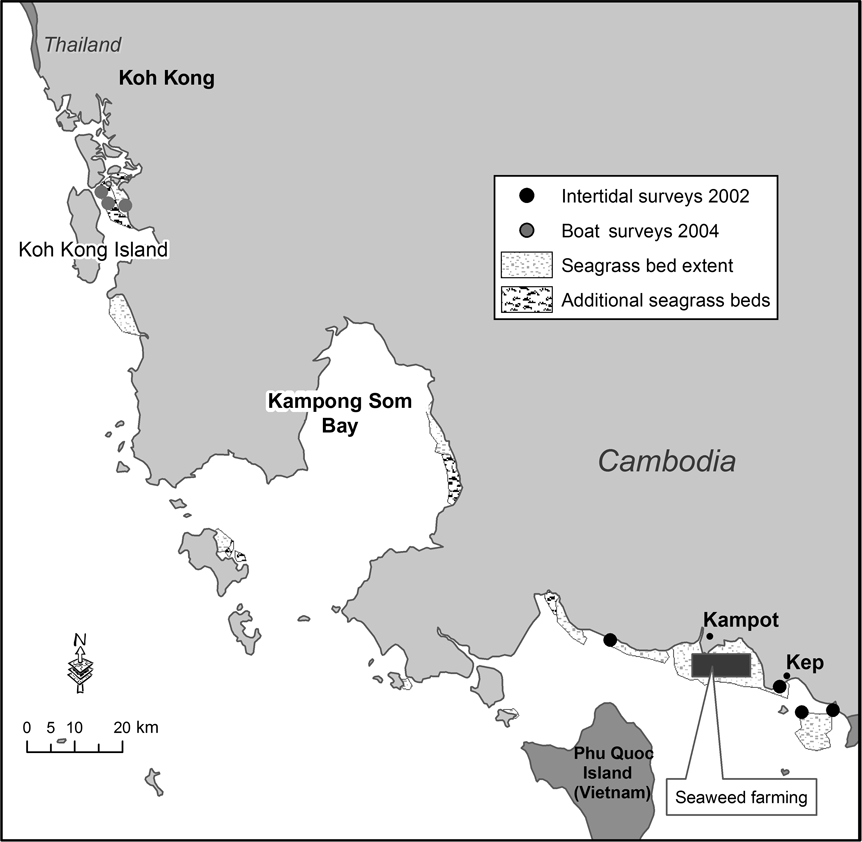
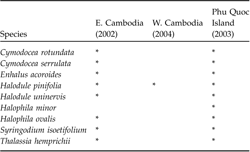
No dugongs or feeding trails were seen during the aerial surveys in Cambodia. Water clarity was high, Beaufort Sea State was ≤2 and 1,102 km of transects were flown over 4 days. Based on observations from the aerial surveys we extended the boundaries of seagrass beds previously mapped by Cambodian seagrass scientists (Fig. 2). We saw eight species of seagrass during intertidal surveys in eastern Cambodia in 2002. During the 2004 boat-based surveys we found sparse beds of Halodule pinifolia near Koh Kong in western Cambodia at depths of <1-1.3m in sandy mud (Table 1, Fig. 2). In both eastern and western Cambodia the seagrass we saw had a dense (>60%) cover. In eastern Cambodia, along the coast of Kampot province, there was extensive seaweed farming (Fig. 2). Hoa (Reference Hoa, Cox, Khuong and Hines2003) has documented species, extent and cover percentage for beds around Phu Quoc Island (Table 1). The largest and most dense beds are along the north-east and eastern coast between Bai Thom to south of Ham Ninh, with a 100 ha bed near An Thoi in the south of the island (Fig. 3).
Seagrass areas as originally mapped by the Cambodian Department of Fisheries (seagrass bed extent), as augmented by aerial surveys, intertidal and boat surveys in 2002 and 2004 (additional seagrass beds), and approximate seaweed farming extent in eastern Cambodia.
Interview sites in Cambodia and Phu Quoc Island, Vietnam, in 2002 and 2004.

Species of seagrass found in western Cambodia in 2002, eastern Cambodia in 2004, and around Phu Quoc Island, Vietnam, by Hoa (Reference Hoa, Cox, Khuong and Hines2003).
Interviews in Cambodia
A total of 49 respondents were interviewed in Kampot and Kep provinces in eastern Cambodia. In 2002 we spoke to 28 respondents (23 of whom were male), and in 2004 two teams of researchers interviewed 21 (17 men and four women) respondents in fishing villages in Kampot and Kep. In 2004 we also conducted 21 interviews (15 men and six women) in Koh Kong (western Cambodia) province (Fig. 3), including two in-depth interviews with the Chiefs of major fishing villages. The age range of respondents was 19-72 (mean 45 years). Only three of the interviewees had been born in the villages in which they were interviewed. Two other respondents had lived in their villages before 1975, left, and returned after Pol Pot was deposed in 1979 (one in 1980, the other in 1992). Others moved to the coast after 1979.
As a key informant, the Chief of the village of Peam Krasoap (Koh Kong province) provided the following background information: In Peam Krasoap there are 200 families; 61% use crab nets and traps, 20% small set nets, 18% gill nets to catch catfish, and 1% small trawl nets. Fishers have an average income of THB 3,000 a month (c. USD 75). During the Pol Pot years (1975-1979) no one was in the village. After 1979 17 or 18 families came, and from 1985 to 1987, 70 more families came. Fishing is now declining because of the number of fishers and people along the coast. There is conflict between local fishers and big trawlers that destroy the nets of small-scale fishers. There are no dugongs here but they have been seen near Chrouy Pras. Before 1975, when young, the Chief saw c. 10 dugongs, most of which were caught and eaten. We also spoke to the Chief's representative in Chrouy Pras, who indicated there are 300 families (in 2004), whereas there were 80 in 2002. Before 1975 there were c. 100 families. Fishers use crab nets and traps, illegal push nets, gill nets, prawn nets, small trawlers, and surrounding nets. He had not heard of dugong sightings within the past 5 years.
History and sightings
Seventeen of the respondents from Koh Kong province said they had never seen dugongs in the wild, two said they had seen 1-2 per year before 1970, and two had seen dugongs before 1975. No one has seen dugongs since then. Forty of the 49 respondents from eastern Cambodia had seen small groups of dugongs 1-24 years ago, nine respondents had never seen a dugong, and of these, four had never heard of the dugong. No respondents reported seeing dugong calves.
All respondents from western Cambodia said the dugong had never been hunted, whereas all respondents in eastern Cambodia said the dugong had been hunted in the past. Three people stated that the dugong had been hunted 30, 40 and 50 years previously. Dugongs in both western and eastern Cambodia are occasionally caught accidentally, and fetch a good price in the market, but since there was (in 2004) a proposed MAFF Fisheries law prohibiting catching or selling dugong, they now release animals caught in nets. As the interviewers were from the Department of Fisheries, which enforces this law, these responses may be biased. In western Cambodia four respondents said that dugong can be found in Chrouy Pras, 13 did not know and four said dugong are not found in western Cambodia. Four respondents mentioned that they had recently seen dugongs at the market at Peam Krasoap that had been caught at Chrouy Pras.
In eastern Cambodia 20 respondents pointed out seagrass areas near the interview villages. All respondents mentioned seeing dugongs at the market at Kbal Romeas at least once per year. Meat is sold for c. USD 2 kg−1, and tusks for USD 100-150.
Conservation issues and local use
Overall, 74% of respondents believed that numbers of dugong are decreasing, mostly because seagrass is destroyed by illegal fishing trawlers. Reasons given for this decline in western Cambodia included too many people, too much fishing activity in the seagrass beds, and dugong getting caught in fishing nets. Respondents in western Cambodia all stated that neither they nor anyone in their villages had caught a dugong. In eastern Cambodia 30 respondents mentioned that dugongs are caught in fishing nets every year. When asked if anyone had caught dugongs, eight respondents had caught them in nets, and 12 said they knew someone who had.
A stranded dugong is a dead animal found on land or a live one unable to swim to sea, either from natural causes or because it was caught in a fishing net and released (Hines et al., Reference Hines, Adulyanukosol, Duffus and Dearden2005b). No respondents answered positively to having found a stranded dugong. All respondents in western Cambodia mentioned they would return a stranded animal to the sea if alive; 20 of 21 respondents gave the reason that the dugong is a rare animal. One respondent said he would return the dugong to sea as an example to other villagers as he is the village Chief. Four respondents mentioned the (then) proposed MAFF Fisheries law. One respondent stated if the dugong was dead but fresh he would eat the meat, if decomposed he would take the flippers, tusks, and bones, and if alive he would kill it because he could get a high price in the market. In eastern Cambodia, in 2002, 18 respondents would kill a live animal and take a dead one, and use or sell the meat or body parts in various ways. All 21 respondents in 2004 stated they would return the dugong to the sea. One respondent in 2004 mentioned that local government authorities in 2000 instituted a fine of USD 50-100 if a dead dugong was brought into a village.
In both years and areas, 41 respondents were positive about dugong conservation, 26 respondents were neutral and three negative. Amongst the former, the most common reason was to conserve them for subsequent generations. People with negative responses believed that fishers were so poor they should catch dugongs for money. All but two respondents believed seagrass conservation was important as habitat and breeding ground for marine animals, food for dugongs, and fishing grounds. In 2002, 17 out of 28 respondents in western Cambodia had used or sold various dugong body parts as a medicine or amulet. Even though all respondents in 2004 responded that they had not themselves used dugong body parts, all had heard of this practice (Table 2).
Use of dugong body parts, as reported in interviews in Cambodia (see text for further details). Some respondents listed more than one use.

Interviews in Vietnam
On Phu Quoc Island, in southern Vietnam (Fig. 3) we conducted interviews in Duong Dong, the largest city, where we spoke to 13 women aged 30-60 years. In An Thoi village we interviewed five meat sellers in the local market, and five villagers (four men and one woman) aged 38-80 years. In Ham Ninh, respondents were three married couples aged 41-56, and in Bai Thom we met a famous dugong hunter, then 87 years old.
History and sightings
At the Duong Dong meat market sellers agreed the last time dugong meat was common was 1994-1995. The meat is now so precious that fishers who catch dugongs do not sell them in the market. One woman used to process dugong meat for fishers but had not seen any for 2 years. When the oldest woman started selling dugong meat 30 years ago, it was seen more often. She suggested we go to Ham Ninh where dugongs are seen regularly. In An Thoi all but two respondents had not seen dugongs for 10-20 years. One fisher responded that only the older generation knows about the dugong. Two respondents had caught dugongs in nets in the past year. Fishers in Ham Ninh see dugongs and reportedly catch several every year. Tu Diep, the dugong hunter in Bai Thom, stated that he sees as many dugongs now as he did 25 years ago.
Conservation issues and local use
In all areas except Ham Ninh and Bai Thom respondents indicated that dugongs are declining. In An Thoi one respondent mentioned that dugongs are declining because they get caught by trawlers every year. Here dugongs that are caught or found stranded are eaten, and some of the meat sold. In Ham Ninh and Bai Thom dugongs are hunted with special sting ray/shark nets imported from Japan or Korea (an investment of c. USD 62). These nets are set overnight in the seagrass beds during highest and lowest tides. Dugongs, swimming into the beds to forage, are caught and left to drown. The initial investment for the net is usually recovered within a year. Respondents catch 2-5 dugongs per year. In the yard of one of the dugong hunters in Ham Ninh we found six discarded dugong skulls (Plate 1). Tu Diep estimated he has caught 100 dugongs in 60 years.
Dugong skulls found in the yard of a dugong hunter in Phu Quoc Island, Vietnam.

In An Thoi respondents agreed that dugong conservation is important, but not as important as in the past because they are not seen by young people. Seagrass is considered unimportant and of no use. Ham Ninh respondents did not believe that conservation of either dugongs or seagrass were important. Tu Diep did not believe dugongs are threatened as they are always seen here and in Cambodia, and stated that nobody cares about seagrass.
Respondents in Duong Dong agreed that dugong tusks and bones can be effective for childrens' fevers when ground into powder and added to rice water. All respondents in An Thoi commonly ate or sold dugong meat (USD 2 kg−1). Tusks are kept as decorations or given away. Bones and teeth are ground down for fevers. In Ham Ninh and Bai Thom meat is eaten or sold, and skin is made into a special hot-pot dish. Every part of the dugong can be sold: a large pair of tusks can be sold to a middleman for Chinese traditional medicine or tourism for up to USD 650, skin for USD 4 kg−1, ear bones for USD 6.50 each, and bone pieces (especially ribs) for USD 0.20-0.65. Here, tusks, bones, and dried bile ducts are used as medicine.
Discussion
The dugong was historically abundant along South-east Asian coasts but reduction in numbers and local extinctions have left small, isolated groups with a high risk of extirpation (Marsh et al., Reference Marsh, Penrose, Eros and Hughes2002). Any assessment of conservation issues affecting the dugong, a species with specialized foraging needs that keep it close to the shore, must consider how these requirements create unique vulnerabilities. Rapid development, coupled with a rapidly increasing human population in coastal areas, has resulted in the degradation of the coastal resources that the dugong depends on. There has also been an increase in commercial fishing (Pauly, Reference Pauly2006). While coastal areas are vital for people's needs and livelihoods, immigration from overcrowded provinces into an open-access artisanal fishery and an often destructive and corrupt commercial fishing industry has created a situation that places the dugong and its habitat at risk (Mathew, Reference Mathew, Sinclair and Valdimarsson2003; Pomeroy & Viswanathan, Reference Pomeroy, Viswanathan, Wilson, Raakjaer-Nielsen and Degnbol2003).
Further research on dugongs and coastal seagrass in Cambodia and Phu Quoc Island is clearly needed. A single aerial survey is of limited utility in a large area with few dugongs, as their movement and behaviour can make them unavailable to view even in the best sighting conditions. In addition, there is little supportive infrastructure for small planes in Cambodia, and the nearest airport (Phnom Penh) to the coast of eastern Cambodia is a 1.5 h round-trip. The expense, time and safety of further aerial surveys should be weighed carefully. Further interviews and boat-based seagrass research are more practical in such conditions.
In western Cambodia most fishers interviewed only fish in the seagrass when the tide is low and may therefore not see dugongs. People had not seen dugongs recently but had heard of them being caught and sold. Respondents in Peam Krasoap had heard of dugongs in Chrouy Pras, but in Chrouy Pras no one had seen them. In eastern Cambodia seagrass was plentiful but used regularly by locals. Although no one had seen dugongs, respondents mentioned areas where they thought dugongs were, and knew about using dugong body parts. Respondents in Phu Quoc told us dugongs and seagrass were between their island and the Cambodian coast. Along the southern and west coasts of Phu Quoc dugongs are now only seen sporadically but comparatively frequently in the east and north. Based on the results of our interviews, and on current knowledge of the potential movement abilities of dugongs (Sheppard et al., Reference Sheppard, Preen, Marsh, Lawler, Whiting and Jones2006), the area between the eastern coast of Cambodia and the north-eastern coast of Phu Quoc Island is probably an important, yet severely depleted, area of dugong habitat.
Most respondents had heard of dugong body parts being used as medicine or amulets but only one person in Cambodia admitted to having done so. Direct hunting of dugongs is uncommon in Cambodia and respondents were not aware of the importance of the conservation of nearshore areas, fish, or other animals. In Vietnam, Fisheries officials on Phu Quoc Island found nine dugongs killed between September and November 2002. Their meat, tusks, bones, and skin were sold in markets and hotels. As a result a provincial directive was issued by the Kien Giang Provincial Peoples Committee in November 2002 prohibiting the hunting, transportation, and consumption of sea turtles, dugongs and dolphins (Tuan, Reference Tuan, Cox, Khuong and Hines2003).
Seaweed farming in seagrass beds is being promoted by the Cambodian Department of Fisheries as an alternative to fishing. Although not harmful, this farming requires a fixed structure in the seagrass that could discourage or trap dugongs. There are also serious conflicts between small-scale fishers and commercial trawlers (many of the latter from Vietnam and Thailand) that fish illegally close to shore, and shrimp farming is starting along the shoreline.
Poverty and issues of every-day survival have understandably taken precedence in this area. Cambodia has yet to recover fully from the Khmer Rouge genocide between 1975 and 1979 that killed 2 out of 8 million people. Most respondents in Cambodia moved to the coast after leaving Pol Pot's camps in 1979. Comments about protected areas were contradictory: while some people thought that a protected area would allow fish to grow and deter illegal trawlers, others mentioned that too many people already fish in a small area and a protected area would further limit their fishing grounds. Answers as to how governments could help elicited requests for regulations and enforcement to protect fishing grounds from illegal trawlers, and fishers from neighbouring villages and seaweed growers (who set up seaweed farms in fishing areas). Twenty-six (37%) of Cambodian respondents wanted alternative livelihoods and 17 wanted to farm rice.
In summary, threats to the dugong include incidental catch from both small-scale and illegal commercial fishers, direct hunting near Phu Quoc Island and direct catch when an animal is seen, the common knowledge of profits from the sale of dugong body parts, and increasing use and degradation of seagrass beds. At present, the dugong is too valuable a catch in a crowded, impoverished, overfished area. Protected area designations and endangered species legislation are effective only if social conditions also encourage self-regulation (Reiser et al., Reference Reiser, Hudson, Roady, Norse and Crowder2005). Perhaps the dugong could be the flagship for an educational campaign to increase environmental awareness in conjunction with efforts to improve living conditions (Marsh et al., Reference Marsh, Penrose, Eros and Hughes2002).
Government officials and international NGOs in both countries were made aware of our results but no further research or education programmes on the dugong have taken place in Cambodia. WWF-Indochina sponsored a workshop on dugongs and seagrass in Vietnam in 2003 and invited both local and international scientists to discuss conservation issues (Cox et al., Reference Cox, Khuong and Hines2003). However, even with the resulting provincial directive and educational programmes in Kien Gang province, insufficient funds and personnel are available to enforce existing regulations and management. In Phu Quoc provincial officers found 12 animals killed in 2002, five in 2003, and four in 2004. No dugongs have been seen along the eastern coast of Phu Quoc Island by fishers or dugong hunters since 2005 (K. Symington, pers. comm.).
Acknowledgements
We would like to thank Ocean Park Conservation Foundation, Project Aware, Sirenian International, WWF-Indochina, especially Tran Minh Hien, Hoang Thi To Linh and Teak Seng, National Research Council of Thailand, The Department of Fisheries, Cambodia, the Director of the Phuket Marine Biological Center, Thailand, Pantaruk Buakaew, Winston Ussher, Nao Thouk, Ing Try, Colin Poole, Joe Walston and Isabel Beasley.
Biographical sketches
Ellen Hines has been researching dugong in South-east Asia since 1999. Her interests are establishing practical field protocols, training local scientists, and creating frameworks for research to contribute to integrated conservation- oriented management. Kanjana Adulyanukosol has been researching dugong since 1988. In Thailand she devotes her life to the conservation of marine endangered species. Kanjana was designated ‘the best conservationist in the field of Thai wildlife research’ in 2003. Phay Somany and Leng Sam Ath trained in marine mammal research at Phuket Marine Biological Center, and work on Irrawaddy dolphins with the Cambodian Mekong Dolphin Conservation Project. Nick Cox lived and worked in Con Dao National Park in Vietnam during 2000–2002, developing conservation programmes for marine turtles and dugong. He managed WWF's marine programme in Vietnam, and organized a regional dugong conservation workshop in 2003. Potchana Boonyanate studies coral reefs and seagrasses in the Eastern Gulf of Thailand. Nguyen Xuan Hoa is a seagrass scientist and marine conservation biologist in central Vietnam.



