




1. Introduction
This article presents an empirical study investigating the form-to-meaning mapping of singular noun phrases in generic statements in Norwegian. Norwegian singular noun phrases offer an interesting case study, as all three forms, the definite, indefinite, and bare form, can express some form of generic meaning. The current body of literature reflects disagreement, and these form–meaning mappings have not been investigated experimentally so far across the different generic contexts. This is the goal of the present study.
The article is structured as follows: first we outline the various types of genericity and their accounts discussed in the semantics literature; next we describe our experimental design and findings. The statistical analyses are oriented to address our research questions. Finally, we present our discussion and conclusions.
1.1 Types of generic meanings
Generic statements impart generalizations about the world and reflect how humans categorize objects and events (Carlson & Pelletier Reference Carlson and Pelletier1995, Krifka et al. Reference Krifka, Pelletier, Carlson, Chierchia, Link, Carlson and Pelletier1995, Mari, Beyssade & Del Prete Reference Mari, Beyssade and Del Prete2012). More precisely, genericity is the phenomenon in which a linguistic expression (e.g. a sentence or a phrase) is used to generalize over kinds of individuals or over events. The ability to express generic meanings allows us to establish an efficient relationship with the environment by describing regular events or properties of objects. To our knowledge, all natural languages are capable of expressing genericity without resorting to dedicated overt linguistic devices in their grammars (Carlson Reference Carlson, Maineborn, von Heusinger and Portner2011).
Two main forms of genericity are recognized and widely discussed in the semantics literature: kind and characterizing generics. The first type of generic expression describes a kind as an abstract individual (Krifka et al. Reference Krifka, Pelletier, Carlson, Chierchia, Link, Carlson and Pelletier1995, Mari et al. Reference Mari, Beyssade and Del Prete2012). Consider examples (1a) and (1b), where the NP the rabbit/kaninen refers not to a specific rabbit but to the species Oryctolagus cuniculus. Here, genericity is conveyed at the NP level and is associated with verbs referring to the totality of the members constituting a kind. Predicates such as to be extinct or to be widespread force the NP to denote a kind, given that individual entities or groups cannot possess the quality of being extinct (Ionin, Montrul, Kim & Philippov Reference Ionin, Montrul, Kim and Philippov2011). kind genericity also encompasses what is referred to as taxonomic reference (1c) (Krifka et al. Reference Krifka, Pelletier, Carlson, Chierchia, Link, Carlson and Pelletier1995). In example (1c), the noun with a kind reading refers to a sub-kind of the species, not to the whole species. However, we are not taking taxonomic reference into consideration in the current study.

The second type of generic sentences, characterizing ones, draw generalizations over the prototypical representative of a class, such as in (2). Unlike transient properties, these represent normative or intrinsic attributes of the described NP (Krifka et al. Reference Krifka, Pelletier, Carlson, Chierchia, Link, Carlson and Pelletier1995:13). Such statements do not have to be true of a hundred percent of referents/objects. For instance, the veracity of a characterizing statement as in (2c) remains intact even though only adult male lions have a mane. Characterizing sentences predominantly possess a stative nature since they manifest a property rather than relay a particular event (Krifka et al. Reference Krifka, Pelletier, Carlson, Chierchia, Link, Carlson and Pelletier1995:17).

Generic meanings are similar, indeed universal, across languages as they abstract away from individual objects and events. However, languages show crucial differences in how these meanings are expressed.
The field of genericity enjoys a vast body of theoretical analyses concerning the form-to-meaning mapping in English (Krifka et al. Reference Krifka, Pelletier, Carlson, Chierchia, Link, Carlson and Pelletier1995) and beyond (Dayal Reference Dayal2004). Genericity has been discussed from a theoretical perspective in several languages including German (Barton, Kolb & Kupisch Reference Barton, Kolb and Kupisch2015), Spanish (Borik & Espinal Reference Borik and Teresa Espinal2015), Greek (Chatzigoga, Katsos & Stockall Reference Chatzigoga, Katsos and Stockall2017), and Russian (Seres Reference Seres2020).
From an empirical point of view, the investigations that have been conducted (Leslie, Khemlani & Glucksberg Reference Leslie, Khemlani and Glucksberg2011, Khemlani, Leslie & Glucksberg Reference Khemlani, Leslie and Glucksberg2012, Barton et al. Reference Barton, Kolb and Kupisch2015, Chatzigoga et al. Reference Chatzigoga, Katsos and Stockall2017) mostly focus on the exact interpretation of generic statements. Empirical investigations on genericity span other subfields of linguistics such as child language acquisition (Hollander, Gelman & Star Reference Hollander, Gelman and Star2002, Gelman & Raman Reference Gelman and Raman2003) and natural language processing (Reiter & Frank Reference Reiter and Frank2010). There is also a vast body of research on the acquisition of genericity in second and third language acquisition (Snape, García Mayo & Gürel Reference Snape, del Pilar García Mayo and Gürel2009, Ionin, Montrul, Kim & Philippov Reference Ionin, Montrul, Kim and Philippov2011, Ionin, Montrul & Santos Reference Ionin, Montrul and Santos2011, Park Reference Park2013, Snape, Mayo & Gürel Reference Snape, del Pilar García Mayo and Gürel2013, Snape, Hirakawa, Hirakawa, Hosoi & Matthews Reference Snape, Hirakawa, Hirakawa, Hosoi, Matthews and Miller2014, Ionin, Grolla, Santos & Montrul Reference Ionin, Grolla, Santos and Montrul2015, Hermas Reference Hermas2020); these studies base their predictions for additional language acquisition on the observations made for native speakers of the relevant target language.
Genericity in Norwegian has been addressed in extensive work on the nominal system (Borthen Reference Borthen2003, Halmøy Reference Halmøy2016), including investigations of Norwegian corpora (Rosén & Borthen Reference Rosén and Borthen2017, Skrzypek & Kurek Reference Skrzypek and Kurek2018). Empirical surveys have been conducted by Kurek-Przybilski (Reference Kurek-Przybilski2021) and by Skrzypek, Kurek-Przybilski & Piotrowska (Reference Skrzypek, Kurek-Przybilski and Piotrowska2022). Kurek-Przybilski (Reference Kurek-Przybilski2021) investigated the use of NPs across a variety of generic references, and found bare singulars, indefinite singulars, and bare plurals to account for the majority of count nouns in the task; the definite singular was represented in around 16% of the instances (Kurek-Przybilski Reference Kurek-Przybilski, Diewald and Politt2022:97). Skrzypek et al. (Reference Skrzypek, Kurek-Przybilski and Piotrowska2022) tested which forms can be used as generic NPs in the languages of Mainland Scandinavian. They established similarities between Swedish and Norwegian, as the participants accepted more than one form in the generic context, indicating a versatile use of NP forms.
Genericity in Norwegian can be expressed both with singular and plural expressions. Skrzypek et al. (Reference Skrzypek, Kurek-Przybilski and Piotrowska2022) found that, within the plural forms, the definite had a very low acceptance rate, whereas the indefinite plural was preferred to denote genericity. In this work, we limit ourselves to describing singular forms because the bare singular is not common for count nouns across languages with articles, and thus interesting to study, as it has a non-negligible use in Norwegian. Secondly, the reported task is part of a larger study in which plural forms were tested with another task. In the name of research ecology, we presented our participants with only one NP per test item. Including the plural forms would have increased the test length, leading to attention overload.
In the following sections, we outline how each singular nominal relates to some type of expression of genericity in Norwegian. This line of inquiry warrants attention because all three singular NP forms seem to have the potential to express some form of genericity.
1.2 Norwegian singular noun phrases
In Norwegian, a singular NP can manifest in three distinct forms: indefinite singular (en katt- ‘a cat’), bare singular (katt- ‘cat’), and the definite singular (katten- cat-def ‘the cat’); note that the definite marker is realized as a suffix on the noun. This section offers a comprehensive review of the extant literature on the capability of these forms to express genericity in Norwegian. Complementing this, later we present new empirical data sourced from native Norwegian speakers, delving into the association between the three forms and distinct generic connotations. Alongside kind and characterizing meanings, we explore the notion of type-denoting genericity.Footnote 1 Mass nouns are excluded from the current study as their distribution with regard to generics is different from count nouns and would add too much variation.
1.2.1 The definite singular
The definite singular can have a kind reading in Norwegian as exemplified by (1b) above. However, it cannot have a kind reading with super-kinds (Halmøy Reference Halmøy2010) as in (3), as there are many sub-species of dinosaurs and they are all extinct.

The definite singular can also have a characterizing generic reading, as exemplified in (4).

The definite singular can of course denote meanings related to definiteness, such as anaphoric mention (5b) or uniqueness (5a), and thus take a range of non-generic meanings.

1.2.2 The indefinite singular
The indefinite singular can signal characterizing genericity (6a) but cannot refer to kind readings. An example of the latter from Halmøy (Reference Halmøy2016) is provided in (6b).

The kind reading is available under the taxonomic interpretation of en potet: if we were referring to a particular sub-kind of potatoes (e.g. En potet, nemlig Beate, kommer opprinnelig fra Peru). The indefinite singular denotes, of course, a wide range of non-generic meanings such as the existential readings in (7).

However, the indefinite singular has been described as dis-preferred in subject position: Søfteland (Reference Søfteland2014) investigated the realization of subjects in vernacular spoken Norwegian and found that indefinite subjects are quite rare. This dis-preference for indefinite subjects (with the indefinite article) in Norwegian may be related to the fact that Norwegian exhibits a more frequent use of constructions with expletive subjects (e.g. the cleft construction) compared to English (see e.g. Gundel et al. Reference Gundel, Hasselgård, Johansson, Behrens and Fabricius-Hansen2002).
1.2.3 The bare singular
In this study, we follow Borthen’s definition of the bare singular form: ‘A bare singular is a nominal constituent that is countable, singular, and indefinite, and that does not have a phonetically realized determiner’ (Borthen Reference Borthen2003:10). There has been ample discussion regarding the Norwegian bare singular; for a detailed overview see Borthen (Reference Borthen2003) and Rosén & Borthen (Reference Rosén and Borthen2017). The form is morphologically singular; however, its semantic reference is often number-neutral, as defined in Dobrovie-Sorin & de Oliveira (Reference Dobrovie-Sorin and Pires de Oliveira2008), Espinal (Reference Espinal2010), and Espinal & McNally (Reference Espinal and McNally2011).
Halmøy (Reference Halmøy2016:45) defines the bare singular as marked for general number. Let us examine more closely one of our test examples in (8). The NP dog refers to any number and subspecies of dogs. If the example were with the indefinite or with the bare plural, it would mean that it is healthy to have a single dog or more than one dog, respectively.

Crucial for the present study is that Norwegian bare singulars are type-emphasizing, rather than token-emphasizing; they refer to an abstract entity, unlike tokens, which refer to an individual or an instance. Take the example in (9) from Borthen (Reference Borthen2003): svart sykkel is non-referential and cannot point to a specific black bike. The specific reading, however, is readily available with the indefinite singular (i.e. Jeg ønsker meg en svart sykkel).

Halmøy (Reference Halmøy2016:99) describes sentences such (10) as acceptable. According to her, the bare noun can receive both the characterizing (10a) and the kind (10b) interpretation.

On the other hand, Borthen (Reference Borthen2003) considers some bare singulars to be ill-formed in more prototypical kind (11a) and characterizing (11b) readings.

This apparent contradiction of the acceptability of example (10) but the unacceptability of (11) underscores the ‘unstable’ interpretation of the bare singular construction. Borthen (personal communication) explains that there is something about Norwegian moose that makes the bare form particularly likely: they live in groups (which may be considered ‘masses of plurals’) and they are often eaten as meat, which means that the noun elg ‘moose’ is often used as a mass noun and thus appears without a determiner. Thus, it might be possible that there is some kind of mass interpretation making the examples in (10) acceptable, which would not fit Borthen’s (Reference Borthen2003) interpretation of a bare singular (see definition above). Discussions with native Norwegian speakers suggest that animals native to Norway have an overall higher chance of being interpreted as mass. Therefore, our test items feature African and Asian animals, as there is more consensus on their linguistic regularity as count entities.
In summary, all three singular NP forms can express kind and characterizing generic readings, albeit in different alignments. The literature describes the definites as best suited to expressing kind readings, while the indefinites are more germane to characterizing and taxonomic kind readings (the latter not included in our study). The bare singular can also denote genericity in Norwegian, but its mapping onto generic meanings is much more complicated than for the other singulars, as outlined above. The bare form, in particular, deserves further experimental research.
2. The current study
In the current study we empirically test the observations made in the literature regarding the distributions and interpretations of the forms in relation to the different generic nuances. We posed the following research questions:
-
RQ1. What are the form-to-meaning mappings in Norwegian singular generic expressions? Which form best expresses each generic meaning?
-
RQ2. How exclusively is an NP form used in a particular generic context?
-
RQ3. Are the same forms accepted across generic and non-generic contexts?
Since genericity is a phenomenon at the syntax–semantics and syntax–pragmatics interface and responsive to many variables such as context and lexicon, we expected to see tendencies rather than strong categorical distinctions. We included the non-generic uses of the three NP forms in our investigation, in a parallel fashion. We developed an Acceptability Judgment Task (AJT) in which the target sentences were preceded by a context that helped participants interpret the sentence as generic or non-generic.
3. Methodology
We designed a timed AJT in OpenSesameWeb (Mathôt, Schreij & Theeuwes Reference Mathôt, Schreij and Theeuwes2012) and distributed it through a JATOS server (Lange, Kühn & Filevich Reference Lange, Kühn and Filevich2015). The task was part of a larger study which comprised a total of three tasks, the AJT being the second one administered to the participants.
Genericity has been tested by means of AJTs and/or Truth Value Judgment Tasks in English, Spanish, Brazilian Portuguese (Ionin, Montrul, Kim & Philippov Reference Ionin, Montrul, Kim and Philippov2011), in Greek (Lazaridou-Chatzigoga & Alexiadou Reference Lazaridou-Chatzigoga, Alexiadou, Gattnar, Hörnig, Störzer and Featherson2019), and in Danish, Swedish, and Norwegian (Skrzypek et al. Reference Skrzypek, Kurek-Przybilski and Piotrowska2022). In these studies, the generic contexts were followed by the target sentences appearing with all the NP forms possible in the target language. Our task used a binary choice scale instead of a finer-grained Likert scale, to avoid participants favoring the middle value and reducing item variation. This binary approach forced a choice between GOOD and BAD, clarifying the analysis by making judgments categorical. Although we anticipated gradience in these judgments, which the binary scale still revealed as items were variably accepted or rejected, we also measured reaction times (RT) to further analyze the gradience in acceptability. It is important to note that this task was originally designed to test the acquisition of genericity in Norwegian as an additional language (L2 and L3), which affected some methodological choices.
3.1 Materials
The task contained a total of 72 test items preceded by context, to ensure that the test sentences were interpreted with the intended meaning. The task tested three generic meanings (kind, characterizing, and type-denoting) and three non-generic meanings (specific, existential, and type-denoting). The non-generic conditions were chosen as counterparts of the generic ones. The specific condition included contexts that would determine the nominal as definite, identifiable, and specific, that is, the opposite of the kind meaning. Our existential contexts are best described as specific and indefinite, meaning situations in which an identifiable object is introduced for the first time. Finally, the contexts for bare singular nominals were either generic or concrete, ongoing, episodic situations. In the kind and specific conditions, we tested all forms in subject and object position separately, in order to check whether the meaning applies in the same way regardless of syntactic function. This array gives us a total of eight conditions. An example of each condition is provided in Table 1; the full list of test items is provided in the supplementary material, available online.
Overview of the test conditions with example contexts and test items

The same NPs (e.g. tiger, peach) appeared in a pair of conditions, as shown in Table 2. The color shading indicates that the same NPs were used in those conditions.
Overview of NP distribution per condition
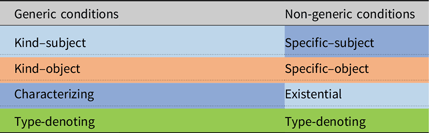
Each condition (n = 8) contained six test items, for a total of 48 test items. For each item, participants evaluated one of the three singular forms: definite, indefinite, and bare. The participants saw each context only once, which is why three lists were created to test the full array of conditions and forms. The lists were created in such a way that the same NPs did not appear in the same form in the same list; that is, in list A the noun potato appeared in the bare form in the kind-subject condition, but it was expressed with the indefinite form in the characterizing condition.
There was a total of 24 fillers, equally divided between grammatical and ungrammatical sentences. The ungrammaticality involved a V2 violation. All three lists contained the same fillers. They had the same format as the target test items: a context followed by a test sentence as in (12).

The inclusion of ungrammatical fillers had two reasons. First, clear exclusion criteria were needed to check if the participants were following the task. Participants who accepted a high number of ungrammatical items would have been excluded from the task; fortunately, this was not necessary. Secondly, grammatical fillers were relevant to assess the Norwegian proficiency of other participants in the larger study, who were L2/L3 speakers of Norwegian. At the same time, the choice of ungrammatical fillers may be considered a limitation for the native speaker experiment we present in this article. That is because the native speakers may have considered the V2-violation in examples such as the one in (12) a more critical mistake (as it is truly ungrammatical), compared to the infelicitous sentences which are our targeted test items.
3.2 Procedure
The participants were instructed to place their left index finger on the letter E, their right index finger on the letter O, and both thumbs on the space bar. The letter keys were used to judge the sentences, whereas the space bar was used to progress in the task. The instructions were presented both in written and spoken form. The participant could not progress to the next screen before the audio instruction had finished, to ensure that they heard the full instructions. There was a practice trial before they started the task.
The task proceeded as follows: a blue dot appeared in the center of the screen for 500 ms, after which a context sentence appeared. The participants were instructed to read that sentence carefully as it was the context according to which they would judge the following sentence. After they had read the context, they pressed the space bar for the test sentence to appear. They would then judge it as GOOD by pressing the letter E, or BAD by pressing the letter O. Reaction times (RTs) were measured from the appearance of the test sentence on screen.
3.3 Participants
A total of 33 Norwegian native speakers completed the task. Two of the participants declared they had been raised in a bilingual environment, with Norwegian as one of their native languages (along with English and Dutch). We decided not to exclude these two participants, as Norwegian was in fact (one of) their native language, and we do not believe they have diminished competence in it. While it is true that the languages of a bilingual may exert influence onto one another, the L1 can be also influenced by any additional language acquired at a later stage. All the participants declared that they spoke additional languages, so none of them were monolingual at the time of testing. Influence from another language is thus possible for the entire cohort, and thus the simultaneous bilinguals are retained in the study.
The participants were recruited through sign-up links on social media and flyers with QR-codes distributed on campuses of Norwegian universities. Participants were asked to input their email and to generate a unique ID following the provided instructions. They then received two links, one for the background questionnaire and one for the task. They received a 200 NOK (approx. 20 Euros) gift card upon completion of the experiment.
The participants were between 18 and 77 years old, with a mean age of 29.1 years; 26 females and 7 males. Their education level varied from elementary school (n = 1) to a doctoral degree (n = 1); fourteen participants had completed high school, nine participants had a BA level degree, and eight had an MA level degree. The participants were residing in bigger Norwegian cities at the time of testing and declared that they spoke a variety of Norwegian dialects.
4. Results
4.1 Exclusion of items and participants
Three test items were excluded: two in the type-denoting non-generic condition (one due to a grammatical mistake in the test item and another due to a prime NP present in the context). We also excluded an item from the specific object condition as the context did not have as clear a specific reading as the rest of the examples in this condition. The generic test conditions retained six items each.
4.2 Fillers
We analyzed the responses to the fillers and found that the participants paid attention to the task. A linear mixed effects model was fitted with response (Bad vs. Good coded as 0 and 1 respectively) as the dependent variable and type of item (grammatical vs. ungrammatical) as the independent variable. Participant and test item were set as random effects. The model revealed that there were significantly more Good responses to the grammatical fillers and significantly more Bad responses to the ungrammatical fillers, which is something we would expect from participants engaged in and responsive to the task.
4.3 Generic items
An overview of the responses is displayed in Figure 1. The graphical representation suggests that an item’s acceptability within a context emerges as a gradient preference rather than as a clear-cut distinction. The data also exhibit some variability, contingent on the nature of genericity in question. The standard error (SE) whiskers are relatively small, which gives us confidence that the means of the response for each NP form and condition are estimated with high precision. We will discuss speaker variation in more detail in the section on individual results.
Overview of the responses in the generic conditions.

Overall, we found that the definite form is preferred in kind as well as characterizing readings. No pronounced discrepancies were discovered between kind subjects and kind objects. The indefinite form does not seem to be accepted in kind readings, as it performed poorly both in the subject and object sub-conditions. The indefinite forms are accepted in characterizing conditions, but surprisingly, the definite NPs are accepted more strongly. As for type-denoting contexts, the indefinite displays high acceptability rates, paralleling the bare form, as argued by Borthen (Reference Borthen2003). Nevertheless, it is imperative to emphasize the nuanced semantic divergence between the bare and indefinite forms. The former adheres more closely to the intended generic interpretation, exemplified in (13).

The bare noun choice indicates that it is healthy to own the type-NP dog which may be any number of dogs, whereas with the indefinite form, a possible reading is that it is healthy to have just one dog and not more. However, we did not test this distinction in our experiment.
4.4 Statistical analysis of the generic conditions
The R software was used to run the analyses. Categorical responses were coded as 0 for Bad and 1 for Good. Glmer models from the lme4 package (Bates, Machler, Bolker & Walker Reference Bates, Machler, Bolker and Walker2015) were run on each condition, with the response value as the dependent variable and the NP form as the independent variable. Participant and test item were set as random effects across all the glmer models.
We first describe the model set for the kind conditions (Table 3). Here we have an additional independent variable when compared to the rest of the statistical models shown below, as syntactic position (subject vs. object) is included. The definite form and subject position are set as the intercept. The model revealed that the definite is the form best suited for expressing this type of generic meaning, as both the indefinite and the bare form were accepted significantly less (p < .001). There was no difference between subject and object kind generics, which indicates that the genericity semantics is not influenced by the syntactic position of the NP. This holds for all forms, as there was no interaction between syntactic position and item form: indefinite and bare NPs were less accepted in kind readings regardless of syntactic position. The large absolute values in the estimates and the small p-values offer strong evidence that these NP forms are accepted to significantly different degrees within the outlined condition.
Generalized linear mixed-effect model of the kind conditions

The characterizing model included only NP form as the dependent variable (Table 4); the definite NP was set as the intercept. The model revealed that the indefinite form is accepted significantly less than the definite (p < .05), whereas there is a marginal difference of acceptance (p < .1) between the definite and the bare form.
Generalized linear mixed-effect model of the characterizing condition

The type-denoting model (Table 5) is set up in the same way as the characterizing model in terms of variables, but we set the bare singular form as the intercept, as this is where we would expect this form to be the most accepted (Borthen Reference Borthen2003). The model indicates that the definite form is strongly rejected when compared to the intercept (p < .001). There was no statistical difference (p = .2826) in the acceptance of the indefinite when compared to the bare form, entailing that both forms are acceptable with the proposed reading.
Generalized linear mixed-effect model of the type-denoting condition

In summary, the results indicate that the definite form is the most appropriate form for expressing kind readings, be it in subject or object position; furthermore, the definite form is not appropriate for expressing type-denoting generics. The indefinite form seems to be the least well accepted across the generic contexts tested here, although it is well accepted in type-denoting conditions. Characterizing generics allow for more variation, as there are high acceptance rates for all three forms; still, the definite singular seems to be the most appropriate form in the contexts that were tested. Our findings for characterizing are in line with theoretical proposals (Krifka et al. Reference Krifka, Pelletier, Carlson, Chierchia, Link, Carlson and Pelletier1995) and studies conducted on other languages (English) that find this type of generic meaning most prone to variation in expression. We elaborate on these results in the Discussion (Section 5).
4.5 Statistical analysis of NP forms
The next step in our analyses explored acceptability of NP forms (definite, indefinite, and bare). This setup of statistical models sheds light on the dynamics between different conditions and NP forms, and addresses RQ2 (How exclusively is an NP form used in a particular generic context?). Models (glmer) were thus plotted for the definite, indefinite, and bare form separately. The responses were once more set as the dependent variable, and condition was set as the independent variable. Again, participant and item were set as random effects.
The model analyzing the definite form is displayed in Table 6. The kind condition with the NP in subject position was set as the intercept. The model indicates that the acceptance of the definite form is high for the kind subject position (intercept) and this does not change when the acceptance is compared to the kind object and characterizing conditions. Thus, the definite form is broadly accepted across diverse conditions. However, its acceptance is significantly diminished in the type-denoting condition (p < .001), an observation previously underscored in condition-specific models.
Generalized linear mixed-effect model for the definite NP form

The analysis pertaining to the indefinite form is presented in Table 7. Here we set the type-denoting condition as the intercept, as the indefinite is felicitous in this condition, whereas, based on the results provided in the previous section, it is less felicitous in the characterizing condition. We indeed see that this NP form tends to be accepted in the type-denoting condition (indicated by the positive value in the Estimate). In contrast, its acceptance significantly diminishes in all other conditions: p < .05 for kind subject and p < .001 for the kind object and characterizing comparisons. Overall, the indefinite does not seem to be the preferred form in generic readings. A potential task effect cannot be excluded as the subject position was tested more extensively in this task. Nevertheless, it is quite clear that the indefinite form cannot denote kind meanings, as indefinite subjects were rejected as often as indefinite subjects in this condition.
Generalized linear mixed-effect model for the indefinite NP form

The type-denoting condition was also set as the intercept for the model on the bare form (Table 8). This model shows that, in comparison to the type-denoting condition, the bare singular form registers significantly reduced acceptance across the other conditions, the difference being stronger for kind–object (p < .01) than for kind–subject and characterizing conditions (p < .05).
Generalized linear mixed-effect model for the bare NP form

To summarize our observations and analyses, the models discussed in this section suggest that the definite form is most applicable across the range of generic contexts tested. In contrast, the indefinite and bare forms are most suitable in the type-denoting condition. A comparison of Tables 7 and 8 reveals more significant differences between the intercept and other conditions for the indefinite form than for the bare form. The reader should remember that the intercept for both forms was aligned with the type-denoting condition, enabling direct comparison between the models. This comparison suggests that the indefinite form is less suitable than the bare form in the generic conditions we investigated. We will delve deeper into this observation in the Discussion (Section 5).
4.6 Generic versus non-generic contexts
The study of generic form-to-meaning mapping is complex because all of these forms can indeed denote non-generic statements. Therefore, it is essential to juxtapose the acceptance rates of these forms against those in non-generic contexts. Figure 2 displays an overview of the responses in the non-generic conditions. Both definite and indefinite nominals can be specific, so in principle both these forms could be accepted in the specific conditions. As the contexts mentioned the specific nominals (subject or object) and created anaphoric relations, we expected the definite forms to be the most acceptable ones. This expectation was met in the specific object condition. Indefinites were less highly accepted than definites in the specific subject condition, but still not completely rejected. At present, we have no good explanation for this finding. Since it is not an item effect, we leave it for future research. As the reader can also ascertain from Table 11, the definite form was not unacceptable in the existential condition, because the context allowed for the only potato in the bag, or one of the potatoes in the bag, to roll out. Thus, we submit that our research participants were quite sensitive to the item-preceding context. Most importantly, the bare form is ungrammatical in these conditions which is why we do see a high rejection rate. We look at separate generic–non-generic comparisons directly below.
Responses in non-generic conditions.

Generalized linear mixed-effect model of kind and specific subject conditions

Generalized linear mixed-effect model of kind and specific object conditions

Generalized linear mixed-effect model of characterizing and existential conditions

In this analysis, specific, existential, and type-denoting non-generic conditions were evaluated. This section presents a comparison of form acceptance in paired generic and non-generic contexts. We plotted three models with such pairings: the kind and specific model due to the presupposed similarity of the acceptance of the definite, the characterizing and existential model due to how the indefinite form should fare according to the literature, and a model comparing the generic and non-generic type-denoting condition. We plotted a glmer model for each generic and non-generic pair of conditions. The response was always set as the dependent variable and NP form and condition as the independent variable; participant and item were set as random effects.
For the kind–specific comparison, we ran the models separately for the subject and object position. The kind condition and the definite form were set as the intercept. In the data analysis comparing the kind and specific conditions in subject position, we plotted the comparison models with the definite and bare forms only, due to the high acceptance of the indefinite form in the specific conditions (Figure 2). The comparison data is displayed in Figure 3. The model (Table 9) reveals that the bare form is less accepted than the definite in kind contexts (p < .001), confirming our findings within the kind-model (Table 3). The comparison between the generic and non-generic condition suggests that the definite form is accepted to a similar degree, as there was no statistical difference (p = .8710). However, the model did find an interaction between form and genericity, as the bare form was significantly less accepted in the specific condition (p < .01). This may be an indication that the bare form is only felicitous when it is denoting some type of genericity.
Overview of responses in kind and specific subject conditions.

We plotted the kind–specific comparison in the object position (Table 10) in the same way as the subject model. In the current model, the indefinite was included, as its acceptance aligned with expectations (Figure 4). Kind and definite were once more set as the intercept. As confirmed in Section 4.4, the analysis indicated both the bare and indefinite forms witnessing significantly lower acceptance in the generic conditions (p < .001). The specific condition is not significantly different from the kind condition (p = .583), entailing that the definite form is accepted to the same degree in these generic and non-generic conditions. The model did not find any interactions between the generic and non-generic conditions. This suggests that the rejection rate of the indefinite and bare form remained the same across the two conditions.
Overview of responses in kind and specific object conditions.

The model juxtaposing the characterizing and existential conditions (Figure 5, Table 11) was set the same way as the kind–specific object model above. The characterizing condition and definite form remained the intercept. While the indefinite form is the more natural form for expressing the non-generic existential condition, it seems to be the less felicitous for expressing characterizing genericity. We therefore chose not to set it as the intercept. The model showed a slight, albeit insignificant, decline in the acceptance of the definite form, when comparing the generic and non-generic conditions (p = .5507). Within the characterizing condition, both the indefinite (p < .01) and the bare form (p < .05) were accepted to a lesser degree when compared to the definite form. This was already established in the previous section. Interactions between the conditions highlight a significantly higher acceptance of the indefinite in existential contexts (p < .01), while the difference for accepting the bare singular is only marginally significant (p < .1).
Overview of responses in characterizing and existential conditions.

Lastly, we fitted a glmer comparing the acceptance ratios in the two type-denoting conditions (Table 12). Response was the dependent variable with genericity (generic vs. non-generic) and NP form set as the dependent variables. Participant and test item remain the random effects. Here the bare form and generic condition were set as the intercept. Figure 6 illustrates a significant difference in the acceptance of the bare form across our two distinct type-denoting conditions; it was less accepted in the non-generic condition (p < .05). As in the model in Section 4.4, we see that the definite form is strongly rejected in the generic type-denoting condition (p < .01), whereas the indefinite and the bare form are equally acceptable (p = .3332). There is no interaction per condition or the indefinite form, entailing that the indefinite is accepted to the same degree across the two conditions under investigation here. The interaction with the non-generic condition and definite form indicates a higher acceptance of the definite in non-generic conditions (p < .001).
Generalized linear mixed-effect model of type-denoting conditions (generic and non-generic)

Distribution of the acceptance of the bare form across all conditions.

Having seen and statistically analyzed the responses in the full array of the tested conditions, an interesting interplay between genericity and type-denoting conditions emerges. The bare singular is highly accepted in the generic type-denoting contexts, but it also reaches a high degree of acceptance in the other generic conditions (Figure 6), as it does in the type-denoting non-generic condition.
We set a glmer (Table 13) with the response as the dependent variable, with genericity (generic vs. non-generic) and type-denoting(ness) (type-denoting vs. not type-denoting) as the independent variables. The task was not set to explicitly address this, and thus the data sets are unbalanced, as there were only two conditions that were labelled type-denoting, and four which were not. Participant and test item were set as random effects; the type-denoting generic condition was set as the intercept. The statistical analysis confirms what was observed in the previous models: The bare form is accepted less across non-generic conditions (p < .05); it is also accepted less in contexts which are not type-denoting (p < .01). However, there was no interaction between generic and type-denoting properties of the conditions, entailing that the acceptance of the bare form is not incrementally increased by genericity and type-denoting contexts (p = .9355).
Generalized linear mixed-effect model of the bare forms across conditions

4.6 Individual variation
The overall results revealed gradience in the acceptance of singular NP forms across the tested contexts. This is something that we expected in general, but for some surprising findings, a more in-depth investigation is warranted. For example, we ask how to account for the approximately 50% ratio of acceptance in some form/conditions as opposed to others. A 50% acceptance can be the result of having two distinct groups of participants: one that always accepts a specific form in a certain condition and another that always rejects this combination. Alternatively, it could be that all participants accept/reject different test items with the same NP form within the same condition.
We thus plotted average responses per form and condition for each participant and present them in Figure 7. Each dot represents the average acceptance ratio for a participant for a particular combination of condition and NP form. All the participants are represented in every ‘violin’ of the plot.
Individual variation in the generic conditions.

The graph in Figure 7 illustrates that the 50% acceptance in the characterizing condition for the indefinite and the bare singular is due to both types of participants. There are participants that always accept one of these forms in characterizing condition, and an approximately equal number of participants that persistently reject it. But we also have participants who are positioned in the middle of the graph, entailing that these items are sometimes accepted and sometimes rejected by another group of participants. The bare singular form has more participants gravitating towards the middle of the graph, compared to the indefinite which has a higher number of participants at the two extremes. It is also visible from the graph that definite and indefinite forms are accepted and rejected, respectively, by most participants in the kind and type-denoting conditions.
Consider the bare singular 50% acceptance in the two kind conditions. Once again this is due to a combination of three different participant types: the ones that always accept the bare form in kind contexts, the ones that always reject it, and participants who land somewhere in the middle. It is only in the characterizing condition that participants have truly divergent evaluations of the form’s acceptability.
In summary, the individual results show that there is gradience not just in conditions, but also among participants. However, this variability is more prevalent in some contexts than in others.
4.7 Reaction times
In the process of conducting the timed AJT, we collected reaction times (RTs) commencing from the moment the target sentence became visible on the screen until the response button was pressed.
Thus, what we present in this section are RTs for the whole sentence. For analytical precision, we opted to omit all RTs exceeding 10,000 milliseconds (ms) to ensure we are assessing genuine reactions from the participants. Again, we found the responses to be gradient rather than categorical; however, the examination of the RTs can illuminate this distinction further. Faster RTs – whether they signify acceptance or rejection of an item – speak to a faster decision-making process without vacillations. Sentences that are closer to the boundaries of acceptability might require longer processing times, revealing their position on a gradient of acceptability.
In linguistic studies, RTs often indicate some ambiguity resolution in the sentence. Ambiguous constructs typically require a prolonged comprehension compared to unambiguous constructs. In our type of target sentences, we are not dealing with ambiguity, as the context narrowed down the set of possible interpretations. Nonetheless, the RTs grant us a glimpse into the immediacy of acceptance or rejection of a form in diverse generic contexts. Our predictions posit that the prototypical form corresponding to a generic meaning will be accepted faster. For instance, the definite should surpass the bare in kind conditions in speed; furthermore, the bare form should be rapidly dismissed in non-generic scenarios. Figure 8 shows an overview of the RTs per condition and per response type.
Overview of RTs per condition, item form, and response type.

An examination of Figure 8 reveals that negative judgments (Bad) can manifest shorter RTs than their positive counterpart (Good) with the same form and condition. This underscores the imperative to consider both response categories in our analytical framework. The speed of both accepting and rejecting an item is essential, especially when items are dismissed more rapidly than they are accepted, hinting at their ungrammaticality or inappropriateness.
For statistical modeling, we employed linear mixed-effects regression models (lmer), run on each generic condition. The response time was set as the dependent variable. All the RTs were logarithmically transformed. We ran a separate model per each generic condition. Two models were run for each condition, one with the raw RTs and another one with logarithmic RTs. The models presented below report the result of the logarithmic RTs, but the reported milliseconds (ms column) are taken form the models run on the raw RTs. The dependent variables were NP form (definite, indefinite, bare) and response type (Good vs. Bad).
The model on the kind–subject condition had the definite form and good response set as the reference level; the results are displayed in Table 14. We see that acceptance of the indefinite and the bare is significantly slower (p < .05) than acceptance of the definite form. Rejection of the definite is marginally slower than its acceptance, but recall that rejections of the definite in the current condition are rare, which makes this a small sample. The interactions reveal that both the indefinite and the bare form are rejected faster (p < .05), indicating their decreased appropriateness for this reading compared to the definite.
Linear mixed-effects model on the RTs in kind subject condition

The model run on the kind object condition had the same setup as the model above. We find fewer significant differences in RTs (Table 15), though the tendencies were similar. A potential reason for having diminished significant differences is that it takes longer overall to react to generic contexts featuring a generic reference in object position, and thus the differences in RTs are weaker. Compare the raw value for the RT for the subject position in Table 14 (2979 ms) and for the object position in Table 15 (3716 ms).
Linear mixed-effects model on the RTs in kind object condition

The indefinite is accepted with slower RTs when compared to the intercept, though the difference is not significant; the bare form was accepted slightly faster than the intercept, but this difference also did not reach significant difference. The interactions indicate that the indefinite and bare forms were rejected faster, but the difference only reached marginal significance (p < .1) for the indefinite, and it was not significant for the bare comparison (p = .8117).
In the characterizing model, discrepancies in RTs did not attain statistical significance. Upon inspecting raw RTs, variances between variables were negligible, all being under 1000 ms.
Lastly, we plotted an lmer for the type-denoting condition, with the same setup as the models above, the only difference being that the bare form was set as the reference level, aligning with its natural inclination to express genericity. The RTs of accepting the sentences did not differ across the three forms; the bare forms, however, take longer to be rejected than accepted (p < .05). The significant interaction in the penultimate row of Table 16 suggests that definite NPs affect participants’ rejection speed differently than their acceptance, indicating that definite NPs are processed more quickly when rejected and more slowly when accepted, compared to sentences with bare and indefinite NPs. (p < .05).
Linear mixed-effects model on the RTs on type-denoting condition

5. Discussion
In this study we investigated the extent to which three morphological realizations of singular NPs are accepted in a variety of generic and non-generic contexts by native speakers of Norwegian. Generic meanings are expressed with readily available forms in the language, but these forms also convey other (non-generic) meanings. Hence, context plays a pivotal role in disambiguating the intended generic interpretation. Moreover, there are different types of genericity.
In this article, we have provided empirical evidence of the form-to-meaning mappings in generic contexts in Norwegian. We analyzed the results of our timed AJT, in which the target generics were presented in a clear context to convey the intended meaning for each item. Our findings reveal an interesting interplay between the type of generic meaning and the respective acceptance of each form. In particular, we established that all three forms under investigation can signify genericity. More concretely, the definite singular effectively carried kind and characterizing readings but, notably, not type-denoting readings. The bare form reached above chance acceptance in kind and characterizing contexts, but it was highly accepted in type-denoting contexts. The indefinite was not accepted with kind generics, and this was the case to the same extent in subject and object position. This finding is in line with Dayal’s (Reference Dayal2004) treatment of singular kinds depending on a definite determiner. Indeed, the definite singular performed well in the kind condition. The finding is also in line with Cohen’s (Reference Cohen2001) theory of singular indefinites being restricted to characterizing contexts. The indefinite was indeed well accepted as denoting characterizing generics, though its acceptance was surpassed by the acceptance of the definite form. The indefinite was also well accepted in the type-denoting conditions, with the bare form possibly transmitting a number-neutral reading more readily. Overall, the indefinite form was not the preferred expression of any generic meaning, so it may seem that it is the least readily available form to express genericity. However, indefinites may be more acceptable in object position, a consideration that our experiment did not include a priori.Footnote 2 This possibility is left for further research.
Our findings addressing RQ1 regarding the form-to-meaning mappings are visualized in Figure 9. The best expression of kind and characterizing meanings are the definite singulars. However, type-denoting situations are best captured by either bare or indefinite singulars.
Visualization of form-to-meaning mappings in Norwegian. Note: black arrows stand for preferred expression.

RQ2 asked how exclusively an NP is used in a generic context. To address this question in a similar visual manner, we added possible but less preferred expressions in Figure 10. No NP is used exclusively in a single generic context; that is, there is no one-to-one mapping. While the definite and indefinite can express two meanings, the bare forms are acceptable in all three meanings, to lesser degrees. Importantly, we have revealed that the indefinite form cannot take kind readings, while the definite form cannot be used in type-denoting contexts.
Visualization of all the generic meanings an NP can express in Norwegian. Note: black arrows stand for preferred expressions (over 70% acceptance); red arrows denote possible but statistically less preferred expressions (at roughly 50% acceptance).

Finally, RQ3 probed into the other form–meaning associations among the meanings we tested. The definite forms were accepted in kind, specific, characterizing, and existential contexts, appearing as the most versatile form. Adding to those the definite non-specific meanings that we did not test, this NP can be associated with at least five meanings. Indefinite singulars can express existential (indefinite specific) as well as indefinite non-specific and taxonomic kind readings (not tested), together with characterizing and type-denoting meanings, another one-form-to-five-meanings association. Although bare forms are mostly related to type-denoting NPs, they are also multi-functional. In this respect, the diversity of Norwegian singular NPs expressing genericity surpasses that of the English equivalent paradigm, since the bare singular is not available in English.
Related to the multi-functional forms, we argue, is the variability evident in the native speaker acceptability choices. ‘A general observation that can help explain variability is the fact that, although context includes previous discourse, it is not completely determined by it, as context is partly created by the interlocutors as processing takes place’ (see e.g. Sperber & Wilson Reference Sperber and Wilson1995). Given that context is not a static feature, it is not surprising that informants may imagine different contexts than the ones intended by the researchers (Borthen, Hemforth, Mertins, Behrens & Fabricius-Hansen Reference Borthen, Barbara Hemforth, Behrens, Fabricius-Hansen, Hemforth, Mertins and Fabricius-Hansen2014). We are mindful of the message from the above quote, and tried to mitigate it in our experimental design.
An important insight of the experiment is that when one tests for informants’ preference in a case where the informants have a ‘free choice’ (perhaps related more to communicative intention than cognitive and linguistic constraints), very subtle features of the response alternatives and the involved languages may have a considerable effect on the results. That is, minor linguistic differences may lead to pulling the choice from one interpretive option to the other and consequently have a crucial influence (Borthen et al. Reference Borthen, Barbara Hemforth, Behrens, Fabricius-Hansen, Hemforth, Mertins and Fabricius-Hansen2014:139).Footnote 3
The bare singulars are especially interesting in Norwegian grammar, as use of this form along with an indefinite singular is rare among Germanic languages. Other languages with bare singulars include Swedish, Spanish, Catalan, Greek, Brazilian Portuguese, and Persian. It is important, then, to discuss the tendency that bare singulars receive higher acceptability scores in the generic conditions than in the non-generic conditions. Comparative models contrasting these contexts confirmed that the bare singular was unacceptable in specific and existential scenarios. In line with Borthen (Reference Borthen2003), we suggest that there is an intrinsic generic nuance in the bare singular, more so than in the other singular forms. Borthen (Reference Borthen2003) outlines that the bare singular is type-emphasizing, a premise foundational to our type-denoting test items. Although we probed potential interactions between genericity and type-denoting interpretations as factors influencing the bare form’s acceptance rates, no such interaction emerged. Yet we identified the type-denoting nature of the bare form as the predominant factor bolstering its acceptance. This could potentially stem from the dataset’s structure, as there were only two conditions (one generic, one non-generic) designated as type-denoting and four conditions without this designation. A plausible explanation is that the type-denoting nature of the form – which abstracts from particular objects or events (Carlson & Pelletier Reference Carlson and Pelletier1995) – resonates with the broader semantic essence of generics, thereby fostering its high acceptance across various generic readings.
The current study has its limitations, some of which are due to the fact that it was part of a larger project investigating second and third language acquisition of Norwegian. Two findings could be attributed to the low number of items we could plausibly test to prevent experimental fatigue. First, indefinite singulars did not seem to be well accepted, but this could be due to a task effect as we did not include taxonomic kind reference, where indefinites should be highly accepted. Secondly, we did not have a well-balanced investigation of syntactic position, as the majority of our items had the target NP in subject position, which could further have diminished the acceptability of indefinites (Søfteland Reference Søfteland2014). Syntactic positions are not created equal. Often, subjects and sentence-initial elements are more naturally interpreted as topics, known information, hence definite, than object positions. Thus, indefinites do not fare well in subject positions. We leave testing generic indefinites in object positions for further research.
6. Conclusion
The current study probed the expression of genericity in Norwegian through singular NPs. We established that all three Norwegian forms (bare, definite, and indefinite) are used to express some generic meaning or other. What is more, the singular NPs are multifunctional, as they express up to five meanings, generic and non-generic. Most importantly, however, this does not mean that the forms are used interchangeably across the generic readings. While there was substantial variability in the responses, our findings also revealed clear patterns in the form-to-meaning mapping of the tested generics confirming the theoretical discussions in the semantics literature. We also established that the bare singular is overall a well-accepted form across generic contexts, due to its type-denoting nature, akin to generic meanings.
Supplementary material
To view supplementary material for this article, please visit https://doi.org/10.1017/S0332586524000258
Acknowledgements
This study is part of the ADIM (Across-Domains Investigations in Multilingualism) project made possible with Norway grants NCN, ID: DEC-2019/34/H/HS2/00495. We would like to thank our extended team for feedback and extensive discussions; we thank the AcqVA research group at the Norwegian University of Science and Technology for piloting the first iteration of the task and the numerous comments. We are especially grateful to Kaja Borthen for valuable comments on the first version of the draft, for the ample discussions on NP forms, referring expressions, and their contextual uses in Norwegian.
Competing interests
The authors declare none.


 Open access

