

1 Introduction
This article is concerned with the diachronic development of mirative end up constructions like the ones illustrated in (1):
(1) (a) They agreed to drive nearly five hours across the state from their home, figuring they would spend maybe two hours at the prison. They ended up staying for the entire six-hour visiting period. (COCA:SPOK, 2015)
(b) Its face was hideous and I couldn’t tell what type of animal it was. Ends up, it was a moose. (NOW:CA, 2010)
Originally meaning ‘to come to an end’ (OED s.v. end, v.1., II.5.a.), the phrasal verb end up has acquired mirative senses over time through a process of pragmatic enrichment and subjectification. Thus, certain present-day end up constructions, like the [end up V-ing] construction in (1a) and the end up parenthetical in (1b), have come to signal information that is new or unexpected, with overtones of surprise and counterexpectation.
To the best of my knowledge, the diachronic development of mirative end up has not yet been studied. The record shows that phrasal end up is a late-nineteenth-century innovation. Although this verb allowed a variety of complements from its onset, it is not until the 1920s that end up starts taking gerundial complements (1a). The [end up V-ing] construction experienced a dramatic rise in frequency in the later decades of the twentieth century and is now pervasive across registers.
The data reveal other less frequent constructions, such as parenthetical uses like (1b). Parenthetical expressions have attracted a great deal of scholarly attention, especially as regards their emergence (see, for instance, López-Couso & Méndez-Naya Reference López-Couso and Méndez-Naya2014a, Reference López-Couso and Méndez-Naya2014b). The still scant presence of end up parentheticals seems to indicate that the verb is undergoing further change in present-day American English, in line with the developments followed by other raising verbs like happen, seem or turn out. In fact, the emergence of end up parentheticals appears to be the result of analogical modeling after similar constructions, most conspicuously the grammaticalized mirative parenthetical (it) turns out.
This article aims to explore the emergence of phrasal end up and the mechanisms that result in its mirative readings. In order to do so, I trace the changes that take it from its original meaning as a lexical verb expressing completion towards its eventual copularization and recruitment as a raising verb conveying mirative nuances. Moreover, I elaborate on the seemingly pivotal role that analogy has played in this process, especially as regards its role as a catalyst for cooptation (see Heine Reference Heine2013).
The present article is organized as follows. Section 2 offers an overview of mirativity and its expression in English. Section 3 describes the data and some methodological issues. Section 4 presents an overview of end up constructions in Present-day American English, while section 5 explores the diachronic emergence of the phrasal verb. Section 6 delves into the role that analogical processes might have played in the (ongoing) development of end up and presents a brief discussion of the theoretical implications of these findings. Finally, section 7 offers some concluding remarks and suggestions for further research.
2 Mirativity and English
The languages of the world possess a myriad of ways to express surprise and related meanings like unexpectedness and counterexpectation. The linguistic expression of these meanings can be subsumed under the broad label of mirativity, a complex category that conveys ‘sudden discovery, surprise, and unprepared mind of the speaker (and also the audience or the main character of a story)’ as well as ‘overtones of counterexpectation and new information’ (Aikhenvald Reference Aikhenvald2012: 435). A number of Quechuan varieties, for instance, have been reported to possess such mirative markers:
(2) chawra-qa cha: -qa ka-ku-na[q] alquFootnote 1
then-top that-top be-cust-3.a/s.mir dog
‘So it turned out that he was a dog [not a human being as he had appeared to be].’
(Adelaar Reference Adelaar2013: 102)
Adelaar (Reference Adelaar1977: 96) describes the Tarma Quechua ‘sudden discovery tense marker’ -naq, exemplified in (2), as a form that ‘refers to events that have been going on unnoticed and which are suddenly discovered by the speaker or by another person playing a central role in the narrative’. The author translates this marker as it turned out that, and indicates that it has the function of ‘denoting surprise, unexpectedness or unawareness of an ongoing event or situation’. That is to say, it functions as a mirative marker.
Mirativity has oftentimes been considered together with – or even as part of – evidentiality, ‘a linguistic category whose primary meaning is source of information’ (Aikhenvald Reference Aikhenvald2004: 3). Evidentials are used to signal the way in which speakers have obtained the information, i.e., whether they have seen, heard, smelled or inferred what has happened. Despite their close relationship, it is now widely accepted that mirativity constitutes a category of its own (see Aikhenvald Reference Aikhenvald2004: 195–215 for an overview of the relationship between both categories; Aikhenvald Reference Aikhenvald2012; DeLancey Reference DeLancey2012; Peterson Reference Peterson2017).
Still, the boundaries between these two categories remain blurry, and evidentiality and mirativity are seemingly interrelated. This relation is observable in the mirative extensions that some evidentials may acquire. An often-quoted example is the extended use of the Turkish evidential marker -mIş (3), which can be used to express surprise (Aksu-Koç & Slobin Reference Aksu-Koç and Slobin1986).
(3) Ahmet gel-miş.
Ahmet came-ev
(a) ‘(Seems like) Ahmet came’ [inferential reading]
(b) ‘(Apparently) Ahmet came’ [hearsay reading]
(c) ‘(Turns out) Ahmet came.’ [mirative reading]
(adapted from Aksu-Koç & Slobin Reference Aksu-Koç and Slobin1986: 159)
Broadly speaking, the -mIş suffixes in Turkish encode indirect experience in the form of inference and hearsay. Thus, different evidential interpretations may be available depending on the context of utterance. Given that the speaker in (3) has not seen Ahmet yet, (s)he could either infer that he has arrived from some contextual cue (e.g. the speaker might have seen his coat hanging on the front door) or have learned it from hearsay (i.e. the speaker might have been told that he has already arrived). However, in certain contexts this marker can also signal mirativity. The speaker might utter (3) having full sensory information of Ahmet’s arrival; for instance, after seeing him turn up unexpectedly (Aksu-Koç & Slobin Reference Aksu-Koç and Slobin1986: 162). Thus, the mirative use of evidential -mIş depends on specific contextual constraints whereby the speaker indicates that (s)he is ‘unprepared’ for the event (in this case, Ahmet’s arrival) and thus finds this unexpectedness surprising.
Peterson (Reference Peterson2013, Reference Peterson2017) distinguishes between two major types of mirativity: parasitic and non-parasitic. Whenever the mirative meaning is not intrinsic to the entailed meaning of the elements of the sentence, mirativity is said to be parasitic. The mirative use of evidentials, a relatively robust, well-documented cross-linguistic phenomenon, would be a case of parasitic mirativity (Peterson Reference Peterson2013: 20). The mirative use of Turkish -mIş in (3) can be considered such a case. Conversely, whenever the mirative meaning is inherent to an expression – whether the language in question has a dedicated expression for mirative meaning – mirativity is said to be non-parasitic. In other words, non-parasitic miratives express surprise-related meanings independently of other grammatical and semantic categories. That would be the case with (2) above, or with a lexical expression such as surprisingly.
Like many other European languages, English does not encode evidentiality or mirativity morphologically, as it does not possess a grammatical category of evidential or mirative markers analogous to other grammaticalized categories like tense or person. Rather, the linguistic realizations of these categories in English are semantic distinctions which constitute optional communicative strategies and which are often lexically represented (see Diewald & Smirnova Reference Diewald and Smirnova2010). Mirative strategies in English are expressed in various ways at different linguistic levels, ranging from prosody to discourse. Exclamatory intonation, for instance, may convey mirative nuances of surprise. So may a range of discourse-pragmatic expressions, like the interjection wow, as well as adverbial expressions such as surprisingly and unexpectedly.
The expression of these strategies, however, also takes place in more grammatical settings. Specific constructions like the [what a NP] construction in (4) are used to express mirative meaning (Krawczak & Glynn Reference Krawczak and Glynn2015):
(4) Outside, [Mr. Trump] greeted a crowd of about 1,000 who had gathered by saying, ‘What a crowd! What a turnout!’(COCA:NEWS, 2017)
The raising predicate turn out is also used in mirative constructions. The raised subject construction in (5) is one such example:
(5) Others examined the comet’s surface, which turned out to be as hard as ice in contrast to the ‘soft and fluffy’ consistency scientists expected. (COCA:MAG, 2015)
Like mirative end up constructions, turn out constructions express mirative nuances of counterexpectation and unexpectedness that have grammaticalized from an erstwhile resultative meaning. This seems to be a widespread tendency cross-linguistically (González Fernández & Maldonado Reference González Fernández, Jesús and Maldonado1998; Serrano-Losada Reference Serrano-Losada2017a, Reference Serrano-Losadab), as can be seen in the in the end-type of expressions under (6), all of which convey (parasitic) mirative meanings in English (6a), Spanish (6b) and Dutch (6c):
(6) (a) To guard against the possibility that he could engage in ‘illegal campaigning,’ electoral monitors imposed a five-minute delay in the television broadcast of the address, [...]. In the end, there was no such censorship, and the few minutes of lag time did not seem to matter much to Israeli viewers. (COCA:NEWS, 2015)
(b) Después de hacer varios intentos de viajar a Chile, finalmente pudieron conseguir una oportunidad de trabajo en España
‘After several attempts to travel to Chile, in the end they were able to find a work opportunity in Spain’ (CDE, 19-N)
(c) Uiteindelijk blijft de kwestie dan een nationaal probleem.
‘In that case, the matter turns out to be a national problem after all.’ (Europarl3)
In examples (6a–c) the end results seem to contravene the speakers’ expectations, thus producing a surprise effect. Whether in English, Spanish or Dutch, the in the end expressions convey mirative overtones of counterexpectation and unexpectedness, and hence surprise. Example (6c) is especially revealing. This Dutch example and its English equivalent were retrieved from Europarl3,Footnote 2 a multilingual parallel corpus comprising texts extracted from the proceedings of the European Parliament. The language that the original speaker in (6c) was using is unknown. However, the English version features two different expressions indicating mirative meaning: the raising turn out construction and the expression after all, both of which are encompassed by uiteindelijk (‘in the end’, ‘eventually’, ‘finally’) in the Dutch version. Another possible, if rather more straightforward, translation for the Dutch example could be: In the end, the issue remains a national problem.
3 Data and methodology
Several corpora were examined to trace the genesis of the phrasal verb end up. The earliest attestations of this verb in the historical record date back to the mid-nineteenth century. In light of the data examined, it is difficult to establish whether phrasal end up is an American or a British innovation. Although the construction is pervasive in American English from early on, the British English data provide some isolated examples of phrasal end up which predate the first American documentation in COHA. Moreover, the verb follows a parallel evolution in both varieties from its earliest occurrences, despite being more frequent in American English (figure 1). The Google Books data in figure 1, however, must be taken with caution, as many of the alleged instances of phrasal end up are, obviously, false positives.Footnote 3
Phrasal end up in British and American English in Google BooksFootnote 4

Early attestations of phrasal end up in British English are scarce. The Corpus of Late Modern English Texts (CLMET3.0) yields only 10 instances of phrasal end up, all of them with prepositional complementation. The first instance appears in Anne Brontë's 1848 The Tenant of Wildfell Hall (This is Hattersley’s – every page stuffed full of railing accusations, bitter curses, and lamentable complaints, ending up with swearing that he’ll get married himself in revenge). However, the verb is not documented again until 1909, when it appears six times in the works of Jerome K. Jerome. Since CLMET3.0 is a relatively small corpus (34 million words), the 1.6-billion-word Hansard Corpus was also examined. Although this corpus represents a very specific text type – political speeches delivered at the British Parliament – its use is justified by its size, as other well-balanced diachronic corpora of British English (e.g. ARCHER or the Helsinki Corpus) yielded insufficient data. Phrasal end up is first attested in this corpus in 1879, but it remains fairly infrequent until the 1910s, where 83 tokens (1.04 pmw) are registered. From the 1910s onwards, end up progressively increases in frequency, although it is still less frequent in British (Parliamentary) English than in American English: while the Hansard Corpus yields 37.66 pmw in the 2000s, COCA yields 61.33 pmw for the same decade.
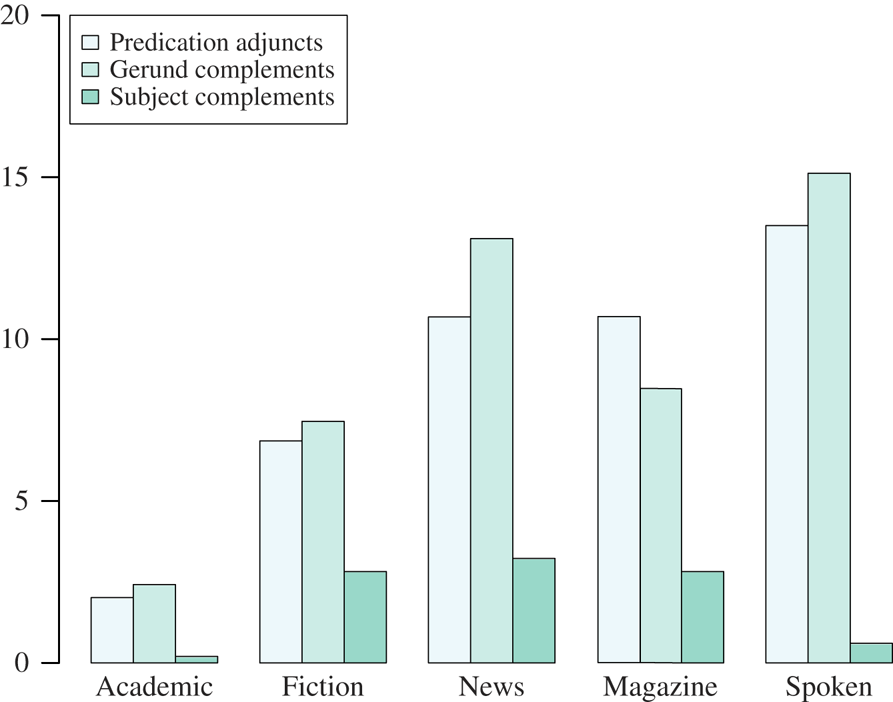
An initial probing of the different corpora demonstrates that end up is more frequent in American English, where it is pervasive across genres (see figure 2 below). Moreover, this variety yields innovative mirative constructions, including parenthetical and impersonal uses. Thus, American English has been selected to analyze the rise and development of mirative end up. The corpus material that has been investigated covers the emergence of the phrasal verb through the course of the Late Modern English (LModE) period and into Present-day American English.
Phrasal end up complementation in COCA per genre (relative frequencies)
The data used for the synchronic Present-day English (PDE) characterization in section 4 were drawn from the Corpus of Contemporary American English (COCA). At the time of data retrieval, the corpus contained 450 million words and included texts from 1990 to 2015 (it has been expanded since). COCA is genre-balanced, comprising academic journals, fiction, newspapers, popular magazines and spoken texts. The search string ‘[end] up’ yielded 31,581 tokens in COCA. Given the enormous amount of data for the PDE period, a randomized 500-token data set was selected to carry out its PDE description.
The primary corpus used for the LModE period (section 5) was the Corpus of Historical American English (COHA), a 400-million-word corpus covering the period 1810-2009 that comprises fiction, newspapers, non-fiction books and popular magazines. A total of 5,392 tokens were retrieved from COHA. The data set used for section 6 is somewhat heterogeneous, as it was build on diverse evidence drawn from the different corpora examined. Evidently, examining the data required extensive manual pruning to eliminate the many false positives that arise in the data (e.g. noun + preposition combinations). Where necessary, additional sources were consulted, including the News on the Web corpus (NOW) and the Oxford English Dictionary (OED).
4 A brief characterization of phrasal end up in Present-day English
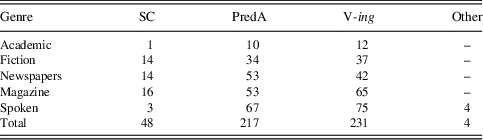
PDE end up takes part in two main constructions, the copulative construction and the raising construction. While copular end up takes subject complements (SC) and obligatory predication adjuncts (PredA), raising end up takes -ing complements. Table 1 summarizes the COCA data set as regards text type and complementation pattern (namely SCs, PredAs and -ing complements). However, other types of constructions appear, including the still emerging parenthetical uses of end up, which have been mostly recorded in the spoken component of the data. The present section offers an overview of these end up constructions. After briefly addressing them, I will focus on the mirative meaning of end up.
Overview of the COCA data set
4.1 Copulative constructions
Quirk et al. (Reference Quirk, Greenbaum, Leech and Svartvik1985: 1171–5) classify end up as a copular phrasal verb, together with other similar verbs like turn out and wind up, and describe it as a ‘verb of becoming’. Moreover, they class its complements as resulting attributes, since they result ‘from the event described by the verb’ (Quirk et al. Reference Quirk, Greenbaum, Leech and Svartvik1985: 741–2).Footnote 5 They thus include end up among those verbs that may be followed by a subject complement (SC; e.g. Jack is happy) or a predication adjunct (PredA; e.g. the meeting is tomorrow). Both SCs and PredAs are obligatory elements in clause structure, since they ‘cannot be dropped without changing the meaning of the verb’ (Quirk et al. Reference Quirk, Greenbaum, Leech and Svartvik1985: 1171; see also Huddleston & Pullum Reference Huddleston and Pullum2002: 219–28, 257–8).
SCs make up 9.3 percent of the COCA data set. A SC may either be an adjective phrase (7a) or a noun phrase (7b). SCs, however, allow for some variation, including marking by as (7c):
(7) (a) So you had sex with her on a Thursday, and then she ends up dead on a Friday. Can you understand why people think that that’s odd? (COCA:SPOK, 2017)
(b) Who would have ever guessed Mandela would end up the president of South Africa? (COCA:NEWS, 2013)
(c) Hillary Clinton is going to be the nominee, Biden isn’t going to run, Jeb Bush will probably end up as the nominee and these outsiders will go away. (COCA:SPOK, 2015)
Huddleston & Pullum (Reference Huddleston and Pullum2002: 288) regard examples like (7a–c) as instances of the [end up (as) SC] construction,Footnote 6 where as may occur when the SC is an NP, as in (7c), but not when it is an AdjP, as in (7a). Thus, while (7b) would allow a paraphrase like Mandela ended up as the president of South Africa, the equivalent paraphrase for (7a) would be ungrammatical: *she ended up as dead. Related verbs like wind up and finish up also appear in the [cop (as) SC] construction. Phrasal turn out, however, does not allow marked as-SCs (Huddleston & Pullum Reference Huddleston and Pullum2002: 288).
Obligatory PredAs (Quirk et al. Reference Quirk, Greenbaum, Leech and Svartvik1985: 505–10, 1175), as illustrated in (8)–(9), are complements surfacing as PPs or adverbial phrases. These amount to 43.4 percent of the data set:
(8) (a) If Langley suspected he possessed the bomb, his Russian ass could end up in a Guantnamo [sic] Bay sweatbox for the next decade. (COCA:FIC, 2015)
(b) England will be in serious straits if she ends up with neither a queen nor an heir. (COCA:FIC, 2015)
(9) How did we end up here? This place is horrible. It smells like expletive. (COCA:SPOK, 2015)
PredAs realized as PPs are the most frequent ones (36.4 percent of the total data set). The governing prepositions include with, in, on and by, among others. These are usually space adjuncts (see Quirk et al. Reference Quirk, Greenbaum, Leech and Svartvik1985: 1174). Manner adjuncts, however, are also common. Phrasal end up may also take adverbs proper (4.2 percent), as in (9). The exact grammatical status of obligatory PredAs is not always clear, as pointed out by Quirk et al. (Reference Quirk, Greenbaum, Leech and Svartvik1985: 732–3), who acknowledge the existence of a gradient between SCs proper (realized by NPs or AdjPs) and adverbs and PPs seemingly functioning as obligatory PredAs. While spatial adjuncts such as in a Guantnamo Bay sweatbox (8a) are less problematic, manner adjuncts can at times be semantically similar to adjectives or noun phrases (and hence to SCs), as is the case with with neither a queen nor an heir in (8b). The latter, in fact, could even be replaced by an adjective like heirless, or could be coordinated with an adjective (e.g. and bankrupt). This distinction, however, is not altogether relevant for the present characterization, and all instances of prepositional complementation have been considered obligatory PredAs in the analysis.
4.2 Raising constructions
As illustrated in (10), end up can also take a raised subject and a V-ing-clause. Such instances are the most frequent in the COCA data set (46.2 percent):
(10) In 1992, Cuomo ended up delivering the nominating speech for Bill Clinton at the Democratic convention in New York. (COCA:NEWS, 2015)
Huddleston & Pullum (Reference Huddleston and Pullum2002: 1228) classify end up among those catenative verbs that take gerundial complements only. Moreover, they argue that ‘most aspectual verbs have raised subjects, relating to the situation as a whole rather than specifically to the subject-argument’. In fact, the function of phrasal end up in this construction resembles that of an auxiliary verb, since it expresses secondary information (mirative overtones), while the primary propositional meaning is contained in the -ing-clause. Like other raising verbs that take -ing complements, raising end up constructions disallow impersonal transformations and do not generally take that-clauses (or finite complements), although the data include some impersonal end up constructions, as will be seen in section 6.
Figure 2 represents the relative frequencies for end up constructions by complement type and genre in the COCA sample (see also table 1 above).Footnote 7 As regards the copulative construction, a distinction has been made between SCs and obligatory PredAs. The overall frequency of the construction is higher in the spoken component of the sample. Copulative constructions with SCs are the least frequent in general, but this low frequency is especially pronounced in the spoken sample. In the present-day American English data, the raised subject construction is the most common end up construction in the spoken data sample. The data point to a higher incidence of phrasal end up constructions in the most informal genres in the corpus, namely the spoken and the popular magazine components. However, it is present in all registers, in spite of its low frequency in academic texts.
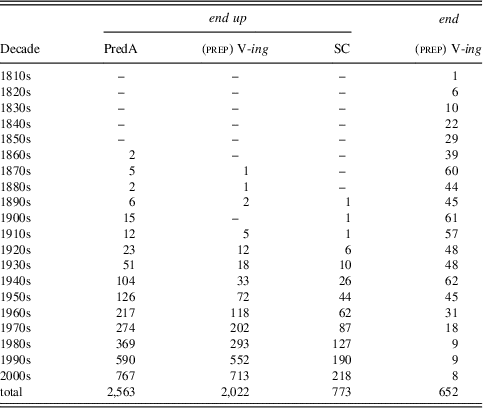
Overview of the COHA data set
4.3 Other constructions
Spoken corpus data reveal sporadic uses of diverging end up constructions, including parentheticals, impersonal constructions and raising constructions with infinitival complementation. Their incidence, however, is rather low, and the COCA random sample barely contained two such instances. The raising construction with the to -inf complement in (11) is one of them. Even though the randomized data set did not yield any parenthetical instances, the examples under (12) illustrate different instances of end up parenthetical constructions.
(11) I just happen to be very lucky that I was in films that ended up to be commercial successes. (COCA:SPOK, 1995)
(12) (a) Missed the show, ended up, because we couldn’t land at Dulles. (COCA:SPOK, 2000)
(b) They have come from 18 states to Hargrave – ‘The Grave’ to the initiates – for a crash course in, it ends up, humility. (COCA:NEWS, 2005)
Examples (12a, b) are instances of medial parentheticals. While the former features anticipatory it deletion, the latter retains the anticipatory pronoun. Divergent end up uses such as (11) and (12) have been increasingly growing over time since they are first documented in COCA, in the early 1990s. Even though these constructions are most commonly found in spoken discourse, they also appear in written genres, including Fiction and News. The incipient emergence of such instances will be dealt with in section 6.
4.4 Mirative end up
The core senses of phrasal end up convey meanings related to becoming, change of state or end of a process (e.g. she ended up dead, I ended up being happy), among others. Alongside these meanings, end up tends to express mirative nuances whereby the speaker’s (and/or the interlocutor’s) expectations are challenged by the final outcome of the event that is being described, thus expressing overtones of sudden revelation, surprise and/or counterexpectation. In fact, phrasal end up can be easily substituted with a mirative adverbial such as ‘unexpectedly’, ‘contrary to what one may expect’ or ‘surprisingly’ in most contexts. Although mirative meaning is essentially parasitic in copulative end up constructions (7), it seems to be non-parasitic when end up is used in the raised subject (10) and the parenthetical (12) constructions.
The examples under (13) illustrate the end up copulative constructions, with a SC (13a) and a PredA (13b), while the ones under (14) exemplify the raising construction (14a) and parenthetical end up (14b):
(13) (a) She was an excellent cellist. It’s just – she’s what everybody dreams your daughter is going to grow into, hard-working, had goals, [...]. So how does she end up dead on prom night, Michael Board? (COCA:SPOK, 2015)
(b) ‘You could end up in Minneapolis’, he said, in a tone suggesting that Minnesota was in another galaxy. (COCA:MAG, 2015)
(14) (a) They ended up waiting for several hours, so well-intentioned staff members offered to bring everyone some food. (COCA:MAG, 2009)
(b) Ends up, the local police chief set the fire so he could rescue his girlfriend, who lived in an upstairs apartment. (COCA:FIC, 2008)
The mirative dimension of end up can be probed through different tests, including the simple entailment test illustrated in (13ʹ)–(14ʹ). This test is aimed at canceling out the meaning of surprise and unexpectedness (see Peterson Reference Peterson2017: 324ff.). If the result is at least odd, we can consider that these constructions convey mirative meaning to a certain extent:
(13ʹ) (a) She ended up dead on prom night, # not that this is newsworthy, unexpected or surprising.
(b) You could end up in Minneapolis, # not that this is newsworthy, unexpected or surprising
(14ʹ) (a) ?They ended up waiting for several hours, # not that this is newsworthy, unexpected or surprising.
(b) ?Ends up the local police chief set the fire, # not that this is newsworthy, unexpected or surprising.
In (13ʹ), the test indicates that mirativity is a parasitic nuance, since canceling the surprise or unexpectedness effect is plausible given the appropriate context. An alternative phrasing of this test could include an adversative like although or but (e.g. you could end up in Minneapolis, although this is not surprising). Canceling the mirative meaning in the non-parasitic examples under (14) is more problematic because phrasal end up would have to be omitted altogether to achieve this, as in (14ʹʹ):
(14ʹʹ) (a) They waited for several hours.
(b) The local police chief set the fire so he could rescue his girlfriend.
Phrasal end up, however, cannot be omitted in the case of the copular construction in (13), which are instances of parasitic mirativity.
5 Mirative end up: a historical account
This section aims to disentangle the origin and development of mirative end up in American English. A mid-nineteenth-century innovation, this phrasal verb is first documented in COHA in 1866.
Table 2 provides an overview of the COHA data set. It accounts for the different complementation patterns of phrasal end up, namely PredA, SC and -ing complements, and for occurrences of the short-lived [end (prep) V-ing] construction. The latter was taken into consideration to provide a better account of the emergence of raising end up.
In what follows, I provide a description of the evolution of end up, with a focus on American English. First, I present an overview of the diachronic origins of end up taking into account the senses provided in the OED (section 5.1). Then I delve into the semantic development of the phrasal verb, zooming in on the processes of subjectification and semantic change that lead to the emergence of its mirative readings (section 5.2); finally, I focus on the rise of gerundial complementation (section 5.3). The different semantic and syntactic changes, however, are mutually dependent.
5.1 Origins of end up
Phrasal end up inherits its core semantic and syntactic characteristics from the verb end, which is attested from Old English (endian, OED, s.v. end) and which has developed both transitive and intransitive uses over time. Around the Middle English period, intransitive end acquires a resultative sense, especially in the context of following prepositional phrases: ‘to issue or result in’ (OED, s.v. end, II.5.b.). The adverbial – often of manner – accompanying end becomes obligatory, and the verb thus acquires a copulative use from very early on (15):
(15) þe frakele worldes froure [...] schal enden eaure in sar & in sorehethe fragile world’s comfort [...] shall-3.s end-inf ever in pain and in sorrow.‘the world’s fragile comfort [...] will always end in pain and sorrow’
(?1225, Ancrene Riwle, OED)
From its earliest attestations in COHA, end up already behaves like a copula (16), since the phrasal verb inherits its complementation patterns from end, although it also appears in intransitive and even transitive uses (the latter only amount to 0.2 percent of the data set).
(16) He called Eradicate all the mean names he could think of, ending up with: ‘You won’t hear the last of this for a long time, either.’ (COHA:FIC, 1866)
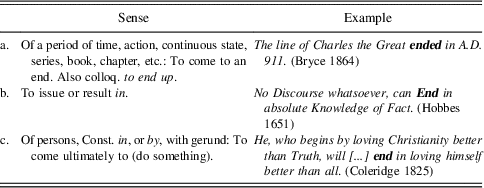
Table 3 includes the main senses of end involved in the emergence of end up. In spite of not having its own entry in the OED, end up is mentioned from 1885 in sense (a). The OED data bear witness to the reinforcement of the resultative sense of end by means of the particle up, an adverb meaning completion which was grammaticalized as a verbal particle over the course of history (see Denison Reference Denison1985). Particle up has a prototypical reading of vertical orientation; that is the case with phrasal verbs like take up or go up. However, it has very complex semantics, and as Tyler & Evans (Reference Tyler and Evans2003: 141) argue, up also has a somewhat less central sense of completion: ‘[this] Completion meaning, which is non-spatial in nature, derives from spatial experience and understanding, that is, the correlation between an activity being complete and the upward trajectory of an entity central to the activity.’ Thus, in the case of end up, the particle contributes to the general sense of completion expressed by this phrasal verb.Footnote 8
Intransitive end senses in the OED (s.v. end, II)
The emergence of end up is not an unusual process, as it is embedded in a general trend by virtue of which new phrasal verbs emerge as erstwhile prepositions are recruited as verbal particles over the course of history. In fact, the number of English phrasal verbs has increased considerably over the recent history of the language, a trend that seems to have been especially pronounced during the LModE period (see Brinton Reference Brinton1988; Claridge Reference Claridge2000).
5.2 Subjectification and semantic change
The emergence of mirative end up is brought about via a process of pragmatic enrichment, which triggers the subjectification of end up, ultimately resulting in the semantic change of the verb. The different OED senses included in table 3 can help us reconstruct the semantic development of end up from a resultative verb to a mirative predicate. Sense (a), ‘to come to an end’, and Sense (b), ‘to issue or result in’, are illustrated in (17) and (18) respectively:
(17) Moon, Mrs. Myers, Marvin, and William Leland all signed the articles of capitulation, and the affair ended up with a grand ball at the Clarendon. (COHA:FIC, 1872)
(18) You’re both always telling me about your domestic happiness, and every time I see you, you end up in a quarrel. (COHA:FIC, 1879)
The intransitive verb in (17) expresses terminative aspect, and is more or less synonymous with finish. In contrast, end up in (18) is used to convey result, thus expressing resultative aspect. Both senses are present for end and are documented before the emergence of the phrasal verb, and are thus inherited by phrasal end up. Whereas the former sense corresponds to an intransitive use of end up, the latter is closer to a copular use of the phrasal verb found in PDE.
The third definition provided in table 3, sense (c), ‘to come ultimately to (do something)’, hints at the mirative meaning of end, as the verb comes to express surprise as a result of a sudden or unexpected realization or discovery as regards the proposition. An example of this is provided in (19):
(19) All this cast a gloom on the beginning of the day; but it ended up brilliantly. (COHA:MAG, 1878)
This example illustrates a copular instance of end up. Here, the complement is an obligatory manner adjunct that expresses the speaker’s evaluation, as it qualifies the end result as brilliant. Moreover, the outcome expresses counterexpectation. In this case, this nuance is derived not only from end up, but also from the adversative conjunction but.
Senses (a) and (b) appear simultaneously in the end up data as a consequence of their previous existence as senses of the verb end. As regards the third sense, (c), it can be argued that, over a rather brief period of time, end up undergoes an important semantic change whereby erstwhile pragmatic inferences become conventionalized as semantic meaning. This change, which was enabled by copulative end, can be seen as a process of subjectification. This process triggers the emergence of mirative readings, which are acquired in a process whereby the speaker reinterprets an objective, externally observed change in terms of his/her own (internal) perceptual or cognitive evaluation (see Traugott’s Tendency I, Reference Traugott1989: 34). The speaker's perspective is thus expressed in the proposition as surprise and/or counterexpectation. By means of this process of subjectification – which is analogous to the one undergone by turn out in the late eighteenth century (Serrano-Losada Reference Serrano-Losada2017b) – end up comes to express surprise as a result of a sudden or unexpected realization or discovery as regards the proposition.
The schema under (20) summarizes the plausible semantic change experienced by end up. As mentioned in section 2, this is not an isolated case, as there is a cross-linguistic tendency for resultative senses to develop mirative readings of counterexpectation (see González Fernández & Maldonado 1998; Serrano-Losada Reference Serrano-Losada2017a, Reference Serrano-Losadab).
(20) Semantic change of end up
‘to come to an end’→‘to come to do something unexpectedly’
resultativity→mirativity
These subtle semantic changes, however, do not suffice to account for the rise and institutionalization of mirative end up. In fact, they were very much triggered by the accompanying morphosyntactic changes that the phrasal verb underwent in certain grammatical contexts.
5.3 Morphosyntactic change: the rise of -ing complementation
There are two main syntactic milestones in the development of phrasal end up: the consolidation of the copular verb and the rise of -ing complementation (and thus its entrenchment as a raising verb). The former is inherited from earlier copular uses of end and is reinforced by the above-mentioned process of pragmatic enrichment and subjectification; the latter is embedded in a more general process of morphosyntactic change affecting complementation patterns in the English language.
As seen in figure 2 above, the most common mirative end up construction in present-day American English is the raising construction, which takes a gerundial complement. [end up V-ing] is a relatively new construction that has only been used from about the 1930s. As regards its diachronic evolution, my assumption is that the gerundial complementation of phrasal end up has developed from an earlier [end prep V-ing] construction.
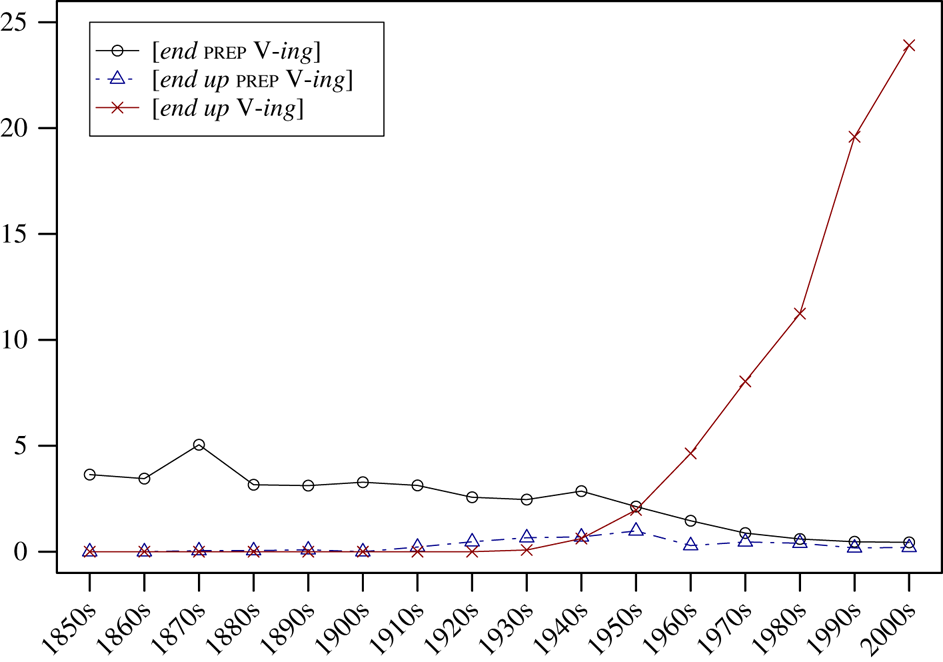
Figure 3 shows the normalized frequencies (pmw) for the different [end (up) (prep) V-ing] structures in the data. While those constructions featuring a prepositional head decrease, the [end up V-ing] construction rises in frequency.
Development of the [end (up) (prep) V-ing] construction in COHA (Nf pmw)
Prior research on the history of English clausal complementation (see Fanego Reference Fanego2010, Reference Fanego2016: 88-90; also De Smet Reference De Smet2008) has shown that throughout the Middle English and Modern English periods the English gerund was largely restricted to prepositional usage (e.g. busy in ordaining priests and clerics). It was only gradually, and very recently, that gerunds came to be licensed in functions other than that of prepositional complements, for instance as objects (e.g. he could not refrain telling them), subjects (e.g. inviting the twins was a big mistake) or predicatives (e.g. her first job was selling computers). This broader structural change is also reflected in the [end up prep V-ing] construction, as the availability of gerundial complementation eventually renders the preposition redundant.
This development contributed to the reanalysis of end up as a raising verb; a change which in turn boosted its status as a mirative predicate, as the verb began to express secondary information, i.e. surprise and counterexpectation, while the main proposition is contained in the non-finite clause (much in the line of other raising verbs like happen and turn out). The cline in (21) illustrates the structural pathway leading to raising end up constructions.
(21) [end prep V-ing] > [end up prep V-ing] > [end up V-ing]
(a) [end (prep) V-ing]
I ended by saying, that she ‘might depend on their being published. [...]’ (COHA:NF, 1824)
(b) [end up (prep) V-ing]
If something isn’t done, they’ll end up by knocking in our front doors or burning us all up. (COHA:FIC, 1880)
(c) [end up V-ing]
Last fortnight Negley Farson did at last crack [...] in a semi-autobiographical novel about a famous U.S. newspaperman who ends up drinking himself to death in a backwoods cabin in British Columbia. (COHA:MAG, 1939)
The development schematized in (21) is embedded in the larger shift mentioned above. Over the second half of the twentieth century, [end prep V-ing], the first instance of which is recorded in the 1820s, begins to decrease steadily, and by the 1950s this construction is residual. In turn, the first instances of [end up prep V-ing] begin to emerge during the 1870s, modeled after the previous constructions. Their fate, however, will be the same as their predecessors. The first instances of [end up V-ing] emerge in the 1930s. This construction becomes entrenched very rapidly, as its frequency increases over the second half of the twentieth century.
6 Analogy at work
The rise and development of mirative end up, however, cannot be understood in isolation, without taking into consideration other mirative constructions. In fact, its emergence seems to be closely related to mirative turn out, a rasing verb with which it shares multiple semantic and syntactic traits.
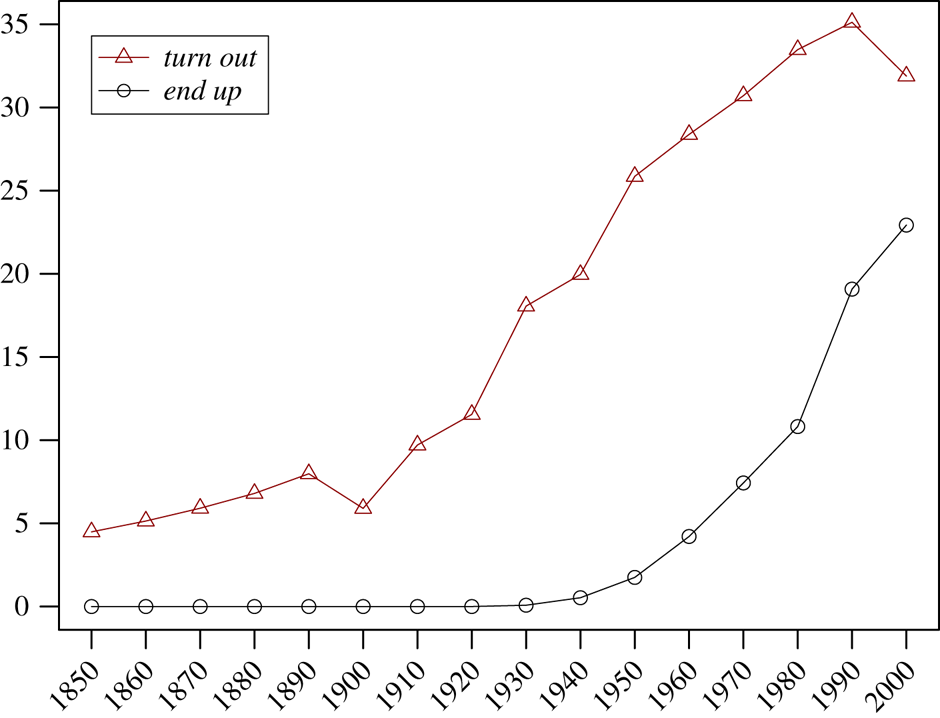
Analogy-driven change is difficult to demonstrate. Figure 4 plots the normalized frequencies for turn out constructions – both impersonal (e.g. it turns out that he left willingly) and raised subject (she turned out to be an amazing singer) constructions – and for raised subject end up constructions in COHA. Mirative turn out, an earlier and more frequent innovation, seems to have played an important role in the development of mirative end up, as analogical forces may have helped precipitate the rise of its mirative senses and shape its constructional makeup.
Impersonal and raised sbjturn out and raising end up in COHA (Nf pmw)
The data show that mirative end up is undergoing further changes in PDE, in line with other mirative and evidential verbs like turn out. One such change is the emergence of end up parenthetical instances like (12a, b). This recent PDE innovation cannot be adequately explained through any of the more traditional hypotheses for the emergence of parenthetical expressions. In fact, well-established (although not undisputed) theories like Thompson & Mulac’s (Reference Thompson and Mulac1991) ‘matrix clause hypothesis’ (Brinton Reference Brinton2008: 36) or Brinton’s (Reference Brinton1996, Reference Brinton2008) ‘relative pronoun hypothesis’ (Fischer Reference Fischer2007: 302) do not suffice to explain the emergence of such constructions. Thompson & Mulac (Reference Thompson and Mulac1991) posit matrix clauses with that-complements as the source construction for parenthetical expressions like I think. In their view, the rise in frequency of complementizer elision would bring about the emergence of parenthetical instances. Brinton (Reference Brinton1996, Reference Brinton2008) does not agree with them completely, and puts forward a complementary pathway. Given that zero-complements are not that common in the historical data, Brinton opts for emphasizing the role of adverbial/relative clauses (e.g. so/as I think) in the emergence of the parenthetical.
As regards the ‘matrix clause hypothesis’, end up constructions do not generally take part in impersonal constructions of the type [it V that-clause]. Thus, an intermediate stage where the complementizer that is dropped is not plausible. As regards the ‘relative pronoun hypothesis’, there are no adverbial/relative end up clauses of the type [so/as it V] in the historical record that could be used to postulate an intermediate stage before the emergence of PDE parentheticals. Therefore, alternative hypotheses need to be formulated to explain the process whereby mirative end up is recruited as a parenthetical.
Phrasal end up is part of a larger set of evidential and mirative raising verbs, most of which can be used in parenthetical constructions (e.g. as it happens, it seems, turns out). In fact, end up parenthetical uses seem to be the result of analogical modeling after more central members of this category, most prominently turn out parentheticals. The chronology of these parentheticals, their overall frequencies and their semantic proximity suggest that end up parentheticals emerged due to the analogical pressure exerted by turn out parentheticals. In what follows, two seemingly relevant mechanisms, cooptation and analogy, are examined. The interaction of these mechanisms will let us provide a convincing hypothesis for the emergence of mirative end up parentheticals. While the process of cooptation (section 6.1) can be used to explain the spontaneous emergence of these parentheticals, analogy (section 6.2) is claimed to be the mechanism driving this process. To support the analogy hypothesis, some of the different end up and turn out constructions are contrasted. The record shows instances of constructional contamination and blends, as end up sometimes acquires deviant complementation patterns which seem to have been influenced by turn out constructions.
6.1 Cooptation
Kaltenböck et al. (Reference Kaltenböck, Heine and Kuteva2011) argue for a two-domain system to account for the organization of discourse: sentence grammar (SG) and thetical grammar (TG), the latter referring to the grammar of parenthetical elements (‘theticals’, in their own terminology), i.e. those elements which are either added at the periphery of an utterance or which form utterances on their own (Kaltenböck et al. Reference Kaltenböck, Heine and Kuteva2011: 856). Cooptation has been defined as a ‘packaging strategy whereby a clause, a phrase, a word, or any other unit is taken from SG and is coopted (or re-defined) for use as a thetical’ (Kaltenböck et al. Reference Kaltenböck, Heine and Kuteva2011: 879). Thus, the inception of parenthetical end up could be explained as a result of cooptation, that is, a process whereby a sentence element is taken from SG and is redefined for use as a thetical in TG. Consider in this regard the examples under (22):
(22) (a) She ended up coming to the conference.
(b) Ended up, she came to the conference.
(c) Ends up, she came to the conference.
In (22b) the coopted element ended up is freed from the syntactic constraints of sentence grammar (22a), thus appearing as an elliptic segment that has secondary status and can be moved around in the sentence. Frequent repetition of cooptation may lead to grammatical change (Kaltenbock et al. 2011: 879). At first, the coopted unit arises as the result of a spontaneous process. However, over time repetition results in entrenchment, and the coopted element may become grammaticalized. Phrasal end up seems to be undergoing such change in American English. Over the course of a grammaticalization process, the coopted unit loses most of its lexical meaning in favor of discourse functions and/or procedural meaning, turning into a fixed formulaic unit. Parenthetical instances of end up seem to be undergoing further semantic generalization, moving further along the cline from resultative to mirative meaning, as posited in (20). Moreover, as this change develops this unit can become eroded, losing part of its morphological and phonetic substance. This would be the case illustrated in (22c), where the tense of the thetical element is independent of that of the main clause.
The development of this new thetical function, exemplified by instances like (22b, c), could thus be considered the product of cooptation, since the new construction seems to operate within the domain of TG. Heine (Reference Heine2013: 1223) has argued that cooptation seems to be a prerequisite for the emergence of grammaticalized theticals, even though cooptation and grammaticalization are distinct processes. According to the author, once a given expression is coopted as a thetical, it can then be recruited as a formulaic parenthetical (as opposed to spontaneous parenthetical instances). A grammaticalized coopted parenthetical would then be prosodically, semantically and syntactically independent from the utterance in which it is linearly integrated. Theoretically, this analysis could explain the emergence of parenthetical end up satisfactorily. However, there seems to be an underlying mechanism operating behind cooptation: analogy.
6.2 Analogy and blending
Analogy and blending are pivotal mechanisms in language change (see Fischer Reference Fischer2008; De Smet Reference De Smet2013; De Smet & Fischer Reference De Smet and Fischer2017), and as such they may have played an essential role in the emergence of mirative end up constructions. The most evident model for the emergence of parenthetical instances such as (12a, b) is mirative turn out, which presents various semantic and syntactic similarities with end up. Mirative uses of turn out first emerged in the 1740s, more than a century before the inception of end up. Within a strikingly short period of time, turn out developed copular and raising uses and started being used in impersonal and raised subject constructions. The first turn out parentheticals are attested in the 1820s (Serrano-Losada Reference Serrano-Losada2017a: 173), while mirative end up parentheticals are only attested in the late twentieth century. Thus, the chronological evidence points towards a potential influence of turn out over end up.
The similarities between these verbs are conspicuous. First and foremost, both express resultative meaning and can be used in copular constructions (e.g. he ended up dead; it turned out well) and in raised subject constructions, although the latter have different patterns. While end up takes V-ing complements (e.g. he ended up passing the exam), turn out takes to -inf complements (she turned out to be his sister). In contrast with turn out, phrasal end up does not allow, in principle, impersonal constructions or to -inf complements. However, the record provides ample evidence of constructional contamination. In what follows, I illustrate the effects of analogical pressure, as exerted by mirative turn out over mirative end up constructions.
The examples in (23) show an instance of each turn out and end up featuring infinitival complementation:
(23) Raised subject construction (to -inf complement)
(a) So, look, I did what was, as I said, allowed. I said it wasn’t the best choice. And it turned out to be a mistake, in retrospect. (COCA:SPOK, 2015)
(b) So, you have children. If one of your children ends up to be gay later on in life when they are old enough to realize that they are gay, what are you going to do? (COCA:SPOK, 2015)
While (23a) illustrates the raised subject turn out construction proper, (23b) exemplifies a non-canonical instance of end up with infinitival (instead of gerundial) complementation. (23b) can be regarded as a case of blending, taking into account the aforementioned similarities between both phrasal verbs. (24) provides further evidence to support the analogy and blending hypothesis:
(24) (a) mann: And who did it turn out to be?
drummond: Well, it ended up, oddly enough, to be a Saudi Prince in a British made Tornado egressing Baghdad (COCA:SPOK, 2002)
(b) But even in an early draft, he was in love with a sperm bank technician and ended up having an affair with her, and was a completely different guy to what he ended up to be. Each time, the names would change as well, as we changed the nature of the characters in each draft. (NOW:AU, 2012)
In (24a), the infelicitous end up to be is primed by the previous instance of turn out to be.Footnote 9 The Australian English example in (24b) features variation between gerundial and infinitival complementation within the same utterance, which shows that there might be even some vacillation as regards the non-finite complement. Furthermore, while end up might virtually take any gerund as complement, turn out takes to be as an infinitive in its raised construction in an overwhelming majority of the cases (Serrano-Losada Reference Serrano-Losada2017b: 418). Interestingly, all instances of end up with infinitival complements in the data occur with to be, pointing towards the blending hypothesis. The COHA data set does not provide instances of end up with infinitival complementation, which suggests a rather recent innovation.
A further case to support the role of analogy is found in the seemingly recent emergence of impersonal end up constructions, modeled after the pervasive impersonal turn out construction. Though scant (78 hits in COCA), these impersonal end up constructions are also present in the data, across registers:
(25) Impersonal construction
(a) It turns out that elephants have an advanced sense of self, which means in part that they’re smart enough to be capable of really caring about others. (COCA:SPOK, 2008)
(b) Pat heard this squeaking and squealing on deck, and there was the pilot. fiddling on the fiddle. It ended up that we sold him the fiddle for most of the pilotage charge, after telling him that, as far as we knew, it might be a rare and valuable violin. (COHA:MAG, 1954)
(c) It ends up that they weren’t satisfied with that. (COCA:SPOK, 2014)
Example (25a) illustrates the impersonal turn out construction, whereas (25b, c) are instances of impersonal end up constructions. Although the latter are already present from the 1950s onward in the COHA data set (25b), their frequency is rather low, and they seem to have emerged due to the analogical pressure exerted by the much more frequent impersonal turn out constructions (see figure 4).
Similarly, the emergence of parenthetical end up constructions could also be considered the result of analogical modeling. As mentioned above, mirative turn out parentheticals (26) are documented since the LModE period (26a). Such parentheticals provide a plausible stencil to explain the emergence of end up parentheticals (27):
(26) Mirative turn out parentheticals
(a) perhaps, it would, as it turned out, have been much better for me, personally, if I had gone there again (CLMET3.0:NF, 1820-2)
(b) She is of German birth, it turns out, despite her name, which isn’t her original one. (COHA:MAG, 1927)
(c) I thought I’d looked everywhere. Everywhere but up, turns out. (COCA:FIC, 2009)
(27) Mirative end up parentheticals
(a) But as it ends up, it didn’t affect students putting themselves through college. (COCA:SPOK, 1998)
(b) The co-author of the book, it ends up, is a vicious – is a – of the anti-Kerry book is a vicious bigot. (COCA:SPOK, 2004)
(c) Ended up she wouldn’t let us sell what we brought back directly. (COCA:FIC, 2014)
As shown in (26) and (27), end up parentheticals occur in the same patterns as their turn out models. Thus, they may appear as adverbial parentheticals (27a), modeled after their turn out counterparts (26a), they may feature an anticipatory pronoun (27b), like the analogous turn out example in (27b), or occur as bare parentheticals (27c), after instances like (26c). In the case of end up parentheticals, their (still) low frequency, together with the lack of diachronic evidence (given their recent inception), make analogy-driven cooptation a fairly plausible – though still tentative – explanation to account for their emergence.
7 Conclusions and further research
Although mirativity has attracted a great deal of attention recently, the mechanisms and pathways through which it arises and is encoded are still to be studied, even as regards those languages which do not express it morphologically. The present article has focused on a specific verb, phrasal end up, which expresses mirative meaning both parasitically – when occurring in copulative constructions (e.g. he ended up dead) – and non-parasitically – when attested in raising constructions (e.g. he ended up being a great swimmer) and in the still incipient parenthetical construction (e.g. ends up, she wasn’t there).
The record shows that subtle semantic changes in the verb have triggered syntactic innovations which, in turn, result in the encoding of mirative meaning. Such senses are the result of implicatures becoming conventionalized, most likely by means of repeated use (Traugott Reference Traugott2003: 635). Moreover, those semantic changes seem to be the result of a subjectification process that triggers the semantic innovations which result in the encoding of mirative senses.
The ever-elusive mechanism of analogy seems to be one of the driving forces behind these changes, taken the abrupt pace at which changes progress and become entrenched in the data. Although proving the role of analogy in the emergence of late-nineteenth-century end up is difficult to demonstrate (due mostly to insufficient data for the earlier decades after its inception), its influence seems to be clearer in the case of the emerging PDE parenthetical instances: this is due not only to data accessibility (billions of words available to the researcher), but also to the very specific analogical models that these parentheticals seem to follow. Ultimately, it is suggested that the emergence of end up parentheticals is the result of blending and analogy at work, given the availability of preexisting mirative turn out parentheticals. Moreover, analogy is posited as the driving force behind cooptation, a mechanism that could account for the rise of end up parentheticals. This study also suggests that mirative meaning, as well as evidential meaning, seems to be pushed towards the clause periphery in English. In fact, English seems to favor the creation of evidential and mirative parentheticals (see López-Couso & Méndez-Naya Reference López-Couso and Méndez-Naya2014a, Reference López-Couso and Méndez-Naya2014b).
This article, however, does not suffice to account for the development of mirative meaning nor for the role of analogy in its inception. The inner workings of analogy are still to be further explored in order to offer a more comprehensive account of this mechanism and its fundamental role in language change. Moreover, the influence of preexisting mirative and evidential constructions is still to be further examined. A deeper understanding of the development of similar verbs (e.g. prove, happen, chance) can shed light on the nature of raising and its relation to mirativity (and evidentiality), and on the emerging paradigm of raising evidential and mirative verbs.


 Open access

