





Introduction
Biomass is the third largest natural source of energy in the world and in Poland it is considered as an important renewable energy resource (Nowak and Jasiewicz, Reference Nowak and Jasiewicz2012). Simultaneously, expectations related to the energy use of straw and wood ‘waste’ from forests need a new rethink.
The area of cereal crops production does not increase, and the systematic use of straw for heating purposes results in lowering the content of humus and soil depletion.
Forests should provide technological wood for processing and construction, small assortments obtained during felling of technological wood should be crushed and left on felling areas.
For this reason, since the beginning of the 1990s, we have seen an increase in the area of cultivation of plants used for energy purposes (Nowak et al., Reference Nowak, Sowiński and Jama2011), among which, basket willow is one of the more important species in countries with moderate climate (Wojciechowski et al., Reference Wojciechowski, Zawieja and Sowiński2011; Nissim et al., Reference Nissim, Pitre, Teodorescu and Labrecque2013). Cultivation of this crop can help to protect the natural environment (Toome et al., Reference Toome, Heinsoo, Holm and Luik2010; Jama and Nowak, Reference Jama and Nowak2012; Holm and Heinsoo, Reference Holm and Heinsoo2013; Kubátová et al., Reference Kubátová, Száková, Břendová, Kroulíková-Vondráčková, Drešlová and Tlustoš2018).
Like some other perennial plants, willow prevents soil erosion and is sometimes used in the rehabilitation of degraded land (Zydroń and Skórski, Reference Zydroń and Skórski2018). By taking up heavy metal ions, it contributes to their removal from soil (Dos Santos Utmazian et al., Reference Dos Santos Utmazian, Schweiger, Sommer, Gorfer, Strauss and Wenzel2008; Kubátová et al., Reference Kubátová, Száková, Břendová, Kroulíková-Vondráčková, Drešlová and Tlustoš2018). The interest in willow (Salix viminalis L.) as a renewable source of energy results from its low soil and thermal requirements as well as high yields (Korniak, Reference Korniak2007). In addition, its wide prevalence is due to the ease of vegetative reproduction and a wide range of biological variability (Christersson et al., Reference Christersson, Sennerby-Forsse and Zsuffa1993; Mitchell, Reference Mitchell1995). It can be grown even in submontane conditions (Kozak and Sowiński, Reference Kozak and Sowiński2004). What can limit willow cultivation is mainly water and nutrients deficiency, including nitrogen, which is the strongest yielding factor (Nowak et al., Reference Nowak, Sowiński and Jama2011).
The optimal dose of nitrogen has a beneficial effect on yield and technological value of the willow. Nitrogen deficiency inhibits plant growth by reducing the chlorophyll content in the leaves, which, in turn, lowers the photosynthesis efficiency, and consequently, affects yields. On the other hand, too high N content deteriorates the quality of the raw material, through excessive branching and brittleness of the shoots (Nowak et al., Reference Nowak, Sowiński and Jama2011). Excessive N doses lead to N gas losses to the atmosphere, and nitrates leak to ground and surface water, which lead to financial losses, and create ecological threat (Cavanagh et al., Reference Cavanagh, Gasser and Labrecque2011; Staniszewski, Reference Staniszewski2012).
In the first years of willow vegetation, this problem may be solved by willow intercropping with white clover. White clover can be treated as a living litter that limits weed infestation (Adiele, Reference Adiele2012; Helios, Reference Helios2013), improves soil properties by enriching it with organic matter and reduces soil erosion (Arevalo et al., Reference Arevalo, Drew and Volk2005; Adiele, Reference Adiele2012; Rogowska and Rybczyński, Reference Rogowska and Rybczyński2012). Also, nitrogen fixed by nodule bacteria is released into the soil gradually, and therefore, its leaching from the soil is small, unlike in the case of ammonium and nitrate ions in mineral fertilizers (Stevenson et al., Reference Stevenson, Walley and van Kessel1998). Interactions between clover and willow in intercropping system cultivation are still poorly understood. Therefore, the aim of the present study was to determine the subsequent influence of white clover on willow plant density, number of shoots, height and yield of willow plants. The study was of practical nature and served to understand the possibility of limiting nitrogen fertilization at willow plantations by intercropping it with white clover.
Methods
The field experiment with willow planted in a pure stand and intercropped with white clover was set up in Poland (51° 10′35″N, 17° 07′13″E) in 2010 on light soil defined as a very light alluvial soil, on loose sand and sandy gravel. On the 6th of March 2013 willow plants were cut and first measurements started at the beginning of May.
A year prior to willow planting, weeds were controlled with a double spray of Roundup 360 SL at a dose of 5 l ha−1, next autumn ploughing was performed. An experiment was carried out in a split plot design with two variable factors with four replications. The first factor was the cultivation system (main plot) (a) without white clover and (b) with white clover (hand-sown at the rate of 10 kg ha−1 during plantation set-up). The second factor was three basket willow clones: 1047, 1052 and 1057 (subplot). Willow was planted in rows 65 cm apart with plant spacing every 40 cm (38.5 thousand of cuttings per ha). The area of the harvesting plot was 6.76 m2.
Every year the analysis of two soil samples (with and without clover) was carried out. Samples were taken at 0–30 cm depth at the beginning of vegetation period. The pH of the soil and the content of macronutrients are shown in Table 1. The data show that the soil was acidic, the content of phosphorus and potassium was from high to very high (Egner, Reference Egner1940; Riehm, Reference Riehm1940, Reference Riehm1943), and the amount of Mg was from very low to low (Schachtschabel, Reference Schachtschabel1954).
Macronutrients in the soil (mg kg−1) and the pH of the soil

From the moment of willow planting to the end of the experiment, no weed, disease and pest controls were performed. Every year, fertilizers were applied in doses of 17.4 kg P and 49.8 kg K per hectare. Nitrogen fertilization was not used. In the years of study, after starting and before the end of the growing season, all plants and shoots were counted on the plots, and the shoot diameters were measured. Every 4 weeks throughout the growing season, the height of the willow was measured on the sample of ten plants from each plot. Each year in June, weed infestation was determined on each plot in four randomly selected places of 0.25 m2. Water content of weeds and their dry matter was determined after 5 h drying process at 105 ± 2°C. The fresh willow matter was collected on 23/01/2015.
Analyses of the chemical composition of willow sprouts were made using the following methods:
• total nitrogen—modified Kjeldahl's method
• crude ash—by burning plant material in an electric furnace at 600°C
• magnesium, potassium, calcium and sodium—by flame photometry using a flame spectrophotometer (Spectra 220 FS, Candela: http://www.candela.com)
• phosphorus—colorimetric method using an appropriate equipment (Cecil CE 2011-P)
The water content in the willow shoots was determined by the drying method at 105 ± 2°C for 5 h. Statistical analyses were carried out with the ‘AWA’ programs (Bartkowiak Reference Bartkowiak1978) and Statistica 10.
Results and discussion
The weather conditions affect the growth of willow. Moderate temperatures and frequent rainfall are suitable conditions for growing willows. Willow has very high evapotranspiration requirements. In Sweden, for optimal growth at mid-summer 5–6 mm of available water per day are needed (Perttu, Reference Perttu1999). The climate in Poland with an average annual temperature of 9.2°C and mean annual precipitation of 523.8 mm is classified by Köppen as cold (D), without a dry season (f) and with warm summers (b) (Peel et al., Reference Peel, Finlayson and Mcmahon2007). Detailed climatic data on the Wrocław region in Poland are described in Gąsiorek et al. (Reference Gąsiorek, Grządziel, Musiał and Rojek2012). As observed on 22/04/2013 (the stage where new leaves started to appear), lower air temperatures, maintained from January to mid-April, in comparison with multiyear averages, delayed the onset of willow growing season. Also, in the first year of the study, the number of shoots was higher at the beginning of the growing season than in the corresponding period next year (Table 5). The reason for this might be harvesting willow prior to the experiment and higher water availability in soil (Styszko et al., Reference Styszko, Borzymowska and Ignatowicz2011) due to higher precipitations in February and March 2013 than in 2014. The sum of precipitations in 2013, compared to the long-term averages, was higher by 207.3 mm. Due to poor transpiration, the precipitation deficit observed in October and December did not have a negative impact on willow growth. Extremely little rainfall in February 2014 with a temperature above 0°C was not conducive to water storage in the soil before the vegetation began. The shortage of rainfall in June and July, however, had an adverse effect on the growth of willow (Table 2).
Weather conditions in 2013–2014

Data collected by Wrocław-Swojec weather station.
Classification of monthly precipitation averages for Wrocław (Gąsiorek et al., Reference Gąsiorek, Grządziel, Musiał and Rojek2012), RPI, relative precipitation index.
A–extremely dry (RPI: <19), B–very dry (RPI: 19−31.5), C–dry (RPI: 31.5−68), D–normal (RPI: 68−120), E–wet (RPI: 120−192), F–very wet (RPI: 192−235), G–extremely wet (RPI: >235).
The area covered with white clover and weed infestation
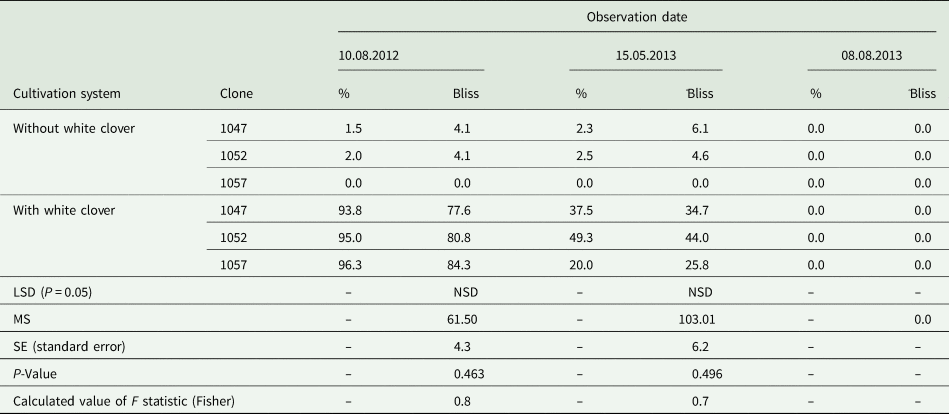
No significant losses of white clover were observed (Helios, Reference Helios2013) in the first years after the plantation was set up. Clover dying was observed because of little access to light in the first year (2013) of the experiment after the harvest of 3 year old willow plants (Table 3). It was caused by a large number of new willow shoots at the beginning of the growing season (Table 5).
White clover cover as (%) total area (average for the interaction of the cultivation system and willow clones)
NSD, no significant difference.
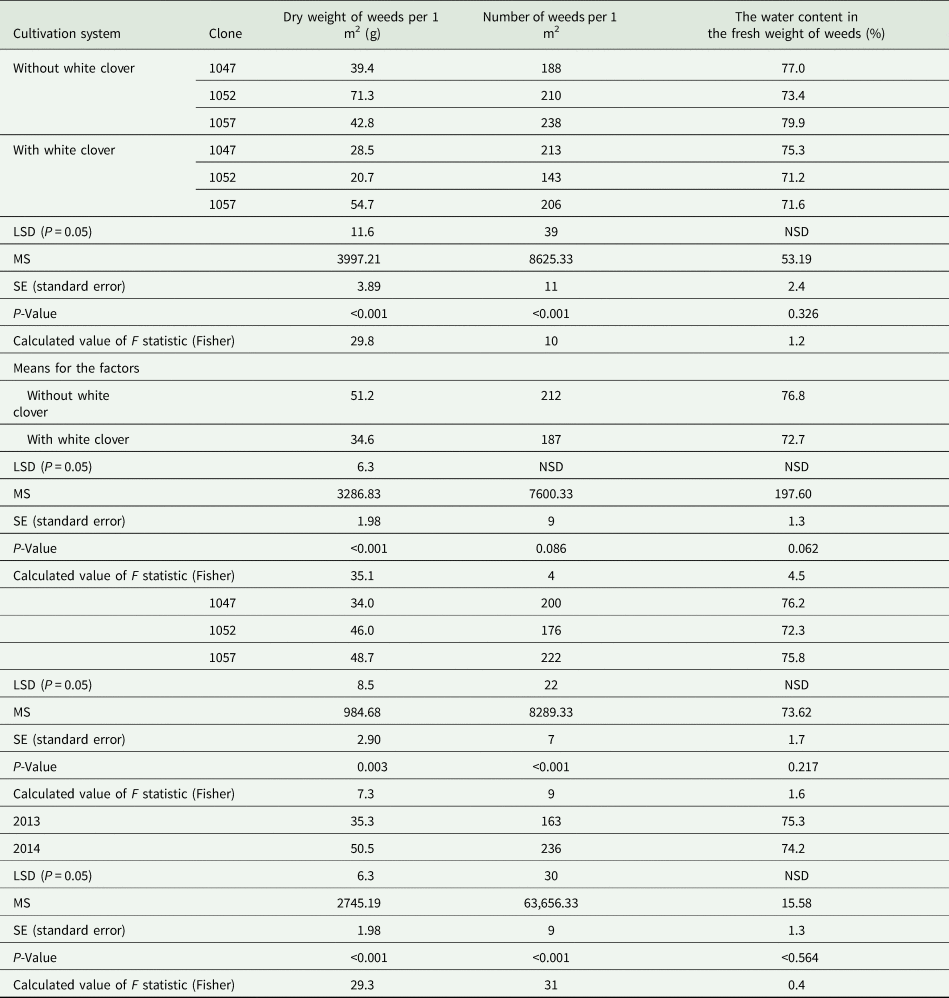
In the years 2013–2014, the number of weeds per 1 m2 was lower than in the first years after the experiment was set up. Similar results were obtained by other authors (Borkowska and Molas, Reference Borkowska and Molas2010). Despite comparable water content and the number of weeds in both cultivation systems, the dry weed matter per 1 m2 was higher in willow pure stand than in the intercropped stand, which indicates that less light reaches the soil surface in the latter cultivation system (Borkowska and Molas, Reference Borkowska and Molas2010). The lowest weed dry matter was observed in clone 1047. Similar trends were recorded in 2010–2012 (Helios, Reference Helios2013). Higher weed infestation occurred in the second year of the study, which was caused by the partial loss of leaves due to lower precipitation and the occurrence of giant willow aphid (Tuberolachnus salignus Gmel.) (Table 4).
Effect of the cultivation system and willow clones on weed infestation in the following clones of willow
NSD, no significant difference.
The yield of willow biomass from 1 ha depends on the length of shoots and their number per root (Nowak et al., Reference Nowak, Sowiński and Jama2011). In our study, the density of willow plants at the beginning of the growing season did not depend significantly on the cultivation system. At the end of the growing season, a significantly higher number of plants per 1 m2 was observed on control plots. Probably it was caused by both competitions from white clover in the first years of cultivation, and drought during the period of the study. There were no significant differences in the number of willow plants in particular years of the experiment. The number of plants per 1 m2 in clones 1047 and 1057 at the end of the growing season was significantly higher than in the clone 1052. According to other authors, the experiments with a density of 40 thousand plants per ha resulted in 3.7–3.8 plants per 1 m2 in 4th and 5th year after the experiment was established (Szczukowski et al., Reference Szczukowski, Tworkowski, Stolarski and Przyborowski2004). The density of willow shoots in the present experiment, at the beginning of the growing season, did not depend on the cultivation system or the genotype, but it varied in years. In the first months of the study, after cutting the plants in the previous year, willow developed 48.5 shoots per 1 m2 (Table 5).
Density of plants and shoots (average by factors and years)

NSD, no significant difference.
In the following months (2013), weaker willow shoots withered due to the lack of enough light. In the second year of the experiment, it was observed that willow plants did not die as much as in the first year, and the number of willow shoots increased during the growing season (Table 6). In our study plant losses were smaller on the experimental plots than in natural growth stand (Jakubowski, Reference Jakubowski2005) as there was no damage caused by humans or animals. The willow losses were also lower in our study compared to experiments with a density of 40 thousand plants per 1 hectare, in which willow was harvested annually (Szczukowski et al., Reference Szczukowski, Tworkowski, Stolarski and Przyborowski2004).
The loss of plants and shoots during the vegetation period (average for factors and years)

NSD, no significant difference.
In the reported experiments (Arevalo et al., Reference Arevalo, Drew and Volk2005), it was observed that during the first 2 months after ploughing of a 34-day old clover, willow grew better in a pure stand. After 3 months of the experiment, a higher biomass was obtained in clover intercropped plots, and at the end of the vegetation period, the control plots showed the highest yields. In the present experiment, we observed that the influence of 3-year intercropping (2010–2012) on the height of plants and an increase in plant height was maintained for the next 2 years (2013–2014) (Figs 1 and 2, Table 7), and the most significant increases in plant height were recorded between 30 and 120 days of vegetation in the first year after harvesting the crop (Fig. 2).
The successive effect of white clover on the height of the willow plants.

The successive effect of white clover on the growth dynamics of the willow plants.

Effect of cultivation system on the morphological characteristics of three willow clones at the end of the growing season in 2013–2014 (average for factors and years)

NSD, no significant difference.
The diameter and number of willow main shoots did not depend on the cultivation system. A similar number of shoots (9.6 per plant) was obtained by other authors (Szczukowski et al., Reference Szczukowski, Tworkowski, Stolarski and Przyborowski2004). The clone 1057 was characterized by the highest height and diameter of shoots, and at the same time, by the lowest number of shoots on the plant. In the second year (2014) of the experiment, there was a significant increase in the plant height and shoot diameter with a similar number of shoots per plant (Table 7).
The dry matter of main shoots, side shoots and of the whole plant did not depend on the cultivation system. The highest dry matter of side shoots and of the entire plant was observed in clone 1047 after 2 years of the experiment. Due to the large differences in the weight of branching of individual plant shoots, the effect of the cultivation method on shaping this morphological characteristic was not shown (Table 8).
Effect of cultivation system on dry matter of one shoot and one plant (g) of three willow clones after 2 years of cultivation

NSD, no significant difference.
The dry matter of side shoots of 1047 clone was higher when grown with white clover (Table 8).
Yield components and the number of first-order branches were not affected by the cultivation system. In clone 1047, side shoots made the largest part of the dry matter yield, but the number of main branches in the investigated genotypes was similar (Table 9).
Effect of cultivation system on yield components (%) and number of first order shoots in three willow clones after 2 years of cultivation (average by factors)

NSD, no significant difference.
Willow dry matter yield from 1 ha determines the energy value (Nowak et al., Reference Nowak, Sowiński and Jama2011). The yields of willow in the present study did not depend significantly on the cultivation system and per one year was lower than in other studies with a 2-year harvesting cycle (Szczukowski et al., Reference Szczukowski, Stolarski, Tworkowski, Przyborowski and Klasa2011a, Reference Szczukowski, Tworkowski, Klasa and Stolarski2011b). The 1047 clone yielded the best. The yield of side shoots was lower on the control plots than at stand where white clover was previously grown. The largest dry matter yield of side shoots was obtained in clone 1047. Genetic properties of clones and the cultivation method did not affect the water content in willow shoots (Table 10). No interaction was observed in the yield between the cultivation method and the tested genotypes. Water content ranged between 530–550 g kg−1 (Table 11), which are similar values to those reported in other studies (Stolarski et al., Reference Stolarski, Szczukowski and Tworkowski2008).
Effect of cultivation system on yield and water content of three willow clones after 2 years of cultivation (average for factors)

NSD, no significant difference.
Chemical composition (g kg−1)of 2-year-old willow shoots after vegetation period

The average crude ash content was 14.8, the contents of: nitrogen was 4.04, phosphorus was 0.85, potassium was 2.17 and calcium was 3.28 g kg−1. Similar values of ash and macronutrients in willow wood were recorded by Jama and Nowak (Reference Jama and Nowak2012). Almost twice higher content of phosphorus and potassium was observed by Nowak and Jasiewicz (Reference Nowak and Jasiewicz2012). Differences in chemical composition may depend on the variety and the harvesting cycle (Jakubiak, Reference Jakubiak2010). Detailed chemical composition of 2-year-old shoots is given in Table 11.
The accumulation of nutrients is a function of yield and chemical composition that allows determining optimal doses of fertilizers in the future. In the studies of Sevel et al. (Reference Sevel, Ingersley, Nord-Larsen, Jorgensen, Holm, Schelde and Raulund-Rasmussen2014), these values were as follows: nitrogen 35–61, phosphorus 9–12, potassium 30–40, calcium 26–35 and magnesium 4–5 kg ha−1 yr−1. In the present study similar results were recorded. The accumulation of nutrients in the biomass of plants did not depend on the cultivation system. The largest accumulation of macronutrients was noted in clone 1047 (Table 12).
Nutrients' accumulation (kg ha−1) in 2-year-old willow shoots after vegetation period

NSD, no significant difference.
Conclusion
On the basis of the obtained data, it is possible to conclude:
(1) There was no long-term follow-up effect of intercropping cultivation on the yield and nutrient accumulation of willow.
(2) There was a beneficial effect of white clover on the height of willow plants.
(3) The intercropping system of willow and clover reduced the number of willow plants at the end of the growing season when precipitation was low.
(4) Clone 1047 gave the highest biomass yields and it can be recommended for broad agricultural practice as a source of renewable energy.


 Open access

