




Introduction
Carved trees, known as dendroglyphs or arborglyphs, are an intriguing but largely understudied form of cultural heritage in Australia. They represent an important expression of Aboriginal visual cultural practice and tradition, but one that has been overshadowed by the spectacular rock art corpus present across the continent. Nonetheless, the broader category of culturally modified trees, which includes scarring from various types of resource extraction and other cultural activities, is a growing area of archaeological enquiry (e.g. Buhrich Reference Buhrich2017; Buhrich & Murison Reference Buhrich and Murison2020; Spry et al. Reference Spry2020). Some of these studies concentrate on the modification of trees during the historical period, following European invasion and settlement of Australian First Nations lands (e.g. Morrison & Shepard Reference Morrison and Shepard2013; Cole et al. Reference Cole2020).
In this article, we focus on north-west Australia, but dendroglyphs are well known from other parts of the continent. These carved trees were a source of fascination for some early European settlers. Edmund Milne (Reference Milnen.d.), for example, made an extensive collection of images and information about carved trees in New South Wales, where such trees were recorded as marking Aboriginal burial grounds and ceremonial or bora grounds (e.g. Etheridge Reference Etheridge2011 [1918]: 6–7; Black Reference Black1941: 13). Indeed, these trees were apparently prolific at some bora grounds, with as many as 120 specimens recorded by Etheridge (Reference Etheridge2011 [1918]: 65) at one site in central-west New South Wales. Black (Reference Black1941: 18) reported that burial trees in New South Wales usually marked the graves of important men, although there is one record of a carved tree marking a woman's grave (Pearse Reference Pearse1897: 100). Dendroglyphs marking graves were made on a variety of hardwood tree species and the designs were predominantly geometric—similar to those found on items of personal equipment, such as shields and the inside of skin coats (Black Reference Black1941: 28). In contrast, dendroglyphs marking ceremonial grounds often featured animals, tracks, anthropomorphs and other clan or totem images (Black Reference Black1941: 13). In the Wet Tropics rainforest of northern Queensland dendroglyphs were carved on a variety of tree species along Aboriginal pathways cleared through the rainforest, and close or adjacent to campsites, storyplaces and bora grounds (Buhrich Reference Buhrich2017). Like the boabs that form the subject of this article, they are also often associated with evidence of habitation (Buhrich Reference Buhrich2017).
The Australian boab
The Australian boab is one of eight species of baobabs (Adansonia sp.), with the others endemic to Africa (one species) and Madagascar (six species) (Baum Reference Baum1995; Wickens & Lowe Reference Wickens and Lowe2008). The common name for the Australian species—‘boab’—is probably a corruption of the African common name ‘baobab’. Members of the Adansonia genus are united by characteristics that include longevity, massive trunks and large, ovoid seed pods—known in Australia as boab nuts, which contain kidney-shaped seeds encased in a dry, powdery pith (Baum Reference Baum1995). In tropical northern Australia, A. gregorii is unusual in being deciduous. Its large, creamy-white flowers and leaves appear in the summer wet season and are lost in the dry winter months, although the nuts often remain on the tree late into the dry season (Done Reference Done2010: 20–21).
How the boab reached Australia has been the subject of debate, with theories including that it is a relic of the supercontinent of Gondwana (see review in Armstrong Reference Armstrong1983); that it arrived by natural trans-oceanic dispersal (Armstrong Reference Armstrong1983); or that it was transported by humans arriving from Africa by boat (Pettigrew Reference Pettigrew2011). Recent molecular research, however, indicates that A. gregorii shares a common ancestor in the Miocene with other extant species of Adansonia (Baum et al. Reference Baum, Small and Wendel1998; Leong Pock Tsy et al. Reference Leong Pock Tsy2009), effectively eliminating all theories aside from the oceanic drift of seed pods or even whole trees.
Globally, Adansonia are economically important. The leaves, fruit pulp, seeds and young tap roots are widely consumed in Africa and Madagascar (Wickens & Lowe Reference Wickens and Lowe2008: 67–80). Parts of the tree are also prepared and eaten for religious ceremonies and for rainmaking rituals, and the hollow trunks are used for storing goods and grain, as well as for burial. Baobabs feature prominently in many rites of passage, and some African groups believe that the trees possess souls or are inhabited by ancestral spirits. A comprehensive account of the economic and ritual uses, as well as myths and legends surrounding the origins, appearance and supernatural powers of the African and Madagascan baobabs, can be found in Wickens and Lowe (Reference Wickens and Lowe2008). Despite this diverse range of uses and cultural significance, however, we have found only a single reference to baobabs being carved as part of traditional practice in Africa: Meek (Reference Meek1925: 24) reports that the Kengawa, Bata and Bachama tribes of northern Nigeria revered the baobab and “cut symbols in the bark”, although provides no further details about the nature of this carving.
In north-west Australia, A. gregorii demonstrates a similar diversity of uses (Wickens & Lowe Reference Wickens and Lowe2008). The pulp, seeds and young tap roots are favoured foods of Indigenous peoples (Crawford Reference Crawford1982: 58; Done Reference Done2010: 20–21; Lowe Reference Lowe2019: 34–43). The pith surrounding the seeds can be eaten raw and the sap from the bark is also edible, and both can be used to make a refreshing drink (Bates Reference Batesn.d.: 74; Gardner Reference Gardner1923: 66; Crawford Reference Crawford1982: 58). The seeds themselves can be crushed and eaten raw or roasted (Fitzgerald Reference Fitzgerald1916: 74). Boabs are also used for medicinal purposes; a stomach-ache, for example, can be treated with an infusion made from the sap (Done Reference Done2010: 21). The bast from the roots is also an important resource that is used to make string (Crawford Reference Crawford1982: 58; Balme et al. Reference Balme2022). In addition, the hollow trunks of old trees sometimes hold rainwater, which can be collected when surface water is scarce (Fitzgerald Reference Fitzgerald1916: 74).
Recent molecular research into the diversity of A. gregorii has documented a lack of strong genetic structure across its distribution, indicating high levels of gene flow (Bell et al. Reference Bell2014). Human use of the fruit as a portable food source might partly explain this (Bell et al. Reference Bell2014). This is corroborated by the terms used to describe the boab in the different Indigenous languages across its distribution, some of which reference the edible qualities of the fruit, and which correlate closely with its observed genetic variation (Rangan et al. Reference Rangan2015).
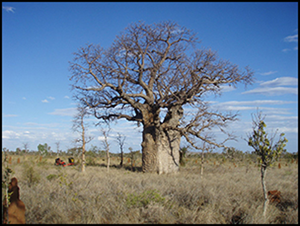
Like its African and Madagascan relatives, the Australian boab is extraordinarily long-lived; however, establishing the absolute age of a tree can be difficult because the inner part of the trunk is soft and fibrous and does not record annual or seasonal growth rings. AMS radiocarbon dating of the stable architecture of the inner cavities of large, living trees in Africa has produced good results (Patrut et al. Reference Patrut2011, Reference Patrut2018). Using this method, some of the oldest and largest of the African baobabs have been shown to have lived for more than 1500 years, with one individual more than 2000 years old (Patrut et al. Reference Patrut2007, Reference Patrut2018). This particular method has not yet been applied in Australia, however, and the only boab tree dated by radiocarbon methods so far returned a modern age (Bowman Reference Bowman1997). A hint of the great age of some of the Australian boabs can be gauged from those trees with historic European inscriptions. The oldest known example is the National Heritage-listed ‘Mermaid tree’ on the Kimberley coast (Figure 1), which bears the inscription ‘HMC Mermaid 1820’. This was carved during Phillip Parker King's second voyage around Australia, while his ship was careened for repair to its keel. At the time of carving, the girth of the Mermaid tree was measured at 29 feet (8.8m) (King Reference King1827: 424). Today, more than 200 years later, the inscription is still clear, despite the trunk's circumference increasing to approximately 12m (Wickens & Lowe Reference Wickens and Lowe2008: 42).
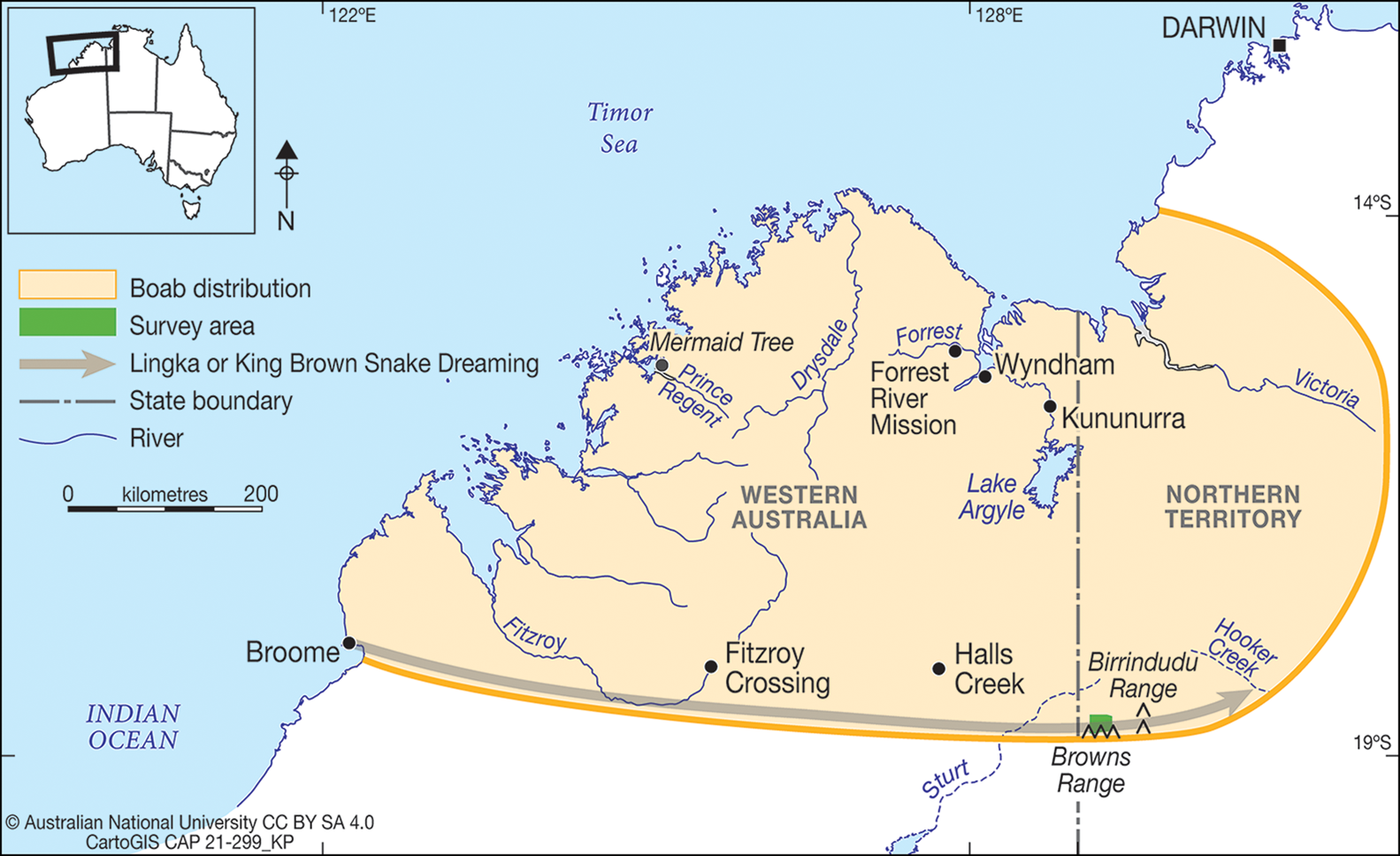
Map showing the distribution of boabs and the track of the Lingka Dreaming (produced by CartoGIS ANU).
Many of the oldest and largest baobabs in Africa have died over the last decade, possibly succumbing to the effects of climate change (Patrut et al. Reference Patrut2018). Although no comparable studies have yet been carried out on the health of older boab trees in north-west Australia, they are vulnerable to lightning strikes and bush fires, and insects that bore into the outer bark, destroying or obscuring carvings. There is clearly, therefore, some urgency to record those ancient trees with Indigenous carvings.
Indigenous carvings on Australian boab trees
George Grey, a mid nineteenth-century explorer, was the first to report that some boab trees had pictures carved into their bark, surmising that they must have been made by Indigenous Australians. Grey was disparaging about the artistic merit of these carvings, describing them as “rude drawings scratched upon the trees” indicating “a very ordinary degree of talent”. He did, however, note the various uses of boabs for food and fibre, and their association with favoured Aboriginal campsites (Grey Reference Grey1841: 113).
The earliest depictions of carvings on boab trees were made by the British artist and explorer, Thomas Baines, during the North Australian Expedition (1855–1856) led by Augustus Gregory. The expedition's purpose was to assess the region's potential for colonial settlement, and Baines was the official artist tasked with documenting the mission, producing more than 300 watercolour and pencil sketches within an 18-month period (Driver & Jones Reference Driver and Jones2009: 31). Several of these included the Australian boab, which later formed a key subject in the oil paintings he produced on his return to London. At that time, A. gregorii was referred to as a ‘gouty-stemmed tree’, following Phillip Parker King's earlier description:
the gouty habit of the stem, which was soft and spongy, gave it an appearance of disease: but as all the specimens, from the youngest plant to the full-grown tree, possessed the same deformed appearance, it was evidently the peculiarity of its habit (1820 Oct. 5). (King Reference King1827: 423–24)
The usage of this term persisted (e.g. Grey Reference Grey1841: 111; Jackson Reference Jackson1868), explaining the annotations and titles that Baines adopted in his artworks. Judging from his sketches and the journal he kept, Baines was obviously interested in Aboriginal people and the traces they left in the landscape, and this is particularly evident in Figures Painted on Rocks and Carved on a Gouty Stem Tree (c. 1850s) (Figure 2). Here, Baines depicts a rock overhang with paintings of anthropomorphs and zoomorphs. Immediately to the right is a boab, with the silhouette shapes of anthropomorphs and a kangaroo carved into the bark. What is particularly notable about this painting is the compositional link that Baines depicts between these two Aboriginal visual cultural practices. Although Baines had no informed knowledge of the function or meaning behind the paintings and carvings, by coupling the two mediums in his artwork and the title, he was, perhaps intuitively, implying a conceptual linkage.
Thomas Baines, Figures Painted on Rocks and Carved on a Gouty Stem Tree. Source: Collection of the Herbarium, Library, Art & Archives, Royal Botanic Gardens, Kew 1850s MO 108 (published under a CC BY-NC licence: https://creativecommons.org/licenses/by-nc/4.0).

Another explorer who showed an interest in carvings on boabs was Aeneas Gunn. Writing under the nom de plume ‘Explorer’, Gunn described a carved tree by the Victoria River in the Northern Territory and another by the Prince Regent River in Western Australia (Explorer 1896: 7). The latter depicted an anthropomorph, which he noted looked much older than the inscription on the Mermaid tree of 1820.
Herbert Basedow was one of the first anthropologists to spend time in the northern Kimberley region, in 1916. Although ostensibly employed for his geological expertise to investigate potential mineral deposits, Basedow also took the opportunity to pursue his “ethnological investigations” (Kaus Reference Kaus, Peterson and Kenny2017: 311). He photographed boab trees and remarked upon one with Aboriginal carvings:
Near the base of the massive butt of the tree we were under several designs had been carved into the bark by native hand. Among other less obvious figures we recognised an emu (vide Plate V.), three feet high, an emu track and a snake, five feet in length (Thurs 6th April). (Basedow Reference Basedow1918: 122)
Despite this early interest in boab tree carvings, no follow-up research was conducted into how or why boabs were carved, until Ian Crawford published The Art of the Wandjina in 1968. Crawford, an archaeologist at the Western Australian Museum, made an extensive record of painted and engraved rock art in rockshelters in the Kimberley region of Western Australia during the 1960s. Crawford also described how the Aboriginal people accompanying him would repaint or repair the paintings to make them fresh.
During these fieldtrips, Crawford photographed several carved boab trees with depictions of animals, spirit beings and non-figurative markings (Crawford Reference Crawford1968). He was told by his local guides that one carving at Karunjie Station, in the north-eastern Kimberley, depicted Karn-gi (the moon) and Daualimbi (the black-headed python), both of whom stopped at this campsite to rest while travelling through the country (Crawford Reference Crawford1968: 129, fig. 115). The mythic narrative of Karn-gi and Daualimbi outlines the rules governing suitable marriage partners in the east-central Kimberley and is also depicted in the painted rock art of this region (Crawford Reference Crawford1968: 106–107, fig. 93).
Crawford's observations are important, as they provide the only known eyewitness accounts regarding the methods of tree carving. He described how, on one occasion, his Indigenous guides used their bush knives to carve designs into the trees and then filled “the excavated areas with paint … The results were quite striking, and a rather drab camp was rapidly turned into an art gallery with snakes, crocodiles and turtles on all of the trees” (Crawford Reference Crawford1968: 128). Based on his observations, Crawford (Reference Crawford1968: 128) suggested that outline carvings were not painted but regularly re-cut, whereas motifs created by removing the bark over the full area of silhouette figures may have been infilled with paint.
As Crawford's (Reference Crawford1968: 130) Aboriginal guides never offered him any explanation for these carvings, he concluded it was possible that these images were nothing more than attempts to “make the place look pretty”. This surprising conclusion appears to be at odds with his observations that the carved trees depicted mythological beings and narratives that mirrored those in the painted rock art. It is possible, of course, that the Indigenous people accompanying Crawford either thought that his primary interests lay in the rock art, or that they were selective in the knowledge they shared. They did tell Crawford, however, that carved boabs marked favourite camping sites, providing
shade from the sun, and under each tree one can find a slab of stone, which was once used by Aborigines as an anvil on which to break up the nuts of the tree, and a scatter of chips of stone, the waste material from the manufacture of spear heads. (Crawford Reference Crawford1968: 126)
Another important point Crawford (Reference Crawford1968: 126) made concerns the common currency of the boab tree in cross-cultural communication; he noted that both Indigenous and non-Indigenous people used boab trees to locate specific places, or to describe other features in the landscape, for example, “Where you see three bottle trees, well, it is near there”. Consequently, despite the brevity of Crawford's observations about carved boab trees, we can glean the following points:
1) the carving of boabs trees was an ongoing cultural and artistic practice until at least the mid 1960s;
2) the carved images included animals, anthropomorphic figures and non-figurative marks;
3) in some parts of the Kimberley, the motifs carved into the boabs represent the same mythic figures as depicted in rock art;
4) in some parts of the Kimberley, carvings on boab trees were regularly re-cut to maintain their appearance—a practice that was also applied to certain rock art motifs that were retouched with paint;
5) some boab tree carvings were infilled with pigment;
6) boab trees are prominent and enduring features of the landscape, and used as a mnemonic for describing places or routes; and,
7) large boabs provided good shade and were favoured camp sites, with abundant evidence of food preparation and stone artefact production found around their bases.
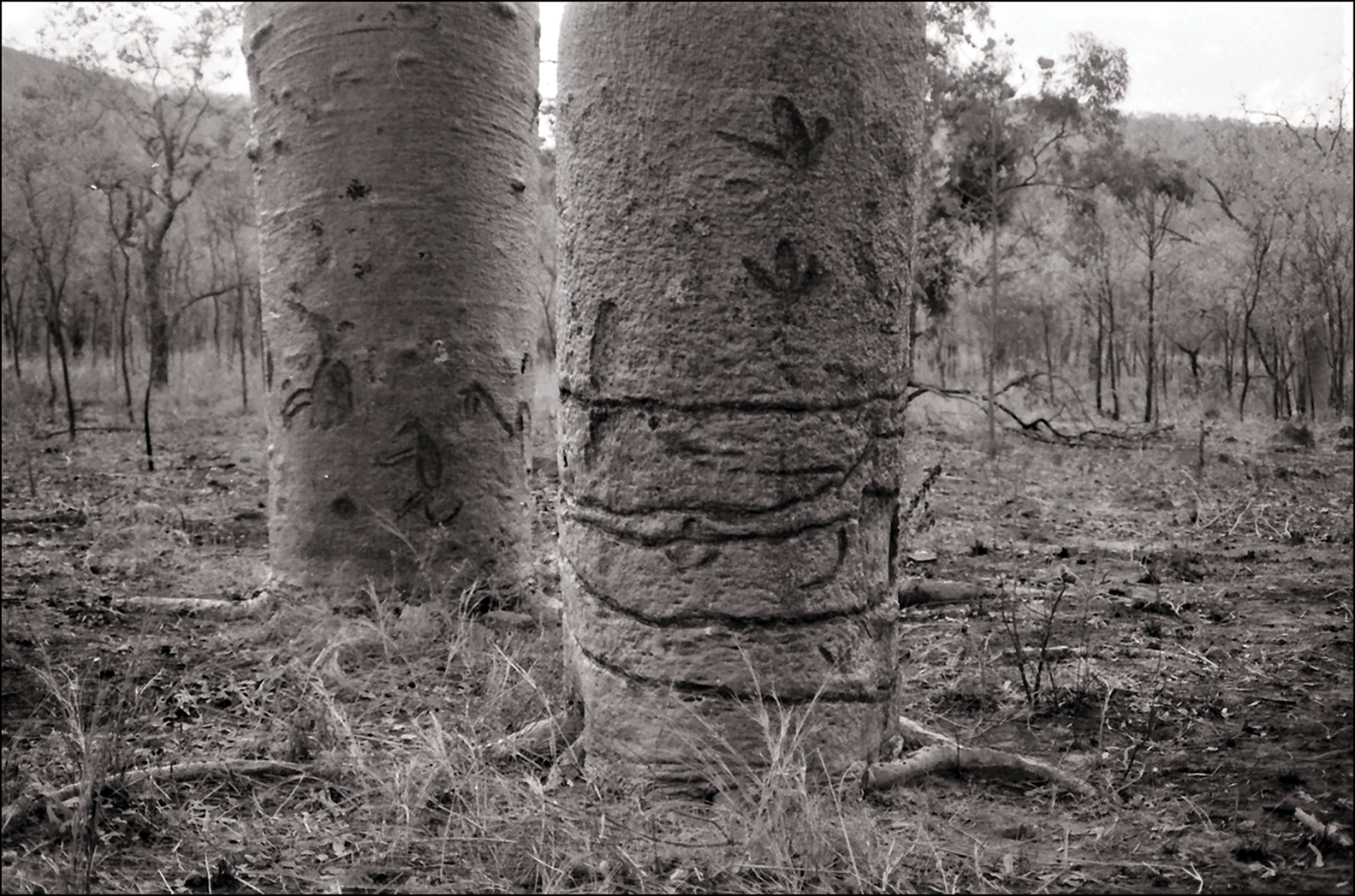
Since Crawford's work, there has been very little research undertaken on carved boab trees. One exception is the extensive survey and recordings conducted by the historian and archaeologist Darrell Lewis. Although Lewis (Reference Lewis1993) initially suggested that surviving boab trees with Aboriginal art were rare, he has since located many examples bearing traditional Aboriginal motifs (e.g. Figures 3–5), as well as images and names carved by Indigenous and non-Indigenous stockmen, cattle drovers and others (Lewis Reference Lewis2014). The majority of these incorporate text and imagery relating to pastoral life and were produced in the late eighteenth and early nineteenth centuries. A smaller number, including the Tanami Desert boabs discussed below, were almost certainly carved prior to European settlement in Australia, which began in 1788 (Lewis Reference Lewis2004: 528).
Two boabs with carvings of animals, birds, tracks and serpentine lines at Camballin Spring, Bradshaw Station (photograph by D. Lewis).
More recently, a group of Indigenous scholars from the Dambimangari Aboriginal Corporation and Wunambal Gaambera Aboriginal Corporation published several photographs of carved boabs in the western Kimberley (Mangolamara et al. Reference Mangolamara and Doohan2018). These carvings are interpreted through the perspective of a broader ontology, in which the images form parts of interconnected narratives describing the actions of the Wanjinas and other creative beings that shaped the landscape. In explaining some of the anthropomorphic images carved into coastal boab trees, Yorna Woolagoodja (in Mangolamara et al. Reference Mangolamara and Doohan2018: 20) says that “Wandjina put themselves in the country and on the boab trees too. They still tell the story. Here are the Wandjina for the saltwater country.” Here, Yorna is saying that the carving on the boab is not merely a representation of the Wandjina being but, rather, a manifestation with agency.
Indigenous carved boab trees in the Tanami Desert
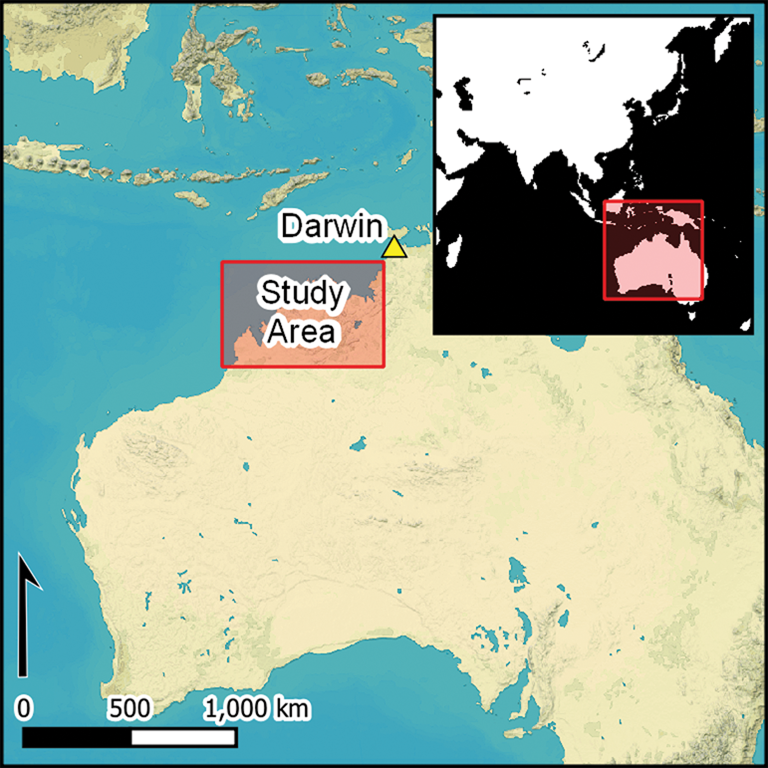
Fieldwork for the current project commenced in June 2021 with an expedition to the Tanami Desert, Northern Territory. Despite the fact that the Tanami Desert is generally considered to be too dry for boabs (Wickens & Lowe Reference Wickens and Lowe2008), one tree from this area is registered in the records of the Australian National Herbarium, and Lewis (Reference Lewis2008) located hundreds of boabs while searching the northern Tanami Desert for a tree marked by the European explorer, Ludwig Leichhardt, who disappeared in 1848. At least 22 of the trees documented by Lewis displayed evidence of Indigenous carvings (e.g. Figures 4–6). In several instances, however, Lewis (Reference Lewis2008) recorded clusters of trees in which some were carved, but he did not photograph all of the carved trees nor all the motifs on each tree. Oral history and anthropological research as part of a land claim in the late 1980s indicates that these carvings relate to the King Brown Snake or Lingka (snake) Dreaming, which travels through traditional country in the Yingualyalya Aboriginal Lands Trust and Browns Range area (Office of the Aboriginal Land Commissioner, Australia 1991) (see Figure 1).
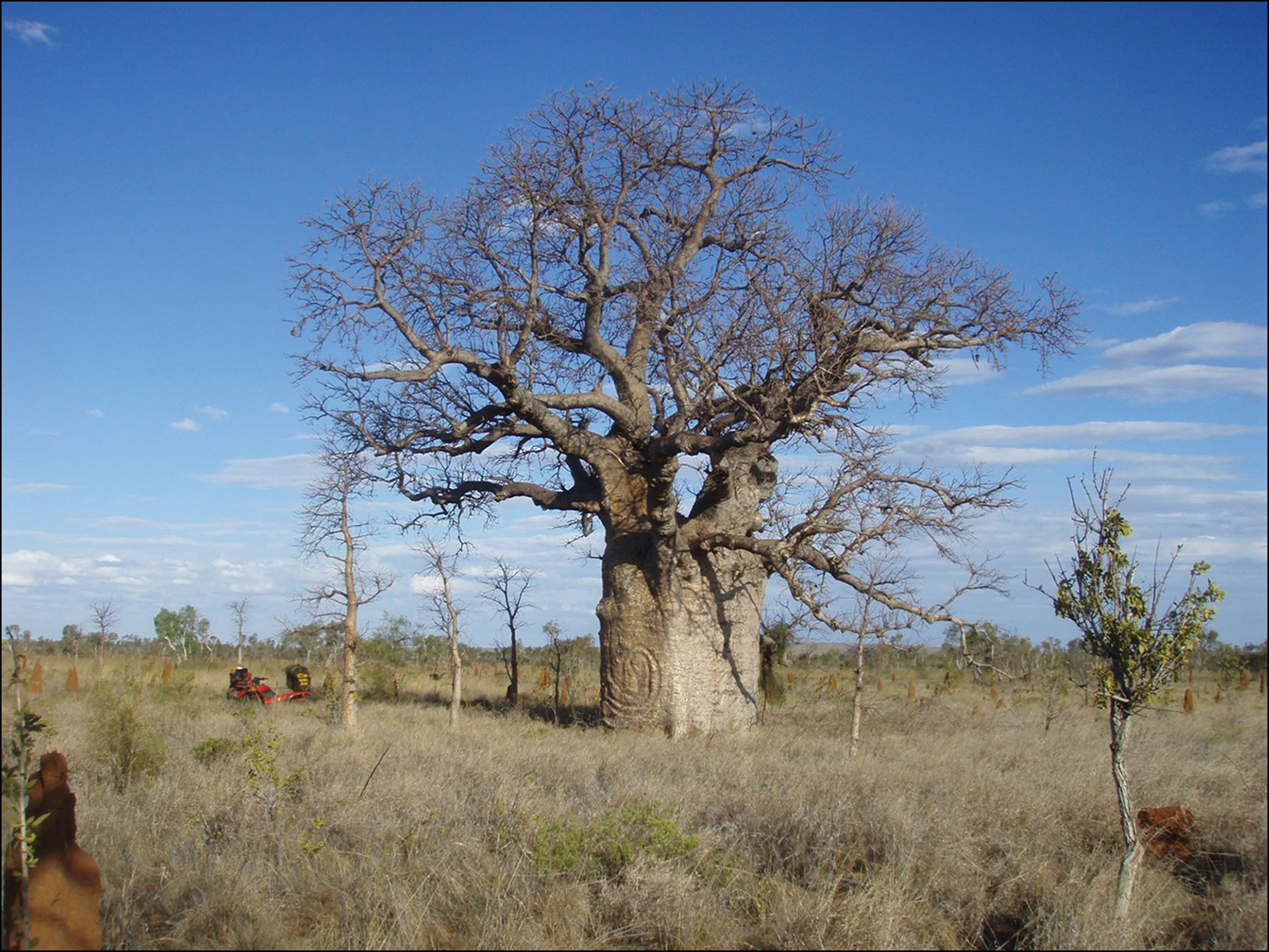
Large boab tree with coiled snake carving, northern Tanami Desert (photography by Darrell Lewis).
a) Open-mouthed snake and emu track (right), northern Tanami Desert. The carving is approximately 1.2m across; b) boab tree with coiled and extended snake carvings, northern Tanami Desert (photographs by D. Lewis).

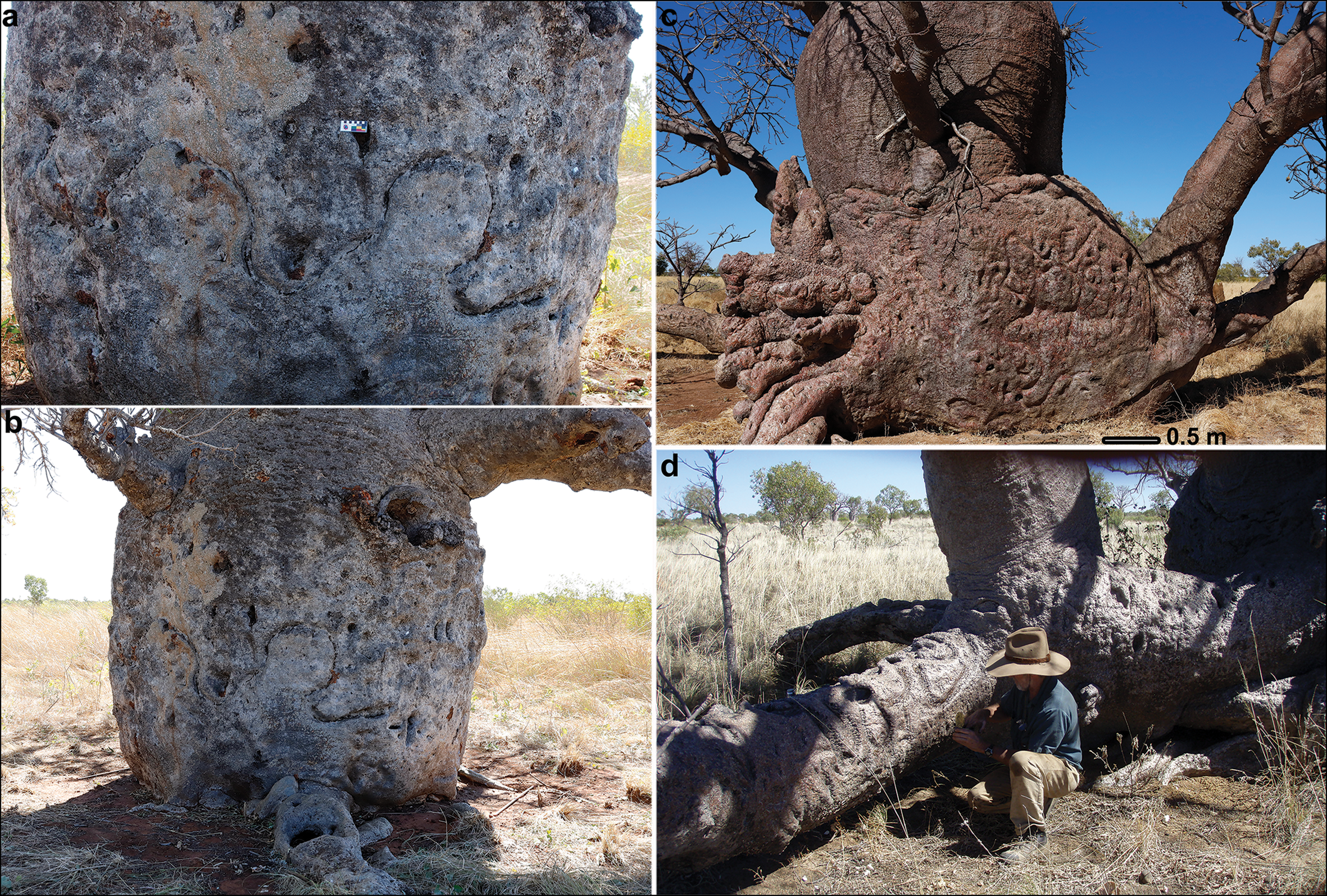
a) Enlargement of a snake carving, showing areas of damage to bark caused by insect larvae; b) location of carving on boab shown in a); c) partially collapsed boab, with elaborate snake carvings on the trunk and low branches; and d) Darrell Lewis sitting next to a low branch with deeply carved snakes (photographs a–c by S. O'Connor; d) by D. Lewis).
Building on these foundations, archaeologists, together with the Djaru Traditional Owners of the Linga Estate group (authors B.G., A.R., J.B., D.L., R.B. and A.B., who are part of the Lingka (snake) clan), therefore collaborated on an expedition to relocate the carved trees recorded by Lewis. In advance of the project, one of the authors (B.G.) independently contacted Lewis to request information on their locations. This information was used to plan a survey covering approximately 160km2 using off-road vehicles, coupled with pedestrian survey (Figure 1), with the aim of producing a high-resolution photographic record of these trees, their carvings and their landscape contexts.
Twelve boab trees with Aboriginal carvings were recorded during the survey. The dominant motifs on the boabs are snakes (e.g. Figure 4), followed by emu tracks (e.g. Figures 3 & 5a) and kangaroo tracks. Other motifs include a goanna-like figure, a zoomorph, and various geometric markings, such as linear scores, arcs and oblongs. The snakes take various forms, with some depicted as coiled and others extended, as if moving (Figures 4–7). The largest tree has a circumference of 12.25m and only a single emu track carving, while the smallest, which has carved snakes on both sides of its trunk, measures only 5.5m in circumference (Figure 7). There is no observable pattern in the aspect of the carvings, which variously face north, south, east and west. Most motifs are prominently positioned between 0.5m and 2m above ground level, which falls within the average height and reach of an adult; some trees display more extensive designs. One living but partially collapsed tree has a horizontal branch, which, in places, touches the ground. This branch and the massive trunk are covered in deeply incised snake carvings that extend down almost to ground level (Figure 6c–d). Another displays a vertical snake motif extending to a height of approximately 3m.
Traditional owner Brenda Garstone at the smallest of the carved boabs recorded in the northern Tanami Desert (photograph by S. O'Connor).

Around the base of many of the carved boabs are fragments of grinding stones and flaked lithic artefacts of a variety of lithologies (Figure 8). The presence of surface archaeology in association with the trees correlates with observations made by other archaeological investigations to the north of the Tanami Desert (Head & Fullagar Reference Head and Fullagar1997). It also accords with oral history and historical observations, which indicate that boab trees were favoured places for Aboriginal people to ‘sit down’ and camp. In areas of open country where rock outcrops and shelters are sparse, such trees provide prominent landmarks, a source of shade and a surface on which motifs of cultural value could be carved and maintained.
Fragments of a broken grinding stone found near the base of a boab with a coiled snake carving (photograph by S. O'Connor).

Discussion
Carved boab trees in the northern Tanami Desert—most notably in the Yingualyalya area of the Browns Range—have a restricted range of motifs, with snakes by far the most frequently represented. This emphasis on snakes corresponds with an important Indigenous Dreaming track known as the King Brown Snake or Lingka Dreaming. The traditional owners of Yingualyalya (including authors B.G., R.B., J.B., A.R. and A.B. of the Lingka (snake) clan), who represent a segment of the Lingka Dreaming, explain the link between the boabs and the carvings: the trees are manifestations of the travels of the ancestral Lingka being, which gave the landscape its present form. The Dreaming has its origin in the west, near Broome in Western Australia, and travels east across the Kimberley and into the Browns Range and Hooker Creek region in the Northern Territory. The boabs and their carvings are thus central to the Lingka clan's identity—a tangible symbol of their Dreaming and connection to country.
Another symbol of this connection is illustrated by co-author Anne Rivers. Anne and her three siblings were removed to the Forest River Mission in Western Australia in the mid twentieth century and, thus, Anne did not grow up in her traditional country. The coolamon—a traditional Aboriginal carrying vessel—that Anne holds in Figure 9 was made by her mother's extended family and was presented to her as an adult to symbolise the reestablishment of her bonds to her mother's ancestral estate, the Lingka Dreaming, which is situated on her traditional lands. Painted with boab trees, the coolamon embodies the creation narrative for this country.
a) Traditional owner Anne Rivers holding a coolamon painted with baob trees; and b) enlargement of painted coolamon (photograph by J. Balme).

In addition to snakes, the boabs in the northern Tanami Desert include a variety of non-figurative motifs, including animal tracks and geometric marks. The differentiation of figurative and non-figurative motifs is, however, of questionable relevance, as tracks are widely recognised by Indigenous people as manifestations of various animals and provide tangible links to the creation event featuring those animals or spirit beings. As Yorna Woolagoodja's words in relation to Worrora Country to the west (Mangolamara et al. Reference Mangolamara and Doohan2018: 20) make apparent—“Wandjina put themselves in the country and on the boab trees too. They still tell the story”—the carvings on boab trees, like the paintings in rock shelters, tell the story of the creation of the landscape. With reference to the painted art, Yorna explains that the images were not made by humans but are refreshed by them through repainting in order to keep them alive. Continuing interaction with the images serves as a reminder of their centrality and presence in people's spiritual lives, as does singing to the images and other performative actions (O'Connor et al. Reference O'Connor and Zubieta2022). The traditional owners accompanying Crawford were observed to pick up a lump of rock and re-scour the lines of boab carvings, suggesting a similarity in the roles of these two forms of Indigenous cultural practice (Blundell & Woolagoodja Reference Blundell and Woolagoodja2005; O'Connor et al. Reference O'Connor, Barham and Woolagoodja2008).
The prominent positioning of most motifs between 0.5m and 2m above the ground indicates that the carvings were designed to be viewed. This, combined with the ubiquitous presence of broken fragments of basal grinding stones, anvil stones and lithics around the bases of the trees, supports Crawford's (Reference Crawford1968: 126) record that these sites were favoured campsites. Many areas of the Kimberley have rocky outcrops with caves and shelters that could be occupied during the wet season (e.g. Explorer 1896: 7), when heavy monsoonal rains necessitate cover. But across large areas of the northern Tanami Desert, no surface rock formations occur. Here, the wet-season foliage of the boabs probably provided shelter from the rain, while the large trunks would have offered shade during the dry season. If our hypothesis is correct, boabs should be associated with dense, sub-surface habitation debris—a hypothesis that could be tested through future excavation.
Australian desert peoples are renowned for the distances they travelled between seasonally restricted water sources, both as part of their subsistence cycle and for ceremonial purposes (Gould Reference Gould1969). The carvings on the Tanami Desert boabs tell of the travels of the mythical creation figures who preceded them, creating and shaping the country into what it is today. Recent molecular and linguistic research (Bell et al. Reference Bell2014; Rangan et al. Reference Rangan2015) indicates that Australian Aboriginal peoples probably shaped the current distribution of A. gregorii by carrying the seed pods as a portable food from place to place. The Tanami Desert boabs are no doubt a result of these practices over the course of thousands of years.
Conclusions
Carved boab trees in Australia are part of a continuing cultural tradition, whereby Aboriginal people mark the landscape and make it meaningful. The carvings manifest important stories and clan symbols. While there has been minimal documentation or research undertaken on this type of site, in recent years, the voices of Aboriginal traditional owners have begun to cast new light on this cultural practice. They indicate that these dendroglyphs record the creation of the landscape, in the same way that the painted art in rockshelters recreates the creative journeys of mythical beings. The shelter and shade provided by the trees made them favoured locations for campsites, and the worn and broken grindstones and flaked lithics discarded around them attest to their repeated use by family groups engaged in domestic activities, such as grinding seeds and repairing tools. Just as the rock art was retouched to keep the creation stories alive and the country fresh, carvings on the boab trees were regularly re-grooved, probably for a similar purpose—to maintain knowledge of the Dreamtime creative process and to ensure that peoples’ obligations to observe the law were kept fresh in the memory of those using such campsites. The collaboration undertaken as part of this project demonstrates how bringing traditional Indigenous knowledge to bear on archaeological questions can build a richer, more holistic understanding of the cultural landscape and adds to our understanding of dendroglyphs in Australia.
Acknowledgements
Fieldwork was undertaken under Central Land Council permit SP67389. The authors would like to acknowledge the assistance of anthropologist Nicolas Peterson (Australian National University, Canberra) for points of clarification on the Lingka Dreaming narrative. Kim Akerman and Sam Harper helped source images. Central Land Council anthropologist Dale Quinlin provided advice when we were preparing for the fieldwork. Gary Faulks, Manager of Gordon Downs Pastoral Lease, is thanked for permission to access the station tracks. Finally, Chris Garstone provided logistical support, without which the fieldwork would not have been possible.
Funding statement
Fieldwork for this project was funded by an Australian Research Council (ARC) grant SR200200473 and Rock Art Australia Pty Ltd.


 Open access

