


Introduction
A central theme in the populism literature has been the lack of trust in the political elite. Yet, even if people do not trust the political elite, they might have faith in the social welfare institutions and the ability of these institutions to solve the country’s social problems if only the ‘right’ people were in government. Even though there have been ample studies on welfare attitudes and voting for populist parties (see below), the issue of WSP remains rather unexplored. Since populism plays on voter dissatisfaction with the political elite, we might expect dissatisfaction with the welfare state to play a role as well.
A recent study shows a strong link between subjective perceptions of WSP and satisfaction with democracy (Sirovátka et al., Reference Sirovátka, Guzi and Saxonberg2019). It turns out that those who perceive that the welfare state is performing well are also more likely to be satisfied with the way the democratic system is functioning in their country. Meanwhile, other studies have shown a connection between dissatisfaction with democracy and support for populist parties (Lubbers et al., Reference Lubbers, Gijsberts and Scheepers2002; Belanger and Aarts, Reference Belanger and Aarts2006; McLaren, Reference McLaren2012a, Reference McLaren2012b; Rooduijn, Reference Rooduijn2018). Logically, because of transitivity, we would also expect those who have negative views toward WSP to be more likely to vote for populist parties. Yet, so far, we have not found any studies that have actually tested this link. Moreover, even though rightwing populism has dominated the studies of populism, there is a growing recognition that welfare attitudes among voters of leftwing populist (LWP) parties might differ from voters of rightwing populist (RWP) parties (e.g., Visser, et al., Reference Visser, Lubbers, Kraaykamp and Jaspers2014; Rooduijn and Akkerman, Reference Rooduijn and Akkerman2017; Rooduijn and Burgoon, Reference Rooduijn and Burgoon2018; van Hauwaert and van Kessel, Reference van Hauwaert and van Kessel2018; Burgoon, et al., Reference Burgoon, Noort, Rooduijn and Underhill2019; Busemeyer et al., Reference Busemeyer, Abrassart and Nezi2021). If this is true, we might expect WSP to influence LWP voters differently than RWP voters. This differentiation is important given the increasing prominence of LWP in Europe. For example, in the previous decade, LWP parties came to power in Greece and Slovakia, they also joined a government coalition in Spain and have participated in local coalition governments in Germany. Consequently, this article not only examines the link between WSP and voting for populist parties, it also examines whether WSP influences voting for LWP and RWP parties differently.
The research question thus becomes: what kind of influence do subjective perceptions of WSP have on voting for LWP and RWP parties and do they influence LWP and RWP voting differently?
This article proceeds with a theory section, which is broken into three parts: one presents the most common current theories that explain the differences between welfare attitudes among LWP and RWP voters; the second discusses the discourse on WSP; the third presents our hypotheses. A method section follows, after which we present our results and analysis, to be followed by our conclusion.
Theoretical discussion
Below we discuss the difference between LWP and RWP regarding welfare issues before discussing the discourse on WSP and then presenting our hypotheses.
Welfare differences between LWP and RWP
The literature on welfare attitudes and support for populism initially linked support for RWP with welfare chauvinism. That is, supporters of RWP believe that ‘natives’ should get more welfare, while outgroups (such as immigrants and minority ethnic groups) should get less (e.g., Van Oorschot, Reference van Oorschot2006; de Koster et al., Reference de Koster, Achterberg and van Der Waal2013; Emmenegger and Klemmensen, Reference Emmenegger and Klemmensen2013; Van der Waal et al., Reference van der Waal, de Koster and van Oorschot2013). Their anti-immigrant views present an example of how the socio-cultural dimension is more important for them than the socio-economic dimension (Rooduijn et al., Reference Rooduijn, Burgoon, van Elsas and van de Werfhorst2017; van Hauwaert and van Kessel, Reference van Hauwaert and van Kessel2018; Harteveld et al., Reference Harteveld, Kokkonen, Linde and Dahlberg2021). RWP is also becoming more supportive of generous but selective welfare policies (e.g., Ennser-Jedenastik, Reference Ennser-Jedenastik2016; Schumacher and van Keersbergen, Reference Schumacher and van Kersbergen2016; Busemeyer et al., Reference Busemeyer, Rathgeb and Sahm2022), although this support is typically combined with authoritarian attitudes. This means that moral judgements on the deservingness of welfare state provisions represent the core of RWP support for the welfare state (Ennser-Jedenastik, Reference Ennser-Jedenastik2016, Reference Ennser-Jedenastik2018; Busemeyer, Reference Busemeyer2022; de Blok and Kumlin, Reference de Blok and Kumlin2022). Consequently, RWP supporters want to preserve welfare state provisions for the natives and ‘hard-working’ people (Ennser-Jedenastik, Reference Ennser-Jedenastik2016; Schumacher and van Keersbergen, Reference Schumacher and van Kersbergen2016). RWP supporters also oppose social investment policies (e.g. Busemeyer et al., Reference Busemeyer, Rathgeb and Sahm2022; Rathgeb and Busemeyer, Reference Rathgeb and Busemeyer2022). In other words, RWP supporters want a generous welfare state, but one that is only generous toward those whom they deem to be ‘deserving’. Therefore, they argue for cuts in welfare programmes for groups whom they perceive to be undeserving, like the unemployed. They want to coerce social assistance recipients into joining activation/workfare programmes. In addition, they want to allocate taxpayer money to the ‘hard-working producers’, typically through pensions and healthcare (van Hootegem et al., Reference van Hootegem, Abts and Meuleman2021; Busemeyer et al., Reference Busemeyer, Rathgeb and Sahm2022; Rathgeb and Busemeyer, Reference Rathgeb and Busemeyer2022).
Thus, studies show that RWP voters support policies promoting equity principle, but not equality, because equity benefits are based on contributions and thus linked to ‘deservedness’ (Ennser-Jedenastik, Reference Ennser-Jedenastik2018).
Studies on LWP generally conclude that, in contrast to RWP, LWP parties claim to have socialistic or social democratic principles. Their supporters share egalitarian and altruistic values and rely on the role of the state (e.g., Rooduijn et al., Reference Rooduijn, Burgoon, van Elsas and van de Werfhorst2017). They also oppose the European Union’s (EU) austerity policies and engage in some amount of economic nationalism. As Kriesi (Reference Kriesi2014: 370) notes, rather than emphasise the nation, LWP emphasises the defense of the national welfare state against Europe (we would add against globalisation) and aims to defend ‘the economic privileges of domestic sectors of the economy and of domestic production sites’.
Even though most studies conclude that LWP does not share the anti-immigrant, welfare chauvinist stances of RWP, Busemeyer et al. (Reference Busemeyer, Rathgeb and Sahm2022) find that LWP supporters often share the welfare chauvinist views of RWP. This contrasts the majority of studies, such as Jessoula et al. (Reference Jessoula, Natili and Pavolini2022), Mudde and Rowira Kaltwasser (Reference Mudde and Rovira Kaltwasser2013) who write about exclusionary populism for the right and inclusionary populism of the left.
Thus, LWP social policies are generally based on defending the national welfare state, egalitarianism (in contrast to RWP), and anti-globalisation (similar to RWP) (e.g., March, Reference March2007). Recently, the window of opportunity for LWP has increased because social democratic governments have often supported some amount of welfare state retrenchment (March and Rommerskirchen, Reference March and Rommerskirchen2015). In terms of social policy objectives, LWP voters strive for equal opportunities, as well as for income redistribution. They also want to protect the rights of the socially excluded like migrants and jobless (e.g., Visser, et al., Reference Visser, Lubbers, Kraaykamp and Jaspers2014: 542; Rooduijn, et al., Reference Rooduijn, Burgoon, van Elsas and van de Werfhorst2017; Burgoon, et al., Reference Burgoon, Noort, Rooduijn and Underhill2019), marginalised gender groups (Mudde and Kaltwasser, Reference Mudde and Kaltwasser2015; Salmela and von Scheve, Reference Salmela and von Scheve2018; Kantola and Lombardo, Reference Kantola and Lombardo2019) and the disabled (March, Reference March2017; Tekdemir; Reference Tekdemir2019).
In summary, while both RWP and LWP populist voters desire well-functioning welfare states, their views on deservingness greatly diverge. LWP voters are more traditionally social democratic in wanting universalist, inclusive, egalitarian, and redistributive policies and therefore, deem all residents of the country to be ‘deserving’. RWP voters, by contrast, believe that certain groups, such as immigrants, certain minority groups, and people who are unemployed out of ‘laziness’ are not deserving. Therefore, RWP voters are not so concerned with reducing inequality or poverty, but rather with the principle of procedural fairness understood as deservingness.
Perceptions of welfare state performance and populist voting
Previous studies show that LWP and RWP parties follow different social policy strategies, but do differences in perceptions of WSP among LWP and RWP voters help explain differences in their electoral choices? So far, no studies have investigated this issue.
We recently published a study showing that those who perceive that WSP is doing poorly in their country are also likely to be dissatisfied with the way democracy is functioning in their country. Thus, they consider welfare performance to be a sign of good governance (Sirovátka et al., Reference Sirovátka, Guzi and Saxonberg2019). Meanwhile, other recent studies show that those who are dissatisfied with the functioning of their country’s democracy are more likely to vote for populist parties (Lubbers et al., Reference Lubbers, Gijsberts and Scheepers2002; Belanger and Aarts, Reference Belanger and Aarts2006; McLaren, Reference McLaren2012a, Reference McLaren2012b; Rooduijn, Reference Rooduijn2018). Even though such studies tend to focus on RWP, some studies have compared them and concluded that dissatisfaction with democracy is only important for RWP parties but not LWP ones (e.g., Akkerman et al., Reference Akkerman, Zaslove and Spruyt2017). However, so far, we are not aware of any studies that investigate the relationship between WSP and support for populism. Most studies of WSP examine the policy feedback, and its influence on support for social policies focusing on mutual reinforcement mechanism between WSP and trust into welfare institutions (e.g., Busemeyer et al., Reference Busemeyer, Abrassart and Nezi2021; Busemeyer, Reference Busemeyer2022; de Blok and Kumlin, Reference de Blok and Kumlin2022; Laenen and Gugushvili, Reference Laenen and Gugushvili2022). Studies also explain that citizen’s dissatisfaction with welfare policies can imply their support for a stronger welfare state or alternatively support for leaner welfare state, depending on the level of trust in welfare institutions (e.g., Busemeyer et al., Reference Busemeyer, Abrassart and Nezi2021). Consequently, our contribution will be to investigate whether WSP also influences support for different types of populist parties.
Even though we have not found any studies that directly link WSP to support for populism, van Hootegem et al. (Reference van Hootegem, Abts and Meuleman2021) come close in their discussion of resentment coming from welfare state design. They argue that RWP voters feel resentment toward the welfare state, because they believe it is behaving unfairly by giving benefits to people whom they do not think deserve it. This implies that voters choose RWP parties because they think that the welfare state is performing poorly, although they do not use the term WSP.
Despite the growing literature on WSP, operationalisations and measurements of WSP are not uniform. Studies tend to either focus on ex-ante assessments of social policies (preferred policy objectives and measures) or ex-post assessments (satisfaction with the actual policies). The latter is generally considered to be a subjective measure of welfare state performance (e.g., Van Oorschot et al., Reference van Oorschot, Laenen, Roosma, Meuleman, Nelson, Nieuwenhuis and Yerkes2022). However, depending on data availability, a variety of indications may be used as measurements. General assessments of the economic, moral and social outcomes of social policies deal with the issue of whether the welfare state is doing well in ‘preventing poverty’ and ‘creating a more equal society’ (e.g., Van Oorschot et al., Reference van Oorschot, Reeskens and Meuleman2012). Often studies employ more specific measures of WSP like satisfaction with the standard of living of the unemployed, the pensioners, satisfaction with the state of healthcare and education in the country (e.g., Roosma et al., Reference Roosma, Gelissen and van Oorschot2013; Baute and Meuleman, Reference Baute and Meuleman2020), or whether it provides high-quality social services (Baute, Reference Baute2022). While ex-post assessment of WSP focusing mainly on outcomes are commonly used, some studies pay attention to design of policies indicated as procedural fairness/deservingness, target groups, and generosity and/or quality of the concrete measures (e.g. Ennser-Jedenastik Reference Ennser-Jedenastik2016, Reference Ennser-Jedenastik2018).
In this study, we follow such scholars as Ringen (Reference Ringen1987) and Polavieja (Reference Polavieja and Gallie2013) in combining the ex-ante assessments and ex-post assessments in defining WSP as the difference between citizens’ expectations for social policies and their assessment of government performance. In other words, the subjective evaluations of welfare state performance are indicated by a discrepancy between what citizens expect from the government and what they perceive is provided by the government. This definition allows us to measure WSP independently of the voters’ ideological beliefs.
Our study investigates whether the policy deficit influences support for populist parties. Unfortunately, as is often the case, we do not have perfect data to fully test our assumptions, because of the complexity of the issues, which we discuss below. Thus, we only test the hypotheses about WSP for which we have data, which means we are limited to using two measurements of WSP as independent variables: (1) the state’s efficiency in reducing social inequalities, and (2) its efficiency in reducing poverty. These measures capture the influence of social policies on social stratification, which scholars, such as Esping-Andersen (Reference Esping-Andersen1990), consider to be a central task of the welfare state. For this reason, they are commonly used in measuring WSP. Although these two variables are not truly independent even at the conceptual level (since poverty represents a particular kind of inequality), we prefer to use both measurements since they correspond to two different objectives of WSP: protection of the minimum living standard, and horizontal and vertical equity (Barr and Whynes, Reference Barr and Whynes1993). We must omit the equity and deservingness dimension of WSP, which we would expect to be important for RWP, because the survey does not include questions about policy expectations for these issues.
Interestingly, although the European Social Survey (ESS) does not ask questions about expectations toward equity policies, it does ask a question about satisfaction with the healthcare system. One can consider this to be an equity issue, as receiving healthcare is not based on everyone being equal, but rather on the equity principle of if you are sick, you need care. Furthermore, in most countries healthcare benefits for being sick are based on the insurance principle, which also belongs to the equity category. Since there are no questions about expectations toward healthcare, we can only look at one part of the equation – satisfaction with healthcare. It turns out that when running our full regressions, satisfaction with healthcare is actually positively correlated with supporting RWP! That means that voters do not turn to RWP because they are dissatisfied with equity policies like healthcare. Since we are not able to design a policy deficit variable for this, we have not included the table with these results in our article.
Hypotheses on WSP and support for populist parties
Based on the discussion above, we formulate our main hypotheses as follows:
-
1) Solidarity of the left: Since leftist voters want a more generous, egalitarian, and solidaristic welfare state, deficits in income inequality reduction and in poverty reduction are important. Thus, both types of deficits in WSP will be positively correlated with support for LWP parties (Rooduijn, et al., Reference Rooduijn, Burgoon, van Elsas and van de Werfhorst2017; Burgoon et al., Reference Burgoon, Noort, Rooduijn and Underhill2019).
-
2) Anti-egalitarianism of the right: RWP voters want an effective, selectively generous welfare state underpinned with deservingness principles but fear that undeserving people are getting benefits (Ennser-Jedenastik, Reference Ennser-Jedenastik2016; Busemeyer et al., Reference Busemeyer, Abrassart and Nezi2021; Busemeyer, Reference Busemeyer2022; Rathgeb and Busemeyer, Reference Rathgeb and Busemeyer2022). Since they favour programmes that are based on equity and reciprocity rather than those that support equality (Ennser-Jeddenastik, Reference Ennser-Jedenastik2018), the poverty reduction and inequality reduction deficits are not an important problem for them and therefore, will not be statistically significant.
-
3) Anti-immigration attitudes and welfare chauvinism: Since LWP is more inclusive and RWP more exclusive, we assume that negative attitudes toward immigrants will matter more than WSP for RWP voters but not for LWP voters (see theory section). However, we cannot raise a hypothesis on how anti-immigrant attitudes are affected by welfare chauvinism since we don’t have appropriate data on this.
Methodology
This article follows the mainstream definitions of populism that emphasise that populist parties claim to represent ‘the people’ against a ‘corrupt elite’ (e.g., Canovan, Reference Canovan1981). In classifying parties as either LWP or RWP, we use the PopuList databases in Rooduijn et al. (Reference Rooduijn, Van Kessel, Froio, Pirro, De Lange, Halikiopoulou, Lewis, Mudde and Taggart2019), which have a reputation as being among the most reliable and widely used lists of populist parties in Europe. Then we use Krause and Wagner (Reference Krause and Wagner2019) to differentiate between LWP and RWP. Although Krause and Wagner agree with Rooduijn et al. (Reference Rooduijn, Van Kessel, Froio, Pirro, De Lange, Halikiopoulou, Lewis, Mudde and Taggart2019) on which parties are populist, they also differentiate between LWP and RWP, while Rooduijn et al. (Reference Rooduijn, Van Kessel, Froio, Pirro, De Lange, Halikiopoulou, Lewis, Mudde and Taggart2019) only note if a party is a leftwing or rightwing extremist. Thus, we agree, for example, with Krause and Wagner (Reference Krause and Wagner2019) that the Slovak party Smer is LWP since it is a member of the socialist international and sits with the socialist group in the EU, but it is not an extremist party, and therefore, in Rooduijn et al. (Reference Rooduijn, Van Kessel, Froio, Pirro, De Lange, Halikiopoulou, Lewis, Mudde and Taggart2019) it is only listed as being populist. The advantage of using well-respected databases that are commonly accepted within the field is that it minimises the risk of using subjective criteria that differ from other scholars in our judgements. To check on whether a populist party is leftist or rightist, we also looked at which political group they sit with, in the EU parliament.
Our empirical data comes from the sixth round of the European Social Survey (ESS, 2012), which was collected between September 2012 and August 2013 and the tenth round (ESS, 2020), which was collected between September 2020 and September 2022. We chose them because they contain a special module on democracy with questions on welfare state performance. The final dataset covers twenty-two countries, in which we identify populist voters for our analysis. Thus, we drop Cyprus, Czechia, Great Britain, Iceland, Portugal, and Spain in 2012, and Croatia and Iceland in 2020 ESS round since they had no populist voters when the survey was conducted. We also drop Albania, Israel, Kosovo, Russia, and Ukraine because relevant country-level data are not available.
Following such studies on populist voting as Rooduijn and Burgoon (Reference Rooduijn and Burgoon2018), we estimate the logistic multilevel random intercept models in which individuals (level 1) are nested in their country (level 2). The dependent variable indicates whether the respondent voted for a LWP or RWP party in the last election. We do not see it as a problem that some of the countries do not have both an LWP and an RWP party in the database, because we are interested in the demand side rather than the supply side. We assume that every country with democratic elections has a large number of parties, including both LWP and RWP parties. Therefore, if the demand were high enough then these parties would make it to the ballot. So, the fact that one country might ‘only’ have a LWP party on the ballot but not a RWP (or it might have a RWP but not a LWP party) implies that the demand for one kind of populist party was higher than for the other kind. Consequently, we follow the most important previous studies on populist and extremist voting such as Gidron and Hall (Reference Gidron and Hall2017) in including countries that do not have both types of parties in the survey. We feel confident of our results because they remained robust when we replicated the estimations on the subsample of countries that have both LWP and RWP parties (see Appendix A2).
To assess subjective measures of WSP, we take the difference between citizens’ preferences regarding social policy and their assessment of government efforts in carrying it out. We construct two key variables to capture the difference between citizens’ expectations for government policy and their assessment of it: one in connection with attempts to reduce poverty, the other in connection with efforts to reduce inequality. The poverty-reduction policy deficit variable is constructed by taking the difference between two survey questions, as measured on an eleven-point scale: (1) ‘Thinking generally rather than about [country], how important do you think it is for democracy in general that the government protects all citizens against poverty?’; and (2) ‘To what extent do you think the following statement applies in [country]: the government in [country] protects all citizens against poverty?’ Thus, a high score implies a large gap between expectations and assessments; in other words, the respondents perceive that the welfare state is performing poorly.
We calculate the inequality-reduction policy deficit variable based on the difference in responses to two survey questions, as measured on an eleven-point scale: (1) ‘Thinking generally rather than about [country], how important do you think it is for democracy in general that the government takes measures to reduce differences in income levels?’; and (2) ‘To what extent do you think the following statement applies in [country]: the government in [country] takes measures to reduce differences in income levels?’
Since these two WSP variables are highly correlated (correlation = .77) we run separate regressions for each of them to avoid problems of collinearity.
To measure anti-immigrant attitudes, we follow Rooduijn and Burgoon (Reference Rooduijn and Burgoon2018) in constructing an index of anti-immigration attitude (measured from zero to ten) by combining three questions: (1) ‘Would you say it is generally bad or good for [country]’s economy that people come to live here from other countries?’; (2) ‘Would you say that [country]’s cultural life is generally undermined or enriched by people coming to live here from other countries?’; and (3) ‘Is [country] made a worse or a better place to live by people coming to live here from other countries?’ (the Cronbach alpha reliability score is zero point eight seven in the pooled sample). Thus, the greater the anti-immigration attitude of respondents, the higher their total score will be.
For controls at the individual level, we use gender; four age groups (fifteen to twenty-nine years, thirty to forty-four years, forty-five to fifty-nine years, and older than sixty); four education levels (lower secondary, upper/post-secondary vocational, upper-secondary general, and tertiary); household total net income decile (we checked that using subjective household-income assessment in four categories lead to the same findings), and the set of dummy variables (the experience of unemployment within the last five years; and self-employment).
At the country level, we include national unemployment levels as a control variable. According to some studies, a high unemployment rate leads to increased support for populist parties (e.g., Golder, Reference Golder2003; Arzheimer and Carter, Reference Arzheimer and Carter2006; Arzheimer, Reference Arzheimer2009; Lubbers et al., Reference Lubbers, Gijsberts and Scheepers2002). By contrast, Rooduijn and Burgoon (Reference Rooduijn and Burgoon2018) suggest the dampening hypothesis: because of risk aversion, if the risk of hardship is greater, voters are less willing to take risks and vote for parties outside of the mainstream.
Results
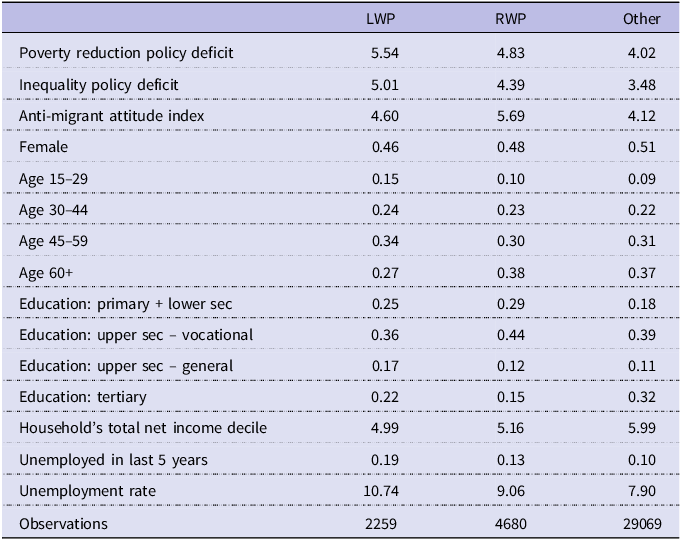
The descriptive statistics in Table 1 show that when pooling the data for the 2012 and 2020 surveys, both the poverty reduction and inequality policy deficits are higher among LWP than RWP voters. Not surprisingly, RWP voters have stronger anti-immigrant attitudes than do LWP voters. Demographic characteristics (including age, gender, and education) seem very well balanced among the pool of LWP and RWP voters in our sample. In comparison to other groups LWP voters seem to have the lowest household income, and the highest incidence of unemployment.
Descriptive statistics of estimation sample

Table 1 Long description
The table presents descriptive statistics for an estimation sample, comparing various metrics across three groups: LWP, RWP, and Other. The table has 17 rows and 4 columns, including headers. The columns are labeled LWP, RWP, and Other. The rows include metrics such as poverty reduction policy deficit, inequality policy deficit, anti-migrant attitude index, gender distribution, age groups, education levels, household income, and unemployment rates. Notable trends include higher poverty reduction and inequality policy deficits among LWP voters compared to RWP voters. RWP voters exhibit stronger anti-immigrant attitudes. Demographic characteristics like age, gender, and education are well balanced between LWP and RWP voters. LWP voters have the lowest household income and the highest unemployment rates compared to other groups.
Source: European Social Survey (2012, 2020), Eurostat, own calculations.
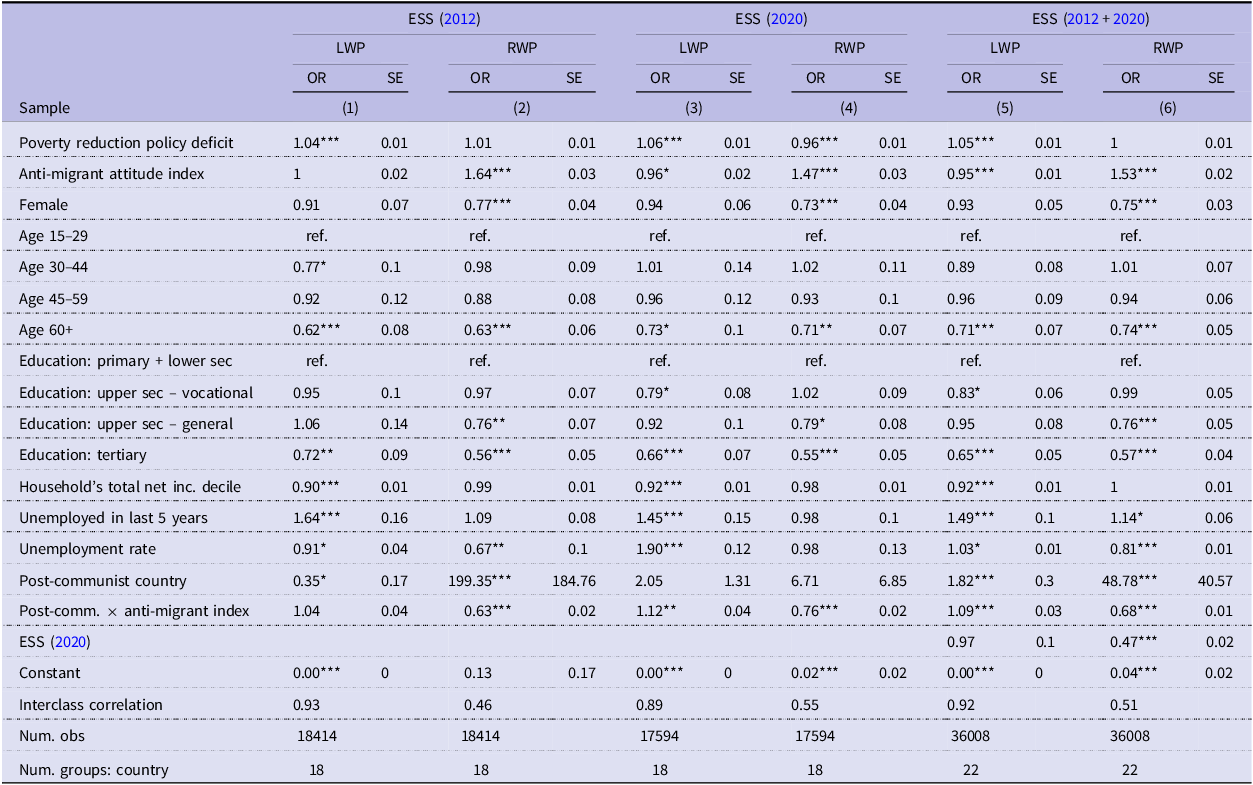
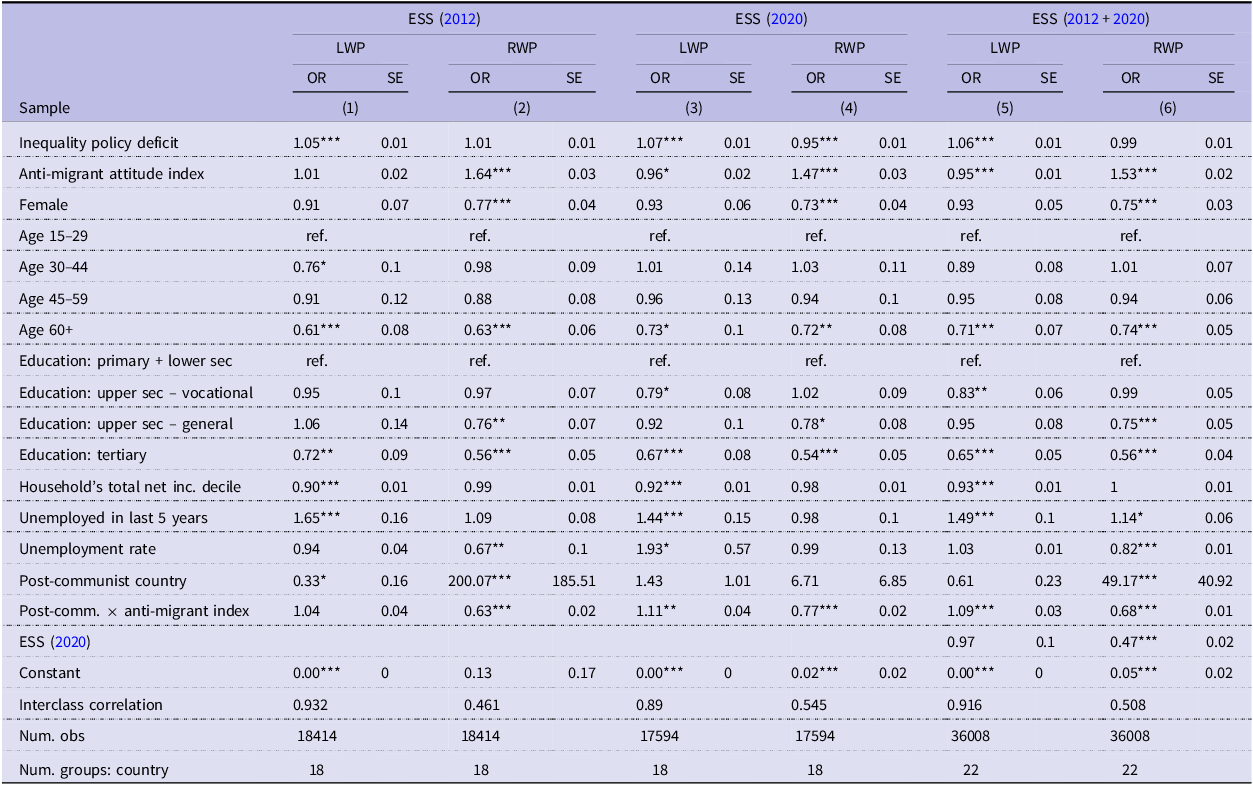
Our multilevel logit regressions provide support for Hypothesis 1 about the solidarity of the left: both WSP variables are significantly correlated with voting for LWP parties, as the odds ratios are greater than one for both the 2012 and 2020 surveys as well as the pooled sample. This is true for both the poverty reduction policy deficit and the income inequality reduction deficit. Meanwhile, both variables are insignificant for voting for RWP parties in the pooled sample and 2012 sample, which indicates that general dissatisfaction with WSP is not a motivating factor for choosing a RWP party, although for the 2020 survey both deficits were indeed significant, but negatively correlated as the odds ratios were less than one. In other words, according to the 2020 survey, those who perceive the welfare state to be performing poorly are even less likely to vote for RWP (see Tables 2 and 3).
Multilevel logistic model on voting for leftwing and rightwing populist parties with poverty reduction deficit
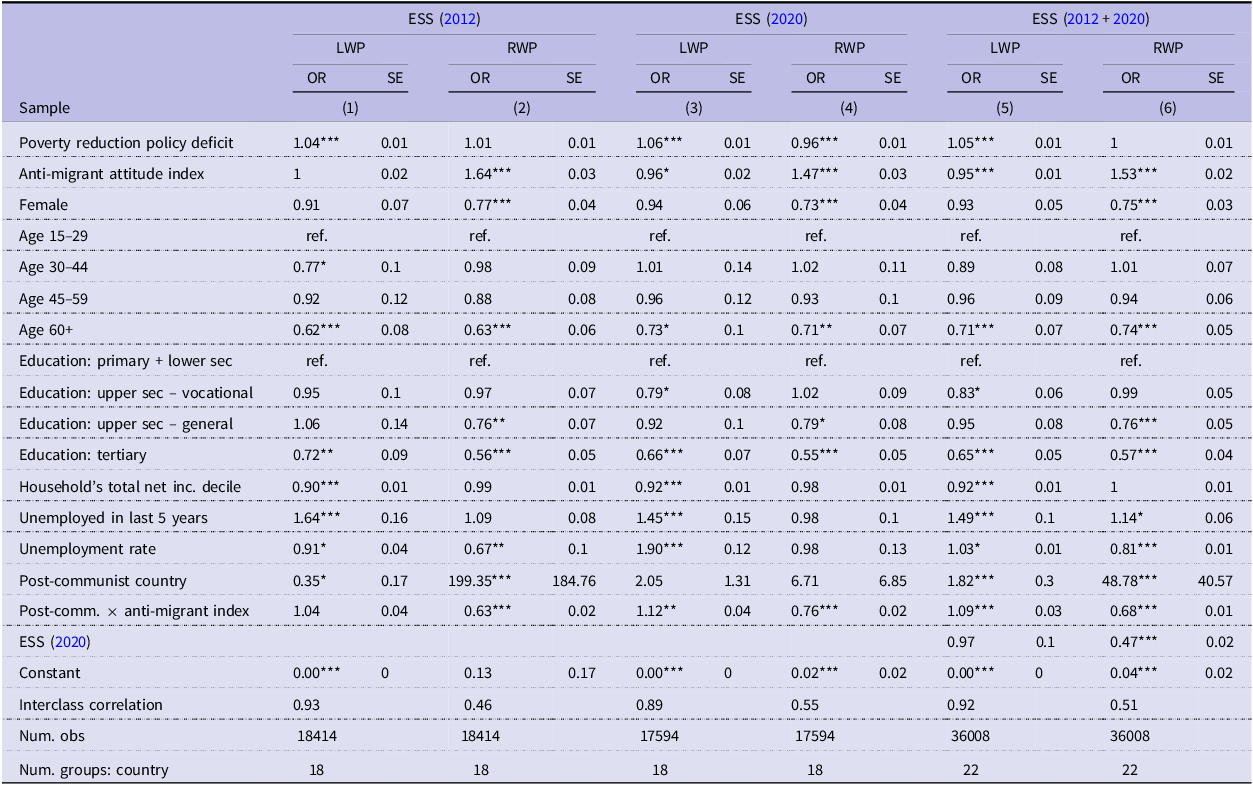
Table 2 Long description
The table presents data from multilevel logistic models analyzing voting patterns for leftwing populist (LWP) and rightwing populist (RWP) parties in relation to the poverty reduction policy deficit. The table is divided into columns for the years 2012 and 2020, as well as a combined dataset for 2012 and 2020. Each year has separate columns for LWP and RWP, with odds ratios (OR) and standard errors (SE) provided for various sample characteristics. Key variables include poverty reduction policy deficit, anti-migrant attitude index, gender, age groups, education levels, household income, unemployment status, and country-specific factors. Notable trends include significant correlations between the poverty reduction policy deficit and voting for LWP parties in both 2012 and 2020, while the same variables are insignificant for RWP parties in the pooled sample and 2012 sample. The table also highlights the impact of anti-migrant attitudes and other demographic factors on voting behavior.
Source: European Social Survey (2012, 2020), Eurostat, own calculations.
Note: *p < 0.05; **p < 0.01; ***p < 0.001.
The dependent variable is a dichotomous measure of whether the respondent voted for a LWP or RWP party in the last election. Odds ratios (OR) and standard errors (SE) are published.
Multilevel logistic model on voting for leftwing and rightwing populist parties with inequality reduction deficit

Table 3 Long description
The table presents a multilevel logistic model analyzing voting behavior for leftwing and rightwing populist parties based on inequality reduction deficit. It includes data from surveys conducted in 2012 and 2020, as well as a pooled sample from both years. The table is structured with six columns: three for the 2012 survey, two for the 2020 survey, and one for the pooled sample. Each column pair includes odds ratios (OR) and standard errors (SE) for leftwing populist parties (LWP) and rightwing populist parties (RWP). The rows represent various factors such as inequality policy deficit, anti-migrant attitude index, gender, age groups, education levels, household income, unemployment status, and country-specific variables. Notable trends include significant correlations between welfare state performance variables and voting for leftwing populist parties in both surveys and the pooled sample, while these variables are insignificant or negatively correlated for rightwing populist parties in most cases.
Source: European Social Survey (2012, 2020), Eurostat, own calculations.
Note: *p < 0.05; **p < 0.01; ***p < 0.001.
The dependent variable is a dichotomous measure of whether the respondent voted for a LWP or RWP party in the last election. Odds ratios (OR) and standard errors (SE) are published.
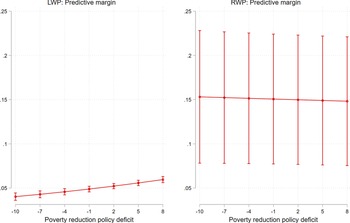
Figures 1 and 2 show this clearly. The predicted probability based on the pooled sample shows that voting for LWP parties greatly increases the greater the perceived policy deficit. That is, the greater the gap between voters’ preferences regarding social policies to decrease poverty and inequality and their assessment of government results in achieving these goals, the more likely people are to vote for LWP parties. The contrast between the steeply rising curves for policy deficits and voting for LWP parties and the flat but very slightly sinking curves for voting for RWP parties is striking. The great difference in the standard errors also stand out, which can be seen by the much longer vertical lines for each point on the curve for RWP compared to LWP.
Predicted probabilities for the values of inequality policy deficit.

Figure 1 Long description
The image contains two line graphs side by side. The left graph is labeled 'LWP: Predictive margin' and the right graph is labeled 'RWP: Predictive margin'. Both graphs plot 'Inequality policy deficit' on the x-axis, ranging from -10 to 8, and 'Predictive margin' on the y-axis, ranging from 0.05 to 0.25. Each graph features a red line with error bars indicating the predictive margins for different values of inequality policy deficit. In the LWP graph, the predictive margin increases slightly as the inequality policy deficit moves from -10 to 8. In the RWP graph, the predictive margin decreases slightly as the inequality policy deficit moves from -10 to 8. The error bars in both graphs represent the confidence intervals for the predictive margins.
Predicted probabilities for the values of poverty reduction policy deficit.

Figure 2 Long description
The image contains two line graphs side by side. The left graph is titled 'LWP: Predictive margin' and the right graph is titled 'RWP: Predictive margin'. Both graphs plot 'Poverty reduction policy deficit' on the x-axis, ranging from -10 to 8, and 'Predictive margin' on the y-axis, ranging from 0 to 0.25. The left graph shows a gradual increase in predictive margin as the poverty reduction policy deficit increases, with values starting around 0.05 and ending around 0.1. The right graph shows a relatively constant predictive margin around 0.15, with error bars indicating variability. The error bars in the right graph are larger compared to the left graph, suggesting more variability in the data for RWP. The graphs illustrate how the predictive margins for poverty reduction policy deficit differ between LWP and RWP.
Since neither policy deficit is positively correlated with RWP, we find some support for the anti-egalitarism of the right hypothesis. This hypothesis predicted that resentment that the ‘underserving’ receive benefits would lead to disinterest both in fighting inequality (as the undeserving groups are not ‘equal’) and removing poverty, as they support a welfare state on equity principles rather than egalitarian ones. This is consistent with descriptive evidence that the policy deficit is larger for LWP voters than RWP voters. Nonetheless, in 2020, both the inequality deficit and poverty deficit are actually negatively correlated with voting for RWP as the odds-ratio is less than one. In other words, if one is dissatisfied with the states performance on reducing inequality, one is less likely to vote for a RWP party, but more likely to vote for a LWP party. This still basically supports the anti-egalitarism hypothesis but implies even greater resentment: not only is fighting poverty not a priority for RWP parties, but if the state is good at it, they are even less likely to vote for a RWP party.
Since people with anti-immigrant attitudes are more likely to vote for RWP parties than other parties, while neither WSP variable is correlated with voting for RWP parties, our results suggest that welfare chauvinism remains the most important welfare issue for these voters, as they are anywhere from one point four seven times to one point six four times more likely to harbour anti-immigrant views than other voters.
The importance of welfare chauvinism for RWP voters is strengthened by the fact that social economic variables such as having been unemployed in the last five years are more important for LWP voters. Having been unemployed in the last five years makes somebody almost one point five times more likely to vote for a LWP party in the pooled data set for both types of policy deficits, but only a little over one point one times more likely to vote for a RWP party. In addition, having been unemployed in the last five years is not statistically significant for RWP voting in either survey, despite being significant for the pooled data. Meanwhile, having a high family income is negatively correlated with voting for LWP parties and not significant for RWP parties, while educational level is negatively correlated for both types of populist voting as the odds ratios are less than one. Thus, LWP voters, having low incomes and having experienced unemployment, are more likely than RWP voters to follow their material interests, while RWP voters are more concerned about social issues such as immigration.
We noticed that in the 2020 survey there was a sharp rise in anti-immigrant attitudes among those LWP supporters living in post-communist countries, so we tested for this by adding the country-level variable ‘post-communist’ country and the interaction variable post-communist country and LWP voter. When doing so, anti-immigrant attitudes as a whole are negatively correlated with voting for LWP as the odds-ration is less than one for each regression (2012, 2020, and the pooled data). However, the interaction term of post-communism and anti-immigrant attitudes actually becomes positive for 2020 as LWP voters in post-communist countries are one point two times more likely to hold anti-immigrant views in the regression for the poverty reduction policy deficit and one point one one times more likely to hold anti-immigrant views in the regression for the inequality reduction policy deficit in 2020.
How can we account for this change from 2012 to 2020 and the difference between LWP voters in post-communist countries and those living in other European countries? We do not have the data to be able to answer this question and one of the reasons could be that in 2020 more countries have LWP parties in parliament. We distrust the latter reasoning, though, because if there had been a demand for LWP parties in 2012, then more of them would have been in parliament, so we think the demand for LWP parties has increased over time. A more probable explanation has to do with two important factors:
-
a) In contrast to most other European countries, the post-communist countries lack a stable party system and strong traditional socialist or social democratic parties, which makes it easier for LWP to emerge, especially as in many of the post-communist more mainstream leftist parties have imploded.
-
b) Because of the war in Syria, the civil war in Iraq, and other international developments, a great increase in refugees coming to Europe took place. Even though very few of them moved to post-communist countries, the public discourse in these countries has become highly securitised and LWP populist parties have tried to capitalise on this, such as Smer in Slovakia and Die Linke in Germany (see Saxonberg, et al., Reference Saxonberg, Frič and Gyárfášová2023 for the Slovak case).
In other words, it seems that LWP voters differ from both RWP and mainstream voters in several ways. The rise of LWP parties combined with the decline of mainstream socialist and social democratic parties implies that people with socialist or social democratic values might be turning to LWP parties out of dissatisfaction with the mainstream leftist parties. Many reasons have been given in the past for this, such as globalisation limiting the possibilities of socialist and social democratic governments to carry out generous welfare policies. However, our study shows that dissatisfaction with the manner in which the welfare states are performing is also a driving factor.
This also separates LWP voters from RWP voters, as the latter is not interested in the policy deficits for policies dealing with the equality dimension. As previous studies show, they support policies that are based on equity rather than equality and the ESS data only allows us to measure policy deficits dealing with two equality issues: fighting poverty and inequality.
As expected, RWP voters are driven by anti-immigrant attitudes. Even though no questions in the ESS survey deal directly with welfare chauvinism, we can assume that if respondents do not like immigrants, then they do not want immigrants to receive welfare benefits. The surprising result here is that in the 2020 survey anti-immigrant attitudes also became positively correlated with voting for LWP among those living in post-communist countries, which indicates that LWP has a slightly different dynamic in these countries than in other European countries.
Since not all countries in the survey have both LWP parties and RWP parties, as a robust test, we ran separate multilevel logistic regressions for LWP that only include countries with LWP parties in parliament and multilevel logistic regressions for RWP that only include countries with RWP in parliament (see Appendix A2). At the individual level, the results are almost the same in terms of odds ratios, and there are no differences as to which variables are significant or not. Thus, even when we restrict ourselves to running regressions only for the countries where there were LWP parties in parliament or for the cases where there were RWP in parliament, the substantive results are the same.
Conclusion
Previous studies have shown that WSP influences satisfaction with democracies, which would lead to the logical assumption that WSP should also influence support for populism, since populist voters usually are dissatisfied with the function of democracy in their country. Yet, so far, nobody has tested this proposition. Our study shows that there is indeed a link, but only for LWP voters. If voters with leftist values perceive that the welfare state is performing much more poorly than their expectations, they are likely to turn to LWP parties. In other words, if socialist and social democratic politicians want to stay popular and prevent their supporters from turning to LWP alternatives, they need to find a way to get the welfare state to perform better when they are in power. Thus, this study provides an important lesson for mainstream, left-leaning political parties (see Tables 2 and 3).
On the other hand, if voters have below average educational levels, are not interested in WSP on equality issues, and hold anti-immigrant attitudes, then they are more likely to support RWP parties.
It is not surprising that the welfare chauvinist thesis holds up in our study as well, since it has been tested many times, but now we see that it matters much more than welfare state performance for RWP voters, while welfare state performance is what matters for LWP voters. Another important finding is that although LWP voters in general do not display anti-immigrant attitudes, those in post-communist countries do in fact hold such views. This implies that LWP has a different dynamic among voters living in post-communist countries than those living in other European countries. Even though we offered some plausible explanations for this, we have little evidence to support our claims, which shows a definite need for more research on special dynamics of post-communist populism and how it differs from other countries.
Supplementary material
To view supplementary material for this article, visit https://doi.org/10.1017/S1474746424000010



 Open access

