

As he prepared for his second term, Donald Trump and his allies benefited from something none of his predecessors (except Grover Cleveland) had ever enjoyed: four years to plan. It made a difference. Although Trump undoubtedly was a disrupter in 2017, on many fronts his efforts fell flat. The push to repeal and replace the Affordable Care Act (ACA) famously flopped. His efforts to crack down on sanctuary cities by withholding federal grants were largely blocked in the courts. The Advisory Commission on Election Integrity quietly folded after finding no evidence of widespread voter fraud. Furthermore, despite Trump issuing numerous orders to make it so, much of the long-promised border wall with Mexico remained unbuilt. By contrast, the second Trump administration has moved with unprecedented speed to implement key components of its agenda. In only twelve months, President Trump essentially destroyed the established order that has regulated global trade since World War II, dramatically cracked down on illegal immigration, waged a veritable war on large swathes of the federal bureaucracy, and invaded a sovereign nation and asserted control over its oil industry “indefinitely.”
This flurry of action speaks directly to three major ongoing debates in executive politics scholarship. How exceptional is President Trump’s use of executive power (Potter et al. Reference Potter, Rudalevige, Thrower and Warber2019, Reference Potter, Rudalevige, Thrower and Warber2022)? Do presidents primarily employ unilateral action to influence policy outcomes (Howell Reference Howell2003; Moe and Howell Reference Moe and Howell1999) or to seek symbolic “wins” and send signals to key constituencies (Lowande Reference Lowande2024)? Finally, how resilient are the checks, both popular (Christenson and Kriner Reference Christenson and Kriner2020; Reeves and Rogowski Reference Reeves and Rogowski2022) and institutional (Bolton and Thrower Reference Bolton and Thrower2022; Chiou and Rothenberg Reference Chiou and Rothenberg2017) on its exercise?
TRUMPIAN EXCEPTIONALISM?
Like most of his predecessors, President Trump used executive power aggressively in his first term, thereby prompting political brawls over travel bans, Deferred Action for Childhood Arrivals repeal, and the banning of transgendered Americans from serving in the military. However, empirical analyses have found that in terms of raw numbers, Trump’s early administrative presidency appeared to be broadly similar to those of his predecessors (Potter et al. Reference Potter, Rudalevige, Thrower and Warber2022). His second term remains a work in progress. However, one of its defining features already is abundantly clear: an unprecedented broad and direct assault on Congress’s core constitutional power–the power of the purse.
All presidents exploit the office’s unilateral powers to advance their policy agendas (Moe and Howell Reference Moe and Howell1999) and, historically, presidents and Congress have battled for influence over federal spending (Fisher Reference Fisher2000). President Trump’s first term featured several high-profile contests over spending powers, including his declaration of a national emergency to reprogram funds for the Mexico border wall in direct defiance of Congress, and the administration’s delay of congressionally appropriated aid for Ukraine, which precipitated Trump’s first impeachment. However, the scope and scale of President Trump’s 2025 impoundment of hundreds of billions of dollars across programs—from clean-energy subsidies to foreign-development assistance to National Institutes of Health grants, as well as his unilateral imposition of across-the-board tariffs that could cost American businesses and consumers trillions of dollars during the next decade—are unparalleled.
On January 27, 2025, Matthew Vaeth, the acting director of the Office of Management and Budget, directed federal agencies to freeze grant awards and disbursements of funds until they were reviewed for compliance with recent executive orders “including, but not limited to, financial assistance for foreign aid, nongovernmental organizations, DEI, woke gender ideology, and the green new deal” (Vaeth Reference Vaeth2025). Although the memo was rescinded only two days later, the administration’s push to freeze billions of dollars in congressionally appropriated funds had begun. In parallel, the new Department of Government Efficiency (DOGE) orchestrated the termination of more than 80,000 federal workers—despite their salaries being congressionally appropriated—and offered early-retirement buyouts to tens of thousands more. This likely was in violation of the Anti-Deficiency Act because the promised payout period exceeded current appropriations (Price, Pasachoff, and Lawrence Reference Price, Pasachoff and Lawrence2025, 13). Estimates suggest that by the summer of 2025, the administration had frozen or canceled more than $400 billion, while shuttering entire agencies, such as the United States Agency for International Development.Footnote 1
Presidential impoundments—that is, refusing to spend congressionally appropriated funds—date back to the early-nineteenth century. However, their use increased dramatically under President Richard M. Nixon, leading Congress to respond by placing tight legal restrictions on the practice via the Impoundment Control Act (ICA) of 1974. The ICA permits the administration to make a “deferral” of spending “to provide for contingencies.” However, deferred funds must be released by the end of the fiscal year so that agencies may spend them to achieve their statutorily mandated purpose. The ICA also provides a mechanism for the administration to legally cancel funds it believes wasteful: it can propose a recission to Congress, which then considers the package under expedited procedures. With partisan control of both chambers and the ability to pass any recission package with a simple majority in the Senate, the Trump administration had significant opportunities to pursue its agenda through standard legislative channels. The administration proposed a $9.4 billion recission package in June, which targeted more than $8 billion in cuts to foreign-assistance programs and defunding the Corporation for Public Broadcasting. Congressional Republicans approved the recission, apart from the $400 million for the President’s Emergency Plan for AIDS Relief program.
However, the Trump administration declined to seek congressional approval to rescind the overwhelming majority of impounded funds. Rather, it has employed legal gimmicks (e.g., “pocket recissions”) and advanced extraordinary claims of executive authority over federal spending that threaten to eviscerate Congress’s constitutional power over the purse strings (Price Reference Price2025).
President Trump’s egregious abuse of impoundment is perhaps the most direct challenge to Congress’s powers and existing statute. However, his sweeping “Liberation Day” tariffs and dismantling of the global trade regime also constitute unprecedented challenges to Congress’s power to tax. Article I, Section 8, of the US Constitution grants Congress the power “to regulate Commerce with foreign nations.” Throughout history, Congress has enacted tariffs by statute, and it has repeatedly delegated authority to the president to raise and lower trade barriers under various conditions. For example, Section 232 of the Trade Expansion Act of 1962 authorizes the president to impose tariffs on goods if an investigation by the Secretary of Commerce determines that a product is being imported in a way that threatens national security. The first Trump administration relied on this authority to place tariffs on steel and aluminum; the second Trump administration cited it to justify a 25% tariff on automobiles and parts from Canada and Mexico. Section 201 of the 1974 Trade Act authorizes the president to impose tariffs to protect a domestic industry from a surge in imports if the US International Trade Commission finds evidence of serious injury, subject to certain limits. President George W. Bush cited this authority for his 2002 steel tariffs. Similarly, Section 301 of the 1974 Trade Act authorizes the United States Trade Representative to impose tariffs on imports in response to unfair trade practices. President Joe Biden cited this authority for continuing and expanding tariffs against certain Chinese goods. (For a comprehensive review, see Zirpoli Reference Zirpoli2025.)
More nebulously, the International Emergency Economic Powers Act (IEEPA) of 1977 delegates broad powers to the president to “regulate” imports when a national emergency has been declared, pursuant to the National Emergencies Act. The IEEPA never mentions the word “tariff,” and it specifies that this delegated authority is limited “to deal[ing] with an unusual and extraordinary threat, which has its source in whole or substantial part outside the United States, to the national security, foreign policy, or economy of the United States.”Footnote 2 Before 2025, presidents had cited IEEPA authority to impose sanctions, seize assets, and restrict exports. However, no president had ever used it to impose a tariff until President Trump, who invoked it in February 2025 to justify new tariffs on Canada, Mexico, and China, and then again in April 2025 for his “Liberation Day” tariffs of at least 10% on all US trading partners.Footnote 3 Although the invocation of IEEPA was unprecedented, it was convenient because other statutory delegations of trade authority require more administrative effort (e.g., formal investigations) and place more stringent limits on the scope of tariff authority that could be exercised than the blanket assertion of essentially unfettered power to impose tariffs as the president alone sees fit.Footnote 4
Without any congressional sanction, President Trump unilaterally imposed tariffs that the most recent Congressional Budget Office report estimated could generate $3.3 trillion of revenue during the next decade—an amount almost identical to the deficit cost of the One Big Beautiful Act (OBBA) (Congressional Budget Office 2025; Swagel Reference Swagel2025). Even if it is more favorable for the nation’s fiscal health, the president’s assertion of power to unilaterally impose tariffs—that is, a tax—on the scale of the OBBA starkly demonstrates the extent of Trump’s truly exceptional assault on Congress’s power of the purse. While Trump’s second term also has featured a range of actions the primary purpose of which may be symbolic, from renaming the Gulf of Mexico as the Gulf of America, to ending “federal censorship,” to creating the National Garden of Heroes, the sheer scale of Trump’s assault on the power of the purse—not to mention an array of other actions—clearly demonstrates the president’s ability to effect unilaterally major changes in public policy.
PUBLIC OPINION AND POLITICAL CHECKS ON UNILATERAL POWER
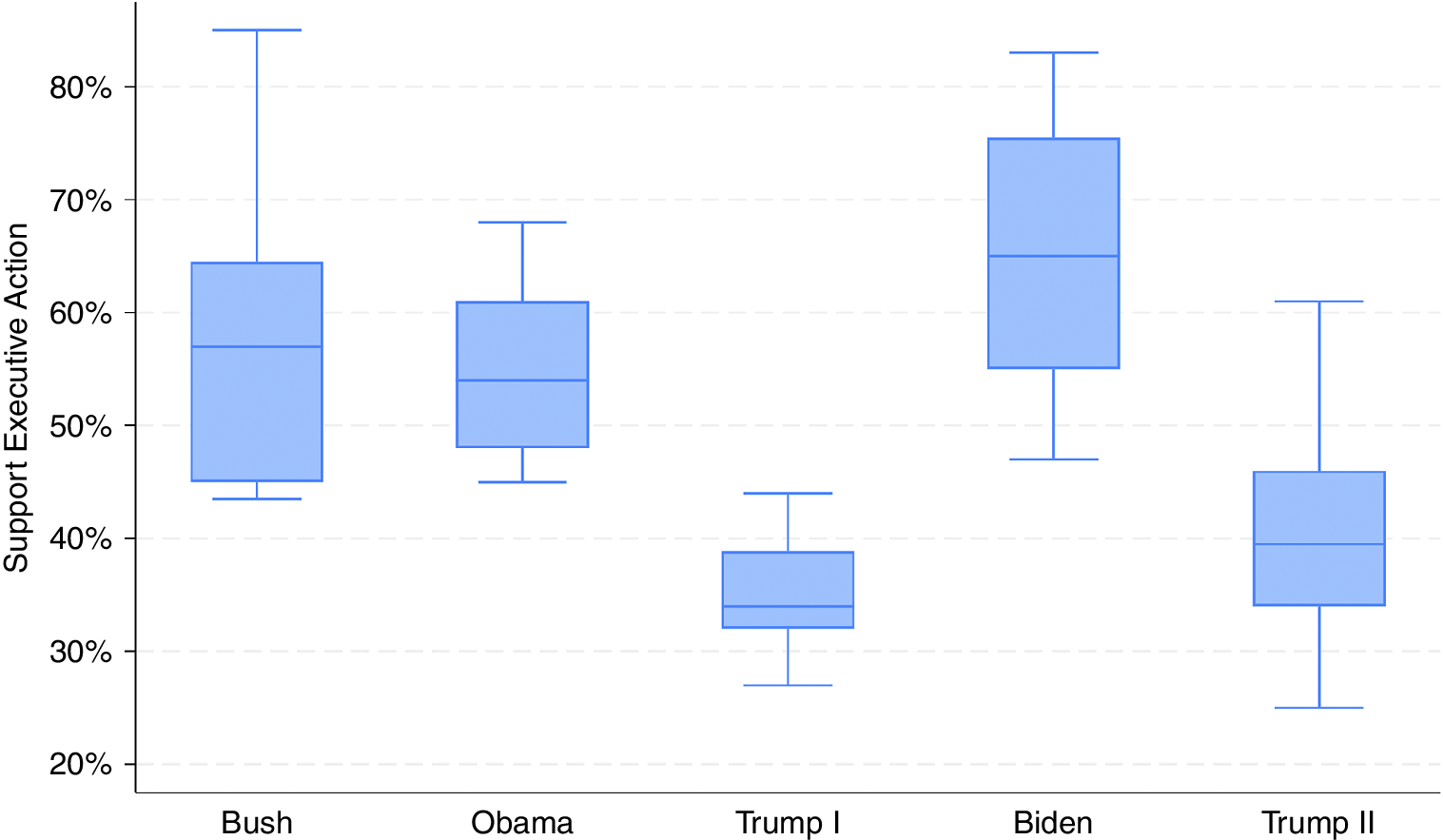
Whereas most unilateral politics scholarship has focused on the conditions under which other institutional actors can check the unilateral executive (e.g., Howell Reference Howell2003), recent research focuses on the role of public opinion and more informal political checks on executive overreach (Christenson and Kriner Reference Christenson and Kriner2020; Reeves and Rogowski Reference Reeves and Rogowski2022). If presidents avoid acting unilaterally when doing so risks provoking broad public opposition, we might expect most executive actions to be generally popular. Previous research found strong support for this expectation with an important exception: President Trump’s first term. Whereas the executive actions of President George W. Bush and President Barack Obama were generally popular and supported by the median voter, most of President Trump’s first-term executive actions appealed only to his core partisan base (Christenson and Kriner Reference Christenson and Kriner2020, 148–55). Figure 1 extends prior work to include public polling data on executive actions taken by Biden and Trump in his second term. President Biden’s executive actions were broadly popular, with a median approval rating of 65%—even higher than the corresponding figure for President Bush or President Obama. By contrast, regardless of which term, President Trump is the clear outlier: the median second-term Trump action was supported by less than 40% of Americans, according to publicly available polls (Kriner Reference Kriner2026).
Public Support for Executive Actions by Biden and Trump
Note: Bush, Obama, and Trump I actions are from Christenson and Kriner (Reference Christenson and Kriner2020, 149–55). Biden and Trump II actions are listed in figure 2. Outlying values are excluded from the plot.

Figure 1 Long description
The Y-axis is labeled Support Executive Action and ranges from 20% to 80% with horizontal grid lines at 10% intervals. The X-axis lists five categories from left to right.
* Bush: The box spans from approximately 45% to 64% with a median line at 57%. Whiskers extend from 43% to 85%.
* Obama: The box spans from 48% to 61% with a median line at 54%. Whiskers extend from 45% to 68%.
* Trump I: This is the lowest support group. The box spans from 32% to 39% with a median line at 34%. Whiskers extend from 27% to 44%.
* Biden: This is the highest support group. The box spans from 55% to 75% with a median line at 65%. Whiskers extend from 47% to 83%.
* Trump II: The box spans from 34% to 46% with a median line at 39%. Whiskers extend from 25% to 61%.
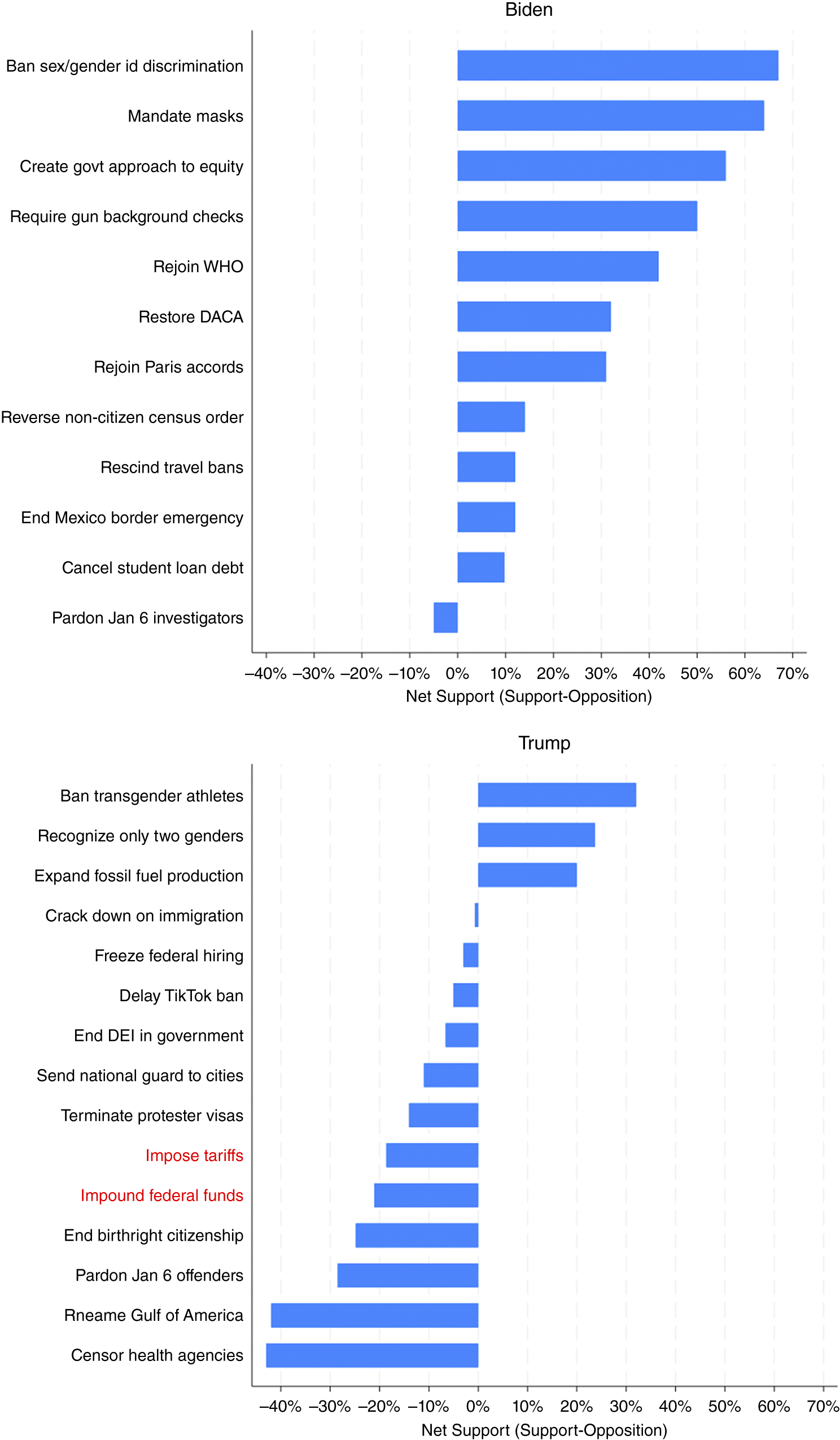
The core elements of Trump’s assault on the power of the purse—impoundment and tariffs—are no exception. Figure 2 plots the net approval rating—that is, the percentage approving minus the percentage opposing—for each executive action. The contrast between Trump and Biden again is stark.
Net Support for Specific Executive Actions
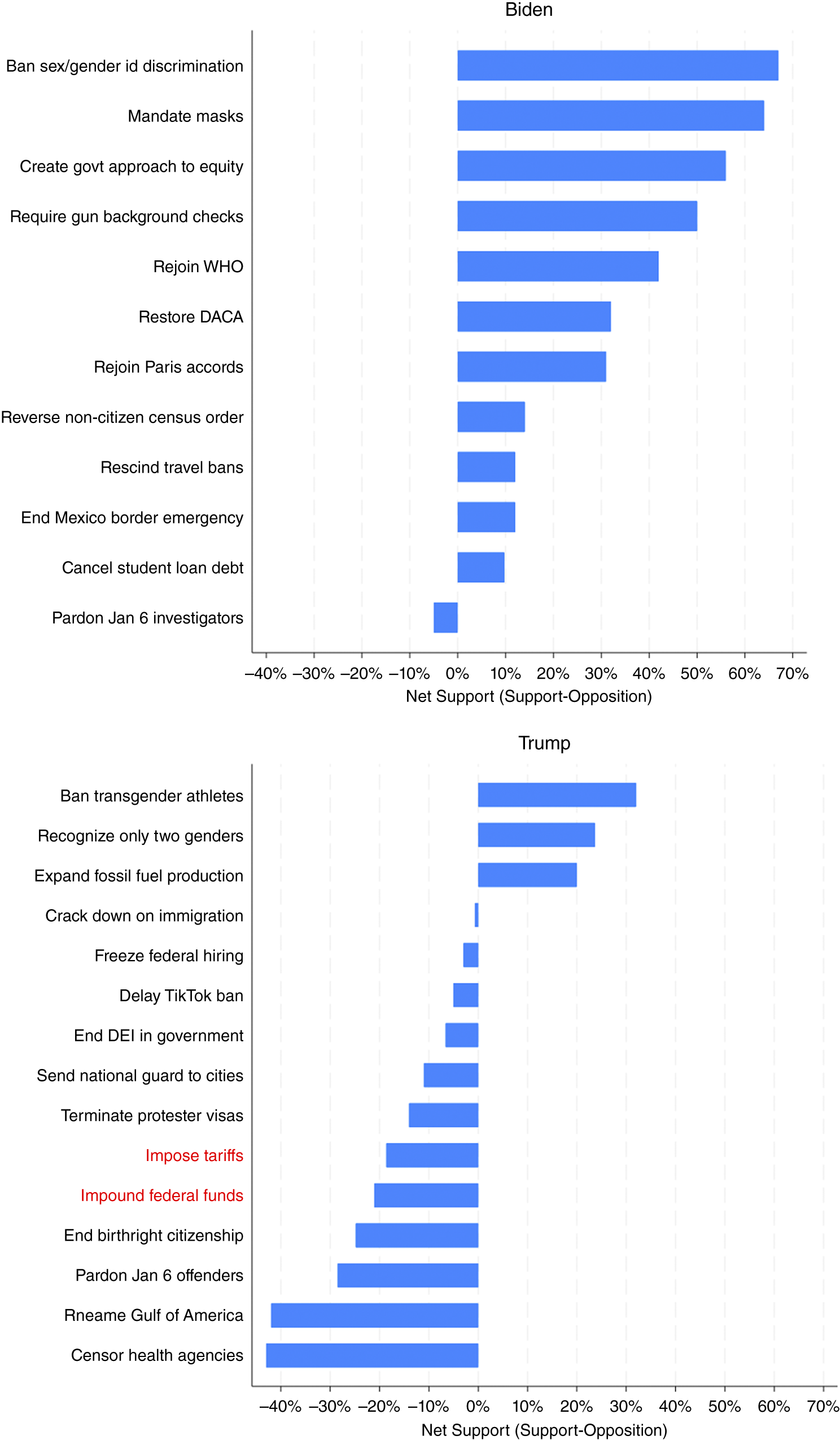
Figure 2 Long description
A two-panel figure displaying net support calculated as support minus opposition. The X axis for both charts ranges from negative 40 percent to 70 percent.
Top panel titled Biden:
* Ban sex/gender id discrimination: approximately 68 percent.
* Mandate masks: approximately 65 percent.
* Create govt approach to equity: approximately 56 percent.
* Require gun background checks: approximately 50 percent.
* Rejoin W H O: approximately 42 percent.
* Restore D A C A: approximately 32 percent.
* Rejoin Paris accords: approximately 31 percent.
* Reverse non-citizen census order: approximately 14 percent.
* Rescind travel bans: approximately 12 percent.
* End Mexico border emergency: approximately 12 percent.
* Cancel student loan debt: approximately 10 percent.
* Pardon Jan 6 investigators: approximately negative 5 percent.
Bottom panel titled Trump:
* Ban transgender athletes: approximately 32 percent.
* Recognize only two genders: approximately 24 percent.
* Expand fossil fuel production: approximately 20 percent.
* Crack down on immigration: approximately 1 percent.
* Freeze federal hiring: approximately negative 3 percent.
* Delay TikTok ban: approximately negative 5 percent.
* End D E I in government: approximately negative 7 percent.
* Send national guard to cities: approximately negative 11 percent.
* Terminate protester visas: approximately negative 14 percent.
* Impose tariffs (text in red): approximately negative 19 percent.
* Impound federal funds (text in red): approximately negative 21 percent.
* End birthright citizenship: approximately negative 25 percent.
* Pardon Jan 6 offenders: approximately negative 28 percent.
* Rename Gulf of America: approximately negative 42 percent.
* Censor health agencies: approximately negative 43 percent.
For Biden, every action except one (i.e., pardoning all congressional January 6 investigators) is “above water” with more support than opposition. For Trump, only three actions—banning transgender women from women’s sports, recognizing only two genders in government records, and taking steps to expand oil and gas production—had more support than opposition.
Across all available polls, fewer than 40% of Americans supported Trump’s efforts to freeze or cancel federal funding and almost 60% opposed them (Kriner Reference Kriner2026). Three questions explicitly mentioned Congress and asked whether Trump had the authority to freeze spending authorized by the legislature. In these questions, Trump fared even worse, with opposition outpacing support by 30%. Trump’s tariffs generated similar splits. Support was highest in questions that focused on tariffs against China; lowest in questions that focused on Canada; and broadly consistent with the overall numbers in questions that measured support for tariffs in general.Footnote 5
Whereas most presidents anticipate the public’s response when contemplating unilateral action and avoid “going it alone” when they expect broad popular resistance, President Trump follows a different political calculus. Base mobilization is central to both his electoral and governing strategies. Whereas most presidents craft their unilateral agenda to appeal to the median voter, President Trump does not hesitate to take bold executive action—provided that it pleases (or at least does not alienate) his core supporters.Footnote 6
CONGRESSIONAL ABDICATION
Congress approaches inter-institutional battles with a unitary executive at an institutional disadvantage (Moe Reference Moe and Nelson1994). The Framers of the Constitution hoped their constitutional system would incentivize individual political actors to defend their institution’s prerogatives from encroachments to protect their own power; however, partisan forces complicate this incentive structure. Because presidential copartisans may perceive their interests as better served by backing rather than challenging the president, partisan forces can overwhelm the will to defend even core legislative prerogatives from executive encroachment—particularly in divided government in intensely polarized eras (Kriner and Schickler Reference Kriner and Schickler2016).
That said, Congress historically has pushed back in the face of perceived presidential incursions into its power of the purse. For example, the ACA provided for government cost-sharing reimbursements to insurance companies that offered plans with lower copayments and deductibles for lower- and middle-income customers on the exchanges. Although the law clearly authorized the program, beginning in FY2014, Congress did not appropriate the requested funds. The Obama administration spent the money regardless, arguing that a permanent appropriation enacted prior to the ACA already appropriated monies for the cost-sharing reductions (Bagley Reference Bagley2016, 1729–31). In July 2014, the House passed H. Res. 676 authorizing Speaker John Boehner to sue the administration. The DC District Court found that although the House did not have standing to challenge statutory interpretation, it could sue the president for alleged constitutional violations of the appropriations clause. Ultimately, it ruled for the House on the merits of the case. The Obama administration appealed, but the incoming Trump administration dropped the appeal in 2017, which allowed the DC District Court’s ruling to stand.
Congressional Republicans also pushed back against one of President Biden’s most sweeping executive actions: his efforts to cancel up to $400 billion in student loan debt. The Biden administration cited the Higher Education Relief Opportunities for Student Act of 2003 as providing the requisite legal authority for a one-time debt cancellation to address financial harms wrought by the COVID-19 pandemic. However, many in Congress disagreed and claimed it usurped Congress’s power of the purse.Footnote 7 Committee investigators held hearings on Biden’s move and its legality, and both chambers passed H.J. Res. 45 to invoke the Congressional Review Act and nullify the rule that put Biden’s plan into effect. President Biden vetoed the resolution before the US Supreme Court struck down the plan in Biden v. Nebraska.
Congress similarly challenged President Trump’s efforts to reprogram funds to build the border wall with Mexico in his first term. A stalemate over wall funding contributed to the then-longest government shutdown in unified government. Trump capitulated but then declared a national emergency to repurpose existing funds to build the wall. The bold move provoked bipartisan outcry and 12 Senate Republicans voted with Democrats to rescind the emergency. Unsurprisingly, Trump vetoed the resolution.Footnote 8
Even the Republican-controlled 115th Congress occasionally pushed back against alleged overreach by the first Trump administration (Killough and Barrett Reference Killough and Barrett2017). Prominent Republicans criticized President Trump’s first “Muslim Ban” in early 2017 (Plummer Reference Plummer2017). Following extensive investigations, Congress passed legislation that imposed sanctions on Russia for interfering in the 2016 election and that limited the president’s ability to lift them unilaterally. Moreover, when President Trump announced that the administration would not impose new sanctions on Russia despite the statutory requirement, the pushback from Congress was staunch enough that the administration backed down.
By contrast, in the face of a truly unprecedented assault on a core congressional power—actions that a super-majority of Americans oppose—the 119th Congress has been conspicuous only for its absence. Individual members, usually senators, occasionally have criticized specific cuts or freezes. Susan Collins (R-ME), chair of the Senate Appropriations Committee, denounced various administration moves as intrusions on Congress’s constitutional powers. Most recently, Collins condemned the administration’s announcement that it would use a pocket recission to cancel another $4.9 billion in appropriated spending on foreign aid programs as “a clear violation of the law” and announced her intention to work with Senate Democrats to add new safeguards to next year’s spending bills.Footnote 9 However, as of the close of 2025, the formal institutional response in both the hearing room and on the floor has been virtually nonexistent.
Similarly, despite the unprecedented scale and scope of the Trump tariffs and mounting legal rulings that the president usurped a core congressional power, the main response from congressional leaders has been to bury in committee legislation introduced to check the president’s abuse of tariff power (e.g., H.R. 407, Prevent Tariff Abuse Act). Making this inaction all the more ironic is that congressional Republicans introduced legislation to circumscribe the president’s unilateral tariff authority—during the Biden administration. In 2023, Mike Lee (R-UT) reintroduced the Global Trade Accountability Act—which Jerry Moran (R-KS) had reintroduced in 2021—to require congressional approval for any proposed unilateral trade action that would increase trade barriers. However, when presented with the opportunity to terminate the national emergency that Trump used to impose his unilateral tariffs, both Lee and Moran voted no. On October 30, 2025, four Senate Republicans (i.e., Paul, Murkowski, Collins, and McConnell) joined all 47 Democrats to rescind the emergency and roll back the tariffs. However, House Republicans indicated their intention to block further consideration.
With President Trump back in power and the threat of presidents usurping Congress’s power of the purse to effectively impose a tax of trillions of dollars on American consumers reified, Congress—including erstwhile cosponsors of the Global Trade Accountability Act—is essentially missing in action.
CHECKS IN THE BALANCE
Partisan incentives have long frustrated the Framers’ hope that to protect their own power prospects, members of Congress instinctively would defend those of their institution from executive encroachment. Although presidential power undoubtedly has grown over time, Congress has repeatedly pushed back against the most extreme presidential power grabs. When President Nixon impounded an estimated $18 billion (approximately $118 billion in current dollars), Democrats and Republicans alike voted overwhelmingly to repudiate the president and affirm Congress’s sole control over the federal purse strings. By contrast, the 119th Congress has responded with little more than a whimper to President Trump’s blatant disregard for the Budget Impoundment and Control ActFootnote 10 and his abuse of emergency authority to impose tariffs worth potentially trillions of dollars. Not even widespread public opposition to his power grab has encouraged Trump’s copartisans to break with the White House and defend their institutional prerogatives.
The 119th Congress has responded with little more than a whimper to President Trump’s blatant disregard for the Budget Impoundment and Control Act and his abuse of emergency authority to impose tariffs worth potentially trillions of dollars.
What can explain this historic spinelessness? Perhaps the most important factor is one of the same features that Frances Lee (Reference Lee2026) identifies in this symposium as a key reason for Trump’s markedly greater legislative success in his second term: that is, his dominance of the GOP. President Trump carried all but three House Republican districts in 2024, and he experienced stronger electoral support in Republican Senate constituencies than any other twenty-first-century president. Republican members know they cross Trump at their peril and that doing so could prompt a well-funded primary challenge or significant barriers to further career advancement. In such conditions, “the interest of the man” is no longer “connected with the constitutional rights of the place,” as Federalist 51 intended (Madison Reference Madison1788). The constitutional order has reached an inflection point. If Congress fails to defend its core constitutional authority over the purse strings, the consequences for separation of powers could be enduring.
ACKNOWLEDGMENTS
I thank the symposium editor, George Edwards; two anonymous reviewers; and participants in a corresponding panel at the 2025 Annual Meeting of the American Political Science Association for their helpful feedback and suggestions.
DATA AVAILABILITY STATEMENT
The polling data needed to produce figures 1 and 2 are openly available on the PS: Political Science & Politics Harvard Dataverse at https://doi.org/10.7910/DVN/9SA3UZ.
CONFLICTS OF INTEREST
The author declares that there are no ethical issues or conflicts of interest in this research.