




Introduction
How cities and civilisations produce and sustain their food supplies is fundamental to their survival. Across both the Old and New Worlds, researchers have investigated the nature of past food supply under changing climate and social conditions, emphasising that diversity is a key aspect of sustainability (e.g. Demarest Reference Demarest2004; Marston & Miller Reference Marston and Miller2014; Middleton Reference Middleton2017). As Halstead and O'Shea (Reference Halstead and O'Shea1989) have noted, food surplus and the supply chain are critical in this risk mitigation. Decisions relating to diversity, specialisation, yield and the integration of agricultural systems are all thought to have influenced how urban centres were supplied and how well they weathered the challenges of social and climatic change. The nuances of decision-making around specific factors such as yield, surplus, trade and risk mitigation during short-term episodes of stress and their long-term and far-reaching implications have, however, often been overlooked.
Extending over present-day Pakistan and parts of north-western India, the Indus civilisation (c. 2600–1700 BC) was one of the great Old World Bronze Age cultures (Figure 1, Table 1). This vast region of South Asia encompasses two rainfall systems, two major rivers, numerous ecological habitats and gradients ranging from arid to semi-tropical climate zones. Its geographical complexity has posed challenges for understanding the nature of past agricultural supply and demand. While farming strategies of the Indus civilisation clearly varied across the region (Pokharia & Srivastava Reference Pokharia and Srivastava2013; Petrie et al. Reference Petrie, Bates, Higham and Singh2016; Petrie & Bates Reference Petrie and Bates2017; Bates Reference Bates2019), the role played by agriculture during the decline of the Indus has been much debated (Vishnu-Mittre & Savithri Reference Vishnu-Mittre, Savithri and Possehl1993; Madella & Fuller Reference Madella and Fuller2006; Pokharia et al. Reference Pokharia, Kharakwal and Srivastava2014; Petrie Reference Petrie, Cunningham and Driessen2017; Petrie et al. Reference Petrie2017). In the Late Harappan (c. 1900–1700 BC), a phase characterised by de-urbanisation and coinciding with the 4.2kya aridification event, questions centre on sustainability—that is, how the various elements of the wider Indus tradition interacted with the changing climate and societal structure and how the food supply was maintained at supra-regional, regional and local scales.
Map of the Indus civilisation showing the location of the main sites mentioned in the text (figure by the authors).

Chronology of the Indus tradition (after Possehl Reference Possehl2002: 29; Kenoyer Reference Kenoyer and Lashari2020: tab. 1).

The Indus provides an opportunity to study the challenges faced by an urban culture during a period in which climate, environment and social factors combined to become what Petrie et al. (Reference Petrie2017: 19) have called “unpredictable unpredictability” – something beyond that which people could handle. Rather than looking at the Indus as a monolithic system, or as geared solely towards urban food supply (as implied in the modelling of Halstead & O'Shea Reference Halstead and O'Shea1989), we explore how different components of the Indus agricultural systems interacted with changing conditions. Specifically, we consider how the concepts of diversity and specialty, polyculture and monoculture, low and high yield, and flexibility versus supply-driven production can be used to look at variable risk mitigation and failure. We approach this through a comparison of archaeobotanical datasets from three key areas: Harappa, Gujarat and the north-east of the zone covered by the Indus civilisation.
Indus agricultural modelling
The Late Harappan phase witnessed a series of social changes. Larger ‘monumental’ features such as the Great Bath at Mohenjo Daro began to fall into disuse (Possehl Reference Possehl1997; Wright Reference Wright2010; Petrie Reference Petrie and Yoffee2019), many specialist crafts declined, as did ‘technical virtuosity’ in production methods (Vidale & Miller Reference Vidale, Miller, Taddei and de Marco2000). Some large sites such as Mohenjo Daro were eventually abandoned after a period of decline and depopulation (Possehl Reference Possehl1997; Wright Reference Wright2010), while Harappa continued to be occupied, albeit with a reduced population (Petrie Reference Petrie, Cunningham and Driessen2017). Settlement reorientation is also documented, with people moving away from the larger conurbations to smaller villages. These changes are traditionally argued to have been accompanied by an agricultural ‘revolution’. Richard Meadow (Reference Meadow and Kenoyer1989), for example, saw agricultural change as a critical component of the Late Harappan phase, based on the roles played by different crops in the Indus system. The food crops found on Indus sites are listed in Table 2.
Main crops found on Indus sites, based on published data (Weber Reference Weber, Weber and Belcher2003; Petrie & Bates Reference Petrie and Bates2017; Bates Reference Bates2019; for more details and more taxa, see Weber Reference Weber, Weber and Belcher2003).

Meadow (Reference Meadow and Kenoyer1989) linked changes in cereal production with the 4.2kya event. This climatic shift is broadly described as an abrupt and severe arid phase that began c. 2150 BC and lasted between one and several centuries (Staubwasser et al. Reference Staubwasser, Sirocko, Grootes and Segl2003; Prasad et al. Reference Prasad2014). The 4.2kya event has formed a major part of various hypotheses linking climate change and the decline of the Indus civilisation (and other Bronze Age cultures; Weiss et al. Reference Weiss, Courty, Wetterstrom, Guichard, Senior, Meadow and Curnow1993; An et al. Reference An, Tang, Barton and Chen2005; Staubwasser & Weiss Reference Staubwasser and Weiss2006; Lawrence et al. Reference Lawrence, Palmisano and de Gruchy2021). Meadow (Reference Meadow and Kenoyer1989) argued that during the Late Harappan phase, kharif (summer monsoon) crops, specifically rice, sorghum and millets, became more important due to the increased aridity of the 4.2kya event. This may have destabilised the socio-economic system, causing, or at least exacerbating, wider societal decline (e.g. Weber Reference Weber, Weber and Belcher2003; Madella & Fuller Reference Madella and Fuller2006). The correlation and causation of agricultural and socio-economic change and the 4.2kya event are, however, problematic (Petrie Reference Petrie, Cunningham and Driessen2017). The growing recognition within Indus archaeology of the diversity inherent in ecological and agricultural systems (Vishnu-Mittre & Savithri Reference Vishnu-Mittre, Savithri and Possehl1993; Madella & Fuller Reference Madella and Fuller2006; Pokharia et al. Reference Pokharia, Kharakwal and Srivastava2014; Petrie Reference Petrie, Cunningham and Driessen2017; Petrie et al. Reference Petrie2017) requires us to reconsider such ‘economic shift’ hypotheses in light of human decision-making. It is on this economic-agentive aspect that this article focuses— namely, the nature of Indus agricultural diversity in relation to food supply strategies and choices, through the lenses of farmer agency, resilience and sustainability.
Intensification, specialisation, diversity and yields
Intensification—that is, an increase in crop yield per unit of land—can take many forms including specialisation and diversification (Brookfield Reference Brookfield1984; Morrison Reference Morrison1994: 143–44). The processes of specialisation and diversification are not the same as diversity and specialty (Morrison Reference Morrison1994). Diversity and specialty can be the result of varying intensification strategies but are not requisites or predetermined outcomes of intensification because specialisation and diversification are processes, increases in yield per unit of land through changing strategies, while specialty and diversity are measures of difference in the overall crop or agricultural system. Specialisation and diversification are processes; diversity and specialty are measures of difference. Here, we focus specifically on measures of difference rather than on processes of intensification.
In an article on the divergence of tropical and cereal-based agricultural origins, Harris (Reference Harris1972) discussed the measures of speciality and diversity, contrasting the short-term high yields of cereals with the long-term stability of vegeculture. The outcome of such modelling can be expressed in a series of equations:
• vegeculture/mixed taxa versus the dominance of cereal/grain cultivation
• (simplified to) diversity versus monoculture
• (resulting in, or with demand for) low versus high yields.
A further related equation is: flexibility versus supply-driven production or, as Harris (Reference Harris1972: 188) put it, stability versus instability.
A diverse system is flexible and adaptable: should some variable change, such as a crop failure, other plants or strategies can compensate. However, given the amount of land needed to support such diverse systems, the ecological requirements of diverse crops (Petrie & Bates Reference Petrie and Bates2017) and their longer production season (i.e. no single harvest time), such systems may not be able to supply the same abundance of food compared with more specialised systems.
Specialised cropping strategies provide large harvests of a single crop grown intensively and with much higher yields than possible in diverse agricultural systems. These specialised systems can produce such vast quantities by focusing on one aim, the so-called ‘eggs in one basket’ approach. On the other hand, if one or more variables of production or supply change, the entire system is at risk, with no flexibility or back-up. In a specialised system, flexibility and risk aversion are potentially sacrificed to achieve high yields.
Consequently, farmers, and wider society, must make critical decisions as to whether to embrace diversity or specialty, polyculture or monoculture, low or high yields, and flexibility or supply-driven production. Moreover, these decisions affect not only the producers but also the consumers of agricultural products, and the effects may be intensified during periods of climate change when adaptation to new environmental conditions may be combined with greater economic demand.
Harappa: feeding an urban site
Weber et al. (Reference Weber, Kashyap and Harriman2010) have argued that large-grained cereals played a vital role in the rise of urban centres in the Indus. Large grains, mainly rabi wheat and barley (Triticum sp. and Hordeum sp.), provided high yields, encouraging urbanisation by allowing larger populations to gather together. While the analytical approach taken by Weber et al. (Reference Weber, Kashyap and Harriman2010) can be critiqued (Hayden Reference Hayden, Feinman and Price2001 follows a different approach; see also Petrie Reference Petrie and Clark2013), their study serves as a reminder that large cereal grains (i.e. wheat and barley in their article) are thought to have been the main crops supplied to the Indus cities during the Harappan phase; this monocrop supply system may have been the result of the climatic and social changes of the Late Harappan phase.
The best archaeobotanical data for an Indus city come from Harappa. Eighty per cent of the 250 000 seeds so far analysed from Harappa are cereal grains (Weber Reference Weber1999, Reference Weber, Weber and Belcher2003; Weber et al. Reference Weber, Kashyap and Harriman2010). Of these, the majority are large grains, predominantly the rabi cereals, wheat and barley, which led Weber (Reference Weber1999) to build a tiered model of Indus cropping, with cereals being Tier I staple crops. The data from Harappa are, however, still only partially analysed (with just 20 per cent of the entire assemblage published to date). Although the raw data have yet to be published, the standardised data from Harappa (ubiquity, density, proportions) are nevertheless useful for model building and have been extensively discussed (e.g. Weber Reference Weber, Weber and Belcher2003). From this, Weber determined that the main crops at Harappa were rabi cereals, wheat and barley.
Crop choices at Harappa fluctuated over time. Barley was the dominant crop during the Early Harappan phase, wheat predominated in the Harappan phase, then barley took over again in the Late Harappan (Weber Reference Weber, Weber and Belcher2003: tab. 5.3.c). Kharif crops, particularly millets, also increase over time, although at no point do they represent more than seven per cent of the assemblage (Weber Reference Weber, Weber and Belcher2003; also Petrie & Bates Reference Petrie and Bates2017). Weber (Reference Weber, Weber and Belcher2003: 181–89) has argued that an increased diversity over time was perhaps due to adaptation to changing climate, but as noted in Petrie and Bates (Reference Petrie and Bates2017) there was little actual focus by farmers providing for Harappa on increasing yields through multicropping, and agriculture at Harappa predominantly focused on rabi monocultures of wheat and barley.
Mohenjo Daro is another urban site with published archaeobotanical remains, and where wheat and barley also dominate the assemblage (Luthra Reference Luthra and Vats1941, who also comments on its presence at Harappa; Shaw Reference Shaw and Mackay1943). The seeds were, however, hand collected during the early twentieth-century excavations and the collection is thus not comparable to the remains retrieved by systematic flotation from other sites. Millets, for example, would have been missed given their small size. The quantified urban data available from Harappa, and probably Mohenjo Daro, therefore suggest that a monoculture of rabi large-grained cereals was likely to have been driven by the demand from growing cities. This is hypothesised to have begun as demand for yield to support urban growth during the Early Harappan phase and continued into the main Harappan phase when it sustained large urban populations (Weber Reference Weber, Weber and Belcher2003; Weber et al. Reference Weber, Kashyap and Harriman2010; Petrie & Bates Reference Petrie and Bates2017). Over time, the demand for supply versus the instability in the system created by the environmental and economic upheaval of the Late Harappan phase may have created pressure around Harappa to maintain urban food supplies. One outcome or response to this was an increased, but limited, use of millets to provide flexibility for maintaining urban food supplies under changing conditions.
Gujarat: surviving an arid zone
While the available data from Harappa show a predominantly rabi-based monoculture of wheat and barley, different cropping strategies are documented in other regions (Weber Reference Weber1991, Reference Weber1999; Vishnu-Mittre & Savithri Reference Vishnu-Mittre, Savithri and Possehl1993). Unlike the urban site of Harappa where we are reliant on summary tables (see Weber Reference Weber, Weber and Belcher2003), numerous sites in Gujarat provide both the raw data and their quantified analysis. Gujarat is a hyper-arid region. Most rainfall occurs between June and September, during the Indian summer monsoon, shaping agricultural and pastoral activities. Prolonged drought is a recurrent phenomenon, particularly in the driest areas of north Gujarat and Kachchh (Ajithprasad & Sonawane Reference Ajithprasad, Sonawane, Osada and Endo2011), with implications for the resilience of agricultural strategies.
Archaeobotanical data from the site of Rojdi indicate multicropping strategies including intercropping or duo-culture, with evidence for change over time (Weber Reference Weber1991, Reference Weber1999; Petrie & Bates Reference Petrie and Bates2017). This was a flexible millet-based system that could shift between monocropping, intercropping and maslin (the practice of sowing two or more cereals together; van der Veen Reference van der Veen, Kroll and Pasternak1995). Similarly complex patterns of diverse millet cropping are also recorded at Surkotada (Vishnu-Mittre Reference Vishnu-Mittre and Joshi1990) and Babar Kot (Reddy Reference Reddy2003).
These patterns are not the only strategies recorded in the region. At the sites of Khirsara and Kanmer (Pokharia et al. Reference Pokharia, Kharakwal, Rawat, Osada, Nautiyal and Srivastava2011, Reference Pokharia, Agnihotri, Sharma, Bajpai, Nath, Kumaran and Negi2017) a non-millet-based system was in place for much of the time. At Khirsara, the Early Harappan cropping strategy was 90 per cent barley, a monoculture similar to that seen at Harappa in Punjab. This is ill-suited to the local environmental conditions, suggesting that regional or pan-regional economic demands for large rabi cereals during the urbanising period may have pushed agricultural strategies beyond well-adapted and resilient local ecological limits. This strategy diversified over time, breaking up the monoculture, so that in the Harappan phase barley formed only 49 per cent of the assemblage. Kharif pulses were also introduced, and a duo-crop of rice was added. By the Late Harappan phase the assemblage was mainly kharif crops, with pearl millet (Pennisetum sp.), rice (Oryza sp.) and sorghum (Sorghum bicolor). Rabi crops such as barley were still part of the system but played a greatly reduced role (Pokharia et al. Reference Pokharia, Agnihotri, Sharma, Bajpai, Nath, Kumaran and Negi2017). A similarly dramatic change over time is also seen at Kanmer (Pokharia et al. Reference Pokharia, Kharakwal, Rawat, Osada, Nautiyal and Srivastava2011).
The contrast between Khirsara and Kanmer on the one hand and Rojdi on the other illustrates the flexible strategies employed in Gujarat. At Kanmer and Khirsara, there was a shift from cereal monocultures and single-season cropping which was perhaps due to economic demands in the urbanising period, to a more diverse polyculture and multi-season cropping, perhaps reflecting a shift between the economic demands of the urbanising period towards a greater emphasis on local ecological conditions in the later periods.
Trade is a further aspect to consider. Western Kachchh, and Gujarat in general, is one of the driest and least climatically predictable regions of the Indus civilisation. Trade and the exchange of agricultural goods would have been important for maintaining the Indus economy, especially in Gujarat (Bhan et al. Reference Bhan, Sonawane, Ajithprasad and Pratapchandran2005). The production of rabi crops might have been part of this elaborate trade system and it could be argued that, as trade broke down towards the end of the Harappan phase, either the availability of rabi crops via trade (supply) or need to produce rabi crops (demand) declined. To support this hypothesis, we would need crop-processing data from Khirsara to ascertain whether the site was a primary producer or consumer of rabi crops. A correlation between the decline in the quantity of traded goods with the decrease in rabi crops suggests that the complexities of the Indus economic systems are related to changes in agricultural demand as well as ecological conditions (see Madella Reference Madella, Madella, Lancelotti and Savard2014; García-Granero et al. Reference García-Granero, Lancelotti, Madella and Ajithprasad2016). Khirsara managed to survive these inter-regional changes by switching to the consumption of (probably locally grown) kharif crops. At Rojdi, by contrast, the crop-processing data suggest that the site was both a consumer of wheat and barley traded from beyond the region but also a producer of millets for local use (Weber Reference Weber1991, Reference Weber1999). A similar argument has been put forward for sites such as Shikarpur in Gujarat (García-Granero et al. Reference García-Granero, Lancelotti, Madella and Ajithprasad2016). Unlike at Harappa, flexibility in attitudes towards production and consumption, created by a combination of environmental and economic choices, may therefore have formed part of the Gujarati Harappan system.
The north-east: life in villages
Villages in the north-eastern part of the Indus area reflect different patterns. The agricultural systems in this region followed a pattern of sequential cropping, using mixed monocropping, duo- and polycultures, and mix and strip/row intercropping (Petrie & Bates Reference Petrie and Bates2017). There is no chronological pattern to this and no indications of a shift related to (de)urbanisation or environmental stress (Petrie & Bates Reference Petrie and Bates2017). For example, sequential cropping is documented at Masudpur VII in all three Indus phases. There were small amounts of wheat and barley monocropping among the rabi crops, and intercropped millets among the kharif crops alongside strip/intercropped pulses attested in the Early Harappan phase. Intercropped mustard and pulses among the rabi crops and monocropped sawa millet (Echinochloa sp.) with strip/intercropped pulses among the kharif crops were introduced in the Harappan phase. Kharif monocrops of rice and mixed intercropped millets were added in the Late Harappan. This complex use of multiple strategies with continual additions to the existing systems suggests a flexible approach to agriculture, without concentrating on any single crop at any one time. It denotes shifting approaches to specialisation, diversification, specialised or diversified cropping, and intensification proper, adapting to the mix of summer and winter rains and the multiplicity of environmental conditions in the region.
Many questions remain to be answered, including what kind of food was being supplied to Rakhigarhi. Did this city rely on monocrops of wheat and barley like Harappa? What impact did this have on the city during the Late Harappan phase while the villages around Rakhigarhi remained resilient to the changes in society and climate, in part because they diversified their crops? Rakhigarhi was one of the cities that declined and was abandoned during the Late Harappan phase (Nath Reference Nath1999); the data from some of the villages in the region, such as Masupdur I, Masupdur VII, Bahola and others excavated nearby, have led to questions about whether or not these villages were supplying food to Rakhigarhi during the Harappan phase (Bates et al. Reference Bates, Singh and Petrie2017). We might then ask: did Rakhigarhi rely on non-diverse food supplies such as monocropped cereals and did this play a part in the site's lesser resilience than the villages?
Implications
While the 4.2kya event created an “unpredictably unpredictable” set of conditions (Petrie et al. Reference Petrie2017:19), the weakening of the summer monsoon would not have had the same impact everywhere. In a complex environment such as the Indus we should not expect climatic effects to be the same across the entire region (Petrie Reference Petrie, Cunningham and Driessen2017). Moreover, it is not only the complex environment that fosters resilience or hinders it, but also different agricultural strategies and, critically, also people's experiences and responses in the face of change; not everyone experienced this ‘unpredictable unpredictability’ in the same way.
As Weber et al. (Reference Weber, Kashyap and Harriman2010) note, the idea of ‘cereal cities’ and the monocropping of wheat and barley could have been especially important in the rise and maintenance of large urban populations. It is hypothesised that stable surplus creation (Wheeler Reference Wheeler1950; Kenoyer Reference Kenoyer, Richards and van Buren2000; Weber et al. Reference Weber, Kashyap and Harriman2010; Wright Reference Wright2010), while important for urban support, would have become unsustainable as a strategy during periods of climate and social change. Over-reliance on large-grained rabi crops, likely due to population size and the need to feed cities (yield demands), is considered here to have created an inflexible system at sites such as Harappa. While, as Weber (Reference Weber, Weber and Belcher2003: 181) has asserted, millet use may have increased in the Late Harappan at Harappa in response to changing ecological conditions—reflecting a desire to create a more reliable and resilient food supply—it was too little too late. The need for high yields and supply in the short term (feeding the masses) outstripped the need for long-term diversity and adaptability. Consequently, only small amounts of a non-wheat and barley monoculture could be incorporated into the Harappa's food strategies, and this may have created a feedback loop of demand–yield pressures contributing to the decline of the city as wheat and barley supply chains were interrupted by the 4.2kya event (Madella & Fuller Reference Madella and Fuller2006).
More seasonally tailored millet duo-cultures and mixed cropping, for example at Rojdi, allowed people to be ready to deal with arid conditions and to have fall-backs should any one of the millet crops fail to produce sufficient yield. At sites such as Kanmer and Khirsara, a willingness to shift away from high-yield (possibly imported) crops to sustainable and locally grown crops also allowed for greater risk mitigation. This raises questions concerning the model of a monolithic system focused solely on extensive agricultural strategies in the so-called ‘peripheral’ zone of the Indus civilisation in Gujarat (Madella & Fuller Reference Madella and Fuller2006; Pokharia et al. Reference Pokharia, Agnihotri, Sharma, Bajpai, Nath, Kumaran and Negi2017). The Gujarat assemblages suggest that in the urban Harappan phase it was a region of flexible choices with regard to supply and demand. This flexibility endured in the changing conditions of the Late Harappan phase, when people adapted their cropping strategies to suit their changing needs. The demands of the economy, the environment, ecological shifts and inter/intra-regional trade networks may have created a situation in which a single rigid agricultural system was improbable, as farmers negotiated between their own needs and demands that changed rapidly over space and time. Millet use may have been suitable at certain moments for village subsistence, while wheat growing for interaction with cities may have allowed for more engagement with different economic networks during periods of stability. In the north-east, the early adoption of varied multicropping systems, which were flexible at the local level, created a similar resilience in village economies.
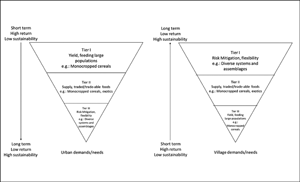
These hypotheses need to be tempered by the different scales of the datasets: while extensive open-area excavations were undertaken in Gujarat, sondages were favoured in the north-east, and the publication of the dataset from Harappa remains incomplete. Overall, the Indus archaeobotanical landscape provides a wealth of data offering insights into the decisions taken by Indus farmers (Figure 2): vegeculture/mixed taxa versus a dominance of cereal/grain, diversity versus monoculture, low versus high yield, and flexibility versus supply-driven production (following Harris Reference Harris1972; Brookfield Reference Brookfield1984; Morrison Reference Morrison1994). These choices, based on balancing demand, population size and access to land, crops and labour, may have had consequences during the Late Harappan phase, leading to regionally and even site-by-site patterns of stability versus instability as people tried to weather the different demands placed on them by the economy and the changing social and environmental circumstances.
Schematised model of differing demands on Indus cropping systems. Differing choices relating to demand (economic and ecological) influenced both the returns (e.g. yields) and sustainability of the systems over the short and long term (figure by the authors).

Conclusions
As McIntosh et al. (Reference McIntosh, Tainter, McIntosh, McIntosh, Tainter and McIntosh2000) have argued, people react not to nature itself but to their perception of nature and such perception acts as a filter to reaction. The 4.2kya event and social changes during the Late Harappan phase is likely to have created a situation in which the population and the environment were under stress. This could have put pressures on food production and supply chains (Petrie Reference Petrie, Cunningham and Driessen2017) but it was not uniform across the Indus. Agricultural decisions were guided by different needs and demands, economic, social and environmental. As these changed, the choices made by farmers in different circumstances resulted in different outcomes, creating diverse levels of resilience in changing conditions.
Our discussion echoes many that have been aired in Old World Bronze Age archaeology and touches on broader sustainability and risk-mitigation debates (Marston Reference Marston2015; Paloviita & Järvelä Reference Paloviita and Järvelä2016; Green et al. Reference Green2020). Rather than highlighting the overarching patterns of change and chronological shifts with regard to large-scale events, we suggest that something more nuanced and complex took place within the Indus civilisation. In the same way that change over the longue durée has been posited for places such as Gordion in Phrygia (present-day Turkey), with a second-millennium BC diversification towards agro-pastoralism (Marston & Miller Reference Marston and Miller2014) and Roman-period demands for irrigated wheat (Gürsan-Salzmann Reference Gürsan-Salzmann and Kealhofer2005), the archaeobotanical evidence from the Indus points to a particular moment of stress within a diverse social, environmental, climatic and geographical context. This diversity and the variable reactions and perceptions to these elements promoted further diversity in the strategies that people employed to exploit the landscape, and in turn determined how they responded to the challenges of the Late Harappan phase. This South Asia case study, with its unique combination of environment and complex human responses, provides an important archaeobotanical perspective on the successes and failures of early urban civilisations.
Acknowledgements
This article was completed at Seoul National University, Department of Archaeology and Art History, where Jennifer Bates is assistant professor of Archaeological Science and Jungwoo Choi is a student. They are grateful for the support shown to them by the department.


 Open access

