




Introduction
Neolithic funerary practices in the Sudanese Nile Valley are varied and complex; they are also thoroughly and richly documented (e.g. Salvatori & Usai Reference Salvatori and Usai2008, Reference Salvatori and Usai2019; Maines Reference Maines2019; Sellier et al. Reference Sellier, Aoudi, Mains and Chambon2019). In Upper Nubia, in the District of Kadruka, around 20 Neolithic cemeteries were discovered in the 1980–1990s by J. Reinold (Reference Reinold2001). Among them, Kadruka 23 (KDK23), located 14km east of the Nile River (Figure 1), is currently under excavation by a multidisciplinary Franco-Sudanese team (Langlois et al. Reference Langlois2019).
Map showing the location of KDK23 (map by H. Alarashi).

Material culture studies suggest that the cemetery functioned during the Middle Neolithic. Radiocarbon dates obtained from an eroded settlement area to the west (KDK23H) place its occupation from the mid-fifth to the early fourth millennium cal BC (Langlois et al. Reference Langlois2019).
To date, KDK23 has revealed 142 human burials and three animal deposits (Figure 2). Individuals buried are predominantly juveniles (0–9 years) and adults (30–49 years) (Maines Reference Maines2019), and all graves were endowed with funerary goods. Among the latter, beads, bone and lithic tools occur as finished objects and as distinct stages of the chaîne opératoire, including raw fragments, cores, preforms and unfinished items, some of which refit.
General plan of the cemetery (illustration by P. Chambon).

Burying raw materials and unfinished artefacts
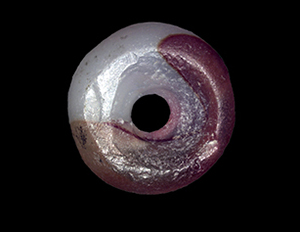
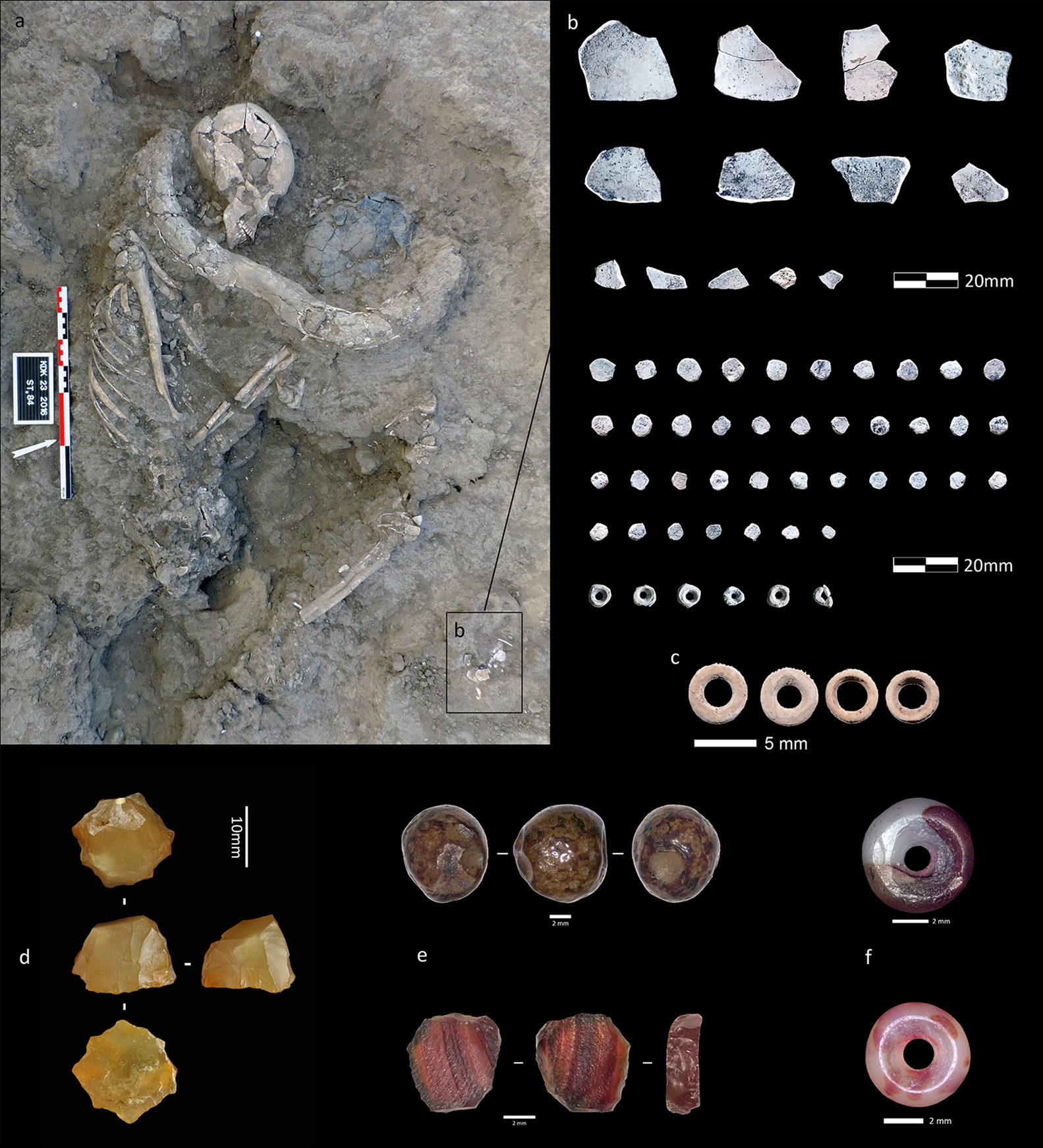
While finished beads (Figure 3c & f; Figure 6a) were found with juveniles, sub-adults and adults, unfinished items were discovered exclusively in adult graves (Figure 3b & e). In burial st. 84, a concentration of items representing the production sequences of ostrich eggshell (OES) beads was discovered next to an adult male (Figure 3a & b). Preforms of agate and carnelian beads (Figure 3e) were also found in adult graves, including a male (st. 93) and an indeterminate adult (st. 73) (Maines Reference Maines2019). In addition, a knapped bead core was recorded in the nearby settlement area (Figure 3d).
a) Adult grave st. 84, with concentration of OES items (b), raw refitted fragments, sub-circular preforms and perforated preforms; c) finished OES beads from other graves; d–e) carnelian and agate bead core and preforms; f) finished agate beads (photograph (a) by Kadruka Project; photographs (b–f) by H. Alarashi).
Knapped flint cobbles, associated flake debitage and backed microliths were recovered from several burials. Use-wear analysis of backed microliths recovered alongside an indeterminate adult (st. 24) indicates that these were unused. Moreover, almost all debitage flakes could be refitted together, allowing us to reconstruct the reduction sequences of the flake-on-cobble production (Figure 4). The freshness of the removals and number of refits suggest that they may have been produced shortly before burial.
a) Grave st. 24, with knapped lithics, including flint backed microliths (b–c) and refits of cobbles from which they were knapped (illustration by P. Chambon; photographs by L. Khalidi).

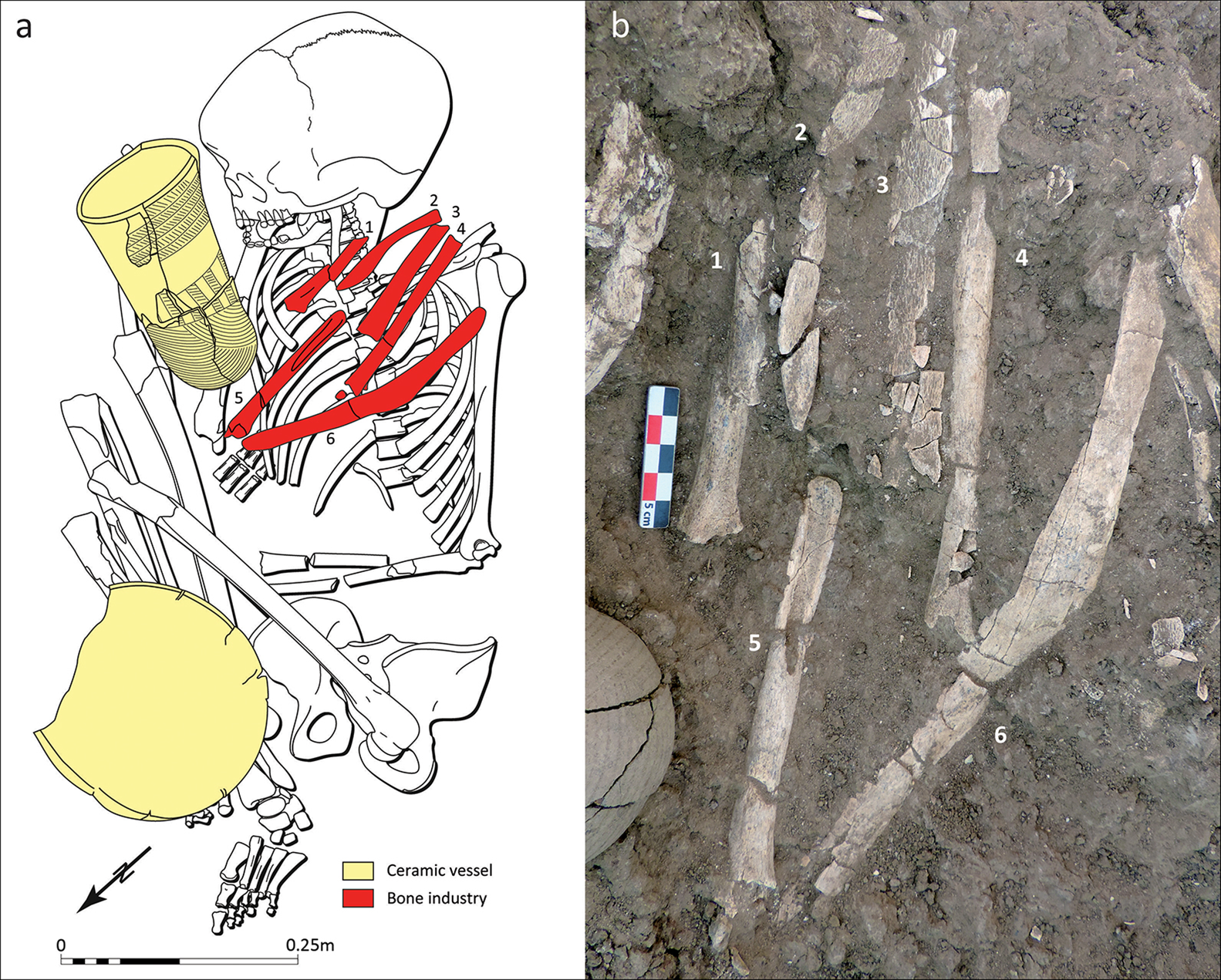
Raw bone materials, preforms and final tools were also frequent. In an adult grave (st. 65), we recovered one unworked caprine tibia with two bevelled tools (‘spatulae’), one cattle rib split longitudinally and two flat tools (Figure 5).
a) Grave st. 65, with animal bones (b), including ‘spatulae’ from caprine tibia (1 & 5); ‘polishers’ from a cattle rib (2–3); unworked tibia of caprine (4); and cattle rib split longitudinally (6) (illustration by P. Chambon; photographs by Kadruka Project).
Some graves contain the production sequences of composite artefacts. In a female grave (st. 92), decorated ochre, four unworked animal bones and bone tools were discovered (Figure 6). Below them, rows of yellow backed microliths bound in resin were found, suggesting hafted sickles or composite cutting tools. Ephemeral imprints observed in the resin may suggest the use of handles that have not survived. Near this group, a concentration of red jasper backed microliths and small flakes were also recovered, but with no evidence of resin (Figure 6). These lithics, along with the unfinished long bones, may have been deposited together as the constituent elements of a sickle, representing its production sequence. This assemblage suggests the contents of a satchel that had disintegrated after being deposited near the deceased. Similar observations were documented at KDK1 (Reinold Reference Reinold2005: 108).
a) Grave st. 92, with backed microliths (1); spatula (2); unworked bone blade (3); red backed microliths (4); backed microliths bound in resin (5); and an incised bone containing a complete needle (6); b) detail of incised bone (illustration by P. Chambon; photograph by L. Khalidi).

Food for thought
While there has been little documentation of Neolithic craft activities in the District of Kadruka due to the paucity of preserved occupation sites, the presence of artefacts in different stages of production in some adult burials at KDK23 is akin to an instruction manual for prehistorians, offering crucial insight into the fabrication steps of different artefacts and tools. Notably, this practice concerns local materials, such as OES, chalcedony and bone; it is not evidenced for objects made from non-local materials, such as amazonite.
These findings are not exclusive to KDK23, but occur in other Neolithic cemeteries in Upper Nubia, such as KDK1, R12, Ghaba and Geili (Caneva & Baracchini Reference Caneva and Baracchini1988; Reinold Reference Reinold2001; Salvatori & Usai Reference Salvatori and Usai2008; Salvatori et al. Reference Salvatori, Usai and Lecointe2016). For instance, at R12, a very rich group of finished and unfinished beads, raw materials, sandstone palettes probably used for bead abrasion, and a perforator were found in the grave of a male adult (38 Inf.), thus hinting at “an artisan specialized in bead-making” (Usai Reference Usai, Salvatori, Usai and Lecointe2016: 69). In the case of KDK23, it is still unclear whether this practice illustrates the artisanal activity of the buried adults and represented ‘survival kits’ for the afterlife (i.e. rebirth or metempsychosis rites), or whether they carry further symbolic or sociocultural values related to the identity of the deceased (Stevenson Reference Stevenson2009). Although this practice does not appear to be gender specific, it is premature to advance interpretations regarding gender-related patterns, as further data are required. Nevertheless, the deposition of raw materials, unfinished objects and tools in graves indicates that these artefacts, and the fabrication processes, had as much symbolic value as the finished products themselves (Appadurai Reference Appadurai1986).
By showcasing this practice through a diversity of utilitarian and non-utilitarian categories of artefacts at KDK23, our aim is to piece together aspects of the daily lives of Neolithic Nubian communities and to better understand the importance of craft activities for these populations and their social status in life and death. These sophisticated early inhumation rituals provide a glimpse into what could be a nascent manifestation of the more explicit funerary traditions of the renowned Predynastic and early kingdoms of the Nile Valley (e.g. Davis Reference Davis1983).
Acknowledgements
We thank the NCAM and the SFDAS institutions in Sudan for their support. This article is dedicated to the memory of our friend from Kadruka, Abdul Ghani Osman Idriss (1969–2018).
Funding statement
Part of this study has received funding from the EU's Horizon 2020, under the Marie Skłodowska-Curie Individual Fellowship (grant 846097) PRECIOUS: making and wearing semi-precious stone beads in the Near East and the Nile Valley during the Neolithic. Fieldwork was funded by the Qatar-Sudan Archaeological Project and supported by the CNRS laboratories CEPAM-7264 (Nice), and Éco-anthropologie, Anthropologie biologique et Bio-archéologie-7206 (Paris).


 Open access

