

Introduction
The ecological crisis is deepening at an unprecedented pace, with ecosystem degradation advancing faster than anticipated (e.g., Planetary Boundaries Science 2025; Willcock et al. Reference Willcock, Cooper, Addy and Dearing2023). At the same time, the neoliberal order – with its inadequate market-based solutions to environmental problems – is mutating into an increasingly authoritarian politics dominated by right-wing populism, which either denies the ecological crisis or strategically uses narratives of environmental breakdown to legitimise aggressive forms of xenophobic nationalism that reinforce social injustices while leaving the drivers of ecological destruction untouched (Lawrence and Laybourn-Langton Reference Lawrence and Laybourn-Langton2021, 62–65). These alarming developments raise urgent questions: how can prevailing socioeconomic arrangements be changed to become sustainable? How can the transition towards sustainable societies be made just? And given the urgency for action, how can research itself contribute to these transformations? The article addresses these questions by developing an innovative framework for evaluating and co-producing just transition policies.
The concern for a ‘just transition’ originated with the rise of labour environmentalism in North America in the 1970s, whereby, rather than defending jobs at any cost, unions began collaborating with environmental justice movements to support a shift to less toxic products and production processes (e.g., Stevis and Felli Reference Stevis and Felli2020, 2). While unions continue to employ the concept of just transition, the latter is now used by a variety of actors, from international organisations and states to civil-society organisations and political activists. After having been endorsed by the International Labour Organisation (ILO) and included in the preamble to the 2015 Paris climate agreement, just transition has become a global policy concept aimed at bridging the gap between social, economic, and environmental policies. Yet, beyond a shared but vague understanding as a move toward a green economy under fair conditions, conceptions of just transition vary widely – from employment-centred approaches that focus on green job creation within existing socio-economic structures to post-growth and post-capitalist perspectives, including eco-feminist, eco-socialist and eco-Marxist alternatives.
A key controversy concerns the notion of transition itself. In particular, some critics argue that, rather than a mere ‘transition’, more profound changes are needed. Viewing ‘transition’ as a process limited to incremental reforms within existing structures – centred on technological innovation and top-down policymaking – they instead advocate the term transformation to denote deeper systemic change (Clarke and Lipsig-Mummé Reference Clarke and Lipsig-Mummé2020; Goetz et al Reference Goetz, Gotchev, Richter and Nicolaus2020, 338). Others, however, reclaim transition for transformative agendas, contending that the problem lies not in the term but in its dominant political usage. Acknowledging that a ‘transition’ limited to replacing carbon-based energy with renewables is insufficient (Albert Reference Albert2022; Brand et al Reference Brand, Görg and Wissen2020; Eckersley Reference Eckersley2021; Paterson Reference Paterson2021), these scholars support transformative just transitions that entail new institutions, values and forms of socio-economic organisation (Bell et al Reference Bell, Price, McLoughlin and Kojola2024; Bell Reference Bell2025; Ciplet Reference Ciplet2022; Ding and Hirvilammi Reference Ding and Hirvilammi2024; Kreinin Reference Kreinin2020; Winkler Reference Winkler2020). Moving beyond the ‘jobs vs. environment’ dichotomy and the narrow compensatory logic advanced by the ILO (2015), they conceptualise just transition as a broader political project aimed at rebuilding the entire economy ‘from the ground up’ (Healy and Barry Reference Healy and Barry2017, 454–455).
Against this background, a key analytical challenge is to assess the transformative potential of just transition approaches. Building on previous efforts to tackle this challenge (e.g. Just Transition Research Collaborative 2018; Kreinin Reference Kreinin2020; Stevis and Felli Reference Stevis and Felli2015, Reference Stevis and Felli2020), this article develops a new framework for evaluating and co-producing just transition policies. This framework brings together conceptions of justice and understandings of sustainable development that underpin just transition approaches. While debates on justice and development have evolved as largely separate strands within the literature, they have yet to be systematically integrated. Drawing on a review of the literature, we identify and systematise seven dimensions of a comprehensive conception of social-ecological justice – distributive, epistemic, restorative, planetary, intergenerational, ecological, and procedural – and distinguish two ideal types of development – growth-driven development and social-ecological. To bridge the conceptions of justice and development and address their transformative potential, we use Sen’s capability approach (Sen Reference Sen1999, Reference Sen2009). The resulting framework not only enables the evaluation of just transition policies but also invites their co-production through democratic participation of all affected constituencies.
The article proceeds as follows. The first section outlines the seven dimensions of social-ecological justice, while the following section examines the contrasting conceptions of sustainable development to be found in the literature. The third section introduces the capability approach as a normative foundation for bridging conceptions of justice and development, emphasising the importance of co-production and political participation. Finally the last section demonstrates the practical relevance of our framework by assessing the transformative potential of the ILO’s Guidelines for a just transition (ILO 2015).
Towards a holistic and multidimensional conception of social-ecological justice
Just transition policies are informed, albeit often only implicitly, by different conceptions of justice. While justice between humans has dominated the debates on the welfare state established in the Global North after the Second World War, the ecological crisis brings forcefully into play justice between humans and non-human nature. Indeed, the post-war social democratic compromise based on the Keynesian cycle of mass production and mass consumption was able to reduce socioeconomic inequalities but neglected ecological issues. The relationship between humans and nature can be characterised either as anthropocentric, where nature is seen merely as a resource that humans have the right to exploit, or as centred on ecological concerns, where nature is viewed as having some intrinsic value that can lead to a claim of justice for nature and to conceiving nature as a subject of rights. Ecological justice refers to these attempts to promote justice in the relationship between humans and non-human nature (Baxter Reference Baxter2005; Yaka Reference Yaka2019).
With regard to justice between humans, the literature highlights its multidimensionality. Beyond distributive justice, it introduces epistemic-recognitional justice; restorative and intergenerational justice (involving temporal dimensions); planetary justice (involving spatial dimensions); and procedural justice, thereby inscribing just transition into the broader debate on democracy (Abram et al Reference Abram, Atkins, Dietzel, Jenkins, Kiamba, Kirshner, Kreienkamp, Parkhill, Pegram and Santos Ayllón2022; Evans and Phelan Reference Evans and Phelan2016; Galgóczi Reference Galgóczi2022; Goddard and Farrelly Reference Goddard and Farrelly2018; Gürtler and Herberg Reference Gürtler and Herberg2023; Healy and Barry Reference Healy and Barry2017; McCauley and Heffron Reference McCauley and Heffron2018; Newell and Mulvaney Reference Newell and Mulvaney2013; Schwanen Reference Schwanen2021).
Distributive justice has historically been concerned with the fair distribution of the harms and benefits of social arrangements. It is now also about the distribution of the costs and benefits of the ecological crisis and the greening of the economy. It usually involves a focus on material resources. For example, Rawls’ influential theory is mostly concerned with the distribution of primary goods, that is, those resources that all individuals need independently of their specific life plans and conceptions of the good life (Rawls Reference Rawls1971). The distributive perspective on justice has, however, been criticised for framing issues such as rights, opportunities, and power in terms of resources that people own rather than in terms of social relationships (Young Reference Young1990) or in terms of converting these resources into valuable outcomes (Sen Reference Sen2009). These critiques have opened the way for considering other dimensions of social justice.
Epistemic justice (Fricker Reference Fricker2007; Herzog Reference Herzog2024) – which we consider together with recognitional justice (Fraser and Honneth Reference Fraser and Honneth2003; Honneth Reference Honneth1996; Taylor Reference Taylor and Gutmann1992; Young Reference Young1990) – introduces concerns for recognition and respect (Gürtler and Herberg Reference Gürtler and Herberg2023), thereby questioning the production of social identities and knowledge. By relying on unquestioned social categories, prevailing approaches to just transition fail to problematise predefined and oppressive identities generated by existing institutions and the hierarchies they create, for instance, the subaltern position of workers within capitalism (Velicu and Barca Reference Velicu and Barca2020). Instead, epistemic justice requires democratising the question of work, allowing workers themselves to contribute to designing the transition. In this view, justice ‘does not revolve solely around demanding better wages and labor conditions’, but also around workers’ freedom to be recognised as more than wage-workers and ‘to speak for themselves’ (Velicu and Barca Reference Velicu and Barca2020, 268). More broadly, epistemic justice implies the ability of affected constituencies to be heard and to offer their insights, as well as the capacity of institutionalised knowledge-creation processes to integrate those insights. It involves recognising ‘contextual, place-specific and socially situated knowledges’ and allowing communities affected by transition to articulate their own understandings and experiences, thereby creating space for alternative possible futures (Schwanen Reference Schwanen2021, 687).
Restorative justice foregrounds the imperative to redress historical and structural injustices, including those stemming from the Global North’s disproportionate contribution to environmental degradation and climate change over the past century, as well as its role in perpetuating poverty and inequality in the Global South through various forms of (neo)colonialism (Abram et al Reference Abram, Atkins, Dietzel, Jenkins, Kiamba, Kirshner, Kreienkamp, Parkhill, Pegram and Santos Ayllón2022; McCauley and Heffron Reference McCauley and Heffron2018). However, the scope of restorative justice extends beyond North-South relations. It encompasses the need to acknowledge and compensate individuals and communities for the past harms they have suffered – whatever their origin or location – while addressing the underlying power asymmetries that reproduce such harms.
Intergenerational justice underscores the obligation to account for the needs and well-being of future generations in present-day policymaking. Challenging the prevailing tendency of socioeconomic and political decision-making to privilege immediate interests and short-term gains over future needs, it raises critical questions about the responsibilities and moral obligations of the current generation toward those to come (e.g., Barry Reference Barry1997).
Finally, planetary justice (Stevis and Felli Reference Stevis and Felli2020) emphasises that a just transition in a region or world cannot come at the expense of others, i.e., through the externalisation of social and ecological costs to other societies (Lessenich Reference Lessenich2019). A central contradiction within dominant just transition discourses is that the low-carbon economy they promote requires a massive increase in the extraction of minerals and metals – primarily in the Global South – to produce technological objects like batteries or solar panels. This fuels new forms of extractivism led by Northern-based multinational corporations that exacerbate both social and environmental injustice in the South (Bainton et al Reference Bainton, Kemp, Lèbre, Owen and Marston2021). From this perspective, a just transition cannot be confined to promoting renewable energy or securing new employment opportunities for workers in declining industries in the Global North. The planetary dimension instead calls for an expansion of the ‘scale’ frame of just transition to include the whole world (Stevis and Felli Reference Stevis and Felli2020). It entails recognising ‘rights-bearing beyond the nations’ (Saeten Reference Saeten2025) and confronting nationalist and protectionist tendencies that undermine transnational solidarity and justice (Conversi Reference Conversi2020).
Transversal to the distributive, epistemic, restorative, intergenerational, and planetary dimensions of justice is procedural justice. Procedural justice demands fair procedures, which in democracies require that those affected by the decisions to be taken should have the opportunity to participate in those decisions. However, the right to participate can imply very different degrees of power to effectively influence decisions. For example, consultative approaches involve a rather limited form of participation, which consists in providing information to decision-makers without any influence on the final decision. Some scholars argue for a stronger version of procedural justice that goes beyond promoting people’s participation in consensus-oriented consultations, which are often reduced to technical questions within a previously established agenda (Schwanen Reference Schwanen2021, 686). The focus is then on democratisation – involving confrontation and conflict – as opposed to the ‘depoliticized techno-optimistic hopes’ that green innovations and win-win situations will suffice to achieve a just transition (Healy and Barry Reference Healy and Barry2017, 456).
We use the expression holistic justice to designate a conception of social-ecological justice that includes both an intrinsic concern for non-human nature (ecological justice) and the six aforementioned dimensions of justice among humans (social justice). Moving beyond Schlosberg’s (Reference Schlosberg2007) approach of environmental justice, which combines Fraser’s three-dimensional conception of social justice (Fraser and Honneth Reference Fraser and Honneth2003) with ecological justice, our concept of social-ecological justice is grounded in a more comprehensive framework integrating intergenerational, restorative, and planetary dimensions. By explicitly incorporating these dimensions, the framework underscores not only the interrelations between human and non-human nature but also between past, present, and future life and between the different parts of the world.
From sustainable development to social-ecological development
Just transition approaches differ not only in terms of the dimensions of justice they emphasise but also in their underlying conception of sustainable development. The notion of sustainable development, especially as institutionalised in the Sustainable Development Goals (SDGs), has faced strong criticism. Scholars have criticised it for perpetuating Western-modernist, anthropocentric and materialist traditions, for promoting ‘linear’, quantified and result-based knowledge, and for foregrounding approaches centred on property-based capitalist markets, competition, extractivism and individualistic meritocratic values (van Norren Reference van Norren2020; Waldmüller et al Reference Waldmüller, Yap and Watene2022). The priority given to economic aims over social wellbeing, justice and ecological objectives led critics to emphasise the inherent contradiction between the commitment to GDP growth (SDG 8) and a social-ecological transformation informed by decoloniality, global justice, and ecological viability (Eisenmenger et al Reference Eisenmenger, Pichler, Krenmayr, Noll, Plank, Schalmann, Wandl and Gingrich2020; Gupta and Vegelin Reference Gupta and Vegelin2016; Hickel, Reference Hickel2019; Krauss et al Reference Krauss, Jiménez Cisneros and Requena-i-Mora2022; Kreinin and Aigner Reference Kreinin and Aigner2022; Menton et al Reference Menton, Larrea, Latorre, Martinez-Alier, Peck, Temper and Walter2020). By ignoring this contradiction, the concept of sustainable development would serve to ‘co-opt and neutralize’ counter-hegemonic challenges to (neoliberal) capitalism (Briant Carant Reference Briant Carant2017; Wanner Reference Wanner2015, 23).
In light of these critiques, some authors invite us to abandon the concept of sustainable development (Grossmann et al Reference Grossmann, Connolly, Dereniowska, Mattioli, Nitschke, Thomas and Varo2022). They argue that it mistakenly places social, ecological, and economic goals on the same footing, rather than conceiving economic objectives as means to achieve social and ecological goals. We agree on the need to reposition the economy as a means rather than an end in itself. Yet, as for the notion of ‘just transition’, the meaning of ‘sustainable development’ can vary, depending on how and by whom it is used. In its most radical interpretations – including ecofeminist and ecosocialist ones – sustainable development combines strong commitment to social equality, human wellbeing, and ecological sustainability, demanding a radical transformation of economic and power structures (Hopwood et al Reference Hopwood, Mellor and O’Brien2005). From this perspective, the concept can still serve emancipatory ends, provided that we learn from past mistakes such as equating development with unlimited economic growth and colonisation.
While social-ecological justice, with its seven dimensions, serves as a normative goal or ideal within our framework, ‘development’ refers to the temporal and processual dimensions of the social changes needed for achieving this goal. Two main political-economic perspectives on sustainable development can be identified. The first one equates sustainable development with the greening of economic growth; the second questions the very logic of growth, ranging from its qualitative reformulation to its rejection. We refer to this second perspective as social-ecological development to differentiate it from the prevalent, growth-driven interpretations of sustainability.
A growth-driven conception of sustainable development frames the ecological crisis mainly in depoliticised terms as a market failure. It promotes market-based solutions such as emissions trading (Felli Reference Felli2015) and state intervention to support ‘green’ innovation, skill development, and industrial policies. Within this logic, just transition policies primarily aim to provide new employment opportunities for workers displaced from polluting sectors, such as coal and oil. By emphasising technology-driven win-win solutions, this approach neglects underlying power asymmetries within and between states and downplays political conflict. It thus conforms to the socio-economic status quo, with the risk of reinforcing social and ecological inequalities through new forms of ‘green colonialism’ (Bainton et al Reference Bainton, Kemp, Lèbre, Owen and Marston2021; Lang et al Reference Lang, Manahan and Bringel2024; Vela Almeida et al Reference Vela Almeida, Kolinjivadi, Ferrando, Roy, Herrera, Vecchione Gonçalves and Van Hecken2023). In this sense, just transition policies address the symptoms of the problems (lack of employment opportunities, climate change, loss of biodiversity, and so on), rather than their root causes (Bouzarovski Reference Bouzarovski2022).
In contrast, social-ecological development entails a transformative process oriented towards the wellbeing of humans and other living species, while caring for the biophysical limits of the planet. Rejecting depoliticised win-win scenarios, it calls for confronting power inequalities and expanding democratic control over the economy, including through changes in ownership and control over resources (Healy and Barry Reference Healy and Barry2017). It is open to post-growth visions of the ‘good life’ (Rosa and Henning Reference Rosa and Henning2018; Soper Reference Soper2020), and challenges the priority given to economic production and paid employment over social reproduction and care work – visions that are compatible with both ecosocialism and ecofeminism (Kreinin Reference Kreinin2020).
Social-ecological development is inherently global, incorporating concern for North-South inequalities and a critique of consumerism and productivism. It views capitalism as a historically specific system in which production is oriented toward profit rather than human and non-human nature wellbeing (Jackson Reference Jackson2021; Schmelzer et al Reference Schmelzer, Vansintjan and Vetter2022). Echoing Polanyi’s (Reference Polanyi2001) notion of a ‘great transformation’, the most radical conceptions of social-ecological development aim to subordinate economy to social and ecological wellbeing. Accordingly, a transformative just transition policy would transcend the capitalist imperative of accumulation and reorient economic activity to serve emancipation, solidarity, and social-ecological justice within planetary boundaries (Brand et al Reference Brand, Görg and Wissen2020; Novy Reference Novy2022).
These two perspectives, growth-driven development and social-ecological development, can be understood as the two opposite poles of a continuum. At one extreme stands a purely capitalist society, driven by principles of profit maximisation and unlimited economic growth; at the other, the ideal of a feminist, decolonial and eco-socialist society (Laruffa Reference Laruffa2025). Real-world just transition policies reflect different possible compromises and degrees along this continuum.
Bridging justice and development through the capability approach
So far, we have examined conceptions of justice and development separately. In this section, we seek to integrate them within a single analytical framework, drawing on the capability approach. To recap: regarding sustainable development, we distinguished between growth-driven development – in which social and ecological goals are subordinated to economic requirements of profit and unlimited growth – and social-ecological development, in which the economy is subordinated to the pursuit of democratically defined human, social, and ecological wellbeing. Regarding social-ecological justice, we identified seven interrelated dimensions:
-
1. Distributive: ensuring that the costs and benefits of the ecological transition are shared fairly and equitably;
-
2. Epistemic: recognising individuals and communities as holders of legitimate knowledge and values, and enabling them to contribute their perspectives to the decision-making processes that affect them;
-
3. Restorative: implementing reparations and restorative measures to address past harms and historical responsibilities for injustices;
-
4. Intergenerational: ensuring that current policies safeguard the capability of future generations to meet their needs and aspirations;
-
5. Planetary: recognising that justice in one part of the world cannot be achieved by externalising social or ecological harm to others;
-
6. Ecological: extending the concern for justice beyond human societies to encompass the intrinsic value and rights of non-human nature;
-
7. Procedural: guaranteeing meaningful participation of individuals and communities – including those speaking on behalf of non-human nature – in decision-making processes through a redistribution of power.
The capability approach offers a particularly helpful basis for integrating these dimensions of justice with conceptions of development, as it combines an open-ended understanding of development (Sen Reference Sen1999) with an idea of justice that reaches beyond a narrow focus on distribution (Sen Reference Sen2009). Centred on the concept of capability – the genuine freedom people have to achieve what they have reason to value – the approach invites us to assess well-being not merely by the possession of material goods, but by the real opportunities people enjoy to pursue valued ways of living. While material resources are crucial for achieving wellbeing by providing the means for access to food, shelter, health, or education, Sen (Reference Sen1999; Reference Sen2009) argues that their distribution alone is insufficient for assessing justice and development, as individuals differ in their capability to convert those resources into valuable achievements and real freedom. Factors such as health situation, social position, gender, and environmental conditions affect how resources are converted into capabilities. Consequently, the capability approach shifts the evaluative focus from the distribution of commodities and incomes to the actual freedoms and achievements people can attain.
On this basis, following Sen (Reference Sen1999), we adopt an open-ended understanding of development, defined as the expansion of people’s substantive freedoms to lead lives they have reason to value – with capabilities being both the means and the end of development. Such a definition is potentially compatible with a variety of practical conceptions of development, ranging from growth-based approaches to less materialist visions of social wellbeing, such as buen vivir originating from the Global South (Beling et al Reference Beling, Vanhulst, Demaria, Rabi, Carballo and Pelenc2018; Carballo Reference Carballo2015; Deneulin Reference Deneulin2012).
Concerning the idea of justice, Schlosberg (Reference Schlosberg2007) rightly argues that the capability approach allows us to articulate different dimensions of social-ecological justice into a coherent normative framework. Thus, beyond classical distributive issues, the capability approach is concerned with epistemic justice (e.g., Walker and Boni Reference Walker and Boni2020); it also brings restorative issues into play (Walker Reference Walker2024) and allows for the articulation of intergenerational justice (Page Reference Page2007). Moreover, its focus on human rights helps us to think in terms of planetary justice (Sen Reference Sen2009). The capability approach can also accommodate some form of ecological justice by attributing intrinsic value to non-human nature, even if this dimension still needs further elaboration (Kramm Reference Kramm2020; Nussbaum Reference Nussbaum2022; Watene Reference Watene2016). Finally, the procedural aspects of social justice are particularly emphasised by Sen (Reference Sen2009), who assigns a central importance to democratic participation and deliberation. The open-ended vision of development he promotes implies that citizens should establish socio-economic priorities through their active participation in democratic deliberation (Sen Reference Sen1999).
The significance of deliberative democracy in the capability approach should not be taken to imply that procedural justice holds greater weight than the other dimensions of social-ecological justice. Rather, procedural justice is ‘transversal’ to them: it mediates all other dimensions because democratic deliberation is required to resolve the unavoidable tensions that may arise among them. For instance, intergenerational justice may constrain current consumption patterns, creating tensions with distributive and restorative justice. Deliberation thus becomes essential for negotiating competing claims and making legitimate collective decisions about the trade-offs involved in pursuing a just transition.
In this sense, social-ecological justice, in its multidimensional complexity, necessarily involves a political process, where politics is understood as inherently conflictual (e.g., Mouffe Reference Mouffe2005). Given the plurality and contingency of the social world – things could always be otherwise – any attempt to define or realise justice inevitably involves conflicts between alternative visions of the good life, economic organisation, and our relationship with nature. The transition to sustainable societies inevitably entails restrictions on certain freedoms and capabilities (Crabtree Reference Crabtree2012; Holland Reference Holland2008; Leßmann and Rauschmayer Reference Leßmann and Rauschmayer2014; Peeters et al Reference Peeters, Dirix and Sterckx2015), and determining whose capabilities to prioritise or limit (those of employers, shareholders, workers, consumers, human or non-human beings) or which capabilities to promote (to make profit or to protect biodiversity) are matters of conflict. Rather than entrusting their resolution solely to ruling elites, technocrats, and so-called ‘experts’, or to the market, the capability approach makes decisions about the means and ends of development a matter of public reasoning involving deliberative democracy.
Deliberative democracy emphasises the role of argument-based discussions between citizens, where political issues and disagreements are articulated and opinions and preferences formed. Importantly, these processes of democratisation are not limited to the formal political sphere but permeate all spheres of social life, including the economy. It involves, for instance, questioning the meaning and purpose of work in light of social-ecological issues through participatory processes down to the workplace (Zimmermann and Engelbrecht Reference Zimmermann and Engelbrecht2024). Instead of having markets or shareholders determining the value of work, the capability approach implies that such value should be established democratically (Laruffa Reference Laruffa2022). Similar participatory mechanisms are required in the sphere of social policy, where welfare reform cannot be only delegated to technocratic experts.
More generally, the idea is that representative democracy alone is insufficient for advancing social-ecological justice, establishing developmental priorities, and making decisions acceptable and legitimate. A deeper form of democratisation is required, one that combines representative democracy with direct participatory and deliberative practices, enabling the voice of affected people to be heard at multiple scales, from the local to the global. Making citizen participation central to social-ecological justice therefore implies empowering people to articulate what they value, to assess what should be sustained and to deliberate on how sustainability should be achieved through inclusive and conflict-rich public reasoning (Bonvin and Laruffa Reference Bonvin and Laruffa2024; Herzog and Zimmermann Reference Herzog and Zimmermann2025; Laruffa Reference Laruffa2022; Zimmermann and Engelbrecht Reference Zimmermann and Engelbrecht2024).
Yet, emphasising the role of democratic participation for a just transition raises significant challenges. Sustainability is deeply interdependent across scales: local actions have global consequences and vice versa. Public reasoning must therefore operate across multiple levels of government; however, developing effective deliberative structures at the global scale remains a major challenge. Whatever the scale, defining via public deliberation the capabilities to be promoted requires appropriate institutions through which constituencies can express their divergences, seek agreement, and where decisions can be taken and implemented.
At the same time, deliberative processes risk being colonised by technocratic and neoliberal forms of governance, in which depoliticised, consensus-oriented and power-blind approaches to participation prevail (e.g., Moini Reference Moini2011). In such cases, participatory schemes may reproduce rather than challenge existing power hierarchies and asymmetries, especially the influence of powerful economic actors whose interests may run counter to a transformative just transition. Additionally, the success of government through public reasoning presupposes that citizens value political participation, particularly in relation to sustainability issues, an assumption that cannot be simply taken for granted (e.g., Seckler and Volkert Reference Seckler and Volkert2021).
These challenges reveal a persistent gap between the normative ideal of the capability approach and the empirical reality of contemporary democracies. From an evaluative standpoint, this gap does not preclude the use of the capability approach to assess just transition schemes, including in light of their distance from that ideal. However, from a practical and policy-making perspective, the challenges inherent to participatory democracy need to be addressed. We see in the interdependency between democratic participation with other dimensions of social justice a possible way of doing so. As Nancy Fraser has argued a just distribution of resources and mutual recognition are prerequisites for citizens’ equal participation, while, conversely, democratic participation, is often essential for achieving distributive and epistemic justice (Fraser and Honneth Reference Fraser and Honneth2003). Rather than constituting a flaw in participatory democracy, this circular relationship points to the practical obstacles that may prevent democracy and justice from reinforcing one another. Just transition policies must therefore address these obstacles by fostering not only justice but democratic renewal as well.
We do not underestimate the difficulties associated with democratic participation, nor the risk that deliberation may at times hinder social-ecological justice by privileging local or short-term interests. To account for the systemic and interconnected nature of social and ecological transformations, deliberative democracy must therefore be complemented by representative institutions and, crucially, by mechanisms that foster the integration of various forms of knowledge. These include the voices of citizens, experts, political representatives, affected communities, and other stakeholders across multiple levels of government (Herzog Reference Herzog2024; Holland Reference Holland2014). Such an integrated approach enhances both the legitimacy and the transformative potential of just transition policies.
In this respect, ‘co-production’ (see e.g., Bandola-Gill et al Reference Bandola-Gill, Arthur and Leng2023) within ‘alliances of knowledge’ (Stigendal and Novy Reference Stigendal and Novy2018) offers a worthwhile perspective to pursue. Building on epistemic pluralism, alliances of knowledge refer to collaborative schemes in which actors from different backgrounds – academic and non-academic, expert and lay, human and non-human representatives – jointly produce problems’ framing, evidence, and solutions. These schemes require mutual learning and dialogical knowledge production that bridges scientific, local, experiential, and political knowledge, thereby enhancing both the epistemic and procedural dimensions of social-ecological justice. Alliances of knowledge can easily be accommodated with the capability approach, for instance, through the adoption of participatory research methods (e.g., Bonvin and Laruffa Reference Bonvin and Laruffa2024; Laruffa and Hearne Reference Laruffa and Hearne2024; Walker and Boni Reference Walker and Boni2020). They constitute an institutional and cognitive tool for democratic capability-building: they expand the range of voices and values in public reasoning and enable the co-definition of what development and justice mean in specific contexts.
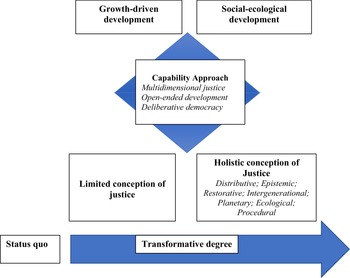
Under these conditions, the capability approach provides a robust approach for democratically defining justice and development, integrating them into an analytical framework and evaluating their potential for transformation along a continuum on which different just transition policies can be situated (Figure 1).
A framework articulating justice and development for evaluating the transformative potential of just transition policies.
Source: Authors’ own elaboration.

Assessing the ILO’s just transition guidelines through a social-ecological justice lens
In order to illustrate the potential of our framework for assessing existing policies, this section evaluates the ILO’s Guidelines for a just transition towards environmentally sustainable economies and societies for all (ILO 2015). The ILO’s approach is particularly significant because it shapes the currently dominant global understanding of just transition. As a key international organisation, the ILO participates in what Berten and Kranke (Reference Berten and Kranke2022) term a ‘politics of the future’, legitimising certain policy pathways through ‘anticipatory governance’ by framing problems and defining solutions.
Concerning the problems, the Guidelines acknowledge that moving toward green economies may create new social imbalances, particularly affecting low-income households through carbon taxes, higher energy and commodity prices, and job losses in high-emission sectors (ILO 2015, 5). In response, the ILO proposes to mitigate these effects primarily through the promotion of decent, green jobs (ILO 2015, 4–5). Green employment is presented as the principle mechanism to reconcile the social, environmental, and economic dimensions of sustainable development, fostering ‘social inclusion’, ‘social justice’, and ‘environmental sustainability’ simultaneously.
This framing rests on a growth-oriented conception of development, grounded in the assumption that economic growth can be decoupled from resource use and carbon emission. It equates social justice with participation in the formal labour market, whereas non-market, care-based, and community-oriented forms of work that are central to a social-ecological understanding of development are ignored. Work remains commodified and instrumental to economic growth rather than being conceived as a sphere of social and ecological transformation.
This growth-based understanding of development is accompanied by a narrow conception of justice implicitly limited to distributive aspects – mainly the allocation of employment opportunities for all and compensation for displaced workers through social protection and retraining. Justice is presumed to follow naturally from the creation of jobs and the implementation of the decent work agenda. Such an approach largely leaves unchallenged the structural foundations of inequality, including the distribution of wealth, ownership, global economic asymmetries, and power relationships between capital and labour, between men and women, or between the Global North and the Global South. In particular, the definition of what counts as valuable work remains in the hands of employers. The debate mainly revolves around the means for achieving inclusive green growth within an economic system whose goals have been set ex ante.
Consistent with its tripartite organisation, the ILO promotes social dialogue among governments, employers, and workers, supplemented by consultations with ‘all relevant stakeholders’ to build consensus on the ‘goal and pathways to sustainability’ (ILO 2015, 5). Yet, rather than advancing procedural justice, this dialogue builds on selected stakeholders who all have, more or less, an interest in preserving the existing system, leaving little opportunity for challenging the status quo. By relegating at best other actors like informal workers, local communities, and ecological actors to peripherical consultations, it constrains the democratic scope of decision-making and turns participation into a tool for managing transitions within prevailing political-economic parameters rather than fostering their redefinition.
Similarly, the epistemic dimension of justice is largely ignored, as the approach reaffirms Western-industrial values of employment-based productivism and the associated androcentric views of work and of what it means to contribute to society. By defining valuable work as paid employment, the ILO overlooks indigenous, feminist, and Southern epistemologies that emphasise care, reciprocity, and ecological interdependence. This reproduces global hierarchies of knowledge and limits the diversity of perspectives necessary for a truly just transition.
Moreover, despite the global scope of the ILO’s mandate, its Guidelines on just transition give surprisingly little room to planetary justice, as the needs and perspectives of the Global South are mostly ignored. Moreover, its anthropocentric and state-centric approach treats nature as an instrument for economic progress and job creation. Environmental protection is valued insofar as it supports human livelihoods, not as a moral or ecological imperative. This neglects the interconnectedness of human and non-human systems central to planetary wellbeing.
Relatedly, the colonial legacies shaping contemporary inequalities and the historical responsibility of the Global North for ecological degradation – involving issues of restorative justice – are not addressed. By universalising a developmental trajectory modelled on industrialised economies, the approach perpetuates rather than repairs global injustices.
While intergenerational justice is rhetorically affirmed through the Brundtland principle of meeting present needs without compromising the ones of future generations, the assumption that unlimited economic growth can be indefinitely decoupled from resource use risks shifting environmental and social costs onto future generations.
Finally, in terms of ecological justice, the ILO’s framework reflects a technocratic model of eco-efficiency according to which environmental problems are framed as challenges of innovation and market adaptation, leaving intact the logic of extractivism and commodification inherent to capitalism. The aim is to make existing production systems greener and more efficient, rather than transforming human–nature relations.
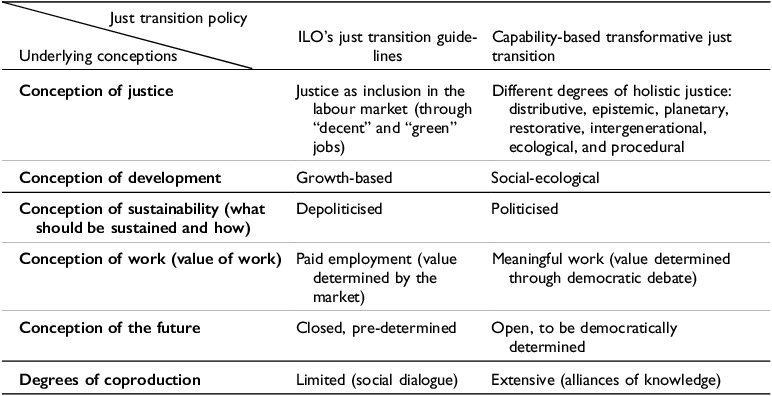
As the ILO case shows, the value of our evaluative framework lies in its multidimensionality, which allows us to detect limited transformative potential also in those policy approaches that appear greatly progressive. Hence, while the ILO approach to just transition may involve a more ambitious eco-social agenda than the ones promoted by the European Union and the International Monetary Fund (Cigna et al Reference Cigna, Fischer, Hasanagic Abuannab, Heins and Rathgeb2023), its transformative potential still remains limited. By focusing on inclusion within the prevailing growth paradigm, the Guidelines reproduce rather than transform the underlying socioeconomic and ecological order. The definition of valuable work remains largely determined by market actors, while questions of recognition, procedural fairness, and ecological or intergenerational justice are not addressed consistently. Consequently, the ILO’s vision of a just transition reproduces the current model of society rather than advancing a genuinely transformative social-ecological agenda (Table 1).
Assessing the transformative potential of the ILO guidelines

Source: Authors’ own elaboration.
Conclusion: towards co-producing transformative just transitions
In this article, we have proposed an analytical and normative framework for evaluating just transition policies based on their underlying conceptions of justice and development, using the capability approach to integrate these dimensions into a single coherent framework. We argued that the transformative potential of just transition policies depends on the extent to which they embrace a holistic conception of social-ecological justice – encompassing distributive, epistemic, restorative, intergenerational, planetary, ecological, and procedural dimensions of justice – and align with a social-ecological rather than growth-driven understanding of development. Applying this framework to the ILO’s Guidelines for a just transition (2015) revealed the limitations of this dominant approach, which remains tied to growth imperatives, labour-market inclusion, and social dialogue, thereby constraining both justice and transformation.
The capability approach, which makes democratic participation the means for integrating potentially conflicting conceptions of justice and development, leads us to argue that advancing social ecological justice is inseparable from deepening democratic participation. We understand democratic participation as a multi-level process – encompassing both representative and direct forms of participation – capable of mediating tensions among competing values, different forms of knowledge, and interests. Co-producing a transformative just transition, therefore, requires extending participation beyond representative democracy and tripartite social dialogue to include other constituencies – such as informal workers, local communities, and ecological actors – alongside institutional stakeholders and experts, including researchers.
Co-production also invites reflection on the role of researchers themselves. Scholars are not merely observers or critics but potential co-agents in shaping alternative futures. Through collaboration with trade unions, civil society organisations, social movements, and policymakers, they can help foster alliances of knowledge able to democratise expertise, address epistemic injustice, and politicise the aspirations and purposes that underpin transition policies. In this sense, researchers share an ethical and political responsibility not only to analyse the conditions for transitions but also to co-shape them, aligning knowledge production with the pursuit of social-ecological development and justice.
Acknowledgements
A previous draft of this article was presented at the workshop ‘Post-Growth Bureaucracy’ held at the Copenhagen Business School (29–30 August 2023). We wish to thank the organisers of the workshop, Jacob Hasselbalch and Matthias Kranke, as well as all participants in this event for their insightful comments on our paper. We are also grateful to two anonymous reviewers for their constructive critiques and suggestions. Finally, we thank Piotr Zuk for the invitation to contribute to this special issue and the editor of this journal, Diana Kelly, for her encouraging feedback. All mistakes remain our exclusive responsibility.
Funding statement
This work has been supported by the project ‘Involve: for trustful, participatory and inclusive public policies’ (grant number 101094560) funded by the EU H2020 research and innovation programme and by the Swiss Confederation (Swiss State Secretariat for Education, Research and Innovation, SERI). Views and opinions expressed are, however, those of the authors only and do not necessarily reflect those of the European Union or European Commission or SERI. Neither the European Union nor the European Commission nor SERI can be held responsible for them. Francesco Laruffa also acknowledges the support received by the Swiss National Science Foundation through the research project ‘Beyond Inclusion: Rethinking Work and Welfare for a Post-Neoliberal Socio-Ecological Transformation’ (grant number: P500PS_202970).
Conflicts of interest
The authors have no competing interests.
Francesco Laruffa currently works for the project ‘Involve’ at the Sociological Research Institute (SOFI) in Göttingen, Germany. His research focuses on welfare reform; the relationship between democracy and (neoliberal) capitalism; social justice; the future of work and the social-ecological transformation. His work appears in journals such as Politics & Society, New Political Economy, and Competition & Change, among others.
Bénédicte Zimmermann is Professor of Sociology at the Advanced School for Social Sciences (EHESS) in Paris. Her current research interests include work from a social-ecological perspective, workers’ aspirations and capabilities, and social justice, as well as critical sociology. Among her recent publications is Shifting Categories of Work. Unsettling the Ways We Think about Jobs, Labor and Activities (2023, eds with Lisa Herzog, London: Routledge).

 Open access

