


1. Introduction
Energy-intensive industries (EIIs) — including the steel, cement, chemical, glass, and non-ferrous metals sectors — play a crucial role in supporting the European economy but are also responsible for a substantial share of its greenhouse gas (GHG) emissions and other environmental burdens. According to the European Environment Agency, EIIs account for approximately 25% of the total industrial energy consumption and nearly 20% of total CO2 emissions in the European Union (European Commission, n.d.). The decarbonisation of these sectors has therefore become a major focus of the European Green Deal and related industrial transition policies (European Commission, 2019). Despite their economic importance, these industries are among the hardest to decarbonise due to their dependence on high-temperature processes, fossil-based feedstocks, and material-specific reaction pathways that generate process emissions (Reference Bataille, Åhman, Neuhoff, Nilsson, Fischedick, Lechtenböhmer, Solano-Rodriquez, Denis-Ryan, Stiebert, Waisman, Sartor and RahbarBataille et al., 2018).
Over the last decade, Life Cycle Assessment (LCA) has become a fundamental method for evaluating the environmental performance of EIIs and for supporting innovation in low-carbon technologies. LCA enables the quantification of environmental impacts associated with products, processes, or systems across their life cycle — from raw material extraction to manufacturing, use, and end-of-life (ISO 14040:2006, 2006). Numerous studies have employed LCA to assess the potential of emerging technologies such as hydrogen-based steelmaking, carbon capture and storage in cement plants, or electrification of process heat in chemical production (Reference Azimi and van der SpekAzimi & van der Spek, 2025; Reference Rihner, Whittle, Gadelhaq, Mohamad, Yuan, Rothman, Fletcher, Walkley and KohRihner et al., 2025). These analyses provide essential insights into trade-offs between different technological pathways and help policymakers and industry stakeholders identify effective decarbonisation strategies.
However, while the application of LCA in energy-intensive sectors is growing rapidly, interpreting the results remains a major challenge. This is especially true when using comprehensive impact assessment methods such as the Environmental Footprint (EF) 3.1, which is the reference method recommended by the European Commission for product and organisational environmental assessments (Reference Andreasi Bassi, Biganzoli, Ferrara, Amadei, Valente, Sala and ArdenteAndreasi Bassi et al., 2023). EF 3.1 expands upon previous versions by providing 25 impact categories, each representing a distinct environmental mechanism (e.g. climate change, acidification, particulate matter, resource use, ecotoxicity, human toxicity). The method includes updated characterisation factors and normalisation factors that align with the most recent environmental data at the EU-27 level. While this makes EF 3.1 scientifically robust and harmonised across sectors, it also means that LCA results often consist of a vast array of indicators that are difficult to compare or aggregate without proper interpretation (Reference Sala, Crenna, Secchi and PantSala et al., 2017).
The interpretation phase, as defined in ISO 14043 (ISO, 2000), is a critical step in the LCA framework, aiming to derive significant conclusions and recommendations from the results. Nevertheless, for complex systems like EIIs, interpretation requires careful contextualisation. The EF 3.1 indicators encompass a range of midpoint categories — from those strongly related to energy use (e.g. climate change, photochemical ozone formation) to those linked to resource depletion or toxicity. This multi-dimensional nature complicates the identification of environmental “hotspots” and the communication of results to non-expert audiences. For example, a steelmaking route that reduces GHG emissions through increased scrap utilisation may simultaneously lead to higher impacts in freshwater ecotoxicity or mineral resource use (Reference Suer, Traverso and JägerSuer et al., 2022). Without a structured interpretative approach, such trade-offs risk being overlooked or misrepresented.
Given these considerations, it becomes evident that a structured interpretative framework is required to support the analysis of LCA results for EIIs. Such a framework should facilitate a comprehensive understanding of the multiple EF 3.1 impact categories by linking them to the specific environmental mechanisms that characterise these industrial sectors. It must also enable the identification of trade-offs between energy use, material efficiency, and emission pathways, acknowledging that improvements in one dimension may lead to unintended consequences in others. Furthermore, the framework should serve as a conceptual bridge between LCA results and decision-making contexts, supporting their practical interpretation in process design, technology optimisation, and policy evaluation. Finally, it should ensure the comparability of environmental performance across plants, technologies, and subsectors, thereby promoting consistency and transparency in the assessment of EIIs.
To address this gap, this work develops the IMpact PRofile and INterpretation for Energy-intensive Industry Technologies (IMPRINT) framework, a methodological tool designed to enhance the interpretability of EF 3.1-based LCA results in EIIs. The framework was constructed following a systematic classification of EF 3.1 indicators according to their environmental mechanism, relevance to industrial processes, and potential influence on strategic decision-making. The resulting framework comprises five interpretative categories, which group the EF 3.1 indicators into meaningful clusters reflecting the main environmental dimensions relevant to EIIs.
This structured approach aims to simplify the interpretation process without oversimplifying environmental complexity. By providing guidance on how to read and contextualise LCA results, the IMPRINT framework contributes to a more transparent, communicable, and decision-oriented use of LCA in industrial innovation and environmental policy.
The remainder of this paper is structured as follows. Section 2 presents the research methodology adopted to develop the proposed framework. Section 3 details the framework itself, emphasising its distinctive relevance and applicability to energy-intensive industries. Finally, Section 4 outlines the main conclusions and provides recommendations for future research and development.
2. Research methodology
To develop the IMPRINT framework, the 25 midpoint indicators defined by the EF 3.1 impact assessment method were first analysed. To ensure a comprehensive understanding of their meaning and scope, these indicators were systematically mapped onto the 16 impact categories proposed by the European Commission (Reference Andreasi Bassi, Biganzoli, Ferrara, Amadei, Valente, Sala and ArdenteAndreasi Bassi et al., 2023). Table 1 presents an overview of the 25 EF 3.1 midpoint indicators, as implemented in the main LCA software tools, together with their corresponding European Commission categories and interpretative descriptions.
List of the F 3.1 midpoint indicators used to build the IMPRINT framework

Then, a team composed by both researchers and industry experts, through the application of the Sort, Lable, Integrate and Prioritize (SLIP) methodology (Reference MaedaMaeda, 2006), the indicators were clustered in different categories based by considering five main aspects. First, indicators were aligned according to their underlying environmental mechanisms, grouping together those that operate through similar cause-effect pathways and impact processes, thereby facilitating a clearer understanding of how environmental pressures translate into impacts. Second, each cluster was designed to ensure management strategy coherence, so that indicators within the same category could be effectively addressed through coordinated interventions, enhancing the efficiency of environmental improvement efforts. Third, the clustering approach aimed to improve stakeholder communication by enabling more targeted dialogue — for example, using specific categories to discuss community health effects, climate-related performance, or circular economy initiatives. Fourth, the framework supports strategic decision-making by providing a structured basis for prioritising environmental actions and investments according to business strategy, regulatory requirements, and stakeholder expectations. Finally, the categorisation facilitates performance tracking by allowing aggregated metrics to be developed for each environmental domain — such as a “Human Health Impact Score” or “Climate and Energy Performance Index” — thereby simplifying reporting, monitoring, and key performance indicator development.
Replication requires applying the SLIP protocol: sort indicators by environmental mechanism, label coherent domains, integrate them based on management and communication logic, and prioritise clusters according to strategic relevance and aggregation potential.
3. Results and discussions
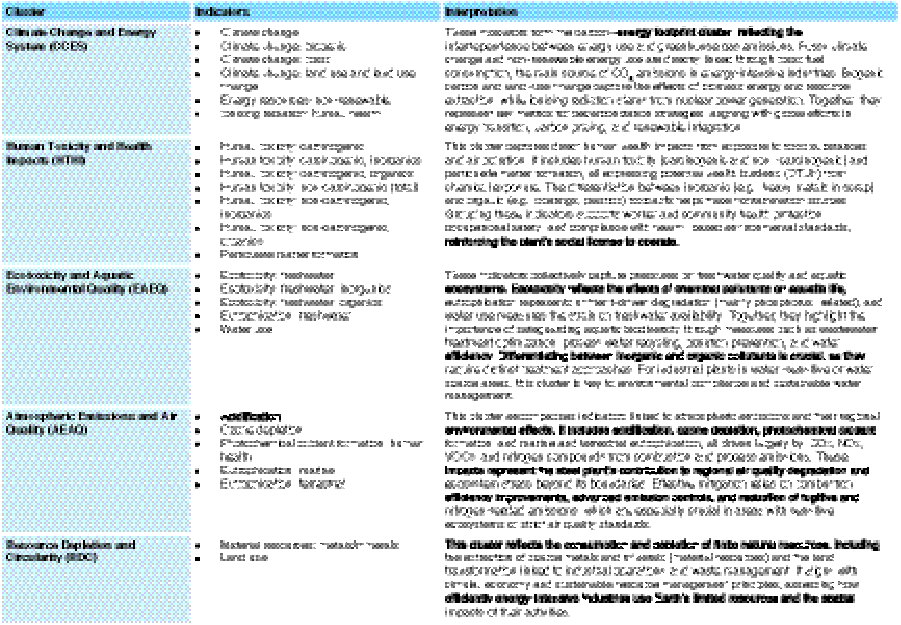
By applying the described research methodology, the IMPRINT framework was obtained, which is reported in Table 2.
IMPRINT framework structure: grouping of the 25 EF 3.1 midpoint indicators into five decision-relevant environmental clusters using the SLIP methodology

As it can be observed, the environmental indicators are organized into five interconnected clusters that reflect the multidimensional nature of EIIs’ environmental footprint, each addressing distinct but related aspects of sustainability performance:
-
• Climate Change and Energy System: it addresses the carbon and energy footprint of EIIs, grouping together climate change indicators across their three components—fossil fuel combustion, biogenic carbon cycles, and land use transformations—alongside non-renewable energy resource consumption and ionising radiation from nuclear power in the electricity mix. This cluster is intrinsically unified through the energy system, as fossil climate change and non-renewable energy resources are directly connected since energy consumption from fossil fuels represents the primary driver of CO2 emissions in EIIs (IEA, 2020), while biogenic carbon relates to biomass energy utilisation and land use change impacts stem from indirect effects of resource extraction. This cluster forms the foundation for decarbonisation strategies and is critical for alignment with Science-Based Targets, carbon neutrality commitments, and regulatory frameworks such as the EU Emissions Trading System, enabling integrated management strategies like switching to renewable electricity, and improving energy efficiency.
-
• Human Toxicity and Health Impacts: it focuses exclusively on direct human health consequences from toxic substance exposure and air pollution, encompassing all human toxicity indicators that measure potential health burden in Comparative Toxic Units for humans (CTUh), differentiated by carcinogenic potential and separated into inorganic and organic chemical classes, alongside particulate matter formation which represents a direct pathway for respiratory and cardiovascular disease with well-established epidemiological evidence linking PM2.5 and PM10 exposure to premature mortality (Reference Pope and DockeryPope & Dockery, 2006). The distinction between inorganic and organic toxicants provides valuable diagnostic information for source identification—inorganic toxicants typically originate from heavy metals present in used materials such as lead, cadmium, and chromium, while organic toxicants may derive from coatings, plastics, lubricants, or other organic contaminants in the feedstock (Reference Galvão, Reis, Lima, Stuetz, D’Azeredo Orlando and SantosGalvão et al., 2019). This cluster is essential for occupational health and safety management, community health protection, maintaining social license to operate, and compliance with health-based environmental quality standards.
-
• Ecotoxicity and Aquatic Environmental Quality: it collectively describes impacts on freshwater ecosystems and water resources, grouping ecotoxicity indicators that measure potential harm to aquatic organisms from chemical pollution (again separated into inorganic and organic classes to reflect different contamination sources and treatment requirements), freshwater eutrophication which addresses nutrient loading primarily from phosphorus that causes algal blooms and oxygen depletion in water bodies, and water use which quantifies consumption of freshwater resources in water-stressed regions affecting availability for both ecosystems and other human users. This cluster is unified by its focus on freshwater environmental quality and aquatic biodiversity protection, with indicators that share common management approaches including wastewater treatment optimization, process water recycling and closed-loop systems, pollution prevention at source, and water efficiency measures. The separation of inorganic versus organic ecotoxicants is particularly valuable because they often require fundamentally different treatment technologies—inorganic contaminants such as metals can be removed through precipitation, filtration, or ion exchange, while organic compounds may necessitate biological treatment systems or advanced oxidation processes (Reference Kurniawan, Chan, Lo and BabelKurniawan et al., 2006). For facilities located near sensitive water bodies, in water-scarce regions, or in watersheds with strict discharge limits, this cluster becomes critical for environmental permitting, watershed management participation, and maintaining ecosystem services that support both natural systems and human communities.
-
• Atmospheric Emissions and Air Quality: it encompasses indicators related to atmospheric emissions and their regional-scale environmental impacts that extend well beyond facility boundaries, including acidification resulting from sulfur oxides and nitrogen oxides that form acid rain damaging forests, soils, and aquatic systems across broad geographic areas; ozone depletion related to stratospheric ozone layer destruction by chlorofluorocarbons and halons; photochemical oxidant formation describing ground-level ozone and smog creation from volatile organic compounds and nitrogen oxides that affect human health; and both marine and terrestrial eutrophication which are included in this atmospheric cluster rather than the aquatic cluster because they primarily result from long-range atmospheric nitrogen deposition of ammonia and nitrogen oxides that travels significant distances before depositing in coastal marine ecosystems or terrestrial environments. These impacts share common emission sources including combustion processes, material handling operations that generate fugitive emissions, and intentional or unintentional chemical releases, and they are collectively governed by air quality regulations, emission limits, and transboundary pollution agreements that recognize the regional nature of these environmental challenges. Management strategies demonstrate significant overlap across these indicators: improving combustion efficiency and fuel quality, installing or upgrading emission control systems such as scrubbers and baghouses for particulate control or selective catalytic reduction for nitrogen oxides, reducing fugitive emissions through enclosed material handling and process optimization, and minimizing the use of nitrogen-containing compounds in auxiliary materials. This cluster is particularly relevant for facilities operating in regions with stringent air quality standards, those located in or upwind of acid-sensitive ecosystems, or those contributing to regional air quality challenges in populated areas, with the consistent improvements observed across these indicators in high-yield scenarios suggesting lower overall combustion emissions intensity and improved material handling practices.
-
• Resource Depletion and Circularity: it addresses the consumption of finite natural capital and resource efficiency, grouping material resources measured in antimony equivalents that quantify the extraction of scarce metals and minerals and reflect the industry’s draw on geological reserves that are ultimately exhaustible, alongside land use which captures both the spatial footprint and the qualitative transformation of land associated with mining operations, processing facilities, infrastructure development, and waste disposal sites. This cluster is conceptually aligned with circular economy principles and sustainable resource management paradigms, measuring how efficiently the EIIs utilise Earth’s finite geological resources and the extent of landscape transformation and habitat alteration required to supply materials and accommodate industrial operations. This cluster is relevant for corporate natural capital accounting frameworks, sustainable and responsible sourcing commitments, alignment with circular economy policy frameworks being developed globally and particularly in Europe and connects directly to biodiversity conservation concerns since land use transformation through mining and associated activities represents one of the primary anthropogenic drivers of habitat loss and fragmentation worldwide.
To demonstrate the interpretative added value of IMPRINT compared to a flat EF 3.1 result table, a hypothetical comparison between two steelmaking routes is considered: (A) conventional blast furnace and (B) hydrogen-based direct reduction combined with electric arc furnace.
A standard EF 3.1 output may show that Route B achieves substantial reductions in climate change (−45%) and non-renewable energy use (−30%), alongside moderate improvements in particulate matter (−15%) and acidification (−10%). However, the same results may also indicate increases in ionising radiation (+60%), freshwater ecotoxicity (+35%), mineral resource use (+25%), and land use (+20%). When presented as a flat list of midpoint indicators, the outcome appears mixed and fragmented. Interpretation risks becoming selective (e.g., focusing primarily on GHG reduction) or excessively technical, requiring detailed explanation of each individual category.
Using IMPRINT, the same results are reinterpreted at cluster level. The Climate Change and Energy System cluster shows a clear systemic improvement, reflecting effective decarbonisation, albeit with increased dependence on electricity mix characteristics (ionising radiation). The Human Toxicity and Health Impacts and Atmospheric Emissions and Air Quality clusters indicate moderate improvements linked to reduced combustion-related emissions. In contrast, the Ecotoxicity and Aquatic Environmental Quality and Resource Depletion and Circularity clusters reveal deterioration, suggesting a shift of environmental burden toward upstream material supply chains and increased reliance on scarce minerals and land-intensive infrastructure.
Rather than presenting isolated indicator fluctuations, IMPRINT makes visible a structural transition: environmental pressure moves from combustion-based impacts to resource- and material-intensive impacts. This reframing supports a more strategic narrative—Route B achieves decarbonisation but requires complementary circularity and supply-chain mitigation strategies to avoid burden shifting.
Importantly, IMPRINT does not prescribe weighting across clusters. Instead, it supports structured trade-off management through transparent comparison. Practitioners may handle cross-cluster tensions using: (i) cluster-level normalisation and aggregation to develop domain-specific performance indices; (ii) multi-criteria decision analysis, where clusters act as explicit decision criteria aligned with corporate or policy priorities; (iii) threshold-based approaches that prevent deterioration beyond regulatory or science-based limits; or (iv) Pareto and dominance analysis to identify balanced or burden-shifting technology profiles.
By elevating midpoint indicators into five strategic environmental domains, IMPRINT preserves methodological rigour while enhancing decision relevance. In energy-intensive industries, where decarbonisation pathways often involve electrification, hydrogen use, and increased material intensity, this structured interpretation is essential to prevent climate-only optimisation and to ensure that environmental improvements are systemically coherent rather than problem-shifting.
Finally, an overview of the IMPRINT framework is provided in Figure 1.
MPRINT clustering of EF 3.1 midpoint indicators into five interpretative environmental domains

4. Conclusions
In this work, the IMPRINT framework was developed, following the objective of creating a structured interpretative tool that enhances the readability and decision-relevance of EF 3.1-based LCA results for EIIs. The IMPRINT framework organises the 25 EF 3.1 indicators into five interpretative clusters: (1) Climate Change and Energy System, (2) Human Toxicity and Health Impacts, (3) Ecotoxicity and Aquatic Environmental Quality, (4) Atmospheric Emissions and Air Quality, and (5) Resource Depletion and Circularity. This categorization was developed through systematic application of the SLIP methodology, ensuring that indicators within each cluster share common environmental mechanisms, can be addressed through coordinated management strategies, facilitate targeted stakeholder communication, support strategic decision-making, and enable aggregated performance tracking. The resulting framework provides a conceptual bridge between comprehensive LCA results and practical decision-making contexts in process design, technology optimization, and policy evaluation, thereby addressing the persistent challenge of translating multi-dimensional environmental data into actionable insights.
For instance, the framework enables analysts to identify whether environmental improvements are concentrated in specific domains (such as climate and energy) or distributed across multiple clusters, to detect trade-offs between different environmental dimensions (such as reduced climate impacts accompanied by increased toxicity burdens), and to communicate results more effectively to diverse stakeholder groups by focusing discussions on relevant thematic areas rather than individual technical indicators. This enhanced interpretability is particularly valuable in the context of comparing alternative technological pathways for decarbonization, where decision-makers must weigh complex environmental trade-offs alongside economic and technical feasibility considerations.
Nevertheless, the present work acknowledges several important limitations that should be considered when applying the IMPRINT framework. First, while the five-cluster structure provides a manageable level of aggregation for interpretation purposes, it necessarily involves some degree of simplification of the underlying environmental complexity. The framework groups indicators that share commonalities but may still respond differently to specific interventions, and users should remain attentive to indicator-level results when designing targeted improvement strategies. Third, the current version of IMPRINT focuses on impact assessment and interpretation but does not prescribe specific weighting or aggregation methods for combining indicators within clusters into single scores, leaving such methodological choices to be determined based on the specific decision context and stakeholder values. Fourth, the framework addresses midpoint indicators as defined in EF 3.1 but does not extend to endpoint-level interpretation or monetization approaches, which represent complementary but distinct analytical perspectives.
Future research and development should pursue several promising directions to enhance the utility and applicability of the IMPRINT framework. First, empirical validation studies across multiple EII sectors—including cement, chemicals, glass, and non-ferrous metals—would help establish the framework’s robustness and identify any sector-specific refinements needed to accommodate distinctive environmental impact patterns. Second, development of guidance documents and case study repositories would support consistent application of the framework across different organisations and facilitate knowledge sharing regarding best practices in environmental performance interpretation. Third, integration of the IMPRINT framework with emerging digital tools for LCA implementation, such as cloud-based platforms and real-time environmental monitoring systems, could enable more dynamic and accessible interpretation capabilities for industrial practitioners.
Acknowledgement
We acknowledge support from the European Union through the following projects: “Substitution of fossil Combustion in Industrial high-Temperature processes by ADvanced ELectrical heating technologies (CITADEL)” (Grant Agreement No. 101138794), and “Metallic Elements Dissipation Avoided by Life cycle design for Steel (MEDALS)” (Grant Agreement No. 101138516), funded under the HORIZON-CL4-2023-TWIN-TRANSITION-01 call.
It was also co-funded by the European Union (CERES project (n.101111684)). Views and opinions expressed are however those of the author(s) only and do not necessarily reflect those of the European Union or the European Education and Culture Executive Agency (EACEA). Neither the European Union nor EACEA can be held responsible for them.



 Open access

