

In Parts I and II, we have discussed key frameworks to conceptualize sustainability transitions, and we dove into the dimensions that shape how transition processes unfold. This Part III focuses on reflections and suggestions on how to study sustainability transitions. This part is not intended to provide concrete approaches of what one should do to study transitions, but rather on how to reflect upon the decisions that are being made while approaching questions relevant for sustainability transitions.
First, we’ll dive more into the ontological and epistemological debates within sustainability transitions research. After that, we’ll be engaging with questions about ‘systems’ and the role they play in research. Following, we’ll stay with the systems, but take a closer look at system dynamics. Finally, this part ends with an engagement with reflexivity and (non-)neutrality in sustainability transitions research.
24.1 Introduction
Most scholars will agree that understanding and catalysing sustainability transitions require insights and engagement from across disciplines. Nevertheless, establishing an understanding or working across disciplinary boundaries is seldom easy. Even scholars who work within socio-technical traditions may quarrel over questions such as ‘when innovation is environmental’ or ‘what constitutes societal transition’ (Stirling, Reference Stirling2011: 82). One of the reasons for this is that different theoretical perspectives and research approaches are anchored in different ontologies, that is, ‘foundational assumptions about the nature of the (social) world, and its causal relationships’ (Geels, Reference Geels2010: 496). Further, scholars operate within different epistemologies, namely different ways of understanding ‘what constitutes valuable knowledge’ (Hazard et al., Reference Hazard, Cerf, Lamine, Magda and Steyaert2020). Spelled out differently, this means that how we understand reality, combined with our methods, theories and evaluations of normative questions, feeds into the production of knowledge, resulting in distinctly different styles of research that are not always easily compared, combined or integrated.
Within sustainability transitions research, such dynamics have been exacerbated by the research community growing rapidly over the last decade. With this growth, the focus of transition scholars has expanded. From its beginnings, sustainability transitions research studied patterns of technological change and stability, with the underlying question being how new and more sustainable technologies could replace existing, environmentally harmful ones (e.g. Kemp, Reference Kemp1994). This was done through conceptualising sectors like energy supply, water supply or transportation as socio-technical systems, alongside an understanding of socio-technical transitions as ‘a set of processes that lead to a fundamental shift in socio-technical systems’ (Markard, Raven and Truffer, Reference Markard, Raven and Truffer2012: 956). An example is the study of the processes that advance or impair a shift from fossil fuel energy systems to renewable energy systems. Today, such system-internal inquiry is accompanied by research that probes sustainability transitions but from different angles. Examples include studies of the justice and ethical implications of transitions, non-technological transitions (e.g. through sufficiency) or research on the interaction between multiple sectors and systems as a consequence of transitions (e.g. Köhler et al., Reference Köhler, Geels, Kern, Markard, Onsongo, Wieczorek and Wells2019; Khmara and Kronenberg, Reference Khmara and Kronenberg2020; Ryghaug and Skjølsvold, Reference Ryghaug and Skjølsvold2021; Solbu et al., Reference Solbu, Ryghaug, Skjølsvold, Heidenreich and Næss2024; Andersen et al., Reference Andersen, Geels, Coenen, Hanson, Korsnes, Linnerud and Wiebe2023). Hence, transition studies have experienced an expansion in what we can call their epistemological and ontological focus: what they recognise as important knowledge and what the key building blocks of that knowledge are.
Through exploring ontological and epistemological debates, this chapter seeks to advance reflections about some of the different ways that we can know sustainability transitions and about the relationships between these ways of knowing. The ambition is on the one hand to facilitate navigation of an increasingly complex field, but perhaps also to help make sense of some of the confusions and frustrations that may emerge as part of working in an interdisciplinary reality. I will argue that the epistemological and ontological diversity that is currently emerging within sustainability transitions research is a strength that should be embraced, rather than pursuing a strategy of consolidating a uniform style of research where disciplinary boundaries are tightly policed and competing understandings of what matters pushed out.
24.2 Epistemological and Ontological Debates in Sustainability Transitions Research
Ontological and epistemological debates within sustainability transitions research have typically emerged around what we can call the dominant frameworks in the tradition. Geels (Reference Geels2022) notes that a ‘first wave’ of transition studies emerged during the 1990s and early 2000s, and that this wave served to establish frameworks such as the multi-level perspective (MLP), strategic niche management (SNM) and technological innovation systems (TIS). With the addition of transition management (TM), these are what have become the four dominant frameworks within early sustainability transitions research (Markard, Raven and Truffer, Reference Markard, Raven and Truffer2012; Zolfagharian et al., Reference Zolfagharian, Walrave, Raven and Romme2019). For much of the research during this early phase, the MLP served either as a basis for the research conducted or as a reference point. Today, the MLP arguably serves as what sociologists of innovation have called an obligatory passage point (see, e.g. Callon, Reference Callon1986) within the transition community, that is, a prism that shapes debates, and that scholars often relate to whether they use the perspective or not (Zolfagharian et al., Reference Zolfagharian, Walrave, Raven and Romme2019). Given its centrality in the field, and because SNM, TM and the MLP all circle around the basic concepts of niche, regime and landscape, the MLP will serve as the starting point and basis for the following discussion.
24.2.1 The Epistemological and Ontological Building Blocks of First Wave Sustainability Transitions Research
The MLP (e.g. Geels, Reference Geels2002), as it emerged during the first wave of transition studies, started from a distinct interest in technology and in understanding the potential role of technologies in rendering the world a more sustainable place. Early contributions were agnostic about the contribution of technologies in making a sustainable world, highlighting that the outcome would depend on developments, for example within population growth and natural resource use. Nevertheless, pioneers such as Kemp (Reference Kemp1994) were instrumental in establishing a dominant narrative where the goal of transition studies was to analyse ‘[…] The possibilities of inducing large-scale technological transitions, i.e., an change in our basic technologies of production, transport and consumption’ (ibid.: 1024). This interest in technology and large-scale technological changes was operationalised through the introduction of what are today household concepts within transition studies, such as niches, regimes and landscapes (Kemp, Reference Kemp1994; Kemp, Schot & Hoogma, Reference Kemp, Schot and Hoogma1998; Rip and Kemp, Reference Rip, Kemp, Rayner and Malone1998).
This core interest in technological change as the central process to achieve sustainability resulted in a strong focus on what was understood to be the introduction of sustainable innovations. The classical narrative that follows from this way of thinking is that sustainable innovations, typically conceptualised as emerging in niches, face an uphill battle against existing socio-technical regimes. These regimes are understood to be path dependent and locked in to established modes of operation guided by stable rules and infrastructures. In terms of change, regimes tend to produce incremental innovation for efficiency gains or end-of-pipe solutions while serving as an effective barrier for radical shifts. Activities within both niches and regimes are seen as impacted by developments within what the MLP calls the landscape. These are exogenous, macro developments that are difficult to affect, for example, climate change and geopolitics.
The MLP, then, sees socio-technical transitions as the outcome of alignments between processes across these three levels. First, protected niches build up, for example, through processes of learning, policy support or an increase in investments. Once achieving momentum, niches can begin affecting, changing and potentially destabilising regimes. These developments can become exacerbated by landscape developments (which if they are intense and immediate are often referred to as ‘shocks’). From these processes, regimes become pressured, and what scholars refer to as windows of opportunities for expanding niche innovations may emerge.
It is important in this context to note that the MLP is not meant as ‘an ontological description of reality, but an analytical and heuristic framework’ (Geels, Reference Geels2002: 1273). This means that it constitutes a lens that primarily exists so that scholars can understand the dynamics of technological innovation journeys and their challenges when focusing on niches or on ‘regime shifts (transitions) and the factors that lead to the destabilisation of existing regimes and the emergence of new regimes’ (Markard, Raven and Truffer, Reference Markard, Raven and Truffer2012: 956). That lens has been constructed by a mix of foundational ontological and epistemological assumptions borrowed from different academic traditions.
Many of the ontological and epistemological discussions of first-wave transition studies circled around what the relevant types of knowledge are for understanding such innovation journeys or how to sharpen the lens for understanding regime shifts. Later, however, the challenges have become more fundamental, for example, by questioning if technological change should be at the core of analysis or how we can really know that a new technological regime is sustainable. Nevertheless, let us first discuss some of the original ontological and epistemological building blocks that have shaped transition studies before scrutinising some early tensions and resulting expansions in what transition scholars have tended to view as relevant knowledge.
The first wave of transition studies was characterised by ‘single case studies of longitudinal innovation and transition processes’ (Geels, Reference Geels2022). It combined insights from evolutionary economics (e.g. Dosi, Reference Dosi1982) with perspectives from Science and Technology Studies (STS) (e.g. Pinch and Bijker, Reference Pinch and Bijker1984). These perspectives share an interest in technology and technological change but are rooted in distinct foundational ontologies, which have different understandings of transitions, both in terms of how one should understand the agents that produce change and the mechanisms that lead to change. Evolutionary economics provided a focus on the broad dynamics and patterns of technological stability and change. In evolutionary thinking, the key causal agents are understood as individual agents that are part of a broader population (Geels, Reference Geels2010, building on Mahoney, Reference Mahoney2004). The key agents in question are firms. Through processes of variation (e.g. R&D investments, competence building and knowledge flows) and feedback from the selection environment (e.g. the market, green policies), a process of technological change gradually evolves.
Science and Technology Studies, on the other hand, is rooted in a constructivist or interpretivist ontology. This perspective highlights that different individuals and social groups have different interpretations of new technologies and that a key challenge for the stabilisation and growth of technologies is to close controversies that arise from such interpretations. Through such a perspective, society, typically operationalised as social groups, interests and networks, makes sense of, adapts, domesticates, uses and through all of this, embeds technologies in society. The key agents of change, then, are individuals or social groups with different interpretations and understandings. Within such a perspective, processes of shared meaning-making through interaction and the closure of controversies through debate between societal interests are central to the development of new technologies (Geels, Reference Geels2010). Through this combination of evolutionary and constructivist thinking, Geels (Reference Geels2010: 505) argues that scholars can combine ‘evolutionary interest in long-term patterns (trajectories, speciation, invasion, extinction) with an interpretive interest in social enactment, sense-making, and cognitive learning’, in a framework that is fundamentally socio-technical in its analysis of the challenges that new, sustainable technologies face.
24.2.2 Epistemic and Ontological Challenges to First Wave Transition Theories
The MLP and associated theories of transition have been subject to at least two types of criticism. First, a large body of literature has called for a broadening of the epistemic focus of transition studies. Many of these criticisms did not pose foundational challenges to how transition scholars of the first wave understood and explained transitions but have rather called for shifts or broadenings in the types of questions asked and the types of insights that the tradition understands as valuable knowledge. Examples of this include calling for the study of transitions beyond technological innovation (e.g. Shove and Walker, Reference Shove and Walker2007), the incorporation of spatial and geographic perspectives (e.g. Hansen and Coenen, Reference Hansen and Coenen2015), a stronger focus on the role of actors and agency (e.g. Bjerkan et al., Reference Bjerkan, Ryghaug and Skjølsvold2021), an increased interest in the role of politics (Meadowcroft, Reference Meadowcroft2009) and a similar call for the inclusion of studies of power (e.g. Avelino and Rotmans, Reference Avelino and Rotmans2009). From such challenges, at least two trends can be observed. First, a tendency for MLP and the other core perspectives of sustainability transitions research has been to build such considerations into existing frameworks, thereby making the MLP more complex (see, e.g. Geels (Reference Geels2019) for a discussion or Sorrell Reference Sorrell2018 for a criticism). Second, however, Zolfagharian et al. (Reference Zolfagharian, Walrave, Raven and Romme2019) note that there has been a tendency of transition scholars turning to other social scientific frameworks and borrowing insights from them to make transition analyses with a different flavour. Geels (Reference Geels2022) recognises this and maintains that this outreach to and consolidation with the broader social sciences is what characterises a second wave of transition studies.
The second challenge that the MLP and associated theories have received is anchored in ontology, questioning the ‘foundational assumptions about the nature of the (social) world’ within dominant transition studies. During the relatively early stages of transitions research, one such strand of criticism was fronted by scholars advancing variants of what we can call flat ontologies (e.g. Shove and Walker, Reference Shove and Walker2010; Jørgensen, Reference Jørgensen2012; Schatzki, Reference Schatzki, Spaargaren, Weenink and Lamers2016). Anchored in theories such as actor-network theory (ANT) (e.g. Callon, Reference Callon1986) and social practice theory (e.g. Cetina, Schatzki and Von Savigny, Reference Cetina, Schatzki and Von Savigny2005), researchers within such perspectives note that the three levels mobilised in the MLP, SNM and TM are ‘ontologically suspect’ (Schatzki, Reference Schatzki, Spaargaren, Weenink and Lamers2016). Such perspectives reject the idea of predetermined levels of structuration and hierarchy and rather focus on how stability and change are constantly produced and reproduced through concrete actions and interactions between actors and technologies. As Schatzki (Reference Schatzki, Spaargaren, Weenink and Lamers2016: 16) writes: ‘What the MLP distinguishes as the micro and the meso “levels” are really just different components of a single plenum embracing spaces of innovation’. Within these perspectives, there is a strong focus on what actors do or on the enactment of practices. This lends itself to studies of innovation ‘in action’, for example, through translation processes to build and mobilise new actor-networks to advance innovations.
Geels (Reference Geels2010) positions these perspectives under the umbrella of relationism and highlights that it might be difficult to find fertile ground if one attempts to reconcile the MLP-style work with this tradition. In part, this has to do with the mobilisation of an analytical style that increases the complexity of the social world compared to the MLP, but Geels also relates this difficulty to what he sees as a lack of interest in stability among scholars working within flat or relational perspectives. That said, ideas from ANT have frequently found their way into MLP-style studies, for example, through a focus on the role of translation in niche development (Raven and Verbong, Reference Raven, Verbong, Schilpzand and Witkamp2011). Further, work has also been done to bring ideas from practice theory in dialogue with the core transition studies frameworks (Hargreaves et al., Reference Hargreaves, Longhurst and Seyfang2013; Svennevik, Reference Svennevik2022). This suggests that while the fundamental ontological differences between such perspectives are too large for strong integration, pragmatic mobilisation of concepts across these spheres can be, and has been, fruitful.
While scholars adhering to a flat ontology may find the analytical style of the MLP too rigid, recent years have also seen a different type of ontological debate. Writing from a critical-realist perspective, several scholars have argued that the MLP and its process-oriented and narrative analyses primarily describe but do not really explain transitions (e.g. Sorrell, Reference Sorrell2018). Critical realists see the social world, and therefore also transitions, as consisting of three layers. First, a surface or empirical layer, which consists of events that can be experienced, observed or measured directly. Second is the actual layer. Here, one can find all events and processes that happen in the world. These can sometimes be observed, but sometimes these are also not observable. Finally, the real layer consists of causal structures and mechanisms, which underlie and cause the events in the actual and empirical layers.
Sorrell (Reference Sorrell2018) notes that this understanding of the world poses some challenges to the MLP. First, he notes that the case study-driven research of MLP scholars has focused on the directly observable, but that it is lacking in terms of understanding underlying mechanisms and structures. Further, the types of epistemic expansions noted earlier in this chapter are considered a problem, because they create unnecessary complexities, which might make key causal mechanisms and structures more difficult to see. Whereas the tendency among relationist scholars will be to increase the complexity and ‘messiness’ of transition analysis, critical realists will gravitate towards reducing complexity, seeking more formal explanations (Svensson and Nikoleris, Reference Svensson and Nikoleris2018). These discussions also carry over into debates about epistemology in the form of methodology and representation. Also here, critical realists have advocated for more formal methods, such as agent-based modelling (see, e.g. McDowall and Geels (Reference McDowall and Geels2017) and Sorrell, Reference Sorrell2018 for discussions), the argument being that that such modelling exercises might enable the identification of key causal mechanisms in transition processes.
24.3 Beyond Studies of Transitions as Innovation and Technology Journeys
In the discussions raised over the last pages, I have provided some pointers to ontological and epistemological debates within first-wave transition studies. Here, transitions were seen through processes where niches bump against regimes. With research questions along such lines, the MLP and associated frameworks provide a basic ‘plot for the study of transitions’ (Geels, Reference Geels2011; Sorrell, Reference Sorrell2018). Stirling (Reference Stirling2019) notes that there has been a tendency within this tradition of reifying concepts such as ‘incumbency’ or ‘regimes’, that is, treating these ideas as if they are solid material entities that exist in the world. This tendency, he notes, might result in blind spots, leading the community of transitions researchers to overlook crucial phenomena that lie beyond what concepts such as the ‘regime’ may explain. Through relying too much on a reified standard narrative, transition studies may end up in a paradoxical position, where they see possibilities for change within discrete socio-technical systems while rendering the rest of society and its power dynamics stable, or, as Haugland (Reference Haugland2022) noted, promoting ‘innovation for preservation’. Perhaps as a reaction to the reification of concepts and a basic transition plotline, sustainability transitions research has become populated with scholars that contest these ideas. Reviewing papers from the last decade published within the journal Environmental innovations and Societal Transitions, Truffer et al. (Reference Truffer, Rohracher, Kivimaa, Raven, Alkemade, Carvalho and Feola2022: 335) note that ‘Gender and different forms of power and conflict constellations are receiving increasing attention and, alongside with that, critical perspectives have gained increasing salience in the field’. In the following, I will discuss three of the many epistemological strands of research that coexist with the first-wave traditions.
While first-wave transition studies circled around technology, new work challenges the epistemic primacy of this focus, calling for epistemic and normative engagement with more fundamental traits of contemporary societies. Critique along these lines notes that the basic plotline of the MLP has made sustainability transitions scholars ‘blind’ to phenomena such as capitalism (Feola, Reference Feola2020). Feola argues that sustainability transitions research tends to treat capitalism as a landscape phenomenon, and therefore neglects to analyse it. On the one hand, this externalisation is problematic because there are a variety of capitalisms across different territories that might have different bearings on transitions (see also Loewen, Reference Loewen2022). Further, Feoloa argues that the blindness to capitalism makes it difficult to assess to what degree the transitions studied by sustainability transitions scholars are actually sustainable, because with ‘endless accumulation of capital and economic growth, gains in efficiency are likely to be accompanied by rebound effects’ (Feoloa, Reference Feola2020: 243). This line of critique, then, challenges both how we evaluate transitions (e.g. the diffusion rate of electric vehicles vs. the evaluation of social, economic and environmental consequences of a strategy that replaces combustion engines with batteries) and how we understand how transitions come about. It also comes with its own plotline, which emphasises that the central activity in social scientific inquiry is to expose how a capitalist mode of organisation leads to negative environmental, social and economic effects, as opposed to a plot that emphasises niche innovation.
This critique of sustainability transitions research is echoed in work that foregrounds the role of coloniality both in upholding unsustainable societies, and in influencing and shaping the ways that research understands transitions (e.g. Hopkins et al., Reference Hopkins, Kester, Meelen and Schwanen2020; Arora and Stirling, Reference Arora and Stirling2023). Such work, often done under the banner of de-colonialism, emphasises how coloniality as a deep power structure, together with other intersecting structures (e.g. patriarchy), constitutes broad developments such as capitalism and modernity. This critique carries with it the notion that core theories of sustainability transitions research have been developed within the context of western societies, and that they come with distinct packages of understandings that explain, for example the way firms and individuals behave. These packages of generalised knowledge, then, carry with them values that are not neutral or objective but which reflect historical priorities made in those societies. Arora and Stirling (Reference Arora and Stirling2023) discuss such dynamics with respect to the regime concept in the MLP, concluding that ‘the preoccupation with defining dominant rules can mean that plural and marginal voices are side-lined not only in the ‘objects’ of research, but also in subjective processes of analysis’ (11). Hence, this line of epistemological critique emphasises that the challenge is not only to expand on the themes and topics that sustainability transitions research engages with (e.g. by shifting from the study of regimes to the study of capitalism) but also to cultivate a more reflexive style of research that does not merely reflect dominant interests (see also Jasanoff, Reference Jasanoff2018). As Hopkins et al. (Reference Hopkins, Kester, Meelen and Schwanen2020) notes, this is particularly important when conducting research in non-western contexts.
Together with exposing and challenging power relations, de-colonial analysis tends to promote ethical evaluations rooted in concerns for justice in transitions. Around sustainability transitions, several strands of research have emerged, which provide a different plotline than that of the MLP, rooted in ideas of justice. Built on the social justice theories of John Rawls, the notion of energy justice proposes a set of principles or tenets by which one can assess the justice implications of transition activities. First is the notion of distributional justice, which concerns the distribution of burdens and benefits of transitions within and across societies, generations, social groups and so on. Second is the procedural justice, which points towards a focus on the ways that decisions are made in transition processes. Third is recognitional justice, which points towards a focus on who are recognised as legitimate stakeholders in such processes (see, e.g. Jenkins et al., Reference Jenkins, McCauley, Heffron, Stephan and Rehner2016). In terms of expansion, then, this style of research proposes a shift from asking how one can diffuse niche technology to asking who benefits, how the transition can be organised and who are recognised as legitimate participants. While there have been conceptual efforts to internalise energy justice concerns to the MLP (Jenkins, Sovacool and McCauley, Reference Jenkins, Sovacool and McCauley2018), crossovers between core transition theories and justice-oriented scholarship remain scarce. As Sareen and Haarstad (Reference Sareen and Haarstad2018) note, the explanation might be found in the fact that exploring such normative issues does not fit the basic ontological and epistemological underpinnings, or in other words, the main plotline of the MLP. This, Sareen and Haarstad note, brings with it a ‘silencing effect’ for concerns that reside outside that basic plot of activities across niche, regime and landscape.
24.4 Concluding Discussion
This chapter has done three things. First, it has recapped the epistemological and ontological building blocks of first-wave transition studies. Second, it has illustrated some of the ways that this way of knowing transitions has been challenged. Third, it has pointed to epistemological approaches that probe transitions through asking different types of questions and highlighting knowledge on aspects beyond innovation as central for understanding transitions. First, the discussion illustrates a basic aspect of all knowledge production. Knowledge is always produced from within an epistemological and ontological position, which serves to highlight certain aspects of reality over others or to describe reality in different ways. Second, the discussion shows that the way scholars engage with sustainability transitions is reflective of empirical developments. The epistemological and ontological expansions within the field follow an empirical development where sustainability transitions have shifted from being a marginal phenomenon to being one that increasingly affects all aspects of society (see, e.g. Markard, Reference Markard2018). This brings with it more adverse consequences and the need to have more and different types of academic conversations about transitions.
The positions discussed in this chapter are far from exhaustive when it comes to potential ontological and epistemological positions. As an example, the contributions discussed in this chapter all share a rejection of ‘the core assumptions of positivism’ (Zolfagharian et al., Reference Zolfagharian, Walrave, Raven and Romme2019: 1277), which is one of the key ontological positions in science broadly (e.g. Hazard et al., Reference Hazard, Cerf, Lamine, Magda and Steyaert2020). Positivism ‘assumes an independent objective world, with deterministic relations between variables’ (McDowall and Geels, Reference McDowall and Geels2017: 46). Analysis within such a perspective tends to mobilise statistical data or formal models in analyses. I will not dive into positivism here, but simply note that it is important for researchers within the transitions community to know about it, especially for researchers involved in interdisciplinary and collaborative work, because such perspectives can also have a silencing effect. Geels et al. (Reference Geels, Berkhout and Van Vuuren2016) note that in integrated assessment models, a central tool in climate science, positivism is assumed, also when assessing societal processes. Such a view, the authors note, means that most social scientific inquiry will not fit, and therefore cannot be easily integrated into such models. In turn, this means that social elements are typically silenced within such frameworks.
Hopkins et al. (Reference Hopkins, Kester, Meelen and Schwanen2020) argue that there should be room for what they call radical theoretical pluralism within sustainability transitions research. This is basically an argument for embracing plotlines beyond those promoted by the core transition frameworks. This, they argue, has benefits and risks for sustainability transitions research as a research field. First, radical theoretical pluralism might result in what they dub a conceptual Esperanto, reducing shared worldviews and problematisations, as well as a loss in the sense of community among sustainability transitions researchers. Externally, it could reduce the recognisability of sustainability transitions research as a field. On the other hand, it can open up new, diverse insights as well as greater reflexivity and debate about black-boxed assumptions. Externally, this might foster the entry of new forms of scholars into transition studies, and the broadening of transition studies repertoire of policy-relevant insights.
I am sympathetic to the plea for epistemological and ontological diversity in sustainability transitions research. The challenges contemporary societies face are a complex and interrelated mix of social, technological and environmental. They cannot be reduced to narratives about introducing new technologies. Understanding, and acting on these issues in a meaningful way, requires engaging with knowledge that transgresses innovation journey plotlines. This can probably not be achieved through the integration of an ever-expanding set of issues in core theories that were designed primarily to grasp innovation journeys. From my perspective, current dynamics pose a strong argument for the study and conceptualisation of transitions from a broad range of disciplines and an open approach to epistemology and ontology. This, however, is not an argument for a retreat to disciplinary boundary lines, because there is a strong need for interaction between scholars and to understand the epistemological and ontological differences that produce very different analyses of related phenomena. Achieving this will make our field more open to the diverse ways that societies transition, what such transitions might entail and the deep societal consequences of such transitions.
25.1 Introduction: Transitions Thinking – A Systemic Approach to Sustainability
Transitions research has gained traction in sustainability studies for its holistic, systemic, policy-operational approach to environmental challenges. A central tenet is that the persistence of these challenges can be attributed to ‘system failures’ (Rotmans, Reference Rotmans2005; Turnheim Reference Turnheim and Sovacool2020; Turnheim & Sovacool, 2020). Accordingly, system innovation is held to be needed, that is, a multitude of innovations that co-evolve into system-wide transformations (Chapter 2). So, transitions are transitions of systems. They are processes of change from one defined system state to another (Chapter 2). Recurring questions therefore arise concerning: Transition of which system? To where? For instance, is transitioning the ‘mobility system’ a matter of electrification or of unlearning car dependency? In transitioning the ‘energy system’, is importation of rare minerals a central part or an externality?
This chapter provides an overview of discussions around the ‘which system, to where’ issues. We approach it as a methodological challenge: When studying transitions, one needs to define and conceptualise the system under study (ontology), to think through how it can become known to us (epistemology; cf. Chapter 24), to determine what matters most in any given context (normativity), to specify system demarcations (analytical focus) and to choose methods for the empirical analysis of the systems under study (data gathering).
Taking a reflexive methodology approach (Alvesson & Sköldberg, Reference Alvesson and Sköldberg2017), this chapter addresses ‘systems’ as representations. Common notions of ‘energy systems’, ‘mobility systems’ or ‘innovation systems’ – and related more institutional ideas around socio-technical ‘regimes’ and ‘incumbent actors’ – are all representations of relevant aspects of transitions issues. So it is not self-evident what might count as the most ‘systematic system representation’ (Holtz et al., Reference Holtz, Alkemade, de Haan, Köhler and Trutnevyte2015). It is through a variety of corresponding ‘mental models’ of systems that individuals address transitions challenges (van Den Broek et al., Reference Van den Broek, Negro and Hekkert2024), and it is by developing sophisticated but understandable system models (MLP, transition management, TIS and many others) that transitions thinking has become attractive for policymakers and other practitioners (Voß, Reference Voß2014).
Our reflexive, constructivist approach serves two purposes. First, it provides a canvas for our methodological overview of systems analysis. Second, it brings out how transitions research has developed a fine sense of Critical Systems Thinking (CST) (Ulrich, Reference Ulrich2003; Midgley & Rajagopalan, Reference Midgley and Rajagopalan2020). CST underlines that system change revolves around the negotiation of different system understandings – and especially around the implicit assumptions underlying these system understandings. CST opens up dialogue on these assumptions through so-called boundary questions. Transforming ‘systems’: Which? How? Whose? Why? Whither? Whence?
Accordingly, the chapter will bring out how transitions research has engaged with such critical systems thinking through a range of methodological advances. On the other hand, we will also show the need for further methodological reflection. Many contrasting views of ‘systems’ and ‘systemic frameworks’ are seemingly always clamouring for attention, whilst it is not always clear what they’re referring to. Importantly, this ambiguity is sometimes strategic: Casual references to ‘systems’ often conveniently sidestep uncertainty and disagreement – don’t we all aim for sustainable mobility, energy and food ‘systems’? The chapter therefore highlights how system analysis has brought transitions research not only a common language for interdisciplinary collaboration but also a space within which to convene contending interests and perspectives. As such, systems thinking raises some particularly controversial methodological issues: Identification of particular ‘systems’ and ‘systemic problems’ informs proposals for particular systemic interventions.
The chapter continues with an overview of systems thinking in transitions research, sketching historical development and identifying the main research themes (Section 25.2). After providing some empirical illustrations (Section 25.3), we delve deeper into ongoing debates (Section 25.4) and reflect on recently emerging and future research (Section 25.5).
25.2 Historical and Thematic Development: ‘Systems’ in Transitions Research
Transitions thinking has made its mark in sustainability science/governance through its holistic, systemic policy-operational approach (Chapters 1 and 2). As it emerged around the turn of the millennium, its key argument was that persistent sustainability problems were of a deep-rooted, systemic nature – and that systemic ‘solution’ strategies should accordingly be devised. Rotmans (Reference Rotmans2005) underlined that sustainability governance should move beyond the ideological discussions of market and government failures and address systemic failures instead. Smith et al. (Reference Smith, Voß and Grin2010) have clarified how the associated proposals for system innovation marked a shift in sustainable innovation research. Compared to the still prevalent focus on sustainable technologies and innovation in products and processes, transitions thinking presented an attractive allure of comprehensiveness.
A key concept in this systems thinking is the socio-technical ‘regime’. Throughout transitions research, these are taken as more institutionally informed views of the ‘systems’ to be pushed towards sustainable development paths. Especially in early transitions research, much effort was expended in seeking to specify system components: ANT, SCOT and the history of technology have been invoked to clarify what socio-technical systems are made of. Regarding the system boundaries, transitions thinking is informed by insights on organisational fields, large technical systems and innovation systems. These concepts help to understand how socio-technical networks can solidify into more or less coherent systems. Regarding the system dynamics, transitions thinking draws on the history of technology and innovation studies to understand how social and technological system components cluster, form webs of relations and interdependencies, and solidify eventually in path-dependent and possibly locked-in (Unruh, Reference Unruh2000) systems. Combined with insights from sociology and especially institutional theory (Fuenfschilling & Truffer, Reference Fuenfschilling and Truffer2014), this makes for quite elaborate insights into system reproduction.
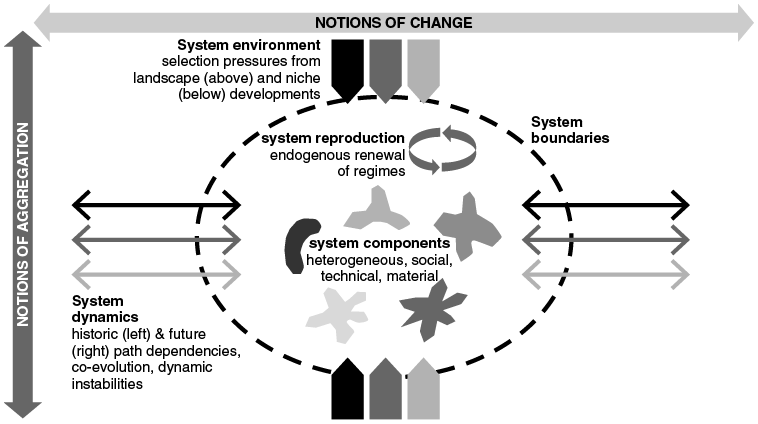
Beyond these ideas about system reproduction and systemic inertia, transitions research stands out for its exploration of dynamics of system change. Here, a key concept is the transitions S-curve, indicating shifting rates of change and innovation diffusion. Elaborating these system understandings further through insights from Complex Adaptive Systems, evolutionary economics, sociology, institutional theory and governance studies, transitions research has theorised the dynamic instability of the socio-technical ‘regimes’, the co-evolution between external pressures from system environments (e.g. ‘landscape’ pressures and emerging ‘niches’), internal dynamics (like ‘endogenous renewal’ of regimes) and system transformation ‘pathways’ that can be discerned across empirical contexts. Taken together, these insights have yielded a basic grammar of system transitions. Broadly shared by an interdisciplinary transitions research community and a wide range of practitioners as well, this systems vocabulary might be visualised as follows:
Figure 25.1 schematises some key features in this shared systems language. It shows how this system transformation vocabulary allows diverse actors to work together despite contrasting notions of system change (in multiple dimensions and modalities collapsed onto the horizontal axis) and of system aggregation (multiple dimensions and levels of aggregation collapsed onto the vertical axis). Frameworks such as the MLP, TIS and SNM have proposed more specific ideas about such features of systems ontologies. In particular, transition management (Rotmans, Reference Rotmans2005; Loorbach, Reference Loorbach2007) has been important in conceptualising transitions in terms of complex adaptive system dynamics (Grin et al., Reference Grin, Rotmans and Schot2010). Functioning implicitly as ‘boundary objects’ (Voß, Reference Voß2014), the elements represented in Figure 25.1 offer only a rough consensus. Throughout the past twenty-five years of transitions research, questions have arisen on all these elements:
What are the key system dynamics and how to underpin accounts of these? This is a longstanding question in transitions research, and notably in transition modelling. Through its disciplinary roots in integrated sustainability assessment and Complex Adaptive Systems research (Peter & Swilling, Reference Peter and Swilling2014), transitions research has always relied strongly on systems modelling approaches (Holtz et al., Reference Holtz, Alkemade, de Haan, Köhler and Trutnevyte2015). Intensively researched issues of system dynamics are the co-evolution patterns underlying transition pathways (Chapter 2), the dynamics of niche formation (Chapter 5) or the barriers and drivers in innovation systems (Chapter 4). After this ‘first wave’ (Chapter 24) of research on the transition dynamics themselves, the underpinning of the theorised system dynamics has been debated more in recent years (Sorrell, Reference Sorrell2018). A prominent example is Geels (Reference Geels2022), discussing different kinds of complex causal mechanisms.
How to transform the system? This line of questioning tends to accompany the aforementioned system dynamics questions (Grin et al., Reference Grin, Rotmans and Schot2010). This coupling of analysis and intervention is usual in systems thinking, operations research and management. The ‘how to transform’ issues have of course been considered extensively in transitions governance research (Chapter 3). Particularly noteworthy however are the specifically systems-analytical ideas on ‘tipping points’ and ‘intervention points’, in the tradition of Meadows’ (Reference Meadows1997) ‘leverage points’ in complex systems.
What is the system environment? In transitions theory, the system in focus is by default a ‘regime’, in interaction with various external ‘niche’ and ‘landscape’ processes. By contrast, analyses in terms of TIS or social practices zoom in on configurationally smaller systems (with socio-technical ‘regimes’ as the system’s environment). For its part, ‘deep transitions’ research (Chapter 7) rather zooms out. More generally, there is an intensifying reflection on the socio-material, political-economic, cultural, ideological and social-ecological system environments through which transition processes are shaped.
What are the system’s boundaries? Queries about system environments logically imply questions on the boundaries that separate systems from their environment. System demarcation is in fact a prominent line of questioning in its own right: Is it to be regarded as a ‘system innovation’, or is it just system optimization that innovates at the level of a subsystem? Such issues have been addressed in terms of ‘subsystems’ (Pel & Boons, Reference Pel and Boons2010), ‘whole system reconfiguration’ (McMeekin et al., Reference McMeekin, Geels and Hodson2019) and ‘multi-system interactions’ (Andersen & Geels, Reference Andersen and Geels2023).
What are the systems composed of? Figure 25.1 only sketches the general assumptions of heterogeneous, socio-technical ‘regimes’. Basic questions on system components tend to be taken for granted, however. When they are addressed, this typically occurs through a dialogue between sector-specific and more general transitions-theoretical insights. For example, Gaitán-Cremaschi et al. (Reference Gaitán-Cremaschi, Klerkx, Duncan, Trienekens, Huenchuleo, Dogliotti and Rossing2019) distinguish ‘agricultural production system’, ‘value chain’ and ‘support structures’ to specify the components of food systems. Holtz et al. (Reference Holtz, Brugnach and Pahl-Wostl2008) presented a more fundamental consideration of ‘regime’ components, and Svensson & Nikoleris (Reference Svensson and Nikoleris2018) initiated further discussion: How to develop causal explanations if we conceive of transitions as changes in rules and institutions? The relevance of material system components has been argued in the account of social-metabolic transitions by Fischer-Kowalski (Reference Fischer-Kowalski2011), a view on system components that is particularly relevant in the context of ‘circular economy’ transitions.
What is system reproduction? Questions on system components may appear rather formal, analytical matters. However, as Svensson & Nikoleris (Reference Svensson and Nikoleris2018) stressed, questions about system constitution are crucial if we want to distinguish system reproduction from system transition. Even if seldom undertaken through explicit systems thinking, questions on system reproduction form the core of research on transitions governance, politics and institutionalisation dynamics (Fuenfschilling & Truffer, Reference Fuenfschilling and Truffer2014). Highlighting the paradoxes, grey zones and ‘niche–regime dynamics’ (Chapter 9) of transition processes, these analyses contain urgent questions about what changes and what stays the same.
This overview summarises intensive explorations of the systems to be transformed. Yet beyond the above ‘what’ and ‘how’ questions, a further line of queries emerges. As underlined in second-order cybernetics, representations in the spirit of Figure 25.1 provide ‘first-order’ systems pictures: Meant to show a categorically objectified system ‘out there’, they downplay how such representations are shaped and coloured by the context of their respective system observers. (Krippendorff, Reference Krippendorff1996: 311) considered this difference essential: ‘To me, the shift from a first-order to a second-order cybernetics signaled a shift in scientific attitude toward reality, from privileging the perspectives of detached observers, spectators or engineers of a world outside of themselves to acknowledging our own participation in the world we observe and construct as its constituents’.
Transforming systems, a common systems vocabulary in transitions research
The systems that transitions thinking is dealing with are composed of people, Krippendorf reminds us. Yet many forms of system understanding are rather distant, objectifying people and speaking in the abstract of ‘them’. The conditions bearing on the kinds of representations people choose typically remain under-attended to. To remedy this, system analyses might more systematically disclose how different observers (and their different contexts of observation) tend to yield contrasting representations and framings of the same systems (Krippendorff, Reference Krippendorff1996: 314). System representations might thereby become more ‘plural and conditional’ (Stirling, Reference Stirling2008) – paying more balanced attention not just to a plurality of quite disparate system representations, but also to the particular political, cultural or institutional conditions that each embodies. This central importance of recognising how systems are ‘framed’ forms a key part of the ‘pathways approach’ to sustainability transformations (cf: figure 3.1 in Leach et al., Reference Leach, Stirling and Scoones2010).
As emphasised in participatory approaches to transition modelling (Köhler et al., Reference Köhler, Turnheim and Hodson2020), system analysis can take the form of a dialogue between transitions researchers and practitioners about the (mobility, energy, food or other) systems in which they are implicated. But the point here is not simply to aggregate into some supposedly transcendent ‘consensus view’ but to systematically elicit how contrasting equally valid political perspectives yield different system ontologies, epistemologies and normativities. Transitions analysis – no matter how authoritative it may seem – should never be treated as if it could stand definitively on its own (Saltelli et al., Reference Saltelli and Di Fiore2023), or as if it were exempt from thorough democratic deliberation (Stirling, Reference Stirling2024).
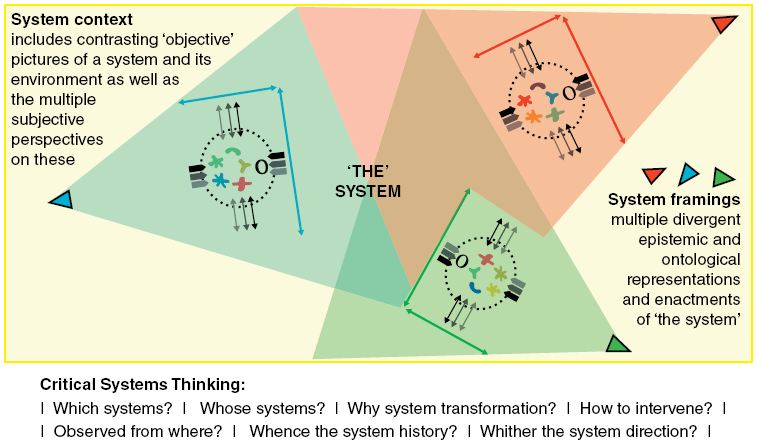
In keeping with this broader and deeper ‘second order’ systems view, Figure 25.2 displays three different framings of Figure 25.1. Different actors associated with diverse subjectivities across the ‘system context’ can make different assumptions about system components, system reproduction, transformation dynamics and system boundaries. This may lead them to widely different framings of transitioning systems – hence the visualisation in different colours. Likewise, as indicated through the arrows that define axes for each system view, they may analyse the systems along different epistemic, ontological and normative dimensions. As displayed at the bottom, this multiplicity of system framings raises a range of ‘boundary questions’ – the queries used in Critical Systems Thinking to disclose the different assumptions underlying system understandings (Ulrich, Reference Ulrich2003):
Which systems? The shift from first-order (Figure 25.1) to second-order (Figure 25.2) systems thinking implies a move away from questions about ‘what the system components, boundaries, dynamics are’. Rather than categorically assuming objective systems ‘out there’, it raises relational ‘which systems’ questions that acknowledge the existence of multiple valid representations. This way of speaking about systems is not uncommon in transitions research. It is one way to avoid the ‘reification trap’ (Ison, Reference Ison2016) of mistaking system representations for reality itself. An MLP analysis, for instance, can identify the main features of mobility systems, but its results do not show us ‘the mobility system’. ‘Which systems’ questions help to avoid ‘voyeuristic’, managerial (Walker & Shove, Reference Walker and Shove2007:219) systems thinking that are overconfident regarding system interventions.
Whose system representations count? Whose interests are reflected in system representations? The notion of ‘system failures’ is suggestive of objective states of affairs and agreed-upon problem. The same applies to common references to ‘the energy regime’ and ‘the incumbent actors’. This objectivism has been challenged particularly extensively in Smith & Stirling (Reference Smith and Stirling2010). Applying critical systems thinking to an empirical study on traffic management, Pel & Boons (Reference Pel and Boons2010) showed how transitions governance revolves around the re-definition of systems. This is in fact a key element of transition management (Loorbach, Reference Loorbach2007): Transition arenas and visioning activities are meant to instigate ‘second-loop learning’ and dialogue on systemic problems.
Why is system transformation needed? These ‘why’ questions tend especially to open up normative dimensions of transitioning systems. These normative dimensions often remain implicit, or hidden under global consensus on ‘sustainability’, ‘system lock-in’ and ‘institutional inertia’. ‘Why’ questions have been asked in various early critical interventions (Walker & Shove, Reference Walker and Shove2007; Bening et al., Reference Bening, Blum and Schmidt2015; Schlaile et al., Reference Schlaile, Urmetzer, Blok, Andersen, Timmermans, Mueller and Pyka2017), but these normative aspects of systems thinking are becoming particularly central issues in analyses of ‘just’ transitions. Especially relevant readings are ‘justice, equity, inclusion, and fair transitions’ (Chapter 16) and studies of the ‘dark sides’ of transitions (Pel et al., 2023).
How to intervene? Observed from where? As mentioned, Figure 25.2 highlights the position of the system observer. Jørgensen (Reference Jørgensen2012) pointed out similarly how societal actors can have widely divergent interpretations of the MLP. So: From which vantage point do we know and engage with the system? To help address this, Smith & Stirling (Reference Smith and Stirling2007) elaborated a distinction between ‘inside’ and ‘outside’ perspectives. Quite literal approaches to the ‘observing from where’ question were offered by Stirling (Reference Stirling2019) and Sovacool et al. (Reference Sovacool, Hess, Amir, Geels, Hirsh, Medina and Yearley2020), who argued for ‘worm eye’ modes of systems analysis. Similar arguments against transcendent, ‘ideal-observer’, ‘cockpit’ and ‘bird’s eye’ perspectives have been made in calls for ‘humility’, ‘situated analysis’, reflexive research (Chapter 27) and in (often participatory) transitions research that accounts for positionality.
Whence the system history? There is agreement that transitions are processes of change that take place over time. Figure 25.1 expresses this temporal aspect through the notions of system reproduction and system dynamics. Guided by ideas about transition processes between present and future system states, the transitions-theoretical systems thinking revolves around evolutionary mechanisms, such as niche development, selection pressures, emergence and co-evolution. Many studies work with a rather pragmatically chosen t = 0, but there are questions to ask about the start of system evolution: The ‘deep transitions’ framework (Chapter 7) proposes to start from ‘industrial modernity’, for example, but there are also more fundamental moves towards a plural understanding of system histories: Key examples are the analyses of temporality (Garud & Gehman, Reference Garud and Gehman2012) and engagements with coloniality (Ghosh et al., Reference Ghosh, Ramos-Mejía, Machado, Yuana and Schiller2021). Importantly, different histories lead to different system understandings (Balanzó-Guzmán & Ramos-Mejía, Reference Balanzó-Guzmán and Ramos-Mejía2023).
Whither the system direction? There are many ways of knowing systems: as a basis for future predictions or as a diagnosis of past transformations. Where the former tends to disclose possibilities and initiatives towards sustainability transitions, the latter tends to elicit lock-in, debt and injustice. Informed by historical case studies, transitions thinking has developed a distinctly prospective mode of systems thinking. A key element of transition management is indeed to evoke reflection on ‘whither the system direction’, through activities of problem structuring and visioning in transition arenas (Loorbach, Reference Loorbach2007). Scholarship on transitions directionality has underlined that this reflection on possible and desirable futures is indeed crucial for the transitions-theoretical systems thinking. It has long been observed that actors in system transitions can influence the direction for change by successfully articulating expectations (Brown & Michael, Reference Brown and Michael2002). Importantly, transition scholars’ own representations also raise expectations (Stirling, Reference Stirling2019). The ‘whither’ question is thus fundamental. It should not be reduced to a matter of ‘directing the transition towards the right direction’ (Stirling, Reference Stirling2024): Transitions research deals with systems that are not only complex as objects but also as performative representations (they create expectations).
Critical systems thinking: boundary questions in systems thinking
This overview already reveals how systems thinking forms a quite diverse methodological family. It gives rise to debates and controversies. Before going into these in Section 25.4, we briefly discuss empirical applications.
25.3 Empirical Application: System Transitions across Contexts
Transitions research has developed a systems language that helps to understand transformative change across contexts. It helps to compare ‘niche–regime’ dynamics (Chapter 9) or ‘strategic niche management’ (Chapter 5) across empirical domains. Featuring volumes on transitions in mobility, agriculture, energy and health systems, the KSI book series starting from Grin et al. (Reference Grin, Rotmans and Schot2010) illustrates this very well. Inversely, context-transcending models such as the MLP, TIS, SNM and transition management have been developed and validated through the comparison and formalisation of various historical case studies. Empirical application of the systems thinking has proven to be easy: This speaks to the proliferating multiplicity of adapted MLP or TIS diagrams, or schemes of transition management phases, that have been crafted to express case specifics.
Transitioning-systems language has been applied to a very wide range of empirical contexts: Beyond the many studies on functional systems of energy, mobility, agriculture and health, other remarkable examples are practices of burying and cremation, rock ‘n’ roll, animal welfare or earth-space engineering. Kanger (Reference Kanger2020) stresses how the study of such ‘neglected systems’ – even if less interesting in terms of environmental impacts – is likely to support theoretical advances. Also, the ‘geographical turn’ in transitions research (Chapters 21–23) has questioned how widely our systems language can be applied: Does it make sense to conceive of transformations in national systems, as if they were isolated processes? Is the idea of coherent, identifiable ‘regimes’ applicable beyond the (northwestern-) European context?
Throughout empirical domains and across the different strands of transitions research, we see many applications of critical systems thinking. Researchers and practitioners illuminate in many ways how the conceptualisation and demarcation of ‘systems’ tends to be neither obvious nor innocent: The ‘mobility system’, with its unsustainable fossil fuel dependency, is often represented as a sub-system of the energy system. Meanwhile, the mobility system has also been characterised by the regime of car dependence. Importantly, the latter system understanding refers to other mechanisms of system reproduction and other key system components than the former. In turn, these different ‘mobility system’ understandings lead to quite different evaluations of system innovation and system reproduction: Electric vehicles can be considered as radical ‘niches’ challenging the dominant design of the internal combustion motor, but they can also be considered as ‘techno fixes’ that essentially reproduce the car-dependency system. Meanwhile, it is not even obvious to characterise energy transition as a matter only of decarbonisation. Again, this underscores how greater reflection on the diversity of possible attributed system purposes – whether in terms of ‘energy democracy’ (Stirling, Reference Stirling2014) or wider ‘innovation democracy’ – supports accountable practices concerning system representations.
Studying transitions processes through systems analysis directs attention to very basic aspects of empirical situations. A most instructive application is the comparative analysis by Papachristos et al. (Reference Papachristos, Sofianos and Adamides2013). Starting from the common assumption that transitions are often triggered by particular ‘outsiders’, they revisited several of the well-known empirical cases that underpinned typologies of transition pathways. Considering concrete examples of ‘outsiders’ (e.g. medical doctors or the taxi sector), they explored a series of fundamental theoretical issues: The outsiders, in which sense are they external to the system under study? Should they perhaps be rather considered as parts of niches, spawned by the internal tensions of the ‘regime’, and as such as parts of the system under study? And if they are indeed to be considered as external to the system under study, are they then to be considered as niches challenging other, surrounding ‘regimes’?
Considering further that radical niches can come from within and from without, and that ‘regime’ shifts are partly resulting from the dynamics of other, surrounding systems – is it then not logical that we see empirical examples of newly emerging systems, such as the functional foods ‘niche’, or the computer regime (ibidem.: 62)? And these newly emerging systems, how can we distinguish them from their ‘parent systems’? Rigorously examining empirical cases for their systemic properties, this study laid important foundations for later explorations of ‘multi-system interactions’ (Andersen & Geels, Reference Andersen and Geels2023). Importantly, it also provided a good demonstration of CST: The analysis of ‘multi-system interactions’ presupposes a series of assumptions about insiders and outsiders, about system boundaries, about exogenous and endogenous ‘drivers’ of change, and about the supposed ‘functions’ of systems and technologies. An instructive example from Papachristos et al. (Reference Papachristos, Sofianos and Adamides2013) was the ‘functional foods’: Should they be analysed as derivative of foods or of pharmaceutical products, as a hybrid between these two, or as something entirely different altogether?
25.4 Ongoing Debates: Adequacy, Politics and Plural Perspectives
Regarding ongoing debates, a first observation is perhaps that many accounts of ‘system transitions’ lack specific reference to any concrete, bounded, empirical system. A certain common understanding has developed around socio-technical ‘regimes’, their components and the co-evolution dynamics of system transitions, but the systems vocabulary is seldom operationalised in detail. This is reflected in a tendency towards relatively casual references to ‘outsiders’ or ‘endogenous change’ (Section 25.3).
This relative absence of systematic debate is noteworthy, but we have also seen a quite thorough exploration of systems and system understandings (Section 25.2). The engagements with the boundary questions have opened up scientific debates and indeed controversies. As expressed through the Figures 25.1 and 25.2, one can raise different kinds of questions about ‘systems’ in transitions. The questions we raise reflect fundamental ontological and epistemological assumptions, as well as contrasting patterns of normative interest in systems: Systems can be taken as analytical constructs for modelling, as coding devices for case comparison, as representations of governance issues, or as resources for policy advocacy. As Krippendorff (Reference Krippendorff1996) stressed, first-order and second-order systems thinking really raise different questions and perspectives. It makes a difference whether one takes an ‘eagle eye’ or a ‘worm eye’ perspective.
Overall, we can see three main debates about the systems-in-transitions thinking. These debates are connected in terms of theoretical and practical implications, yet scholars tend to engage in them out of different knowledge interests. The debates unfold to a certain extent in parallel.
(1) Ontological adequacy. In first-order systems thinking, ‘what’ and ‘how’ questions predominate. This involves intensive debates about the social-technical-ecological constitution of the systems to transform (‘how about economic sectors, socio-economic classes, geographic regions, or geo-morphological layers?’), and about the underpinnings of theorized transition dynamics (‘how useful is the focus on rules/institutions for transition analysis, what about material impacts?’). These debates have yielded a rich systems-theoretical body of knowledge on units and levels of transitions analysis, systems-of-systems, whole-systems analysis, subsystem innovation and multi-system interactions. These debates are driven mostly by scholars engaged in theory development, and by the transitions modelling community. While the discussions on transitions ontologies involve an increasingly diversified transitions research field, the modelling community plays a key role in the formalisation of the ‘systems’ under study.
(2) Normative-political implications. The ‘which’, ‘why’ and ‘whose’ systems questions have gained attention, especially in research on transitions governance and politics. A recurring issue is whether prevailing system representations are giving appropriate, balanced and fair accounts of systemic problems and solutions. Are the representations of systems challenging or reproducing dominant actor constellations, interests and discourses? Whose system definitions count? In the politics-focused approaches and in ‘just’ transitions scholarship, a central issue is who gets to define the system. This marks to a certain extent the shift from Figure 25.1 (representing the singular system ‘out there’) to Figure 25.2 (representing plurality of system understandings). On the other hand, some of these debates stay within first-order systems thinking. This is the case for example when dominant system representations are dismissed as ‘false’ system representations.
(3) Plural perspectives. Finally, there is the dispersed but ongoing engagement with the ‘whence’, ‘whither’ and ‘observed from where’ lines of questioning. These are the typical second-order systems thinking questions of Figure 25.2, starting from the diversity of system understandings. A key issue is the position of the actor defining the system, and related to this, the many subtle ways in which system definitions introduce assumptions of expertise, overview and control. The system’s language itself carries a certain technocratic temptation, a mindset of overview and control (Stirling, Reference Stirling2019). An increasingly prominent question is therefore (see also Chapter 23 on the Global South and North): How are system representations articulating or suppressing epistemic diversity? The debates on epistemic diversity involve engagements with entirely different approaches to sustainable development, such as political ecology. This deepens transitions research through questions such as the following: Is the ‘systems’ notion at all compatible with the handling of complex transformation processes, and with the heterogeneity of social-ecological networks? Should we perhaps understand transitions in terms of networks, arenas, processes, flows, webs or fields? It is worth noting how this line of questioning links back into the debates on ontological adequacy.
25.5 Emerging Research and Further Needs
Systems thinking is fundamental for transitions research – the cross-references to other chapters have underlined this. The vocabulary of transitioning systems has helped to develop our highly interdisciplinary transitions research community. The notion of ‘the system’ is easily taken for granted, however. This chapter has shown how casual references to ‘outsiders’, ‘endogenous change’ and ‘system transformations’ call for greater clarity about systems and system representations. Invoking Critical Systems Thinking, we have also shown how some transitions research has developed quite rich debates around various ‘boundary questions’ about the ‘systems’ in transition (Section 25.2). This systems thinking tradition provides useful methodological resources for the investigation and comparison of diverse transition cases (Section 25.3).
Regarding the emergence of promising lines of research and further needs, it is important to recognise the notable advances that are already being made. There is some shared critical awareness of the ‘reification trap’, that is, of assuming system understandings to be obvious and beyond discussion. First-order systems thinking still prevails as a norm for its capacity to make complexity tractable, but it is generally accompanied with at least some second-order systems thinking awareness. System models and theories tend to be presented cautiously as ‘frameworks’ or ‘perspectives’, for example, and there have been many efforts to articulate the variety of system understandings. We have indicated various newly emerging themes, but the debates over ontological adequacy, normative-political implications and epistemic diversity also indicate an already longstanding tradition of systems thinking (Section 25.4).
In more operational terms, it is noteworthy to see how researchers in transition modelling and scenario development are developing iterative, participatory approaches (Köhler et al., Reference Köhler, Turnheim and Hodson2020). This shows in a nutshell how reflection on first-order and second-order systems thinking can be applied and valorised. Also encouraging is the emergence of methodologies for addressing epistemic diversity, such as multi-criteria analysis, ‘quantitative storytelling’ (Kovacic et al., Reference Kovacic, Strand and Völker2019) or critical innovation studies (Godin & Vinck, Reference Godin and Vinck2017). Finally, there is also transitions research that is clearly in the second-order systems spirit of Krippendorff (Reference Krippendorff1996), highlighting how appraisal itself forms part of the transitioning systems being studied. This includes studies on the performativity of the ‘transition management’ governance model (Voß, Reference Voß2014) and its susceptibility to inadvertent influence by incumbent interests (Stirling, Reference Stirling2019). Such second-order systems thinking approaches remind us of the fundamental democratisation issues that transitions research itself is raising – through the circulation of system representations (Stirling, Reference Stirling2024).
Regarding ‘further needs’, it must be stressed in critical systems thinking mode that no ‘advance’ can be considered definitive, self-evident or unambiguous. Figures 25.1 and 25.2 indicate an important epistemological move towards second-order systems thinking. The awareness of this inescapable subjectivity is a fundamental advance in systems thinking. Still, these first and second orders should not be mistaken for hierarchical orders: as shown, they indicate different modes of asking questions about systems. The three debates distinguished in Section 25.4 should similarly not be taken as progressive ‘stages of reflection’. This would neglect how the various ‘what’, ‘which’ and ‘whose’ questions evoke each other. As already elaborated under the banners of ‘double-loop learning’ (Argyris, Reference Argyris1977), Soft Systems Methodology (Checkland & Scholes, Reference Checkland and Scholes1999) and indeed Critical Systems Thinking (Ulrich, Reference Ulrich2003), any of these questions can be the start of a dialogue about the ‘systems’ to be transitioned. This chapter has provided concepts, themes and search terms that support this.
26.1 Introduction
Sustainability transitions research focuses on understanding and fostering fundamental change processes in our human systems and making our societies more sustainable. It is urgent that these system transitions need to increase in scope, scale and speed, as highlighted by the IPCC’s 2018 Special Report on limiting warming to 1.5°C (de Coninck et al., Reference De Coninck, Revi, Babiker, Bertoldi, Buckeridge, Cartwright, Dong, Ford, Fuss, Hourcade, Ley, Mechler, Newman, Revokatova, Schultz, Steg, Sugiyama, Araos, Bakker and Bazaz2018). Interventions in our human systems intended to bring about the necessary transitions have to come from a systems-based view that accounts for interactions within and across systems (Andersen and Geels, Reference Andersen and Geels2023; Köhler et al., Reference Köhler, Geels, Kern, Markard, Wieczorek, Alkemade, Avelino, Bergek, Boons, Fünfschilling, Hess, Holtz, Hyysalo, Jenkins, Kivimaa, Martiskainen, McMeekin, Mühlemeier, Nykvist, Onsongo, Pel, Raven, Rohracher, Sandén, Schot, Sovacool, Turnheim, Welch and Wells2019; Papachristos et al., Reference Papachristos, Sofianos and Adamides2013). While the sustainability transitions field has developed its own theoretical frameworks and related approaches, such as the multi-level perspective (MLP, see Chapter 2) and technological innovation systems (TIS, see Chapter 4), it has also benefited significantly from insights drawn from complexity science and systems thinking. This chapter examines how complexity science and systems thinking approaches can enhance our understanding of sustainability transitions. These approaches are particularly valuable because they provide frameworks and tools for the analysis of interactions, feedback loops and emergent behaviours that characterise transition processes.
This chapter provides a cursory review of how the sustainability transitions literature builds on other systems-oriented approaches, specifically complex systems approaches and system dynamics. It outlines their link to the main theoretical sustainability transitions approaches and describes the extent to which insights from different systems approaches have been applied and have informed transition research. The chapter first explores how systems thinking has informed our conceptualisation of socio-technical systems and innovation systems. We then examine how complexity science and system dynamics approaches help us understand transition dynamics, particularly through concepts like path dependence, feedback loops and emergent behaviour. Finally, we discuss and illustrate through specific case studies the practical application of these approaches in transition research and policymaking. For early career researchers, this chapter provides conceptual tools for transitions analysis through systems thinking. By understanding systems approaches, researchers can better grasp how different elements of transitions interact and how these interactions influence transition processes.
The unit of analysis in transitions research is the socio-technical system and the way it undergoes fundamental change towards a more sustainable direction. Transitions literature builds on insights from systems science, science and technology studies (Bijker, Reference Bijker1997; Bijker et al., Reference Bijker, Hughes and Pinch2012) and evolutionary economics (Nelson and Winter, Reference Nelson and Winter1982), as well as frameworks such as Large Technical Systems (Hughes, Reference Hughes1993). In systems science (Boulding, Reference Boulding1956; Forrester, Reference Forrester1968; Von Bertalanffy, Reference Von Bertalanffy1968), a system is conceptualised as consisting of diverse and interacting elements that adhere to a set of rules and form part of system mechanisms that serve a particular function. The interdependence of system elements leads to understanding socio-technical systems as complex adaptive systems (Miller and Page, Reference Miller and Page2007), where system behaviour emerges out of system elements interactions and the operation of several mechanisms.
In line with this systems-based view, a socio-technical system is defined as the actors, technologies and infrastructures that provide key societal functions like energy or mobility provision as well as the formal and informal institutions that govern their interaction (Geels, Reference Geels2002). A defining characteristic of socio-technical systems is the high degree of interdependence between their components and groups of actors, which develop and evolve over time through multiple feedback processes (Geels, Reference Geels2005; Smith et al., Reference Smith, Voss and Grin2010). The strong interdependence of all system elements requires a high level of coordination and alignment between them to enable the system to function. This has two implications. First, the tight coordination and alignment between elements make the system resistant to change. Second, a high level of interdependence between actors, technologies, infrastructures and institutions makes understanding systems difficult by looking at the behaviour of individual elements, for example, actors or technologies. The implication is that system change is difficult even when change is desirable and urgent. This is a notion that transition research takes into account in theory development and case analysis, as discussed in Section 26.2.
26.2 Researching System Interactions and Transitions
Understanding how socio-technical systems change requires examining the complex interactions and feedback mechanisms and understanding how they can either drive or inhibit transitions (Geels, Reference Geels2022; Papachristos, Reference Papachristos2014; Reference Papachristos2018; Reference Papachristos and Adamides2019; Sorrell, Reference Sorrell2018). This is the aim of two established frameworks for transitions research discussed in the following paragraphs. This section then focuses on how different types of interactions can shape transition dynamics and non-linear system behaviour.
26.2.1 Theoretical Frameworks for Understanding System Change
Two prominent theoretical frameworks that have been widely applied to the study of transition processes are the MLP and TIS (Köhler et al., Reference Köhler, Geels, Kern, Markard, Wieczorek, Alkemade, Avelino, Bergek, Boons, Fünfschilling, Hess, Holtz, Hyysalo, Jenkins, Kivimaa, Martiskainen, McMeekin, Mühlemeier, Nykvist, Onsongo, Pel, Raven, Rohracher, Sandén, Schot, Sovacool, Turnheim, Welch and Wells2019). The first framework applied to the study of transitions is the TIS, which offers a complementary perspective. A TIS includes the actors and institutions that together aim to stimulate the development and diffusion of a certain sustainable innovation, typically a technology. Here studies focus on the structure and functions of the system and the presence of relevant actors. Seven important system functions have been identified in the literature: entrepreneurial activities, knowledge development and knowledge diffusion, guidance of the search, market formation, resource mobilisation and creating legitimacy (Hekkert et al., Reference Hekkert, Suurs, Negro, Kuhlman and Smits2007; Negro et al., Reference Negro, Alkemade and Hekkert2012). In early TIS studies, these systems were typically analysed within a specific geographical context. The approach has led to useful insights in what went well and what went wrong in specific case studies and especially important in the context of this chapter, the approach has also led to the identification of typical interaction patterns, labelled motors of innovation that drive the development of a TIS (Walrave and Raven, Reference Walrave and Raven2016). The approach has been criticised for not explicitly taking into account contextual factors that arise outside the boundaries of the TIS, something of particular relevance when key developments are international. In this respect, it is necessary to discern conceptually whether the focal unit of analysis concerns local or global innovation systems (Binz and Truffer, Reference Binz and Truffer2017). For policymakers that seek to strengthen local innovative capacity, such distinctions between local and global innovation systems are key (Li et al., Reference Li, Heimeriks and Alkemade2020; van den Berge et al., Reference van den Berge, Weterings and Alkemade2020).
The second framework is the MLP (Geels and Schot, Reference Geels and Schot2007, see also Chapter 2), which is used to study system transitions by focusing on the interactions between the regime that represents the incumbent system and the niche where novel alternatives to the current system are developed and nurtured. Because of the path dependence and inertia present in socio-technical systems, typically pressure from within the system (a loss of legitimacy or changing preferences) or exogenous shocks (the oil crisis) are necessary for system change. The MLP has received critique on several theoretical and methodological issues (Genus and Coles, Reference Genus and Coles2008) and it has been refined as a result in later publications (Geels, Reference Geels2011; Geels et al., Reference Geels, Kern, Fuchs, Hinderer, Kungl, Mylan, Neukirch and Wassermann2016).
Transitions in the MLP framework come about when there is a shift in the balance of self-reinforcing loops that drive change in a system and destabilise it, and those drive it towards stability and a lock-in state. The system is destabilised through interactions of developments that take place at three levels (Geels and Schot, Reference Geels and Schot2007): (1) innovations that may develop in system internal niches through learning processes, price/performance improvements and support from powerful groups or come from external niches through speciation (Papachristos et al., Reference Papachristos, Papadonikolaki and Morgan2024), (2) pressures that events may generate or trends at the landscape level that act on the regime (economic, cultural, demographic and other), (3) internal regime tensions that can accumulate and create windows of opportunity for innovations in niches and (4) external influence from other systems, regimes or niches (Papachristos et al., Reference Papachristos, Sofianos and Adamides2013). A transition can then accelerate when the alignment of visions and activities of different actor groups in the system acts to further strengthen the feedback loops that drive change in the system. The transition is finally completed when the social and technical aspects of novel innovations become embedded in the new socio-technical system.
The complex systems literature offers detailed theoretical models of transitions or fundamental changes in system behaviour; such changes can often be quite rapid and irreversible (Scheffer, Reference Scheffer2009; Scheffer et al., Reference Scheffer, van Bavel, van de Leemput and van Nes2017). Non-linear dynamics are also at the core of innovation studies and transitions studies, but the different types of interactions and feedbacks are typically studied qualitatively and in isolation (Chilvers et al., Reference Chilvers, Bellamy, Pallett and Hargreaves2021; Edmondson et al., Reference Edmondson, Kern and Rogge2019; Gillard et al., Reference Gillard, Gouldson, Paavola and Van Alstine2016; Roberts et al., Reference Roberts, Geels, Lockwood, Newell, Schmitz, Turnheim and Jordan2018; Rosenbloom et al., Reference Rosenbloom, Meadowcroft and Cashore2019). In short, the transitions literature is rife with suggestions on how non-linear interactions and their timing matter, and it provides detailed empirical insights on the effects of such interactions on individual socio-technical transitions. These qualitative studies were followed by more quantitative studies that systematically mapped these interactions and feedbacks (Papachristos and Adamides, Reference Papachristos and Adamides2016; Papachristos, Reference Papachristos2018).
Sustainability transitions are increasingly studied through qualitative and quantitative approaches to the different types of interactions that link socio-technical transitions in different domains and on different scales through concepts such as multi-scalarity, functional and structural couplings (Binz and Truffer, Reference Binz and Truffer2017; Miörner and Binz, Reference Miörner and Binz2021). For example, Walrave and Raven (Reference Walrave and Raven2016) develop a simulation model based on the seven functions of the TIS framework (Bergek et al., Reference Bergek, Jacobsson, Carlsson, Lindmark and Rickne2008; Hekkert et al., Reference Hekkert, Suurs, Negro, Kuhlman and Smits2007). They investigate how TIS emerge or decline in the context of the four socio-technical transition pathways stipulated in the MLP (Geels and Schot, Reference Geels and Schot2007). Walrave and Raven (Reference Walrave and Raven2016) identify through a series of tests the tipping point for the eventual emergence and self-sustaining dynamics or decline of a TIS. The tipping point is crossed when the self-reinforcing mechanisms of the TIS are no longer counteracted sufficiently by the regime’s resistance to change. The result is the emergence of a self-sustaining niche market. In contrast, if this point is not reached, the TIS will decline and disappear.
26.2.2 System Interactions and Feedback Loops
The study of interactions between technologies and the feedback loops that form around them is important as they are directly linked to the pace of transitions. Several of the feedbacks that underlie transitions have been widely studied and have been quantified to some extent also in different literatures, including innovation sciences and energy science. The main self-reinforcing feedback for many modular energy technologies, especially in wind and solar energy generation, is cost reduction and performance improvement through economies of learning and economies of scale, leading to more deployment and, in turn, to more learning (Kavlak et al., Reference Kavlak, McNerney and Trancik2018; Nemet and Greene, Reference Nemet and Greene2022; Sharpe and Lenton, Reference Sharpe and Lenton2021). For example, the German feed-in tariff for renewables is frequently mentioned as an enabling condition for this feedback (Otto et al., Reference Otto, Donges, Cremades, Bhowmik, Hewitt, Lucht, Rockström, Allerberger, McCaffrey, Doe, Lenferna, Morán, van Vuuren and Schellnhuber2020). The cost reductions in renewable generation technologies like wind energy and solar photovoltaics (PV) have been massive and took place much faster than predicted. As a result, renewables are now among the cheapest energy generation options (IEA, 2022, IRENA 2022, Haegel et al., Reference Haegel, Atwater, Barnes, Breyer, Burrell, Chiang, De Wolf, Dimmler, Feldman, Glunz, Goldschmidt, Hochschild, Inzunza, Kaizuka, Kroposki, Kurtz, Leu, Margolis, Matsubara, Metz, Metzger, Morjaria, Niki, Nowak, Peters, Philipps, Reindl, Richter, Rose, Sakurai, Schlatmann, Shikano, Sinke, Sinton, Stanbery, Topic, Tumas, Ueda, van de Lagemaat, Verlinden, 492Vetter, Warren, Werner, Yamaguchi and Bett2019).
The cost-performance feedback loop is not the only self-reinforcing feedback that drives system change and the development dynamics for wind and solar (Alkemade et al., Reference Alkemade, de Bruin, El-Feiaz, Pasimeni, Niamir and Wade2024). For instance, there is a proximity effect in the diffusion of rooftop solar PV whereby its adoption by people is more likely in areas where there are other adopters in proximity (Graziano and Gillingham, Reference Graziano and Gillingham2014; van der Kam et al., Reference van der Kam, Meelen, van Sark and Alkemade2018). This suggests that diffusion is partly a social process influenced by, for example, observability, trialability and word-of-mouth (Rogers, Reference Rogers1983). Moreover, markets are still expanding as performance improvements make the technology attractive to a wider range of users. As a result of these technological improvements and cost reductions, renewable energy generation is increasingly possible in locations where wind or sun conditions are less favourable or where installation is more difficult and costly. The increasing attention to floating solar illustrates this point. In addition, another positive feedback loop stems from policy interactions, whereby policy creates legitimacy and new interests, leading to increased lobbying and support for policy (Meckling et al., Reference Meckling, Sterner and Wagner2017; Roberts et al., Reference Roberts, Geels, Lockwood, Newell, Schmitz, Turnheim and Jordan2018; Rosenbloom et al., Reference Rosenbloom, Meadowcroft and Cashore2019; Sewerin et al., Reference Sewerin, Béland and Cashore2020). The reason why so much attention is devoted to self-reinforcing feedback loop is that they generate system path dependence that makes system change more difficult.
26.2.3 Path Dependence of Systems in Transition
The path dependence of socio-technical systems sits at the core of the transitions research program, and it traces its origin to evolutionary economics, as is the case with several other key ideas (Geels, Reference Geels2020). Path dependence is considered instrumental in shaping transition processes and related efforts of system change, under both the MLP and TIS frameworks. Path dependence is a mechanism in transition processes that connects the past and the future at the macro level of institutions, at the meso level of technology and governance modes and at the micro level of organisational resources and capabilities (Vergne and Durand, Reference Vergne and Durand2010). Thus, it is instrumental for transitions research because it essentially concerns processes of system lock-in and change, for example, the lock-in of socio-technical systems in fossil fuel-based technologies (Unruh, Reference Unruh2000).
Path dependence occurs when small changes in events become reinforced and lead to very different system-level outcomes and to very different system states termed lock-ins that persist in time (Arthur, Reference Arthur1989; Garud and Karnøe, Reference Garud and Karnøe2001). The sources of path dependence in transitions include increasing returns to scale and learning (Arthur, Reference Arthur1989; Levitt and March, Reference Levitt and March1988; Levinthal and March, Reference Levinthal and March1993). Path dependence arises also in systems from sunk costs in existing infrastructure and technologies, which create significant financial and material increasing returns to scale and thus barriers to system change. These investments are often of substantial economic value and reflect commitment on the part of incumbent actors to a particular course of action, which tends to shape the organisational structure of the system and makes other technology alternatives less attractive. It thus shapes also the physical structure of the system over the long term. Thus, a state of lock-in arises out of the interactions of actors, technologies and infrastructures that operate as parts of powerful self-reinforcing mechanisms and effectively ‘select out’ in a progressive manner any alternative technologies or courses of action (Klitkou et al., Reference Klitkou, Bolwig, Hansen and Wessberg2015; Onufrey and Bergek, Reference Onufrey and Bergek2015; Seto et al., Reference Seto, Davis, Mitchell, Stokes, Unruh and Ürge-Vorsatz2016).
Path dependence has been studied and observed in many past transitions, but the study of contemporary transitions quite often focuses on a single transition pathway and ways to create new ones away from lock-in and toward sustainability (Köhler et al., Reference Köhler, Geels, Kern, Markard, Wieczorek, Alkemade, Avelino, Bergek, Boons, Fünfschilling, Hess, Holtz, Hyysalo, Jenkins, Kivimaa, Martiskainen, McMeekin, Mühlemeier, Nykvist, Onsongo, Pel, Raven, Rohracher, Sandén, Schot, Sovacool, Turnheim, Welch and Wells2019). For example, transitions in large technical systems such as transport and energy are characterised by path dependence (Dangerman and Schellnhuber, Reference Dangerman and Schellnhuber2013; Klitkou et al., Reference Klitkou, Bolwig, Hansen and Wessberg2015). In general, change in path-dependent systems away from a state of lock-in is difficult because of self-reinforcing mechanisms of increasing returns to adoption (Vergne and Durand, Reference Vergne and Durand2010). Processes of increasing returns to adoption can quickly lead a system to an inefficient pathway, and the idea is best illustrated in literature with the canonical examples of QWERTY and DVORAK keyboards (David, Reference David1985; Liebowitz and Margolis, Reference Liebowitz and Margolis1990), and VHS vs. Betamax (Arthur, Reference Arthur1989; Cusumano et al., Reference Cusumano, Mylonadis and Rosenbloom1992). Thus, the notion that markets ‘know best’ and leaving path-dependent systems to their own devices is not nearly enough to achieve real change in our current mobility patterns.
For example, the source of balancing feedbacks that oppose system change and reinforce the path dependence of fossil fuel-based energy systems are energy infrastructures, technologies and institutions (Hughes, Reference Hughes, Bijker, Hughes and Pinch1987; Köhler et al., Reference Köhler, Geels, Kern, Markard, Wieczorek, Alkemade, Avelino, Bergek, Boons, Fünfschilling, Hess, Holtz, Hyysalo, Jenkins, Kivimaa, Martiskainen, McMeekin, Mühlemeier, Nykvist, Onsongo, Pel, Raven, Rohracher, Sandén, Schot, Sovacool, Turnheim, Welch and Wells2019). Energy infrastructures are typically built for a lifespan of around 40 years, and changing these infrastructures takes place on the timescale of months to years. Once built, they contribute to stabilising the system state and are a source of path dependence and lock-in. These can directly hinder change and the decarbonisation of the energy system through existing standards and resistance from incumbents and vested interests. The availability of cheap energy indirectly stimulates demand for energy-intensive goods and services. Similarly, the high return on fossil fuel investments and the assessment of renewables as risky make it difficult to move capital from fossil fuels to renewables (Pauw et al., Reference Pauw, Moslener, Zamarioli, Amerasinghe, Atela, Affana, Buchner, Klein, Mbeva, Puri, Roberts, Shawoo, Watson and Weikmans2022). In addition, social dynamics can also create balancing feedbacks when they mobilise opposition and a lack of societal support for larger-scale solar and wind parks (Devine-Wright, Reference Devine-Wright2011; Klok et al., Reference Klok, Kirkels and Alkemade2023; Windemer, Reference Windemer2023). In this respect, a complication arises in that change in the behaviour of system actors can be quite swift and frequent, but other parts of it such as infrastructure are slower to change. It is thereby important to realise that different feedback loops work on different timescales.
A way to counter the lock-in tendency of path-dependent processes and effect real change is the introduction of more diversity in a system, technological and/or otherwise, which can potentially set in motion new mechanisms of increasing returns to scale (Papachristos, Reference Papachristos2017). In transitions research, this is done in niches that are shielded from market forces (Smith and Raven, Reference Smith and Raven2012) or through recombination of knowledge (Kogut and Zander, Reference Kogut and Zander1992) and technologies (van den Bergh, Reference van den Bergh2008), or through the speciation of new technologies from one domain of application into another, potentially followed by new firm entry (Levinthal, Reference Levinthal1998; Papachristos et al., Reference Papachristos, Papadonikolaki and Morgan2024), or multi-system interactions (Papachristos et al., Reference Papachristos, Sofianos and Adamides2013).
All of these types of system interventions constitute, in effect, parts of a transformation process because they bring about a change in the diversity of system options that are available to shape its future trajectory. They can succeed to the extent that they bring about a change in the ensemble of feedbacks that drive change and those that oppose it so that the operation of self-reinforcing mechanisms in the aggregate favours the success of system interventions. It follows that a key policy challenge is attending to and modulating the balance between the feedbacks that drive change and those that oppose it. In this respect, the MLP emphasises how niche innovations can challenge system stability, and TIS focuses on developing functional innovation systems, both frameworks point to a critical policy challenge: how to promote sustainable alternatives without leading the system into new lock-ins. These are key concerns for policymakers that seek to advance new, more sustainable alternatives.
A specific concern for policymaking that is insufficiently addressed relates to competition and choice between different technological options. While mission-oriented and effectiveness-oriented policy approaches increasingly allow for policies that are not technology neutral, this also raises concerns about creating the conditions for new lock-ins (Meckling et al., Reference Meckling, Sterner and Wagner2017) instead of having and maintaining sufficient diversity in a system (Van den Bergh, Reference van den Bergh2008). Technology assessment traditionally focuses on comparing the desirability of alternative technological options. Under this perspective, the transition path to be followed in the future is dictated by the technological alternative that is preferable at present.
This approach to technological transitions faces two problems. First, the future performance of systems that are developed and centred around alternative technological options remains uncertain. Initial transition steps early on a particular path may cut off alternative paths due to the path dependence and the irreversible nature of technological development (Arthur, Reference Arthur1989; Cowan, Reference Cowan1990; David, Reference David1985). However, such alternative paths may turn out to be more desirable at a future moment in time, when new information becomes available, but at that juncture it will be difficult to re-orient the system into a new transition path. Second, societal preferences may change during a transition process (Pinch and Bijker, Reference Pinch and Bijker1984) and induce a reversal of the transition process that will waste time and resources.
26.3 Examples of Application of Complexity and System Dynamics Approaches
26.3.1 Complex Systems Approach to Transitions
A complex systems approach to transitions can be of particular relevance as the core metaphor it offers is that of a system in a transition pathway and its need to adapt continuously. In evolutionary terms, the fitness of the system has to be maintained at high levels through continuous adaptation, in effect steering the system in a fitness landscape. This is an entry point to conceptualise policy design as a process of search and evaluation of a range of technological options. Toward this, Alkemade et al. (Reference Alkemade, Frenken, Hekkert and Schwoon2009) used a complex systems approach for technology assessment based on the concept of rugged fitness landscapes (Kauffman, Reference Kauffman1993), which takes into account the path dependence and irreversibility that is inherent to technological transitions.
Complex technological systems contain several interdependent subsystems that function in a coherent manner (Hughes, Reference Hughes1993; Rosenberg, Reference Rosenberg1969; Silverberg and Verspagen, Reference Silverberg and Verspagen2005; Simon, Reference Simon1969; Vincenti, Reference Vincenti1990). Interdependencies between subsystems render the performance or fitness of the overall system dependent on the specific combination of the subsystems. All possible combinations form the state space or design space of the technological system. The combinatorial logic of assembling systems from subsystems implies that the number of possible designs that can be assembled from only a small set of subsystems is large. For example, a system with only ten elements, each of which can be designed in two ways, has a design space of 210 = 1,024 possible designs. Depicting technological change as a search process within a design space captures the idea that future technological systems can be represented as combinations of known subsystems. Empirical studies of technological change have shown that many innovations indeed occurred through the combination of existing subsystem technologies (Frenken, Reference Frenken2006). Complex systems theory provides us with models to study the effects of interdependencies among subsystems on combinatorial search processes.
Complex technological systems are characterised by rugged fitness landscapes with local optima reflecting compromises between conflicting constraints. In this framework, flexibility can be defined in two ways. First, initial transition steps should be robust in the case of changing evidence regarding the ‘fitness’ (performance) of alternative technological options. Changing evidence can be dealt with by maximising the number of local optima that can still be reached after an initial transition step and by maximising the number of possible paths toward each local optimum after an initial transition step has been taken. Second, initial transition steps should be robust to changing preferences to avoid a reversal of the transition process. Changing preferences can be dealt with by pursuing an initial transition step that yields an improvement regarding all preferences (Pareto improvement).
26.3.2 System Dynamics Modelling of Transitions
System dynamics is another systems approach for the study of interdependence of system elements in contemporary transitions research (Holtz et al., Reference Holtz, Alkemade, De Haan, Köhler, Trutnevyte, Luthe, Halbe, Papachristos, Chappin, Kwakkel and Ruutu2015; Köhler et al., Reference Köhler, De Haan, Holtz, Kubeczko, Moallemi, Papachristos and Chappin2018; Papachristos, Reference Papachristos2019; Papachristos and Struben, Reference Papachristos, Struben, Moallemi and De Haan2019; Sterman, Reference Sterman2000). Contemporary transitions to sustainability differ from historical ones in that processes of growth and increasing carbon intensity cannot be allowed to continue unfettered, in contrast to what happened in cases of historical transitions (Fouquet and Pearson, Reference Fouquet and Pearson2012; Papachristos, Reference Papachristos2014). Thus, the study of contemporary transitions requires an endogenous perspective to identify those drivers of feedback loops that offer the best leverage for system reorientation toward a desirable future direction. System dynamics offers precisely this endogenous perspective as the basis of inquiry (Papachristos, Reference Papachristos2012, Reference Papachristos2019; Richardson, Reference Richardson2011). The knowledge of these leverage points can be used to anticipate and change system transitions trajectories, avoid niche lock-in to unsustainable developments or unlock existing regimes (Smith et al., Reference Smith, Voss and Grin2010). System trajectories can be purposefully steered when this knowledge is applied to raise the aggregate intensity of the feedback loops that drive the transition process over the intensity of the loops that tend to keep the system in its current state (Papachristos, Reference Papachristos2011, Reference Papachristos2014; Papachristos and Adamides, Reference Papachristos and Adamides2016; Papachristos and van de Kaa, Reference Papachristos and van de Kaa2018). This is a threshold that consists of many separate institutional, market and societal tipping points. Their number and idiosyncratic characteristics make the transition process seem incremental.
26.4 Conclusions and Future Research Directions
While insights from complexity science on path dependence and uncertainty have been embraced by historical studies of transitions, this is much less so for future-oriented studies. Especially TIS approaches often operate with an implicit assumption that the system under study is desirable and should be stimulated. The approaches outlined in this chapter offer well-tested methods to incorporate some of the complexity arising from interactions between systems in our analyses. The systems approaches discussed in this chapter create opportunities for better connection with other communities investigating transition pathways. For example, in climate science, where modelling approaches are much more common, these methods can help bridge different analytical traditions. This integration is particularly valuable as transitions research increasingly engages with urgent climate challenges. It also makes it easier to connect to other communities that investigate transition pathways such as climate science where modelling approaches are much more common.
A crucial methodological challenge in transitions research is connecting models that operate on very different timescales and aggregation levels in a meaningful way. Current approaches often struggle to integrate analyses of short-term dynamics (such as policy implementation or market responses) with longer-term evolutionary processes (like infrastructure development or institutional change). This challenge becomes particularly pertinent in studies of structural coupling, systems coupling, tipping dynamics and phase-out processes, where changes at different scales interact in complex ways. For example, while system dynamics models can capture feedback loops within specific subsystems, they often struggle to incorporate broader institutional changes that emerge from MLP analyses. Similarly, agent-based models that excel at representing individual actor behaviours may not adequately capture slower-moving landscape developments.
To address these challenges, promising methodological developments are emerging at the intersection of different modelling approaches. Hybrid modelling frameworks that combine qualitative case studies with quantitative simulation models offer one pathway forward. Another promising direction is the development of multi-scale modelling architectures that can maintain consistency across different levels of analysis while allowing for appropriate methodological approaches at each level. These developments could help bridge the gap between detailed technological transition pathways and broader socio-technical system change, particularly in areas like energy system transformation where changes in infrastructure, behaviour and institutions need to be analysed simultaneously. Such methodological advances would be particularly valuable for studying how different transition processes might interact and potentially accelerate or hinder each other, an understanding that is crucial for steering sustainability transitions.
The development of more sophisticated methodological approaches to study sustainability transitions through a systems lens is not merely an academic exercise – it is essential for understanding and steering the complex societal changes that are necessary to address our urgent sustainability challenges. The combination of insights from complexity science, system dynamics and transitions research and the development of new tools that bridge different analytical scales and approaches, will place us in a better position to understand and influence the profound systems changes that sustainability transitions require.
At a time of unprecedented climate pressures, rising inequality and increasingly militant demands for societal transformation, academic researchers grapple with the question of engagement. Should they, as detached observers, strictly adhere to the adage of presenting the scientific facts and leave acting upon them to others? Or does their deeper understanding of the issues bestow upon them a greater obligation to actively bring about change? Such one-sided views on scientific engagement are rooted in an outdated conception of knowledge as a neutral mirror of reality. In this chapter, we argue that, whether you are a theoretical physicist, archaeologist or transition researcher, you are always inherently engaged. As a producer of knowledge about how the world works, you inevitably – and often implicitly – address the question of what the world should look like (Jasanoff, Reference Jasanoff2004). The issue, therefore, is not whether you engage as a researcher, but how you shape that engagement. Addressing this issue asks for reflexivity – an introspective process in which the researcher turns their own engagement into a subject of research, reflection and discussion.
In this chapter, we explore the concept of reflexivity specifically in sustainability transitions research (STR) and aim to make it tangible for individual researchers. While reflexivity is relevant across all scientific disciplines, it is particularly critical in STR because the field explicitly aligns itself with a normative vision of how the world should be – namely ‘sustainable’. Given that sustainability is a widely embraced guiding principle, at least in our Western colonial context, there is a risk that unexamined engagement may too easily reinforce established power relations. In other words, the escape route of so-called neutrality is simply not an option for transition researchers.
The chapter unfolds as follows: In Section 27.1, we introduce the concept of reflexivity through the lens of Science and Technology Studies (STS), emphasising the social embeddedness and inherent non-neutrality of science and technology. Section 27.2 elucidates the importance of reflexivity for STR, particularly in relation to both its normative and descriptive categories. In Section 27.3, we focus on concrete instances of STR where mobilising reflexivity makes a difference in opening creative pathways of transformative research towards sustainability. This exploration culminates in the conclusion that reflexivity presents transition researchers with an inextricable and inescapable responsibility.
27.1 Reflexivity and the Non-neutrality of Technology and Knowledge
Technological innovation and knowledge production are socially embedded practices. It is always specific individuals who, within particular social, cultural and material contexts, develop new technology and knowledge, which in turn further shape these contexts. In STS, it has been convincingly demonstrated how this contextual embeddedness co-shapes research interests, methods and concepts. In other words, knowledge and technology are not neutral.
In this context, reflexivity is commonly cited as a means of addressing this non-neutrality. Reflexivity involves becoming aware of the embeddedness of the technology and knowledge that we, as human beings, develop. However, questions remain as to the extent to which one can become fully aware of their own embeddedness, what form this ‘knowledge about one’s own knowledge’ can take, and whether it can actually remedy the non-neutrality of technology and knowledge.
But what do we mean when we assert that technology and knowledge are (or are not) neutral? While STS offers many nuanced perspectives on these questions, this contribution focuses on three ideal-typical responses. In addition to and beyond the illusory claim that technology and knowledge are neutral, we distinguish two fundamentally different ways of understanding non-neutrality: a first-order and a second-order claim (Goeminne, Reference Goeminne2012). The first-order claim views non-neutrality as the result of – though in principle avoidable – influences from social, cultural and material contexts on technology and knowledge. This claim characterises non-neutrality negatively, as it represents a deviation from an ideal of neutrality. In contrast, the second-order claim acknowledges embeddedness affirmatively, seeing it as a necessary condition for, and even constitutive of, the production of meaningful knowledge and usable technology.
In what follows, we link these three ideal-typical responses to corresponding approaches for addressing (non-)neutrality in the application of technology and knowledge. We draw inspiration from Stirling’s (Reference Stirling, Voss, Bauknecht and Kemp2006) incremental distinction between ‘unreflectiveness’ (neutrality), ‘reflectiveness’ (first-order non-neutrality) and ‘reflexivity’ (second-order non-neutrality). This ideal-typical framework will guide our exploration of how transition researchers, both individually and collectively, can address this non-neutrality as conscious producers of transformative knowledge for shaping sustainability transitions.
27.1.1 Unreflectiveness: Neutrality
The neutrality thesis, still prevalent in various forms within societal debates, assumes that knowledge represents a universally valid and faithful reflection of the world. According to this view, regardless of who conducts the research or the context in which it occurs, one inevitably arrives at the objective truth about reality. Similarly, technologies are viewed merely as instruments, with their societal impact being determined by how they are used by individuals or societies. In other words, technology is seen as a neutral means to an end, with ethical or social implications arising from the intentions and actions of its users, rather than being inherent to the technology itself.
From this perspective, there is no need for a remedial movement. Technological innovation and knowledge production should instead embrace the position of the disinterested researcher and be guided solely by scientific objectivity and technical efficiency. Drawing from our own experience, this attitude is exemplified by technology-oriented actors who claim to be developing ‘merely a technology’, implying that their social responsibility ends at that point. For instance, it is objectively established that hydrogen can store energy at high density and produces no carbon dioxide upon combustion. From an unreflective viewpoint, the focus of hydrogen technology researchers should be on deploying and optimising this lab-proven technical efficiency. In this view, it is the responsibility of legislators, policymakers and social scientists to address the legal, political, market, psychological and other barriers to ensure that the technology reaches its full potential. Unreflectiveness thereby subscribes to a linear model of progress in which the best possible technology and knowledge are developed upstream in the seclusion of the lab, with the expectation that they will lead to the best possible solutions to societal problems downstream.
27.1.2 Reflectiveness: First-Order Non-neutrality
The first-order claim about the non-neutrality of technology and knowledge rests on the idea that, as human practices, they are inherently imperfect. Non-neutrality is considered negative because it stems from unintended and potentially avoidable influences and limitations in the concrete research design and its all-too-human execution. These influences lead to incompleteness and bias in the knowledge produced. With respect to technology, this claim points to the unintended consequences, societal implications, cross-cutting aspects and socio-technical issues associated with introducing technology into society.
In this approach, the imperfection of technology and knowledge can be addressed with an attitude of reflectiveness. Here, multi-, inter- and transdisciplinary approaches are used to anticipate the implications of technological innovation. Stirling (Reference Stirling, Voss, Bauknecht and Kemp2006) uses the metaphor of a mirror to describe reflectiveness as striving for a ‘faithful reflection of all that lies in the field of view’ (p. 227), whereby all possible implications have to be considered before using a particular technology. To stay with our hydrogen example, reflectiveness starts from the recognition that deploying hydrogen as an energy carrier will have economic, environmental, geopolitical and other societal implications. These include the need for massive and hitherto unavailable amounts of renewable energy to produce green hydrogen, the potentially disruptive effect on geopolitical power relations and the need for new infrastructure, markets and regulations (Hanusch & Schad, Reference Hanusch and Schad2021; Van De Graaf et al., Reference Van De Graaf, Overland, Scholten and Westphal2020). Reflectiveness thus expands the societal responsibility of hydrogen technology researchers from merely developing the most efficient technology possible (as per the unreflective attitude) to anticipating and addressing these socio-technical implications.
While reflectiveness and the integration of ethical and societal considerations into technology and knowledge are essential, this approach maintains the ideal of completeness and neutrality, albeit as an aspirational goal. In this sense, reflectiveness should be seen as a form of knowledge acquisition on the same epistemological level as the original technological innovation practice. The aim is to obtain the most complete representation possible of the system under study, now claimed to be understood not merely in narrow technical terms but as an encompassing socio-technical entity. Here, inter- and transdisciplinarity are viewed as methods that allow for stitching together fragmented knowledge from different scientific domains and societal spheres into a comprehensive picture (Smith & Stirling, Reference Smith and Stirling2007). As such, reflectiveness operates in a linear model of progress, in which more technology and knowledge lead to better solutions.
27.1.3 Reflexivity: Second-Order Non-neutrality
As discussed in Section 27.1.2 on reflectiveness, the first-order claim only brings the social, cultural and material embeddedness of the research practice into focus to the extent that it negatively influences technological innovation and knowledge production by diverting it from an ideal of neutrality. By contrast, the second-order claim focuses on the researcher and their – now affirmatively understood – embeddedness from which they delineate and construct their research object. With this second-order claim, the image of the disinterested scientist is set aside and the researcher now appears as an always already engaged individual (Goeminne et al., Reference Goeminne, Kolen and Paredis2011). According to Bourdieu (Reference Bourdieu1990), this engagement involves an ‘objectifying relationship’ with the object of knowledge, whereby it is ‘the value-orientation of the scholar [that] directs them toward what is culturally significant, narrowing the field and enabling them to ‘make sense’ of the empirical context’ (Collyer, Reference Collyer2011, p. 322). As a culturally embedded individual, a researcher’s engagement is thus imbued by the ways in which they interrelate with others, reality, and themselves, and by what they consider to be true, real and good in these interrelationships. In other words, knowledge is always already engaged, or ‘situated’ as Haraway (Reference Haraway1988) puts it,Footnote 1 encompassing inextricable epistemological, ontological and ethical dimensions. In what follows, we will use ‘engaged’ and ‘situated’ interchangeably. Although they cover the same conceptual ground, ‘situatedness’ may be more suited when discussing the contextuality of non-neutrality, whereas ‘engagedness’ is more easily associated with directionality. That said, it is crucial to understand that we do not use ‘engaged’ in a voluntaristic sense. Rather, we employ it, somewhat provocatively, to underscore that knowledge, being situated, inherently carries a specific value orientation.
From this perspective on the non-neutrality of technology and knowledge, more – and something different – is required than mere reflectiveness. First, it reveals how researchers, as intrinsically engaged actors, can hold incommensurable framings, rendering problematic any straightforward inter- or transdisciplinary aggregation (Smith & Stirling, Reference Smith and Stirling2007). Second, despite their aspiration for inclusiveness, reflective approaches, being contextually embedded practices, will remain partial by their very nature. This constitutes the typical inclusion-exclusion mechanism of knowledge production: a scientific perspective allows for certain considerations but necessarily excludes others, rendering them irrevocably unknowable. To remain within the terms of Stirling’s (Reference Stirling, Voss, Bauknecht and Kemp2006) mirror metaphor: you have to hold the mirror up and look into it, otherwise you will see nothing. This means not only that you have an active part in creating the reflection but also that no matter how you turn the mirror, you will never be able to fully see that active part (i.e. oneself). Whereas reflectiveness aims to broaden the view and account for unintended consequences and implications, reflexivity turns the gaze inward, to how those implications are intertwined with the socio-cultural context of the concrete research practice. Reflexivity entails questioning one’s own engagement. It includes introspection on the part of the researcher, both individual and collective, and ideally provides the means to assess the extent and nature of social and cultural elements in the research process. It is from this introspective movement, and the learning process that accompanies it, that the opportunity arises for transition researchers to actively shape their engagement in a reflexive manner.
In the case of hydrogen technology research, reflexivity thus directs attention to the ‘objectifying relations’ from which this field of research derives its purpose and meaning. We suffice here by raising a few questions as potential starting points for an in-depth introspection that traverses the economic, spiritual, emotional, existential and political ties that the research domain and each of its members maintain with its social fabric. For instance: What vision of sustainability aligns with a technological quest for hydrogen-based ‘sustainable fuels’? Who benefits from this research and who finances it? As a researcher with a specific positionality – informed by race, gender and cultural and social background – whose voices do I respond to in formulating my research questions? What socio-ecological relationships give ‘hydrogen’ the sense that it takes in my research? What human-nature relations are presupposed in a project involving resource-intensive technologies such as electrolysers and industrial-scale solar farms? Does this not risk reinforcing a technological solutionist approach that perpetuates neo-colonial power relations through unequal ecological and value exchange (Andreucci et al., Reference Andreucci, García López, Radhuber, Conde, Voskoboynik, Farrugia and Zografos2023)?
In sum, while reflexivity is possible to a certain extent, it does not offer a meta-perspective from which to approach things neutrally. Engaging with different frameworks and stakeholder perspectives, as well as conducting reflexive exercises, can enhance reflexive awareness, but the incompleteness is irreducible: you can encounter it, you can encircle it, but you cannot erase it with more knowledge. Reflexivity cannot be instrumentalised as a conscious, organised and planned activity as proposed by the reflective approach (Beers & Van Mierlo, Reference Beers and Van Mierlo2017). As such, reflexivity demands modesty and openness, which will be discussed in Section 27.3.
27.2 Why Reflexivity is Key for Transition Researchers
Building on the preceding discussion regarding the non-neutrality of technology and knowledge, this section argues why STR should turn its gaze inward to the non-neutrality of its own research practices. As the STR community approaches technology and knowledge from an STS perspective – emphasising their co-evolution with society – numerous scholars have engaged with the concept of reflexivity (Beers & Van Mierlo, Reference Beers and Van Mierlo2017; Chilvers & Longhurst, Reference Chilvers and Longhurst2016; Smith & Stirling, Reference Smith and Stirling2007). However, the primary focus has been on reflexivity in the governance of transitions, particularly regarding the unintended consequences of transition interventions and strategies to anticipate and address them.
Rather than advocating for a governance approach aimed at optimising transitions by addressing as many societal implications as possible, this chapter concentrates on reflexivity in STR as an inherently engaged practice.Footnote 2 As mentioned in the introduction, reflexivity is of particular significance to STR. Although the non-neutrality of sustainability as a normative guiding principle may seem self-evident, how this principle is given shape and direction within the situated practice of STR is far from straightforward.
Following Beck et al. (Reference Beck, Jasanoff, Stirling and Polzin2021), who recently argued that STR needs to step ‘back from the assumption that descriptive and normative categories in which people make sense of transitions and sustainability are somehow equally self-evident to everybody involved’ (p. 144), this section examines STR’s normative (e.g. sustainable, transformative, deep, radical) and descriptive (e.g. transition, system, regime, practice) categories. Although discussed separately later, these categories are intertwined and overlap. As situated concepts, both categories encompass inextricable epistemological, ontological and ethical dimensions. In combination with the third section of this chapter, the objective is to elucidate what reflexivity might entail for a transition researcher as an engaged individual.
27.2.1 The Non-neutrality of Sustainability
Transition researchers often focus on ‘deep transitions’ (Kanger & Schot, Reference Kanger and Schot2019), ‘big picture questions’ (Köhler et al., Reference Köhler, Geels, Kern, Markard, Onsongo, Wieczorek, Alkemade, Avelino, Bergek, Boons, Fünfschilling, Hess, Holtz, Hyysalo, Jenkins, Kivimaa, Martiskainen, McMeekin, Mühlemeier and Wells2019) or ‘deep transformative change’ (Loorbach, Reference Loorbach2022). Efforts are made to distinguish, for example, socio-technical transitions and sustainability transitions (Loorbach et al., Reference Loorbach, Frantzeskaki and Avelino2017) or transitions and transformations (Hölscher et al., Reference Hölscher, Wittmayer and Loorbach2018) to make room for explicitly relating the desired changes to sustainability. Yet within STR, the emphasis often is on historical reconstructions of transition processes, the underlying dynamics and the emerging patterns of change (Grin et al., Reference Grin, Rotmans and Schot2010; Köhler et al., Reference Köhler, Geels, Kern, Markard, Onsongo, Wieczorek, Alkemade, Avelino, Bergek, Boons, Fünfschilling, Hess, Holtz, Hyysalo, Jenkins, Kivimaa, Martiskainen, McMeekin, Mühlemeier and Wells2019), typically leaving substantive and normative aspects underexposed. In what follows, normative categories of STR are elucidated by drawing inspiration from the literature on the politics of sustainability.
Sustainability problems such as climate change, biodiversity loss and social inequality underscore the need for transitions (Richardson et al., Reference Richardson, Steffen, Lucht, Bendtsen, Cornell, Donges, Drüke, Fetzer, Bala, Von Bloh, Feulner, Fiedler, Gerten, Gleeson, Hofmann, Huiskamp, Kummu, Mohan, Nogués-Bravo and 514Rockström2023). However, ongoing discussions about sustainability, particularly regarding the what, when and how of transitions to sustainability, highlight the politics of sustainability. In this context, scholars show how stakeholders such as researchers, policymakers, industry and NGOs all have their specific concerns related to sustainability. They present different problem definitions and solutions, harbour competing interests and hold conflicting values, necessitating analyses of who defines sustainability for whom and to what ends and effects (Blythe et al., Reference Blythe, Silver, Evans, Armitage, Bennett, Moore, Morrison and Brown2018; Scoones et al., Reference Scoones, Newell, Leach, Scoones, Leach and Newell2015). Correspondingly, other scholars highlight that these discussions reveal the characteristics of sustainability problems, namely incomplete and fragmented expert knowledge and high levels of uncertainty (Block et al., Reference Block, Goeminne and Van Poeck2018; Rittel & Webber, Reference Rittel and Webber1973). Hence, sustainability emerges as a highly political and contested concept.
To explore the politics of sustainability, scholars have proposed several classifications with system-affirming approaches on the one hand and system-breaking approaches on the other (e.g. Block & Paredis, Reference Block, Paredis, Van Poeck, Östman and Öhman2019; Dryzek, Reference Dryzek2005). Based on Hopwood (Reference Hopwood, Mellor and O’Brien2005), Block & Paredis (Reference Block, Paredis, Van Poeck, Östman and Öhman2019) distinguish three views on the nature and scope of change: status quo, reformist and transformative views. According to status quo approaches, sustainability can be achieved within existing networks of political, cultural and economic power. Currently, this perspective is linked to eco-efficiency, international competitiveness, economic growth and free markets as well as concepts such as ‘ecological modernisation’ and ‘green growth’. Reformist approaches seek to preserve but thoroughly reform existing power relations, assigning a crucial role to regulative and redistributive governance. According to transformative approaches, finally, fundamental change is needed as sustainability problems are ‘located within the very economic and power structures of society’ (p. 45) and in ‘how humans interrelate and relate with the environment’ (Hopwood et al., Reference Hopwood, Mellor and O’Brien2005, p. 45). Consequently, solutions and transition pathways must be sought outside dominant networks of power and beyond eco-efficiency. Here one can think of sufficiency, redistribution and decommodification, as well as transformative approaches like environmental justice, degrowth and an economic system that defines serving the common good as its principal goal (e.g. D’Alisa et al., 2015; Feola et al., Reference Feola, Vincent and Moore2021; Schlosberg, Reference Schlosberg2007).
It is clear that STR’s key normative categories are non-neutral, particularly sustainability, which is a highly political and contested concept. Reflexivity, in this respect, requires transition researchers to acknowledge this political dimension in an open and critical manner while remaining aware of the assumptions, concerns, problem definitions, interests and values they include or exclude. Researchers may then not only ask what kind of socio-technical systems and transition pathways their research embeds and incites but also which systems and pathways they intend to shape, and where and when? Before further exploring such a reflexive stance in Section 27.3, the chapter delves into the non-neutrality of STR’s descriptive categories.
27.2.2 The Non-neutrality of Transition Frameworks
While it may be evident that normative categories and sustainability in particular are not neutral, the descriptive categories in STR are also far from neutral. Each transition framework contains rationales, logics, assumptions and concerns that, often implicitly, touch upon the question of what the world should look like.
Frameworks like the multi-level perspective, strategic niche management, technological innovation systems (TIS) and transition management, for example, each offer a specific ‘systemic’ lens that highlights certain issues and concerns while overlooking others. The multi-level perspective has a theoretical basis in social constructivism, evolutionary economics and neo-institutional theory (Geels, Reference Geels2020), which manifests itself, for example, in a focus on the interaction between hierarchical levels as different degrees of structuration (e.g. the landscape, regime and niche levels), at the expense of considering actor (inter)actions (De Haan & Rotmans, Reference De Haan and Rotmans2018) or the dynamics of social practices in everyday life (De Roeck & Van Poeck, Reference De Roeck and Van Poeck2023; Laakso et al., Reference Laakso, Aro, Heiskanen and Kaljonen2021). Interestingly, Keller and colleagues (Reference Keller, Noorkõiv and Vihalemm2022) note that, when combined, both approaches are useful for uncovering the reasons why change derails or fails. Similarly, inclusion-exclusion mechanisms play a role in TIS. While TIS analyses have provided valuable theoretical and empirical insights into the dynamics of technological innovation (Bergek et al., Reference Bergek, Jacobsson, Carlsson, Lindmark and Rickne2008; Hekkert et al., Reference Hekkert, Suurs, Negro, Kuhlmann and Smits2007), they are also criticised for their ‘inward-looking’ nature with insufficient consideration of contextual factors that can influence the success or failure of a technology (Edsand, Reference Edsand2019; Markard & Truffer, Reference Markard and Truffer2008). As Edsand (Reference Edsand2019) illustrates, a lack of reflexivity makes it so that what becomes external context receives little attention. Hence, TIS researchers have to decide for themselves where the boundaries of the focal innovation system lie, illustrating the non-neutrality of the TIS approach.
More fundamentally, transition frameworks are imbued with ontological, epistemological and ethical assumptions. Rather than a faithful mirror of the world (cf. Section 27.1.2), STR concepts and frameworks (e.g. niche, regime, landscape, transition pathways, incumbents) are models and metaphors that represent a particular understanding of the world – they are situated concepts. For example, a few studies indicate that STR has been structured by a rather modernist worldview based on dualistic separations between subject vs. object, human vs. non-human, nature vs. culture and emotion vs. rationality (cf. Chapter 25 by Pel & Stirling; Stirling, Reference Stirling, Scoones, Leach and Newell2015). Along these lines, STR is increasingly challenged because it separates science and action (Shove & Walker, Reference Shove and Walker2007), it neglects culture in the co-evolution of technology and culture (Genus & Coles, Reference Genus and Coles2008), and it may fail to understand colonially accumulated power relations (Ghosh et al., Reference Ghosh, Ramos-Mejía, Machado, Yuana and Schiller2021; McGowan & Antadze, Reference McGowan and Antadze2023). Additionally, concerns have been raised about the dominance of capitalist nature-society relations (Feola, Reference Feola2020) and the failure to engage with the pluriverse, which acknowledges the potential of diverse ways of being and knowing (Arora & Stirling, Reference Arora and Stirling2023; Escobar, Reference Escobar2015). In this context, it becomes pertinent for transition researchers to explore these and other, hitherto excluded, paradigms and worldviews as well as to allow for a different imaginary of politics.
Let us attempt to illustrate the potential implications through the lens of human-nature relationships. The ‘modern’ view typically separates humans from nature, implying that non-human actors (e.g. ecosystems, animals, plants) lack agency, leaving the capacity for action, control or management solely to humans, which is an assumption that is engrained in transition frameworks. However, what if transition researchers also took inspiration from scholars like Haraway (Reference Haraway2016), Stengers (Reference Stengers2015), Latour (Reference Latour2018) or Pohl (Reference Pohl2020) as well as from indigenous perspectives (Arora & Stirling, Reference Arora and Stirling2023; Escobar, Reference Escobar2018) to experiment with alternative paradigms that acknowledge the interconnectedness of beings and the agency of non-human actors?
While it is impossible to theorise what this implies for STR at this stage, it does create an opportunity for transition researchers to question their own practices in a reflexive manner. Using a pluralistic perspective and acknowledging the legitimacy and value of other ways of knowing, the following ideas can be explored: What socio-technical futures could STR envision if it no longer perceives ‘(m)Other Nature’ (Pohl, Reference Pohl2020) as ‘out there’ or as the harmonious and stable background, but rather as an actor on stage disrupting current relations (Latour, Reference Latour2018)? How might STR give voice to non-human actors to delve deeper into the interconnectedness of humans and non-humans? And how can STR integrate their agency into theorising possible transition pathways? Moreover, should STR continue to focus on multi-level perspective analyses from different levels (niches, regime, landscape) within one system if everything is fluid and interconnected through relational networks (Contesse et al., Reference Contesse, Duncan, Legun and Klerkx2021)? If anthropocentrism and techno-optimism fade into the background and people are seen as more humble terrestrials among other terrestrials (Latour, Reference Latour2018), how then could STR reconsider and redefine some of its key concepts and assumptions about ‘commons’ and property rights over natural resources and land? And how might STR reconceptualise the boundaries of a TIS by including the role of non-human actors and their agency?
27.3 Mobilising Reflexivity in Sustainability Transitions Research
The preceding section illuminated the non-neutrality of STR in terms of its normative and descriptive categories. As a result, transition researchers bear the responsibility to shape their engagement in a reflexive way, thereby probing the myriad ways in which their research, explicitly as well as implicitly, touches upon the question of what the world should look like. This section explores what this call for reflexivityFootnote 3 may imply by posing three questions: Where am I going (i.e. research orientation)? How can I act (i.e. research roles)? And where do I come from (i.e. positionality)? These questions are addressed through a few fictionalised experiences.
27.3.1 Research Orientation: Where Am I Going?
Consider the following example of an early-career transition researcher: A transition researcher embarks on a study focusing on oil majors with the intent of showcasing these actors as regime members impeding change. After scrutinising the annual reports of oil majors against the Paris Agreement’s reduction targets, the researcher’s first publication illustrates that these companies are, indeed, villains when it comes to sustainability. Presenting these findings to the industry, the researcher hopes to influence their behaviour by portraying them as, at best, incrementalists. Continuing this effort in a second study, the researcher conducts interviews within the industry. The belief in their own sustainable technology is strong and their rhetoric sounds powerful. Still, the researcher observes that a lot of these oil folks at least say that they support radical sustainability agendas. However perplexing and inconsistent these observations are, they prompt the researcher to reassess the initial results, revealing that actors who were previously categorised as regime actors are, in hindsight, more diverse and complex. Infused with doubt and vulnerability stemming from the first two studies, the researcher starts a third study focused on engaging with the industry through several workshops. Here, the researcher balances between the findings of the first and subsequent studies. Specifically, the researcher feels compelled to highlight the concerns of other actors with divergent assumptions. Yet it is a struggle to use an equally powerful rhetoric and introduce clear alternatives. Throughout this balancing process, the researcher continuously reflects on existing research that highlights the significant role of oil majors in impeding much-needed shifts to sustainability, assumptions about regime actors in STR, his own partial discoveries and personal views.
In each new study, our researcher encounters an irreducible incompleteness as well as a multitude of perspectives, interests and concerns. The first study challenges very powerful actors’ views, while an open-ended and perhaps vulnerable approach in the second study not only calls these findings into question but also challenges STR’s core concept of the regime. In the third study, the researcher balances between these findings, existing literature, stakeholder views and their own values and position. Overall, this leads the researcher to adopt a modest stance. Over time, he acknowledges and navigates the situatedness of other actors’ perspectives and assumptions, his own findings as well as STR concepts. Yet such navigating does not come easily, the circumstances of the researcher’s study, particularly the overwhelming messiness and uncertainty, often evoke feelings of anxiety and vulnerability. Indeed, every reflexive effort will be met with new uncertainties and full reflexivity is an elusive goal. Still, the researcher overcomes anxiety and carefully and continuously interrogates, and balances between, theory, the empirical settings and one’s own findings and feelings.
While these circumstances may induce modesty in the researcher, recognising the situatedness of the research practices, including the normative and descriptive categories of STR (cf. Section 27.2), is precisely what enables transition researchers to enrich this modesty with an immodest, engaged research orientation.Footnote 4 Such a modest immodesty (Goeminne & Block, Reference Goeminne, Block, Block and Goeminne2014), characterised by a continuous learning-by-doing attitude, allows transition researchers to commit to justice without adhering to fixed sustainability principles and to move between such principles and concrete settings. They can then navigate power dynamics in ways that do not unfold destructively (Caniglia et al., Reference Caniglia, Luederitz, von Wirth, Fazey, Martín-López, Hondrila, König, von Wehrden, Schäpke, Laubichler and Lang2021), especially by playing various roles (cf. Section 27.2.2). Furthermore, regarding the balancing between modesty and immodesty, STR allows to pursue a zone of nuanced positions and well-considered engagement. Here, transition concepts can serve as a starting point for overcoming lines of polarisation resulting from naive optimism and paralysing critiques of transitions. Against naive optimism, path dependence may highlight the heavy hand of the past; the institutional contradictions within a regime can be seized to create opportunities for change, leading away from both naive optimism and paralysing critiques; and niche–regime dialectics allow to illustrate how innovations diversify over time into brighter and darker variations (Pel et al., Reference Pel, Wittmayer, Avelino, Loorbach and De Geus2023).
Taken together, a reflexive research orientation involves transition researchers being continuously attentive to how their research trajectory unfolds with respect to sustainability (cf. Section 27.1.1), transition frameworks (cf. Section 27.1.2), empirical and institutional environments and their own views. To be sure, this process of introspection knows no end and is being shaped and co-shaped over time by, amongst other things, theory, empirics, research environments as well as personal views and experiences. Yet, while acknowledging their own situatedness calls for a degree of modesty, it also encourages transition researchers to shape their engagement in a reflexive manner. This engagement may encompass a range of more immodest research roles, to which we turn now.
27.3.2 Research Roles: How Can I Act?
Let us return to the example of our transition researcher: The third study engaged with the industry through workshops and revealed the conditions under which regime actors facilitate or impede transitions. Building upon this, a fourth study continues to explore this field by conducting additional interviews with NGOs and policymakers. This results in a paper that underscores the diverse views of the stakeholders regarding transitions rather than reproducing a single view of one actor. By discussing the results on several occasions with the different stakeholders, the researcher takes up the role of mediating between these diverse perspectives in an attempt to inform stakeholders about each other’s views. This task is demanding as the researcher does not only navigate stakeholder viewpoints but also his own and those found in the existing literature and those of colleagues. It may involve feigning neutrality, managing diverse expectations and facing accusations of bias. Yet, as the researcher gains confidence, stakeholders are brought together to facilitate a dialogue process geared towards learning. While the researcher identifies opportunities for long-term learning processes, the stakeholders express a desire for concrete solutions to real-world problems. In yet another workshop, the researcher gathers the confidence to actively intervene and challenge dominant views by not only elucidating the diversity of perspectives but also highlighting excluded views. The researcher balances between modest and immodest roles, risking criticisms of ambiguity once again.
This example illustrates how one researcher may intentionally adopt various roles within different academic, policy and empirical settings where STR is put to use. The researcher moves from the conventional role of a scholar to that of a knowledge broker, mediating between the different perspectives of stakeholders. Subsequently, the role of a process facilitator is played, establishing and facilitating collaborative learning processes with stakeholders. Eventually, a role akin to a change agent is adopted, particularly advocating for marginalised views. Over the past years, these and other roles of researchers have been identified and described in sustainability literature (Schrage et al., Reference Schrage, Barraclough, Wilkerson, Cusens and Fuller2023; Turnhout et al., Reference Turnhout, Stuiver, Klostermann, Harms and Leeuwis2013; Wittmayer & Schäpke, Reference Wittmayer and Schäpke2014).
Importantly, in addition to acknowledging and playing such roles, the researcher seizes the opportunity to take up a variety of engaged and more immodest roles to open up these settings to wider scrutiny. Balancing and juggling between different researcher roles (Balmer et al., Reference Balmer, Calvert, Marris, Molyneux-Hodgson, Frow, Kearnes, Bulpin, Schyfter, MacKenzie and Martin2015; Chambers et al., Reference Chambers, Wyborn, Klenk, Ryan, Serban, Bennett, Brennan, Charli-Joseph, Fernández-Giménez, Galvin, Goldstein, Haller, Hill, Munera, Nel, Österblom, Reid, Riechers, Spierenburg and Rondeau2022; Schuijer et al., Reference Schuijer, Broerse and Kupper2021), the researcher attempts to induce change while carrying out research. In the example, there is a move from sensibly brokering between knowledges and perspectives towards a more explicit commitment to elevating marginalised views and perhaps a transformative sustainability perspective (cf. Section 27.1.1). In other words, as ‘various positions and actions become differentially possible across space, types of engagement and over time’ (p. 16), there is potential to enable change by moving back and forth between roles and ‘play the chameleon’ (Balmer et al., Reference Balmer, Calvert, Marris, Molyneux-Hodgson, Frow, Kearnes, Bulpin, Schyfter, MacKenzie and Martin2015, p. 16).
The example further shows that such role-playing faces serious challenges. Specifically for early-career scholars, it has been observed that the current academic system binds them to developing transformative knowledge rather than enabling change through stakeholder engagement or action research (Kump et al., Reference Kump, Wittmayer, Bogner and Beekman2023). Moreover, adopting multiple research roles requires social, organisational and, above all, navigational skills that go beyond the regular academic curriculum (Schuijer et al., Reference Schuijer, Broerse and Kupper2021). Other challenges that were identified in the context of playing different roles include role conflicts between engaged academic and project worker roles, established political settings that favour traditional research roles, and results and outcomes (e.g. Bulten et al., Reference Bulten, Hessels, Hordijk and Segrave2021; Thapa et al., Reference Thapa, Vermeulen and Deutz2022; Wittmayer et al., Reference Wittmayer, Huang, Bogner, Boyle, Hölscher, Von Wirth, Boumans, Garst, Hendlin, Lavanga, Loorbach, Mungekar, Tshangela, Vandekerckhove and Vasques2024). Notwithstanding these challenges, transition researchers can, in different contexts, intentionally and reflexively juggle between multiple roles to open academic and empirical settings to wider scrutiny.
27.3.3 Positionality: Where Do I Come From?
Let us return to our example of a transition researcher once more: as mentioned, the researcher’s first publication portrays oil majors as regime members. This led to attempts to change these actors by explaining to them how they are villains and block niche innovation. Yet, when wrapping up the four studies in a methodological chapter of the PhD, the researcher realises, in hindsight, that his gender, Western background, education, research group, progressive ideas and reading of early yet established STR may have shaped the research results. Specifically, being progressive and following STR, he may have uncritically assumed that all oil majors are regime members and thus villains. At the same time, as a Western man, he felt a degree of acceptance within an industry dominated by middle-aged men in suits, which may have facilitated roles such as knowledge brokering between the industry and civil society. Yet in doing so, this background may have made him a gullible researcher who neglected the industry’s historical roles and current delaying tactics.
This example not only illustrates the non-neutrality of the regime concept (cf. Section 27.1.1), making researchers see certain things and not others (e.g. all oil majors are villains by definition), but also underscores the persisting nature of reflexivity in relation to one’s own positionality. Reflexivity is not ‘a badge of honor’ (p. 17) that can be earned (Peshkin, Reference Peshkin1988), but rather a continuous inquiry into how one holds oneself as a responsible subject within the intricate web of personal characteristics (e.g. personality, capacities and specific histories) and research assumptions. The beginnings of such introspective reflections have begun to emerge in recent transition research (e.g. McGowan & Antadze, Reference McGowan and Antadze2023; Susur & Karakaya, Reference Susur and Karakaya2021) and can be found in the PhD theses of a few transition scholars (e.g. Ampe, Reference Ampe2022; Avelino, Reference Avelino2011; Bosman, Reference Bosman2022; Wittmayer, Reference Wittmayer2016). For instance, as ‘the only woman, wearing a pink scarf’, Avelino (Reference Avelino2011) notes a sharp contrast with ‘the crowd that predominantly consisted of middle-aged men in grey suits’ (p. 111) in her case studies, which is an observation that persisted throughout the research process. Likewise, one of us reflected on how personal, institutional and cultural contexts shaped the produced research (Ampe, Reference Ampe2022). These researchers attempt to bear witness to how their research findings are co-shaped by personal experiences with research roles, specific histories, institutional goals, resource-limited projects and normative ambitions, among many other factors. While such introspection is standard practice in fields like anthropology, ethnology and gender studies – where, for example, dedicating a full chapter to one’s positionality is considered an essential component of a PhD – it remains subject to dismissal in some academic circles as ‘unscientific’. Indeed, embracing vulnerability in this context requires both courage and determination.
27.4 Conclusion
In this chapter, we explored the question of engagement within STR through the lens of reflexivity. In the first section, we introduced reflexivity from an STS perspective on the situatedness of technology and knowledge. Distinguishing between unreflectiveness, reflectiveness and reflexivity, we advocated for an incrementally introspective attitude towards the non-neutrality of technology and knowledge. In the second section, we outlined why reflexivity is important to STR. We demonstrated that reflexivity extends beyond acknowledging the non-neutrality concerning sustainability and the direction of transitions. It also encompasses the more implicit non-neutrality inherent in the concepts and frameworks STR mobilises. In the third and final section, we addressed how transition researchers can mobilise reflexivity. Through some fictionalised experiences, we illustrated how a reflexive attitude continually prompts researchers to confront new and often challenging questions about their own research practice and how this, in turn, invites creative, critical and relevant interventions.
We close by stating that an ethos of reflexivity confronts transition researchers with an inescapable responsibility. This responsibility complicates the research process, making it far from straightforward, but it also makes it considerably more challenging and, at times, existential. There is an essential portion of reflexivity that is indispensably personal, in that it cannot be outsourced or delegated. Reflexivity is not a subroutine of a research procedure that can be addressed with a toolbox, principles, a separate reflexivity workshop or work package. Rather, reflexivity is the systematic and cultivated wonder about the social, societal and political status of one’s own research practice, and, as such, it accompanies every move you make. This is something everyone has to do, by themselves, very personally. It is, after all, you, raising or not raising objections, seeing or not seeing the bigger picture, caring or not caring to understand what is at stake in what you are (or are not) doing. Much of reflexivity, therefore, lies in the question of how, and with what kind of awareness, you are personally doing what you are doing. If you are a transition researcher, you are in a comparatively powerful societal position so that your choices do make a difference in the world.
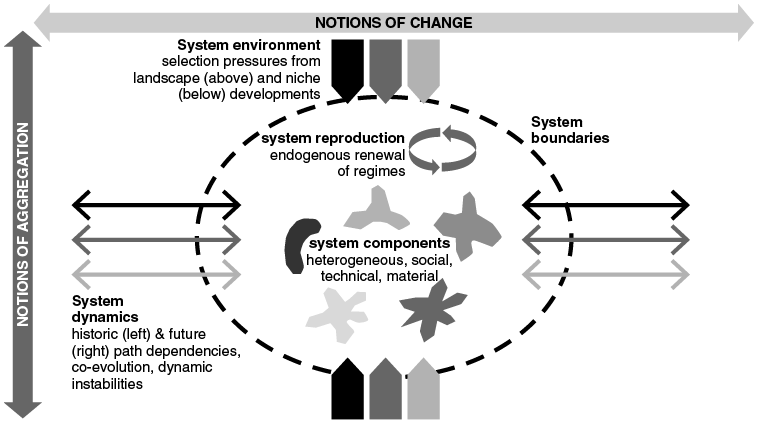
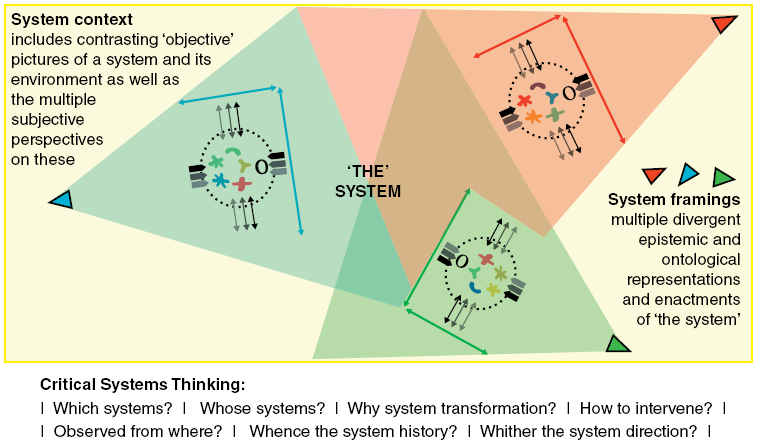

 Open access