





1. Introduction
Different languages have different referential expressions and interpretation biases. For example, in English, referents that are more accessible are usually expressed as pronouns. In comprehension, speakers of English tend to refer pronouns to a first-mentioned/subject referent, which is often the most salient in the previous discourse, as shown in example (1).
(1) Johni saw Mark while hei was at the coffee shop
Differently than English, in a null subject language like Spanish, reference to previously mentioned entities can be expressed using full noun phrases, null pronouns and overt pronouns. Null and overt pronouns have different (and complementary) interpretation biases in Spanish; more specifically, comprehenders tend to interpret null pronouns as referring to a previously mentioned subject antecedent, while overt pronouns are more often interpreted as referring to a non-subject antecedent, as exemplified in (2) (for Mexican Spanish, the variety tested here: Contemori & Di Domenico, Reference Contemori and Di Domenico2021; Keating, VanPatten & Jegerski, Reference Keating, VanPatten and Jegerski2011; Keating, Jegerski & VanPatten, Reference Keating, Jegerski and VanPatten2016).
(2) Pedroi saludó a Carlosj cuando élj/øi cruzaba la calle
Pedro greeted Carlos when he crossed the street
Notice that individual variability in the interpretation of pronouns may exist among comprehenders (e.g., Arnold, Reference Arnold2015). Recent research has shown that some of the variability can be explained by comprehenders’ print exposure, demonstrating that language experience has an important role on the use of anaphora resolution in monolingual English-speaking adults (e.g., Arnold, Strangmann, Hwang, Zerkle & Nappa, Reference Arnold, Strangmann, Hwang, Zerkle and Nappa2018; Arnold, Castro-Schilo, Zerkle & Rao, Reference Arnold, Castro-Schilo, Zerkle and Rao2019; Langlois & Arnold, Reference Langlois and Arnold2020). For example, in a series of experiments, Arnold et al. (Reference Arnold, Strangmann, Hwang, Zerkle and Nappa2018) measured subject pronoun interpretation in monolingual English speakers and found that among a number of individual differences (i.e., print exposure, theory of mind, working memory, socioeconomic status) only print exposure predicted the strength of the subject/first-mentioned bias. In the case of English, speakers with higher reading exposure become more familiar with the high frequency of subjects being re-mentioned in discourse and referred to using a pronoun, a result that supports theoretical accounts of reference based on probabilistic inferences (e.g., Arnold, Reference Arnold1998; Kehler, Kertz, Rohde & Elman, Reference Kehler, Kertz, Rohde and Elman2008).
In addition, previous research has demonstrated that comprehension preferences are variable, and that they may change based on the referential probability of pronouns presented in the statistical environment (e.g., Contemori, Reference Contemori2019; Kaiser, Reference Kaiser, Hendrickx, Branco, Lalitha Devi and Mitkov2009). A question that remains open is how permeable are the statistics that bilingual speakers calculate in their languages. In the present study, we aim to fill this gap by investigating cross-linguistic discourse representations in Spanish–English bilingual speakers.
Bilingual individuals that speak a null and a non-null subject language, like English and Spanish, must choose between two languages’ competing strategies to interpret pronouns. While monolinguals make inferences about the probability of occurrence of pronominal forms and referents in one language, bilinguals must track probabilities in two languages. Does bilinguals’ probabilistic inference in tracking referents in one language affect the other language? We address this question by looking at pronoun resolution biases in Spanish–English bilinguals using the comprehension priming technique.
1.1 Discourse priming
We know that comprehenders can adapt their pronoun resolution biases to the likelihood of occurrence of specific type of pronouns in the input. For example, in a study by Fernandes, Luegi, Correa Soares, de la Fuente, and Hemforth (Reference Fernandes, Luegi, Correa Soares, de la Fuente and Hemforth2018), speakers of European and Brazilian Portuguese were tested on their interpretation preferences for null and explicit pronouns. While European Portuguese speakers present similar interpretation strategies as Spanish speakers, Brazilian Portuguese speakers interpret explicit pronouns as referring to a second-mentioned/object antecedent less often than European Portuguese speakers (European Portuguese: 75%; Brazilian Portuguese: 46%). This pattern has been linked to the high production of explicit pronouns in Brazilian Portuguese (e.g., Brazilian Portuguese: 56%, European Portuguese: 22%, i.e., Barbosa, Duarte & Kato, Reference Barbosa, Duarte and Kato2005). Fernandes et al. manipulated the number of null and explicit pronouns presented in a sentence comprehension task, where pronouns could refer either to a first-mentioned/subject antecedent or a second-mentioned/object antecedent. The results showed that by decreasing the number of overt pronouns presented in the task, comprehenders’ preference for interpreting explicit pronouns towards a second-mentioned/object antecedent increased. This pattern of interpretation was stronger for Brazilian Portuguese speakers in comparison to European Portuguese speakers, due to the weaker second-mentioned/object antecedent preference for explicit pronouns in Brazilian Portuguese, suggesting that adaptation took place between the existing statistical knowledge about pronouns distribution and the statistical information obtained in the experiment. The findings by Fernandes et al. demonstrate that comprehenders actively calculate distributional probabilities of pronouns in a given environment.
Previous research has also demonstrated that comprehenders are sensitive to the frequency of occurrence of specific pronoun interpretations presented in a task (e.g., Contemori, Reference Contemori2019; Kaiser, Reference Kaiser, Hendrickx, Branco, Lalitha Devi and Mitkov2009). For example, using a sentence comprehension task that included novel verbs, Kaiser (Reference Kaiser, Hendrickx, Branco, Lalitha Devi and Mitkov2009) found that English monolinguals’ pronoun interpretation preferences in a sentence like “Stephen tulvered Peter and Diane churbited him” where “him” can refer to either Stephen or Peter, was modulated by the type of prime presented before the target (subject or object pronoun interpretation: William swooked Betty and Kevin brucked him/her). The results of the comprehension task demonstrated that during pronoun resolution there is activation of an abstract level of representation and that after encountering an anaphoric configuration, the processing of the same configuration can be facilitated, i.e., an effect of immediate priming. With two additional experiments, Kaiser (Reference Kaiser, Hendrickx, Branco, Lalitha Devi and Mitkov2009) showed that the priming effect results from the combination of two factors: (i) the activation of an anaphoric dependency and (ii) the activation of coherence relations between clauses (i.e., intersentential semantic relations), an effect that is not specifically linguistic, but rather domain-general (i.e., pronoun interpretation was primed by coherence relations presented either linguistically or visually). Kaiser (Reference Kaiser, Hendrickx, Branco, Lalitha Devi and Mitkov2009) is the first study to address the nature of abstract representations associated with pronoun resolution by using the priming technique. The author concluded that the abstract representations activated during pronoun resolution are shared between (non-pronominal) coherence relations inference and pronoun resolution processes.
In a study looking at English monolingual speakers and unbalanced bilinguals (i.e., adult second language learners of English whose first language is Mexican Spanish), Contemori (Reference Contemori2019) used the priming technique in a comprehension study including prime sentences like “Emily liked Brian because he was a good person”. The aim of the prime sentences was to attenuate first-mentioned/subject pronoun interpretations in English sentences that contained a potentially ambiguous pronoun, like “Mary met Linda while she was travelling”. Contemori (Reference Contemori2019) found an effect of immediate priming in both groups, demonstrating that unbalanced bilinguals and monolingual speakers were more likely to interpret an ambiguous pronoun as referring to the second-mentioned/object antecedent (i.e., Linda) after a prime sentence, than after encountering a non-prime sentence. The study by Contemori (Reference Contemori2019) showed that priming can change bilingual and monolingual speakers’ pronoun interpretation preferences in English as a result of exposure. In a follow up study, Contemori, Mossman and Ramos (Reference Contemori, Mossman and Ramos2021) tested the comprehension of English pronouns in more complex discourse contexts showing that exposure through priming can be effective in changing within-language interpretations up to 7–10 days, potentially aiding in the successful acquisition of pronoun resolution biases in the non-dominant language (English) of bilingual speakersFootnote 1. While pronoun interpretations can be primed in bilingual speakers using a single-language priming task (e.g., Contemori, Reference Contemori2019; Contemori et al., Reference Contemori, Mossman and Ramos2021), it is not clear if pronoun interpretations can be primed cross-linguistically. The present study addresses this open question, by investigating cross-linguistic abstract representation associated with pronoun resolution in bilingual speakers.
1.2 Cross-linguistic priming
Cross-linguistic priming is a technique adopted to investigate the interaction of two languages during bilingual language processing (e.g., Altarriba & Basnight-Brown, Reference Altarriba and Basnight-Brown2007 for a review). Cross-linguistic priming has been interpreted to indicate cross-language activation and shared abstract representations, which has been shown at the phonological, word-level and syntactic level in bilingual individuals (e.g., Kootstra & Muysken, Reference Kootstra and Muysken2017; for a review). For instance, word-level priming has demonstrated that processing primed words in one language can activate the stored links to the target words in the other language (e.g., Altarriba & Basnight-Brown, Reference Altarriba and Basnight-Brown2007 for a review). At the syntactic level, cross-linguistic priming has been observed when the production/comprehension of a syntactic structure in one language facilitates the production/comprehension of the same syntactic structure in the other language, leading researchers to hypothesize that syntactic representations are shared between languages (the shared-syntax model, Hartsuiker, Pickering & Veltkamp, Reference Hartsuiker, Pickering and Veltkamp2004). Hartsuiker et al. (Reference Hartsuiker, Pickering and Veltkamp2004) hypothesize that lexical and syntactic representations are interconnected so that a unit (lemma) for translation equivalents in two languages is linked to combinatorial nodes and a shared conceptual representation in the underlying system of a bilingual speaker. Cross-linguistic effects of structural priming are typically weaker than within-language priming effects in bilinguals (e.g., Bernolet, Hartsuiker & Pickering, Reference Bernolet, Hartsuiker and Pickering2013; Van Gompel & Arai, Reference Van Gompel and Arai2017, for a review). In addition, while structural priming across-languages has been observed even when the syntactic structures in the two languages are not fully identical (e.g., when syntactic structures have different word orders; e.g., Song & Do, Reference Song and Do2016), priming may be stronger when the two structures fully overlap (e.g., Jacob, Katsika, Family & Allen, Reference Jacob, Katsika, Family and Allen2017; Chen, Jia, Wang, Dunlap & Shin, Reference Chen, Jia, Wang, Dunlap and Shin2013). This evidence has been taken to suggest that non-identical syntactic structures in two languages may be connected but not fully shared in the underlying grammar of bilingual speakers (e.g., Kantola & Van Gompel, Reference Kantola and Van Gompel2011; Van Gompel & Arai, Reference Van Gompel and Arai2017).
Notice that while many structural cross-linguistic priming studies have analyzed production, only a few published studies have looked at comprehension priming (e.g., Kidd, Tennant & Nitschke, Reference Kidd, Tennant and Nitschke2015). In addition, while research on structural cross-linguistic priming has focused on syntax, only one published study has analyzed discourse persistence in bilinguals’ production, by analyzing a corpus of Spanish–English bilingual speech (Travis, Torres Cacoullos & Kidd, Reference Travis, Torres Cacoullos and Kidd2017). Travis et al. (Reference Travis, Torres Cacoullos and Kidd2017) investigated the production of first person pronouns in Spanish–English bilinguals, looking at within-language (Spanish to Spanish) and between-language (English to Spanish) priming. While the first person pronoun is explicit in English, it can be either explicit or null in Spanish. Travis et al. observed that the spontaneous use of the first person singular pronoun I primes the use of the explicit first person singular pronoun yo in Spanish in mixed-language utterances. The cross-linguistic persistence in the use of the explicit first person pronoun observed by Travis et al. was limited to specific verb configurations and topic-continuity contexts. Additionally, while the persistence of use of the explicit pronoun occurred within-language (Spanish-only) and between-language (from English), the between-language priming effect was weaker than the within-language effect, a result analogous to structural cross-linguistic priming effects (e.g., Van Gompel & Arai, Reference Van Gompel and Arai2017). Existing research has not yet investigated discourse level representations cross-linguistically using comprehension priming. In addition, while priming has been shown in production from English to Spanish (explicit pronoun in English priming an explicit pronoun in Spanish), it is unclear how the two pronominal forms available in Spanish (null and explicit) map onto the representation of explicit pronouns in English, a question that we address here by investigating Spanish to English priming.
Previous evidence from discourse priming demonstrated that abstraction of discourse structures can be observed (Kaiser, Reference Kaiser, Hendrickx, Branco, Lalitha Devi and Mitkov2009; Contemori, Reference Contemori2019). However, discourse priming in comprehension involves multiple layers of activation, including the priming of an abstract anaphoric dependency representation and the priming of the event structure, as shown by Kaiser (Reference Kaiser, Hendrickx, Branco, Lalitha Devi and Mitkov2009). Because an anaphoric dependency and sentence coherence relations are intrinsically connected in discourse, it may be difficult to isolate effects deriving purely from the activation of the (structural) anaphoric dependency. In this respect, discourse priming may be fundamentally different from structural priming, where only the abstract structure of a sentence/phrase can be activated (e.g., Van Gompel & Arai, Reference Van Gompel and Arai2017). Nonetheless, the activation of an anaphoric dependency may be reminiscent of structural ambiguities resolution, such as relative clause attachment. For example, in the sentence “the servant of the actress who was on the balcony”, the relative clause “who was on the balcony” can attach high, to first noun phrase (the servant) or low, to the second noun phrase (the actress), creating global ambiguityFootnote 2. Previous research has shown that by exposing monolingual German speakers to an unambiguous high attached relative clause increased the speakers’ likelihood of producing a high-attached relative clause in a following sentence. On the other hand, when participants were exposed to an unambiguous low-attached relative clause, the probability of producing a low-attached relative clause increased in a subsequent stimulus (e.g., Scheepers, Reference Scheepers2003). Recent studies on the priming of relative clause attachment have suggested that linguistic structural knowledge may be shared across other domains such as mathematics, so that the structure that underlies (high and low) relative clause attachment can be primed by mathematical equations that have similar hierarchical structures (e.g., Scheepers, Sturt, Martin, Myachykov, Teevan & Viskupova, Reference Scheepers, Sturt, Martin, Myachykov, Teevan and Viskupova2011). In addition, relative clause attachment can be primed cross-linguistically, as shown by Desmet and Declercq (Reference Desmet and Declercq2006) in a study with Dutch–English bilinguals. Similarly to the formation of a dependency in relative clause attachment, pronoun resolution requires establishing a dependency between a referent and the pronominal expression, which we hypothesize may lead to cross-linguistic priming.
2. Aims and predictions
In the present study, using a sentence comprehension experiment that implements the cross-linguistic priming technique, unambiguous null pronouns (indicated as ø) referring to a second mentioned-referent are presented in Spanish (3) with the aim of decreasing first noun phrase/subject interpretations in English in sentences containing a potentially ambiguous pronoun like (4).
(3) Spanish priming sentence (experiment 1):
Ana invitó a Alvaro al cine porque ø era un buen chavo.
Ana invited Alvaro to the movies because (he) was a good(masc) kid(masc).
(4) Target English sentence with ambiguous pronoun:
John met Paul while he was in high school
The prime sentence provides evidence against the comprehender's statistics that first-mentioned/subject antecedent re-mention is frequent, with the L1 (Spanish) distribution being experimentally skewed towards second-mentioned/object antecedent re-mention. Grammatical gender in the prime sentences provides disambiguation that the Spanish pronoun (a null pronoun in (3)) refers to the second-mentioned/object referent (buen chavo in the masculine = Alvaro). In addition, the prime sentence includes an implicit causality verb (invitar/to invite in (2)) followed by the connector because. Implicit causality is a feature of certain psychological verbs where the verb elicits re-mention of either a first-mentioned or a second-mentioned referent. In our prime sentences, second-mentioned/object biased verbs are used to create high expectation that a second-mentioned referent should be re-mentionedFootnote 3. The grammatical and discourse coherence features of the Spanish priming sentences aim to attenuate the strength of the first-mention bias used to interpret L2 (English) sentences like (4) that contain a potentially ambiguous pronoun. We test L1 to L2 priming (Spanish to English) using two sentence comprehension experiments. In one experiment, we test cross-linguistic priming using Spanish null pronouns, as exemplified in (3) and in a second experiment, the Spanish prime sentence contains a gender unambiguous explicit pronoun, as shown in (5).
(5) Spanish priming sentence (experiment 2):
Ana invitó a Alvaro al cine porque él era un buen chavo.
Ana invited Alvaro to the movies because he was a good kid.
In experiment 2, it is possible that if priming is found, the strength of the effect may differ in comparison to experiment 1. While cross-linguistic structural priming research has assumed shared representations between corresponding syntactic structures (e.g., Hartsuiker et al., Reference Hartsuiker, Pickering and Veltkamp2004), it is unclear if the representations of two different pronouns in one language (null and explicit in Spanish) can map onto the representation of one pronominal form in the other language (explicit pronouns in English). Thus, it is an open question if and how the use of Spanish null and explicit pronouns may affect priming in English, and if the use of either pronoun in the Spanish primes may affect the size of the priming effect. The present study is the first to address these questions.
3. Experiment 1
3.1 Participants
Fifty-eight Spanish–English bilinguals were recruited at the University of Texas at El Paso (USA) (15 males, 43 females; mean age = 21.5; SD: 5). Informed consent was obtained and participants received credits for their participation.
Participants completed a language background questionnaire (Kaushanskaya, Blumenfeld & Marian, Reference Kaushanskaya, Blumenfeld and Marian2007) and two proficiency tests, one in English and one in Spanish (Diplomas de Español como Lengua Extranjera/DELE and the Michigan English Language Institute College English Test/MELICET). The MELICET assesses English proficiency and consists of 50 multiple-choice questions organized in two sections (30 grammar questions, and 20 cloze questions from a reading passage). The DELE is a test for Spanish proficiency that contains 20 cloze questions from a reading passage, 10 vocabulary questions and 20 grammar questions. The self-reported measures and proficiency scores in Spanish and English are reported in Table 1.
Experiment 1 and 2: Participants’ information based on the language history questionnaire and proficiency tests: Mean (SD).
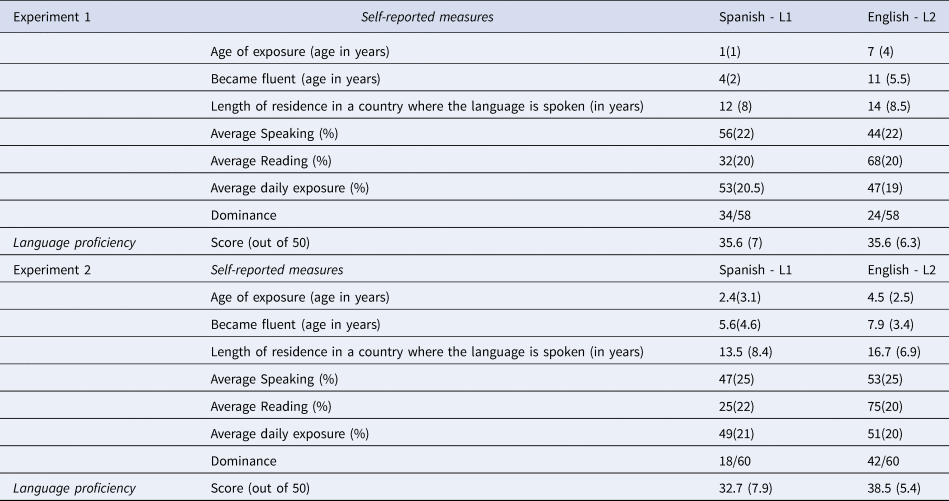
A one-sample t-test was used to compare bilingual speaker's proficiency in English and a one-sample t-test was used to compare bilingual speaker's proficiency in Spanish, based on the MELICET and DELE scores. The t-test showed that bilingual speakers were significantly different in terms of proficiency in English (t(57) = 42.209, p < 0.0001) and Spanish (t(57) = 38.128, p < 0.0001), demonstrating that proficiency in the two languages was not homogenous. Since in the present study we measure pronoun comprehension in English, we used the MELICET scores as a continuous variable in our statistical analysis to observe if English proficiency modulates the cross-linguistic priming effect.
3.2 Materials
In a sentence comprehension task adapted from Contemori (Reference Contemori2019), participants read sentences in English and Spanish and answered a comprehension question. Thirty sentences in English contained either two stereotypical male or two stereotypical female proper nouns and a transitive verb in a main clause followed by the connector “while”, as shown in (4), repeated here as (6). In the subordinate clause, a potentially ambiguous third person pronoun was presented, and pronoun gender was counterbalanced across-items. The verbs in the main clause did not include an implicit causality bias and the use of the connector “while” ensured a more semantically neutral context than the prime sentences. The English sentences were the same as the target sentences used in Contemori (Reference Contemori2019) and were normed to ensure that the preferred interpretation for the pronoun is toward the first mentioned/subject referent. The norming task was conducted with twenty monolingual speakers of English using Amazon Mechanical Turk. We selected target sentences that had a minimum of 75% first mentioned/subject referent interpretations, an average preference that has been shown in previous studies investigating the first mentioned/subject bias in intra-sentential English anaphora resolution (e.g. for a corpus study, see Arnold, Reference Arnold1998; for a comprehension study see Contemori, Asiri & Perea Irigoyen, Reference Contemori, Asiri and Perea Irigoyen2019).
(6) John met Paul while he was in high school
Participants answered a three-choice comprehension question about the referent of the pronoun, and could choose between the subject referent (John), the object referent (Paul) or an external referent (Someone else), as exemplified in (7). The position of the referents in the multiple-choice question was counterbalanced across the experiment. While the external referent is not a possible interpretation for the pronoun in English, we included this option as a distractor.
(7) Who was in high school?
(a) John
(b) Paul
(c) Someone else
Half of the target sentences were preceded by a Spanish prime sentence that included a male and a female stereotypical proper name and a second-mentioned/object-biased implicit causality verb, as shown in (5), repeated here as (8). The implicit causality verbs were selected from a previous normative study on Spanish by Goikoetxea, Pascual and Acha (Reference Goikoetxea, Pascual and Acha2008). The connector “because” introduced a subordinate clause that included a null pronoun, indicated in (8) as ø. The subordinate sentence was semantically biased to include information about the second-mentioned/object antecedent and included a gender-inflected noun or adjective that identifies the second-mentioned/object antecedent as the referent of the null pronoun. For example, in (8), “buen chavo” is inflected in the masculine and refers unambiguously to the second-mentioned/object masculine antecedent “Alvaro”. In half of the prime sentences, the second-mentioned/object antecedent was masculine and in half of the prime sentences, it was feminine. Prime sentences were followed by comprehension questions that probed the second-mentioned/object antecedent interpretation, as shown in (9).
(8) Spanish prime sentence:
Ana invitó a Alvaro al cine porque ø era un buen chavo.
Ana invited Alvaro to the movies because (he) was a good-masculine kid-masculine.
(9) ¿Quién era un buen chavo?
Who was a good kid?
(a) Ana
(b) Alvaro
(c) Alguien más (Someone else)
Half of the target English sentences were preceded by a Spanish sentence that did not contain a pronoun (baseline condition), as exemplified in (10).
(10) Kathy le dio un regalo a Sheila por su cumpleaños la semana pasada. Sheila regresó el regalo porque no le gustó.
Kathy gave a present to Sheila for her birthday. Sheila returned the present because she did not like it.
¿ Quién regresó el regalo?
Who returned the present?
(a) Kathy
(b) Sheila
(c) Alguien más (Someone else)
Thirty filler sentences (15 in English and 15 in Spanish) were included that had a variable number of referents. The fillers had similar structure as the baseline sentences.
The structure of the task and the materials are exemplified in the Supplementary Materials. Two lists were created, so that each English target sentence with an ambiguous pronoun followed a baseline sentence in one list, and a priming sentence in the other list.
3.3 Procedure and Coding
The task was presented as an online Question Pro survey. Participants were instructed to read the sentences and answer the comprehension questions. There was no time limit to complete the survey. The survey was presented in one session, without breaks. In addition to the sentence comprehension task, participants completed an online version of the language history questionnaire, the DELE and MELICET.
Participants whose proficiency was lower than 0.95 on unambiguous sentences were discarded (two participants not included in the participants’ section). Overall, participants demonstrated high accuracy on the task, scoring 0.96 (SD = 0.19) on English fillers and 0.99 (SD = 0.09) on Spanish fillers. Participants’ accuracy on Spanish baseline (mean = 0.98; SD = 0.11) and Spanish priming sentences (mean = 0.99; SD = 0.08) was also at ceiling.
In the analysis, we compared the likelihood of choosing a first-mentioned/subject antecedent for the English pronoun in the baseline and prime conditions. We used mixed-effects logistic regression (Jaeger, Reference Jaeger2008), coding number of interpretations per each subject and item as 1 or 0. The independent variable is Prime condition (baseline vs. prime). We also included English proficiency as a continuous factor in the analysis, measured with the MELICET scores. A stepwise backward inclusion procedure was used to test both first-level effects and the interactions between the fixed-effect factors. The analysis was conducted using glmer (lme4 library, Bates & Sarkar, Reference Bates and Sarkar2007).
3.4 Results
Table 2 shows the proportions of first-mentioned/subject interpretations produced by bilingual speakers after the Spanish prime sentences and after the Spanish baseline sentences.
Experiment 1: Proportion of first-mentioned/subject choices (he = John) for the English sentences with ambiguous pronouns by priming type (SD in parenthesis)

Table 3 summarizes the full model. The maximal random effect structure leading to convergence includes by subject and by item random intercepts and slopes for the effect of Priming condition.
Experiment 1: Full model statistics

In the analysis, we found a main effect of Priming condition and English proficiency. The main effect of Priming condition indicates that participants produced significantly fewer first-mentioned/subject interpretations for ambiguous English pronouns after encountering a prime sentence (0.65) than after encountering a baseline sentence (0.70). A main effect of English proficiency emerged, revealing that the first-mentioned/subject bias is weaker for bilinguals with lower English proficiency than participants with higher English proficiency. We chose a MELICET cut-off score of 38 to split lower and higher proficiency participants (see Contemori & Dussias, Reference Contemori and Dussias2016, for similar criteria to determine proficiency levels). The main effect of English proficiency indicates that participants with lower proficiency score an average of 0.63 first-mentioned/subject choices, while higher proficiency participants chose the first-mentioned/subject on average 0.70 of the times.
3.5 Interim discussion
In experiment 1, we measured bilinguals’ interpretations of English pronouns that are potentially ambiguous. The English sentences were preceded by Spanish primes where a null pronoun unambiguously refers to a second-mentioned/object. Interpretation of English pronouns presented after prime sentences was compared to English pronouns presented after baseline sentences. A main effect of prime condition indicated that participants’ first-mentioned/subject interpretations significantly decreased after a Spanish prime in comparison to English pronouns encountered after a Spanish baseline sentence. This effect suggests that the first-mention bias in English can be attenuated by null pronoun interpretations in Spanish, when gender and semantic bias point to an object interpretation of the null pronoun. Although from the present experiment we cannot disentangle the priming of coherence relations from the priming of the anaphoric dependency (e.g., Kaiser, Reference Kaiser, Hendrickx, Branco, Lalitha Devi and Mitkov2009), this result is the first to show that inferences about probability distributions and coherence relations in one language (L1, Spanish) can affect the other language (L2, English). As bilingual speakers can be primed to establish a dependency in relative clause attachment cross-linguistically (e.g., Desmet & Declercq, Reference Desmet and Declercq2006), our results demonstrate that a dependency between a referent and a pronominal expression can also be activated across the two languages of bilingual speakers.
From the analysis, a main effect of English proficiency emerged suggesting that participants with higher English proficiency have a stronger first-mentioned/subject bias than participants with lower proficiency. As the first-mentioned/subject bias is a language-specific interpretation strategy, it is expected that participants with more English experience would show an increased preference for comprehending the pronoun as referring to the first-mentioned/subject antecedent. Previous research has demonstrated that bilingual speakers do not always show monolingual patters of pronoun comprehension and production in the L1/L2 (e.g., Montrul, Reference Montrul2004, Reference Montrul2018; Sorace & Filiaci, Reference Sorace and Filiaci2006), and effects of language dominance have recently been shown (Contemori, Tsuboi & Armendariz, Reference Contemori, Tsuboi and Armendarizsubmitted; Contemori, Mossman, Armendariz, Perea-Irigoyen, submitted). Studies on monolingual English-speaking adults have also demonstrated that variability in the strength of the first-mention bias exists, with monolinguals that have higher reading exposure displaying a more robust first-mentioned/subject bias (Arnold et al., Reference Arnold, Strangmann, Hwang, Zerkle and Nappa2018, Reference Arnold, Castro-Schilo, Zerkle and Rao2019). Arnold et al. (Reference Arnold, Strangmann, Hwang, Zerkle and Nappa2018) point out that while written language can be an ideal source of evidence for frequently occurring discourse patterns (i.e., in English, subjects are the entities more often referred to), spoken language can also provide supporting evidence. Our results demonstrate that in bilingual speakers who divide their time between two languages (and who are naturally more variable than monolinguals on their language proficiency), individual language experience, measured as proficiency, can account for some of the variability in the strength of the first-mentioned/subject bias. This result adds to the literature highlighting that language experience plays a role in the development of discourse patterns comprehension (e.g., Arnold et al., Reference Arnold, Strangmann, Hwang, Zerkle and Nappa2018, Reference Arnold, Castro-Schilo, Zerkle and Rao2019).
In experiment 2, we use similar materials as in experiment 1, to verify if L1 to L2 cross-linguistic priming is found when the explicit pronominal form is used in Spanish to refer to a second-mentioned/object antecedent.
4. Experiment 2
4. 1. Participants
Sixty Spanish–English bilinguals participated in experiment 2 (8 males, 50 females; two participants did not answer the gender question; mean age = 20.8; SD: 2.8). They were recruited at the University of Texas at El Paso (USA). Informed consent was obtained and participants received credits for their participation.
Participants completed a language background questionnaire (Kaushanskaya et al., Reference Kaushanskaya, Blumenfeld and Marian2007) and the MELICET and DELE proficiency tests. The self-reported measures and proficiency scores measured with the MELICET and DELE tests are reported in Table 1. Concerning within-group proficiency, a one-sample t-test showed that participants in experiment 2 are not homogeneous in terms of proficiency in English (t(59) = 53.840, p < 0.0001) and Spanish (t(59) = 31.560, p < 0.0001). As in experiment 1, we used MELICET scores as a continuous variable in the analysis of experiment 2's results: to observe if proficiency modulates cross-linguistic priming effects. In addition, we compared the MELICET and DELE scores of participants in experiment 1 and 2 to verify if the groups have comparable proficiency in the two languages. An independent sample t-test showed that participants in experiment 2 score significantly higher on the MELICET (38.5) than participants in experiment 1 (35.6) (t(116) = 2.621, p < 0.01). Concerning the Spanish proficiency measure, participants in experiment 2 (32.7) score significantly lower on the DELE than participants in experiment 1 (35.5): (t(116) = 2.029, p < 0.04). Therefore, we can assume that while the bilingual group in experiment 1 is more Spanish dominant, the group tested in experiment 2 is more English dominant, as also confirmed by the self-reported dominance in Table 1.
4. 2. Materials
The materials in experiment 2 are the same as in experiment 1, except that the Spanish prime sentences included an explicit pronoun, as illustrated in (11). In experiment 2, besides the semantic bias and the adjective/noun gender disambiguation, the gender of the pronoun unambiguously identifies the second-mentioned object referent (él = Alvaro). Half of the prime sentences contained the feminine third person pronoun ella, and half of the sentences included the masculine third person pronoun él.
(11) Spanish priming sentence:
Ana invitó a Alvaro al cine porque él era un buen chavo.
Ana invited Alvaro to the movies because he was a good kid.
4. 3. Procedure and Coding
The procedure and statistical analysis were the same as in experiment 1.
Participants who scored lower than 0.90 on unambiguous sentences were discarded (three participants not included in the participants’ section). Overall, bilingual participants demonstrated high accuracy on the task, scoring 0.97 (SD = 0.15) on English fillers and 0.98 (SD = 0.12) on Spanish fillers. Participants’ accuracy on Spanish baseline (mean = 0.98; SD = 0.13) and priming sentences (mean = 0.99; SD = 0.05) was also at ceiling.
4. 4. Results
Table 4 shows the proportions of first-mentioned/subject interpretations produced by bilingual speakers after the Spanish prime sentences and after the Spanish baseline sentences.
Experiment 2: Proportion of first-mentioned/subject choices (he = John) for the English sentences with ambiguous pronouns by priming type (SD in parenthesis)

Table 5 summarizes the full model. The maximal random effect structure leading to convergence includes by-subject and by-item random intercepts and by-subject random slopes for the effects of Priming Condition.
Experiment 2: Full model statistics
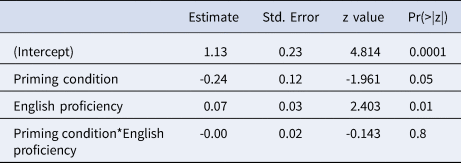
As in experiment 1, the analysis revealed a main effect of English proficiency. Using the same median split as in experiment 1 for the MELICET scores, we found that bilinguals with higher proficiency in English have a stronger first-mention bias (0.71) than bilinguals with lower English proficiency (0.62).
An effect of Priming condition is marginally significant, showing a decrease in first-mentioned/subject interpretations after a prime sentence in comparison to baseline. We conducted an additional exploratory analysis where we compared the results of study 1 and 2 with existing within-language priming data by Contemori (Reference Contemori2019) (see Supplementary Materials). In Contemori (Reference Contemori2019), English primes (e.g., Emily liked Brian because he was a good person) preceded English sentences containing a potentially ambiguous pronoun (Mary met Linda while she was travelling). The study by Contemori (Reference Contemori2019) found discourse within-language priming with a group of adult L2 English learners (intermediate L2 proficiency; L1 Spanish), demonstrating that L2 speakers’ interpretation of the ambiguous pronoun was affected by the prime. The aim of the exploratory analysis is to investigate if the size of the priming effect differs within and across-language (cross-linguistic priming: Spanish to English vs. within-language priming: English to English). The comparison did not show any differences in the size of the priming effect between the present study and Contemori (Reference Contemori2019).
5. Discussion and conclusions
In experiment 2, we found that an effect of priming condition approached significance, showing a tendency for bilingual participants’ first mention bias in English to be attenuated after a Spanish prime sentence was encountered. The effect confirms the results of experiment 1, demonstrating that the statistics about likely referents of a pronoun in one language can affect pronoun resolution in the other language, when gender and semantic disambiguation favor an object interpretation of the explicit pronoun. The effect of priming that we found in experiment 2 approached significance in comparison to the fully significant effect observed in experiment 1. A possible explanation to account for the difference in the strength of the effect is that the difference between the priming effect in experiment 1 and 2 is analogous to the findings that cross-linguistic structural priming is weaker when the surface and hierarchical structures tested in the two languages are similar but not identical (e.g., Bernolet, Hartsuiker & Pickering, Reference Bernolet, Hartsuiker and Pickering2009; Kidd et al., Reference Kidd, Tennant and Nitschke2015; Jacob et al., Reference Jacob, Katsika, Family and Allen2017). Previous research has shown that for balanced bilinguals, cross-linguistic priming is strong when the syntactic structures tested are identical in their surface and hierarchical structure in the two languages (e.g., Hartsuiker, Beerts, Loncke, Desmet & Bernolet, Reference Hartsuiker, Beerts, Loncke, Desmet and Bernolet2016). This evidence has been taken to suggest that the underlying representations of these structures are fully shared across languages. On the other hand, when the surface and hierarchical structure are similar but not identical, cross-linguistic priming can be observed, but it may be weaker than in structures with identical surface constituent and hierarchical configuration (e.g., Bernolet, Hartsuiker & Pickering, Reference Bernolet, Hartsuiker and Pickering2007). These results have been interpreted to indicate that the underlying representations of syntactic structures that do not fully overlap could be connected rather than shared across-languages (Van Gompel & Arai, Reference Van Gompel and Arai2017). We tentatively speculate that this may be the case for the representations of explicit pronouns in Spanish and explicit pronouns in English. Null pronouns (the default form in Spanish) and English explicit pronouns (the default form in English) are used to refer to topic/prominent antecedents in the two languages (Arnold, Reference Arnold1998; Contemori & Di Domenico, Reference Contemori and Di Domenico2021). The similarity in the use of the two referential expressions may suggest that the two forms have fully shared representations, as indicated by the fully significant effect of priming. On the other hand, explicit pronouns in English and Spanish have different uses (in Spanish the explicit pronoun tends to refer to a non-topic antecedent; Contemori & Di Domenico, Reference Contemori and Di Domenico2021). As a result, the underlying representations of the explicit pronouns in the two languages may be connected but not fully overlapping, leading to a weaker priming effect that approaches significance. Notice that Spanish explicit pronouns are usually stressed or strong pronouns as opposed to weak null pronouns, a distinction that may parallel that of overt subject pronouns in English that are typically unstressed but can receive contrastive or emphatic stress (e.g., Lipski, Reference Lipski2008; Otheguy, Reference Otheguy2004; Toribio, Reference Toribio2004). We do not exclude that a distinction may be made in the underlying representations of bilingual speakers between the stressed/unstressed pronouns in English and the null/explicit Spanish pronouns. Further research should address this open question using a priming comprehension task in the auditory modality to uncover what is the degree of sharing between pronoun representations that include emphasis across the two languages.
We conducted an exploratory analysis to investigate within-language and cross-language priming effects, by comparing the results of the present study to the results by Contemori (Reference Contemori2019). The analysis suggests that the within and cross-language priming experiments lead to similar effects of discourse priming. This result is not in line with previous studies indicating that within-language priming leads to stronger priming effects than cross-language priming (e.g., Travis et al., Reference Travis, Torres Cacoullos and Kidd2017). However, notice that the group of bilinguals tested in Contemori (Reference Contemori2019) is very different from the participants tested here. Contemori (Reference Contemori2019) recruited a group of adult second language learners (L1 Spanish) with intermediate English proficiency who attended English as a Second Language courses at a large American university. Future research should compare within and cross-language discourse priming in the same group of participants using a within-subject design.
The present study demonstrates that some degree of sharing exists between the representations of anaphoric dependencies in the two languages of a bilingual speaker. The present results are relevant for research on bilingual discourse acquisition. The interpretation and use of referential expression is a domain where differences can be observed between monolinguals and various bilingual populations even at the highest levels of proficiency (e.g., native speakers in situation of attrition: Tsimpli, Sorace, Heycock & Filiaci, Reference Tsimpli, Sorace, Heycock and Filiaci2004; adult learners: Sorace & Filiaci, Reference Sorace and Filiaci2006; Rothman, Reference Rothman2008; heritage speakers: Keating et al., Reference Keating, VanPatten and Jegerski2011, Reference Keating, Jegerski and VanPatten2016). One of the factors that previous research has identified to explain the (sometimes-persistent) optionality at the discourse level is cross-linguistic interference (e.g., Sorace, Reference Sorace2011, for a review). However, to determine the degree of cross-linguistic interference that might occur in pronoun resolution among bilinguals, previous research has relied on the comparison between groups that speak different L1s or L2s. While this method provides informative results, it also has some limitations, due to the nuanced differences in the use of referring expressions among languages (e.g., for Spanish dialects: Carvalho, Orozco & Shin, Reference Carvalho, Orozco and Shin2015) and differences among different populations of bilingual speakers (e.g., learning context, socio-economic status, age, immigrant status).
The current study provides evidence of cross-language interaction at the discourse level within the same population of bilingual speakers, a strong indication that cross-linguistic interference may exist in bilingual discourse for speakers with varying degrees of L1 and L2 proficiency. To conclude, we stress the importance of studying cross-linguistic priming as a process that could inform other research domains such as contact-induced language change at the discourse level in bilingual populations (e.g., Torres Cacoullos & Travis, Reference Torres Cacoullos and Travis2011, Reference Torres Cacoullos and Travis2015; Kootstra & Muysken, Reference Kootstra and Muysken2017).
Competing interests declaration
Competing interests: The authors declare none
Supplementary Material
For supplementary material accompanying this paper, visit https://doi.org/10.1017/S1366728922000566
Data availability statement
The data that support the findings of this study are available from the first author.


 Open access

