


1. Introduction
This article investigates the interaction of long-distance agreement and wh-movement into and out of different clause types in Passamaquoddy (Eastern Algonquian) as a lens into the structure of the left periphery.Footnote 1 I argue that complement clauses in Passamaquoddy come in (at least) three different sizes – larger phasal CPs, smaller non-phasal CPs, and bare TPs. I then show that various facts about wh-movement (both short and long-distance), long-distance agreement, and their interaction all fall out naturally from these independently-diagnosable clause size differences with a minimum of pre-existing theoretical machinery (e.g., phases and the economy condition of Multitasking).
By “clause type”, I refer to the different syntactic contexts that trigger the use of the three different (non-imperative) inflectional paradigms of Passamaquoddy verbs: the independent, the conjunct, and the subordinative. Below I provide examples of opu ‘sit’ inflected in each of these three paradigms, giving an initial sense of the morphological differences between them.

I will speak of “independent clauses”, those that feature verbs inflected in the independent, “conjunct clauses”, those that feature verbs inflected in the conjunct, and “subordinative clauses”, those that feature verbs inflected in the subordinative.
The core empirical puzzle I focus on are various interactions between long-distance agreement (LDA), wh-movement, and clause type. LDA into complements of epistemic predicates like ’kocicihtun ‘know’ and wewitahatomon ‘remember’, which embed independent or conjunct, and LDA into direct perception complements of verbs like nomihtun ‘see’ and nutomon ‘hear’, which embed conjunct, is free, able to index any embedded argument, subject only to Ā-locality. Consider the following examples of LDA under epistemic and perception predicates, where either of the embedded subject or object can control LDA (throughout, I bold the exponents of LDA and underline the controller):Footnote 2


These examples demonstrate that speakers have free choice of LDA with either the embedded subject or object – but crucially, as we will eventually see, it isn’t possible to get LDA with a DP inside an island.
In contrast, LDA with verbs like ’pawatomon ‘want’ and ’kisehtun ‘make’, which take subordinative complements, is highly restricted, subject instead to A-locality – LDA is only possible with the embedded argument that occupies the highest A-position (i.e., the “subject”). In the examples below, we find LDA only with the embedded subject Winiwol ‘Winnie’, not the embedded first-person plural object:

From this data, it seems there are two LDA types: (i) free LDA, found with independent and conjunct complements under epistemic and perception predicates, and (ii) restricted LDA, found with subordinative complements under verbs like ’pawatomon ‘want’ and ’kisehtun ‘make’.
But this is not the full picture. A different split appears when we examine the interaction of LDA and long-distance wh-movement. Direct perception complements and subordinative complements retain their typical LDA patterns under long-distance wh-movement – free (Ā-locality) and restricted (A-locality), respectively:


Comparing these to the baseline examples without wh-movement in (3) and (4), we see that long-distance wh-movement of a DP does not affect the baseline LDA patterns.
In contrast, LDA into epistemic complements displays a striking interaction with long-distance wh-movement of DPs: LDA suddenly becomes restricted to the wh-moved DP (Bruening Reference Bruening2001, LeSourd Reference LeSourd2019a, Grishin Reference Grishin2023b), a loss of the typical freedom of LDA into epistemic complements.Footnote 3 In the examples below, we see that LDA is restricted to the wh-item wen ‘who’, and we cannot get LDA with the embedded first-person singular subject:

‘Who do you remember that I went to see?’ (LeSourd Reference LeSourd2019a: 389)
Comparing the baseline (2) to (7) above, we see that LDA into epistemic complements shows two different patterns, depending on the presence or absence of long-distance wh-movement: in its absence, LDA is free, just like in direct perception complements (2), but when there is long-distance wh-movement of a DP, we must get LDA with that DP – no other option is available (7).
I summarize these patterns in Table 1. One of the core goals of this article is to provide an analysis of why we see these particular kinds of interactions in Passamaquoddy.
Interaction between LDA and long-distance Ā-extraction

The ultimate answer I provide builds on certain observations we can make about the internal syntax of independent, conjunct, and subordinative clauses – namely, that independent and conjunct clauses show robust evidence of a CP domain, whereas subordinative complements seem to instead be bare TPs. What’s more, direct perception complements seem to have a reduced CP domain compared to other conjunct complements. I thus propose the following structure for the Passamaquoddy left periphery, with C2 optionally being exponed as the complementizer eli in conjunct clauses:Footnote 5

Additionally, as illustrated above, I propose that both C1 and C2 are able to host Ā-probes of various types, in contrast to T, which does not. A consequence of this is that both independent and conjunct complements are able to host Ā-movement to their left edge, feeding free LDA (Bruening Reference Bruening2001, Branigan and MacKenzie Reference Branigan and MacKenzie2002, a.o.), while subordinative complements (bare TPs) are not big enough to, resulting in restricted LDA.
The last piece needed to connect this internal picture of the Passamaquoddy left periphery to the cross-clausal interactions between LDA and long-distance wh-movement introduced above (Table 1) is the assumption that C2, but not C1, is a phase head (see Yoshimoto Reference Yoshimoto2012, Carstens and Diercks Reference Carstens, Diercks, Seda Kan, Moore-Cantwell and Staubs2013, Kishimoto Reference Kishimoto2021, a.o., for similar proposals), as illustrated below:

The result is the following, in short: if a DP is to wh-move out of a CP2-sized clause, it must pass through Spec,CP2 in order to escape the phase, which will force LDA with (an intermediate copy of) the wh-item. In contrast, since C1 and T are not phase heads, long-distance wh-movement out of a CP1- or TP-sized clause need not pass through the edge, as there is no phase to escape – extraction can proceed directly from the next highest phase edge, which I assume to be Spec,VoiceP (equivalent to what is often labeled vP; here I use v as the label for the verbal categorizing head). The ultimate result is that long-distance wh-movement has no effect on the LDA properties of direct perception complements (CP1) and subordinative complements (TP), as they are not phasal. LDA into direct perception complements (CP1) will universally show Ā-locality properties, as it can (optionally) be fed by Ā-movement to Spec,CP1. In contrast, LDA into subordinative complements (TP) will universally show A-locality properties, as it can only be fed by A-movement to Spec,TP (or some other A-position above VoiceP).
This analysis has a number of theoretical consequences, not only for our understanding of Passamaquoddy morphosyntax, but also for our broader understanding of the syntax of the left periphery crosslinguistically. As a result of this investigation, we will learn that Passamaquoddy clauses come in (at least) three sizes: larger phasal CPs, smaller non-phasal CPs, and bare TPs. Additionally, this analysis has certain consequences for the theory of phases. It requires that the CP phase be a high projection in the split CP domain (Yoshimoto Reference Yoshimoto2012, Carstens and Diercks Reference Carstens, Diercks, Seda Kan, Moore-Cantwell and Staubs2013, Rizzi Reference Rizzi, Enoch Aboh, Haeberli, Puskás and Schönenberger2017, Kishimoto Reference Kishimoto2021, a.o.; but contra Fernandez-Rubiera Reference Fernandez-Rubiera2009, López Reference López2009, Radford and Iwasaki Reference Radford and Iwasaki2015, a.o.) – for me, CP2 – and that phasehood not be contextual (contra Wurmbrand Reference Wurmbrand, Stefan Keine and Sloggett2013, Reference Wurmbrand2017; Bošković Reference Bošković2014, Reference Bošković2015; a.o.). CP2 is always a phase, and CP1 and TP are never phases, even when CP2 is not present in the structure.
This article is organized as follows. First, section 2 provides some background on Passamaquoddy to help orient the reader through the data to come. Next, I investigate the interaction of clause type and wh-movement (independent of long-distance agreement) in section 3, and then the interaction of clause type and LDA in section 4. The core theoretical conclusion following these sections is that differences between independent and conjunct clauses on the one hand and subordinative clauses on the other are derivative of more basic differences in clause size: independent and conjunct clauses have a left periphery, whereas subordinative clauses are bare TPs. With the basic facts in place, we can then turn to interactions between long-distance wh-movement and LDA in section 5, which receives a formal analysis in section 6. I conclude by summarizing the proposals put forth in this article and discussing some of their consequences.
2. Background
Passamaquoddy is an Eastern Algonquian language, traditionally split into two closely related dialects: Passamaquoddy, spoken in eastern Maine, and Wolastoqey (or Maliseet), spoken in New Brunswick along the Wolastoq (Saint John River). Speakers identify both dialects as being the same language and have no issue understanding each other: the differences are mainly lexical, along with a few small phonological and grammatical differences. The data in this article represent both dialects; as far as I am aware, the dialects do not differ in the phenomena discussed here. I refer to both varieties together under the name Passamaquoddy. This article reports on work with three Passamaquoddy speakers from Sipayik (Pleasant Point, ME), Margaret Apt, Dwayne Tomah, and Grace Paul, and two Wolastoqey speakers who grew up in Neqotkuk (Tobique First Nation, NB), Edwina Mitchell and Roger Paul. The data presented here come from a number of sources: most of it is from regular Zoom elicitations (summer 2020 to present day) carried out by members of the MIT Passamaquoddy Workshop with Margaret Apt, Grace Paul, Roger Paul, and Edwina Mitchell; some of it comes from an in-person field trip to Maine in January 2023; and some of it comes from various secondary sources, most notably the online Passamaquoddy-Maliseet Portal (https://pmportal.org/), an online dictionary and cultural resource.
To begin, I will introduce some basic background on Passamaquoddy morphosyntax which I will be assuming throughout the rest of this article, namely the different Algonquian verb classes (e.g., II/AI/TI/TA), an abbreviated description of Passamaquoddy verbal agreement and the morphology of the different Passamaquoddy clause types, and a basic description of the syntactic distribution of each clause type (for more details, see Grishin Reference Grishin2023b: 100–125).
2.1 Verb classes
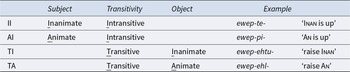
Algonquian verbs feature derivational suffixes immediately following the verb root that mark the transitivity of the verb and the grammatical animacy of the intransitive subject and transitive object: these are traditionally called finals (Bloomfield Reference Bloomfield and Henry Hoijer1946, Goddard Reference Goddard1990). There are four basic verb classes, which are abbreviated II ‘inanimate intransitive’, AI ‘animate intransitive’, TI ‘transitive inanimate’, and TA ‘transitive animate’. I illustrate these classes in Table 2, exemplifying with the root ewep- ‘up’.
Basic verb classes, with the root ewep- ‘up’

In addition to conveying information about the transitivity and the animacy of one of the arguments, finals can often convey other lexical information. For instance, the finals -(o)te and -(o)pi in Table 2 are intransitive finals that denote that the subject is in a particular location, whereas -ehtu and -ehl are generic causative finals that attach to unaccusative roots. Outside of these basic classes, two other more complex verb classes will also appear in this article: AI+O, which are verbs with an AI final that still take an object, and TA+O, which are ditransitive verbs (generally formed with an applicative suffix -(u)w or -ew, except for a few inherently ditransitive roots like mil- ‘give’). Following much of the existing theoretical literature (e.g., Brittain Reference Brittain, Sophie Burelle and Somefalean2003, Hirose Reference Hirose2003, Mathieu Reference Mathieu, Emily Elfner and Walkow2007, Slavin Reference Slavin2012, a.m.o.), we can treat finals as instantiations of the categorizing head v. In glossed examples, I will generally not segment out finals, but I will subscript each verb stem with its corresponding class abbreviation.
2.2 Agreement
There are three core sites of  $\varphi$-agreement in the Algonquian verb (excluding finals, if those are to be analyzed as $\varphi$-agreement), distributed as follows in the verbal template, exemplifying with an independent verb:

The third line provides a standard Algonquianist label for the relevant position in the verbal template, and the fourth line lists the position in the clause spine that I assume each slot spells out. Below, I provide a summary of the general behaviour of each agreement slot:
• The theme sign (italicized above) is object agreement in Voice, which is realized in certain cases as the inverse marker -(o)q, -(o)ku (Rhodes Reference Rhodes1976; Brittain Reference Brittain and David H. Pentland1999; McGinnis Reference McGinnis, Leora Bar-el, Déchaine and Reinholtz1999; Bruening Reference Bruening2001; Goddard Reference Goddard and H. C. Wolfart2007; Coon and Bale Reference Coon and Bale2014; Oxford Reference Oxford2019c, Reference Oxford2023, Reference Oxford2024a, Reference Oxford2024b; a.o.).
• Central agreement (bolded above) is composed of the person prefix (in the independent and subordinative, absent in the conjunct) plus the central suffix (Goddard Reference Goddard1979; Oxford Reference Oxford2017a, Reference Oxford, D. K. E. Reisinger and Lo2019b; Hammerly Reference Hammerly2020; Grishin Reference Grishin2023b). It agrees in person and number with the animate argument highest on the hierarchy 1, 2 $\gg$ prox $\gg$ obv, and it occupies T (Halle and Marantz Reference Halle, Marantz, Ken Hale and Keyser1993, Bruening Reference Bruening2005, Coon and Bale Reference Coon and Bale2014, Hamilton Reference Hamilton, Monica Macaulay, Noodin and Valentine2017, a.o.).Footnote 7
• Peripheral agreement (underlined above) hosts a probe that agrees omnivorously with third persons (Grishin Reference Grishin2023c). In the Passamaquoddy independent it indexes the lowest clausemate third-person argument (Xu Reference Xu2022, Grishin Reference Grishin2024a), and in the conjunct it optionally appears, agreeing with Ā-extracted DPs. It does not appear in the subordinative. It occupies C (Halle and Marantz Reference Halle, Marantz, Ken Hale and Keyser1993, Branigan and MacKenzie Reference Branigan, MacKenzie, Pius Tamanji, Hirotani and Hall1999, Bliss Reference Bliss2013, Oxford Reference Oxford2017a, Grishin Reference Grishin2024a, a.o.).


2.3 Clause types
2.3.1 Morphology
Morphologically, independent and subordinative verbs are extremely similar, in contrast to the very different conjunct (as Goddard Reference Goddard1983 notes, the subordinative is an Eastern Algonquian innovation developing from the independent). The exponents of the theme sign (Voice) are identical across paradigms, but central agreement (T) is radically different, as depicted in the simplified paradigms below:
Independent/subordinative T

Conjunct T

In the independent and subordinative, T is realized discontinuously with prefixes and suffixes, with the prefix exponing person and the suffix exponing number (and person). In the conjunct, we only have suffixes, which expone both person and number. In addition to this difference in T, the independent/subordinative differs from the conjunct in its distribution of inverse marking in Voice; I refer the interested reader to Oxford (Reference Oxford2024a, Reference Oxford2024b) and Grishin (Reference Grishin2023b) for more details. These particular morphological differences are not crucial in the rest of this article – I will simply clearly indicate whether a given verb is independent, conjunct, or subordinative in the relevant examples.
The conjunct also features a particular morphophonological phenomenon called initial change: in Passamaquoddy, this surfaces as schwas (written o) in initial syllables becoming e /e/: opi-t ‘sitai-3cj’  $\rightarrow$ epi-t ‘ic.sitAI-3cj’. Conjunct verbs without initial change show up in conditional antecedents, whereas conjunct verbs with initial change show up in all other conjunct contexts. As I am not dealing with conditionals in this article, all our examples of conjunct will feature initial change.
The independent and subordinative distinguish themselves morphologically in three main ways. First, all subordinative verbs with an animate argument feature a poorly understood multifunctional suffix -n(e) (which I gloss n), also found (but in different contexts) in the independent:Footnote 8

Second, intransitive (both AI and II) independent verbs express the features of third person subjects using the peripheral suffix (C), whereas the subordinative uses central agreement (T):

Finally, in contrast to the independent, the subordinative lacks peripheral agreement (C) entirely, a fact which already suggests that subordinative clauses lack CP layers:

Since peripheral agreement is the only marker that specifies the number of the inanimate argument in (13a), the subordinative form in (13b) is ambiguous for number.
A final difference between independent and conjunct verbs is the behaviour of peripheral agreement (C). In the independent, C agrees with the lowest third person, but in the conjunct, peripheral agreement is optional, and when it appears it agrees with an Ā-extracted DP (Bruening Reference Bruening2001, Reintges et al. Reference Reintges, LeSourd, Chung, Lisa Lai-Shen Cheng and Corver2006).

In the independent clause in (14a), C agrees with the lowest third person – the object. In contrast, in the conjunct clause in (14b), C agrees with the subject, as that is the Ā-extracted element.
2.3.2 Distribution
Here, I will briefly outline some basic facts about the distribution of each clause type, focusing primarily on clausal complementation (see Grishin Reference Grishin2023b for more detail). To start with the independent, we can note that it is in some sense the “default” clause type, appearing in out-of-the-blue matrix declaratives, as well as polar and alternative questions:

The independent is also the preferred clause type under the verbs itom ‘say’ and litahasu ‘think’, which crosslinguistically are the most common verbs to allow various kinds of main clause phenomena (though occasionally they can be found embedding conjunct clauses):

The conjunct is found under epistemic verbs like ’kocicihtun ‘know’, emotives like assokitahasu ‘be surprised’, and perception verbs like nutomon ‘hear’ (though, at least under the epistemic verbs, we can occasionally find independent):

The subordinative is found under predicates that crosslinguistically tend to embed structurally-reduced complements, like Wurmbrand and Lohninger’s (Reference Wurmbrand, Lohninger, Jutta M. Hartmann and Wöllstein2023) situation and event complements. These include verbs like ’pawatomon ‘want’ and ’kisehtun ‘make’:

In this article, we will focus on complements of epistemic verbs (like ’kocicihtun ‘know’; I also include itom ‘say’ and litahasu ‘think’ in this category, but these do not participate in LDA), which can either be conjunct or independent; on complements of perception verbs under a direct perception reading, which are always conjunct; and on subordinative complements.
3. Ā-extraction
In this section, we will investigate how clause type interacts with Ā-movement, focusing especially on wh-movement. I will argue that only independent and conjunct clauses allow for the full range of Ā-movement possibilities, and that subordinative clauses are strikingly restricted: they allow Ā-movement to proceed out of them, but subordinative clauses cannot be the final landing site for Ā-movement. I propose that we can understand these facts as arising from differences in clause size: independent and conjunct clauses have CP layers, but subordinative clauses lack them.
3.1 Ā-phenomena involve CP
Before reaching the main argument, we must establish one of the main assumptions of this article: that Ā-phenomena in Passamaquoddy crucially implicate the left periphery (i.e., the CP layer(s)). I focus in particular on wh-movement and relativization (though, as far as I am aware, other kinds of Ā-movement behave in very similar ways; see Grishin Reference Grishin2023b).
3.1.1 Wh-phrases move into CP
Passamaquoddy has overt wh-movement (Bruening Reference Bruening2001). If wh-phrases are not in a left-peripheral position, they can only be interpreted as plain existential quantifiers (at least this is true of wen ‘who’, keq ‘what’, and tama ‘where’, which are quexistentials, to use a term from Hengeveld et al. Reference Hengeveld, Iatridou and Roelofsen2023):

In (19), we see the basic contrast. In (19a) the wh-item tama ‘where’ appears in clause-initial position, and this sentence can be interpreted as a wh-question. In contrast, (19b) features tama in a non-initial position, and this cannot be interpreted as a wh-question – at best it can only be a polar question.Footnote 9
Generally, wh-phrases will always be sentence-initial. Occasionally, certain kinds of material can precede them – but the material that can precede wh-phrases is restricted to hanging topics and frame-setters (20), or certain kind of left-edge discourse particles (21):

‘But you, what would you do?’ (Bruening Reference Bruening2001: 187)


(https://pmportal.org/dictionary/nita-2)
In (20a), the wh-phrase tan ‘how; what; where’ is preceded a hanging topic kil ‘you’, here functioning as a contrastive topic (marked by the second-position clitic =olu ‘CTOP’), and in (20b) the wh-phrase keq ‘what’ is preceded by a frame-setting temporal adjunct aponuwot molaqs ‘after you bought milk’. In (21), we find examples of two discourse particles preceding the wh-phrase: apc ‘again; else’, and nita ‘uh-oh; well then’.Footnote 10 On the basis of this data, we can conclude that wh-phrases must move overtly to the left periphery in Passamaquoddy, to a position that can only be preceded by very high left-peripheral material like hanging topics, frame-setters, and certain discourse particles.
3.1.2 Ā-agreement in C
The second argument that Ā-phenomena in Passamaquoddy involve the CP domain comes from an Ā-agreement pattern found in the conjunct clause type. In relative clauses, wh-questions, and sentences containing DP foci, an agreement marker located in the CP domain, the peripheral suffix, can optionally appear and agree in number, animacy, and obviation with whatever’s been Ā-extracted – respectively, the relative head, the wh-phrase, or the focused DP (Bruening Reference Bruening2001, Reintges et al. Reference Reintges, LeSourd, Chung, Lisa Lai-Shen Cheng and Corver2006, Grishin Reference Grishin2023b).Footnote 11 Here, I provide examples from relative clauses, to illustrate that Ā-movement in relative clauses also involves the CP domain, just as with wh-questions:

(https://pmportal.org/dictionary/tehsahqaphal)

In (22), we see that this suffix (bolded) can agree with the head of the relative clause (underlined), no matter its syntactic role: subject (22a), direct object (22b), indirect object (22c). That a CP-layer agreement marker indexes the head of the relative clause suggests that the Ā-probe involved in creating a relative clause dependency is located in the CP domain.Footnote 12
Thus, I conclude that Ā-processes in Passamaquoddy crucially implicate the CP domain: they involve a CP-layer Ā-probe, which in some cases can be spelled out (above), and they involve Ā-operators landing in the CP domain (as in the wh-movement examples above). With this background assumption now in place, we can turn to examining how Ā-movement interacts with various different clause types.
3.2 Wh-movement in independent and conjunct clauses
In this section, I show that Ā-dependencies are robustly found in independent and conjunct clauses, indicating that they must be large enough to contain a CP domain, focusing particularly on wh-movement. Other kinds of Ā-dependencies, like relative clauses, focus movement, comparatives and so on, all involve the conjunct; I refer the interested reader to Bruening (Reference Bruening2001, Reference Bruening2004, Reference Bruening2006), Reintges et al. (Reference Reintges, LeSourd, Chung, Lisa Lai-Shen Cheng and Corver2006), and Grishin (Reference Grishin2023b) for more extensive discussion of a wider range of Ā-dependency types.
In Passamaquoddy, wh-questions are either independent or conjunct – this is true of both matrix and embedded questions (for simplicity, I focus on matrix questions here; see Grishin Reference Grishin2023b for data on embedded wh-questions). In the general case, we can see that wh-questions are typically conjunct:

The independent appears in the following kinds of wh-questions: (i) wh-questions with tama ‘where’ and tayuwek ‘when’ (24a); (ii) wh-questions over the complements of the verbs luhke ‘do’, liwisu ‘be named’, itom ‘say’, and litahasu ‘think’ (24b); and (iii) tan ‘how’ questions (24c).Footnote 13

We find a similar picture in long-distance wh-extraction. Wh-movement is possible out of and into both independent and conjunct clauses, as illustrated below:

‘Who did he say he saw?’ (Bruening Reference Bruening2004: 230)

In the examples above, we have plain long-distance wh-movement. However, a common alternative for expressing long-distance wh-questions is a wh-scope marking construction (26):Footnote 14

‘Who did he say he saw?’ (Bruening Reference Bruening2004: 230)
In the wh-scope marking construction, we find wh-movement of the wh-phrase within the complement clause and keq ‘what’ in the matrix clause. Here, I accept Bruening’s (Reference Bruening2001, Reference Bruening2004, Reference Bruening2006) argument that Dayal’s (Reference Dayal1994) indirect dependency analysis of wh-scope marking is correct for Passamaquoddy. Under this analysis, there are two distinct wh-dependencies involved in wh-scope marking, a lower one and a higher one:

‘Who did he say he saw?’ (Bruening Reference Bruening2004: 230)
The lower wh-phrase moves to embedded Spec,CP, and in the matrix clause we base-generate keq ‘what’ as a complement of the attitude predicate and move it to matrix Spec,CP.
As we can see in (26), wh-scope marking is possible out of both independent clauses (26a) and conjunct clauses (26b). This means that the embedded clauses in these examples, both independent and conjunct, must contain a CP layer to host the lower wh-dependency. We thus find extensive evidence from various kinds of wh-questions (short vs. long-distance, plain vs. wh-scope marking) that both independent and conjunct clauses are large enough to contain a CP domain. As we’ve seen, the alternation between independent and conjunct depends on what kind of wh-phrase we have, but unfortunately I must leave this alternation a puzzle for future research.
3.3 No Ā-movement in subordinative clauses
In contrast, subordinative clauses systematically fail to host Ā-dependencies: the left edge of a subordinative clause cannot be the landing site (or trigger of) Ā-movement. Again, I focus on wh-movement.
Let us begin with wh-scope marking. In the previous subsection, we saw that wh-scope marking was possible with both independent and conjunct complements, as seen in (26) above. In striking contrast, wh-scope marking is impossible out of subordinative clauses:

(Bruening Reference Bruening2001: 203)
Crucially, this is not because subordinative clauses cannot contain wh-phrases at any point in the derivation: long-distance wh-movement out of a subordinative clause is fine:

‘Where does Tolitoli want you to meet her?’
(Bruening Reference Bruening2001: 180)
This contrast suggests that, while wh-phrases can originate in a subordinative clause, a subordinative clause cannot be their final landing site. Under the indirect dependency analysis of wh-scope marking, what’s going wrong in (28) is the lower wh-dependency:

(Bruening Reference Bruening2001: 203)
Since the subordinative clause cannot host wh-movement, the lower wh-dependencies in (30) are impossible, resulting in ungrammaticality.
More evidence for this conclusion comes from trying to form plain monoclausal embedded wh-questions out of subordinative complements. The relevant kinds of predicates to test this are predicates like unitahasin ‘forget’, which can take either subordinative complements or wh-question complements.Footnote 15

Example (31a) involves embedding a non-interrogative subordinative complement, and (31b) involves embedding a wh-question conjunct complement. Notice the implicit modal in the subordinative complement (also found with the English infinitival complement), which is rendered explicit in the corresponding conjunct wh-question with ahcuwi ‘must, have to’.
The natural question then is whether these two properties – subordinative embedding and question embedding – can co-occur. They cannot:

Example (32a) shows we cannot combine a subordinative verb form with a wh-question. To convey the same information, we must use an independent or conjunct clause with an overt modal, as in (32b) (which is independent due to the wh-item tayuwek ‘when’). Again, this indicates that subordinative clauses cannot host wh-movement, suggesting that subordinative clauses are structurally impoverished – they lack a left periphery that could be the landing site of Ā-movement.
At this point, it is worth noting that subordinative complements really are at least as big as TP, as they can contain (interpreted) past tense marking – the preterite suffix -hpon, which I take to be in T.

In (33a), the preterite suffix -hpon serves the backshift the embedded buying time relative to the matrix desire time. In (33b), the modal verb cuwitpot ‘it should be the case that’ has a bouletic ordering source involving Elizabeth’s present desires (as indicated by the conditional antecedent), and its complement describes what Elizabeth should have done in the past to fulfill these present desires. In both instances, -hpon makes a clear temporal semantic contribution, indicating the presence of fully interpretable TP. The only clausal structure that subordinative clauses are missing, then, is the CP domain.
3.4 Summary
In this section, I examined how each clause type interacts with Ā-movement. I showed that independent and conjunct clauses can host a full range of Ā-dependencies, while subordinative clauses are quite restricted: they can contain the launching position of Ā-movement, but an Ā-moving phrase cannot land at the left edge of a subordinative clause. This all suggests that independent and conjunct clauses contain a CP domain that can trigger and host Ā-dependencies, whereas subordinative clauses lack one.
4. Long-distance agreement
Now that we have some understanding of the internal syntax of independent, conjunct, and subordinative clauses, let us look at the behaviour of long-distance agreement (LDA) into each clause type. Let us begin by first establishing some baseline properties of LDA in Passamaquoddy. First, we should note that LDA is possible into each clause type, though only a certain subset of attitude predicates participate in LDA:Footnote 16

Additionally, note that this is long distance object agreement: the matrix verb agrees with an argument in the complement clause as if it were a matrix object.
In general, LDA is optional – this is true for epistemic predicates like ’kocicihtun ‘know’, emotive predicates like assokitahasu ‘be surprised’, and certain subordinative-embedding LDA predicates like ’pawatomon ‘want’:


Without LDA, the epistemic predicates and subordinative-embedding predicates appear in an invariant transitive verb form marked for agreement with an inanimate singular object, as in (35a) and (37a) – which either reflects agreement with the embedded clause as a whole or default agreement indicating a failure to find a suitable  $\varphi$-feature-bearing goal.Footnote 17 In contrast, emotive predicates generally appear in an intransitive form in the absence of LDA, agreeing only with the matrix subject (36a).
There are, however, a few predicates that seem to obligatorily participate in LDA: these include the subordinative-embedding predicate ’kisehtun ‘make, cause’, as well as direct perception predicates:


We can prevent LDA from occurring under these predicates by getting rid of a suitable LDA target in the complement clause – for instance, by embedding a (presumably avalent) weather predicate downstairs. In this case, we get a non-agreeing default TI verb form with inanimate singular object agreement:

Thus, these predicates (including all instances of direct perception reports, as far as I’m aware) always participate in LDA, unless there is no suitable matching goal in the embedded clause.
Additionally, we should note that only direct perception reports allow for LDA. Indirect perception reports – that is, perceiving indirect evidence for the event expressed by the embedded clause, rather than directly perceiving the embedded event – disallow LDA entirely. Moreover, indirect perception reports require the overt complementizer eli, and are infelicitous without it:

Intended: ‘I saw that my friend had moved out.’Footnote 18
In this context, the matrix subject is inferring that the embedded event occurred on the basis of post hoc visual observation. The only way to express this is a lack of LDA and the presence of eli (41a) – leaving eli out (41b) or attempting LDA (41c) are impossible.
Conversely, direct perception reports reject eli entirely, in addition to requiring LDA:

Here, the only possibility is LDA without eli (42a) . We can’t insert an eli (42b), nor can LDA be absent (42c). With the non-agreeing verb form nutomon ‘I hear it’, speakers want to interpret the sentence as conveying that the matrix subject has heard reportative evidence for the embedded event (i.e., that someone told them about it), rather than having directly heard the embedded event itself, as indicated by the speaker comment. As far as I am aware, perception reports are the only situation where the presence or absence of eli matters: in all other contexts it seems that eli is entirely optional, with its presence/absence having no obvious syntactic or semantic effect (though of course this may be due to not yet having found the right kinds of contexts to differentiate these options).
In terms of word order, a surface observation we can make is that the LDA target (the DP that the matrix verb is agreeing with) can either appear clearly inside the embedded clause, at the left edge of the embedded clause, or clearly inside the matrix clause:


However, it seems that the syntactic properties of these different options do not particularly differ, and they can be analyzed in a unified way (Bruening Reference Bruening2001; see also LeSourd Reference LeSourd2019a on independent/conjunct LDA and Grishin Reference Grishin, Suet-Ying Lam and Ozaki2023a on subordinative LDA). Bruening (Reference Bruening2001) and Grishin (Reference Grishin, Suet-Ying Lam and Ozaki2023a) propose that the variation in linear order simply boils down to variation in spellout of the relevant movement chain – spelling out the highest copy (overt movement) or a lower copy (covert movement). I will follow these works in treating the varying surface syntax of apparently different LDA constructions as different surface realizations of the same underlying syntax.
Having established some basic properties of different types of LDA in Passamaquoddy, in the rest of this section I will closely examine the locality properties of independent, conjunct, and subordinative LDA. I will show that LDA into independent and subordinative clauses shows Ā-locality properties: LDA can occur with any embedded argument, as long as it is not in an island. In contrast, LDA into subordinative clauses shows A-locality properties: LDA can only occur with the embedded argument in the highest A-position.
I then propose that we can understand these differences as a natural consequence of the internal syntax of each clause type combined with a locality restriction on LDA: LDA is only possible with the highest DP in the complement clause. The idea is that independent and conjunct clauses have a left periphery to which DPs can Ā-move (potentially covertly), deriving the Ā-locality properties of independent and conjunct LDA (following Bruening Reference Bruening2001, Polinsky and Potsdam Reference Polinsky and Potsdam2001, and Branigan and MacKenzie Reference Branigan and MacKenzie2002). In contrast, subordinative clauses lack a left periphery entirely, thus preventing any clause-internal Ā-movement, giving us the A-locality properties of subordinative LDA.
4.1 LDA into independent and conjunct clauses
LDA into independent and conjunct clauses is found with a restricted set of predicates, all of which typically embed conjunct complements but can occasionally be found with independent complements. These include the epistemic predicates ’kocicihtun ‘know’, ’piluwitahatomon ‘suspect; think differently’, wewitahatomon ‘remember’, mihqitahatomon ‘recall; remember’, and unitahasin ‘forget’; emotive predicates like ulitahatomon ‘be happy’, ’palitahatomon ‘be proud; be happy’, and ’tassokitahatomon ‘be surprised’; and (direct) perception predicates like nutomon ‘hear’ and nomihtun ‘see’.
Whether taking an independent or conjunct complement, LDA with these predicates is free – for instance, it is possible for the matrix verb to agree with either the embedded subject or object:

(Bruening Reference Bruening2001: 272)

‘I remember that I didn’t see people in Calais.’
(Bruening Reference Bruening2001: 259)

We have LDA with the embedded subject in the (a) examples above, and LDA with the embedded object in the (b) examples – both options are possible. In fact, it is even possible to get LDA across multiple clause boundaries:

(LeSourd Reference LeSourd2019a: 360)
Here, the matrix verb nkosiciyak ‘I know (about them)’ is agreeing with nikt ehpicik ‘those women’ across two clause boundaries.
However, this is not to say that independent and subordinative LDA is completely unrestricted. If we construct sentences where the LDA target is embedded inside an island, the results are ungrammatical:

(Bruening Reference Bruening2001: 266)


Note that island effects result regardless of whether the LDA target is moved to the left edge of the embedded clause (48a) or remains in situ (48a–c). This island-sensitivity indicates that LDA in Passamaquoddy must be derived by Ā-movement of the LDA target (Bruening Reference Bruening2001, Polinsky and Potsdam Reference Polinsky and Potsdam2001, Branigan and MacKenzie Reference Branigan and MacKenzie2002, contra LeSourd Reference LeSourd2019a). This movement can be overt, resulting in the LDA target being spelled out in its landing site in Spec,CP, or it can be covert, resulting in the LDA target being spelled out in situ.
The fact that LDA must be fed by Ā-movement suggests that, despite surface appearances, LDA is actually strikingly local, a conclusion echoed by much of the literature on LDA crosslinguistically (e.g., see the survey in Bhatt and Keine Reference Bhatt, Keine, Martin Everaert and van Riemsdijk2017). For our purposes, we can understand this as a probe on Voice that Agrees with the closest accessible DP (Bruening Reference Bruening2001) – deriving (highest) object agreement in the general case, and LDA with the highest embedded DP in LDA contexts.Footnote 19 I illustrate in (49).

4.2 LDA into subordinative clauses
I now turn to LDA into subordinative clauses, which (as we’ll see) has an A-locality profile, in contrast to the Ā-locality properties of independent and conjunct LDA. However, it is useful to first observe the following morphological point: in contrast to independent/subordinative LDA, where the matrix verb agrees with an embedded DP as if it were the matrix object, in subordinative LDA the matrix verb agrees with an embedded DP as if it were the matrix recipient of a ditransitive. That is, subordinative LDA predicates look like ditransitive verbs (for more discussion of this fact and an analysis thereof, see Grishin Reference Grishin, Suet-Ying Lam and Ozaki2023a). A consequence that must be kept in mind is that subordinative LDA displays the following morphological property of agreement with ditransitive recipients in Passamaquoddy: agreement with third-person recipients of direct verbs (SAP $\rightarrow$3 or prox $\rightarrow$obv) fails to realize the number or obviation status of the recipient, only indexing person.
To illustrate, observe the following examples:

Note first that in both examples we find the applicative suffix -(u)w, indicating that these verbs are ditransitive. Additionally, we can see that the recipient nitapiyik ‘my friends (prox)’ in (50a) is indexed only by the third-person theme sign -a ‘3obj’, and its number (plural) and proximate/obviative status (proximate) are left unexponed on the verb. The peripheral suffix -ol ‘in.pl’ indexes the inanimate plural theme nisonul posonutiyil ‘two baskets’. Similarly, in the subordinative LDA example in (50b), the embedded subject minsòss ‘raspberries (obv)’ is indexed only by the third-person theme sign -a ‘3obj’ on the matrix verb, and its number (plural) and proximate/obviative status (obviative) are also left unindexed. In the peripheral suffix slot in subordinative LDA we always get invariant inanimate singular peripheral agreement (which is null). This null suffix is either a morphological default as the result of failed Agree, or agreement with the embedded clause as a whole.
Note that the number of third-person indirect objects is in fact indexed if the verb is inverse, as in the following example:

Here, with this inverse verb, central agreement fully indexes both the person and number of the indirect object: the indirect object ‘them’ (a null pronoun) is indexed by the third person prefix ’(t)- and the plural central suffix -(y)a.
With this morphological preliminary out of the way, let us survey the data from subordinative LDA (for more details, see Grishin Reference Grishin2025). The first observation to make is that generally, with an embedded transitive verb, LDA is only possible with the embedded external argument:


In all these cases, we can only get agreement with the embedded external argument, as demonstrated by the (a) examples. Trying to agree with the internal argument, as in the (b) examples, is impossible, in striking contrast to independent and conjunct LDA.
It is important to note that this is about general A-locality, and not only agreement with external arguments. To see this, we can observe that A-movement of the internal argument over the external argument can feed subordinative LDA. In Passamaquoddy, we find such “syntactic inversion” in the 3 $\rightarrow$3 inverse (though, crucially, not the 3 $\rightarrow$SAP inverse as in (52) above, which is purely a surface morphological phenomenon – for extensive discussion of this issue and the difference between morphological and syntactic inversion, see Grishin (Reference Grishin2023b, Reference Grishin2025) and Oxford (Reference Oxford2023, Reference Oxford2024a). When we find 3 $\rightarrow$3 inverse downstairs, LDA with the internal argument is the only option:
(54) obv $\rightarrow$
  : agreement with prox onlyFootnote 20

In these examples, we have 3 $\rightarrow$3 inverse in the embedded clause (indicated in the translation by an English passive), with a plural external argument olomùss ‘dogs (obv)’ and a singular internal argument ‘him/Peter’. Since subordinative LDA uses the same morphology associated with recipients of ditransitives, the only way to tell which third person the matrix verb is agreeing with is if the matrix verb is inverse. With this all in place, we see that we can only get third-person singular agreement with the embedded internal argument ‘him/Peter’ (54a), and not third-person plural agreement with the embedded external argument olomùss ‘dogs’ (54b). Thus, we can conclude that subordinative LDA does not simply index external arguments, but rather whichever embedded argument is in the highest A-position. In other words, subordinative LDA is fed by A-movement.
This raises a question: why can subordinative LDA only be fed by A-movement, when independent and conjunct LDA can be fed by Ā-movement? Put differently, why should subordinative LDA differ in its locality properties from independent and conjunct LDA?
The answer, I propose, is that this is a simple consequence of the structural size of subordinative versus independent/conjunct clauses. Independent and conjunct clauses contain a left periphery to host Ā-probes and be a landing site for Ā-movement. In contrast, subordinative clauses lack a left periphery entirely, being bare TPs, and thus cannot host (clause-internal) Ā-dependencies. The reason that subordinative LDA is so restricted, then, is simply because there is nowhere at their edge for DPs to be able to Ā-move to in order to feed LDA. Thus, only A-movement to lower positions (e.g., perhaps Spec,TP) is able to feed subordinative LDA.
4.3 Summary
To summarize: I have established an empirical difference between independent and conjunct LDA on the one hand and subordinative LDA on the other. Independent/conjunct LDA is free, fed by Ā-movement (as indicated by its sensitivity to islands), whereas subordinative LDA is restricted, fed only by A-movement. In order to account for this difference, I proposed that the structural differences in clause size diagnosed in section 3 on the basis of Ā-phenomena like wh-movement are the source of these different locality properties: independent and conjunct clauses are large enough to contain CP layers that could host Ā-movement, whereas subordinative clauses lack such structure, being bare TPs. Thus, subordinative clauses are too small for subordinative LDA to possibly be fed by Ā-movement.
5. Interactions between wh-movement and long-distance agreement
Now that we understand some of the properties of wh-movement and LDA separately in Passamaquoddy, we can turn to their interaction. These interactions motivate a finer-grained division of LDA types: whereas in section 4 I distinguished between independent/conjunct LDA and subordinative LDA, it will become apparent that we need to distinguish (at least) three categories of LDA complements: epistemic complements, direct perception complements, and subordinative complements.
With embedded wh-questions, there is no interaction between LDA and Ā-movement, though this is only straightforwardly testable with epistemic complements, as subordinative complements cannot be wh-questions, and it is unclear whether direct perception complements can be the right semantic type to be questions. Long-distance wh-movement out of both direct perception complements and subordinative complements similarly fails to affect their normal LDA behaviour: direct perception LDA is still free, and subordinative LDA is still subject to A-locality. However, there are nontrivial interactions between wh-movement and LDA into epistemic complements: if there is long-distance wh-movement of a DP (but not a non-DP, like tama ‘what’ or tayuwek ‘when’), then LDA becomes restricted to the wh-phrase only. This behaviour is summarized in Table 5, repeated from Table 1:
Interaction between LDA and long-distance Ā-extraction (repeated)

5.1 Embedded wh-questions: no interaction
First, let us take a look at how LDA interacts with embedded wh-questions (in epistemic complements). In these cases, embedded wh-questions have no effect on LDA behaviour – in the normal case, these predicates participate in free LDA (Ā-locality), and this is true here also:

‘Peter doesn’t remember who I gave a car to.’ (Bruening Reference Bruening2001: 270)

‘I know what the three bears ate.’ (Bruening Reference Bruening2001: 177)
In (55a), there is LDA with the wh-phrase, and in (55b) there is LDA with another DP in the embedded clause.
In some sense, this freeness might be surprising. If LDA into independent and conjunct clauses is fed by Ā-movement, and wh-questions are formed by obligatory wh-movement, then one might have expected a more restricted pattern: LDA with the wh-phrase only (a pattern found with LDA in Mi’gmaq; see Hamilton Reference Hamilton, Thuy Bui and Özyıldız2015a, Reference Hamilton2015b). But this is not what occurs – LDA remains free.
A few conclusions can be drawn at this point about the scenario of LDA with a DP that is distinct from the wh-phrase:
• Since LDA is sensitive to wh-islands (48c), LDA targets that are not wh-phrases (e.g., nuhuwok muwinuwok ‘three bears’ in (55b)) cannot be moving entirely out of a wh-question: they must still be inside the complement clause.
• Since LDA is, despite appearances, extremely local, the LDA target – when not the wh-phrase – must be moving to some position above the wh-phrase (potentially covertly).
These two constraints narrow down the possibility space to the following two options: either the LDA target moves to a higher CP layer than the wh-phrase (56a), or the LDA target moves to a (higher) co-specifier of the wh-phrase (56b).Footnote 21

As both options are compatible with my later conclusions, in this article I will assume (pending further investigation) that both are possible derivations of examples such as (55b).
5.2 Long-distance wh-questions: interaction
In contrast to embedded wh-questions, we do find interactions between LDA and Ā-movement in the case of long-distance wh-questions – but only when wh-moving a DP out of epistemic complements. In this section, I will present the data motivating this generalization in detail.
5.2.1 Subordinative and direct perception complements
With subordinative and direct perception complements, long-distance wh-movement does not affect their typical LDA behaviour. Subordinative LDA is subject to A-locality, and direct perception LDA is free – and it is still so when wh-moving something out of the complement clause:


In these examples, wenil ‘who (obv)’ is moved out of the object position of the complement clause to form a matrix wh-question. In the subordinative examples in (57), we can see that this cannot feed new LDA possibilities: LDA is still restricted to the embedded subject. Similarly, in the direct perception examples in (58), long-distance wh-extraction also has no effect on the LDA behaviour: we are still able to get free LDA with either the embedded subject (58a) or the embedded object (58b).
5.2.2 Epistemic complements
It thus appears that LDA and wh-movement do not interact in any particularly special way. However, this is not true in the case of epistemic complements. With epistemic complements, long-distance wh-movement of DPs forces LDA with the moving wh-phrase:

‘Who do you remember that I went to see?’ (LeSourd Reference LeSourd2019a: 389)

Intended: ‘Who do you remember that I went to see?’ (LeSourd Reference LeSourd2019a: 389)
In contrast to the normal free LDA pattern we find with wewitahatomon ‘remember’, here we can only get third-person object agreement with wen (59a). Attempting LDA with another argument – in (59b), the null first-person singular pronoun – is impossible.
Moreover, LDA with these wh-phrases is obligatory – we cannot get a default non-LDA verb form:

In (60a), we’re getting LDA with the wh-phrase wenil ‘who’. If we use a default TI non-LDA verb form with inanimate singular object agreement, as in (60b), the results are unacceptable. Thus, epistemic LDA and long-distance Ā-movement show a striking interaction: their combination restricts LDA to the moving wh-item, and we lose both the typical freeness as well as optionality of epistemic LDA.
Note that this is also true if the wh-item is keq ‘what’ – in this case, the verb must show inanimate object agreement, and cannot agree with another embedded argument:

In (61a), kecicihtuwon ‘you know it’ is inflected for agreement with an inanimate singular object. Given that long-distance wh-movement out of epistemic complements forces LDA, kecicihtuwon ‘you know it’ must then be agreeing with keq ‘what’. If we try to agree instead with the embedded subject ’qoss ‘your son’, as in (61b), the result is ungrammatical.
But what happens when we are long-distance wh-moving something that is not a possible agreement target – for instance, an adverbial wh-phrase like tama ‘where’? Consider the following examples:

In this case, we can see that LDA remains free: we can agree with the embedded subject (62a) or the embedded object (62b). From this we can conclude that only wh-movement of DPs restricts LDA options – wh-movement of non-DPs does not interact with the normally-free LDA behaviour of epistemic LDA predicates. We could imagine an alternate universe where long-distance wh-movement of non-DPs forces inanimate singular object agreement, indicating a failed attempt to Agree with the wh-phrase and the impossibility of trying to agree with any other possible LDA target. However, we do not live in such a world.
The question thus arises: Why do LDA and wh-movement generally not affect each other, except in the very specific case of long-distance wh-movement of a DP out of an epistemic complement, which causes a normally free LDA pattern to suddenly become restricted to agreement only with the moving DP?
6. Analysis
Drawing on the independently diagnosable properties of the types of complement clauses looked at above – epistemic complements, direct perception complements, and subordinative complements – I propose that the differences in the LDA properties of each complement type are derivative of their structural size. Epistemic complements are phasal CPs that are large enough to contain the complementizer eli (CP2), direct perception complements are smaller, nonphasal CPs that cannot contain eli (CP1), and subordinative complements are bare TPs:

As argued in section 4, the presence/absence of CP layers can derive the contrast between the Ā-locality of independent/conjunct LDA and the A-locality of subordinative LDA. I additionally propose that the phasal status of the larger CP domain found in epistemic complements causes the interaction between LDA and long-distance Ā-movement of DPs – the lack of the phase head C2 in direct perception complements will result in no interaction, just as in subordinative complements.
6.1 Bruening’s (Reference Bruening2001) analysis
My ultimate analysis extends and modifies Bruening’s (Reference Bruening2001) proposal for epistemic LDA in order to account for the full range of LDA behaviours we find in Passamaquoddy (a similar proposal can be found in Branigan and MacKenzie Reference Branigan and MacKenzie2002 for LDA in Innu), which I summarize below.Footnote 22
Bruening’s (Reference Bruening2001) account consists of the following parts:
(1) (Transitive) Voice has a
$\varphi$-probe, giving us object agreement – this is the theme sign. Additionally, at least with LDA predicates, this $\varphi$-probe must appear on Voice.(2) Voice has an Ā-probe (Bruening labels this v) – this is a consequence of taking Voice to be a phase head (Chomsky Reference Chomsky, Roger Martin, Michaels, Uriagereka and Keyser2000, Reference Chomsky and Michael Kenstowicz2001, a.m.o.) and adopting a featural account of successive cyclic movement (Chomsky Reference Chomsky1995; van Urk Reference van Urk2015, Reference van Urk2020; a.o.).
(3) A head containing multiple probes is subject to an economy constraint of Multitasking (Pesetsky and Torrego Reference Pesetsky, Torrego and Michael Kenstowicz2001, van Urk and Richards Reference van Urk, Coppe and Richards2015, Newman Reference Newman2021). For our purposes, we can understand this as the following: a head with multiple probes will prefer to value all probes with a single goal (if possible) rather than value each probe with a distinct goal. (More specifics on this below.)


To see how this works, let us try to derive LDA with something other than a DP wh-phrase under long-distance wh-movement. This would require that both the wh-phrase and the hopeful LDA target move to the CP edge – the wh-phrase needs to move there on its way into the matrix clause due to CP being a phase, and the hopeful LDA target needs to move there in order to get local enough to matrix Voice:

Then, in order to get LDA with DP, the  $\varphi$-probe on Voice needs to Agree with it, and in order to move wh up higher, the Ā-probe on Voice needs to Agree with wh and move it:

Unfortunately, this violates Multitasking. Since the wh-phrase is a DP, it has both Ā- and  $\varphi$-features – so by Multitasking, Voice should only agree with wh, as illustrated below:

So, even if we did move DP into the embedded left periphery, that would have no effect on the LDA possibilities. The only derivation that converges, given all these assumptions, is the one where we get LDA with the wh-item, correctly deriving the attested pattern with epistemic LDA.
Moreover, Bruening correctly predicts a noninteraction between long-distance wh-movement of non-DPs and epistemic LDA. Under the assumption that non-DPs do not have  $\varphi$-features, that would prevent Multitasking from kicking in, and we could satisfy Voice’s $\varphi$-probe with DP and the Ā-probe with a non-DP wh-phrase, as illustrated below:

This analysis is very successful, but faces a crucial problem: it is tailor-made for the LDA behaviour of epistemic LDA predicates, and is unable to derive differences in LDA behaviour with different kinds of LDA predicates. As we’ve seen, this is clearly undesirable, as other types of LDA do not pattern in this way. Is there a way to modify Bruening’s analysis in order to capture the full range of patterns?
Observe the role of the phasehood of CP in this account: it being a phase forces embedded wh-phrases to move to its specifier successive-cyclically, putting them in view of matrix Voice. It is precisely this step of the derivation that feeds the Multitasking logic of Bruening’s proposal and forces LDA with the (intermediate copy of the) wh-phrase. Thus, if we play with the presence or absence of a left-peripheral phase head, we should derive different LDA behaviour.
6.2 Subordinative LDA
To see the logic of this proposal, let us begin by examining the (non)interaction of subordinative LDA and long-distance wh-movement in Passamaquoddy. Subordinative clauses lack CP layers, a fact with two relevant consequences: (i) there are no Ā-probes at the left edge of a subordinative clause, and (ii) the maximal projection of a subordinative clause is not phasal (under the assumption that TP is never a phase). One repercussion of this is that subordinative LDA is predicted to display A-locality properties. Another repercussion, more relevant for our current purposes, is that long-distance Ā-movement will not proceed through the left edge of a subordinative clause: there are no Ā-probes to attract wh-phrases there, nor will wh-phrases ever be required to move there successive-cyclically to escape a phase complement.
So what happens when we long-distance Ā-extract the object of a subordinative complement, as in (57), repeated below in (68a)? Here, the embedded object wenil ‘who’ would move to the lowest phase edge, which I assume to be embedded VoiceP. Since there is no CP phase between embedded VoiceP and matrix VoiceP (and no inverse to cause the object to A-move over the external argument), it should proceed directly from embedded Spec,VoiceP to matrix Spec,VoiceP. I illustrate below in (68b).

Here, the most local goal to Voice for its  $\varphi$-probe is the first singular subject, so we can only get LDA with the embedded subject. Since there is no phase edge at the left edge of the subordinative clause, nonsubject wh-phrases can’t get close enough to matrix Voice to compete with the embedded subject for LDA. We thus predict A-locality in subordinative LDA even in the presence of Ā-movement out of the complement clause.
The question here arises as to why Multitasking does not prevent the derivation schematized in (68b) – after all, wenil ‘who’ bears both  $\varphi$-features as well as Ā-features, and should therefore be able to satisfy both probes on Voice. Why, then, does this not force LDA with the wh-phrase?
To address this, we must spell out our assumptions about Multitasking in more detail. The crucial issue is which goals exactly compete for the evaluation of this economy constraint. For many formulations of Multitasking, like that proposed by van Urk and Richards (Reference van Urk, Coppe and Richards2015), provided below in (69), we compare entire (sub)derivations.Footnote 23

Here, “[a]t every step in a derivation” refers to the syntactic processes that occur at each Merge step in the derivation (“The reference set for Multitasking is the set of possible operations one head can trigger”, van Urk and Richards Reference van Urk, Coppe and Richards2015: 132). Van Urk and Richards’s proposal is that once we Merge a head H containing certain features, we compare every possible way of checking those features and evaluate them relative to Multitasking. Under this formulation, (68b) would indeed be ruled out, as we are comparing possible ways of satisfying the feature on matrix Voice once it’s been Merged, and the derivation where we get LDA with wenil is indeed the most economical one given (69). This is clearly not a desirable result given our purposes.
Instead, I propose that Multitasking is to be evaluated at each step in a probe’s incremental search procedure. I assume an Agree mechanism which proceeds incrementally down the structure, interacting with closer goals first before later interacting with more distant ones (e.g., Béjar and Rezac Reference Béjar and Rezac2009; Kotek Reference Kotek2014; Deal Reference Deal, Thuy Bui and Özyıdız2015, Reference Deal2024; Coon and Keine Reference Coon and Keine2021; Branan and Erlewine Reference Branan and Erlwine2022; a.m.o.). Thus, each “step” in the search procedure would be an instance of interacting with a particular matching goal (or set of goals), from closest to furthest. In the most basic cases, Multitasking will not apply, as each step in the search procedure would only involve interacting with a single matching goal. However, if one assumes that multiple constituents in a syntactic structure can be equdistant, such as multiple specifiers of the same phrase (Chomsky Reference Chomsky1995, Reference Chomsky, Roger Martin, Michaels, Uriagereka and Keyser2000; Ura Reference Ura1996; Hornstein Reference Hornstein2009; Longenbaugh and Polinsky Reference Longenbaugh and Polinsky2018; a.o.), then we can say that they are searched in one single step by a particular probe, and can thus compete for the satisfaction of various kinds of syntactic economy constraints (for the same idea but with different kinds of constraints, see Oxford Reference Oxford, Aaron, Kaplan, McCarvel and Rubin2017b). I provide such a version of Multitasking in (70).

Under this definition, since wenil in (68) (repeated as (71) below) sits in the specifier of embedded VoiceP, and the subject sits in Spec,TP (or some other A-position above VoiceP), they will not compete for the evaluation of Multitasking, as they are not equidistant and thus will not be visible to matrix Voice in the same step.

Thus, we correctly derive the (non)interaction of long-distance wh-movement and subordinative LDA. I will assume this formulation of Multitasking throughout the rest of this article.
6.3 Direct perception complements vs. epistemic complements: differences in clause size
I will now investigate the differences between direct perception complements and epistemic complements, to try to understand their different syntactic properties with regards to LDA and long-distance Ā-movement. I discuss two such differences here: the presence/absence of the complementizer eli, and the semantic interpretation of the complement clause. I propose that both of these differences indicate that epistemic complements are larger than direct perception complements.
I will begin with eli. Morphologically, eli is composed of two components: the preverb (o)li, which in its lexical use means ‘to there; thus, in that way’, plus the suprasegmental morpheme of initial change, which turns initial schwas into e (hence (o)li /əli/  $\rightarrow$ eli). I follow Bruening (Reference Bruening2001) in treating eli as being a simple semantically-bleached complementizer, the relationship between eli and the preverb (o)li- now being merely diachronic (see also Grishin Reference Grishin2023b for some critical evaluation of LeSourd’s Reference LeSourd2019a dissenting view). Observe that eli is optional in epistemic complements but banned in direct perception complements:


The fact that direct perception complements cannot host complementizers suggests that these clauses lack some of the CP-layer structure found in other complement types.
Additional suggestive evidence for direct perception complements being structurally reduced comes from comparing direct and indirect perception reports (Barwise Reference Barwise1981, a.m.o.). In a direct perception report, the attitude holder directly perceives the event described by the embedded clause, and the embedded clause does not describe anything about the subject’s beliefs, but rather describes an actual event in the world. In contrast, with an indirect perception report, the attitude holder perceives evidence for the content of the embedded clause, and the embedded clause represents a belief state.
To illustrate the difference, in English direct perception reports are expressed with bare infinitive or gerund complements, whereas indirect perception reports are expressed with finite complements:

The direct perception report can be followed with something like but she believed it wasn’t, indicating that the embedded clause doesn’t represent Laura’s belief state. In contrast, the indirect perception report cannot be felicitously followed with such a continuation, indicating that the embedded clause does represent Laura’s belief state (in this particular example).
In Passamaquoddy, as discussed above, the difference between direct and indirect perception reports is syntactically expressed via the presence or absence of eli (in addition to the presence or absence of LDA – direct perception reports allow LDA, indirect perception reports ban it). In addition, we find the same semantic contrasts that we find in English. To illustrate, consider the following examples, where in (75) we have a direct perception report and in (76) we have an indirect perception report:


The context sets up a situation in the actual world where Peter is shaking the apple tree, but Elizabeth comes to the wrong conclusion about this event, believing that the tree shaking is a result of strong winds. Thus, we can differentiate between a description of the actual event/situation – Peter shaking the tree – and the belief Elizabeth holds as a result of witnessing this event/situation: that it’s very windy outside. This allows us to very clearly distinguish between a direct perception report, where the complement describes the actual event of Peter shaking the tree, from an indirect perception report, where the complement describes Elizabeth’s (false) belief that it was very windy, which she developed from visual evidence.
When the complement describes Peter’s shaking of the tree, we see that eli is impossible (75), and can therefore conclude that eli is impossible in direct perception complements. This is paralleled in the English translation by the impossibility of a finite complement of see: that would (incorrectly) attribute to Elizabeth the belief that Peter was shaking the tree, a belief she does not hold. In contrast, when the complement describes it being very windy, we see that eli is required (76). We can conclude from this that eli is necessary in an indirect perception report.Footnote 25 Put differently, it seems that adding eli to a perception complement turns it from a plain event/situation description to a full proposition representing something about the attitude holder’s beliefs.
This contrast between direct and indirect perception does not come down to accidental homophony between two verbs ‘see’. For one thing, we find this same kind of contrast with many other verbs (e.g., nutomon ‘hear’), and we also find the exact same kind of ambiguity in other languages, with strikingly similar syntactic reflexes – that is, more syntactic structure in indirect perception complements (Moulton Reference Moulton2009, Bondarenko Reference Bondarenko2022, a.m.o.). I thus assume that perception verbs are not ambiguous: nomihtun ‘see’ describes a seeing eventuality under all its uses, nutomon ‘hear’ describes a hearing eventuality under all its uses, and so on. Instead, to derive these different readings of perception predicates, we can follow Moulton (Reference Moulton2009) and Bondarenko (Reference Bondarenko2022) in concluding that indirect perception reports involve more syntactic structure – in particular, more syntactic structure in the complement clause, which, crucially, has the semantic effect of “intensionalizing” the perception verb’s complement. For instance, Bondarenko (Reference Bondarenko2022) proposes that these opaque intensional complements contain an extra functional head Cont in the CP domain, the addition of which has the consequence of turning a clause which would normally be a predicate of situations to one that represents some kind of belief state. More precisely, under the kind of semantics of attitudes employed by Bondarenko (building off Kratzer Reference Kratzer2006; Moulton Reference Moulton2009, Reference Moulton2015; Bogal-Albritten Reference Bogal-Albritten2016; Elliott Reference Elliott2020; a.o.), it is an entity with propositional content.
In this article, I will not dig into the details of the semantics of attitude reports – for our purposes, it suffices to note that the semantics of direct and indirect perception reports suggests that indirect perception complements really do contain more syntactic structure than direct perception complements. That is, there is not an alternation here between an overt C eli and a null C, but between a smaller eli-less CP and a larger eli-full CP. I will label these two CP layers CP1 and CP2:

We can also attribute to C2 a distinct semantic contribution: it is what converts a predicate of situations into a full proposition (however this is to be formalized), deriving the semantic distinctions between direct and indirect perception reports.
How does this all connect to epistemic complements? The answer is simple: since epistemic complements are intensional contexts denoting propositions rather than situations, they must then contain a CP2 layer. This accords with the fact that epistemic complements can always optionally contain an overt instance of eli. And thus, in effect, indirect perception complements are simply a subtype of epistemic complements:

One last issue needs to be addressed: the fact that eli is optional in non-perception epistemic complements, but obligatory in indirect perception complements. For our purposes, we can adopt a stipulative and ultimately unexplanatory analysis, whereby there are two exponents of C2, eli and a null complementizer, and perception verbs subcategorize either for C1 or eli (as well as DPs), but not the null version of C2. In contrast, the other epistemic predicates subcategorize for C2, without regard for which version of C2 they appear with. There is surely more to be said here, and I leave this issue aside for further research. The main takeaway is that there are syntactic and semantic reasons to think that epistemic complements are systematically larger than direct perception complements. This independently-motivated syntactic distinction between these two complement types can now be leveraged for an explanation of the distinct behaviour of epistemic and direct perception LDA.
6.4 Accounting for differences in direct perception LDA vs. epistemic LDA
With this all in place, we are finally at a point where we can account for the differences between direct perception and epistemic LDA. There are two important differences which we can identify. The first is that direct perception LDA is obligatory, as long as there is a  $\varphi$-bearing DP in the embedded clause. In contrast, epistemic LDA is always optional, in the basic case. I repeat the relevant data below.


The second is that long-distance Ā-extraction has no effect on direct perception LDA, which remains free, whereas long-distance Ā-extraction requires epistemic LDA with the moving wh-phrase:

‘Who do you remember that I went to see?’ (LeSourd Reference LeSourd2019a: 389)

Intended: ‘Who do you remember that I went to see?’
(LeSourd Reference LeSourd2019a: 389)

I propose that taking C2 to be a phase head provides a natural account of both of these differences. I will show that the first difference can be derived if probes cannot see into the complements of phase heads, and the second can be derived under the Multitasking-based account of the interaction between long-distance Ā-movement and epistemic LDA.
If C2 is a phase head, then epistemic complements are phasal, whereas direct perception complements are not. This immediately predicts a difference in the amount of material visible to matrix probes like Voice: in epistemic complements, only the material at the phase edge (Spec,CP2) should be visible, while in a direct perception complement, all the material at the edge of the lower phase (e.g., embedded Spec,VoiceP) and higher should be accessible. I illustrate in (83).

Given the small accessibility domain for epistemic complements, only DPs that have moved to Spec,CP2 can be targets for epistemic LDA. If nothing has moved there, there would be no goals in the complement clause accessible to matrix probes, and thus no LDA. The optionality of epistemic LDA, under this proposal, arises from the choice of whether to move anything to Spec,CP2. In contrast, direct perception complements have a much larger accessibility domain for matrix probes, including much of the A-domain of the clause. Under the assumption that at least one DP argument will appear in this domain – for instance, an external argument being base-generated in Spec,VoiceP (Kratzer Reference Kratzer, Johan Rooryck and Zaring1996, a.m.o.), or a DP A-moving to Spec,TP – LDA into direct perception complements is essentially guaranteed, even in the absence of anything moving into the left periphery. Thus, we correctly capture the first difference between direct perception LDA and epistemic LDA: the obligatoriness of the former and the optionality of the latter.
As for the second difference, recall Bruening’s (Reference Bruening2001) Multitasking-based explanation for obligatory LDA with wh-DPs moving out of epistemic complements. Since CP2 is a phase, wh-phrases trying to make their way into the matrix clause must pass though Spec,CP2. This step renders them automatically accessible to the matrix clause for agreement, thus resulting in forced LDA with the wh-phrase. The reason LDA is unavailable with any other DP is Multitasking: in order to get another potential LDA target in a position accessible to the matrix clause, it would also need to move to Spec,CP2, making it equidistant with the intermediate copy of the wh-DP. However, since these two specifiers are equidistant, Multitasking will result in Voice preferring to Agree with only the wh-DP, since that would satisfy both the  $\varphi$-probe and Ā-probe on Voice, bleeding LDA with any other DP (even one that had moved to Spec,CP2).
Recall, moreover, that crucially, the phasehood of the highest projection in the complement clause is what gives us this result: in subordinative clauses, since there are no CP layers (and thus no phase), no successive-cyclic movement to the subordinative clause edge is triggered, so we are not forced to agree with the wh-phrase and we preserve the typical subordinative LDA pattern (A-locality). Direct perception complements, though they have a CP layer (unlike subordinative clauses) that allows them an Ā-locality pattern in LDA, lack a CP2 phrase: thus, we do not expect any interaction between long-distance Ā-extraction and LDA. A wh-phrase can move directly into the matrix clause from embedded Spec,VoiceP, easily allowing for LDA with another DP that has moved to a higher position, such as Spec,TP or Spec,CP1. Alternatively, we could decide to move the wh-phrase to Spec,CP1, resulting in LDA with the wh-phrase. But remember: this step of movement isn’t forced, as CP1 is not a phase. Thus, we preserve the free LDA pattern in direct perception complements, even under long-distance Ā-extraction.
6.5 Summary and discussion
In this way, we can reduce this three-way typology of LDA behaviours found with these three different complement types to three independently-diagnosable sizes of clause, with epistemic complements being CP2-sized, direct perception complements being CP1-sized, and subordinative complements being TP-sized. In addition to this core difference between each complement type, we needed a few additional assumptions: the phasehood of CP2, the possibility of both C2 and C1 hosting Ā-probes, and Multitasking, as illustrated below in (85).


To end this section, it is worth discussing a few points about phasehood crucial to this analysis. The first point is that, as mentioned, this analysis requires that C2, but not C1, be a phase head in Passamaquoddy. This accords with several scholars who assume, suggest, or argue for a high projection in the left periphery (e.g., ForceP) corresponding to the traditional CP phase, like Yoshimoto (Reference Yoshimoto2012), Carstens and Diercks (Reference Carstens, Diercks, Seda Kan, Moore-Cantwell and Staubs2013), Rizzi (Reference Rizzi, Enoch Aboh, Haeberli, Puskás and Schönenberger2017), Alboiu and Hill (Reference Alboiu and Hill2019), Branigan (Reference Branigan, Rebecca Woods and Wolfe2020), and Kishimoto (Reference Kishimoto2021), among others. This conclusion stands in opposition to proposals that it is in fact a low projection in the split CP (e.g., FinP) that is the phase, following Fernandez-Rubiera (Reference Fernandez-Rubiera2009), López (Reference López2009), Radford and Iwasaki (Reference Radford and Iwasaki2015), Baier (Reference Baier2018), and van Craenenbroeck and van Koppen (Reference van Craenenbroeck, Jeroen and van Koppen2018), among others. An alternative possibility is that a non-universalist position might be the right approach: it could be that languages differ in the precise position of the CP phase within the left periphery (e.g., Hinterhölzl Reference Hinterhölzl2017 on (Standard) German vs. Cimbrian). Suffice it to say, which projection in a split CP corresponds to the traditional CP phase from Chomsky (Reference Chomsky, Roger Martin, Michaels, Uriagereka and Keyser2000, Reference Chomsky and Michael Kenstowicz2001) is still an open question. The analysis presented in this article is only compatible with the “universally-high” view of the CP phase or the non-universalist view. If the proposal I put forth is convincing, then this article may be considered an argument against a “universally-low” view of the location of the CP phase.
It is also crucial for this analysis that phasehood never be contextual (at least in the environments examined here): C2 must always be a phase head, and C1 and T can never be phase heads. This is at odds with various kinds of proposals for contextual phasehood. For instance, Wurmbrand (Reference Wurmbrand, Stefan Keine and Sloggett2013, Reference Wurmbrand2017) and Bošković (Reference Bošković2014, Reference Bošković2015) propose that the highest projection of a clause (or, more generally, the highest extended projection of a phrase) is a phase, and similarly Chomsky (Reference Chomsky, Elisa Di Domenico, Hamann and Matteini2015) and Branigan (Reference Branigan2023) propose that if C is structually removed, then T inherits C’s phasal properties via a mechanism of feature inheritance. These kinds of views are incompatible with the analysis presented here, for which it is crucial that a lack of CP2 corresponds with a lack of a CP phase, deriving the differences between epistemic LDA on the one hand and direct perception LDA and subordinative LDA on the other. Finally, there is another set of views about contextual phasehood, which is that head movement can “extend” phasehood up the tree (e.g., den Dikken Reference den Dikken2007, a.o.). In the absence of conclusive evidence as to where the verb moves, if it even moves anywhere at all (a difficult question, given the striking freedom of Passamaquoddy word order; see some discussion in Bruening Reference Bruening2024), it is difficult to ascertain how compatible these kinds of phase-extension ideas are with my analysis, and I leave further investigation of this particular issue to future work.
7. Conclusion
This article has examined a complex constellation of facts regarding the interaction of wh-movement, LDA, and clause typing in Passamaquoddy, and argued that, at their core, these facts arise from independently-diagnosable differences in the size of different types of complement clauses: epistemic complements being large CPs, direct perception complements being smaller CPs, and subordinative complements being bare TPs. I showed that this conclusion, combined with a few reasonable assumptions (Agree being subject to locality, an economy condition like Multitasking, any C head being able to host Ā-probes in Passamaquoddy, and a high locus of phasehood in a split CP), is able to derive all of the interactions between Ā-movement, LDA, and clause typing.
To diagnose differences in clause size, I first used the possibility of clause-internal wh-movement in independent and conjunct clauses but not subordinative clauses to argue that subordinative clauses are bare TPs, whereas the other clause types contain CP layers (section 3). Then, to diagnose a difference in the size of direct perception complements and epistemic complements, I used syntactic data from the presence and absence of the complementizer eli as well as semantic data from direct and indirect perception reports to argue that epistemic complements are systematically larger than direct perception complements (section 6.3).
I then connected these differences in clause size to differences in LDA behaviour. In section 4, I showed that the Ā-locality of LDA into epistemic and direct perception complements can be captured by the fact that they both contain CP layers that could host Ā-movement, feeding the locality of agreement. Subordinative clauses, in contrast, lack CP layers that could host Ā-movement, deriving the impossibility of Ā-movement feeding subordinative LDA, which results in subordinative LDA displaying A-locality properties. Finally, section 5 examined the interaction between LDA and long-distance wh-movement, which demonstrates a different split between LDA types: subordinative and direct perception LDA do not display any interaction, whereas epistemic LDA is restricted to DP wh-phrases under long-distance wh-movement. In section 6 I connected this split to a difference in phasehood, adapting Bruening’s (Reference Bruening2001) Multitasking-based economy account of the LDA restriction into epistemic complements and proposing that CP2 is a phase, but not CP1 or TP. The result is that only in epistemic complements, which are phasal, do we get forced LDA with intermediate copies of wh-movement.
If correct, this analysis has a number of consequences for certain aspects of syntactic theory. First, the competitors for satisfying the economy condition of Multitasking must be equidistant. Second, the CP phase must be located in a high position within a split CP; it cannot be the lowest phrase in the left periphery. Finally, phasehood of the CP phase cannot be contextual (at least in the syntactic contexts examined in this article): CP2 must always be a phase, and CP1 and T can never be phases.
To end, I would like to point out that the conclusions about clause size proposed in this article nicely correlate with the syntactic contexts in which we find independent, conjunct, and subordinative clauses (for more detailed discussion, I refer the reader to Grishin Reference Grishin2023b: Ch. 6). In the domain of complementation, Wurmbrand and Lohninger (Reference Wurmbrand, Lohninger, Jutta M. Hartmann and Wöllstein2023) distinguish between three broad classes of complement types: proposition complements, which are minimally CP-sized, situation complements, which are minimally TP-sized, and event complements, which are minimally VP-sized. Grishin (Reference Grishin2023b) demonstrates that Passamaquoddy perfectly obeys this cline. All proposition complements are conjunct or independent and never subordinative, an observation which can be explained by subordinative clauses being bare TPs and thus not large enough to be a proposition complement. In contrast, situation and event complements are most often subordinative (though they can occasionally be conjunct under a few verbs). Similarly, in the domain of coordination, Bjorkman (Reference Bjorkman, Yelena Fainleib, LaCara and Park2012, Reference Bjorkman, Raffaella Folli and Sevdali2013) argues that asymmetric clausal coordination – clausal coordination in which the second conjunct temporally and/or causally follows from the first – involves coordinating two TPs. Grishin (Reference Grishin2023b) demonstrates that asymmetric coordination is expressed in Passamaquoddy by putting the second conjunct in the subordinative – which, again, nicely patterns with the fact that subordinative clauses are TP-sized. Thus, there is converging evidence from multiple domains in Passamaquoddy – Ā-movement, LDA, clause typing, distribution of complement types, and the interpretation of clausal coordination – that different kinds of clauses come in different sizes, in a systematic and principled way. There is still much work to be done, however, in explaining how and why exactly all these phenomena correlate in the ways that they do.
Acknowledgements
Pol nkoti-wolasuweltomuwa psi-te wen etolokehkimit’tolatuwewakon: Margaret Apt, Edwina Mitchell, Grace Paul, naka Roger Paul. I’d also like to thank Tanya Bondarenko, Phil Branigan, Chris Hammerly, Sabine Iatridou, Will Oxford, David Pesetsky, Norvin Richards, anonymous reviewers, and audiences at MIT, UC Berkeley, NYU, and WSCLA 2023 for helpful questions and discussion. Finally, I’d like to thank guest editor Éric Mathieu for his patience as I brought this article to light. Blame me and not any of them for any mistakes, misunderstandings, or misrepresentations.