


In 2013, 339 672 deaths (29·8 %) in Brazil were due to CVD(1). Among factors contributing to CVD, hypertension is one of the most important, since it is considered the main risk factor for the development of cardiovascular complications. In addition, it represents one of the chronic conditions most commonly treated by primary-care physicians and other health-care professionals in Brazil(1). The prevalence of hypertension among Brazilian adults, in 2015, was estimated at 23 %(2).
Among the risk factors for the development of hypertension, overweight and obesity have become a growing concern(Reference Booth, Prevost and Gulliford3) because body fatness, especially visceral adiposity, is associated with metabolic inflammation, dyslipidaemia, insulin resistance and increased risk of developing CVD(Reference Tchernof and Despres4). Although overweight is an independent risk factor for systemic arterial hypertension, intra-abdominal fat deposition may increase the risk of elevated blood pressure level(Reference Dorresteijn, Visseren and Spiering5). Individuals with normal blood pressure levels, who develop central adiposity, are more exposed to the risk of developing hypertension(Reference Ren, Su and Wang6).
BMI has been the total adiposity index most widely used in epidemiological studies(7). In addition, due to the close relationship between abdominal fat accumulation and cardiovascular risk, the use of anthropometric indicators of central adiposity also has great applicability in population studies. Among these markers of fat location, waist circumference (WC), waist-to-hip ratio and waist-to-height ratio (WHtR) have been widely used(8).
However, there is still controversy in the literature over the predictive role of anthropometric indicators, with different performance among them depending on the population (ethnicity, sex and age) and the outcome being evaluated(Reference Zhu, Wang and Heshka9). WC is commonly considered an important indicator of the development of obesity-related morbidities, and it is correlated with visceral adipose tissue depots and metabolic alterations in some populations(Reference De Koning, Anwar and Merchant10). However, for the Brazilian population, some studies have found that WC is a predictor of overall fatness because of a high correlation with total adiposity(Reference Pereira, Sichieri and Marins11, Reference Lemos-Santos, Valente and Gonçalves-Silva12).
WHtR has been proposed as a more sensitive marker to estimate central adiposity(Reference Ashwell and Gibson13). Some Brazilian studies have reported good performance of WHtR in the prediction of cardiovascular risks with specific populations, not representative of the general population of the country(Reference Pitanga and Lessa14–Reference Corrêa, Tomasi and Thumé16).
The definition of cut-off points for anthropometric indicators is pertinent, since it may aid the screening of hypertension based on easily measurable and low-cost markers(17). The cut-off limits used to indicate elevated WC or WHtR are based on international studies and their predictive ability for systemic arterial hypertension have not yet been explored in studies with nationally representative Brazilian samples. In addition, as changes in body composition with ageing may affect the risk of developing hypertension(17–Reference Sun19), it is important to evaluate how this increase occurs in the Brazilian population given its dynamic specificities, such as multiracialism and age composition(20).
Thus, the present study analysed the sensitivity and specificity of anthropometric indices in different age and sex strata in a representative sample of the Brazilian adult and elderly population examined in the first National Health Survey, 2013(Reference Souza-Júnior, Freitas and Antonaci21, Reference Damacena, Szwarcwald and Malta22), which is considered to be the most comprehensive health research conducted in Brazil to date.
Methods
Study population
The present study is a cross-sectional study analysing data from the 2013 Brazilian National Health Survey (PNS; translated from the original in Portuguese (Pesquisa Nacional de Saúde)), a nationwide household-based survey conducted in 2013 on health, lifestyle and chronic diseases. The sampling plan for the PNS was developed from the master sample of the Integrated System for Household Surveys of the Brazilian Institute of Geography and Statistics. Thus, the PNS sample has a geographic coverage that includes the census tracts of the geographical operating base of the 2010 Brazilian population census(Reference Souza-Júnior, Freitas and Antonaci21).
The sampling plan was defined by conglomerates, configured in three stages: (i) primary sampling units, i.e. census tracts or set of sectors; (ii) secondary units, represented by households; and (iii) tertiary units, which corresponded to residents aged 18 years or over. Adjustments were made to sample size by considering the design effect values, and sample weights were defined for the primary sampling units, households and all residents; also, a weight value was assigned to the resident selected to answer the individual interview.
A non-response rate of 20 % was estimated and the estimated total sample size was approximately 80 000 households. A total of 81 167 households were visited, of which 69 994 were occupied, where 64 348 household interviews and 60 202 individual interviews were conducted. Further details on the development process and sampling plan can be found in other publications(Reference Souza-Júnior, Freitas and Antonaci21, Reference Damacena, Szwarcwald and Malta22).
The present study analysed data from 57 230 individuals, aged at least 20 years old, for whom there was information on blood pressure measurements or who reported using antihypertensive medication. Individuals between 18 and 19 years old included in the PNS represented 4·8 % of the sample and were not analysed in the present study because the performance of anthropometric markers in detecting hypertension in this age group differs from that in adults and elderly people, thus requiring a specific approach in the interpretation and discussion of the results.
Data collection
Data collection was carried out in 2013, through the application of a structured questionnaire using a handheld device (personal digital assistant). The survey consisted of three modules: domicile, residents of the household and individual. After the initial contact between the researcher and a resident of the selected household, a list was made of all residents aged ≥18 years, who answered the household questionnaire. Additionally, one adult was randomly selected to answer an individual interview. Physical measures (blood pressure, weight, height and waist circumference) were taken in accordance with an anthropometry procedures manual designed for the PNS(23).
Measurements
Education level was grouped into the following categories: no education and incomplete elementary education; complete elementary education and incomplete high school; complete high school and incomplete college education; and complete college education. The variable race/skin colour was classified according to the categorization proposed by the Brazilian Institute of Geography and Statistics(20) and grouped as: white; black; mixed; and others.
Blood pressure was measured by the oscillometric method, by using an MA 100 G-TECH automatic device, on the left arm, with the participants sitting comfortably, with feet flat on the floor and a clamp at the level of the heart. The participants were instructed to empty their bladder and not to practise any physical activity, smoke or drink before the blood pressure measurement. Three measurements were taken, with an interval of 2 min between each measurement(23, Reference Malta, Santos and Perillo24). The mean between the second and third measurements was used in the present study. Hypertension was defined according to the VI Brazilian Guideline for Hypertension, which considers hypertension as the sustained elevation of blood pressure levels corresponding to ≥140 mmHg for systolic blood pressure and/or ≥90 mmHg for diastolic blood pressure in individuals aged at least 18 years, in the absence of antihypertensive medication(1). In the PNS, individuals with normal or high blood pressure levels who reported using antihypertensive medication over the last two weeks prior to the interview were also considered hypertensive.
The following anthropometric variables were evaluated: weight, height and WC. Weight was recorded in kilograms and measured by means of portable digital scales with 150 kg capacity; height was measured with a portable stadiometer. WC was measured with a flexible and inextensible tape measure at the waist level, at the midpoint between the last rib and the iliac crest. The reading was made to the nearest centimetre, where the tape crossed the zero point, between expiration and inspiration(23). Based on WC (in centimetres) and height (in centimetres) measurements, WHtR was calculated by dividing the former by the latter.
BMI (weight/height2) was used to classify weight status according to age group. For adults, BMI cut-off points used were <18·5 kg/m2 (underweight); ≥18·5 and <25·0 kg/m2 (normal weight); ≥25·0 and <30·0 kg/m2 (overweight) and ≥30·0 kg/m2 (obesity)(17). For the elderly (60 years or older), the following BMI cut-offs proposed by The Nutrition Screening Initiative(Reference Wellman25) and recommended by the WHO(17) were used: <22·0 kg/m2 (underweight), ≥22·0 and <27·0 kg/m2 (normal weight) and ≥27·0 kg/m2 (overweight).
Statistical analysis
The cut-off points for WC, WHtR and BMI, as well as sensitivity and specificity, were determined by sex (male, female) and age group (20–30, 31–40, 41–50, 51–60 and >60 years old) using receiver-operating characteristic curves. Statistical analyses were performed with R Studio version 3.4. Sensitivity results (Se), on the vertical axis, and the complement of specificity (Sp), on the horizontal axis, were calculated for several cut-off points to allow identification of the best cut-off point for the anthropometric indicators being evaluated. The statistical software package SPSS Statistics version 17.0 was used to estimate the areas under the receiver-operating characteristic curves (AUC) and their 95 % CI. A statistically significant result was considered when the lower limit of the 95 % CI did not include the value 0·50. Prevalence of hypertension and its 95 % CI were also estimated, while considering the study design and sample weights, by sex and age group.
Ethical aspects
The PNS project was approved by the National Research Ethics Commission (report number 10853812.7.0000.0008), assuring participants the right to voluntary participation, anonymity and possibility of withdrawal at any moment of the study, by signing a free and informed consent form.
Results
From the total of 60 202 individuals aged ≥18 years examined in the PNS, 732 had no information on blood pressure measurement and 2240 were younger than 20 years old, and thus did not comply with the criteria to be included in the present study. Thus, the data analysed in the present study refer to 57 230 individuals, 52·7 % of whom were female, 24·3 % were between 20 and 30 years old, 40·2 % had no education or only incomplete elementary education, 47·7 % self-reported themselves as having white skin colour, 33·6 % were hypertensive and 17·1 % were obese (Table 1).
Distribution of the study population by sociodemographic, economic and health characteristics. National Health Survey, Brazil, 2013 (n 57 230)
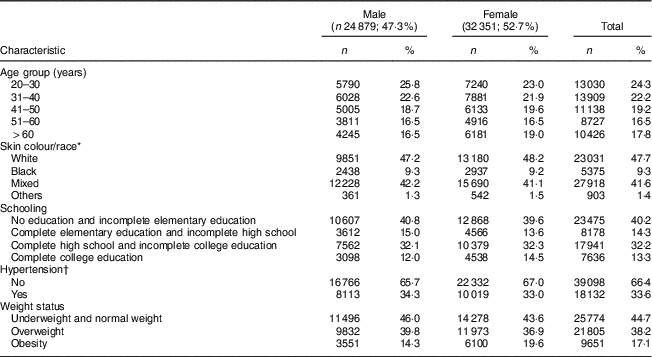
All proportions took sample weights into account.
* Five missing cases.
† Hypertension identified by blood pressure measurement (classified according to the Sociedade Brasileira de Cardiologia(1)) or by report of use of antihypertensive medication.
The prevalence of hypertension increased with age in both sexes. Among women, the prevalence ranged from 5·8 (95 % CI 4·9, 6·7) % in the 20–30 years age group to 68·4 (95 % CI 66·4, 70·3) % among those >60 years old. For men, the prevalence ranged from 13·0 (95 % CI 11·5, 14·7) % among those aged 20–30 years to 65·6 (95 % CI 63·2, 68·0) % among those aged >60 years (Table 2).
Prevalence of hypertensionFootnote * in the Brazilian population by sex and age group. National Health Survey, Brazil, 2013 (n 57 230)

All proportions took sample weights into account.
* Hypertension identified by blood pressure measurement (classified according to the Sociedade Brasileira de Cardiologia(1)) or by report of use of antihypertensive medication.
The cut-off points identified for WC in males ranged from 88·0 cm in the age group of 20–30 years (AUC=0·665, 95 % CI 0·643, 0·688, Se=61·4 %, Sp=62·1 %) to 95·9 cm for those >60 years old (AUC=0·606, 95 % CI 0·589, 0·623, Se = 57·8 %, Sp=57·9; Table 3). For females, the variation of cut-off points was from 85·0 cm in the age range of 20–30 years (AUC=0·653, 95 % CI 0·624, 0·683, Se=61·7 %, Sp=62·0 %) to 93·2 cm for those aged >60 years (AUC=0·619, 95 % CI 0·605, 0·634, Se=59·0 %, Sp=58·5 %; Table 4).
Cut-off points, areas under the receiver-operating characteristic curve (AUC), sensitivity and specificity for waist circumference (WC), waist-to-height ratio (WHtR) and BMI in the prediction of hypertension for males by age group (years). National Health Survey, Brazil, 2013 (n 24 879)

Cut-off points, areas under the receiver-operating characteristic curve (AUC), sensitivity and specificity for waist circumference (WC), waist-to-height ratio (WHtR) and BMI in the prediction of hypertension for females by age group (years). National Health Survey, Brazil, 2013 (n 32 351)
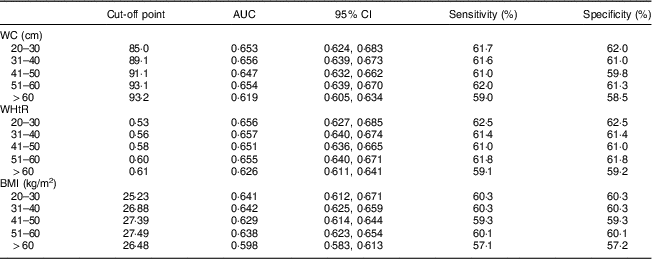
For men, WHtR cut-off points ranged from 0·51 in the 20–30 years age group (AUC=0·655, 95 % CI 0·633, 0·678, Se=62·2 %, Sp=62·2 %) to 0·58 for those >60 years old (AUC=0·603, 95 % CI 0·585, 0·620, Se=58·0 %, Sp=58·0 %; Table 3). Among women, the variation was from 0·53 in the 20–30 years age group (AUC=0·656, 95 % CI 0·627, 0·685, Se=62·5 %, Sp=62·5 %) to 0·61 for those aged >60 years (AUC=0·626, 95 % CI 0·611, 0·641, Se=59·1 %, Sp=59·2 %; Table 4).
The analysis of cut-off points for BMI by sex and age groups showed similar performance to that of indicators of fat location. In males, cut-off values ranged from 25·35 kg/m2 in the 20–30 years age group (AUC=0·652, 95 % CI 0·629, 0·674, Se=61·4 %, Sp=61·5 %) to 25·50 kg/m2 for those >60 years old (AUC=0·581, 95 % CI 0·564, 0·598, Se=56·1 %, Sp=56·1 %; Table 3). In females, the variation was from 25·23 kg/m2 in the age group 20–30 years (AUC=0·641, 95 % CI 0·612, 0·671, Se=60·3 %, Sp=60·3 %) to 26·48 kg/m2 for age >60 years (AUC=0·598, 95 % CI 0·583, 0·613, Se=57·1 %, Sp=57·2 %; Table 4).
Discussion
The present study analysed data of a population-based nationwide survey and identified cut-off points and the predictive ability of WC, WHtR and BMI to predict the occurrence of hypertension among Brazilian adults and elderly. All three anthropometric indicators showed good performance in the detection of hypertension, and all AUC 95 % CI lower limits were greater than 0·50.
Previous studies have shown that anthropometric indicators of fat located in the central region of the body are better predictors of cardiometabolic risk, including hypertension, in comparison to BMI(Reference De Koning, Anwar and Merchant10, Reference Ashwell, Gunn and Gibson26). The best performance of these markers can be explained by their association with visceral fat, which is considered a better predictor of risk than total adiposity(Reference De Koning, Anwar and Merchant10). However, the predictive capacity of the anthropometric markers of fat location varies by race/ethnicity and the outcome being evaluated(Reference Zhu, Wang and Heshka9).
The Brazilian population, for example, shows great ethnic diversity, which may explain the differences found in the pattern of body fat distribution in comparison to Caucasian populations, as indicated by correlations found between BMI and fat location measures. In two Brazilian studies that evaluated the performance of fat location indicators with cardiometabolic outcomes, WC was not identified as a good marker of risk and was highly correlated with BMI(Reference Peixoto, Benicio and Latorre27, Reference Haun, Pitanga and Lessa28).
Few studies have evaluated the predictive capacity of anthropometric markers for the prediction of hypertension in Brazil. One of the pioneering studies was conducted by Pereira et al., who analysed the performance of these markers as predictors of hypertension in a population-based study including adults and elderly in the city of Rio de Janeiro. The authors concluded that among the markers of fat location, waist-to-hip ratio was the best predictor of hypertension and it was also less correlated with BMI than WC and WHtR(Reference Pereira, Sichieri and Marins11).
Although some Brazilian studies have shown the superiority of waist-to-hip ratio as a marker of risk for chronic diseases(Reference Pereira, Sichieri and Marins11, Reference Lemos-Santos, Valente and Gonçalves-Silva12), the greater interference in the privacy of the individual to obtain the hip measurement compared with waist circumference has limited its use in epidemiological studies, such as the PNS.
In the present study, the AUC were very similar for the WC, WHtR and BMI cut-off limits, and therefore it is difficult to recognize which is the best marker. In addition, associations between these cut-off limits and the presence of hypertension showed similar performance in both sexes and in all age groups.
As for WC, since the internationally recommended cut-off points were determined based on studies with predominantly white populations, specific guidelines have been established for different ethnicities. Thus, countries such as China and Japan defined new cut-off points, set at 80 cm for women and 85 cm for men(Reference Lear, James and Ko29). In Brazil, studies evaluating the cut-off points of WC based on hypertension screening in adults found values ranging from 89·5 to 96·0 cm for men and from 86·2 to 94·0 cm for women(Reference Silva, Petroski and Peres30, Reference De Oliveira, Ulbrich and Neves31). These values are, in general, higher than those found in the present study, which showed variations in each decade of life, with the greatest differences identified at 40 years old or older in men and 50 years old or older in women.
The hypothesis that WC cut-off points should be the same in all age groups may not be adequate, because of the many physiological changes that occur with ageing. According to a systematic review by Chang et al. which included twenty-five studies conducted in different countries, there is still no agreement on the best cut-off points of WC for elderly individuals, with cut-off points ranging from 90 to 102 cm for men and from 79 to 95·6 cm for women(Reference Chang, Beason and Hunleth32). Also, prediction of hypertension by WC decreases as age increases, according to the resulting sensitivity and specificity values.
In the analysis of WC by sex, it was found that for men in the younger age groups (20–30 and 30–40 years) the best WC cut-off limits for hypertension prediction were lower than that established by the WHO, i.e. >94 cm(17). In these age groups, the cut-off points of WC were 88·0 and 93·3 cm, respectively, meaning that in the younger male population, there is already an increased risk for hypertension for values lower than the recommended ones. However, with increasing age, WC values were more similar to the recommended ones, reaching 95·9 cm in the male population with the oldest age group (>60 years old).
Also for women, the WC cut-off points for hypertension prediction were higher than that established by the WHO, i.e. >80 cm(17), in all age groups, mainly for women over 50 years old, among whom the anthropometric indicators of obesity usually do not perform well in the screening of cardiovascular risks(Reference Pitanga and Lessa14).
In the present study, WC performance among women was similar to that observed for men, showing a tendency to reduced power to predict hypertension in older age groups, especially for those over 60 years old. One possible explanation for this finding is that for the same WC measure in older women, there is more visceral fat than in younger women; hence the discriminatory power of this indicator is changed, especially after menopause(Reference Foucan, Hanley and Deloumeaux33).
In general, among older people, anthropometric measurements may not adequately quantify body fat because of age-related changes in body composition, such as loss of muscle mass, increased body fat, redistribution of adipose tissue and height reduction(Reference Harris, Visser and Everhart18). Therefore, the prediction of disease by anthropometric indicators in older people seems to vary according to the factors associated with biological changes related to age, such as age-related arterial stiffening(Reference Sun19), previous diseases in childhood and in adult life, lifestyle and socio-economic factors(17, Reference Song, Jousilahti and Stehouwer34).
Based on the results of the present study, it can be suggested that the currently recommended WC cut-off points would be more appropriate for Brazilian men after 40 years of age, at least with regard to screening of hypertension. Moreover, it is possible that the risk of hypertension among younger men may be underestimated with the use of the WC cut-off limit of 94 cm(17). Nevertheless, the largest discrepancies with the current recommended WC cut-off of 80 cm(17) were found for women in all age groups, for whom the use of this limit may overestimate the risk of hypertension.
As regards the WHtR anthropometric indicator, Ashwell et al.(Reference Ashwell, Gunn and Gibson26), unlike the findings of the present study, found that this indicator is better than WC in the prediction of cardiometabolic risk factors in a systematic review of studies involving adults from different ethnic groups, including a Brazilian study. It should be emphasized that the outcome evaluated in the Brazilian study included in the review was not hypertension but increased coronary risk. However, the area under the receiver-operating characteristic curve (0·69, 95 % CI 0·67, 0·71) in the WHtR analysis for hypertension was similar to the one found in the present study. Two Brazilian studies evaluating the capacity of WHtR to predict hypertension found favourable results for the efficacy of this indicator for screening purposes, in both sexes(Reference Luz, Barbosa and d’Orsi15, Reference Silva, Petroski and Peres30).
The cut-off points for WHtR identified in the present study, in both sexes and in all age groups, were greater than 0·50, the value usually proposed in the literature(Reference Lee, Lim and Baek36) and similar to those identified in other Brazilian studies, which found values ranging from 0·50 to 0·55 among men and from 0·49 to 0·55 among women(Reference Silva, Petroski and Peres30, Reference Corrêa, Tomasi and Thumé16).
Most international studies have found values slightly smaller than those found in the current study. In Korea, for example, it was found that the most appropriate cut-off point for males was 0·49 and for females, 0·51(Reference Lee, Lim and Baek36), which is lower than the cut-off point of 0·55 estimated in a study with Spaniards to detect cardiovascular risks in both sexes(Reference Cristo Rodríguez Pérez, Del De Leon and Jaime-Aguirre37). It should be noted that these studies took the WC measurement at waist level, the midpoint between the last rib and the iliac crest. Different locations proposed in studies to measure WC may interfere with the identification of cut-off points for WC as well as for WHtR, hence comparisons can be difficult(Reference Vasques, Rosado and Rosado38).
In the present study, BMI showed similar performance to that of fat location markers in the prediction of hypertension, in both sexes and in all age groups, with a reduction in sensitivity and specificity values as age increased. The BMI cut-off points estimated to predict hypertension among individuals up to 60 years old were compatible with the overweight condition, while for individuals over 60 years old, the identified cut-off value is in the BMI normal range for age.
Based on the present results, BMI showed sensitivity and specificity values for the different cut-off points by sex and age similar to those found for WC and WHtR. In addition, BMI is the anthropometric indicator most frequently used in health services and in Brazilian surveys.
In the present study, in all sex and age groups, moderate values were estimated for AUC, sensitivity and specificity for the cut-off points of the anthropometric markers analysed. Nevertheless, the AUC values for the three anthropometric markers analysed herein were similar to those observed in a systematic review conducted by Ashwell et al.(Reference Ashwell, Gunn and Gibson26). Likewise, in a longitudinal 5-year study about the performance of anthropometric markers for detecting hypertension in Chinese adults, Ren et al.(Reference Ren, Su and Wang6) showed moderate sensitivity and specificity for the cut-off points identified and AUC values ranging from 0·57 to 0·72, suggesting that other factors may also contribute to the prediction of hypertension such as socio-economic status, lifestyle, and combinations of genes that are associated with hypertension and gene–environment interactions that may lead to blood pressure variation.
One limitation of the present study is the lack of information on hip circumference, which would allow an evaluation of the performance of waist-to-hip ratio in predicting hypertension, which has been considered the fat location marker with the best predictive power for hypertension in the Brazilian population(Reference Pereira, Sichieri and Marins11).
On the other hand, the present study has the strength of analysing a nationwide representative sample of the Brazilian population using direct anthropometric measures, since previous studies conducted on this matter in Brazil have been limited to specific cities.
Conclusion
In conclusion, the present study showed that, for Brazilian adults and elderly, WC, WHtR and BMI had similar performance in the prediction of hypertension. Additionally, the identified cut-off points for WHtR were similar to those reported in the literature. For both men and women, the limits estimated for WC and BMI were different from those recommended internationally, meaning that their application may lead to under- or overestimation of the hypertension risk, depending on the age group under consideration.
Acknowledgements
Acknowledgements: The authors are thankful to the Ministry of Health of Brazil and the Secretary of Health Surveillance for supporting the National Health Survey 2013. Financial support: This work was supported by the Coordenação de Aperfeiçoamento de Pessoal de Nível Superior (CAPES), Brazil, through a Master grant (A.P.A.S; Finance Code 001). However, CAPES had no role in the design, analysis or writing of this manuscript and the authors have no conflicts of interest to be reported. Conflict of interest: None. Authorship: A.P.A.S. contributed to the literature review, statistical analysis, interpretation of data and drafting of the manuscript. A.P.M., N.F.M. and R.S. contributed in the interpretation of data and critical revision of the manuscript for important intellectual content. R.A.P. contributed in the article design, interpretation of data and critical revision of the manuscript for important intellectual content. P.R.M.R. and M.G.F. contributed in the article concept, design, statistical analysis, interpretation of results, writing and critical revision of the manuscript for important intellectual content. Ethics of human subject participation: This study was conducted according to the guidelines laid down in the Declaration of Helsinki and all procedures involving human subjects were approved by the National Research Ethics Commission, Brazil (report number 10853812.7.0000.0008). Written informed consent was obtained from all subjects.



