

Introduction
Jebel Moya (Site 100) is a large agro-pastoral site located in the province of Sennar, ca. 240 km distant from Khartoum (Figure 1). The site lies between the White and Blue Niles in what is now a semi-arid environment. The name Jebel Moya (Mountain of Water) refers to both the present village, located at the foot of the mountain, and the mountain valley itself. Site 100 is located in a valley bounded by large granite boulders. Excavated by Henry Wellcome (1911–14), the site has been widely considered of marginal interest. Since 2017, a new fieldwork programme has revealed a complex site and area history. This paper offers the present state of knowledge about Jebel Moya. First, it traces the history of Wellcome's excavations and subsequent interventions and engagement; second, it offers a comprehensive account of renewed fieldwork; and finally, it places the site within its appropriate spatial and temporal contexts, showing how, rather than being marginal, the site was part of a dynamic landscape.

Figure 1. Location of Jebel Moya in relation to Khartoum and other known archaeological localities.
Presently, the view of Site 100 is dominated by two large stone houses, two stone incinerators and a number of foundations. These are the remains of Henry Wellcome's camp (see section 2). While these are now part of the heritage landscape, the valley had few ancient architectural remains. Nevertheless, it was a persistent/enduring place stretching over ca. 104,000 sq m (26 acres) and saw constant activity over a period of ca. five thousand years. The valley is made up of a number of gentle slopes in the southern part, rising steeply to the east and west. To the north, there is an extensive view of the Gezira plain. From a distance, the mountains give an impression of impenetrability, but they are broken by a series of paths that continue to be traversed by herders in the present. Henry Wellcome viewed the site as a Meroitic cemetery (ca. 350 BC–AD 350). A re-examination of the site and renewed fieldwork identified it as a large agro-pastoral cemetery and, as of 2022, it is clear that parts of the site were used for habitation during the Late Mesolithic (late sixth millennium BC) and Neolithic.
History of excavations and present strategies
Pharmaceutical entrepreneur, avid collector and philantropist Henry Wellcome was born in Wisconsin in 1853. He was a British subject by 1910 and well established in Edwardian London's social and political scene. He fostered relationships with leading figures, including Herbert Kitchener. Kitchener invited Wellcome to Sudan in 1898, eventually resulting in Wellcome setting up the Tropical Research Laboratories. Wellcome had an interest in archaeology or, more precisely, in ancient things (Larson Reference Larson2009), but he also viewed the African continent as a place for medical advances and financial gain. Eventually he settled on the site of Jebel Moya as his personal archaeological project. The aim was to find the origins of African civilization (for a detailed discussion, see Vella Gregory Reference Vella Gregory2020). As evidenced by the Wellcome Archives, he prepared extensively for this expedition. The camp was set up in 1911 and was shut down in 1938, two years after his death. For various reasons, only four seasons of excavations were carried out (Jan–Apr 1911; Dec 1911–Apr 1912; Nov 1912–Apr 1913; and Nov 1913–Apr 1914), in the process removing over 3,000 burials.
As part of his expedition, Wellcome consulted extensively with Egyptologist George Reisner, who excavated at the site for two weeks during the fourth season. The House of Boulders was built during the second season. As evidenced by the extensive photographic archive at the Wellcome Collection, Wellcome built a highly ordered camp with a number of other structures (for further information on the camp, see Vella Gregory Reference Vella Gregory2023). Piecing together this part of Jebel Moya's history has proven vital for the present project. On a practical level, tracing excavation records and materials remains an ongoing endeavour. A number of objects and records were lost before publication, mostly as a result of being moved around a number of warehouses in London. The material was only examined for publication after Wellcome's death when the trustees appointed Frank Addison to analyse and publish materials, with the assistance of Archibald Laurence Patrick Kirwan. Just as the First World War disrupted excavations, so did the Second. The results were published in 1949 under the name of Frank Addison, although Kirwan's contribution is acknowledged in select pages. The human remains were only published in 1955 (Mukherjee, Rao and Trevor Reference Mukherjee, Rao and Trevor1955).
One of the many problems with this expedition was that of chronology (see section 3), resulting in what many archaeologists regarded as an unsolvable puzzle. Prior to 2017, the only other excavations were two test trenches conducted by Desmond Clark in 1973 (Clark Reference Clark1973; Clark and Stemler Reference Clark and Stemler1975), who also opened a number of ad hoc test pits in neighbouring areas. The test excavations were not published in full and to date there is no further information on these test pits. Like many others after him, Clark relied on Addison's report. Randi Haaland (Reference Haaland1987) included Jebel Moya when looking at related examples of pottery from her excavations at Neolithic Rabak. A number of archaeologists combined Addison's report with their own pottery analysis (see, for example, Andrea Manzo (Reference Manzo1995) and Isabella Caneva (Reference Caneva1991) who recognised Mesolithic pottery among the assemblage curated at the British Museum). Chronology continued to be a difficult issue. The subject was revisited by Gerharz (Reference Gerharz1994), but he relied solely on Addison, and Brass (Reference Brass2016), who examined existing burial documentation, expedition records and pottery curated at the British Museum and Petrie Museum. The latter provided strong indications of a longer chronology.
This history has informed the current project in various ways. In the first instance, it was clear that any expedition would have to contend with a significant colonial burden. Second, Brass (Reference Brass2016) re-examined the site, which at the time was regarded as the largest excavated pastoralist cemetery in sub-Saharan Africa. A study of the site reports, Wellcome's archives and material curated at the Duckworth Laboratory (Cambridge), the British Museum and the Museum of Archaeology & Anthropology (Cambridge) offered fresh insights into the site's chronology and social evolution. It was clear that this was not simply a ‘Meroitic’ cemetery. The burial records, a fresh study of the pottery and OSL (Optically stimulated luminescence) dates confirmed that the site's history started in at least the Late Mesolithic. As such, it was considered viable to initiate a fieldwork project.
Chronology
The chronology of Jebel Moya is extremely complex and it is best understood by first considering how it has been approached. This is due to the excavation methods used, the lack of solid direction in the Wellcome era (compounded by an ever-changing rota of archaeologists) and a final study by Frank Addison that contains many inherent flaws. The publication of the site suffered numerous setbacks, ranging from Wellcome's reluctance to publish anything until he deemed the excavations were at an end and all the materials had been examined, disruption caused by two world wars (which in turn resulted in material being moved multiple times) and Addison's narrow focus (for an in-depth discussion, see Vella Gregory Reference Vella Gregory2023).
In the published two-volume report, Addison (Reference Addison1949, 249–60) concludes that the chronology of Jebel Moya is contemporary with the Napatan state to the north, ca. 750 to 350 BC. This is not based on any particularly contextual archaeological argument. Rather, it parallels the recognised chronology of the Napatan period of Upper Nubia. To support his argument, Addison selected a number of amulets, statuette, beads, faience and metal objects which he regarded as non-local and which derived from a small number of graves. Furthermore, Addison interpreted a number of areas across the valley as showing remains of habitation. Subsequent re-examination by Brass (Reference Brass2016, 72–74) has shown that these are clay deposits hardened by calcium carbonate. Similar instances continue to be identified in the current excavations.
Addison used this to date all burials to the time of the Napatan state. This approach was contrary to the traditional practice of classification and analysis. It did not account for the variety of pottery, disturbances, erosion or for the possibility that certain attributions by the Egyptological experts he consulted could be inaccurate. By the 1930s the Anglophone world of archaeology demanded more sophisticated methods, particularly in terms of explanatory models (see, for example, Steward and Setzler Reference Steward and Setzler1938; Bennett Reference Bennett1943). While this was met with resistance in some quarters, the practice of archaeology still required a more thorough approach to object analysis. Despite his lack of formal training in archaeology, Addison would have been aware of methodological approaches in use at the time, particularly in his role as Antiquities Inspector in Sudan.
Addison's interpretations were met with controversy. In particular, A.J. Arkell (Reference Arkell1955) strongly disputed his methodology and conclusions. Arkell was an Oxford Classics graduate. His career started as an airman in the Royal Flying Corps (now the Royal Air Force) and he subsequently joined the Sudan Political Service. He had a deep interest in archaeology, history and anthropology and while on leave he learned archaeology from Mortimer Wheeler, then famed for his field methods. By 1938 he was appointed the first Commisioner for Archaeology and Anthropology in Sudan and throughout his career he not only excavated extensively, but also set up a functioning antiquities service in Sudan. Arkell was thus well versed in archaeology more broadly, but especially in Sudan and he disputed both the chronology and Addison's approach to erosion activities, arguing that he presented a very uniform picture of a complex process.
Arkell (Reference Arkell1955, 126–27) specifically contrasted the extent of experience of both men and further noted the improbability of all burials belonging to a single phase. Addison (Reference Addison1956) responded by revising his chronology, placing the entire occupation of the site to the Meroitic period (350 BC–AD 350). The reason provided by Addison (Reference Addison1956) was that a grave with a Meroitic pot was placed lower in the stratigraphic sequence than a grave previously attributed to the Napatan period. This critique failed to address adequately issues of erosional activity, possible deliberate differential depths of burials and the earlier non-pottery artefactual evidence which had led to the prior Napatan-period attribution. The arguments are bewildering. While Arkell never offered a chronological answer, Addison's approach eschewed convention in terms of both methodology and interpretation. Henry Wellcome's original desire was to find the origins of an African civilization (Wellcome Archive HSW/AR/Jeb/2). Addison (Reference Addison1949: 254, 258) concluded the site had no great antiquity, the original settlers were unknown and that suggesting the first inhabitants were of the same tribe as the ancestors of the Ethiopian dynasty would be going beyond the evidence. He also disagreed with Arkell on the usefulness of further fieldwork (Addison Reference Addison1956, 17). The result was huge confusion within the archaeological community and questions raised over whether investigations over the extant material or the site itself were worth pursuing.
In 1973, Desmond Clark dug a test pit in the western perimeter of Site 100. Clark (Reference Clark1973, 60, table 1) dated two charcoal samples from 80–90 and 90–100 cm depth, but there was no description of their association with human occupational activity. Subsequent studies also relied on Addison's original report (see, for example, Randi Haaland Reference Haaland1984; Reference Haaland1987). The first identification of Late-Mesolithic (late sixth millennium BC) activity came when Isabella Caneva (Reference Caneva1991) identified Late-Mesolithic sherds at the British Museum. Later, Gerharz (Reference Gerharz1994) attempted to revisit the issue of chronology in his 1994 doctoral dissertation. Gerharz concluded there were three phases of occupation: Late Mesolithic; a relatively unspecified Neolithic occupation relying solely on Desmond Clark's date of 3009–2500 calibrated BC; and a third phase stretching from the Napatan down to the Meroitic. However, Gerharz relied entirely on Addison's publications, Caneva's work and Desmond Clark. He did not examine Wellcome's assemblage himself, and neither did he undertake fresh excavations nor radiometric dating on any of the remains.
Consequently, Brass (Reference Brass2016) re-examined all extant burial documentation and expedition records, together with all of the existing pottery at the British Museum. OSL dates were obtained on pottery samples from the British Museum (Table 1). For the first time, dates could broadly be assigned to the pottery assemblages, now systematically defined by Brass. Three phases were discerned and the known burial activity was ascribed to the final phase, the Meroitic. Brass (Reference Brass2016) also noted that large portions of the site were unexcavated and the chronology of the burials would need to be tested through fieldwork and an AMS (Accelerator Mass Spectrometry) dating programme.
Table 1. Summary of the previous (2012) and revised (2019) OSL dating results on Jebel Moya sherds curated at the British Museum by the Research Laboratory for Archaeology and the History of Art (Oxford University).

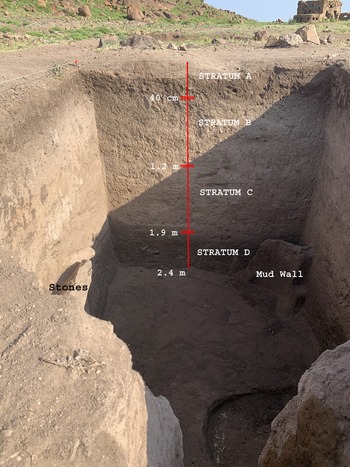
To this end, new fieldwork at Jebel Moya was initiated in October 2017 (Figure 2). The chronology of the site has been extensively revised (Brass et al. Reference Brass, Fuller, MacDonald, Stevens, Adam, Kozieradzka-Ogunmakin and Abdallah2019; Brass and Vella Gregory Reference Brass and Vella Gregory2021; Vella Gregory, Brass and Kozieradzka-Ogunmakin Reference Vella Gregory, Brass and Kozieradzka-Ogunmakin2022) from that proposed by Frank Addison (Arkell Reference Arkell1955; Addison Reference Addison1956). AMS dates on cereal, faunal and humans remains, and OSL dates on pottery, show occupational activity from 2000 years ago down into the third millennium BC (Tables 1–3). Trench 2, which has the full stratigraphic sequence (Figure 3), continues down into the late sixth millennium BC, as evidenced by the Late-Mesolithic pottery sherds and their parallel dates from the central Sudan. This is the first unbroken stratigraphic sequence for any archaeological site in the central and southern Gezira.

Figure 2. Location of the trenches, seasons 1-3. The view is from the House of Boulders facing south.

Figure 3. Trench 2 with some of the Late Mesolithic dried mud wall visible.
Table 2. AMS dates on botanical and faunal remains from trenches 1, 2 and 4. Dating was done by Beta Analytic and the Research Laboratory for Archaeology and the History of Art (Oxford University). Calibration: OxCal 4.3.2, Intcal13, Sigma 2 (95.4%).

Table 3. AMS dates for the human skeletons from trenches 3 and 8. Dating was done by the Radiocarbon Laboratory, Institute of Physics – Centre for Science and Education, Silesian University of Technology and the Research Laboratory for Archaeology and the History of Art (Oxford University). Calibration: OxCal 4.3.2, Intcal13, Sigma 2 (95.4%).

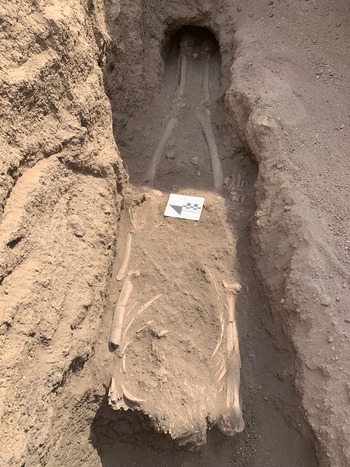
The earliest dated burial activity is from Trench 3, Stratum C (2470–2210 BC). The continuation of burial activity for over 2,000 years is shown by two individuals from Trench 8 dated to 1192–1013 BC and 96 BC–AD 95.4 respectively (Vella Gregory, Brass and Kozieradzka-Ogunmakin Reference Vella Gregory, Brass and Kozieradzka-Ogunmakin2022). There is a potential earlier burial cut into the Late-Mesolithic basal layers of Trench 14 (Figure 4), but the first attempt at AMS dating a tooth failed, due to no-carbon yield at the combustion stage of the process.

Figure 4. Skeleton from the bottom of the burial pit, Trench 14.
Three macro-level phases of occupation are discernible so far from radiocarbon dates and pottery (Brass et al. Reference Brass, Fuller, MacDonald, Stevens, Adam, Kozieradzka-Ogunmakin and Abdallah2019; Brass and Vella Gregory Reference Brass and Vella Gregory2021; Vella Gregory, Brass and Kozieradzka-Ogunmakin Reference Vella Gregory, Brass and Kozieradzka-Ogunmakin2022), and these can be correlated with the macro-geological strata termed A–D:
• Phase 1. This late-sixth-millennium BC phase encompasses Stratum D and pottery Assemblage 1.
• Phase 2. It stretches from arguably before the third millennium BC into the second millennium BC. It is represented by pottery Assemblage 2 and is predominantly in Stratum C. Burial activity occurred in this phase.
• Phase 3. This first-millennium BC to early-first-millennium AD phase encompasses strata A and B, and pottery Assemblage 3. Considerable burial activity occurred in this phase.
A mass AMS programme needs to be instituted to arrive at a finer chronological resolution, in conjunction with studies on micro-level erosion.
Fieldwork
Upon starting the new excavations in October 2017, it was determined that there was no micro-stratigraphy for us to follow consistently for excavation. Accordingly, the decision was made to excavate carefully and methodically in 10-cm spits, which allows control over recording, finds, for flotation samples to be taken and also to record accurately any changes. It has also been determined that the macro-level geological Strata labelled A–D by Wellcome's geologists is correct and we have retained these designations. The numbering of the trenches is according to the order in which they were opened.
The first two seasons saw five trenches (1, 2, 5, 7 and 9) opened in the west of the valley, three in the centre (3, 8 and 10), one in the north (6) and one in the east (4). Of these, trenches 3, 8, 9 and 10 yielded human remains; trenches 1, 2 and 4 yielded valuable archaeobotanical data, and Trench 2 had the best archaeological stratigraphic sequence down into the Late Mesolithic (see Brass et al. Reference Brass, Adam, Vella Gregory, Abdallah, Alawad, Abdalla and Kozieradzka-Ogunmakin2020 for particulars of each trench). The third field season saw the opening of a further six trenches. We continued using the spit method of excavation, which has proven to be so successful for the site.
Four of the six trenches in Season 3 were in the centre and centre-west of the valley. These are trenches 11, 13, 15 and 16. Trench 11 was slightly to the north of previous trenches 3, 8 and 10 also on the west bank of the same shallow gully. The top layer of soil was a thin Stratum B. The surface was first cleaned before spit-level excavation occurred. Spit 1 was excavated and contained fragmented animal bone and lithics. Beneath, a burial cut was observed in Stratum C. The orientation of the trench was changed to follow what was the first detectable burial cut by our mission. The burial cut orientation was north to south. After recovery of the human remains, the trench was closed due to the lack of further finds.
Trench 13 was opened adjacent to Trench 11, immediately to its south. It was a 1 × 1 m trench opened to investigate what looked like two leg bones against the slope sediment. A grinding surface stone was found along the west wall. Spit 1 had the thin layer of Stratum B lead into Stratum C. The trench was closed after the human humeral shaft was recovered. Other remains in the two spits included animal bones, natrolite beads, lithics, ostrich beads and pottery sherds. Trench 15 was opened to investigate a bone seen in the surface sediment on the embankment on the other side of the gully from T11 and T13, which is a long flat surface eroded to a thin Stratum B into C. This bone – Spit 1 – turned out to be an animal bone. The trench was closed after Spit 1 due to remains being found in the wall of a gully to the north-west, so Trench 16 was opened. The pottery of Spit 1 was Assemblage 3.
Trench 16 was a 1 x 1 m trench against a gully face. All the spits excavated are Stratum B. Adjacent to the trench was a stone circle. This proved to be archaeologically sterile. Subsequent investigations revealed that these circles are frequently made by herders, even in the present day. Flotation samples were taken from Spit 2 onwards. The first four spits were relatively poor with a few animal remains, some pottery and the odd lithic. The fifth spit was richer with animal bones, lip plugs, pottery and lithics including a large core. In Spit 7, the soil changed to very fine sandy grey; there was a huge pounder found at a depth of 70 cm, angled 5–10 cm from the south wall, 21 cm in length and at approximately the same depth as the animal fragmentary bones visible in the gully face. The final spit had animal bones, pottery, a microlithic arrowhead and a mini pick-axe, and the appearance of hardened calcium carbonate at a depth of 73 cm (measurement from north wall).
In the west of the valley, Trench 12 was opened between the positions of former trenches 1 and 9. It was a 2 x 2 m trench oriented east–west inwards from the front of a slope. Visually, while marking out the trench, a human skeletal deposit of a partially crushed and fragmented cranium alongside an animal bone was identified at the bottom left, north-east corner of the front of the trench in the slope. There was also a curious reddish-brown layer, which stretched horizontally for a number of metres across the slope. Stratum A had been eroded and Stratum C was entered in Spit 3. Remains in the initial spits consisted of animal bones, some charcoal, pottery, lithics, shell, a grinder and a lower grinding stone. The number of remains increased from Spit 5 down. In Spit 5, there were three pounders, an upper grinding stone, a lip plug, lithics, animal bones and much pottery. It continued in Spit 6 with, amongst others, an upper grindstone and, in the north-east corner, the first intact whole pot found in the modern excavations; the pot was infilled with sediment and bulk lifted. The base of the pot was in Spit 7 at a depth of 63 cm as measured from the west wall. The pot was Assemblage 2, had no decoration, a diameter of 14 cm and traces of its original red slip. There was an animal bone in situ with the pot. Lithics and pottery were also found nearby. A cranium was excavated from Spit 8. Only the back part survived, held together by the thick sediment. It is thin and small, probably of a child, and currently awaiting further examination. There was a small piece of charcoal and a small carnelian lithic core by the cranium. The pottery in all spits is all Assemblage 2.
Trench 2 proved to be the most productive trench from the first two field seasons. When it was re-opened at the start of the third season, we found we had reached sterile bedrock. The dried mud wall previously described by Brass et al. (Reference Brass, Adam, Vella Gregory, Abdallah, Alawad, Abdalla and Kozieradzka-Ogunmakin2020) rested on the bedrock. Based on the pottery, the lowermost spits are Late Mesolithic (late sixth millennium BC). Trench 2 was extended eastwards and the extension was named Trench 14 due to the surface being 30 cm lower than the former surface of Trench 2. The north–south length remained the same at 2.5 m while the east–west width was 2 m. The composition of the first three spits made it clear that the original slope was closer to Trench 2, and soil and pottery had been dumped from Wellcome's excavations against Trench 2. Therefore three depositional events are witnessed: modern topsoil, large stoney soil and majority gravel stones (Strata B and C soil). The deposition ends 47 cm below the modern ground surface in the north-east corner, 45 cm below in the south-west corner and 54 cm below in the south-east corner. The first in situ deposit started in Spit 4 where two grinding stones, together with animal bone, lithics and pottery, were found. Spit 6 was the first in situ deposit spanning the trench.
Spit 6 has diverse finds: pottery, lithics, animal bones, a lip plug, one hammerstone and one pounder. In the north-east was a semi-circular stone circle laying on the base of the spit, 33 cm wide and 40 cm from the east wall, extending into the north wall. Resting on the right side on top of the stones were large pottery fragments. In the gap between the circle and east wall were one shell, a long animal bone and more pottery sherds. Separately, in the northern third along the east wall (29 cm from the north wall right on the east wall) was a broken pot base, not at the base of the spit but within the spit.
In Spit 8, a figurine was found 114 cm from the east wall, 68 cm from the south wall at the end of the spit (80 cm). It is the second figurine found in situ, the first being a goat figurine from Spit 13 of Trench 13 (Brass et al. Reference Brass, Adam, Fuller, Stevens, Hassan, Kozierdazka-Ogunmakin and Abdallah2018; Vella Gregory Reference Vella Gregory2021).The start of Stratum C is first visible in Spit 9 and becomes more prominent in Spit 10 across the trench; for Trench 12, it was the start of Spit 13. Animal bones, lithics, grinding stones and shells are present in these spits until the end of Spit 11.
At the end of Spit 11, an interesting phenomenon was observed for the first time in the modern excavations, and which was rarely detected in Wellcome's excavations: the entire cut of a burial pit. The top of the pit extended 106 cm westwards to the west wall (the boundary with Trench 2). The top was 61 cm wide (south to north). The pit is east to west. It is 38 cm from the south wall, narrowing to 30 cm at the point of connection with Trench 2. It is 155 cm from the north wall. In the west wall with Trench 2, the pit cuts down on the south side for 50 cm to the start of Stratum D. The cut then levels out northwards for 40 cm before cutting down at an angle to 10 cm above disintegrating granitic bedrock where the top of a human cranium was visible.
The sediment in the pit was mixed and was an intentional backfill as seen from the texture and the pottery types, which consisted of a couple of Late-Mesolithic (ca. late sixth millennium BC) sherds as well as Assemblage 2 sherds. There was disintegrated bone at a depth of 13 cm into the pit, but it was of a quantity and placement which rendered it indeterminable whether there had been a second human internment or whether it was an animal, or disturbed remnants churned with the backfill. There was a schist rock at a depth of 28 cm; it is perhaps local to the plateau (not to the valley or mountain range) but chemical analysis is required. Lithics were also found.
The cranium was 133 cm from the north wall and it was hidden by a thin layer of soil in the former east wall of the Trench 2. The skeleton was oriented east to west, with the cranium to the west and the cranium turned to face south. The cranium was resting on very hard, disintegrating granite. The current hypothesis, based on the outline of the pit cut and the fill, is that the pit was dug down and then sideways for the body to be placed in a cavity. An initial attempt at AMS dating of the skeleton failed due to no carbon yield at the combustion stage of the process; a second attempt will be made when funds permit, given the importance of validating whether the skeleton does indeed date to the Neolithic or earlier.
Archaeological remains
The pottery
The pottery was catalogued using standardised parameters to keep the information collected as clear and concise as possible on the dimensions, condition and specific features of the pottery. An attribute-based approach is followed to analyse the decoration, looking at attribute-based analysis, looking at what aspects are changing and which are remaining stable spatially and temporally. This approach has been argued to be a more statistically nuanced and justifiable approach to defining assemblages (Brass and Vella Gregory Reference Brass and Vella Gregory2021, Brass Reference Brass2016).
The sherds from the first two seasons have previously been analysed in detail (Brass and Vella Gregory Reference Brass and Vella Gregory2021). It was determined that the range of Assemblage 2 and 3 decor was far greater than previously recognised. There are indications in the sherds from early Stratum C of potential early (pre-mid third millennium BC) connectivity with the Central Sudan. In the third season, more Neolithic sherds were collected in situ and analysed, as were the first in situ Late Mesolithic sherds from Stratum D.
A total of 5,733 sherds were collected and analysed from the first two seasons. Of these, 485 have decoration. The presence and absence of attributes of the pottery sherds from the originating stratum (A–D) were compared in order to elucidate further the nature of stratified variability present at Jebel Moya. This was accomplished by first quantifying the single occurrence of attributes in the different strata and by examining the co-occurrence of attributes across rim sherds on a per stratum basis. Strata A and B contain Assemblage 3 sherds, Stratum C contains Assemblage 2 and Stratum D Assemblage 1. Furthermore, all the Assemblage 3 sherds are slipped and burnished. Assemblage 3 sees the stylus as the dominant tool used in body decor. Assemblage 2 has the greatest variety of Alternately Pivoting Stamp (APS), stylus and comb motor actions on the body sherds, and also sees the first known instance of rolled fish spine. The one instance of the APS smocking technique from Spit 1 Trench 8 is the first time it is identified at Jebel Moya. Overall, there is a much stronger focus on body decor than rim decor, and the motifs and motor actions in Assemblage 2 are particularly diverse. Assemblage 3 has a number of vessels suitable for storage, including vessels with a straight upper body ideal for the storage of dry goods. Furthermore, there are a number of Assemblage 3 wide, flat platters of the type that can be used for food sharing, and vessels with a wide opening at the neck. It has been argued that sherds from Trenches 6 and 8 bear strong similarities to others found at Kadero and other sites (Brass and Vella Gregory Reference Brass and Vella Gregory2021). It suggests potential contact between the southern Gezira and the Central Sudan during the Neolithic period and, together with the problematic contextual radiocarbon dates from Rabak where Jebel Moya-like sherds were found (Haaland Reference Haaland1987), an earlier Neolithic habitation at Jebel Moya than so far confirmed by the existing AMS dates.
The pottery from the third season builds on these results. It consists of 1,458 sherds of which 139 are decorated. Of these 139, 18 are Assemblage 3, 117 Assemblage 2, 2 Assemblage 1 and 2 are indeterminate rim sherds. Previously known decoration has continued to be found, together with new decoration ranging from scraped clay lines to rocker-stamped fish net (for example, Figures 5, 6) (Table 4). In terms of the stratigraphic distribution of the types of sherds, it conforms to the pattern observed in the previous two seasons: namely, Assemblage 1 in Stratum D, Assemblage 2 predominantly in Stratum C, while Assemblage 3 is in Stratum B and above. As in the previous seasons, slipping and burnishing predominate for assemblages 2 and 3 (Table 5). New is the presence of a slip on an Assemblage 1 sherd from Spit 12, Trench 14. Previous Assemblage 1 sherds had burnish but no slip. The rim forms also follow the same pattern as previous seasons for assemblages 2 and 3, and a greater variety of rim forms is found in Assemblage 2 (Table 6). There are no Assemblage 1 rims from the third season. There are 12 rim and body sherds from Assemblage 3. In Assemblage 2, there are 13 rim-only and 65 rim and body sherds. Rims which are straight and thin or straight and thick dominate each assemblage. The thick, everted (rolled) form is only present in Assemblage 2.

Figure 5. Comb-dragged v-shaped wavy lines. Trench 14, Spit 10 (start of Stratum C).

Figure 6. Stylus-incised packed chevrons. Trench 12 Spit 5.
Table 4. The varied decoration found in seasons 1–3. The bold is for decoration not present in seasons 1 and 2.

Table 5. Prevalence of slipping and burnishing in the three pottery assemblages out of the total number of sherds with decoration.

Table 6. Rim forms from decorated assemblages 2 and 3 sherds.

Rim codes
RE: Thick everted
TE: Thin everted
RER: Everted rolled
THI: Thick in-sloping
RS: Rolled, straight
TI: Thin in-sloping
RSTK: Straight thick
RSTN: Straight thin
The tools and motor actions used to create the decoration on the sherds are also similar (Tables 7–9). New rim decoration compared with the previous seasons was identified, which was made using a spatula: stamped chevrons, stamped cross-hatching and stamped lines crossed with comb-stamped lines to form cross-hatching. The comb and stylus motor actions are present in the previous seasons, and the relationship between the decor and type of rims is also similar.
Table 7. Rim sherds: single-attribute occurrences of decor tools and the corresponding motor actions.

Table 8. Co-occurrences of rim types and motor actions for Assemblage 2.

Table 9. Body sherds by assemblage: Single-attribute occurrences of decor tools and their corresponding motor action.

The newly recognised decor on body sherds consists of:
• Comb: dragged, V-shaped wavy lines, stamped chevrons to form squares, unevenly serrated packed dotted lines, rocker-stamp, plain-edge fish net (straight zig-zag lines)
• Fillet: with incised lines and spatula-stamped lines
• Spatula: spatula-stamped vertical lines leading on from the comb-stamped dots, stamped chevrons, stamped cross-hatching
• Stylus: dragged lines, incised lines in a geometric pattern, dragged punctuates, scrapped lines
• Other: scratched lines.
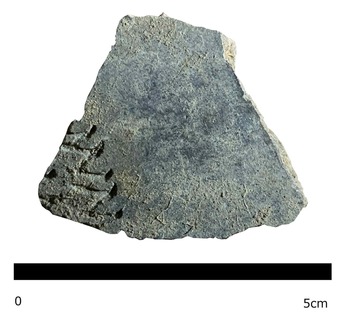
The temper and thickness for each of the assemblages remains consistent. There is a curious Assemblage 2 sherd from Trench 12 Spit 2 (Figure 7). It has rocker-stamp, plain-edge fish net (straight zig-zag) lines. It has a parallel from Shaqadud Midden (Caneva Reference Caneva1991, Plate I: 1, 4). At Shaqadud Midden, fish net did appear in layers 29–31, but it is consistently present from layer group 20–22 down to layer group 57 (Caneva Reference Caneva1991, table 2) while most prevalent in layer group 14–16. The Jebel Moya example is Assemblage 2. Level 12 at Shaqadud Midden is dated to 5511–4267 BC (Marks Reference Marks, Marks and Mohammed-Ali1991; Brass, Adam and Wellings Reference Brass, Adam and Wellings2018). However, fish net also continues at the neighbouring Shaqadud Cave in the Neolithic (Marks Reference Marks, Marks and Mohammed-Ali1991). In addition, Arkell's ‘fish-scale’ at Shaheinab are comb-stamped lozenges/quadrangles. The Jebel Moya sherd is an interesting variation on a theme, but it does not currently hold chronological significance. Also from Trench 12 was the first whole pot found since Wellcome's excavations. It is from Stratum C (Spit 7) and has some surviving red slip. It is undecorated. The diameter is 14 cm. Other pottery fragments and lithics were found in the same spit. The hardness of the spit and that the pot was upright is suggestive of a potential living floor.

Figure 7. Rocker-stamp plain edge fish net which has a parallel from Shaqadud Midden Pottery (Caneva Reference Caneva1991 Plate I: 1, 4).
Petrography and residue analysis
A total of 62 sherds from predominantly Assemblage 3 were examined by Mantus Valancius as part of his PhD (Valancius et al. Reference Valancius, Brass, Vella Gregory and Adam2023). Most of the sherds derived from trenches 1, 2 and 4. Of the 62 sherds, three were surface finds and these were two from Assemblage 2 and one Assemblage 1 included as outliers. The sherds derived from the first season of excavation (2017). All 62 sherds were characterised and classified compositionally using a combination of thin-section petrography and instrumental geochemistry. This was to determine the origin of the clay sources, and the identification of pottery traditions and their longevity primarily over the period encompassed by Assemblage 3.
The sherds were first divided into ‘fabrics’ based on similarities and differences in their inclusions, ceramic matrix and texture, which represent distinct ‘recipes’ characterised by specific raw materials and paste preparation techniques. Their multivariate geochemical data was subsequently determined, analysed and explored using principal component analysis (PCA). The resulting geochemical groupings were compared with the petrographic classification of the pottery to check for correspondence and to reconcile the two in terms of the mineral and rock sources of specific elements. They were divided into three groups: Perthite-Rich Granitic Fabric, Granitic Fabric and Grog Fabric. The granitic fabrics both contain similar poorly sorted angular inclusions derived from granitic igneous rock, while the Perthite-Rich Granitic Fabric has significant quantities of perthitic feldspar. The Grog Fabric has inclusions of grog, quartz and feldspar, as well as rare amphibole, biotite and chert. The petrographic composition of the sherds correlates with the geology of the Jebel Moya and Jebel Saqadi massifs. The chemical sub-groups are suggestive of combining several clay sources with differences not visible to the naked eye. The source for the Grog Fabric is speculated to be from the Blue Nile, perhaps Abu Geili where Jebel Moya-like sherds have been found, or the northern Gezira where Cretaceous sedimentary rocks including mudstone outcrop is found.
The two Assemblage 2 sherds were found to have a similar chemical composition, which tentatively points towards a possibility that clay sources or recipes did not fundamentally change, while their motifs did. This needs to be tested through an expanded petrographic sample database inclusive of better regional geological sampling to provide better information on potential clay sources together.
Organic residue analysis was also conducted to characterise the commodities that were processed within vessels found at the site. Lipid residue analysis was performed on a separate set of randomly selected 50 sherds from Assemblage 3, originating from trenches 1, 2 and 4. Of the 50 sherds, 9 had sufficient concentrations to be analysed. There are two main profiles. Profile 1 is degraded animal fat, while the second profile has long-chain fatty acids typical of plant processing. Two sherds plot for ruminant dairy, of which one is suggestive of dairy and ruminant carcass products. Three samples plot in the ruminant adipose region. Another plotted for ruminant and non-ruminant/plant regions either at the same time or over the pot's lifetime. The sherds for Profile 2 showed signatures strongly indicative either of an origin in leaf or stem epicuticular waxes or possibly suberin, an aliphatic polyester found in all plants. However, the long-chain fatty acids are not diagnostic of any plant families and the best which can be stated at present is that some pots were used for plant processing.
Other finds
Grave goods consist of pottery, lip plugs, beads, stone tools, figurines and some other small objects. The beads are made of raw materials ranging from carnelian, stone, natrolite and shell, and require further study. Stone tools range from very large pounders, grinders, querns and pestles to microliths, including arrowheads. Macroliths associated with grinding and food processing are made from local granite rock. Macroscopic examination reveals traces of use, further confirmed by botanical remains (see below). Querns are typically elongated with a concave active surface. The sides and base were produced by repeated flaking and pecking, creating rounded edges. Grinders are mostly oval or semi-oval shaped and smooth. Pounding tools consist of large cylindrical stone objects, bearing heavy traces of use. Similar techniques of shaping and pecking were used to create rounded edges. The flattened sides tend to be very smooth. Also present are celts, smooth polished stones, usually green in colour. In terms of smaller tools, there is a large number of polishing, burnishing and abrading tools in a range of materials. Less common is the presence of micro arrowheads, which have been found in different Neolithic strata, as well as one example in association with the burial in Trench 9. These tools will be studied and they are hard to relate to those described in Addison's (Reference Addison1949) publication due to the latter's lack of formal context.
Lip plugs (sometimes called labrets) come in a variety of sizes, shapes and materials. This includes clay, natrolite and other types of stone. Clay lip plugs are fired and burnished, often with a very high burnish. Even lip plugs made from the same material vary significantly in size and shape. They range in length from 1.3 to 3 cm and in width from 0.3 to 1.1 cm. The most common shape is that of a mushroom-like top, the ends vary from a round point to a flat, circular bottom. The middle parts can be fairly straight or with a bulge, and the overall shapes range from long and narrow to short and squat. The lip plugs have predominantly been found along with other artifacts and remains in the Neolithic strata; for example, from Trench 12 Spit 8 we recovered three plugs with a piece of ostrich shell. There is one example from our excavations in association with a burial: Trench 8 Skeleton 1 had a stone lip plug by the forehead.
The use of lip plugs is widely attested across the African continent, including Sudan, and elsewhere (see, for example, Garve et al. Reference Garve, Garve, Türp and Meyer2017) and is related to body modification and identity. There is a great variety of shapes and uses. The use of these objects causes modifications to dentition. At Jebel Moya, for example Rachel Hutton MacDonald (Reference Hutton MacDonald1999) examined the dental caries and wear on the extant teeth from the Duckworth Laboratory in the late 1990s. She noted there was dental mutilation through the deliberate removal of some teeth, though not always ‘as 12% of individuals who exhibited labret wear facets had not lost any of their anterior teeth’ (Hutton MacDonald Reference Hutton MacDonald1999, 147). Lip plugs were most commonly worn through the bottom lip, although there was one instance of labret facet wear on both the mandibular and maxillary incisors of an unspecified individual. Hutton MacDonald also attributed the presence of abscesses to the use of lip plugs (Hutton MacDonald Reference Hutton MacDonald1999, 168–69), which agrees with Grave et al. (2017) noting that the use of lip plugs affects the dental, osseous, muscular and connective tissue structures. The practice involves the removal of teeth, which are then replaced with these objects, in the process changing both how a person looks but also the structure of the mouth. As Garve et al. (Reference Garve, Garve, Türp and Meyer2017) note, the wearing of lip plugs also changes a person's way of life. Lip plugs require individuals to keep their jaw open or partly open, leading to increasing salivation and mouth breathing. They also affect how one eats and drinks, particularly mastication, facial expression and patterns of speech.
As an object and a practice, the use of lip plugs is widely misunderstood. As of 2004, the World Medical Association classed the practice as infant oral mutilation (Garve et al. Reference Garve, Garve, Link, Türp and Meyer2016). The discourse is further complicated by western scholars and visitors Othering people who practise bodily modification. Among the Mursi in Ethiopia, for example, facial modification is deeply embedded in identity and they are well aware of being Othered, particularly through being photographed as objects of curiosity (Turton Reference Turton2004). Bodily modifications cannot be read in isolation. They are part of one's social skin and personhood (Turner Reference Turner, Burroughs and Ehrenreich1993). At Jebel Moya, there appear to be no particular dangerous pathologies associated with the practice (Brass et al. Reference Brass, Adam, Vella Gregory, Abdallah, Alawad, Abdalla and Kozieradzka-Ogunmakin2020). While it is not possible to determine the extent of any oral infections (as expressed by Garve et al. Reference Garve, Garve, Link, Türp and Meyer2016), skeletal remains from current and older excavations indicate overall longevity. In the case of Jebel Moya, the practice appears to be confined to adult teeth and to date no cases of this practice in infants has been detected.
This type of body modification needs to be read in its wider context. Figurines appear frequently in association with burials. As noted previously (Vella Gregory Reference Vella Gregory2021), figurines can be broadly classified into three types: anthropomorphic, cylindrical abbreviated and zoomorphic, with variations within each group (see figure 3 in Vella Gregory Reference Vella Gregory2021). A figurine found during the fourth season is of the cylindrical, plain, abbreviated type, although the bottom half is missing, so it is not known whether it had a bulge in the lower body. Made of clay, it is highly burnished and fired dark red and dark grey at the back. The top part is semi-circular and flattened. Figurines, lip plugs and indeed material culture more broadly need to be seen within the broader network of social relations. Latour (Reference Latour1999) notes that such objects are the result of complex processes of negotiation between the material world, people and broader historical currents. In other words, these objects need to be viewed within the wider network and, while Latour (Reference Latour2007) does not explain why a network takes a certain form, archaeology is well placed to elucidate this matter. In the case of Jebel Moya, figurines and lip plugs form part of a long burial tradition (to date these objects have not been found in Late-Mesolithic habitation levels), in turn forming part of a landscape that has endured for a very long time. As such, these objects are read from the perspective of dwelling (sensu Ingold Reference Ingold2000).
Animal remains
Analysis of the faunal remains by Kevin MacDonald is ongoing, but preliminary results on diagnostic elements from the first season and 50% of the remains from the second and third seasons are available (Table 10). Bones of cattle (Bos sp.), goats (Capra hircus) and probably sheep (Ovis aries) are present throughout the sampled stratigraphic sequences (first millennium BC and Neolithic). Interestingly, kob (Kobus kob) is present in the early spits from two trenches (Trench 1 Spit 4 and Trench 15 Spit 1); the pottery in association with the latter spit is assigned to Assemblage 3, first millennium BC. It, together with waterbuck (Kobus ellipsiprymnus) from Trench 1 Spit 4, indicates that there was a permanent water source present in the area, probably at least up until the middle of the first millennium BC. There are no natural permanent water sources today between the two Niles in the southern Gezira. The survival of any permanent water source from earlier periods, together with the kob's ecological requirements, indicates that there was reliable rainfall and a grass savannah environment. This is reinforced by the presence of hartebeest or topi in Trench 1 Spit 4. The transition to the present-day, semi-arid environment was not yet complete, although the presence of Gazelle dorcas (Trench 2 Spit 4) indicates that the process was under way.
Table 10. The occurrence of different animal species in seasons 1–3. The equivalent spit of Trench 14 compared with the adjacent Trench 2 is 20 cm (T14 Spit 11 is T2 Spit 13).

The elephant molar (Trench 4 Spit 6), Limicolaria flammata (below) and the presence of Ourebia ourebi (oribi) for the Neolithic period indicate that there was a wetter environment before the first millennium down to the third millennium BC. The oribi can live in a variety of ecologies from floodplains to savannahs and tropical grasslands, but prefers open grasslands with grasses between 10 and 100 cm tall. It is a grazer and an occasional browser. Although the oribi derives much of its water from its food and does not require permanent water sources, it prefers a habitat with a steady ecology. Loxodonta can go several days without drinking, but they do require one or more permanent water sources and are most often located in grassland, woodland, montane forest and riverine habitats. Separately identified by Brass and Vella Gregory is the presence of the Limicolaria flammata land snail in quantities in Trench 2 (spits 7, 10 and 12, with one example also from Spit 15) and Trench 4 (Spit 6). It is uncommon around modern Sennar. It is only abundant from Gedaref southwards (410 km south of Khartoum and ca. 160 km south of Jebel Moya) where the annual rainfall is 500 mm and over and the environment is of Acacia-Tall Grass savanna (Williams, Adamson and Abdulla Reference Williams, Adamson, Abdulla, Williams and Adamson1982).
Botanical remains
Excluding the uppermost topsoil in each trench, sediment from each sampled spit was collected for recovery through flotation. Each sample consisted of 20 litres (2017, 2019) and 10 litres (2022) of bulk sediment and two such samples were taken from each sampled spit. The samples were floated using simple wash-over bucket flotation using a 250μm mesh (Pearsall Reference Pearsall2000; Fuller Reference Fuller, Ucko, Quin and Hubert2008). The results from 2017 have previously been reported (Brass et al. Reference Brass, Fuller, MacDonald, Stevens, Adam, Kozieradzka-Ogunmakin and Abdallah2019). In 2017 and 2019, the flotation was carried out at and used water from a local hafir. In 2022, the hafir was dry and water was brought in from another source to the Jebel Moya village where the flotation was done by Mike Brass in the courtyard outside the place of residence.
Subsequent identification and quantification of the 2019 and 2022 seasons’ archaeobotanical remains was carried out by Anna den Hollander and Dorian Q. Fuller at University College London's Institute of Archaeology, making use of the Institute's botanical reference collection (Tables 11, 12). From the 2017 sampling, identifiable sorghum items accounted for 85.6% of all remains, indicating it was a staple of the diet. The sorghum was predominantly domesticated, including plump (wide) grains and some torn rachilla spikelet bases. Three AMS dates were obtained (see Table 2) with ranges between 2500–2200 BC, the second-oldest dated examples of domesticated sorghum in the world. The only other definite food plant is represented by fruit stones from Ziziphus sp. (jujube), a small tree or shrub that produces edible fruits. These remains are likely to represent either Z. spina-christi (L.) Willd. or the similar Z. mucronata. While Z. mucronata is a shrub of the savanna throughout sub-Saharan Africa, Z. spina-christi favours watered micro-habitats in climatically dry areas, such as wadi bottoms and Nile valley (Andrews Reference Andrews1950–1956; African Plant Database 2023). Both have sweet fruits and large stones, and Z. spina-christi is widely utilised as a dry season fruit and found in markets across northern Sudan (Saied et al. Reference Saied, Gebauer, Hammer and Buerkert2008). Other fragments of possible nutshell and parenchyma tissue that could be from tubers hint at the use of additional wild plant resources. Grasses and small legumes were also identified.
Table 11. Archaeobotanical remains of the 2019 season at Jebel Moya.

Table 12. Archaeobotanical remains of the 2022 season at Jebel Moya.

In 2019 and 2022, 20 and 21 flotation samples were taken respectively. The flotation of these samples was not always successful, and due to time constraints the samples where the sand had not been removed from the charred remains sufficiently were omitted in this analysis. Overall, the samples returned a relatively varied but small number of botanical remains, with the 2019 samples being richer and having a higher return overall than the 2022 samples. Of the 21/2022 samples analysed, five returned no archaeobotanical remains, as opposed to one sample returning no botanical remains from the 2019 season. The samples had a moderate amount of charcoal, with none of the contexts returning a large amount of wood charcoal and some contexts not containing any charcoal at all. Across both seasons, 410 litres of soil were sampled, returning a total of 522 carbonised remains. Of these, 240 remains of the 2019 season (total n = 352), and 45 remains of the 2022 season (total n = 170) could be identified down to species level.
The majority of identified plant remains comes from a group of small grasses, weeds and sedges (Echinochloa sp., Poaceae Andropogon type, additional indet. small grasses, Amaranthaceae types, Cyperaceae types, Malva sp., Malvaceae sp., Aizoaceae (Trianthema and Zaleya), Mollugo sp., and additional Molluginaceae, Nigella sp., cf. Schophulariaceae type). Together these groups make up 48% of all identified carbonised seeds. As in the 2018 season, Sorghum caryposes (grains or grain fragments) and husks or ‘glumes’(lemma/palea) were returned, with a significantly higher number of caryposes (n = 10) coming from the 2022 season as opposed to the 2019 season (n = 3). By contrast, more glumes were identified in the 2019 samples (n = 66) compared with the 2022 season (n = 2), potentially the result of a difference in flotation strategies, although future analyses should consider possible difference in the distribution of crop-processing waste. The glume remains indicate dehusking prior to food preparation was taking place at the site. Most of the glume remains are fragmentary and do not preserve the spikelet bases, which can be used to differentiate wild and domesticated morphotypes, but some do. Further detailed study of these remains is required to quantify wild and domesticated morphotypes through each trench, but it is clear that at least some of the domesticated form with a torn rachilla are present (on criteria, see Winchell et al. Reference Winchell, Stevens, Murphy, Champion and Fuller2017; Beldados et al. Reference Beldados, Manzo, Murphy, Stevens, Fuller, Mercuri, D'Andrea, Fornaciari and Höhn2018; Barron et al. Reference Barron, Fuller, Stevens, Champion, Winchell and Denham2020). In terms of other potential economic crops, some small legumes and Vigna sp. cotelydons were identified in both the 2019 (n = 5) and 2022 (n = 10) seasons. Lastly, some fragments of Ziziphus fruits are again present, as well as other unidentified endocarp, which suggest gathering of fruit during the winter and dry season. Parenchyma fragments need further study to determine if these represent edible tubers; charred amorphous food fragments also need further study. The potential for mixing across the straigraphic profile is indicated by the presence of desiccated modern roots in most samples and seven out of the 20 samples from 2019 contain ants.
Human skeletal remains
The human skeletal remains were examined macroscopically by Kozieradzka-Ogunmakin to assess their state of preservation and completeness, estimate demographic attributes (sex and age at death) and assess individual physical health at the time of death. The skeletal recording was conducted in accordance with the CIfA/British Association for Biological Anthropology and Osteoarchaeology's 2018 Updated Guidelines to the Standards of Recording Human Remains. Sex and age-at-death estimations were based on current standards (Miles Reference Miles1962; Brothwell Reference Brothwell1981; Buikstra and Ubelaker Reference Buikstra and Ubelaker1994; Schwartz Reference Schwartz2006; Cunningham, Scheuer, and Black Reference Cunningham, Scheuer and Black2016).
In 2017 and 2019, a total of five human skeletons were excavated and subsequently examined (Brass et al. Reference Brass, Fuller, MacDonald, Stevens, Adam, Kozieradzka-Ogunmakin and Abdallah2019, Reference Brass, Adam, Vella Gregory, Abdallah, Alawad, Abdalla and Kozieradzka-Ogunmakin2020). In 2022, a sixth human skeleton was uncovered together with a cranium (gully), the top of a cranium (calvaria; Trench 12) and human skeletal fragments from other areas of the site. The latter consists of a gracile right humeral shaft (Trench 13, Spit 2), a maxillary bone fragment with dentition, proximal tibia and metatarsal (Trench 13, below Spit 2) and remains from Trench 11. The Trench 11 remains were of an adult of indeterminate sex aged 35+ years at the time of death. There were incomplete long bones of the left leg (tibia and fibula), a small fragment of the left auricular surface of the ilium and a fragment of the first sacral body with advanced osteophytosis and intervertebral disc disease (pitting, porosity). The age was determined based on the degenerative changes of the auricular surface of the ilium. The examination of the calvaria from Trench 12 is forthcoming.
In the gully wall near Trench 2, a cranium was found at the bottom of Stratum C. It is of an adult, possibly male, of approximately 35+ years of age at the time of death. The cranium was robust and fragmented; there were a few cranio-facial elements, including the right and left supraorbital ridges and right zygomatic bone. The mastoids are long (R-39mm) and robust, suggestive of a male, and the cranial sutures are closed (sagittal = 2; lambdoid = 1/2), indicating the individual's age to be 35 years or over at the time of death. A sample of the preserved petrous bone has been selected for DNA analysis.
The most complete skeleton found so far comes from the base of Trench 14. The individual was a young adult male aged 25–35 years at the time of death. The long bones were fairly well preserved, but the foot bones were not present. The combined impact of the taphonomic processes and soil pressure significantly impacted the preservation of the skeletal remains, including the ribs, vertebrae, sacrum and pelvis. The dentition was well preserved. The cranium's morphological features were generally gracile; the glabella was smooth and the nuchal area presented a slight prominence. Parietal or frontal bossing were not observed and the mandibular ramus was obtuse. The quadrangular shape of the orbit, the large size of the mastoid processes and the acute angle of the sciatic notch (left ilium) point to a male individual. All epiphyses were fully fused. The cranial sutures were in early or advanced stages of closure, suggestive of an adult individual. Degenerative changes observed in a fragment of the left auricular surface of the ilium were suggestive of an individual age 30–34 years (Phase 3) at the time of death. Slight degenerative changes were observed in the right elbow joint and knee joint (left and right), while a single fragment of a lower vertebral body showed evidence of intervertebral disc disease. The permanent dentition complete with fully erupted third molars showed slight to moderate occlusal wear. Uneven wear affecting the lingual aspect of the crown and roots was observed on the maxillary molars, with enamel trauma observed on the corresponding teeth. These could result from masticatory or habitual activities.
Isotopes
The native grasses and sedges of the south-central Sudan include many that use the C4 photosynthetic pathway. The average δ13C value of C3 plants is -28‰ to -26.5‰, whereas C4 plants average -14‰ to -12.5‰ (van der Merwe Reference Van der Merwe1982). However, no isotope studies have yet been undertaken on the modern plants in and around Jebel Moya. Sorghum and millet are C4 cereals. At Jebel Moya, the sorghum δ13C values are -14.7‰, -9.8‰ and -9.6‰ (Table 2). When offsetting the Trench 3 carbonate value of -5.04‰ to compensate for the differences between collagen and apatite (Brass et al. Reference Brass, Fuller, MacDonald, Stevens, Adam, Kozieradzka-Ogunmakin and Abdallah2019), the dietary value of approximately -17.04‰ indicates a probable diet of 67% C4 and 33% C3. Ziziphus spp., many other fruits, tubers or Vigna would all represent C3 plants. The slightly higher δ13C carbonate values of 7.01 and 6.89 (19.01 and 18.89‰ respectively) from Trench 8 do suggest a slightly higher consumption of C3 plants but still a predominantly C4 diet.
Cattle would have been general grazers, while goats would have consumed food leftovers, as well as leaves from bushes, shrubs and the lower branches of trees, including fruits. Goats are also a valuable source of meat. When the Neolithic oxygen isotope range from the Trench 3 skeleton was compared with those from Al Khiday (just south of Khartoum), they fall near the median range for the latter's Neolithic bovids (31.9) and fish (28.8) (Iacumin et al. Reference Iacumin, di Matteo, Usai, Salvatori and Venturelli2016). This was suggestive of a dry environment during the Neolithic period of Jebel Moya, although an environment which was wetter than the current semi-arid conditions, as supported by the presence of Kobus kob and the White Nile's temperature being an average of 13°C lower than today (Iacumin et al. Reference Iacumin, di Matteo, Usai, Salvatori and Venturelli2016).
Heritage and community
The project leadership is very conscious of working in a country facing a complex history and present turbulent times. While research is at the heart of this project, equally important are training and broader community engagement. From the outset it was clear that the project needed to address the legacy of the Wellcome excavations, in which Sudanese participation was only in terms of labour. The local inhabitants were labelled as thieves by Wellcome and were directly excluded from their own heritage (see Vella Gregory Reference Vella Gregory2020). In more recent years, Jebel Moya has been eclipsed by the city of Sennar, centre of the Funj kingdom. However, it is worth noting that Jebel Moya was initially the temporary headquarters for the Funj, prior to their move to Sennar, and enjoyed a period of prosperity as a commercial hub (Adam Reference Adam2011).
The excavations are training a new generation of archaeologists in field and research methods, heritage studies and leadership. The younger generation of archaeologists is part of a broader movement engaged in the rebuilding of Sudan, wherein heritage plays a very prominent role. This project provides a platform for Sudanese archaeologists at various stages of their careers to develop their own projects which will shape the future of Sudan. The other vital component of this project is the village of Jebel Moya. This rural village is resource-poor and faces a number of challenges relating to accessibility of safe water, unpredictable harvests and other socio-political issues. The excavations contribute in three main ways. First, they provide paid employment to a number of locals. Second, they offer a platform for training in a number of skills, in collaboration with the local schools. Third, they are helping the village to establish its own identity, moving away from the shadow of Sennar. The latter particularly benefits from the participation of Sudanese archaeologists. They come from various regions of Sudan and are best placed to lead conversations about the dynamic and multi-faceted identities in the country. The project not only recognises the multitude of identities, ethnicities and traditions in the country, but actively embraces them as agents of positive change. In this, the project is aligned with the UNESCO-supported culture of peace (El-Hussein Reference El-Hussein2003).
This project has become embedded in the life of the community. The leadership has adopted an open-door policy, inviting the inhabitants to visit and participate in excavation and post-excavation. As the project progresses, more people join these activities and they have started to share their memories of the Wellcome years. A study of the Wellcome archives reveals detailed inventories of objects and specifications of things such as tents and other equipment. There is frequent mention of the large number of workmen employed by Wellcome, but bar a few overseers, these people remain nameless. Their memory survives among their descendants, who have retained material relics from this time in the form of metal medallions. These bear the Wellcome-designed Jebel Moya logo on the obverse and a number (in the English notation) on the reverse. Each worker was given a number, taking away their name and identity. Some descendants remember the names and these are being documented.
Sudanese team members regularly conduct site tours and hold community meetings (Figure 8). These have widespread participation from all sectors of society. The excavations are strongly supported by the Ummda, the leader of Jebel Moya and surrounding villages, whose ancestors were part of the Wellcome excavations. As of 2023 (fourth season), Ezzeldin Hajjaj led efforts to establish the annual heritage festival, which is part of the long-term community museum project (Figure 9). As a response to requests by the local schools to help with language instruction and the promotion of history, Vella Gregory and Adam wrote and translated into Arabic a book about the story of Jebel Moya. The dual-language book serves the purpose of instruction in language and history. It was widely distributed across the village and formed an important part of the heritage festival. The story was also communicated via a series of performances involving young and old members of the village. In response, a number of young adults took to the stage and recited poetry and stories about Sudanese heritage and identity, with a focus on Jebel Moya. Storytelling and performances are a key part of the Jebel Moya community. They range in scale from a household level to larger events such as the heritage festival. They are embedded in a series of cultural norms (for example, being invited into homes and drinking coffee) built on mutual courtesy and respect. This is not a case of westerners ‘giving’ information; all interactions occur in a sphere of mutual exchange.

Figure 8. Musaab and Ezzeldin teaching the village children about the excavations and the finds.

Figure 9. The heritage festival with Mike, Isabelle, Ahmed, the Ummda to the immediate right of Ahmed and prominent villagers.
Conclusion
The marginality of Jebel Moya is one of perception, rather than reality. After Wellcome's excavations, the site was largely overlooked in archaeological narratives or seen through a Nubian lens. Historical sources show that it was a hub of activity since at least the medieval period (Adam Reference Adam2011) and renewed excavations demonstrate that the site has seen continuous activity since at least the late sixth millennium BC. It is clear that the site requires further investigation, particularly in light of current excavations. Apart from the pottery, the most striking evidence for habitation during the Late Mesolithic are the remains of two dried mud walls. Ongoing investigations will focus on this phase, which remains poorly known across the Gezira plain south of Al Khiday.
While there may have been earlier burial activity, it has become clear that such activity was established in large numbers by the third millennium BC at the latest and continued down to 2,000 years ago. It is also clear that, while the site was re-used as a cemetery, the activities went beyond burial rituals. There is strong evidence of the processing of plant and animal remains, accompanied by a number of related tools (querns, pounders, grinders). These do not solely relate to burial ritual, but suggest domestic occupation involving routine crop-processing and food preparation. The presence of sorghum, which would been grown through the rainy season (planting June/July, harvesting October–December, Mackinnon Reference Mackinnon and Tothill1948; Fuller and Lucas Reference Fuller, Lucas, Emberling and Williams2021), as well as Ziziphus fruits, which are available from starting in October through April (Saied et al. Reference Saied, Gebauer, Hammer and Buerkert2008), raises the possibility that in the third millennium BC the Neolithic population lived here through much of the year, or for extended seasons.
Interestingly, the multi-purpose use of the site does not seem to have raised many questions on the relationship between life and death. While Addison misidentified non-mortuary activity, present excavations show that some of this activity was contemporaneous with burials. Taking into account the broader landscape, this is hardly surprising. The valley offers a number of important resources and serves as a pathway for numerous activities, including herding and travel to nearby villages. Initial reconnaissance by the current expedition strongly indicates that the larger area has a high potential for further archaeological remains.
In terms of the regional landscape, the positioning of Jebel Moya in the eastern Sahel raises unanswered questions regarding the movements of people and/or cereals. Although the first example of domesticated sorghum is around 1,000 year earlier at KG23 in the Butana (Winchell et al. Reference Winchell, Stevens, Murphy, Champion and Fuller2017; Barron et al. Reference Barron, Fuller, Stevens, Champion, Winchell and Denham2020), later sorghum from Kassala is in a less advanced state of domestication than the sorghum from Jebel Moya from the mid-third millennium BC (Beldados et al. Reference Beldados, Manzo, Murphy, Stevens, Fuller, Mercuri, D'Andrea, Fornaciari and Höhn2018; Barron et al. Reference Barron, Fuller, Stevens, Champion, Winchell and Denham2020). Precisely what this means in terms of where sorghum was first domesticated and how it moved around the eastern Sahel, and onwards, is the subject of future investigations. Collecting of sorghum is now known before the third millennium BC, but whether any are on the pathway to domestication remains to be determined. A similar importance can be attached to the domesticated animal remains. Jebel Moya is on the pathway for diffusion of early livestock from the Central Sudan and the central Sahelian belt to the Eritrean and Ethiopian Highlands. Disentangling the first appearance and types of cattle, sheep and goats will help resolve the question of when and how these animals moved into East Africa.
The pottery decoration from the first two seasons has previously been examined in detail (Brass and Vella Gregory Reference Brass and Vella Gregory2021). The third season's sherds add to the range, particularly for the Neolithic period. The diversity of pottery decoration is in contrast to the limited range of fabrics for Assemblage 3 (Valancius et al., Reference Valancius, Brass, Vella Gregory and Adam2023). The vast majority of the temper is from local sources (Jebel Moya and Jebel Saqadi share a similar geology), while the Grog Fabric appears to originate from along the Blue Nile, according to existing geological information. This does highlight the need for sampling from different localities across the southern Gezira in order to build a more comprehensive picture, which would assist in reconstructing movements in the landscape. There is no link between decoration and the type of fabric for the first millennium BC pottery (Assemblage 3). There is also residue evidence for plant-processing, dairy and ruminant carcass products using the vessels (Valancius et al., Reference Valancius, Brass, Vella Gregory and Adam2023).
The emphasis on decoration as a differential appears to be part of a community of practice which also finds expression in the wide variety of figurines (Vella Gregory Reference Vella Gregory2021), lip plugs and small fine-stone tools. The variety of lip plugs is one of the indicators of social skin and identity which is materialised in many forms. In the figurine corpus, there's a wide range of animals in a diverse landscape – perhaps people were aware of climate change and relating them to shifting ways of life? Body modification is also seen on cattle figurines. There is a sense of playing with the very notion of the human body, as shown by anthropomorphic and abbreviated figurines.
To date, the final (fourth) season was in early 2023 and the materials are currently under the supervision of the National Corporation for Antiquities in Khartoum. The current situation in Sudan makes the timing of the next season uncertain. From a research perspective, the plan is to investigate further population health, how life changed across the millennia, particularly in view of climate change, and changing adaptations with potential impacts on health and inter-regional connectivity. We will also widen our outreach programmes, further developing the community museum. More importantly, the project aims to continue our collaboration with Sudanese archaeologists. As equal partners in this venture, we respect the Sudanese wish to resume work when the circumstances allow us to do so. As a team, we stand united as peers and we acknowledge the importance of heritage not just for its own sake, but as an integral part of identity and social sodality.
Acknowledgements
We are grateful to BILNAS for supporting this field project and to the reviewers for their helpful comments. All the photos showing Jebel Moya inhabitants were taken and included here with their permission. This project is an equal partnership between archaeologists based in the Global North and Sudan. We want to acknowledge the contributions and resilience of our team, especially our Sudanese partners, who continue to work tirelessly to protect their heritage while living in very difficult circumstances.