




Introduction
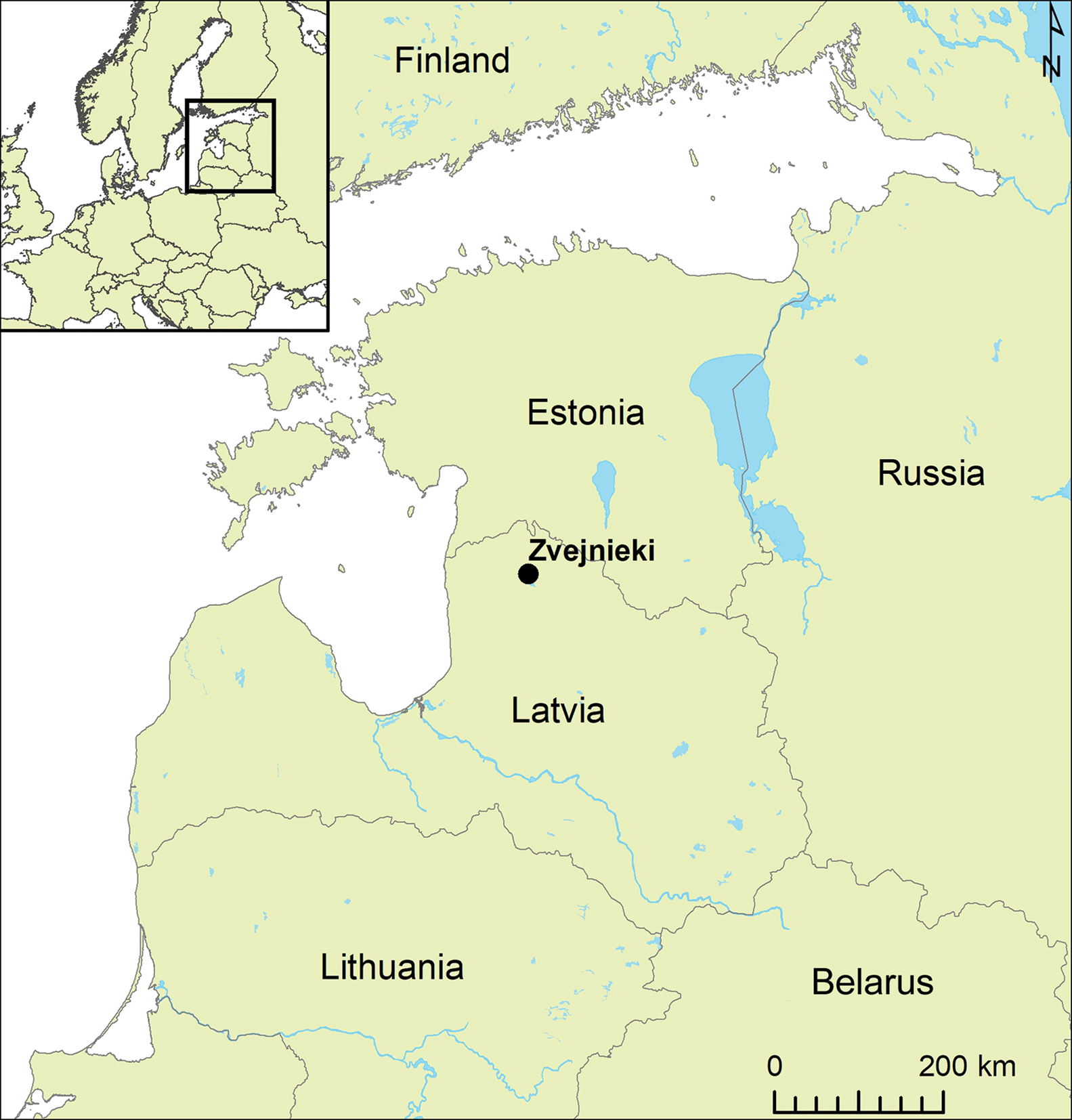
The Zvejnieki cemetery in north-eastern Latvia (Figure 1) is one of the largest hunter-gatherer cemeteries in Northern Europe (Larsson et al. Reference Larsson, Stutz, Zagorska, Bērziņš and Ceriņa2017). The site is located on a drumlin that was formerly an island of Lake Burtnieks. Discovered and excavated during the 1960s and 1970s by Ilga and Francis Zagorskis (Zagorskis Reference Zagorskis1987, Reference Zagorskis2004), the complex comprises Mesolithic and Neolithic settlement occupation and a cemetery of 330 burials. Radiocarbon dates indicate that the cemetery was in use between 7500 and 2600 BC, and thus it has the longest period of use of any prehistoric burial ground in Northern Europe (Zagorska Reference Zagorska, Larsson and Zagorska2006).
Location of the Zvejnieki complex (map by K.-G. Sjögren based on public domain data from Natural Earth, https://www.naturalearthdata.com/).
New excavations at the site were conducted between 2005 and 2009 as part of a collaborative project between Lund University (Sweden) and the Latvian History Institute. These excavations yielded 27 burials, including a double burial, numbered 316–317 (Larsson Reference Larsson2010; Nilsson Stutz et al. Reference Nilsson Stutz, Larsson and Zagorska2013; Nilsson Stutz & Larsson Reference Nilsson Stutz and Larsson2016; Larsson et al. Reference Larsson, Stutz, Zagorska, Bērziņš and Ceriņa2017).
This double inhumation of a male and a female was richly furnished with grave goods and items of personal adornment, including more than 200 tubular beads, all originally identified as being made of bird bones (Larsson Reference Larsson2010: 85; Nilsson Stutz et al. Reference Nilsson Stutz, Larsson and Zagorska2013: 1023). Re-examination of these finds, however, now shows that some of the beads are made from fossils. This article presents the geological and archaeological backgrounds of these beads. It then reviews the use of fossils in other prehistoric contexts and, more generally, hunter-gatherer encounters with unusual materials from their environmental surroundings.
The burial
Burial 316–317 (Figure 2) was discovered and partly excavated in 2007. The remaining elements were excavated in 2009. The grave was located much deeper (0.80m) than the other burials at the site, and it was not cut by any of the surrounding graves. Burial 316–317, however, had cut through several earlier burials, and material from these was present in its fill, which consisted of very dark humic soil containing artefacts and human and animal bones (Nilsson Stutz et al. Reference Nilsson Stutz, Larsson and Zagorska2013; Larsson et al. Reference Larsson, Stutz, Zagorska, Bērziņš and Ceriņa2017).
The double burial 316–317; the beads of fossilised sea lilies are under the knees of the buried female (left) (drawing by L. Lecareux).
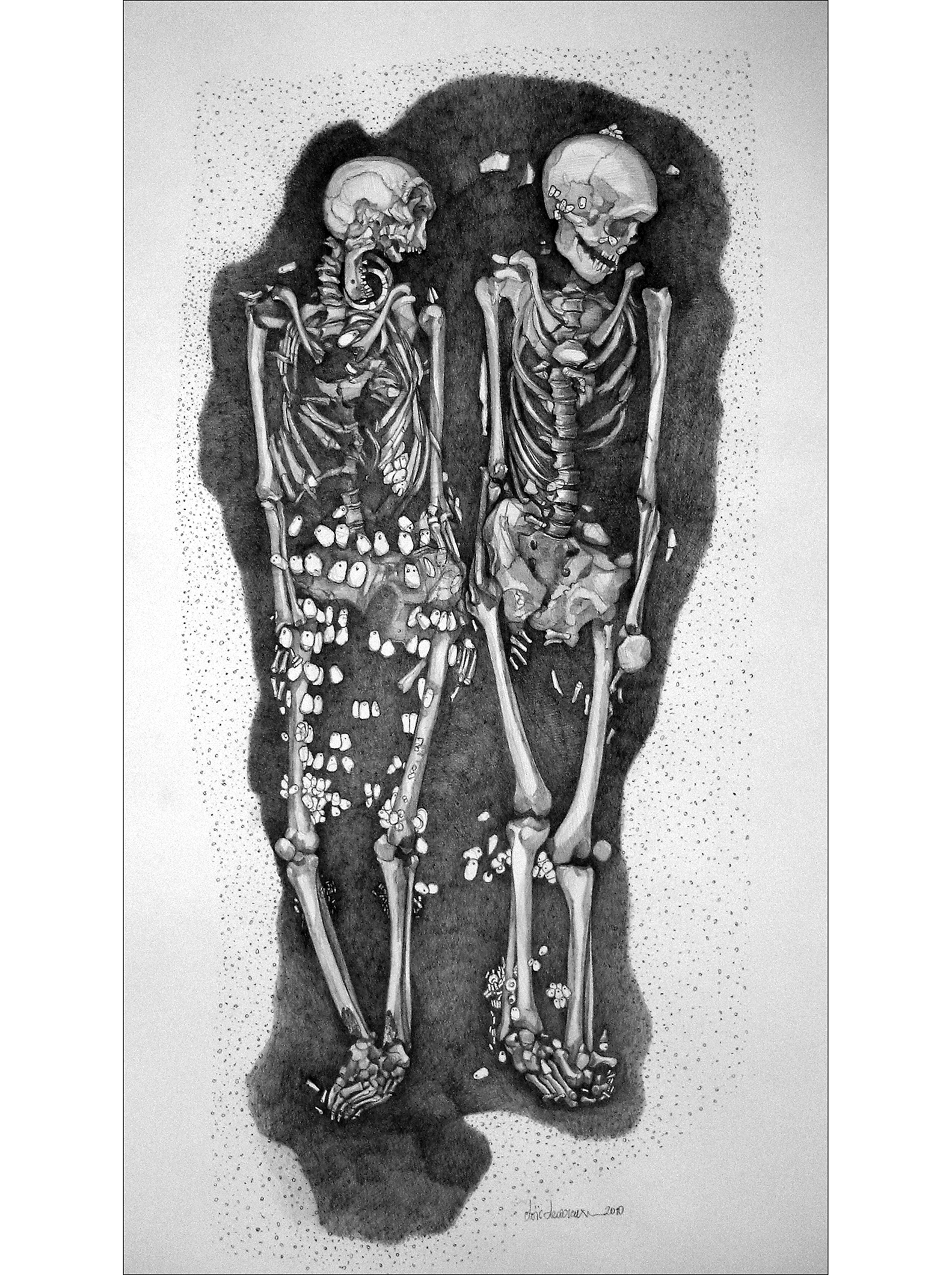
The two individuals were interred in a supine position and the bodies were liberally sprinkled with ochre. The female (316) was aged around 36–40 years at death, and the male (317) was 25–30 years old. The quantity of amber ornaments (nearly 140 in total) and bone pendants (the latter not previously found at Zvejnieki) makes this double burial one of the richest in the whole cemetery. The female had two amber rings on her chest and 113 amber pendants placed in rows between the pelvic area and the knees. While she had a few tubular bone beads beneath her knees, most of the beads and bone pendants were associated with the male's lower legs (Larsson Reference Larsson2010; Nilsson Stutz et al. Reference Nilsson Stutz, Larsson and Zagorska2013; Larsson et al. Reference Larsson, Stutz, Zagorska, Bērziņš and Ceriņa2017). Other grave goods included a bone awl or a dagger, a flint knife and an elk-tooth pendant (previously identified as the tooth of an aurochs; Larsson et al. Reference Larsson, Stutz, Zagorska, Bērziņš and Ceriņa2017: 75).
Archaeothanatological analysis (a taphonomy-based approach applied in-field to study the decomposition processes of human remains with an aim to reconstructing mortuary practices) was applied when excavating the double burial, and it confirmed that the two individuals were buried simultaneously (Nilsson Stutz & Larsson Reference Nilsson Stutz and Larsson2016: 718). Collagen from the bones of the female is dated to 5285±55 cal BP (LuS-8217: 4255–3979 BC at 95.4 per cent confidence; date modelled in OxCal v.4.3.2, using IntCal 13 atmospheric curve; Bronk Ramsey Reference Bronk Ramsey2009; Reimer et al. Reference Reimer2013), and the male to 5105±50 cal BP (LuS-8216: 4033–3781 BC; Larsson et al. Reference Larsson, Stutz, Zagorska, Bērziņš and Ceriņa2017: 84). The difference in these dates is probably due to a freshwater reservoir effect (cf. Meadows et al. Reference Meadows, Bērziņš, Legzdiņa, Lübke, Schmölke, Zagorska and Zariņa2018), although no isotope analyses have yet been undertaken for these two individuals. The most reliable absolute date for the burial comes from a dagger or awl made of an elk ulna, found associated with the upper right arm of the male and dated to 4865±60 cal BP (LuS-7852: 3786–3521 BC; Larsson et al. Reference Larsson, Stutz, Zagorska, Bērziņš and Ceriņa2017: 88).
More than 200 tubular beads of various shapes and sizes were found in the grave. These were originally interpreted as being made of bird bones on the basis of general morphological characteristics (Larsson Reference Larsson2010; Nilsson Stutz et al. Reference Nilsson Stutz, Larsson and Zagorska2013: 1023); such items have been found in other hunter-gatherer contexts (e.g. Zagorskis Reference Zagorskis1987, Reference Zagorskis2004; Gumiński Reference Gumiński2005; Mannermaa Reference Mannermaa2008; Kostyleva & Utkin Reference Kostyleva and Utkin2010). Such identifications, however, are not always accurate (see Macāne et al. Reference Macāne, Nordqvist and Kostyleva2019). A more detailed analysis of the faunal assemblage and personal adornments from Zvejnieki was undertaken as part of ongoing doctoral research by the author, focusing on evidence for human-animal relationships in prehistoric hunter-gatherer burials of North-Eastern Europe. Differences were noted in the raw materials of tubular beads during the analysis of the entire grave inventory: some of them differed from the often porous bone material. In addition, these beads seemed to be more cylindrical in shape. Further research (see below) demonstrates that not all the tubular beads were made of bird bones (see also Larsson et al. Reference Larsson, Stutz, Zagorska, Bērziņš and Ceriņa2017: 75); the beads found under the knees of the female (316) are actually made of fossils.
The fossil beads
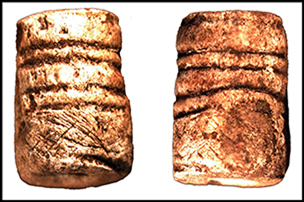
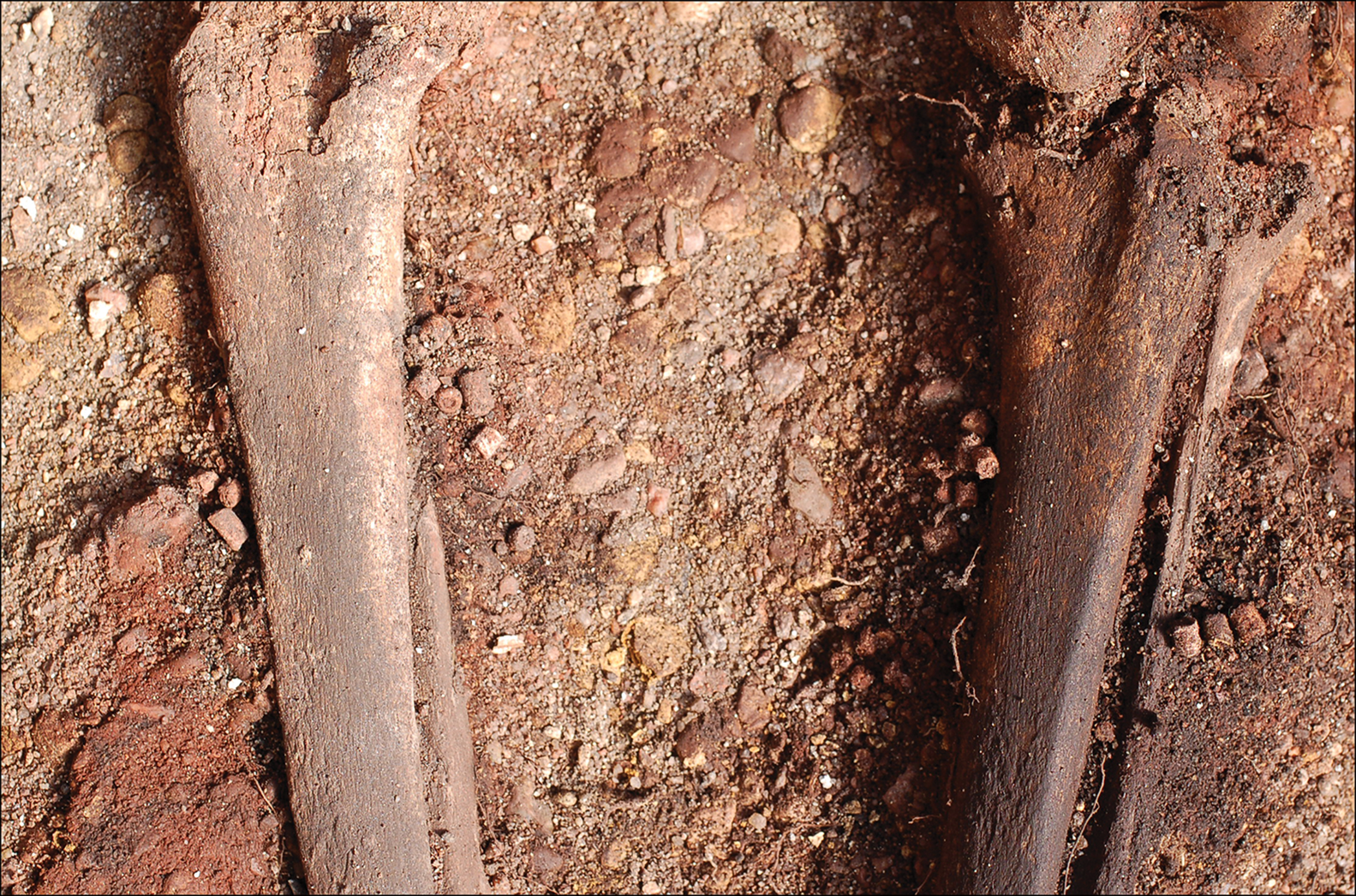
In total, 68 beads were collected in situ from beneath the knees of the female: 32 under the right knee and 36 under the left (Figure 3). Permission was granted for 11 of the beads to be taken from the National History Museum of Latvia to the Faculty of Geography and Earth Sciences at the University of Latvia for microscopic analysis; the remainder were examined visually at the museum. The perforated tubular beads are naturally light in colour, although most are stained with red ochre (Figure 4). Some of the larger beads exhibit a natural zig-zag pattern. The beads vary in size, with lengths of 1.66–11.60mm, diameters of 4.09–6.88mm and perforation diameters of 1.21–3.14mm. The total weight of the bead assemblage is 10.60g. Examination (Figure 5) using a Leica MZ16 light microscope identified the beads as being made of fossilised sea lilies (Crinoidea). Furthermore, application of a weak (10 per cent) hydrochloric acid solution to a test sample resulted in a fast reaction, confirming that the beads are of calcite, rather than of phosphate, which constitutes vertebrate bones (E. Lukševičs pers. comm.).
Fossil beads in situ (photograph by L. Larsson).
Threaded crinoid beads from individual 316 (photograph by L. Larsson).

Crinoidea columnals with traces of human modification (indicated by black arrows) (taken by E. Lukševičs using a Leica MZ16 microscope).

Sea lilies (crinoids) belong to the largest group of exclusively marine animals (Echinodermata), and have no freshwater or land representatives. The oldest probable sea lilies are known from the Late Cambrian (497 Myr). They flourished during the Ordovician and Silurian (480–410 Myr), but later faced major extinctions (Hints & Stukalina Reference Hints, Stukalina, Raukas and Teedumäe1997). Resembling a plant, most sea lilies have a stem or stalk consisting of calcite discs called columnals (Rozhnov Reference Rozhnov1990). The upper part of the organism is called a crown and comprises a bulbous theca (or calyx, containing the vital organs) and the arms (frond-like tentacles) (Figure 6).
Fossilised sea lilies (Crinoidea) from Estonia, showing the main parts of the animal (photograph by G. Baranov, Geoscience collections of Estonia, http://geocollections.info/file/46988).

Crinoids can be extracted from sedimentary rocks, in which longer chains of fossils may occasionally be visible. More often, they are found in coastal gravel, divided into smaller fragments or single columnals by wave activity. Columnals are naturally hollow, with parallel-sided walls and a circular or, more rarely, pentalobate opening (lumen). During the decomposition of the soft body and burial on the seabed, the lumen fills with sediment. If the in-filling sedimentary rock is in itself soft (e.g. clay-rich carbonate), the filling can be later naturally washed out by wave action, or easily removed from the lumen by humans (L. Ainsaar pers. comm.).
The Zvejnieki beads are made from fossilised crinoid stalks, which, when examined, showed some examples with a natural zig-zag pattern, which connects the columnals. Additional grooves or lines observed on some of the beads were probably made during the preparation process, rather than representing intentional decoration (Figure 5). All of the 68 examined beads at Zvejnieki have a perforation. As the majority of holes have a conical shape, with one end being wider than the other (the largest difference between the ends is 1.16mm), the stalks were likely cleaned by people from one side to remove the lithified sediments out of the natural hollow. The different aspects of the fossil objects described here clearly demonstrate the transformation by human action of a natural material, well suited by its physical configuration, into cultural artefacts—beads.
The provenance of the fossilised sea lilies is uncertain. These fossils are frequently found in limestone or dolomite deposits. In present-day Latvia, such bedrock is deeply buried and cannot be found outcropping at the surface (Lukševičs Reference Lukševičs, Nikodemus, Kļaviņš, Krišjāne and Zelčs2018; Zelčs Reference Zelčs, Nikodemus, Kļaviņš, Krišjāne and Zelčs2018). The nearest Silurian deposits containing these types of rock are located in Estonia, some 100km to the north of Zvejnieki (Figure 7). The most abundant outcrops of crinoid-containing limestone beds occur on Saaremaa Island, although they can also be found on the Estonian mainland (L. Ainsaar pers. comm.). As drumlins contain large amounts of Silurian and Ordovician material transported from the territory of Estonia by continental ice (Eberhards Reference Eberhards, Larsson and Zagorska2006: 26), fossil-containing rocks are present in the topsoil at the Zvejnieki cemetery. Soft limestone containing crinoids would, however, not have survived such transportation, and it would be impossible to extract crinoids cemented within harder limestone without damaging them (L. Ainsaar pers. comm.). A source within the territory of modern Estonia for the crinoids associated with individual 316 at Zvejnieki is therefore more plausible, suggesting that either the raw materials or the finished beads were brought in from several tens of kilometres to the north.
Simplified geological map of Estonia and Latvia. Legend: PR3) Precambrian; O1) Lower Ordovician; O2) Middle Ordovician; O3) Upper Ordovician; S1) lower part of Silurian (Llandovery, Wenlock); S2) upper part of Silurian (Ludlow, Pridoli); D1) Lower Devonian; D2) Middle Devonian; D3) Upper Devonian; C1) Lower Carboniferous; P2) Upper Permian; T1) Lower Triassic; J2–3) Middle–Upper Jurassic (based on Brangulis et al. Reference Brangulis, Kuršs, Misāns and Stinkulis1998; Stinkulis Reference Stinkulis2018).

Aside from individual 316, no fossils have been recorded in any of the other graves excavated at Zvejnieki; the only other example of a fossilised sea lily from an archaeological context in Latvia known to the author comes from the Early Iron Age burial of Laidzes Lazdiņi, in the western part of the country (J. Ciglis pers. comm.). Although the author's analysis of the contents of the graves excavated between 2006 and 2009 has revealed another three fragments of fossils (one of coral and two of unidentified species), these cannot be regarded as grave goods, as they were part of the graves’ backfill. The generally rich grave inventory and its unique finds, as well as other deviatory features in the burial custom (see above) distinguish double burial 316–317 from other graves at Zvejnieki. They underline its atypical character within the cemetery, implying that either the couple who were buried in 316–317 had a special role or status in the community, or perhaps they were non-locals.
Fossil finds in Holocene hunter-gatherer contexts
Even though various fossils have been found in archaeological contexts, this category of finds is often overlooked. Exceptions include more systematic approaches to fossil and natural finds from archaeological contexts on sites in Great Britain and Ireland (Jackson & Connolly Reference Jackson and Connolly2002; McNamara Reference McNamara2011, Reference McNamara2012; Leeming Reference Leeming, Houlbrook and Armitage2015), as well as Estonia (Johanson Reference Johanson2018a & Reference Johansonb).
There are several challenges to interpreting fossils from archaeological contexts. The excavation strategy and the excavators’ personal interest, for example, may affect the types and quantities of material collected, as well as which materials are regarded as natural or human-made (Johanson Reference Johanson2018b: 91). Most fossils found on archaeological sites are unmodified, and are therefore rarely collected, particularly in areas where fossils are naturally abundant (Leeming Reference Leeming, Houlbrook and Armitage2015: 17–19; Johanson Reference Johanson2018a: 95). Furthermore, fossils are often excluded from archaeological recording due to their insecure contexts and uncertain traces of modification (for similar uncertainties with other materials, see Bar-Yosef Mayer & Bosch Reference Bar-Yosef Mayer and Bosch2019: 20). When fossils are recovered, examination is usually restricted to basic taxonomic identification, without further investigation (Johanson Reference Johanson2018a: 86).
Fossils, however, are not uncommon in prehistoric contexts (Oakley Reference Oakley1985; Jackson & Connolly Reference Jackson and Connolly2002; McNamara Reference McNamara2011; Leeming Reference Leeming, Houlbrook and Armitage2015; Johanson Reference Johanson2018a & Reference Johansonb). Various types of fossils have been found, for example on Western European Upper Palaeolithic sites, with sea urchins (Echinoidea) and ammonite (Cephalopoda) as the most common (Conneller Reference Conneller2011: 96). The former have been collected more intensively throughout prehistory and in more recent times (McNamara Reference McNamara2011, Reference McNamara2012), probably because of their aesthetic properties. Belemnites (Cephalopoda) are also frequently encountered on prehistoric sites, and have been interpreted as tools for decorating pottery (e.g. at the Sakhtysh Neolithic sites in western Russia; Kostyleva & Kalinina Reference Kostyleva and Kalinina2002), as perforated ornaments (at the Kostenki 17 Palaeolithic site in southern Russia; White Reference White1992), as arrowheads (on the Kodzadermen tell in Bulgaria; Boyadziev Reference Boyadziev, Kostov, Gayadarska and Gurova2008), and as grave goods (in the Dudka cemetery in Poland; Gumiński & Bugajska Reference Gumiński, Bugajska, Grünberg, Gramsch, Larsson, Orschiedt and Meller2016).
Fossil finds from hunter-gatherer burial contexts are less frequently documented. Sea urchins have been found, for example, in two graves at the Skateholm cemeteries in southern Sweden. In grave VI at Skateholm II, a sea urchin was found in the pelvic area of a female, while grave 44 at Skateholm I yielded another sea urchin associated with a mature individual's femur (Larsson Reference Larsson1983: 26, Reference Larsson1988: 143). As urchins have often been found in the pelvic area of female burials, they have been interpreted as connected with the concept of rebirth (McNamara Reference McNamara2011).
At the Dudka and Szczepanki Mesolithic cemeteries in northern Poland, several types of limestone fossils have been found in graves. Gumiński and Bugajska (Reference Gumiński, Bugajska, Grünberg, Gramsch, Larsson, Orschiedt and Meller2016: 495) emphasise the special attention paid to the aesthetic properties (e.g. colour, shape and size) of stones and fossils when selecting examples for inclusion in graves. Such fossils are interpreted as objects of personal adornment, while the crescent-shaped fossils from two graves at Dudka are suggested to have been used as cloth fasteners. Other types of fossil found in juvenile graves have been explained by the tendency of children to collect “nice-looking things” (Gumiński & Bugajska Reference Gumiński, Bugajska, Grünberg, Gramsch, Larsson, Orschiedt and Meller2016: 494).
In general, crinoids are seldom found in hunter-gatherer contexts (Conneller Reference Conneller2011: 96). Oakley (Reference Oakley1985: 38) mentions several crinoid fragments from habitation layers in Upper Palaeolithic hut-sites and caves in Western Europe, while in burials, crinoids are documented from the Neolithic onwards (Oakley Reference Oakley1985). The main challenge with assessing the significance of crinoids found on such sites, however, is identifying whether they are naturally or anthropogenically modified. Are they naturally perforated objects already suitable for use as beads, or are they intentionally worked in some way? Four crinoids are known from burial contexts at the Dudka cemetery, and some have also been found on nearby settlement sites, but whether or not they were intentionally modified is unspecified by the investigators (Gumiński & Bugajska Reference Gumiński, Bugajska, Grünberg, Gramsch, Larsson, Orschiedt and Meller2016). Similar difficulties beset the interpretation of crinoids from the Motala site in central Sweden. The natural occurrence of fossils in the area and uncertainty regarding their modification preclude a positive identification as beads and therefore an unambiguous link with the Mesolithic burials at the site (L. Hagberg pers. comm.). Archaeological crinoid finds increase in later periods, including in Neolithic passage graves and in Bronze Age barrows and cremations in Great Britain, Ireland and France. Most interpretations of crinoids from archaeological contexts suggest that their natural perforations made them suitable for use as beads (e.g. Oakley Reference Oakley1985: 39; Jackson & Connolly Reference Jackson and Connolly2002). In Estonia, for example, 20 crinoid fragments from sites of different periods (predominantly from Iron Age burial contexts) have been interpreted as beads (Johanson Reference Johanson2018a: 97).
Descriptions of fossil finds from archaeological contexts often concentrate on the material properties of the fossils. Their surface features, perceived as reflecting their inner qualities, seem to be crucial for the selection and use of the fossils (Johanson Reference Johanson2018a: 160). Further evidence for interpreting fossil finds is provided by folklore and mythology, which, for example, refer to apotropaic properties or use for medical and healing purposes (Duffin Reference Duffin2008, Reference Duffin, Duffin, Gardner-Thorpe and Moody2017; Johanson Reference Johanson2018a & Reference Johansonb; Johanson & Jonuks Reference Johanson and Jonuks2018), symbolism as charms or amulets (Oakley Reference Oakley1985; Conneller Reference Conneller2011; McNamara Reference McNamara2011; Leeming Reference Leeming, Houlbrook and Armitage2015; Taylor Reference Taylor2016) and their magical powers associated with their resemblance to once living organisms (Leeming Reference Leeming, Houlbrook and Armitage2015: 17). Even if they were used in their natural form, their intentional working and suspension suggest that their selection did not happen by chance.
Hunter-gatherer encounters with unusual materials
The crinoid beads from burial 316 at Zvejnieki offer a unique opportunity to explore hunter-gatherer encounters with unusual raw materials due to the well-documented context of discovery and clear traces of working. The scarcity of fossil finds at Zvejnieki and in Latvian archaeological assemblages in general argues for the special character of these beads. The selection of an unusual raw material suggests that both the beads and the person who wore them were exceptional, a suggestion supported by the grave's status as one of the most richly furnished in the entire Zvejnieki cemetery. The positioning of the beads below the knees of the woman and their distribution around both legs suggest a decorated leg garment. The fossil beads were probably not connected with the amber ornaments covering the upper part of her body (Irita Žeiere pers. comm.).
Were the properties of the raw materials, their symbolic significance or other factors decisive in the choice of the crinoids as items of adornment? Conneller (Reference Conneller2011) has investigated why some materials became desirable and which aspects were crucial in their selection. The properties of various raw materials and the messages that they convey appear to have been significant for hunter-gatherers when collecting fossils or other unusual materials for making artefacts and tools. All fossils were once living organisms, which, through petrification, have had their properties changed. The embodiment of animal characteristics pertains to both ornaments made of animal bones or teeth and to the remains of fossilised animals. Fossil finds from Upper Palaeolithic contexts have been linked with the abstract thought of individuals who may have perceived the fossils as petrified spirit animals (Conneller Reference Conneller2011: 97).
Appearance, curious shapes and other outstanding aesthetic or non-physical properties are probably some of the factors that attracted hunter-gatherers’ attention and prompted the collection of unusual materials (Herva et al. Reference Herva, Nordqvist, Lahelma and Ikäheimo2014). Furthermore, belief in the transformative function of some materials or their properties may have encouraged the shaping of these unusual materials into ornaments. Conneller (Reference Conneller2011: 121) considers bead production as one of the processes through which the materials’ ‘inner essence’ was exposed (see also Herva et al. Reference Herva, Nordqvist, Lahelma and Ikäheimo2014: 149). Not all raw materials (such as shells and stones with natural holes or curious shapes), however, required such alteration, but embodied special meanings in their natural forms, without further modification.
Whether the hunter-gatherers of Zvejnieki were aware that they were using an ancient petrified animal for their personal adornment remains an open question. Assuming that they did understand, this would certainly increase interpretive possibilities. Regardless, the beads offer an interesting case study of human and non-human relationships. The prehistoric environment was inhabited by a wide range of entities and encompassed a diversity of human and non-human interactions and relationships. Encounters with non-humans, like animals and other natural objects (such as trees, plants, mineral materials, physical and sensory landscape features) were fundamental in creating peoples’ awareness about themselves and their surroundings. Hunter-gatherer engagement with unusual and rare materials was crucial in establishing new relations and interactions that altered their perception of the world. Herva et al. (Reference Herva, Nordqvist, Lahelma and Ikäheimo2014), for example, argue that encountering new materials was among the aspects that facilitated the Neolithisation process in North-eastern Europe. Similar discussions concerning the ‘culturisation’ of nature, however, begin with the Upper Palaeolithic, when the intensified use of various new and rare materials appears in the production of pendants and other personal ornaments (Glørstad et al. Reference Glørstad, Nakrem and Tørhaug2004; Conneller Reference Conneller2011; Johanson Reference Johanson2018a).
Evidence for the exploitation of other types of fossilised substances is not unusual in Baltic hunter-gatherer contexts. Fossilised tree resin (Baltic amber or succinite), for example, is found abundantly in graves at Zvejnieki. Indeed, burial 316–317 was also the richest in amber ornaments in the entire cemetery. The use of amber intensified during the fourth millennium BC, when it became widespread not only at Zvejnieki but also across the Eastern Baltic and western Russia (Zagorskis Reference Zagorskis1987; Zagorska Reference Zagorska, Larsson and Zagorska2006; Loze Reference Loze2008; Kostyleva & Utkin Reference Kostyleva and Utkin2010). Complex hunter-gatherer networks and exchange systems developed in North-eastern Europe during this period, including native copper, metatuff (greenstone) chopping tools and amber (Loze Reference Loze2008; Nordqvist & Herva Reference Nordqvist and Herva2013; Tarasov Reference Tarasov2015). Fossils or ready-made crinoid beads could have travelled along these hunter-gatherer exchange and communication networks.
Dynamic interaction with new and unusual materials—whether fossils, amber or stones—indicate changing relationships between hunter-gatherers and their environment. Hunter-gatherers encountered and collected these materials, expressing curiosity towards their surroundings; they were aware of where they could be obtained (Herva et al. Reference Herva, Nordqvist, Lahelma and Ikäheimo2014), and of the places and contexts in which they could be used and deposited. The crinoid beads discussed here illustrate how the conscious transformation of such materials and their properties turned these once living animals into meaningful objects for hunter-gatherers, who incorporated them into daily life, as well as death.
Conclusions
The identification of worked fossils in the Zvejnieki cemetery not only highlights the importance of re-examining excavated assemblages, but more specifically emphasises the need to re-analyse other tubular beads from prehistoric burial contexts. Such research may offer new insight into this rare category of finds, allowing us to draw conclusions about how hunter-gatherers related to their environment and the materials that they extracted from it. Hunter-gatherer awareness of new and unusual raw materials seems to have increased during prehistory, suggesting changes in their conception of the world. Through conscious transformation, materials were shaped into objects that embodied special meanings throughout life and death.
The fossil beads from burial 316 are the only verified example of fossil use in a funerary context among the 330 graves at Zvejnieki. The mentioned double burial also stands out in terms of other deviatory features in the burial custom and grave goods, indicating the atypical character of this burial or the buried individuals. The Zvejnieki bead assemblage provides an opportunity to discuss further the use of fossils by hunter-gatherers. Beyond that, it illuminates not only hunter-gatherer burial archaeology in North-eastern Europe, but human encounters with unusual materials more generally, and their relationships with their environment.
Acknowledgements
I am thankful to Ervīns Lukševičs (Faculty of Geographical and Earth Sciences, University of Latvia) for help with identifying the fossils, and to Zane Buža, Jānis Ciglis and Irita Žeiere (Archaeology Department at the National History Latvian Museum of Latvia) for their help while analysing the materials. I am grateful to Leho Ainsaar (Institute of Ecology and Earth Sciences, University of Tartu) for clarifying questions concerning Estonian geology. I also thank Lars Larsson, Ola Magnell, Liv Nilsson Stutz, Kerkko Nordqvist, Karl-Göran Sjögren and the two anonymous reviewers for their comments on the manuscript. Thanks also to Sofia Filatova and the other participants in the ‘Dialogues with the Past’ workshop in Rome, November 2018, for discussing the first draft of this article. The writing was supported by the Lennart J. Hägglunds Stiftelse.


 Open access

