





Food environment studies gained special notoriety following one of the firsts exclusive models on this topic promoted in literature from 1999 and 2005 onwards(Reference Swinburn, Egger and Raza1,Reference Glanz, Sallis and Saelens2) , and today its relevant role in determining food choices is recognised(Reference Downs, Fox and Mutuku3,Reference Neufeld, Andrade and Suleiman4) . The food environment is characterised by the physical, socio-cultural, economic and political space, opportunities and conditions that influence the nutritional status of people and can contribute to the emergence of chronic non-communicable diseases(Reference Swinburn, Sacks and Vandevijvere5). It is closely related to socio-economic factors and social vulnerability, as it conditions food choice on access to healthy food, availability, quality, opening hours, diversity and price of food in establishments, among others(Reference Hager, Cockerham and O’Reilly6,Reference Jin and Lu7) .
To assess the food environment, there are several instruments in the literature that aim to measure it objectively or subjectively(Reference Partington, Menzies and Colburn8). Subjective methods, in particular the perception of individuals, are related both to the characteristics of the external environment, such as physical and economic access to food, purchasing power, desirability and convenience of food, and to the influence of individual interaction with the external food environment(Reference Downs, Ahmed and Fanzo9). Measurements through perception can be performed by focus groups, photovoice, among others. Despite the possibilities, a systematic review found a gap in the instruments that quantitatively assess the perceived food environment, since most research focuses on qualitative observations(Reference Yamaguchi, Praditsorn and Purnamasari10).
The use of instruments that measure the food environment is a challenge, since few studies have been carried out to evaluate validity and reliability measures(Reference Lytle11,Reference Saelens and Glanz12) and most were developed for high-income countries(Reference Mendes, Rocha and Botelho13). Among the existing tools for measuring the food environment, the Perceived Nutrition Environment Measures Survey (NEMS-P) is one of the most used. Although it is a validated and reliable instrument, it hast not been validated in Brazil. The tool measures the perception of individuals based on its theoretical model, subdivided into three environments: home, consumer and community(Reference Green and Glanz14). It was also validated for Spanish and the Chilean context, demonstrating its feasibility after cultural adaptations(Reference Martínez-García, Trescastro-López and Galiana-Sánchez15,Reference Molina Carrasco, Ríos and Espinoza16) .
Given the need for adequate instruments to measure the Brazilian food environment, the objective of this study is to evaluate the validity and reliability of the adapted version of the NEMS-P instrument for use in Brazil.
Methods
Study design and sampling
The present study is part of the initial phase of a nutritional intervention project with primary health care users with arterial hypertension in the municipality of Ouro Preto. The city belongs to the Iron Quadrangle region in Minas Gerais, one of the largest Fe ore producing areas in Brazil, with a population of 74·821 people according to the 2022 demographic census(17) and a Municipal Human Development Index of 0·741 according to the 2010 demographic census(18).
People of both sexes, diagnosed with arterial hypertension and over 20 years old, residing in the city of Ouro Preto, participants of both sample groups (control and intervention groups) and who answered the questionnaires within a period of up to 20 years were included in the sample 15 d after the first appointment with the nutritionists.
People who had CVD (angina, infarction, heart failure, atherosclerosis, peripheral vascular disease), ischaemic cerebrovascular disease, chronic liver, kidney or infectious diseases assessed by medical history were excluded, as were those who presented weight changes of more than 10 % of body weight in the 2 months prior to the study; those who were using anti-inflammatories; women undergoing exogenous ovarian hormone replacement, pregnancy or breast-feeding; people with special needs; people with Alzheimer’s disease, advanced dementia or life expectancy shorter than the study follow-up duration and people who had cognitive difficulties that made it difficult to complete the questionnaires.
To calculate the sample, power was considered based on the hypothesis of evaluating the effect size of the outcome variable, blood pressure and between groups. A difference between means of –5·05 mmHg and sd of 6·1 was assumed, based on previous studies(Reference Schwingshackl, Chaimani and Schwedhelm19,Reference Radovanovic, Bevilaqua and Molena-Fernandes20) . When considering a significance level of 0·05 and a power of 90 %, the estimated sample size was 144 individuals (72 in each group) and when considering a dropout rate of 40 %, the total sample was estimated at 180 people (90 in each group).
Data collection
Data collection took place between March and July 2022, based on two face-to-face interviews. In the first one, previously trained nutritionists explained the research proposal and how the collection procedures would be. Then they collected registration data, socio-demographic and economic variables, gender (female and male), age (20–29; 30–39; 40–59; 60 or >), marital status (married/consensual union, separated/divorced/separated, single, widowed), colour (white, non-white: black/brown, yellow), education (illiterate, primary, secondary, higher education) and individual income (up to 1 minimum wage, 1–2 minimum wages, 2–3 minimum wages, 3–4 minimum wages and 5 or > minimum wages).
Posteriorly, all participants were referred and invited to respond to the NEMS-P within a period of up to 15 d, with this second interview on the food environment lasting an average of 15–20 min. The interviews were collected on tablets, using the KoBoCollect® application.
All interviewers (undergraduate and stricto sensu post-graduate students in Nutrition) were trained to carry out the field work and the questionnaire survey. The training lasted 4 h, including data collection procedures and ethical aspects. A field coordinator monitored the application of the questionnaire to solve any questions that might arise.
Validity and reliability
For the present work, the version of the NEMS-P questionnaire used(Reference Green and Glanz14) was previously translated and cross-culturally adapted for the Brazilian reality, in a process that included translation from English into Portuguese, synthesis of translations, back-translation, evaluation by the expert committee, pilot test and final version(Reference Pires, Höfelmann and Reis21).
The final version of the NEMS-P for Brazil consists of twenty-nine questions related to the food environment and descriptive questions of the respondent (socio-demographic and life habits). Questions related to the food environment are grouped into four dimensions: home; consumer (food purchases); community (meals away from home) and habits and thoughts about food. The questions have different types of answers: dichotomous and ordinal (with a Likert scale ranging from three to six points).
When considering that the questionnaire underwent changes from the original version to adapt to the Portuguese language, it becomes relevant to assess its validity, which is the object of this study. Validity aims to assess the extent to which that instrument measures what it is intended to measure(Reference Raykov and Marcoulides22). Therefore, it is necessary that the intended concepts and results be well delimited, as well as understanding whether the questionnaire is valid and reliable for the Brazilian context(Reference Reichenheim and Bastos23,Reference Gleason, Harris and Sheean24) .
For instrument reliability, two aspects were taken into account: internal reliability and intra-rater reliability. Reliability seeks to estimate how accurate the questionnaire responses are, indicating whether the tool is stable, therefore, whether they are reliable measurements of what is intended(Reference Bujang, Omar and Baharum25,Reference Rossato, Mosele and Moreira26) .
To assess whether there is intra-rater reliability, the test–retest of the instrument was carried out through the reapplication of the intra-rater instrument, in a period of 7–21 d after the first application, consisting of a randomly selected sample. The second application was conducted face-to-face (n 9) or by telephone (n 26), since some participants could not attend in person to conduct the collection.
Statistical analysis
Initially, descriptive analyses of the total sample and subsample were carried out, as well as a sensitivity sample between the samples. Psychometric measures were also evaluated: validity and reliability (internal and intra-rater consistency).
In order to assess the validity and reliability, questions with ordinal scales and those used in the original article were selected(Reference Green and Glanz14), validated for Spanish(Reference Green and Glanz14) and validated to the Chilean context(Reference Molina Carrasco, Ríos and Espinoza16). For this purpose, the questions below were selected: question 3, which assesses the accessibility of healthy and unhealthy foods at home through a four-point scale of ‘never or rarely’ (1) to ‘almost always’ (4); question 10 regarding the importance of the decision to go to the establishment where most food purchases are made with a four-point scale from ‘not at all important’ (1) to ‘very important’ (4); question 11 whether it is easy or not finding healthy and unhealthy foods where most purchases are made with a four-point scale ‘very easy’ (1) ‘very difficult’ (4); question 14 in relation to the establishment where one buys most of their food and shopping habits, with a five-point scale ‘strongly disagree’ (1) to ‘strongly agree’ (5) and question 19 in relation to the most frequented restaurant with a five-point scale ‘strongly disagree’ (1) to ‘strongly agree’ (5). The questions were composed of ordinal variables, as shown in Table 1. The questions have different scales; therefore, the analyses were made separately in fourteen questions.
Description of the questions that make up the NEMS-P instrument, Portuguese version

NEMS-P, Perceived Nutrition Environment Measures Survey.
* Response options: 0 = strongly disagree to 4 = strongly agree.
† Response options: 0 = not at all important to 3 = very important.
‡ Response options: 0 = very easy to 3 = very difficult.
§ Response options: 0 = strongly disagree to 4 = strongly agree.
|| Response options: 0 = strongly disagree to 5 = does not apply.
To assess validity, in other words, whether the instrument adequately represents the theoretical construct to be measured, the Kaiser–Meyer–Olkin test was used to assess the adequacy of the exploratory analysis, in which values close to zero (0) indicate that the analysis may not be adequate. Bartlett’s sphericity test was also performed to test the hypothesis that the variables are not correlated in the sample, based on the chi-square test, so that the factorial analysis method is adequate, and the significance value in the test must be lower than 0·05(Reference Rossato, Mosele and Moreira26). Such tests aim to confirm whether it is possible to perform subsequent factor analysis with the scales. Subsequently, an exploratory factor analysis, aiming at understanding the internal structure and whether the item relationship is internally consistent(Reference Boateng, Neilands and Frongillo28), was carried out to identify how many factors made up each question related to the food environment, since the questionnaire underwent minor changes when translated into Portuguese. The procedure used ‘principal axes’ with varimax rotation.
Reliability was measured by internal consistency analysis and intra-rater reliability analysis. First, the internal consistency aimed to assess whether there is a correlation between the items of the NEMS-P instrument. To this end, the calculation of Cronbach’s α was used for each subscale (ranging from 1 to 4, 1 to 5 and 1 to 6 points) of the selected questions. A Cronbach’s α below 0·5 was considered to be an unacceptable level of reliability; between 0·5 and 0·6, bad; between 0·6 and 0·7, weak; between 0·7 and 0·8, acceptable; between 0·8 and 0·9, good and values above 0·9, excellent(Reference Carvajal, Centeno, Watson and Martínez29).
In addition to the internal consistency, the intra-rater reliability was evaluated. It determines whether the participants had the same answer after an interval of 15–21 d of application of the questionnaire. For this purpose, the intra-class correlation coefficient (ICC) was calculated by determining the averages of each interval scale, using the two-way model of randomised effect and a 95 % CI. ICC values range from 0 to 1, with ICC < 0·4 being considered low; 0·4 ≤ ICC < 0·75 satisfactory to good; ICC ≥ 0·75 excellent and P value < 0·05 as a significant correlation(Reference Bland and Altman30,Reference Marx, Menezes and Horovitz31) .
Data were tabulated in an Excel® spreadsheet. Subsequently, statistical analyses were performed using IBM SPSS Statistics for Windows, Version 20.0.
Results
The final sample consisted of 176 people who met the inclusion criteria. Most participants were female (79%), aged between 40 and 59 years (54·5%), with non-white skin colour (76.7%), married (64·2 %) and a large portion with primary (46%) and secondary (36·9%) education. Finally, more than half of the participants received up to one minimum wage (60.8%), as shown in Table 2.
Socio-demographic characteristics of the sample of participants in the perceived food environment survey (n 176) and subsample of the intra-rater assessment (n 35), Brazil, 2022

* The minimum wage on the collection date was R$1302.00/some participants refused to answer this question.
Validity and reliability
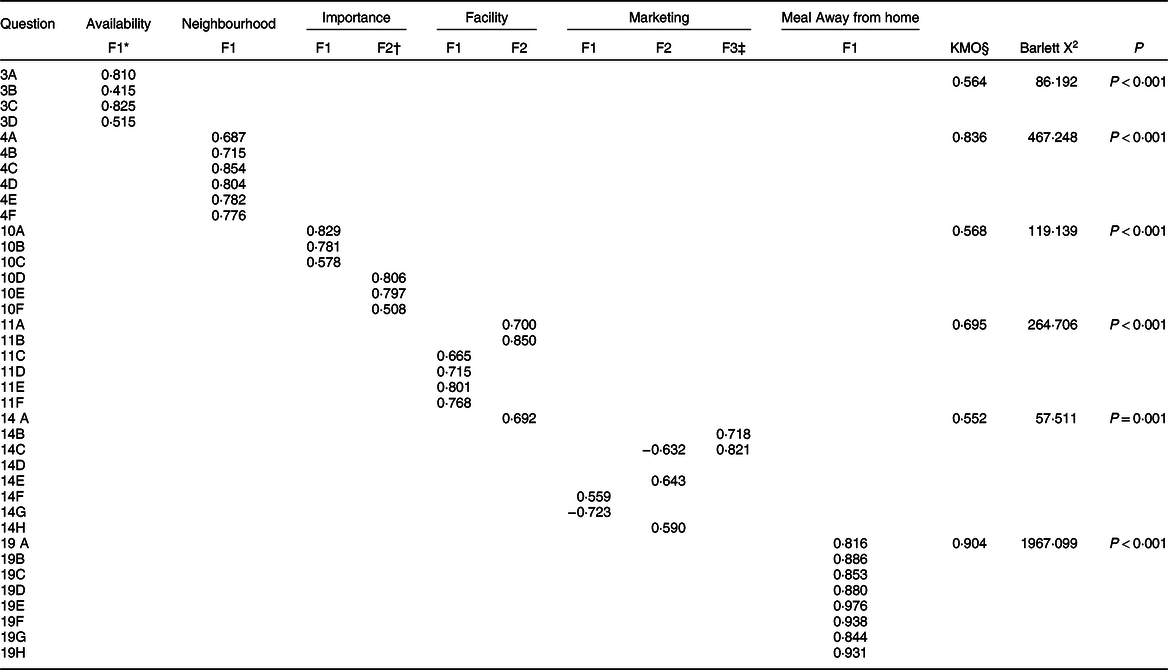
Exploratory factor analysis evaluated the validity of the constructs, measuring the components of the food environment and assessing whether they were maintained after changes in translation and adaptation made to Pires and collaborators(Reference Pires, Höfelmann and Reis21). The Kaiser–Meyer–Olkin and Barlett tests obtained satisfactory results (Kaiser–Meyer–Olkin > 0·5; Barlett, P < 0·05); therefore, the exploratory factor analysis was carried out independently for each question, since they had their own scales and mediated different constructs of the food environment.
Table 3 presents the results of the exploratory factor analysis. In the first question analysed (question three), the construct accessibility of food at home was found. In the second subscale (question 4), a construct was also found, referring to the neighbourhood food environment. In the case of question 10, two constructs were found, availability of healthy foods v. availability of unhealthy foods. In question 11, two factors were differentiated: the ease of finding fresh foods and the ease of finding ultra-processed foods and meat. In question 19, the factor meals away from home were found. Finally, in question 14, three factors were identified, but with unsatisfactory values.
Exploratory factorial analysis by factors according to the different types of food environment of the NEMS-P for the Portuguese language
NEMS-P, Perceived Nutrition Environment Measures Survey.
* F1 = factor 1.
† F2 = factor 2.
‡ F3 = factor 3.
§ KMO = Kaiser–Meyer–Olkin test.
The internal consistency analysis identified that most Cronbach’s α coefficients ranged from 0·6 to 0·9, that is, with a reliability level from poor to excellent (Table 4). The dimensions related to accessibility of healthy food at home (0·796), selection and motivation for purchase (0·582–0·665), access to purchase healthy food (0·472–0·695) and unhealthy food (0·795) showed satisfactory reliability, with emphasis on the consumer food environment issues with values considered satisfactory, availability of healthy options (0·923), accessibility to healthy options (0·941) and promotion of healthy options (0·969). On the other hand, the dimensions of food arrangement in the environment (0·148), influence of where the food is on the shelves (0·391) and perception of food promotions (0·259) showed unsatisfactory values.
Internal consistency analysis of the NEMS-P questionnaire, Portuguese version, according to Cronbach’s α values and intervals (n 176)

NEMS-P, Perceived Nutrition Environment Measures Survey.
Number of items analysed: number of questions evaluated; scale range: variation of the Likert scale, ranging from 1 to 4, 1 to 5 and 1 to 6 points.
Finally, Table 5 shows the intra-rater reliability, with a sample of thirty-five participants, nine collected by face-to-face interview and twenty-six by telephone. It is noteworthy that a sensitivity analysis was performed and the subsample had socio-demographic characteristics similar to the total sample (Table 2). The calculation of the Intra-ICC was performed in fourteen questions, since each question had different scales, as shown in the table. Most of the ICC values were rated from satisfactory to excellent (ranging from 0·563 to 0·878). However, some values were unsatisfactory, such as food price (–0·188), marketing strategies in supermarkets (0·035) and food promotion (0·104).
Test–retest reliability of key constructs of questionnaire NEMS-P (n 35)

NEMS-P, Perceived Nutrition Environment Measures Survey; ICC, intra-class correlation coefficient.
Discussion
This study evaluated the validity and reliability properties of one version adapted of the NEMS-P instrument for the Brazilian population. The proposed Portuguese version(Reference Pires, Höfelmann and Reis21), as well as its cross-cultural modifications, proved to be feasible to be applied in the Brazilian context with primary health care users, as it is easy to understand and has adequate internal consistency and intra-examiner reliability. In this way, as in its original version, depending on the researcher’s interest, each section can be used independently, according to the food environments to be investigated (home, consumer and community), making application time more flexible.
The one version adapted version of the NEMS-P to Brazilian context proved to be valid, similarly to the Spanish version NEMS-P MED(Reference Martínez-García, Trescastro-López and Galiana-Sánchez15). However, question 14 referring to the ‘availability and promotion of food in the place where the individual does most of the food shopping’ did not result in a satisfactory grouping and obtained low factorial values, which indicates that they are not strong measures of this dimension, or they do not measure what they propose, or are difficult for participants to understand. However, the same question in the study in Spanish(Reference Martínez-García, Trescastro-López and Galiana-Sánchez15) obtained satisfactory values and resulted in three factors.
Question 14 again stood out, with low values of Cronbach’s α (0·148; 0·391; 0·259) being observed in the measurement of internal reliability. However, in the original study(Reference Green and Glanz14), alpha variability was also observed. Refining the questions can improve these values, as data collection revealed that understanding this question was notably difficult. However, such difficulty may be due to the low level of schooling in the sample, with half of them having incomplete elementary and high school, and also the lack of knowledge of the sales strategies used by the food industry, such as food inserts(Reference Moreira, Silva and Leme32).
As for the reliability measured by the internal consistency of the other questions, the majority proved to be acceptable, ranging from 0·665 to 0·969. In the original study(Reference Green and Glanz14), Cronbach’s α was performed on the pilot study sample of 215 people, obtaining values ranging from 0·41 to 0·94. In the Spanish version of the NEMS-P MED, values ranged between 0·6 and 0·9. However, there were also low values for items related to accessibility to healthy options in restaurants (0·253) and for the last items on motivation of choice of place of purchase (0·263)(Reference Martínez-García, Trescastro-López and Galiana-Sánchez15). And in the version for the Chilean context of the NEMS-P-Ch, reliability levels varied between 0·44 and 0·88, with low values referring to aspects of food at home(Reference Molina Carrasco, Ríos and Espinoza16). These results demonstrate that the instrument has good internal reliability, that is, the questions measure what they are intended to do(Reference Carvajal, Centeno, Watson and Martínez29).
Regarding intra-rater reliability, the instrument demonstrated acceptable reliability for most of the questions analysed, as was observed in the original scale(Reference Green and Glanz14), in the adaptation for the Spanish population(Reference Martínez-García, Trescastro-López and Galiana-Sánchez15) and to the Chilean context(Reference Molina Carrasco, Ríos and Espinoza16). Most items showed acceptable values between 0·563 and 0·878, demonstrating the stability of the instrument to provide the same results when repeated in the same individuals and obtained at different moments in time. However, food prices, marketing in supermarkets and food promotion had low and even negative values, similarly to the findings of the original version, in which a low value was also observed referring to the price of fruits and vegetables in stores(Reference Green and Glanz14). It is important to consider that Brazil is going through a period of inflation and inconstancy in food prices(33). However, the authors herein hypothesise that this would not be the only explanation for these findings, since a low understanding of the questions was observed during data collection. Another point to be highlighted is the difficulty of psychometric methods of assessing the perception of individuals, since the perception can change due to the greater attention given from the questioning(Reference Yamaguchi, Praditsorn and Purnamasari10); therefore, when reapplying the test, the behaviour may have probably been modified by the instrument itself.
It is noteworthy that the instrument is satisfactory and its application in the individuals of the present study was adequate, being positive to measure aspects related to the perception of the food environment, since the development of a new instrument is always the last option in epidemiology(Reference Bastos, Duquia and González-Chica34). Among the current limitations, we mention the lack of adequate instruments, especially those regarding the perception of individuals in relation to the food environments in which they live(Reference Saelens and Glanz12,Reference Caspi, Sorensen and Subramanian35) . Therefore, it is suggested to use the NEMS-P one version adapted to Brazil as an instrument for measuring the food environment, which is one of the most used instruments in the literature as demonstrated by a literature review(Reference Glanz, Fultz and Sallis36).
This study must be interpreted considering some strengths and limitations. Among the limitations, three participants answered the questionnaire by telephone from the final validity sample and twenty-six participants from the test–retest reliability subsample, due to travel issues and availability to attend the location so that the interview could be conducted; due to the cost on them, since they did not receive help for this; and also because it occurred during the COVID-19 pandemic, however, this was the format used for validation for the Chilean context and satisfactory results were obtained(Reference Martínez-García, Trescastro-López and Galiana-Sánchez15). It is clarified that sample sizes smaller than 30 are acceptable for reliability assessment, provided that the first eigenvalue of the principal components analysis is greater than six(Reference Yurdugül37). Even though some applications were done by telephone, the reliability values were within the range of good acceptability. Second, although the number of participants in the study is reduced and intra-rater is not calculated for the whole population, only for thirty-five persons, the original instrument was validated with a sample of 221 and the validation in Spanish was conducted with 95 people(Reference Green and Glanz14,Reference Martínez-García, Trescastro-López and Galiana-Sánchez15) ; therefore, there is no need for large samples in validation and reliability studies(Reference Coluci, Alexandre and Milani38). As a third point, it should be noted that the sample is characterised by adults, with the age group being concentrated among the elderly and with relatively low levels of education, which can affect the understanding of the questions. However, even when applied to people with these characteristics, the results indicate that the instrument has sufficient validity and reliability. And finally, the sample is made up of primary health care users diagnosed with hypertension, although the main objective of the primary health care is the promotion of health and prevention of diseases; in most cases, users who seek the service are those who already have some chronic comorbidity. Also, it is important to consider that the food environment plays a preponderant role in the evolution of non-communicable diseases. Another important point to clarify is that the reason of hypertensive individuals is justified, in part, because this study was conducted as part of a larger project aimed at this public. Hence, this limitation was included in discussion. Despite the diagnosis of hypertension, this group may have a more sensitive perception of the food environment, as at some point they may have already received guidance about food and nutrition.
This instrument advances in understanding individuals’ perceptions of food environments, since the metrics are still incipient(Reference Yamaguchi, Praditsorn and Purnamasari10). The NEMS-P one version adapted to Brazil, either in its full version or in its short version, can be used in future studies, thus contributing to the evaluation and description of different realities and perceptions of food environments, a fundamental step in the literature for the scientific development of the theme of food environment. This can contribute to subsequent stages, such as the development of interventions and public policies aimed at reducing health and food disparities, in addition to the incidence of non-communicable diseases determined by the environment in which the individual is inserted.
Conclusions
The instrument proved to be valid and reliable, revealing the usefulness of the NEMS-P one version adapted to Brazil to measure what it proposes and to reproduce similar results in different samples. However, some questions showed unsatisfactory values; therefore, it is suggested to refine them. It can be applied by subdividing the questions according to the environments of interest (home, store consumer and community), thus reducing application time. Understanding the food environment and its determinants results in better comparability between studies and contributes to progress in different scenarios for high-income countries (where the topic is already better understood), diagnosis for future interventions, as well as evaluation and monitoring of policies that aim to promote adequate and healthy food through healthy food environments.
Acknowledgements
This study was financed in part by the Coordenação de Aperfeiçoamento de Pessoal de Nível Superior – Brasil (CAPES) – Finance Code 001. The authors acknowledge the support of the Federal University of Ouro Preto (UFOP), Pró-Reitoria de Pesquisa, Pós-Graduação e Inovação (PROPPI) and the Research and Education Group in Nutrition and Collective Health (GPENSC/UFOP), and Health Department of Ouro Preto for their support and incentive.
Authorship
B.A.A. made substantial contributions to the conception of the work, participated in the acquisition and analysed an interpretation of data for the work and draft the article; A.A.F.H. made substantial contributions to the conception of the work, interpretation of data for the work and revise it critically for important intellectual content; A.P.S. made substantial contributions to the conception of the work, participated in the acquisition, interpretation of data for the work, outlined the proposal, got appeal and revise it critically for important intellectual content; L.L.M. made substantial contributions to the conception of the work, interpretation of data for the work and revise it critically for important intellectual content; J.C.C.C. made substantial contributions to the conception of the work, participated in the acquisition, interpretation of data for the work, outlined the proposal, got appeal and revise it critically for important intellectual content; R.D.M. made substantial contributions to the conception of the work, participated in the acquisition, analysed an interpretation of data for the work, outlined the proposal, got appeal and revise it critically for important intellectual content. M.C.M. made substantial contributions to the conception of the work, outlined the proposal, got appeal, participated in the interpretation of data and revise it critically for important intellectual content. All authors gave final approval of the version to be published.
Financial support
Support was provided by FAPEMIG (Fundação de Amparo à Pesquisa do Estado de Minas Gerais, notice 001/2021 – PROCESS N°APQ-00499-21), National Council for Scientific and Technological Development – CNPq and Ministry of Health of Brazil – MoH (CNPQ 27/2020 - PROCESS Nº 442346/2020-4). This study was financed in part by the Coordenação de Aperfeiçoamento de Pessoal de Nível Superior - Brasil (CAPES) - Finance Code 001.
Conflict of interest
The authors have no conflicts of interest.
Ethics of human subject participation
This study was conducted according to the guidelines laid down in the Declaration of Helsinki, and all procedures involving research study participants were approved by the Research Ethics Committee of the Federal University of Ouro Preto, with opinion number 5.327.958 and Ethical Appreciation Presentation Certificate n°. 42858120.9.0000.5150. Written informed consent was obtained from all subjects/patients.


 Open access

