





Introduction
Herbicides have been the primary tool for weed control for approximately 60 yr (Clay Reference Clay2021; Crafts Reference Crafts1975). Harper (Reference Harper1956) hypothesized the evolution of herbicide-resistant weeds before triazine-resistant common groundsel (Senecio vulgaris L.) was confirmed in 1968 (Ryan Reference Ryan1970). Since that first confirmed case, there have been 509 cases of unique herbicide-resistant weeds documented globally, and 21 of those 509 inhabit North Carolina (Heap Reference Heap2022). Consequently, there are few postemergence herbicides that can effectively control weeds in North Carolina row crops. The evolution of herbicides that inhibit acetolactate synthase (EC 2.2.1.6; classified as a Group 2 herbicide by the Weed Science Society of America [WSSA]) and weeds that are resistant to glyphosate (WSSA Group 9) have caused North Carolina farmers to rely extensively on other effective herbicides (Braswell et al. Reference Braswell, Cahoon, York, Jordan and Seagroves2016; Cahoon et al. Reference Cahoon, York, Jordan, Everman, Seagroves, Culpepper and Eure2015; Mahoney et al. Reference Mahoney, Jordan, Burgos, Jennings, Leon, Vann, Everman and Cahoon2020). Glufosinate (WSSA Group 10) remains one of the few effective postemergence herbicides for use in North Carolina crops (Mahoney et al. Reference Mahoney, Jordan, Burgos, Jennings, Leon, Vann, Everman and Cahoon2020). Glufosinate is a nonselective herbicide, thus it must be applied to fallow ground, as a directed application, or to crops that have been genetically modified (Anonymous 2017).
The first glufosinate-tolerant crop was canola, which became commercially available in 1995, and was followed by corn (1997), cotton (2004), and soybean (2011; Duke Reference Duke2014). While glufosinate is effective on many North Carolina summer annual weeds (Culpepper and York Reference Culpepper and York1999; Everman et al. Reference Everman, Burke, Allen, Collins and Wilcut2007; Mahoney et al. Reference Mahoney, Jordan, Burgos, Jennings, Leon, Vann, Everman and Cahoon2020), adoption of glufosinate use has not been high for many reasons, including cost, poor agronomic traits of glufosinate-tolerant crops (i.e., low yielding), and weed height-dependent efficacy (Bradley et al. Reference Bradley, Johnson, Hart, Buesinger and Massey2000; Culpepper et al. Reference Culpepper, York, Batts and Jennings2000; Steckel et al. Reference Steckel, Wax, Simmons and Phillips1997). Glufosinate-tolerant cotton has been more widely planted in North Carolina since it was commercialized to allow for less intensive herbicide applications and to control glyphosate-resistant weeds (Price et al. Reference Price, Koger, Wilcut, Miller and van Santen2008; Wilcut et al. Reference Wilcut, Jordan, Vencill and Richburg1997). Adoption of glufosinate-tolerant corn is widespread in North Carolina because the bar gene that confers glufosinate tolerance (phosphinothricin acetyltransferase; EC 2.3.1.183) is a marker for the Bt (Bacillus thuringiensis) trait, which provides control of several important insect pests in corn (Fearing et al. Reference Fearing, Brown, Vlachos, Meghji and Privalle1997). Despite the widespread adoption of glufosinate-tolerant corn in the state, glufosinate has been rarely used due to the availability of other effective herbicides (Armel et al. Reference Armel, Richardson, Wilson and Hines2008; Crow et al. Reference Crow, Steckel, Mueller and Hayes2016; Ferrell and Witt Reference Ferrell and Witt2002). Glufosinate-tolerant soybeans have not been planted in North Carolina until recently due to the limited availability of varieties with acceptable yields (WJE, personal communication). Glufosinate may be applied frequently to control and delay the evolution of protoporphyrinogen oxidase (EC 1.3.3.4)-inhibiting herbicide (Group 14)-resistant Palmer amaranth (Amaranthus palmeri) populations that are present in North Carolina soybeans (Cahoon et al. Reference Cahoon, York, Jordan, Everman, Seagroves, Culpepper and Eure2015; Heap Reference Heap2022; Schwartz-Lazaro et al. Reference Schwartz-Lazaro, Norsworthy, Steckel, Stephenson, Bish, Bradley and Bond2017).
Glufosinate-resistant Italian ryegrass [Lolium perenne L. ssp. multiflorum (Lam.)] has been confirmed in North Carolina, but no summer annual weed has yet evolved glufosinate resistance (Molin et al. Reference Molin, Nandula and Wright2017; Heap Reference Heap2022). While globally only one broadleaf species (Palmer amaranth) has evolved resistance to glufosinate (Heap Reference Heap2022), it is important to note that it is the driver species for increased glufosinate use in North Carolina. As North Carolina farmers increase the number of times they apply glufosinate to control problem weeds, it is important to understand how farmers perceive its ability to control specific weeds and how and when glufosinate is applied. Knowledge of control failures with glufosinate will provide insight on which weeds to monitor for the potential evolution of glufosinate resistance. Understanding how farmers are currently using glufosinate can also foreshadow the loss of susceptibility over time (Neve et al. Reference Neve, Norsworthy, Smith and Zelaya2011; Young Reference Young2006).
Farmer surveys are important because through them, weed scientists are able to gain insight on the perceptions and usage of specific weed management tactics (Givens et al. Reference Givens, Shaw, Kruger, Johnson, Weller, Young, Wilson, Owen and Jordan2009; Gott and Coyle Reference Gott and Coyle2019; Johnson et al. Reference Johnson, Owen, Kruger, Young, Shaw, Wilson, Wilcut, Jordan and Weller2009; Sarangi and Jhala Reference Sarangi and Jhala2018; Schwartz-Lazaro et al. Reference Schwartz-Lazaro, Norsworthy, Steckel, Stephenson, Bish, Bradley and Bond2017; Sosnoskie and Culpepper Reference Sosnoskie and Culpepper2014). Thus, we determined that surveying farmers who attend North Carolina Cooperative Extension meetings would be an appropriate strategy for gauging their current perceptions and usage of glufosinate. The survey hypothesis was that North Carolina farmers are using glufosinate in accordance with the label, but control failures are occurring with problem weeds. The specific objectives of this survey were to determine 1) how North Carolina farmers are applying glufosinate, 2) whether stakeholders have observed any weed control failures after glufosinate applications, and 3) whether glufosinate perceptions (i.e., control satisfaction and concern with the evolution of glufosinate-resistant weeds) and use differ across regions and crops in North Carolina.
Materials and Methods
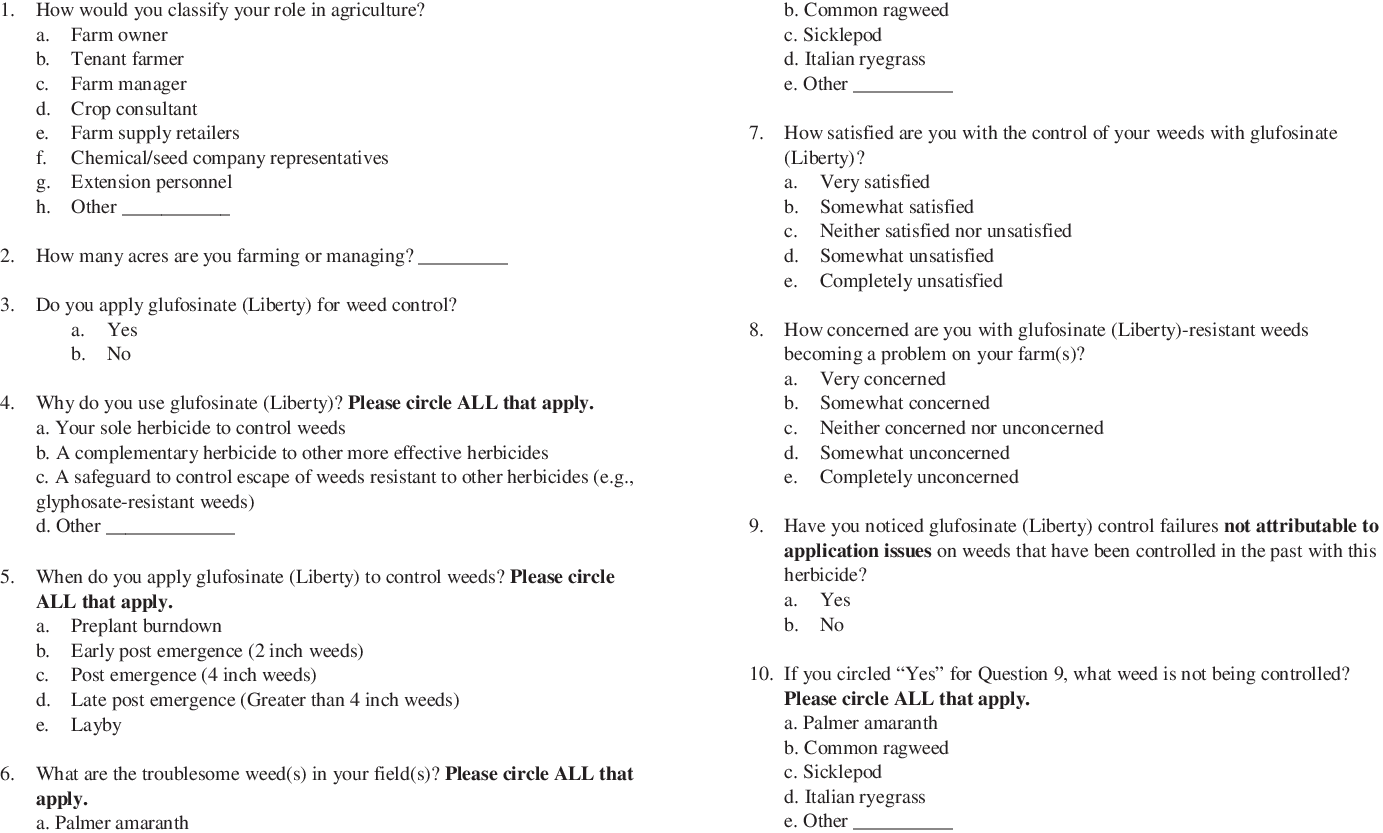
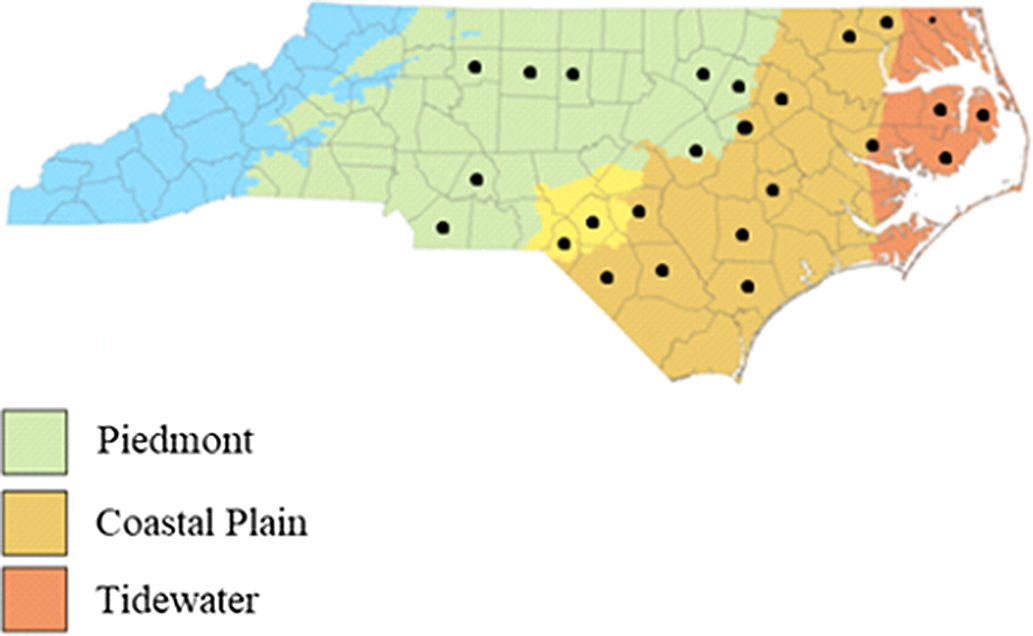
A survey was distributed to stakeholders during North Carolina Cooperative Extension meetings conducted between January and March in 2019 and 2020. The survey consisted of 10 questions (Figures 1 and 2). Five-hundred and 343 surveys were distributed in 2019 and 2020, respectively. Common names of weeds and the tradenames “Liberty, Liberty Link, Widestrike” for glufosinate and the term “layby” was used in place of postemergence-directed were used in the survey to avoid unintentional confusion. Changes to survey questions were made between years to improve question clarity, conciseness, and to address responses from the prior survey (Figures 1 and 2). For the question “How would you classify your role in agriculture?”, the response “Farm Owner and Operator” from the 2019 survey was not included on the 2020 survey to minimize redundancy from the answer “Farm Owner” (Figures 1 and 2). The 2020 survey included the question “Do you apply glufosinate for weed control?”, which replaced the question “What glufosinate-tolerant crop(s) do you plant?” on the 2019 survey (Figures 1 and 2). The question “What glufosinate-tolerant crop(s) do you plant?” was redacted from the 2020 survey because it deterred farmers that do not use glufosinate from completing the survey. The question “Do you apply glufosinate for weed control?” was also included on the 2020 survey because many stakeholders wrote “Do not plant” or “Do not spray” to answer the question “What glufosinate-tolerant crop(s) do you plant?” on the 2019 survey. The possible responses for the question “When do you apply glufosinate to control weeds?” was changed from 2019 to 2020; specifically, the change was made from “Main herbicide” to “Sole herbicide”. The change in the answer options was made because “main herbicide” could be mistaken for a herbicide that is just part of a chemical management plan rather than the only (i.e., sole) herbicide used for weed control (Figures 1 and 2). The response “Post emergence” was included for the question “When do you apply glufosinate to control weeds?” on the 2020 survey because the 2019 survey included only “Early post emergence” and “Late post emergence” (Figures 1 and 2). The question about observed control failures after glufosinate application was reworded to exclude control failures that were incurred by application error (Figures 1 and 2). Additionally in 2020, the county where the survey was distributed and the type of crop being grown were recorded. Counties were then grouped into regional categories that included Coastal Plain, Piedmont, and Tidewater (Figure 3). County-level data were recorded to account for the unique production factors present in each region of the state (Gibson et al. Reference Gibson, Johnson and Hillger2005; Wiles et al. Reference Wiles, Oliver, York, Gold and Wilkerson1992).
The stakeholder survey of glufosinate use and perception distributed to North Carolina farmers at 2019 Extension meetings.

The stakeholder survey of glufosinate use and perception distributed to North Carolina farmers at 2020 Extension meetings.
The counties where the Extension meetings were held and the glufosinate use survey administered was recorded for the 2020 survey. The counties were grouped into geographical regions within North Carolina. The Piedmont region consists of seven counties; the Coastal Plain region has five counties; and the Tidewater has five counties. Black dots represent surveyed counties.
Surveys were considered completed if ≥ 70% of the questions were answered. Additionally, the survey was considered completed if “no” was answered for “Do you apply glufosinate for weed control?” on the 2020 survey. Responses were represented with a numeric dummy variable to the corresponding response for each survey question. Responses to each survey question were modeled with a linear regression using the GLM procedure in SAS software v.9.4 (Statistical Analysis System, SAS Institute, Inc., Cary, NC) to determine whether the independent variables were significant predictors of the dependent variables (question responses; α ≤ 0.05, where the independent variable for the 2019 survey questions was stakeholders and the independent variables for the 2020 survey were crop, region, and stakeholders. This method of analyzing categorical survey data has been used for previous surveys (Jussaume et al. Reference Jussaume, Dentzman, Frisvold, Ervin and Owen2021; Hope and Shannon Reference Hope and Shannon2005; McKelvey and Zavoina Reference McKelvey and Zavoina1975). The survey questions “Why do you use glufosinate?” and “When do you apply glufosinate to control weeds?” were used as covariates for the responses to the survey questions “How concerned are you with glufosinate-resistant weeds becoming a problem on your farm(s)”, “Have you noticed glufosinate control failures on weeds that have been controlled in the past with this herbicide?” (2019), and “Have you noticed glufosinate control failures not attributable to application issues that have been controlled in the past with this herbicide?” (2020; Figures 1 and 2). Pearson’s correlation coefficients were determined between the questions “What are the troublesome weeds(s) in your field(s)?”, “Have you noticed glufosinate control failures with glufosinate on weeds that have been controlled in the past with this herbicide?”, and “If you circled ‘yes’ for Question 9, what weed(s) are not being controlled” using the Corr procedure in SAS 9.4 (α ≤ 0.05).
Results and Discussion
Response Rate
Of the surveys that were distributed, 229 were completed in 2019 (500 distributed, 46% response rate) and 296 were completed in 2020 (343 distributed, 86% response rate). Because the survey composition differed between 2019 and 2020, comparisons cannot be directly made across surveys, so they are discussed separately.
Stakeholder Composition
Most of the survey respondents classified themselves as farm owners and/or owner-operators (2019, 77%; 2020, 71%). Stakeholder description did not have a significant effect on the responses of subsequent survey questions in either year (P > 0.05), thus, all survey question responses were pooled across stakeholder type for both years. The stakeholder composition of survey years is provided in Table 1. Because the type of stakeholder had no effect on responses, herein the collective stakeholders will be referred to as farmers.
Responses to the survey question “How would you classify your role in agriculture?”

a The response “Farm owner and operator” was deleted from the question on the 2020 glufosinate use survey.
Hectares Farmed or Managed
Total farmland represented by completed surveys were 212,000 and 222,000 ha in 2019 and 2020, respectively. The farmland represented by completed surveys is approximately 10% to 15% of the total row crop farmland (1.8 million ha) in North Carolina (USDA-NASS 2019).
Glufosinate-Tolerant Crops Grown
The question “What glufosinate-tolerant crop(s) do you plant?” was asked on the 2019 survey only. The most common singular planted glufosinate-tolerant crop was cotton (16%) and soybean (15%), followed by corn (5%; Table 2). Farmers responses to multiple glufosinate-tolerant crops planted in their operation included corn+soybean (25%), cotton+soybean (13%), and then cotton+corn (3%), with 17% of farmers planting glufosinate-tolerant corn+cotton+soybean (Table 2). Although “Do not plant” was not a response option on the survey, 6% of the surveyed farmers wrote in those words (Table 2). Previous survey results show similar percentages of glufosinate-tolerant crops being planted in other parts of the United States (Riar et al. Reference Riar, Norsworthy, Steckel, Stephenson and Bond2013a, Reference Riar, Norsworthy, Steckel, Stephenson, Eubank and Scott2013b; Sarangi and Jhala Reference Sarangi and Jhala2018; Schwartz-Lazaro et al. Reference Schwartz-Lazaro, Norsworthy, Steckel, Stephenson, Bish, Bradley and Bond2017).
Responses to the question “What glufosinate-tolerant crop(s) do you plant?” in the 2019 survey.

a “Do not plant” was not a response option in the 2019 glufosinate use survey, but 6% of respondents wrote that in on the survey.
Glufosinate for Weed Control
The question “Do you apply glufosinate for weed control?” was asked on the 2020 survey only. Region (P = 0.47), crop (P = 0.054), or region by crop (P = 0.56) did not influence the response to the question. Fifty-six percent of the respondents to the 2020 survey reported they used glufosinate for weed control. Similar survey results provide evidence that glufosinate use is lower than 50% in other parts of the United States (Riar et al. Reference Riar, Norsworthy, Steckel, Stephenson and Bond2013a, Reference Riar, Norsworthy, Steckel, Stephenson, Eubank and Scott2013b; Sarangi and Jhala Reference Sarangi and Jhala2018; Schwartz-Lazaro et al. Reference Schwartz-Lazaro, Norsworthy, Steckel, Stephenson, Bish, Bradley and Bond2017). In comparison, the survey was conducted more recently and in a different geographic region than those other studies, which likely influenced the responses.
Problem Weeds
Palmer amaranth along with combinations of Palmer amaranth and common ragweed (Ambrosia artemisiifolia L.), sicklepod [Senna obtusifolia (L.) H.S. Irwin & Barneby], or Italian ryegrass were the most reported problem weeds in the 2019 and 2020 surveys. This result was expected because Palmer amaranth ranks as the most pervasive and ubiquitous weed in the southeastern United States, and the aforementioned weeds are ubiquitous in North Carolina row crops as well (Van Wychen and Hand Reference Van Wychen and Hand2020).
Glufosinate Use
Region (P = 0.11), crop (P = 0.84), or region by crop (P = 0.70) did not influence the response to the question “Why do you use glufosinate?” in 2020, and the responses were consistent across both years. The most common answer was “resistance safeguard” (2019, 28%; 2020, 33%), and “complementary herbicide” was the second most reported answer in 2019 (22%) and 2020 (28%; Table 3). Additionally, “resistance safeguard + complementary herbicide” was the most common response of the selected combination responses in 2020 (14%; Table 3). Only 6% of surveyed farmers answered “resistance safeguard + complementary herbicide” in 2019 (Table 3). The sizable percentage of farmers subscribing to these three answers may be regarded as a likely intent for “delaying of the evolution of herbicide resistance” as the answers represent frequently recommended practices to farmers (Beckie and Harker Reference Beckie and Harker2017; Owen Reference Owen2016).
Conversely, the use as “main herbicide” (2019) and “sole herbicide” (2020) represented 17% and 13% of the total responses to this question, respectively (Table 3). These two responses were concerning because this means that approximately 20,000 ha represented in the surveys are being treated with glufosinate as the main or sole herbicide, and relying on a single herbicide for weed control will impart selection pressure and expedite the evolution of glufosinate-resistant weeds on these farms (Matzrafi et al. Reference Matzrafi, Morran and Jasueniuk2020; Young Reference Young2006). Most responses (50% to 60%) to the question “Why do you apply glufosinate” provides evidence that North Carolina farmers are using glufosinate as part of a diverse herbicide program. However, because responses indicate that glufosinate was being intensively relied on for weed control (i.e., as the main or sole herbicide), herbicide stewardship still needs to be communicated at Extension meetings in an attempt to prolong the time until a glufosinate-resistant summer annual weed evolves in North Carolina.
Responses to the question “Why do you use glufosinate?”
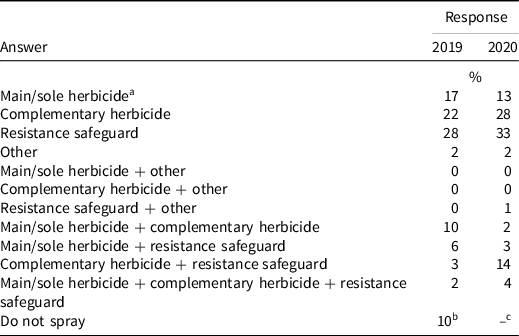
a Main herbicide was the response on the 2019 glufosinate use survey, while sole herbicide was the response on the 2020 glufosinate use survey.
b “Do not spray” was not a response option on the 2019 glufosinate use survey, but a noticeable number of respondents wrote that in on the survey.
c “Do not spray” was not included in the 2020 glufosinate use survey.
Glufosinate Applications
Region (P = 0.48), crop (P = 0.18), or region by crop (P = 0.06) did not influence the response to the question “When do you apply glufosinate to control weeds?” in 2020. The question covariate “Why do you use glufosinate for weed control?” had a significant effect on the responses to this question in 2020 (P = 0.002); in these instances the more reasons why a farmer used glufosinate resulted in more application timings being used. No other question covariate was significant from either survey year. The most common response to the question “When do you apply glufosinate to control weeds?” was early postemergence (26%) in 2019 and postemergence (18%) in 2020 (Table 4). These responses (applying glufosinate early postemergence and postemergence) are well received because these applications are the most efficacious with glufosinate. The survey provided evidence that some farmers (4.5% to 10%) are applying glufosinate at late postemergence, which is concerning because weeds are generally not effectively controlled with this application timing (Cahoon et al. Reference Cahoon, York, Jordan, Everman, Seagroves, Culpepper and Eure2015; Everman et al. Reference Everman, Burke, Allen, Collins and Wilcut2007; Steckel et al. Reference Steckel, Wax, Simmons and Phillips1997; Table 4). North Carolina farmers also responded that they used glufosinate for burndown and postemergence-directed applications, which is inconsistent with recommendations of North Carolina State University Extension specialists (Table 4). Applying glufosinate as a burndown is not recommended in North Carolina because air temperature and relative humidity are lower when these applications are typically made, which can result in control failures (Coetzer et al. Reference Coetzer, Al-Khatib and Loughin2001; Sellers et al. Reference Sellers, Smeda and Johnson2003). Additionally, other efficacious herbicides can be applied for burndown and postemergence-directed purposes, and thus reduce the selection pressure and evolution of glufosinate-resistant weeds (Boerboom Reference Boerboom1999; Everman et al. Reference Everman, Burke, Allen, Collins and Wilcut2007; Price et al. Reference Price, Koger, Wilcut, Miller and van Santen2008). Many of the farmers who responded to the survey use ≥ 2 application timings of glufosinate per season: early postemergence + late postemergence (13%) and early postemergence + postemergence (14%) were the most common responses in 2019 and 2020, respectively (Table 4). The plethora of glufosinate application combinations represented in both survey years is presented in Table 4. While the responses suggesting glufosinate applied in multitudinous ways could be concerning because it suggests overreliance, these responses could represent how a North Carolina farmer uses glufosinate as deemed fit for particular environments and prevalent weeds across years.
Responses to the question “When do you apply glufosinate to control weeds?”

a Layby was used in place of postemergence-directed on the glufosinate use survey to avoid unintentional confusion.
b The response was not included as an option on the 2019 glufosinate use survey.
c “Do Not Spray” was not a response option on the 2019 glufosinate use survey, but a noticeable number of respondents wrote that in on the survey.
d “Do Not Spray” was not a response option on the 2020 glufosinate use survey.
Satisfaction of Weed Control with Glufosinate
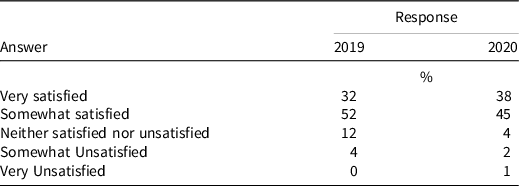
Region (P = 0.07), crop (P = 0.91), or region by crop (P = 0.33) did not influence the response to the question “How satisfied are you with the control of your weeds with glufosinate?” in 2020. The question covariate “When do you apply glufosinate for weed control?” had a significant effect on the responses to the 2019 survey (P = 0.01) in that the more application timings a farmer used resulted in somewhat satisfaction with weed control. No other question covariate was significant from either survey year. Responses of very satisfied and somewhat satisfied represented 80% and 93% of the total responses in 2019 and 2020, respectively (Table 5). This result was expected because glufosinate will control weeds (including weeds that are resistant to other herbicides) when applied in a timely manner. Evidence that North Carolina farmers are applying glufosinate in a timely manner was derived from the question “When do you apply glufosinate to control weeds?” as glufosinate is applied to weeds < 10 cm in height (Table 4). Satisfaction with glufosinate control is parallel to results of other farmer surveys conducted in areas where the herbicide is still efficacious (Sarangi and Jhala Reference Sarangi and Jhala2018; Schwartz-Lazaro et al. Reference Schwartz-Lazaro, Norsworthy, Steckel, Stephenson, Bish, Bradley and Bond2017).
Responses to the question “How satisfied are you with the control of your weeds with glufosinate?”
Concern with the Evolution of Glufosinate-Resistant Weeds
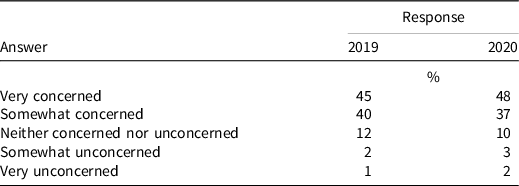
Region (P = 0.37), crop (P = 0.84), or region by crop (P = 0.33) did not influence the response to the question “How concerned are you with glufosinate-resistant weeds becoming a problem on your farm(s)?” in 2020. The question covariate “Why do you spray glufosinate?” had a significant effect on the responses to the 2019 survey (P = 0.03): the more reasons a farmer gave for applying glufosinate resulted in a decreased concern for the evolution of glufosinate-resistant weeds. No other question covariate was significant from either survey year. Very concerned and somewhat concerned represented 85% of the total responses in both years (Table 6). The responses to this question provide evidence that most North Carolina farmers are cognizant that glufosinate resistance can evolve among the summer annual weeds that inhabit their fields. The remaining responses of neither concerned, somewhat concerned, and very unconcerned about weeds evolving resistance to glufosinate are highly worrisome because herbicide-resistant weed management should be a community approach (Ervin and Frisvold Reference Ervin and Frisvold2017). Pollen and seeds from herbicide-resistant weeds (e.g., glufosinate-resistant weeds) from fields that are poorly managed can emigrate to fields in proximity where management practices are being implemented to mitigate the evolution of glufosinate resistance (Ervin and Jussaume Reference Ervin and Jussaume2014; Liu et al. Reference Liu, Davis and Tranel2012; Norsworthy et al. Reference Norsworthy, Griffith, Griffin, Bagavathiannan and Gbur2014).
Responses to the question “How concerned are you of glufosinate-resistant weeds becoming a problem on your farm(s)?”
Responses to the question “Have you noticed glufosinate control failures not attributable to applications issues on weeds that have been controlled in the past with this herbicide?”

a No corn Extension meeting was held in the Tidewater region in 2020.
Control Failures
Control failures with glufosinate were reported for the surveys distributed in 2019 and 2020. Region (P = 0.84) and crop (P = 0.40) did not influence the response to the question on the 2020 survey; however, there was a significant interaction between the two main effects (P = 0.007). The question “When do you apply glufosinate to control weeds” was a significant covariate for the responses to the 2019 survey (P = 0.02): the more application timings a farmer used resulted in realizing a control failure. This result could be due to the application of glufosinate to weeds too large to control (i.e., late postemergence and postemergence-directed). No other question covariate was significant from either survey year. Responses to the questions “What are the troublesome weed(s) in your field(s)?” and “Have you noticed control failures with glufosinate on weeds that have been controlled in the past with this herbicide?” were not correlated in 2019 (r = 0.025; P = 0.7) or 2020 (r = -0.04; P = 0.58). Of the farmers who responded to the survey, 70% and 60% in 2019 and 2020, respectively, did not experience a glufosinate control failure. The reported glufosinate control failures do not delineate the evolution of glufosinate resistance but are worth noting (Mahoney et al. Reference Mahoney, Jordan, Burgos, Jennings, Leon, Vann, Everman and Cahoon2020; Sosnoskie and Culpepper Reference Sosnoskie and Culpepper2014). On average, control failures with glufosinate did not occur with Piedmont corn and soybean, Coastal Plain corn and cotton, or Tidewater soybean (Figure 3; Table 7). Responses to questions regarding control failures and successes were similar in the Piedmont (yes, 43%; no, 57%) and Tidewater (yes, 38%; no, 62%) cotton (Figure 3; Table 7). The responses to questions regarding glufosinate control failures being common in Piedmont cotton may be skewed. Piedmont cotton was represented only by seven surveys in one county (Figure 3; Table 7). Those few surveys representing that region was expected because cotton is not widely grown in the Piedmont. Control failures with glufosinate was the common response in Coastal Plain soybean (Figure 3; Table 7).
While the responses to the survey questions provide evidence that the majority of glufosinate applications are efficacious in North Carolina, control failures are evident and farmer complaints should be taken seriously. Recommendations should focus on controlling the weeds that survive the herbicide application immediately rather than allowing surviving weeds to produce seed (Beckie and Harker Reference Beckie and Harker2017; Owen Reference Owen2016). The limited number of reported control failures could be due to the application of more efficacious, complementary herbicides and appropriate application timing of the herbicide (Cahoon et al. Reference Cahoon, York, Jordan, Everman, Seagroves, Culpepper and Eure2015; Everman et al. Reference Everman, Clewis, York and Wilcut2009; Vann et al. Reference Vann, York, Cahoon, Buck, Askew and Seagrove2017).
Weeds Not Being Controlled with Glufosinate
Region (P = 0.43), crop (P = 0.051), or region by crop (P = 0.77) did not influence the response to the question “If you circled ‘Yes’ for Question 9, what weed is not being controlled?” in 2020. Responses to the questions “What are the troublesome weed(s) in your field(s)?” and “If you circled ‘Yes’ for Question 9, what weed is not being controlled?” were correlated in 2019 (r = 0.3; P = 0.02) and 2020 (r = 0.39; P = 0.005). Palmer amaranth was the most commonly reported weed that was not controlled with glufosinate in both years (2019, 52%; 2020, 53%). This response was expected because Palmer amaranth ranks as one of the most pervasive and ubiquitous weeds in the southeastern United States (Van Wychen and Hand Reference Van Wychen and Hand2020). Aside from Palmer amaranth being pervasive and ubiquitous, control failures are often incurred due to the rapid growth of the species, resulting in applying the herbicide when the weed is too large (Bond and Oliver Reference Bond and Oliver2006; Steckel et al. Reference Steckel, Wax, Simmons and Phillips1997). Palmer amaranth has evolved resistance to 10 unique herbicide groups (including glufosinate-resistant and multiple herbicide–resistant populations), so the assumption that some populations may be in a transition from glufosinate-susceptible to glufosinate-resistant should be a core component in any weed management and glufosinate stewardship strategy (Heap Reference Heap2022; Norsworthy et al. Reference Norsworthy, Barber, Priess, Houston, Piveta, Bradley, Gage, Hager, Kruger, Steckel, Reynolds and Young2021; Salas-Perez et al. Reference Salas-Perez, Saski, Noorai, Srivastava, Lawton-Rauh, Nichols and Roma-Burgos2018).
Overall, the responses to the glufosinate use survey indicate that most farmers in North Carolina are currently stewarding glufosinate to some degree and that this herbicide remains efficacious on most row crop weeds. The survey sample from 2020 also indicated that approximately half of the farmers who responded are applying glufosinate. Since some of the responses raised concerns (i.e., inappropriate application timing, incurred control failures, no concern about the risk of the evolution of glufosinate resistance), herbicide stewardship should be continuously addressed and corrected by Extension personnel. Increasing awareness of glufosinate use can influence farmer decisions to extend the effectiveness longevity of this herbicide. The survey responses will also aid Extension personnel to understand how and why glufosinate is being used in their region. The glufosinate use survey should be redistributed in North Carolina semiannually to monitor the use of glufosinate, farmers’ perception of it, and weed susceptibility to it. Since control failures were identified in all crops and regions surveyed, North Carolina weed populations should be collected and screened to determine the susceptibility to glufosinate. In parallel, if glufosinate control failures do occur, determining why and how glufosinate was used could provide an explanation for the failure. Additional questions should be added to subsequent glufosinate (or any given herbicide) use surveys to determine why farmers choose to not apply glufosinate for weed control purposes. Understanding the barriers to glufosinate adoption could provide insight on how Extension personnel could accommodate and recommend how and why to use glufosinate (or any given herbicide) for weed control.
Acknowledgments
No conflicts of interest have been declared. Funding was provided by the North Carolina Soybean Producers Association. Special thanks to Charles W. Cahoon and Wesley J. Everman for distributing the glufosinate use surveys at North Carolina Extension Cooperative meetings for two years. We extend a special thank you to Dr. Micheal D.K. Owen for reviewing the manuscript.


 Open access

