


The two living species of solenodon are recognized as key priorities for conservation attention because of their evolutionary distinctiveness from other extant mammals (Roca et al., Reference Roca, Kahila Bar-Gal, Eizirik, Helgen, Maria and Springer2004; Isaac et al., Reference Isaac, Turvey, Collen, Waterman and Baillie2007). The Hispaniolan solenodon Solenodon paradoxus, one of only two surviving native Hispaniolan land mammals, has always been considered rare and highly threatened, if not already extinct, and is currently categorized as Endangered on the IUCN Red List (IUCN, 2007). Although this species is still known from several localities in the Dominican Republic across a range of different habitat types and elevations (Ottenwalder, Reference Ottenwalder1999), it has declined drastically in Haiti. Woods (Reference Woods1981) concluded on the basis of wide-scale surveys that the species was ‘functionally extinct’ in most of the country, surviving only as a relict population in the Massif de la Hotte, a montane refugium at the periphery of its former range. Research into the status of solenodons in this region was qualitatively summarized by Woods & Ottenwalder (Reference Woods and Ottenwalder1992) and Sergile & Woods (Reference Sergile and Woods1996), who reported that the only solenodon population known in Haiti was apparently limited to an 8–10 km radius around the village of Duchity, a region with a dense human population and highly disturbed patches of mid elevation mesic broadleaf forest east of Pic Macaya, and was largely or completely restricted to the remote areas of Diquillon and Mare Cochon (1,200–1,400 m) south-east of Plaine Martin.
Woods & Ottenwalder (Reference Woods and Ottenwalder1992) and Sergile & Woods (Reference Sergile and Woods1996) were pessimistic about the probability of even short-term solenodon survival in the Massif de la Hotte, predicting that the species was likely to become extinct within 10–20 years because of accelerating habitat destruction, heavy predation by introduced carnivores (especially dogs), opportunistic exploitation for food by subsistence farmers, and stochastic factors associated with population fragmentation and small population size. A detailed recovery plan for this population (Woods & Ottenwalder, Reference Woods and Ottenwalder1992) advocated comprehensive surveys and ecological studies, formal habitat protection and management, including expansion of the boundaries of Parc National Pic Macaya, reduction of solenodon mortality from human and exotic mammal predation, and development of a captive breeding programme. However, no actions have been taken to implement or initiate this recovery plan, and no further targeted conservation research has subsequently been conducted to assess the continued survival of solenodons in Haiti.
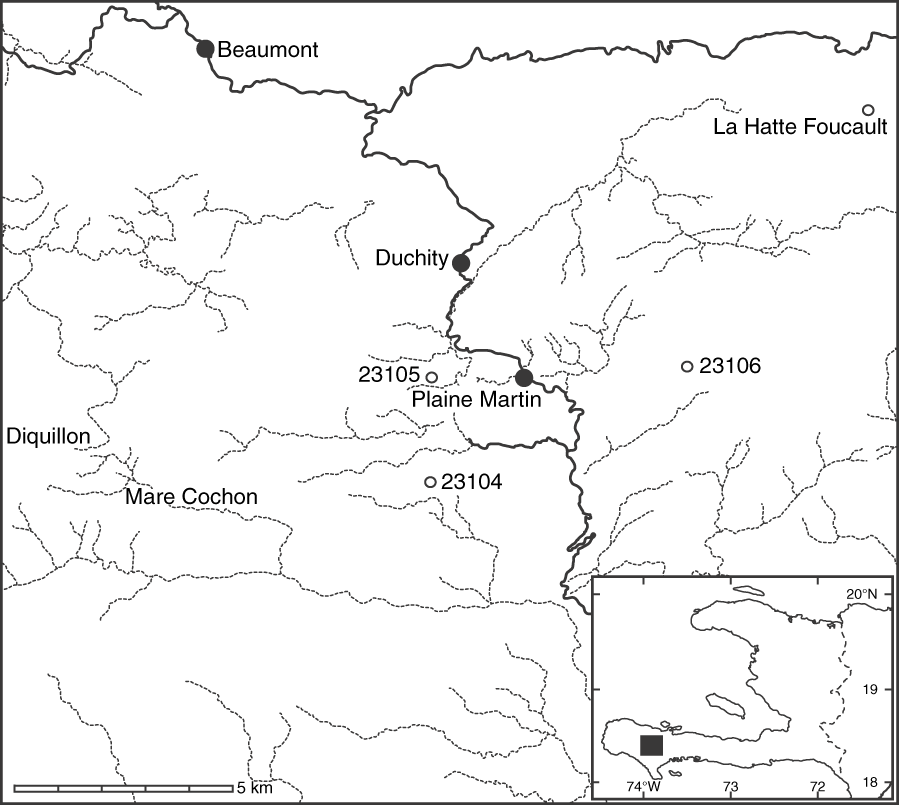
We carried out an 11-day survey to investigate the status of Hispaniolan solenodons in the Duchity region of the Massif de la Hotte in April 2007 (Fig. 1), using sign surveys and interviews with villagers and subsistence farmers. Informants were asked descriptive, structured and contrast questions based on a series of laminated illustrations of Hispaniolan solenodon, Hispaniolan hutia Plagiodontia aedium, black and brown rats Rattus rattus and Rattus norvegicus, mongoose Herpestes sp., and rhinoceros iguana Cyclura cornuta (photographs or colour paintings from Allen, Reference Allen1910; Lyneborg, Reference Lyneborg1971; and by permission of Eladio Fernandez and Richard Gibson). Additional illustrations of red acouchi Myoprocta acouchy and nine-banded armadillo Dasypus novemcinctus from Eisenberg & Redford (Reference Eisenberg and Redford1999) were used as controls; interviews in which informants claimed to recognize these test species were discounted as unreliable, although this rarely occurred.
Location of the three solenodons collected during this study (with their OUM specimen numbers; Table 1), showing main settlements, roads, rivers, and localities mentioned in the text. The black rectangle on the inset shows the location of the study area in south-west Haiti.
Whereas hutias (zagouti), mongoose (mou long) and rats were consistently recognized in all structured (n = 13) and informal semi-structured interviews, solenodons were not familiar to most informants in the study region. However, although they were frequently confused with hutias and blamed for damaging taro and bean crops (cf. Woods, Reference Woods1981; Woods & Ottenwalder, Reference Woods and Ottenwalder1992; Sergile & Woods, Reference Sergile and Woods1996), they were known to some informants from across the region either as a distinct second variety of hutia or by a range of local Creole names all referring to their elongated snouts (nen long, bouche long, zagouti bouche long, cochon dinjue nen long). All informants who were able to distinguish between the two species stated that hutias were much more common than solenodons.
Whilst it is possible that local knowledge of solenodons in the Massif de la Hotte may be influenced by memories of scientific research expeditions in this region between the 1970s and early 1990s, continued survival of the species in Haiti was confirmed when the remains of three dead solenodons were brought to us in Duchity over 23–25 April 2007 as a result of local interest in our survey (Table 1). None of these individuals had been killed as a result of our arrival in the region: OUM 23104 had been found freshly dead c. 8 months earlier; OUM 23105 had been found the previous day in a state of decomposition (having probably died 7–10 days earlier), with damage to the back of the cranium suggestive of mongoose predation; and OUM 23106 had been killed and eaten by subsistence farmers 3 months earlier. Although additional skeletal remains of 15 hutias were also brought to us for sale, OUM 23104–23106 were accurately identified by local guides as solenodons rather than hutias on the basis of skeletal differences, demonstrating their familiarity with the species.
Collection data for three solenodon specimens obtained during fieldwork in the Duchity region of the Massif de la Hotte.
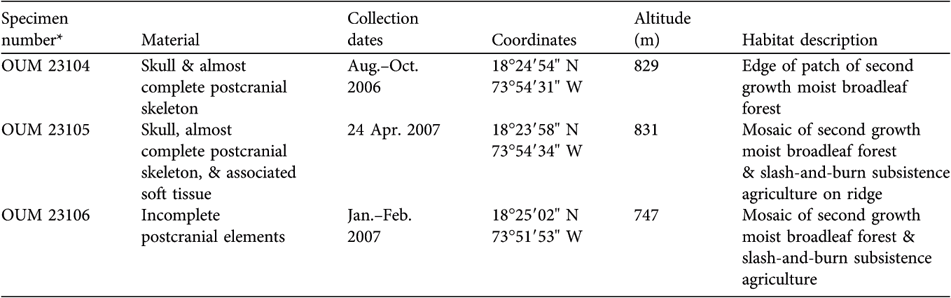
* OUM, Oxford University Museum of Natural History accession numbers
The farmers who had collected solenodon remains were employed as guides to the respective collection sites, and further soft tissue and skeletal remains from the same solenodon individual were located at the OUM 23105 collection site. All three sites were close to karstic outcrops of jumbled limestone boulders on slopes or ridges, with degraded secondary regrowth and adjacent to bean fields and/or areas grazed by cattle belonging to subsistence farmers (Table 1). The farmer who had found OUM 23105 also reported having seen a live solenodon at this site on 22 April 2007. To discourage any active killing of native mammals by local farmers for perceived reward from visiting researchers, all informants were told that no further specimens would be required, and the importance of solenodon conservation was stressed to all informants throughout the survey period.
Although our study presents only limited data on solenodon abundance and distribution in the Massif de la Hotte, we were surprised to find that not only were solenodons still extant in the region but that they occurred at lower elevations and in more anthropogenically degraded habitat than suggested by the most recent regional environmental assessment (Sergile & Woods, Reference Sergile and Woods1996), including localities close to Duchity and other population centres and to major roads, and were recognized by villagers as far north-east as La Hatte Foucault village c. 20 km from the Mare Cochon-Diquillon region (Fig. 1). It is unclear whether this represents a population expansion or merely differences in survey techniques or difficulties in interpreting baseline data from earlier studies; solenodon specimens from the Duchity region in existing museum collections (Museum of Zoology, University of Vermont, USA; Florida Museum of Natural History, USA) frequently lack collection data corresponding to known localities. However, it is important to note that dogs were almost completely absent across all of our study region, in marked contrast to lower elevations in Haiti (e.g. Camp Perrin), and local villagers informed us that all dogs had been culled in 23 villages around the Duchity region in 1979 because of their depredations on domestic chickens and goats. Although this cull was not commented on by earlier researchers, it may be a significant factor in solenodon survival in the region.
The importance of conserving Haiti's last solenodon population is emphasized by the biological distinctiveness of the Massif de la Hotte, which contains extremely high levels of faunal and floristic endemism (including Haiti's only endemic bird species) but has also been identified as a centre of imminent extinction (Ricketts et al., Reference Ricketts, Dinerstein, Boucher, Brooks, Butchart and Hoffmann2005). The potential for substantial new biological discoveries in the region is highlighted by two new avian sighting records made during our survey: the first record of indigo bunting Passerina cyanea for Haiti (Duchity, 21 April 2007), and the first record of yellow-headed blackbird Xanthocephalus xanthocephalus for Hispaniola (marsh in Fond Lacoma region c. 1 km north-east of Fond Déron village, 21 April 2007; see Latta et al., Reference Latta, Wiley, Rimmer, Raffaele, Keith, McFarland and Fernandez2006). Although Ottenwalder (Reference Ottenwalder, Woods and Sergile2001) tentatively assigned the Massif de la Hotte solenodon population to the south Hispaniolan subspecies Solenodon paradoxus woodi, he suggested that it might be morphologically distinct, and it has often been considered to represent a distinct unnamed subspecies or even species (Woods & Ottenwalder, Reference Woods and Ottenwalder1992; Sergile & Woods, Reference Sergile and Woods1996). The establishment of an effective research and conservation programme for solenodons in the Massif de la Hotte must therefore be considered an urgent priority; continued community surveys and local awareness-raising across the Massif de la Hotte region are now underway, and a wider-scale field project to investigate solenodon distribution, habitat utilization, density, and interaction with introduced predators in the region is currently being developed.
Acknowledgements
Logistical support for fieldwork was provided by Société Audubon Haïti and Sociedad Ornitológica de la Hispaniola. Particular thanks go to Philippe Bayard, Jessie Haspil, Osé Pauléus, Paul Judex Ezouardin, Potau Rosevalt, Frederique Chéron, José Ottenwalder, Eladio Fernandez and Jorge Brocca. Funding was provided by a NERC Postdoctoral Fellowship and the British Ecological Society.
Biographical sketches
Samuel Turvey is a conservation biologist and palaeontologist with an interest in vertebrate extinctions on island systems. He is involved with conservation field projects targeting threatened species with few or no close relatives as part of the Zoological Society of London's EDGE of Existence programme, which aims to prevent the loss of large amounts of unique evolutionary history. Helen Meredith is interested in the conservation of threatened phylogenetically distinct species. She is the Coordinator of the EDGE Amphibians programme at the Zoological Society of London, and combines field conservation with environmental awareness-building. Paul Scofield is Curator of Vertebrate Zoology at Canterbury Museum, New Zealand. His varied research interests include albatross biology, seabird taxonomy and avian palaeontology, and he is the co-author of the recently published Helm Field Guide to the Albatrosses, Petrels and Shearwaters of the World.



