





Introduction
The quest to master clear pronunciation often presents a formidable challenge to many language learners, a phenomenon that has long piqued scholarly interest within the domain of foreign language acquisition. As Lippi-Green (Reference Lippi-Green2012) articulates, an accent is a collection of “loose bundles of prosodic and segmental features” that vary across speakers from geographic or social boundaries. This difference is especially pronounced in additional language speakers (ALSs),Footnote 1 who often retain a distinct accent reminiscent of their native phonological system, despite proficiency in other aspects of the more recently acquired language(s). This retention, termed the Joseph Conrad phenomenon or the Henry Kissinger effect by Scovel (Reference Scovel1978), underscores the fact that accents are not mere linguistic markers but hold profound sociocultural and symbolic significance (Cai, Fank, Sun & Jiang, Reference Cai, Fang, Sun and Jiang2022; Chakraborty, Reference Chakraborty2017; Diao, Reference Diao2017; Duff, Reference Duff2007; Gatbonton, Trofimovich & Segalowitz, Reference Gatbonton, Trofimovich and Segalowitz2011; Jones, Reference Jones2001). Within ethnolinguistic communities, biases toward accents are evident, influencing perceptions of prestige, competence, and social attractiveness (Bishop, Coupland & Garrett, Reference Bishop, Coupland and Garrett2005; Honey, Reference Honey and Coulmas2017). If speakers can suffer from negative evaluations due to their pronunciation of their first language (L1), one must wonder about the anxieties that ALSs experience about their accents in the language of another ethnolinguistic group. While a substantial amount of research has dissected the attitudes of native speakers (NSs) toward ALS accents, there is a noteworthy void in exploring the concerns that ALSs have regarding their own accents. This paper seeks to fill this gap, endeavoring to gain a comprehensive understanding of accent anxiety from the ALSs’ viewpoint. By defining it as a subset of speaking anxiety, we hope to offer a more holistic view of the complexities surrounding accents in intercultural communication and language acquisition.
Measuring speaking and pronunciation anxiety
Research shows that anxiety is experienced by many learners of additional languages, and this anxiety can negatively affect ALSs’ language practice. This specific anxiety, termed foreign language anxiety (FLA), encompasses the feelings of tension and apprehension that arise during language acquisition and use. Early investigations sometimes grouped FLA with other forms of anxiety, such as test and state-trait anxieties (see Mandler & Sarason, Reference Mandler and Sarason1952; Spielberger, Reference Spielberger and Spielberger1966). Scovel (Reference Scovel1978), however, argued that language anxiety stands as a distinct concern, and, likewise, MacIntyre and Gardner (Reference MacIntyre and Gardner1994) framed it as an emotion directly linked to the process of learning another language. A definition by Horwitz, Horwitz and Cope (Reference Horwitz, Horwitz and Cope1986) has gained broad acceptance, positing FLA as a unique type of anxiety rooted in the language learning situation, encompassing individuals’ self-perceptions, beliefs, and behaviors.
Assessments of anxiety related to speaking an additional language can be categorized into tools designed for classroom contexts and those for the world outside the classroom. Predominantly, classroom-focused tools have been influenced by the Foreign Language Classroom Anxiety Scale (FLCAS), introduced by Horwitz et al. (Reference Horwitz, Horwitz and Cope1986). Instruments like the Foreign Language Speaking Anxiety Questionnaire and the English-Speaking Anxiety Scale were developed to assess speaking anxiety while using the language in the classroom (Liu, Reference Liu2018; Öztürk & Gürbüz, Reference Öztürk and Gürbüz2013). In contrast, Clément and Baker’s (Reference Clément and Baker2001) English Use Anxiety Scale indexes English usage anxiety in everyday situations outside the classroom. And Woodrow’s (Reference Woodrow2006) Second Language Speaking Anxiety Scale (SLSAS) assesses both classroom and daily life contexts. Despite these contributions, there remains a need to deepen our understanding beyond general English-speaking anxieties.
Accent anxiety
Zooming into a more specific aspect of speaking anxiety, Baran-Łucarz (Reference Baran-Łucarz2014, Reference Baran-Łucarz and Pawlak2016) developed the Pronunciation Anxiety Scale to assess learners’ anxieties related to English pronunciation within academic environments. This tool has been instrumental in exploring the interplay between learners’ pronunciation anxieties and their motivation to learn and willingness to communicate (WTC) in classroom settings. In their work, pronunciation anxiety is conceptualized as a complex emotion encompassing apprehensions stemming from negative self-perceptions and specific beliefs and fears of pronunciation-related concerns. While these studies have significantly advanced our understanding, there remains a pressing need for a validated tool that gauges accent-related anxieties in contexts beyond the classroom.
When speaking a new language in day-to-day life outside the classroom, ALSs can face several challenges, including accent-induced anxiety (Baquiran & Nicoladis, Reference Baquiran and Nicoladis2020; Bresnahan, Ohashi, Nebashi, Liu & Morinaga Shearman, Reference Bresnahan, Ohashi, Nebashi, Liu and Morinaga Shearman2002; Chakraborty, Reference Chakraborty2017; Kristiansen, Reference Kristiansen2001; Park, Hodge & Klieve, Reference Park, Hodge and Klieve2022; Romero-Rivas, Morgan & Collier, Reference Romero-Rivas, Morgan and Collier2022; Spence, Hornsey, Stephenson, & Imuta, Reference Spence, Hornsey, Stephenson and Imuta2024). This anxiety often stems from deeply held beliefs about a society’s acceptable linguistics standards with regard to accents. When ALSs communicate with those whose accents conform to this standard, this anxiety can intensify, potentially impacting their speech clarity and overall understanding (Wilang & Singhasiri, Reference Wilang and Singhasiri2017). Kim, Roberson, Russo and Briganti (Reference Kim, Roberson, Russo and Briganti2019) identified various negative experiences that ALSs face in these situations, ranging from feeling typecast based on stereotypes to actively avoiding such interactions. The sections that follow delve more deeply into the nature of ALSs’ accent anxiety and its psychological and sociocultural correlates.
Fear of negative evaluation
A predominant concern among ALSs is the apprehension of negative evaluations due to their accented speech, stemming from their deviation from perceived language norms. Without targeted instruction, ALSs often struggle to discern and assimilate the pronunciation features typical of NSs (Foote & Trofimovich, Reference Foote and Trofimovich2016). The deep-seated pursuit of linguistic standardness has often become a barrier to ALSs’ acceptance of their own unique accents, thereby heightening anxiety. In their study of international students in the United States, Scales, Wennerstrom, Richard and Wu (Reference Scales, Wennerstrom, Richard and Wu2006) found that most students aspired for a native-like accent, often overlooking the importance of being simply understood. A noticeable gap existed between their accent goals and their actual language abilities, and this gap was exacerbated by the fact that many are aiming for a vaguely defined “ideal” accent. This aspiration was not necessarily tempered, even after long stays in English-speaking countries. The length of time spent learning the language is only one factor that can influence the extent to which one acquires a standard accent. Also important is the age at which one begins to learn an additional language, with younger learners typically more successful (e.g., Flege, Munro & Mackay, Reference Flege, Munro and Mackay1995; Piske et al., Reference Piske, MacKay and Flege2001).
In her examination of Japanese learners of English, Kimura (Reference Kimura and Pawlak2021) noted that the sources of their accent-related anxieties were often linked to how they presented themselves. A recurring theme was the deep-seated fear of being negatively judged. Authority figures in the English world, such as NSs or experienced educators, were found to amplify these anxieties. Some learners felt overwhelmed when their pronunciation mistakes were highlighted. These concerns might be even intensified after extensive practice. The learners reported that these concerns affected both one-on-one conversations and interactions within larger groups.
Consistent with Kimura’s findings, Baran-Łucarz (Reference Baran-Łucarz, Piechurska-Kuciel, Szymańska-Czaplak and Szyszka2017) found that ALSs with elevated anxiety levels were especially worried about external feedback and sensitive to criticism, leading to reduced confidence and a declining drive to improve. Coppinger and Sheridan (Reference Coppinger and Sheridan2022) likewise found that fear of negative feedback is central to accent anxiety. Interestingly, they believed this fear is more internal, rather than based on actual external feedback (Baran-Lucarz, Reference Baran-Łucarz, Piechurska-Kuciel, Szymańska-Czaplak and Szyszka2017) or perceived expectations from others (Kimura, Reference Kimura and Pawlak2021). In essence, the anxiety is self-imposed, stemming from one’s own pressure rather than criticism from others. Coppinger and Sheridan suggested that positive interactions with English speakers might help alleviate this anxiety. Given that their fears of embarrassing scenarios were largely rooted in their imagination, substantial real-world English interactions might actually be less negative than imagined. Interestingly, the study found that French ALSs were more anxious when speaking with fellow ALSs than with NSs. This stronger anxiety, driven more by perceived rather than actual negative experiences, further indicates that accent anxiety might be grounded in personal fears of negative evaluation, rather than actual experiences of negative evaluation.
Fear of intergroup rejection
Accent anxiety is not just rooted in the fear of negative evaluations (FNE) but also can be influenced by concerns about ethnic prejudice and the navigation of identity. Accents mark an individual’s social identity and the relative status of their ethnolinguistic group within society (Gordon, Reference Gordon2000; Jones, Reference Jones2001; Marx, Reference Marx2002; McCrocklin & Link, Reference McCrocklin and Link2016; Szyszka, Reference Szyszka2022). For ALSs, their accent carries more significance than an idiosyncratic linguistic trait; it symbolizes their cultural and ethnic heritage. In minority language contexts, this accent can also become a reason for bias. As sarcastically noted by Cook (Reference Cook1999, p. 195), ALSs with discernible accents are often derogatorily perceived as “failures.” Even when unintentionally expressed by NSs (Piller, Reference Piller2002), these biases can potentially exacerbate ALSs’ anxiety across several spheres of life (e.g., Baquiran & Nicoladis, Reference Baquiran and Nicoladis2020; Bresnahan et al., Reference Bresnahan, Ohashi, Nebashi, Liu and Morinaga Shearman2002; Chakraborty, Reference Chakraborty2017; Piller, Reference Piller2002).
Highlighting the challenges faced by immigrants and international students in English-speaking countries, Derwing (Reference Derwing2003) reported that immigrant learners of English in Canada expressed a desire for better pronunciation, mainly driven by a quest for societal acceptance. Derwing (Reference Derwing2003) noted that not all accents face biases; accents linked with certain ethnic backgrounds are more or less subject to discrimination. While some of Derwing’s participants acknowledged occasional understanding and patience, most said their encounters were clouded by indifference, outright impoliteness, and deliberate misunderstandings. Echoing this finding, Veliz, College and Veliz-Campos (Reference Veliz, College and Veliz-Campos2021) described the alienated experiences of international students in Australian institutions due to their accents.
Dovchin and Dryden’s (Reference Dovchin and Dryden2022) insightful interviews with Australian migrants further illuminate these concerns. One participant expressed fears that her foreign accent might inadvertently tarnish the reputation of her entire ethnic group, resonating with broader issues of maintaining collective pride and avoiding societal shaming. Her interactions in English were laden with embarrassment, distress, and significant anxiety. Such feelings might be indicative of subtle accent biases where some NSs, perhaps even unknowingly, communicate a message of “otherness” to the ALS speaker (Zhang, Reference Zhang2021).
Intelligibility concerns
Research suggests that accentedness and its linguistic correlates vary across beginner to advanced ALSs (Saito, Trofimovich & Isaacs, Reference Saito, Trofimovich and Isaacs2016), such that they may have different concerns. Among beginner ALSs, achieving clear communication in English is paramount and urgently required (e.g., Boonsuk & Fang, Reference Boonsuk and Fang2022). Derwing and Rossiter (Reference Derwing and Rossiter2002) conducted an in-depth study, evaluating the communication challenges of new ALS immigrants in Canada. They pinpointed pronunciation as a major factor impacting their communicative interactions. Interestingly, a significant portion of their subjects identified their own accent as the primary communication barrier. A majority struggled to specify their exact pronunciation issues, felt unsure about improvement strategies, and struggled with mastering certain English sounds. The researchers hypothesized that these participants might have either missed out on effective training or did not benefit much from the language instruction they did receive. For example, a lot of learners focused more on specific sounds like “th” or “l/r” than on the overall flow or tone of speech. Building on this, Derwing (Reference Derwing2003) observed that while many learners acknowledged the challenges posed by their accents, they often lacked insight into the particular problems and the ways of improvement.
An emphasis on clarity over perfect native-like pronunciation might be more evident in more advanced learners. In Barzegar Rahatlou, Fazilatfar and Allamis’ (Reference Barzegar Rahatlou, Fazilatfar and Allami2018) study, Iranian English teachers appeared to have a more practical perspective on accents, prioritizing their own intelligibility for better communicative competence. However, the challenges and concerns faced by teachers in nonimmersion settings may differ from those experienced by ALSs residing in English-speaking countries. Teachers of English, due to their extensive experience, knowledge, and familiarity with the language, may exhibit a different attitude toward English pronunciation than learners.
The operationalization of accent anxiety
These and other studies shed light on the complex nature of ALSs’ accent anxiety, providing a nuanced understanding of both individual and societal dynamics. Some of these studies focus on classroom settings with a pedagogical lens (e.g., Baran-Lucarz, Reference Baran-Łucarz2011, Reference Baran-Łucarz2014, Reference Baran-Łucarz, Piechurska-Kuciel, Szymańska-Czaplak and Szyszka2017, Reference Baran-Łucarz and Lee2021), and others have delved into general beliefs, motivations, and willingness toward accent modification (e.g., Derwing, Reference Derwing2003). Many of these studies employed qualitative approaches to investigate the interplay of ALSs’ concern about their own accent and their psychological sources of fear, establishing a foundation for a clear operationalization of this construct, which is necessary to study its antecedents and outcomes in difference domains in larger samples of ALSs.
Drawing from this collective knowledge, we conceptualize accent anxiety as an emotional and cognitive response stemming from perceived challenges in linguistic interactions. Horwitz et al.’s (Reference Horwitz, Horwitz and Cope1986) FLCAS and its shortened version by Botes, van der Westhuizen, Dewaele, MacIntyre and Greiff (Reference Botes, van der Westhuizen, Dewaele, MacIntyre and Greiff2022) identified three sources of FLA: (a) communication apprehension, (b) FNE, and (c) test anxiety. Although inspired by this foundational work, we chose to omit the test anxiety dimension because our interest emphasizes accent anxiety outside the classroom. Reflecting broader societal dynamics, we introduced an additional dimension centered around concerns of intergroup rejection. Furthermore, we broadened the FNE dimension to encompass avoidance of feelings of inferiority connected to linguistic practice, self-perception, and proficiency in real-world scenarios as opposed to a classroom environment.
Accordingly, our conceptualization of accent anxiety encompasses three areas: (a) ALSs’ apprehension about negative evaluations about themselves, tied to their nonstandard pronunciation (FNE); (b) concerns about rejection from the target language community because of their “foreign” pronunciation (fear of intergroup rejection [FIR]); and (c) anxiety over potential communication hurdles attributed to their pronunciation (intelligibility concerns [ICs]). Contrary to Baran-Łucarz’s (Reference Baran-Łucarz, Piechurska-Kuciel, Szymańska-Czaplak and Szyszka2017) model on pronunciation anxiety, which focuses on pronunciation self-efficacy, self-image, FNE, and learner-related pronunciation beliefs in the language classroom, our model underscores real-world interactions outside the English classroom. In a multicultural setting, most ALSs are not just learners but also active users of English (Cook, Reference Cook1999, Reference Cook2017). As many are no longer in formal English classes, and their interactions are largely in real-life contexts, our framework integrates more sociolinguistic elements, transcending purely linguistic and pedagogical viewpoints.
Research objectives
To date, few instruments exist to gauge the reasons that ALSs might be anxious about their accent outside of classroom settings. To address this gap, our model draws on the concerns identified in previous studies, including concerns about ineffective communication, FNE, and stigmatization due to ethnolinguistic group membership to devise an instrument for evaluating these dimensions of ALSs’ anxiety concerning their accent. Through three studies of speakers of English as an additional language, we will evaluate the AAS’s psychometric properties, following the 2014 testing standards of the American Educational Research Association, American Psychological Association, and National Council on Measurement in Education (NCME).
In Study 1, we examine the AAS’s structural validity in a sample of immigrant speakers of English as an additional language, using exploratory factor analysis (EFA) to determine its dimensions and their interrelationships as well as the items that best define each subscale. We also examine the AAS’s convergent validity (i.e., the extent to which the new measure is associated with other measures in the same domain) by correlating the AAS’s subscales with other measures of language anxiety, with the hypothesis that the AAS would be most closely associated with speaking anxiety and less so with other aspects of language anxiety. To test discriminant validity, we correlated the AAS with measures that are not expected to be highly related with accent anxiety, including math anxiety and the years spent learning English. We assessed criterion-related validity (assessed concurrently) by examining the interrelations between the AAS and variables that are hypothesized to predict or be predicted by accent anxiety. These included demographic variables (e.g., gender, years spent learning English, and years living in Canada) as well as language and communication related variables (e.g., WTC in English and linguistic confidence) and intercultural relations (e.g., sociocultural adaptation and perceived discrimination) variables. We also tested the internal consistency of the AAS and its subscales.
In Study 2, we extend Study 1 by focusing on another population who speaks English as an additional language, international students. We tested the structural validity through confirmatory factor analysis (CFA) and the subscales’ internal consistency. We examined the AAS’s convergent, divergent and concurrent validity through correlational analyses using the same variables as in Study 1.
In Study 3, we further extended the validity analyses using additional variables relevant to language and communication and intercultural relations. We also assessed the subscales’ test-retest reliability in addition to their internal consistency.
All the descriptive and reliability analyses, correlational tests, and the EFA were executed using jamovi 2.3 (The jamovi project, 2023), whereas the CFA was conducted utilizing Mplus 8.6 (Muthén & Muthén Reference Muthén and Muthén2017). Prior to the major analyses, the data were reviewed for missing data. Across all studies, the missing data only accounted for a small portion of the responses for all variables measured (Study 1: 0.47%; Study 2: 0.46%; and Study 3: 1.12%), which is not likely to affect the validity of the analysis (Dong & Peng, Reference Dong and Peng2013). Tables providing the variables’ descriptive statistics and intercorrelations are provided for each study in the Appendix.
Study 1
Method
Participants and procedure
Immigrant students who were NSs of languages other than English (N = 203: 44.3% males, 55.2% females, and 0.5% did not wish to disclose) were recruited from introductory psychology courses at a western Canadian university. Their age ranged from 17 to 32 years (mean [M] = 19.44, standard deviation [SD] = 1.84). All participants reported that they were born outside of Canada and were permanent residents of Canada or Canadian citizens. Their average length of residence (LOR) in Canada was 11.29 years (SD = 5.18). Sixty-nine L1s were represented, with the top five languages Tagalog (7.88%), Punjabi (6.40%), Hindi (5.42%), Urdu (4.93%), and Spanish (3.94%).
The data were collected online using the Qualtrics survey platform during a group testing session that lasted an average of 30 min. For their collaboration, the participants received partial course credit. This research project was approved by the institutional ethics review committee at the university.
Materials
The questionnaire was made up of the newly constructed items to assess accent anxiety as well as diverse instruments to assess construct, convergent, and discriminant validity (see Appendix). Cronbach alpha indices of internal consistency are presented in parentheses (α). Because the research focuses on anxiety using a language outside of the classroom context and because English is the predominant language in the city in which the study was conducted, the target language was English.
Accent anxiety. The AAS encompasses three subscales that assess ALSs’ concerns about their accent: FNE, which delves into anxiety derived from apprehensions of potential adverse judgments due to their foreign accent (e.g., “I fear people making fun of my English accent”); FIR, underscoring anxiety arising from worries about being rejected by interlocutors from other ethnic groups (e.g., “It bothers me that my English accent identifies me as an outsider”); and ICs, gauging anxiety related to concerns that others may struggle to understand their speech (e.g., “I worry people don’t understand me because of my accent”).
Each subscale initially included between 6 and 8 items, culminating in a total of 20 items. The item pool included items adapted from FLA instruments, including the FLCAS (Horwitz et al., Reference Horwitz, Horwitz and Cope1986), Short-form Foreign Language Classroom Anxiety Scale (Botes et al., Reference Botes, van der Westhuizen, Dewaele, MacIntyre and Greiff2022), Pronunciation Anxiety Scale (Baran-Łucarz, Reference Baran-Łucarz and Pawlak2016), and English Use Anxiety Scale (see Clément & Baker, Reference Clément and Baker2001), and items developed based on issues raised in pronunciation research by Derwing (Reference Derwing2003), Leary (Reference Leary1983), McCrocklin and Link (Reference McCrocklin and Link2016), and Szyszka (Reference Szyszka2022). The participants responded to each item on a 6-point Likert scale, spanning from “strongly disagree” to “strongly agree.” The reliability coefficient for the initial total scale was .97 and those for the FNE, FIR, and IC subscales were .96, .93, .89, respectively.
English speaking anxiety. English speaking anxiety was evaluated using Clément and Baker’s (Reference Clément and Baker2001) 8-item English Use Anxiety Scale. The participants rated the extent to which they felt anxious while using English on a 6-point scale (1 = strongly disagree and 6 = strongly agree) across various situations (e.g., “I get nervous every time I have to speak in English to a salesclerk.”). The mean score indicated a high level of anxiety when speaking English (α = .87).
English listening/reading/writing anxiety. Anxiety associated with the three other English language skills (listening, reading, and writing), was measured using three 9-item scales (Cheng, Reference Cheng2017; e.g., “When listening to English, I often worry that I will miss information”; “When reading English, I often worry that I will misunderstand something”; and “As soon as I start writing English, I begin to worry about not being able to express myself”). Participants rated the extent to which they felt anxious (1 = strongly disagree and 6 = strongly agree). The reliability coefficients were .91, .92, and .91, respectively.
Math anxiety. The 9-item Abbreviated Math Anxiety Scale evaluated math anxiety (Hopko, Mahadevan, Bare & Huntal, Reference Hopko, Mahadevan, Bare and Hunt2003). Participants rated each item in terms of how anxious they would feel during the scenario specified (e.g., “Listening to a lecture in math class”: 1 = low anxiety and 6 = high anxiety). A high mean score indicated a high level of math anxiety (α = .91).
Willingness to communicate in English. A 10-item list of English oral communication tasks was adapted from a 20-item list consisting of speaking and writing domains to assess participants’ willingness to engage in English communication (MacIntyre, Babin & Clement, Reference MacIntyre, Babin and Clement1999). Only items that concerned WTC orally in English outside the classroom were included (e.g., “Speak about your favourite relative and explain why this person is your favourite”: 1 = definitely no and 5 = definitely yes). The mean score was computed to represent the overall level of WTC in English (α = .94).
Sociocultural adaptation. The 11-item Revised Sociocultural Adaptation Scale assessed participants’ adaptation to Canadian society (Wilson, Ward, Fetvadjiev & Bethel, Reference Wilson, Ward, Fetvadjiev and Bethel2017). Participants rated their competence in everyday activities (e.g., “Attending or participating in community activities”: 1 = Not at all competent and 5 = Extremely competent). The mean score represented the overall level of sociocultural adaptation (α = .90).
Other English-related experiences. Participants’ daily English communication difficulties were measured by a 6-item list, formulated specifically for this study, containing six scenarios involving English conversation with different interlocutors (e.g., seeing the doctor, talking to salesclerks, and ordering at the restaurant; α = .91). Participants were asked how frequently they experience communication difficulties within these situations (1 = almost never and 6 = very frequently). In addition, participants’ familiarity with different accents was assessed by the question, “How familiar are you with the different English accents other than native English accents (e.g., British accent, American accent)?” (1 = not at all familiar and 6 = very familiar).
Results and discussion
Exploratory factor analysis
An initial EFA with minimum residuals extraction and Oblimin rotation was used to refine the AAS items from the immigrant sample. The Kaiser-Meyer-Olkin measure was notably robust, with every item’s Kaiser-Meyer-Olkin index exceeding .9, signifying excellent sampling adequacy (Kaiser, Reference Kaiser1974). Bartlett’s test of sphericity was also significant (p < .001), showing the correlations in the data are strong enough to use a dimension-reduction analysis. The extracted factors accounted for 78.2% of the total variance, indicating substantial explanatory power (Hinkin, Reference Hinkin1998). Table 1 displays the 12 items retained from the initial 20-item scale, after eliminating items that either did not load substantively (loading <.30) or cross-loaded >.30 onto multiple factors and after checking face validity and avoiding redundancy of item phrasing. Each subscale contained 4 items that presented clear and strong loadings on their respective latent variables. The interfactor correlations were .776 (between FNE and FIR), .855 (between FNE and IC), and .712 (between FIR and IC), respectively.
Factor loadings of the final items for the 3-factor Accent Anxiety Scale

Note: FIR = fear of intergroup rejection; FNE = fear of negative evaluation; ICs = intelligibility concerns.
Reliability analyses
The total scale exhibited high internal consistency with Cronbach α = .964. Similarly, the subscales showed good internal consistency with Cronbach α = .922, .915, and .950, for FNE, FIR, and ICs, respectively.
Validity analyses
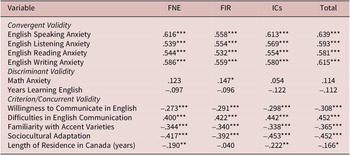
Correlations between the total and subscale scores of the AAS and variables chosen to test for convergent, discriminant, and (concurrent) criterion validity are presented in Table 2. Moderate correlations were identified between accent anxiety and other English-related anxiety variables, specifically those associated with speaking, listening, reading, and writing. A regression analysis, in which the four types of anxiety were the predictor variables and the total accent anxiety score was the criterion variable, yielded a statistically significant result (F4, 176 = 46.2, R2 = .512, p < .001). Consistent with the hypothesis that accent anxiety is most closely linked to speaking anxiety, an examination of the beta values showed that only the speaking anxiety predicted the total accent anxiety once the intercorrelation among anxiety types was controlled (β = .405 and p < .001). The absence of a relation between accent and math anxiety supports the discriminant validity, as does the finding, consistent with Coppinger and Sheridan’s (Reference Coppinger and Sheridan2022) findings, that the length of English learning is not related to accent anxiety. No gender difference was found in any subscale (FNE: t = –.081, df = 200, p = .936, d = –.011; FIR: t = –.917, df = 200, p = .360, d = –.130; ICs: t = –.980, df = 200, p = .328, d = –.139; total: t = –.696, df = 200, p = .487, d = –.099), consistent with previous research showing that gender differences are not significant in FLA (Piniel & Zólyomi, Reference Piniel and Zólyomi2022).
Immigrants: correlations between accent anxiety and validation variables
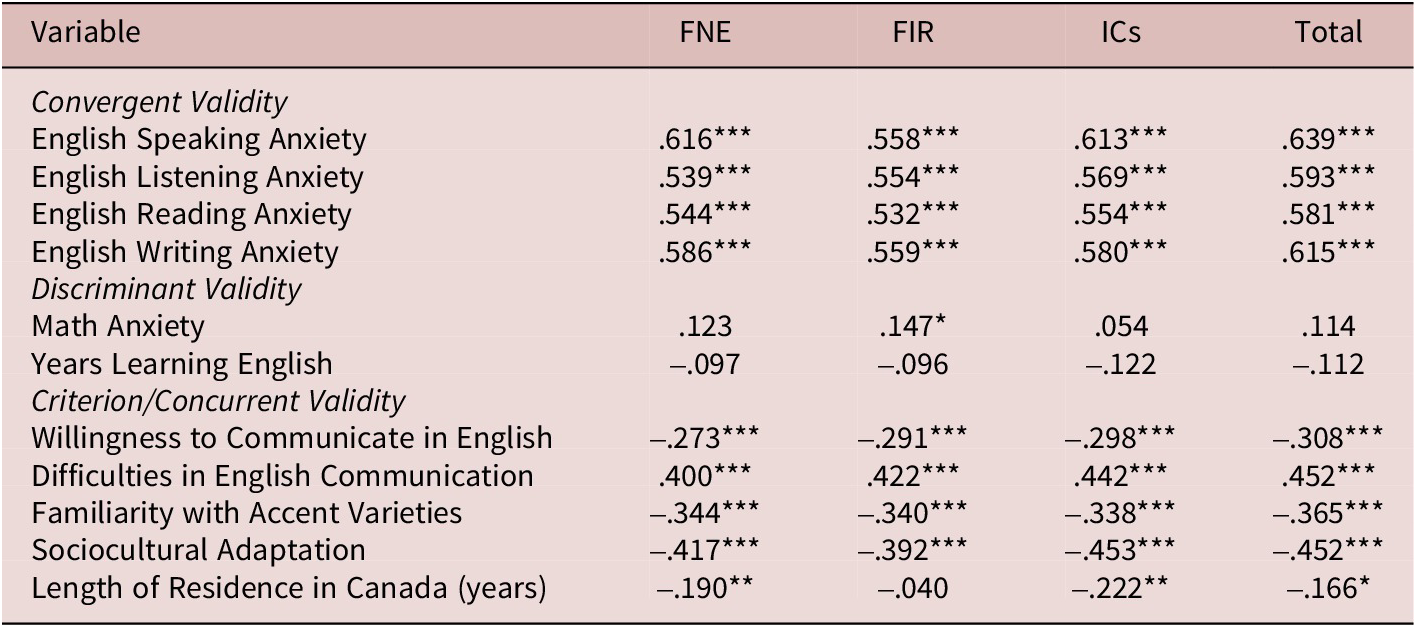
Note: FIR = fear of intergroup rejection; FNE = fear of negative evaluation; ICs = intelligibility concerns. * p < .05; ** p < .01; *** p < .001.
Evidence of criterion validity comes from the significant associations between accent anxiety and the intercultural communication and adaptation variables. Those immigrants who are anxious about their accent find it more difficult and are less willing to engage in English and find it more difficult to adapt to Canada. This anxiety, however, is lower with increased familiarity with a variety of English accents and lessens, modestly, the LOR in Canada but not with the years spent learning English. These absent and/or weak relations are in line with the findings in Scales et al. (Reference Scales, Wennerstrom, Richard and Wu2006) study, showing that some ALSs struggle for an ideal accent regardless of their long LOR in the new society.
Study 2
The purpose of Study 2 is to cross-validate the results of Study 1 by using another sample of ALSs to confirm the factor structure and replicate the scales’ psychometric characteristics. We recruited international students, recognizing that they constitute a substantial segment of ALSs and represent a group that encounters challenges in language learning within English-speaking contexts (Derwing, Reference Derwing2003; Veliz et al., Reference Veliz, College and Veliz-Campos2021).
Method
Participants and procedure
International students who were NSs of languages other than English (N = 153: 57.8% males and 42.2% females) were recruited from introductory psychology courses at a western Canadian university. All of the students were born in a country other than Canada and resided in Canada with a student visa issued from the federal government. Thirty-five languages were represented, of which the top five were Chinese (20.26%), Hindi (15.03%), Bangla (5.88%), Bengali (5.23%), and Gujarati (1.96%). The age of participants ranged from 17 to 26 years (M = 20.1 and SD = 1.80). The mean LOR in Canada was 3.11 years (SD = 1.97).
The data were collected online using the Qualtrics survey platform during a group testing session. Prior to the start of the survey, participants filled out consent forms and were provided with study procedures. All participants completed a questionnaire that took them an average of 30 min. For their collaboration, these students receive partial course credit. This research project was reviewed by the institutional ethics review board at the university.
Materials
The materials included in Study 2 are the same as the ones used in Study 1.
Results and discussion
Confirmatory factor analysis
A CFA was conducted on the refined 12-item AAS, as informed by the EFA results in Study 1. The model fit was assessed using several global fit indices: the χ2 test, root mean square error of approximation (RMSEA), standardized root mean residual (SRMR), comparative fit index (CFI), and Tucker–Lewis index (TLI). As depicted in Model 1 and 2 in Figure 1, we began by examining the AAS’s internal structure, comparing a 1-factor model and a first order 3-factor model. The 1-factor model demonstrated inadequate fit: χ2(54) = 336, p < .001, RMSEA = .184, 90% CI [0.165, 0.203], SRMR = .077, CFI = .818, and TLI = .777. In contrast, the first order 3-factor model exhibited a better but marginally acceptable fit: χ2(51) = 133, p < .001, RMSEA = .102, 90% CI [0.081, 0.124], SRMR = .035, CFI = .947, and TLI = .931. We then revised the model by allowing item residual covariances according to the modification indices: FNE1 with FNE2 and FNE4 with FNE5. The revised 3-factor model showed good fit to the data: χ2(49) = 83.1, p = .002, RMSEA = .067, 90% CI [0.041, 0.092], SRMR = .030, CFI = .978, and TLI = .970 (see Figure 1, Model 3).
CFA model comparisons.

Because the factor intercorrelations of this modified model ranged from .70 to .90, indicating possible issues with discriminant validity with a cutoff of .7 (Dormann et al., Reference Dormann, Elith, Bacher, Buchmann, Carl and Carré2013), we tested a 2-factor model in which we integrated the FNE and IC factors. However, the 2-factor model displayed poorer model fit: χ2(53) = 188, p < .001, RMSEA = .129, 90% CI [0.109, 0.149], SRMR = .046, CFI = .913, and TLI = .891 (see Figure 1, Model 4). The fit indices were still worse than the 3-factor model after allowing residual covariances: χ2(51) = 113, p < .001, RMSEA = .089, 90% CI [0.067, 0.111], SRMR = .047, CFI = .960, and TLI = .948. Therefore, based on comparisons between the model fit, the 2-factor model solution was rejected.
The observation of strong intercorrelations between factors prompted consideration of a higher order factor to account for the shared variance among first order factors. Consequently, the hierarchical 3-factor model, incorporating 3 first order factors and a higher order factor representing general accent anxiety, was selected as the optimal model. The fit indices for this final model demonstrated a favorable fit to the data: χ2(49) = 83.1, p = .002, RMSEA = .067, 90% CI [0.041, 0.092], SRMR = .030, CFI = .978, and TLI = .970.
Reliability analyses
The total scale exhibited high internal consistency (Cronbach α = .948). Similarly, the subscales showed strong internal consistency, with Cronbach α = .909, .894, and .917 for FNE, FIR, and ICs, respectively.
Validity analyses
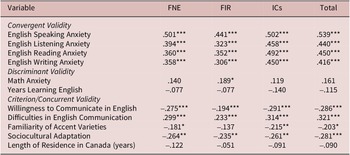
As presented in Table 3, the pattern of correlations mainly replicated that of Study 1. Accent anxiety was correlated with anxiety across speaking, listening, writing, and reading domains, and a standard regression analysis in which anxiety across these four domains predicted accent anxiety was statistically significant (F4, 134 = 16.6, R2 = .331, and p < .001). The beta values showed that only speaking anxiety predicted the total accent anxiety score (β = .443 and p < .001). As hypothesized, neither math anxiety nor the length of learning English was consistently associated with accent anxiety. Furthermore, significant associations in the expected directions between accent anxiety and WTC in English, difficulties in daily English communication, and sociocultural adaptation, further attesting to the criterion validity of the AAS.
International students: correlations between accent anxiety and validation variables
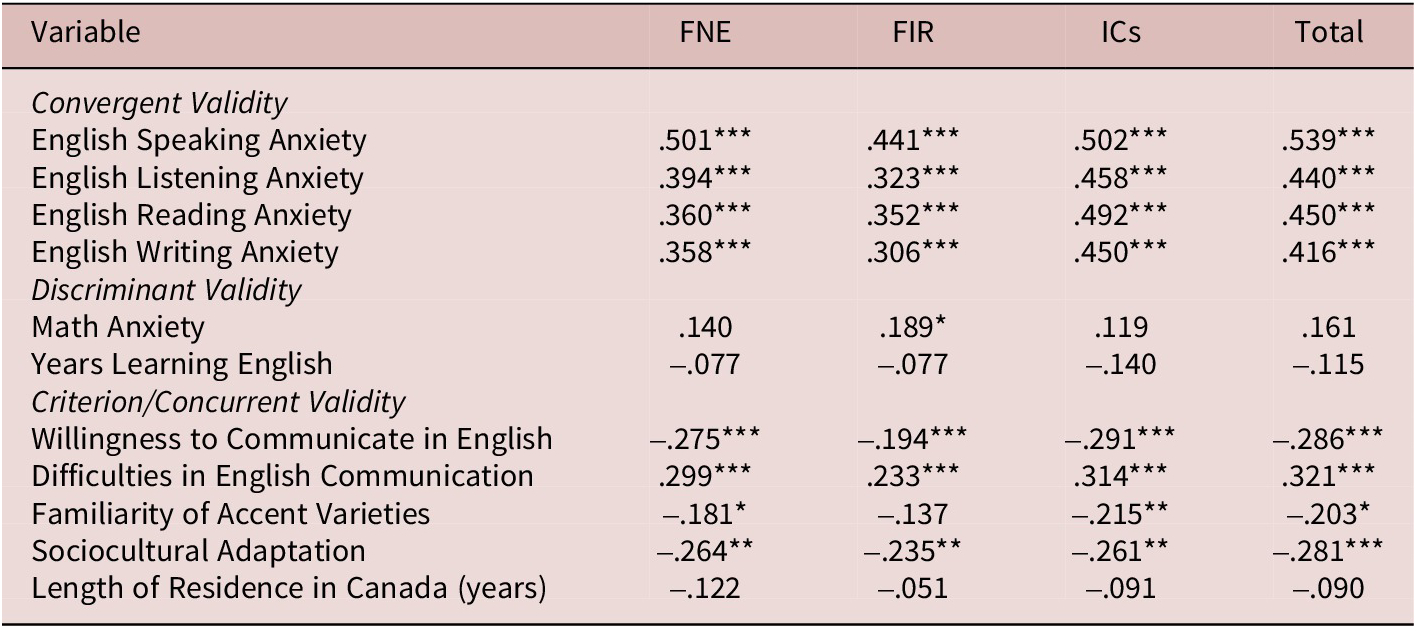
Note: FIR = fear of intergroup rejection; FNE = fear of negative evaluation; ICs = intelligibility concerns. * p < .05; ** p < .01; *** p < .001.
A few minor inconsistencies with Study 1 were detected. First, the sex difference was marginally significant for FNE (t = 2.127, df = 150, p = .035, and d = .349) and FIR (t = 2.038, df = 148, p = .043, and d = .336) but not ICs (t = .997, df = 150, p = .320, and d = .164) and the total score (t = 1.830, df = 146, p = .069, d = .304). The participants’ LOR was not significantly correlated with the total accent anxiety score nor the subscale scores. Greater familiarity with accent varieties was linked with less FNE, ICs, and the total score but not associated with the FIR subscale. These minor differences may be due to differences across the two samples due to different sample sizes (i.e., differential power) or sample characteristics. The effect sizes, however, are not sufficiently substantive to warrant extensive interpretation, particularly given the inconsistencies across the two studies.
Study 3
Study 3 extended Studies 1 and 2 by examining relations between the AAS with a broader range of language and communication and intercultural relations variables. Additionally, this study evaluated the temporal stability of the AAS by examining its test-retest reliability.
Method
Participants and procedure
International students (N = 118: 52.5% males, 46.7% females, and 0.85% other) from introductory psychology courses at a western Canadian university participated in an online questionnaire survey, as described in Studies 1 and 2. Their ages ranged from 15 to 25 years (M = 19.344 and SD = 1.53). All the participants were born outside of Canada and were residing in Canada with a government-issued student visa, and their average LOR in Canada was 1.44 years (SD = 1.56). None of the participants spoke English as L1; 40 different first languages were reported, of which the top three were Chinese (includes Mandarin and Cantonese; 17.50%), Hindi (14.17%), and Tamil (5.83%). The participants typically started to learn English at 5.77 years of age (SD = 2.98), and their average length of time spent in formal English courses was 11.45 years (SD = 3.53).
Materials
Accent anxiety. Accent anxiety was assessed with the same 12-item instrument described in Study 2. The Cronbach α indices of internal consistency were excellent (total: .946, FNE: .917, FIR: .883, and ICs: .906).
Language aptitude. Language aptitude was assessed by Meara’s (Reference Meara2005; Meara & Rogers, Reference Meara and Rogers2019) measurement of the ability to learn novel vocabulary (Language Learning Aptitude Measurement in Adults [LLAMA] B), which is a subtest of their language aptitude battery. This test requires participants to learn novel words that are native language–neutral. Due to time constraints, the full LLAMA inventory could not be included, so the LLAMA B was selected because it demonstrates the strongest convergence with other LLAMA measures (Bokander & Bylund, Reference Bokander and Bylund2020).
Perceived personal discrimination. Four items, adapted from Taylor, Wright, Moghaddam and Lalonde (Reference Taylor, Wright, Moghaddam and Lalonde1990) measure of personal discrimination, assessed participants’ experience of discrimination across four domains, including language skills, racial characteristics, religious faith, and gender (e.g., “To what extent have you experienced discrimination by Canadians due to language characteristics?”). For each of these domains, participants rated the frequency of discrimination they perceived that was directed to themselves (1 = never experienced and 6 = always experience; α = .909).
English contact frequency. English contact frequency was measured by asking, “During the past year, how much contact have you had with English Canadians in the following situations?” under three different situations: “at school,” “in public (e.g., with salesclerks),” and “while traveling.” The questions were answered on an 8-point Likert scale ranging from “no contact” to “very frequent contact,” representing participants’ daily life English contact frequency.
Can-do list. Participants rated their self-perceived English competence on 26 items from Clark’s (Reference Clark and Barrows1981) can-do list. The four subcategories include listening (α = .888), speaking (α = .815), reading (α = .759), and writing (α = .859) (e.g., “understand movies without subtitles”, “count to 10”, “read popular novels without using a dictionary”, and “fill out a job application form requiring information about your interests and qualifications”). Each item was measured using a 5-point scale ranging from 1 (could not do it at all) to 4 (very easily).
Self-esteem. The Rosenberg Self-Esteem Scale (Rosenberg, Reference Rosenberg1965) was used for assessing participants’ self-esteem. This scale is an extensively validated measure of self-esteem (Schmitt & Allik, Reference Schmitt and Allik2005), comprising 10 items that evaluate global self-worth by measuring both positive and negative feelings about the self. Each item is answered on a 4-point Likert scale ranging from “strongly agree” to “strongly disagree,” facilitating the quantification of self-esteem levels (α = .825).
Results and discussion
Validity analyses
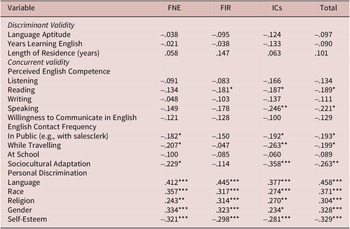
As shown in Table 4, correlational analyses provided additional evidence of the AAS’s validity. With regard to discriminant validity, there were no significant correlations between the AAS total and subscale scores and participants’ language aptitude, consistent with the distinction between cognitive and emotional constructs. As was found previously with international students in Study 2, neither the years spent learning English nor the years living in Canada predicted the accent anxiety scores. There was also no significant difference in accent anxiety across genders (t = .424, df = 115, p = .673, and d = .079).
International students: correlations between accent anxiety and validation variables
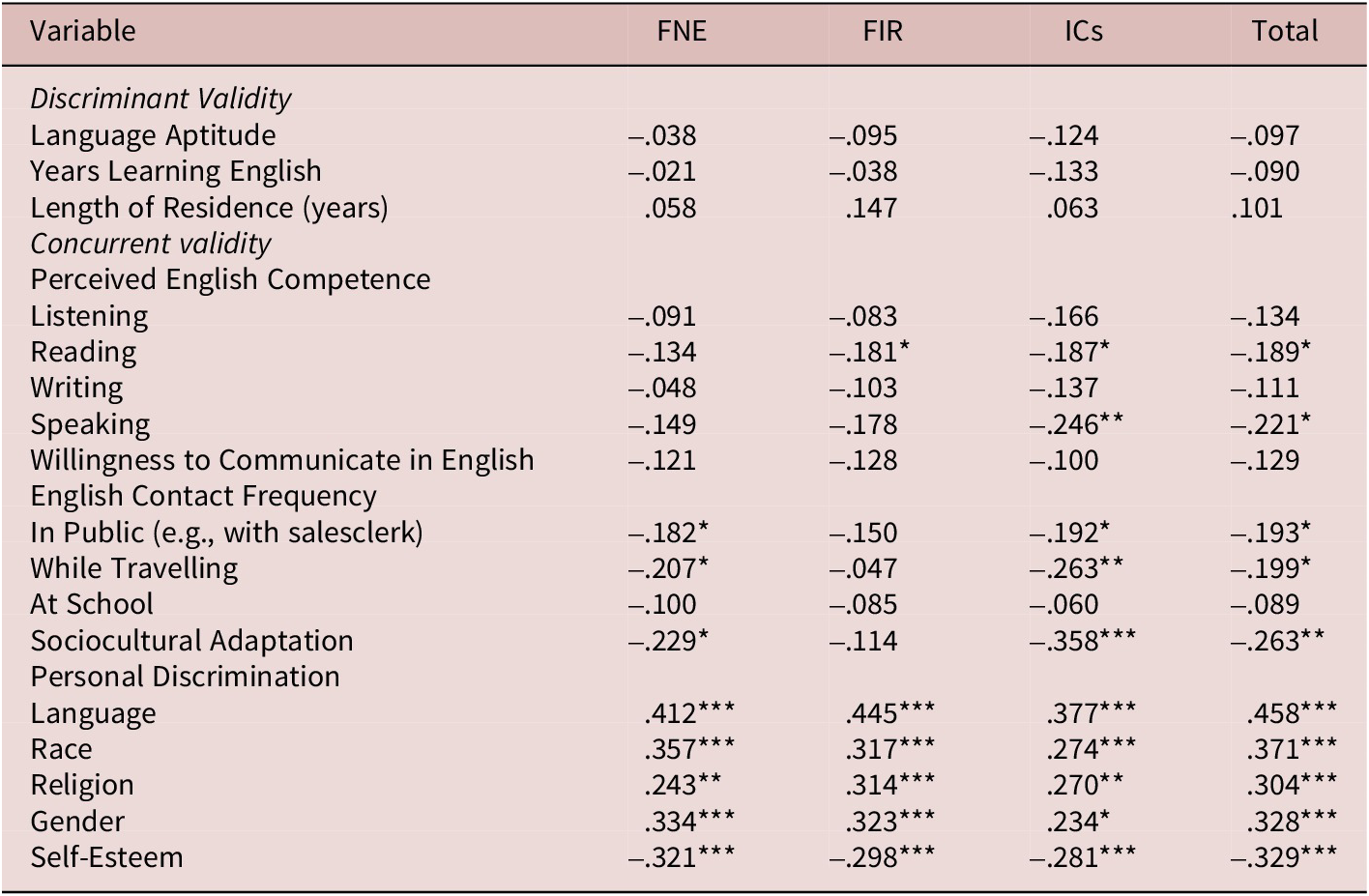
Note: FIR = fear of intergroup rejection; FNE = fear of negative evaluation; ICs = intelligibility concerns. * p < .05; ** p < .01; *** p < .001.
Concerning criterion validity, the AAS total and subscale scores were negatively correlated with self-perceptions of English reading and speaking competence but not with listening or writing competence. Contrary to our expectations and inconsistent with Studies 1 and 2, the AAS was not associated with WTC, although the values trended in the expected direction.
The AAS scores were generally related as expected to aspects of intercultural relations. Consistent with the AAS’s focus on situations outside the classroom, accent anxiety was negatively correlated with the frequency of contact with English speakers in public situations and while traveling but unrelated to contact in the school setting. All AAS subscales were related to sociocultural adaptation, indicating that international students with less accent anxiety also experienced better adaptation to Canada. Although the AAS total and subscale scores were correlated with discrimination across all four domains, they were most strongly correlated with language discrimination. A statistically significant standard regression analysis (F4, 112 = 8.58, R2 = .512, and p < .001) showed that only language discrimination predicted the total accent anxiety (β = .371 and p < .01), consistent with observations that those with nonstandard accents may encounter discrimination due to their speech style (e.g., Derwing & Munro, Reference Derwing and Munro2009; Gluszek & Dovidio, Reference Gluszek and Dovidio2010). Lastly, greater accent anxiety was associated with lower self-esteem, in line with other studies that show a robust association between anxiety and self-esteem (Sowislo & Orth, Reference Sowislo and Orth2013).
Test-retest reliability
A subsample of the participants (N = 73: 37.14% males, 58.57% females, and 4.29% others) were invited to complete the AAS a second time, 21 days after the first testing session. No significant demographic differences (e.g., age started learning English and length of learning English) were found between the returning sample and the original sample, except that a larger proportion of females took part in the second testing session: χ2(2) = 13.23 and p < 0.01. Similar to the first testing session, the Cronbach α indices of internal consistency were excellent (Total: .961, FNE: .931, FIR: .921, and ICs: .922).
As shown in Table 5, correlational analyses assessing the test-retest reliability over the 21-day period demonstrated moderate temporal consistency (Guttman, Reference Guttman1945). The total score and the three subscale scores yielded test-retest reliability indices of a similar magnitude. Paired sample t tests indicated that FIR is the only subscale for which the group mean level significantly differed across the two time points, such that the fear FIR because of one’s accent slightly increased over time. This difference might suggest that FIR could be influenced by individuals’ daily social interaction experiences and thus has less stability compared with the other two aspects of accent anxiety. In contrast, FNE and IC may be influenced by more stable personal traits or skills.
Test-retest means, standard deviations, and coefficients and intraclass correlation coefficients for the subscale and total scale scores of the Accent Anxiety Scale
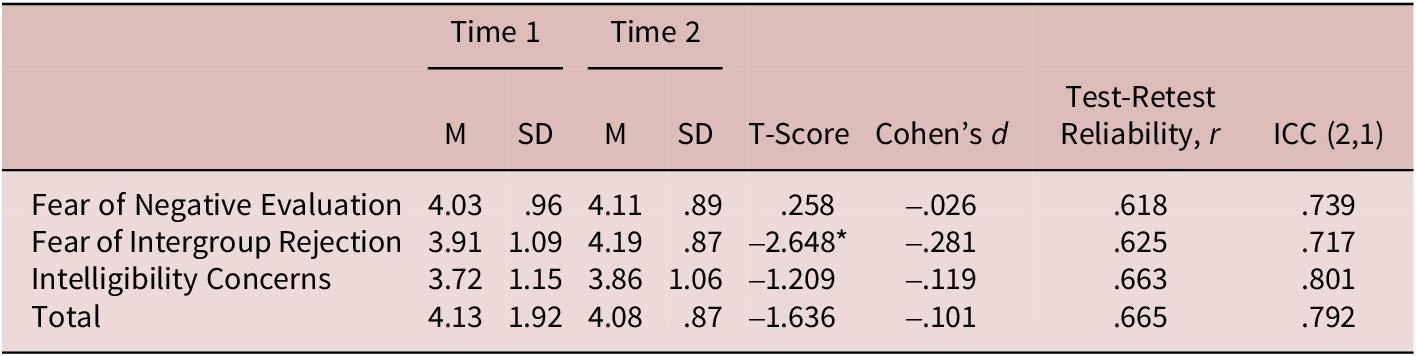
Note: * p < .05; ** p < .01; *** p < .001.
In addition, we employed the intraclass correlation coefficient (ICC) as another measure of temporal stability across the two time points. Given the self-reported nature of our measures, we selected the ICC (2,1) model (Koo & Li, Reference Koo and Li2016), which is appropriate for single measures with fixed raters. The results indicated a high degree of reliability for the total score and all subscales. In particular, the ICC for the total score and IC demonstrated a substantial degree of consistency (cutoff > .75 [Koo & Li, Reference Koo and Li2016]).
General discussion
Within the domain of accent-focused research on foreign language pronunciation, it is important to understand ALSs’ concerns about their own accents because they may render individuals vulnerable to uncomfortable communication experiences, undermine effective and appropriate intercultural communication, and impact ALSs’ well-being. By drawing on the concerns identified in previous studies, this study articulated a typology of concerns that undergird the anxiety experienced in everyday, nonacademic situations and presented an instrument to gauge these worries. The AAS, which conceptualizes accent anxiety as a negative affective response stemming from actual, perceived, or imagined challenges in using another language in nonacademic situations, comprises three dimensions: FNE, FIR, and ICs. The findings demonstrate the robust structural validity and internal consistency of the AAS’s subscales, and cross-validation analyses across three samples of ALSs bolsters the scale’s generalizability to other ALS populations, particularly speakers of English as an additional language.
The AAS’s strong convergence with established measures of language-related anxiety and its discernible differentiation from variables that are theoretically and/or empirically unrelated (e.g., math anxiety, length of English learning, and gender) validate the scale’s capacity to assess the distinct construct of accent anxiety. The AAS’s associations with other language and communication variables that have elsewhere been associated with language anxiety (speaking competence, WTC, etc.), with intercultural relations variables (e.g., frequency of intercultural contact outside the classroom and experiences of [language] prejudice), and with adaptation and well-being measures (e.g., sociocultural adaptation and self-esteem) provide further evidence of its criterion-related validity. These correlations suggest that accent anxiety might impede ALSs’ communicative efficacy and appropriateness, contribute to less frequent but more negative interactions in the target language, and compromise their psychosocial well-being. This finding coincides with recent research indicating a bias against accented speech. While earlier studies predominantly examined the link between accented speech and discrimination from the evaluations of L1 speakers (e.g., Isbell & Crowther, Reference Isbell and Crowther2023; Tan et al., Reference Tan, Jospa, Mohd-Said and Awang2021), our results provide a much-needed perspective of ALSs.
Another noteworthy observation was the somewhat counterintuitive lack of association between accent anxiety and certain demographic characteristics. First, although women often report more general anxiety than men (Farhane-Medina, Luque, Tabernero & Castillo-Mayén, Reference Farhane-Medina, Luque, Tabernero and Castillo-Mayén2022), a recent meta-analysis suggests gender differences in language anxiety are generally insignificant (Piniel & Zólyomi, Reference Piniel and Zólyomi2022). The inconsistent findings across these three studies further underscore the weakness of this effect. Second, although it might be expected that ALSs who have had more language education, started their language education earlier, or spent a longer time in a country where the language was spoken would have less accent anxiety, such associations were generally not found across the three studies. These null findings are consistent with Scales et al.’s (Reference Scales, Wennerstrom, Richard and Wu2006) observation that some ALSs struggle for an ideal accent regardless of how long they had been using the language of the host society.
Third, we observed a link between the frequency of English use in personal life situations and heightened accent anxiety. This trend was notably absent in academic settings, likely because our participant cohort, comprising university students, engages in compulsory English communication in these contexts. This absence of correlation in educational environments suggests that the mandatory nature of English use in such settings may not significantly impact accent anxiety. Future investigations could benefit from examining a broader ALS population and exploring different English contact situations.
Additionally, our findings indicated that while participants’ self-perceived listening and writing skills in English were not significantly associated with accent anxiety, their reading and speaking skills exhibited a notable correlation. Our measure of English reading skills was operationalized as reading in daily life settings, which is related to ALSs’ oral communication ability. This pattern underscores the potential impact of accent anxiety on the communicative proficiency of ALSs, particularly in aspects of English production. The implication here is profound: reducing accent anxiety could play a crucial role in mitigating the challenges ALSs face in English communication, especially in productive capacities. Moreover, challenges in daily English communication correlate positively with all facets of accent anxiety, which underscores the influence of prior adverse experiences in molding ALSs’ accent anxiety. These observations contrast with Coppinger and Sheridan’s (Reference Coppinger and Sheridan2022) perspective, which posits that accent anxiety primarily originates from imagined negative feedback among classroom English learners. Such a discrepancy might underscore the nuanced differences in analyzing accent anxiety within classroom contexts versus outside-of-classroom contexts. Finally, a negative correlation between familiarity with the variety of accents and accent anxiety may suggest that more awareness of accent variations could reduce ALSs’ apprehensions about being salient and nonstandard. This observation aligns with previous research, which posits that exposure to varied accents mitigates ALSs’ adverse perceptions of nonstandard English accents (Cai et al., Reference Cai, Fang, Sun and Jiang2022). Such insights underscore questions about the sole representation of English legitimacy via the NS standard accent. Collectively, these correlations support the internal validity of the AAS.
The AAS unveils the multidimensional nature of ALSs’ accent anxiety, which may originate from previous linguistic practice and intergroup interactions. From a pedagogical perspective, these findings offer directions to lessen accent anxiety, suggesting refined approaches in language instruction for ALSs. Prior research has called for a shift in pronunciation teaching for ALSs in terms of focus and desired outcomes. For example, it might be practical to discourage unnecessary accent changes for intelligible speakers (Derwing, Reference Derwing2003) and to prioritize the specific needs of ALS learners in terms of accent improvement (McCrocklin & Link, Reference McCrocklin and Link2016). Also, the concern about negative evaluation suggests that ALSs might overly worry about nonstandard pronunciation. This possibility aligns with past studies that suggest ALSs’ concerns might arise from striving for “perfect” English speech (Scales et al., Reference Scales, Wennerstrom, Richard and Wu2006). Therefore, incorporating various English accents in language courses, rather than a sole emphasis on NS standard forms, might alleviate some concerns. On a sociocultural level, our findings highlight the close connection between accent anxiety and perceptions of ethnic or group membership. In multicultural contexts, promoting inclusivity may help reduce ALSs’ concerns related to group identification and potential exclusion. Beyond pedagogical strategies, fostering a less discriminatory cultural environment may benefit ALSs’ communicative experiences.
Limitations and future directions
This initial examination of accent anxiety beyond the classroom has several limitations that point to directions for future research. Importantly, the predictive validity of the AAS warrants further examination through longitudinal studies delving into both the predictors and outcomes of accent anxiety. In the present study, it was hypothesized that language and communication variables, such as WTC and English competence, and intercultural relations variables, such as frequency of contact with English speakers, perceived discrimination, and sociocultural adaptation, could be important proximal and distal correlates of accent anxiety. The concurrent assessment, however, did not allow a determination of which variables might be causal antecedents or consequences of accent anxiety (or of any more complex models involving mediated, moderated, reciprocal and/or transactional relations), which would be essential knowledge for further theory development and practical application. Additionally, broadening the scope beyond the variables examined in the present study, future investigations might consider whether and how individual differences (e.g., personality traits and motivational orientations) and educational programs (e.g., pronunciation training) affect accent anxiety, and how accent anxiety predicts diverse outcomes, including oral proficiency and pronunciation comprehensibility and intelligibility appraised through expert or lay assessments and/or standardized tests.
Second, while the current study offers insights into ALSs’ accent anxiety in English in Canada, the experience of ALSs in specific ethnolinguistic contexts should be examined. For instance, within and outside Anglosphere countries, different ethnolinguistic groups might emphasize different concerns regarding their accent, depending on their socio-structural status relative to other groups in the society. Such comparisons could offer a deeper understanding of the generalizability of the typology of anxiety concerns beyond the Canadian context that is assessed by the AAS. Third, to enhance construct validity and address the complex nature of accent anxiety, interpretive research utilizing methods to obtain qualitative data could more deeply examine the concerns that ALSs have regarding their accents. In addition, this study employed different scales in its measurements (e.g., a 6-point Likert scale), with some ranging from a 4-point scale (self-esteem) to an 8-point Likert scale (English contact frequency). Future research designs could address this inconsistency.
Conclusion
Accent anxiety can be a formidable obstacle in ALSs’ acquisition and utilization of a new language. The current research presented a conceptual framework of the sources of ALSs’ accent anxiety and tested the psychometric properties of an instrument that can be used to investigate these sources. The analyses demonstrate robust support for the AAS’ psychometric properties and lay the groundwork for an understanding why ALSs might have anxieties about their accent when using their new language in everyday life. This framework and measurement tool can contribute to the ongoing theoretical and empirical knowledge regarding emotions, oral proficiency, and multilingualism and potentially help create more inclusive learning environments for ALSs.
Acknowledgments
This research was completed in partial fulfillment of the requirements for the first author’s master of science degree at the University of Alberta, which was conducted under the supervision of the second author. We thank the students who assisted with data collection, including Tianzi Dou, Zhengqi Zeng, and Pinren Lu. We also thank the thesis examiners, Chris Westbury, Jennifer Foote, and Jean-Marc Dewaele, for their critical insights and valuable feedback, which greatly improved this manuscript.
Competing interest
The author declares that the research was conducted in the absence of any commercial or financial relationships that could be a penitential conflict of interest. We disclose that Dr. Kimberly Noels, the second author of this manuscript, serves as the graduate supervisor of Qingyao Xue, the first author, at University of Alberta.
Appendix
Study 1: descriptives and correlation matrix.

Note: AA = accent anxiety; FIR = fear of intergroup rejection; FNE = fear of negative evaluation; ICs = intelligibility concerns. * p < .05; ** p < .01; *** p < .001.
Study 2: descriptives and correlation matrix.
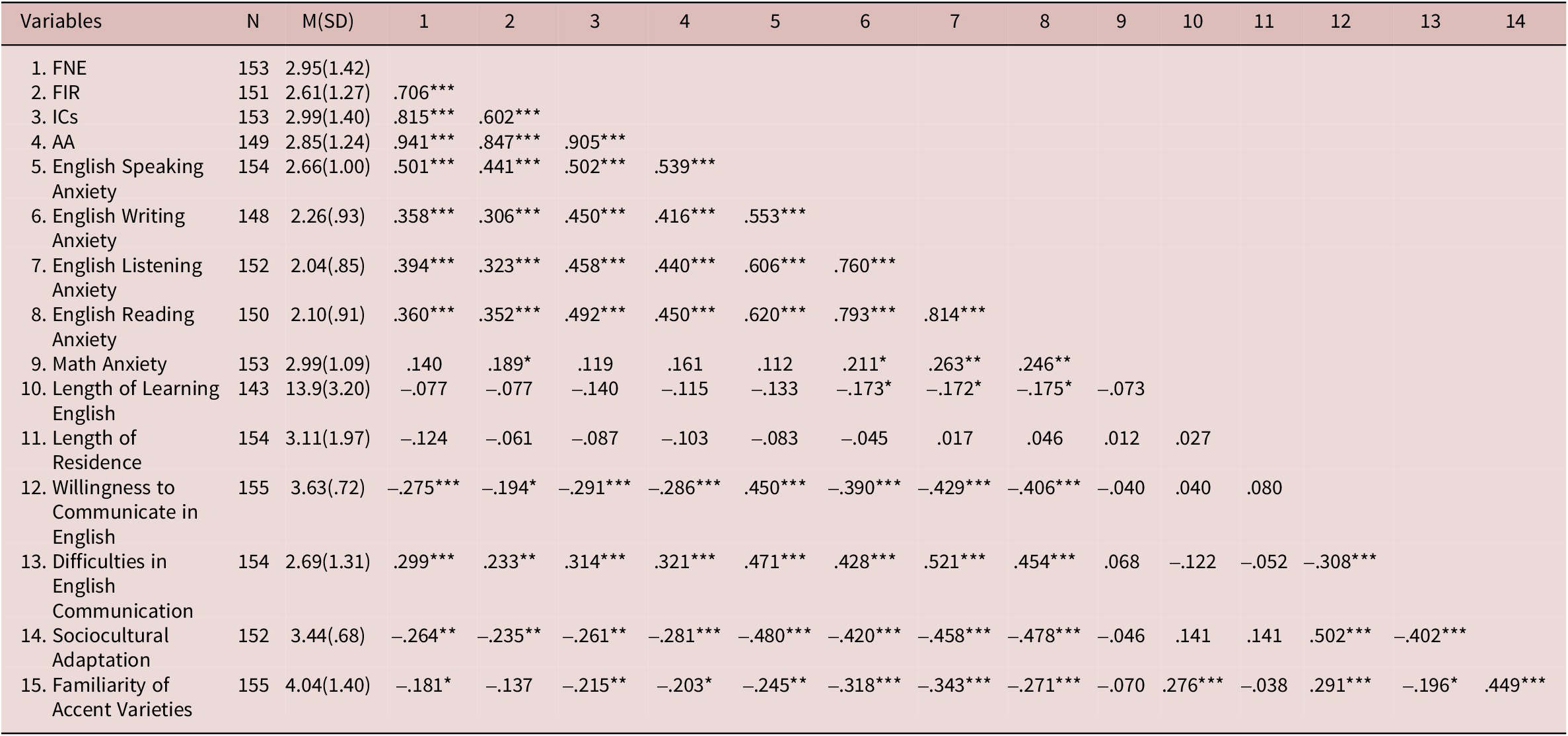
Note: AA = accent anxiety; FIR = fear of intergroup rejection; FNE = fear of negative evaluation; ICs = intelligibility concerns. * p < .05; ** p < .01; *** p < .001.
Study 3: descriptives and correlation matrix.

Note: AA = accent anxiety; FIR = fear of intergroup rejection; FNE = fear of negative evaluation; ICs = intelligibility concerns. * p < .05; ** p < .01; *** p < .001.
Appendix: Accent anxiety—the original scale
1 = strongly disagree; 6 = strongly agree; * = reversely coded items
-
(1) Fear of negative evaluation
-
a) I am worried what others might think of my English proficiency when they hear my accent.
-
b) I am worried whether others see me as a competent person when they hear my English accent.
-
c) I worry about making mistakes in English pronunciation.
-
d) I fear people making fun of my English accent.
-
e) I fear that people may find my English accent weird or funny.
-
f) I am afraid of people criticizing my English accent.
-
g) *I am afraid that people will find fault with my accent.
-
h) I am worried about embarrassing myself with my English accent.
-
-
(2) Fear of intergroup rejection
-
a) I worry that others might identify my ethnic background when they hear my English accent.
-
b) I am concerned that people will think I am a foreigner when they hear my accented English.
-
c) It bothers me that my English accent identifies me as an outsider.
-
d) I worry people will know I am not a native English speaker once they hear my accent.
-
e) It bothers me that my ethnicity is indicated by my accent.
-
f) *I am afraid people from other ethnic groups will not approve of my accent.
-
-
(3) Intelligibility concerns
-
a) I worry people don’t understand me because of my accent.
-
b) I fear my accent is hard to comprehend.
-
c) I feel stressed that my accent makes my spoken English confusing.
-
d) I fear that people misunderstand my spoken English due to accent.
-
e) I worry that my accent causes misunderstandings.
-
f) I am confident that my English pronunciation clearly conveys my ideas.
-




 Open access

