


The city of Meninx in south-eastern Djerba rose to become the main centre of the entire island by the Roman imperial period at the very latest, and it was henceforth counted as one of the largest settlements in Roman North Africa (Hobson Reference Heilmeyer2020, 297–313). According to Pliny the Elder (Naturalis Historia, 9.127), the city's wealth was based on its blooming purple dyeing industry. Alongside this, the city benefitted from its fertile hinterland (Pseudo-Scylax, Periplous, 110) and its ideal topographic location with a large, well-protected harbour on the edge of the Sahara between Carthage and Lepcis Magna (Fiederling et al. Reference Fiederling, Pflederer, Gadhoum, Ritter and Ben Tahar2022).
In contrast to numerous other cities in northern Tunisia or Tripolitania, Meninx was long overlooked in the scholarly debate, which was due to the comparatively poor state of preservation of its ruins. The city's setting directly on the shore and its permanent abandonment from the seventh century AD onwards made the site an ideal target for post-antique stone and marble robbing. Today, apart from a few walls visible beneath the sand, the only evidence preserved above ground level of the former urban centre are countless purple sea snail shells (murex), pottery sherds, and some scattered architectural elements.
For these reasons, the ancient site was almost completely ignored in the literature with only a few exceptions (for example, Duval Reference Duval1942). It was left in a sort of limbo until a first archaeological survey project was undertaken on the entire island of Djerba from 1996 to 2000, led by Ali Drine, Elizabeth Fentress, and Renata Holod, which included geophysical surveying and some limited excavations at the site of Meninx (Fentress et al. Reference Fentress, Drine and Holod2009). In 2017 and 2018, there followed a new project of large-scale archaeological excavations led by Stefan Ritter and Sami Ben Tahar, which has provided an entirely new basis for our knowledge and understanding of the ancient city. Alongside other forms of investigations (including geophysical and other scientific analyses), the opening of 12 trenches and the recording of their archaeological stratigraphy have cast new light on the city and its surrounding region. Combined with the surviving literary sources (Agus and Zucca Reference Agus, Zucca, Khanoussi, Ruggeri and Vismara2002; Fentress et al. Reference Fentress, Drine and Holod2009, 37–43), this has allowed researchers to piece together and sketch out a broad history of the city from the fourth century BC to the seventh century AD (Ritter and Ben Tahar Reference Plattner2022).
Survey of architectural elements (2017–18)
Before the second century AD, the architecture of Meninx was characterized by the use of a local, highly calcareous and soft limestone, which was sourced directly on the island (Fentress et al. Reference Fentress, Drine and Holod2009, 201–05; Beck Reference Beck, Ritter and Ben Tahar2022) and was easily subject to weathering. Therefore, the surface of these pre-second-century architectural elements is usually completely corroded, and their original form can no longer be recognized. Alongside these, however, an exceptional series of buildings was constructed during the second century AD in the centre of Meninx, for which marble was specifically brought onto the island. The architectural components of these buildings, which today lie scattered across the city area, have proven far more weather-resistant than those produced in the local limestone, and it is still possible to recognize their original function (for example, as a base or capital) and assess their stylistic features.
Some of these components had received particular attention in the work of Naidé Ferchiou (Reference Ferchiou1983; Reference Ferchiou1986; see also Baratte Reference Baratte1995, 83–94). Yet it was Thomas J. Morton who first undertook a systematic examination of over 100 architectural elements during the late 1990s and early 2000s: the location of these elements in the centre of Meninx suggested the presence of an ancient open square or plaza. In his dissertation, completed in 2003, Morton hypothetically assigned some particularly large elements to four different temples, while other pieces were attributed to a forum portico and a basilica (Morton Reference Milella and Mastino2003; see further on this Morton Reference Morton, Khanoussi, Ruggeri and Vismara2008; Reference Morton2009, 134–53, 155–57; Reference Morton, González, Ruggeri, Vismara and Zucca2016, 283–87). Since Morton had not excavated them or undertaken an autoptic recording, these architectural components remained of limited use for any further research.
For this reason, an architectural survey was completed in cooperation with the new German-Tunisian project, with the aim of gaining new insights into the above-ground levels of the buildings constructed in the ancient city. This was achieved using both the remains visible at ground level and the newly excavated architectural components from the ancient city area, as well as the unpublished architectural elements that were discovered at Meninx and are currently stored in the Bordj el Ghazi Mustapha Museum at Houmt Souk. Approximately 150 elements were documented using SfM (Structure from Motion) technique; ca. 40 particularly well-preserved architectural components were documented through sketches, and Vilma Ruppiene examined the material of ca. 50 samples from selected objects. All the architectural elements that were lying at, or just below, ground level were unearthed to bring to light their lower portions and were cleaned up. In this way, new pieces that had not been recorded by Morton were discovered, and the original function and form of these and of the other previously recorded architectural components could be assessed with precision for the first time. Moreover, the ornamentation of many pieces that were still lying below ground level was especially well-preserved, which allowed for a more comprehensive stylistic analysis of these objects. At the end of the excavation and on-site examination, the recorded architectural components were reburied to ensure their continued preservation.
The marble city centre
Morton and others before him had already identified the ancient forum thanks to the particular concentration of marble architectural components and the presence of the only monument recognizable at ground level in the area, a Roman basilica discernible from the column bases remaining in situ (Morton Reference Merlin2002; Reference Milella and Mastino2003, 79–95, 125–48, 201–29; Reference Morton2009, 138–45; Morton and Aït Kaci Reference Morton, Fentress, Drine and Holod2009). The German-Tunisian excavation was able to add further details to the known history of the square, and it also unearthed the foundations of some of the monuments that developed around it (Figure 1). While domestic dwellings dominated this site during the Punic period (Arndt et al. Reference Arndt, Stoeßel, Gabler, Ritter and Ben Tahar2022; Lamare Reference Kovacs, Lipps, Ritter and Ben Tahar2022), the foundations of the square date to the early imperial period, and besides the somewhat low-lying square itself, these include two shrines referred to as the southern temple (1) (Sheldrick Reference Scheithauer2022) and northern temple, as well as porticoes (2) (Arndt et al. Reference Arndt, Stoeßel, Gabler, Ritter and Ben Tahar2022). Alongside these foundations, only a few isolated antefixes and architectural elements of local limestone found around the forum can provide information about the appearance of the architecture of this early period (Lipps Reference Lipps2022, 185 f.; Scheding Reference Russell, Mugnai, Nikolaus and Ray2022).
Meninx, map of city centre showing location of architectural elements in the square and surrounding buildings: (1) ‘southern temple’; (2) portico; (3) basilica (image T. Bitterer).
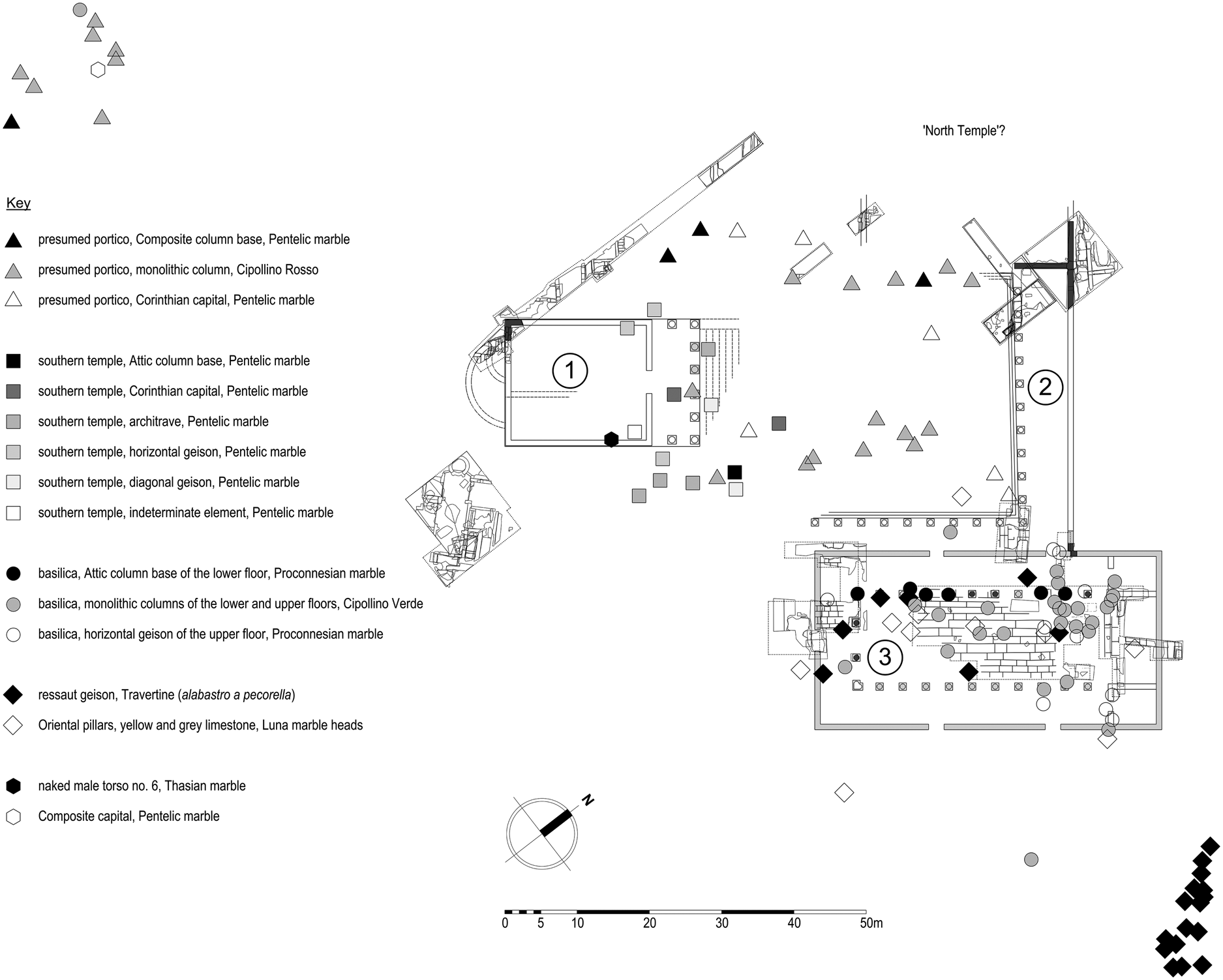
During the second century AD, the foundations reveal a wide-ranging rebuilding of the entire area of the square. On the basis of numerous architectural components and the remains of sculptures scattered around the area, it seems that this rebuilding activity transformed the forum, which was previously characterized by the use of local limestone, into a square filled with gleaming marble ornamentation (see especially Ritter and Ben Tahar Reference Plattner2022, 45–47 with references). These remaining architectural fragments can be assigned to at least three separate monuments, whose placement within the city can be determined with varying degrees of certainty:
(1) From the mass of architectural components found at Meninx, there are 13 pieces worked in Pentelic marble that immediately drew attention, as their large size clearly distinguished them from all the other architectural elements in the city area. The fact that they are all worked in the same material, using the same proportions, and displaying a consistent style of ornamentation and traces of similar carving techniques, suggests they were probably part of the same building. Morton had already recognized the unitarity of these components and assigned them correctly to the shrine which he referred to as the southern temple (Morton Reference Milella and Mastino2003, 98–101, 230–34; Reference Morton2009, 145–47). The size of these architectural components is comparable (among other structures) to the Capitolium at Sabratha (Kenrick Reference Joly and Tomasello1986, 109), the lower order of the Antonine basilica at Carthage (Gros Reference Gabler, Ritter and Ben Tahar1985), and the great temple of Thuburbo Maius (Merlin Reference Merlin1922). In the absence of any excavation of the individual components, only three of which were photographically recorded, Morton was not able to identify with precision the entablature blocks and to propose a hypothetical reconstruction of the building. The new excavation allowed for the identification of these pieces (apart from one block) as: an Attic column base; two fragments of Corinthian capitals; four architraves; and five entablature blocks (three from a horizontal geison, and two from a diagonal geison). Apart from the probable monolithic columns and the frieze, all the components of a full column order are present, and despite the absence of the lost paintwork, they can give a fairly complete idea of the original structure. From this, it is possible to reconstruct a richly decorated Corinthian, probably prostyle, temple (Figure 2) (cf. the more comprehensive discussion in Lipps Reference Lipps2022, 187–91). The only information missing is the exact number of frontal columns, and because of this, the overall dimensions of the complete floorplan are still unclear. Judging by their setting, these building elements may well have belonged to the excavated corner foundation of the temple at the southern end of the forum, which was constructed in the early imperial period and was rebuilt during the first half of the second century AD (Figure 1(1)). The location (see Quinn and Wilson Reference Pensabene2013, 150–67) and discovery of a portrait of Antoninus Pius (Gabler Reference Gabler, Ritter and Ben Tahar2022), as well as a head of Serapis (Kovacs and Lipps Reference Köster2022) in the vicinity, would suggest a sacred context – perhaps a Capitolium or a temple of the imperial cult, and/or the worship of other tutelary gods.
(2) To the north of the proposed ‘southern temple’, 23 fragments of monolithic columns worked in cipollino rosso marble were found scattered around the forum, and Morton connected these to a forum portico (Morton Reference Milella and Mastino2003, 49 f., 75–79, 197–200). On the basis of the associated location where they were found and their identical proportions, these can be probably matched with four composite column bases and seven Corinthian capitals in Pentelic marble, which allows for their hypothetical reconstruction as part of the portico surrounding the square (Figure 3). Morton only saw a selection of the capitals in the immediate vicinity of the basilica, and thus assigned these to the first order of the building (Morton Reference Milella and Mastino2003, 51 f., 211 f., no. 98.16.), while he attributed the composite bases to different temple buildings for which there is no further evidence (Morton Reference Milella and Mastino2003, 103 f.). In the course of our examination, however, more capitals belonging to the same series were discovered, which were found not only in the vicinity of the basilica, but also rather randomly scattered across the entire forum among the red marble columns and the composite bases. Moreover, the material of the bases and capitals (Pentelic marble) differs from that of the other architectural components that can be assigned with certainty to the basilica, for the latter are worked in Proconnesian marble (Lipps Reference Lipps2022, 186 f.; Stoeßel Reference Sheldrick, Ritter and Ben Tahar2022, 117, note 689). The excavated foundation of the portico in the north-east part of the square (Figure 1(2)) might be related to these architectural elements, yet it is important to note that other sectors of the square may also have been enclosed by porticoes.
(3) Alongside these two buildings, a basilica built with a frontal portico in the south-east sector of the square represents a third significant marble structure, dating from the mid-imperial period (Figure 1(3)). This appears to have been an entirely new building, without evidence of any previous construction phases, which was erected abutting the forum at this later date. This is also the only monument within the city centre that can be precisely and securely located and whose components can be recognized without any doubt. Only the column bases are preserved in situ; the rest of the architectural elements belonging to this structure are found scattered between these bases (one column is still in the place where it fell down). The bases were first excavated in 1942 by Paul-Marie Duval but were only later recognized as components of the basilica (Duval Reference Duval1942). In 2018 a part of this building was freed from the surrounding sand, which revealed a rectangular floorplan of a three-aisled basilica. Two rows of 11 columns each stood on the long sides, while four columns were placed along the short, southern side. A slightly elevated floor section in the northern part of the building was perhaps reserved for a tribunal or a similar structure (Stoeßel Reference Schulz and Winnefeld2021, 138 f.) (Figure 4). In 2017 and 2018, the archaeologists were able to record 43 architectural components belonging to the basilica within the excavation site, and three more were found at the Borj el Ghadzi Mustapha Museum. In total, these components comprise 27 fragments of cipollino marble columns, eight bases, as well as 11 entablature blocks of Proconnesian marble, which together attest to the presence of a two-storey structure. Furthermore, numerous smaller fragments of Corinthian capitals probably also belonged to the basilica (Figure 5).

Hypothetical visualization of portico, based on the Corinthian capitals shown on Figures 15 and 16 (image T. Bitterer, after template by J. Lipps).

Reconstruction of floor plan of the basilica (image T. Bitterer, after model by L. Stoeßel).

Reconstruction of cross-section of the basilica (image T. Bitterer, after model by L. Stoeßel).

Foreign architects, artisans and marble at Meninx
A detailed analysis of the three above-mentioned structures, as well as their individual components, is not only able to provide insights into the actual building processes of the respective monuments, but it may also enrich and articulate the ongoing debate over North African architecture of the mid-imperial period. This architecture is characterized by the novel and extensive use of imported marble and has thus far been considered as a conceptual hybrid of various architectural traditions (see especially Pensabene Reference Morton, Aït Kaci, Fentress, Drine and Holod1986; Reference Pensabene1989; Reference Pensabene and Giardina1991).
At this point, attention should be drawn to the strikingly close similarity of the syntax, motifs, and execution of the ornamentation of the southern temple (1) with the pieces from the frigidarium of the Antonine Baths at Carthage. Of the two slightly differing capital types used at Carthage, it is the so-called series ‘à structure simplifiée’ (Bessière Reference Bessière2006, 687–89; Scheding Reference Rohmann2019, 140–43) that displays particular similarities with the pieces from Meninx. This comparability is not limited to the syntax and choice of motifs of the individual elements, but it also extends to the execution of details, as can be observed in the finely carved features such as the preserved central leaf or the cauliculus (Figure 6 and Figure 7). The soffits of the architraves from both Carthage and Meninx are framed by the same type of egg-and-dart motif, with a semi-circular indentation for the fleuron of the capital underneath, showing a very similar decorative pattern on the scrollworks in terms of craftsmanship and execution (Figure 8 and Figure 9). The same can be said for the ornamentation of the remarkably richly decorated geisa from both cities. On these pieces, we can observe how four almost identically executed decorative bands lead to the consoles in the upper register, featuring respectively from bottom to top: a leaf-and-dart kymation (Scherenkymation) with an accentuated eyelet; a row of rectangular dentils; an astragal decorated with elongated oval beads and rhomboid reels; and an egg-and-dart motif with nearly open shells (Figure 10 and Figure 11) (Mattern Reference Lipps, Ritter and Ben Tahar2001, 43, type 1c; 51, type 4; 56–58, 64–68, type 6). Furthermore, it is worth drawing attention to the same finely drilled groove used to frame the lower leaf-and-dart kymation in both pieces from Carthage and Meninx. In addition, the techniques and types of tools, as well as the way they were used on the stone blocks, the lifting holes, and clamping techniques, all correspond precisely in their number, placement, size, and execution (cf. Lézine Reference Leon1968, 37–61; Reference Lézine1969). These analogous technical features suggest that the southern temple of Meninx – to our knowledge one of the earliest marble structures on the island of Djerba – may in fact have been executed by the same groups of stonemasons who were responsible for the Antonine Baths at Carthage. The idea of ‘itinerant’ stonemasons working along the Tunisian coast, as already proposed by Naidé Ferchiou in 1983, is also suggested by the hair locks of a monumental head of Serapis found at Meninx in 2018. The execution of these locks is so similar to those of an analogous monumental head of the same god from Carthage, that it strongly suggests these were the work of the same sculptor, who was active in both cities (Kovacs and Lipps Reference Köster2022). Yet there are qualitative differences between the architectural elements from Meninx and those from Carthage, which make us recognize the temple on Djerba as the more elaborate type of building. This becomes clear, among other things, when one looks at the more refined working of the egg-and-dart motif on the soffits (Figure 8 and Figure 9), as well as the more elongated shape and more accurate execution of the dentils on the geison (Figure 10 and Figure 11).
Corinthian capital from the ‘southern temple’ (photo M. Kovacs, reworked by A. Schurzig).

Corinthian capital from the Antonine Baths at Carthage (photo D. Beck, reworked by A. Schurzig).

Ionic architrave from the ‘southern temple’, detail of soffit (photo M. Kovacs, reworked by A. Schurzig).

Ionic architrave from the Antonine Baths at Carthage, detail of soffit (photo D. Beck, reworked by A. Schurzig).

Console geison from the ‘southern temple’ (photo J. Lipps, reworked by A. Schurzig).

Console geison from the Antonine Baths at Carthage (photo D. Beck, reworked by A. Schurzig).

The occurrence of models from Italy, particularly Rome, however, has been pointed out in the literature with regard to the Antonine Baths. In particular, the Flavian structures on the Palatine hill and the buildings of Trajan's Forum, among others, have been mentioned in this connection (Harrazi Reference Gros1982; Gros Reference Gabler, Ritter and Ben Tahar1985, 106; Pensabene Reference Morton, Aït Kaci, Fentress, Drine and Holod1986, 364–67; Milella Reference Mattern1989, 418; Eingartner Reference Eingartner2005, 24; Bessière Reference Bessière2006, 686–89; Scheding Reference Rohmann2019, 140). The shape of the leaves on the capitals from Carthage and Meninx resemble (among other examples) those from the Temple of Vesta in the Roman Forum, now dated to the Antonine period, and correspond even more closely to those of an example currently kept in the so-called ‘House of Livia’ on the Palatine hill (Heilmeyer Reference Harrazi1970, 164, plate 59.3–5; Leon Reference Lamare, Ritter and Ben Tahar1971, 225; Freyberger Reference Freyberger1990, 103 f.; Caprioli Reference Caprioli2007, 151–57, 237–44; cf. further on this one capital from Ostia: Pensabene Reference Morton, Alcock, Egri and Frakes1972, 65 f., no. 252, 258, plate 24). The architraves of Trajan's Forum display the same division into three fasciae increasing progressively in height from lowest to highest, and are decorated at the top with a bead-and-reel motif with elongated oval beads and rhomboid reels, just like at Meninx. The geisa are even more significant: their syntax and type of ornamentation are almost identical on all the pieces from Trajan's Forum, Carthage, and Meninx. The only difference one can point out is that in Rome, the lower leaf-and-dart kymation (Scherenkymation) is replaced by a stirrup-framed leaf-and-dart kymation (Bügelkymation) (Leon Reference Lamare, Ritter and Ben Tahar1971, 59–75). The comparison can be extended to the finest typological details of the individual elements of the ornamentation: if the shape of the arrow-head placed between the shells of the egg-and-dart motif can be observed from the later first century AD (Mattern Reference Lipps, Ritter and Ben Tahar2001, 50 f., type 4), the accentuated eyelet of the leaf-and-dart kymation from Carthage and Meninx only became common after the construction of Trajan's Forum (Mattern Reference Lipps, Ritter and Ben Tahar2001, 58). Similarly, the dentils with a Via-Füllung through the horizontal rows on the geison appear for the first time in Trajan's Forum (Mattern Reference Lipps, Ritter and Ben Tahar2001, 65–67). Even the deeply drilled groove we observed, which was used to frame the leaf-and-dart kymation in the background relief, is a typical stylistic feature of Roman reliefs dating from the Hadrianic and early Antonine periods.
Nonetheless, it would be an oversimplification to assume a relatively straightforward scenario on the basis of these syntactic, typological, and technical similarities. It would be too easy to suggest a pattern according to which architectural concepts and production techniques that were common in Rome from the Trajanic period onwards travelled in the form of architects and stonemasons (at least a generation later!) to Tunisia, where these artisans created new employment opportunities for themselves. If one observes more closely the architectural components of the southern temple at Meninx, it is possible to identify details in their production techniques that would have been exceptional and somewhat unusual in Rome. This applies to the non-elaborated ornaments that occur on the narrow side of the geison (particularly noticeable near the leaf-and-dart kymation) (Figure 10), which display a very effective finishing technique, where the majority of the ornamentation was completed while the piece was lying on the ground, while the narrow sides were left roughed out to be finished once the piece was set into its final position on the building. In this way, the decorative bands could run seamlessly and continuously over the joints between blocks, and the artisans could also execute most of the ornamentation at ground level, which was considerably simpler to accomplish than working such pieces in their final positions. A comparable process can be observed in the Hadrianeum in Rome, where the stone bosses near the joints on the inner side of the architrave blocks of the temple peristasis were not always fully finished (Figure 12) (Lipps Reference Lipps2010–11, 122, 127, Figures 37 f.). One more significant detail suggests an even closer relationship between the architrave of the southern temple at Meninx and that of the Hadrianeum in Rome: one of the well-preserved architrave blocks from Meninx shows a stone boss on the lower surface of the block, which might have been left in place to protect it during construction and was never removed afterwards (Figure 13). In Rome it is only possible to observe a comparable finishing technique on the lower surface of the architrave in the Hadrianeum (Lipps Reference Lipps2010–11, 117 f.) (Figure 14), while the technique is, in contrast, known in both south and south-west Asia Minor and the Levant (cf. for example, Cormack Reference Cormack2004, 282, Figure 171; Schulz and Winnefeld Reference Scheding, Ritter and Ben Tahar1921, plates 127−29). Donald Strong (Reference Stoeßel, Ritter and Ben Tahar1953) had already observed a close relationship between the Hadrianeum in Rome and the architecture of Asia Minor based on the shared ornamental syntax. This syntax must have been connected to some kind of knowledge transfer between Asia Minor and Rome, which cannot be more precisely determined, but can also be observed later on in the Temple of Venus and Roma, and in Hadrian's Mausoleum. Similarities between the building decoration of the Traianeum in Pergamon with that of the above-mentioned buildings in Rome have also been pointed out among other comparisons (see further on this Strocka Reference Stoeßel, Dell'Acqua and Peleg-Barkat1988; Plattner Reference Pensabene and Mastino2004). Finally, while the syntax, choice of ornaments, and technical details of the southern temple at Meninx can lead us to Rome and Carthage, and further on into Asia Minor, the Pentelic marble used for the ornamentation of the building came from mainland Greece.
Hadrianeum in Rome, inner side of architrave block from the peristasis (photo D-DAI-ROM-2008.2909).

Ionic architrave (upside down) from the ‘southern temple’, detail of fasciae (photo J. Lipps, reworked by A. Schurzig).

Hadrianeum in Rome, Ionic architrave from the peristasis (photo D-DAI-ROM-2008.2879).

The seven Corinthian capitals from the proposed portico at Meninx (2), which are also worked in Pentelic marble, are clearly comparable in terms of their composition, style, and execution to the pieces from the southern temple and the architectural components from the frigidarium of the Antonine Baths at Carthage. Accordingly, they may have been completed by stonemasons working within the same group (Figure 15 and Figure 16). These pieces all display a fundamentally consistent composition: the acanthus leaves on both tiers have five leaflets, with the lower side-leaflet showing four lobes and the top-leaflet having five lobes. On one of the acanthus leaves from the lower tier, it is evident that the upper part (which is not preserved) had already been repaired in antiquity, as indicated by a square hole left where a newly finished bit of stone would have been inserted (Figure 15). The helices curl beneath the lip of the abacus, while the volutes are completely broken off. A calyx with wavy leaves is used as the axial motif here. Regrettably, the shape of the fleuron on the abacus can no longer be determined. The relief of the capital is relatively deeply worked. The acanthus leaves are characterized by a flat surface and are worked using the drill, creating a relatively strong light-and-shadow effect.
Corinthian capital from the proposed portico (series 1) (photo M. Kovacs, reworked by A. Schurzig).

Corinthian capital from the proposed portico, held today at Houmt Souk (series 2) (photo M. Kovacs, reworked by A. Schurzig).

Apart from the similarities mentioned above, which bind this group of seven capitals together, there are also differences in the individual execution of the pieces: on certain capitals, the collars of the cauliculi are simply decorated with parallel-running channels (Figure 15), while on other pieces, the collars are arranged into the form of a Lesbian kymation (Figure 16). The eyelets of the acanthus leaves also seem more elongated in one group of capitals (Figure 15), and more drop-shaped in the other (Figure 16). Furthermore, the mid-ribs of the leaves are broader in one group (Figure 15) than in the other (Figure 16). In this way, two discernible series emerge. More than 20 years ago, Jens Rohmann (Reference Quinn and Wilson1998, 11–30) observed that in the case of the Traianeum of Pergamon there were two similar series of capitals that only differed in particular details, but nonetheless belonged to the same structure, and he sought to explain the existence of these two series. About a decade later, similar observations were advanced for the Hadrianeum in Rome (Lipps Reference Lipps2010–11, 118–26). According to these findings, large numbers of capitals were produced step-by-step by different stonemasons during construction of the above-mentioned buildings. Some stonemasons sketched out the layout of the basic elements surrounding the kalathos, while others were responsible for the more detailed work involved in finishing the acanthus leaves and the drilling details. This led to the creation of two series within the same structure that were comparable, but also differentiated by certain details: the coexistence of the two series is confirmed by some ‘hybrid’ pieces showing elements of both. The same kind of working process should also be envisioned for the capitals of the proposed portico at Meninx. In the end, the variations between the two series of capitals are as marginal as those from Pergamon or Rome. Even if we cannot determine the origin of the artisans and workers, it is reasonable to assert that the proposed portico from Meninx can be quite clearly linked to the examples from Rome and Pergamon in terms of carving techniques. This once again reveals how close-knit the trade and exchange in high-quality marble architecture was across the Mediterranean during the second century AD.
The third monument, the basilica (3), differs from the other two structures not only in terms of the material used (Proconnesian marble instead of Pentelic), but also in its design, which shows greater similarities to buildings from the eastern Mediterranean and the region of Tripolitania. Firstly, we can draw attention to the ‘heart-shaped double columns’ of cipollino marble, which can be observed across the whole of the eastern Mediterranean, from Cyrenaica to Asia Minor, but are uncommon in Italy (Dell'Acqua Reference Dell'Acqua, Bombardieri, D'Agostino, Guarducci, Orsi and Valentini2013) (Figure 17). Furthermore, Linda Stoeßel was able to reconstruct the shape of the Corinthian capitals from the basilica on the basis of the numerous small fragments of Proconnesian marble found within the structure. In terms of decorative features, these correspond to the styles common in Asia Minor, such as at Pergamon and Miletus, which are characterized among other things by prickly acanthus leaves with pointed lobes and deep channels (cf. Rohmann Reference Quinn and Wilson1998, 8–38, tab. 1–20; 37; 39–64, tab. 21–37; 65–88, tab. 38–50; 89–93, tab. 51; Köster Reference Kenrick2004, 195, cat. Mi2, tab. 122.4; 195, cat. Mi1, tab. 121.3) (Figure 18). These features distinguish them from contemporary pieces produced in Italy and from the majority of the northern Tunisian capitals. In contrast, they find parallels in the cities of Tripolitania (Stoeßel Reference Schulz and Winnefeld2021, 148 f.), where one can also identify examples of the reversed leaf-and-dart kymation (Bügelkymation) (Figure 19) (Ward-Perkins Reference Strong1993, pl. 25.c).
Heart-shaped double columns of cipollino marble from the basilica (photo J. Lipps, reworked by A. Schurzig).

Fragment of leaf from a Corinthian capital from the basilica (photo L. Stoeßel, reworked by A. Schurzig).

Geison from the upper order of the basilica (photo J. Lipps, reworked by A. Schurzig).

In addition, the floorplan of the basilica allows us to determine further details of the planning and execution of the construction, something that can be postulated, but not proven, in the case of the southern temple and the portico. The reconstructions of the floorplan and elevation of the basilica, as well as its marble architectural components, were all calculated by using the Roman foot (29.6 cm) as a module, while the size of the locally sourced stones used in the foundations corresponds to the Punic foot (51.5 cm). This was clearly a planning and construction process that amalgamated different length units as it brought together local and foreign artisans, a phenomenon that has often been observed in Africa Proconsularis for the mid-imperial period and later (cf. among others Ioppolo Reference Horster1967; Barresi Reference Barresi and Mastino1991; Morton Reference Milella and Mastino2003, 108–10).
In the three monuments discussed above, we can distinguish a great variety of types of marble, architectural features, and construction methods just by looking at the stone used: only the origin of these raw materials can be clearly assigned to a particular geographic context; in contrast, the design concepts and carving methods provide evidence for a fluid exchange of building traditions within a broad, interregional network. Our picture would no doubt become more detailed and complete, if we had further information on the importation and processing of the other materials that were necessary for these structures, such as timber, metal, glass, paint, and stucco (cf. for example Russell Reference Ritter, Ben Tahar, Ritter and Ben Tahar2016). The observations by Paul Scheding (Reference Russell, Mugnai, Nikolaus and Ray2022) point out that some of the early imperial antefixes found at Meninx were imported from Italy, while some pieces were produced on-site using the Italian examples as models.
Meninx and the impact of a melting pot for Roman architectural production
The date of construction of the monumental marble buildings at Meninx, which so far had relied on stratigraphic data and could therefore only be placed broadly within the second century AD, can now be determined with more precision using comparable, securely dated structures. According to a detail in the Historia Augusta (Verus, 3.1), the Hadrianeum was inaugurated in Rome in AD 145. The construction of the baths at Carthage, directly approved by Antoninus Pius himself, appears to have begun immediately after this date, in AD 145 or 146 (CIL VIII, 12513; Horster Reference Hobson, De Ligt and Bintliff2001, 416–18; contra Thébert Reference Strocka2003, 141, 490, no. 22). A second inscription found in the baths (AE 1949, 27) mentions the proconsulship of Voconius and is dated to AD 161/162 (Horster Reference Hobson, De Ligt and Bintliff2001, 417, with note 755; Thébert Reference Strocka2003, 491, no. 23), which is why the architectural elements of the Antonine Baths are most commonly dated to between AD 145 and 162 (Lézine Reference Leon1968, 37–61; Reference Lézine1969; Pensabene Reference Morton, Aït Kaci, Fentress, Drine and Holod1986, 364–67; Bessière Reference Bessière2006, 686 f.; Scheding Reference Rohmann2019, 140–43). However, this Voconius inscription is found on a frieze block from the frigidarium, which indicates the execution of the building ornamentation in that sector of the baths was undertaken in the years 161/162. It is therefore possible to imagine the presence of artisans who came to Carthage in the 140s and were also actively working on other structures in the city before – or perhaps rather after – AD 161/162 (Gros Reference Gabler, Ritter and Ben Tahar1985, 102–9; Bessière Reference Bessière2006, 119 f., with cat. nos 89–90; 682–85), as well as in other locations along the African coast. They established a new style of architectural decoration in Africa Proconsularis, which was to be highly influential for future buildings and its use is attested over a long span of time (Scheding Reference Rohmann2019, 140–48). However, the activity of the same groups of stonemasons in the construction of the southern temple and the proposed portico at Meninx, as well as in the Antonine Baths at Carthage, suggests almost contemporary building processes and points to a dating of the Meninx buildings towards the third quarter of the second century AD.
This kind of precise dating is not possible for the basilica, however. Yet, particularly in the case of the ornamentation of the geisa (Figure 19), we can observe similarities with many monuments from Carthage and other North African cities that were constructed between AD 150 and 175: examples include the Temple of Hercules (Caputo and Ghedini Reference Caputo and Ghedini1984; Aiosa Reference Aiosa2013, 33, cat. 50) and the South Temple (Joly and Tomasello Reference Ioppolo1984, 73, cat. 30) at Sabratha. A simultaneous, or a quickly progressing, construction of the southern temple, the proposed portico, and the basilica at Meninx is therefore also probable.
In this way, a picture emerges of a growing city located between the large cities of Tripolitania and the northern strip of Africa Proconsularis, whose civic centre was transformed into a display of sumptuous, richly coloured marble monuments during the second century AD through the importation of new raw materials and building expertise. The patrons who sponsored this process remain unknown, so we can only advance hypotheses by looking at analogous situations, which suggest that these benefactors were probably members of the local elite who acted in cooperation with the respective city council (cf. Pensabene Reference Pensabene and Mastino2001, especially 101–18). In contrast, the surviving architectural components allow us to observe in detail how raw materials, architects, and artisans from distant areas of the Roman Empire came to Meninx, thus transforming the city into a melting pot of Roman architectural production. The well-known pleas of Pliny the Younger (Epistulae, 10.17 f., 10.37–42), asking Trajan for a suitable architect for his own building projects in Bithynia, show that access to leading architects, artisans, and the necessary raw materials was anything but easy to achieve. However, since the Roman building trade did not usually operate through large, permanent workshops, but rather necessitated the constant gathering of new groups of artisans and workers for each project, large building sites like those at Meninx were probably places for an intensive exchange of both conceptual ideas and production techniques. Such places show how mobile the building trade of the Roman Empire was during the second century AD, thus proving that an overly schematic, territorial placement of architectural concepts, building traditions, and artisans does not really explain the actual processes that took place. Further targeted and detailed inspection of the numerous and well-preserved marble architectural components in North Africa will certainly reveal more information relevant to this topic.
The impact that the newly erected marble buildings had on the respective urban community and the people in the neighbouring towns can hardly be overestimated. Although there are no direct literary references, the effect of these buildings can probably be imagined as similar to that of comparable monuments in Rome and other areas of the Roman Empire, which were described in detail by ancient authors (Scheithauer Reference Scheding2000). Finally, the monuments from Djerba followed similar aesthetic patterns, which became manifest through a refined combination of diverse materials, colours, as well as through the highly advanced building processes that aimed to create shiny surfaces, monumental constructions, and technical masterpieces. At the same time, the urban self-representation as one of the leading cities of the Roman Empire was further strengthened by the international sources of supply of building materials. The resulting heightened urban self-awareness of Meninx was probably even more evident because white marble had previously only been experienced in the form of statues erected here and there, and found no comparison in the neighbouring cities, such as Gightis, even in later periods. Even in the context of a supra-regional comparison with northern Tunisia and Tripolitania, the marble buildings of Meninx belong to a series of comparably high-level complexes of their kind. The temple, which was presumably visible from the sea, and the other buildings around the forum of Meninx probably led to a perceived advancement and increase in prestige of the city and thus to a new self-confidence of its inhabitants. This awareness, of course, only developed through the interaction between the buildings and their use by the local community in the form of various performative acts, including religious, political and economic ones.
Acknowledgements
I would like to thank Sami Ben Tahar most sincerely for permission to carry out and publish the research outlined here, and for the enormous technical and logistic support on site. I would also like to thank Stefan Ritter and the entire excavation team for their kind reception during the 2017–2018 fieldwork seasons. The identification of the marbles presented here was made by Vilma Ruppiene. Plans were drawn by Tobias Bitterer. Furthermore, I would like to thank Marina Milella, Niccolò Mugnai, Paul Pasieka, Linda Stoeßel, and Elisa Schuster for their critical and constructive comments, and Rubymaya Jaeck-Woodgate from A Second Pen for initial help with translation of the text. This article was produced under the Thematic Area T3 ‘Urbane Verdichtung’ (Urban Densification) within the profile area ‘Challenges’ at JGU Mainz, and in line with my work on the sub-project A2 in SFB 1391, ‘Andere Ästhetik’ (Other Aesthetics).


 Open access

