

Despite being one of the most prolific commensal domesticates in the world, with a global population exceeding 600 million and occupying one in three households in the United States (Driscoll et. al. Reference Driscoll, Menotti-Raymond, Roca, Hupe, Johnson, Geffen and Harley2007), cats have received relatively limited archaeological attention. Domestic cats (Felis catus) descend from the African wildcat (Felis silvestris lybica; Clutton-Brock Reference Clutton-Brock1999; Driscoll et al. Reference Driscoll, Menotti-Raymond, Roca, Hupe, Johnson, Geffen and Harley2007). Cats are opportunistic predators thought to have become domesticated after being attracted to prey found around grain stores and food waste in human settlements in the Middle East (Clutton-Brock Reference Clutton-Brock1999).
Cats’ early success was facilitated by their transportation on ships. They were likely introduced to Europe by the Romans for pest control, although their movement as pets or as status symbols cannot be discounted (Bitz-Thorsen and Gotfredsen Reference Bitz-Thorsen and Gotfredsen2018; Cucchi et al. Reference Cucchi, Papayianni, Cersoy, Aznar-Cormano, Zazzo, Debruyne and Berthon2020; Faure and Kitchener Reference Faure and Kitchener2009; Jamieson Reference Jamieson2021). Iron Age and medieval cats in Denmark increased in size over time and reveal evidence of being skinned for leather production (Bitz-Thorsen and Gotfredsen Reference Bitz-Thorsen and Gotfredsen2018). Although they are well adjusted to domestic environments, cats also thrive in the wild and, as an invasive species, have been implicated in the decline or extinction of many indigenous taxa (Doherty et al. Reference Doherty, Davis, van Etten, Algar, Collier, Dickman, Edwards, Masters, Palmer and Robinson2015; Medina et al. Reference Medina, Bonnaud, Vidal, Tershy, Zavaleta, Josh Donlan, Keitt, Le Corre, Horwath and Nogales2011). Despite cats’ achievements and potential ecological impacts, little is known about the timing and speed of their dispersal out of Europe.
In this study we explore the introduction of cats to the New World, using archaeological cat remains, including those of at least two domestic cats recovered from the EP2 shipwreck, which likely represent the earliest cats in what is now the United States.Footnote 1 The discovery of shipboard cats raises many interesting questions. What were cats’ roles on ships? Were they on board to act as ratters and help protect the ship's stores from vermin? Or were cats stowaways, ship's pets, or a food source for the crew or colonists? Through osteological and isotopic analyses of cat remains recovered from EP2, as well as the broader historical literature, this study explores the timing of cats’ introduction to the New World, their role in human communities, and the physical attributes of these feline colonizers.
Arrival of the Cat in the Americas
Like many Eurasian domesticates, cats made their way to the Americas aboard European ships. However, when and from where remains in question. Cats were commonly found on ships where they were deemed to be lucky and hunted rats and mice (Francis Reference Francis2015). The first cats to reach the Americas may have accompanied Columbus, although they are not mentioned in records of these voyages. Cats spread through the Mediterranean basin by 400 BC (Faure and Kitchener Reference Faure and Kitchener2009) and were introduced to the Canary Islands by the fifteenth century to control rodent and rabbit populations (Lever Reference Lever1994). Either population could have provided a source for cats in the Spanish Caribbean. The Canary Islands were a popular stepping-stone for transatlantic voyages; Columbus reportedly stopped at the Canary Islands in both 1492 and 1493 to take on crew, supplies, and even livestock including horses (Delsol et al. Reference Delsol, Stucky, Oswald, Reitz, Kitty, Emery and Guralnick2022; Parsons Reference Parsons1985). Some cats may also have been introduced via Acapulco through the Manila galleon trade route as early as the 1560s (Jeffery et al. Reference Jeffery, McKinnon and Van Tilburg2021).
In the Caribbean, cat remains have been documented at several sites including in post-1492 deposits from En Bas Saline, a large classic Taíno town located on the northeastern coast of Hispaniola (today, Haiti; see Table 1 and Figure 1). En Bas Saline is believed to have been the principal town of the cacique Guacanagari, where Columbus established his tiny settlement of La Navidad in 1492 after the wreck of the Santa María (Deagan Reference Deagan1995; Wing Reference Wing1961). Deagan (Reference Deagan, Milanich and Milbrath1989) and Gaspar (Reference Gaspar2000) suggest that cats, along with other animals, were transported from the Canary Islands to La Isabela (1493), the first Spanish settlement and town in the Americas.
Sites in the Americas Where Cat Remains Have Been Reported.

Sites where cat remains have been reported by century (see online figure for color). Numbering follows Table 1.
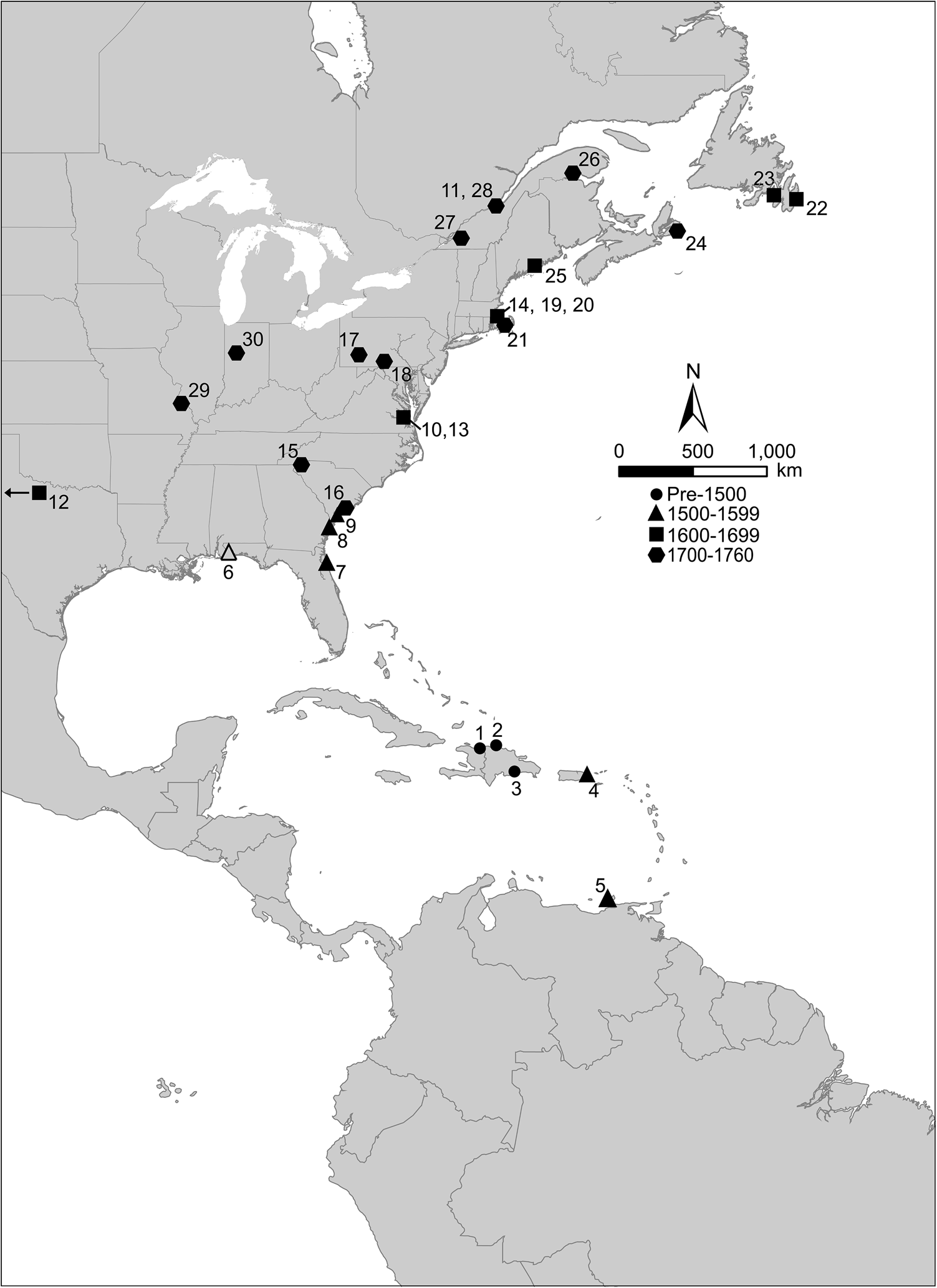
Cat remains have also been identified in sixteenth-century contexts in the ruins of Convento de San Francisco in the city of Santo Domingo in the Dominican Republic. Santo Domingo was founded by Christopher Columbus's brother Bartholomew in 1496 and moved to its present location in 1502. Four cats were found at Puerto Real (est. 1502–1505) in a domestic context likely dating to before 1550 (Deagan Reference Deagan1995). Six cats are represented in the early to mid-sixteenth-century levels at Nueva Cadiz, a former port town on Cubagua, off the coast of Venezuela that was established as a seasonal settlement and pearl fishery in 1500 and grew into a permanent town by 1515 (Cumbaa Reference Cumbaa1975; Wing Reference Wing1961). Cat remains from Havana, Cuba, and Mexico City also suggest their introduction during the colonial era (Rodríguez-Alegría Reference Rodríguez-Alegría, Nichols and Rodríguez-Alegría2016). Feral cats in today's San Juan, Puerto Rico, are thought to be descended from cats brought by Spanish conquistadors in the early 1500s (Raffaele et al. Reference Raffaele, Petrovic, Colón López, Yntema and Salguero Faria2021).
Caribbean cats of European origin, supplemented by those from later transatlantic crossings, likely served as the source population for the Americas. Cats may have sailed from the Caribbean with the Spanish admiral Pedro Menendez de Aviles, Florida's first governor. Ten cats are reported in sixteenth-century contexts at St. Augustine (1565). Many were recovered from a “frog/toad” layer in shallow barrel wells that readily flooded with saltwater and were then used as trash middens (Reitz and Scarry Reference Reitz and Scarry1985). Frogs, toads, and possibly cats from this layer may have fallen or jumped in and been unable to get out. Reitz and Scarry (Reference Reitz and Scarry1985) also note the presence of one cat at Santa Elena (1566) from a presumed domestic context (38BU162D). Cats also accompanied the Spanish Franciscans into the Southwest, reaching Awat'ovi before 1680 (Olsen and Wheeler Reference Olsen and Wheeler1976).
Cats from England likely arrived in Jamestown in 1607 and were certainly present during the “Starving Time.” George Percy, a resident of Jamestown during that time, reports, “Then, having fed upon horses and other beasts as long as they lasted, we were glad to make shift with vermin, as dogs, cats and mice” (Nicholls Reference Nicholls2005). Cats may also have been present on the Mayflower when the Pilgrims arrived in Plymouth, Massachusetts, in 1620. According to Edwards (Reference Valerie Anne2023), a Mrs. Kay Thoma McQuillen stated that her family Bible shows an entry by her great-great-grandmother Mrs. Heaney that a shorthair female (calico) accompanied her on the Mayflower and produced a litter of kittens soon after arriving at Plymouth Rock, thus implying that a male Shorthair was also aboard. In 1634 William Wood (Reference Wood1865 [1634]) reported that cats saved the Plymouth Colony's crops from squirrels. Cat remains were recovered from the Clarke Site (1630–1676) in Plymouth (Chartier Reference Chartier2015). Cats were also present at Champlain's settlement at Québec dating to between 1602 and 1624 (Rick Reference Rick1994) and in Newfoundland by 1622 (Tourigny Reference Tourigny2009).
Historical and Archaeological Context
In this study we report on two lines of analysis. The first uses morphometric data on cat remains from Old and New World archaeological sites to examine whether Old World cat populations are homogeneous in size and to contextualize New World cats within this range. Second, we use zooarchaeological, isotopic, and genetic analyses to explore the biographies of cats aboard the EP2 shipwreck. The EP2 shipwreck is one of 11 Spanish ships, under the command of Don Tristán de Luna y Arellano. Carrying 1,500 soldiers, colonists, enslaved peoples, and Indigenous Aztecs, it was anchored in Pensacola Bay, Florida, in 1559 near the newly established settlement of Santa María de Ochuse. On the night of September 19–20, a powerful hurricane swept into Pensacola Bay, wreaking havoc on Tristán de Luna y Arellano's colonial fleet. Six of the 11 Spanish ships were grounded and sank, while one was driven inland and came to rest in a grove of trees within an arquebus-shot's distance from the settlement (Worth et al. Reference Worth, Benchley, Lloyd and Melcher2020). The Luna settlement in Pensacola (AD 1559–1561) preceded the Spanish settlement in St. Augustine, Florida, by six years and the English settlement in Jamestown, Virginia, by 48 years, but it was abandoned shortly after the loss of these ships.
Maritime archaeologists discovered the first Luna shipwreck, Emanuel Point I, in 1992 (Smith Reference Smith2018). The second and third Spanish colonization ships were discovered by the University of West Florida (UWF) in 2006 and 2016 using magnetometer and ground truthing. The Emanuel Point I and Emanuel Point II wrecks were found a little less than a kilometer apart on the same sand bar at a depth of only 4 m. Emanuel Point III was found nearby but much closer to shore at a depth of 2 m. Interpretation of the hull remains strongly suggests that the first two ships were larger members of the fleet: they were galleons, urcas, or naos (Bendig Reference Bendig2016). Ongoing excavation at the site of the third vessel indicates that it either was one of Luna's smaller vessels (barca) or one that was much more broken up in the storm.
Excavation at all three sites was undertaken using a water-induction dredge. When artifacts were encountered, dredging was paused, and they were recorded in situ. A mesh bag attached to the dredge head was used to catch smaller artifacts, including faunal remains, missed by the excavators. Following each dive, the “dredge spoil” captured in the mesh bag was taken to a land-based screening station so that any artifacts missed by the excavators could be recovered and assigned to an excavation quad (50 × 50 cm). This enabled comparisons between the fleet and settlement site (also discovered in 2016) and provided insights into foodways, shipboard pests, ballast origins, and defense. Among these artifacts are a collection of extremely well-preserved faunal specimens, including the remains of cow (Bos taurus), pig (Sus scrofa), sheep/goat (Ovis/Capra), chicken (Gallus gallus), cat (Felis catus), black rat (Rattus rattus), and house mouse (Mus musculus): they likely represent the earliest recovered specimens of sheep/goats, rats, and mice in North America (Bratten Reference Bratten and Johnston1995; Smith Reference Smith2018; Smith et al. Reference Smith, Spirek, Bratten and Ireton1998).
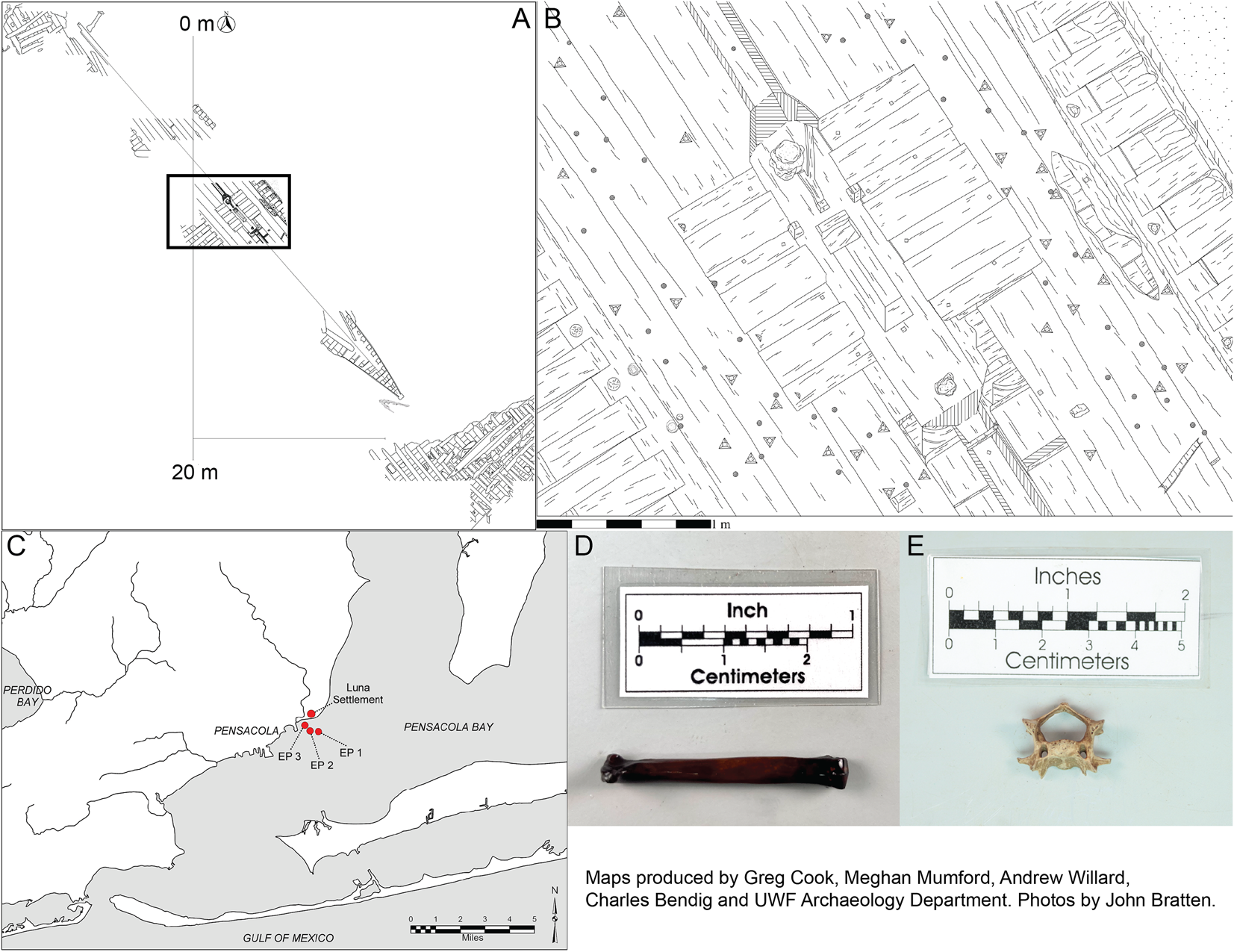
Cat remains, believed to be the earliest ones in what is now the United States, were recovered from the dredge spoil of the Emanuel Point 2 wreck attributed to depths ranging from 50 to 90 cm below surface. They were found in the ship's lower hull in an area that was ultimately determined to be the ship's midship and mast step (Table 2; Figure 2).
The Cat Remains Identified in the Emanuel Point 2 Wreck.
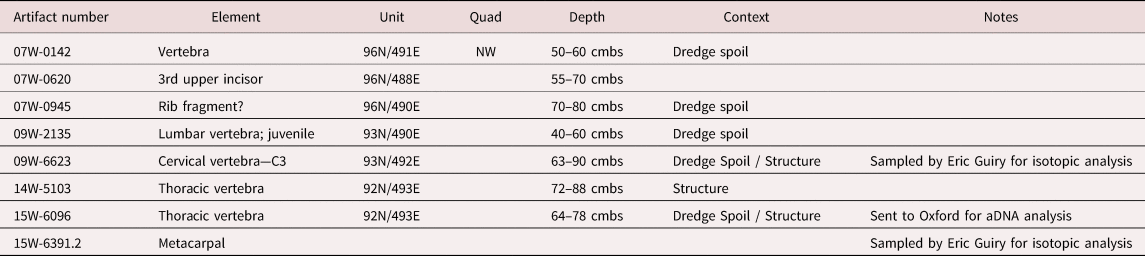
A panel depicting (A) plan map of the Emanuel Point 2 Wreck; (B) inset of the Emanuel Point 2 Wreck (depicted by black box in A demonstrating the location of the cat remains); (C) map of the Florida coast showing the location of the Emanuel Point Wrecks (EP1-3) and the Luna Settlement; (D) and (E) examples of a cat metacarpal and cervical vertebrae from the Emanuel Point 2 Wreck.
Materials and Methods
Osteometrics: Contextualizing Early Cats
To contextualize Old and New World cat sizes, we compiled linear morphometric measurements collected following Von Den Driesch (Reference Von Den Driesch1976) from Old World (n = 127) and New World (n = 21) cat remains from available sources (see Supplemental Data 1). To overcome the relatively limited morphological dataset on cats on either side of the Atlantic, we relied on the log standard index or “log-ratio method.” Although direct comparison of the same measurements taken on the same skeletal element is preferred and provides a more detailed picture of morphology, datasets of the size needed for such an analysis are not presently available. The log-ratio method enables analysts to amalgamate measurements taken in the same axes on different skeletal elements into a single analysis (see Davis Reference Davis1996; Fothergill Reference Fothergill2017; Meadow Reference Meadow, Becker, Manhart, Peters and Schibler1999; O'Connor Reference O'Connor2007; Thomas et al. Reference Thomas, Holmes and Morris2013; Welker et al. Reference Welker, Foster and Tourigny2021; Woldekiros et al. Reference Woldekiros, D'Andrea, Thomas, Foster, Lebrasseur, Miller, Roberts and Sykes2019). Here we rely on length and breadth measurements on the humerus, radius, ulna, femur, and tibia. These measurements are then log-transformed and rescaled against the corresponding values from a standard; we use the mean values from five domestic house cats of known age and sex published by O'Connor (Reference O'Connor2007) in a comparable analysis. This approach provides a general sense of cat size in these assemblages.
Multiproxy Analyses: Reconstructing the Lives of Cats aboard EP2
To explore the experiences of cats in the New World in more detail, we combined existing zooarchaeological and aDNA evidence from the literature with new diet-focused isotopic analyses of cat remains from the Emanuel Point 2 shipwreck. In this section we offer context for the application of all three methods in historical archaeology, as well as a more detailed methodological background for data streams (i.e., isotopic analyses) for which we present new results.
Zooarchaeology
Historical zooarchaeology has a long and well-developed track record for reconstructing a wide range of human–animal relationships, including animal trade and husbandry in the New World (for review, see Landon and Opishinski Reference Landon, Opishinski, Orser, Zarankin, Funari, Lawrence and Symonds2020). Taxomonic identifications of cat remains were performed by Catherine B. Parker (University of West Florida; UWF) and Drs. Dewey Wilhite and Eleanor Josephson (Auburn University) following visual inspection and comparison to UWF's reference collections.
Isotopic Analyses
To provide clues about the roles that cats may have played onboard EP2, we conducted stable carbon (δ13C) and nitrogen (δ15N) isotope analyses on collagen extracted from the adult cat's vertebra specimen (Table 2). Stable isotope analysis is based on the principles that you are what you eat and that different foods can have distinctive isotopic compositions. A growing body of research using archaeological domestic animal remains from historical sites is demonstrating the potential of isotopic analyses to reveal previously invisible aspects of the social and economic dimensions of animal trade (Guiry et al. Reference Guiry, Noël and Tourigny2012, Reference Guiry, Harpley, Jones and Smith2014; Klippel Reference Klippel2001) and husbandry (Guiry, Noël, and Fowler Reference Guiry, Noël and Fowler2021; Guiry et al. Reference Guiry, Hepburn and Richards2016; Reitsema et al. Reference Reitsema, Brown, Hadden, Cutts, Little and Ritchison2015), as well as the roles animals play in colonial identities (Guiry et al. Reference Guiry, Szpak and Richards2017; Guiry, Jones, et al. Reference Guiry, Beglane, Szpak, Schulting, McCormick and Richards2018; Kennedy and Guiry Reference Kennedy and Guiry2022). In the context of shipboard feline diets, isotopic analyses can provide insights on whether cats consumed fish and other meats (generating higher δ15N values) and on whether their diets included marine or C4 foods (generating higher δ13C values; for reviews, see Guiry Reference Guiry2019; Guiry et al. Reference Guiry, Noël and Tourigny2012; Szpak Reference Szpak2014; Tieszen Reference Tieszen1991). Stable isotope compositions of bone collagen offer a long-term, multiyear perspective on the foods that an animal has eaten: therefore, they are better suited to exploring dietary trends over the cat's entire life span (Hobson and Clark Reference Hobson and Clark1992).
Interpretation of shipboard cat isotopic compositions requires baseline isotopic data (Katzenberg Reference Katzenberg1989) from potential food sources that could have been consumed while aboard the ship. Published isotopic data from shipwreck fauna are still extremely rare, particularly for the sixteenth century (Guiry et al. Reference Guiry, Staniforth, Nehlich, Grimes, Smith, Harpley, Noël and Richards2015; Guiry, Jones, et al. Reference Guiry, Jones, Susan deFrance, Durst and Richards2018). Suitable samples for generating faunal isotopic baselines were scarce among the recovered materials from EP2. Our baseline sample for EP2 consists of three chickens (Gallus gallus), one pig (Sus scrofa), and one triggerfish (Balistidae). Published data from five rodents from EP2 and three rodents from an associated contemporaneous wreck, Emmanual Point 1 (EP1), provide further support for interpreting the cat diet. Species identifications for rodent samples was assigned by ZooMS (Buckley Reference Buckley, Giovas and LeFebvre2018): there were six black rats (Rattus rattus) and two mice (Mus sp.; likely house mouse, Mus musculus, based on context; Guiry et al. Reference Guiry, Kennedy, Orton, Armitage, Bratten, Dagneau and Dawdy2024).
Bone collagen was extracted and δ13C and δ15N compositions measured following established methods (e.g., Guiry et al. Reference Guiry, Orchard, Needs-Howarth and Szpak2022) at Trent University. Information on calibration procedures and standard reference materials used in isotopic analyses are reported in Supplemental Data 2 (Tables S2–S4). For δ13C and δ15N, the standard uncertainty was ± 0.10‰ and ± 0.51‰, respectively. The integrity of isotopic data was evaluated using well-established collagen quality control criteria: liberal C:N criteria (Guiry and Szpak Reference Guiry and Szpak2021) and carbon (>13.8%) and nitrogen (>4.0%) elemental concentrations (Ambrose Reference Ambrose1990).
Results
Osteometrics: Contextualizing Early Cats
Morphometric data on medieval and postmedieval cats from England, Portugal, and Denmark (Figure 3; Supplemental Data 1) revealed a wide range of variation. Cats in Denmark were markedly larger in the postmedieval period than their medieval predecessors, as reported by Bitz-Thorsen and Gotfredsen (Reference Bitz-Thorsen and Gotfredsen2018). This was not, however, true of English cats across the same period, suggesting that cat body size was not homogeneous across Europe during the postmedieval period. This is noteworthy for two reasons. First, it suggests that various source populations in Europe may have produced cats of different sizes. Second, with large enough datasets, future scholars may be able to tentatively attribute cats to some of these populations. It is notable that the size range of archaeological cats encapsulates that of modern cats reported by Kratochvil (Reference Kratochvil1976) and used by O'Connor (Reference O'Connor2007). Figure 3 shows that archaeological specimens are both significantly larger and smaller than the average of modern cats found at the intersection of the x and y axes, which suggests that cats can range significantly in body size. Morphometric data available from cats from Spanish contexts at St. Augustine and Santa Elena, and from the French Fortress of Louisbourg in Cape Breton, Nova Scotia, demonstrate that cats from colonial contexts are comparable to or smaller than modern cats and are similar to those in England across the medieval and postmedieval periods. This may imply that cats in much of western Europe were relatively small during this period.
Log-transformed cat long bone length vs width. The origin reflects the average of nine modern cats after O'Connor (Reference O'Connor2007). Comparative data are drawn from published and unpublished sources (see Supplemental Data 1).

Zooarchaeology
Osteological comparative analyses showed that at least one adult and a sub-adult cat were among the fauna recovered from the EP2 wreck. This may suggest that a female cat was aboard before it sailed from Vera Cruz, Mexico, to Pensacola, Florida. Transcriptions of historical documents indicate that Luna's ships took eight weeks to make the journey, which is slightly shorter than the average gestation period for a cat, meaning that a pregnant cat could have given birth while crossing the Gulf of Mexico aboard the EP2 ship.
Stable Isotope Analysis
Collagen extracted from the EP2 cat and most baseline fauna passed quality control tests (Table 3; Figure 4). Two chicken samples (HEAL 9 and 10) had C:N ratios that fall slightly outside the acceptable range—a C:N cut of 3.35 for samples with δ13C values that are greater than –10‰ (Guiry and Szpak Reference Guiry and Szpak2021)—indicating that their δ13C values may skewed negatively by at least 1‰; that is, their true δ13C values, had there been no taphonomic contamination, would be about 1‰ greater than shown in Table 3. However, this minimal contamination does not significantly undermine the suitability of these data to serve as a general baseline for interpreting cat diet when placed in the context of our larger comparative sample.
Isotopic Compositions for EP2 Cat and Baseline Fauna.
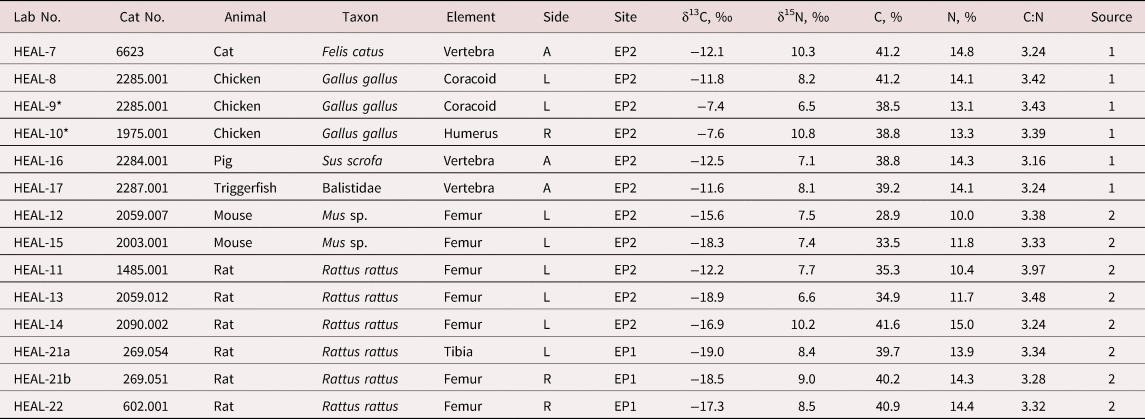
Sources: 1 = this study; 2 = Guiry et al. Reference Guiry, Kennedy, Orton, Armitage, Bratten, Dagneau and Dawdy2024.
Note: Asterisks identify samples that do not pass quality control (see text r for details).
Bone collagen isotopic compositions for cat and other EP2 fauna. All data from rodents are from Guiry and colleagues (Reference Guiry, Kennedy, Orton, Armitage, Bratten, Dagneau and Dawdy2024). Note that three rat samples are from EP1 (see Table 2).
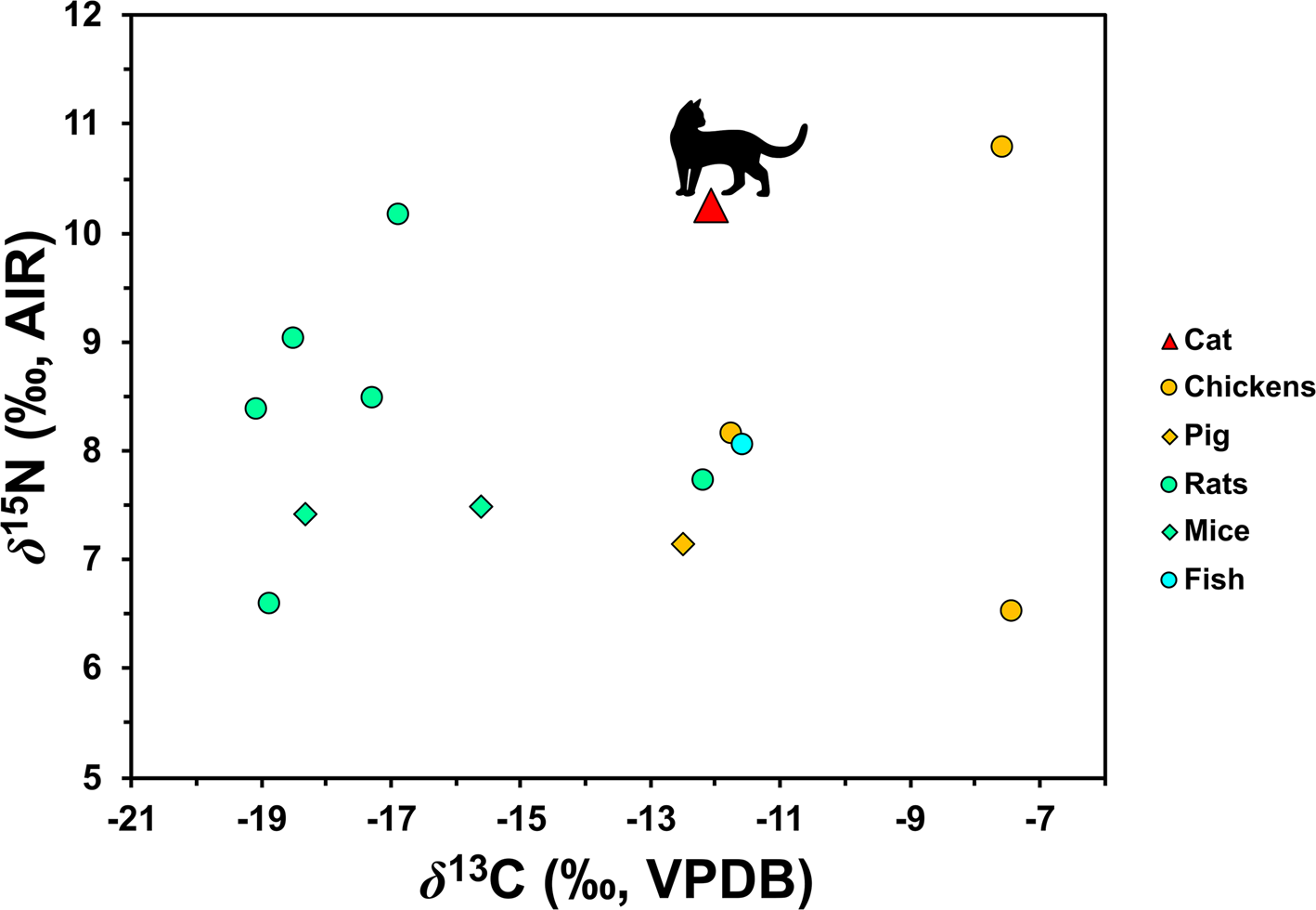
Livestock, including three chickens and one pig. show a wide range of isotopic compositions, with δ13C values spanning C3-to-C4 and terrestrial-to-marine / aquatic diet spectrums (–12.5 to –7.4‰, mean = –9.8 ± 2.7‰). These animals show δ15N values (spanning +6.5 to +10.8‰, mean = +8.2 ± 1.9‰) suggesting a range of animal protein consumption patterns. Acknowledging the potential complexities linked to variation in terrestrial nitrogen isotope baselines (Guiry, Beglane, et al. Reference Guiry, Beglane, Szpak, Schulting, McCormick and Richards2018; Szpak Reference Szpak2014), at a basic level and in the context of potential shipboard diets, these data suggest that, although some livestock had diets incorporating relatively little animal protein (lower δ15N values), others had diets with considerable quantities of terrestrial mammal and marine fish protein (higher δ15N values).
In contrast to livestock, rodents have δ13C values falling at the lower end of the spectrum (–19.0 to –12.2‰; mean = –17.1 ± 2.3‰), suggesting that rats and mice had less access to C4 or marine foods or products derived from animals fed with those foods. Rats also show a large range of δ15N values (+6.6 to +10.2; mean = +8.2 ± 1.1‰), indicating that they had access to a wide variety of animal products. These findings are clear indications that animal protein of terrestrial and marine origin could have been sourced by scavengers aboard EP2 and the other ships lost at Emanuel Point. Together with baseline data from livestock, rodents offer an interpretive framework for assessing aspects of cat diet and behavior. Specifically, whereas data from livestock show that a tremendous range of isotopic composition could be associated with foods consumed aboard EP2, a diet focused mainly on rats would likely produce lower δ13C values.
The isotopic composition of the triggerfish sample produced δ13C and δ15N values of –11.6‰ and +8.6‰. Although this provides a sample size of only one to represent all nondomestic, marine animal protein, and we cannot be certain that this sample is contemporaneous with the wreck,Footnote 2 these data fit well with expected isotopic compositions from marine fish from another historical wreck in the region (Guiry, Jones, et al. Reference Guiry, Jones, Susan deFrance, Durst and Richards2018) and more generally with historical marine fish recovered from terrestrial sties in the Gulf of Mexico (Guiry, Kennedy, et al. Reference Guiry, Noël and Fowler2021).
The EP2 cat produced δ13C and δ15N values of –12.1‰ and +10.3‰, respectively. In the context of our faunal isotopic baseline, a cat consuming mainly rats would have had lower δ13C and δ15N values, a different pattern from one expected for diets focused on livestock (higher δ13C, variable δ15N) and marine fish (higher δ13C and δ15N). Within the shipboard food web we reconstructed, our results reveal that this cat was a generalist, high-level carnivore. It likely had a diet focused on animal protein, including marine fish, although the data could also be consistent with the consumption of livestock meat products such as pork, poultry, and possibly beef (though no EP2 cattle samples were available for analyses) and smaller quantities of rodents. In other words, this cat's diet suggests that, though it may have hunted rats and mice aboard the ship, a significant proportion of its diet came from other sources.
Discussion
In contrast to dogs and livestock, few documentary sources provide information on the cats accompanying Europeans to the New World. This may simply reflect cats’ ubiquity and independence. From their domestication until their arrival in the New World, cats’ primary role in many communities was pest control, something that they were well suited to and that required little supervision from their human cohabitants. Gaspar (Reference Gaspar2000) contends that cats would have been constant companions on ships because they were the only defense against rats and would therefore have been among the first domesticates to colonize the New World. Despite the lack of documentation, genetic and morphometric data can provide some insights into what these cats may have looked like.
Our morphometric comparison of cats from Europe and the Americas reveals that these animals varied significantly in size: there were individual cats that were both larger and smaller than modern cats as measured by Kratochvil (Reference Kratochvil1976). Cat remains from Denmark indicate a marked increase in size from the medieval to the postmedieval periods, but this increase was not seen in all European cat populations such as those reported by O'Connor (Reference O'Connor2007). Early cat remains from North America are comparable to or smaller than Kratochvil's (Reference Kratochvil1976) modern reference. Genetic analyses have found that blotched patterning on cats was not common until the eighteenth century (Ottoni et al. Reference Ottoni, Van Neer, Cupere, Daligault, Guimaraes, Peters and Spassov2017), and physical traits, including this patterning, were not intensively selected for until the nineteenth century to produce fancy breeds (Driscoll et al. Reference Driscoll, Clutton-Brock, Kitchener and O'Brien2009; Ottoni et al. Reference Ottoni, Van Neer, Cupere, Daligault, Guimaraes, Peters and Spassov2017). This means that early cats in the Americas, including the EP2 cats, were likely orange or gray-striped tabbies corresponding to the mackerel-tabby pattern exhibited by wild cats (Driscoll et al. Reference Driscoll, Clutton-Brock, Kitchener and O'Brien2009).
Genetic analysis of one EP2 cat (Jamieson Reference Jamieson2021; Jamieson et al. Reference Jamieson, Carmagnini, Howard-McCombe, Doherty, Hirons, Dimopoulos and Lin2023) attributes this specimen to the IV-A clade, which is the most widespread mitochondrial haplogroup among archaeological and modern cats in Europe. Cat remains from the EP2 were recovered from near the ship's mast step and pump well and were intermixed with ballast, which may raise the possibility that the cat remains date to an earlier voyage in the ship's history (e.g., from Spain to Mexico); however, even this possibility supports the conclusion that this cat's ancestors lived in Europe. Nevertheless, these remains are the earliest cats documented in what is now the United States, and the presence of fused and unfused vertebrae may indicate the possibility that two cats, an adult and a subadult, were aboard the EP2 during its final voyage.
Broadly, it appears that the animal protein in the EP2 cat's diet was similar to that eaten by a typical sailor during this era. This means that the EP2 cat's isotopic composition is not consistent with a diet based primarily on the consumption of rats and mice from the wreck. This may suggest that this cat (1) did not subsist primarily on the rats and mice it caught or (2) was so effective at controlling rat populations that such prey was an insufficient food source. It is important to bear in mind some of the contextual constraints that limit our interpretations. First, it remains possible that the cat's lifespan aboard EP2 did not overlap with those of the rats we sampled—that our baseline data are simply not contemporaneous with the cat. Yet, the fact that we see a similar pattern in rat diets across both EP1 and EP2 suggests that the rat diets we observed are broadly representative. Second, the cat sampled was an adult that may have lived some of its life on land, where the isotopic composition of cat foods could reflect a different isotopic baseline than shipboard diets. As a result, these interpretations remain tentative.
Understanding cats’ role in the Americas requires us to consider the diverse ways in which they participated in human society over time and the available data from archaeological sites in the Americas. Cats have played numerous roles in human societies, including as sources of pelts and meat and as pets; however, their most enduring and consistent role in human communities has generally been controlling pests, including mice and rats. Rodents plagued food stores on land and consumed cargo and food supplies on ships. Exactly when cats were first used to control shipboard pests is unknown; however, literary sources imply that this practice may be quite old. Burwash (Reference Burwash1947) reports that Edward the First's law of AD 1275 “laid down that if any living thing, be it man or dog or cat, escaped a stricken vessel, it was no wreck,” suggesting that cats were commonly found on medieval period ships in Europe. The Consolato del Mare (A Manual of Maritime Law: Consisting of a Treatise on Ships and Freight and a Treatise on Insurance) published in 1484 contains references to the practice of keeping cats on board ships (Sandall Reference Sandall2018):
Note LVIII
If goods laden on board of a ship are devoured by rats, and the owners consequently suffer considerable damage, the master must repair the injury sustained by the owners, for he is considered in fault. But if the master kept cats on board, he is excused from the liability.
This was modified in a later edition. Note LVIII adds,
If the ship has had cats on board in the place where she was loaded, and after she has sailed away the said cats have died, and the rats have damaged the goods, if the managing owner of the ship shall buy cats and put them on board as soon as they arrive at a place where they can find them, he is not bound to make good the said losses, for they have not happened through his default.
A sixteenth-century carving of a cat amid a pile of rope on a column at the Jerónimos Monastery in Lisbon may be the earliest representation of a ship's cat. English admiralty records denote that the Anne of Hull was to carry “a doge and a cat with all other necessaryes” on a voyage to the Isle of Man in 1532 (Sandall Reference Sandall2018).
Cats introduced to the Americas must have originated from cats kept aboard ships during transatlantic voyages. These cats likely hunted mice and rats for at least some of their sustenance on the voyage; however, as demonstrated by the cat from the EP2, their diets may have been subsidized by their companions. We will likely never know whether this was because they were so effective at controlling pests that subsidizing was necessary or because their human cohabitants were fond of them and fed them out of affection. Kitchener and O'Connor (Reference Kitchener, O'Connor, O'Connor and Sykes2010) claimed that the pest-control benefits of cats are often overstated. Elton (Reference Elton1953) reported that cats may have had a limiting effect on the growth of low-density rat and mouse populations but were ineffective in reducing abundant populations. Rodent populations aboard sixteenth-century ships may have been constrained from growing to high densities by limited food, water, and space, a factor that may have amplified cats’ effectiveness in tamping down pest populations. Dogs, particularly terrier breeds, were also used to control pests, particularly rats, and were found on ships like the Mary Rose (Zouganelis et al. Reference Zouganelis, Ogden, Nahar, Runfola, Bonab, Ardalan and Radford2014); however, cats being smaller and nimbler, might have been more useful combating rodents in the tighter confines of a ship.
The consumption of commensal animals or use of their skins or pelts can vary widely based on cultural norms, availability, and dietary preference. A 1560 Spanish cookbook includes a recipe for roast cat (Nola Reference Nola and Worth1560). Archaeological cats from Viking period medieval deposits in Denmark (Bitz-Thorsen and Gotfredsen Reference Bitz-Thorsen and Gotfredsen2018) and medieval deposits in the British Isles (Albarella and Davis Reference Albarella, Davis and Chapman2010; McCormick Reference McCormick, Niocaill and Wallace1988; Serjeantson Reference Serjeantson, Serjeantson and Waldron1989) and Spain (Lloveras et al. Reference Lloveras, Thomas, Garcia, Florensa, Segura, Medina, Orri and Nadal2017) often had cut marks, suggesting they were skinned for their furs. Notably, cats used for their pelts in these contexts were often subadults approaching adult body size, deposits tended to be large and include multiple individuals, and cut marks indicative of skinning were common (Albarella and Davis Reference Albarella, Davis and Chapman2010; Bitz-Thorsen and Gotfredsen Reference Bitz-Thorsen and Gotfredsen2018; Lloveras et al. Reference Lloveras, Thomas, Garcia, Florensa, Segura, Medina, Orri and Nadal2017; McCormick Reference McCormick, Niocaill and Wallace1988; Serjeantson Reference Serjeantson, Serjeantson and Waldron1989).
Evidence for either of these practices appears limited in the Americas. Cat remains reported from sites in the Americas reflect few individuals and are often incomplete skeletons or isolated bones. Furthermore, except for cats reportedly eaten during the Starving Times in Jamestown, cut marks or evidence of cooking are rarely reported. Admittedly, relatively few studies in the Americas have focused on archaeological cat remains, but the current lack of compelling evidence for skinning or eating cats would seem to imply that cats filled other roles in the European colonies.
Finally, it is possible that these animals were thought of as pets. Pets are animals occupying domestic spaces and primarily serve as entertainment or companionship for humans (Tague Reference Tague2008; Tourigny Reference Tourigny2020). Archaeological studies of pets are complicated by the simple fact that we cannot observe the living relationship between animals and humans that serves a prominent role in defining this role. Tourigny (Reference Tourigny2020) documented changes in the role of animals in English society using pet cemeteries across the nineteenth and twentieth centuries. Unfortunately, cats in these cemeteries were very rare until quite late in the sequence, and so little information has been produced on the emergence of cats as pets. The isotopic compositions of the EP2 cat examined in this study suggest that from a dietary perspective, in addition to scavenging fish and eating rats, cats aboard the ship may have had access to human foods, suggesting they could have been provisioned by human companions. For our purposes, it is worth considering the cultural context of the period. As early as 1233 Pope Gregory IX demonized cats in the papal bull Vox in rama (Aerts Reference Aerts2016). Around this time, owning cats was generally considered unlucky and could get a person in serious trouble. Despite this cultural stigma, cats’ role in hunting mice and rats was reportedly recognized and appreciated by European scholars during the plague, and they were kept in monasteries and abbeys to keep rodents away from books (Aerts Reference Aerts2016). Sailors also appreciated having cats aboard and believed that those with extra toes, a condition called polydactyly, were especially lucky (Francis Reference Francis2015). Anti-cat sentiment seems to have waned in the seventeenth century and is reflected in more frequent and friendlier references in documentary sources and artwork (Aerts Reference Aerts2016).
Thus, it is probable that many cats in the European colonies continued to serve their traditional role as pest control against both native and introduced pests. Cats are known to hunt hundreds of small animal species, including birds, rodents, insects, reptiles, and amphibians (Doherty et al. Reference Doherty, Davis, van Etten, Algar, Collier, Dickman, Edwards, Masters, Palmer and Robinson2015). In addition to native species, archaeological and genetic data indicate that house mice (Mus musculus) and black rats (Rattus rattus) arrived in Americas in the sixteenth century (Agwamba and Nachman Reference Agwamba and Nachman2023; Guiry et al. Reference Guiry, Kennedy, Orton, Armitage, Bratten, Dagneau and Dawdy2024). The larger brown rat (Rattus norvegicus) arrived slightly later but became dominant around the 1730s (Guiry et al. Reference Guiry, Kennedy, Orton, Armitage, Bratten, Dagneau and Dawdy2024). Black rats were recovered from both Emanuel Point wrecks 1 and 2 and the San Juan, a shipwreck in Newfoundland, all three wrecks dating to 1559: this indicates that they were aboard ships that likely carried cats. Sailors’ affection for their ship's cats may have extended to considering them as pets; unfortunately, we can rarely demonstrate this solely from archaeological skeletal remains.
Conclusion
European contact and the Columbian Exchange undeniably altered the New World, facilitating the transatlantic movement of people, plants, animals, and diseases (Crosby Reference Crosby1972). Despite the importance of Eurasian domesticated animals to European colonization, they have not received detailed examination. Cats were among the first domesticated animals to reach the New World. This analysis examined the introduction of domestic cats to the Americas and the roles of cat aboard early colonial ships. It joins a growing body of archaeological research examining the early history of Eurasian domesticates in North America (Guiry et al. Reference Guiry, Kennedy, Orton, Armitage, Bratten, Dagneau and Dawdy2024; Welker and Dunham Reference Welker and Dunham2019; Welker et al. Reference Welker, Foster and Tourigny2021) and provides a foundation for future research on cats by compiling available morphological and archaeological abundance data on cats into a single source.
Though a recipe for roast cat was included in a Spanish cookbook dating to 1560, the small number of cats and the absence of cut marks on the Emanuel Point cats and others from sites in the Americas suggest that cats were not commonly consumed. This same logic suggests that cats were also not widely used for their pelts in the Americas. This is contrast to the wide use of cat pelts in Ireland (McCormick Reference McCormick, Niocaill and Wallace1988), England (Albarella and Davis Reference Albarella, Davis and Chapman2010; Serjeantson Reference Serjeantson, Serjeantson and Waldron1989), Spain (Lloveras Reference Lloveras, Thomas, Garcia, Florensa, Segura, Medina, Orri and Nadal2017), and Denmark (Bitz-Thorsen and Gotfredsen Reference Bitz-Thorsen and Gotfredsen2018) from at least the ninth to fifteenth centuries. Evidence for skinning cats was less frequently reported for the postmedieval period, but the trade did continue. More than 3,000 cats were killed and skinned in Ghent in 1837 and 1838 (Aerts Reference Aerts2016).
That cats were on board EP2 suggests their primary role may have been as commensal ratters and mousers that kept the onboard rodent population in check. This does not, however, preclude the possibility that these cats were well liked and cared for by the sailors. Indeed, that one cat ate a diet similar to that expected for sailors aboard EP2 suggests that it may have been considered a companion for the crew. Although cats were believed to consort with witches, beliefs that persist in contemporary superstitions about black cats, cats were well regarded on ships and often believed to be lucky. This was especially true of cats exhibiting extra toes (Francis Reference Francis2015).
Acknowledgments
Thanks to Julie Bitz-Thorsen and Drs. Elizabeth Reitz, Richard Thomas, and Anne Birgitte Gotfredsen for generously sharing their linear morphometric measurements with us for this analysis. Thanks also to Alexandra Jamieson, Laurent Frantz, Cathy Parker, John Worth, Emma Graumich, and Edward Morrison.
Funding Statement
The archaeological fieldwork was conducted under 1A-32 permit 1314.057 from Florida's Bureau of Archaeological Research and funded by the University of West Florida archaeology program and Florida Division of Historical Resources Special Category Grants SC503 and 23.h.sc.300.139.
Data Availability Statement
All data used in this study are available in the Supplemental Material.
Competing Interests
The authors declare none.
Supplemental Material
For supplemental material accompanying this article, visit https://doi:10.1017/aaq.2024.84.
Supplemental Data 1. Morphometric Data on Modern Cats and Archaeological Specimens from North America and Europe.
Supplemental Data 2. Electronic Supplemental Materials for Stable Isotope Analysis.


 Open access

