

Introduction
In most societies, the family is the primary unit of socialization, and of economic and social support. When families are not able to support and care for their members, front-line social workers become pivotal in providing support and services. The service provided by social workers is, however, highly dependent upon the contexts in which such services takes place (Duffy and Collins, Reference Duffy and Collins2010; Lundström and Sallnäs, Reference Lundström, Sallnäs, Hämäläinen, Littlechild, Chytil, Sramata and Jovelin2010; Rush and Keenan, Reference Rush and Keenan2014). For example, social workers operate within complex welfare systems. One major component in a welfare system is the social legislative framework, which includes both a protective and a controlling aspect in relation to the social work profession. Legislation can: for example, function as a protection of service users’ rights, while, at the same time, it can exert social control, such as in child protection and unemployment policies (Scourfield and Welsh, Reference Scourfield and Welsh2003; Thorén, Reference Thorén2008). Overall, legislation provides formal professional boundaries to which social workers must relate. The role and composition of the family is changing in Europe, and migration, non-traditional family forms and alternative lifestyles question the notion of the traditional nuclear family. This development poses a challenge for European welfare systems and national legislations that govern marriage, divorce, and child protection (Hantrais, Reference Hantrais2004). Welfare systems need to adapt to changing notions of family: for example, who should count as family members and the rights and duties of family members.
The aim of this article is to compare how ‘family’ is addressed and conceptualized in comparative countries – Lithuania and Sweden – on three legislative levels: the constitutional level, the general family level, and the child welfare level. Lithuania and Sweden have been identified as representing two different types of welfare state regimes; Lithuania as ‘re-familialised’ and Sweden as ‘de-familialised’ (Hantrais, Reference Hantrais2004). Previous comparative research on welfare states has had a broad policy focus (Hantrais, Reference Hantrais2004; Kuronen, Reference Kuronen2010), but our aim in this article is therefore to examine how family is conceptualised through a qualitative content analysis of several levels of key legislation. Furthermore, although welfare systems are usually relatively stable over time, in the post-Cold-War period, eastern European countries have shown a rapid change in recent years (Aspalter, Reference Aspalter2017). By a contrast of social legislation in two countries from the theoretical viewpoint of welfare states, general principles behind the conceptualisation of ‘family’ in social legislation can be critically re-evaluated and highlighted (Hearn et al., Reference Hearn, Pösö, Smith, White and Korpinen2004). This comparative aspect also highlights knowledge gaps and creates a context for future studies at a practice level (Bloemraad, Reference Bloemraad2013); there is an increased interest in comparative perspectives in policy research, not least from the perspective of the European Union (EU), because comparisons of policy between countries can potentially lead to transnational policy development.
Overview of family policy in Lithuania and Sweden
Family policy can be defined in terms of government activities that encompass family creation, economic support, childrearing and care-giving (Ooms, Reference Ooms1990). As a sub-category, child welfare policies deal more specifically with issues of child welfare and child protection. As argued by Russell (Reference Russell2011), family and child welfare policies have a normative content in that they are based on ideological views on what a family is and on the role of the state as opposed to the role of the family.
General family policy in Lithuania
Since 1990, after restoration of the nation's independence, social policies in Lithuania have moved towards liberalisation and marketisation, in line with a general political move towards a market economy (Aidukaite et al., Reference Aidukaite, Bogdoanova and Guogis2012) and a move away from the previous extensive state-run Soviet welfare system (Bernotas and Guogis, Reference Bernotas and Guogis2006). Today, the Lithuanian Ministry for Social Security and Labour (MSSL) is responsible for family welfare. Lithuanian family policy aims to enable the family to be a responsible, stable, and active institution capable of functioning independently of outside assistance (MSSL, 2017). Since the early 2000s, the target of family policy has been to reduce poverty, to enhance parents’ responsibilities towards their children (Aidukaite, Reference Aidukaite2006), to reduce income inequality, and to protect children and families (MSSL, 2016/2017).
Since 1990, Lithuania has also developed a social security system that comprises social insurance and social assistance. The state-run social insurance system, including pensions and parental leave benefits, is based on a ‘pay-as-you-go’ principle and labour market participation. Social assistance is primarily related to municipal financial support and is designed to help meet the minimum needs of low-income persons. Service provision by the social services is often fragmented, means-tested, and based on short-term projects that depend on temporary financial support: for example, day care centres for disadvantaged children. In Lithuania, child protection is separated from social services. Social workers from public agencies or NGOs provide a support function for families at social risk, while law educated chief specialists at Child Protection Units perform the decision-making control function in child protection cases.
Overall, the welfare system in Lithuania has been under continuous development over the past three decades. Current challenges include: strains on the social insurance system due to demographic changes such as low fertility rate and emigration, high levels of poverty, and income inequalities. Recent family and child welfare policy developments aim to increase preventive approaches when working with families (e.g. child benefits for each child) and a centralised, state-run system for protecting children's rights is in development (MSSL, 2016/2017).
General family policy in Sweden
In Sweden, the Ministry of Health and Social Affairs is responsible for social welfare and social policies. In practice, however, much of the implementation of social policies: for example, providing social services, is decentralized to the municipality level. Traditionally, the state plays a large part in implementing social and family policies (Kuronen, Reference Kuronen2010), which are mostly focused on the individual rather than the family (Hantrais, Reference Hantrais2004) and the promotion and support of dual-earner families (Lundqvist and Roman, Reference Lundqvist and Roman2008). In the 1970s, major shifts in social policies were introduced to stimulate dual earner families and included heavily subsidised child care, individual income taxes, paid paternal leave, and joint custody becoming the norm (Lundström and Sallnäs, Reference Lundström, Sallnäs, Hämäläinen, Littlechild, Chytil, Sramata and Jovelin2010; Duvander and Ferrarini, Reference Duvander and Ferrarini2013). The Swedish welfare state consists of a mixture of universal (for example, child allowance, paid parental leave) and means-tested (for example, housing benefits, social security) social benefits. Many benefits are earnings-related and funded through taxes in a system of income redistribution. The social services are responsible for child welfare and child protection, and services are provided for children-at-risk, parents, or for whole families. Most services are voluntary, including out-of-home placements; however, children-at-risk can be placed in compulsory out-of-home care by the social services after a decision by the administrative court.
Following the financial crisis of the 1990s, the Swedish welfare state has faced significant economic strain through continuing high levels of both unemployment and sick leave (Fritzell et al., Reference Fritzell, Gähler and Nermo2007). In addition, there has been a shift in ideology, leading to a steady increase in private and NGO service providers regarding services, such as those for children in out-of-home placements (Lundström and Sallnäs, Reference Lundström, Sallnäs, Hämäläinen, Littlechild, Chytil, Sramata and Jovelin2010). This, in turn, has caused a significant expansion of state regulation and control of non-state service providers (Moberg, Reference Moberg2017).
Comparative welfare state research
Comparative welfare state research makes use of different cluster analyses (Aspalter, Reference Aspalter2017). Countries with similarities are clustered together based on factors, such as, coverage, compensation levels, and universality and/or on text-based analysis of policy documents and rhetoric. Heavily influenced by Esping-Andersen's (Reference Esping-Andersen1990) typology of welfare state regimes, comparative researchers have suggested de-familialisation as a central characteristic of a welfare state (e.g. Lister, Reference Lister, Baldwin and Falkingham1994; Leitner, Reference Leitner2003; Hantrais, Reference Hantrais2004). Although there are diverging definitions of de-familialisation, all are typically concerned with the extent to which an individual can receive support and care outside of the family, either from the state, civil society, or the market (Hantrais, Reference Hantrais2004; Saxonberg, Reference Saxonberg2013). Hantrais identified a four-fold typology, reflecting de-familialised, partly de-familialised, familialised, and re-familialised types of welfare states (Hantrais, Reference Hantrais2004). Sweden is characterized by de-familialisation and family policy is explicit and coherent and aims to minimise the individual's reliance on the family through universal and relatively generous welfare provision. State involvement is legitimised, and many services are universal, tax-funded and based on residence, which means that individuals, to a large extent, are able to uphold a reasonable living standard independent of family. Lithuania, on the other hand, has been described as a re-familialised welfare state that has undergone a political shift, moving from high state involvement during the socialist era, towards a minimalist state and increased market orientation. What were state responsibilities have shifted to being familial responsibilities, and state support for families is more rhetorical than a reality (Hantrais, Reference Hantrais2004); welfare systems are partial, underfunded and underdeveloped.
Child welfare is an area of family policy where the relationship between state and familial responsibilities becomes critical and comparative research of child welfare systems indicates that countries might be clustered differently to the ways suggested in the dominant regime typologies. Gilbert: for example, compares North American and Western European countries (Gilbert, Reference Gilbert2012) and suggests that approaches to child maltreatment can be organised into three orientations: child protection, family service, and child development. Consequently, when considering street-level social work, it seems that alternative patterns appear, and countries like Lithuania and Sweden might be more similar than Hantrais (Reference Hantrais2004) suggests.
Method
The study presented here was a sub-study of the NORFACE-WSF funded research project Family Complexity and Social Work (FACSK, http://bit.ly/1WMDO8T). Analysis aims to compare how family is conceptualized in Lithuanian and Swedish social legislation, as representatives of a ‘re-familialised’ and a ‘de-familialised’ welfare state. As sources of data we used central legislation on three legislative levels: 1) constitutional level, 2) general family level, and 3) child welfare level (see Table 1). These pieces of legislation, adopted between 1810–2006, were currently in force in Lithuania and Sweden (by May 2018).
Lithuanian and Swedish legislation included in the analysis
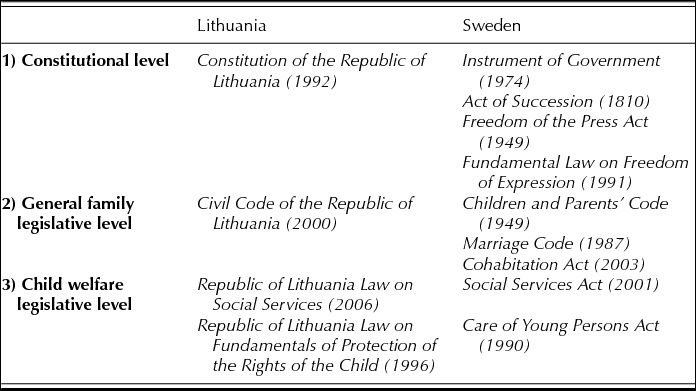
The legislative texts were read in Lithuanian and Swedish, respectively, and were analysed using qualitative content analysis. Through several readings, the texts were distilled into sub and main categories, furthering the level of abstraction (Elo and Kyngäs, Reference Elo and Kyngäs2008). We began by searching the legislative texts for variations of words referring to family or family members, such as ‘family’, ‘mother’, ‘father’, ‘child’, ‘parent’, and ‘spouse’. When found, pieces of text containing these words were put into sub-categories in accordance with the content in which these words were mentioned (within marriage, divorce, childcare, child protection etc.). When the text did not include the concept of family (or family members), this was also noted. The coding procedure resulted in three main themes, as presented below: conceptualisation of family; regulation of family life; and children's rights.
Results
Conceptualisation of family
The importance of family is explicitly stated in the Lithuanian Constitution, which states ‘The family shall be the basis of society and the State’ and ‘family, motherhood, fatherhood, and childhood shall be under the protection and care of the State’ (1992: article 38). On a general family legislative level, the Lithuanian Civic Code (2000) implicitly defines family as a marriage between a man and a woman who have legal family relations. Cohabitation is equivalent to marriage if the couple have had a relationship for more than one year with the intention of creating family relations. Both marriage and cohabitation are restricted to heterosexual couples. The Lithuanian Civic Code (2000) uses the terms ‘mother’, ‘father’, ‘motherhood’, ‘fatherhood’, and ‘parent’ throughout the legislative text to conceptualise parents.
On the child welfare legislative level, Lithuanian legislation (Republic of Lithuania on Fundamentals of Protection of the Rights of the Child, 1996; Republic of Lithuania Law on Social Services, 2006) repeatedly uses the term ‘family’. Family is conceptualised in relation to social risk when one parent is an addict or child abuser, or otherwise poses a threat to the development and security of the children. There is also a strong focus on parental obligations as well as on the rights and duties of children. On the constitutional level, in Sweden, family is only mentioned once, and that is in the Instrument of Government (1974), stating that public institutions are responsible for defending the individual's private life and family life. Family is not explicitly mentioned on the general family legislative level; however, marriage and cohabitation (including same-sex couples) are two types of formalized relationships in Sweden (The Marriage Code, 1987; Cohabitees Act, 2003). In the Swedish Children and Parents Code (1949), the terms ‘mother’ and ‘father’ have been replaced with ‘custodian’ and ‘guardian’ (at times, also ‘parent’). While a custodian has a responsibility for the day-to-day care and supervision of the child, the guardian is responsible for the administration of property and legal representation of the child. The terms ‘father’ and ‘mother’ are only mentioned in relation to establishment of fatherhood/motherhood (1949). Similar to the general family legislative level, family is not explicitly conceptualised on the child welfare legislative level in Sweden (Care of Young Persons (Special Provisions) Act, 1990; Social Services Act, 2001). The terms ‘custodians’ and ‘guardians’ are once again used. The Social Services Act (2001) is strongly influenced by consideration of the child's best interest.
Regulation of family life
The Lithuanian Constitution (1992) regulates marriage by stipulating that marriage is a voluntary union between a man and a woman, and implies equal rights for both spouses. The Lithuanian Constitution also notes that, for working mothers, the law provides paid leave before and after childbirth and favourable working conditions for the mother.
On a general family legislative level in Lithuania, the Civic Code (2000) states that married spouses must be monogamous, loyal, respectful, protective of the rights of their children, and supportive of one another morally and materially. Termination of marriage is possible if both spouses agree and if they have been married for more than one year. One spouse can also apply to terminate the marriage in case of long-term separation or substantial breach of the obligations of marriage: for example pre-meditated crime, adultery, or abuse. Only the spouse who is not at fault is eligible for maintenance after a marriage has been terminated. For cohabitating couples, legislation mainly regulates property.
Lithuanian general family legislation stresses parental rights and duties: for example, parents have the right to have contact with their child in the case of a custody dispute, and parents have a duty to care for, supervise, educate and create favourable conditions for the child. In case of child abuse, parents avoiding parental responsibilities, or neglect, the Civic Code (2000) regulates a possible restriction (temporary or permanent) of parental authority. Parents do, however, maintain the right to have contact with a child.
On the child welfare legislative level (Republic of Lithuania Law on Fundamentals of Protection of the Rights of the Child, 1996), in Lithuania, it is families (with children) that are positioned as requiring support from the state; according to the Law on Social Services (2006), social workers are to direct services to families who are at social risk, and provide information, counselling, and training in parenting skills. The social services aim to maintain and strengthen family relationships and work in cooperation with family members to solve the issues at hand, but in extreme risk situations, out-of-home placements might be required. Child welfare legislation is based on both children's rights and duties, and on parental duties.
In Sweden, family is not regulated per se on the constitutional level. Instead, regulations on marriage, cohabitation, divorce and childcare specify regulation on a general family legislative level. In Sweden, both heterosexual and same-sex couples can enter into marriage (The Marriage Code, 1987) and, in marriage, both spouses have equal rights and duties: for example, responsibility for the home, the children and the financial support of the other spouse. The law also states that the spouses should be faithful and considerate. Married couples have a right to terminate their marriage at any time, regardless of the reason; however, there is a six month reconsideration period if there are children in the family or if only one spouse wants to divorce. A divorce in Sweden most often ends economic ties between the former spouses and, if neither parent applies for sole custody, then joint custody is automatically mandated by the court.
On the child welfare legislative level in Sweden, focus lies on individual support; however, it is regulated that social services are to include families in their work (Social Services Act, 2001). Municipal social services are responsible for supporting, informing, guiding and providing services to families in need, in cooperation with the child and his/her custodians. Few specific services are mentioned due to the Social Services Act (2001) being a framing law; however, all municipalities are required to offer parental and/or family counselling. Children can also be eligible for a contact person/family outside of their own families. Although most services for individuals are voluntary, a situation might require an out-of-home compulsory placement, either due to the child's own behaviour or due to the situation in the home (Care of Young Persons (Special Provisions) Act, 1990). Out-of-home placements are re-evaluated every six months. After three years, a transition of custody to the family home is to be considered. Overall, the legislation is based on children's rights rather than parents’ rights. For example, in out-of-home placements, contact with parents is based on the child's needs, while parents’ needs are disregarded.
Children's rights
In the Lithuanian Constitution (1992) it is specified that ‘childhood’ is under the protection of the state. The constitution also specifies that education is compulsory up until age sixteen, and that adult children have a duty to respect and to care for their elderly parents. On a general family legislative level, the Lithuanian Civic Code (2000) notes parental duties towards their children as well as children's rights and duties. Children are under the supervision of their parents, who have a duty to support their children's rights: for example, the right to education, health, personal integrity, and the right to be heard. Children's rights are the same regardless of if their parents are living together or not. Since 2017, corporal and undignified punishments are prohibited. Lithuanian children also have duties, which includes respecting their parents. If parents do not carry out their duties, or if parents violate their children's rights, the state or an assigned guardian assumes responsibility for the child. A child (above age fifteen) also has the right to apply independently to the child rights protection service or to the courts if his/her rights are violated.
On the child legislative level, in Lithuania, a child who is under threat of experiencing psychological, physical or sexual abuse, or violence in the family, which limits his/her possibilities of education and participation in society, is named as a child at social risk (Republic of Lithuania Law on Social Services, 2006). The child's best interest and the child's right to be heard is emphasized in the legislation (Republic of Lithuania Law on Fundamentals of Protection of the Rights of the Child, 1996). For example, if a child has been placed in out-of-home care, the child has the right to have continued contact with his/her parents.
On the constitutional level, in Sweden, it is stated that the rights of children are protected by the state, and that children have the right to an education (The Instrument of Government, 1974). On the general family legislative level, legislation is formulated from the basis of children's rights (Swedish Children and Parents Code, 1949). The child is entitled to care, security, respect, education, and corporal and undignified punishments of children are prohibited. The legislation also emphasizes a child's right to have contact with both parents and to be heard depending on the child's age and maturity (1949). Parents can lose custody if parental responsibilities are not met.
In Sweden, children's rights are also heavily emphasized in child welfare legislation, and consideration of the best interest of the child in cases where children are involved is positioned as a primary goal. The social services have a particular responsibility to prevent, discover and intervene when children are at risk of abuse. The Social Services Act (2001) offers voluntary services, with a prominent focus on family support and prevention, and cooperation with the child's home is foremost. If needed, there is also a possibility for voluntary out-of-home care (family homes, group homes, and small institutions) but, if a child lives in out-of-home care, the relationship with close relatives must to be nurtured. If the voluntary options are insufficient, another piece of legislation is invoked in the case of compulsory out-of-home placements, either due to the child's own behaviour or due to an abusive home environment (Care of Young Persons (Special Provisions) Act, 1990). In such cases, the best interest of the child is imperative, including efforts to maintain the best possible relationships with parents/custodians.
Discussion
Family as a concept is much more pronounced in Lithuanian legislation; on the constitutional level, family is conceptualised as a central unit in society, and its supposed members comprise of a mother, father and children. The terms ‘family’, ‘mother(hood)’, ‘father(hood)’, and ‘parent’ are used throughout the legislative text on all legislative levels. On a child welfare legislative level, the distinction of a ‘family at social risk’ is also made to identify a family, as a unit, in need of social services or child protection. These results support previous research placing Lithuania as a re-familialised welfare state, where family as a unit is made central (Hantrais, Reference Hantrais2004). This also coincides with previous research indicating that ‘the post-communist countries have explicitly or implicitly tried to persuade women to leave the labour market by pursuing re-familisation policies’ (Saxonberg and Sirovátka, Reference Saxonberg and Sirovátka2006: 198).
In Swedish legislation, the notion of family is much less obvious. Family is rarely mentioned in the text, and instead of the terms ‘mother’ and ‘father’, the gender-neutral terms ‘custodian’ and ‘guardian’ are used. This fits well with Sweden's categorisation as a de-familialised welfare state (Hantrais, Reference Hantrais2004). The concepts of individuality and autonomy are culturally significant in Sweden (Lundström and Sallnäs, Reference Lundström, Sallnäs, Hämäläinen, Littlechild, Chytil, Sramata and Jovelin2010), and the welfare of the individual, rather than the welfare of the family, is accentuated in policies and legislation (Kuronen, Reference Kuronen2010). According to the World Values Survey, Sweden scores very high on the individualistic characteristic ‘self-expression’ as compared to Lithuania, which does not score highly in this regard (Worldvaluesurvey.org, 2018). Self-expression values highlight gender equality, interpersonal trust, and tolerance, and relate to high levels of economic security in the population (Inglehart, Reference Inglehart2008).
There are similarities between Lithuania and Sweden regarding regulations of marriage, cohabitation, and divorce (for example, the equal duties of spouses to support each other, care for children, and to be faithful) although the Lithuanian regulations of family are at times more detailed. Both countries recognize cohabitation as a formal relationship with rights and duties, which can be interpreted as a step towards recognizing diverse family forms. One obvious difference, however, pertaining to a formalised conceptualisation of family, is that Sweden recognises marriage and cohabitation between same-sex couples, while Lithuania does not, which shows a more liberal stance in Sweden towards diverse family forms.
Children's rights are stressed in both countries on the child welfare legislative level, thereby strengthening the position of the child in relation to his/her family; a de-familialising trait. In Sweden, children's rights also permeate the constitutional and general family legislative level. Overall, regulations on the child-parent relationship are formulated as children's rights in Sweden. However, in Lithuania, they are also formulated from the perspective of parental duties: for example, Lithuanian parents have a duty to care for and educate the child, while, in Sweden, the child is entitled to care and education. On the general family legislative level, parents also have the right to have contact with the child in Lithuania, while, in Sweden, it is the child who has the right to have contact with his/her parents. This indicates that Lithuanian parents remain key actors in ensuring children's rights, and their role is more pronounced in the latest child welfare legislation, which emphasises comprehensive support for families (MSSL, 2017). Overall, there seems to be a stronger generational contract between children and parents in Lithuania, and detailed rights and duties of children and parents are stated at all levels of legislation. The family concept is, although only peripheral, marginally more visible in the Swedish child welfare legislation, and the social services are made responsible for directing their services towards both individual and families: for example, through family counselling. Aa a further example of a more familialistic orientation, out-of-home placements are most often temporary with the general aim to reunite children with their biological parents (Höjer and Sjöblom, Reference Höjer and Sjöblom2010).
On a child welfare legislative level, the typologies of Hantrais (Reference Hantrais2004) are not easily applied to Lithuania and Sweden. Lithuania shows signs of de-familialisation through the strengthening of children's rights, and Sweden shows signs of familialisation through family-oriented services. There are also differences on the street level in terms of how social policy recognises and encounters the ‘family’. For example, although the Lithuanian state continues to assume formal responsibility for the social welfare of Lithuanian citizens, individuals have to rely, to a large degree on themselves, their families, or the market, to uphold a decent living standard because the state's provision of services for its citizens is less than adequate (Mazeikiene et al., Reference Mazeikiene, Naujaniené and Ruskus2014). The assistance provided for families ‘at social risk’ has been particularly criticised as inadequate in relation to families’ needs (MSSL, 2016/2017). There is also on-going policy development in Lithuania aiming toward reducing the number of children placed in large institutions and, between 2014 and 2015, the number of children living in institutions decreased from 5809 to 5540 (Statistics Lithuania, 2016). This has been difficult, however, because the availability of foster parents, corresponding with the Swedish concept of family homes (foster), is very low. As for Sweden, although legislation is worded in a de-familialised manner, both state supervision and the local social services are comparatively family focused. The state applies the concept of individual and family care in guidelines and evaluations, and the municipalities often organise major social services under the same concept. Municipalities also provide support explicitly for families in order to, for example, strengthen the parent-child relationship (Lundström and Sallnäs, Reference Lundström, Sallnäs, Hämäläinen, Littlechild, Chytil, Sramata and Jovelin2010).
Overall, the welfare state regime theory that underlies typologies such as Hantrais’ is applicable as a conceptual framework when researching the function of legislation for social workers who work with families with complex needs, because such typologies emphasise the state-family relationship and provide useful analytical categories (Hantrais, Reference Hantrais2004). Recognition of children as individual bearers of agency and rights has had a particular impact on family policy over the past decades, not least in the dynamics between children's rights and parental rights and responsibilities (Reynaert et al., Reference Reynaert, Bouverne-de-Bie and Vandevelde2009). However, as Hantrais (Reference Hantrais2004) reasons, a macro-level analysis of state support and the degree of legitimacy of state intervention in family life, constitutes a central theme in a welfare state cluster. It is also pertinent that variations in the residual parts of family policy – that is, child welfare – reflect an alternative clustering. Gilbert's mid-1990s study analysis of child welfare systems placed the ‘de-familialised’ Sweden in a family service model (2012), and our analysis indicates that Lithuania appears to be more oriented towards a child protection model that emphasises the dysfunctions of parents and investigates deviance legalistically. Thus, comparing residual policies might require modifications to welfare regime theory.
Family policies have a direct impact on families, not least with regards to regulation of marriage and divorce. Many European countries are facing demographic changes: for example, increased divorce rates and diverse family forms. In light of such changes, strengthening children's rights becomes even more important. Additionally, the social work profession should conform to legislative boundaries; for example, using words such as ‘mother’/‘father’ or ‘custodian’/‘guardian’ set important administrative boundaries for service provision (Braye et al., Reference Braye, Preston-Shoot and Wigley2013). The legislative boundaries may differ, though, depending on the type of legislation: for example, a framing law allows for higher level professional discretion (Hearn et al., Reference Hearn, Pösö, Smith, White and Korpinen2004).
Our study has several strengths. The approach is unusual because it compares a western and an eastern European country, while most previous research has excluded the latter category (Meeuwisse and Swärd, Reference Meeuwisse and Swärd2007). The study design also has a novel approach in its interaction between comparative social policy and comparative law studies. The focus on legislative texts also reduces the obvious risk in comparative research that the objects of comparison are not comparable in every detail (Jones, Reference Jones1985). A methodological challenge is that, although our study reveals crucial macro-level conditions for social work, it is not designed to take into account the interplay between policy and practice. How legislation is interpreted and transferred into operations of state and local authorities can vary and can lead to different emphasies on ‘family’ in the daily service provision (Ellingsen et al., Reference Ellingsen, Studsrød, Jensen, Studsrød and Tuastad2017). Social workers are among those who, according to Murray and Barnes (Reference Murray and Barnes2010:542), have ‘access to privileged knowledge of family practices’ and ‘must negotiate a balance between institutional prescriptions of family and their lived experiences of what family means in practice’. Future research would benefit by trying to address this space between legislation and practice: for example, by adding policy documents with statutory guidance to the analysis. Furthermore, because a distribution of state-family responsibilities exits, not only across countries, but also within countries, based on factors such as socio-economic status, gender, and region, the macro-level comparisons of legislation can risk overgeneralising the findings. Moreover, the EU influences policies in all member states, not least due to the legislative power of the EU Parliament. Although member state discretion is substantial regarding family policies, an examination of the EU's influence on national legislative development is suggested for future research. Future comparative studies on family conceptualisations in legislation covering other social work target groups – for example, people with disabilities or the elderly – would also be of interest.
Finally, the re-familialised family policies of Lithuania and the de-familialised family policies of Sweden produce boundaries for professionals’ actions on the street level. Legislation, as a part of these policies, reflects wider contexts of political, cultural, and religious values and affects how professional discretion is played out in practice. In this article, we have shown differences and similarities in the notion of family, in legislation, on different levels, between Lithuania and Sweden. Although previous research on ideal-type welfare states is mostly confirmed by our results (Hantrais, Reference Hantrais2004; Saxonberg and Sirovátka, Reference Saxonberg and Sirovátka2006; Kuronen, Reference Kuronen2010), such ideal-types are problematized on the child welfare policy level. As such, this study contributes to knowledge, by showing how macro-level policies are mediated through legislation and how they generate conditions for professional action in relation to complex family issues.
Acknowledgements
The authors are grateful for the funding from NORFACE: The Welfare State Futures Programme.



