

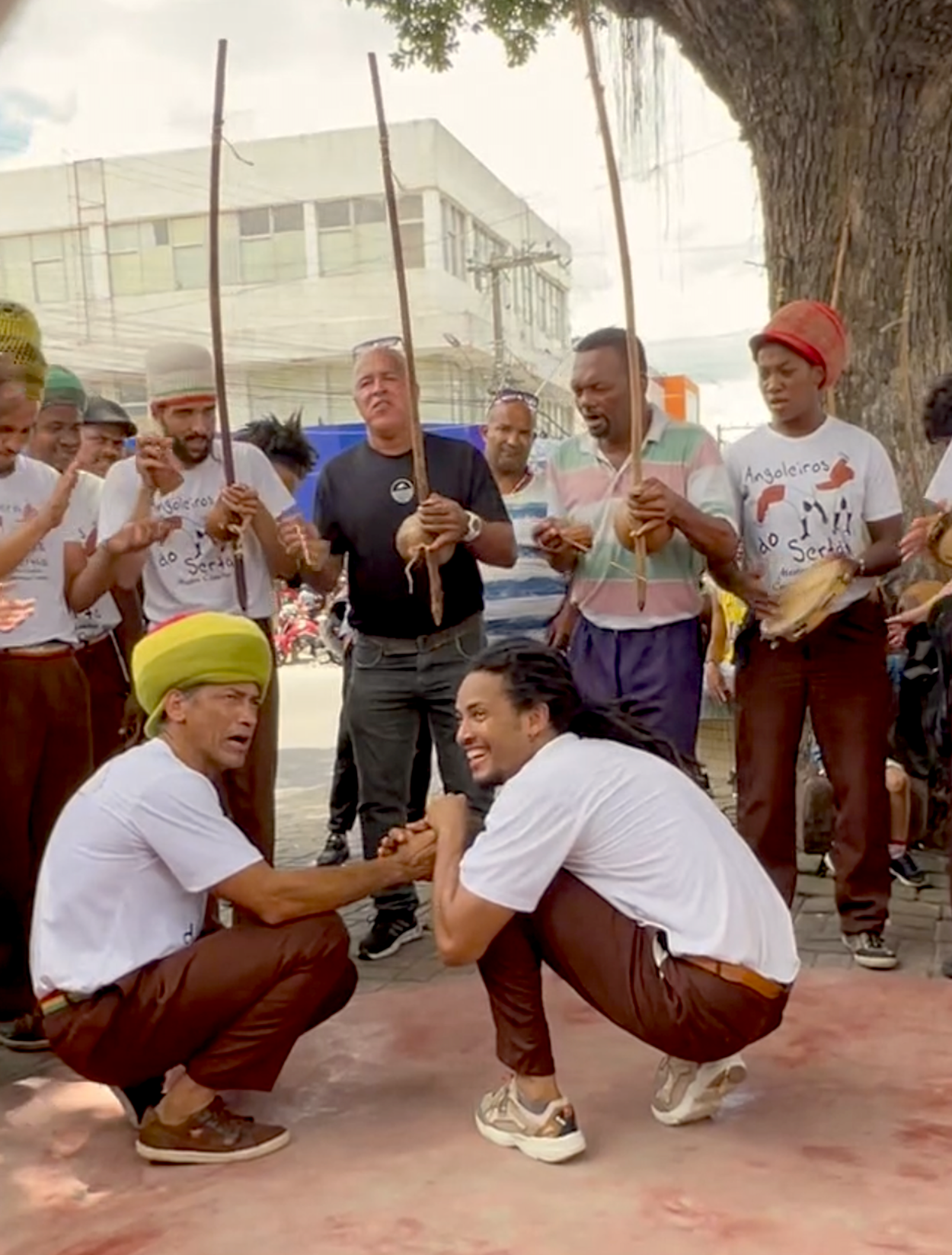
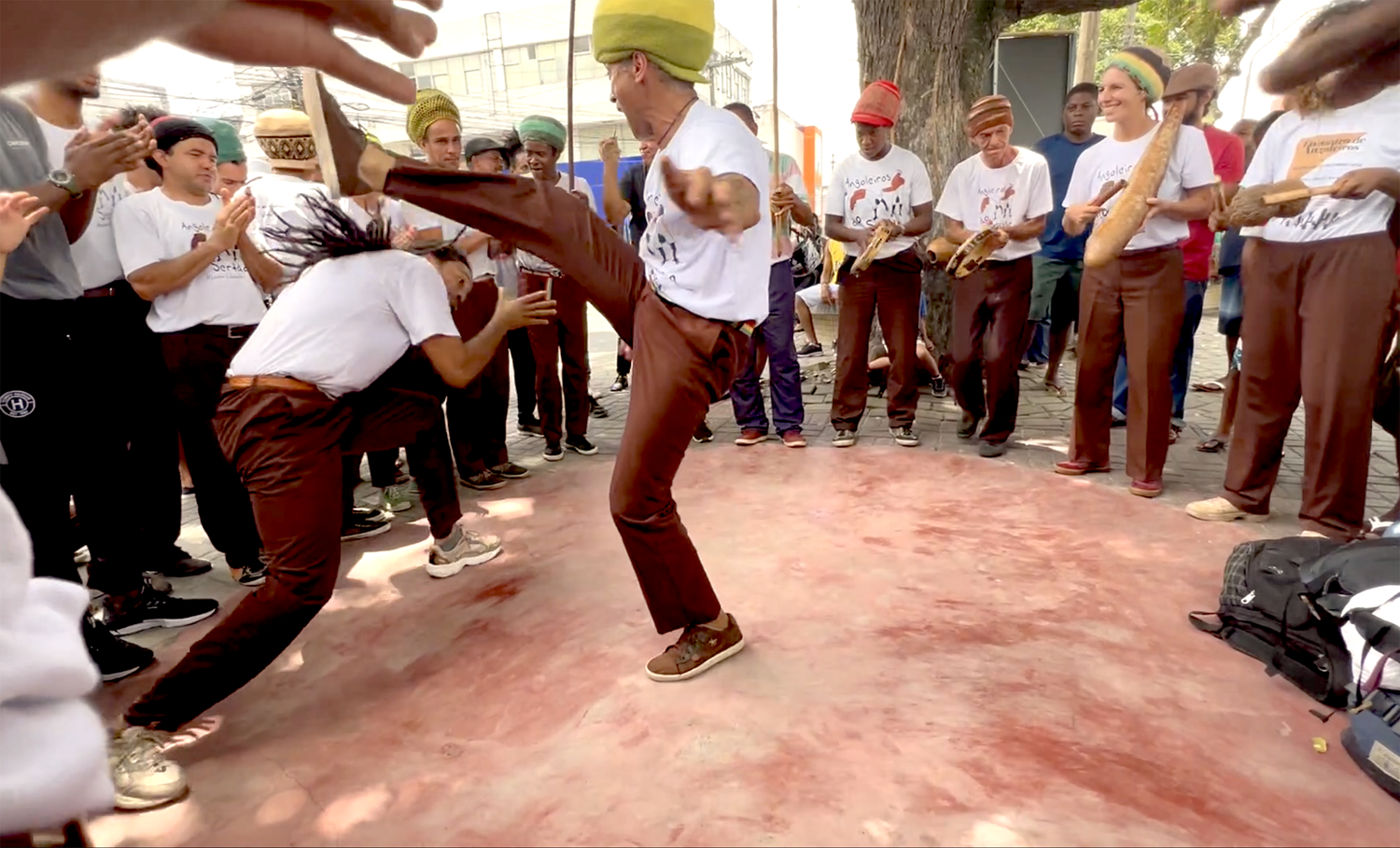
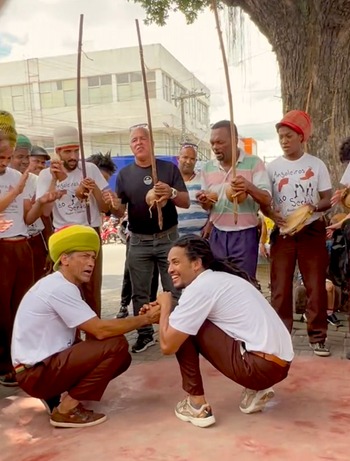
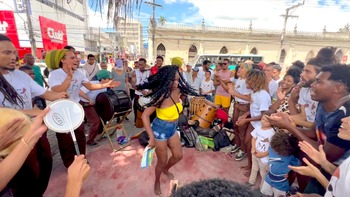
Every Saturday morning, on a wide median strip of a main avenue of Feira de Santana, Bahia, Brazil, the Angoleiros do Sertão (Capoeira Angola Players of the Backlands) play capoeira, a fight-game played to live music, which they follow with their rural style of samba.Footnote 1 Forming a roda (circular space of play and the performance event) with their bodies, group members take turns playing percussion instruments and playing capoeira two at a time. Mestre Cláudio Costa, the group's founder and teacher, holds the lead berra-boi berimbau, the bowed single string instrument, suspending its weight on his left pinky finger, clutching the seed rattle caxixi and wooden stick baqueta, with which he strikes the berimbau string, sounding signals to direct the capoeira play in the ring. After singing the solemn opening ladainha, he sings, “Iê! Viva Bahia!” and the group responds in full-voiced chorus, “Iê! Viva Bahia, camará!” Soon a capoeira game will start. (See Figures 1 and 2).
Mestre Cláudio, left, and Treinel (advanced teacher) Hulluca, right, crouch at the feet of the three berimbau (stringed bow resonator gourd instruments) players, before beginning a game in Feira de Santana, January 2023. Photo by the author.
Treinel Hulluca, left, and Mestre Cláudio, right, playing capoeira at the Saturday roda in Feira de Santana, January 2023. Photo by the author.
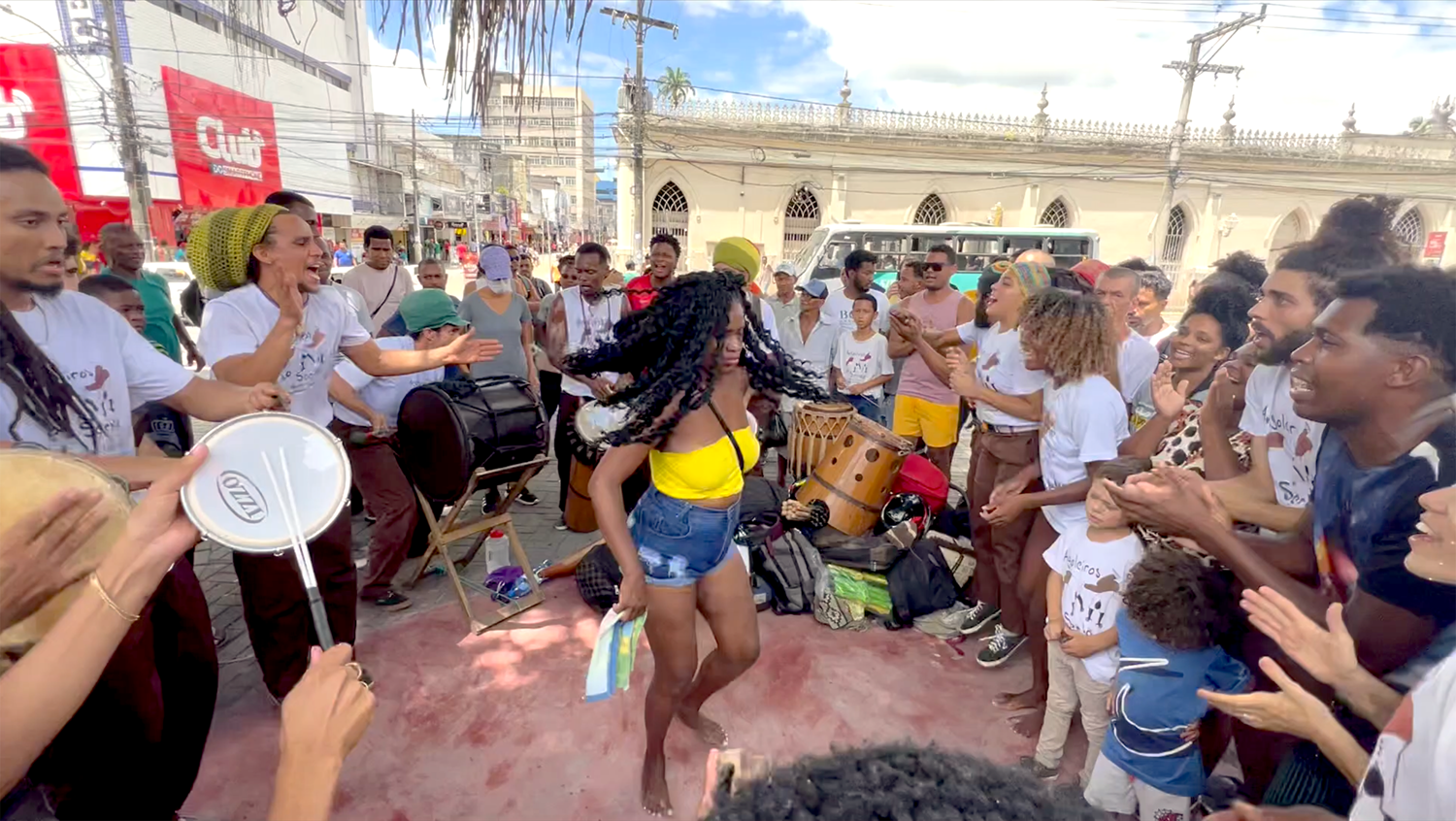
When the capoeira ends, the samba begins, and residents of Feira de Santana and the surrounding region eagerly join in the samba's rapid shaking steps and high-energy clapping and singing. Like Mestre Cláudio, most community members are of African descent.Footnote 2 They are workers catching the roda before or after shifts at construction sites, call centers, and as security guards. They are shoppers on a busy market day in a city named for its markets (feira means market), carrying produce and other products in tightly tied plastic bags, which they leave at the edge of the roda when they enter to samba. The capoeira group members are slightly more racially diverse, counting more white members of European descent, especially when including visitors from more southern states in Brazil and abroad. They wear the group's uniform of brown pants and white shirt with group logo, many with their hair tucked into rasta tams. Everyone understands that by participating in the capoeira and samba, they are supporting Mestre Cláudio's commitment to Bahia's Black cultura popular (popular culture) as practiced by the rural communities in Bahia's interior, the arid sertão (backlands) (see Figure 3).Footnote 3
Samba dancer in the roda. Hulluca plays triangle (obscured) at far left. Contramestre Orikerê claps and sings to Hulluca's left. Feira de Santana, January 2023. Photo by the author.
Many months earlier, Mestre Cláudio had harvested the cabaça gourd that forms the berimbau's resonator from a patch of his land. Months prior to harvest, he had planted the seeds and tended their growth. Months from now, the group will again hold its annual January event; but before the first guests arrive at the Mestre's plot of land on the rural outskirts of Feira de Santana, roughly a hundred kilometers northwest of Bahia's coastal capital Salvador, he and Rita, a long-time capoeira Angola practitioner, group member, and the mestre's wife, will have prepared for the event. They will have coordinated his students, delegated tasks, working more intensely in the weeks leading up to the event, clearing land, repairing structures, making instruments, organizing logistics, and securing the attendance of renowned mestres and artists of cultura popular. When Rita or the mestre call for group members to help, they are expected to respond by rising to the task at hand.
Years ago, one capoeira player in the ring was a young boy growing up in a periphery (periferia) of Feira.Footnote 4 Today he claims that capoeira has shielded him from the violence that encroached on his life, from police or drug traffickers, and he has started to teach his own capoeira classes. Years from now, another young player, today still getting her footing, moving with awkward sudden motions in the roda, will also start teaching a group of her own, in another periphery, passing on the knowledge ways of capoeira Angola to a younger generation.
~
Capoeira players often talk about the roda as a microcosm of society: The smaller capoeira game transmits skills and wisdom applicable to the larger “game of life.”Footnote 5 This article considers the ways in which one specific musical-embodied aspect of capoeira play extends into practitioners’ lives before and after the roda. I focus on call and response—the mechanisms by which sounds and movements summon responses of sound or movement—and show that capoeira Angola practitioners experience call and response not only as a musical trope but also a summons to assume ethical responsibilities beyond moments of musical interplay. Closely considering the ways that call and response organizes sociality, I argue that the music and movement of capoeira call practitioners to respond by entering ethical relationships with one another and the broader Black community of backland Bahia.
This article takes as a given that musical practices can reveal, influence, and reinforce a group's ethics and sense of community.Footnote 6 This case study contributes by revealing how Black music-dance practices across the Americas generate ethical knowledge through their sounds, performance practices, and movements—that is, how they transmit ethics in nonverbal, sonic, and corporeal forms. Although call and response is a prominent feature of African diasporic music-dance forms, exceedingly familiar to (ethno)musicologists and practitioners alike, I offer a close reconsideration of antiphony's ethical potentials, which the literature consistently acknowledges but rarely explores in depth. I further argue that scholars and philosophers of ethics would do well to consider more seriously the ethical knowledges generated within African diasporic music-movement practices. However, following Kofi Agawu, I recognize the difficulty of defining abstract ethical norms.Footnote 7 I focus, therefore, on the “specific, local situations” that arise among the Angoleiros do Sertão, a capoeira group based in the backlands of Bahia, in the first decades of the twenty-first century.Footnote 8 In this way, the article brings ethnographic specificity to the social, ethical, and political possibilities of call and response.
Capoeira Angola is an Afro-Brazilian music-movement form played in a ring of practitioners’ bodies, with eight instrumentalists playing percussion who are periodically replaced by the other players who complete the circle.Footnote 9 Ability allowing, everyone takes turns playing the instruments and the capoeira games (two players at a time, inside the circle) with more advanced practitioners playing the berimbaus, choosing songs, and leading the event. Call and response is fundamental to capoeira practice, not only in the song structures (a leader sings the call and the chorus responds) but also in the ways that the music and sounds call practitioners to move. In our interview, Rita, who identifies as white, described how the music even calls to people on the street, pulling their bodies towards the roda:
“It's a call [chama]! It practically drags you there! It pulls you! … It calls my attention! … I need to be there!’”
Seeking to confirm that the sounds had a physical effect, I prompted, “And you'll feel it, too—”
“You will get involved,” she corrected me. “You'll feel the energy, the involvement of this movement … It's the energy, it's the comprometimento [commitment] with the work. The ogans [drummers of Candomblé] are extremely committed to the terreiro [house] of Candomblé [the Afro-Brazilian religion]. Just as we have to be very committed to capoeira, to take care of the instruments, not to leave them without someone watching them. It is this same responsibility.”
Still focused on the corporeal, I asked, “And it's also bodily? The drums, the berimbaus, the music—”
“—are what involve you!”
Later in the interview, Rita summarized, “[This] is how everything fits together. How the game of question and response [pergunta e resposta] exists.”
“And,” I added, “this thing of everything being so connected. You can't separate the samba from the capoeira—”
“You can't be more committed to samba than to capoeira. The responsibility is the same.”Footnote 10
Throughout our interview, as I asked about bodily perception of sound and connections between practices, Rita gently but firmly insisted that the calling on bodies to join the movement led to deeper commitments. Rita patiently redirected my attention to the ways in which the sounds of the capoeira and samba rodas “involve” people by calling on them to assume responsibilities in their lives. The sonic calls of the berimbau or the samba drums pull bodies into the roda and into motion, but Rita wanted me to understand that what begins as sound calling bodies to enter the roda and move, sing, play, or samba becomes a summons to deeper involvement. Being called into the roda involves practitioners in the social movement of the Angoleiros do Sertão, summoning them to take on commitments that extend far beyond the roda. In this way, Rita insisted that capoeira's game of question and response resonates beyond the roda.
Mestre Cláudio often refers to this deep, broad sense of commitment as compromisso (commitment, obligation, and/or promise). Spending time with him over the years (since 2013), I've learned that Mestre Cláudio prefers to teach by example rather than verbal explanation, but on one occasion he discussed compromisso explicitly. In 2016, he was giving a masterclass for a new satellite group in Northeastern Brazil that he had recently welcomed into the Angoleiros do Sertão. After an intensive training, we sat on the floor in a loose circle and listened to his impromptu lecture. He began by telling us that when a Candomblé adept suffers a negative situation in their life, often their spiritual leader (mãe- or pai-de-santo) will recommend that they fulfill an obligation (obrigação) to appease their orixá (divine being/energy). Mestre Cláudio said that in his experience capoeira was similar. He explained that he has often heard practitioners complain that capoeira wasn't delivering the benefits they had expected, such as earning a steady income from a dedicated group of students. Yet, he asked, before complaining about what capoeira hadn't given them, had they asked themselves what they had given to capoeira? This, he told us, was compromisso: understanding that to practice capoeira is to assume obligations to capoeira itself. He said, “Capoeira dá, mas ela cobra.” (Capoeira gives, but it also demands payment.) Responding to capoeira's call means making a long-term commitment to capoeira, assuming ongoing responsibilities, and continually asking oneself, “Am I giving enough to capoeira?” It seemed he was telling us, his students, not to expect to gain from capoeira if we haven't committed ourselves to capoeira. Yet he left it up to us to figure out what exactly this looked like in practice.
In what follows, I consider the ways that capoeira calls its practitioners into compromisso and how they respond by assuming certain responsibilities in their lives. Visiting and leaving Mestre Cláudio's roça numerous times since 2013 to conduct ethnographic research, I have thought about compromisso both as a concept significant for group members and in terms of what demands it might make on me personally, given my relatively unique position (within the group) as a white North American researcher and only part-time student. Indeed, my interest in compromisso is also driven by my broader concerns with ethnographic ethics and the issues that arise when white researchers study African diasporic practices.Footnote 11 Here I propose that the concept of compromisso, as embodied in capoeira Angola practice, has much to contribute to discussions of ethical philosophy.Footnote 12
I proceed by making a case for understanding call and response as not only a musical mechanism but also an ethics. Capoeira players commonly speak of the music/sound as a “call” (chama) that summons bodies into motion. Yet as Rita stressed, responding musically and physically also involves practitioners more deeply in the practice, leading them to assume responsibilities and commitments. Remarkably, given the prominence of call and response in African diasporic music-dance practices and the wide scholarly recognition that call and response also structures sociality within those practices, very little of the literature examines the ethical implications of call and response in depth. In contrast, numerous philosophical essays consider ethics in terms of call and response when drawing on Emmanuel Levinas's ethical philosophy, which theorizes the encounter with an other as issuing a call that summons ethical responsibility. However, the literature on Levinasian ethics in turn overlooks both the knowledge generated in Black music-movement practices and African(a) philosophical literature.Footnote 13 As a corrective, I consider how the ethics of compromisso in capoeira resonates with Africana philosophy, especially with theorizations of responsibility to community as expressed through the concept of ubuntu. Returning to the capoeira roda, I describe how sound summons responses in the moments of the game. Then I expand beyond the roda, in space and time, to explore how the smaller frequencies of the roda spiral outward, as calls and responses repeat (but always with variation or difference) over weeks, years, and generations.Footnote 14 By bringing together ethical Africana philosophy with scholarship and ethnography on call and response in Black music-movement practices, I argue that capoeira's call and response does more than structure musical and bodily exchanges; it also regulates the capoeira community's ethics, calling upon members to respond in myriad ways.
Call and Response as Ethics
Scholars of African diasporic music and dance forms widely recognize call and response, or antiphony, as a prominent structure—one of the most foundational “mechanics of delivery”—in Black music and dance.Footnote 15 Mellonee Burnim has shown that the inclusive imperative of call and response opens up space for “everyone to participate” and, through repetition, creatively modify lyrics, melodies, rhythms, and textures.Footnote 16 Declaring its significance for the musics and people of the Black Atlantic, Paul Gilroy found antiphony to be the “principal formal feature of [Black Atlantic] musical traditions,” a practice that is at once “democratic, communitarian” and that “symbolizes and anticipates (but does not guarantee) new, non-dominating social relationships.”Footnote 17 Tracing call and response as an Africanist aesthetic across numerous African diasporic music-dance practices, hip hop dance scholar Imani Kai Johnson notes that a significant function of call and response is “keeping up the spirit” (or putting in the axé, as I discuss below), which reveals “call and response as an approach that deepens an individual's relationship to the collective through the body.”Footnote 18 Taken together, these passages suggest that call and response generates inclusive, ethical modes of embodied participation and belonging in community.
Brazilian scholars also frequently acknowledge the centrality of call and response to Afro-Brazilian music-dance practices, though practitioners more often speak of pergunta e resposta (question and answer), as Rita did above. Scholars additionally refer to solo-refrão (solo-refrain), verso e refrão (verse and refrain), or simply solo e coro/grupo (solo and chorus/group).Footnote 19 Still it is clear that all these terms refer to the same phenomenon, as when Brazilian capoeira scholar Cristina Rosa writes (in English) that “across their call-and-response dialogues, capoeira players propose metaphorical questions to ‘test’ the other in the hope that their opponent will eventually run out of answers or will be unable to improvise them in a timely fashion.”Footnote 20 However, as in much of the North American literature, in Brazilian literature call and response seems largely to be taken for granted: few scholars have explored in depth how the musical mechanism reverberates in social or ethical thought and behavior.
Samuel Floyd has offered one of the most extensive explorations of call-and-response musical devices through his concept of Call-Response, “the master trope, the musical trope of tropes,” which he leveraged to define a “culture-specific approach” to analyzing Black music so as to reveal its deeper meanings and complexities.Footnote 21 Black popular culture scholar Angela Nelson applied Floyd's concept to find that, in a profound sense, call and response “encourages and maintains spiritual harmony, a sense of group solidarity, and validates aesthetic and cultural values.”Footnote 22 Ingrid Monson also noted that as a “fundamentally social, conversational, and dialogic way to organize musical performance,” call and response structures the sociality of communities of practice.Footnote 23 I extend these insights further to explore how call and response organizes community members’ ethical ways of being beyond performance contexts.
Doing so, I am also inspired by Shana Redmond's expansive approach to antiphony in her theoretically rich rumination on Paul Robeson's life, work, politics, and art. With Robeson's life as model, Redmond invokes “Black antiphonal life” as “a method of engagement with and challenge to the brutalities of the ‘afterlife of slavery,’” citing Saidiya Hartman's generative framing of the ways that the logics and legacies of slavery sustain conditions in which “black lives are still imperiled and devalued by a racial calculus and a political arithmetic that were entrenched centuries ago.”Footnote 24 “Black antiphonal life,” Redmond explains, “arrives as a vibrational practice shared openly and freely, across space and time.”Footnote 25 As I interpret Redmond's theorization, the vibrations of call and response, resonating beyond the space-times of musical events and individual lifespans, can summon people again and again to address and redress the persisting racial harms of systemic white supremacy. Calls must repeat over time and responses must transform into future calls as long as racialized violence endures. This is what determines the ongoing, “non-linear and open-ended” nature of Black antiphonal life.Footnote 26
Listening to the sounds and movements of the Angoleiros do Sertão in the roda and in their lives, I ask how call-and-response vibrations resonate throughout their community, calling upon members to live Black antiphonal lives. Considering the ethical dimensions of antiphony, I explore how intensive embodied participation in the calls and responses of capoeira Angola summons broader ethical responses from practitioners. As capoeira practice orients players to call and respond in specific ways with sound and movement, this further reorients their ways of thinking and being, summoning them to assume responsibilities and make commitments not only to capoeira practice and their group, but also to the wider Black community.
Levinas's Ethical Philosophy and Ubuntu
The work of French philosopher Emmanuel Levinas has had a profound influence on theorists and philosophers of ethical responsibility. Levinas argued that ethical responsibility arises in the face-to-face encounter with “the other” because the face of the other issues forth a summons, demand, or call for ethical response.Footnote 27 As Levinas wrote, “the face before me summons me, calls for me, begs for me … and in so doing recalls my responsibility,” for in “responding, I discover my responsibility to them.”Footnote 28 Levinas's language thus eloquently echoes the musical terms of call and response, thereby lending them greater gravitas: Could musical and corporeal calls not also summon more fundamental ethical responsibilities? Notably, Levinas also understands responsibility as inexhaustible: “As responsible, I am never finished with emptying myself of myself. There is infinite increase in this exhausting of oneself.”Footnote 29 The ethical responsibility summoned by one's encounter with another person is never ending. Likewise, one's compromisso with capoeira is unending. Levinas's ethical philosophy could therefore inform an understanding of capoeira's ethics, yet I propose that the reverse is also true. Ethical philosophers have much to gain by seriously considering capoeira and other African diasporic music-dance forms as constituting their own traditions of ethical thought.Footnote 30
Moreover, despite these productive resonances, Levinas's thinking does not align seamlessly with compromisso as practiced by the Angoleiros do Sertão. Most difficult to reconcile, perhaps, is Levinas's insistence on the absolute alterity and abstraction of “the other.” This reduces the other to its otherness; removes it from “the particular and worldly encounters in which beings are constituted in and through their relationship to one another”; and thus “conceal[s] the particularity of others.”Footnote 31 Sara Ahmed proposes that attending to the “particular or finite circumstances” in which others encounter one another “may open up the possibility of an ethics that … resist[s] thematising others as ‘the other.’”Footnote 32 Staying grounded in particularity “helps us to move beyond the [Levinasian] dialectic of self-other and towards a recognition of the differentiation between others.”Footnote 33 Ahmed's critique of Levinas thus maintains the truism that everyone is other to everyone else—which surely was Levinas’ point, that we are each unique beings who can only perceive the world through our own bodies-selves—while shifting the focus to recognizing differences among others (some of whom are invariably deemed more “other” than others). Moving beyond the self-other dialectic further allows questions of how members of communities conceive of their responsibilities to one another and to other communities.
Members of the Angoleiros do Sertão, when discussing responsibility, rarely speak in first-person Levinasian terms—“(my)self” facing “the other.” Rather, they use “we” and “us” and talk in terms of collective ethical responsibilities to their communities, especially Brazil's Black peripheries that are “othered” by dominant society. Attending to the particularity of how group members experience their encounters with one another reveals that they differentiate among others above all when recognizing that white supremacist systems subjugate and marginalize Black people. How do those who are violently othered conceive of their responsibilities to others and to whom do they feel most committed? I found that group members’ ethical thinking resonates powerfully with philosophical discussions of ubuntu—a term familiar to group members as it also circulates widely among Black movement activists and communities in Brazil.
Archbishop Desmond Tutu famously evoked the ubuntu concept in the mid-1990s when searching for language to express the common humanity of South African citizens, both victims and perpetrators of apartheid violence, as the country attempted to heal in its post-apartheid era.Footnote 34 Commonly translated as “I am because we are” (or in Portuguese, “Eu sou, porque nós somos”) ubuntu has since been debated and theorized by numerous (South) African and diasporic philosophers. Many philosophers and laypeople alike consider ubuntu the foundation of African(a) ethical thought.Footnote 35 As ubuntu has traversed oceans, contexts, time, and space, theorizers and philosophers have interpreted it variously and to diverse ends, and many diasporic Africans across the Americas have embraced ubuntu as an idealistic counter to the cult of Western individualism. In Brazil, ubuntu has received extensive philosophical, academic, and popular attention in recent years, circulating widely in literature, memes, forwarded WhatsApp videos, and dozens of articles on geledes.org, the popular online activist platform of the Geledés Institute of the Black Woman.Footnote 36 Brazilian scholars have used ubuntu to argue, for example, against competition and for “collaborative solidarity” in education; to call for tolerance to bolster a democracy in crisis; and as a basis for a decolonial Afro-Brazilian philosophy.Footnote 37
In popular discourse, ubuntu is often leveraged simply to express that community matters, or to paraphrase, I would not exist without my community. As I describe below, capoeira practice embodies such an ubuntu ethic: Just as the roda needs a critical mass of players to complete and close the circle, an individual angoleiro cannot learn, train, and play capoeira without the group. They might say, “I am (and can be) an angoleiro only because we are angoleiros.” In the abstract, ubuntu is an ideal that prioritizes friendliness, care, and compassion in service of community and social harmony.Footnote 38 However, the ease with which such values can be embraced masks the difficulty of putting them into practice. Recalling both Agawu's call for specifics and Ahmed's similar call for particularity, I briefly consider the South African context to inform my discussion of ubuntu.Footnote 39
In No Future Without Forgiveness, Tutu arrived at ubuntu as an explanation for why South Africans had decided (collectively, after negotiations) neither to hold perpetrators accountable in court nor to grant them general amnesty, but rather to form the Truth and Reconciliation Commission, which would enable victims to meet and forgive perpetrators.Footnote 40 This context reveals not only the radical potential of ubuntu, but also its complexity. Pumla Gobodo-Madikizela, a South African scholar of violence and intergenerational trauma, reminds us that the now well-worn word “ubuntu” stands in for a longer proverb which in isiXhosa goes, “Umntu ngumntu ngabanye abantu,” which she says can be translated as, “‘A person is a person through being witnessed by, and engaging in reciprocal witnessing of other persons,’ or, ‘A person becomes a human being through the multiplicity of relationships with others.’”Footnote 41 Gobodo-Madikizela identifies two meanings embedded in the proverb: “First, subjectivity depends on being witnessed; … Second, the phrase conveys the kind of reciprocity that calls on people to be ethical subjects.”Footnote 42 In other words, I depend upon others to witness, recognize, and thereby summon forth my humanity, and this ushers a call for me to do the same with others. Their humanity also depends upon my witnessing. Or in Levinas's terms, just as the face of the other issues forth a call for my ethical response, my face summons a responsibility in the other.
The particularity of the South African context is significant when thinking about what ubuntu might mean in Brazil. In both places, Black subjects continue to wrestle with enduring dehumanization, trauma, and violence. If ubuntu “speaks of the very essence of being human,” then it is deeply relevant in contexts where some are deemed less human than others.Footnote 43 Putting ubuntu into practice, therefore, can also be understood as belonging to a broader project of defining new ways of “being human as praxis.”Footnote 44 Among the Angoleiros do Sertão, this means witnessing and summoning forth the humanity of Bahia's marginalized Black communities. By acknowledging the Black Bahian community as originators and guardians of cultura popular, which includes capoeira, samba, and other expressions, the Angoleiros do Sertão recognize that their beloved practices have been sustained only through the broader community's support, historically and through the present. This is why their compromisso to capoeira necessarily extends to the community and aligns with the ubuntu ethic of recognizing, witnessing, and confirming one another's humanity.Footnote 45
Turning now to the sonic-corporeal calls in the roda, I consider how they summon players to assume a compromisso with capoeira, invoking responses that resonate antiphonally through practitioners’ lives, and ultimately call on them to witness their own and one another's humanity.
Calling and Responding in the Roda
Group members’ compromisso manifests both materially and energetically in and around the roda, and it can be expressed as a series of responsibilities players take on to sustain the roda's calls and responses. On a material level, the roda requires bodies and instruments. Time and again I heard Mestre Cláudio warn his students not to miss the Saturday roda. They should arrive at nine o'clock in the morning, even though the capoeira doesn't usually begin until eleven or noon. First they have to fetch the instruments from the storage space several blocks away. Then they must string up and tune the berimbaus, at least two of each size, adjust and tune the drums, and make any necessary minor repairs. The bateria, the roda's instrumental ensemble, requires at least eight competent players for the three berimbaus, two pandeiros, the atabaque, and the “instruments of effect” (as Rita called them) reco-reco and agogô; but more than eight players are needed to switch out and give everyone a chance to play capoeira, too. Students must take on these responsibilities to sustain the weekly roda.
The physical presence of bodies is also needed to generate the less visible but equally tangible energy of the roda, which group members often refer to as axé.Footnote 46 The roda needs bodies not simply to complete the circle, for aesthetic or spatial reasons, delineating the space of play. A roda with too many “holes,” without enough bodies to close the circle, is also considered too “open.” Too much space between bodies will prompt the mestre to cry, “Fech’ a roda!” (Close the roda!). In rodas without enough participants to close the circle, it seems as if the axé escapes through the gaps between bodies. Such rodas tend to feel sluggish, as if running through mud, and exhausting, like pouring water into a leaking bucket. The sounds of the roda dissipate and the axé disperses. The closed ring of players keeps the energy circulating, amplifying, and reverberating among participants’ bodies. At a bare minimum, therefore, a compromisso with capoeira Angola calls for players to be present and participate.
Producing axé-energy, however, requires more than just showing up and joining in the calls and responses. To create energy, everyone must play their instruments and games in the right way: Participants must play the instruments “with attitude,” as Mestre Cláudio puts it, and the chorus must respond with full voice. Rita related how the Mestre instructs his students: “When you are on the instrument, [he says] give yourself! You must give yourself! … Give the best of yourself, play the best you can, because whoever is playing depends on your best!”Footnote 47 Practitioners also express this as giving (dar) axé or putting (botar) axé into the music. Binho, a Black group member and Candomblé practitioner in Feira, explained, “When we say, ‘Let's put in axé!’ it means we have to exert ourselves a bit more, put in more energy, make something happen—sing more, play more. You see how the samba sometimes falls [the energy dips]? When it rises up again, the axé is there!”Footnote 48 Afonso Mesquita, a white member from São Paulo state, underscored the essential role the responding chorus plays: “The chorus is very important! We don't talk much about it, but what gives the roda axé is the chorus! … A really great roda has thirty people, eight playing [instruments] and twenty-two responding. That's axé! This is why capoeira brings people together [agrega]. … The secret isn't in any one individual person, but in the thirty, the combination.”Footnote 49 Playing music with axé is a generous, collective action that not only fuels the games but also calls the community into being.
Playing with axé and “attitude” in turn requires specific bodily commitments. Mestre Cláudio demonstrates playing instruments with “attitude” through bodily posture, centering his weight equally on both legs, head up, with serious, focused attention and an alert, proud stance. He critiques his students if they slouch or stand with their weight on one leg, a hip jutting out, while playing instruments in the roda. This committed bodily attitude directly impacts the bodily ability of the players in the ring, as Rita explained:
If the game is governed by what's being played, and if you're playing with little energy, with bad music, naturally the game will be bad, with little energy. It will be difficult for things to flow well, for the game of question and response to occur. In this moment, the body needs the incentive of the music in order to react.Footnote 50
Rita drew a direct connection: Players’ bodies need the musicians to play with axé because this enables them to respond and call to one another. The singers and percussionists are responsible for players’ ability to respond—their response-ability.Footnote 51
Responding with movement—playing capoeira—to the axé-infused sounds of the roda also requires putting in energy. Contramestre Orikerê, a dedicated Black group member with many years of experience, described playing capoeira with axé in this way: “Axé is when you give your body, you sweat for it, you really throw yourself!”Footnote 52 This is where the distinction between calls and responses begins to blur, for calling with the appropriate energy summons an equally energetic response, which calls back to the callers who respond with more calls. These calls and responses happen among all participants—singers, instrumentalists, capoeira players, samba dancers—and the reciprocal cycle of energy exchange is what keeps the axé high and circulating.
Responding to capoeira's call thus means accepting multiple responsibilities within the micromoments of the roda, and these extend into students’ lives (showing up early to the roda, repairing instruments) and to communities beyond the group. Binho asserted that playing in the roda is a great responsibility that extends to the Black community of Feira, whose cultural practices face increasing demonization from evangelical leaders.Footnote 53 In what could be seen as a continuation of historical practices of mutual protection between capoeira practitioners and Candomblé houses, the Saturday roda provides a space of refuge where Black community members can openly and safely participate in practices they cherish. In this context, Binho explained:
You know you are doing good for yourself, and at the same time you are passing on some of the culture, which few people truly value. And you have the responsibility. You know there are people depending on you to show up and contribute to it. This Saturday roda, for us here in Feira, it's a total responsibility. We have to do that roda because the people are expecting it, waiting for it, every Saturday. It's a complete responsibility.Footnote 54
Binho's and other group members’ compromisso with community members in the ring reveals the tremendous sense of care with which they dedicate themselves to capoeira. Given the direct relationship between musicians giving their best and people playing or dancing their best in the ring, holding an instrument is akin to holding their bodies in one's hands. Indeed, the Portuguese verb for playing music, tocar, also means “to touch,” and the term for rhythmic pattern, toque, also translates as the noun “touch.”Footnote 55 Playing the instruments, directing the sounds, tocando, one is directing, moving, touching, and caring for bodies in the community.
Experiencing the Calls
Group members often described experiencing the sounds calling their bodies as being carried (away), cared for, or accompanied by someone. Solange, a Black group member from Feira, said, “For me, it's just me and the other person playing there, the music that's singing, and I try not to think about the movements. I don't think! I do the movements that come, I get excited/carried away! [Eu me empolgo!] It's as if another person enters into me at that moment.”Footnote 56 Binho also noted that the music helped narrow his focus: “To be totally truthful, in that moment, when I'm playing, I only see my partner and the bateria. … I don't see anything else. … The sintonia [syntony, alignment of frequencies] carries your body. … The music does all of this.” Both Solange and Binho experienced the calls of the roda—the songs, vibrations, and frequencies—as honing their attention and aiding or carrying their movements.
Flavinha, a Black practitioner of Candomblé, group member, and professional dancer of Afro-Brazilian styles compared the experience to “possession” because “it makes [her] feel like [she's] not alone.” She clarified that she had never experienced possession in Candomblé, but she imagined that her sensations in the roda were “very close” to those experienced by Candomblé adepts. She explained:
Because I feel in the capoeira roda, in the game, that it's not necessarily I, Flávia, who's talking with you and when she dances, thinking, “I'm going to do this movement, and, oooo how nice it feels!” No, it's not within my control. My movement is submitted to the movement of the other, and the tension of having everyone around, encircling [us], the rhythm—for me, the moment of the game borders a lot on this thing of non-total control between the mind and the body, because it's a corporeal conversation. You are not alone there. You can't do whatever you want.Footnote 57
Capoeira players’ altered states of consciousness are often referred to as a kind of trance,Footnote 58 and practitioners sometimes use this term, but here I emphasize not the terminology but the sensations of not being alone—of being accompanied. Responding to the calls, practitioners experienced an extraordinary sense of being aided, cared for, and carried by the presences in the roda, which in addition to the other players may include ancestors, entities, sounds, energies, vibrations, or all of the above.
Playing music in capoeira and samba thus means being responsible for the other bodies in the roda, carrying them (giving energy so they can play better) and caring for them, and this responsibility extends to everyone who shows up. When Binho spoke of a “total responsibility,” therefore, he gestured beyond the capoeira group. When Rita insisted that the call of the music involves you, she emphasized that practitioners' compromisso also extends beyond the space-times of rodas, revealing that the roda's call and response directs more than the sounds and bodies in the roda. Indeed, call and response “has a ritualistic quality that ‘restores,’ ‘reconciles,’ ‘regenerates,’ and ‘recuperates’ the humanity of black people.”Footnote 59 In this expansive sense, then, call and response orientations “embody the solutions to the problems of Africana people around the world.”Footnote 60 They are “blueprints” for action.Footnote 61 Taking on their compromisso, Mestre Cláudio's students respond to capoeira's calls by assuming responsibilities to care for one another and the broader community beyond the group, including past and future generations of practitioners and aggrieved Black communities in Brazil.
Responding to the Call of Compromisso Beyond the Roda
Weekly and yearly frequencies
As with much cultura popular in Brazil and Black cultural manifestations across the diaspora, the capoeira group operates along regularly repeating temporal cycles. During the periods I visited the group, weekly trainings took place on Monday, Wednesday, and Friday evenings, and members gathered on the street in Feira every Saturday morning to play capoeira and samba. Yet students also dedicated themselves to other activities throughout the week, such as practicing instruments and training capoeira alone or in small groups. A growing number of group members also teach satellite groups, throughout the city and its peripheries. These dedicated activities make up the weekly cycle, culminating in Saturday's roda, a ritual event that group members eagerly anticipate, some rearranging schedules and traveling long distances to attend.
Just as the Saturday roda punctuates the week, the group's annual event (evento) in January is the highlight of the year. Like a Candomblé house's annual public festa, the encounter (encontro, a more formal term) welcomes players from other groups and styles, and they arrive from all over Brazil and abroad, though members of the Angoleiros do Sertão still make up the majority. The event is held at Mestre Cláudio's roça,Footnote 62 his compound in the rural outskirts of Feira de Santana. Covering several acres, the Mestre's roça consists of two houses (one which has been under renovation for nearly a decade), a small apartment, a workshop for building instruments, and two capoeira training sheds (one still with open sides). There is also a swimming pool with covered bar and barbecue area, with a built-in grilling oven (churrasqueira). The rest of the land is covered with various fruit trees (coconuts, mangos, cashews) and low brush. Attending capoeira practitioners bring their own tents and sleeping mats and camp out for the duration of the event. In recent years, by my estimates, the event has hosted over a hundred registered participants, perhaps exceeding two hundred in some years. Mestre Cláudio also opens his compound's gate to the local community for the event's Saturday night celebration. Soon after dark, community members arrive by motorcycle, horse, or car, dressed in their best fashion tees and dresses. The samba thunders all night long as the roda's centripetal force pulls bodies inward, and group and community members jostle one another in a joyous struggle to experience one fleeting moment in the center of the roda's vortex of axé.
An encounter of such scale requires months of preparation, with the intensity of the workload increasing exponentially as the event date approaches. Group members understand that if they arrive early to the event they will be expected to help. When I attended the event for my first time in January 2014, I also came a couple weeks early and observed that group members from near and far arrived gradually but steadily, setting up their tents in their preferred spots, whether favoring shade or a plot closer to or further from gathering areas. January in Brazil is summer, so many members had planned and budgeted so they could spend their vacation from work or school at the roça. The atmosphere was both relaxed and charged, with impromptu capoeira rodas, samba sessions, and pool lounging interspersed with manual labor. Yet since there were so many available hands, it never felt (to me) that any one person was working constantly—no one, that is, except for Rita, Mestre Cláudio's wife. Unable to take time off, she continued to work her full-time job in Salvador during the week and drove to the roça each weekend to coordinate the work being done there and unload supplies. These included spare tents, sleeping mats, trash bins, kitchen supplies, plastic coffee cups, plates, utensils, and non-perishable food. Rita's compromisso is profound.
One important and labor-intensive task every year is clearing the land of brush to make room for visitors’ tents. In 2014, I observed the male students performing the heavy task of slicing away the brush with large scythes, machetes, or hoes. After the brush was removed, I joined others in clearing the ground of twigs, stones, mango pits, coconut shells, and trash—anything that could poke into a tent floor—and stamping down softer grasses to create a flat surface. One year, I also worked with other women washing, drying, and waxing the slate tiles of the capoeira space floor. Each year there is any number of small tasks, from bleaching white plastic chairs to handwashing kitchen rags (also in bleach) and hanging them to dry in the sun over the barbed wire fencing at the property's edge. Other tasks include organizing the logistics of event registration, transportation, cleaning training spaces and bathrooms, setting up the temporary outhouses and showers. In addition to delegating tasks, Rita hires the cooks and arranges rentals of plastic tables, chairs, and catering supplies. She makes sure that tents are cleaned, repaired, and if necessary, purchased, then set up for the visiting mestres, who are guests of honor. One year she asked me to go around to each mestre's tent and place a bar of soap and a chocolate on each pillow, just like you'd find at a hotel. The event t-shirt also must be commissioned, designed, and printed well in advance. Rita assumes an outsized responsibility and her ethic of care permeates the preparations, but the event could not happen without the collective effort of group members.
Meanwhile, before the event begins, Mestre Cláudio will have seen to one or more major construction projects, whether building a new training space (the concrete floor was finished one year, the roof another) or a water tower to ensure there will be enough water for the hundreds of thirsty and bathing attendees. Each year, he also prepares several baterias worth of instruments. He grows cabaças, the gourds for the berimbaus, on his property. After harvesting the cabaças, he lays them to dry and harden, eventually cutting a circular opening, scraping out their seeds, and drilling holes for a string to fasten the gourd. Then he begins the task of “marrying” the gourds to their beribas, the stiff wooden rods that provide the bow's tension. Just as the group must maintain capoeira and samba instruments throughout the year for the roda every Saturday, Mestre Cláudio and his more advanced students must make sure there are enough instruments to sustain the many rodas that take place during event. In the weeks leading up to the event, they can be heard testing the berimbaus, playing and tuning them as someone listens from a short distance, switching out different cabaças, ensuring that there are enough berimbaus of each pitch range, from the large, lower berra-boi, the mid-range gunga, to the higher-pitched twangy viola.
Although the intensity of commitments ebbs and flows throughout the year, group members understand that their compromisso requires that they be ready to serve when needed. This commitment manifests most crucially in the weeks leading up to the annual event, but it also calls to members every week, as if each seven-day cycle were a microcosm of the annual cycle. As the years spiral outward, the call and response of compromisso likewise reverberates over time and space across generations.
Generational frequencies
During my first fieldwork trip to Mestre Cláudio's roça, in July 2013, he told me in one of our interviews about a project he had started roughly fourteen years earlier in Mantiba, his community in the rural outskirts of Feira de Santana. His intention was to create a center of capoeira education based in the periphery, where he had grown up, to give back to his community. Whereas many capoeira mestres leave their hometowns and migrate to wealthier cities in Brazil or the Global North, Mestre Cláudio always knew he wanted to live and teach capoeira in the roça where he grew up. Capoeira has enabled him to “envision new horizons” (enxergar novos horizontes), as he put it, and he wanted to bring this perception of expanded possibilities to the marginalized people—his people—of Feira's peripheries. He called the project “Oasis of the Sertão.”Footnote 63
The project took off. He gave capoeira classes every day of the week, mornings, afternoons, and evenings, with Sunday the day of the roda. Everyone came, children, adolescents, and adults. He had more than a hundred children taking his classes. It was a veritable espaço cultural, a space of cultura popular, where he taught samba de roda in addition to capoeira. The only problem was that he alone bore all the costs of the project. He had designed the project to serve his community, to offer them lessons in their own cultura popular free of charge. He also supplied the pants and shirts needed for training. Often he found himself putting down the work that sustained his livelihood, such as building percussion instruments for sale, to teach the classes because, he told me, if you start missing classes the students will become discouraged (vai desanimando). He realized at a certain point that it was no longer viable to continue the project in this way. He said, “As the saying goes, ‘If you stretch a rope too much, it will eventually break.’” (Corda que estique demais, uma hora ela quebra). He ended the project.
I sensed both regret and resignation in his voice as he told the story. It sounded like a marvelous project—imagine a hundred children throwing themselves into circular back-kicks (rabo de arraias) and cartwheels (aús). The Oasis fully embodied Mestre Cláudio's compromisso with capoeira and his community. Truly selflessly, he had set out to create a wellspring of popular wisdom and knowledge in the arid backlands, his native sertão of Bahia. He had tried to pass on to his community what he had gained from practicing the Afro-Brazilian art form of capoeira.
However, it proved unsustainable. Mestre Cláudio shunned public support from the city or state, a common source of funding in Brazil, because it was always term limited and subject to be discontinued by a new administration. He also had to earn a living to support himself and family members. He transitioned to teaching paid classes in Feira's city center, mostly to college students and others who could afford the monthly tuition. He also continued to travel, as he still does today, visiting his satellite schools in Brazil, Europe, and the US and teaching guest workshops at other schools all over Brazil and the world.
As Mestre Cláudio's students in Feira have matured, many of them have begun to teach in other peripheral neighborhoods of the city. For instance, at some point in 2015 or 2016, two students, Pernalonga and Solange, began teaching in a neighborhood called Subaé, a southeast periphery of Feira. Since they have moved to another city, while Solange pursues a PhD, another student has taken over the classes. At the end of 2017, Hulluca, Mestre Cláudio's son, began teaching in the CASEB neighborhood, in the northeast of the city. Then in August 2023, I saw that Hulluca posted on the group's WhatsApp chat that he had recently reinitiated the project in Mantiba, teaching residents of the community, “slowly giving continuity to the movement that has always existed” (devagarinho dando continuidade ao movimento que sempre existiu). He was referring to his father's Oasis of the Sertão, implying it had never really ended.
In October 2023, I called Hulluca for a phone interview to ask how the resurrection of the project in Mantiba was progressing. I began by explaining that I was writing an article about the compromisso group members have with capoeira, the Saturday roda, and the rural Black community of Feira. I asked,
“I'm wondering if you think this makes sense and if giving classes in Mantiba is also a kind of compromisso with the community?”
Hulluca responded, “I agree with what you're saying.” But he made clear that for him the terminology—calling it “compromisso”—was less important. It was necessary with capoeira, he told me, as with any kind of work, to understand why they were doing it. “Capoeira brings within us [Black Brazilians] a sense of identity. There is no way to think about identity without thinking about responsibility.”Footnote 64 For Hulluca the starting point was understanding how capoeira contributed to fostering Black Brazilian identity, and from that perspective it became obvious why he had to assume a compromisso. Regarding the newly resumed project in Mantiba, at the roça, Hulluca explained:
It's a project that already existed, through my father, Mestre Cláudio, and now I'm bringing it back again after thirteen, sixteen years, without having anything here. So I understand where capoeira comes from and I understand that it needs to occupy other places, only I also understand that we can't let it cease to exist in the place where it came from.
A vibrant theme of discussion with Mestre Cláudio and other concerned group members is the issue of who has access to capoeira training. As a fight-game-art developed by enslaved Africans and their descendants (“where capoeira comes from”), capoeira is widely considered a product of Black resilience and a tool for fighting oppression (physically, psychologically, mentally, and/or spiritually) and even seizing freedom. Whether or not enslaved people used capoeira to physically liberate themselves in the past, capoeira remains a powerful instrument for marginalized Black Brazilians to learn about their history and affirm the value of their culture and lives.Footnote 65 Yet as capoeira has spread across the world (the “other places” capoeira now occupies), Black Brazilians are now far outnumbered by non-Black and non-Brazilian practitioners. When Hulluca said “we can't let [capoeira] cease to exist in the place where it came from,” he underscored the importance of maintaining capoeira in Black Brazilian communities, where many of the descendants of capoeira's originators live today. Hulluca went on to explain the nature of the responsibility he has taken on:
When I think about bringing this [project] back, it's necessary for me to have responsibility. Aside from entering a space that I already am part of, it's a space where there are people who need care.
He talked about his sensitivity to different forms of “abandonment” the people may have been subjected to, abandoned by family members out of necessity or abandoned by the state, the government, and how this creates the need for a certain kind of “accompaniment,” following along with his students, regularly checking in with them. Hulluca seemed acutely attuned to the depth and breadth of the possible needs of his students and the resulting gravity of his commitment. He then explained why he took his compromisso so seriously:
From the moment that you move [movimentar] the community with capoeira—because capoeira is a space of identity, it strengthens our identities, so it moves [touches, mexe com] the Black people of the peripheries, of the Bahian sertão—so when you give these people access to capoeira, you're messing [mexendo] with a piece of their identity. So you need to have responsibility with the [social] movement [of capoeira] as much as with the people that are part of the movement.
Hulluca understood that being involved with capoeira meant being involved with the local community, inviting them into spaces of cultura popular not only because this was already their culture but also because participating in Black cultural practices could strengthen senses of belonging, pride, and self-esteem among Black community members.
Like his father, Hulluca assumes all costs for the project. However, for now the scale is significantly smaller, and he has received some financial support from friends and other contacts. He teaches Mondays and Wednesdays, around six children in the morning and fifteen to twenty adults and young adults in the evening. This allows him to continue his paid work teaching capoeira in the CASEB neighborhood.
Hulluca also explained how he needs to operate differently in each space:
For example, in the city [classes] the students pay monthly fees, they have to have [and provide their own] shoes, their clothes [school uniforms], they pay for transportation. They have a different financial condition. But here [in Mantiba] some people need to train without shoes. Like one of the youngsters, one day, I asked him, “Hey, where are your shoes?” And he said, “Oh, Hulluca, the only shoes I have are for school. If I use them [for capoeira] my mother will get angry with me!”
Most capoeira Angola schools have strict rules that prohibit training in bare feet. However, Hulluca recognized that teaching in Mantiba meant considering his students’ life conditions and challenges, which led him to relax the rules around wearing shoes, for instance. This illustrates how Hulluca was thinking about his responsibility to care for his students and community members.
Hulluca also told me that his students are already worried that the project won't last, expecting or fearing that he will abandon them. Hearing of a trip he was planning to Germany to teach there for a short time in the following year, they demanded, “And now, [when you go] capoeira's going to stop?!” He told me this demonstrates their social need or lack (carência social) and how much they want the capoeira lessons to continue. In response, he talked with them about responsibility, telling them they had to assume the responsibility to keep the trainings going even in his absence. He would arrange for an advanced student to teach while he was away, but it was ultimately up to them to continue to show up, “with respect and with responsibility.”
Eventually, Hulluca envisioned expanding the project to include other subject areas, for instance, studying for university entrance exams and learning English. These other services were also necessary because, as he put it, “The peripheral zone, the rural zone, is really abandoned by the state.” The residents of the periphery, in Hulluca's view, need support to stimulate their personal growth so they can realize their capacities, and capoeira provides this kind of assistance: “Capoeira gives us the strength to pursue [prosseguir, alcançar] other objectives. In addition to strengthening our identity, we are able to see other [life] paths.”
Capoeira's power to strengthen Black identities lies in the ways it directly counters white supremacist values. Young Black people in Brazil's peripheries grow up in conditions of abandonment, learning that the state does not value their lives, even though their family and community members do. In contrast, training capoeira teaches them that they descend from a long line of people who resisted racialized subjugation and dehumanization in part by weaving their experience into music, songs, movements, and ritual practices. The result—Black cultura popular—provides spaces where young people are cared for and where students learn about where they came from and where they can go. By continuing his father's work in Mantiba, Hulluca understands that his commitment ensures that younger generations will pass on capoeira's sonic-embodied knowledge that fundamentally affirms and values Black lives. Thus his responsibility far transcends simply teaching movements and songs. It encompasses an ethic of care. He must concern himself with his students’ wellbeing, their sense of self, and their place in the world, as his father has also done for decades. Hulluca responds to capoeira's calls by assuming certain responsibilities to a peripheral Black community of the Bahian sertão, yet this reveals how capoeira's call to compromisso can also reverberate across other generations and geographies.
Conclusion
Call and response may originate in the sounds and movements of the roda, but the energy exchanges resonate beyond the ring, expanding and repeating. The tong-tong of the berimbau wire resonating in its gourd summons people into Black Brazilian antiphonal spaces, communities, and lives. The pulse of the music and song calls participants back again and again to partake in the weekly, yearly, and generational frequencies of events, passing on the practice to future teachers. As their involvement increases, practitioners realize that capoeira makes demands on their lives and asks them to consider how they will put their compromisso into practice. The calls, responses, and responsibilities vibrate through space—throughout the city of Feira de Santana, across Brazil, and beyond—and over time, calling on practitioners to consider how to respond to the calls of generations past and future. Responding to a call in one moment means assuming the responsibility to issue future calls, thereby ensuring the response-ability of community members to come, so that they, too, can call and answer past and future calls.Footnote 66
However, as the particular examples described here demonstrate—from Rita's deep involvement and Hulluca's resurrection of Mestre Cláudio's Oasis of the Sertão project to the myriad weekly and yearly tasks group members undertake—sustaining compromisso, like living by ubuntu, takes hard work, care, and time. One must be willing to recommit oneself over and over again. When Mestre Cláudio decided to give up his Oasis project, he did not give up his compromisso, but rather found new ways to sustain it. Because he has continued to teach capoeira in Feira de Santana, his son Hulluca could train intensively, eventually gaining the skills he needed to continue the project of teaching capoeira in Mantiba. In this way, Hulluca and other group members are readying themselves to assume the responsibility of sustaining Mestre Cláudio's capoeira Angola legacy when he is no longer there, and they are already training future generations who will assume the mantle after they are gone. Clearly the work is never finished. Moreover, just as there is no point at which a capoeira mestre would claim to have mastered every aspect of the art form, there is no end in sight to systemic racism and white supremacy. Understanding one's compromisso with capoeira as a commitment to the Black community means that the responsibility is infinite.
Interpreting Levinas, Ahmed explains, “To say that responsibility is infinite, is to imply that it is a debt that cannot be paid back, and hence that there is always a call, a demand, for a future response to an other whom I may yet approach.”Footnote 67 Likewise, in the capoeira roda, finite responses are undesirable. Responding with a kick that, for instance, knocks an opponent out of the ring or renders them unconscious would end the game. Keeping the call and response going, ensuring that the games keep flowing, requires care and continually generates the axé-energy of the roda, ultimately, as I have shown, sustaining capoeira for future generations. Given the impossibility of ever fully responding to an infinite call, yet the necessity of responding anyway, Ahmed concludes, “How to respond to the particular at the same time as one takes responsibility for that which exceeds the particular would be the quest and the question of such an ethics.”Footnote 68 She then asks, “How would such an ethics work?” I propose that the call, response, responsibility, and compromisso of the Angoleiros do Sertão provide an answer to this question and a model for this quest.
Seeing how call and response can orient the lives of capoeira practitioners reveals the value of asking what kinds of ethical and other philosophical knowledges are generated in Black music-dance practices across the Americas. I have drawn connections among philosophies originating on multiple continents, but focusing on the particularity of capoeira Angola in the Bahian sertão has shown how practitioners bring Black Brazilian musical-corporeal knowledge into ethical practice in their lives.
Acknowledgements
I drafted this article while a faculty fellow in the Department of Dance Studies of the University of Ghana, Legon, as part of the BECHS-Africa fellowship program supported by the Mellon Foundation. I am deeply grateful to my colleagues there for their support and constructive feedback: Dr. Offei Samuel Kwame, Dr. Samuel Agyei-Mensah, Dr. S. Kwashie Kuwor, Dr. Jennies Darko, Dr. Awo Mana Asiedu, Senyo Okyere, Benedict Fosu, Princess Brown, and many others. A special gratitude and appreciation go to Dr. Lauren van der Rede, for her friendship and for introducing me to Gobodo-Madikizela's work. I also thank Dr. Patrick Burke, Dr. Lauren Eldridge Stewart, and Bryce Noe for comments on earlier drafts, and the helpful suggestions from anonymous reviewers. Finally, sincere thanks to Dr. Jacqueline Avila for supporting the article's publication.
Competing interests
The author declares none.
Esther Viola Kurtz is an Assistant Professor of Ethnomusicology in the Department of Music and a faculty affiliate with the Department of African and African-American Studies at Washington University in St. Louis. Her research focuses on the ways that practitioners of Black expressive practices cultivate sounded and embodied knowledge to understand and transform their worlds. Her book, A Beautiful Fight: The Racial Politics of Capoeira in Backland Bahia, is forthcoming with the University of Michigan Press in its Music and Social Justice series.


 Open access

