

1. Introduction
There is a growing consensus that institutions matter to explain countries' differences in economic performances (see e.g. North, Reference North1991; Tylecote, Reference Tylecote2016). In particular, democracy is a powerful predictor of countries' prosperity (e.g. Acemoglu et al., Reference Acemoglu, Naidu, Restrepo and Robinson2019; Alfonso-Gil et al., Reference Alfonso-Gil, Lacalle-Calderon and aánchez2014).
Such findings have resurfaced the question of how democracy emerges and consolidates, in spite of institutional persistence (Acemoglu and Robinson, Reference Acemoglu and Robinson2006). Bringing back the theory of collective action into models of democratic change (Acemoglu and Robinson, Reference Acemoglu and Robinson2006; Olson, Reference Olson1965; Ostrom, Reference Ostrom2005), some scholars claim that when citizens achieve solving their collective action problem, they might force the elites to democratize and make coups easier to resist, more costly to undertake and less likely to succeed (Acemoglu and Robinson, Reference Acemoglu and Robinson2001, Reference Acemoglu and Robinson2005; Boix, Reference Boix2003).
The increase of public demonstrations, from the end of World War II to the more recent global protest wave, has revived these bottom-up theories and the debate about whether citizens' contribution to regime change and democratic stability matters or not. Using the level of protests as a proxy of collective action, several scholars find that citizens contribute positively to democratic change (e.g. Aidt and Franck, Reference Aidt and Franck2015; Aidt and Leon, Reference Aidt and Leon2016; Aleman and Yang, Reference Alemán and Yang2011; Teorell, Reference Teorell2010).
Such bottom-up theories challenge top-down approaches, which consider the elites the most influential agents of democratic change (e.g. Jack and Lagunoff, Reference Jack and Lagunoff2006; Lizzeri and Persico, Reference Lizzeri and Persico2004). Nevertheless, some scholars argue that the dichotomy between top-down and bottom-up theories is misleading because elites and citizens interact strategically. This happens not only through the mechanism of expectations, but also because agents have inter-dependent strategies. For instance, pro-democracy elites may help citizens solve their collective action problem by threatening a revolution against the pro-autocracy elites (Ghosal and Proto, Reference Ghosal and Proto2009; O'Donnell and Schmitter, Reference O'Donnell and Schmitter1986).
Despite their interdependencies, the bottom-up and top-down theories of democratic change have rarely been tested simultaneously even if elites' behaviours might influence both democratic change and collective action. A possible explanation is that elites' strategies are often unobservable and change over time. While most scholars address the presence of unobserved heterogeneity by using fixed- or random-effects regression and/or instrumental variables, Marino et al. (Reference Marino, Li Donni, Bavetta and Cellini2020) have recently provided an alternative empirical strategy, which takes into account unobservable factors by using a latent variable and by jointly modelling top-down and bottom-up theories. In such a way, they overcome the critical challenge of finding proper instruments in a cross-country framework.Footnote 1
The strategy elaborated by Marino et al. (Reference Marino, Li Donni, Bavetta and Cellini2020), however, leaves unexplored whether collective action is still an important driver of democratic change once the dynamic nature of institutional change is considered. For this reason, our work explicitly models the dynamics of collective action, democratic change and unobservable factors. We achieve this aim by estimating a Structural Dynamic Model (SDM), which jointly models the probability of citizens to engage in some form of collective action and the probability of elites to democratize and consolidate the democratic system. We allow these probabilities to depend on previous conditions to model the persistence of collective action and democracy. Moreover, we account for the possibility that elites might impede or promote both democracy and collective action in unobservable ways. To capture all sources of unobserved heterogeneity (time-constant and time-varying), we introduce a latent variable following a first-order Markov chain. The spirit of the latent variable is to decompose countries' unobserved heterogeneity in a discrete number of states which are allowed to change over time, giving the opportunity to disentangle persistence, change and dependence on initial conditions.
We apply the model to 170 countries from 1971 to 2014 and our results find the role of citizens' collective action important for democratic change, but not for democratic consolidation. Such findings stress the relevance of modelling the interaction between citizens and elites, the dynamic nature of the two political phenomena under investigation and unobservable factors.
The paper is organized as follows. Section 2 describes theories of democratic change and the difficulties of testing the role of citizens' collective action on democracy. Section 3 shows the challenges posed by time-varying unobserved heterogeneity and outlines a strategy to address it. Section 4 introduces the data. Section 5 displays the results of our empirical estimation with the presentation of the main findings and some robustness tests. Some conclusions and suggestions for further studies bring the paper to a close in Section 6.
2. Background
When studying democratic change, one generally refers to the unseating of the dictatorship through elections (the emergence of democracy) and the subsequent long-lasting status of the democratic rule (democratic consolidation) (O'Donnell and Schmitter, Reference O'Donnell and Schmitter1986). In such a framework, the focus is on the implementation of new formal rules in a country, in particular constitutional rules (Ostrom, Reference Ostrom2005).
Democratic change has historically been considered as a function of structural socio-economic variables (Boix, Reference Boix2003; Lipset, Reference Lipset1959; Przeworski et al., Reference Przeworski, Alvarez, Cheibub and Limongi2000). More recently, it is analysed within agent-based models that consider transitions as a function both of structural factors and of the behaviours of two main political agents, citizens (bottom-up approach) and elites (top-down approach).
The bottom-up approach sees elites and citizens as having conflicting political preferences with the former supporting autocracy and the latter democracy. The emergence of democracy and its consolidation arise because of citizens' capacity to solve their collective action problem by threatening a revolution (Acemoglu and Robinson, Reference Acemoglu and Robinson2001, Reference Acemoglu and Robinson2005). Such theories do not make clear whether democratic change arises because of a latent threat that indirectly pushes the elite to anticipate a democratic transition or because of the real pressure of collective action.
The top-down approach sees elite's political preferences and power distribution as the determinants of the institutional outcome with no role left for citizens who are, at best, manipulated. Two possible elite-led democratization theories have been elaborated. The first assumes that elites openly relinquish power without social conflict because democracy is in their best interest (Jack and Lagunoff, Reference Jack and Lagunoff2006; Lizzeri and Persico, Reference Lizzeri and Persico2004; O'Donnell and Schimtter, Reference O'Donnell and Schmitter1986). The second departs from the assumption of close-knit elites introducing intra-elite conflict. Some scholars assume that elites split between pro-democracy soft-liners and pro-dictatorship hard-liners. Democratic change is more likely when soft-liners help citizens solve their collective action problem and to contrast hard-liners (Ghosal and Proto, Reference Ghosal and Proto2009; O'Donnell and Schimtter, Reference O'Donnell and Schmitter1986). Others instead claim that new elites (politically disenfranchised yet rising economic groups) struggle against ruling elites to obtain credible commitments against expropriation of their income and assets (Ansell and Samuels, Reference Ansell and Samuels2010).
When analysing democratic change, both the top-down and bottom-up approaches caution us about the role of persistence. To explain why dictatorships do not easily collapse, some scholars stress the role of history (Acemoglu and Robinson, Reference Acemoglu and Robinson2006) and path-dependence (Kingston and Caballero, Reference Kingston and Caballero2009) pointing to the lasting impact of initial and previous conditions of elites' vested interests and of citizens' capacity to solve their collective action problem. Others explain why democratic institutions, once created, are difficult to revert. Democratic stability depends in large measure on structural factors (e.g. economic development), which change agents' incentives and preferences for democracy (Boix, Reference Boix2003; Epstein et al., Reference Epstein, Bates, Goldstone, Kristensen and O'Halloran2006; Przeworski et al., Reference Przeworski, Alvarez, Cheibub and Limongi2000).
Starting in the 70s, the increased availability of data allowed scholars to test the two theories above by focusing either on the role of elites or citizens. When analysing the former, the empirical analysis is made difficult by the partially unobserved nature of the elite's behaviours. However, case studies and historical accounts find that many democratic changes are driven by elites (e.g. Ghosal and Proto, Reference Ghosal and Proto2009; Lizzeri and Persico, Reference Lizzeri and Persico2004; O'Donnell and Schimtter, Reference O'Donnell and Schmitter1986). When the role of citizens is accounted for, quantitative analyses performed on a larger sample of countries also find a positive contribution of citizens' collective action on democratic change (e.g. Aidt and Franck, Reference Aidt and Franck2015; Aidt and Leon, Reference Aidt and Leon2016; Aleman and Yang, Reference Alemán and Yang2011; Teorell, Reference Teorell2010).
Given that strategic interactions between citizens and elites are possible, testing the two approaches simultaneously is crucial.Footnote 2 However, this is challenging since elites' behaviours influence democracy both directly and indirectly, with a series of unobservable actions (e.g. anticipating a revolution, inciting citizens to rebel, organizing a coup). Unfortunately, a measure of these actions is not easily available, making any empirical appraisal of the role of the elites in the process of democratic change very difficult.
The presence of unobserved heterogeneity and the potential endogeneity that might derive from it has been already acknowledged in the empirical analysis of democratic change. Several strategies have been proposed. For instance, Acemoglu et al. (Reference Acemoglu, Johnson, Robinson and Yared2008) rely on country fixed effects, which capture only time-constant unobserved heterogeneity. Others have focused on single countries or specific geographical areas using instrumental variables (e.g. Aidt and Franck, Reference Aidt and Franck2015; Aidt and Leon, Reference Aidt and Leon2016). While the latter is a good identification strategy, it does not allow a generalization of results to cross-country analysis. Moreover, finding instruments is not always an easy task. Recently, Marino et al. (Reference Marino, Li Donni, Bavetta and Cellini2020) have proposed a different strategy by estimating a system of equations and by introducing a latent variable, which captures both time-constant and time-varying unobserved heterogeneity.
In our work, following the approach proposed by Marino et al. (Reference Marino, Li Donni, Bavetta and Cellini2020), we build on the existing evidence on the role of citizens' collective action on democratic change by taking more deeply into account the dynamic nature of the two political processes under scrutiny. In particular, we set an SDM which jointly models elites' decision to democratize (and sustain democracy once in place) and citizens' decision to engage in collective action by disentangling unobserved heterogeneity, persistence and initial conditions. From this perspective, our contribution takes into account the coexistence of change and persistence of institutions and, in so doing, fully captures the role of collective action.
3. Empirical strategy
We model both the probability of elites to democratize and consolidate and the probability of citizens to engage in collective action. Let D it = {0, 1} being a binary indicator of democracy, where i is the country and t the time period, with i = 1, …, N and t = 1, …, T i.Footnote 3 When the country becomes democratic, the index takes value equal to one. Similarly, let CA it indicating if country i at the time t is experiencing any collective action.
Suppose H it is an index capturing a mix of unobservable factors (typically referred to as unobserved heterogeneity), which systematically affect democracy and collective action. We do not formally characterize H it, but one can assume that it captures also the unobserved elites' propensity towards democracy and collective action.
In a standard univariate setting where D is the dependent variable and CA the independent variable, the common approach is modelling the unobservable components by including a set of subject-specific parameters that can be treated as random (e.g. Persson and Tabellini, Reference Persson and Tabellini2009) or fixed (e.g. Acemoglu et al., Reference Acemoglu, Johnson, Robinson and Yared2008; Aidt and Leon, Reference Aidt and Leon2016). Given the dynamic nature of the democratic process, it would also be important to include the dependent lagged variable among the covariates and estimate dynamic random or fixed-effects non-linear models (Wooldridge, Reference Wooldridge2005), which are better suited to control for persistence and to avoid the initial conditions problem (Heckman, Reference Heckman and Rosen1981).Footnote 4
However, the above models ignore the presence of time-varying unobserved heterogeneity, making collective action potentially endogenous and impeding to disentangle true (persistence) from spurious state dependence (related to unobserved heterogeneity). For such reason, we set a bivariate SDM that explicitly considers the presence of time-varying unobserved heterogeneity H it and represents it by a finite number of discrete groups captured by a latent variable modelled non-parametrically through a vector of time-varying subject-specific parameters. Finally, potential endogeneity is tackled by jointly modelling D it and CA it and capturing persistence through the inclusion of D it−1 and CA it−1 among the covariates.
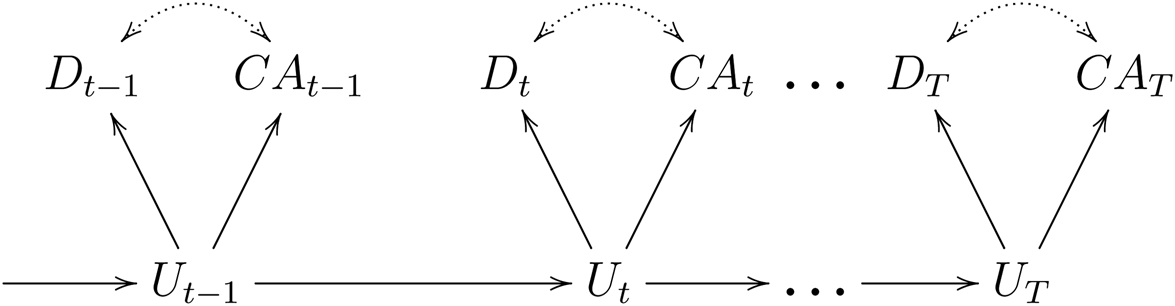
The SDM models H it in a flexible way by assuming that (i) the subject-specific random parameter α it follows a first-order homogeneous Markov chain with latent states U(c), forc = 1, …, k, and (ii) such latent states make D it and CA it conditional independent given D it−1, CA it−1 and a set of exogenous variable x it−1 measuring socio-economic observable structural characteristics.Footnote 5
The latter is a form of local independence assumption and it implies that, given the set of observable covariates, any source of residual association between D it and CA it is related to H it.
To better understand what the latent states stand for, suppose that we could approximate H it with a discrete random variable, U, with support in {1, 2, …, c}. Different states c are simply meant to capture unobserved heterogeneity affecting CA and D after conditioning on x it−1, CA it−1 and D it−1, without any assumption on the underlying structure; what matters here is that a sufficient number of states is used to capture all sources of heterogeneity. Since U jointly affects CA and D, this implies that our model can be written as a system:

where U it(c) denotes a set of k mutually exclusive dummy variables defining latent states membership in each time period; the parameters α it capture the relative contribution of unobserved heterogeneity. The dynamic nature of the process is captured by γ and δ – the lagged effects of CA and D – which describe persistence (γ ca, δ d) and processes' crossed effects (δ ca, γ d). Moreover, the system of equations (1) allows to evaluate the effect of collective action and covariates on democratic consolidation (Boix, Reference Boix2003). This is achieved by including in the vector of covariates both the interaction between x it−1 and D it−1 and between CA it−1 and D it−1.
Finally, (υcait, υdit) are the error terms with standard logistic distribution. They are usually assumed independent since the latent process makes D and CA conditional independent. Since this assumption may not be always fully satisfied, we relax it by allowing D it and CA it being residual correlated conditional on latent states (Li Donni and Thomas, Reference Li Donni and Thomas2019). For this reason, we also include a parameter ρ capturing potential residual association which still remains after conditioning on x t−1, D it−1, CA it−1 and unobservable states α(c).
Our proposed model above is displayed in Figure 1.Footnote 6
Latent Markov model.
The system of equations (1) is usually completed by (i) a set of transition probabilities describing how countries move between unobserved states, and (ii) the initial probabilities describing how the pattern of latent states depends on the initial level of democracy, collective action and the other covariates.
The choice of the appropriate number of latent states is generally done through the Bayesian information criterion (BIC) by choosing the model with the lowest BIC. More details on the parameterization of the joint distribution and the estimation procedure are reported in the Appendix A.
4. Data
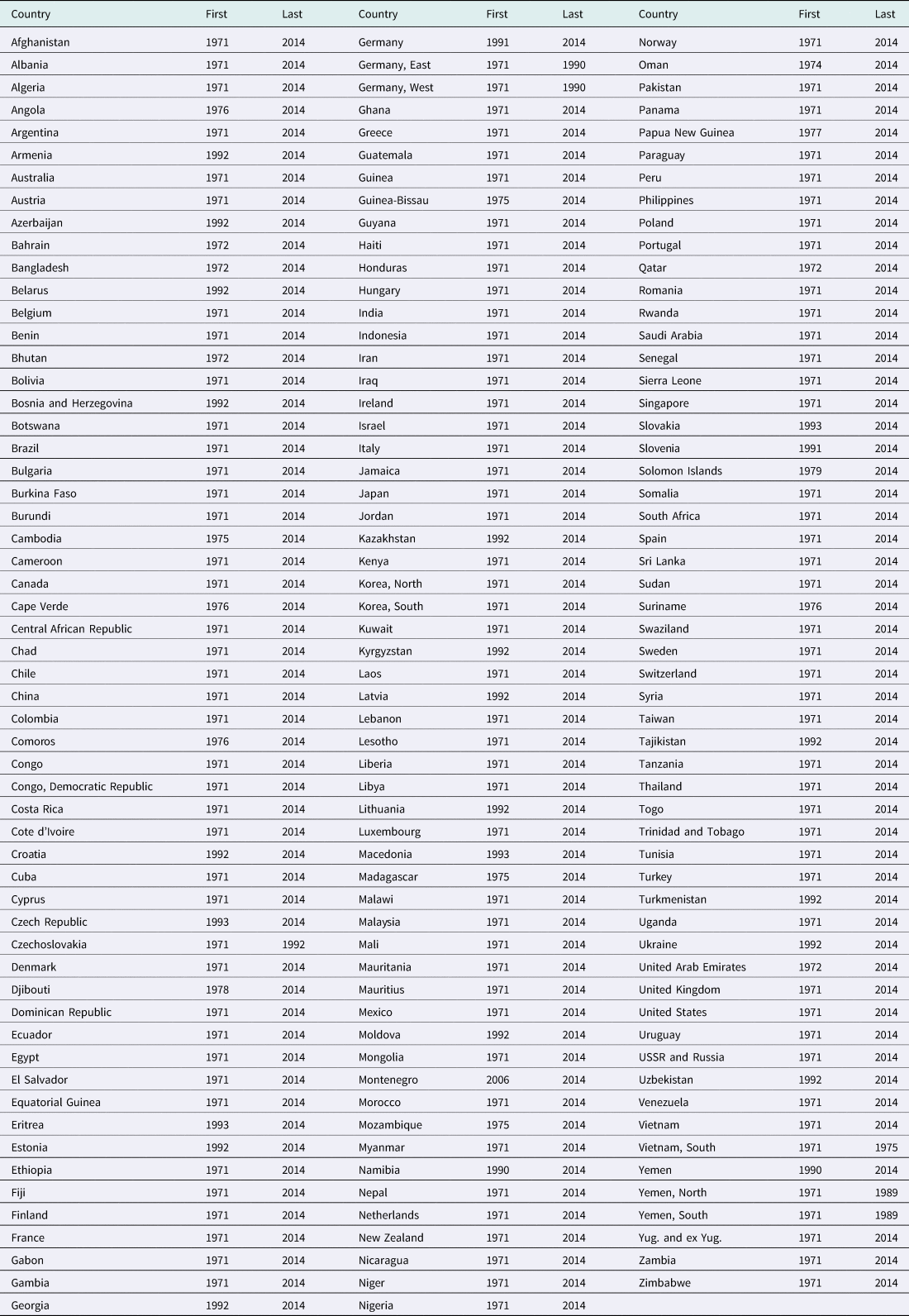
Appendix B shows the list of the 170 countries included in our sample, ranging from 1970 to 2014 for a total of 6,719 observations.Footnote 7 We consider the classification of regimes elaborated by Papaioannou and Siourounis (Reference Papaioannou and Siourounis2008) and Acemoglu et al. (Reference Acemoglu, Naidu, Restrepo and Robinson2019): they define a binary index (dictatorship/democracy) using an algorithm that combines information from the Freedom House and the Polity IV. In particular, a country is a democracy when the Freedom House scores ‘Free’, or ‘Partially Free’ and the Polity IV is positive.Footnote 8 Of the 6,719 observations, we have 118 democratizations and 59 authoritarian reversals.
Citizens' collective action is generally proxied by the level of protests. We take data from the CNTS (Cross-National Time-Series) Data Archive (Banks and Wilson, Reference Banks and Wilson2016)Footnote 9 and use the raw number of anti-government demonstrations, strikes, riots and revolutions to create a binary index taking value 1 if there is at least one of these collective actions in the country.Footnote 10
We consider four model specifications where covariates are added incrementally. Model E consists of three economic variables: economic development, economic crisis and the presence of natural resources. We proxy economic development by the logarithm of the gross domestic product (GDP) per capita at current prices in US dollar (UN Statistic, 2016). Economic crisis is proxied by an indicator taking value 1 if there is at least one of the following shocks: economic recession, bank, currency and debt crisis. Economic recession is built as a binary index taking value 1 when the level of GDP growth per capita goes below zero. The bank, currency and debt crisis indexes are elaborated by Laeven and Valencia (Reference Laeven and Valencia2018). Finally, to proxy the extent of natural resources, we include the level of oil production collected by Ross and Mahdavi (Reference Ross and Mahdavi2015).
Model ES adds education and urbanization to Model E. The first is taken from the Global Educational Attainment Dataset of the Institute for Health Metrics and Evaluation (IHME, 2015). The education variable is built as the average years of education of male and female (15–24 years). Urbanization is taken from the World Development Indicators (World Bank Group, 2012) and refers to the percentage of urban population.
Model ESC includes two indicators of ethnic and religious fractionalization taken from Alesina et al. (Reference Alesina, Devleeschauwer, Easterly, Kurlat and Wacziarg2003). They range from 0 (most homogeneous) to 1 (most heterogeneous) and capture to what extent a country is diverse in term of racial, linguistic and religious composition.
Finally, Model ESCE adds the extent of external influences to capture diffusion effects (Gleditsch and Ward, Reference Gleditsch and Ward2006; Starr, Reference Starr1991). This is measured through the level of democracy in the neighbouring countries. We thus include the average number of democratic countries that are in the same region of the examined country.Footnote 11
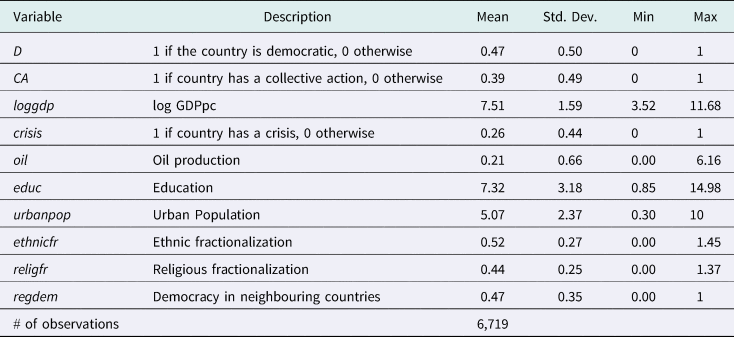
We also include year dummies to capture time-trends. Table 1 reports the descriptive statistics.
Label of variables and summary statistics
5. Results
5.1 Structural Dynamic Model
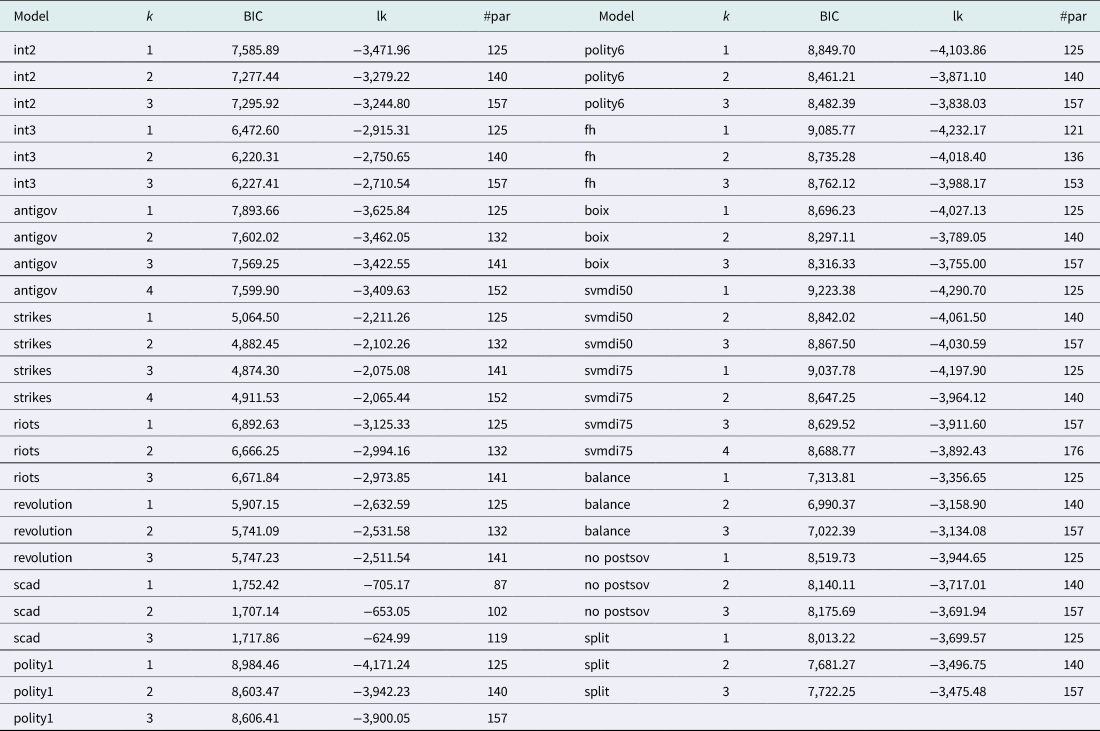
We fit the SDM with different latent states k for each model described in Section 4. With the exception of Model E, Table 2 shows that two latent states best fit the data: the BIC index takes the lowest value when k = 2 in most of the estimated models.
Model selection
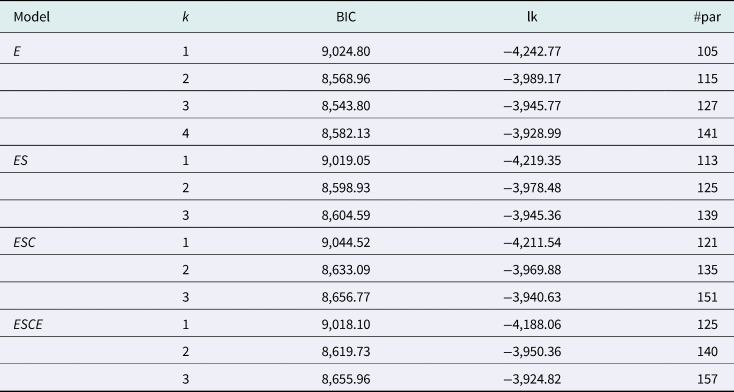
Table 3 reports the estimated parameters for each model given their respective latent states. In particular, we report the coefficients on the two lagged dependent variables (γ and δ), the covariates (β) and the residual association between democracy and collective action (ρ). Because of the inclusion of the interactions between x it−1 and D it−1 and between CA it−1 and D it−1, we report two panels. Columns CA of Panel A (Panel B) for each model display the coefficients of the covariates on the equation of collective action if the country is a dictatorship (democracy). Similarly, Columns D of Panel A (Panel B) report the coefficients on the equation that describes the emergence of democracy (democratic consolidation).
Structural dynamic model
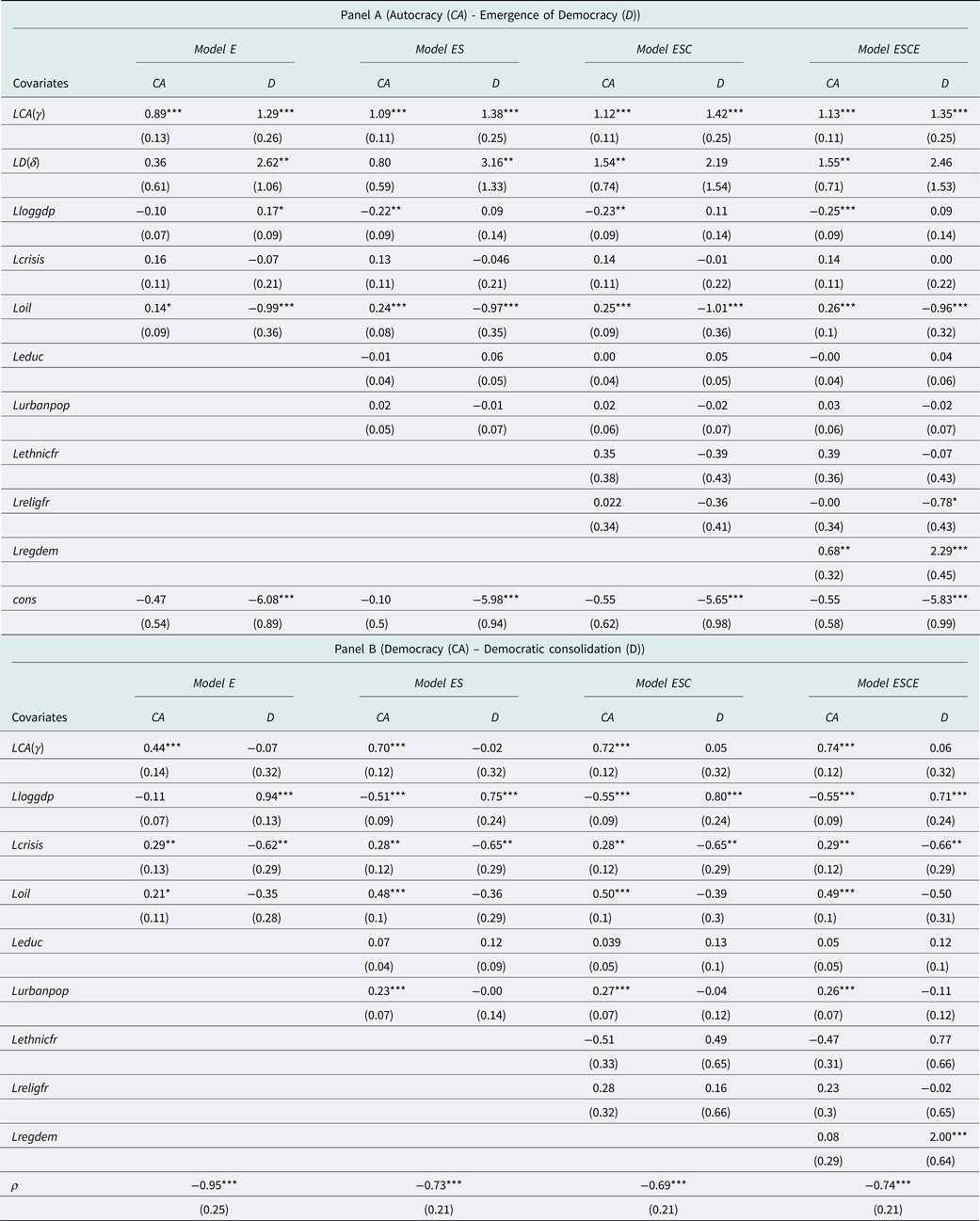
*significant at 10%, **significant at 5%, ***significant at 1%.
Three sets of results are presented: persistence and cross effects, the role of covariates and unobserved heterogeneity.Footnote 12 Initial conditions are reported in Appendix C.
5.1.1 Persistence and cross effects
The γs (δs) represent the lagged values of collective action (democracy) on the equation of collective action (democracy) and on the democracy (collective action), capturing respectively persistence and the role of collective action (democracy) on democratic change (collective action).
We find that collective action is persistent when the country is both a dictatorship (Panel A) and a democracy (Panel B). Citizens who have solved their collective action problem in the previous year are also likely to solve it in subsequent years. Thus, collective action is a learning process (Finkel and Muller, Reference Finkel and Muller1998; Rüdig and Karyotis, Reference Rüdig and Karyotis2014).
Most importantly for the scope of our work, the results show that collective action predicts the emergence of democracy (Panel A), strengthening similar findings in previous studies (e.g. Aidt and Franck, Reference Aidt and Franck2015; Aleman and Yang, Reference Alemán and Yang2011; Teorell, Reference Teorell2010). However, our results also indicate that collective action does not affect democratic consolidations (Panel B). To explain a similar result, we can draw insight from Haggard and Kaufman (Reference Haggard and Kaufman2016) who emphasize the difference between short-run dynamics of the emergence of democracy and its long-run consolidation. The latter is indeed affected by structural factors that do not operate through the former. Accordingly, citizens' and elites' interactions are more likely to depend on economic factors which shape vested interests in the democratic status quo and a generalized aversion to the uncertainties of the authoritarian rule. As also discussed below, our findings give support to this hypothesis: consolidation is more likely to be directly connected with the state of the economy in a country than with the role of citizens.
Finally, the δs represent the lagged values of democracy on the equation of collective action and democracy. The first coefficient shows a positive and significant sign but not in all specifications. Similarly, the second one shows a similar pattern, which is a surprising result compared with previous analyses on the role of institutional inertia (e.g. Acemoglu et al., Reference Acemoglu, Johnson, Robinson and Yared2008; Epstein et al., Reference Epstein, Bates, Goldstone, Kristensen and O'Halloran2006).
5.1.2 The role of covariates
Our model allows us to assess the role of covariates simultaneously on collective action and democracy.
Economic factors are among the most important predictors of collective action and democratic change. A decline in the level of economic development increases the probability of collective action both when the country is a dictatorship (Panel A) and a democracy (Panel B). Economic crises exacerbate conflict, but only in democracies. These results take on a similar flavour to previous works pointing to a relation between adverse economic shocks and collective action with the former affecting the cost of the latter (Acemoglu and Robinson, Reference Acemoglu and Robinson2001, Reference Acemoglu and Robinson2005; Brückner and Ciccone, Reference Brückner and Ciccone2011; Burke and Leigh, Reference Burke and Leigh2010). Economic development is not related to the emergence of democracy (Panel A), while it has a positive effect on democratic consolidation (Panel B) (Boix, Reference Boix2003; Przeworski et al., Reference Przeworski, Alvarez, Cheibub and Limongi2000). Similarly, we find that temporary shocks undermine democratic consolidation (Acemoglu and Robinson, Reference Acemoglu and Robinson2005). As already mentioned, the importance of economic factors for democratic consolidation supports Haggard and Kaufman (Reference Haggard and Kaufman2016). Finally, countries endowed with natural resources are more likely to solve the collective action problem (both in a dictatorship and in a democracy). Such results confirm that natural resources act like selective incentives fuelling collective action (Collier and Hoeffler, Reference Collier and Hoeffler2004). Moreover, the presence of natural resources only decreases the probability of the emergence of democracy leaving unchanged the probability of consolidation (Ross, Reference Ross2001).
Among social factors, we find that education has generally no effect on collective action and on democratic change. However, Section 5.2.2 shows that such result is sensitive to the degree of violence involved in collective action. This is in line with previous studies showing that education increases the cost of collective action, especially when peaceful forms of mobilization are available (Collier and Hoeffler, Reference Collier and Hoeffler2004; Thyne, Reference Thyne2006). Urbanization increases the probability of collective action in democracies (Panel B), confirming at least partially that opportunities offered by the modernization process favour the solution of the collective action problem (e.g. Lipset, Reference Lipset1959; Przeworski et al., Reference Przeworski, Alvarez, Cheibub and Limongi2000; Teorell, Reference Teorell2010).
Cultural factors (religious and ethnic fractionalization) weakly explain the dynamics of collective action (either in dictatorship or in a democracy), confirming previous studies (Collier and Hoeffler, Reference Collier and Hoeffler2004). They are also weak to predict the emergence of democracy and its consolidation. In Appendix C, however, we show that diversity matters when initial conditions are taken into account.
Finally, we control for the level of democracy in the neighbouring countries: spillover effects have strong effects both on the emergence of democracy and on democratic consolidations (e.g. Starr, Reference Starr1991; Teorell, Reference Teorell2010).
5.1.3 Unobserved heterogeneity
The SDM provides insights on the underlying unobserved heterogeneity captured by time-varying latent states, which lump together countries whose unobserved factors similarly affect the propensity towards democracy and collective action.
Table 4 reports the two random intercepts αs (one for collective action and one for democracy) for the two latent states of Model ESCE.Footnote 13 To explore in detail what these states stand for, conditional average probabilities are computed: they describe how likely unobserved types are to report a positive outcome of the relevant dependent variables. These probabilities reveal that the two groups of countries have almost the same propensity towards democracy, but differ substantially in their propensity towards collective action. The second group is indeed about three times more likely than the first to engage in collective action. The result reveals that heterogeneity is mainly related to factors affecting the propensity of a country to mobilize.
Estimated intercepts and conditional average probabilities
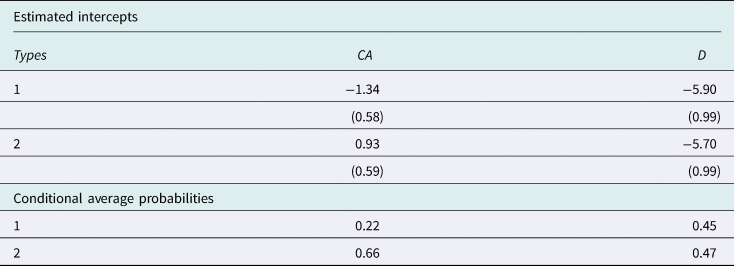
Following theories on democratic change, and assuming that unobservable factors refer to elites' strategies, the first latent state (with a lower propensity towards collective action) can therefore be associated with democratic transitions achieved through elites' institutional reforms induced by the anticipation of perceived collective actions. The second latent state (with a higher propensity towards collective action) could refer instead to transitions where much disagreement exists among elites who have a greater incentive to sustain citizens' efforts towards collective action.
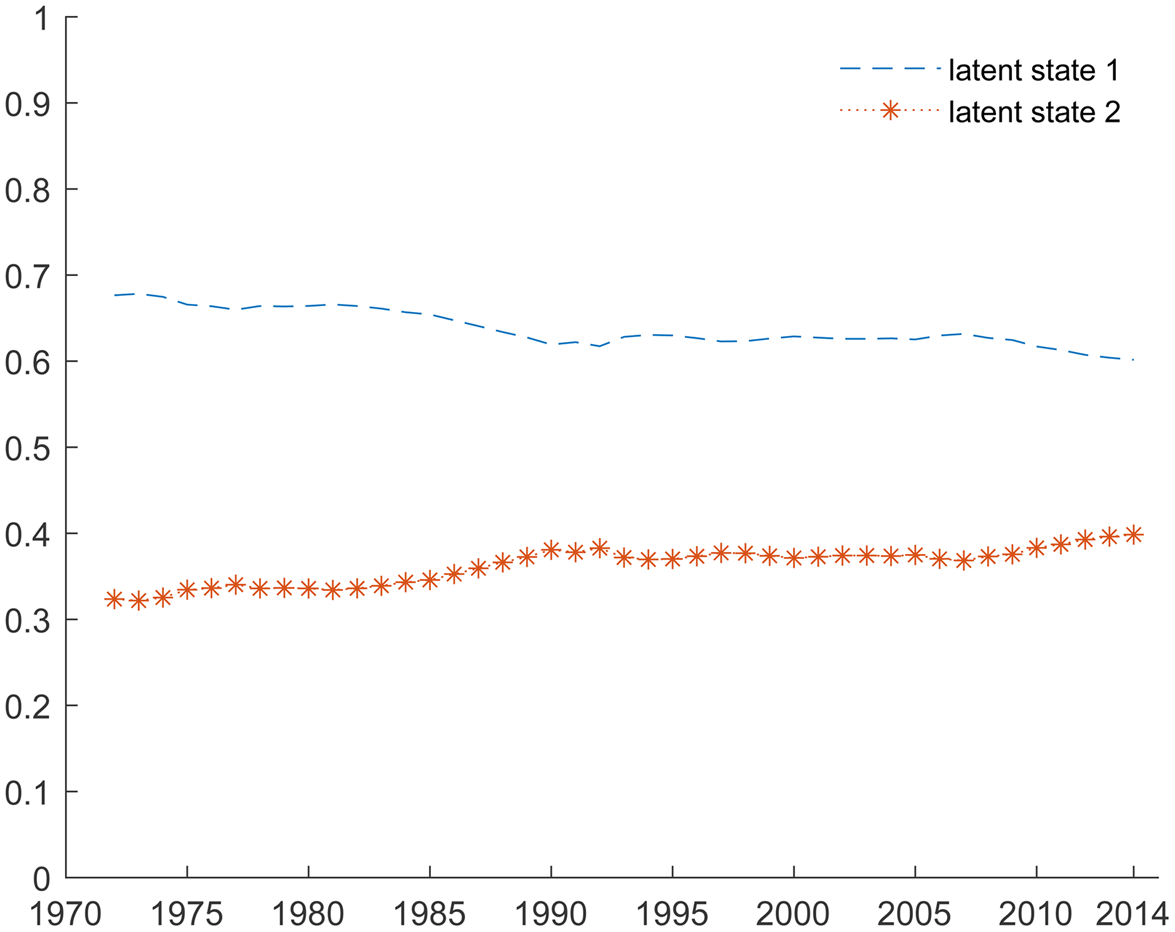
More information on unobserved heterogeneity can be inferred by looking at how the two latent states evolve over time. Table 5 reports transition probabilities.Footnote 14 Unobserved heterogeneity seems to be relatively persistent. In fact, the off-diagonal elements are substantially smaller, indicating that changes in the unobserved factors exist but have smaller probabilities. Specifically, the probability of moving from the first to the second latent state is about 2%, while the opposite is about 1.7.
Transition probabilities

The evolution of unobservable factors can be depicted in Figure 2, which plots the average probability of each latent state over time. The probability of the first latent state decreases across time, whereas the second increases.
Estimated average probability of each latent state in every year.
5.2 Robustness
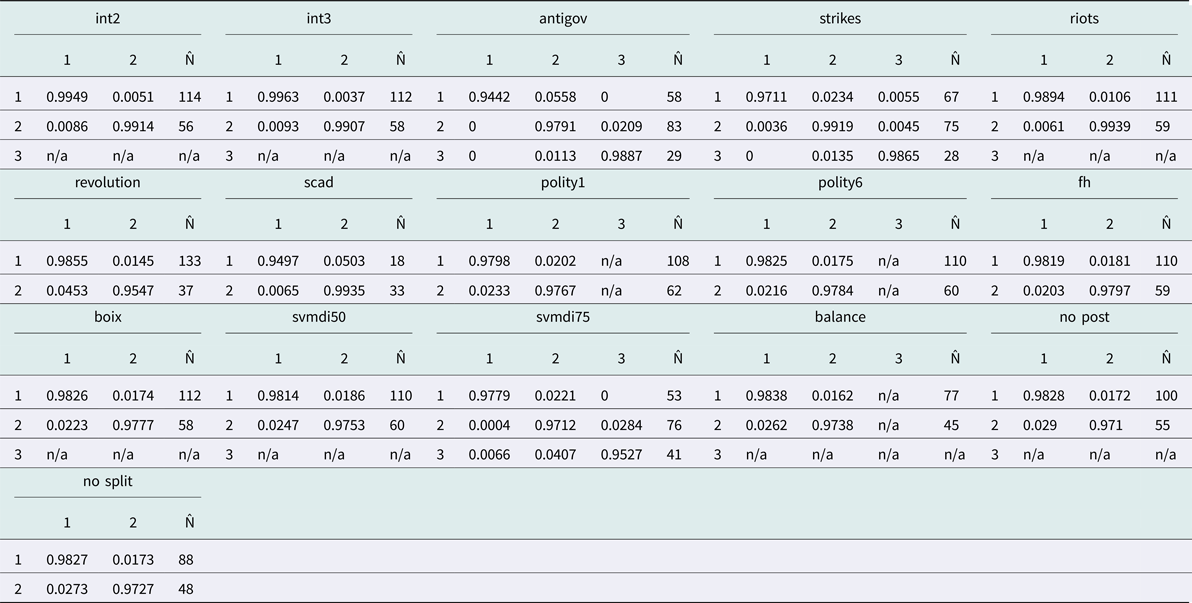
Since models with country/year observations can be highly sensitive to alternative specifications, we run several types of robustness tests. On the one hand, we implement two falsifications tests. On the other hand, we estimate alternative specifications with (i) other indicators of collective action; (ii) other indicators of democracy; and (iii) alternative samples. This is all done on our baseline model (Model ESCE). For the sake of brevity, we report the BIC results of all robustness models and the transition probabilities respectively in Appendix D and E.
5.2.1 Falsification
We conduct two falsification tests where the collective action variable is carried forward both 3 (forward3) and 5 years (forward5).
Table 6 shows that the two variables do not display any statistical significant effect. This result alleviates concerns about other possible confounding factors and confirms that 1-year lag of collective actions is not spuriously driving the observed effects of democratic change.
Falsification tests
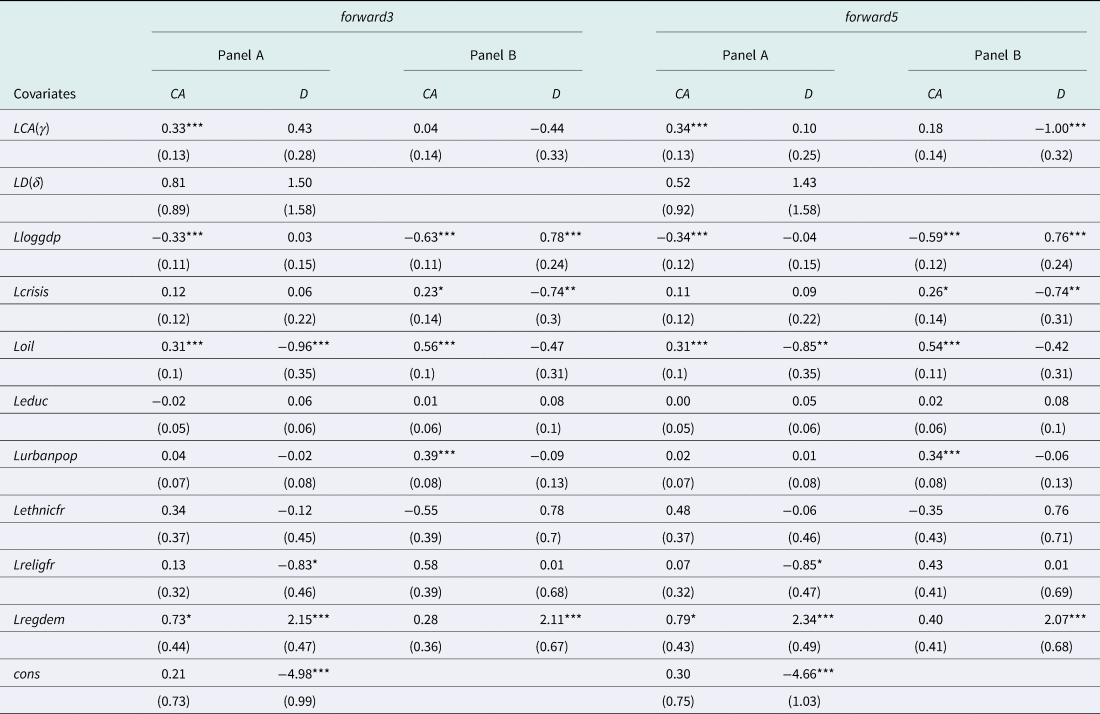
*Significant at 10%, **significant at 5%,***significant at 1%.
5.2.2 Robustness on collective action
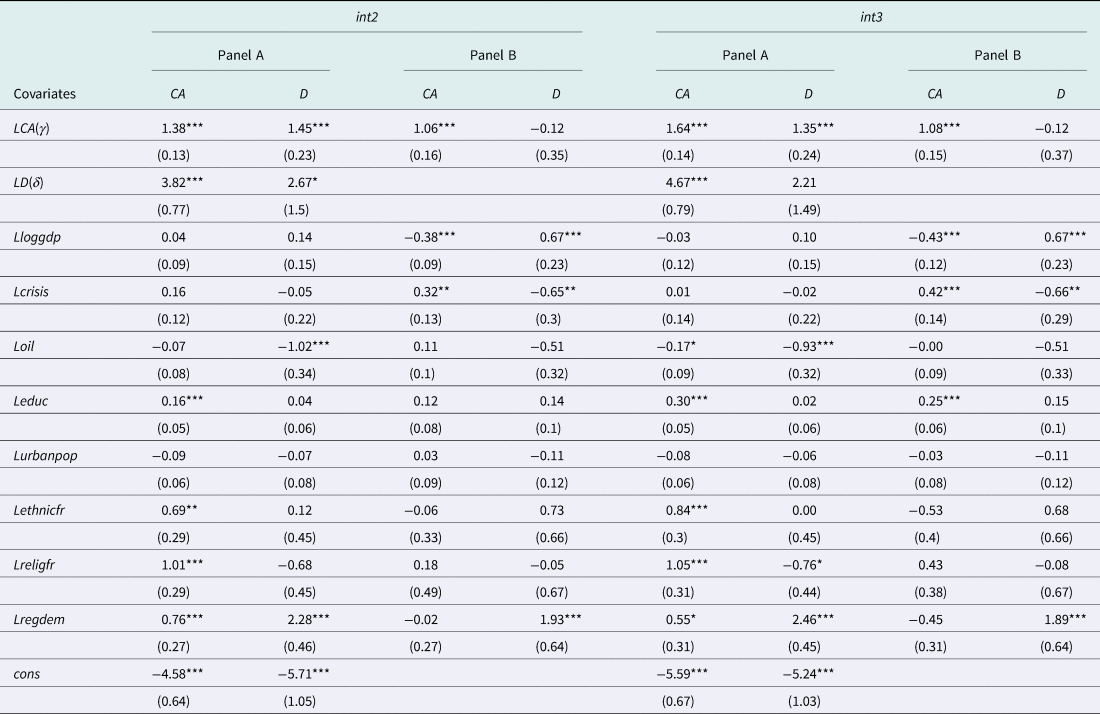
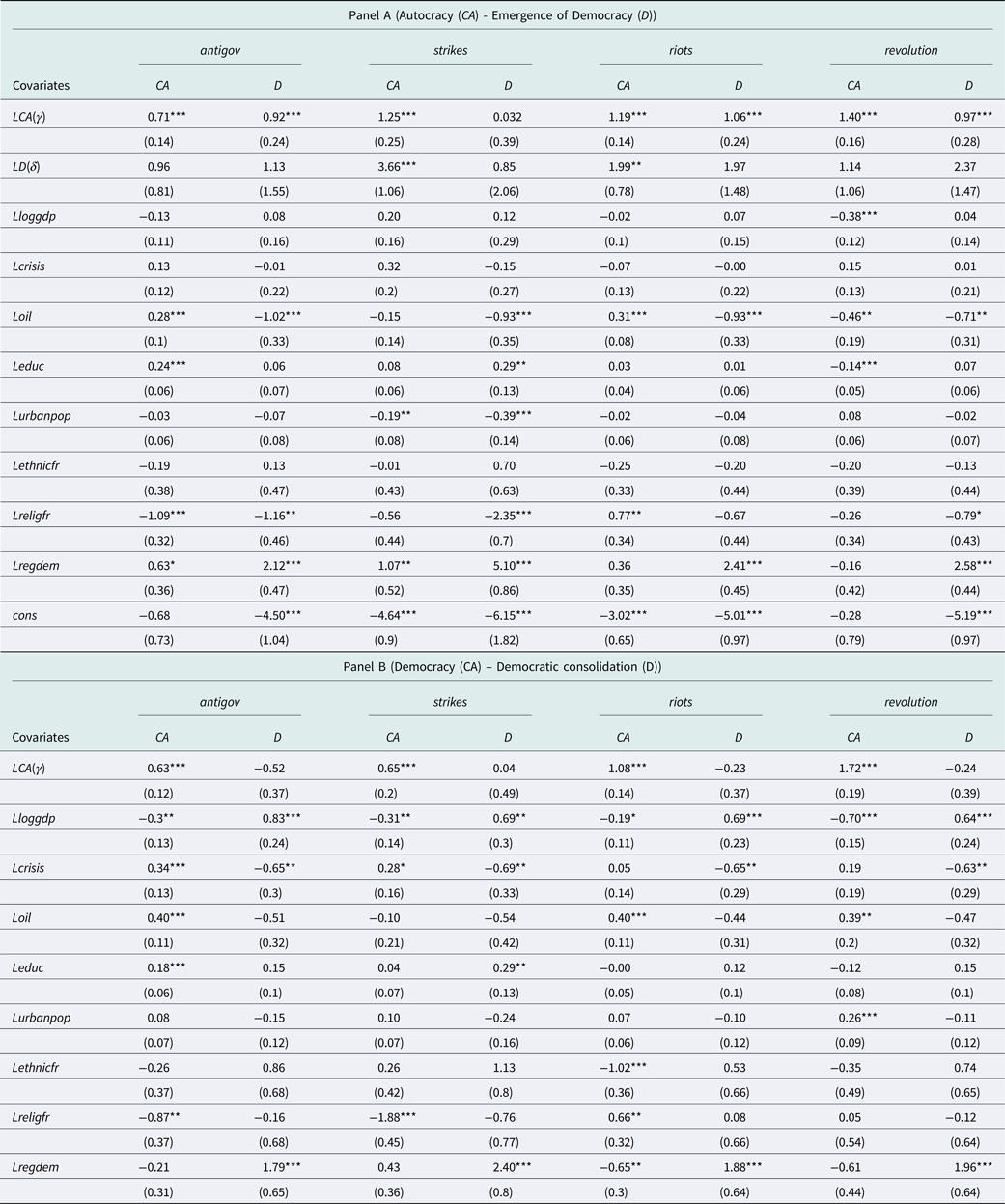
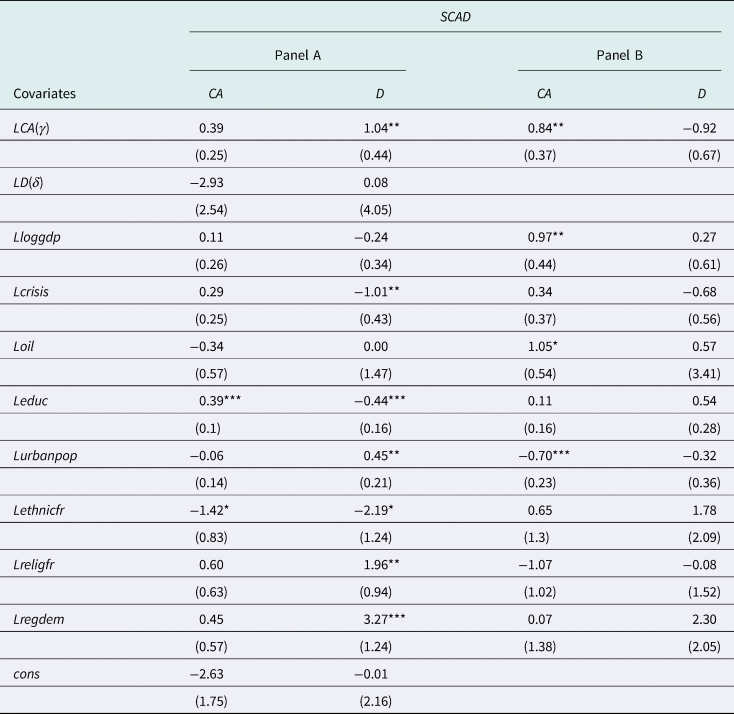
Robustness on collective action is done in three ways. First, we account for its intensity and build the binary indicator CA using different thresholds of the raw number of collective actions. In particular, two new indicators are defined taking value 1 if in the country there are at least two (int2) or three (int3) actions.Footnote 15 Results are reported in Table 7. Second, we employ the four indicators of collective action for separate regressions: anti-government demonstrations (antigov), strikes (strikes), riots (riots) and revolutions (revolution). Results are reported in Table 8. Finally, we use the Social Conflict Analysis Database (SCAD) as an alternative source of data for collective action. Information on several forms of social conflict is included from 1990 to 2014. Despite SCAD covers only African countries, it is a high-quality dataset (Aidt and Leon, Reference Aidt and Leon2016).Footnote 16 The binary index of collective action (scad) is built by combining three criteria: (1) the type of event must fall in one of the following three categories: organized demonstration, general strikes and violent riots; (2) the target of the event must be the central government; (3) democracy is mentioned as the first source of tension/disorder. We end up with a total of 1,221 observations (51 countries), 39 democratizations and 19 authoritarian reversals. Table 9 collects the results.
Collective action intensity
*Significant at 10%, **significant at 5%,***significant at 1%.
Collective actions
*significant at 10%, **significant at 5%, ***significant at 1%.
Alternative collective action data (SCAD)
*Significant at 10%, **significant at 5%,***significant at 1%.
In general, the three above tables confirm the importance of collective action for the emergence of democracy but not for its consolidation. Interestingly, Table 8 unveils which types of collective action are more likely to affect the emergence of democracy. Results show that, while most episodes of collective action increase the likelihood of democratic transitions, strikes behave differently. While this seems to contradict Collier (Reference Collier1999), it confirms Teorell (Reference Teorell2010): labour mobilization is not a proximate determinant of the emergence of democracy but precedes other types of collective action.
5.2.3 Robustness on democracy
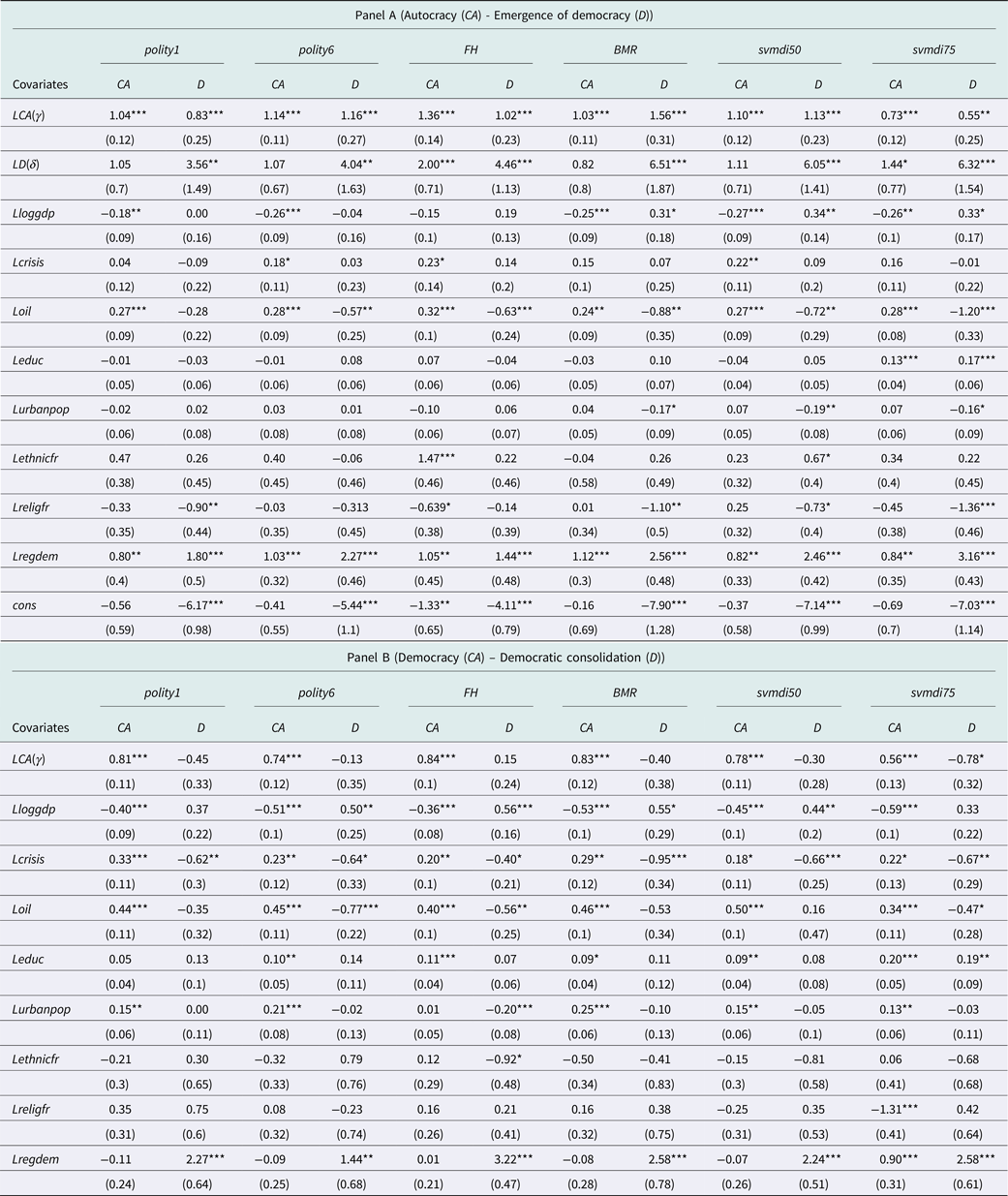
The robustness on democracy is done by employing alternative indicators: the Polity IV, the Freedom House (FH), the binary Boix, Miller and Rosato index (BMR) (Reference Boix, Miller and Rosato2013) and the Score Vector Democracy Indicator (Svmdi) elaborated by Gründler and Krieger (Reference Gründler and Krieger2016).
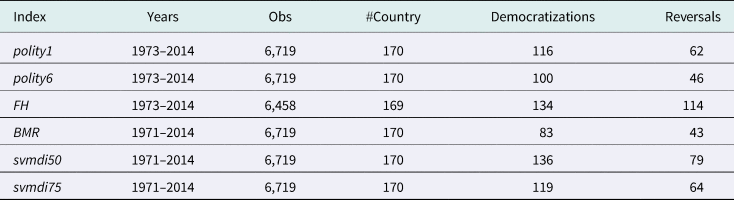
The Polity captures regime authority spectrum on a 21-point scale ranging from −10 (autocracy) to +10 (consolidated democracy). From it, we define two binary indicators with different thresholds: polity1 takes value 1 if the Polity receives at least a positive value (Acemoglu et al., Reference Acemoglu, Naidu, Restrepo and Robinson2019; Papaioannou and Siourounis, Reference Papaioannou and Siourounis2008) and polity6 which takes value 1 if the Polity takes at least a value ≥to 6 (Marshall et al., Reference Marshall, Gurr and Jaggers2018). The Freedom House (FH) captures a country's political rights and civil liberties from a status of Free, Partly Free or Not Free. Following Papaioannou and Siourounis (Reference Papaioannou and Siourounis2008) and Acemoglu et al. (Reference Acemoglu, Naidu, Restrepo and Robinson2019), we create a binary variable taking value 1 when the FH rating is equal to Free and Partly Free (FH). Finally, we split the continuous Score Vector Democracy Indicator (Svmdi) into quartiles and create two dummy variables which take value 1 at the third (svmdi50) and fourth quartile (svmd75), respectively.
Table 10 reports some descriptives of the above six indicators.
Alternative indicators of Democracy
Finally, Table 11 reports the results. We find again support for our previous findings: citizens matter for the emergence of democracy but not for its consolidation. An interesting finding emerging from Table 11 is related to democratic persistence. Although it is beyond the scope of our work, such issue would deserve further investigation since democratic persistence seems to be very sensitive to the chosen indicator when time-varying unobserved heterogeneity is taken into account.
Democracy
*significant at 10%, **significant at 5%, ***significant at 1%.
5.2.4 Robustness on alternative samples
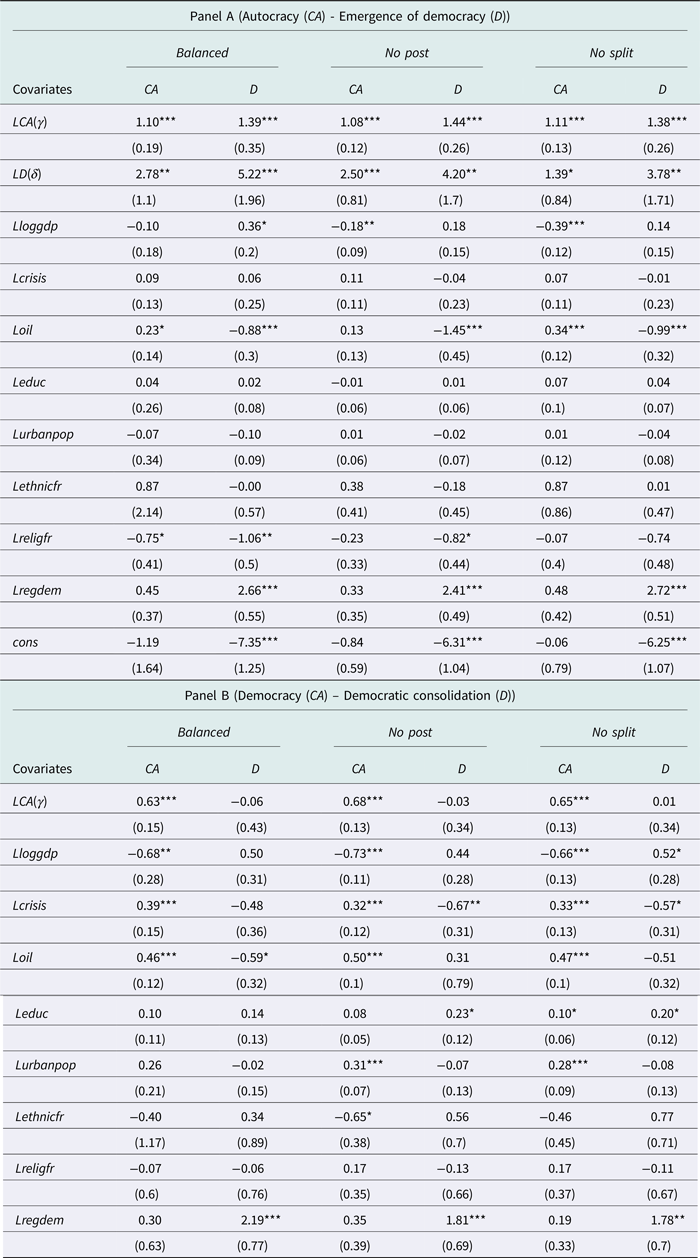
Finally, estimations are conducted on three different samples: (1) a balanced panel, which drops countries created after the first year of our sample (5,368 observations, 122 countries, 88 democratizations and 41 reversals)Footnote 17; (2) a no post sample, which excludes countries belonging to the ex-USSR (6,353 observations, 155 countries, 111 democratizations, 53 reversals)Footnote 18; a no split sample, which drops all countries that suffered some split (5,900 observations, 136 countries, 106 democratizations, 52 reversals).Footnote 19 Table 12 shows that once again collective action matters for the emergence of democracy but not for its consolidation.
Alternative samples
*Significant at 10%, **significant at 5%,***significant at 1%.
6. Conclusion
Many studies analyse the effect of citizens' collective action on democratic change. Generally they employ a bottom-up approach whose focus is on the role of citizens. Nevertheless, although hard to measure, elites' contribution to democratic change is also important, as the top-down approach claims. Our work jointly tests the bottom-up and the top-down approach by introducing a bivariate SDM, which allows us to control for unobserved heterogeneity. The model provides different insights on how collective action and democracy are jointly related in a purely dynamic framework, which builds on the previous literature. In particular, our results show that collective action affects the emergence of democracy but not its consolidation. We also find that collective action is a very persistent state, indicating that once citizens learn how to solve the collective action problem, they are more likely to solve it again in subsequent periods. To the contrary, democratic persistence seems to be very sensitive to which type of democracy indicator is used. Such findings suggest the importance of further investigation on institutional inertia as suggested by many neo-institutionalism scholars.
Finally, our results shed light on other determinants of democratic change. In particular, democratizations are more likely when the level of natural resources is lower and the level of democracy in neighbour countries is higher. Instead, democratic consolidations are shaped positively by economic development and negatively by crisis.
Despite the potential advantage of setting an SDM to jointly study changes in countries' level of citizens' collective action and democracy, our approach suffers from some limitations. First, interpreting the effects of unobserved heterogeneity only in terms of elites is not necessarily straightforward, since the latent variable may capture other unobserved factors. Nevertheless, this does not undermine the main result of our work: the role of collective action on the emergence of democracy matters.
Second, our model relies on two main assumptions: local independence and the (discrete) homogeneous autoregressive structure of the latent variable. Nevertheless, the approach can be extended in the future by allowing the discrete latent variable to follow higher order Markov chains. This extension is of interest in this field since democracy can be a long-term memory process, with the role of collective action becoming blurry once a democratic institution has been set.
Finally, spatial econometric issues are unaccounted for and this can limit our results since we are analysing political processes with a high degree of countries' interdependence.
Despite the above limitations, our model paves the way for future empirical research to explore the dynamic of changing preferences and strategies of different political agents in the democratic process by modelling hidden interactions between citizens and elites.
Acknowledgements
We thank the participants of the 2018 Political Economy of Democracy and Dictatorship (Munster), the ECPS 2019 (Jerusalem), the seminars at the Leuphana University, University of Florence and two anonymous reviewers for their valuable comments and suggestions.
Appendix
Appendix A. Model estimation
The Structural Dynamic Model (SDM) described by the system of equations (1) relies on two sets of parameters:
(1) the conditional distribution of D it and CA it:
$$\matrix{ {\Pr \lpar {CA_{it} = 1\vert \alpha \comma \;{\bi x}_{it-1}\comma \;D_{it-1}\comma \;CA_{it-1}} \rpar } \hfill & { = \Lambda \lpar {\alpha_{cait}\lpar c \rpar + {\bi x}_{it-1}^{\prime} {\bi \beta }_{ca} + D_{i\comma t-1}\delta_{ca} + CA_{it-1}\gamma_{ca}} \rpar \qquad } \hfill & {} \hfill & \qquad \hfill \cr {\Pr \lpar {D_{it} = 1\vert \alpha \comma \;{\bi x}_{it-1}\comma \;D_{it-1}\comma \;CA_{it-1}} \rpar } \hfill & { = \Lambda \lpar {\alpha_{dit}\lpar c \rpar + {\bi x}_{it-1}^{\prime} {\bi \beta }_d + D_{i\comma t-1}\delta_d + CA_{it-1}\gamma_d} \rpar \qquad } \hfill & {} \hfill & \qquad \hfill \cr }$$where Λ is the logit link function; α dit and α cait are the random individual specific terms, one for each latent state c, and capture the effect of the unobservable latent state U(c) on D it and CA it (the arrows from U to D and CA in Figure 1). Finally γ ca and δ d capture the persistence respectively on CA and D, while γ d and δ ca the crossed effects of D and CA respectively on CA and D.
(2) the distribution of the subject-specific parameters αs, capturing the unobservable heterogeneity, is described by the initial probabilities and the transition probabilities. In particular for each country i, initial probabilities are described by p(αi1 = c|D i0, CA i0, xi0), where αi1 = [α di1, α cai1]. To take into account the initial condition problem (Heckman, Reference Heckman and Rosen1981), these probabilities are allowed to depend on the initial observations D i0, CA i0, xi0 using a multinomial logit parametrization. Finally, transition probabilities are denoted by π cj = p(αit = j|α it−1 = c), with c, j = 1, …, k and t = 2, …, T. They are collected in k × k matrix Π. Note that transition probabilities only depend on the previous time period given the first-order assumption on the Markov chain. These probabilities are of particular interest as they describe how countries move between unobserved states.

The estimation of the above parameters can be implemented by following Bartolucci and Farcomeni (Reference Bartolucci and Farcomeni2009), but extending their case to unbalanced panel. In practice, the estimation strategy relies on a family of multivariate link functions that allow to directly model (i) the marginal distribution of D and CA, (ii) their association, and (iii) the distribution of the subject-specific parameters. Let υdit and υcait be independent error terms with standard logistic distribution, then the system of equation (1) can be rewritten to describe the marginal distribution of D and CA as follows:


The residual association between D it and CA it, ρ, is modelled by including the marginal log-odds ratio defined as the contrast between the two variables:

ρ captures any current residual association between collective action and democracy which still remains after conditioning on xt−1, lagged dependent variables and unobservable U.
Finally, for each country i, the random parameter vector αit = [α dit, α cait] is assumed to follow a first-order Markov chain with states c, for c = 1, …, k. Initial probabilities are allowed to depend on the initial observation using a multinomial logit parametrization as follows:

Finally, the transition probabilities are denoted by π cj = p(αit = j|α it−1 = c), c, j = 1, …, k, t = 2, …, T and are collected in the k × k matrix Π. Note that transition probabilities only depend on the previous time period given the Markov chain first-order assumption. These probabilities describe how unobservable factors in c evolve over time capturing time variation on H it.
The system of equations (2)–(5) and the transition probabilities π cj are estimated via EM algorithm.
Appendix B. List of countries
Appendix C. Initial conditions
In the spirit of the Heckman's initial condition problem, the SDM allows the unobservable latent states to depend on the countries' initial observation. In practice, the estimated parameters can be interpreted as the effect of an observable characteristic on the probability of being in a specific latent state with respect to another state at the initial period. Parameters are reported in Table C1. Since there are only two latent states, coefficients can be interpreted as the contribution of a specific covariate on the probability of being in the second latent state with respect to the first latent state.
Two results are noteworthy. First, a country experiencing collective action in the first period is more likely than a country without collective action to belong to the second state, namely to those countries where democracy comes with more political mobilizations. In other words, once citizens have historically developed the formal and informal framework to solve the collective action problem, then it is easier for them to be mobilized again. Second, a country with a higher level of ethnic fractionalization in the first period is more likely to belong to the first state, where democracy comes with less political mobilizations and more top-down reforms. This result confirms recent findings that diversity is not necessarily detrimental to democracy (Gerring et al., Reference Gerring, Hoffman and Zarecki2018). However, our model shows that diversity affects the initial stock of social capital within a society (Anderson and Paskeviciute, Reference Anderson and Paskeviciute2006).
Estimated coefficients of the initial conditions

Appendix D. Robustness model selection
Appendix E. Robustness transition probabilities


 Open access

