

Introduction
The maritime archaeologist’s toolkit today looks quite different from that of a decade ago. While many of the technologies used today – robotics, photogrammetry, and marine geophysics – have been around since the 1960s, they are now deployed by universities and small archaeological units from inflatable boats rather than being deployed from multi-million-pound research vessels. Significantly, the intellectual toolkit of today’s maritime archaeologist is greatly expanded, focusing on climate change, non-Western perspectives, and contemporary philosophy. This paper provides a review of developments in shipwreck archaeology over the last decade (2013–2023). While the broad trends in our field can be applied to underwater archaeological research around the world, the focus of this paper is on Mediterranean maritime archaeology, and the ancient shipwrecks and submerged cultural heritage in which this region is so richly blessed.
Four trends emerge when considering how the landscape, or, perhaps better, the seascape, of shipwreck archaeology in the Mediterranean has changed over the past decade: survey and excavation of sites which are harder to access, better use of excavated material through a comprehensive programme of scientific analysis, faster investigation and documentation of sites through geophysical methods and digital recording, and stronger interpretations of our findings through the development of archaeological theory and contemporary philosophy in our field.
The first trend identified is our ability to explore, excavate, and assess sites that are harder to access: the ambitious investigations of shipwreck sites in increasingly difficult areas such as the deep-sea (less than 100 metres) allow us to reach sites that are less likely to have been disturbed by looters and recreational divers, whose depths rarely exceed 30–40 metres. George Bass’ paradigm-founding observation was that archaeology under water could be conducted by diving archaeologists as rigorously as archaeology on land (Bass Reference Bass1966). While underwater work, especially in deep-sea sites is harder, more difficult, and in some instances more dangerous, it allows us to reach previously inaccessible sites in the Mediterranean and Black Sea.
The second trend consists of making better use of excavated material: maritime archaeologists are increasingly collaborating with archaeological scientists to use biomolecular approaches to interrogate artefacts found on shipwreck sites. Techniques used include ancient DNA analysis, organic residue analysis, and radiocarbon (C14) dating. Within this second trend, there are two important shifts that have occurred in the last decade: one is that programmes of scientific analysis and conservation are more frequently factored into mission planning from the on-set, as opposed to being designed only after excavation has taken place. Another is the application of scientific analysis to previously excavated material. This, indeed, makes far better use of archaeological remains and is perhaps the most beneficial trend identified in recent years.
The third clear trend is faster survey, recording, and documentation of shipwreck sites. This pace has been achieved through a variety of means, including with geophysical methods and digital recording techniques. Many of these techniques, such as side-scan sonar (SSS) and sub-bottom profilers, have been around for decades; however, the last decade has seen rapid development of their methods such that they are far more cheaply available and can be deployed by small boats. These advances allow for the rapid mapping of the seafloor while virtually replacing the recording of underwater sites by hand with the use of digital photogrammetry. This means that shipwrecks sites can be recorded and generate a high-resolution site plan following one dive rather than over the course of an entire field season.
Xlendi shipwreck; 2. Oranto shipwreck; 3. Capo Corso shipwreck; 4. Kyrenia shipwreck; 5. Gulf of Cadiz; 6. Ezerovo log boat; 7. Apollonia Pontica log boat; 8. Black Sea MAP; 9. Fournoi; 10. Skerki Bank; 11. Dalmatia; 12. Zakynthos; 13. Antikythera; 14. Strait of Sicily.

The final trend explored in this review is the shift towards stronger and more robust interpretations in the field of maritime archaeology. Such has been achieved through a greater awareness, appreciation, and incorporation with archaeological theory and contemporary philosophy over the last decade. This most recent trend is perhaps the most significant shift, as the lack of an explicit theoretical framework in maritime archaeology until the last few years belied our field’s relative ‘academic immaturity’ (Muckelroy Reference Muckelroy1978: 10) when compared to the wider discipline of archaeology in which theory and philosophy have for many decades played a central role (Harris and Cipolla Reference Harris and Cipolla2017). Contemporary theory includes far more significant input from the Global South than past theoretical approaches, drawing on Indigenous and non-Western modes of thought (Morton Reference Morton2013). The result is a more inclusive maritime archaeology, which follows significant programmes of capacity-building and training over the last decade. Engagement with non-Western scholarship and contemporary philosophy are closely linked to climate change and the epoch of the Anthropocene, more closely situating the field with global challenges relating to our planet’s changing climate and increasing the impact of scholarship for contemporary communities. Together, stronger and more robust interpretations of archaeology are being achieved through the diversity of cultural, economic, and educational backgrounds in the field today.
Harder: excavation and investigation of shipwrecks at previously inaccessible depths
The ocean’s depths have always presented a challenge, but each decade moves the bar. In 1931 Kingsley Moses wrote (Moses Reference Moses1931: 346): ‘No human eye is ever likely to see such deep-sunk wrecks as the famous Titanic, down in a thousand or more fathoms. The mere matter of even locating a wreck beneath an open ocean, where there are no markers to line a sight on, is baffling.’ In a little over a decade after Moses wrote these works, sonar technology for seafloor mapping would be invented and five decades later the Titanic would be found. The ‘unfathomable’, a term whose etymology relates to the sea’s depths, has increasingly been put within reach of underwater archaeologists, with the last decade demonstrating rapid advances in deep-water archaeology. While the challenges of deep-water archaeology remain expensive and time-consuming, the advances of the past 10 years demonstrate that rigorous deep-water research is not simply possible, but can unlock the great potential of archaeology.
The underwater environment presents inherent challenges to excavation that are not a concern for terrestrial archaeological sites. Excavation schedules are often limited by a diver’s maximum ‘bottom time’. This is the amount of time at which humans can safely remain at depth before being subject to decompression limits imposed by diving tables, which calculate the amount of N2 accumulating within tissue compartments. In the last decade, however, sites of increasing depth have been made accessible to underwater archaeologists. This is accomplished through the use of robotic systems and developments in diving technologies.
Increasingly, archaeologists are exploring submerged cultural heritage through robotic systems, including remote-operated vehicles (ROV) and autonomous underwater vehicles (AUVs), tools which are not subject to the physiological limitations of humans and are able to be controlled to depths of hundreds, if not thousands, of metres of seawater. While the first robotic systems, such as the Scripps Institute’s remote underwater manipulator, date to the 1960s, recent advances in marine technologies has led to a boom in affordable ROVs and AUVs. By comparison to the deep-water survey methods of the 1990s used by Robert Ballard and Anna Marguerite McCann (McCann and Oleson Reference McCann and Oleson2004), the surveys of the last decade have excelled at high-resolution seafloor mapping and inspection of sites. To be clear, ROVs and AUVs have been critical research tools for decades on multi-million-pound research vessels, but, with micro-ROVs costing less than £5,000 and launchable from a small boat, robotic systems have never been more accessible to archaeologists. In the summer of 2023 the Strait of Sicily Shipwreck Survey began a large-scale SSS survey of one of the most important maritime trade routes in antiquity (Briggs and Campbell, in preparation). With a fleet of three micro-AUVs (Fig. 6.1 ), this project seeks to democratize deep-water survey through demonstrating the efficacy of low-cost, light-weight AUVs for the discovery, investigation, and recording of submerged cultural heritage at depths up to 300 metres.
Strait of Sicily Shipwreck Survey team with their fleet of micro-AUVs. © H. Phoenix.

The government archaeological services of France, Italy, and Spain have directed a series of deep-water surveys and excavations, led by archaeologists including Franca Cibecchini, Barbara Davidde, Iván Negueruela Martinez, and Michel L’Hour, at shipwrecks in the Oranto Strait (780m), Gulf of Cadiz (1,100m), Capo Corso (350m), and more (L’Hour, Creuze and Dégez Reference L’Hour, Creuze and Dégez2020; Martinez et al. Reference Martinez, Rocío, Belinchón, Sierra Méndez and Recio Sánchez2020; Davidde, Masiello and Raguso Reference Davidde, Masiello and Michele Raguso2022; Cibecchini and L’Hour Reference Cibecchini and L’Hour2023). This includes a large-scale collaborative survey between Algeria, Croatia, Egypt, France, Italy, Morocco, Spain, and Tunisia, led by UNESCO, at Skerki Bank, which relocated several shipwrecks found by Ballard and McCann’s team as well as locating several new shipwrecks (UNESCO 2022).
The benchmark for deep-water survey during the last decade has been the Black Sea Maritime Archaeological Project ( Black Sea MAP ). Between 2015 and 2019, the project mapped Bulgaria’s Exclusive Economic Zone to examine Black Sea sea-level change. In doing so, 65 shipwreck sites were documented through using bathymetric data, ROV inspection, and photogrammetry (Pacheco-Ruiz, Adams and Pedrotti Reference Pacheco-Ruiz, Adams and Pedrotti2018; Pacheco-Ruiz et al. Reference Pacheco-Ruiz, Adams, Pedrotti, Grant, Holmlund and Bailey2019; Peev et al. Reference Peev, Farr, Slavchev, Grant, Adams and Bailey2020). Covering over 2,000km2 of seafloor, the project’s ambitious scale was matched by the high-resolution 3D models of well-preserved shipwrecks in the Black Sea’s anoxic layer.
The Phoenician shipwreck at Xlendi (Malta) is an exemplar of deep-water excavation. Timmy Gambin, the project director, has succeeded in achieving the deepest ancient shipwreck investigation conducted by human excavators in an excavation strategy using closed circuit rebreathers (CCRs) to enable divers to excavate the sixth century BC shipwreck site by hand at depths of 110 metres (Gambin, Sourisseau and Anastasi Reference Gambin, Sourisseau and Anastasi2021). To achieve this, Gambin oversaw a team that created a bespoke airlift dredge that could achieve suction at these depths, recruited a group of CCR divers and underwater archaeologists to dive to these depths and undertake the excavation (Fig. 6.2 ), and collected a team of specialists to study the material culture recovered from the wreck. The Phoenician shipwreck at Xlendi (Malta) is characteristic of the type of sites that are harder to access, yet, due to their inaccessibility, are far more likely to have remained undisturbed on the seafloor. By their very nature, sites that until recently were previously inaccessible to looters and recreational SCUBA divers are far more likely to retain the contextual information that is fundamental to archaeological research. As underwater archaeologists continue to overcome the difficulties involved with working at ever harder sites to access, we can retain an optimistic outlook for the future of our field where ‘harder’ sites do not equate with impossible and the successful excavation of a wreck at a depth over 100 metres represents a breakthrough.
Closed circuit rebreather divers working at 110 metres depth on the Xlendi shipwreck. © J. Wood.

Better: scientific analysis of new and previously excavated samples
One must remember that, when charting shipwrecks that have been investigated since the invention of the aqualung in 1943, the number of discoveries peaked in the 1970s with the widespread looting and destruction of underwater sites by treasure hunters (Keith and Carrell Reference Keith and Carrell2009). Shipwreck archaeology, unfortunately, investigates a diminishing cultural resource. The last decade, however, has demonstrated that archaeologists can do more with less, as scientific analysis is revealing more information about these at-risk cultural resources.
The scientific advances of the last decade have highlighted the importance of a central tenet of the 2001 UNESCO Convention on the Protection of the Underwater Cultural Heritage, namely in situ preservation of shipwrecks as a first option. Many of the fully excavated shipwrecks of the 1960s through the adoption of the Convention now face potential contamination for methods available today, such as DNA analysis. In situ preservation, of at least a portion of shipwrecks, maintains material on the seafloor for whichever scientific advances develop in the future decades.
Submerged archaeological sites have long been a fertile arena for the application of new biomolecular and scientific methods. This rare union of science and archaeology allows aspects of the past to be revealed in technicolour, providing information on the when, where, why, and how of material culture. Dating, provenance, molecular analysis, genetic information provide a rich tapestry of information now at the fingertips of the marine archaeologists who seek to better understand the shipwrecks they excavate. Through scientific methods, artefacts recovered from shipwreck sites can be investigated and published to the greatest extent possible.
The analysis of shipwreck material by scientific methods is not new: artefacts from shipwreck sites have long provided rich material on which novel methods of analysis are often tested and improved. These analyses have included some of the earliest applications of gas chromatography to amphora, consisting of research on ceramic transport containers from the Madrague di Giens shipwreck (Formenti, Hesnard and Tchernia Reference Formenti, Hesnard and Tchernia.1978); the first extraction of DNA from bone was conducted on a set of samples which included a pig bone from the Mary Rose shipwreck (Hagelberg and Clegg Reference Hagelberg and Clegg1991); and early research into the utility of C14 dating was performed on waterlogged wood from shipwreck sites (Ralph Reference Ralph1967). Results from such analyses have shifted our understanding of the types of cargo items contained in ceramic vessels, the genetic makeup of zoological remains from shipwrecks, and from what era wooden elements of shipwrecks date. In this section we explore two of the fundamental shifts in scientific research on shipwreck material that have occurred in the last decade and how and why these shifts better the field of shipwreck archaeology.
The two fundamental shifts explored here in turn are: 1) a trend towards incorporating a plan for the scientific analysis of samples from the outset of archaeological excavation; and 2) the return to previously excavated material to investigate samples more thoroughly by additional scientific methods. The first trend allows archaeological scientists to be intimately involved in the research design of shipwreck excavations, a process that can significantly enhance the quality of results in future analysis. Rather than being an afterthought in the planning of archaeological missions, many shipwreck excavations and archaeological missions now cost in scientific research into their original budgets and collections strategies in mind for the recovery of samples for scientific analysis. Often scientific analysis was left to the conservation phase, but both conservation and scientific analysis are being planned from the start of excavations.
Scientific analysis as integral to the research design
Over the course of the past decade the cost of scientific analysis has decreased, so archaeology, a discipline with smaller project budgets, can make good use of the techniques. This constitutes a democratization of science in archaeological research, whereby scientific methods are now more accessible to the directors of shipwreck excavation projects. This trend applies to both terrestrial and underwater archaeology; however, as shipwreck excavation is more expensive to begin with, the decreasing costs of scientific analysis is especially beneficial in our field, where budgets are often stretched to the limits from the start.
DNA sequencing has decreased in cost exponentially, allowing for maritime archaeologists to analyse organic remains from shipwreck sites by a method that over a decade ago would have been outside the reach of our discipline. DNA analysis of samples recovered from underwater and maritime archaeological sites has increased significantly in the last decade and has included samples taken from shipwrecks in marine environments, archaeological sites in lakes and freshwater environments, and environmental samples of seafloor sediment and seawater (Briggs Reference Briggs2020). DNA analysis of organic remains such as waterlogged grape pips has revealed patterns of clonal propagation and aspects of Vitis vinifera genetic diversity throughout the Mediterranean, in some cases establishing such close relationships between vines that our understanding of the trade and transportation of grape varietals has significantly increased (Brown et al. Reference Brown, Cappellino, Kistler, Lister, Oliveira, Wales and Schlumbaum2015; Wales et al. Reference Wales, Ramos Madrigal, Cappellini, Carmona Baez, Samaniego Castruita, Romero-Navarro, Carøe, Ávila-Arcos, Peñaloza, Moreno-Mayar, Gasparyan, Zardaryan, Bagoyan, Smith, Pinhasi, Bosi, Fiorentino, Grasso, Celant, Bar-Oz, Tepper, Hall, Scalabrin, Miculan, Morgante, Di Gaspero and Gilbert2016; Ramos-Madrigal et al. Reference Ramos-Madrigal, Wiborg Runge, Bouby, Lacombe, Samaniego Castruita, Adam-Blondon, Figueiral, Hallavant, Martínez-Zapater, Schaal, Töpfer, Petersen, Sicheritz-Pontén, This, Bacilieri, Gilbert and Wales2019). These results offer great promise for additional studies in this area. In many instances, the provision for samples to be collected for DNA analysis and the cost of sequencing were considered at the start of these projects, indicating a growing awareness for the potential of such research as integral to the investigation of underwater archaeological sites.
Return to previously excavated material
The second shift in the application of scientific analysis to archaeological material recovered from shipwrecks and submerged sites is in the return to previously excavated artefacts and environmental samples. Increasingly, new analysis can supplement our understanding of these materials.
Certain archaeological remains are notoriously hard to date from a purely stylistic method, as design may have remained relatively static for a long period of time. One example would be watercraft that have changed very little over the millennia, such as log boats. Their simple design and rudimentary materials (in essence, a hollowed-out log) have largely remained the same from the Neolithic to the Age of Exploration. A series of log boats was discovered in 1966 during dredging operations along the Bulgarian Black Sea coast at Ezerovo, yet until recently only one had been dated scientifically. Initially these watercraft were dated through a tentative association with nearby archaeological remains: one log boat found in 1966 was discovered near Neolithic and Early Bronze Age material (fifth to fourth millennium BC) and thus a very early date was ascribed to this watercraft (Ivanova Reference Ivanova2012: 343). Another was discovered near submerged Chalcolithic and Early Bronze Age (fourth millennium BC) cultural material, which led excavators to believe that it might be associated with these settlements and, thus, they dated it to the same period (Georgieva Reference Georgieva2021: 94). A third log boat, the Mandrensko ezero log boat, was thought to date from the Late Iron Age (sixth–fifth century BC) due to the type of tool marks discovered on the waterlogged wood and its proximity to the Greek colony of Apollonia Pontica (Ivanova Reference Ivanova2008).
In 2018, four of these log boats were reassessed by scientific methods, with C14 dating being applied to the waterlogged wood from these vessels discovered on the Black Sea coast (Georgieva Reference Georgieva2021: 94). Results from this new study revealed dates for these small wooden vessels firmly in the Medieval period between AD 1020 and 1450 (Georgieva Reference Georgieva2021: 90), thus highlighting the importance of returning to previously excavated material. The new information yielded by C14 dates of these watercraft illustrate the continuity in log boat design throughout the ages, the longevity of human activities on the shore of the Black Sea, and complexity of dating a wooden watercraft by simple association with nearby settlements.
A recent study on the post-depositional chemical alterations to amphorae recovered from shipwreck sites in Croatia including the Supetar-Cavtat, Polačišće Bay, Gnjilna, and Žirje shipwrecks utilized 264 ceramic sherds recovered from 15 different archaeological sites along the Dalmatian coast (Miše, Quinn and Glascock Reference Miše, Quinn and Glascock2021). Through ceramic petrography and instrumental neutron activation analysis (INAA) conducted on the shipwreck amphorae, as well as through using a comparison with the same amphora types recovered from terrestrial contexts, the authors determined that the marine deposition environment causes leaching of certain elements and enrichment of others, demonstrating that direct comparison of chemical composition between amphorae from terrestrial sites and shipwrecks, even amphorae produced at the same workshop with the same type of clay, may not be possible due to the leaching that occurs underwater (Miše, Quinn and Glascock Reference Miše, Quinn and Glascock2021: 6). As scanning electron microscopy and INAA both allow for the chemical constituents of shipwreck amphorae to be determined, it is important we have a baseline understanding of how the constituents may have altered over the course of several millennia under the sea. Studies such as this move the field forward both by helping us to understand how and why shipwreck material may reveal different chemical profiles than terrestrial material, and by making use of previously excavated material.
The field is also making better use of previously discovered shipwreck sites. A shipwreck at Zakynthos, Greece (ID 1600), which was discovered and surveyed over 25 years ago, has now been investigated further: excavation was recently undertaken, and new scientific analysis of the wooden hull structure yielded C14 dates between AD 1485 and 1684 for the building of the ship, and investigation of the cargo revealed thousands of hazelnuts were transported on board (Dellaporta Reference Dellaporta2017: 437). This new evidence for diverse cargo elements, such as hazelnuts, helps inform our understanding of trade in the Greek islands during the 15th to 17th century.
The Antikythera shipwreck (ID 18172, ID7480, ID2909), perhaps one of the most famous ancient shipwrecks in the world, continues to yield new information about site formation dynamics on wreck sites in the Mediterranean. Recent work conducted on the endolithic and epilithic sponges at this site and in the Blue Grotto of Capri helps maritime archaeologists to understand the taphonomy of the marble statues found at this site, where these boring sponges had excavated inside the calcareous statues, and the precise species of boring species most prevalent at each site (Calcinai et al. Reference Calcinai, Sacco Perasso, Davidde Petriaggi and Ricci2019). Discovered in 1900, the continued work on the Antikythera site demonstrates the scope for new research at sites known to archaeologists for over a century.
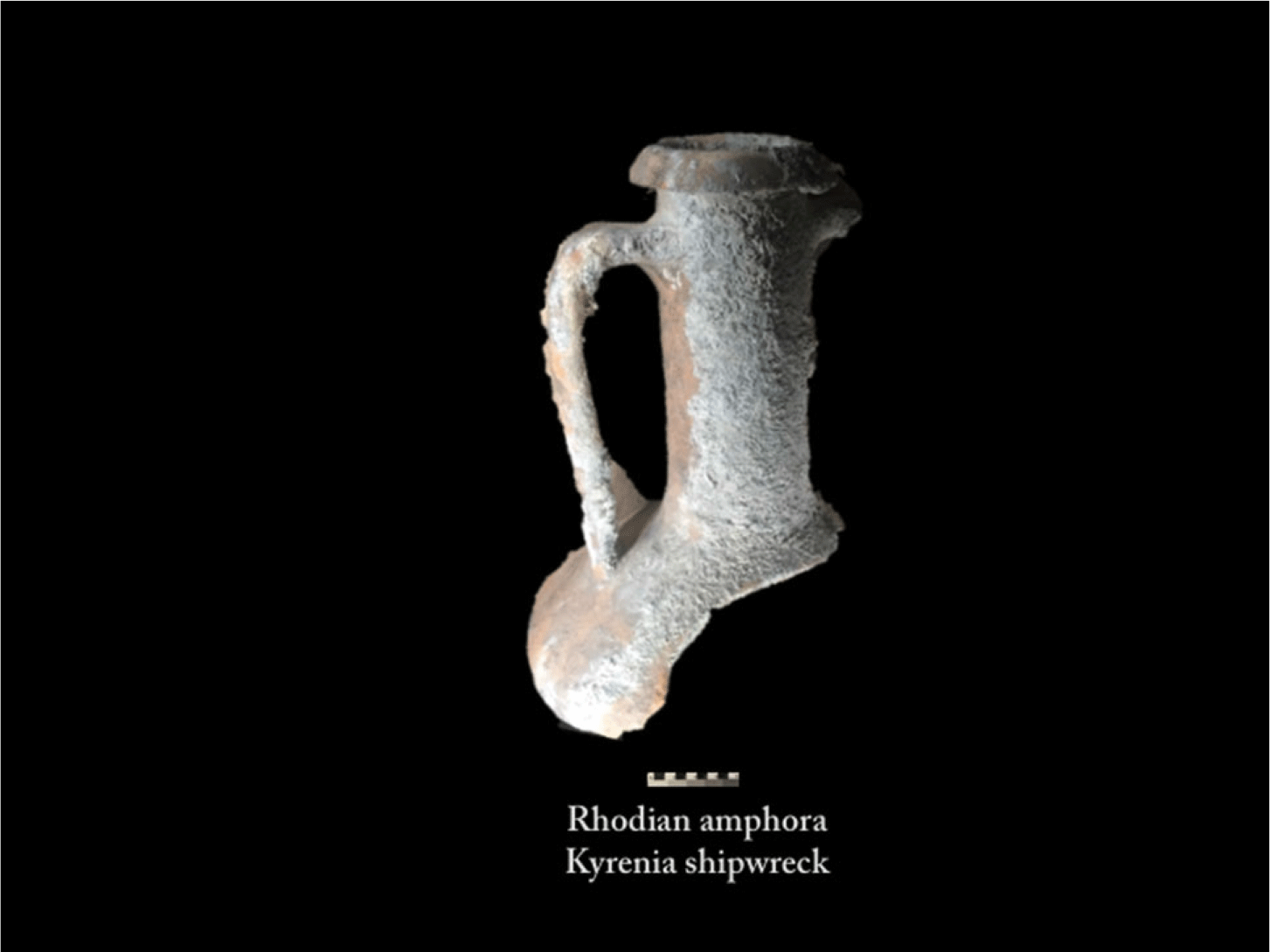
As a final example of the recent trend for the new analysis of previously excavated material, the publication of the Kyrenia Ship Final Excavation Report: Volume I (Katsev and Swiny Reference Katsev and Swiny2023) contains several studies of material of the Kyrenia ship of Cyprus (originally excavated the 1970s), which were only commissioned and completed in the last decade. A programme of organic residue analysis of amphorae (Figs 6.3 and 6.4 ) and cooking pots was included in this volume and revealed that there was evidence for plant oils, fruit products, and Pinaceae products inside the shipwreck ceramics (Briggs and Drieu Reference Briggs and Drieu2023). This study was commissioned in 2017, completed in 2020, and published in 2023, almost 50 years after the excavation began on this iconic shipwreck. This is an example of how new discoveries can be made about shipwreck material excavated half a century earlier.
Rhodian fractional amphora from the Kyrenia ship. © L. Briggs.

Rhodian amphora from the Kyrenia ship. © L. Briggs.
Faster: the ‘digital turn’ and geophysical investigations
The ‘digital turn’ has taken over archaeology as a field, allowing for rapid documentation of sites and dissemination of data (Opitz Reference Opitz2018). The digital turn is particularly impactful for maritime archaeology, where time on site is measured in the number of breaths. Two decades ago, sites were recorded with tape measures, occasionally entered into 3D site plan software like SiteRecorder, or recorded with acoustic positioning systems like Sonic High Accuracy Ranging and Positioning System (SHARPS). However, even these advanced, more costly, systems were dependent on diver-based hand documentation. This changed with the advent of low-cost digital cameras and digital photogrammetry software. While analogue photogrammetry has been used since the earliest shipwreck investigations, notably in the work of George Bass and Nic Flemming in the 1960s, the digital turn in maritime archaeology is linked to the invention of digital photogrammetry. The first applications were made in the late 2000s, but photogrammetry has become a standard methodology across the field during the last decade following the arrival of software including Agisoft PhotoScan/Metashape (Henderson et al. Reference Henderson, Pizarro, Johnson-Roberson and Mahon2013; McCarthy and Benjamin Reference McCarthy and Benjamin2014; Yamafune, Torres and Castro Reference Yamafune, Torres and Castro2017). John McCarthy and colleagues (McCarthy et al. Reference McCarthy, Benjamin, Winton and van Duivenvoorde2019) identify an increase in publications using photogrammetry in 2009, but the period in which photogrammetry became firmly entrenched as best practice for field recording is within the last decade. Whereas underwater projects in the early 2010s would require dozens of divers to record a shipwreck, today a wreck can potentially be documented, and a site plan produced, in a single dive by a single individual, such as at the Fournoi shipwreck sites (ID 18031) discussed below.
Geophysical techniques have likewise significantly improved, in large part due to how valuable these technologies are to the marine oil and gas sector, as well as to wind farm production, and to the industry pushes for improved technologies. SSS surveys are now able to reveal shipwreck sites in such great detail that individual amphorae can be seen in SSS data. At the Fiskardo shipwrecks off Kefalonia, Greece, a recent survey of a Roman shipwreck revealed an amphorae pile at high resolution, even at 80 metres depth (Ferentinos et al. Reference Ferentinos, Fakiris, Christodoulou, Geraga, Dimas, Georgiou, Kordella, Papatheodorou, Prevenios and Sotiropoulos2020).
While robotic systems have been used at scale by Robert Ballard’s teams since the 1980s, such systems have largely been out of reach to the average archaeological researcher due to their prohibitive cost. Today, the average university or archaeological unit can afford a micro-ROV, while micro-AUVs are becoming more accessible. Similarly, SSS, multibeam, and sub-bottom profilers are technologies that have been around for decades. However, a decade ago multibeam heads, for example, had to be hull-mounted on large research vessels in a dry-dock. Today, a multibeam fits in a suitcase-sized case and can be fitted to an inflatable boat, kayak, or remote-controlled unmanned boat. Advances in these technologies increase accessibility, allowing for deployment in areas where marine geophysics surveys have not been undertaken before. Importantly, as archaeologists apply these technologies to their data, novel applications appear. CHIRP sub-bottom profilers, for example, which have existed for decades, were recently tuned to detect the reflective acoustic signature of knapped flints in buried prehistoric settlements in submerged palaeo-landscapes at a series of sites in northern Europe including Meilan Schellen in Lake Zürich, Switzerland, and Roskilde Fjord, Denmark (Grøn et al. Reference Grøn, Boldreel, Smith, Joy, Tayong Boumda, Mäder, Bleicher, Madsen, Cvikel and Nilsson2021). As archaeologists gain access to technologies and refine their use for archaeological contexts, then the potential for locating sites greatly increases.
Large-scale projects such as the Black Sea MAP, discussed earlier, are part of this ‘digital revolution’ of the last decade, deploying the latest geophysical investigation methods and documenting sites with photogrammetry. Rapid survey and documentation is perhaps typified by another project, the Fournoi Underwater Survey in Greece (ID 18031; Campbell and Koutsouflakis Reference Campbell and Koutsouflakis2021). The small archipelago was largely unknown to archaeology before the 2015 survey, which was prompted by ethnographic research with sponge divers and spearfishers. The survey, conducted between 2015 and 2019, located 58 shipwrecks, dating from the sixth century BC to the 20th century AD and located at depths of 3–65 metres. The survey was conducted by divers, but sites were rapidly documented using photogrammetry (Figs 6.5 and 6.6). While certain diving days would result in the discovery of four to five new wrecks, the subsequent days would be spent documenting the sites using photogrammetry, allowing for large-scale coverage by the dive teams while thoroughly documenting the wreck sites. As work conducted at the Fournoi archipelago demonstrates, the combination of ethnographic work and community engagement, used since George Bass and Peter Throckmorton’s research in Turkey in the 1960s, with technical diving and photogrammetry, allows for rapid coastal survey.
Photographing large Pontic amphoras that date to the Roman period at Fournoi, Greece. © V. Mentogianis.

Photogrammetry of Wreck 15, Fournoi, Greece. © Kotaro Yamafune.

Over the last five years, there has been increased engagement with machine learning, deep learning, and artificial intelligence. While publications by maritime archaeologists using these methods are limited, the large quantities of SSS and multibeam data, as well as satellite data of shallow-water sites (Nayak et al. Reference Nayak, Nara, Gambin, Wood and Clark2021; Andreou et al. Reference Andreou, Nikolaus, Westley, El Safadi, Blue, Smith and Breen2022), suggests that survey may become more rapid in the future as these methods can be used to improve the identification of submerged archaeological sites.
Stronger: returning agency to the sea through contemporary philosophy
Perhaps the most significant development in recent years within shipwreck archaeology (and in underwater archaeology more broadly) is in returning agency to the sea through the incorporation of contemporary philosophy into the discipline. The traditional theory books of maritime archaeology courses, Keith Muckelroy’s Maritime Archaeology (Reference Muckelroy1978) and Richard Gould’s edited volume Shipwreck Anthropology (Reference Gould1983), have become dated as they centre heavily on processual and post-processual archaeology. The application of contemporary philosophy to maritime archaeology not only returns agency to the sea (Campbell Reference Campbell2020), but allows us to reconsider our assumptions and the practice of archaeology under water (Rich Reference Rich2021). The timing is significant, as other fields in the humanities have sought maritime-ontological approaches, including Oceanic Thought and the Blue Humanities, which maritime archaeologists should be contributing to and learning from (Steinberg and Peters Reference Steinberg and Peters2015; Mentz Reference Mentz2023). Oceanic Thought imagines the ocean as central to understanding the world and its connections to history, while the Blue Humanities is the belated recognition of the close relationship between modern Western culture and the sea. Recent publications, including Contemporary Philosophy for Maritime Archaeology (Rich and Campbell Reference Rich and Campbell2023a), bring together non-archaeologists, such as prominent philosophers and theorists, to consider maritime archaeology and suggest new approaches.
Contemporary philosophy is deeply entwined with the planet’s climate crisis, which both maritime archaeological theory and policy have sought to address over the last decade (Wright Reference Wright2016; Henderson Reference Henderson2019; Velentza Reference Velentza2023). Contemporary philosophy includes Indigenous and non-Western modes of thought (Morton Reference Morton2013) and the past decade has seen important capacity-building and centring of Global South research in maritime archaeology, especially in addressing climate change and the economic impacts of maritime culture on communities (Blue and Breen Reference Blue and Breen2019; Demesticha, Semaan and Morsy Reference Demesticha, Semaan and Morsy2019; Henderson Reference Henderson2019; Henderson et al. Reference Henderson, Breen, Esteves, La Chimia, Lane, Macamo and Marvin2021; Holly et al. Reference Holly, Henderson, Bita, Forsythe, Ombe, Poonian and Roberts2022). This includes the capacity for the protection of underwater heritage from threats of looting and destruction (Recinos and Blue Reference Recinos and Blue2019; Nikolaus et al. Reference Nikolaus, Westley and Breen2023). Decolonization and collaboration with Indigenous communities require broader engagement within the field (Rich and Campbell Reference Rich and Campbell2023b: 45), but recent studies demonstrate the discoveries that can arise from collaborations and how interpretations change with non-Western modes of thought (Wiseman et al. Reference Wiseman, O’Leary, Hacker, Stankiewicz, McCarthy, Beckett, Leach, Baggaley, Collins, Ulm, McDonald and Benjamin2021; Rich et al. Reference Rich, Sievers-Cail and Patterson2022).
Discussion and conclusion
Shipwreck archaeology over the last decade can be typified by a move away from mere discovery to these four themes of accessing harder to reach sites, better scientific analysis, faster investigation and documentation, and stronger interpretations. Ships were the ‘largest and most complex machine produced’ in any pre-industrial society (Muckelroy Reference Muckelroy1978: 3), and given the close relationship between seafaring and technological advancements perhaps it is not a surprise that the first three trends explored here relate to the increased use of technology in our archaeological excavations. Yet maritime archaeology, and shipwreck archaeology in particular, has been occasionally at odds with the technological advances it so often employed. While the SCUBA gear, recompression chambers, and underwater photographic equipment used in our field are often ‘cutting edge’, for many decades maritime archaeology was, if anything, in a stasis pertaining to the adoption of new technologies, often due to the significant costs of new marine technologies. As this review article explores, however, four trends in the last decade have allowed the field to further develop into a more mature discipline that embraces technological advancements in the acquisition of data, but also rejects a dependence on technology bordering on fetishism (McGhee Reference McGhee1997: 1; Han Reference Han2023) which typified earlier periods of the field by encouraging the use of theoretical approaches that better appraise, interpret, and disseminate what we have found to the wider world.
These trends have important knock-on effects, both in research and policy. The rapidly expanding dataset allows for better analysis, even as computational modelling also improves. Important studies of network analysis of maritime trade (Harpster and Chapman Reference Harpster and Chapman2019; Leidwanger Reference Leidwanger2020) and modelling of the navigational landscape (Safadi and Sturt Reference Safadi and Sturt2019; Harpster et al. Reference Harpster, Trakadas, Denel, Capriglione, Pelling, Lucarini, Meranda, Morselli, Bennett, Zazzaro, Demirci, Donadio, Ferranti, Stanislao, Zavagno and Pecci2021) have emerged in recent years. Increased data, from surveys and scientific analysis, also allow for more robust interpretations.
The impact of maritime archaeology on policy has likewise increased over the last decade. A significant percentage of the field has devoted efforts toward the protection of underwater cultural heritage, as well as aligning the field with the United Nations Sustainable Development Goals (SDGs) and the Decade of the Ocean (Firth Reference Firth2018; Henderson Reference Henderson2019; Trakadas, Firth and Gregory Reference Trakadas, Firth and Gregory2019). Over the last decade, organizations such as the Honor Frost Foundation have placed an emphasis on reaching policymakers, but also on on-the-ground capacity-building and awareness-raising (Blue and Breen Reference Blue and Breen2019; Demesticha, Semaan and Morsy Reference Demesticha, Semaan and Morsy2019). Projects such as Rising from the Depths seek to identify ways in which marine cultural heritage can benefit coastal communities in Tanzania, Mozambique, and Kenya by leading community-focused maritime initiatives, addressing the UN SDGs, and facing social challenges through maritime archaeology within the Global South (Henderson et al. Reference Henderson, Breen, Esteves, La Chimia, Lane, Macamo and Marvin2021; Holly et al. Reference Holly, Henderson, Bita, Forsythe, Ombe, Poonian and Roberts2022).
Important questions are being raised about the climate crisis and role of archaeology (Flatman Reference Flatman2023), and the value of drawing shipwreck archaeology closer to contemporary issues and policy cannot be understated. Underwater archaeology is critical for understanding past climate and social change, as well as for protecting cultural heritage against these changes (Erlandson Reference Erlandson2012). With a trend over the last decade for the growth of contemporary philosophy, capacity-building, and community focus, maritime archaeology is positioned at a critical junction. Our field can contribute to movements such as degrowth, which emphasizes community and ecological well-being in response to the climate crisis (Zorzin Reference Zorzin2021). In order to continue the development of maritime archaeology in the Global South, address UN SDGs, and fulfil the duty of care for the protection of underwater cultural heritage at risk from social and environmental effects of the climate crisis, archaeology faces key challenges in the coming decade.


 Open access

