




1 Introduction
Let X be a non-empty compact metric space and
$f:X\to X$
 a continuous surjective map. Moreover, denote
$\mathbb {N}:=\{1,2,3, \ldots \}$
a continuous surjective map. Moreover, denote
$\mathbb {N}:=\{1,2,3, \ldots \}$
 . Our primary interest in this paper is in the collection of periodic points of period
$n\in \mathbb {N}$
. Our primary interest in this paper is in the collection of periodic points of period
$n\in \mathbb {N}$
 , denoted

and the periodic points of least period n, which we denote

For convenience, we will also write
$p_n(f):=|P_n(f)|$
 and
$q_n(f):=|Q_n(f)|.$
and
$q_n(f):=|Q_n(f)|.$
 It is clear that

In particular, we are interested in characterizing the period set of f,

and the least period set (LPS), that is, the set of periodic orbit lengths, of f,

This question is of interest in various situations, two of which we will briefly explain.
First, in 1964, Sharkovskii completely classified
$\operatorname {LPS}(f)$
 when f is a continuous selfmap of a (possibly infinite) interval
$I\subset \mathbb {R}$
when f is a continuous selfmap of a (possibly infinite) interval
$I\subset \mathbb {R}$
 . In his proof, he first constructs what is sometimes known as the Sharkovskii ordering
$\triangleleft $
. In his proof, he first constructs what is sometimes known as the Sharkovskii ordering
$\triangleleft $
 on
$\mathbb {N}$
on
$\mathbb {N}$
 , given by

A tail in a total ordering is a set S such that whenever
$n\in S$
 and
$n \triangleleft m$
and
$n \triangleleft m$
 , then
$m\in S$
, then
$m\in S$
 . The result known as Sharkovskii’s theorem then states the following.
Theorem 1.1. (Sharkovskii [Reference SharkovskySha24])
A set
$S\subset \mathbb {N}$
 is the LPS of a continuous selfmap f on an interval
$I\subset \mathbb {R}$
is the LPS of a continuous selfmap f on an interval
$I\subset \mathbb {R}$
 if and only if S is a tail in the Sharkovskii ordering.
Our second motivating example comes from symbolic dynamics. This field is rich, but we will only introduce some basic tools. For an extensive introduction, we refer to [Reference Lind and MarcusLM21]. Let
$\mathcal {A}$
 be a finite set of symbols equipped with the discrete topology, called the alphabet. We call
$\mathcal {A}^{\mathbb {Z}}$
be a finite set of symbols equipped with the discrete topology, called the alphabet. We call
$\mathcal {A}^{\mathbb {Z}}$
 the full shift on
$\mathcal {A}$
the full shift on
$\mathcal {A}$
 and equip it with the shift map
$\sigma $
and equip it with the shift map
$\sigma $
 defined by

A shift space is then a subset of
$\mathcal {A}^{\mathbb {Z}}$
 that is
$\sigma $
that is
$\sigma $
 -invariant and compact with respect to the product topology. We will denote shift spaces
$X,Y$
-invariant and compact with respect to the product topology. We will denote shift spaces
$X,Y$
 , etc. and write
$p_n(X)$
, etc. and write
$p_n(X)$
 as opposed to
$p_n(\sigma )$
as opposed to
$p_n(\sigma )$
 , and use the same convention for other notation introduced throughout.
A word w on
$\mathcal {A}$
 is a finite sequence of symbols in
$\mathcal {A}$
is a finite sequence of symbols in
$\mathcal {A}$
 whose length will be denoted
$|w|$
whose length will be denoted
$|w|$
 . We write
$w^\infty $
. We write
$w^\infty $
 for the point
$x=\cdots w.ww\cdots $
for the point
$x=\cdots w.ww\cdots $
 , where the full stop indicates that
$x_0=w_0,$
, where the full stop indicates that
$x_0=w_0,$
 the first symbol in w. A word w is purely periodic if there exists a word v and integer
$k>1$
the first symbol in w. A word w is purely periodic if there exists a word v and integer
$k>1$
 such that
$w=v^k$
such that
$w=v^k$
 .
.
More generally, for
$a,b\in \mathbb {Z},a\leq b$
 , we write
$x_{[a,b]}:=x_ax_{a+1}\cdots x_{b-1}x_b$
, we write
$x_{[a,b]}:=x_ax_{a+1}\cdots x_{b-1}x_b$
 . The cylinder set of a word w will be

We say that a shift space X is a shift of finite type (SFT) if there exists a finite collection of words
$\{w_1, \ldots ,w_n\}$
 on
$\mathcal {A}$
on
$\mathcal {A}$
 such that

Stated otherwise, an SFT is a shift space that can be described by ‘forbidding’ finitely many words from occurring in any point in the shift space.
By recoding to what is known as a higher block representation of X, we may always assume that the forbidden words
$w_j$
 are of length 2, in which case, we will say that X is a one-step SFT. This will be a standing assumption on SFTs in what follows.
One of the main benefits of this assumption is that, as per [Reference Lind and MarcusLM21, Theorem 2.3.2], the SFT can be presented by the collection of bi-infinite walks, encoded as sequences of edges, on some finite graph G. If G is such a graph with adjacency matrix A, we will write
$X_G$
 or
$X_A$
or
$X_A$
 to mean the associated SFT and
$\sigma _G$
to mean the associated SFT and
$\sigma _G$
 or
$\sigma _A$
or
$\sigma _A$
 for the corresponding shift map. The global period of an SFT X is defined to be
$\gcd (\operatorname {PS}(X))$
for the corresponding shift map. The global period of an SFT X is defined to be
$\gcd (\operatorname {PS}(X))$
 , which is equal to the period of any graph presentation of X.
A general dynamical system
$(Y,f)$
 is a factor of an SFT X if there exists a continuous surjection, called a factor map,
$\phi :X\to Y$
is a factor of an SFT X if there exists a continuous surjection, called a factor map,
$\phi :X\to Y$
 such that the following diagram commutes.

If there exists an
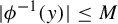
$M\in \mathbb {N}$
 such that
$|\phi ^{-1}(y)|\leq M$
such that
$|\phi ^{-1}(y)|\leq M$
 for all
$y\in Y$
for all
$y\in Y$
 , we say
$\phi $
, we say
$\phi $
 is bounded-to-one. When there is no confusion, we will use ‘
$(Y,f)$
is bounded-to-one. When there is no confusion, we will use ‘
$(Y,f)$
 is a factor of X’ and ‘Y is a factor of X’ interchangeably. If a factor map
$\phi $
is a factor of X’ and ‘Y is a factor of X’ interchangeably. If a factor map
$\phi $
 is a homeomorphism, we call
$\phi $
is a homeomorphism, we call
$\phi $
 a conjugacy.
If Y as above is both a factor of an SFT and a shift space itself, we say that Y is sofic [Reference WeissWei73]. In parallel with the graph presentation for SFTs, sofic shifts can be presented by bi-infinite walks on a graph G modulo a labeling
$\Phi $
 of the edges in G. We will call
$(G,\Phi )$
of the edges in G. We will call
$(G,\Phi )$
 a presentation of a sofic shift.
Suppose X is a compact metric space. We say a homeomorphism
$f:X\to X $
 is expansive if there exists a constant
$\varepsilon>0$
is expansive if there exists a constant
$\varepsilon>0$
 such that for any
$x\neq y\in \Omega $
such that for any
$x\neq y\in \Omega $
 , there exists an
$n\in \mathbb {Z}$
, there exists an
$n\in \mathbb {Z}$
 such that

We call
$\varepsilon $
 an expansive constant for f.
If a dynamical system
$(Y,f)$
 is an expansive factor of an SFT, then we say that it is finitely presented (FP). Standard examples of FP systems are sofic shifts and hyperbolic toral automorphisms, that is, diffeomorphisms on
$\mathbb {R}^d/\mathbb {Z}^d$
is an expansive factor of an SFT, then we say that it is finitely presented (FP). Standard examples of FP systems are sofic shifts and hyperbolic toral automorphisms, that is, diffeomorphisms on
$\mathbb {R}^d/\mathbb {Z}^d$
 induced by a matrix
$A\in \operatorname {GL}_d(\mathbb {Z})$
induced by a matrix
$A\in \operatorname {GL}_d(\mathbb {Z})$
 with no eigenvalues of modulus 1 [Reference Adler and WeissAW70, Reference SinaiSin68]. We will discuss the definition further in §3.1.
A general dynamical system
$(X,f)$
 is topologically transitive if for every pair of non-empty open sets
$U,V\subset X$
is topologically transitive if for every pair of non-empty open sets
$U,V\subset X$
 , there exists an
$n>0$
, there exists an
$n>0$
 such that

In particular, if for all non-empty open
$U,V\subset X$
 the above is true for all n larger than some
$N=N(U,V)>0$
the above is true for all n larger than some
$N=N(U,V)>0$
 , we say that
$(X,f)$
, we say that
$(X,f)$
 is topologically mixing.
Let X be an SFT represented by a graph G with adjacency matrix
$A_G$
 . We say that X is irreducible, respectively mixing, if
$A_G$
. We say that X is irreducible, respectively mixing, if
$A_G$
 is irreducible, respectively primitive. Note that irreducibility of a shift space is thus equivalent to being topologically transitive and mixing means topologically mixing.
The interest in the LPS of shift spaces comes from the famed Krieger embedding theorem. Here,
$h(X)$
 denotes the entropy of X, which will be defined in §4.
Theorem 1.2. [Reference KriegerKri82]
Let Y be a mixing SFT and X any shift space such that
${h(X)<h(Y)}$
 . Then, X embeds into Y if and only if
$q_n(X)\leq q_n(Y)$
. Then, X embeds into Y if and only if
$q_n(X)\leq q_n(Y)$
 for all
$n\in \mathbb {N}$
for all
$n\in \mathbb {N}$
 .
.
A similar statement is true when X is irreducible, see the work by Marcus et al [Reference Marcus, Meyerovitch, Thomsen and WuMMTW25]. We point out the irreducible case because here, the difference in LPS between SFTs and sofic shifts is more pronounced, see Table 1. We touch on this again in §4.
Summary of classification of LPSs.

Table 1 Long description
The header row lists S F T, Sofic, and F P as column titles. The first column on the left defines three properties vertically: Mixing, Transitive, and General. For Mixing, all three columns show curly bracket one or S. For Transitive, S F T displays curly bracket d or d S, while Sofic and F P both show F union summation from i equals one to n of d sub i S sub i, marked with an asterisk. For General, all columns show F union summation from i equals one to n of d sub i S sub i. Mathematical notation is preserved exactly as shown in each cell.
The zeta function of a dynamical system
$(X,f)$
 is
is

wherever it is defined. In this definition, we assume that
$p_n(f)<\infty $
 for all n, which will be the case for all systems under consideration.
For two integers
$d,k\in \mathbb {N}$
 , we will denote

More generally, for any set
$S=\{s_1,s_2,\ldots \}\subset \mathbb {N}$
 and integer
$d\in \mathbb {N}$
and integer
$d\in \mathbb {N}$
 , we will write

We are now ready to state our main results.
Theorem 1.3. Let
$(X,f)$
 be a dynamical system with zeta function
$\zeta _f(t)$
be a dynamical system with zeta function
$\zeta _f(t)$
 with positive radius of convergence such that
${d}/{dt}\ln \zeta _f(t)$
with positive radius of convergence such that
${d}/{dt}\ln \zeta _f(t)$
 is rational. Then, the period set of X is of the form

where the union is possibly empty. In particular, if
$\zeta _f(t)$
 is rational, the conclusion holds.
A set
$S\subset \mathbb {N}$
 is cofinite if its complement in
$\mathbb {N}$
is cofinite if its complement in
$\mathbb {N}$
 is finite. The following result classifies the LPS for FP systems. The converse is also true: see Theorem 4.2, where we construct a sofic shift (that is, an FP system) that realizes an LPS of the form below.
Theorem 1.4. Let
$(\Omega ,f)$
 be an FP system. Then,
$\operatorname {LPS}(f)$
be an FP system. Then,
$\operatorname {LPS}(f)$
 is of the form

where F is finite, each
$S_i$
 is cofinite, and either F or the big union may be empty, but not both.
Moreover, if
$(\Omega ,f)$
 is a topologically transitive FP system, then
$\operatorname {LPS}(f)$
is a topologically transitive FP system, then
$\operatorname {LPS}(f)$
 is either a singleton or of the form above with
$n\geq 1$
is either a singleton or of the form above with
$n\geq 1$
 , that is, at least one cofinite set
$S_i$
, that is, at least one cofinite set
$S_i$
 .
.
Finally, if
$(\Omega ,f)$
 is mixing, then
$\operatorname {LPS}(f)$
is mixing, then
$\operatorname {LPS}(f)$
 is either
$\{1\}$
is either
$\{1\}$
 or a cofinite set.
If the FP system in theorem above is a mixing sofic shift, the result was shown by Doering in [Reference DoeringDoe20]. The classification for SFTs can be made more specific. The following theorem was proved directly by Doering and Pavlov; we provide an alternative proof as a special case of the result above.
Theorem 1.5. [Reference Doering and PavlovDP19]
Let X be an SFT. Then,
$\operatorname {LPS}(X)$
 is of the form

where F is finite, each
$S_i$
 is cofinite, and either F or the big union may be empty, but not both.
If X is irreducible, then
$\operatorname {LPS}(X)$
 is either a singleton
$\{d\}$
is either a singleton
$\{d\}$
 or of the form
$dS$
or of the form
$dS$
 for S cofinite, and if X is mixing, then
$\operatorname {LPS}(X)$
for S cofinite, and if X is mixing, then
$\operatorname {LPS}(X)$
 is either
$\{1\}$
is either
$\{1\}$
 or cofinite.
The results on LPSs are summarized handily in Table 1, where any set denoted S or
$S_i$
 is understood to be cofinite and F denotes a finite set. The condition
$(*)$
is understood to be cofinite and F denotes a finite set. The condition
$(*)$
 indicates that if the LPS of a toplogically transitive FP system or of an irreducible sofic shift is finite, it must be a singleton. This condition does not hold in the general case.
The structure of this paper is as follows. In §2, we prove Theorem 1.3, and in §3, we prove Theorems 1.4 and 1.5. The latter section also contains some intermediate results that may be of independent interest and we further provide a classification for the LPS of shifts known as gap shifts by elementary tools.
Section 4 is dedicated to constructions that show that any LPS identified in §3 can indeed be realized by some dynamical system, in fact, a shift space.
2 Period sets
In this section, we prove Theorem 1.3, which in particular classifies the period set of dynamical systems with a rational zeta function. Systems with this property include rational maps of the complex plane [Reference HinkkanenHin94] and FP systems [Reference FriedFri87], which include Axiom A diffeomorphisms [Reference ManningMan71] and SFTs [Reference Lind and MarcusLM21].
Recall that we are trying to show that if
$(X,f)$
 is a dynamical system whose zeta function with positive radius of convergence such that
${d}/{dt}\ln \zeta _f(t)$
is a dynamical system whose zeta function with positive radius of convergence such that
${d}/{dt}\ln \zeta _f(t)$
 is rational, then the period set of X is of the form

where the union is possibly empty.
We require a lemma due to Schützenberger, which we modify slightly to suit our purposes. A sequence of complex numbers
$p_n$
 satisfies a linear recurrence (of order k) if there exist a finite collection of complex numbers
$b_i$
satisfies a linear recurrence (of order k) if there exist a finite collection of complex numbers
$b_i$
 for
$0\leq i \leq k$
for
$0\leq i \leq k$
 , not all 0, such that for all n larger than some
$N\in \mathbb {N}$
, not all 0, such that for all n larger than some
$N\in \mathbb {N}$
 ,
,

The proof of the lemma is fairly elementary and we include it here for completeness.
Lemma 2.1. (Schützenberger)
Consider a sequence
$(p_n)_{n=0}^\infty $
 of complex numbers such that on some open disk in
$\mathbb {C}$
of complex numbers such that on some open disk in
$\mathbb {C}$
 , centered at 0, we have

with
$A(t),B(t)\in \mathbb {C}[t]$
 . Then, for large enough n,
$(p_n)$
. Then, for large enough n,
$(p_n)$
 satisfies a linear recurrence. Moreover, if
$p_n\in \mathbb {Q}$
satisfies a linear recurrence. Moreover, if
$p_n\in \mathbb {Q}$
 for all n, then the coefficients of
$A(t),B(t)$
for all n, then the coefficients of
$A(t),B(t)$
 are rational.
Proof. Since the series does not have a pole at 0, we may write

so that the numerator and denominator are relatively prime in
$\mathbb {C}[t]$
 . Then, we have

and so for
$n> k,$


The linear recurrence above is in fact of minimal order, since otherwise,
$\operatorname {gcd}(A(t)$
 ,
$B(t))\neq 1$
,
$B(t))\neq 1$
 . Let now

so that

Since
$(p_n)$
 does not satisfy any shorter linear recurrence,
$P_n$
does not satisfy any shorter linear recurrence,
$P_n$
 is invertible. It follows that

hence,
$B(t)\in \mathbb {Q}[t]$
 . By (1),
$A(t)\in \mathbb {Q}[t]$
. By (1),
$A(t)\in \mathbb {Q}[t]$
 and the proof is complete.
The second part of the lemma above implies that if a system has a rational zeta function, its poles and zeroes must be algebraic numbers.
We also use the following powerful theorem, which is much broader than our use case. We refer the reader to [Reference Hansel and BrauerHan85] for a comprehensive proof. For a sequence
$(a_n)$
 , we denote its zero set by

Theorem 2.2. (Skolem–Mahler–Lech)
Let
$(a_n)$
 be a sequence of complex numbers that satisfies a linear recurrence. Then, there exist
$r,b_1,\ldots ,b_k$
be a sequence of complex numbers that satisfies a linear recurrence. Then, there exist
$r,b_1,\ldots ,b_k$
 with k possibly
$0$
with k possibly
$0$
 such that the zero set of
$(a_{n})$
such that the zero set of
$(a_{n})$
 is
is

where F is finite.
We have now equipped ourselves with all the tools required to prove our main result of this section.
Proof of Theorem 1.3.
Let
$\zeta (t)$
 denote the dynamical zeta function of
$(X,f)$
denote the dynamical zeta function of
$(X,f)$
 . By definition of the zeta function, we have

Since
$({d}/{dt})\ln \zeta (t)$
 is assumed to be rational, by Lemma 2.1, the sequence
$(p_n)$
is assumed to be rational, by Lemma 2.1, the sequence
$(p_n)$
 satisfies a linear recurrence. By Theorem 2.2, this means that for some
$r,K\in \mathbb {N}$
satisfies a linear recurrence. By Theorem 2.2, this means that for some
$r,K\in \mathbb {N}$
 , and some
$B\subset \{0,1,\ldots ,r-1\}$
, and some
$B\subset \{0,1,\ldots ,r-1\}$
 and finite
$F\subset \mathbb {N}$
and finite
$F\subset \mathbb {N}$
 ,
,

and thus,

where
$F'=\{ 1,\ldots ,K-1 \}\setminus F$
 .
.
We write
$i|j\!\! \mod r$
 to mean that for some
$a\in \mathbb {N}$
to mean that for some
$a\in \mathbb {N}$
 ,
$ai=j\!\! \mod r$
,
$ai=j\!\! \mod r$
 , or equivalently that j is an integer combination of i and r. We note further that by definition of
$(p_n)$
, or equivalently that j is an integer combination of i and r. We note further that by definition of
$(p_n)$
 , for all
$k,n\in \mathbb {N}$
, for all
$k,n\in \mathbb {N}$
 ,
,

This means that if
$i\in B^c$
 and
$i|j\!\! \mod r$
and
$i|j\!\! \mod r$
 , then
$j\in B^c$
, then
$j\in B^c$
 . Indeed, suppose
$K\leq i+kr\in \operatorname {PS}(X)$
. Indeed, suppose
$K\leq i+kr\in \operatorname {PS}(X)$
 and
$a(i+kr)=j+br$
and
$a(i+kr)=j+br$
 for some constants
$a,b,$
for some constants
$a,b,$
 and k. Then,
$K\leq j+br\in \operatorname {PS}(X)$
and k. Then,
$K\leq j+br\in \operatorname {PS}(X)$
 , so
$j\in B^c$
, so
$j\in B^c$
 .
.
We now show that

On the one hand, for fixed
$n\in \mathbb {N}$
 , we have
$i|ni\!\! \mod r$
, we have
$i|ni\!\! \mod r$
 . Hence,
$ni =j+kr$
. Hence,
$ni =j+kr$
 for some
$j\in B^c$
for some
$j\in B^c$
 , implying

On the other hand, if
$m=i+kr$
 , we can write
$m=k'\gcd (i,r)$
, we can write
$m=k'\gcd (i,r)$
 for some
$k'\in \mathbb {N}$
for some
$k'\in \mathbb {N}$
 . The well-known Bézout's lemma tells us that
$i|\gcd (i,r)\!\! \mod r$
. The well-known Bézout's lemma tells us that
$i|\gcd (i,r)\!\! \mod r$
 and so
$\gcd (i,r)\in B^c$
and so
$\gcd (i,r)\in B^c$
 . This means

establishing (4).
Applying this equality to (2), we get that

Both
$F'$
 and
$B^c$
and
$B^c$
 are finite, giving the desired expression.
Finally, if
$\zeta (t)={R(t)}/{S(t)}$
 for some polynomials
$R,S\in \mathbb {Q}[t]$
for some polynomials
$R,S\in \mathbb {Q}[t]$
 , then

This expression is rational, so
$\zeta (t)$
 satisfies the assumptions of the theorem and the conclusion holds.
3 Least period sets
3.1 Entropy and FP systems
For our result on LPSs, we will need some tools from topological dynamics, which we develop here. For a detailed introduction, we refer to [Reference WaltersWal00].
Let
$(X,d)$
 be a compact metric space and
$f:X\to X$
be a compact metric space and
$f:X\to X$
 our transformation of interest. The transformation f induces a new metric

for each
$n\in \mathbb {N}$
 . We say that a set of points E is
$(n,\varepsilon )$
. We say that a set of points E is
$(n,\varepsilon )$
 -separated if for
$x,y\in E$
-separated if for
$x,y\in E$
 ,
$x\neq y$
,
$x\neq y$
 , we have
$d_n(x,y)>\varepsilon $
, we have
$d_n(x,y)>\varepsilon $
 . Let
. Let

which is finite for fixed
$n,\varepsilon $
 by compactness of X.
We can now state one way of defining the topological entropy of a dynamical system. This particular definition is due to Bowen, see [Reference WaltersWal00, Ch. 7.2].
Definition 3.1. The topological entropy of a dynamical system
$(X,f)$
 as above is

The first half of the next lemma is well known and follows for example from combining Theorems 7.2 and 7.8 in [Reference WaltersWal00]. A purely topological proof of the second half can be found in [Reference RobinsonRob95, Ch. IX], Theorem 1.8, which uses [Reference BowenBow71, Theorem 17].
Lemma 3.2. If
$\pi :(X,f)\to (Y,g)$
 is a factor map between dynamical systems, then

Moreover, if
$\pi $
 is also bounded-to-one, then

We also use a property called entropy-minimality, which says that any proper subsystem must have strictly smaller entropy than the whole system.
Definition 3.3. A dynamical system
$(X,f)$
 is entropy-minimal if, whenever Y is a closed invariant proper subset of X, we have

Irreducible SFTs, for example, have this property. The following lemma is [Reference Lind and MarcusLM21, Theorem 4.4.7].
Lemma 3.4. Suppose
$(X,\sigma )$
 is an irreducible SFT. Then,
$(X,\sigma )$
is an irreducible SFT. Then,
$(X,\sigma )$
 is entropy-minimal.
Combining this result with Lemma 3.2 immediately shows that entropy-minimality holds for any bounded-to-one factor of an irreducible SFT.
Corollary 3.5. Suppose
$\pi :X\to \Omega $
 is a bounded-to-one factor map from an irreducible SFT X to some dynamical system
$(\Omega ,f)$
is a bounded-to-one factor map from an irreducible SFT X to some dynamical system
$(\Omega ,f)$
 . Then,
$(\Omega ,f)$
. Then,
$(\Omega ,f)$
 is entropy-minimal. In particular, topologically transitive FP systems are entropy-minimal.
Proof. Let
$Z\subsetneq \Omega $
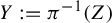
 be a proper subsystem. Since Z is closed and f-invariant,
$Y:=\pi ^{-1}(Z)$
be a proper subsystem. Since Z is closed and f-invariant,
$Y:=\pi ^{-1}(Z)$
 is compact and a strict subshift of X. Moreover, since
$\pi $
is compact and a strict subshift of X. Moreover, since
$\pi $
 is bounded-to-one, so is
$\pi ':=\pi |_Y$
is bounded-to-one, so is
$\pi ':=\pi |_Y$
 , giving the following diagram.

Thus,

Finally, the following well-known lemma on entropy for expansive homeomorphisms is in [Reference BowenBow78].
Lemma 3.6. When
$(\Omega ,f)$
 is an expansive homeomorphism, we have

Proof. Let
$\delta $
 denote an expansive constant for f and let
$\varepsilon <\delta .$
denote an expansive constant for f and let
$\varepsilon <\delta .$
 Let
$x,y\in P_n(f).$
Let
$x,y\in P_n(f).$
 By expansiveness, for some
$i\in \mathbb {Z}$
By expansiveness, for some
$i\in \mathbb {Z}$
 ,
,

However, since
$x,y$
 are periodic with period n, this means

That is,
$P_n(f)$
 is
$(n,\varepsilon )$
is
$(n,\varepsilon )$
 -separated for all n and we get that

for all n. The conclusion follows.
Recall from the introduction that an FP system is an expansive factor of an SFT. We introduce briefly an equivalent definition of FP given by Fried in [Reference FriedFri87]. Suppose
$f:\Omega \to \Omega $
 is a factor of an SFT
$X\subset \mathcal {A}^{\mathbb {Z}}$
is a factor of an SFT
$X\subset \mathcal {A}^{\mathbb {Z}}$
 on alphabet via
$\pi :X\to \Omega $
on alphabet via
$\pi :X\to \Omega $
 . Then, we have an equivalence relation E on X given by

and we can write
$\Omega = X/E$
 . Now, if we view E as a subshift of
$(\mathcal {A}\times \mathcal {A})^{\mathbb {Z}}$
. Now, if we view E as a subshift of
$(\mathcal {A}\times \mathcal {A})^{\mathbb {Z}}$
 , [Reference FriedFri87] introduces the term FP for such f where E is an SFT. The same reference also provides the following fundamental theorem, which in particular gives the equivalence of the two definitions.
Theorem 3.7. (Fried [Reference FriedFri87])
$\Omega =X/E$
 for some SFTs
$X,E$
for some SFTs
$X,E$
 if and only if
$(\Omega ,f)$
if and only if
$(\Omega ,f)$
 is an expansive factor of an SFT if and only if
$\Omega $
is an expansive factor of an SFT if and only if
$\Omega $
 admits a Markov partition.
These Markov partitions have a long history dating back to Sinai in his work on Anosov diffeomorphisms [Reference SinaiSin68], and work on toral automorphisms by Adler and Weiss [Reference Adler and WeissAW70]. They were further developed by Bowen as a tool in better understanding what are known as Axiom A diffeomorphisms [Reference BowenBow08] and generalized by Fried into FP systems. We also point out that [Reference Ashley, Kitchens and StaffordAKS92] collects many of the results on Markov partitions in generality.
Often, Markov partitions are constructed with a particular class of dynamical system in mind, so there is some variance in the definitions across the literature. For completeness, we give a definition of Markov partitions following [Reference FriedFri87], who in turn follows [Reference BowenBow08]. The definition is somewhat involved, but the main point for us is that a Markov partition yields an SFT and a factor map with properties outlined in Proposition 3.8.
Let
$(\Omega ,f)$
 be an expansive dynamical system, with expansive constant
$c>0$
be an expansive dynamical system, with expansive constant
$c>0$
 . For
${\varepsilon>0}$
. For
${\varepsilon>0}$
 , define the
$\varepsilon $
, define the
$\varepsilon $
 -stable and
$\varepsilon $
-stable and
$\varepsilon $
 -unstable sets

Taking
$\varepsilon \leq c/2$
 ,
$W_\varepsilon ^u(x)\cap W_\varepsilon ^s(y)$
,
$W_\varepsilon ^u(x)\cap W_\varepsilon ^s(y)$
 consists of at most one point for any
$x,y\in \Omega $
consists of at most one point for any
$x,y\in \Omega $
 . Let
. Let

A set
$R\subset \Omega $
 is a rectangle if
$R\times R\subset D_\varepsilon $
is a rectangle if
$R\times R\subset D_\varepsilon $
 . Finally, a Markov partition for
$(\Omega ,f)$
. Finally, a Markov partition for
$(\Omega ,f)$
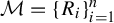
 is a finite cover
$\mathcal {M}=\{R_i\}_{i=1}^n$
is a finite cover
$\mathcal {M}=\{R_i\}_{i=1}^n$
 of
$\Omega $
of
$\Omega $
 consisting of non-empty rectangles with disjoint interiors of diameter less than
$\varepsilon $
consisting of non-empty rectangles with disjoint interiors of diameter less than
$\varepsilon $
 such that
$\overline {\operatorname {int}R}=R$
such that
$\overline {\operatorname {int}R}=R$
 for all
$R\in \mathcal {M}$
for all
$R\in \mathcal {M}$
 , satisfying the Markov property: whenever
$x\in \operatorname {int}R_i$
, satisfying the Markov property: whenever
$x\in \operatorname {int}R_i$
 and
$fx\in \operatorname {int}R_j$
and
$fx\in \operatorname {int}R_j$
 ,
,

Given the Markov partition
$\mathcal {M}=\{R_i\}_{i=1}^n$
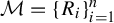 , we define a transition matrix

and denote the shift space generated by this matrix
$X_A$
 . We then obtain a factor map
$\pi :X_A\to \Omega $
. We then obtain a factor map
$\pi :X_A\to \Omega $
 defined by

This map is well defined, continuous, and makes the following diagram commute.

In fact,
$\pi $
 has several other desirable properties.
Proposition 3.8. Let
$\pi :X\to \Omega $
 be a factor map arising from a Markov partition of
$\Omega $
be a factor map arising from a Markov partition of
$\Omega $
 . Then, the following hold.
-
(A) There exists an $M\in \mathbb {N}$
 such that
$\sup _{w\in \Omega } |\pi ^{-1}w|\leq M$
, that is,
$\pi :X\to \Omega $
is bounded-to-one.
such that
$\sup _{w\in \Omega } |\pi ^{-1}w|\leq M$
, that is,
$\pi :X\to \Omega $
is bounded-to-one. -
(B) If $w\in \Omega $
is periodic, all points in
$\pi ^{-1}w$
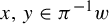
must be periodic. Moreover, any pair of points
$x,y\in \pi ^{-1}w$
must be mutually separated, meaning
$x_i\neq y_i$
for all
$i\in \mathbb {Z}$
. -
(C) The set of $w\in \Omega $
such that
$|\pi ^{-1}w|=1$
is a dense
$G_\delta $
set and, in particular, non-empty. -
(D) If $\Omega $
is topologically transitive, then X is irreducible. Moreover, if
$\Omega $
is mixing, then X is mixing.






Properties (A) and (B) are consequences of [Reference Ashley, Kitchens and StaffordAKS92, Lemma 1.8], sometimes known as the ‘no diamonds’ property of Markov partitions. For the latter, see [Reference ManningMan71, Corollary 11 and Proposition 12], which refers to [Reference BowenBow70].
One can also find property (C) in [Reference Ashley, Kitchens and StaffordAKS92]. From this property, we will actually only need the existence of a single point with a unique preimage in the presentation in the proof of Theorem 1.4. Surprisingly, in [Reference Marcus, Meyerovitch, Thomsen and WuMMTW25], there is significant interest in arbitrary SFT covers where at least one point has a unique preimage. We will touch on this later in this section.
The forward direction of property (D) is [Reference BowenBow08, Theorem 3.19] specifically for the Axiom A case, but the same proof generalizes to FP systems. We note also that the converse statements of property (D) are clearly true.
3.2 Proof of Theorems 1.4 and 1.5
We have collected all the necessary tools to prove the next main result. Along the way, we obtain two intermediate results that are interesting in their own right. Intuitively, we look at different ‘layers’ of the system, where the layers are separated by the number of preimages a point has with respect to the cover arising from a Markov partition. The idea of this proof was first suggested by Doering in [Reference DoeringDoe20] as a way of potentially characterizing the LPS of sofic shift spaces.
Let us begin the proof, by letting
$(\Omega ,f)$
 be an FP system. Recall that our goal is to show that

where F is finite, each
$S_i$
 is cofinite, and either F or the big union may be empty, but not both.
Let
$\mathcal {M}=\{R_i\}_{i=1}^{|\mathcal {M}|}$
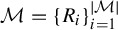 be a Markov partition for
$(\Omega ,f)$
be a Markov partition for
$(\Omega ,f)$
 , X the associated SFT with transition matrix A, and
$\pi :X\to \Omega $
, X the associated SFT with transition matrix A, and
$\pi :X\to \Omega $
 the corresponding factor map. Moreover, let

where it is clear that
$\Omega _1=\Omega $
 . We have that
$\Omega _i$
. We have that
$\Omega _i$
 is f-invariant and

for all i. Note that by Proposition 3.8(A),
$\Omega _i$
 is non-empty for only finitely many i. We analyze each non-empty
$\Omega _i$
is non-empty for only finitely many i. We analyze each non-empty
$\Omega _i$
 separately, as if we are ‘peeling back layers’. The authors of [Reference Ashley, Kitchens and StaffordAKS92] chose independently to call
$\Omega _2$
separately, as if we are ‘peeling back layers’. The authors of [Reference Ashley, Kitchens and StaffordAKS92] chose independently to call
$\Omega _2$
 the core of a Markov partition, invoking a similar image.
Denote

and let

be the set of all periodic points with unique preimage and least period n. It is immediate that

which we use later.
We now construct a set of adjacency matrices
$A^{(i)}$
 such that
$X_i:=X_{A^{(i)}}$
such that
$X_i:=X_{A^{(i)}}$
 is a bounded-to-one factor map onto
$\Omega _i$
is a bounded-to-one factor map onto
$\Omega _i$
 . The idea is inspired by the set of matrices used by Manning to prove that Axiom A diffeomorphisms have rational zeta functions in [Reference ManningMan71].
We define
$A^{(i)}$
 to be the adjacency matrix of a directed graph
$G_i$
to be the adjacency matrix of a directed graph
$G_i$
 whose vertices are the set of all

such that
$|V|=i$
 and
and

We draw an edge from vertex
$U=\{u_1,\ldots ,u_i\}$
 to vertex
$V=\{v_1,\ldots ,v_i\}$
to vertex
$V=\{v_1,\ldots ,v_i\}$
 if and only if there exists a reordering of V such that

for all
$1\leq k\leq i$
 .
.
Recall now that
$\pi (\ldots x_{-1}x_0x_1 \ldots )$
 is defined to be the unique point w such that

There is a natural bounded-to-one factor map
$\pi _i:X_i\to \Omega _i$
 induced from
$\pi $
induced from
$\pi $
 . If
$x\in X_i$
. If
$x\in X_i$
 , then x corresponds to at least i mutually separated points
$y^1,y^2, \ldots , y^i\in X_1$
, then x corresponds to at least i mutually separated points
$y^1,y^2, \ldots , y^i\in X_1$
 such that for all
$n\in \mathbb {Z}$
such that for all
$n\in \mathbb {Z}$
 ,
,

Lemma 1 from [Reference ManningMan71] deduces directly from the definition of
$\pi $
 and expansiveness of f that

and we may thus set

to obtain the following commutative diagram.

Since
$X_i$
 is compact and
$\pi _i$
is compact and
$\pi _i$
 is continuous,
$\Omega _i$
is continuous,
$\Omega _i$
 is a compact subset of
$\Omega $
is a compact subset of
$\Omega $
 .
.
Remark 3.9. In general, it is possible that for an edge in
$G_i$
 from U to V, there exists some
$u\in U$
from U to V, there exists some
$u\in U$
 such that
$A_{uv}=1$
such that
$A_{uv}=1$
 for two distinct
$v\in V$
for two distinct
$v\in V$
 , or some
$v\in V$
, or some
$v\in V$
 such that
$A_{uv}=1$
such that
$A_{uv}=1$
 for two distinct
$u\in U$
for two distinct
$u\in U$
 .
.
However, if this happens, the edge from U to V cannot be part of an irreducible component of
$G_i$
 . If it were, the edge would be part of a cycle, which contradicts Proposition 3.8(B). If
$x\in X_i$
. If it were, the edge would be part of a cycle, which contradicts Proposition 3.8(B). If
$x\in X_i$
 is contained in an irreducible component, it thus corresponds to exactly i mutually separated points in
$X_1$
is contained in an irreducible component, it thus corresponds to exactly i mutually separated points in
$X_1$
 . We later only consider irreducible components of
$X_i$
. We later only consider irreducible components of
$X_i$
 , so we need not be concerned about the scenario above.
Whenever we write f in the remainder of the proof, we always mean f restricted to the appropriate invariant subset of
$\Omega $
 . When there is no ambiguity, we allow ourselves to refrain from explicitly stating this restriction to avoid cumbersome notation.
We briefly put the proof on hold to remark that we have effectively just shown that
$(\Omega _i,f|_{\Omega _i})$
 is FP for all i. Indeed, since
$\Omega _i$
is FP for all i. Indeed, since
$\Omega _i$
 is a factor of the SFT
$X_i$
is a factor of the SFT
$X_i$
 , the only other requirement is that
$f|_{\Omega _i}$
, the only other requirement is that
$f|_{\Omega _i}$
 is expansive by Theorem 3.7, but this is immediate since f is expansive. This fact was already shown by a similar argument for
$(\Omega _2,f|_{\Omega _2})$
is expansive by Theorem 3.7, but this is immediate since f is expansive. This fact was already shown by a similar argument for
$(\Omega _2,f|_{\Omega _2})$
 in [Reference Ashley, Kitchens and StaffordAKS92, Observation 3.1.] We encode this intermediate result as a theorem.
Theorem 3.10. Let
$(\Omega ,f)$
 be an FP system with SFT cover X and factor map
$\pi :X\to \Omega $
be an FP system with SFT cover X and factor map
$\pi :X\to \Omega $
 arising from a Markov partition. Let

Then, if
$\Omega _i$
 is non-empty,
$(\Omega _i,f|_{\Omega _i})$
is non-empty,
$(\Omega _i,f|_{\Omega _i})$
 is an FP system.
We return to the proof. Since
$\pi $
 is bounded-to-one by Proposition 3.8(A), so is
$\pi _i$
is bounded-to-one by Proposition 3.8(A), so is
$\pi _i$
 for all i, although the bounds vary in i. Indeed, if

then
$M(i)$
 may be as high as
$\binom {M(1)}{i}$
may be as high as
$\binom {M(1)}{i}$
 .
.
If
$w\in \Omega $
 is periodic and has exactly i preimages under
$\pi $
is periodic and has exactly i preimages under
$\pi $
 , then these preimages are mutually separated by Proposition 3.8(B) and w must have a unique preimage under
$\pi _i$
, then these preimages are mutually separated by Proposition 3.8(B) and w must have a unique preimage under
$\pi _i$
 . In other words, if we write
$M:=M(1)$
. In other words, if we write
$M:=M(1)$
 , then

Note also that if
$j<i$
 , then w must have at least two mutually separated preimages with respect to
$\pi _j$
, then w must have at least two mutually separated preimages with respect to
$\pi _j$
 , and if
$j>i$
, and if
$j>i$
 , then
$w\notin \Omega _j$
, then
$w\notin \Omega _j$
 .
.
For any i, it is possible that
$X_i$
 is not irreducible. However, since
$X_i$
is not irreducible. However, since
$X_i$
 is an SFT, it consists of finitely many irreducible components and possibly some transient points, cf. [Reference Lind and MarcusLM21], §4.4. Call these irreducible components
$X_i^j$
is an SFT, it consists of finitely many irreducible components and possibly some transient points, cf. [Reference Lind and MarcusLM21], §4.4. Call these irreducible components
$X_i^j$
 for
$1\leq j \leq k_i,$
for
$1\leq j \leq k_i,$
 where
$k_i<\infty $
where
$k_i<\infty $
 . We consider the images of these irreducible components separately.
If a periodic point
$w\in \Omega $
 has a unique preimage x under
$\pi _i$
has a unique preimage x under
$\pi _i$
 , x must be periodic, and hence cannot be transient. That is, x must be in
$X_i^j$
, x must be periodic, and hence cannot be transient. That is, x must be in
$X_i^j$
 for some unique j. Thus, if we write

we get

Now, it is certainly true that a periodic point
$w\in \Omega $
 having i preimages under
$\pi $
having i preimages under
$\pi $
 means it has a unique preimage under
$\pi _i$
means it has a unique preimage under
$\pi _i$
 and, therefore, that preimage x must lie in
$X_i^j$
and, therefore, that preimage x must lie in
$X_i^j$
 for a unique j. However, it may transpire that w has more than i preimages under
$\pi $
for a unique j. However, it may transpire that w has more than i preimages under
$\pi $
 , but a unique preimage with respect to
$\pi _i^j$
, but a unique preimage with respect to
$\pi _i^j$
 for some (or several) j. For example, two preimages of w with respect to
$\pi _i$
for some (or several) j. For example, two preimages of w with respect to
$\pi _i$
 could lie in separate irreducible components of
$X_i$
could lie in separate irreducible components of
$X_i$
 . In other words,

need not form a partition of
$Q_n(f)$
 .
.
Suppose a periodic point
$w\in \Omega _i^j:=\pi _i^j(X_i^j)$
 does not have a unique preimage with respect to
$\pi _i$
does not have a unique preimage with respect to
$\pi _i$
 (note the lack of superscript). Then, w will also be in
$\Omega _{i'}^{j'}$
(note the lack of superscript). Then, w will also be in
$\Omega _{i'}^{j'}$
 for some
$i'> i$
for some
$i'> i$
 and
$j'\leq k_{i'}$
and
$j'\leq k_{i'}$
 . We can thus ignore the period of this point when analyzing
$\Omega _i$
. We can thus ignore the period of this point when analyzing
$\Omega _i$
 and handle it when we get to
$\Omega _{i'}$
and handle it when we get to
$\Omega _{i'}$
 . This means that if
$\Omega _i^j$
. This means that if
$\Omega _i^j$
 contains no points with a unique preimage under
$\pi _i$
contains no points with a unique preimage under
$\pi _i$
 , we can ignore the index pair
$(i,j)$
, we can ignore the index pair
$(i,j)$
 , without losing any periods.
At the same time, if there is
$w\in \Omega _i^j$
 such that
$|\pi _i^{-1}w|=1$
such that
$|\pi _i^{-1}w|=1$
 , then
$\pi _i^{-1}w\in X_i^j$
, then
$\pi _i^{-1}w\in X_i^j$
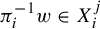 . Thus, if we denote

we can write

To ease the notation, we write

in what follows.
At this point, if we can show that for all
$(i,j)\in \mathcal {G}$
 ,
,

is either a singleton
$\{d\}$
 or
$dS$
or
$dS$
 for a cofinite set S and a positive integer d, we are effectively done with the proof. This is exactly what we do.
Consider two cases. If
$X_i^j$
 is a finite orbit of length d, then
$\Omega _i^j$
is a finite orbit of length d, then
$\Omega _i^j$
 is also a finite orbit of length d, because
$(i,j)\in \mathcal {G}$
is also a finite orbit of length d, because
$(i,j)\in \mathcal {G}$
 . Hence,

Otherwise,
$X_i^j$
 does not consist of a single orbit and some point in
$\Omega _i^j$
does not consist of a single orbit and some point in
$\Omega _i^j$
 has a unique preimage under
$\pi _i$
has a unique preimage under
$\pi _i$
 . We will see that this means

where S is cofinite and d is the global period of
$X_i^j$
 .
.
To this end, we first show that

which we abbreviate to

where
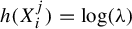
$\unicode{x3bb} $
 is such that
$h(X_i^j)=\log (\unicode{x3bb} )$
is such that
$h(X_i^j)=\log (\unicode{x3bb} )$
 .
.
Let

and
$X':=(\pi _i^j)^{-1}(\Omega ')$
 . Since
$\Omega _{i+1}$
. Since
$\Omega _{i+1}$
 is closed and invariant, so is
$\Omega '$
is closed and invariant, so is
$\Omega '$
 . Moreover,
$\Omega '$
. Moreover,
$\Omega '$
 is a proper subsystem of
$\Omega _i^j$
is a proper subsystem of
$\Omega _i^j$
 , because
$(i,j)\in \mathcal {G}$
, because
$(i,j)\in \mathcal {G}$
 , so
$X'$
, so
$X'$
 is a proper subshift of
$X_i^j$
is a proper subshift of
$X_i^j$
 . Recall also that if
$w\in \Omega _i^j$
. Recall also that if
$w\in \Omega _i^j$
 is periodic but has strictly more than i mutually separated preimages with respect to
$\pi $
is periodic but has strictly more than i mutually separated preimages with respect to
$\pi $
 , then
$w\in \Omega '$
, then
$w\in \Omega '$
 .
.
Let
$\mu $
 denote the real number such that
$h(X')=\log (\mu )$
denote the real number such that
$h(X')=\log (\mu )$
 . We first observe then that
$f|_{\Omega '}$
. We first observe then that
$f|_{\Omega '}$
 is expansive because f is and since
$\pi _i$
is expansive because f is and since
$\pi _i$
 is bounded-to-one, we get that

Moreover, since
$X'$
 is a proper subsystem of
$X_i^j$
is a proper subsystem of
$X_i^j$
 , by Lemma 3.4,

Now, for all
$\varepsilon>0$
 , we have that for all n large enough,

or, equivalently,

We pick
$\varepsilon $
 such that

which is possible by (6).
As a consequence of [Reference Lind and MarcusLM21, Theorem 4.5.11], there exist
$C, D>0$
 such that for all large enough
$n\in \mathbb {N}$
such that for all large enough
$n\in \mathbb {N}$
 ,
,

If
$w\in \Omega _i^j$
 has period n and a unique preimage in
$X_i^j$
has period n and a unique preimage in
$X_i^j$
 , this preimage must also be periodic with period n. Since d is the global period of
$X_i^j$
, this preimage must also be periodic with period n. Since d is the global period of
$X_i^j$
 , this means that a periodic point w can only have a unique preimage if its period is a multiple of d. This yields

for large enough n.
However, every periodic point
$w\in \Omega _i^j$
 that does not have a unique preimage under
$\pi _i^j$
that does not have a unique preimage under
$\pi _i^j$
 lies in
$\Omega '$
lies in
$\Omega '$
 . We remarked earlier that the converse need not be true, so while

the sets on the right-hand side need not be disjoint. We get the inequality

Next, the image of any periodic point of period
$dn$
 in
$X_i^j$
in
$X_i^j$
 must also have (not necessarily least) period
$dn$
must also have (not necessarily least) period
$dn$
 . Some such points in
$X_i^j$
. Some such points in
$X_i^j$
 may be collapsed into a single point in
$\Omega _i^j$
may be collapsed into a single point in
$\Omega _i^j$
 , but we know that
$\pi _i$
, but we know that
$\pi _i$
 is bounded-to-one with bound
$M(i)$
is bounded-to-one with bound
$M(i)$
 . We get

Therefore, for all sufficiently large n,

By our choice of
$\varepsilon $
 ,
,

as
$n\to \infty $
 , and we conclude that indeed

At this stage, we pause the proof once again to collect an intermediate result.
Theorem 3.11. Let
$(\Omega ,f)$
 be a topologically transitive FP system, and let an irreducible SFT X and factor map
$\pi :X\to \Omega $
be a topologically transitive FP system, and let an irreducible SFT X and factor map
$\pi :X\to \Omega $
 be those arising from a Markov partition. Let

and let d be the global period of X. Then, the following quantities are equal:
-
(1) $h(f)$
; -
(2) $\lim _{n\to \infty }({1}/{dn})\log (|\tilde {P}_{dn}(f,\pi )|);$
-
(3) $\lim _{n\to \infty }({1}/{dn}) \log (p_{dn}(f))$
; -
(4) $\limsup _{n\to \infty } ({1}/{n})\log (p_n(f))$
.




Proof. By Proposition 3.8(C), there is at least one point in
$\Omega $
 with a unique preimage under
$\pi $
with a unique preimage under
$\pi $
 . Hence,
$\Omega _2$
. Hence,
$\Omega _2$
 is a strict subsystem of
$\Omega $
is a strict subsystem of
$\Omega $
 . Since X is irreducible by Proposition 3.8(D), following the above argument gives that
${(1)}={(2)}$
. Since X is irreducible by Proposition 3.8(D), following the above argument gives that
${(1)}={(2)}$
 , which we use to obtain the remaining equalities. Note that

and, hence,

A direct chain of inequalities completes the proof:

Remark 3.12. In the statement above, the value of d does not depend on the choice of Markov partition, but is intrinsic to the FP system. In particular, [Reference Marcus, Meyerovitch, Thomsen and WuMMTW25, Proposition 5.1] shows that the global periods of all irreducible SFT covers of a sofic shift for which there exist a point with a unique preimage must be equal. While their result is stated for sofic shifts, the proof carries over to the FP case directly. Combining this with Proposition 3.8(C) shows that the value of d is independent of the choice of Markov partition.
Let us continue with the proof of Theorem 1.4. Recall that

and our aim is to show that

where S is cofinite and d is the global period of
$X_i^j$
 .
.
We have shown that

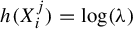
where
$\unicode{x3bb} $
 is such that
$h(X_i^j)=\log (\unicode{x3bb} )$
is such that
$h(X_i^j)=\log (\unicode{x3bb} )$
 and d is the global period of
$X_i^j$
and d is the global period of
$X_i^j$
 . We apply this fact in conjunction with a technique from [Reference Lind and MarcusLM21, proof of Corollary 4.3.8].
First, observe that from (5), we get that

Moreover, we note that
$\tilde {P}_n(f,\pi _i^j)$
 is empty whenever n is not a multiple of d, since a periodic point w with a unique preimage has period n if and only if its preimage has period n. Hence,
$\tilde {Q}_n(f,\pi _i^j)$
is empty whenever n is not a multiple of d, since a periodic point w with a unique preimage has period n if and only if its preimage has period n. Hence,
$\tilde {Q}_n(f,\pi _i^j)$
 is empty if
$n\notin d\mathbb {N}$
is empty if
$n\notin d\mathbb {N}$
 .
.
Since also
$\tilde {p}_{dn,i,j}\sim \unicode{x3bb} ^{dn}$
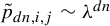 , we conclude from (7) that
$\tilde {Q}_{dn}(f,\pi _i^j)$
, we conclude from (7) that
$\tilde {Q}_{dn}(f,\pi _i^j)$
 is non-empty for all large enough n. That is,

where S is cofinite.
We have now shown that

where F is finite and each
$S_l$
 is cofinite. Since
$X=X_1$
is cofinite. Since
$X=X_1$
 is an SFT, it has at least one periodic point and, therefore,
$\Omega $
is an SFT, it has at least one periodic point and, therefore,
$\Omega $
 has at least one periodic point. Hence, either F or the big union may be empty, but not both. This concludes the general case.
Recall from Proposition 3.8(D) that if
$(\Omega ,f)$
 is FP and topologically transitive, X can be taken to be irreducible. Such an SFT X must either consist of a single finite orbit or have infinitely many periodic points. Consequently, the LPS of a topologically transitive FP system must be of the form above, but if it is finite, it must be a singleton.
Moreover, if
$(\Omega ,f)$
 is topologically mixing, Proposition 3.8(D) says that
$X_1$
is topologically mixing, Proposition 3.8(D) says that
$X_1$
 is mixing, and hence,
$X_1$
is mixing, and hence,
$X_1$
 has period 1 by [Reference Lind and MarcusLM21, Proposition 4.5.10]. In the notation above, this means that
$d_l=1$
has period 1 by [Reference Lind and MarcusLM21, Proposition 4.5.10]. In the notation above, this means that
$d_l=1$
 for some l. The union of a cofinite set with any other subset of the natural numbers is still cofinite, so the contribution of
$\tilde {q}_{n,i,j}$
for some l. The union of a cofinite set with any other subset of the natural numbers is still cofinite, so the contribution of
$\tilde {q}_{n,i,j}$
 for
$i>1$
for
$i>1$
 , the ‘deeper’ layers of the system, to the LPS is effectively hidden. With that, we have proven Theorem 1.4.
Suppose now that
$\Omega $
 is an SFT. Then, it is straightforward to show that the cylinder sets formed by the alphabet of
$\Omega $
is an SFT. Then, it is straightforward to show that the cylinder sets formed by the alphabet of
$\Omega $
 are a Markov partition, where
$\pi $
are a Markov partition, where
$\pi $
 is the identity map. That is,
$X=\Omega $
is the identity map. That is,
$X=\Omega $
 . We thus only need to consider the irreducible components
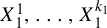
$X_1^1, \ldots , X_1^{k_1}$
. We thus only need to consider the irreducible components
$X_1^1, \ldots , X_1^{k_1}$
 , noting again that any periodic point is not transient, so it must lie in one of these irreducible components. By the above analysis, the LPS of each component is either a singleton
$\{d\}$
, noting again that any periodic point is not transient, so it must lie in one of these irreducible components. By the above analysis, the LPS of each component is either a singleton
$\{d\}$
 or
$dS$
or
$dS$
 for S cofinite. Thus,

where F is finite and each
$S_l$
 cofinite. Again, either F or the big union may be empty, but not both. This classification was first proved in [Reference Doering and PavlovDP19] by a direct combinatorial argument.
The observations we made with respect to the irreducibility hold in the same way. If X is irreducible, then we only have one component
$X_1^1$
 , and
$LPS(X)$
, and
$LPS(X)$
 is either a singleton
$\{d\}$
is either a singleton
$\{d\}$
 or
$dS$
or
$dS$
 for S cofinite. If X is mixing, then
$d=1$
for S cofinite. If X is mixing, then
$d=1$
 , and
$LPS(X)$
, and
$LPS(X)$
 is either
$\{1\}$
is either
$\{1\}$
 or a cofinite set S. This concludes the proof of Theorem 1.5.
3.2.1 Receptive points
In the introduction, we mentioned that our main results are motivated by Krieger’s famed embedding theorem. It is natural to ask for generalizations of this theorem. In [Reference BoyleBoy83], Boyle proves one direction of Krieger’s theorem in the case of mixing sofic shifts, and recent work by Marcus et al in [Reference Marcus, Meyerovitch, Thomsen and WuMMTW25] explores the irreducible case for both sofic shifts and SFTs. In both cases, the main ingredient is the set of receptive periodic points.
Let Y be a sofic shift. A word v is synchronizing if for any words
$w, w'$
 , such that
$wv$
, such that
$wv$
 and
$vw'$
and
$vw'$
 are both allowed in the shift, then
$wvw'$
are both allowed in the shift, then
$wvw'$
 is also allowed. A periodic point
$w^\infty $
is also allowed. A periodic point
$w^\infty $
 in Y with least period
$|w|$
in Y with least period
$|w|$
 is then said to be receptive if there exist synchronizing words
$v_1,v_2$
is then said to be receptive if there exist synchronizing words
$v_1,v_2$
 such that the word
$v_1w^kv_2$
such that the word
$v_1w^kv_2$
 is allowed in X for all
$k\in \mathbb {N}$
is allowed in X for all
$k\in \mathbb {N}$
 .
.
Briefly, the intuition behind the utility of receptive periodic points is as follows. Recall that to embed a shift space X into a mixing SFT Y, Krieger’s embedding theorem requires that
$h(X)<h(Y)$
 and
$q_n(X)\leq q_n(Y)$
and
$q_n(X)\leq q_n(Y)$
 for all
$n\in \mathbb {N}$
for all
$n\in \mathbb {N}$
 . Both conditions force our embedding to behave a certain way on the set of all periodic points: the former gives rise to an embedding into
$P_n(Y)$
. Both conditions force our embedding to behave a certain way on the set of all periodic points: the former gives rise to an embedding into
$P_n(Y)$
 for all but finitely many values of n, while the latter condition forces an embedding on these remaining values of n. A priori, these two embeddings need not cooperate nicely if X is a mixing sofic shift. Receptive periodic points are the key element that allow us to ‘glue together’ the two embeddings that arise from the two conditions, which is precisely what is done in [Reference BoyleBoy83, Theorem 3.6].
For our purposes, it will be convenient to use the following definition of receptive periodic points, which is equivalent to the definition above by [Reference Marcus, Meyerovitch, Thomsen and WuMMTW25, Theorem 4.7].
Definition 3.13. Let Y be a sofic shift and
$w\in Y$
 be periodic. We say w is receptive if there exists an irreducible SFT X and a factor map
$\pi :X\to Y$
be periodic. We say w is receptive if there exists an irreducible SFT X and a factor map
$\pi :X\to Y$
 such that w has a preimage under
$\pi $
such that w has a preimage under
$\pi $
 with the same least period. In particular, periodic points with a unique preimage under some such factor map
$\pi $
with the same least period. In particular, periodic points with a unique preimage under some such factor map
$\pi $
 are receptive.
We also extract from Proposition 5.1 of the same reference the equivalence of two ways in which one might define the ‘period’ of a sofic shift. Recall that the global period of an irreducible SFT X is defined to be
$\gcd (\operatorname {PS}(X)),$
 which is equal to the period of any graph presentation of X.
Proposition 3.14. [Reference Marcus, Meyerovitch, Thomsen and WuMMTW25]
Let Y be an irreducible sofic shift. Then, the global period of any irreducible SFT X for which there exists a factor map
$\pi :X\to Y$
 which is one-to-one on at least one point in Y is equal to the gcd of the periods of all receptive periodic points.
This leads us to the following. Suppose Y is an irreducible sofic shift that is not a finite orbit. Then, Y is a topologically transitive FP system and, hence, admits a Markov partition. Let X be the SFT cover arising from this Markov partition for Y and denote the corresponding factor map
$\pi :X\to Y$
 . Denote also by
$\tilde {Q}_n(Y)$
. Denote also by
$\tilde {Q}_n(Y)$
 the set of points of least period n which have a unique preimage under
$\pi $
the set of points of least period n which have a unique preimage under
$\pi $
 .
.
By Proposition 3.8(C), there is at least one such point, so we know from the proof of Theorem 1.4 that

where
$S'$
 is some cofinite set and d is the global period of X. By Definition 3.13, any point with a unique preimage in this particular cover of Y is receptive, and thus,

However, by Proposition 3.14, we also know that

Of course, in the case that Y is a finite orbit, all of its points are receptive and of the same period. Combining all of the above, we immediately get the following result.
Theorem 3.15. Let Y be an irreducible sofic shift. Then,

is either a singleton
$\{d\}$
 or
$dS$
or
$dS$
 , where S is a cofinite set.
We point out that Definition 3.13 is not symbolic and, hence, a priori can be used to define receptive points in an FP system. In fact, although [Reference Marcus, Meyerovitch, Thomsen and WuMMTW25] focuses on sofic systems, it seems many of their results carry over directly to the FP case. We thus conjecture that Theorem 3.15 also holds for FP systems.
3.3 Gap shifts
We shall obtain a more precise characterization of the LPS of a subclass of shift spaces called gap shifts. We denote
$\mathbb {N}_0:=\mathbb {N}\cup \{0\}$
 .
.
Definition 3.16. Let
$S\subset \mathbb {N}_{0}$
 . Then, the S-gap shift, denoted
$X(S)$
. Then, the S-gap shift, denoted
$X(S)$
 , is the shift on
$\{ 0,1 \}$
, is the shift on
$\{ 0,1 \}$
 such that the word
$10^m1$
such that the word
$10^m1$
 is only allowed if
$m\in S$
is only allowed if
$m\in S$
 .
.
Note that if S is finite, the symbol 1 occurs infinitely many times to the right and to the left in any point
$x\in X(S)$
 . Moreover, if S is infinite, infinitely many consecutive 0s are allowed and, hence, the point
$0^\infty \in X(S)$
. Moreover, if S is infinite, infinitely many consecutive 0s are allowed and, hence, the point
$0^\infty \in X(S)$
 .
.
The intersection of S-gap shifts and sofic shifts (respectively SFTs) is easily described, due to the following result due to Dastjerdi and Jangjoo. We say a set
$S\subset \mathbb {N}_0$
 is eventually periodic if, up to some finite number of elements, it consists only of tails of infinite arithmetic progressions.
Proposition 3.17. [Reference Dastjerdi and JangjooDJ12]
An S-gap shift is sofic if and only if S is eventually periodic. Moreover, an S-gap shift is an SFT if and only if S is finite or cofinite.
A subset R of the natural numbers is almost sum-closed if for any pair of distinct elements of R, their sum is also in R. Given a set S, we denote its almost sum-closure by

The following properties of almost sum-closures are immediate from the definition and Bézout’s lemma.
Proposition 3.18. If
$S\subset \mathbb {N}$
 is a singleton, then

More generally, if
$S\subset \mathbb {N}$
 is almost sum-closed, then

Finally, if S contains at least two distinct elements, then

where
$S'$
 is cofinite.
Recall that a word w is not purely periodic if there is no other word v and integer
$k>1$
 such that
$w=v^k$
such that
$w=v^k$
 . In other words, if w is not purely periodic and
$w^\infty $
. In other words, if w is not purely periodic and
$w^\infty $
 is allowed in a shift, then the least period of
$w^\infty $
is allowed in a shift, then the least period of
$w^\infty $
 is
$|w|$
is
$|w|$
 . Our classification of the LPS of gap shifts is then as follows.
Theorem 3.19. Let
$S\subset \mathbb {N}_0$
 be non-empty and let
$X(S)$
be non-empty and let
$X(S)$
 be the S-gap shift. Then,

if S is finite, and

if S is infinite. In particular,
$\operatorname {LPS}(X(S))$
 is one of the following:
-
• a singleton $\{ d \}$
; or -
• an almost sum-closed set $dR$
with R cofinite; or -
• an almost sum-closed set $dR$
with R cofinite, together with the singleton
$\{ 1 \}$
.


Proof. We consider three cases. First, if
$S=\{d\}$
 , then

which is a finite orbit of length
$d+1$
 . Hence,

Suppose now that S is finite with
$|S|>1$
 and let
$x\in X(S)$
and let
$x\in X(S)$
 be periodic. Since S is finite,
$x\neq 0^\infty $
be periodic. Since S is finite,
$x\neq 0^\infty $
 . Then, we either have

for some
$i\in \mathbb {Z}$
 ,
$n\in S$
,
$n\in S$
 , or
, or

where
$i\in \mathbb {Z}$
 ,
$k>1$
,
$k>1$
 ,
$n_j\in S$
,
$n_j\in S$
 for all
$1\leq j\leq k$
for all
$1\leq j\leq k$
 , and
$w:=10^{n_{1}}10^{n_{2}}1\cdots 10^{n_{k}}$
, and
$w:=10^{n_{1}}10^{n_{2}}1\cdots 10^{n_{k}}$
 is not purely periodic. In the first case, the least period of x is

In the second case, at least two
$n_j,n_{j'}$
 are distinct, so the least period of x is

Thus,
$\operatorname {LPS}(X(S))\subset \Sigma ^*_{S+1}.$
 Conversely, let
$\tilde {n}\in \Sigma _{S+1}^*$
Conversely, let
$\tilde {n}\in \Sigma _{S+1}^*$
 . Then, there exists a set
$\{n_j\}_{j=1}^k$
. Then, there exists a set
$\{n_j\}_{j=1}^k$
 such that
$n_j\in S$
such that
$n_j\in S$
 for all
$1\leq j\leq k$
for all
$1\leq j\leq k$
 and at least two
$n_j,n_{j'}$
and at least two
$n_j,n_{j'}$
 are distinct, and

Then, after sorting the
$n_j$
 in weakly increasing order, the word

is not purely periodic, so

is in
$X(S)$
 and has least period
$\tilde {n}$
and has least period
$\tilde {n}$
 . Using Proposition 3.18, we conclude that

for some cofinite set R.
Finally, suppose S is infinite. We may then repeat exactly the argument above, but must also note that
$0^\infty \in X(S)$
 . This yields a point of period 1. In this case, we thus get

where again R is cofinite.
In the next section, we will show that any set of the form in Theorem 3.19 can in fact be realized by a sofic gap shift or even a gap SFT.
4 Realization
This section is dedicated to explicit constructions that prove the sufficiency in our main results. In fact, each construction will be a shift space. Before we begin with the LPS constructions, we point out that any construction in this section can be used to realize a desired PS as well.
For a set
$S\subset \mathbb {N}$
 , we adopt terminology of [Reference Doering and PavlovDP19] and say S is closed under
$\mathbb {N}$
, we adopt terminology of [Reference Doering and PavlovDP19] and say S is closed under
$\mathbb {N}$
 -multiples if for any
$s\in S$
-multiples if for any
$s\in S$
 and
$k \in \mathbb {N}$
and
$k \in \mathbb {N}$
 ,
$k\cdot s\in S$
,
$k\cdot s\in S$
 . It is immediate from the definition that for a given dynamical system
$(X,f)$
. It is immediate from the definition that for a given dynamical system
$(X,f)$
 ,
,

so
$\operatorname {PS}(f)$
 is closed under
$\mathbb {N}$
is closed under
$\mathbb {N}$
 -multiples. The theorem statements in this section are of the following form.
-
Given $S\subset \mathbb {N}$
with property
$\mathcal {P}$
, there is a shift space X of type
$\mathcal {T}$
such that
${\operatorname {LPS}(X)=S}$
.



The described properties
$\mathcal {P}$
 are compatible with being closed under
$\mathbb {N}$
are compatible with being closed under
$\mathbb {N}$
 -multiples, so we can replace the above with the following.
-
Given an $S\subset \mathbb {N}$
with property
$\mathcal {P}$
that is closed under
$\mathbb {N}$
-multiples, there is a shift space X of type
$\mathcal {T}$
such that
$\operatorname {PS}(X)=S$
.


The constructions are identical, and conclude by noting that if S is closed under
$\mathbb {N}$
 -multiples and
$\operatorname {LPS}(X)=S$
-multiples and
$\operatorname {LPS}(X)=S$
 , then
$\operatorname {PS}(X)=S$
, then
$\operatorname {PS}(X)=S$
 . Of course, one can ignore finite sets S: any finite set that is closed under
$\mathbb {N}$
. Of course, one can ignore finite sets S: any finite set that is closed under
$\mathbb {N}$
 -multiples must be empty.
In particular, this observation means that Theorem 4.2 allows us to construct a sofic shift that realizes a period set of the form outlined in Theorem 1.3.
4.1 SFTs
The following result is a converse to Theorem 1.5, which is also due to Doering and Pavlov. For completeness, we repeat their constructive argument here. For a graph G, a simple cycle is a cycle where every vertex has exactly one incoming edge and exactly one outgoing edge. We call the edge shift of G the collection of all bi-infinite walks on G encoded as sequences of edges. We denote this shift
$X_G$
 .
.
Theorem 4.1. [Reference Doering and PavlovDP19]
Suppose R is a singleton
$\{ d \}$
 or
$dS$
or
$dS$
 for S cofinite. Then, there exists an irreducible SFT whose LPS is R. Moreover, if R is
$\{1\}$
for S cofinite. Then, there exists an irreducible SFT whose LPS is R. Moreover, if R is
$\{1\}$
 or a cofinite set, there exists a mixing SFT whose LPS is R.
Proof. We construct a graph G such that
$X_G$
 is irreducible and

If
$R=\{ d \}$
 , let G be a simple cycle of length d. Then, the edge shift of G consists of d points each with least period d, so
$\operatorname {LPS}(X_G)=\{d\}$
, let G be a simple cycle of length d. Then, the edge shift of G consists of d points each with least period d, so
$\operatorname {LPS}(X_G)=\{d\}$
 .
.
Suppose now that
$R=dS$
 with S cofinite. We can write

where
$F=\{f_1,\ldots , f_k\}$
 is finite,
$f_j<f_{j+1}<N$
is finite,
$f_j<f_{j+1}<N$
 for all
$1\leq j < k$
for all
$1\leq j < k$
 . We begin by constructing a graph G such that
$X_G$
. We begin by constructing a graph G such that
$X_G$
 is a mixing SFT with
$\operatorname {LPS}(X_G)=S$
is a mixing SFT with
$\operatorname {LPS}(X_G)=S$
 . First, construct a simple cycle of length N. For each
$f_j\in F$
. First, construct a simple cycle of length N. For each
$f_j\in F$
 , attach a simple cycle of length
$f_j$
, attach a simple cycle of length
$f_j$
 to this first cycle, so that each vertex in the N-cycle has at most one smaller cycle attached to it. Each of these smaller cycles gives a periodic point with least period
$f_j$
to this first cycle, so that each vertex in the N-cycle has at most one smaller cycle attached to it. Each of these smaller cycles gives a periodic point with least period
$f_j$
 , so
, so

Recall that
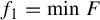
$f_1=\min F$
 . For all
$i\in \{1,2,\ldots ,f_1-1\},$
. For all
$i\in \{1,2,\ldots ,f_1-1\},$
 attach a simple cycle of length
$N+i$
attach a simple cycle of length
$N+i$
 to the ith vertex in the
$f_1$
to the ith vertex in the
$f_1$
 -cycle, completing the graph construction. See Figure 1 for a visualization, where each cycle is labeled by its length.
An SFT construction.

If
$n\geq N$
 , we can write
$n=qf_1+N+i$
, we can write
$n=qf_1+N+i$
 for some
$q\in \mathbb {N}_0, 0\leq i <f_1$
for some
$q\in \mathbb {N}_0, 0\leq i <f_1$
 . By traversing the
$N+i$
. By traversing the
$N+i$
 -cycle once and the
$f_1$
-cycle once and the
$f_1$
 -cycle q times, we obtain a point with least period n; hence,

It remains to show that the least period of any periodic point in
$X_G$
 is in S. Suppose that
$x\in X_G$
is in S. Suppose that
$x\in X_G$
 is periodic and consider two cases. If x only traverses a simple cycle, then this must either be an f-cycle for
$f\in F$
is periodic and consider two cases. If x only traverses a simple cycle, then this must either be an f-cycle for
$f\in F$
 or an
$N+i$
or an
$N+i$
 -cycle for
$0\leq i < f_1$
-cycle for
$0\leq i < f_1$
 . In both cases, the least period of x is in S by construction.
Suppose now that x traverses more than one simple cycle from our construction. Then, necessarily, the least period of x must be at least N. However, any such natural number is in S by assumption, so we have exactly realized the desired LPS. Since G has two coprime cycles, one of length N and one of length
$N+1$
 , the graph period of G is 1, and hence,
$X_G$
, the graph period of G is 1, and hence,
$X_G$
 is mixing.
We have just shown the second half of the theorem statement, namely the case when
$d=1$
 . If
$d>1$
. If
$d>1$
 , it suffices to replace every edge in G with a path of d vertices. Call this new graph
$G'$
, it suffices to replace every edge in G with a path of d vertices. Call this new graph
$G'$
 and note that it is necessarily irreducible. Then, for all
$n\in \mathbb {N}$
and note that it is necessarily irreducible. Then, for all
$n\in \mathbb {N}$
 , there is a bijection between the points of least period n in
$X_G$
, there is a bijection between the points of least period n in
$X_G$
 and the points of least period
$dn$
and the points of least period
$dn$
 in
$X_G'$
in
$X_G'$
 . That is,

which completes the proof.
Note that the above construction can be used to realize a set of the form

as the LPS of a (generally) reducible SFT. This is done by simply treating each singleton in F and each set
$d_iS_i$
 as above, and taking the edge shift on the graph consisting of several disconnected components.
4.2 Sofic shifts
At the end of the previous section, we noted how to construct a certain SFT to realize more complicated LPSs than those in Theorem 4.1. The cost of restricting ourselves to SFTs is then that the resulting shift is not irreducible. However, below we will realize almost all such sets as the LPS of some irreducible sofic shift on a binary alphabet.
We construct a graph G with edge labeling
$\Phi $
 such that the shift on the labeled graph
$\mathcal {G}=(G,\Phi )$
such that the shift on the labeled graph
$\mathcal {G}=(G,\Phi )$
 , which we denote
$X_{\mathcal {G}}$
, which we denote
$X_{\mathcal {G}}$
 , has the desired LPS. Since sofic shifts are FP, the following result provides a converse to Theorem 1.4.
Theorem 4.2. Suppose S is a singleton or a set of the form

where F is finite, each
$S_i$
 is cofinite, and
$n\geq 1$
is cofinite, and
$n\geq 1$
 (that is, there is at least one cofinite
$S_i$
(that is, there is at least one cofinite
$S_i$
 ). Then, there is an irreducible sofic shift with alphabet
$\{0,1\}$
). Then, there is an irreducible sofic shift with alphabet
$\{0,1\}$
 whose LPS is S.
Proof. If
$S=\{ d \}$
 , let
$w=10^{d-1}$
, let
$w=10^{d-1}$
 . Then, the shift consisting of the orbit of
$w^\infty $
. Then, the shift consisting of the orbit of
$w^\infty $
 is sofic (in fact, of finite type), irreducible, and has LPS S.
Otherwise, S can be written as

where
$k_i$
 are such that

Recalling that
$\mathbb {N}:=\{1,2,3,\ldots \}$
 , we begin by writing

where

Our construction now goes in several steps. At each step, we will create several individual graphs dubbed sections to realize some part of the given LPS.
(1) Consider the set
$d_i(\mathbb {N}+k_{i})$
 for
$i\geq 1$
for
$i\geq 1$
 . We will make a section called
$\mathcal {T}_i$
. We will make a section called
$\mathcal {T}_i$
 to realize most of this set as least periods as follows.
Since we assumed
$d_i(k_i+1)>2i$
 , we also have
$d_i(k_i+2)>2i+1$
, we also have
$d_i(k_i+2)>2i+1$
 . We set

so that
$|u_i|=d_i(k_i+1),|v_i|=d_i(k_i+2).$

Let
$t_i\in \mathbb {N}$
 be such that
$t_i>1$
be such that
$t_i>1$
 and
and

The exact choice of
$t_i$
 does not matter, but the latter condition generally requires it to be large.
The section
$\mathcal {T}_i$
 that we build will be a torus-section. We first make a
$t_i$
that we build will be a torus-section. We first make a
$t_i$
 by
$t_i$
by
$t_i$
 grid. From each node
$(n,m)$
grid. From each node
$(n,m)$
 in this grid, add a path to
$(n,m+1\!\! \mod t_{i})$
in this grid, add a path to
$(n,m+1\!\! \mod t_{i})$
 labeled
$u_i$
labeled
$u_i$
 and a path to
$(n+1\!\! \mod t_{i},m)$
and a path to
$(n+1\!\! \mod t_{i},m)$
 labeled
$v_i$
labeled
$v_i$
 . Within the labeled graph
$\mathcal {T}_i$
. Within the labeled graph
$\mathcal {T}_i$
 , we can make a bi-infinite path labeled

for all
$a,b\in \mathbb {N}_0=\mathbb {N}\cup \{0\}$
 . Moreover, any other periodic point in
$X_{\mathcal {T}_i}$
. Moreover, any other periodic point in
$X_{\mathcal {T}_i}$
 will, up to a shift, be of the form
$w^\infty $
will, up to a shift, be of the form
$w^\infty $
 for
for

not purely periodic. The least period of this point is

for some
$a,b\in \mathbb {N}_0$
 .
.
Thus,
$\operatorname {LPS}(X_{\mathcal {T}_i})$
 is
$d_i(\mathbb {N}+k_{i})$
is
$d_i(\mathbb {N}+k_{i})$
 , except for possibly a finite subset. We will treat these missed periods in step (2).
Figure 2 is a visual presentation of a torus-section. Two ends of a snaked arrow on the same column or row are in fact a single path, and each arrow labeled
$u_i$
 or
$v_i$
or
$v_i$
 represents a path of sufficiently many edges labeled by the symbols in these words. Call the (0,0) node the root node, indicated here by
  .
.
A torus-section.

(2) Next, write
$F':= S\setminus \bigcup _{i=1}^n \operatorname {LPS}(X_{\mathcal {T}_i})$
 and note that
$F'$
and note that
$F'$
 is finite. We realize each
$j\in F'$
is finite. We realize each
$j\in F'$
 by making a labeled cycle-section
$\mathcal {C}_j$
by making a labeled cycle-section
$\mathcal {C}_j$
 . First, if
$j\neq 1$
. First, if
$j\neq 1$
 , construct a simple cycle of length
$c_j\cdot j$
, construct a simple cycle of length
$c_j\cdot j$
 , where
$c_j$
, where
$c_j$
 is such that
$c_j\cdot j\in d^*(\mathbb {N}+k^*)$
is such that
$c_j\cdot j\in d^*(\mathbb {N}+k^*)$
 and
$c_j>1$
and
$c_j>1$
 . Label this cycle with the word

repeated
$c_j$
 times.
If
$j=1$
 , make a simple cycle of length
$c_1$
, make a simple cycle of length
$c_1$
 such that
$c_1\in d^*(\mathbb {N}+k^*)$
such that
$c_1\in d^*(\mathbb {N}+k^*)$
 and
${c_1>2n+1}$
and
${c_1>2n+1}$
 . Label this cycle with the word
$w_1=1$
. Label this cycle with the word
$w_1=1$
 repeated
$c_1$
repeated
$c_1$
 times. Thus, for all
${j\in F'}$
times. Thus, for all
${j\in F'}$
 , we have
$\operatorname {LPS}(X_{\mathcal {C}_j})=\{j\}$
, we have
$\operatorname {LPS}(X_{\mathcal {C}_j})=\{j\}$
 .
.
Figure 3 is a visual representation of such a cycle-section, with the same visual indicators as in step 1. Again, call the 0 node the root node, indicated by  .
.
A cycle-section.

(3) Finally, identify the root nodes  of each section together, so that the graph is irreducible. Call this labeled graph
$\mathcal {G}$
of each section together, so that the graph is irreducible. Call this labeled graph
$\mathcal {G}$
 .
.
We now have an irreducible sofic shift
$X_{\mathcal {G}}$
 . By construction,

It remains to show that no other least periods were created in joining the sections together.
Our construction is such that the shifts on all
$\mathcal {T}_i$
 and
$\mathcal {C}_j$
and
$\mathcal {C}_j$
 are disjoint. Having taken
$t_i,c_j>1$
are disjoint. Having taken
$t_i,c_j>1$
 , we also have the following properties for bi-infinite labeled paths
$\tau $
, we also have the following properties for bi-infinite labeled paths
$\tau $
 on
$\mathcal {G}$
on
$\mathcal {G}$
 :
:
-
(i) $\tau $
contains
$1^{c_1}$
if and only if it passes through
$\mathcal {C}_1$
; -
(ii) $\tau $
contains the word
$010^j1$
if and only if it passes through
$\mathcal {C}_j$
,
$j\neq 1$
; and -
(iii) $\tau $
contains
$01^{2i}0$
or
$01^{2i+1}0$
if and only if it passes through
$\mathcal {T}_i$
.


Moreover, a path that goes from one section to another must pass through the root node.
Let
$\tau $
 be a bi-infinite path in G that presents a periodic point
$x\in X_{\mathcal {G}}$
be a bi-infinite path in G that presents a periodic point
$x\in X_{\mathcal {G}}$
 . If
$\tau $
. If
$\tau $
 only passes through a single section, the least period of x is in S by construction.
Otherwise, the above allows us to write, up to a shift,
$x=w^\infty $
 with
with

with w not purely periodic and where each
$\overline {w}_{k}$
 is presented by a path in a single section, starting and ending at the root node.
Writing x in this way, the least period of x is

which will be shown to be in
$d^*(\mathbb {N}+k^*)$
 and, hence, in S. Since
$d^*(\mathbb {N}+k^*)$
and, hence, in S. Since
$d^*(\mathbb {N}+k^*)$
 is closed under addition, it suffices to show that

for all k.
Suppose
$\overline {w}_{k}$
 traverses a torus-section
$\mathcal {T}_{i_k}$
traverses a torus-section
$\mathcal {T}_{i_k}$
 . Then,
$\overline {w}_{k}$
. Then,
$\overline {w}_{k}$
 must consist of a combination of the words
$u_{i_k},v_{i_k}$
must consist of a combination of the words
$u_{i_k},v_{i_k}$
 such that each word appears some integer multiple of
$t_{i_k}$
such that each word appears some integer multiple of
$t_{i_k}$
 times. In other words,

for some
$a,b\in \mathbb {N}_0$
 , not both 0. Recalling again that
$t_{i_k}|v_{i_k}|,t_{i_k}|u_{i_k}|\in d^*(\mathbb {N}+k^*)$
, not both 0. Recalling again that
$t_{i_k}|v_{i_k}|,t_{i_k}|u_{i_k}|\in d^*(\mathbb {N}+k^*)$
 and that this latter set is closed under addition, we get that

If
$\overline {w}_k$
 traverses a cycle-section
$\mathcal {C}_{j_k}$
traverses a cycle-section
$\mathcal {C}_{j_k}$
 , the argument is similar. Indeed, since the path presenting
$\overline {w}_{k}$
, the argument is similar. Indeed, since the path presenting
$\overline {w}_{k}$
 starts and ends at the root node, the length of this path must be an integer multiple of the cycle length of
$\mathcal {C}_{j_k}$
starts and ends at the root node, the length of this path must be an integer multiple of the cycle length of
$\mathcal {C}_{j_k}$
 . That is,

for some
$a'\in \mathbb {N}$
 . Having shown that
$|\overline {w}_{k}|\in d^*(\mathbb {N}+k^*)$
. Having shown that
$|\overline {w}_{k}|\in d^*(\mathbb {N}+k^*)$
 for all j, we conclude that the least period of x is in
$d^*(\mathbb {N}+k^*)\subset S$
for all j, we conclude that the least period of x is in
$d^*(\mathbb {N}+k^*)\subset S$
 , as desired.
We have thus shown that

which completes the proof.
4.3 Gap shifts
The inherent structure of gap shifts allows us to realize their LPS with relative ease. In fact, we obtain the desired LPS via a sofic gap shift. The majority of the proof below follows from Proposition 3.18 and our observations during the proof of Theorem 3.19.
Theorem 4.3. Let Q be a set as outlined in the conclusion of Theorem 3.19. Then, there exists a sofic S-gap shift whose LPS is Q. Moreover, if Q is almost sum-closed, then there exists an S-gap SFT with LPS Q.
Proof. Let Q be a set as indicated and for
$S\subset \mathbb {N}_0$
 , let
$X(S)$
, let
$X(S)$
 be the S-gap shift. We will first prove the second half of the theorem. If Q is a singleton
$\{ n \}$
be the S-gap shift. We will first prove the second half of the theorem. If Q is a singleton
$\{ n \}$
 , we take
$S=\{ n-1 \}$
, we take
$S=\{ n-1 \}$
 . Then,
$X(S)$
. Then,
$X(S)$
 is a finite orbit of length n. Singletons are trivially almost sum-closed and
$X(S)$
is a finite orbit of length n. Singletons are trivially almost sum-closed and
$X(S)$
 is an SFT, so we are done.
Next, suppose Q is an almost sum-closed set
$dR$
 with R cofinite. We will find a finite set of elements whose almost sum-closure is Q. Write first

where every element of F is divisible by d and strictly smaller than
$dN$
 . Now, by assumption, Q is almost sum-closed, so for some
$F'\subset \mathbb {N}$
. Now, by assumption, Q is almost sum-closed, so for some
$F'\subset \mathbb {N}$
 ,
,

Moreover, if we set

then

Thus, in this particular case,

We noted in the proof of Theorem 3.19 that if S is finite,

Thus, if we set
$S=(F\cup B) - 1$
 , then
$X(S)$
, then
$X(S)$
 is an SFT by Proposition 3.17 and

Finally, suppose

with R cofinite and
$dR$
 almost sum-closed. Then,
$dR$
almost sum-closed. Then,
$dR$
 is eventually periodic, so
$dR-1$
is eventually periodic, so
$dR-1$
 is also eventually periodic. Thus, setting
$S=dR-1$
is also eventually periodic. Thus, setting
$S=dR-1$
 , the S-gap shift
$X(S)$
, the S-gap shift
$X(S)$
 is sofic by Proposition 3.17. Now, we recall from the proof of Theorem 3.19 that if S is infinite,

However, by Proposition 3.18, we have

and, hence, for
$S=dR-1$
 ,
,

which completes the proof.
4.4 Arbitrary LPS
We conclude our collection of realizations by showing that any subset of the natural numbers is the LPS of some subshift of the full 2-shift.
Theorem 4.4. Let
$S\subset \mathbb {N}$
 be arbitrary. Then, there exists a shift space
$X \subset \{ 0,1 \}^{\mathbb {Z}}$
be arbitrary. Then, there exists a shift space
$X \subset \{ 0,1 \}^{\mathbb {Z}}$
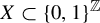 whose LPS is S.
Proof. If S is finite, take
$X=\{\sigma ^n((10^{k-1})^\infty ):k\in S,n\in \mathbb {Z}\}$
 . Then, X is a finite shift space.
Suppose
$S=\{k_{1},k_{2},\ldots \}$
 is infinite and written in strictly increasing order. We consider two cases.
If
$1\in S$
 , for all
$i\in \mathbb {N}$
, for all
$i\in \mathbb {N}$
 , take
$u_{i}=10^{k_{i}-1}$
, take
$u_{i}=10^{k_{i}-1}$
 , which is not purely periodic. Then, the LPS of

certainly contains S. We show that it contains no other periods.
Let X be as above and take
$x\in X$
 periodic with least period k, where
$x=w^\infty $
periodic with least period k, where
$x=w^\infty $
 for w not purely periodic. If there are no 1s in w, then
$x=0^\infty $
for w not purely periodic. If there are no 1s in w, then
$x=0^\infty $
 , which has least period 1. This period is in S by assumption and we are safe.
Otherwise, take
$x^{(n)}$
 to be a sequence of points such that for all
$n\in \mathbb {N}$
to be a sequence of points such that for all
$n\in \mathbb {N}$
 ,
,

for some
$i\in \mathbb {N},j\in \mathbb {Z}$
 and
and

Now, there exists an N such that for all
$n\geq N $
 , we have that

Since there is a 1 somewhere in w, we know that the word
$10^{l}1$
 is in
$w^2$
is in
$w^2$
 for some l. However, if this word is contained in
$x^{(n)}$
for some l. However, if this word is contained in
$x^{(n)}$
 , then
$x^{(n)}$
, then
$x^{(n)}$
 must be some shift of
$(10^l)^\infty $
must be some shift of
$(10^l)^\infty $
 and, therefore,
$l=k_i-1$
and, therefore,
$l=k_i-1$
 for some
$k_i\in S$
for some
$k_i\in S$
 . We conclude that for some
$i\in \mathbb {N},j\in \mathbb {Z}$
. We conclude that for some
$i\in \mathbb {N},j\in \mathbb {Z}$
 ,
,

for all
$n\geq N$
 . Hence,

and the least period of x is in S by construction.
Suppose now that
$1\notin S$
 . Set
$u_1=10^{k_1-1}$
. Set
$u_1=10^{k_1-1}$
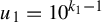 . For
$i>1$
. For
$i>1$
 , take

where
$g_i\in \mathbb {N}_0$
 and
$u_{i}'$
and
$u_{i}'$
 is a strict prefix of
$u_1$
is a strict prefix of
$u_1$
 such that
$|u_1^{g_i}u_{i}'|=k_i-1$
such that
$|u_1^{g_i}u_{i}'|=k_i-1$
 . This way,
$u_i$
. This way,
$u_i$
 is not purely periodic, since the subword 110 only occurs at the very start. At the same time,
$u_i$
is not purely periodic, since the subword 110 only occurs at the very start. At the same time,
$u_i$
 contains the subword 110 for any
$i>1$
contains the subword 110 for any
$i>1$
 , since
$k_1\neq 1.$
, since
$k_1\neq 1.$

Now, the LPS of the shift space

again contains S. We show that no other least periods are created, using a similar, but slightly more subtle, argument as in the previous case.
Let again X be as above and take
$x\in X$
 periodic with least period k, where
$x=w^\infty $
periodic with least period k, where
$x=w^\infty $
 for w not purely periodic.
Moreover, take once again
$x^{(n)}$
 to be a sequence of points such that for all
$n\in \mathbb {N}$
to be a sequence of points such that for all
$n\in \mathbb {N}$
 ,
,

for some
$i\in \mathbb {N},j\in \mathbb {Z}$
 and
and

Slightly altering our previous argument, there exists an N such that for all
$n\geq N $
 , we have that

Suppose that the word 110 appears in x. Then,
$w^3$
 contains a word of the form
$110\tilde {u}110$
contains a word of the form
$110\tilde {u}110$
 for some subword
$\tilde {u}$
for some subword
$\tilde {u}$
 . For all n large enough,
$x^{(n)}$
. For all n large enough,
$x^{(n)}$
 then also contains
$110\tilde {u}110$
then also contains
$110\tilde {u}110$
 . This is only possible if

for some
$i\in \mathbb {N},j\in \mathbb {Z}$
 for all large n, and hence,
$x=\sigma ^j(u_i^\infty )$
for all large n, and hence,
$x=\sigma ^j(u_i^\infty )$
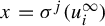 with least period
$k_i\in S$
with least period
$k_i\in S$
 .
.
If the word 110 does not appear in x, take a subsequence
$n_m$
 such that

for all
$m\in \mathbb {N}$
 . Since the word 110 does not appear in
$w^{2m}$
. Since the word 110 does not appear in
$w^{2m}$
 for any m, we know that if 110 appears in
$x^{(n_m)},$
for any m, we know that if 110 appears in
$x^{(n_m)},$
 it must be outside of the window
$[-mk,mk-1]$
it must be outside of the window
$[-mk,mk-1]$
 . In other words, for all m,

for some
$j\in \mathbb {Z}$
 . We then conclude that
$x=\sigma ^j(u_1^\infty )$
. We then conclude that
$x=\sigma ^j(u_1^\infty )$
 , which has least period
$k_1\in S$
, which has least period
$k_1\in S$
 .
.
Acknowledgements
This paper is motivated by earlier work of Madeline Doering and Ronnie Pavlov, and insightful discussions with the latter strengthened several of the results presented here. The author thanks Brian Marcus for his guidance and extensive feedback. The proofs of Theorems 4.2 and 4.3 owe a great deal to Chengyu Wu, who also provided many detailed comments on the work as a whole. Finally, the author expresses his gratitude to the anonymous referee, who provided several detailed comments that helped polish this paper into its final form.
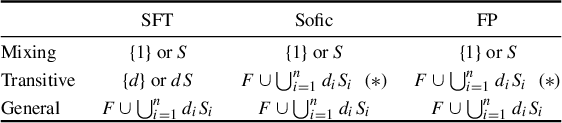
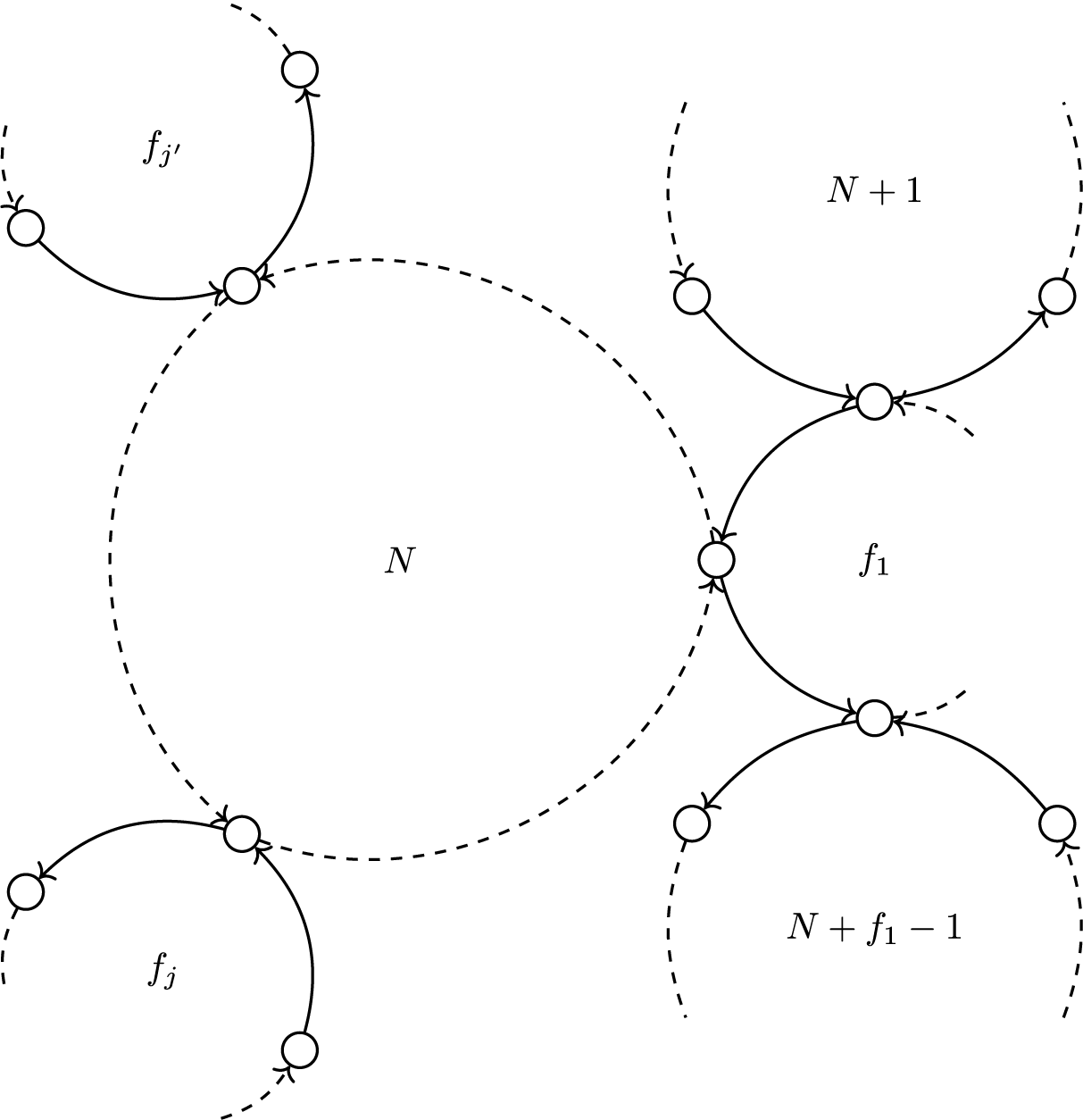
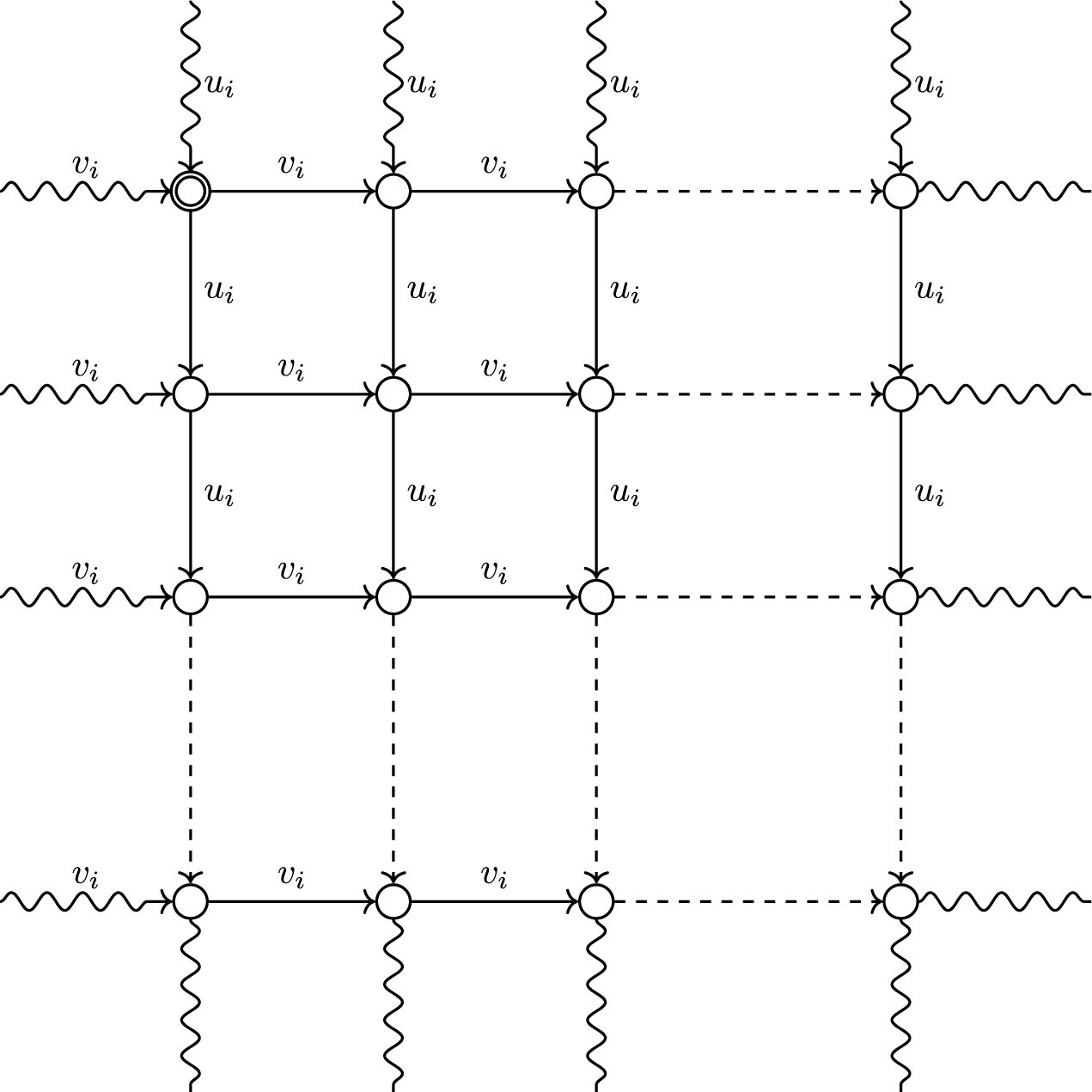


 Open access

